EP0665281A2 - Procédé intégré de récupération de distillats - Google Patents
Procédé intégré de récupération de distillats Download PDFInfo
- Publication number
- EP0665281A2 EP0665281A2 EP95100719A EP95100719A EP0665281A2 EP 0665281 A2 EP0665281 A2 EP 0665281A2 EP 95100719 A EP95100719 A EP 95100719A EP 95100719 A EP95100719 A EP 95100719A EP 0665281 A2 EP0665281 A2 EP 0665281A2
- Authority
- EP
- European Patent Office
- Prior art keywords
- stream
- liquid
- stripping zone
- debutanizer
- vapor
- Prior art date
- Legal status (The legal status is an assumption and is not a legal conclusion. Google has not performed a legal analysis and makes no representation as to the accuracy of the status listed.)
- Withdrawn
Links
Images

Classifications
-
- C—CHEMISTRY; METALLURGY
- C10—PETROLEUM, GAS OR COKE INDUSTRIES; TECHNICAL GASES CONTAINING CARBON MONOXIDE; FUELS; LUBRICANTS; PEAT
- C10G—CRACKING HYDROCARBON OILS; PRODUCTION OF LIQUID HYDROCARBON MIXTURES, e.g. BY DESTRUCTIVE HYDROGENATION, OLIGOMERISATION, POLYMERISATION; RECOVERY OF HYDROCARBON OILS FROM OIL-SHALE, OIL-SAND, OR GASES; REFINING MIXTURES MAINLY CONSISTING OF HYDROCARBONS; REFORMING OF NAPHTHA; MINERAL WAXES
- C10G47/00—Cracking of hydrocarbon oils, in the presence of hydrogen or hydrogen- generating compounds, to obtain lower boiling fractions
-
- C—CHEMISTRY; METALLURGY
- C10—PETROLEUM, GAS OR COKE INDUSTRIES; TECHNICAL GASES CONTAINING CARBON MONOXIDE; FUELS; LUBRICANTS; PEAT
- C10G—CRACKING HYDROCARBON OILS; PRODUCTION OF LIQUID HYDROCARBON MIXTURES, e.g. BY DESTRUCTIVE HYDROGENATION, OLIGOMERISATION, POLYMERISATION; RECOVERY OF HYDROCARBON OILS FROM OIL-SHALE, OIL-SAND, OR GASES; REFINING MIXTURES MAINLY CONSISTING OF HYDROCARBONS; REFORMING OF NAPHTHA; MINERAL WAXES
- C10G49/00—Treatment of hydrocarbon oils, in the presence of hydrogen or hydrogen-generating compounds, not provided for in a single one of groups C10G45/02, C10G45/32, C10G45/44, C10G45/58 or C10G47/00
- C10G49/22—Separation of effluents
-
- F—MECHANICAL ENGINEERING; LIGHTING; HEATING; WEAPONS; BLASTING
- F02—COMBUSTION ENGINES; HOT-GAS OR COMBUSTION-PRODUCT ENGINE PLANTS
- F02B—INTERNAL-COMBUSTION PISTON ENGINES; COMBUSTION ENGINES IN GENERAL
- F02B3/00—Engines characterised by air compression and subsequent fuel addition
- F02B3/06—Engines characterised by air compression and subsequent fuel addition with compression ignition
Definitions
- hydroprocessing Mild hydroprocessing is typically conducted at a temperature of from 350°C to 425°C and at a pressure of from 3.5 to 10 MPa using a fixed-bed catalyst without regeneration. Severe hydroprocessing is typically carried out at higher pressures --from 7 to 21 MPa -- and the fixed bed catalyst has a regeneration cycle.
- the conditions in hydrocracking are similar to those of hydroprocessing except that the severity of the reaction conditions is increased and the catalyst contact times are longer.
- the effluent stream from a conversion reactor will comprise a wide range of molecular weight hydrocarbons which can be processed downstream for recovery of hydrocarbon products useful for various purposes.
- the product recovery train typically combines a means for separating out light end components (e. g. butanes and lighter) and a fractionator tower for recovering the distillate products (e. g. pentanes and heavier).
- reaction heat is generally recovered for preheating the reactor feed stream wherein the effluent stream is cooled and a heavy phase is condensed.
- the mixed-phase stream thus formed is directed to a separation drum to effect phase separation.
- the vessel must be sized to accept the entire reaction effluent stream. Due to the presence of hydrogen sulfide in the effluent stream, the vessel must be constructed from a corrosion-resistant material. Downstream production quantities of light naphtha (for gasoline) are less than that of a fractionation-first process since a portion of the light naphtha product is lost in the stripper overhead stream. Further, the stripper overhead stream cannot be condensed to produce liquid petroleum gas. Thus, a stripper-first recovery process cannot duplicate the product recovery distribution of the fractionator-first scheme.
- the present invention provides a process for recovering products from a hydro-conversion reactor effluent stream.
- step (a) the effluent stream is separated at a relatively high pressure and temperature into a hot vapor stream and a hot liquid stream.
- step (b) the hot liquid stream from the separation step (a) is fed to a stripping zone operated at a moderate pressure relatively lower than the separation step (a) to form a hot overhead vapor stream, and a hot bottoms stream essentially free of butane and lighter components.
- step (c) the vapor stream from the separation step (a) is cooled and separated into relatively cool vapor and liquid streams.
- the overhead vapor stream from the stripping zone, and the liquid stream from the separating step (c), are debutanized in step (d) in a column operated at a relatively moderate pressure to obtain one or more light component product streams essentially free of pentane and heavier components and a debutanized liquid stream.
- the hot bottoms stream from the stripping zone of step (b) and the debutanized liquid stream from debutanizing step (d) are fractionated in step (e) in a column operated at relatively low pressure into a plurality of petroleum distillate products and a residual bottoms stream.
- the volatile vapor stream from step (2) preferably contains hydrogen and methane
- the light-component product streams from the debutanizing step (d) include a vapor stream containing methane and a liquefied petroleum gas stream.
- the petroleum distillate products preferably comprise light naphtha, heavy naphtha, jet fuel, diesel fuel or a combination thereof.
- a debutanizer column is provided for debutanizing at least a portion of the overhead vapor stream from the stripping zone and the liquid stream from the cold, high pressure separator, at a moderate pressure to obtain one or more light component product streams essentially free of pentane and heavier components, and a debutanized liquid stream.
- a fractionation column is provided for distilling the debutanized liquid stream and the bottoms stream from the stripping zone, at a relatively low pressure into a plurality of petroleum distillate products and a residual bottoms stream.
- the unit can include a cold, low pressure separator for separating a mixture of the liquid stream from the cold, high pressure separator and the overhead stream from the stripping zone at a moderate pressure into a volatile vapor stream, and a liquid stream for feed to the debutanizer column.
- High pressures in the unit exceed about 3 MPa, moderate pressures are greater than 1 MPa and less than 3 MPa, and the unit low pressure is preferably less than about 0.5 MPa.
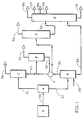
- Fig. 1 shows a simplified block flow diagram of a front end conversion reactor feeding to an integrated distillate recovery process according to the present invention.
- Fig. 2 shows a more detailed schematic flow diagram of one embodiment of the integrated distillate recovery process of Fig. 1.
- a hydrocarbon feedstock is converted in hydro-conversion reactor R , and the effluent stream S1 therefrom is separated in hot, high pressure separator A into respective vapor and liquid streams V1 , L1 .
- the hot liquid stream L1 is fed to stripper B which is operated at a moderate pressure lower than the separator A . Steam can be supplied via line S2 to a lower end of the stripper B .
- a hot overhead vapor stream V2 and a hot bottoms stream L2 are obtained from the stripper B .
- the stream V1 is cooled and fed to separator C to obtain cool vapor stream V3 and cool liquid stream L3 .
- the present process is applicable where either or both naphtha and diesel are the primary desired product, but the benefits obtained are more pronounced when diesel products are desired (as opposed to naphtha products) since the portion of liquid feed in the stream L2 is greater.
- the percentage of the total mass flow rate in the stream L2 directly to the fractionator E , and L5 to the debutanizer D (and then via bottoms stream L4 to the fractionator E ), is generally from about 10 to about 70 percent in stream L5 and from about 90 to about 30 percent in stream L2 (i.e. a weight ratio of stream L5:L2 of about 10:90 to about 70:30), preferably from about 10 to about 40 percent in stream L5 and from about 90 to about 60 percent in stream L2 (i.e. a weight ratio of stream L5:L2 of about 10:90 to about 40:60).
- a petroleum refining process 10 of the present invention includes a front end reaction hydro-conversion zone 10A , heat recovery zone 10B , and an integrated distillate product recovery zone 10C .
- Operation of the reaction hydro-conversion zone 10A is well known in the art.
- a hydro-conversion reactor 12 converts a higher molecular weight liquid hydrocarbon feed such as crude petroleum (suitably desalted and dewatered as necessary as is known in the art) in the presence of heat, elevated pressure, a suitable catalyst and hydrogen, into a range of lower molecular weight hydrocarbon products which are eventually separated into distillate hydrocarbon fractions in the downstream product recovery zone 10C .
- the reaction effluent Prior to product recovery, however, the reaction effluent is passed through heat recovery zone 10B wherein heat of reaction can be used to perform a variety of process heating steps, including preheating the reaction feed stream and generating steam.
- the reactor 12 will operate at a temperature of from 350°C to 400°C and at a pressure of 1.5 MPa to 2.2 MPa (mild hydroprocessing), or at a temperature of from 350°C to 500°C and a pressure of from 7 to 21 MPa (severe hydroprocessing and hydrocracking).
- a fixed bed catalyst will typically be used for hydroprocessing and hydrocracking reactions (with or without catalyst regeneration).
- a makeup hydrogen feed stream is introduced through line 14 into recycle hydrogen-containing gas line 32 and passed in heat exchange through a series of heat exchangers 16a, 16b to preheat the hydrogen-containing stream and recover heat from a reaction effluent stream 18 .
- a preheated hydrogen-containing stream 20 is then further heated to reactor temperature in a fired furnace 22.
- a feed stream 23 including feedstock and recycle oil from line 182 is passed in heat exchange through a series of heat exchangers 24a, 24b, 24c, 24d to preheat the feed stream and recover additional heat from the reaction effluent stream 18 .
- the preheated feed stream 26 is combined with the heated gas stream 28 from the furnace 22 and fed through line 30 to the reactor 12 .
- Reaction effluent stream 18 is suitably cooled in the heat recovery zone 10B and directed through line 38 to the distillate product recovery train 10C .
- the stream 38 containing a wide spectrum of lower molecular weight materials is separated into a desired range of distillate fractions useful for a broad range of purposes.
- Liquid hydrocarbon products recovered from the reactor effluent stream include liquid petroleum gas (LPG), light naphtha fraction (LNAP), heavy naphtha fraction (HNAP), jet fuel and diesel fuel.
- LPG liquid petroleum gas
- LNAP light naphtha fraction
- HNAP heavy naphtha fraction
- jet fuel jet fuel
- diesel fuel diesel fuel
- an offgas is usually produced and a bottoms stream heavier than diesel oil is often recycled to the reactor 12 as the recycle oil stream 182 .
- the liquid stream 44 from the first high pressure separator 40 and the liquid stream 56 from the second high pressure separator 50 are not combined in toto , as was characteristic of the prior art. Instead, the warm liquid stream 44 is first separately stripped of light end components in a steam stripping column 58 , for example, and only the recovered light ends are subsequently combined with the cool liquid phase stream 56 . At least a portion of the resulting combined stream 78 is then fed to a debutanizer column 62 .
- the desired operating pressures of the stripping column 58 and the debutanizer column 62 can be specified and achieved, without the need for a downstream recompression stage, as was commonly heretofore employed in the prior art; and by splitting the feed to the light end recovery equipment between steam stripper 58 and debutanizer 62 , smaller size vessels can be used.
- use of a stripper/debutanizer combination in the present process for light end recovery enhances LPG production efficiency over prior art arrangements.
- the liquid phase stream 56 removed from the second high pressure separator 50 is depressurized through pressure let-down valve 73 for introduction to the debutanizer 62 via lines 76 and 78 .
- the light-end-rich stream 72 from the stripper 58 is also introduced thereto to form a combined stream in the line 78 .
- the combined stream in line 78 is cooled to a temperature on the order of 40-60°C, preferably by an air cooler 80 , to condense a heavy phase.
- a mixed phase stream is directed through line 82 to a low pressure separator vessel 84 operating at about the pressure of the debutanizer 62 , e.g. on the order of about 1.4-2.4 MPa (200-350 psig). From the low pressure separator 84 , a liquid phase stream is separated and fed to the debutanizer 62 through line 86 .
- a vapor phase stream comprising primarily hydrogen, methane and hydrogen sulfide is removed through line 88 .
- the light-end-rich stream 72 prior to combination with the depressurized liquid phase stream 76 from the second high pressure separator 56 , can be cooled in a heat exchanger 92 to a temperature on the order of 100-200°C to produce a light end-rich stream 90 .
- the light-end-rich stream 72 is preferably cooled by an exchange of heat against the liquid phase stream 86 from the low pressure separator 84 in the heat exchanger 92 . In such a manner, the light-end-rich stream 72 can be cooled and the liquid phase stream 86 can be preheated to a temperature on the order of 120-180°C for feed through line 94 to a feed zone of the debutanizer 62 .
- the debutanizer 62 Due to its smaller size, and the prior separation of a significant portion of the heaviest hydrocarbon components from the debutanizer feed stream 94 , the debutanizer 62 can be operated at a much lower bottoms equilibrium temperature (generally well below 300°C, preferably from about 200 to about 250°C) and much smaller flows for a greatly reduced heat duty, in contrast to the prior art. Therefore, the present debutanizer 62 can be reboiled using process heat produced by the conversion reactor 12 . Thus, the present process and unit eliminates the need for a large fired reboiler commonly required in prior art debutanizers.
- the preheated debutanizer feed stream 94 is introduced to the debutanizer 62 at a feed zone thereof.
- substantially all of the C4 and lighter hydrocarbon components, including non-hydrocarbon impurities such as hydrogen sulfide, water, ammonia and remaining hydrogen, are recovered overhead via line 96 .
- a debutanizer bottoms stream 98 is removed from the debutanizer 62 for feed to the fractionator column 75 .
- the debutanizer overhead stream via line 96 is partially condensed using an air cooler 102 and a water-cooled heat exchanger 104 to provide a condensate reflux stream 106 for the debutanizer 62 .
- the partially condensed stream 106 is directed to a separator drum 108 at a pressure usually about 0.03 MPa (5 psi) less than the debutanizer 62 pressure to effect vapor-liquid separation.
- An offgas vapor stream 110 comprising primarily hydrogen sulfide, hydrogen and C1-C2 light hydrocarbons is removed from the separator drum 108 .
- the liquid phase stream 114 comprising primarily C3-C4 light hydrocarbons is pumped by pump 112 as reflux for the debutanizer 62 .
- a sidestream 116 of the reflux stream 114 is withdrawn as an LPG product.
- the debutanizer bottoms stream 98 is throttled by let-down valve 99 to about atmospheric pressure for introduction to the fractionator tower 75 .
- the fractionator feed stream is introduced at a relatively high feed tray conforming in temperature to that of the feed --approximately 200-250°C.
- the stripper bottoms stream 74 is preferably depressurized by let-down valve 129 and introduced to the fractionator tower 75 . Consequently, the stripper bottoms stream 74 is preferably vaporized at a temperature on the order of 300-400°C in a furnace 130 and fed to the fractionator tower 75 through line 131.
- distillate fractions are produced, either as a fuel product having the desired specifications or as feed to a product finishing column.
- the distillate fractions conform to suitable bubble point ranges for the product (or finishing column) in question and are removed from the tower 75 as a sidedraw from the reflux liquid and several of the intermediate trays.
- Bottoms liquid comprises a recycle oil which can be returned to the conversion reactor 12 through line 182 as mentioned previously.
- Such a tower 75 will generally contain about 30-50 vapor-liquid equilibrium trays or stages and operate at an overhead temperature and pressure on the order of 100-140°C and 0.07-0.21 MPa (10-30 psig) and a bottoms temperature and pressure of approximately 300-400°C and 0.14-0.27 MPa (20-40 psig).
- the tower overhead vapor line 140 is preferably cooled in an air cooler 142 to condense the vapor as a reflux condensate.
- Reflux condensate in line 144 is directed to an accumulator drum 146 for feeding a reflux pump 148 .
- the reflux pump 148 returns the reflux condensate to the tower 75 through line 150 except for an overhead distillate which can be removed through line 152 as a light naphtha product stream.
- a distillate sidedraw 154 can be removed from tower 75 to feed a heavy naphtha stripping column 156 .
- a heavy naphtha product can be taken off as a bottoms product from the stripping column 156 through line 158 .
- another distillate side draw 160 can be removed from tower 75 to feed a jet fuel stripping column 162 . Jet fuel is produced as a bottoms product from the stripping column 162 through line 164 . Further down the tower 75 in the vicinity of the twenty-fourth tray (from the top), a further distillate sidedraw can be removed through line 166 to feed a diesel oil stripping column 168. Diesel oil is produced as a bottoms product from the stripping column 168 through line 170. Further down the tower 75 adjacent the lower end, a kerosene and/or heating oil product sidedraw 172 can be removed via pump 173 .
- Low pressure steam is preferably introduced to the bottom of the tower 75 through line 174 .
- Recycle oil pumped by pump 175 from the tower bottoms through line 176 is preferably used as a heating medium in a boiler 178 to produce steam for the steam stripper 58 .
- the boiler 178 is connected to a boiler feed water supply line 180 .
- the recycle oil leaving the boiler 178 is pumped through line 182 back to the reaction conversion train 10A via the heat recovery train 10B as described above, except for a purge stream 184 .
Landscapes
- Chemical & Material Sciences (AREA)
- Oil, Petroleum & Natural Gas (AREA)
- Engineering & Computer Science (AREA)
- Chemical Kinetics & Catalysis (AREA)
- General Chemical & Material Sciences (AREA)
- Organic Chemistry (AREA)
- Production Of Liquid Hydrocarbon Mixture For Refining Petroleum (AREA)
- Organic Low-Molecular-Weight Compounds And Preparation Thereof (AREA)
Applications Claiming Priority (2)
| Application Number | Priority Date | Filing Date | Title |
|---|---|---|---|
| US187932 | 1994-01-27 | ||
| US08/187,932 US5453177A (en) | 1994-01-27 | 1994-01-27 | Integrated distillate recovery process |
Publications (2)
| Publication Number | Publication Date |
|---|---|
| EP0665281A2 true EP0665281A2 (fr) | 1995-08-02 |
| EP0665281A3 EP0665281A3 (fr) | 1995-12-20 |
Family
ID=22691078
Family Applications (1)
| Application Number | Title | Priority Date | Filing Date |
|---|---|---|---|
| EP95100719A Withdrawn EP0665281A3 (fr) | 1994-01-27 | 1995-01-19 | Procédé intégré de récupération de distillats. |
Country Status (14)
| Country | Link |
|---|---|
| US (1) | US5453177A (fr) |
| EP (1) | EP0665281A3 (fr) |
| JP (1) | JPH07252483A (fr) |
| KR (1) | KR100311429B1 (fr) |
| CN (1) | CN1109093A (fr) |
| AU (1) | AU677880B2 (fr) |
| BR (1) | BR9500212A (fr) |
| CA (1) | CA2138691A1 (fr) |
| HU (1) | HUT71632A (fr) |
| MY (1) | MY114664A (fr) |
| PL (1) | PL306975A1 (fr) |
| RU (1) | RU2143459C1 (fr) |
| TW (1) | TW293842B (fr) |
| ZA (1) | ZA95398B (fr) |
Cited By (3)
| Publication number | Priority date | Publication date | Assignee | Title |
|---|---|---|---|---|
| WO2000042123A1 (fr) * | 1999-01-11 | 2000-07-20 | Texaco Development Corporation | Integration de desasphaltage, de gazeification et d'hydrotraitement par solvant |
| WO2011006977A3 (fr) * | 2009-07-15 | 2011-05-19 | Shell Internationale Research Maatschappij B.V. | Procédé de conversion d'un produit hydrocarboné |
| US9803148B2 (en) | 2011-07-29 | 2017-10-31 | Saudi Arabian Oil Company | Hydrocracking process with interstage steam stripping |
Families Citing this family (44)
| Publication number | Priority date | Publication date | Assignee | Title |
|---|---|---|---|---|
| US5647972A (en) * | 1995-01-05 | 1997-07-15 | Abb Lummus Global Inc. | Low pressure chilling train for olefin plants |
| CN1043783C (zh) * | 1996-03-21 | 1999-06-23 | 中国石油化工总公司石油化工科学研究院 | 一种石油烃类催化转化产物的分离方法 |
| CN1052503C (zh) * | 1997-02-27 | 2000-05-17 | 天津大学 | 焦化汽、柴油混合加氢分馏方法及其设备 |
| KR100326588B1 (ko) * | 1998-12-28 | 2002-10-12 | 에스케이 주식회사 | 근적외선분광분석기술을활용한자동원유분석방법 |
| US7015035B2 (en) * | 2002-11-05 | 2006-03-21 | The Trustees Of Columbia University In The City Of New York | RD114-based retroviral packaging cell line and related compositions and methods |
| US8137531B2 (en) | 2003-11-05 | 2012-03-20 | Chevron U.S.A. Inc. | Integrated process for the production of lubricating base oils and liquid fuels from Fischer-Tropsch materials using split feed hydroprocessing |
| RU2451713C2 (ru) * | 2009-12-21 | 2012-05-27 | Владимир Александрович Морозов | Способ удаления вторичного сероводорода, образующегося в тяжелых нефтепродуктах при их производстве |
| CN102399578B (zh) * | 2010-09-08 | 2014-02-26 | 宁夏宝塔石化集团有限公司 | 液化气芳构化制汽油前置冷凝分离法及装置 |
| US8158070B1 (en) | 2011-03-31 | 2012-04-17 | Uop Llc | Apparatus for hydroprocessing two streams |
| US8518351B2 (en) | 2011-03-31 | 2013-08-27 | Uop Llc | Apparatus for producing diesel |
| US8158069B1 (en) | 2011-03-31 | 2012-04-17 | Uop Llc | Apparatus for mild hydrocracking |
| US8753501B2 (en) | 2011-10-21 | 2014-06-17 | Uop Llc | Process and apparatus for producing diesel |
| US8696885B2 (en) | 2011-03-31 | 2014-04-15 | Uop Llc | Process for producing diesel |
| US8747653B2 (en) | 2011-03-31 | 2014-06-10 | Uop Llc | Process for hydroprocessing two streams |
| US8608940B2 (en) | 2011-03-31 | 2013-12-17 | Uop Llc | Process for mild hydrocracking |
| US9321972B2 (en) | 2011-05-02 | 2016-04-26 | Saudi Arabian Oil Company | Energy-efficient and environmentally advanced configurations for naptha hydrotreating process |
| US8475745B2 (en) | 2011-05-17 | 2013-07-02 | Uop Llc | Apparatus for hydroprocessing hydrocarbons |
| US8936716B2 (en) | 2011-08-19 | 2015-01-20 | Uop Llc | Process for recovering hydroprocessed hydrocarbons with two strippers in series |
| US8940254B2 (en) | 2011-08-19 | 2015-01-27 | Uop Llc | Apparatus for recovering hydroprocessed hydrocarbons with two strippers |
| CN103608431B (zh) * | 2011-08-19 | 2016-01-06 | 环球油品公司 | 用两个串联的汽提器回收加氢加工的烃的方法和设备 |
| US8721994B2 (en) | 2011-08-19 | 2014-05-13 | Uop Llc | Apparatus for recovering hydroprocessed hydrocarbons with two strippers and common overhead recovery |
| US9670424B2 (en) * | 2011-08-19 | 2017-06-06 | Uop Llc | Process for recovering hydroprocessed hydrocarbons with two strippers in one vessel |
| US9518230B2 (en) | 2011-08-19 | 2016-12-13 | Uop Llc | Process for recovering hydroprocessed hydrocarbons with two strippers |
| US8715595B2 (en) | 2011-08-19 | 2014-05-06 | Uop Llc | Apparatus for recovering hydroprocessed hydrocarbons with two strippers in series |
| CN103608432B (zh) * | 2011-08-19 | 2016-01-06 | 环球油品公司 | 用两个汽提器回收加氢加工的烃的方法和设备 |
| US8999150B2 (en) * | 2011-08-19 | 2015-04-07 | Uop Llc | Process for recovering hydroprocessed hydrocarbons with two strippers and common overhead recovery |
| US8715596B2 (en) | 2011-08-19 | 2014-05-06 | Uop Llc | Apparatus for recovering hydroprocessed hydrocarbons with two strippers in one vessel |
| US9162938B2 (en) | 2012-12-11 | 2015-10-20 | Chevron Lummus Global, Llc | Conversion of triacylglycerides-containing oils to hydrocarbons |
| US8911693B2 (en) | 2013-03-15 | 2014-12-16 | Uop Llc | Process and apparatus for recovering hydroprocessed hydrocarbons with single product fractionation column |
| US9127209B2 (en) | 2013-03-15 | 2015-09-08 | Uop Llc | Process and apparatus for recovering hydroprocessed hydrocarbons with stripper columns |
| US9079118B2 (en) * | 2013-03-15 | 2015-07-14 | Uop Llc | Process and apparatus for recovering hydroprocessed hydrocarbons with stripper columns |
| US9150797B2 (en) * | 2013-03-15 | 2015-10-06 | Uop Llc | Process and apparatus for recovering hydroprocessed hydrocarbons with single product fractionation column |
| US10041008B2 (en) * | 2014-02-26 | 2018-08-07 | Uop Llc | Process and apparatus for hydroprocessing with two product fractionators |
| US9562201B2 (en) | 2014-06-28 | 2017-02-07 | Saudi Arabian Oil Company | Energy efficient apparatus employing energy efficient process schemes providing enhanced integration of gasification-based multi-generation and hydrocarbon refining facilities and related methods |
| CN108472574B (zh) | 2015-12-29 | 2022-04-29 | 环球油品公司 | 用于通过海绵吸收回收轻质烃的方法和装置 |
| CN108698822B (zh) * | 2016-03-31 | 2023-07-21 | 环球油品公司 | 从气体料流中回收氢气和液化石油气的方法 |
| US10793493B2 (en) * | 2017-08-31 | 2020-10-06 | Uop Llc | Process for recovering benzene and fuel gas in an aromatics complex |
| US10239754B1 (en) * | 2017-11-03 | 2019-03-26 | Uop Llc | Process for stripping hydroprocessed effluent for improved hydrogen recovery |
| US10781381B2 (en) * | 2018-06-26 | 2020-09-22 | Uop Llc | Process for hydrocracking with simplified recovery |
| US11142704B2 (en) | 2019-12-03 | 2021-10-12 | Saudi Arabian Oil Company | Methods and systems of steam stripping a hydrocracking feedstock |
| GB2609807B (en) * | 2020-04-16 | 2025-03-12 | Kellogg Brown & Root Inc | Integrated stabilizer in deisobutanizer for isomerization of hydrocarbons and product separation |
| US11338219B2 (en) | 2020-08-13 | 2022-05-24 | Saudi Arabian Oil Company | Dividing wall debutanizer column, system and method of operation |
| CN117126681A (zh) * | 2023-06-09 | 2023-11-28 | 中国石油化工股份有限公司 | 一种渣油加氢分馏系统及方法 |
| CN118360080A (zh) * | 2024-04-19 | 2024-07-19 | 宁波博盈新材料有限公司 | 一种由重质燃料油生产电池级负极材料原料的方法 |
Family Cites Families (15)
| Publication number | Priority date | Publication date | Assignee | Title |
|---|---|---|---|---|
| US2853439A (en) * | 1952-08-01 | 1958-09-23 | Exxon Research Engineering Co | Combination distillation and hydrocarbon conversion process |
| US3408284A (en) * | 1966-09-15 | 1968-10-29 | Universal Oil Prod Co | Separation of ic4 from alkylation effluent |
| US3405530A (en) * | 1966-09-23 | 1968-10-15 | Exxon Research Engineering Co | Regasification and separation of liquefied natural gas |
| US3371029A (en) * | 1966-11-30 | 1968-02-27 | Universal Oil Prod Co | Mixed-phase conversion product separation process |
| US3598720A (en) * | 1968-12-12 | 1971-08-10 | Universal Oil Prod Co | Desulfurization and conversion of hydrocarbonaceous black oils with maximum production of distillable hydrocarbons |
| US3607726A (en) * | 1969-01-29 | 1971-09-21 | Universal Oil Prod Co | Recovery of hydrogen |
| US3660270A (en) * | 1970-01-15 | 1972-05-02 | Chevron Res | Two-stage process for producing naphtha from petroleum distillates |
| US3671419A (en) * | 1970-02-27 | 1972-06-20 | Mobil Oil Corp | Upgrading of crude oil by combination processing |
| SU732361A1 (ru) * | 1977-12-13 | 1980-05-05 | Всесоюзный научно-исследовательский институт углеводородного сырья | Способ разделени газопродуктовой смеси процесса гидрокрекинга углеводородов |
| US4521295A (en) * | 1982-12-27 | 1985-06-04 | Hri, Inc. | Sustained high hydroconversion of petroleum residua feedstocks |
| US4457834A (en) * | 1983-10-24 | 1984-07-03 | Lummus Crest, Inc. | Recovery of hydrogen |
| US4551238A (en) * | 1984-11-06 | 1985-11-05 | Mobil Oil Corporation | Method and apparatus for pressure-cascade separation and stabilization of mixed phase hydrocarbonaceous products |
| US4990242A (en) * | 1989-06-14 | 1991-02-05 | Exxon Research And Engineering Company | Enhanced sulfur removal from fuels |
| US4973396A (en) * | 1989-07-10 | 1990-11-27 | Exxon Research And Engineering Company | Method of producing sweet feed in low pressure hydrotreaters |
| US5114562A (en) * | 1990-08-03 | 1992-05-19 | Uop | Two-stage hydrodesulfurization and hydrogenation process for distillate hydrocarbons |
-
1994
- 1994-01-27 US US08/187,932 patent/US5453177A/en not_active Expired - Lifetime
- 1994-12-20 TW TW083111932A patent/TW293842B/zh active
- 1994-12-21 CA CA002138691A patent/CA2138691A1/fr not_active Abandoned
-
1995
- 1995-01-13 HU HU9500119A patent/HUT71632A/hu unknown
- 1995-01-16 BR BR9500212A patent/BR9500212A/pt not_active Application Discontinuation
- 1995-01-17 AU AU10259/95A patent/AU677880B2/en not_active Ceased
- 1995-01-18 ZA ZA95398A patent/ZA95398B/xx unknown
- 1995-01-19 EP EP95100719A patent/EP0665281A3/fr not_active Withdrawn
- 1995-01-26 MY MYPI95000188A patent/MY114664A/en unknown
- 1995-01-26 RU RU95101035A patent/RU2143459C1/ru active
- 1995-01-26 JP JP7010977A patent/JPH07252483A/ja active Pending
- 1995-01-26 KR KR1019950001419A patent/KR100311429B1/ko not_active Expired - Lifetime
- 1995-01-27 PL PL95306975A patent/PL306975A1/xx unknown
- 1995-01-27 CN CN95101614A patent/CN1109093A/zh active Pending
Cited By (6)
| Publication number | Priority date | Publication date | Assignee | Title |
|---|---|---|---|---|
| WO2000042123A1 (fr) * | 1999-01-11 | 2000-07-20 | Texaco Development Corporation | Integration de desasphaltage, de gazeification et d'hydrotraitement par solvant |
| US6409912B1 (en) | 1999-01-11 | 2002-06-25 | Texaco, Inc. | Integration of solvent deasphalting, gasification, and hydrotreating |
| WO2011006977A3 (fr) * | 2009-07-15 | 2011-05-19 | Shell Internationale Research Maatschappij B.V. | Procédé de conversion d'un produit hydrocarboné |
| CN102471701A (zh) * | 2009-07-15 | 2012-05-23 | 国际壳牌研究有限公司 | 用于转化烃类原料的方法 |
| US20120125819A1 (en) * | 2009-07-15 | 2012-05-24 | Edmundo Steven Van Doesburg | Process for the conversion of hydrocarbonaceous feedstock |
| US9803148B2 (en) | 2011-07-29 | 2017-10-31 | Saudi Arabian Oil Company | Hydrocracking process with interstage steam stripping |
Also Published As
| Publication number | Publication date |
|---|---|
| ZA95398B (en) | 1995-09-26 |
| AU1025995A (en) | 1995-08-03 |
| KR950032586A (ko) | 1995-12-22 |
| PL306975A1 (en) | 1995-08-07 |
| TW293842B (fr) | 1996-12-21 |
| BR9500212A (pt) | 1995-10-31 |
| EP0665281A3 (fr) | 1995-12-20 |
| HU9500119D0 (en) | 1995-03-28 |
| CN1109093A (zh) | 1995-09-27 |
| AU677880B2 (en) | 1997-05-08 |
| MY114664A (en) | 2002-12-31 |
| KR100311429B1 (ko) | 2001-12-28 |
| RU95101035A (ru) | 1996-11-27 |
| CA2138691A1 (fr) | 1995-07-28 |
| JPH07252483A (ja) | 1995-10-03 |
| RU2143459C1 (ru) | 1999-12-27 |
| US5453177A (en) | 1995-09-26 |
| HUT71632A (en) | 1996-01-29 |
Similar Documents
| Publication | Publication Date | Title |
|---|---|---|
| US5453177A (en) | Integrated distillate recovery process | |
| CN103261374B (zh) | 用于氢化裂解烃进料的方法 | |
| RU2174534C2 (ru) | Способ параллельной гидрообработки (варианты), установка гидрообработки | |
| CA2309972C (fr) | Hydrocraquage en deux niveaux avec contact inter-niveaux entre vapeur et liquide pour l'elimination des heteroatomes de la vapeur | |
| US4673488A (en) | Hydrocarbon-conversion process with fractionator overhead vapor recycle | |
| CA2479287A1 (fr) | Nouveau procede d'hydrocraquage pour la production de distillats de haute qualite a partir de gazoles lourds | |
| CA1143688A (fr) | Distillation du petrole brut dans des tours jumelees | |
| US9127209B2 (en) | Process and apparatus for recovering hydroprocessed hydrocarbons with stripper columns | |
| US7452458B2 (en) | Process for the treatment of a hydrocarbon feedstock | |
| EP0187030A2 (fr) | Procédé de fractionnement d'un mélange à plusieurs composants | |
| US5680775A (en) | Demixing sidedraws for distillation columns | |
| EP3106504A1 (fr) | Procédé pour la récupération de gpl et de propylène dans un gaz combustible fcc | |
| US9150797B2 (en) | Process and apparatus for recovering hydroprocessed hydrocarbons with single product fractionation column | |
| US5914029A (en) | High efficiency desulfurization process | |
| US20050035026A1 (en) | Catalytic distillation hydroprocessing | |
| US9079118B2 (en) | Process and apparatus for recovering hydroprocessed hydrocarbons with stripper columns | |
| US5188709A (en) | Crude oil processing apparatus for heavy oil extraction | |
| KR101805875B1 (ko) | 분리벽형 원유정제장치 및 이 장치를 이용한 원유정제방법 | |
| KR20230109661A (ko) | 나프타 흡수, 스트리핑 및 안정화 제공을 위한 유동 접촉 분해 가스 플랜트 내의 분리벽형 증류탑 | |
| US8911693B2 (en) | Process and apparatus for recovering hydroprocessed hydrocarbons with single product fractionation column | |
| US20250128998A1 (en) | Fcc product vapour separation method for improved product recovery | |
| US4992162A (en) | Method and apparatus for heavy oil extraction | |
| US20020112993A1 (en) | Fractionater revamp for two phase feed | |
| WO2025111581A1 (fr) | Procédé permettant d'augmenter au maximum les oléfines légères par le biais de la saturation de composés aromatiques en configuration de conversion de brut en produits chimiques basée sur un craqueur catalytique en lit fluidisé (fcc) et un vapocraqueur | |
| MXPA99007567A (en) | Olefin plant recovery system employing catalytic distillation |
Legal Events
| Date | Code | Title | Description |
|---|---|---|---|
| PUAI | Public reference made under article 153(3) epc to a published international application that has entered the european phase |
Free format text: ORIGINAL CODE: 0009012 |
|
| AK | Designated contracting states |
Kind code of ref document: A2 Designated state(s): BE DE FR GB IT NL |
|
| PUAL | Search report despatched |
Free format text: ORIGINAL CODE: 0009013 |
|
| AK | Designated contracting states |
Kind code of ref document: A3 Designated state(s): BE DE FR GB IT NL |
|
| 17P | Request for examination filed |
Effective date: 19960617 |
|
| 17Q | First examination report despatched |
Effective date: 19980721 |
|
| STAA | Information on the status of an ep patent application or granted ep patent |
Free format text: STATUS: THE APPLICATION IS DEEMED TO BE WITHDRAWN |
|
| 18D | Application deemed to be withdrawn |
Effective date: 19981202 |