EP0665433A1 - Präzise Bestimmung von Molekulargewichten - Google Patents
Präzise Bestimmung von Molekulargewichten Download PDFInfo
- Publication number
- EP0665433A1 EP0665433A1 EP94119715A EP94119715A EP0665433A1 EP 0665433 A1 EP0665433 A1 EP 0665433A1 EP 94119715 A EP94119715 A EP 94119715A EP 94119715 A EP94119715 A EP 94119715A EP 0665433 A1 EP0665433 A1 EP 0665433A1
- Authority
- EP
- European Patent Office
- Prior art keywords
- variable
- baseline
- detector
- slice
- region
- Prior art date
- Legal status (The legal status is an assumption and is not a legal conclusion. Google has not performed a legal analysis and makes no representation as to the accuracy of the status listed.)
- Granted
Links
- 238000000034 method Methods 0.000 claims abstract description 56
- 238000005259 measurement Methods 0.000 claims abstract description 33
- 238000000149 argon plasma sintering Methods 0.000 claims description 33
- 238000004458 analytical method Methods 0.000 abstract description 10
- 238000009826 distribution Methods 0.000 abstract description 6
- 239000000523 sample Substances 0.000 description 24
- 238000010828 elution Methods 0.000 description 11
- 238000004364 calculation method Methods 0.000 description 8
- YXFVVABEGXRONW-UHFFFAOYSA-N Toluene Chemical compound CC1=CC=CC=C1 YXFVVABEGXRONW-UHFFFAOYSA-N 0.000 description 6
- 230000009897 systematic effect Effects 0.000 description 6
- 238000004422 calculation algorithm Methods 0.000 description 5
- 238000004587 chromatography analysis Methods 0.000 description 5
- 229920000642 polymer Polymers 0.000 description 5
- 238000011993 High Performance Size Exclusion Chromatography Methods 0.000 description 4
- 238000011088 calibration curve Methods 0.000 description 4
- 238000002347 injection Methods 0.000 description 4
- 239000007924 injection Substances 0.000 description 4
- 238000000926 separation method Methods 0.000 description 4
- 239000002904 solvent Substances 0.000 description 4
- 238000013375 chromatographic separation Methods 0.000 description 3
- 230000014509 gene expression Effects 0.000 description 3
- 238000000196 viscometry Methods 0.000 description 3
- 239000000428 dust Substances 0.000 description 2
- 238000002474 experimental method Methods 0.000 description 2
- 238000004811 liquid chromatography Methods 0.000 description 2
- 239000000463 material Substances 0.000 description 2
- 238000000569 multi-angle light scattering Methods 0.000 description 2
- 230000000704 physical effect Effects 0.000 description 2
- 239000000243 solution Substances 0.000 description 2
- 238000010561 standard procedure Methods 0.000 description 2
- 238000007619 statistical method Methods 0.000 description 2
- 238000012109 statistical procedure Methods 0.000 description 2
- 239000004793 Polystyrene Substances 0.000 description 1
- 238000013459 approach Methods 0.000 description 1
- 230000015556 catabolic process Effects 0.000 description 1
- 238000012512 characterization method Methods 0.000 description 1
- 239000000470 constituent Substances 0.000 description 1
- 230000001186 cumulative effect Effects 0.000 description 1
- 238000007405 data analysis Methods 0.000 description 1
- 238000013480 data collection Methods 0.000 description 1
- 238000006731 degradation reaction Methods 0.000 description 1
- 230000001419 dependent effect Effects 0.000 description 1
- 238000005516 engineering process Methods 0.000 description 1
- 239000012530 fluid Substances 0.000 description 1
- 238000000691 measurement method Methods 0.000 description 1
- 239000000203 mixture Substances 0.000 description 1
- 230000003287 optical effect Effects 0.000 description 1
- 229920002223 polystyrene Polymers 0.000 description 1
- 230000000644 propagated effect Effects 0.000 description 1
- 230000003252 repetitive effect Effects 0.000 description 1
- 230000000630 rising effect Effects 0.000 description 1
- 239000012488 sample solution Substances 0.000 description 1
- 238000001542 size-exclusion chromatography Methods 0.000 description 1
- 238000011272 standard treatment Methods 0.000 description 1
- 239000000126 substance Substances 0.000 description 1
Images

Classifications
-
- G—PHYSICS
- G01—MEASURING; TESTING
- G01N—INVESTIGATING OR ANALYSING MATERIALS BY DETERMINING THEIR CHEMICAL OR PHYSICAL PROPERTIES
- G01N30/00—Investigating or analysing materials by separation into components using adsorption, absorption or similar phenomena or using ion-exchange, e.g. chromatography or field flow fractionation
- G01N30/02—Column chromatography
- G01N30/86—Signal analysis
- G01N30/8624—Detection of slopes or peaks; baseline correction
-
- G—PHYSICS
- G01—MEASURING; TESTING
- G01N—INVESTIGATING OR ANALYSING MATERIALS BY DETERMINING THEIR CHEMICAL OR PHYSICAL PROPERTIES
- G01N30/00—Investigating or analysing materials by separation into components using adsorption, absorption or similar phenomena or using ion-exchange, e.g. chromatography or field flow fractionation
- G01N30/02—Column chromatography
- G01N30/62—Detectors specially adapted therefor
- G01N2030/626—Detectors specially adapted therefor calibration, baseline
-
- G—PHYSICS
- G01—MEASURING; TESTING
- G01N—INVESTIGATING OR ANALYSING MATERIALS BY DETERMINING THEIR CHEMICAL OR PHYSICAL PROPERTIES
- G01N30/00—Investigating or analysing materials by separation into components using adsorption, absorption or similar phenomena or using ion-exchange, e.g. chromatography or field flow fractionation
- G01N30/02—Column chromatography
-
- G—PHYSICS
- G01—MEASURING; TESTING
- G01N—INVESTIGATING OR ANALYSING MATERIALS BY DETERMINING THEIR CHEMICAL OR PHYSICAL PROPERTIES
- G01N30/00—Investigating or analysing materials by separation into components using adsorption, absorption or similar phenomena or using ion-exchange, e.g. chromatography or field flow fractionation
- G01N30/02—Column chromatography
- G01N30/86—Signal analysis
- G01N30/8624—Detection of slopes or peaks; baseline correction
- G01N30/8631—Peaks
-
- G—PHYSICS
- G01—MEASURING; TESTING
- G01N—INVESTIGATING OR ANALYSING MATERIALS BY DETERMINING THEIR CHEMICAL OR PHYSICAL PROPERTIES
- G01N30/00—Investigating or analysing materials by separation into components using adsorption, absorption or similar phenomena or using ion-exchange, e.g. chromatography or field flow fractionation
- G01N30/02—Column chromatography
- G01N30/86—Signal analysis
- G01N30/8624—Detection of slopes or peaks; baseline correction
- G01N30/8641—Baseline
-
- G—PHYSICS
- G01—MEASURING; TESTING
- G01N—INVESTIGATING OR ANALYSING MATERIALS BY DETERMINING THEIR CHEMICAL OR PHYSICAL PROPERTIES
- G01N33/00—Investigating or analysing materials by specific methods not covered by groups G01N1/00 - G01N31/00
- G01N33/44—Resins; Plastics; Rubber; Leather
Definitions
- This invention describes a method by which the precision of the reported molecular weights of chromatographically separated molecules may be estimated.
- baseline refers to the relatively flat regions of a chromatogram before and after an eluting peak.
- calibration curve refers to the curve traditionally needed to calibrate a chromatography system, usually a plot of the logarithm of molecular weight vs. elution volume or elution time.
- chromatogram refers to a graph of a detector's signal vs. elution volume or elution time.
- chromatograph refers to a system which performs a separation based on a physical property of the sample.
- chromatography refers to the separation of a sample containing a mixture of materials by a technique sensitive to some physical property of the materials. For example, size exclusion chromatography, SEC, separates molecules by their hydrodynamic size.
- elution volume refers to the volume of solvent which has passed through the detector(s) since the sample was injected.
- the elution volume is equal to the product of the elution time and the solvent flow rate.
- mobile phase refers to the solvent which flows through the chromatography system.
- a molecule's "molecular weight” is the mass of the molecule, measured in grams per mole. For example, the molecular weight of a toluene molecule is approximately 92 g/mol.
- polydispersity refers to the ratio of the weight-average molecular weight to the number-average molecular weight.
- the polydispersity is always greater than or equal to unity.
- a value of unity indicates a monodisperse distribution (i.e ., equal weight and number averages).
- Polymers can be characterized from narrow to broad, depending on whether the polydispersity is close to unity or far from it, respectively.
- Rayleigh ratio refers to a quantity proportional to the amount of light scattered by a sample solution at a particular angle.
- Excess Rayleigh ratio refers to that part of the scattered light due only to the solute molecules, not including the scattering due to the mobile phase.
- radius refers to the root mean square radius of a molecule. This is the square root of the mean square radius, which is the mass-weighted average square distance of each molecular segment from the molecule's center of mass.
- slice refers to the data collected from all detectors (light scattering and concentration) at a moment in time. Data are usually collected at equal time intervals.
- Liquid chromatography and in particular high performance size exclusion chromatography HPSEC, is a useful tool for the characterization of polymers.
- samples are prepared and injected into a chromatograph where they are pumped through columns that separate the molecules.
- HPSEC molecules are separated by their hydrodynamic size; smaller molecules tend to remain longer in the interstices of the columns and therefore elute at later times than larger molecules.
- the chromatograph with its separating columns and concentration sensitive detector was calibrated by using nearly monodisperse polymeric standards spanning a broad range of molecular weight, MW, that bracketed those expected for the unknown samples being processed and analyzed.
- the MWs present in the unknown sample were thus derived from a measurement of the time required for each separated fraction of sample to pass through the chromatograph relative to the corresponding times for the narrow calibration standards. Since the mobile phase is generally pumped through the chromatograph at a constant rate, the time of passage of a sample through the system may be represented equivalently in terms of the cumulative volume of fluid eluted, i.e . the so-called elution volume.
- Calibration-dependent techniques contain a number of sources of error, both random and systematic. Random errors are caused by variations in chromatographic conditions from run to run and differences in baseline and peak settings. Systematic errors arise from several causes. First, the calibration curve itself is generally only an approximation to the relationship between the logarithm of the MW and the elution volume. The MW values of the standards contain uncertainties, many having been obtained from other calibration curve-based measurements. Second, the conformational differences that may exist between the calibration standards and the unknowns, which will result in elution times at considerable variance with those expected to correspond to the unknown's true MW, will exacerbate further these systematic errors and make them quite difficult to detect. Finally, since some time interval inevitably elapses between the calibration and the measurement, drifts in system parameters such as flow rate and temperature become important.
- In-line light scattering measurements especially those including many simultaneous angles such as performed by the system of light scattering detectors manufactured by Wyatt Technology Corporation under the registered trade name DAWN, generally include so many data that one is naturally challenged to ask if the data are sufficient to calculate directly a measure of the precision of the results based on a single chromatographic run. Despite the fact that such amounts of collected data have been available for some time, it has heretofore gone unrecognized that estimates of precision were possible. During my study of many of these data collections, it has become apparent to me how these critical numbers could be generated.
- each detector in a chromatograph gives a signal which contains a peak, or several peaks, rising out of a flat baseline.
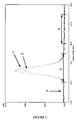
- FIGURE 1 appears the signal from one of the light scattering detectors along with the concentration-sensitive detector.
- these measured excess Rayleigh ratios are related to the weight average molecular weight M i , and the second virial coefficient A 2 by the relation
- K * is an optical parameter defined by where n 0 is the solvent refractive index, dn/dc is the specific refractive index increment of the solution, ⁇ 0 is the vacuum wavelength of the incident light, and N A is Avogadro's number.
- the quantity P i ( ⁇ ) is called the scattering function or form factor for slice i and may always be written as a polynomial in sin2( ⁇ /2) : where ⁇ r2 ⁇ i is the mean square radius of the scattering molecules averaged over the distribution present at slice i . If the molecules are known to be of a particular form, the expression for P i ( ⁇ ) can be written in closed form. For example, if the molecules obey the random coil approximation common for many types of polymer molecules, the scattering function can be written where
- the calculations may also be performed using a reciprocal version of Eq. (1), namely All the same analysis techniques described below apply to both Eqs. (1) and (6).
- Light scattering detectors at very low and very high angles are sometimes unusable due to high noise levels from particulates or stray light. Even when usable, these detectors often have more noise than mid-range angles. This noise shows up in the baseline as well as in the peaks.
- the noise level of the concentration detector is typically, but not always, less than for the light scattering detectors.
- FIGURE 1 shows typical chromatograms showing the light scattering signal at 90° with the concentration detector signal superimposed. Clearly visible are the leading and following baseline regions and the peak.
- FIGURE 2 shows an enlarged view of the following baseline region 4 of FIGURE 1 containing typical noise fluctuations.
- FIGURE 1 shows a typical chromatogram contrasting the scattering of light at 90° 1 with the concentration sensitive refractive index detector signal 2 .
- the sample was a narrow distribution standard of polystyrene having a MW of approximately 30,000 grams per mole.
- the mobile phase was toluene, and a total mass of 0.2 mg was injected before the columns in an injection volume of 100 ⁇ L.
- Two relatively flat baseline regions, 3 and 4 lie on either side of the peak region 5 .
- the invention rests on these observations: The calculations of molecular weight and size only use the peak region 5 where the signal is significantly greater than the baseline noise, as marked in FIGURE 1 .
- the baseline regions 3 and 4 contain no information about the MW and rms radius and are unaffected by the sample.
- the only factors contributing to the noise of the sample that would differ from those present in the mobile phase corresponding to the baseline regions 3 and 4 would be those aggregates and agglomerates introduced with the sample itself. Because of the separation processes associated with the sample's passage through the chromatographic column, this type of spurious debris will generally be separated from the sample itself and will not contribute to the chromatogram of the peak region.
- the amount of noise present in the baseline regions 3 and 4 is a direct measure of that present in the peak region 5 .
- the presence of the peaks neither adds to nor subtracts from this.
- Suitable analysis of the baseline regions can yield standard deviations for each light scattering detector in the multi-angle instrument, as well as the standard deviation for the concentration detector.
- the baseline region 4 is shown at an expanded scale in FIGURE 2 .
- the 90° light scattering signal 1 shows clear evidence of noise fluctuations, while the refractive index signal 2 shows a slight drift and very little noise.
- baseline standard deviations to the peak region 5 allows the calculation of standard deviations in the concentration, MW, and rms radius through the standard statistical procedure called propagation of errors.
- the baseline regions 3 and 4 while providing no information about the values of MW and rms radius, do indeed contain information from which the standard deviation of the MW and rms radius may be determined.
- the standard deviations obtained for MW and rms radius can be taken as typical of the fluctuation that would occur over multiple runs of the same sample.
- baseline regions 3 and 4 were only used to determine the baseline values to be subtracted from the data prior to analysis, and a drifting or noisy baseline indicated a problem with a detector or with the chromatograph itself.
- the statistical significance of the information inherent in the baseline noise has not been heretofore noted nor used in any statistical analyses.
- the method permits the calculation of the standard deviations in concentration. MW, and rms radius at each slice from a chromatographic elution using a multi-angle light scattering instrument and a concentration-sensitive detector. Were only a single LS detector available, then no rms radius value would be calculable, and the MW value could be erroneous. However, the precision of the MW result would still be calculable.
- the method permits the calculation of the standard deviations in MW and rms radius averages for a range of slices defining a peak.
- noisy light scattering detectors are automatically identified, and their contribution to the calculated results is automatically reduced.
- the method may be applied to any theoretical model of molecular structure, including but not limited to random coil, sphere, rigid rod, or simple polynomial of any degree.
- the method may be applied also to the measurement and interpretation of in-line viscometric determinations.
- Equation (8) shows how the associated standard deviation, of each of the derived M i of Eq. (7) may be calculated following the usual methods for calculating the propagated errors.
- My invention discloses a method for estimating the standard deviation of each detected variable for all of the physical quantities measured at each slice without having to perform effectively impossible replicate experiments. This would include various concentration detectors such as refractive index detectors, ultraviolet detectors and evaporative mass detectors as well as light scattering detectors and viscosity detectors. Once these standard deviations have been found, one can apply conventional error propagation algorithms to obtain precision estimates for all derived quantities. This is a significant achievement whose need has been long recognized yet whose implementation has, until now, remained elusive.
- the key element of my invention is the realization that the fluctuations in the baseline region, which are relatively easy to measure, are equivalent to the fluctuations in repeated measurements of a single slice, which are very difficult to measure. This is because any dust, aggregate, and debris components of a sample injected into a chromatographic system will generally be separated from the molecular elements of the sample. These components will be excluded, for the most part, from that chromatographic region within which the major sample constituents will lie. On the other hand, if the mobile phase itself contains a distribution of such noise-causing elements, they will remain unresolved, elute continuously even after the columns, and contribute, therefore, to each slice of the separated sample in an equivalent manner.
- the baseline itself reflects all of these contributions that cause uncertainties in the determination of the corresponding measurements within the slices.
- the baseline reflects all the noise elements associated with detector drift and electronic noise.
- the fluctuations in the baseline region are equivalent to the fluctuations in repeated measurements of a single slice.
- Steps 1 and 4 are simple applications of standard numerical analysis techniques to light scattering.
- my method may be applied equally well to other on-line measurement techniques, such as viscometry.
- viscometry the viscometer produces a signal proportional to the specific viscosity of the solution.
- the intrinsic viscosity of the sample may be determined.
- my method may be applied to this technique to yield precision estimates for the values of intrinsic viscosity, as well as for values of MW and hydrodynamic molecular radius derived by reference to so-called universal calibration curves.
Landscapes
- Physics & Mathematics (AREA)
- Health & Medical Sciences (AREA)
- Life Sciences & Earth Sciences (AREA)
- Chemical & Material Sciences (AREA)
- Analytical Chemistry (AREA)
- Biochemistry (AREA)
- General Health & Medical Sciences (AREA)
- General Physics & Mathematics (AREA)
- Immunology (AREA)
- Pathology (AREA)
- Investigating Or Analysing Materials By Optical Means (AREA)
Applications Claiming Priority (4)
| Application Number | Priority Date | Filing Date | Title |
|---|---|---|---|
| US18826894A | 1994-01-27 | 1994-01-27 | |
| US188268 | 1994-10-20 | ||
| US08/326,628 US5528366A (en) | 1994-01-27 | 1994-10-20 | Precision determination for molecular weights |
| US326628 | 1994-10-20 |
Publications (2)
| Publication Number | Publication Date |
|---|---|
| EP0665433A1 true EP0665433A1 (de) | 1995-08-02 |
| EP0665433B1 EP0665433B1 (de) | 2004-03-17 |
Family
ID=26883892
Family Applications (1)
| Application Number | Title | Priority Date | Filing Date |
|---|---|---|---|
| EP94119715A Expired - Lifetime EP0665433B1 (de) | 1994-01-27 | 1994-12-14 | Präzise Bestimmung von Molekulargewichten |
Country Status (4)
| Country | Link |
|---|---|
| US (1) | US5528366A (de) |
| EP (1) | EP0665433B1 (de) |
| JP (1) | JP3580380B2 (de) |
| DE (1) | DE69433615T2 (de) |
Cited By (11)
| Publication number | Priority date | Publication date | Assignee | Title |
|---|---|---|---|---|
| WO1997039347A1 (en) * | 1996-04-12 | 1997-10-23 | Waters Investments Limited | Chromatographic pattern analysis system employing chromatographic variability characterization |
| WO1999037462A1 (de) * | 1998-01-20 | 1999-07-29 | Karl Hehl | Verfahren zur beurteilung von spritzteilen |
| WO1999051980A3 (en) * | 1998-04-03 | 2001-03-22 | Symyx Technologies Inc | Rapid characterization of polymers |
| US6294388B1 (en) | 1998-04-03 | 2001-09-25 | Symyx Technologies, Inc. | Indirect calibration of polymer characterization systems |
| US6577392B1 (en) | 1998-04-03 | 2003-06-10 | Symyx Technologies, Inc. | Characterization of non-biological polymers using flow-injection analysis with light-scattering detection |
| EP1517143A3 (de) * | 2003-09-18 | 2005-03-30 | Wyatt Technology Corporation | Verfahren um die Effekte von Band-Verbreiterung zwischen Detektoren zu korrigieren |
| US7507337B2 (en) | 2004-09-03 | 2009-03-24 | Symyx Technologies, Inc. | System and method for rapid chromatography with fluid temperature and mobile phase composition control |
| EP2096426A3 (de) * | 2008-02-29 | 2012-03-07 | Wyatt Technology Corporation | Verfahren zur Bestimmung gemittelter Eigenschaften von Molekülen in Lösung durch Injektion in ein fliessendes Lösungsmittel |
| CN109325489A (zh) * | 2018-09-14 | 2019-02-12 | 浙江口碑网络技术有限公司 | 图像的识别方法及装置、存储介质、电子装置 |
| EP3719494A1 (de) * | 2020-01-30 | 2020-10-07 | Bayer AG | Verwendung von in-line-detektoren mit mehrwinkellichtstreuung (mals) zur erstellung digitaler zwillinge von chromatographieinheitsoperationen |
| CN112485361A (zh) * | 2020-11-16 | 2021-03-12 | 武汉月成技术有限公司 | 一种针对气相色谱分析仪的色谱信号低延迟滤波方法 |
Families Citing this family (13)
| Publication number | Priority date | Publication date | Assignee | Title |
|---|---|---|---|---|
| IES20000617A2 (en) | 2000-08-02 | 2002-02-20 | Millipore Ireland Bv | Optical scattering monitor |
| US6868715B1 (en) | 2000-09-20 | 2005-03-22 | General Electric Company | Method and apparatus for rapid determination of polymer molecular weight |
| US6411383B1 (en) * | 2000-12-22 | 2002-06-25 | Wyatt Technology Corporation | Method for measuring the 2nd virial coefficient |
| GB2371358A (en) * | 2001-01-22 | 2002-07-24 | Optokem Ltd | Light scattering particle characterisation apparatus and detection means |
| US6651009B1 (en) * | 2002-07-24 | 2003-11-18 | Wyatt Technology Corporation | Method for determining average solution properties of macromolecules by the injection method |
| EP1889048A4 (de) * | 2005-06-08 | 2010-12-22 | Mds Inc Dbt Mds Sciex Division | Dynamischer ausschluss von hintergrundsignal bei chromatographie-/massenspektrometrie-daten-abhängiger datenaufnahme |
| US10481164B2 (en) * | 2012-03-26 | 2019-11-19 | Amgen Inc. | Method for using light scattering in real time to directly monitor and control impurity removal in purification processes |
| WO2014091888A1 (ja) * | 2012-12-10 | 2014-06-19 | 株式会社島津製作所 | ドリフト算出装置及びこれを備えた光検出装置 |
| US9556695B2 (en) | 2013-04-25 | 2017-01-31 | Baker Hughes Incorporated | Mechanically locked debris barrier |
| WO2016073830A1 (en) * | 2014-11-06 | 2016-05-12 | Wyatt Technology Corporation | Method and apparatus to measure electrophoretic mobility of a flowing sample |
| US11965900B2 (en) * | 2018-11-09 | 2024-04-23 | Wyatt Technology, Llc | Indicating a status of an analytical instrument on a screen of the analytical instrument |
| JP2023119798A (ja) * | 2022-02-17 | 2023-08-29 | 株式会社アイシン | 成分評価装置、成分評価方法及びプログラム |
| EP4610645A1 (de) | 2024-02-29 | 2025-09-03 | Sartorius Stedim Biotech GmbH | Verfahren zur verarbeitung und/oder reinigung eines biologischen produkts mit mehrwinkeliger lichtstreuung als analytisches werkzeug zur prozesssteuerung |
Citations (1)
| Publication number | Priority date | Publication date | Assignee | Title |
|---|---|---|---|---|
| US5129723A (en) * | 1991-04-11 | 1992-07-14 | Wyatt Technology Corporation | High performance Zimm chromatography--HPZC |
Family Cites Families (1)
| Publication number | Priority date | Publication date | Assignee | Title |
|---|---|---|---|---|
| US4875169A (en) * | 1986-04-11 | 1989-10-17 | Iowa State University Research Foundation, Inc. | Method for improving the limit of detection in a data signal |
-
1994
- 1994-10-20 US US08/326,628 patent/US5528366A/en not_active Expired - Lifetime
- 1994-12-14 DE DE69433615T patent/DE69433615T2/de not_active Expired - Lifetime
- 1994-12-14 EP EP94119715A patent/EP0665433B1/de not_active Expired - Lifetime
-
1995
- 1995-01-26 JP JP01056095A patent/JP3580380B2/ja not_active Expired - Fee Related
Patent Citations (1)
| Publication number | Priority date | Publication date | Assignee | Title |
|---|---|---|---|---|
| US5129723A (en) * | 1991-04-11 | 1992-07-14 | Wyatt Technology Corporation | High performance Zimm chromatography--HPZC |
Non-Patent Citations (1)
| Title |
|---|
| L.A. PAPAZIAN, T.D. MURPHY: "Long and Short Range Precision in HPSEC", JOURNAL OF LIQUID CHROMATOGRAPHY, vol. 13, no. 1, 1990, pages 25 - 49 * |
Cited By (19)
| Publication number | Priority date | Publication date | Assignee | Title |
|---|---|---|---|---|
| WO1997039347A1 (en) * | 1996-04-12 | 1997-10-23 | Waters Investments Limited | Chromatographic pattern analysis system employing chromatographic variability characterization |
| US5969228A (en) * | 1996-04-12 | 1999-10-19 | Waters Investments Limited | Method and devices for chromatographic pattern analysis employing chromatographic variability characterization |
| US6312575B1 (en) | 1996-04-12 | 2001-11-06 | Waters Investments Limited | Methods and devices for chromatographic pattern analysis employing chromatographic variability characterizations |
| WO1999037462A1 (de) * | 1998-01-20 | 1999-07-29 | Karl Hehl | Verfahren zur beurteilung von spritzteilen |
| US6517754B1 (en) | 1998-01-20 | 2003-02-11 | Karl Hehl | Method for evaluating injection moulded parts |
| WO1999051980A3 (en) * | 1998-04-03 | 2001-03-22 | Symyx Technologies Inc | Rapid characterization of polymers |
| US6294388B1 (en) | 1998-04-03 | 2001-09-25 | Symyx Technologies, Inc. | Indirect calibration of polymer characterization systems |
| US6577392B1 (en) | 1998-04-03 | 2003-06-10 | Symyx Technologies, Inc. | Characterization of non-biological polymers using flow-injection analysis with light-scattering detection |
| EP1517143A3 (de) * | 2003-09-18 | 2005-03-30 | Wyatt Technology Corporation | Verfahren um die Effekte von Band-Verbreiterung zwischen Detektoren zu korrigieren |
| US7386427B2 (en) | 2003-09-18 | 2008-06-10 | Wyatt Technology Corporation | Method for correcting the effects of interdetector band broadening |
| US7911594B2 (en) | 2003-09-18 | 2011-03-22 | Wyatt Technology Corporation | Method to derive physical properties of a sample after correcting the effects of interdetector band broadening |
| CN102183607A (zh) * | 2003-09-18 | 2011-09-14 | 怀雅特技术公司 | 用于校正检测器间频带增宽效应的方法 |
| CN102183607B (zh) * | 2003-09-18 | 2013-04-24 | 怀雅特技术公司 | 用于校正检测器间频带增宽效应的方法 |
| US7507337B2 (en) | 2004-09-03 | 2009-03-24 | Symyx Technologies, Inc. | System and method for rapid chromatography with fluid temperature and mobile phase composition control |
| EP2096426A3 (de) * | 2008-02-29 | 2012-03-07 | Wyatt Technology Corporation | Verfahren zur Bestimmung gemittelter Eigenschaften von Molekülen in Lösung durch Injektion in ein fliessendes Lösungsmittel |
| CN109325489A (zh) * | 2018-09-14 | 2019-02-12 | 浙江口碑网络技术有限公司 | 图像的识别方法及装置、存储介质、电子装置 |
| CN109325489B (zh) * | 2018-09-14 | 2021-05-28 | 浙江口碑网络技术有限公司 | 图像的识别方法及装置、存储介质、电子装置 |
| EP3719494A1 (de) * | 2020-01-30 | 2020-10-07 | Bayer AG | Verwendung von in-line-detektoren mit mehrwinkellichtstreuung (mals) zur erstellung digitaler zwillinge von chromatographieinheitsoperationen |
| CN112485361A (zh) * | 2020-11-16 | 2021-03-12 | 武汉月成技术有限公司 | 一种针对气相色谱分析仪的色谱信号低延迟滤波方法 |
Also Published As
| Publication number | Publication date |
|---|---|
| DE69433615T2 (de) | 2005-03-24 |
| JP3580380B2 (ja) | 2004-10-20 |
| EP0665433B1 (de) | 2004-03-17 |
| US5528366A (en) | 1996-06-18 |
| JPH0835961A (ja) | 1996-02-06 |
| DE69433615D1 (de) | 2004-04-22 |
Similar Documents
| Publication | Publication Date | Title |
|---|---|---|
| US5528366A (en) | Precision determination for molecular weights | |
| Dyson | Chromatographic integration methods | |
| EP1349879B1 (de) | System und methode zur bestimmung des molekulargewichts und der intrisischen viskosität einer polymerverteilung unter verwendung der gelpermeationschromatographie | |
| EP0181224B1 (de) | Differenzdruckkapillarviskosimeter für die von Strömungsgeschwindigkeit und Temperaturschwankungen unabhängige Messung der Viskosität | |
| US4775943A (en) | Method and apparatus for determining polymer molecular weight distribution parameters | |
| US4578990A (en) | Differential pressure capillary viscometer for measuring viscosity independent of flow rate and temperature fluctuations | |
| Jackson et al. | Computer simulation study of size-exclusion chromatography with simultaneous viscometry and light scattering measurements | |
| Yau et al. | Polymer characterization by SEC-viscometry: molecular weight (MW), size (Rg) and intrinsic viscosity (IV) distribution | |
| CN1598571B (zh) | 用于校正检测器间频带增宽效应的方法 | |
| Nilsoon et al. | Molecular-weight distribution determination of clinical dextran by gel permeation chromatography | |
| Jeansonne et al. | Measurement of statistical moments of resolved and overlapping chromatographic peaks | |
| Netopilı́k et al. | Estimation of width of narrow molecular-weight distributions by size-exclusion chromatography with concentration and light scattering detection | |
| EP1438575A2 (de) | System und verfahren zur bestimmung des gyrationsradius, des molekulargewichts und der intrinsischen viskosität einer polymerverteilung unter verwendung von gelpermeationschromatographie und lichtstreuungsnachweis | |
| Martin | Polymer analysis by fractionation with on-line light scattering detectors | |
| Nyerges et al. | Investigation and comparison of 5% diphenyl–95% dimethyl polysiloxane capillary columns | |
| Kirkland et al. | Polymer characterization by thermal field flow fractionation with a continuous viscosity detector | |
| Zammit et al. | Factors influencing detector matching in multidetector SEC: solvent and concentration effects | |
| Dose et al. | Calibrating detector responses using chromatographic peak shapes | |
| Barth | Hyphenated polymer separation techniques: present and future role | |
| Clementi et al. | Molar mass distributions in homopolymer blends from multimodal chromatograms obtained by Sec/Gpc with a concentration detector | |
| Nguyen et al. | Calibration of thermal field‐flow fractionation using broad molecular weight standards | |
| US4181006A (en) | Quantitative chromatographic analysis without calibration | |
| Pigeon et al. | Correction for interdetector volume in size exclusion chromatography (SEC) | |
| Martin et al. | On-line coupling of thermal field-flow fractionation with low-angle laser light scattering | |
| Schure | Advances in the theory of particle size distributions by field-flow fractionation: Outlet and apparent polydispersity at constant field |
Legal Events
| Date | Code | Title | Description |
|---|---|---|---|
| PUAI | Public reference made under article 153(3) epc to a published international application that has entered the european phase |
Free format text: ORIGINAL CODE: 0009012 |
|
| AK | Designated contracting states |
Kind code of ref document: A1 Designated state(s): CH DE FR GB IT LI SE |
|
| 17P | Request for examination filed |
Effective date: 19960123 |
|
| 17Q | First examination report despatched |
Effective date: 20020516 |
|
| GRAP | Despatch of communication of intention to grant a patent |
Free format text: ORIGINAL CODE: EPIDOSNIGR1 |
|
| GRAS | Grant fee paid |
Free format text: ORIGINAL CODE: EPIDOSNIGR3 |
|
| GRAA | (expected) grant |
Free format text: ORIGINAL CODE: 0009210 |
|
| AK | Designated contracting states |
Kind code of ref document: B1 Designated state(s): CH DE FR GB IT LI SE |
|
| PG25 | Lapsed in a contracting state [announced via postgrant information from national office to epo] |
Ref country code: LI Free format text: LAPSE BECAUSE OF FAILURE TO SUBMIT A TRANSLATION OF THE DESCRIPTION OR TO PAY THE FEE WITHIN THE PRESCRIBED TIME-LIMIT Effective date: 20040317 Ref country code: IT Free format text: LAPSE BECAUSE OF FAILURE TO SUBMIT A TRANSLATION OF THE DESCRIPTION OR TO PAY THE FEE WITHIN THE PRESCRIBED TIME-LIMIT;WARNING: LAPSES OF ITALIAN PATENTS WITH EFFECTIVE DATE BEFORE 2007 MAY HAVE OCCURRED AT ANY TIME BEFORE 2007. THE CORRECT EFFECTIVE DATE MAY BE DIFFERENT FROM THE ONE RECORDED. Effective date: 20040317 Ref country code: FR Free format text: LAPSE BECAUSE OF FAILURE TO SUBMIT A TRANSLATION OF THE DESCRIPTION OR TO PAY THE FEE WITHIN THE PRESCRIBED TIME-LIMIT Effective date: 20040317 Ref country code: CH Free format text: LAPSE BECAUSE OF FAILURE TO SUBMIT A TRANSLATION OF THE DESCRIPTION OR TO PAY THE FEE WITHIN THE PRESCRIBED TIME-LIMIT Effective date: 20040317 |
|
| REG | Reference to a national code |
Ref country code: GB Ref legal event code: FG4D |
|
| REG | Reference to a national code |
Ref country code: CH Ref legal event code: EP |
|
| REF | Corresponds to: |
Ref document number: 69433615 Country of ref document: DE Date of ref document: 20040422 Kind code of ref document: P |
|
| PG25 | Lapsed in a contracting state [announced via postgrant information from national office to epo] |
Ref country code: SE Free format text: LAPSE BECAUSE OF FAILURE TO SUBMIT A TRANSLATION OF THE DESCRIPTION OR TO PAY THE FEE WITHIN THE PRESCRIBED TIME-LIMIT Effective date: 20040617 |
|
| REG | Reference to a national code |
Ref country code: CH Ref legal event code: PL |
|
| PLBE | No opposition filed within time limit |
Free format text: ORIGINAL CODE: 0009261 |
|
| STAA | Information on the status of an ep patent application or granted ep patent |
Free format text: STATUS: NO OPPOSITION FILED WITHIN TIME LIMIT |
|
| EN | Fr: translation not filed | ||
| 26N | No opposition filed |
Effective date: 20041220 |
|
| PGFP | Annual fee paid to national office [announced via postgrant information from national office to epo] |
Ref country code: GB Payment date: 20131217 Year of fee payment: 20 |
|
| PGFP | Annual fee paid to national office [announced via postgrant information from national office to epo] |
Ref country code: DE Payment date: 20140106 Year of fee payment: 20 |
|
| REG | Reference to a national code |
Ref country code: DE Ref legal event code: R071 Ref document number: 69433615 Country of ref document: DE |
|
| REG | Reference to a national code |
Ref country code: DE Ref legal event code: R071 Ref document number: 69433615 Country of ref document: DE |
|
| REG | Reference to a national code |
Ref country code: GB Ref legal event code: PE20 Expiry date: 20141213 |
|
| PG25 | Lapsed in a contracting state [announced via postgrant information from national office to epo] |
Ref country code: GB Free format text: LAPSE BECAUSE OF EXPIRATION OF PROTECTION Effective date: 20141213 |