EP0665693A2 - Méthode de contrôle dynamique de débit de bits pour un codage à très bas débit de vidéo et audio associé - Google Patents
Méthode de contrôle dynamique de débit de bits pour un codage à très bas débit de vidéo et audio associé Download PDFInfo
- Publication number
- EP0665693A2 EP0665693A2 EP94120862A EP94120862A EP0665693A2 EP 0665693 A2 EP0665693 A2 EP 0665693A2 EP 94120862 A EP94120862 A EP 94120862A EP 94120862 A EP94120862 A EP 94120862A EP 0665693 A2 EP0665693 A2 EP 0665693A2
- Authority
- EP
- European Patent Office
- Prior art keywords
- audio
- picture
- bit rate
- coding
- video
- Prior art date
- Legal status (The legal status is an assumption and is not a legal conclusion. Google has not performed a legal analysis and makes no representation as to the accuracy of the status listed.)
- Granted
Links
Images


Classifications
-
- G—PHYSICS
- G10—MUSICAL INSTRUMENTS; ACOUSTICS
- G10L—SPEECH ANALYSIS TECHNIQUES OR SPEECH SYNTHESIS; SPEECH RECOGNITION; SPEECH OR VOICE PROCESSING TECHNIQUES; SPEECH OR AUDIO CODING OR DECODING
- G10L19/00—Speech or audio signals analysis-synthesis techniques for redundancy reduction, e.g. in vocoders; Coding or decoding of speech or audio signals, using source filter models or psychoacoustic analysis
- G10L19/002—Dynamic bit allocation
-
- H—ELECTRICITY
- H04—ELECTRIC COMMUNICATION TECHNIQUE
- H04N—PICTORIAL COMMUNICATION, e.g. TELEVISION
- H04N21/00—Selective content distribution, e.g. interactive television or video on demand [VOD]
- H04N21/20—Servers specifically adapted for the distribution of content, e.g. VOD servers; Operations thereof
- H04N21/23—Processing of content or additional data; Elementary server operations; Server middleware
- H04N21/236—Assembling of a multiplex stream, e.g. transport stream, by combining a video stream with other content or additional data, e.g. inserting a URL [Uniform Resource Locator] into a video stream, multiplexing software data into a video stream; Remultiplexing of multiplex streams; Insertion of stuffing bits into the multiplex stream, e.g. to obtain a constant bit-rate; Assembling of a packetised elementary stream
- H04N21/2368—Multiplexing of audio and video streams
-
- H—ELECTRICITY
- H04—ELECTRIC COMMUNICATION TECHNIQUE
- H04N—PICTORIAL COMMUNICATION, e.g. TELEVISION
- H04N19/00—Methods or arrangements for coding, decoding, compressing or decompressing digital video signals
- H04N19/10—Methods or arrangements for coding, decoding, compressing or decompressing digital video signals using adaptive coding
- H04N19/102—Methods or arrangements for coding, decoding, compressing or decompressing digital video signals using adaptive coding characterised by the element, parameter or selection affected or controlled by the adaptive coding
- H04N19/115—Selection of the code volume for a coding unit prior to coding
-
- H—ELECTRICITY
- H04—ELECTRIC COMMUNICATION TECHNIQUE
- H04N—PICTORIAL COMMUNICATION, e.g. TELEVISION
- H04N19/00—Methods or arrangements for coding, decoding, compressing or decompressing digital video signals
- H04N19/10—Methods or arrangements for coding, decoding, compressing or decompressing digital video signals using adaptive coding
- H04N19/102—Methods or arrangements for coding, decoding, compressing or decompressing digital video signals using adaptive coding characterised by the element, parameter or selection affected or controlled by the adaptive coding
- H04N19/132—Sampling, masking or truncation of coding units, e.g. adaptive resampling, frame skipping, frame interpolation or high-frequency transform coefficient masking
-
- H—ELECTRICITY
- H04—ELECTRIC COMMUNICATION TECHNIQUE
- H04N—PICTORIAL COMMUNICATION, e.g. TELEVISION
- H04N19/00—Methods or arrangements for coding, decoding, compressing or decompressing digital video signals
- H04N19/10—Methods or arrangements for coding, decoding, compressing or decompressing digital video signals using adaptive coding
- H04N19/134—Methods or arrangements for coding, decoding, compressing or decompressing digital video signals using adaptive coding characterised by the element, parameter or criterion affecting or controlling the adaptive coding
- H04N19/146—Data rate or code amount at the encoder output
- H04N19/152—Data rate or code amount at the encoder output by measuring the fullness of the transmission buffer
-
- H—ELECTRICITY
- H04—ELECTRIC COMMUNICATION TECHNIQUE
- H04N—PICTORIAL COMMUNICATION, e.g. TELEVISION
- H04N19/00—Methods or arrangements for coding, decoding, compressing or decompressing digital video signals
- H04N19/10—Methods or arrangements for coding, decoding, compressing or decompressing digital video signals using adaptive coding
- H04N19/169—Methods or arrangements for coding, decoding, compressing or decompressing digital video signals using adaptive coding characterised by the coding unit, i.e. the structural portion or semantic portion of the video signal being the object or the subject of the adaptive coding
- H04N19/17—Methods or arrangements for coding, decoding, compressing or decompressing digital video signals using adaptive coding characterised by the coding unit, i.e. the structural portion or semantic portion of the video signal being the object or the subject of the adaptive coding the unit being an image region, e.g. an object
- H04N19/176—Methods or arrangements for coding, decoding, compressing or decompressing digital video signals using adaptive coding characterised by the coding unit, i.e. the structural portion or semantic portion of the video signal being the object or the subject of the adaptive coding the unit being an image region, e.g. an object the region being a block, e.g. a macroblock
-
- H—ELECTRICITY
- H04—ELECTRIC COMMUNICATION TECHNIQUE
- H04N—PICTORIAL COMMUNICATION, e.g. TELEVISION
- H04N19/00—Methods or arrangements for coding, decoding, compressing or decompressing digital video signals
- H04N19/10—Methods or arrangements for coding, decoding, compressing or decompressing digital video signals using adaptive coding
- H04N19/169—Methods or arrangements for coding, decoding, compressing or decompressing digital video signals using adaptive coding characterised by the coding unit, i.e. the structural portion or semantic portion of the video signal being the object or the subject of the adaptive coding
- H04N19/184—Methods or arrangements for coding, decoding, compressing or decompressing digital video signals using adaptive coding characterised by the coding unit, i.e. the structural portion or semantic portion of the video signal being the object or the subject of the adaptive coding the unit being bits, e.g. of the compressed video stream
-
- H—ELECTRICITY
- H04—ELECTRIC COMMUNICATION TECHNIQUE
- H04N—PICTORIAL COMMUNICATION, e.g. TELEVISION
- H04N19/00—Methods or arrangements for coding, decoding, compressing or decompressing digital video signals
- H04N19/46—Embedding additional information in the video signal during the compression process
-
- H—ELECTRICITY
- H04—ELECTRIC COMMUNICATION TECHNIQUE
- H04N—PICTORIAL COMMUNICATION, e.g. TELEVISION
- H04N19/00—Methods or arrangements for coding, decoding, compressing or decompressing digital video signals
- H04N19/60—Methods or arrangements for coding, decoding, compressing or decompressing digital video signals using transform coding
- H04N19/61—Methods or arrangements for coding, decoding, compressing or decompressing digital video signals using transform coding in combination with predictive coding
-
- H—ELECTRICITY
- H04—ELECTRIC COMMUNICATION TECHNIQUE
- H04N—PICTORIAL COMMUNICATION, e.g. TELEVISION
- H04N21/00—Selective content distribution, e.g. interactive television or video on demand [VOD]
- H04N21/20—Servers specifically adapted for the distribution of content, e.g. VOD servers; Operations thereof
- H04N21/23—Processing of content or additional data; Elementary server operations; Server middleware
- H04N21/233—Processing of audio elementary streams
-
- H—ELECTRICITY
- H04—ELECTRIC COMMUNICATION TECHNIQUE
- H04N—PICTORIAL COMMUNICATION, e.g. TELEVISION
- H04N21/00—Selective content distribution, e.g. interactive television or video on demand [VOD]
- H04N21/20—Servers specifically adapted for the distribution of content, e.g. VOD servers; Operations thereof
- H04N21/23—Processing of content or additional data; Elementary server operations; Server middleware
- H04N21/234—Processing of video elementary streams, e.g. splicing of video streams or manipulating encoded video stream scene graphs
- H04N21/2343—Processing of video elementary streams, e.g. splicing of video streams or manipulating encoded video stream scene graphs involving reformatting operations of video signals for distribution or compliance with end-user requests or end-user device requirements
-
- H—ELECTRICITY
- H04—ELECTRIC COMMUNICATION TECHNIQUE
- H04N—PICTORIAL COMMUNICATION, e.g. TELEVISION
- H04N21/00—Selective content distribution, e.g. interactive television or video on demand [VOD]
- H04N21/20—Servers specifically adapted for the distribution of content, e.g. VOD servers; Operations thereof
- H04N21/23—Processing of content or additional data; Elementary server operations; Server middleware
- H04N21/242—Synchronisation processes, e.g. processing of PCR [Programme Clock References]
-
- H—ELECTRICITY
- H04—ELECTRIC COMMUNICATION TECHNIQUE
- H04N—PICTORIAL COMMUNICATION, e.g. TELEVISION
- H04N21/00—Selective content distribution, e.g. interactive television or video on demand [VOD]
- H04N21/20—Servers specifically adapted for the distribution of content, e.g. VOD servers; Operations thereof
- H04N21/25—Management operations performed by the server for facilitating the content distribution or administrating data related to end-users or client devices, e.g. end-user or client device authentication, learning user preferences for recommending movies
- H04N21/266—Channel or content management, e.g. generation and management of keys and entitlement messages in a conditional access system, merging a VOD unicast channel into a multicast channel
- H04N21/2662—Controlling the complexity of the video stream, e.g. by scaling the resolution or bitrate of the video stream based on the client capabilities
-
- H—ELECTRICITY
- H04—ELECTRIC COMMUNICATION TECHNIQUE
- H04N—PICTORIAL COMMUNICATION, e.g. TELEVISION
- H04N19/00—Methods or arrangements for coding, decoding, compressing or decompressing digital video signals
- H04N19/10—Methods or arrangements for coding, decoding, compressing or decompressing digital video signals using adaptive coding
- H04N19/102—Methods or arrangements for coding, decoding, compressing or decompressing digital video signals using adaptive coding characterised by the element, parameter or selection affected or controlled by the adaptive coding
- H04N19/103—Selection of coding mode or of prediction mode
- H04N19/107—Selection of coding mode or of prediction mode between spatial and temporal predictive coding, e.g. picture refresh
-
- H—ELECTRICITY
- H04—ELECTRIC COMMUNICATION TECHNIQUE
- H04N—PICTORIAL COMMUNICATION, e.g. TELEVISION
- H04N19/00—Methods or arrangements for coding, decoding, compressing or decompressing digital video signals
- H04N19/10—Methods or arrangements for coding, decoding, compressing or decompressing digital video signals using adaptive coding
- H04N19/134—Methods or arrangements for coding, decoding, compressing or decompressing digital video signals using adaptive coding characterised by the element, parameter or criterion affecting or controlling the adaptive coding
- H04N19/146—Data rate or code amount at the encoder output
Definitions
- the present invention relates to very low bit rate video and associated audio coding, specifically to the dynamic allocation of video bit rate according to the instant bit rate consumption of audio signal in a constant bit rate system.
- Digital video and associated audio coding plays a key role in the industrial applications of digital signal storage, processing, transmission and distribution.
- Various digital coding standards have been and are being developed by various standardization bodies.
- typical coding scheme involve three parts, namely, video coding, audio coding and system multiplexing.
- the current transform coding algorithms adopted by the MPEG phase one and phase two standards involve such techniques as transformation, quantization and variable length coding.
- predictive coding techniques such as inter picture prediction, motion estimation and compensation are used. Therefore, a picture could be encoded by reducing its spatial redundancy within the picture itself.
- a picture coded in this way is usually referred to as an I picture.
- a picture could also be encoded in inter picture mode. If a picture is predicted only from the previous picture, it is referred to as a P picture. If a picture is predicted both from previous picture and future picture, the picture is referred to bidirectional predictive coded picture, which is usually called a B picture.
- a main feature of the current video coding scheme is that the bit rate of the coded bitstream is a fixed constant by using a FIFO buffer.
- the fullness of the buffer is used to adjust the quantization step and bits available for the I, B and P picture so as to control the bit rate of each coded picture.
- Very limited variable bit rate for speech coding has been considered for packet switching networks, digital speech interpolation systems and digital communication multiplication equipment systems.
- the main function of the system encoder is to provide the necessary and sufficient information to synchronize the decoding and presentation of video and audio information, and at the same time ensuring that coded data in the decoders' buffer do not overflow or underflow.
- Coding the system layer information includes packetizing the data into packets and creating time-stamps for the packet header.
- Two time stamps are used: presentation time stamp (PTS) which indicates when the presentation unit of an audio frame or video picture should be play or broadcast, and decoding time stamp (DTS) which indicates the time to decode an audio or video picture.
- PTS presentation time stamp
- DTS decoding time stamp
- the PTS and DTS have a common time base, called system clock reference (SCR), to unify the measurement of the timing, ensure correct synchronization and buffer management.
- SCR system clock reference
- the coding scheme described above has following problems that prevent us from achieving a very high compression ratio and coding efficiency, which are the key factors for various very low bit rate video and associated audio coding applications.
- the current audio coding scheme encodes and audio signal in constant bit rate. If we define the audio information as a complexity measure which reflects the signal intensity and frequency distribution, we can find the complexity various with time. For example, considering the videophone application, when one party of the communication is talking, the other party is usually listening and silent. This mean that there are moments when the listener does not make any voice input. Secondly, there are silent moments existing even in person's talking. A constant audio encoder wastes the bandwidth at those silent moments. For very low bit rate coding applications, it is possible that the audio occupies similar or even higher bandwidth than the video. The problem to be solved here is to use a variable bit rate audio encoder for audio coding and save the bits for video coding use.
- the current video coding scheme provides a constant bitstream output by using a FIFO buffer at the end of the encoder.
- the instant bit usage and buffer fullness are used to adjust the bits for each picture and the quantization step.
- the latter is used to control the bit rate of the next encoded macroblock within the picture.
- This bit rate control process is done within the video encoder itself, which is independent of the bit usage of the audio encoder. How to make use of the bit saving from the audio encoder to improve the video coding quality is the problem to be solved.
- the current video coding scheme implements the bit rate control by allocating a certain number of bits to each picture and also adjusting the quantization step for each macroblock of a picture. There are cases when there are sufficient bits available that are more than enough to adjust the quantization step to its minimal value. Under such situation, the extra bits could not be efficiently used.
- Another problem is whether the minimal quantization step is the best way to encode a picture in the predetermined encoding mode, i.e., I picture, P picture and B picture. Especially when the current picture is set to be encoded in B picture, will the smaller quantization step give better coded picture quality than a P picture or even an I picture if the amount of bits available allows us to do either a P picture or an I picture coding?
- the above discussion could be concluded as a problem of how to dynamically select I, P and B picture coding modes.
- a second problem under this item relates to very low bit rate coding where the picture rate of the coding scheme is usually less than the rate required by real time video.
- the picture rate is usually set around 10 pictures per second. Because of this reduced picture rate, the jig effects, would appear if the objects in the picture moves too fast. This problem also makes the predictive coding difficult when a scene is changed. How to efficiently make use of the available bits to insert a picture to the pre-determined picture rate is another issue to be addressed to improve the picture coding quality.
- a dynamic bit rate control video and associated audio coding system has been invented.
- the coding system at first codes a few frames of audio. This number of audio frames is decided by the picture rate of video and audio frame size. It then counts the bit spending and calculates the bit saving from the audio encoder during the previous picture coding time period. By monitoring the input audio level and analyzing of its frequency and energy contents, maximum bits may be saved during silence period. For non-silence period, the number of bits to be used for coding of each audio frame is selected such as to attain a predetermined frequency-weighted Signal-to-Noise measure or other perceptual measures which assures the desired audio quality level.
- the saved bits from the audio encoder is sent to a bit rate allocator, which makes use of these bits together with the bit consumption of the coded previous picture and the fullness of a first-in-first-out (FIFO) buffer to calculate the available bits for the current picture coding.
- a bit rate allocator which makes use of these bits together with the bit consumption of the coded previous picture and the fullness of a first-in-first-out (FIFO) buffer to calculate the available bits for the current picture coding.
- the available bit amount for the current picture is sent to a coding mode selector in the video encoder.
- This coding mode selector decides the I, B and P picture coding for the current picture. It also decides whether an extra picture is to be inserted when the picture rate is lower than the normal picture rate required by real time video application.
- the available bits are also used to control the quantization step in a similar way to the current coding scheme when the picture coding mode is selected.
- the system multiplexer will make up for the video delay with respect to the audio coding by inserting in the system packet the correct time stamp for the respective video and audio data.
- the synchronized audio and video bitstream will then be multiplexed to form a constant bit rate system bitstream.
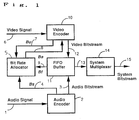
- the operation of the coding system with dynamic bit rate control of combined audio and video coding are illustrated in Figure 1.
- the coding system involves an audio encoder 2, a video encoder 10, a first-in-first-out (FIFO) buffer 11, a bit rate allocator 5 and a system multiplexer 14.
- This invention covers not only such a system configuration and operation, but also covers new means needed by the audio encoder 2, video encoder 10, bit rate allocator 5 and the system multiplexer 14 to support the operation of the overall coding system.
- the audio bitstream 3 is encoded by a variable bit rate audio encoder 2, which includes an audio detection and identification (ADI) module 103 ( Figure 5) that performs several tasks, namely, ADI) module 103 ( Figure 5)
- the BSC 25 calculates the bit saving after each audio frame is coded. Once the BSC 25 receives a request signal from the bit rate allocator (BRA) 5, it calculates the bits saved by the audio frames during the previous picture encoding period. This bit saving amount 4, which is denoted as B s , tells the BRA 5 the amount of bits contributed by the audio encoder 2 for video encoding use.
- BRA bit rate allocator
- bit amount used by the previous picture is provided by the video encoder 10 to the BRA 5.
- fullness of the FIFO buffer 11, B f 9, is also provided by a fullness detector in FIFO buffer 11.
- the video encoder 10 selects the various picture coding modes to achieve the best possible picture coding quality.
- the output 12 of the coded picture will be sent to the FIFO buffer 11.
- the bit usage 7 of the current picture is reported to the BRA 5 for the use of the next picture coding.
- the coded audio 3 and video 12 bitstreams are then multiplexed by a system multiplexer 14 where the audio and video synchronization is realized.
- the system multiplexer 14 multiplexes the audio and video in a constant bit rate and produces a constant system bitstream 15 to either a communication channel or a digital storage media.
- Figure 1 shows the block diagram of the dynamic bit rate controlled video and associated audio coding system.
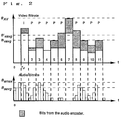
- Figure 2 illustrates the time and bit rate relationship during audio and video encoding process.
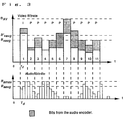
- Figure 3 illustrates the time and bit rate relationship during the multiplexing process.
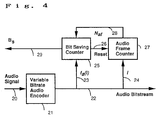
- Figure 4 shows the relationship between the bit saving counter and the variable bit rate audio encoder.
- Figure 5 shows a block diagram of a variable bit rate audio encoder.
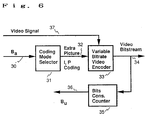
- Figure 6 shows a block diagram of a configuration of a variable bit rate video encoder together with a coding mode selector and a bit consumption counter.
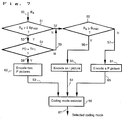
- Figure 7 illustrates the mechanism of dynamic picture coding mode selection flow chart.
- Figure 8 shows a block diagram of a video transform coding scheme.
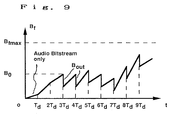
- Figure 9 illustrates the FIFO buffer fullness.
- FIG. 1 A preferred embodiment of the coding system is shown in Figure 1 where the coding system involves only two picture coding modes.
- the first picture coding mode is the intrapicture coding that generates I pictures.
- the second picture coding mode is the predictive coding that generates P pictures. the prediction is only from the previous picture.
- the coding system of this invention is not only limited to I and P picture coding modes. It can also be applied to the I, P and B picture coding modes:
- the control mechanism of the dynamic bit rate allocation is shown in Figure 2.
- B amax there is a preset maximum bit rate for audio coding, which is denoted as B amax .
- the audio signal 1 is encoded by using a variable bit rate encoder 2 with the constraint that the coded audio bit rate shall not exceed the B amax .
- the audio frame rate is set at F a frames per second and the video picture rate is set at F v pictures per second.
- the audio encoder 2 shall start encoding the audio signal 1 for a time period T d . This time is the delay needed by the video encoder 10 and it is set to one picture period.
- the BRA 5 shall send the B a 8 to the video encoder 10 to specify the available bits for the current picture coding.
- the video encoder 10 analyzes the value of B a 8 so as to apply proper picture coding modes.
- the coded audio bitstream 3 shall be delayed with a same time T d to match the corresponding video bitstream 12 in both time and bit rate.
- This operation is illustrated in Figure 3, where the bit saving in audio and bit spending in video are matched in time.
- This alignment control is achieved by the system multiplexer 14 to selectively take audio and video bitstreams from the FIFO buffer 11 and put in the correct time stamps for audio and video synchronization.
- both the audio bitstream 3 and video bitstream 12 are of variable bit rates.
- the output system bitstream 15 is in constant bit rate.
- bit saving counter (BSC) 25 is introduced.
- the audio signal 20 is segmented into F a frames per second.
- the bit spending of the ith audio frame is f a (i) bits 23
- the bit saving during one picture period could be calculated by the following formula: Where the N af 28 is the number of audio frames that have been encoded before the B s request was made from the BRA 5. Once the B s 29 is sent to the BRA 5, the audio frame counter 27 is reset to zero and continue counting for the next picture period.
- the input speech signal 101 is passed to the prediction analysis module 102 and audio detection and identification module 103.
- the prediction analysis module 102 performs the short-term linear spectrum analysis using a specified Mth order autocorrelation analysis.
- the audio detection and identification module 103 the energy distribution across the audio frequency band is computed. Where silence is detected based on a threshold measure, no coding of audio frame need be done.
- the resultant prediction coefficients 104 from prediction analysis 102 the characterization of the speech segment into voiced or unvoiced components (or more subclasses) would take place.
- a maximum bit rate usable for coding of each audio frame could first be present in the bit rate determination module 106.
- bit rate determination module 106 From the prediction coefficient and energy distribution information, a discrete bit rate level equal to or less than the maximum bit rate usable would be selected in the bit rate determination module 106, based on a frequency-weighted Signal-to-Noise measure or other perceptual measure for coding of the audio frame.
- the bit spending data 116 from each audio frame will be transmitted to the bit saving counter.
- the audio frame number 115 generated from a cyclic counter would be transmitted to the frame counter. Coding at a lower bit rate than the maximum could be achieved by using proper subsets of the codebooks 108 (or by reduced codebooks or by re-design for the parametric representation).
- the multiple codebooks 108 constitute the excitation generators which can generate a variety of sequences including pulse-like and noise-like sequences.
- the summation of the excitation sequences 109 is passed through a predictor which can consist various predictors 110 e.g. pitch predictor and spectral predictor.
- the predicted signal 111 is subtracted from the input speech 101 resulting in a difference or error signal 112 which is then perceptually weighted.
- the perceptually weighted error 114 is then used to drive the error minimization Vector Quantization search procedure.
- the line spectral pairs 118 and appropriate parametric codes 117 would be transmitted as components of the audio bitstream.
- variable bit rate operation considered thus far has a different approach from the algorithms which have a nominal rate but can operate at bit rates higher and lower than the nominal rate.
- the BRA 5 receives the audio bit saving B s 4 from the audio encoder 2, the video bits used by the previous coded picture B u 7 from the video encoder 10 and the fullness of FIFO buffer B f 9.
- the preset target bits for picture j is B t(j) , which is equal to the preset I picture coding bit rate B tI or the preset P picture coding bit rate B tP for I picture coding and P picture coding respectively
- the available bits for the j th picture coding shall be calculated by the following control means.
- B a(j) B t(j-l) -B u(j-l) + B s(j-l) + B t(j) if(B a(j) + B f(j) + B amax > B fmax ) ⁇ B a(j) ⁇ B fmax - B f(j) - B amax ⁇ if (B a(j) + B f(j) + B amax ⁇ B Av ) ⁇ B a(j) > B Av - B f(j) - B amax ⁇
- B fmax is the FIFO buffer size
- B AV is the constant system bitstream bit rate.
- the available bits for the jth picture coding is equal to the difference of the target bits for and the actual bits used by the (j-l)th picture, plus the bit saving of audio encoder 2 during the (j-l) picture coding period, plus further the target bits for the jth picture according to the default coding mode. If the sum of the available bits B a(j) , the current FIFO buffer fullness B f(j) and the maximal audio bit rate B amax is greater than the maximal FIFO buffer fullness B fmax , the available bits for the picture j shall be calculated as the maximum FIFO buffer fullness B fmax minus the current buffer fullness B f(j) and minus the maximal audio bit rate B amax to avoid the FIFO buffer 11 overflow.
- the available bits for the picture j shall be calculated as the B AV minus the current buffer fullness B f(j) and minus the maximal audio bit rate B amax to avoid the FIFO buffer 11 underflow.
- the variable bit rate video encoder 10 is configured together with a coding mode selector 31 and a bit consumption counter 35 as illustrated in Figure 6.
- the available bits for the current picture B a 30 is sent to a coding mode selector (CMS) 31.
- CMS coding mode selector
- the CMS 31 conducts a decision making process to select I, P coding or an extra P picture coding. This decision is provided for a variable bitrate video encoder 33 to control the coding of the current picture 37.
- the encoded video bitstream is output through link 34.
- the output 34 is also sent to the bits consumption counter 35 so that the number of bits used for the current picture coding B u 36 is calculated and sent to the BRA 5 ( Figurel) for the next picture coding use.
- the decision making process of CMS 31 is shown in flow chart in Figure 7. Assume that the minimal bits needed to encode an I picture is B Imin and the minimal bits needed to encode a P picture is B Pmin . Assume further that there is a present threshold TH l to check the picture difference (PD) between the previous encoded picture and the picture that is located in the middle of the previous encoded picture and the current picture to be encoded.
- PD picture difference
- the available bits for the current picture B a 50 is input to the comparator 51. If the B a is greater than two times B Pmin , it implies that the available bits are enough to encode two P pictures. In other words, an extra P picture could be inserted. In this case, the output of the comparator 51 goes through the link 53 to the comparator 54, which is used to check further whether it is necessary to insert a P picture based on the PD value as defined previously. If the PD value is greater than the preset threshold TH l , it implies that there is substantial changes of picture contents from the previous encoded picture to the picture in the middle of the previous encoded picture and the current picture to be encoded. Therefore, the decision 62 is made to encode two P pictures if the output of the comparator 54 is "Yes" through the link 58.
- the comparator 54 outputs a "No" through link 59, it implies that the middle picture has no substantial changes with respect to the previous encoded picture and there is no need to insert an extra P picture.
- the available bit amount B a is then check through link 59 by the comparator 55 for the decision making of either an I picture coding or a P picture coding. This process also applies to the case when the comparator 51 outputs "No" from the link 52. Therefore, the succeeding decision making procedure applies to both cases of link 52 and link 59.
- the available bit amount B a is compared with the minimal I picture coding bit amount, B Imin . if B a ⁇ B Imin , it implies that the available bits are enough to encode an I picture and the decision 60, I picture coding, is activated by the output from the link 56. If B a ⁇ B Imin , the decision 61, P picture coding, is selected by the output from the link 57.
- the mechanism described above is defined as the dynamic I and P picture coding mode control.
- the B a is used to adjust the quantization step so as to dynamically control the bit rate generated from the current picture coding. This mechanism is defined as dynamic quantization step control.
- a variable bit rate video encoder 33 is then used to code the current picture according to the picture coding mode 32 selected by the CMS 31.
- One preferred embodiment of the video encoder 33 is shown in Figure 8, which is a transform coding system.
- An input video signal contains pixel data of each picture is input and stored in an input picture memory 71.
- a block sampling circuit 72 receives the data stored in the input picture memory 71 through a line 84 and partitions the picture data into spatially non-overlapping blocks of pixel data. To provide a reasonable level of adaptiveness, a block size of 8x8 pixels may be used.
- the picture number of the picture is also stored in the input picture memory 71 and passed through the block sampling circuit 72 to a switch (SI) 73. Based on the picture number, the switch 73 selectively delivers the output blocks of pixel data from the block sampling circuit 72 through a line 86 for coding in the intra-coded mode or to a line 87 for coding in the predictive-coded mode.
- SI switch
- the output of the block sampling circuit 72 is passed through line 86 to a discrete cosine transform (DCT) circuit 76.
- the DCT circuit 76 performs discrete cosine transform, which is a popular mathematical transformation for converting image data to data in the frequency domain.
- the transformed data i.e. DCT coefficients, are then subjected to the process of quantization in a quantization circuit 77 using a quantizer matrix and a quantization step size which is given by a rate controller 79 through line 93.
- the quantized data are passed together with the quantizer step as side information, through line 91 to run-length coding & variable length coding circuit 78 which performs run-length coding of the quantized data and the associated side information followed by variable length coding of the run-length coded result.
- the output of the run-length coding & variable length coding circuit 78 is a coded bit stream 100 ready to be transmitted to the decoder.
- This bit stream is also passed through line 92 to rate controller 79. Based on the number of bits already used at the time of encoding the block, the rate controller 79 adjusts the quantizer step so that the output bit stream satisfies the bit rate requirement of the encoder system.
- the quantized values obtained by the quantization circuit 77 are passed also through a line 94 to an inverse quantization circuit 80 and an inverse discrete cosine transform (inverse DCT) circuit 81.
- the inverse quantization circuit 80 and inverse DCT perform the reverse process performed by the DCT circuit 76 and quantization 77 to obtain reconstructed data.
- the reconstructed data is stored in a local decoded picture memory 82 through line 96, and will be used for motion estimation and compensation process for the next input picture, which will be a predictive-coded picture.
- the rate controller will calculate the total bit used for coding the I-picture, and decide the number of bit to be allocated to the next P and B-picture.
- the output of the block sampling 72 is passed through switch S1 and then a line 87 to a motion vector (MV) estimation circuit 74.
- MV estimation circuit 74 motion vector estimation is performed to determined the MV from the adjacent picture using the local by decoded picture from the local decoder picture memory 82, obtained through line 98.
- the MV estimation circuit 74 finds the closest match by, for example, determining the direction of translatory motion of the blocks of pixels from one picture to the next by finding the best matching block based on some predetermined criteria, such as mean square error.
- the MV obtained in the motion vector estimation process are passed, together with the blocks to be code, through line 88 to a motion compensation circuit 75 which performs motion compensation using the blocks stored in the local decoded picture memory 82 as predicted blocks.
- the predicted block is obtained from the local decoded memory using the offset given by the MV. Differences between values of the pixels of the block to be coded and values of the pixels of the predicted block are computed to obtain a differential block composed of the difference values.
- the motion compensation circuit 75 also determines whether the block to be passed to DCT circuit 76 for transformation (block to be transformed) should be motion compensated or not by comparing the activity of the block to coded and the differential block using some predefined criteria, such as standard deviation of the blocks.
- the block to be transformed is decided to be motion compensated, its differential block is passed through line 89 to DCT circuit 76. If the block to be transformed is decided not to be motion compensated, the block itself (i.e. the original block outputted from the block sampling circuit 72) is passed through the line 89 to the DCT circuit 76 (which is the same as the block of the intra-coded picture). Further, the motion compensation circuit 75 produces an information bit indicating whether a block is coded with motion compensation or not and passes the information bit together with the motion vector to the DCT circuit 76.
- the data outputted from the motion compensation circuit 75 through the line 89 to the DCT circuit 76 are either the differential block (coded with motion compensation) or the original block (coded without motion compensation), the information bit indicating whether or not the block is coded with motion compensation, and also the motion vector in the case of differential block.
- the block data from the motion compensation circuit 75 are transformed to DCT coefficients in the DCT circuit 76, and the DCT coefficients are quantized in the quantization circuit 77 to be quantized DCT coefficients.
- the information bits each indicates whether or not a block is coded with motion compensation and the MV are passed through the DCT circuit 76 and the quantization circuit 77 through a line 90.
- the quantized data (quantized DCT coefficients), together with side information including the quantization step, the motion vectors and the information bits each indicating whether or not motion compensation is done to a block are passed through the line 91 to the run-length coding & variable length coding circuit 78 to be subjected to run-length coding and variable length coding to decode the output coded bit stream.
- the bit stream is also passed through the line 92 to the rate controller 79.
- the quantized data from the quantization circuit 77 is also passed through the line 94 to be subjected to inverse quantization in the inverse quantization circuit 80, inverse DCT in the inverse DCT circuit 81 and stored in the local decoded picture memory 82 for the encoding of the next picture.
- Figure 9 shows an example of the FIFO buffer status during encoding process of audio and video.
- the coded audio bitstream 3 is written to the FIFO buffer 11.
- the FIFO buffer 11 is filled by both audio bitstream 3 and the video bitstream 12.
- the system multiplexer 14 starts to collect bits from the FIFO buffer 11. Since the system multiplexer 14 takes bits from the FIFO buffer 11 in a constant bit rate B AV , the buffer fullness is reduced at a fixed amount, denoted as B out . This value remains for all the time. Because the audio and video bit rate are variable, the combination of them is also a variable bit rate.
- the speed of FIFO buffer 11 is changing from one time period to another, as illustrated in Figure 9 by different gradient of the buffer fullness curve in each time period.
- the B O is set to avoid the FIFO buffer 11 overflow or underflow.
- this also introduces a time delay for the bitstreams to be transmitted, as illustrated in Figure 9 by 3T d .
- the system multiplexer multiplexes the input video and audio data from the FIFO buffer by packetizing the input video and audio data into packets of fixed length, and inserting the time stamp into the corresponding audio frames and video picture to ensure the correct synchronization.
- Two time stamps are used: presentation time stamp (PTS) which indicates when the presentation unit of an audio or video picture should be played or broadcast, and decoding time stamp (DTS) which indicates the time to decode an audio or video picture.
- PTS presentation time stamp
- DTS decoding time stamp
- the PTS and DTS have a common time base, called system clock reference (SCR), to unify the measurement of the timing, ensure correct synchronization and buffer management.
- SCR system clock reference
- the system multiplexer keep track of the number of pictures sent and as new data are obtained from the FIFO, an appropriate PTS will be inserted to the packet header. No DTS is necessary as the presentation time has a fixed relationship with the decoding time.
- the system multiplexer also keeps track of the number of pictures sent and appropriate PTS and DTS are inserted to the packet header. DTS are necessary in the case when the decoding time and the presentation time of the picture are different.
- the present invention has significant improvement over the prior art method.
- the invention is a constant bit rate video and associated audio coding system which has various dynamic control mechanisms that would allow for saving in the audio encoder to be used by the video encoder.
- the invention provides the mechanisms to control the picture rate as well as picture coding modes. These result in more efficient use of bits available over a fixed period of time, thereby improving the quality of video signal significantly without compromising on the audio quality.
- the invention is especially effective for very low bit rate video and associated audio coding.
- this invention when this invention is applied to the videophone application, it can improve the picture quality by making use all of the audio bit rate of the listener so that the pictures are encoded in more bits and transmitted to the person who is speaking.
Landscapes
- Engineering & Computer Science (AREA)
- Multimedia (AREA)
- Signal Processing (AREA)
- Databases & Information Systems (AREA)
- Computational Linguistics (AREA)
- Health & Medical Sciences (AREA)
- Audiology, Speech & Language Pathology (AREA)
- Human Computer Interaction (AREA)
- Physics & Mathematics (AREA)
- Acoustics & Sound (AREA)
- Compression Or Coding Systems Of Tv Signals (AREA)
- Transmission Systems Not Characterized By The Medium Used For Transmission (AREA)
Applications Claiming Priority (3)
| Application Number | Priority Date | Filing Date | Title |
|---|---|---|---|
| JP33697593 | 1993-12-28 | ||
| JP33697593A JPH07202820A (ja) | 1993-12-28 | 1993-12-28 | ビットレート制御システム |
| JP336975/93 | 1993-12-28 |
Publications (3)
| Publication Number | Publication Date |
|---|---|
| EP0665693A2 true EP0665693A2 (fr) | 1995-08-02 |
| EP0665693A3 EP0665693A3 (fr) | 1996-03-27 |
| EP0665693B1 EP0665693B1 (fr) | 2000-03-15 |
Family
ID=18304332
Family Applications (1)
| Application Number | Title | Priority Date | Filing Date |
|---|---|---|---|
| EP19940120862 Expired - Lifetime EP0665693B1 (fr) | 1993-12-28 | 1994-12-28 | Système de contrôle dynamique de débit de bits pour un codage à très bas débit de vidéo et audio associée |
Country Status (5)
| Country | Link |
|---|---|
| US (1) | US5617145A (fr) |
| EP (1) | EP0665693B1 (fr) |
| JP (1) | JPH07202820A (fr) |
| KR (1) | KR950023017A (fr) |
| DE (1) | DE69423465T2 (fr) |
Cited By (13)
| Publication number | Priority date | Publication date | Assignee | Title |
|---|---|---|---|---|
| WO1998045833A1 (fr) * | 1997-04-07 | 1998-10-15 | Koninklijke Philips Electronics N.V. | Systeme de transmission vocal a debit binaire variable |
| WO1999053479A1 (fr) * | 1998-04-15 | 1999-10-21 | Sgs-Thomson Microelectronics Asia Pacific (Pte) Ltd. | Optimisation rapide de trames dans un codeur audio |
| WO2000074388A1 (fr) * | 1999-05-26 | 2000-12-07 | Koninklijke Philips Electronics N.V. | Procede de codage de signaux video numeriques et systeme de codage ou transcodage correspondant |
| WO2001010136A1 (fr) * | 1999-07-30 | 2001-02-08 | Indinell Sociedad Anonima | Procede et appareil de traitement d'images numeriques et de donnees audio |
| WO2001063939A1 (fr) * | 2000-02-21 | 2001-08-30 | Siemens Aktiengesellschaft | Procede et dispositif pour coder un signal video et un signal vocal, support d"informations lisible par ordinateur et element de programme informatique |
| US6807183B1 (en) * | 2000-05-09 | 2004-10-19 | Advanced Micro Devices, Inc. | Arrangement for reading a prescribed location of a FIFO buffer in a network switch port |
| WO2005048609A1 (fr) * | 2003-11-13 | 2005-05-26 | Matsushita Electric Industrial Co., Ltd. | Paquetisation de donnees codees a debit binaire variable basee sur un controle de debit |
| WO2007078227A1 (fr) * | 2006-01-05 | 2007-07-12 | Telefonaktiebolaget Lm Ericsson (Publ) | Gestion de contenus multimedia |
| WO2008047319A1 (fr) * | 2006-10-20 | 2008-04-24 | Nokia Corporation | Indication générique de chemins d'adaptation pour multimédia extensible |
| CN101930744A (zh) * | 2010-09-07 | 2010-12-29 | 北京航空航天大学 | 一种aac音频编码的握手协议方法 |
| US7965650B2 (en) * | 2006-05-18 | 2011-06-21 | Cisco Technology, Inc. | Method and system for quality monitoring of media over internet protocol (MOIP) |
| US8625959B2 (en) | 2000-06-02 | 2014-01-07 | Sony Corporation | Apparatus and method for image coding and decoding |
| WO2019117866A1 (fr) * | 2017-12-12 | 2019-06-20 | Google Llc | Optimisations de débit binaire pour diffusion en continu de contenus multimédias immersifs |
Families Citing this family (89)
| Publication number | Priority date | Publication date | Assignee | Title |
|---|---|---|---|---|
| US5933450A (en) * | 1994-04-20 | 1999-08-03 | Thomson Consumer Electronics, Inc. | Complexity determining apparatus |
| GB9424436D0 (en) * | 1994-12-02 | 1995-01-18 | Philips Electronics | Video editing buffer management |
| WO1996020575A2 (fr) * | 1994-12-28 | 1996-07-04 | Philips Electronics N.V. | Gestion de tampons destinee a des systemes de compression a debit binaire variable |
| JP2809126B2 (ja) * | 1995-03-30 | 1998-10-08 | 日本電気株式会社 | 音声信号処理回路および音声信号処理方法 |
| EP1209923B1 (fr) * | 1995-04-27 | 2006-05-24 | Hitachi, Ltd. | Procédé et appareil pour recevoir et/ou reproduire des signaux numériques |
| US9832244B2 (en) | 1995-07-14 | 2017-11-28 | Arris Enterprises Llc | Dynamic quality adjustment based on changing streaming constraints |
| US7512698B1 (en) * | 1995-07-14 | 2009-03-31 | Broadband Royalty Corporation | Dynamic quality adjustment based on changing streaming constraints |
| JP4006840B2 (ja) * | 1998-08-10 | 2007-11-14 | ソニー株式会社 | システムターゲットデコーダのオーディオバッファ、多重化方法および装置、再生方法および装置 |
| US6058141A (en) * | 1995-09-28 | 2000-05-02 | Digital Bitcasting Corporation | Varied frame rate video |
| GB2306831B (en) * | 1995-10-30 | 2000-05-24 | Sony Uk Ltd | Video data compression |
| US6075768A (en) * | 1995-11-09 | 2000-06-13 | At&T Corporation | Fair bandwidth sharing for video traffic sources using distributed feedback control |
| WO1997035393A1 (fr) * | 1996-03-15 | 1997-09-25 | Hitachi, Ltd. | Dispositif de separation de donnees |
| US5956674A (en) * | 1995-12-01 | 1999-09-21 | Digital Theater Systems, Inc. | Multi-channel predictive subband audio coder using psychoacoustic adaptive bit allocation in frequency, time and over the multiple channels |
| JPH09233231A (ja) * | 1996-02-20 | 1997-09-05 | Internatl Business Mach Corp <Ibm> | データ伝送方法及び装置 |
| US5949410A (en) * | 1996-10-18 | 1999-09-07 | Samsung Electronics Company, Ltd. | Apparatus and method for synchronizing audio and video frames in an MPEG presentation system |
| KR20050052484A (ko) * | 1997-03-17 | 2005-06-02 | 마츠시타 덴끼 산교 가부시키가이샤 | 데이터 처리방법 |
| KR100261254B1 (ko) * | 1997-04-02 | 2000-07-01 | 윤종용 | 비트율 조절이 가능한 오디오 데이터 부호화/복호화방법 및 장치 |
| KR100513907B1 (ko) * | 1997-06-13 | 2005-09-13 | 코닌클리케 필립스 일렉트로닉스 엔.브이. | 복수의 상호 관련된 오브젝트들의 주기적 전송방법 |
| WO1999000978A1 (fr) * | 1997-06-30 | 1999-01-07 | Motorola Inc. | Systeme, dispositif et procede de codage d'informations video en vue de l'amelioration de leur enregistrement et lecture en continu |
| KR100252108B1 (ko) * | 1997-12-20 | 2000-04-15 | 윤종용 | Mpeg 압축부호화 및 복호화기를 채용한 디지털 기록 재생장치 및 그 방법 |
| JPH11202900A (ja) * | 1998-01-13 | 1999-07-30 | Nec Corp | 音声データ圧縮方法及びそれを適用した音声データ圧縮システム |
| US6307886B1 (en) * | 1998-01-20 | 2001-10-23 | International Business Machines Corp. | Dynamically determining group of picture size during encoding of video sequence |
| US6208640B1 (en) | 1998-02-27 | 2001-03-27 | David Spell | Predictive bandwidth allocation method and apparatus |
| US6373855B1 (en) * | 1998-03-05 | 2002-04-16 | Intel Corporation | System and method for using audio performance to control video bandwidth |
| US7092441B1 (en) | 1998-03-20 | 2006-08-15 | Stmicroelectronics Asia Pacific Pte Limited | Moving pictures encoding with constant overall bit rate |
| EP0982950A3 (fr) * | 1998-08-24 | 2004-09-29 | Sony Corporation | Caméra électronique comprénant un codeur MPEG |
| SE521225C2 (sv) | 1998-09-16 | 2003-10-14 | Ericsson Telefon Ab L M | Förfarande och anordning för CELP-kodning/avkodning |
| US6904089B1 (en) * | 1998-12-28 | 2005-06-07 | Matsushita Electric Industrial Co., Ltd. | Encoding device and decoding device |
| JP3327240B2 (ja) * | 1999-02-10 | 2002-09-24 | 日本電気株式会社 | 画像・音声符号化装置 |
| US6499060B1 (en) | 1999-03-12 | 2002-12-24 | Microsoft Corporation | Media coding for loss recovery with remotely predicted data units |
| JP3519996B2 (ja) * | 1999-08-05 | 2004-04-19 | 三洋電機株式会社 | デジタル記録機器 |
| US6581032B1 (en) | 1999-09-22 | 2003-06-17 | Conexant Systems, Inc. | Bitstream protocol for transmission of encoded voice signals |
| KR100324597B1 (ko) * | 1999-12-30 | 2002-02-16 | 박종섭 | 비트 스트림 프로세서 |
| JP2001274923A (ja) * | 2000-03-28 | 2001-10-05 | Nec Eng Ltd | 携帯電話伝送システム |
| JP4724919B2 (ja) * | 2000-06-02 | 2011-07-13 | ソニー株式会社 | 記録装置および記録方法、再生装置および再生方法、並びに記録媒体 |
| SE517245C2 (sv) * | 2000-09-14 | 2002-05-14 | Ericsson Telefon Ab L M | Synkronisering av audio- och videosignaler |
| US7278069B2 (en) * | 2000-10-31 | 2007-10-02 | Igor Anatolievich Abrosimov | Data transmission apparatus for high-speed transmission of digital data and method for automatic skew calibration |
| JP2002152730A (ja) * | 2000-11-08 | 2002-05-24 | Nec Corp | マルチメディア信号符号化装置、出力符号量制御方法、及びそのプログラムを記録した記録媒体 |
| US20020118746A1 (en) * | 2001-01-03 | 2002-08-29 | Kim Hyun Mun | Method of performing video encoding rate control using motion estimation |
| US7590178B2 (en) * | 2001-03-12 | 2009-09-15 | Robert Bosch Gmbh | Method of multiplexing a number of video signals with a compressor |
| US7050497B2 (en) * | 2001-03-28 | 2006-05-23 | Thomson Licensing | Process and device for the video coding of high definition images |
| WO2002085016A1 (fr) * | 2001-04-11 | 2002-10-24 | Cyber Operations, Llc | Systeme et procede de distribution reseau d'un contenu multimedia a faible debit binaire |
| KR100814431B1 (ko) * | 2001-04-25 | 2008-03-18 | 삼성전자주식회사 | 가변 비트레이트를 적용한 디지털 방송 송신장치 및 그방법, 비디오 데이타 부호화장치 및 그 방법 그리고방송신호의 복호화 시스템 및 그 방법 |
| JP4063508B2 (ja) * | 2001-07-04 | 2008-03-19 | 日本電気株式会社 | ビットレート変換装置およびビットレート変換方法 |
| US6975680B2 (en) * | 2001-07-12 | 2005-12-13 | Dolby Laboratories, Inc. | Macroblock mode decision biasing for video compression systems |
| US7577333B2 (en) * | 2001-08-04 | 2009-08-18 | Samsung Electronics Co., Ltd. | Method and apparatus for recording and reproducing video data, and information storage medium in which video data is recorded by the same |
| US7698132B2 (en) * | 2002-12-17 | 2010-04-13 | Qualcomm Incorporated | Sub-sampled excitation waveform codebooks |
| JP4254297B2 (ja) * | 2003-03-26 | 2009-04-15 | 日本電気株式会社 | 画像処理装置及びその方法並びにそれを用いた画像処理システム及びプログラム |
| US8085844B2 (en) * | 2003-09-07 | 2011-12-27 | Microsoft Corporation | Signaling reference frame distances |
| US7577198B2 (en) * | 2003-09-07 | 2009-08-18 | Microsoft Corporation | Number of reference fields for an interlaced forward-predicted field |
| US7016409B2 (en) | 2003-11-12 | 2006-03-21 | Sony Corporation | Apparatus and method for use in providing dynamic bit rate encoding |
| US20050207501A1 (en) * | 2004-03-18 | 2005-09-22 | Sony Corporation | Method of and system for video bit allocation for scene cuts and scene changes |
| US7624021B2 (en) * | 2004-07-02 | 2009-11-24 | Apple Inc. | Universal container for audio data |
| US8634413B2 (en) * | 2004-12-30 | 2014-01-21 | Microsoft Corporation | Use of frame caching to improve packet loss recovery |
| US8270439B2 (en) * | 2005-07-08 | 2012-09-18 | Activevideo Networks, Inc. | Video game system using pre-encoded digital audio mixing |
| US8074248B2 (en) | 2005-07-26 | 2011-12-06 | Activevideo Networks, Inc. | System and method for providing video content associated with a source image to a television in a communication network |
| JP4745865B2 (ja) * | 2006-02-28 | 2011-08-10 | 富士通セミコンダクター株式会社 | 符号化装置および方法 |
| WO2008088752A2 (fr) | 2007-01-12 | 2008-07-24 | Ictv, Inc. | Système et procédé pour coder des images tramées de défilement |
| US9826197B2 (en) | 2007-01-12 | 2017-11-21 | Activevideo Networks, Inc. | Providing television broadcasts over a managed network and interactive content over an unmanaged network to a client device |
| JP4831351B2 (ja) | 2007-02-01 | 2011-12-07 | 日本電気株式会社 | 映像音声帯域制御システム及び映像音声帯域制御方法 |
| US7751361B2 (en) * | 2007-10-19 | 2010-07-06 | Rebelvox Llc | Graceful degradation for voice communication services over wired and wireless networks |
| US7751362B2 (en) | 2007-10-19 | 2010-07-06 | Rebelvox Llc | Graceful degradation for voice communication services over wired and wireless networks |
| JP2009260436A (ja) * | 2008-04-11 | 2009-11-05 | Sony Corp | 情報処理装置及び情報処理方法、並びにプログラム |
| US9327193B2 (en) | 2008-06-27 | 2016-05-03 | Microsoft Technology Licensing, Llc | Dynamic selection of voice quality over a wireless system |
| CN101330340B (zh) * | 2008-07-31 | 2010-09-29 | 中兴通讯股份有限公司 | 移动多媒体广播终端自适应调整接收速率缓冲播放的方法 |
| US8325662B2 (en) * | 2008-09-17 | 2012-12-04 | Voxer Ip Llc | Apparatus and method for enabling communication when network connectivity is reduced or lost during a conversation and for resuming the conversation when connectivity improves |
| JP4878051B2 (ja) * | 2008-12-04 | 2012-02-15 | 日本電信電話株式会社 | 符号化ストリーム伝送方法,符号化ストリーム伝送装置,符号化ストリーム伝送制御プログラムおよびその記録媒体 |
| JP4879958B2 (ja) * | 2008-12-04 | 2012-02-22 | 日本電信電話株式会社 | 映像・音声ストリーム伝送制御方法、映像・音声ストリーム伝送制御装置、映像・音声ストリーム伝送制御プログラムおよびそのプログラムを記録したコンピュータ読み取り可能な記録媒体 |
| JP4878052B2 (ja) * | 2008-12-04 | 2012-02-15 | 日本電信電話株式会社 | 映像符号量制御方法,映像符号化装置,映像符号量制御プログラムおよびその記録媒体 |
| JP4755239B2 (ja) * | 2008-12-04 | 2011-08-24 | 日本電信電話株式会社 | 映像符号量制御方法,映像符号化装置,映像符号量制御プログラムおよびその記録媒体 |
| JP5391899B2 (ja) * | 2009-07-23 | 2014-01-15 | 株式会社Jvcケンウッド | デジタル信号多重化方法およびデジタル信号多重化装置 |
| US8194862B2 (en) * | 2009-07-31 | 2012-06-05 | Activevideo Networks, Inc. | Video game system with mixing of independent pre-encoded digital audio bitstreams |
| US8780978B2 (en) * | 2009-11-04 | 2014-07-15 | Qualcomm Incorporated | Controlling video encoding using audio information |
| AU2011315950B2 (en) | 2010-10-14 | 2015-09-03 | Activevideo Networks, Inc. | Streaming digital video between video devices using a cable television system |
| EP2472868A1 (fr) * | 2010-12-29 | 2012-07-04 | British Telecommunications Public Limited Company | Codage vidéo |
| WO2012138660A2 (fr) | 2011-04-07 | 2012-10-11 | Activevideo Networks, Inc. | Réduction de la latence dans des réseaux de distribution vidéo à l'aide de débits binaires adaptatifs |
| US10409445B2 (en) | 2012-01-09 | 2019-09-10 | Activevideo Networks, Inc. | Rendering of an interactive lean-backward user interface on a television |
| US9800945B2 (en) | 2012-04-03 | 2017-10-24 | Activevideo Networks, Inc. | Class-based intelligent multiplexing over unmanaged networks |
| US9123084B2 (en) | 2012-04-12 | 2015-09-01 | Activevideo Networks, Inc. | Graphical application integration with MPEG objects |
| WO2014145921A1 (fr) | 2013-03-15 | 2014-09-18 | Activevideo Networks, Inc. | Système à modes multiples et procédé de fourniture de contenu vidéo sélectionnable par un utilisateur |
| US9294785B2 (en) | 2013-06-06 | 2016-03-22 | Activevideo Networks, Inc. | System and method for exploiting scene graph information in construction of an encoded video sequence |
| US9219922B2 (en) | 2013-06-06 | 2015-12-22 | Activevideo Networks, Inc. | System and method for exploiting scene graph information in construction of an encoded video sequence |
| WO2014197879A1 (fr) | 2013-06-06 | 2014-12-11 | Activevideo Networks, Inc. | Rendu d'interface utilisateur en incrustation sur une vidéo source |
| US9788029B2 (en) | 2014-04-25 | 2017-10-10 | Activevideo Networks, Inc. | Intelligent multiplexing using class-based, multi-dimensioned decision logic for managed networks |
| WO2016138502A1 (fr) * | 2015-02-27 | 2016-09-01 | Arris Enterprises, Inc. | Attribution adaptative de débit binaire conjoint |
| US10762911B2 (en) | 2015-12-01 | 2020-09-01 | Ati Technologies Ulc | Audio encoding using video information |
| EP3376766B1 (fr) * | 2017-03-14 | 2019-01-30 | Axis AB | Procédé et système de codage pour déterminer la longueur du gop pour le codage vidéo |
| CN110800047B (zh) | 2017-04-26 | 2023-07-25 | Dts公司 | 用于对数据进行处理的方法和系统 |
| CN114390314B (zh) * | 2021-12-30 | 2024-06-18 | 咪咕文化科技有限公司 | 可变帧率音视频处理方法、设备及存储介质 |
Family Cites Families (10)
| Publication number | Priority date | Publication date | Assignee | Title |
|---|---|---|---|---|
| US5231492A (en) * | 1989-03-16 | 1993-07-27 | Fujitsu Limited | Video and audio multiplex transmission system |
| TW237589B (fr) * | 1991-02-27 | 1995-01-01 | Gen Electric | |
| US5317672A (en) * | 1991-03-05 | 1994-05-31 | Picturetel Corporation | Variable bit rate speech encoder |
| US5159447A (en) * | 1991-05-23 | 1992-10-27 | At&T Bell Laboratories | Buffer control for variable bit-rate channel |
| JP2766919B2 (ja) * | 1991-06-07 | 1998-06-18 | 三菱電機株式会社 | ディジタル信号記録再生装置、ディジタル信号記録装置、ディジタル信号再生装置 |
| JP3141450B2 (ja) * | 1991-09-30 | 2001-03-05 | ソニー株式会社 | オーディオ信号処理方法 |
| US5231484A (en) * | 1991-11-08 | 1993-07-27 | International Business Machines Corporation | Motion video compression system with adaptive bit allocation and quantization |
| US5367629A (en) * | 1992-12-18 | 1994-11-22 | Sharevision Technology, Inc. | Digital video compression system utilizing vector adaptive transform |
| US5467139A (en) * | 1993-09-30 | 1995-11-14 | Thomson Consumer Electronics, Inc. | Muting apparatus for a compressed audio/video signal receiver |
| US5452006A (en) * | 1993-10-25 | 1995-09-19 | Lsi Logic Corporation | Two-part synchronization scheme for digital video decoders |
-
1993
- 1993-12-28 JP JP33697593A patent/JPH07202820A/ja active Pending
-
1994
- 1994-12-22 US US08/361,438 patent/US5617145A/en not_active Expired - Fee Related
- 1994-12-27 KR KR1019940037203A patent/KR950023017A/ko not_active Ceased
- 1994-12-28 DE DE69423465T patent/DE69423465T2/de not_active Expired - Fee Related
- 1994-12-28 EP EP19940120862 patent/EP0665693B1/fr not_active Expired - Lifetime
Cited By (24)
| Publication number | Priority date | Publication date | Assignee | Title |
|---|---|---|---|---|
| WO1998045833A1 (fr) * | 1997-04-07 | 1998-10-15 | Koninklijke Philips Electronics N.V. | Systeme de transmission vocal a debit binaire variable |
| US6012026A (en) * | 1997-04-07 | 2000-01-04 | U.S. Philips Corporation | Variable bitrate speech transmission system |
| WO1999053479A1 (fr) * | 1998-04-15 | 1999-10-21 | Sgs-Thomson Microelectronics Asia Pacific (Pte) Ltd. | Optimisation rapide de trames dans un codeur audio |
| WO2000074388A1 (fr) * | 1999-05-26 | 2000-12-07 | Koninklijke Philips Electronics N.V. | Procede de codage de signaux video numeriques et systeme de codage ou transcodage correspondant |
| WO2001010136A1 (fr) * | 1999-07-30 | 2001-02-08 | Indinell Sociedad Anonima | Procede et appareil de traitement d'images numeriques et de donnees audio |
| WO2001063939A1 (fr) * | 2000-02-21 | 2001-08-30 | Siemens Aktiengesellschaft | Procede et dispositif pour coder un signal video et un signal vocal, support d"informations lisible par ordinateur et element de programme informatique |
| DE10007579A1 (de) * | 2000-02-21 | 2001-09-20 | Siemens Ag | Verfahren und Vorrichtung zum Codieren eines Videosignals und eines Sprachsignals, computerlesbares Speichermedium sowie Computerprogramm-Element |
| US6807183B1 (en) * | 2000-05-09 | 2004-10-19 | Advanced Micro Devices, Inc. | Arrangement for reading a prescribed location of a FIFO buffer in a network switch port |
| US8625958B2 (en) | 2000-06-02 | 2014-01-07 | Sony Corporation | Apparatus and method for image coding and decoding |
| US8644672B2 (en) | 2000-06-02 | 2014-02-04 | Sony Corporation | Apparatus and method for image coding and decoding |
| US8625959B2 (en) | 2000-06-02 | 2014-01-07 | Sony Corporation | Apparatus and method for image coding and decoding |
| US8032645B2 (en) | 2003-11-13 | 2011-10-04 | Panasonic Corporation | Coding method and coding apparatus |
| WO2005048609A1 (fr) * | 2003-11-13 | 2005-05-26 | Matsushita Electric Industrial Co., Ltd. | Paquetisation de donnees codees a debit binaire variable basee sur un controle de debit |
| CN101356828B (zh) * | 2006-01-05 | 2011-06-08 | 艾利森电话股份有限公司 | 媒体内容管理 |
| US8571215B2 (en) | 2006-01-05 | 2013-10-29 | Telefonaktiebolaget L M Ericsson (Publ) | Combined storage and transmission of scalable media |
| WO2007078227A1 (fr) * | 2006-01-05 | 2007-07-12 | Telefonaktiebolaget Lm Ericsson (Publ) | Gestion de contenus multimedia |
| US7965650B2 (en) * | 2006-05-18 | 2011-06-21 | Cisco Technology, Inc. | Method and system for quality monitoring of media over internet protocol (MOIP) |
| CN101601305B (zh) * | 2006-10-20 | 2013-01-23 | 诺基亚公司 | 用于可伸缩多媒体的自适应路径的通用指示 |
| WO2008047319A1 (fr) * | 2006-10-20 | 2008-04-24 | Nokia Corporation | Indication générique de chemins d'adaptation pour multimédia extensible |
| US9807431B2 (en) | 2006-10-20 | 2017-10-31 | Nokia Technologies Oy | Generic indication of adaptation paths for scalable multimedia |
| CN101930744A (zh) * | 2010-09-07 | 2010-12-29 | 北京航空航天大学 | 一种aac音频编码的握手协议方法 |
| WO2019117866A1 (fr) * | 2017-12-12 | 2019-06-20 | Google Llc | Optimisations de débit binaire pour diffusion en continu de contenus multimédias immersifs |
| US11122314B2 (en) | 2017-12-12 | 2021-09-14 | Google Llc | Bitrate optimizations for immersive multimedia streaming |
| US11843814B2 (en) | 2017-12-12 | 2023-12-12 | Google Llc | Bitrate optimizations for immersive multimedia streaming |
Also Published As
| Publication number | Publication date |
|---|---|
| US5617145A (en) | 1997-04-01 |
| DE69423465T2 (de) | 2000-07-06 |
| EP0665693B1 (fr) | 2000-03-15 |
| KR950023017A (ko) | 1995-07-28 |
| JPH07202820A (ja) | 1995-08-04 |
| DE69423465D1 (de) | 2000-04-20 |
| EP0665693A3 (fr) | 1996-03-27 |
Similar Documents
| Publication | Publication Date | Title |
|---|---|---|
| EP0665693B1 (fr) | Système de contrôle dynamique de débit de bits pour un codage à très bas débit de vidéo et audio associée | |
| EP0893027B1 (fr) | Système de distribution de vidéo comprimé, ayant un multiplexeur statistique avec des transcodeurs | |
| US6925120B2 (en) | Transcoder for scalable multi-layer constant quality video bitstreams | |
| KR100407085B1 (ko) | 가변비트-레이트압축방법및비디오신호인코딩장치 | |
| US7016337B1 (en) | System and method for multiple channel statistical re-multiplexing | |
| US7881370B2 (en) | Method of selecting among n spatial video CODECs the optimum CODEC for a same input signal | |
| KR100496210B1 (ko) | 부호화장치,부호화방법,다중화데이터전송장치,다중화데이터전송방법및기록매체 | |
| CA2185704C (fr) | Procede et appareil pour empecher un depassement de capacite positif ou negatif dans un tampon de decodeur | |
| US8160153B2 (en) | Hypothetical reference decoder with low start-up delays for compressed image and video | |
| US7257162B2 (en) | Hypothetical reference decoder for compressed image and video | |
| EP0998151A2 (fr) | Contrôle de débit commun pour la codage d'un signal de vidéo stéréoscopique | |
| US6816550B2 (en) | Image signal coding apparatus with bit stream buffer of reduced storage capacity | |
| US7333515B1 (en) | Methods and apparatus to improve statistical remultiplexer performance by use of predictive techniques | |
| US7173947B1 (en) | Methods and apparatus to evaluate statistical remultiplexer performance | |
| KR100188701B1 (ko) | 가변속 고속 재생기능을 갖는 가변 비트율 동화상복호화장치 | |
| US6504576B2 (en) | Digital signal coding method and apparatus, signal recording medium, and signal transmission method for recording a moving picture signal and an acoustic signal | |
| US7593433B1 (en) | System and method for multiple channel statistical re-multiplexing | |
| JPH09187007A (ja) | 誤りを含むデータストリームへの再同期の方法と、符号化器及び復号化器 | |
| US7522665B2 (en) | Mobile terminal with camera | |
| JP2002314996A (ja) | ビデオ・データの品質を制御するための方法および装置 | |
| US20050190833A1 (en) | Encoded data outputting apparatus and method | |
| KR100950525B1 (ko) | 트랜스코딩 장치 및 방법, 이에 사용되는 타겟비트할당 및픽처 복잡도 예측 장치 및 방법 | |
| KR100233937B1 (ko) | 타임스탬프 보상을 이용한 비디오와 오디오 동기 방법 및 이를 이용한 엠펙-2(mpeg-2) 인코더 장치 | |
| US20070160127A1 (en) | Bandwidth adaptive stream selection | |
| KR101371507B1 (ko) | 저지연 영상 통신 시스템 및 방법 |
Legal Events
| Date | Code | Title | Description |
|---|---|---|---|
| PUAI | Public reference made under article 153(3) epc to a published international application that has entered the european phase |
Free format text: ORIGINAL CODE: 0009012 |
|
| AK | Designated contracting states |
Kind code of ref document: A2 Designated state(s): DE FR GB IT NL |
|
| PUAL | Search report despatched |
Free format text: ORIGINAL CODE: 0009013 |
|
| AK | Designated contracting states |
Kind code of ref document: A3 Designated state(s): DE FR GB IT NL |
|
| 17P | Request for examination filed |
Effective date: 19960708 |
|
| 17Q | First examination report despatched |
Effective date: 19980506 |
|
| GRAG | Despatch of communication of intention to grant |
Free format text: ORIGINAL CODE: EPIDOS AGRA |
|
| GRAG | Despatch of communication of intention to grant |
Free format text: ORIGINAL CODE: EPIDOS AGRA |
|
| GRAH | Despatch of communication of intention to grant a patent |
Free format text: ORIGINAL CODE: EPIDOS IGRA |
|
| GRAH | Despatch of communication of intention to grant a patent |
Free format text: ORIGINAL CODE: EPIDOS IGRA |
|
| GRAA | (expected) grant |
Free format text: ORIGINAL CODE: 0009210 |
|
| AK | Designated contracting states |
Kind code of ref document: B1 Designated state(s): DE FR GB IT NL |
|
| PG25 | Lapsed in a contracting state [announced via postgrant information from national office to epo] |
Ref country code: NL Free format text: LAPSE BECAUSE OF FAILURE TO SUBMIT A TRANSLATION OF THE DESCRIPTION OR TO PAY THE FEE WITHIN THE PRESCRIBED TIME-LIMIT Effective date: 20000315 |
|
| REF | Corresponds to: |
Ref document number: 69423465 Country of ref document: DE Date of ref document: 20000420 |
|
| ITF | It: translation for a ep patent filed | ||
| ET | Fr: translation filed | ||
| NLV1 | Nl: lapsed or annulled due to failure to fulfill the requirements of art. 29p and 29m of the patents act | ||
| PLBE | No opposition filed within time limit |
Free format text: ORIGINAL CODE: 0009261 |
|
| STAA | Information on the status of an ep patent application or granted ep patent |
Free format text: STATUS: NO OPPOSITION FILED WITHIN TIME LIMIT |
|
| 26N | No opposition filed | ||
| REG | Reference to a national code |
Ref country code: GB Ref legal event code: IF02 |
|
| PGFP | Annual fee paid to national office [announced via postgrant information from national office to epo] |
Ref country code: FR Payment date: 20041208 Year of fee payment: 11 |
|
| PGFP | Annual fee paid to national office [announced via postgrant information from national office to epo] |
Ref country code: GB Payment date: 20041222 Year of fee payment: 11 |
|
| PGFP | Annual fee paid to national office [announced via postgrant information from national office to epo] |
Ref country code: DE Payment date: 20041223 Year of fee payment: 11 |
|
| PG25 | Lapsed in a contracting state [announced via postgrant information from national office to epo] |
Ref country code: IT Free format text: LAPSE BECAUSE OF NON-PAYMENT OF DUE FEES;WARNING: LAPSES OF ITALIAN PATENTS WITH EFFECTIVE DATE BEFORE 2007 MAY HAVE OCCURRED AT ANY TIME BEFORE 2007. THE CORRECT EFFECTIVE DATE MAY BE DIFFERENT FROM THE ONE RECORDED. Effective date: 20051228 Ref country code: GB Free format text: LAPSE BECAUSE OF NON-PAYMENT OF DUE FEES Effective date: 20051228 |
|
| PG25 | Lapsed in a contracting state [announced via postgrant information from national office to epo] |
Ref country code: DE Free format text: LAPSE BECAUSE OF NON-PAYMENT OF DUE FEES Effective date: 20060701 |
|
| GBPC | Gb: european patent ceased through non-payment of renewal fee |
Effective date: 20051228 |
|
| PG25 | Lapsed in a contracting state [announced via postgrant information from national office to epo] |
Ref country code: FR Free format text: LAPSE BECAUSE OF NON-PAYMENT OF DUE FEES Effective date: 20060831 |
|
| REG | Reference to a national code |
Ref country code: FR Ref legal event code: ST Effective date: 20060831 |