EP0665708A2 - Blindage électrique - Google Patents
Blindage électrique Download PDFInfo
- Publication number
- EP0665708A2 EP0665708A2 EP95300537A EP95300537A EP0665708A2 EP 0665708 A2 EP0665708 A2 EP 0665708A2 EP 95300537 A EP95300537 A EP 95300537A EP 95300537 A EP95300537 A EP 95300537A EP 0665708 A2 EP0665708 A2 EP 0665708A2
- Authority
- EP
- European Patent Office
- Prior art keywords
- electrical
- housing
- walls
- paths
- layer
- Prior art date
- Legal status (The legal status is an assumption and is not a legal conclusion. Google has not performed a legal analysis and makes no representation as to the accuracy of the status listed.)
- Granted
Links
Images
Classifications
-
- H—ELECTRICITY
- H05—ELECTRIC TECHNIQUES NOT OTHERWISE PROVIDED FOR
- H05K—PRINTED CIRCUITS; CASINGS OR CONSTRUCTIONAL DETAILS OF ELECTRIC APPARATUS; MANUFACTURE OF ASSEMBLAGES OF ELECTRICAL COMPONENTS
- H05K9/00—Screening of apparatus or components against electric or magnetic fields
- H05K9/0007—Casings
- H05K9/0047—Casings being rigid plastic containers having conductive particles, fibres or mesh embedded therein
Definitions
- This invention relates to electrical screening of electronic apparatus to protect the electronic apparatus from the effects of electrostatic discharge and electromagnetic radiation.
- Previously electronic apparatus has been housed in housing formed of metal which has a high electrical conductivity in order to prevent malfunctioning or damage to the circuits of such apparatus resulting from electrostatic discharges or electromagnetic radiation.
- metal housings are costly to manufacture and undesirably increase the overall weight of the apparatus. Accordingly it is now common to house such electronic apparatus in housing constructed of synthetic plastics materials. Such synthetic plastics materials are relatively robust and enable the housings to be manufactured from mouldings of such materials, this being less costly than housings made of metal.
- plastics materials are not electrically conductive and do not provide any protection to the circuits housed therein against electrostatic discharges or electromagnetic radiation. Therefore it has been necessary to provide a conductive coating on the interior of the walls of the housing, the electrically conductive coating being connected to electrical ground.
- the conductive coating In order to provide the required degree of protection against electrostatic discharges and electromagnetic radiation the conductive coating needs to have a relatively high electrical conductivity and it has been common to use zinc as the material to form the coating.
- the zinc coating is applied as a hot spray process which is relatively costly to perform.
- paint loaded with conductive particles As an alternative to use of a metal coating, materials such as paint loaded with conductive particles have been used, for example copper loaded paint. These paints can be applied by a conventional paint spray gun and hence the process of applying the loaded paint is cheaper than the hot spray process required to form a zinc coating.
- coatings formed of paint loaded with conductive particles do not have as low an electrical resistance as metallic coatings such as zinc.
- the higher electrical resistance of such coatings results in the coatings being substantially less effective than coatings of metal in providing a good low resistance path to ground for high potential discharge and in the worst case could allow such a discharge to reach an electronic circuit intended to be protected by the screen. Even if the initial high potential discharge does not directly reach the electronic circuit, secondary discharges may occur within the housing and these discharges may create interference effects inside the electrical screening and result in malfunctioning of the circuits.
- an electrical screen to provide protection to electronic circuits contained in a housing against high potential discharges and electromagnetic radiation includes an electrical ground terminal; a plurality of electrical paths of low electrical resistance extending on a surface of walls of the housing, said paths extending from spaced locations on said walls to said electrical ground terminal; and a layer of material having an electrical resistance higher than that of said paths deposited on said surface in electrical; contact with said paths.
- a method of fabricating an electrical screen on a surface of walls of a housing for electronic circuits including the steps of providing electrical tracks of a first material having a relatively low electrical resistance on the surface of the walls of the housing, said tracks extending from spaced locations of the surface to an electric ground terminal; and depositing on the surface a layer of second material having a higher electrical resistance than said first material; said electrical tracks being in electrical connection with said layer.
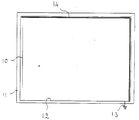
- electronic circuits on a circuit board 10 are housed in a housing 11.
- the walls of the housing are formed of mouldings of synthetic plastics material, such synthetic plastics material being substantially electrically non-conductive.
- Electrical screening is provided by a layer 12 of paint loaded with electrically conductive particles deposited, for example by a conventional paint spray gun.
- the layer of paint makes electrical contact with an electrical ground terminal 13.
- Such a layer has a relatively low electrical resistance and is effective to provide protection against electromagnetic radiation for electronic circuits such as those on the circuit board 10 housed within the walls of the housing 11.
- the electrical resistance of the paint layer may be insufficiently low to ensure that the discharge is conducted wholly to the ground terminal 13.
- the high potential discharge may partially discharge to the circuits on the circuit board or elsewhere in the housing or the potential difference between regions of the layer and the ground potential may be sufficiently high as to result in secondary discharges. These secondary discharges may discharge to the circuits or may create interference signals which cause malfunctioning of the circuits.
- high electrical conductivity paths 14 are provided. These paths 14 make electrical connection with regions of the paint layer and are connected to the ground terminal 13.
- the electrically conductive paths 14 provide low resistance, high conductivity, paths from regions of the paint layer to the ground terminal 13.
- the paths 14 may be formed of wires, foil strips or a wire mesh bonded to an interior surface of the walls of the housing and electrically connected directly to the ground terminal 13.
- a paint layer is then applied to the interior surface of the walls of the housing.
- the paint is loaded with conductive particles, for example of copper, and the layer of paint applied to the interior surface of the walls of the housing makes electrical contact with the electrical paths 14.
- the paths 14 may be applied generally over the interior of the entire walls of the housing or may be provided only to selected regions of the walls of the housing, such selected regions being at locations most susceptible to entry of high potential discharges into the housing.
- the paths may be formed by deposition of metallic material along predetermined tracks on the interior surfaces of the walls of the housing.
- the layer of paint loaded with conductive particles provides a continuous conductive screen effective to provide protection to the circuits in the housing against electromagnetic radiation and the conductive paths provide low resistance paths for electric current arising from high potential discharges directly to the conductive paths and in addition provide low resistance paths from regions of the paint layer adjacent the conductive paths. Hence electric currents arising from high potential discharges to those regions of the paint layer adjacent the conductive paths are provided with a relatively low resistance path to ground via the conductive paths.
Landscapes
- Engineering & Computer Science (AREA)
- Microelectronics & Electronic Packaging (AREA)
- Shielding Devices Or Components To Electric Or Magnetic Fields (AREA)
- Elimination Of Static Electricity (AREA)
Applications Claiming Priority (2)
| Application Number | Priority Date | Filing Date | Title |
|---|---|---|---|
| GB9401648 | 1994-01-28 | ||
| GB9401648A GB2286083B (en) | 1994-01-28 | 1994-01-28 | Electrical screening |
Publications (3)
| Publication Number | Publication Date |
|---|---|
| EP0665708A2 true EP0665708A2 (fr) | 1995-08-02 |
| EP0665708A3 EP0665708A3 (fr) | 1996-01-10 |
| EP0665708B1 EP0665708B1 (fr) | 1998-04-01 |
Family
ID=10749485
Family Applications (1)
| Application Number | Title | Priority Date | Filing Date |
|---|---|---|---|
| EP19950300537 Expired - Lifetime EP0665708B1 (fr) | 1994-01-28 | 1995-01-27 | Blindage électrique |
Country Status (3)
| Country | Link |
|---|---|
| EP (1) | EP0665708B1 (fr) |
| DE (1) | DE69501905T2 (fr) |
| GB (1) | GB2286083B (fr) |
Family Cites Families (3)
| Publication number | Priority date | Publication date | Assignee | Title |
|---|---|---|---|---|
| DE8913928U1 (de) * | 1989-11-25 | 1990-01-25 | Becker, Alfred, 5300 Bonn | Schutzvorrichtung gegen störende Einflüsse an Computern |
| FR2673496B1 (fr) * | 1991-02-28 | 1993-06-11 | Monetel | Coffret pour appareil d'interface ligne telephonique/liaison radio. |
| US5360941A (en) * | 1991-10-28 | 1994-11-01 | Cubic Automatic Revenue Collection Group | Magnetically permeable electrostatic shield |
-
1994
- 1994-01-28 GB GB9401648A patent/GB2286083B/en not_active Expired - Fee Related
-
1995
- 1995-01-27 EP EP19950300537 patent/EP0665708B1/fr not_active Expired - Lifetime
- 1995-01-27 DE DE1995601905 patent/DE69501905T2/de not_active Expired - Fee Related
Also Published As
| Publication number | Publication date |
|---|---|
| GB9401648D0 (en) | 1994-03-23 |
| EP0665708A3 (fr) | 1996-01-10 |
| EP0665708B1 (fr) | 1998-04-01 |
| GB2286083B (en) | 1997-10-08 |
| DE69501905D1 (de) | 1998-05-07 |
| GB2286083A (en) | 1995-08-02 |
| DE69501905T2 (de) | 1998-08-27 |
Similar Documents
| Publication | Publication Date | Title |
|---|---|---|
| US6717485B2 (en) | Interference signal decoupling using a board-level EMI shield that adheres to and conforms with printed circuit board component and board surfaces | |
| US6849800B2 (en) | Board-level conformal EMI shield having an electrically-conductive polymer coating over a thermally-conductive dielectric coating | |
| US4567317A (en) | EMI/RFI Protected enclosure | |
| US20050095410A1 (en) | Board-level conformal EMI shield having an electrically-conductive polymer coating over a thermally-conductive dielectric coating | |
| US5504659A (en) | Shielding structure | |
| US7008483B2 (en) | Curing printed circuit board coatings | |
| US20060152913A1 (en) | Method and apparatus for reducing electromagnetic emissions from electronic circuits | |
| US6743975B2 (en) | Low profile non-electrically-conductive component cover for encasing circuit board components to prevent direct contact of a conformal EMI shield | |
| EP0631460B1 (fr) | Circuit imprimé | |
| US5360941A (en) | Magnetically permeable electrostatic shield | |
| WO1995028822A1 (fr) | Blindage conformable et procede pour sa formation | |
| US8173911B2 (en) | Electronic package | |
| EP1178712B1 (fr) | Structure avec revêtement épousant les formes en polymère mélangé à résistance contrôlée | |
| US5350594A (en) | Conformally coated faraday cage | |
| EP1311146A3 (fr) | Blindage électrique | |
| JP3336160B2 (ja) | 静電気放電および放送電波妨害に対する保護装置 | |
| EP0665708B1 (fr) | Blindage électrique | |
| US20020129971A1 (en) | Filler material and pretreatment of printed circuit board components to facilitate application of a conformal EMI shield | |
| US20010004557A1 (en) | Flat conductor ribbon cable | |
| US20080236883A1 (en) | Structures for implementing emi shielding for rigid cards and flexible circuits | |
| GB2253936A (en) | Shielded electrical conductor | |
| US6498292B2 (en) | Conductive coating arrangement | |
| US7248484B2 (en) | Electro-magnetic suppressive structure | |
| JPH0682890B2 (ja) | Emi対策用回路基板とその製造方法 | |
| US10694620B1 (en) | Method and apparatus for circuit board noise shielding and grounding |
Legal Events
| Date | Code | Title | Description |
|---|---|---|---|
| PUAI | Public reference made under article 153(3) epc to a published international application that has entered the european phase |
Free format text: ORIGINAL CODE: 0009012 |
|
| AK | Designated contracting states |
Kind code of ref document: A2 Designated state(s): CH DE FR GB LI |
|
| PUAL | Search report despatched |
Free format text: ORIGINAL CODE: 0009013 |
|
| AK | Designated contracting states |
Kind code of ref document: A3 Designated state(s): CH DE FR GB LI |
|
| 17P | Request for examination filed |
Effective date: 19960704 |
|
| GRAG | Despatch of communication of intention to grant |
Free format text: ORIGINAL CODE: EPIDOS AGRA |
|
| 17Q | First examination report despatched |
Effective date: 19970613 |
|
| GRAG | Despatch of communication of intention to grant |
Free format text: ORIGINAL CODE: EPIDOS AGRA |
|
| GRAH | Despatch of communication of intention to grant a patent |
Free format text: ORIGINAL CODE: EPIDOS IGRA |
|
| GRAH | Despatch of communication of intention to grant a patent |
Free format text: ORIGINAL CODE: EPIDOS IGRA |
|
| GRAA | (expected) grant |
Free format text: ORIGINAL CODE: 0009210 |
|
| AK | Designated contracting states |
Kind code of ref document: B1 Designated state(s): CH DE FR GB LI |
|
| REG | Reference to a national code |
Ref country code: CH Ref legal event code: NV Representative=s name: HEPP, WENGER & RYFFEL AG Ref country code: CH Ref legal event code: EP |
|
| ET | Fr: translation filed | ||
| REF | Corresponds to: |
Ref document number: 69501905 Country of ref document: DE Date of ref document: 19980507 |
|
| PLBE | No opposition filed within time limit |
Free format text: ORIGINAL CODE: 0009261 |
|
| STAA | Information on the status of an ep patent application or granted ep patent |
Free format text: STATUS: NO OPPOSITION FILED WITHIN TIME LIMIT |
|
| 26N | No opposition filed | ||
| REG | Reference to a national code |
Ref country code: GB Ref legal event code: IF02 |
|
| PGFP | Annual fee paid to national office [announced via postgrant information from national office to epo] |
Ref country code: CH Payment date: 20060113 Year of fee payment: 12 |
|
| PG25 | Lapsed in a contracting state [announced via postgrant information from national office to epo] |
Ref country code: LI Free format text: LAPSE BECAUSE OF NON-PAYMENT OF DUE FEES Effective date: 20070131 Ref country code: CH Free format text: LAPSE BECAUSE OF NON-PAYMENT OF DUE FEES Effective date: 20070131 |
|
| REG | Reference to a national code |
Ref country code: CH Ref legal event code: PL |
|
| PGFP | Annual fee paid to national office [announced via postgrant information from national office to epo] |
Ref country code: DE Payment date: 20090122 Year of fee payment: 15 |
|
| PGFP | Annual fee paid to national office [announced via postgrant information from national office to epo] |
Ref country code: GB Payment date: 20090122 Year of fee payment: 15 |
|
| PGFP | Annual fee paid to national office [announced via postgrant information from national office to epo] |
Ref country code: FR Payment date: 20090115 Year of fee payment: 15 |
|
| GBPC | Gb: european patent ceased through non-payment of renewal fee |
Effective date: 20100127 |
|
| REG | Reference to a national code |
Ref country code: FR Ref legal event code: ST Effective date: 20100930 |
|
| PG25 | Lapsed in a contracting state [announced via postgrant information from national office to epo] |
Ref country code: FR Free format text: LAPSE BECAUSE OF NON-PAYMENT OF DUE FEES Effective date: 20100201 |
|
| PG25 | Lapsed in a contracting state [announced via postgrant information from national office to epo] |
Ref country code: DE Free format text: LAPSE BECAUSE OF NON-PAYMENT OF DUE FEES Effective date: 20100803 |
|
| PG25 | Lapsed in a contracting state [announced via postgrant information from national office to epo] |
Ref country code: GB Free format text: LAPSE BECAUSE OF NON-PAYMENT OF DUE FEES Effective date: 20100127 |