EP0666272B1 - Amidons modifiés par des amino-polycarboxylates - Google Patents
Amidons modifiés par des amino-polycarboxylates Download PDFInfo
- Publication number
- EP0666272B1 EP0666272B1 EP95100270A EP95100270A EP0666272B1 EP 0666272 B1 EP0666272 B1 EP 0666272B1 EP 95100270 A EP95100270 A EP 95100270A EP 95100270 A EP95100270 A EP 95100270A EP 0666272 B1 EP0666272 B1 EP 0666272B1
- Authority
- EP
- European Patent Office
- Prior art keywords
- starch
- ether derivative
- starch ether
- pulp
- added
- Prior art date
- Legal status (The legal status is an assumption and is not a legal conclusion. Google has not performed a legal analysis and makes no representation as to the accuracy of the status listed.)
- Expired - Lifetime
Links
- 0 *C(C(*)NC(*)C(*)C(O)=O)C(O)=O Chemical compound *C(C(*)NC(*)C(*)C(O)=O)C(O)=O 0.000 description 2
Classifications
-
- C—CHEMISTRY; METALLURGY
- C07—ORGANIC CHEMISTRY
- C07C—ACYCLIC OR CARBOCYCLIC COMPOUNDS
- C07C229/00—Compounds containing amino and carboxyl groups bound to the same carbon skeleton
- C07C229/02—Compounds containing amino and carboxyl groups bound to the same carbon skeleton having amino and carboxyl groups bound to acyclic carbon atoms of the same carbon skeleton
- C07C229/04—Compounds containing amino and carboxyl groups bound to the same carbon skeleton having amino and carboxyl groups bound to acyclic carbon atoms of the same carbon skeleton the carbon skeleton being acyclic and saturated
- C07C229/24—Compounds containing amino and carboxyl groups bound to the same carbon skeleton having amino and carboxyl groups bound to acyclic carbon atoms of the same carbon skeleton the carbon skeleton being acyclic and saturated having more than one carboxyl group bound to the carbon skeleton, e.g. aspartic acid
-
- C—CHEMISTRY; METALLURGY
- C07—ORGANIC CHEMISTRY
- C07C—ACYCLIC OR CARBOCYCLIC COMPOUNDS
- C07C229/00—Compounds containing amino and carboxyl groups bound to the same carbon skeleton
- C07C229/02—Compounds containing amino and carboxyl groups bound to the same carbon skeleton having amino and carboxyl groups bound to acyclic carbon atoms of the same carbon skeleton
- C07C229/04—Compounds containing amino and carboxyl groups bound to the same carbon skeleton having amino and carboxyl groups bound to acyclic carbon atoms of the same carbon skeleton the carbon skeleton being acyclic and saturated
- C07C229/06—Compounds containing amino and carboxyl groups bound to the same carbon skeleton having amino and carboxyl groups bound to acyclic carbon atoms of the same carbon skeleton the carbon skeleton being acyclic and saturated having only one amino and one carboxyl group bound to the carbon skeleton
- C07C229/10—Compounds containing amino and carboxyl groups bound to the same carbon skeleton having amino and carboxyl groups bound to acyclic carbon atoms of the same carbon skeleton the carbon skeleton being acyclic and saturated having only one amino and one carboxyl group bound to the carbon skeleton the nitrogen atom of the amino group being further bound to acyclic carbon atoms or to carbon atoms of rings other than six-membered aromatic rings
- C07C229/16—Compounds containing amino and carboxyl groups bound to the same carbon skeleton having amino and carboxyl groups bound to acyclic carbon atoms of the same carbon skeleton the carbon skeleton being acyclic and saturated having only one amino and one carboxyl group bound to the carbon skeleton the nitrogen atom of the amino group being further bound to acyclic carbon atoms or to carbon atoms of rings other than six-membered aromatic rings to carbon atoms of hydrocarbon radicals substituted by amino or carboxyl groups, e.g. ethylenediamine-tetra-acetic acid, iminodiacetic acids
-
- C—CHEMISTRY; METALLURGY
- C08—ORGANIC MACROMOLECULAR COMPOUNDS; THEIR PREPARATION OR CHEMICAL WORKING-UP; COMPOSITIONS BASED THEREON
- C08B—POLYSACCHARIDES; DERIVATIVES THEREOF
- C08B31/00—Preparation of derivatives of starch
- C08B31/08—Ethers
- C08B31/12—Ethers having alkyl or cycloalkyl radicals substituted by heteroatoms, e.g. hydroxyalkyl or carboxyalkyl starch
- C08B31/125—Ethers having alkyl or cycloalkyl radicals substituted by heteroatoms, e.g. hydroxyalkyl or carboxyalkyl starch having a substituent containing at least one nitrogen atom, e.g. cationic starch
-
- D—TEXTILES; PAPER
- D21—PAPER-MAKING; PRODUCTION OF CELLULOSE
- D21H—PULP COMPOSITIONS; PREPARATION THEREOF NOT COVERED BY SUBCLASSES D21C OR D21D; IMPREGNATING OR COATING OF PAPER; TREATMENT OF FINISHED PAPER NOT COVERED BY CLASS B31 OR SUBCLASS D21G; PAPER NOT OTHERWISE PROVIDED FOR
- D21H17/00—Non-fibrous material added to the pulp, characterised by its constitution; Paper-impregnating material characterised by its constitution
- D21H17/20—Macromolecular organic compounds
- D21H17/21—Macromolecular organic compounds of natural origin; Derivatives thereof
- D21H17/24—Polysaccharides
- D21H17/28—Starch
-
- D—TEXTILES; PAPER
- D21—PAPER-MAKING; PRODUCTION OF CELLULOSE
- D21H—PULP COMPOSITIONS; PREPARATION THEREOF NOT COVERED BY SUBCLASSES D21C OR D21D; IMPREGNATING OR COATING OF PAPER; TREATMENT OF FINISHED PAPER NOT COVERED BY CLASS B31 OR SUBCLASS D21G; PAPER NOT OTHERWISE PROVIDED FOR
- D21H17/00—Non-fibrous material added to the pulp, characterised by its constitution; Paper-impregnating material characterised by its constitution
- D21H17/20—Macromolecular organic compounds
- D21H17/33—Synthetic macromolecular compounds
- D21H17/46—Synthetic macromolecular compounds obtained otherwise than by reactions only involving carbon-to-carbon unsaturated bonds
- D21H17/54—Synthetic macromolecular compounds obtained otherwise than by reactions only involving carbon-to-carbon unsaturated bonds obtained by reactions forming in the main chain of the macromolecule a linkage containing nitrogen
- D21H17/55—Polyamides; Polyaminoamides; Polyester-amides
Definitions
- This invention relates to novel modified starches and particularly amino-multicarboxylate starch derivatives and reagents used in the preparation thereof.
- amphoteric starch ether derivatives It is further known to add both cationic and anionic substituent groups to starch to form amphoteric starch ether derivatives.
- Typical prior art methods involve either an "in situ" formation of the amphoteric starch ether derivatives by simultaneous reaction of two different chemical modifying agents with the starch as described in U.S. Patent Nos. 3,459,632 and 4,119,487 or a multi-step procedure where the chemical modifications of the starch are carried out in sequence as described in U.S. Patent No. 3,751,422.
- novel starch derivatives of this invention contain amino-multicarboxylate groups as the amphoteric or zwitterion substituent group.
- amino-multicarboxylate starch derivatives possess different charge ratios and exhibit properties making them especially useful in papermaking as retention and strength aids and as metal chelating agents.
- zwitterion starch derivatives with multicarboxylate groups having the following structure: - or - wherein
- starch derivatives (I) and (Ia) were prepared by reacting starch with selective amino-multicarboxylic acid reagents having the following formula: - or - where
- the reagents (II) and (IIa) were provided by the reaction of selected esters such as alkyl acrylates with aminoalcohols followed by halogenation such as chlorination with thionyl chloride and hydrolysis.
- reagents (II) or (IIa). These reagents are prepared by a Michael reaction between an aminoalcohol and a selected ester containing an activated olefin followed by halogenation with any halide and more particularly chlorination or bromination with chlorination being preferred.
- the chlorination may be carried out using chloride ccmpounds such as thionyl chloride or phosphorus oxychloride. Purification such as by steam stripping or recrystallization from isopropanol or other suitable solvents may be employed, if desired, to improve the purity of the reagent and increase the efficiency of the subsequent starch reaction.
- the above noted reaction scheme in preparing the reagent (II) is illustrated below where ethanolamine is reacted with methyl acrylate followed by chlorination with thionyl chloride and hydrolysis to provide the aminodicarboxyl containing reagent, 2-chloroethylaminodipropionic acid:
- the aminoalcohol used in preparing the multicarboxylic acid reagent (II) or (IIa) will generally have the formula where R is H or alkyl of 1 to 18, preferably 1 to 8 carbon atoms, n is 2 or 3, and the olefin containing ester will be any such ester, for example, alkyl acrylates, alkyl methacrylates or alkyl crotonates and more particularly will have the formula: where R is H or CH 3 , R' is H or CH 3 and R" is alkyl, and more particular, methyl, ethyl or propyl. Diesters of olefin containing esters, e
- the formation of the zwitterion starch derivative (I) or (Ia) involves reacting the selected multicarboxylate reagent (II) or (IIa) with a starch base in an aqueous medium using either an aqueous slurry or an aqueous dispersion of the starch base.
- the reaction is carried out under alkaline conditions at a pH of from about 9.5 to 13, more particularly from about 11 to 12.5 and preferably from about 11.4 to 12.4.
- the pH is conveniently controlled by the periodic addition of a dilute aqueous solution of sodium hydroxide or other common base including potassium hydroxide, calcium hydroxide, sodium carbonate, ammonium hydroxide, tetramethylammonium hydroxide, etc.
- the preferred bases are sodium and calcium hydroxide.
- the reaction is carried out at a temperature of from about 10 to 95°C, preferably from about 20 to 50°C. It will be recognized that the use of temperatures above about 60°C with granular starches in an aqueous medium will result in granule swelling and filtration difficulties or gelatinization of the starch.
- salts e.g., sodium sulfate
- sodium sulfate acts to suppress swelling of the starch and gives a more filterable product.
- the sodium sulfate does not have to be used in the calcium hydroxide reactions
- the amount of zwitterion multicarboxylate reagent (II) or (IIa) to be employed in the reaction will vary from about 0.1 to 100% by weight, based on the weight of dry starch, and depending on such factors as the starch base used, the particular multicarboxylate reagent used, the degree of substitution required in the end product, and to some extent, the reaction conditions used.
- the preferred amount of reagent to be used when preparing the zwitterion starch ether derivative containing amino-multicarboxylate groups is about 0.3 to 10% by weight for granular starches and about 15 to 75% by weight for non-granular starches.
- the multicarboxylate reagent may be added to the reaction mixture as a solid or an aqueous solution.
- the preferred concentration of the solution is 20 to 50% by weight, based on the weight of the reagent.
- the carboxylate reagent solution is brought to the desired alkaline pH prior to its addition to the starch base.
- the reagent is in the form of a salt rather than an acid or partially neutralized acid when it is introduced to the reaction mixture.
- dry starch may be added to an alkaline solution of the carboxylate.
- Reaction time will vary from about 0.2 to 24 hours depending on such factors as the amount, stability and reactivity of the multicarboxylate reagent employed, the temperature, pH, the scale of reaction and the degree of substitution desired. In general, the preferred range of reaction time is from about 1 to 16 hours.
- the pH of the reaction mixture is adjusted to from about 3 to 9 with any commercial acid such as hydrochloric acid, sulfuric acid, acetic acid, etc. Such acids may be conventionally added as a dilute aqueous solution.
- the carboxyl group can be present as either the carboxylic acid or the corresponding salt.
- the cation M as found in starch derivatives (I) and (Ia) can be any cation and more particularly hydrogen, an alkali metal, an alkaline earth metal or ammonium. In the case of a multi-valent cation, e.g., calcium, the structure of the derivative could be cyclic.
- a granular starch is recovered by filtration, optionally washed with water to remove any residual salts, and dried.
- the granular starch products may also be drum-dried, spray-dried, or gelatinized and isolated by alcohol precipitation or freeze drying to form non-granular products (i.e., gelatinized). If the starch product is non-granular, it may be purified by dialysis to remove residual salts and isolated by alcohol precipitation, freeze drying, or spray drying.
- the applicable starch bases which may be used in preparing the starch ether derivatives herein may be derived from any plant source including corn, potato, sweet potato, wheat, rice, sago, tapioca, waxy maize, sorghum, high amylose corn, or the like. Also included are the conversion products derived from any of the latter bases including, for example, dextrins, prepared by the hydrolysis of acid and/or heat; oxidized starches prepared by treatment with oxidants such as sodium hypochlorite; fluidity or thin-boiling starches prepared by enzyme conversion or mild acid hydrolysis; and derivatized starches such as ethers and esters. Starch esters will undergo hydrolysis when exposed to reaction conditions needed to prepare starch ethers.
- the intermediate starch ether can be directly esterified or isolated and purified prior to esterification.
- the starch base may be a granular starch or a gelatinized starch, i.e., non-granular starch.
- the preferred starch derivatives (I) and (Ia) of this invention as described above, are those wherein R, R', and R'' are hydrogen, M is hydrogen and n is 2 and more particularly those having the structure (I).
- the starch base and the resulting starch derivatives may be further derivatized or modified with other groups such as cationic groups which are known and used in the paper industry.
- Particularly useful cationic starches are the tertiary aminoalkyl starch ethers such as 2-diethylaminoethyl chloride and quaternary ammonium starch ethers such as 2,3-epoxypropltrimethylammonium chloride.
- the novel starch ether derivatives of this invention may be used as wet end additives in papermaking and particularly are useful in providing strength and pigment retention properties.
- the term "paper,” as used herein, includes sheet-like masses and molded products made from fibrous cellulosic material, which may be derived from natural sources, synthetics such as polyamides, polyesters, rayon and polyacrylic resins as well as from mineral fibers such as asbestos and glass. In addition, paper made from combinations of cellulosic and synthetic materials are applicable herein. Paperboard is also included within the broad term "paper”.
- Papermaking is a process of introducing an aqueous slurry of pulp or wood cellulosic fibers (which have been beaten or refined to achieve a level of fiber hydration and to which a variety of functional additives can be added) onto a screen or similar device in such a manner that the water is removed, thereby forming a sheet of the consolidated fibers, which upon pressing and drying can be processed into dry roll or sheet form.
- Two well known papermaking operations involve the Fourdrinier machine, the most common, and the cylinder machine.
- the feed or inlet to the machine is an aqueous slurry or water suspension of pulp fibers which is provided from what is called the "wet end" system.
- the pulp along with other additives are mixed in an aqueous slurry and subject to mechanical and other operations such as beating and refining to improve interfiber bonding and other physical properties of the finished sheet.
- Additives commonly introduced along with the pulp fibers are pigments such as titanium dioxide, mineral fillers such as clay and calcium carbonate and other materials introduced into paper to achieve such properties as improved brightness, opacity, smoothness, ink receptivity, fire retardance, water resistance, increased bulk, etc.
- the structure of the zwitterion starch derivatives will vary depending upon the pH of the solution and upon the cations present in the paper pulp. Therefore, the exact structure of the modified starch in the paper pulp may be complex and it may contain the same or different cations and one or more different cations depending upon the valence of the cations present.
- starch derivatives described herein are used in their dispersed (i.e., cooked) form mainly as beater additives, although their addition to the pulp may occur at any point in the paper-making process prior to the ultimate conversion of the wet pulp into a dry web or sheet. Thus, for example, they may be added to the pulp while the latter is in the headbox, beater, hydropulper or stock chest.
- the starch derivatives (I) used as pigment retention aids and otherwise in papermaking may be effectively used for addition to pulp prepared from any types of cellulosic fibers, synthetic fibers, or combinations thereof.
- cellulosic materials which may be used are bleached and unbleached sulfate (kraft), bleached and unbleached sulfite, bleached and unbleached soda, neutral sulfite, semi-chemical chemi-ground wood, ground wood or any combination of these fibers. Fibers of the viscous rayon or regenerated cellulose type may also be used if desired.
- any desired inert mineral fillers may be added to the pulp which is to be modified with the starch derivatives herein.
- Such materials include clay, titanium dioxide, talc, calcium carbonate, calcium sulfate and diatomaceous earths. Rosin or synthetic internal size may also be present, if desired.
- the proportion of the starch derivative to be incorporated into the paper pulp may vary in accordance with the particular pulp involved. In general, it is preferred to use about 0.01 to 5% and preferably about 0.05 to 2% of the starch ether derivative, based on the dry weight of the pulp. Within this preferred range the precise amount which is used will depend upon the type of pulp being used, the specific operating conditions, and the particular end use for which the paper is intended. The use of amounts of starch derivative greater than 2%, based on the dry weight of the pulp, is not precluded, but is ordinarily unnecessary in order to achieve the desired improvements. When added in the proper concentrations, the starch ether derivatives herein serve to increase pigment retention, improve drainage, and increase strength.
- One particularly useful additive which may be used with the starch derivatives of this invention is Kymene® a cationic poly(aminoamide)-epichlorohydrin resin product available from Hercules, Inc. This product may generally be used with the starch derivatives of this invention in effective amounts and more particularly from about 0.01 to 10% by weight, based on the dry weight of pulp.
- colloidal inorganic minerals may be added to the system to form an alkaline microparticle system.
- microparticle systems include colloidal silica, bentonite and anionic alum and may be incorporated into the system in amounts of at least 0.001% and more particularly from about 0.001 to 5% and preferably from about 0.01 to 1% by weight based on the weight of dry pulp. Further description of such microparticle inorganic materials may be found in U.S. Patent Nos. 4,388,150 issued June 14, 1983; 4,643,801 issued February 17, 1987; 4,753,710 issued June 28, '988 and 4,913,775 issued April 3, 1990.
- starch derivatives of this invention are also useful as complexing or chelating agents for various ions such as copper and calcium.
- This example illustrates the preparation of an amino-multicarboxylic acid reagent, i.e., 2-chloroethylaminodipropionic acid.
- the addition funnel was charged with 183.4 ml (2.50 mole) of SOCl 2 and added to the reaction with cooling, maintaining the temperature below 20°C. When complete, the reaction was heated to 80 to 90°C and held for 2 hours. When the reaction had been cooled to less than 30°C, approximately 75 ml of water was added to destroy any residual thionyl chloride and liberate the free acid. The water and other volatiles were removed under vacuum and the product purified by precipitation into isopropanol. The product and intermediate had the expected NMR's and chlorine analysis showed 13.57 percent organic chlorine (98.7 percent of theoretical).
- This example illustrates the procedure for the preparation of starch modified with amino-multicarboxylic acid reagents.
- a constant temperature bath was preheated to 40°C.
- a total of 750 ml of water was added to a half gallon jar equipped with a mechanical stirrer, 200 g of sodium sulfate and 15 g of sodium hydroxide was dissolved in the solution.
- 500 g of waxy corn starch was added quickly with good agitation.
- a total of 20 g of the 2-chloroethylaminodipropionic acid reagent prepared in Example I was added to the reaction and the pH checked to verify that it was over 11.6.
- the reaction vessel was then placed into the bath and stirred for 24 hours.
- the reaction was then cooled to room temperature and the pH of the slurry adjusted to approximately 7.0 with dilute HCl.
- the starch was then filtered through Whatman #1 filter paper and the cake was washed three times with 750 ml of water and allowed to air dry to 15 percent moisture. Analysis of the starch for bound nitrogen showed 0.204% nitrogen (dry basis), indicating that the starch had been modified with the aminodicarboxylic acid functionality.
- This example further illustrates the preparation of an amino-multicarboxylate acid reagent, i.e., 2-chloroethylaminodipropionic acid.
- Toluene 70 ml; 0.66 mole was added to a 250 ml 3-neck round bottom flask and thionyl chloride (22.3 ml; 0.31 mole) added.
- the 2-hydroxyethylaminodiethyl ester (prepared as noted above) was then charged to an equalizing addition funnel and added dropwise to the flask over approximately 90 minutes.
- the temperature was kept low during this phase by use of an ice-water bath (12 to 20°C). After complete addition, the ice-bath was removed and the reaction stirred for 30 minutes. The temperature was then raised to 85°C for 3 hours in a hot oil bath and the flask then cooled to room temperature.
- Deionized water (25 ml) was added to the flask to quench any remaining thionyl chloride.
- a condenser with collection flask was fitted to the flask along with an inlet for the addition of live steam.
- the flask was heated to approximately 80°C and the product steam distilled for 30 to 60 minutes.
- the steam line was removed and the flask cooled to room temperature giving a reaction volume of approximately 200 ml.
- the aqueous product was then concentrated in vacuo to approximately 100 ml to remove any residual alcohol.
- Deionized water ( ⁇ 100 ml) was added in order to give an aqueous solution containing approximately 30% solids and 25% active Cl.
- the product structure was confirmed by C-13 NMR.
- This example illustrates the procedure for the preparation of starch modified with amino-multicarboxylic acid reagent using the reagent of Example III, i.e., 2-chloroethylaminodipropionic acid.
- This example further illustrates the preparation of an aminomulticarboxylate acid reagent, i.e., 2-chloroethyl, N-methylaminosuccinic acid.
- This example illustrates the use of amino-multicarboxylic acid starch derivatives for chelation of metal ions from aqueous solution.
- a stock solution of 0.1 molar copper (II) nitrate was prepared by dissolving 18.7 g of copper nitrate monohydrate into 981.3 ml of water. A total of 10 ml of this solution was placed into a 50 ml beaker and 5 g of the modified starch derivative of Example II was added and stirred for 30 seconds. When the starch had settled, it had absorbed the blue color of the copper. When compared to the blank (unmodified waxy corn starch) a significant difference in color of the starch and supernatant was noted. This experiment suggests the ability of the amino-multicarboxylic acid containing starches to absorb metal ions such as copper from solution.
- This example illustrates the papermaking application of starches modified with amino-multicarboxylic acids.
- Samples of amino-multicarboxylic acid starch derivatives of Example II as well as comparison waxy maize and cationic waxy maize samples were prepared for testing in accordance with Tappi T494 method 1982 ("Tensile Breaking Properties of Paper and Paperboard" using constant rate of elongation apparatus).
- a total of 1.0 g of the respective starch was dissolved in 99.0 g of water and the pH adjusted to 5.0 using hydrochloric acid or sodium hydroxide.
- the mixture was cooked in a boiling water bath for a total of 30 minutes with stirring for the first three minutes.
- the starch was then cooled and added to the pulp in the head box at the rate of 1.0 percent starch based on the dry weight of the paper or pulp.
- This example illustrates the use of amino-multicarboxylic acid starch derivatives in microparticle wet end papermaking systems.
- samples of cationic (quaternary; 0.3% N) potato starch and its amino-multicarboxylic acid starch derivative (2% treatment of reagent prepared in Example III) were prepared for testing for first pass retention (FPR), fiber fines retention, calcium carbonate retention and total fines retention in accordance with Dynamic Alkaline Retention Evaluation, Tappi T 26-pm 79 using a Britt Jar.
- FPR first pass retention
- fiber fines retention fiber fines retention
- calcium carbonate retention calcium carbonate retention
- total fines retention in accordance with Dynamic Alkaline Retention Evaluation
- a 500 ml sample of standard pulp stock comprised of bleached hardwood kraft pulp (BHWK) and bleached softwood kraft pulp (BSWK) with 80:20 BHWK:BSWK, % by weight, (70% fiber and 30% calcium carbonate) was added to a Britt Jar and the pH adjusted 7.8 with dilute HCl. While stirring at 400 rpm, alum 5 lb/ton (0.25%) was added. After 20 seconds the stirring rate was increased to 2,000 rpm and after 10 seconds the starch derivative, 15 lb/ton (0.75%) was added and mixing continued for another 30 seconds.
- This example further illustrates the papermaking application of amino-multicarboxylic acid starch derivatives in combination with Kymene-557, a cationic poly(aminoamide)-epichlorohydrin resin product known as a wet strength paper additive and available from Hercules.
Landscapes
- Chemical & Material Sciences (AREA)
- Organic Chemistry (AREA)
- Chemical Kinetics & Catalysis (AREA)
- Life Sciences & Earth Sciences (AREA)
- Engineering & Computer Science (AREA)
- Biochemistry (AREA)
- Materials Engineering (AREA)
- Health & Medical Sciences (AREA)
- Medicinal Chemistry (AREA)
- Polymers & Plastics (AREA)
- Polysaccharides And Polysaccharide Derivatives (AREA)
- Paper (AREA)
Claims (14)
- Dérivé éther d'amidon, possédant la structure :

 St-O représente une molécule d'amidon,R représente H ou le groupe CH3 ;R' représente H, le groupe CH3 ou COOH ;M est un cation ;n a la valeur 2 ou 3 ; etR" représente H ou un groupe alkyle ayant 1 à 18 atomes de carbone.
 - Dérivé éther d'amidon suivant la revendication 1, dans lequel chacun de R, R' et R" représente de l'hydrogène et M est de l'hydrogène.
- Dérivé éther d'amidon suivant la revendication 2, dans lequel n et égal à 2.
- Dérivé éther d'amidon suivant la revendication 3, possédant la structure (I).
- Composé possédant la structure :
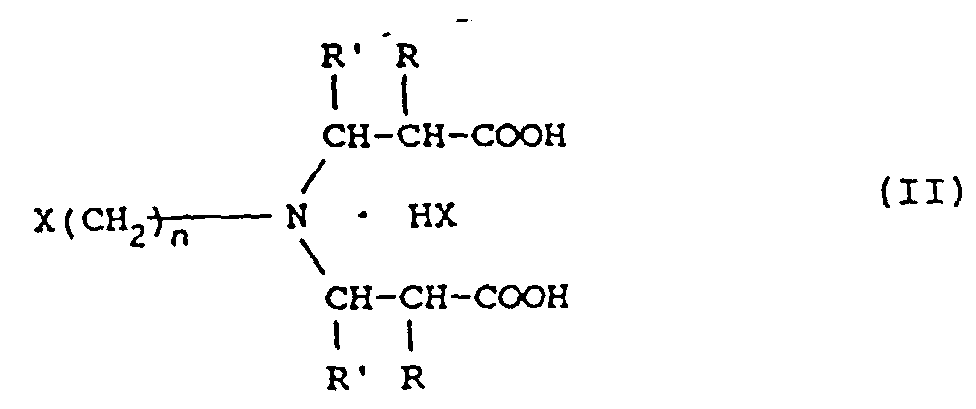
 R représente H ou un groupe CH3 ;R' représente H, un groupe CH3 ou COOH ;n a la valeur 2 ou 3 ; etR" représente H ou un groupe alkyle ayant 1 à 18 atomes de carbone.
 - Composé suivant la revendication 5, dans lequel chaque R, chaque R' et chaque R" représentent de l'hydrogène.
- Composé suivant la revendication 6, ayant la structure (II) dans laquelle X est du chlore et n est égal à 2.
- Procédé perfectionné de fabrication du papier, dans lequel le perfectionnement comprend l'addition du dérivé éther d'amidon modifié suivant la revendication 1 au papier raffiné à un stade quelconque avant la formation d'une bande.
- Procédé suivant la revendication 8, dans lequel le dérivé éther d'amidon présente la structure (I) dans laquelle chacun de R, R' et R" représente de l'hydrogène, M est de l'hydrogène et n a la valeur 2.
- Procédé suivant la revendication 8, dans lequel on utilise environ 0,01 à 5 % en poids du dérivé éther d'amidon sur la base du poids sec de pâte.
- Procédé suivant la revendication 8, qui comprend en outre l'addition d'un système alcalin en micro-particules contenant des substances minérales inorganiques colloïdales choisies dans le groupe consistant en silice, bentonite et alun anionique colloïdal, et dans lequel chacun de R, R' et R" est de l'hydrogène, M est de l'hydrogène et n est égal à 2 dans le dérivé éther d'amidon.
- Procédé suivant la revendication 11, dans lequel le dérivé éther d'amidon a la structure (I) et est ajouté en une quantité d'environ 0,01 à 5 % en poids, sur la base du poids sec de pâte et une proportion d'environ 0,001 à 5 % en poids de la substance minérale inorganique colloïdale est ajoutée, sur la base du poids sec de pâte.
- Procédé suivant la revendication 8, dans lequel un produit formé de résine poly(amino-amide)-épichlorhydrine est en outre ajouté à la pâte raffinée.
- Papier produit suivant l'une quelconque des revendications précédentes de procédé.
Applications Claiming Priority (2)
| Application Number | Priority Date | Filing Date | Title |
|---|---|---|---|
| US190824 | 1994-02-02 | ||
| US08/190,824 US5455340A (en) | 1994-02-02 | 1994-02-02 | Starches modified with amino-multicarboxylates |
Publications (2)
| Publication Number | Publication Date |
|---|---|
| EP0666272A1 EP0666272A1 (fr) | 1995-08-09 |
| EP0666272B1 true EP0666272B1 (fr) | 1997-11-12 |
Family
ID=22702952
Family Applications (1)
| Application Number | Title | Priority Date | Filing Date |
|---|---|---|---|
| EP95100270A Expired - Lifetime EP0666272B1 (fr) | 1994-02-02 | 1995-01-10 | Amidons modifiés par des amino-polycarboxylates |
Country Status (5)
| Country | Link |
|---|---|
| US (2) | US5455340A (fr) |
| EP (1) | EP0666272B1 (fr) |
| JP (1) | JP3222715B2 (fr) |
| CA (1) | CA2141826C (fr) |
| DE (1) | DE69501001T2 (fr) |
Families Citing this family (72)
| Publication number | Priority date | Publication date | Assignee | Title |
|---|---|---|---|---|
| SE504641C2 (sv) * | 1995-07-17 | 1997-03-24 | Sveriges Staerkelseproducenter | Användning av stärkelse av amylopektintyp som ytbehandlingsmedel vid papperstillverkning |
| DE19630428A1 (de) * | 1996-07-27 | 1998-01-29 | Suedstaerke Gmbh | Stärkederivate und deren Verwendung |
| US6296696B1 (en) | 1998-12-15 | 2001-10-02 | National Starch & Chemical Investment Holding Corporation | One-pass method for preparing paper size emulsions |
| US6413372B1 (en) * | 1999-04-20 | 2002-07-02 | National Starch And Chemical Investment Holding Corporation | Starch polymer combinations used in papermaking |
| US6262299B1 (en) * | 1999-07-06 | 2001-07-17 | National Starch And Chemical Investment Holding Corporation | Zwitterionic monomer having amino-multicarboxylic acid functionality |
| FR2803745B1 (fr) * | 2000-01-13 | 2002-03-15 | Oreal | Compositions cosmetiques contenant un amidon amphotere et un agent conditionneur cationique et leurs utilisations |
| FR2819403B1 (fr) * | 2001-01-12 | 2004-10-15 | Oreal | Compositions cosmetiques contenant un fructane, un polysaccharide et un agent benefique et leurs utilisations |
| FR2833599B1 (fr) * | 2001-12-18 | 2004-01-30 | Oreal | Polysaccharide amphotere, composition et utilisation |
| JP5122821B2 (ja) | 2003-11-28 | 2013-01-16 | イーストマン ケミカル カンパニー | セルロースインターポリマー及び酸化方法 |
| FR2881954B1 (fr) | 2005-02-11 | 2007-03-30 | Oreal | Composition cosmetique comprenant un cation, un polymere cationique, un compose solide et un amidon et procede de traitement cosmetique |
| FR2903017B1 (fr) * | 2006-06-30 | 2010-08-13 | Oreal | Compositions cosmetiques contenant un amidon et un diester gras de peg et leurs utilisations |
| FR2920978B1 (fr) | 2007-09-14 | 2012-04-27 | Oreal | Composition cosmetique comprenant un copolymere cationique et un amidon et procede de traitement cosmetique. |
| FR2940102B1 (fr) | 2008-12-19 | 2016-03-11 | Oreal | Composition de teinture d'oxydation des fibres keratiniques comprenant un corps gras, un epaississant et un precurseur de colorant d'oxydation |
| FR2940111B1 (fr) | 2008-12-19 | 2012-06-01 | Oreal | Kit de revetement des matieres keratiniques comprenant un polysaccharide et un agent de complexation ionique ou dative |
| FR2940115B1 (fr) | 2008-12-19 | 2012-06-15 | Oreal | Kit de revetement des matieres keratiniques comprenant un polysaccharide et un agent de reticulation chimique |
| FR2952533B1 (fr) | 2009-11-13 | 2012-01-13 | Oreal | Composition cosmetique pour le conditionnement des cheveux contenant un melange de particules creuses, d'amidon et de tensioactif cationique |
| FR2952537B1 (fr) | 2009-11-13 | 2012-04-13 | Oreal | Composition cosmetique comprenant un agent structurant, un agent absorbant et un tensioactif pour application sur les matieres keratiniques |
| FR2954108B1 (fr) | 2009-12-23 | 2012-03-09 | Oreal | Utilisation d'une composition cosmetique contenant un alcane lineaire volatil et un polymere associatif non ionique pour le conditionnement des cheveux |
| FR2954109B1 (fr) | 2009-12-23 | 2012-03-02 | Oreal | Utilisation pour le traitement cosmetique des fibres keratiniques d'alcane(s) lineaire(s) volatil(s), d'alcool(s) gras solide(s) et d'epaississant(s) polymerique(s) a motif sucres |
| FR2968944B1 (fr) | 2010-12-21 | 2013-07-12 | Oreal | Composition comprenant un sel de zinc non azote et un agent tensioactif cationique particulier |
| FR2968941B1 (fr) | 2010-12-21 | 2014-06-06 | Oreal | Composition cosmetique comprenant un sel de zinc particulier et un amidon |
| FR2975593B1 (fr) | 2011-05-27 | 2013-05-10 | Oreal | Composition comprenant un alcoxysilane et un amidon modifie et son utilisation en cosmetique |
| FR2983069B1 (fr) | 2011-11-25 | 2015-03-27 | Oreal | Composition cosmetique contenant une association d'un polysaccharide hydrosoluble gelifiable, d'amidon et de charges |
| FR2992176B1 (fr) | 2012-06-21 | 2016-07-01 | Oreal | Composition cosmetique des particules d'aerogel de silice hydrophobe et un polymere a motif sucre |
| FR3002448B1 (fr) | 2013-02-25 | 2015-04-03 | Oreal | Composition cosmetique de type gel |
| FR3002444B1 (fr) | 2013-02-25 | 2015-03-13 | Oreal | Composition cosmetique de type gel |
| FR3003464B1 (fr) | 2013-03-19 | 2016-02-12 | Oreal | Composition cosmetique comprenant des particules creuses ou poreuses, un monoalcool et un polymere epaississant, procedes de traitement cosmetique et utilisations |
| FR3004943B1 (fr) | 2013-04-26 | 2015-05-15 | Oreal | Composition comprenant du henne et/ou de l'indigo, une huile et un saccharide, et procede de coloration capillaire la mettant en œuvre |
| FR3008614B1 (fr) | 2013-07-19 | 2015-07-31 | Oreal | Composition de coloration comprenant un tensio actif amphotere particulier et un tensioactif sulfate |
| WO2015007916A1 (fr) | 2013-07-19 | 2015-01-22 | L'oreal | Composition de teinture comprenant un tensioactif amphotère spécifique et un polymère épaississant spécifique |
| EP3021826B1 (fr) | 2013-07-19 | 2018-01-17 | L'oreal | Omposition de colorant comprenant un tensioactif amphotère particulier et un tensioactif d'amide oxyéthyléné ou un tensioactif d'alcool gras oxyéthyléné comprenant moins de 10 unités oe ou un mélange de ces tensioactifs. |
| FR3013972B1 (fr) | 2013-12-02 | 2016-01-01 | Oreal | Composition comprenant au moins un polymere associatif anionique, au moins un polymere fixant anionique et au moins un amidon |
| FR3015231B1 (fr) | 2013-12-23 | 2017-02-24 | Oreal | Article de conditionnement comportant un enveloppe une composition colorante anhydre comprenant un colorant direct, utilisation et procede pour colorer les fibres keratiniques |
| FR3016288B1 (fr) | 2013-12-23 | 2016-09-09 | Oreal | Article de conditionnement comportant une enveloppe et une composition anhydre comprenant un agent oxydant |
| FR3015232B1 (fr) | 2013-12-23 | 2016-01-08 | Oreal | Article de conditionnement comportant un enveloppe une composition colorante anhydre comprenant un colorant d'oxydation, utilisation et procede pour colorer les fibres keratiniques |
| FR3024357B1 (fr) | 2014-08-01 | 2017-10-27 | Oreal | Composition comprenant un copolymere d'amps® et un precurseur de colorant d'oxydation et/ou un colorant direct |
| FR3025075A1 (fr) | 2014-08-28 | 2016-03-04 | Oreal | Nouveau dispositif de soin et/ou maquillage comprenant une composition d’architecture gel/gel |
| FR3025100B1 (fr) | 2014-08-28 | 2016-12-09 | Oreal | Composition cosmetique de type gel a tenue amelioree |
| US20170304658A1 (en) | 2014-08-28 | 2017-10-26 | L'oreal | Gel/gel composition comprising a uv-screening agent |
| FR3030230B1 (fr) | 2014-12-19 | 2018-07-06 | L'oreal | Procede de coloration a partir d'orthodiphenol |
| KR102090472B1 (ko) | 2015-05-12 | 2020-03-18 | 로레알 | 케라틴 섬유용 조성물 |
| FR3037795B1 (fr) | 2015-06-25 | 2018-08-17 | L'oreal | Article de conditionnement comportant une enveloppe et une composition colorante, decolorante ou oxydante anhydre comprenant une argile fibreuse, et un compose choisi parmi un agent colorant et/ou un agent oxydant ; utilisation et procede pour colorer et/ou decolorer les fibres keratiniques |
| EP3334400A1 (fr) | 2015-08-14 | 2018-06-20 | L'oreal | Composition cosmétique comprenant un tensioactif cationique, un alcool gras, un tensioactif amphotère, un dérivé d'amidon, et un polymère de conditionnement cationique |
| WO2018058208A1 (fr) | 2016-09-30 | 2018-04-05 | L'oreal | Compositions cosmétiques capillaires contenant des composés à base de thiol et procédés de lavage et de traitement des cheveux |
| FR3060360B1 (fr) | 2016-12-20 | 2019-05-24 | L'oreal | Composition solide anhydre pour la coloration des fibres keratiniques comprenant un polymere comprenant au moins un monomere heterocyclique vinylique |
| FR3060333B1 (fr) | 2016-12-20 | 2020-01-17 | L'oreal | Composition solide anhydre pour la coloration des fibres keratiniques comprenant un metabisulfite |
| BR112019010335B1 (pt) | 2016-12-29 | 2021-12-07 | L'oreal | Composição cosmética e métodos para tratar de forma cosmética o corpo, para conferir a capacidade de manuseio aos cabelos e para fabricar uma composição cosmética |
| FR3064472B1 (fr) | 2017-03-30 | 2019-06-21 | L'oreal | Composition nettoyante stable sous forme de mousse |
| FR3067934B1 (fr) | 2017-06-27 | 2019-08-09 | L'oreal | Composition gelifiee comprenant une dispersion d'agregats solides. |
| FR3067937B1 (fr) | 2017-06-27 | 2019-12-20 | L'oreal | Composition gel-gel comprenant une cire a l'etat cristallin. |
| FR3075053B1 (fr) | 2017-12-15 | 2020-07-10 | L'oreal | Composition de type gel/gel a base de pigments, d’au moins un dihydroxyalcane lineaire sature en c3-c8, d’acide salicylique sous forme libre |
| FR3079418B1 (fr) | 2018-03-30 | 2020-06-26 | L'oreal | Composition exfoliante anhydre comprenant des polyols en c3-c10 et des polysaccharides |
| JP2022534474A (ja) | 2019-04-30 | 2022-08-01 | ロレアル | 予め計測された粉末状のヘアブリーチの可溶性パッケージ |
| FR3117019B1 (fr) | 2020-12-03 | 2023-12-22 | Oreal | Composition solide anhydre comprenant une association de tensioactifs anioniques carboxylates et sulfonates, de tensioactifs cationiques et éventuellement de tensioactifs amphotères ou zwittérioniques |
| FR3117026B1 (fr) | 2020-12-03 | 2024-01-12 | Oreal | Composition solide anhydre comprenant une association de tensioactifs anioniques particuliers et au moins un polyol |
| FR3117021B1 (fr) | 2020-12-03 | 2024-04-26 | Oreal | Composition solide anhydre comprenant un tensioactif anionique et un mélange d’acide citrique et de bicarbonate |
| FR3117027A1 (fr) | 2020-12-03 | 2022-06-10 | L'oreal | Composition solide anhydre comprenant une association de tensioactifs anioniques de types sulfonate et carboxylate |
| FR3117028B1 (fr) | 2020-12-03 | 2024-01-12 | Oreal | Composition solide anhydre comprenant une association de tensioactifs anioniques et amphotères ou zwittérioniques et des sels d’acides gras |
| FR3117024B1 (fr) | 2020-12-03 | 2025-07-25 | Oreal | Composition solide anhydre comprenant une association de tensioactifs anioniques particuliers et au moins un polysaccharide cationique |
| FR3117020B1 (fr) | 2020-12-03 | 2023-12-22 | Oreal | Composition solide anhydre comprenant des tensioactifs carboxylates et amphotères ou zwittérioniques et des silicones |
| FR3117030B1 (fr) | 2020-12-03 | 2025-07-25 | Oreal | Composition solide anhydre comprenant une association de tensioactifs anioniques particuliers et au moins une charge organique polymérique |
| FR3117023B1 (fr) | 2020-12-03 | 2024-01-05 | Oreal | Composition solide anhydre comprenant l’association particulière d’un tensioactif sulfaté et d’un tensioactif amphotère |
| FR3117025B1 (fr) | 2020-12-03 | 2023-12-15 | Oreal | Composition solide anhydre comprenant une association de tensioactifs anioniques et amphotères ou zwittérioniques et un carbonate métallique |
| FR3122088B1 (fr) | 2021-04-21 | 2024-06-14 | Oreal | Composition changeant de couleur sous forme de gel aqueux |
| FR3141333B1 (fr) | 2022-10-26 | 2025-08-01 | Oreal | Article de conditionnement cosmétique comprenant une composition solide comprenant un amidon phosphaté |
| FR3141335B1 (fr) | 2022-10-26 | 2026-01-23 | Oreal | Composition solide comprenant un tensioactif cationique, un amidon, un polyol et un polymère cationique |
| FR3141336B1 (fr) | 2022-10-26 | 2025-08-01 | Oreal | Composition solide comprenant un tensioactif cationique, un amidon et une quantite specifique d’acide carboxylique en c1-6 |
| FR3141338B1 (fr) | 2022-10-26 | 2025-08-01 | Oreal | Composition solide comprenant un tensioactif cationique, un amidon, une silicone et un corps gras non siliconé |
| FR3141339B1 (fr) | 2022-10-26 | 2025-08-01 | Oreal | Composition solide comprenant un tensioactif cationique, deux amidons, un corps gras liquide et une quantite specifique d’eau |
| FR3141337B1 (fr) | 2022-10-26 | 2025-08-01 | Oreal | Composition solide comprenant un tensioactif cationique, un amidon, un tensioactif amphotere et un corps gras |
| CN116254723B (zh) * | 2023-02-01 | 2023-09-19 | 浙江景兴纸业股份有限公司 | 一种防潮耐污的瓦楞原纸及其制备方法 |
| FR3151761A1 (fr) | 2023-07-31 | 2025-02-07 | L'oreal | Composition cosmétique comprenant une association de charges |
Family Cites Families (10)
| Publication number | Priority date | Publication date | Assignee | Title |
|---|---|---|---|---|
| CA590176A (en) * | 1960-01-05 | F. Paschall Eugene | Starch ethers containing nitrogen and process for making the same | |
| NL134024C (fr) * | 1965-11-17 | 1900-01-01 | ||
| GB1310516A (en) * | 1969-07-08 | 1973-03-21 | Ici Ltd | Manufacture of pyridine derivatives |
| US3880832A (en) * | 1974-03-21 | 1975-04-29 | Nat Starch Chem Corp | Starch ether derivatives and preparation thereof |
| US4017460A (en) * | 1975-12-10 | 1977-04-12 | National Starch And Chemical Corporation | Novel starch ethers |
| US4119487A (en) * | 1977-09-06 | 1978-10-10 | National Starch & Chemical Corporation | Starch ether derivatives, a method for the preparation thereof and their use in paper |
| GB2016473B (en) * | 1979-03-06 | 1982-09-02 | Sumitomo Chemical Co | Cellulosic ion-exchange fibres |
| US4260738A (en) * | 1980-01-10 | 1981-04-07 | National Starch And Chemical Corporation | Novel starch ether derivatives, a method for the preparation thereof |
| US4243479A (en) * | 1979-08-15 | 1981-01-06 | National Starch And Chemical Corporation | Novel starch ether derivatives, a method for the preparation thereof and their use in paper |
| DE3509822A1 (de) * | 1985-03-19 | 1986-09-25 | Bayer Ag, 5090 Leverkusen | Aminobernsteinsaeurederivate und ihre verwendung als emulgatoren fuer polymerdispersionen |
-
1994
- 1994-02-02 US US08/190,824 patent/US5455340A/en not_active Expired - Lifetime
-
1995
- 1995-01-10 DE DE69501001T patent/DE69501001T2/de not_active Expired - Fee Related
- 1995-01-10 EP EP95100270A patent/EP0666272B1/fr not_active Expired - Lifetime
- 1995-02-02 JP JP01618295A patent/JP3222715B2/ja not_active Expired - Fee Related
- 1995-02-02 CA CA002141826A patent/CA2141826C/fr not_active Expired - Fee Related
- 1995-05-23 US US08/447,462 patent/US5500087A/en not_active Expired - Fee Related
Also Published As
| Publication number | Publication date |
|---|---|
| US5455340A (en) | 1995-10-03 |
| EP0666272A1 (fr) | 1995-08-09 |
| DE69501001T2 (de) | 1998-06-10 |
| JP3222715B2 (ja) | 2001-10-29 |
| JPH07278201A (ja) | 1995-10-24 |
| CA2141826A1 (fr) | 1995-08-03 |
| DE69501001D1 (de) | 1997-12-18 |
| CA2141826C (fr) | 1999-03-16 |
| US5500087A (en) | 1996-03-19 |
Similar Documents
| Publication | Publication Date | Title |
|---|---|---|
| EP0666272B1 (fr) | Amidons modifiés par des amino-polycarboxylates | |
| EP0603727B1 (fr) | Procédé de fabrication de papier utilisant des amidons réticulés cationiques/amphotères | |
| US4119487A (en) | Starch ether derivatives, a method for the preparation thereof and their use in paper | |
| US4066495A (en) | Method of making paper containing cationic starch and an anionic retention aid | |
| CA1147727A (fr) | Cationisation de l'amidon sans pollution | |
| CA1284639C (fr) | Amidons amphoteres, et leur preparation | |
| CA2373555C (fr) | Amidons servant a la fabrication du papier | |
| US2935436A (en) | Method of making paper containing a starch ether and product produced thereby | |
| US4029544A (en) | Method of making a novel starch derivative and the product produced thereby | |
| US6365002B1 (en) | Amphoteric starches used in papermaking | |
| JP5398844B2 (ja) | 製紙方法 | |
| JP2509739B2 (ja) | カチオン性ポリサッカライドおよびこれを製造するための試薬 | |
| US4276414A (en) | Novel zwitterion polygalactomannan ether derivatives and a method for the preparation thereof | |
| US4243479A (en) | Novel starch ether derivatives, a method for the preparation thereof and their use in paper | |
| JPS629121B2 (fr) | ||
| US4260738A (en) | Novel starch ether derivatives, a method for the preparation thereof | |
| US4964953A (en) | Amphoteric starches and process for their preparation | |
| US4992536A (en) | Preparation of polycationic polysaccharides by site selective reaction | |
| JPH10131082A (ja) | 定着性及び濾水性が改良された紙を製造する方法 | |
| US4297299A (en) | Novel N-(alkyl)-N-(2-haloethyl)-aminomethylphosphonic acids, a method for the preparation thereof and their use in the preparation of starch ether derivatives | |
| EP0025830B1 (fr) | Ethers de l'amidon, procédé pour leur préparation et leur utilisation dans le papier | |
| JPH0147599B2 (fr) | ||
| JPS6348301A (ja) | 改良された両性デンプンおよびそれらの製造方法 | |
| JPH0124161B2 (fr) |
Legal Events
| Date | Code | Title | Description |
|---|---|---|---|
| PUAI | Public reference made under article 153(3) epc to a published international application that has entered the european phase |
Free format text: ORIGINAL CODE: 0009012 |
|
| AK | Designated contracting states |
Kind code of ref document: A1 Designated state(s): DE FR GB IT SE |
|
| 17P | Request for examination filed |
Effective date: 19950706 |
|
| 17Q | First examination report despatched |
Effective date: 19960416 |
|
| GRAG | Despatch of communication of intention to grant |
Free format text: ORIGINAL CODE: EPIDOS AGRA |
|
| GRAH | Despatch of communication of intention to grant a patent |
Free format text: ORIGINAL CODE: EPIDOS IGRA |
|
| GRAH | Despatch of communication of intention to grant a patent |
Free format text: ORIGINAL CODE: EPIDOS IGRA |
|
| GRAA | (expected) grant |
Free format text: ORIGINAL CODE: 0009210 |
|
| AK | Designated contracting states |
Kind code of ref document: B1 Designated state(s): DE FR GB IT SE |
|
| REF | Corresponds to: |
Ref document number: 69501001 Country of ref document: DE Date of ref document: 19971218 |
|
| ITF | It: translation for a ep patent filed | ||
| ET | Fr: translation filed | ||
| PLBE | No opposition filed within time limit |
Free format text: ORIGINAL CODE: 0009261 |
|
| STAA | Information on the status of an ep patent application or granted ep patent |
Free format text: STATUS: NO OPPOSITION FILED WITHIN TIME LIMIT |
|
| 26N | No opposition filed | ||
| REG | Reference to a national code |
Ref country code: GB Ref legal event code: IF02 |
|
| PGFP | Annual fee paid to national office [announced via postgrant information from national office to epo] |
Ref country code: DE Payment date: 20030131 Year of fee payment: 9 |
|
| PG25 | Lapsed in a contracting state [announced via postgrant information from national office to epo] |
Ref country code: DE Free format text: LAPSE BECAUSE OF NON-PAYMENT OF DUE FEES Effective date: 20040803 |
|
| PGFP | Annual fee paid to national office [announced via postgrant information from national office to epo] |
Ref country code: SE Payment date: 20080107 Year of fee payment: 14 Ref country code: IT Payment date: 20080117 Year of fee payment: 14 |
|
| REG | Reference to a national code |
Ref country code: GB Ref legal event code: 732E |
|
| PGFP | Annual fee paid to national office [announced via postgrant information from national office to epo] |
Ref country code: GB Payment date: 20081211 Year of fee payment: 15 |
|
| REG | Reference to a national code |
Ref country code: FR Ref legal event code: TP Ref country code: FR Ref legal event code: AU |
|
| REG | Reference to a national code |
Ref country code: FR Ref legal event code: CL Ref country code: FR Ref legal event code: AU |
|
| EUG | Se: european patent has lapsed | ||
| PGFP | Annual fee paid to national office [announced via postgrant information from national office to epo] |
Ref country code: FR Payment date: 20090106 Year of fee payment: 15 |
|
| GBPC | Gb: european patent ceased through non-payment of renewal fee |
Effective date: 20100110 |
|
| REG | Reference to a national code |
Ref country code: FR Ref legal event code: ST Effective date: 20100930 |
|
| PG25 | Lapsed in a contracting state [announced via postgrant information from national office to epo] |
Ref country code: FR Free format text: LAPSE BECAUSE OF NON-PAYMENT OF DUE FEES Effective date: 20100201 |
|
| PG25 | Lapsed in a contracting state [announced via postgrant information from national office to epo] |
Ref country code: GB Free format text: LAPSE BECAUSE OF NON-PAYMENT OF DUE FEES Effective date: 20100110 |
|
| PG25 | Lapsed in a contracting state [announced via postgrant information from national office to epo] |
Ref country code: IT Free format text: LAPSE BECAUSE OF NON-PAYMENT OF DUE FEES Effective date: 20090110 |
|
| PG25 | Lapsed in a contracting state [announced via postgrant information from national office to epo] |
Ref country code: SE Free format text: LAPSE BECAUSE OF NON-PAYMENT OF DUE FEES Effective date: 20090111 |