EP0667334B1 - Verfahren zur Herstellung von 4-Alkoxy-3,5,6-trifluorphthalsäuren und 3-Alkoxy-2,4,5-trifluorbenzoesäuren - Google Patents
Verfahren zur Herstellung von 4-Alkoxy-3,5,6-trifluorphthalsäuren und 3-Alkoxy-2,4,5-trifluorbenzoesäuren Download PDFInfo
- Publication number
- EP0667334B1 EP0667334B1 EP95101054A EP95101054A EP0667334B1 EP 0667334 B1 EP0667334 B1 EP 0667334B1 EP 95101054 A EP95101054 A EP 95101054A EP 95101054 A EP95101054 A EP 95101054A EP 0667334 B1 EP0667334 B1 EP 0667334B1
- Authority
- EP
- European Patent Office
- Prior art keywords
- acid
- alkoxy
- alcohol
- employed
- tetrafluorophthalic
- Prior art date
- Legal status (The legal status is an assumption and is not a legal conclusion. Google has not performed a legal analysis and makes no representation as to the accuracy of the status listed.)
- Expired - Lifetime
Links
- 238000000034 method Methods 0.000 title claims description 36
- 239000002253 acid Substances 0.000 title claims description 29
- 238000002360 preparation method Methods 0.000 title claims description 4
- 150000007513 acids Chemical class 0.000 title description 14
- LFQSCWFLJHTTHZ-UHFFFAOYSA-N Ethanol Chemical compound CCO LFQSCWFLJHTTHZ-UHFFFAOYSA-N 0.000 claims description 36
- OKKJLVBELUTLKV-UHFFFAOYSA-N Methanol Chemical compound OC OKKJLVBELUTLKV-UHFFFAOYSA-N 0.000 claims description 27
- 239000000203 mixture Substances 0.000 claims description 24
- BJDDKZDZTHIIJB-UHFFFAOYSA-N 4,5,6,7-tetrafluoro-2-benzofuran-1,3-dione Chemical compound FC1=C(F)C(F)=C2C(=O)OC(=O)C2=C1F BJDDKZDZTHIIJB-UHFFFAOYSA-N 0.000 claims description 17
- XLYOFNOQVPJJNP-UHFFFAOYSA-N water Substances O XLYOFNOQVPJJNP-UHFFFAOYSA-N 0.000 claims description 17
- YJLVXRPNNDKMMO-UHFFFAOYSA-N 3,4,5,6-tetrafluorophthalic acid Chemical compound OC(=O)C1=C(F)C(F)=C(F)C(F)=C1C(O)=O YJLVXRPNNDKMMO-UHFFFAOYSA-N 0.000 claims description 16
- HEMHJVSKTPXQMS-UHFFFAOYSA-M Sodium hydroxide Chemical compound [OH-].[Na+] HEMHJVSKTPXQMS-UHFFFAOYSA-M 0.000 claims description 15
- 238000006114 decarboxylation reaction Methods 0.000 claims description 14
- 239000002585 base Substances 0.000 claims description 13
- KWYUFKZDYYNOTN-UHFFFAOYSA-M Potassium hydroxide Chemical compound [OH-].[K+] KWYUFKZDYYNOTN-UHFFFAOYSA-M 0.000 claims description 12
- 239000002904 solvent Substances 0.000 claims description 12
- GLXDVVHUTZTUQK-UHFFFAOYSA-M lithium;hydroxide;hydrate Chemical compound [Li+].O.[OH-] GLXDVVHUTZTUQK-UHFFFAOYSA-M 0.000 claims description 10
- 239000011541 reaction mixture Substances 0.000 claims description 10
- WMFOQBRAJBCJND-UHFFFAOYSA-M Lithium hydroxide Chemical compound [Li+].[OH-] WMFOQBRAJBCJND-UHFFFAOYSA-M 0.000 claims description 9
- 125000004432 carbon atom Chemical group C* 0.000 claims description 9
- SMWDFEZZVXVKRB-UHFFFAOYSA-N Quinoline Chemical class N1=CC=CC2=CC=CC=C21 SMWDFEZZVXVKRB-UHFFFAOYSA-N 0.000 claims description 8
- -1 alkyl radical Chemical group 0.000 claims description 8
- 239000008346 aqueous phase Substances 0.000 claims description 8
- BDERNNFJNOPAEC-UHFFFAOYSA-N propan-1-ol Chemical compound CCCO BDERNNFJNOPAEC-UHFFFAOYSA-N 0.000 claims description 8
- 239000012442 inert solvent Substances 0.000 claims description 7
- GEZMEIHVFSWOCA-UHFFFAOYSA-N (4-fluorophenyl)methanol Chemical compound OCC1=CC=C(F)C=C1 GEZMEIHVFSWOCA-UHFFFAOYSA-N 0.000 claims description 6
- WVDDGKGOMKODPV-UHFFFAOYSA-N Benzyl alcohol Chemical compound OCC1=CC=CC=C1 WVDDGKGOMKODPV-UHFFFAOYSA-N 0.000 claims description 6
- YXFVVABEGXRONW-UHFFFAOYSA-N Toluene Chemical compound CC1=CC=CC=C1 YXFVVABEGXRONW-UHFFFAOYSA-N 0.000 claims description 6
- RAXXELZNTBOGNW-UHFFFAOYSA-N imidazole Chemical class C1=CNC=N1 RAXXELZNTBOGNW-UHFFFAOYSA-N 0.000 claims description 6
- RHQDFWAXVIIEBN-UHFFFAOYSA-N Trifluoroethanol Chemical compound OCC(F)(F)F RHQDFWAXVIIEBN-UHFFFAOYSA-N 0.000 claims description 5
- LPJITDYKVUMUHL-UHFFFAOYSA-N 1-fluorobutan-1-ol Chemical compound CCCC(O)F LPJITDYKVUMUHL-UHFFFAOYSA-N 0.000 claims description 4
- GGDYAKVUZMZKRV-UHFFFAOYSA-N 2-fluoroethanol Chemical compound OCCF GGDYAKVUZMZKRV-UHFFFAOYSA-N 0.000 claims description 4
- WRMNZCZEMHIOCP-UHFFFAOYSA-N 2-phenylethanol Chemical compound OCCC1=CC=CC=C1 WRMNZCZEMHIOCP-UHFFFAOYSA-N 0.000 claims description 4
- YNQLUTRBYVCPMQ-UHFFFAOYSA-N Ethylbenzene Chemical compound CCC1=CC=CC=C1 YNQLUTRBYVCPMQ-UHFFFAOYSA-N 0.000 claims description 4
- LRHPLDYGYMQRHN-UHFFFAOYSA-N N-Butanol Chemical compound CCCCO LRHPLDYGYMQRHN-UHFFFAOYSA-N 0.000 claims description 4
- AMQJEAYHLZJPGS-UHFFFAOYSA-N N-Pentanol Chemical compound CCCCCO AMQJEAYHLZJPGS-UHFFFAOYSA-N 0.000 claims description 4
- CTQNGGLPUBDAKN-UHFFFAOYSA-N O-Xylene Chemical group CC1=CC=CC=C1C CTQNGGLPUBDAKN-UHFFFAOYSA-N 0.000 claims description 4
- URLKBWYHVLBVBO-UHFFFAOYSA-N Para-Xylene Chemical group CC1=CC=C(C)C=C1 URLKBWYHVLBVBO-UHFFFAOYSA-N 0.000 claims description 4
- JUJWROOIHBZHMG-UHFFFAOYSA-N Pyridine Chemical class C1=CC=NC=C1 JUJWROOIHBZHMG-UHFFFAOYSA-N 0.000 claims description 4
- 150000004945 aromatic hydrocarbons Chemical class 0.000 claims description 4
- MVPPADPHJFYWMZ-UHFFFAOYSA-N chlorobenzene Chemical compound ClC1=CC=CC=C1 MVPPADPHJFYWMZ-UHFFFAOYSA-N 0.000 claims description 4
- 150000001875 compounds Chemical class 0.000 claims description 4
- YOXHCYXIAVIFCZ-UHFFFAOYSA-N cyclopropanol Chemical compound OC1CC1 YOXHCYXIAVIFCZ-UHFFFAOYSA-N 0.000 claims description 4
- FMLSOUMOHNIGAA-UHFFFAOYSA-N difluoromethanol Chemical compound OC(F)F FMLSOUMOHNIGAA-UHFFFAOYSA-N 0.000 claims description 4
- 238000000605 extraction Methods 0.000 claims description 4
- 238000001914 filtration Methods 0.000 claims description 4
- RLWXXXHAQBWSPA-UHFFFAOYSA-N fluoromethanol Chemical compound OCF RLWXXXHAQBWSPA-UHFFFAOYSA-N 0.000 claims description 4
- AWJUIBRHMBBTKR-UHFFFAOYSA-N isoquinoline Chemical class C1=NC=CC2=CC=CC=C21 AWJUIBRHMBBTKR-UHFFFAOYSA-N 0.000 claims description 4
- IVSZLXZYQVIEFR-UHFFFAOYSA-N m-xylene Chemical group CC1=CC=CC(C)=C1 IVSZLXZYQVIEFR-UHFFFAOYSA-N 0.000 claims description 4
- 125000005270 trialkylamine group Chemical group 0.000 claims description 4
- WZCZNEGTXVXAAS-UHFFFAOYSA-N trifluoromethanol Chemical compound OC(F)(F)F WZCZNEGTXVXAAS-UHFFFAOYSA-N 0.000 claims description 4
- 239000003960 organic solvent Substances 0.000 claims description 3
- 150000003138 primary alcohols Chemical class 0.000 claims description 3
- VUYQBMXVCZBVHP-UHFFFAOYSA-N 1,1-difluoroethanol Chemical compound CC(O)(F)F VUYQBMXVCZBVHP-UHFFFAOYSA-N 0.000 claims description 2
- RELMFMZEBKVZJC-UHFFFAOYSA-N 1,2,3-trichlorobenzene Chemical compound ClC1=CC=CC(Cl)=C1Cl RELMFMZEBKVZJC-UHFFFAOYSA-N 0.000 claims description 2
- CYSGHNMQYZDMIA-UHFFFAOYSA-N 1,3-Dimethyl-2-imidazolidinon Chemical compound CN1CCN(C)C1=O CYSGHNMQYZDMIA-UHFFFAOYSA-N 0.000 claims description 2
- OCJBOOLMMGQPQU-UHFFFAOYSA-N 1,4-dichlorobenzene Chemical compound ClC1=CC=C(Cl)C=C1 OCJBOOLMMGQPQU-UHFFFAOYSA-N 0.000 claims description 2
- SWONOXOFDJPMEN-UHFFFAOYSA-N 1-fluorocyclopropan-1-ol Chemical compound OC1(F)CC1 SWONOXOFDJPMEN-UHFFFAOYSA-N 0.000 claims description 2
- MPAGPTVGKNCYOW-UHFFFAOYSA-N 1-fluoropropan-1-ol Chemical compound CCC(O)F MPAGPTVGKNCYOW-UHFFFAOYSA-N 0.000 claims description 2
- KAESVJOAVNADME-UHFFFAOYSA-N 1H-pyrrole Natural products C=1C=CNC=1 KAESVJOAVNADME-UHFFFAOYSA-N 0.000 claims description 2
- LEJBAKZBKUBTSE-UHFFFAOYSA-N 2,3-difluorocyclopropan-1-ol Chemical compound OC1C(F)C1F LEJBAKZBKUBTSE-UHFFFAOYSA-N 0.000 claims description 2
- CAHQGWAXKLQREW-UHFFFAOYSA-N Benzal chloride Chemical compound ClC(Cl)C1=CC=CC=C1 CAHQGWAXKLQREW-UHFFFAOYSA-N 0.000 claims description 2
- BVKZGUZCCUSVTD-UHFFFAOYSA-L Carbonate Chemical compound [O-]C([O-])=O BVKZGUZCCUSVTD-UHFFFAOYSA-L 0.000 claims description 2
- FXHOOIRPVKKKFG-UHFFFAOYSA-N N,N-Dimethylacetamide Chemical compound CN(C)C(C)=O FXHOOIRPVKKKFG-UHFFFAOYSA-N 0.000 claims description 2
- SECXISVLQFMRJM-UHFFFAOYSA-N N-Methylpyrrolidone Chemical compound CN1CCCC1=O SECXISVLQFMRJM-UHFFFAOYSA-N 0.000 claims description 2
- 229910019142 PO4 Inorganic materials 0.000 claims description 2
- NBIIXXVUZAFLBC-UHFFFAOYSA-L Phosphate ion(2-) Chemical compound OP([O-])([O-])=O NBIIXXVUZAFLBC-UHFFFAOYSA-L 0.000 claims description 2
- CZPWVGJYEJSRLH-UHFFFAOYSA-N Pyrimidine Chemical class C1=CN=CN=C1 CZPWVGJYEJSRLH-UHFFFAOYSA-N 0.000 claims description 2
- 150000007933 aliphatic carboxylic acids Chemical class 0.000 claims description 2
- 229910052783 alkali metal Inorganic materials 0.000 claims description 2
- 150000001340 alkali metals Chemical class 0.000 claims description 2
- 229910052784 alkaline earth metal Inorganic materials 0.000 claims description 2
- 150000001342 alkaline earth metals Chemical class 0.000 claims description 2
- HOPRXXXSABQWAV-UHFFFAOYSA-N anhydrous collidine Natural products CC1=CC=NC(C)=C1C HOPRXXXSABQWAV-UHFFFAOYSA-N 0.000 claims description 2
- 239000007864 aqueous solution Substances 0.000 claims description 2
- 235000019445 benzyl alcohol Nutrition 0.000 claims description 2
- KCXMKQUNVWSEMD-UHFFFAOYSA-N benzyl chloride Chemical compound ClCC1=CC=CC=C1 KCXMKQUNVWSEMD-UHFFFAOYSA-N 0.000 claims description 2
- 150000003857 carboxamides Chemical class 0.000 claims description 2
- UTBIMNXEDGNJFE-UHFFFAOYSA-N collidine Natural products CC1=CC=C(C)C(C)=N1 UTBIMNXEDGNJFE-UHFFFAOYSA-N 0.000 claims description 2
- GUDMZGLFZNLYEY-UHFFFAOYSA-N cyclopropylmethanol Chemical compound OCC1CC1 GUDMZGLFZNLYEY-UHFFFAOYSA-N 0.000 claims description 2
- 150000001983 dialkylethers Chemical class 0.000 claims description 2
- 229940117389 dichlorobenzene Drugs 0.000 claims description 2
- ZBCBWPMODOFKDW-UHFFFAOYSA-N diethanolamine Chemical compound OCCNCCO ZBCBWPMODOFKDW-UHFFFAOYSA-N 0.000 claims description 2
- NBIIXXVUZAFLBC-UHFFFAOYSA-M dihydrogenphosphate Chemical compound OP(O)([O-])=O NBIIXXVUZAFLBC-UHFFFAOYSA-M 0.000 claims description 2
- 150000002148 esters Chemical class 0.000 claims description 2
- XLYOFNOQVPJJNP-UHFFFAOYSA-M hydroxide Chemical compound [OH-] XLYOFNOQVPJJNP-UHFFFAOYSA-M 0.000 claims description 2
- YAMHXTCMCPHKLN-UHFFFAOYSA-N imidazolidin-2-one Chemical class O=C1NCCN1 YAMHXTCMCPHKLN-UHFFFAOYSA-N 0.000 claims description 2
- AUHZEENZYGFFBQ-UHFFFAOYSA-N mesitylene Substances CC1=CC(C)=CC(C)=C1 AUHZEENZYGFFBQ-UHFFFAOYSA-N 0.000 claims description 2
- 125000001827 mesitylenyl group Chemical group [H]C1=C(C(*)=C(C([H])=C1C([H])([H])[H])C([H])([H])[H])C([H])([H])[H] 0.000 claims description 2
- 229940078552 o-xylene Drugs 0.000 claims description 2
- WVDDGKGOMKODPV-ZQBYOMGUSA-N phenyl(114C)methanol Chemical compound O[14CH2]C1=CC=CC=C1 WVDDGKGOMKODPV-ZQBYOMGUSA-N 0.000 claims description 2
- NBIIXXVUZAFLBC-UHFFFAOYSA-K phosphate Chemical compound [O-]P([O-])([O-])=O NBIIXXVUZAFLBC-UHFFFAOYSA-K 0.000 claims description 2
- 239000010452 phosphate Substances 0.000 claims description 2
- 239000002244 precipitate Substances 0.000 claims description 2
- UMJSCPRVCHMLSP-UHFFFAOYSA-N pyridine Chemical class COC1=CC=CN=C1 UMJSCPRVCHMLSP-UHFFFAOYSA-N 0.000 claims description 2
- 150000003233 pyrroles Chemical class 0.000 claims description 2
- HNJBEVLQSNELDL-UHFFFAOYSA-N pyrrolidin-2-one Chemical class O=C1CCCN1 HNJBEVLQSNELDL-UHFFFAOYSA-N 0.000 claims description 2
- 150000003254 radicals Chemical class 0.000 claims description 2
- GFYHSKONPJXCDE-UHFFFAOYSA-N sym-collidine Natural products CC1=CN=C(C)C(C)=C1 GFYHSKONPJXCDE-UHFFFAOYSA-N 0.000 claims description 2
- 239000008096 xylene Substances 0.000 claims description 2
- 150000003738 xylenes Chemical class 0.000 claims description 2
- 229910052799 carbon Inorganic materials 0.000 claims 2
- 230000000911 decarboxylating effect Effects 0.000 claims 1
- 230000020477 pH reduction Effects 0.000 claims 1
- 238000006243 chemical reaction Methods 0.000 description 19
- VEXZGXHMUGYJMC-UHFFFAOYSA-N Hydrochloric acid Chemical compound Cl VEXZGXHMUGYJMC-UHFFFAOYSA-N 0.000 description 8
- BZLVMXJERCGZMT-UHFFFAOYSA-N Methyl tert-butyl ether Chemical compound COC(C)(C)C BZLVMXJERCGZMT-UHFFFAOYSA-N 0.000 description 8
- RFFLAFLAYFXFSW-UHFFFAOYSA-N 1,2-dichlorobenzene Chemical compound ClC1=CC=CC=C1Cl RFFLAFLAYFXFSW-UHFFFAOYSA-N 0.000 description 6
- YYAFUGSJSHXYNK-UHFFFAOYSA-N 2,4,5-trifluoro-3-hydroxybenzoic acid Chemical compound OC(=O)C1=CC(F)=C(F)C(O)=C1F YYAFUGSJSHXYNK-UHFFFAOYSA-N 0.000 description 6
- YMWUJEATGCHHMB-UHFFFAOYSA-N Dichloromethane Chemical compound ClCCl YMWUJEATGCHHMB-UHFFFAOYSA-N 0.000 description 6
- 150000001298 alcohols Chemical class 0.000 description 6
- 238000004519 manufacturing process Methods 0.000 description 5
- URINGSBVJMKMEV-UHFFFAOYSA-N 3,4,6-trifluoro-5-methoxyphthalic acid Chemical compound COC1=C(F)C(F)=C(C(O)=O)C(C(O)=O)=C1F URINGSBVJMKMEV-UHFFFAOYSA-N 0.000 description 4
- YVJHZWWMKFQKDC-UHFFFAOYSA-N 2,4,5-trifluoro-3-methoxybenzoic acid Chemical compound COC1=C(F)C(F)=CC(C(O)=O)=C1F YVJHZWWMKFQKDC-UHFFFAOYSA-N 0.000 description 3
- BYXIMXYJZPMWAX-UHFFFAOYSA-N 3,4,6-trifluoro-5-hydroxyphthalic acid Chemical compound OC(=O)C1=C(F)C(O)=C(F)C(F)=C1C(O)=O BYXIMXYJZPMWAX-UHFFFAOYSA-N 0.000 description 3
- HXAPHOPNZQFBEJ-UHFFFAOYSA-N 3-ethoxy-2,4,5-trifluorobenzoic acid Chemical compound CCOC1=C(F)C(F)=CC(C(O)=O)=C1F HXAPHOPNZQFBEJ-UHFFFAOYSA-N 0.000 description 3
- QHLRODZUBAPVQI-UHFFFAOYSA-N 4-ethoxy-3,5,6-trifluorophthalic acid Chemical compound CCOC1=C(F)C(F)=C(C(O)=O)C(C(O)=O)=C1F QHLRODZUBAPVQI-UHFFFAOYSA-N 0.000 description 3
- 239000002168 alkylating agent Substances 0.000 description 3
- 229940100198 alkylating agent Drugs 0.000 description 3
- 230000015572 biosynthetic process Effects 0.000 description 3
- 229910052731 fluorine Inorganic materials 0.000 description 3
- 125000001153 fluoro group Chemical group F* 0.000 description 3
- 239000000243 solution Substances 0.000 description 3
- LBECQBKHNALXFW-UHFFFAOYSA-N 3,4,6-trifluoro-5-(2,2,2-trifluoroethoxy)phthalic acid Chemical compound OC(=O)C1=C(F)C(F)=C(OCC(F)(F)F)C(F)=C1C(O)=O LBECQBKHNALXFW-UHFFFAOYSA-N 0.000 description 2
- NBIIXXVUZAFLBC-UHFFFAOYSA-N Phosphoric acid Chemical compound OP(O)(O)=O NBIIXXVUZAFLBC-UHFFFAOYSA-N 0.000 description 2
- QAOWNCQODCNURD-UHFFFAOYSA-N Sulfuric acid Chemical compound OS(O)(=O)=O QAOWNCQODCNURD-UHFFFAOYSA-N 0.000 description 2
- 125000003545 alkoxy group Chemical group 0.000 description 2
- 238000005661 deetherification reaction Methods 0.000 description 2
- 238000001035 drying Methods 0.000 description 2
- 125000004185 ester group Chemical group 0.000 description 2
- 239000007789 gas Substances 0.000 description 2
- 238000004817 gas chromatography Methods 0.000 description 2
- OJURWUUOVGOHJZ-UHFFFAOYSA-N methyl 2-[(2-acetyloxyphenyl)methyl-[2-[(2-acetyloxyphenyl)methyl-(2-methoxy-2-oxoethyl)amino]ethyl]amino]acetate Chemical compound C=1C=CC=C(OC(C)=O)C=1CN(CC(=O)OC)CCN(CC(=O)OC)CC1=CC=CC=C1OC(C)=O OJURWUUOVGOHJZ-UHFFFAOYSA-N 0.000 description 2
- 239000012074 organic phase Substances 0.000 description 2
- XNGIFLGASWRNHJ-UHFFFAOYSA-N phthalic acid Chemical compound OC(=O)C1=CC=CC=C1C(O)=O XNGIFLGASWRNHJ-UHFFFAOYSA-N 0.000 description 2
- 238000010992 reflux Methods 0.000 description 2
- NBUKAOOFKZFCGD-UHFFFAOYSA-N 2,2,3,3-tetrafluoropropan-1-ol Chemical compound OCC(F)(F)C(F)F NBUKAOOFKZFCGD-UHFFFAOYSA-N 0.000 description 1
- LFGAYLIDUNVOCT-UHFFFAOYSA-N 2,3,4-trifluoro-5-[(4-fluorophenyl)methoxy]benzoic acid Chemical compound FC1=C(F)C(C(=O)O)=CC(OCC=2C=CC(F)=CC=2)=C1F LFGAYLIDUNVOCT-UHFFFAOYSA-N 0.000 description 1
- CGMSFYATZQKRJY-UHFFFAOYSA-N 2,3,4-trifluoro-5-methoxybenzoic acid Chemical compound COC1=CC(C(O)=O)=C(F)C(F)=C1F CGMSFYATZQKRJY-UHFFFAOYSA-N 0.000 description 1
- CRVUIUAQSKENQY-UHFFFAOYSA-N 2,4,5-trifluoro-3-(2,2,2-trifluoroethoxy)benzoic acid Chemical compound OC(=O)C1=CC(F)=C(F)C(OCC(F)(F)F)=C1F CRVUIUAQSKENQY-UHFFFAOYSA-N 0.000 description 1
- SPOSBPVXYYBAMB-UHFFFAOYSA-N 2,4,5-trifluoro-3-propoxybenzoic acid Chemical compound CCCOC1=C(F)C(F)=CC(C(O)=O)=C1F SPOSBPVXYYBAMB-UHFFFAOYSA-N 0.000 description 1
- YVZFWLVZIITCSM-UHFFFAOYSA-N 3,4,5-trifluorophthalic acid Chemical compound OC(=O)C1=CC(F)=C(F)C(F)=C1C(O)=O YVZFWLVZIITCSM-UHFFFAOYSA-N 0.000 description 1
- VBAUKTPUQWIAOT-UHFFFAOYSA-N 3-butoxy-2,4,5-trifluorobenzoic acid Chemical compound CCCCOC1=C(F)C(F)=CC(C(O)=O)=C1F VBAUKTPUQWIAOT-UHFFFAOYSA-N 0.000 description 1
- XNXHTLMYBNXMJK-UHFFFAOYSA-N 4-fluoro-2-oxo-1h-quinoline-3-carboxylic acid Chemical class C1=CC=C2NC(=O)C(C(=O)O)=C(F)C2=C1 XNXHTLMYBNXMJK-UHFFFAOYSA-N 0.000 description 1
- GMVPRGQOIOIIMI-DODZYUBVSA-N 7-[(1R,2R,3R)-3-hydroxy-2-[(3S)-3-hydroxyoct-1-enyl]-5-oxocyclopentyl]heptanoic acid Chemical compound CCCCC[C@H](O)C=C[C@H]1[C@H](O)CC(=O)[C@@H]1CCCCCCC(O)=O GMVPRGQOIOIIMI-DODZYUBVSA-N 0.000 description 1
- 230000002378 acidificating effect Effects 0.000 description 1
- 239000004480 active ingredient Substances 0.000 description 1
- 229910000288 alkali metal carbonate Inorganic materials 0.000 description 1
- 150000008041 alkali metal carbonates Chemical class 0.000 description 1
- 150000008044 alkali metal hydroxides Chemical class 0.000 description 1
- 238000005904 alkaline hydrolysis reaction Methods 0.000 description 1
- 125000000217 alkyl group Chemical group 0.000 description 1
- 150000001350 alkyl halides Chemical class 0.000 description 1
- 229910000147 aluminium phosphate Inorganic materials 0.000 description 1
- 239000003242 anti bacterial agent Substances 0.000 description 1
- 239000006227 byproduct Substances 0.000 description 1
- 125000003178 carboxy group Chemical group [H]OC(*)=O 0.000 description 1
- 238000004140 cleaning Methods 0.000 description 1
- 238000001816 cooling Methods 0.000 description 1
- 230000001419 dependent effect Effects 0.000 description 1
- 150000008050 dialkyl sulfates Chemical class 0.000 description 1
- 150000005690 diesters Chemical class 0.000 description 1
- HAHNKKIPLAKGOT-UHFFFAOYSA-N dimethyl 3,4,6-trifluoro-5-methoxybenzene-1,2-dicarboxylate Chemical compound COC(=O)C1=C(F)C(F)=C(OC)C(F)=C1C(=O)OC HAHNKKIPLAKGOT-UHFFFAOYSA-N 0.000 description 1
- VAYGXNSJCAHWJZ-UHFFFAOYSA-N dimethyl sulfate Chemical compound COS(=O)(=O)OC VAYGXNSJCAHWJZ-UHFFFAOYSA-N 0.000 description 1
- 238000004821 distillation Methods 0.000 description 1
- 230000008030 elimination Effects 0.000 description 1
- 238000003379 elimination reaction Methods 0.000 description 1
- 238000005516 engineering process Methods 0.000 description 1
- 230000032050 esterification Effects 0.000 description 1
- 238000005886 esterification reaction Methods 0.000 description 1
- 238000002290 gas chromatography-mass spectrometry Methods 0.000 description 1
- 238000010438 heat treatment Methods 0.000 description 1
- 125000002887 hydroxy group Chemical group [H]O* 0.000 description 1
- 238000010348 incorporation Methods 0.000 description 1
- 229910052500 inorganic mineral Inorganic materials 0.000 description 1
- 239000000543 intermediate Substances 0.000 description 1
- 125000000956 methoxy group Chemical group [H]C([H])([H])O* 0.000 description 1
- 239000011707 mineral Substances 0.000 description 1
- 150000007524 organic acids Chemical class 0.000 description 1
- 235000005985 organic acids Nutrition 0.000 description 1
- 150000007530 organic bases Chemical class 0.000 description 1
- 239000012071 phase Substances 0.000 description 1
- 239000003495 polar organic solvent Substances 0.000 description 1
- 239000000843 powder Substances 0.000 description 1
- 239000000047 product Substances 0.000 description 1
- 125000006239 protecting group Chemical group 0.000 description 1
- 230000009257 reactivity Effects 0.000 description 1
- 238000001953 recrystallisation Methods 0.000 description 1
- 150000003333 secondary alcohols Chemical class 0.000 description 1
- 239000007787 solid Substances 0.000 description 1
- 238000003756 stirring Methods 0.000 description 1
- 239000000126 substance Substances 0.000 description 1
- 238000003786 synthesis reaction Methods 0.000 description 1
- 231100000925 very toxic Toxicity 0.000 description 1
Classifications
-
- C—CHEMISTRY; METALLURGY
- C07—ORGANIC CHEMISTRY
- C07C—ACYCLIC OR CARBOCYCLIC COMPOUNDS
- C07C51/00—Preparation of carboxylic acids or their salts, halides or anhydrides
- C07C51/347—Preparation of carboxylic acids or their salts, halides or anhydrides by reactions not involving formation of carboxyl groups
- C07C51/377—Preparation of carboxylic acids or their salts, halides or anhydrides by reactions not involving formation of carboxyl groups by splitting-off hydrogen or functional groups; by hydrogenolysis of functional groups
- C07C51/38—Preparation of carboxylic acids or their salts, halides or anhydrides by reactions not involving formation of carboxyl groups by splitting-off hydrogen or functional groups; by hydrogenolysis of functional groups by decarboxylation
-
- C—CHEMISTRY; METALLURGY
- C07—ORGANIC CHEMISTRY
- C07C—ACYCLIC OR CARBOCYCLIC COMPOUNDS
- C07C67/00—Preparation of carboxylic acid esters
- C07C67/30—Preparation of carboxylic acid esters by modifying the acid moiety of the ester, such modification not being an introduction of an ester group
- C07C67/31—Preparation of carboxylic acid esters by modifying the acid moiety of the ester, such modification not being an introduction of an ester group by introduction of functional groups containing oxygen only in singly bound form
Definitions
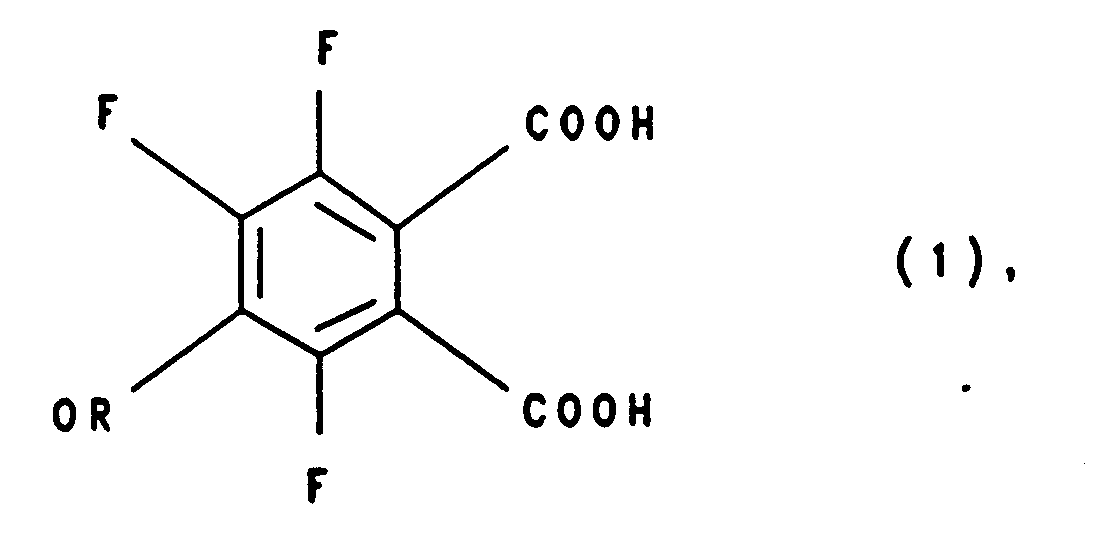
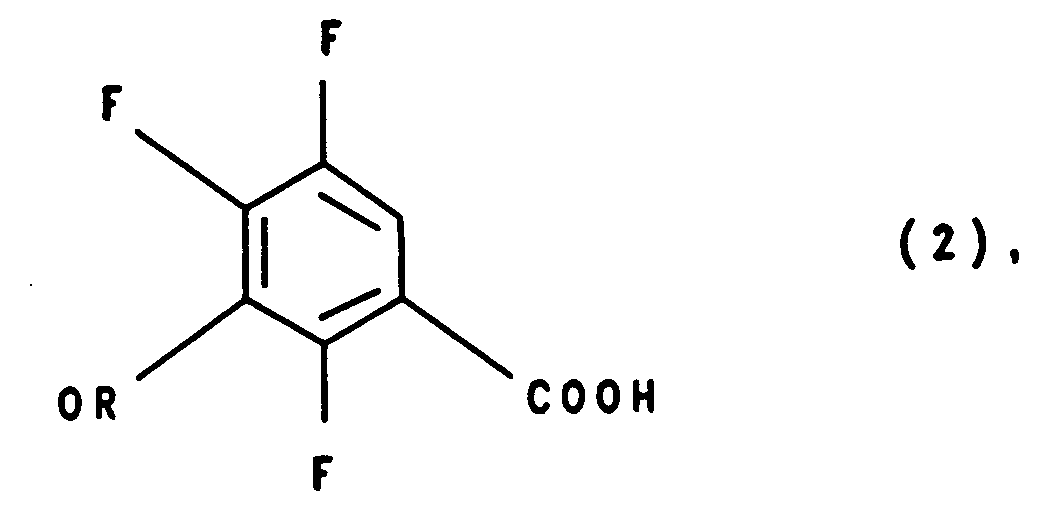
- the present invention relates to a new, advantageous method for Preparation of 4-alkoxy-3,5,6-trifluorophthalic acids and optionally 3-alkoxy-2,4,5-trifluorobenzoic acids.
- 4-alkoxy-3,5,6-trifluorophthalic acids are generally only accessible via a complex and therefore not very economical synthetic route.
- 4-Methoxy-3,5,6-trifluorophthalic acid can thus be prepared in the following manner (N. Ishikawa et al., Nippon Kagaku Kaishi 1 (1976), 200-202, JP-A-3279348 and EP-A-0 271 275 ): Tetrafluorophthalic acid is reacted with methanol to give the corresponding tetrafluorophthalic acid dimethyl ester, then a methoxy group is introduced while replacing the fluorine atom in the 4-position, and the 4-methoxy-3,5,6-trifluorophthalic acid dimethyl ester is obtained in this way.
- the 4-methoxv-3,5,6-trifluorophthalic acid dimethyl ester is then saponified, the 4-methoxy-3,5,6-trifluorophthalic acid being formed.
- the 4-methoxy-3,5,6-trifluorophthalic acid can be converted into the 3-methoxy-2,4,5-trifluorobenzoic acid by decarboxylation. Compare also the following formula scheme A.
- the method according to formula scheme B has with regard to the incorporation of Alkoxy groups have a relatively low variability because of those used for synthesis needed, the corresponding interesting for the production of the active ingredients Alkylating agents containing alkyl groups only in a very limited range Number are available.
- Alkylating agents for example alkyl halides or dialkyl sulfates, right problematic because these substances are very toxic.
- the present invention is therefore based on the object the prior art simplified process for the production of not only 4-alkoxy-3,5,6-trifluorophthalic acids but also, if desired, from 3-Alkoxy-2,4,5-trifluorobenzoic acids to provide the above does not have the disadvantages mentioned and also as wide as possible can be applied.
- R stands for an optionally mono- or polifluorinated alkyl radical with 1 to 5 carbon atoms, for an optionally mono- or polifluorinated cycloalkyl radical with 3 to 5 carbon atoms in the ring or for an optionally mono- or polifluorinated araliphatic radical, and optionally for 3-alkoxy -2,4,5-trifluorobenzoic acids of the general formula where R has the above meaning.
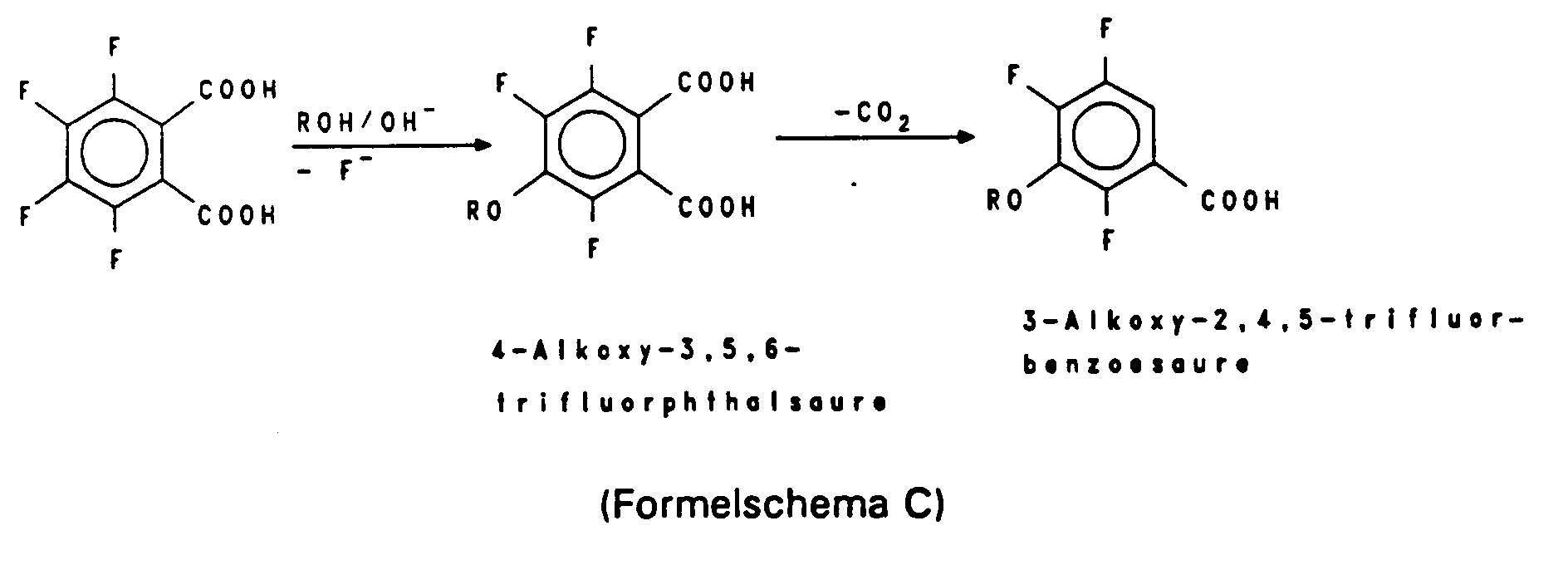
- tetrafluorophthalic acid or tetrafluorophthalic anhydride is reacted with an alcohol of the general formula ROH, in which R has the above meaning, and a water-soluble base in water at elevated temperature, which isolates 4-alkoxy-3,5,6-trifluorophthalic acid and optionally decarboxylated the 4-alkoxy-3,5,6-trifluorophthalic acid in the presence of an organic basic solvent and optionally an inert solvent at 70 to 180 ° C. and the 3-alkoxy-2,4,5-trifluorobenzoic acid formed is isolated.
- ROH tetrafluorophthalic acid or tetrafluorophthalic anhydride
- the method according to the invention leads to the state of the Technology for a significant simplification. It can also be broad Use extensive, because for the first reaction step, namely the Exchange of the 4-position fluorine atom for an alkoxy group a variety of different alcohols is suitable. In addition, for the production of one mole of 4-alkoxy-3,5,6-trifluorophthalic acid or 3-alkoxy-2,4,5-trifluorobenzoic acid consumed only one mole of alcohol. Surprisingly it is not necessary to use the two carboxyl groups of tetrafluorophthalic acid protect by esterification.
- the implementation proceeds with high selectivity and leads to a high yield of 4-alkoxy-3,5,6 trifluorophthalic acid.
- the present invention ensures that the second Reaction step, namely the decarboxylation of 4-alkoxy-3,5,6-trifluorophthalic acid to 3-alkoxy-2,4,5-trifluorobenzoic acid in high yield expires.
- tetrafluorophthalic acid or tetrafluorophthalic anhydride are suitable for elevation, straight chain or without claim to completeness branched aliphatic alcohols, cycloaliphatic alcohols and araliphatic Alcohols.
- ROH can be used as the alcohol of the general formula in the reaction use primary or secondary alcohol, especially a primary alcohol.
- alcohols of the formula ROH are methanol, ethanol, n-propanol, n-butanol, n-pentanol, cyclopropanol, hydroxymethylcyclopropane, Fluoromethanol, difluoromethanol, trifluoromethanol, monofluoroethanol, Difluoroethanol, trifluoroethanol, monofluoropropanol, monofluorobutanol, Monofluorocyclopropanol, difluorocyclopropanol, benzyl alcohol, 4-fluorobenzyl alcohol or phenylethanol, in particular methanol, ethanol, Cyclopropanol, n-propanol, fluoromethanol, difluoromethanol, trifluoromethanol, Monofluoroethanol, monofluorobutanol, benzyl alcohol or 4-fluorobenzyl alcohol called.
- the reaction takes place in the presence of a water-soluble base in water.
- a hydroxide, carbonate, phosphate, hydrogen phosphate or Dihydrogen phosphate of an alkali metal or alkaline earth metal or mixtures the same as a water-soluble base. are well suited as a water-soluble base Lithium hydroxide, lithium hydroxide hydrate, sodium hydroxide or potassium hydroxide.
- the reaction takes place in the presence of water.
- water usually you set 1 to 1500, in particular 10 to 300, preferably 25 to 200 moles of water per mole Tetrafluorophthalic acid or tetrafluorophthalic anhydride.
- reaction of tetrafluorophthalic acid or tetrafluorophthalic anhydride with the alcohol of the formula ROH and the water-soluble base in water takes place at elevated temperature, usually at 25 to 150 ° C. In a Numerous cases have proven to be sufficient, the implementation at 50 to run to 120, in particular 60 to 100 ° C. It is at this point however, indicated that the reaction temperature to be selected in certain extent of the reactivity of the alcohol used and the other reaction conditions is dependent. It is the respective one Adjust conditions accordingly.
- an aqueous reaction mixture is obtained, from which the desired product of value must be separated.
- Unreacted alcohol is usually distilled off from the aqueous reaction mixture and the 4-alkoxy-3,5,6-trifluorophthalic acid is isolated from the aqueous reaction mixture by adding acid and / or extraction.
- the unreacted alcohol-free aqueous reaction mixture is extracted with a water-insoluble organic solvent or the basic solvent.
- Polar organic solvents for example dialkyl ethers or esters of aliphatic carboxylic acids having 1 to 6 carbon atoms, are suitable as the water-insoluble organic solvent.
- the 4-alkoxy-3,5,6-trifluorophthalic acid formed is intended by To convert decarboxylation into 3-alkoxy-2,4,5-trifluorobenzoic acid, see above it is advisable to remove the aqueous unreacted alcohol Extract reaction mixture with the basic solvent and this Use mixture for further processing. This way of working shaped yourself particularly easy.
- An organic base for example, is used as the basic solvent straight-chain or branched aliphatic amine, one or more substituted pyrrole, pyrrolidone, imidazole, imidazolidinone, pyridine, pyrimidine, Quinoline, isoquinoline, an N, N-dialkylated carboxamide or mixtures these compounds, in particular a trialkylamine with 4 to 20, preferably 6 to 14 carbon atoms in the alkyl radical, mixtures of these trialkylamines, Collidine, quinoline, N-methylpyrrolidone, N, N-dimethylacetamide, 1,3-dimethylimidazolidinone or mixtures of these compounds.
- inert solvent aromatic hydrocarbons, single or multiple halogenated aromatic hydrocarbons or mixtures thereof.
- inert Solvent toluene ethylbenzene, mesitylene, o-xylene, m-xylene, p-xylene, technical mixtures of isomeric xylenes, chlorobenzene, dichlorobenzene, Trichlorobenzene, chlorotoluene, dichlorotoluene or mixtures thereof called.
- the decarboxylation is carried out at 70 to 180 ° C by. In a variety of cases, it has been shown to be sufficient Decarboxylation at 80 to 170, especially 100 to 150 ° C to perform.
- the reaction mixture is extracted with an aqueous Solution with a base, separates the resulting aqueous phase, the 3-alkoxy-2,4,5-trifluorobenzoic acid falls by acidifying and isolating them Filtration.
- Alkali metal hydroxides, alkali metal carbonates, in particular, can be used as the base
- Mineral acid for example hydrochloric acid, sulfuric acid, phosphoric acid, in sufficient amount, i.e. up to a pH of 0 to 3, especially 1 to 2.5 and the 3-alkoxy-2,4,5-trifluorobenzoic acid is filtered off.
- the aqueous phase is extracted twice with a mixture of 20 g of 1,2-dichlorobenzene and 10 g of Hostarex A327 (a mixture of different aliphatic trialkylamines with 6 to 14 carbon atoms in the alkyl radical). Thereafter, the aqueous phase contains no organic acids detectable by GC analysis.
- the extract is dried over MgSO 4 , filtered and the solvent is removed on a rotary evaporator. 2.7 (13.1 mmol, corresponding to 66%) slightly yellowish powder remain, which according to GC-MS is shown as methoxy-trifluorobenzoic acid (pure content GC> 95%). Further cleaning can be done by stirring (recrystallization) from hot water.
- Example 2 The procedure is as in Example 1, but the extraction is not carried out using Hostarex A327, but instead is extracted three times with 20 g of MTBE each. After drying the organic phase over MgSO 4 , filtration and removal of the solvent, 3.8 g (15.2 mmol, corresponding to 76%) of yellowish 4-methoxy-3,5,6-trifluorophthalic acid (purity according to GC> 90%) remain.
- Example 3 4-ethoxy-3,5,6-trifluorophthalic acid is isolated as described in Example 2, 4.6 g are obtained (17.4 mmol, corresponding to 87%) 4-ethoxy-3,5,6-trifluorophthalic acid.
- Example 5 The procedure of Example 5 is followed, but decarboxylation and If the phthalic acid is isolated as described in Example 2, 2.2 g are obtained (6.9 mmol, corresponding to 69%) 4-trifluoroethoxy-3,5,6-trifluorophthalic acid as slightly yellowish solid.
Landscapes
- Chemical & Material Sciences (AREA)
- Organic Chemistry (AREA)
- Chemical Kinetics & Catalysis (AREA)
- Engineering & Computer Science (AREA)
- Oil, Petroleum & Natural Gas (AREA)
- Organic Low-Molecular-Weight Compounds And Preparation Thereof (AREA)
Description


Man extrahiert das von nichtumgesetztem Alkohol befreite wäßrige Reaktionsgemisch mit einem in Wasser unlöslichen organischen Solvens oder dem basischen Lösungsmittel. Geeignet als wasserunlösliches organisches Solvens sind polare organische Lösungsmittel, beispielsweise Dialkylether oder Ester aliphatischer Carbonsäuren mit 1 bis 6 Kohlenstoffatomen.
- MS: m/z (%):
- 99 (8,8), 119 (7,8), 147 (6,5), 174 (5,1), 175 (98,2), 192 (100), 193 (6,2), 220 (23,4)
- MS: m/z (%):
- 78 (9,8), 98 (26,3), 117 (29), 146 (71,4), 174 (100), 175 (5,9), 218 (70,6), 246 (25,5, (M-H2O)+
- MS: m/z [%]:
- 79 (14), 83 (7), 98 (12), 117 (42), 129 (14), 145 (17), 146 (11), 157 (5), 159 (30), 228 (100), 229 (8), 256 (89), 281 (13), 300 (M-H2O)⊕, 90), 301 (9)
Claims (18)
- Verfahren zur Herstellung von 4-Alkoxy-3,5,6-trifluorphthalsäuren der allgemeinen Formelworin R für einen gegebenenfalls einfach oder mehrfach fluorierten Alkylrest mit 1 bis 5 Kohlenstoffatomen, für einen gegebenenfalls einfach oder mehrfach fluorierten Cycloalkylrest mit 3 bis 5 Kohlenstoffatomen im Ring oder für einen gegebenenfalls einfach oder mehrfach fluorierten araliphatischen Rest steht, und gegebenenfalls von 3-Alkoxy-2,4,5-trifluorbenzoesäure der allgemeinen Formel
 worin R die vorstehende Bedeutung hat, dadurch gekennzeichnet, daß man Tetrafluorphthalsäure oder Tetrafluorphthalsäureanhydrid mit einem Alkohol der allgemeinen Formel ROH, worin R die vorstehende Bedeutung hat, und einer wasserlöslichen Base in Wasser bei erhöhter Temperatur umsetzt, die gebildete 4-Alkoxy-3,5,6-trifluorphthalsäure isoliert und gegebenenfalls die 4-Alkoxy-3,5,6-trifluorphthalsäure in Anwesenheit eines organischen basischen Lösungsmittels und gegebenenfalls eines inerten Lösungsmittels bei 70 bis 180 °C decarboxyliert und die gebildete 3-Alkoxy-2,4,5-trifluorbenzoesäure isoliert.
- Verfahren nach Anspruch 1, dadurch gekennzeichnet, daß man als Alkohol der allgemeinen Formel ROH einen primären Alkohol einsetzt.
- Verfahren nach Anspruch 1 oder 2, dadurch gekennzeichnet, daß man als Alkohol der Formel ROH Methanol, Ethanol, n-Propanol, n-Butanol, n-Pentanol, Cyclopropanol, Hydroxymethylcyclopropan, Fluormethanol, Difluormethanol, Trifluormethanol, Monofluorethanol, Difluorethanol, Trifluorethanol, Monofluorpropanol, Monofluorbutanol, Monofluorcyclopropanol, Difluorcyclopropanol, Benzylalkohol, 4-Fluorbenzylalkohol oder Phenylethanol einsetzt.
- Verfahren nach einem oder mehreren der Ansprüche 1 bis 3, dadurch gekennzeichnet, daß man als Alkohol der Formel ROH Methanol, Ethanol, Cyclopropanol, n-Propanol, Fluormethanol, Difluormethanol, Trifluormethanol, Monofluorethanol, Monofluorbutanol, Benzylalkohol oder 4-Fluorbenzylalkohol einsetzt.
- Verfahren nach einem oder mehreren der Ansprüche 1 bis 4, dadurch gekennzeichnet, daß man 1 bis 100, insbesondere 20 bis 80, bevorzugt 40 bis 60 Mol Alkohol je Mol Tetrafluorphthalsäure oder Tetrafluorphthalsäureanhydrid einsetzt.
- Verfahren nach einem oder mehreren der Ansprüche 1 bis 5, dadurch gekennzeichnet, daß man ein Hydroxid, Carbonat, Phosphat, Hydrogenphosphat oder Dihydrogenphosphat eines Alkalimetalls oder Erdalkalimetalls oder Mischungen derselben als wasserlösliche Base einsetzt.
- Verfahren nach einem oder mehreren der Ansprüche 1 bis 6, dadurch gekennzeichnet, daß man Lithiumhydroxid, Lithiumhydroxidhydrat, Natriumhydroxid oder Kaliumhydroxid als wasserlösliche Base einsetzt.
- Verfahren nach einem oder mehreren der Ansprüche 1 bis 7, dadurch gekennzeichnet, daß man 1 bis 100, insbesondere 1,1 bis 10, bevorzugt 2 bis 5 Mol Base, je Mol Tetrafluorphthalsäure oder Tetrafluorphthalsäureanyhdrid einsetzt.
- Verfahren nach einem oder mehreren der Ansprüche 1 bis 8, dadurch gekennzeichnet, daß man 1 bis 1500, insbesondere 10 bis 300, bevorzugt 25 bis 200 Mol Wasser je Mol Tetrafluorphthalsäure oder Tetrafluorphthalsäureanyhdrid einsetzt.
- Verfahren nach einem oder mehreren der Ansprüche 1 bis 9, dadurch gekennzeichnet, daß man die Tetrafluorphthalsäure oder das Tetrafluorphthalsäureanhydrid mit dem Alkohol bei 25 bis 150, insbesondere 50 bis 120 bevorzugt 60 bis 100 °C umsetzt.
- Verfahren nach einem oder mehreren der Ansprüche 1 bis 10, dadurch gekennzeichnet, daß man aus dem wäßrigen Reaktionsgemisch nicht umgesetzten Alkohol abdestilliert, die 4-Alkoxy-3,5,6-trifluorphthalsäure durch Zusatz von Säure und/oder durch Extraktion aus dem wäßrigen Reaktionsgemisch isoliert.
- Verfahren nach einem oder mehreren der Ansprüche 1 bis 11, dadurch gekennzeichnet, daß man das wäßrige Reaktionsgemisch mit einem in Wasser unlöslichen organischen Solvens, insbesondere einem Dialkylether oder einem Ester einer aliphatischen Carbonsäure mit 1 bis 6 Kohlenstoffatomen, oder dem basischen Lösungsmittel extrahiert.
- Verfahren nach einem oder mehreren der Ansprüche 1 bis 12, dadurch gekennzeichnet, daß man ein geradkettiges oder verzweigtes aliphatisches Amin, ein gegebenenfalls einfach oder mehrfach alkylsubstituiertes Pyrrol, Pyrrolidon, Imidazol, Imidazolidinon, Pyridin, Pyrimidin, Chinolin, Isochinolin, ein N,N-dialkyliertes Carbonsäureamid oder Gemische dieser Verbindungen als organisches basisches Lösungsmittel einsetzt.
- Verfahren nach einem oder mehreren der Ansprüche 1 bis 13, dadurch gekennzeichnet, daß man ein Trialkylamin mit 4 bis 20 Kohlenstoffatomen im Alkylrest, Gemische dieser Trialkylamine, Collidin, Chinolin, N-Methylpyrrolidon, N,N-Dimethylacetamid, 1,3-Dimethylimidazolidinon oder Gemische dieser Verbindungen als basisches Lösungsmittel einsetzt.
- Verfahren nach einem oder mehreren der Ansprüche 1 bis 14, dadurch gekennzeichnet, daß man aromatische Kohlenwasserstoffe, einfach oder mehrfach halogenierte aromatische Kohlenwasserstoffe oder Gemische derselben als inertes Lösungsmittel einsetzt.
- Verfahren nach einem oder mehreren der Ansprüche 1 bis 15, dadurch gekennzeichnet, daß man Toluol, Ethylbenzol, Mesitylen, o-Xylol, m-Xylol, p-Xylol, technische Gemische isomerer Xylole, Chlorbenzol, Dichlorbenzol, Trichlorbenzol, Chlortoluol, Dichlortoluol oder Gemische derselben als inertes Lösungsmittel einsetzt.
- Verfahren nach einem oder mehreren der Ansprüche 1 bis 16, dadurch gekennzeichnet, daß man bei 80 bis 170, insbesondere 100 bis 150 °C decarboxyliert.
- Verfahren nach einem oder mehreren der Ansprüche 1 bis 17, dadurch gekennzeichnet, daß man das Reaktionsgemisch nach Decarboxylierung mit einer wäßrigen Lösung einer Base extrahiert, die wäßrige Phase separiert, die 3-Alkoxy-2,4,5-trifluorbenzoesäure durch Ansäuern ausfällt und durch Filtration isoliert.
Applications Claiming Priority (2)
| Application Number | Priority Date | Filing Date | Title |
|---|---|---|---|
| DE4404519A DE4404519A1 (de) | 1994-02-12 | 1994-02-12 | Verfahren zur Herstellung von 4-Alkoxy-3,5,6-trifluorphthalsäuren und 3-Alkoxy-2,4,5-trifluorbenzoesäuren |
| DE4404519 | 1994-02-12 |
Publications (3)
| Publication Number | Publication Date |
|---|---|
| EP0667334A2 EP0667334A2 (de) | 1995-08-16 |
| EP0667334A3 EP0667334A3 (de) | 1996-01-03 |
| EP0667334B1 true EP0667334B1 (de) | 1998-01-07 |
Family
ID=6510121
Family Applications (1)
| Application Number | Title | Priority Date | Filing Date |
|---|---|---|---|
| EP95101054A Expired - Lifetime EP0667334B1 (de) | 1994-02-12 | 1995-01-26 | Verfahren zur Herstellung von 4-Alkoxy-3,5,6-trifluorphthalsäuren und 3-Alkoxy-2,4,5-trifluorbenzoesäuren |
Country Status (6)
| Country | Link |
|---|---|
| US (1) | US5488152A (de) |
| EP (1) | EP0667334B1 (de) |
| JP (1) | JPH083109A (de) |
| CA (1) | CA2142255A1 (de) |
| DE (2) | DE4404519A1 (de) |
| ES (1) | ES2113687T3 (de) |
Families Citing this family (2)
| Publication number | Priority date | Publication date | Assignee | Title |
|---|---|---|---|---|
| EP0669310B1 (de) * | 1994-02-23 | 1998-12-23 | Asahi Glass Company Ltd. | Verfahren zur Herstellung von Tetrafluorphtalsäureanhydrid |
| CN100408542C (zh) * | 2005-09-02 | 2008-08-06 | 中国科学院上海有机化学研究所 | 一种合成2,4,5-三氟-3-甲氧基苯甲酸的方法 |
Family Cites Families (9)
| Publication number | Priority date | Publication date | Assignee | Title |
|---|---|---|---|---|
| US4831190A (en) * | 1986-12-04 | 1989-05-16 | Ube Industries, Ltd. | Trifluorohydroxyaromatic acid and preparation thereof |
| IT211834Z2 (it) * | 1987-09-24 | 1989-05-25 | Plastiape Spa | Dispositivo di erogazione, apllicabile su boccette e flaconi, aventi pareti flessibili, ed atto a provocare la nebulizzazione del liquido erogato. |
| JP2725179B2 (ja) * | 1988-04-21 | 1998-03-09 | 日本カーバイド工業株式会社 | 2,4,5−トリフルオロー3−ヒドロキシ安息香酸の製造方法 |
| DE3917898A1 (de) * | 1989-06-01 | 1990-12-06 | Wacker Chemie Gmbh | Verfahren zur herstellung von sphaerischem, monodispersen organopolysiloxan oder siliciumoxycarbid |
| JPH03279348A (ja) * | 1990-03-28 | 1991-12-10 | Kyorin Pharmaceut Co Ltd | 2,4,5―トリフルオロ―3―アルコキシ安息香酸の製造方法 |
| JP2943944B2 (ja) * | 1990-12-27 | 1999-08-30 | 日本カーバイド工業株式会社 | 3−置換−2,4,5−トリフルオロ安息香酸及びその 製造方法 |
| JP2918134B2 (ja) * | 1992-05-15 | 1999-07-12 | 宇部興産株式会社 | 3−ジアルキルアミノ−2−置換ベンゾイルアクリル酸誘導体 |
| JP3130653B2 (ja) * | 1992-07-02 | 2001-01-31 | 株式会社日本触媒 | 含フッ素無水フタル酸類の製造方法 |
| US5380926A (en) * | 1994-03-28 | 1995-01-10 | Occidental Chemical Corporation | Method of making 3-methoxy-2,4,5-trifluorobenzoic acid |
-
1994
- 1994-02-12 DE DE4404519A patent/DE4404519A1/de not_active Withdrawn
-
1995
- 1995-01-26 DE DE59501191T patent/DE59501191D1/de not_active Expired - Fee Related
- 1995-01-26 ES ES95101054T patent/ES2113687T3/es not_active Expired - Lifetime
- 1995-01-26 EP EP95101054A patent/EP0667334B1/de not_active Expired - Lifetime
- 1995-02-09 JP JP7022107A patent/JPH083109A/ja not_active Withdrawn
- 1995-02-09 US US08/386,292 patent/US5488152A/en not_active Expired - Fee Related
- 1995-02-10 CA CA002142255A patent/CA2142255A1/en not_active Abandoned
Also Published As
| Publication number | Publication date |
|---|---|
| CA2142255A1 (en) | 1995-08-13 |
| DE59501191D1 (de) | 1998-02-12 |
| EP0667334A3 (de) | 1996-01-03 |
| US5488152A (en) | 1996-01-30 |
| ES2113687T3 (es) | 1998-05-01 |
| DE4404519A1 (de) | 1995-08-17 |
| JPH083109A (ja) | 1996-01-09 |
| EP0667334A2 (de) | 1995-08-16 |
Similar Documents
| Publication | Publication Date | Title |
|---|---|---|
| DE3853581T2 (de) | Verfahren zur herstellung von dialkylestern von polyhalogenaromatischen säuren mit hoher ausbeute. | |
| EP0569823B1 (de) | Verfahren zur Herstellung von 2,5-Di-phenylamino-terephthalsäure und ihrer Dialkylester | |
| DE1945703A1 (de) | Verfahren zur Herstellung von Arylchlorcarbonylketenen | |
| DE2804063C3 (de) | Verfahren zur Herstellung von Protocatechualdehyd oder 3-Methoxy- bzw. Äthoxy-4-hydroxybenzaldehyd | |
| EP1002786B1 (de) | Verfahren zur Herstellung von Trifluorbenzoesäuren | |
| DE2630981C2 (de) | 4-β,β-Dichlor- und 4-β,β-Dibromvinyl-3,3-dimethylbutyrolactone, Verfahren zu ihrer Herstellung und deren Verwendung zur Herstellung von Estern der 3-β,β-Dichlor- oder 3-β,β-Dibrom-vinyl-2,2-dimethylcyclopropancarbonsäure | |
| DE3314816A1 (de) | Verfahren zur herstellung von cyclohexandionderivaten | |
| DE69229459T2 (de) | Verfahren zur Herstellung von Ketosäuren | |
| EP0667334A2 (de) | Verfahren zur Herstellung von 4-Alkoxy-3,5,6-trifluorphthalsäuren und 3-Alkoxy-2,4,5-trifluorbenzoesäuren | |
| DE2918900C2 (de) | ||
| DE2410782C2 (de) | Phenylendiessigsäuredialkylester und Verfahren zu deren Herstellung | |
| EP0498847B1 (de) | Verfahren zur herstellung von 1,4-bis-(4-hydroxybenzoyl)-benzol | |
| CH630052A5 (de) | Verfahren zur herstellung von 5-(quaternaeren-alkyl)resorcinen. | |
| EP0623579B1 (de) | Verfahren zur Herstellung von Ethercarbonsäuren | |
| DE102004040702B4 (de) | Verfahren zur Herstellung eines Dioxazin-Derivats | |
| CH650488A5 (de) | Verfahren zur herstellung des m-phenoxy-benzyl-alkohols. | |
| EP0051233B1 (de) | Verfahren zur Herstellung von 13-Oxabicyclo(10.3.0)-pentadecan | |
| EP0533131B1 (de) | Verfahren zur selektiven Mono-ortho-Hydroxyalkylierung von 4-substituierten Pyridin-Derivaten | |
| EP1481959A1 (de) | Verfahren zur Herstellung von Lactonen und von aromatischen Hydroxycarbonsäuren | |
| EP0741123B1 (de) | Verfahren zur Herstellung von Salzen substituierter oder unsubstituierter Phthalsäure-Derivate | |
| DE3437634A1 (de) | Verfahren zur herstellung von gegebenenfalls substituierter zimtsaeure in gegenwart eines katalysators | |
| EP0320451A2 (de) | Verfahren zur Herstellung von alkylsubstituierten Phenolen oder Naphtholen | |
| EP0186629B1 (de) | Verfahren zur Herstellung von 3,5-Dialkyl-4-hydroxybenzoesäure | |
| EP0287956B1 (de) | Verfahren zur Herstellung von 5-Formylvaleriansäureestern oder den entsprechenden Acetalen | |
| EP0643036B1 (de) | Verfahren zur Herstellung von Pimelinsäureestern |
Legal Events
| Date | Code | Title | Description |
|---|---|---|---|
| PUAI | Public reference made under article 153(3) epc to a published international application that has entered the european phase |
Free format text: ORIGINAL CODE: 0009012 |
|
| AK | Designated contracting states |
Kind code of ref document: A2 Designated state(s): BE CH DE ES FR GB IE IT LI NL |
|
| PUAL | Search report despatched |
Free format text: ORIGINAL CODE: 0009013 |
|
| AK | Designated contracting states |
Kind code of ref document: A3 Designated state(s): BE CH DE ES FR GB IE IT LI NL |
|
| 17P | Request for examination filed |
Effective date: 19960703 |
|
| GRAG | Despatch of communication of intention to grant |
Free format text: ORIGINAL CODE: EPIDOS AGRA |
|
| GRAG | Despatch of communication of intention to grant |
Free format text: ORIGINAL CODE: EPIDOS AGRA |
|
| GRAH | Despatch of communication of intention to grant a patent |
Free format text: ORIGINAL CODE: EPIDOS IGRA |
|
| 17Q | First examination report despatched |
Effective date: 19970512 |
|
| GRAH | Despatch of communication of intention to grant a patent |
Free format text: ORIGINAL CODE: EPIDOS IGRA |
|
| RAP1 | Party data changed (applicant data changed or rights of an application transferred) |
Owner name: CLARIANT GMBH |
|
| GRAA | (expected) grant |
Free format text: ORIGINAL CODE: 0009210 |
|
| AK | Designated contracting states |
Kind code of ref document: B1 Designated state(s): BE CH DE ES FR GB IE IT LI NL |
|
| REG | Reference to a national code |
Ref country code: CH Ref legal event code: EP |
|
| REF | Corresponds to: |
Ref document number: 59501191 Country of ref document: DE Date of ref document: 19980212 |
|
| ITF | It: translation for a ep patent filed | ||
| GBT | Gb: translation of ep patent filed (gb section 77(6)(a)/1977) |
Effective date: 19980312 |
|
| ET | Fr: translation filed | ||
| REG | Reference to a national code |
Ref country code: ES Ref legal event code: FG2A Ref document number: 2113687 Country of ref document: ES Kind code of ref document: T3 |
|
| REG | Reference to a national code |
Ref country code: IE Ref legal event code: FG4D Free format text: 78235 |
|
| PLBE | No opposition filed within time limit |
Free format text: ORIGINAL CODE: 0009261 |
|
| STAA | Information on the status of an ep patent application or granted ep patent |
Free format text: STATUS: NO OPPOSITION FILED WITHIN TIME LIMIT |
|
| PGFP | Annual fee paid to national office [announced via postgrant information from national office to epo] |
Ref country code: NL Payment date: 19981208 Year of fee payment: 5 |
|
| PGFP | Annual fee paid to national office [announced via postgrant information from national office to epo] |
Ref country code: BE Payment date: 19981228 Year of fee payment: 5 |
|
| 26N | No opposition filed | ||
| PGFP | Annual fee paid to national office [announced via postgrant information from national office to epo] |
Ref country code: ES Payment date: 20000128 Year of fee payment: 6 |
|
| PG25 | Lapsed in a contracting state [announced via postgrant information from national office to epo] |
Ref country code: BE Free format text: LAPSE BECAUSE OF NON-PAYMENT OF DUE FEES Effective date: 20000131 |
|
| PGFP | Annual fee paid to national office [announced via postgrant information from national office to epo] |
Ref country code: IE Payment date: 20000209 Year of fee payment: 6 |
|
| BERE | Be: lapsed |
Owner name: CLARIANT G.M.B.H. Effective date: 20000131 |
|
| PG25 | Lapsed in a contracting state [announced via postgrant information from national office to epo] |
Ref country code: NL Free format text: LAPSE BECAUSE OF NON-PAYMENT OF DUE FEES Effective date: 20000801 |
|
| NLV4 | Nl: lapsed or anulled due to non-payment of the annual fee |
Effective date: 20000801 |
|
| PG25 | Lapsed in a contracting state [announced via postgrant information from national office to epo] |
Ref country code: IE Free format text: LAPSE BECAUSE OF NON-PAYMENT OF DUE FEES Effective date: 20010126 |
|
| PG25 | Lapsed in a contracting state [announced via postgrant information from national office to epo] |
Ref country code: ES Free format text: LAPSE BECAUSE OF NON-PAYMENT OF DUE FEES Effective date: 20010127 |
|
| REG | Reference to a national code |
Ref country code: IE Ref legal event code: MM4A |
|
| REG | Reference to a national code |
Ref country code: GB Ref legal event code: IF02 |
|
| REG | Reference to a national code |
Ref country code: ES Ref legal event code: FD2A Effective date: 20021016 |
|
| PGFP | Annual fee paid to national office [announced via postgrant information from national office to epo] |
Ref country code: DE Payment date: 20031205 Year of fee payment: 10 |
|
| PGFP | Annual fee paid to national office [announced via postgrant information from national office to epo] |
Ref country code: GB Payment date: 20031218 Year of fee payment: 10 Ref country code: FR Payment date: 20031218 Year of fee payment: 10 Ref country code: CH Payment date: 20031218 Year of fee payment: 10 |
|
| PG25 | Lapsed in a contracting state [announced via postgrant information from national office to epo] |
Ref country code: IT Free format text: LAPSE BECAUSE OF NON-PAYMENT OF DUE FEES;WARNING: LAPSES OF ITALIAN PATENTS WITH EFFECTIVE DATE BEFORE 2007 MAY HAVE OCCURRED AT ANY TIME BEFORE 2007. THE CORRECT EFFECTIVE DATE MAY BE DIFFERENT FROM THE ONE RECORDED. Effective date: 20050126 Ref country code: GB Free format text: LAPSE BECAUSE OF NON-PAYMENT OF DUE FEES Effective date: 20050126 |
|
| PG25 | Lapsed in a contracting state [announced via postgrant information from national office to epo] |
Ref country code: LI Free format text: LAPSE BECAUSE OF NON-PAYMENT OF DUE FEES Effective date: 20050131 Ref country code: CH Free format text: LAPSE BECAUSE OF NON-PAYMENT OF DUE FEES Effective date: 20050131 |
|
| PG25 | Lapsed in a contracting state [announced via postgrant information from national office to epo] |
Ref country code: DE Free format text: LAPSE BECAUSE OF NON-PAYMENT OF DUE FEES Effective date: 20050802 |
|
| GBPC | Gb: european patent ceased through non-payment of renewal fee |
Effective date: 20050126 |
|
| REG | Reference to a national code |
Ref country code: CH Ref legal event code: PL |
|
| PG25 | Lapsed in a contracting state [announced via postgrant information from national office to epo] |
Ref country code: FR Free format text: LAPSE BECAUSE OF NON-PAYMENT OF DUE FEES Effective date: 20050930 |
|
| REG | Reference to a national code |
Ref country code: FR Ref legal event code: ST |