EP0667356A1 - Verfahren zur Herstellung eines Stärkehydrolysaten mit niedrigem Polymolekularitätindex; so hergestelltes Stärkehydrolysat und seine Anwendung in der Peritonealdialyse - Google Patents
Verfahren zur Herstellung eines Stärkehydrolysaten mit niedrigem Polymolekularitätindex; so hergestelltes Stärkehydrolysat und seine Anwendung in der Peritonealdialyse Download PDFInfo
- Publication number
- EP0667356A1 EP0667356A1 EP95400292A EP95400292A EP0667356A1 EP 0667356 A1 EP0667356 A1 EP 0667356A1 EP 95400292 A EP95400292 A EP 95400292A EP 95400292 A EP95400292 A EP 95400292A EP 0667356 A1 EP0667356 A1 EP 0667356A1
- Authority
- EP
- European Patent Office
- Prior art keywords
- starch
- hydrolyzate
- polymolecularity index
- glucose
- starch hydrolyzate
- Prior art date
- Legal status (The legal status is an assumption and is not a legal conclusion. Google has not performed a legal analysis and makes no representation as to the accuracy of the status listed.)
- Granted
Links
- 229920002472 Starch Polymers 0.000 title claims abstract description 83
- 235000019698 starch Nutrition 0.000 title claims abstract description 83
- 239000008107 starch Substances 0.000 title claims abstract description 77
- 238000000502 dialysis Methods 0.000 title claims description 8
- 238000004519 manufacturing process Methods 0.000 title claims description 6
- 239000000413 hydrolysate Substances 0.000 title abstract 7
- XLYOFNOQVPJJNP-UHFFFAOYSA-N water Substances O XLYOFNOQVPJJNP-UHFFFAOYSA-N 0.000 claims abstract description 14
- 238000011210 chromatographic step Methods 0.000 claims abstract description 13
- 239000002253 acid Substances 0.000 claims abstract description 8
- 102000004139 alpha-Amylases Human genes 0.000 claims abstract description 8
- 108090000637 alpha-Amylases Proteins 0.000 claims abstract description 8
- 229940024171 alpha-amylase Drugs 0.000 claims abstract description 8
- 235000013336 milk Nutrition 0.000 claims abstract description 6
- 239000008267 milk Substances 0.000 claims abstract description 6
- 210000004080 milk Anatomy 0.000 claims abstract description 6
- 230000001580 bacterial effect Effects 0.000 claims abstract description 5
- WQZGKKKJIJFFOK-GASJEMHNSA-N Glucose Natural products OC[C@H]1OC(O)[C@H](O)[C@@H](O)[C@@H]1O WQZGKKKJIJFFOK-GASJEMHNSA-N 0.000 claims description 53
- 239000008103 glucose Substances 0.000 claims description 51
- 229920000642 polymer Polymers 0.000 claims description 39
- 238000000034 method Methods 0.000 claims description 37
- 239000011347 resin Substances 0.000 claims description 24
- 229920005989 resin Polymers 0.000 claims description 24
- 230000008569 process Effects 0.000 claims description 23
- 125000002091 cationic group Chemical group 0.000 claims description 9
- 238000004587 chromatography analysis Methods 0.000 claims description 7
- 230000002255 enzymatic effect Effects 0.000 claims description 6
- 238000006317 isomerization reaction Methods 0.000 claims description 4
- 239000002357 osmotic agent Substances 0.000 claims description 4
- ZLMJMSJWJFRBEC-UHFFFAOYSA-N Potassium Chemical group [K] ZLMJMSJWJFRBEC-UHFFFAOYSA-N 0.000 claims description 3
- 238000009903 catalytic hydrogenation reaction Methods 0.000 claims description 3
- HDTRYLNUVZCQOY-UHFFFAOYSA-N α-D-glucopyranosyl-α-D-glucopyranoside Natural products OC1C(O)C(O)C(CO)OC1OC1C(O)C(O)C(O)C(CO)O1 HDTRYLNUVZCQOY-UHFFFAOYSA-N 0.000 claims 1
- HDTRYLNUVZCQOY-WSWWMNSNSA-N Trehalose Natural products O[C@@H]1[C@@H](O)[C@@H](O)[C@@H](CO)O[C@@H]1O[C@@H]1[C@H](O)[C@@H](O)[C@@H](O)[C@@H](CO)O1 HDTRYLNUVZCQOY-WSWWMNSNSA-N 0.000 claims 1
- HDTRYLNUVZCQOY-LIZSDCNHSA-N alpha,alpha-trehalose Chemical compound O[C@@H]1[C@@H](O)[C@H](O)[C@@H](CO)O[C@@H]1O[C@@H]1[C@H](O)[C@@H](O)[C@H](O)[C@@H](CO)O1 HDTRYLNUVZCQOY-LIZSDCNHSA-N 0.000 claims 1
- 230000006641 stabilisation Effects 0.000 claims 1
- 238000011105 stabilization Methods 0.000 claims 1
- 230000001131 transforming effect Effects 0.000 claims 1
- 238000005903 acid hydrolysis reaction Methods 0.000 abstract description 6
- 108010009736 Protein Hydrolysates Proteins 0.000 abstract description 2
- 229920002245 Dextrose equivalent Polymers 0.000 abstract 3
- 239000003513 alkali Substances 0.000 abstract 1
- 239000003729 cation exchange resin Substances 0.000 abstract 1
- 229940023913 cation exchange resins Drugs 0.000 abstract 1
- 230000003301 hydrolyzing effect Effects 0.000 abstract 1
- 239000002184 metal Substances 0.000 abstract 1
- 229940088598 enzyme Drugs 0.000 description 19
- 239000000047 product Substances 0.000 description 19
- 108090000790 Enzymes Proteins 0.000 description 9
- 102000004190 Enzymes Human genes 0.000 description 9
- WQZGKKKJIJFFOK-VFUOTHLCSA-N beta-D-glucose Chemical compound OC[C@H]1O[C@@H](O)[C@H](O)[C@@H](O)[C@@H]1O WQZGKKKJIJFFOK-VFUOTHLCSA-N 0.000 description 9
- 239000000203 mixture Substances 0.000 description 9
- 239000003463 adsorbent Substances 0.000 description 8
- 230000007062 hydrolysis Effects 0.000 description 8
- 238000006460 hydrolysis reaction Methods 0.000 description 8
- OWEGMIWEEQEYGQ-UHFFFAOYSA-N 100676-05-9 Natural products OC1C(O)C(O)C(CO)OC1OCC1C(O)C(O)C(O)C(OC2C(OC(O)C(O)C2O)CO)O1 OWEGMIWEEQEYGQ-UHFFFAOYSA-N 0.000 description 7
- GUBGYTABKSRVRQ-PICCSMPSSA-N Maltose Natural products O[C@@H]1[C@@H](O)[C@H](O)[C@@H](CO)O[C@@H]1O[C@@H]1[C@@H](CO)OC(O)[C@H](O)[C@H]1O GUBGYTABKSRVRQ-PICCSMPSSA-N 0.000 description 7
- 238000000605 extraction Methods 0.000 description 7
- 229920002774 Maltodextrin Polymers 0.000 description 6
- 238000005194 fractionation Methods 0.000 description 5
- 238000009434 installation Methods 0.000 description 5
- 238000000746 purification Methods 0.000 description 5
- 239000000126 substance Substances 0.000 description 5
- 239000006188 syrup Substances 0.000 description 5
- 235000020357 syrup Nutrition 0.000 description 5
- 238000011282 treatment Methods 0.000 description 5
- VEXZGXHMUGYJMC-UHFFFAOYSA-N Hydrochloric acid Chemical compound Cl VEXZGXHMUGYJMC-UHFFFAOYSA-N 0.000 description 4
- 238000005115 demineralization Methods 0.000 description 4
- 230000002328 demineralizing effect Effects 0.000 description 4
- 238000003795 desorption Methods 0.000 description 4
- 230000007071 enzymatic hydrolysis Effects 0.000 description 4
- 238000006047 enzymatic hydrolysis reaction Methods 0.000 description 4
- 238000001914 filtration Methods 0.000 description 4
- 238000005259 measurement Methods 0.000 description 4
- 239000002245 particle Substances 0.000 description 4
- 239000005913 Maltodextrin Substances 0.000 description 3
- 230000009471 action Effects 0.000 description 3
- 238000004458 analytical method Methods 0.000 description 3
- 238000006243 chemical reaction Methods 0.000 description 3
- 230000000875 corresponding effect Effects 0.000 description 3
- 238000010828 elution Methods 0.000 description 3
- 229940035034 maltodextrin Drugs 0.000 description 3
- 239000000178 monomer Substances 0.000 description 3
- 239000012429 reaction media Substances 0.000 description 3
- 239000000243 solution Substances 0.000 description 3
- 238000001179 sorption measurement Methods 0.000 description 3
- MYRTYDVEIRVNKP-UHFFFAOYSA-N 1,2-Divinylbenzene Chemical compound C=CC1=CC=CC=C1C=C MYRTYDVEIRVNKP-UHFFFAOYSA-N 0.000 description 2
- 229920000856 Amylose Polymers 0.000 description 2
- 229920002261 Corn starch Polymers 0.000 description 2
- 125000000129 anionic group Chemical group 0.000 description 2
- 239000008120 corn starch Substances 0.000 description 2
- 238000004925 denaturation Methods 0.000 description 2
- 230000036425 denaturation Effects 0.000 description 2
- 239000008121 dextrose Substances 0.000 description 2
- 230000007717 exclusion Effects 0.000 description 2
- 201000011243 gastrointestinal stromal tumor Diseases 0.000 description 2
- 239000008187 granular material Substances 0.000 description 2
- 238000005984 hydrogenation reaction Methods 0.000 description 2
- 239000012528 membrane Substances 0.000 description 2
- 230000003204 osmotic effect Effects 0.000 description 2
- 229920002959 polymer blend Polymers 0.000 description 2
- 238000006116 polymerization reaction Methods 0.000 description 2
- 230000000717 retained effect Effects 0.000 description 2
- WECIKJKLCDCIMY-UHFFFAOYSA-N 2-chloro-n-(2-cyanoethyl)acetamide Chemical compound ClCC(=O)NCCC#N WECIKJKLCDCIMY-UHFFFAOYSA-N 0.000 description 1
- DBTMGCOVALSLOR-UHFFFAOYSA-N 32-alpha-galactosyl-3-alpha-galactosyl-galactose Natural products OC1C(O)C(O)C(CO)OC1OC1C(O)C(OC2C(C(CO)OC(O)C2O)O)OC(CO)C1O DBTMGCOVALSLOR-UHFFFAOYSA-N 0.000 description 1
- 239000004382 Amylase Substances 0.000 description 1
- 102000013142 Amylases Human genes 0.000 description 1
- 108010065511 Amylases Proteins 0.000 description 1
- 229920000945 Amylopectin Polymers 0.000 description 1
- 241000186063 Arthrobacter Species 0.000 description 1
- 241000894006 Bacteria Species 0.000 description 1
- 235000008733 Citrus aurantifolia Nutrition 0.000 description 1
- FBPFZTCFMRRESA-FSIIMWSLSA-N D-Glucitol Natural products OC[C@H](O)[C@H](O)[C@@H](O)[C@H](O)CO FBPFZTCFMRRESA-FSIIMWSLSA-N 0.000 description 1
- RXVWSYJTUUKTEA-UHFFFAOYSA-N D-maltotriose Natural products OC1C(O)C(OC(C(O)CO)C(O)C(O)C=O)OC(CO)C1OC1C(O)C(O)C(O)C(CO)O1 RXVWSYJTUUKTEA-UHFFFAOYSA-N 0.000 description 1
- 229920002307 Dextran Polymers 0.000 description 1
- 241000196324 Embryophyta Species 0.000 description 1
- UFHFLCQGNIYNRP-UHFFFAOYSA-N Hydrogen Chemical compound [H][H] UFHFLCQGNIYNRP-UHFFFAOYSA-N 0.000 description 1
- 240000007594 Oryza sativa Species 0.000 description 1
- 235000007164 Oryza sativa Nutrition 0.000 description 1
- 229910000564 Raney nickel Inorganic materials 0.000 description 1
- NPXOKRUENSOPAO-UHFFFAOYSA-N Raney nickel Chemical compound [Al].[Ni] NPXOKRUENSOPAO-UHFFFAOYSA-N 0.000 description 1
- 241000589180 Rhizobium Species 0.000 description 1
- 244000269722 Thea sinensis Species 0.000 description 1
- 235000011941 Tilia x europaea Nutrition 0.000 description 1
- 238000010521 absorption reaction Methods 0.000 description 1
- 230000002378 acidificating effect Effects 0.000 description 1
- 235000019418 amylase Nutrition 0.000 description 1
- 239000007864 aqueous solution Substances 0.000 description 1
- 230000000721 bacterilogical effect Effects 0.000 description 1
- 238000010923 batch production Methods 0.000 description 1
- 230000008901 benefit Effects 0.000 description 1
- GUBGYTABKSRVRQ-QUYVBRFLSA-N beta-maltose Chemical compound OC[C@H]1O[C@H](O[C@H]2[C@H](O)[C@@H](O)[C@H](O)O[C@@H]2CO)[C@H](O)[C@@H](O)[C@@H]1O GUBGYTABKSRVRQ-QUYVBRFLSA-N 0.000 description 1
- 150000001720 carbohydrates Chemical class 0.000 description 1
- 210000004534 cecum Anatomy 0.000 description 1
- 235000013339 cereals Nutrition 0.000 description 1
- 238000013375 chromatographic separation Methods 0.000 description 1
- 238000004040 coloring Methods 0.000 description 1
- 239000000470 constituent Substances 0.000 description 1
- 238000010276 construction Methods 0.000 description 1
- 238000010924 continuous production Methods 0.000 description 1
- 238000001816 cooling Methods 0.000 description 1
- 230000002596 correlated effect Effects 0.000 description 1
- 238000004132 cross linking Methods 0.000 description 1
- 239000000385 dialysis solution Substances 0.000 description 1
- 238000009792 diffusion process Methods 0.000 description 1
- 238000002845 discoloration Methods 0.000 description 1
- 239000006185 dispersion Substances 0.000 description 1
- 238000004821 distillation Methods 0.000 description 1
- 230000000694 effects Effects 0.000 description 1
- 239000003792 electrolyte Substances 0.000 description 1
- 238000005227 gel permeation chromatography Methods 0.000 description 1
- 238000010438 heat treatment Methods 0.000 description 1
- 229920006158 high molecular weight polymer Polymers 0.000 description 1
- 229910052739 hydrogen Inorganic materials 0.000 description 1
- 239000001257 hydrogen Substances 0.000 description 1
- 125000004435 hydrogen atom Chemical group [H]* 0.000 description 1
- 125000002887 hydroxy group Chemical group [H]O* 0.000 description 1
- 239000012535 impurity Substances 0.000 description 1
- 229910052500 inorganic mineral Inorganic materials 0.000 description 1
- PNDPGZBMCMUPRI-UHFFFAOYSA-N iodine Chemical compound II PNDPGZBMCMUPRI-UHFFFAOYSA-N 0.000 description 1
- 239000003456 ion exchange resin Substances 0.000 description 1
- 229920003303 ion-exchange polymer Polymers 0.000 description 1
- 230000002045 lasting effect Effects 0.000 description 1
- TWNIBLMWSKIRAT-VFUOTHLCSA-N levoglucosan Chemical group O[C@@H]1[C@@H](O)[C@H](O)[C@H]2CO[C@@H]1O2 TWNIBLMWSKIRAT-VFUOTHLCSA-N 0.000 description 1
- 239000004571 lime Substances 0.000 description 1
- 239000007791 liquid phase Substances 0.000 description 1
- 125000003071 maltose group Chemical group 0.000 description 1
- FYGDTMLNYKFZSV-UHFFFAOYSA-N mannotriose Natural products OC1C(O)C(O)C(CO)OC1OC1C(CO)OC(OC2C(OC(O)C(O)C2O)CO)C(O)C1O FYGDTMLNYKFZSV-UHFFFAOYSA-N 0.000 description 1
- 239000000463 material Substances 0.000 description 1
- 238000000691 measurement method Methods 0.000 description 1
- 239000011707 mineral Substances 0.000 description 1
- 238000002156 mixing Methods 0.000 description 1
- 235000013615 non-nutritive sweetener Nutrition 0.000 description 1
- 230000009965 odorless effect Effects 0.000 description 1
- 239000003960 organic solvent Substances 0.000 description 1
- 238000002103 osmometry Methods 0.000 description 1
- 239000002304 perfume Substances 0.000 description 1
- 239000011591 potassium Substances 0.000 description 1
- 229910052700 potassium Inorganic materials 0.000 description 1
- 239000000843 powder Substances 0.000 description 1
- 239000002244 precipitate Substances 0.000 description 1
- 238000001556 precipitation Methods 0.000 description 1
- 238000002360 preparation method Methods 0.000 description 1
- 102000004169 proteins and genes Human genes 0.000 description 1
- 108090000623 proteins and genes Proteins 0.000 description 1
- 230000001698 pyrogenic effect Effects 0.000 description 1
- 239000002994 raw material Substances 0.000 description 1
- 230000035484 reaction time Effects 0.000 description 1
- 230000009467 reduction Effects 0.000 description 1
- 235000009566 rice Nutrition 0.000 description 1
- 150000003839 salts Chemical class 0.000 description 1
- 238000000926 separation method Methods 0.000 description 1
- 239000002904 solvent Substances 0.000 description 1
- 239000000600 sorbitol Substances 0.000 description 1
- 241000894007 species Species 0.000 description 1
- 230000009466 transformation Effects 0.000 description 1
- FYGDTMLNYKFZSV-BYLHFPJWSA-N β-1,4-galactotrioside Chemical compound O[C@@H]1[C@@H](O)[C@H](O)[C@@H](CO)O[C@H]1O[C@@H]1[C@H](CO)O[C@@H](O[C@@H]2[C@@H](O[C@@H](O)[C@H](O)[C@H]2O)CO)[C@H](O)[C@H]1O FYGDTMLNYKFZSV-BYLHFPJWSA-N 0.000 description 1
Images

Classifications
-
- C—CHEMISTRY; METALLURGY
- C08—ORGANIC MACROMOLECULAR COMPOUNDS; THEIR PREPARATION OR CHEMICAL WORKING-UP; COMPOSITIONS BASED THEREON
- C08B—POLYSACCHARIDES; DERIVATIVES THEREOF
- C08B30/00—Preparation of starch, degraded or non-chemically modified starch, amylose, or amylopectin
- C08B30/12—Degraded, destructured or non-chemically modified starch, e.g. mechanically, enzymatically or by irradiation; Bleaching of starch
- C08B30/16—Apparatus therefor
-
- C—CHEMISTRY; METALLURGY
- C12—BIOCHEMISTRY; BEER; SPIRITS; WINE; VINEGAR; MICROBIOLOGY; ENZYMOLOGY; MUTATION OR GENETIC ENGINEERING
- C12P—FERMENTATION OR ENZYME-USING PROCESSES TO SYNTHESISE A DESIRED CHEMICAL COMPOUND OR COMPOSITION OR TO SEPARATE OPTICAL ISOMERS FROM A RACEMIC MIXTURE
- C12P19/00—Preparation of compounds containing saccharide radicals
- C12P19/14—Preparation of compounds containing saccharide radicals produced by the action of a carbohydrase (EC 3.2.x), e.g. by alpha-amylase, e.g. by cellulase, hemicellulase
-
- B—PERFORMING OPERATIONS; TRANSPORTING
- B01—PHYSICAL OR CHEMICAL PROCESSES OR APPARATUS IN GENERAL
- B01D—SEPARATION
- B01D15/00—Separating processes involving the treatment of liquids with solid sorbents; Apparatus therefor
- B01D15/08—Selective adsorption, e.g. chromatography
-
- C—CHEMISTRY; METALLURGY
- C08—ORGANIC MACROMOLECULAR COMPOUNDS; THEIR PREPARATION OR CHEMICAL WORKING-UP; COMPOSITIONS BASED THEREON
- C08B—POLYSACCHARIDES; DERIVATIVES THEREOF
- C08B30/00—Preparation of starch, degraded or non-chemically modified starch, amylose, or amylopectin
- C08B30/12—Degraded, destructured or non-chemically modified starch, e.g. mechanically, enzymatically or by irradiation; Bleaching of starch
-
- C—CHEMISTRY; METALLURGY
- C08—ORGANIC MACROMOLECULAR COMPOUNDS; THEIR PREPARATION OR CHEMICAL WORKING-UP; COMPOSITIONS BASED THEREON
- C08B—POLYSACCHARIDES; DERIVATIVES THEREOF
- C08B30/00—Preparation of starch, degraded or non-chemically modified starch, amylose, or amylopectin
- C08B30/12—Degraded, destructured or non-chemically modified starch, e.g. mechanically, enzymatically or by irradiation; Bleaching of starch
- C08B30/18—Dextrin, e.g. yellow canari, white dextrin, amylodextrin or maltodextrin; Methods of depolymerisation, e.g. by irradiation or mechanically
-
- C—CHEMISTRY; METALLURGY
- C12—BIOCHEMISTRY; BEER; SPIRITS; WINE; VINEGAR; MICROBIOLOGY; ENZYMOLOGY; MUTATION OR GENETIC ENGINEERING
- C12P—FERMENTATION OR ENZYME-USING PROCESSES TO SYNTHESISE A DESIRED CHEMICAL COMPOUND OR COMPOSITION OR TO SEPARATE OPTICAL ISOMERS FROM A RACEMIC MIXTURE
- C12P19/00—Preparation of compounds containing saccharide radicals
- C12P19/02—Monosaccharides
-
- C—CHEMISTRY; METALLURGY
- C12—BIOCHEMISTRY; BEER; SPIRITS; WINE; VINEGAR; MICROBIOLOGY; ENZYMOLOGY; MUTATION OR GENETIC ENGINEERING
- C12P—FERMENTATION OR ENZYME-USING PROCESSES TO SYNTHESISE A DESIRED CHEMICAL COMPOUND OR COMPOSITION OR TO SEPARATE OPTICAL ISOMERS FROM A RACEMIC MIXTURE
- C12P19/00—Preparation of compounds containing saccharide radicals
- C12P19/04—Polysaccharides, i.e. compounds containing more than five saccharide radicals attached to each other by glycosidic bonds
-
- A—HUMAN NECESSITIES
- A61—MEDICAL OR VETERINARY SCIENCE; HYGIENE
- A61M—DEVICES FOR INTRODUCING MEDIA INTO, OR ONTO, THE BODY; DEVICES FOR TRANSDUCING BODY MEDIA OR FOR TAKING MEDIA FROM THE BODY; DEVICES FOR PRODUCING OR ENDING SLEEP OR STUPOR
- A61M1/00—Suction or pumping devices for medical purposes; Devices for carrying-off, for treatment of, or for carrying-over, body-liquids; Drainage systems
- A61M1/14—Dialysis systems; Artificial kidneys; Blood oxygenators ; Reciprocating systems for treatment of body fluids, e.g. single needle systems for hemofiltration or pheresis
- A61M1/28—Peritoneal dialysis ; Other peritoneal treatment, e.g. oxygenation
- A61M1/287—Dialysates therefor
-
- C—CHEMISTRY; METALLURGY
- C12—BIOCHEMISTRY; BEER; SPIRITS; WINE; VINEGAR; MICROBIOLOGY; ENZYMOLOGY; MUTATION OR GENETIC ENGINEERING
- C12P—FERMENTATION OR ENZYME-USING PROCESSES TO SYNTHESISE A DESIRED CHEMICAL COMPOUND OR COMPOSITION OR TO SEPARATE OPTICAL ISOMERS FROM A RACEMIC MIXTURE
- C12P2201/00—Pretreatment of cellulosic or lignocellulosic material for subsequent enzymatic treatment or hydrolysis
-
- C—CHEMISTRY; METALLURGY
- C12—BIOCHEMISTRY; BEER; SPIRITS; WINE; VINEGAR; MICROBIOLOGY; ENZYMOLOGY; MUTATION OR GENETIC ENGINEERING
- C12Y—ENZYMES
- C12Y302/00—Hydrolases acting on glycosyl compounds, i.e. glycosylases (3.2)
- C12Y302/01—Glycosidases, i.e. enzymes hydrolysing O- and S-glycosyl compounds (3.2.1)
- C12Y302/01001—Alpha-amylase (3.2.1.1)
Definitions
- the present invention relates to a method for manufacturing a starch hydrolyzate with a low polymolecularity index.
- a starch hydrolyzate with a low polymolecularity index which is particularly suitable for the technique of continuous and ambulatory peritoneal dialysis. It also relates, as a new product, to the starch hydrolyzate thus obtained, as well as to the use of said hydrolyzate as an osmotic agent in continuous ambulatory peritoneal dialysis.
- Standard starch hydrolysates are produced by acid or enzymatic hydrolysis of starch from cereals or tubers. They are in fact a mixture of glucose and glucose polymers, of extremely varied molecular weights.
- a first way of classifying them is the measurement of their reducing power, conventionally expressed by the concept of equivalent dextrose or DE.
- DE dextrose
- a DE of 100 is fixed at dextrose or pure glucose, the constituent monomer of these polymers.
- very high glucose polymer has an ED close to 0.
- starch hydrolysates there is a whole range of starch hydrolysates, the most hydrolyzed having an ED close to 100, the least hydrolyzed having a DE tending towards 0.
- Such a measurement of DE is however insufficient to accurately represent the molecular composition of the starch hydrolyzate.
- a glucose polymer formed from two molecules of this sugar, with a degree of polymerization (DP) equal to 2 and which has only one reducing end for two molecules of glucose shows a theoretical ED close to 50, which is the same as that provided by a 50/50 mixture of starch and glucose.
- Mn therefore does not fully characterize the dispersion of the molecular weights of the polymer blends that are starch hydrolysates since it also does not make it possible to make the difference between the maltose and the blending separately. equal starch and glucose.
- starch has an infinite molecular mass. Although it is a very high glucose polymer, its molecular mass is actually finite and is a few million daltons. Likewise, the reaction water necessary for the total hydrolysis of the polymer was not taken into account, but which represents only 10% of the weight of the latter and even only 5% of the weight of the maltose.
- the Mp / Mn ratio is often called the "polymolecularity index" and makes it possible to characterize globally the dispersity of the molecular masses of a polymeric mixture.
- Mn and Mp making it possible to better define the polymolecular species composing the polymer blends are not calculated but are measured by different techniques. Osmometry, ebulliometry, cryometry, isothermal distillation, the thermoelectric method or the chemical determination of terminal groups of polymers, such as DE allow access to Mn. The diffusion of light allows access to the Mp and sometimes to the Mn. These two values, Mp and Mn, can also be accessed by gel permeation chromatography, on chromatography columns calibrated with dextrans of known molecular weights (Alsop et Al., Process Biochem, 12, 15-22; 1977 or Alsop et al., J. Chromatography 246, 227-240; 1982). This last measurement method is very suitable for glucose polymers and is the one used in the context of the present invention.
- British patent application GB 2,247,242 describes amylose granules which precipitate in aqueous solution, which have an Mn of 4000 to 7000 daltons and a particularly low polydispersity index, from 1.4 to 1.7, fixing, for these granules, an Mp of 5.600 to 11.900 daltons.
- European patent application No. 207,676 teaches that for use in continuous and ambulatory peritoneal dialysis, starch hydrolysates forming clear and colorless solutions at 10% in water and having a weight average molecular weight (Mp) of 5,000 to 100,000 daltons and a number average molecular weight (Mn) of less than 8,000 daltons are preferred.
- Mp weight average molecular weight
- Mn number average molecular weight
- Such starch hydrolysates also preferably comprise at least 80% of glucose polymers whose molecular weight is between 5,000 and 50,000 daltons, little or no glucose or glucose polymers with DP less than or equal to 3 (weight molecular 504) and little or no glucose polymers with a molecular weight greater than 100,000 (PD close to 600).
- the preferred starch hydrolysates are starch hydrolysates of low polymolecularity index.
- the method according to the invention makes it possible to obtain starch hydrolysates completely soluble in water and of a particularly low polymolecularity index.
- the invention therefore relates, as a new industrial product, to a waxy starch hydrolyzate characterized in that it has a polymolecularity index of less than 2.8 and preferably less than 2.5, an average molecular weight of weight Mp between 8,000 and 22,500 daltons, and more preferably still between 12,000 and 20,000 daltons, as well as an average molecular mass in number Mn of less than 8,000 daltons.
- This starch hydrolyzate in question preferably contains less than 3% of glucose and of glucose polymers of DP less than or equal to 3 and less than 0.5% of glucose polymers of DP greater than 600.
- starches composed almost exclusively of amylopectin and commonly called waxy starches or waxy starches could be used as raw material in the process of the invention. Starches containing a significant proportion of amylose are not suitable.
- the starch used in the process of the invention is a waxy corn starch, but waxy rice starches or waxy starches may also be suitable.
- the acid hydrolysis is carried out using hydrochloric acid in an amount sufficient to bring the acidity of the starch milk to a value between 20 and 50 meq / l (milliequivalents per liter).
- the temperature at which the hydrolysis takes place can be between 105 and 135 ° C., but it is generally preferred to work under pressure at a temperature in the region of 117 ° C.
- the duration of hydrolysis is variable and is inversely correlated to the amount of acid used and the temperature at which it is carried out.
- the optional enzymatic hydrolysis step using bacterial alpha-amylase is preferably carried out at a temperature between 40 and 100 ° C and preferably between 50 and 80 ° C.
- a step which results above all in the hydrolysis of products of very high molecular weight makes it possible, for an equal chromatography yield, to lower the polydispersity index of the products obtained.
- the pH of the reaction medium is then adjusted by means of lime for example to a value close to the optimal pH of the alpha-amylase used and which is generally between 5 and 7.
- the amount of enzyme used is preferably between 200 and 2,000 TAU units (Thermostable amylase units) per kilogram of starch used.
- This unconventional unit is defined as follows: a TAU unit is the amount of enzyme which converts under standard conditions 1 mg of soluble starch per minute into a product having the same absorption power at 620 nm, after reaction with iodine, only a reference color. These standard conditions are: pH 6.6, temperature 30 ° C, reaction time from 15 to 25 minutes.
- an amount of enzyme of between 500 and 1500 TAU per kilogram of starch an amount which is such that it is not too low for the reaction to take place in an acceptable time and which is such that 'It is not too strong so as to be able to stop this hydrolysis in time, it should be remembered that it is necessary to put an end to the obtaining of a DE between 11 and 18, preferably between 12 and 15.
- any process of chemical or physical denaturation of alpha-amylase can be used.
- the chromatography step is carried out in a manner known per se in relation to other starch hydrolysates. It can be carried out discontinuously or continuously (simulated moving bed), but must be carried out on adsorbents of the macroporous cationic resins type because the Applicant company has discovered that cationic resins of gel structure, traditionally used in the fractionation of hydrolysates of starch or their isomerisates were not suitable for this application. These resins must also be strong cationic resins and be put in alkaline or possibly alkaline-earth form.
- the potassium K + form is preferred.
- This chromatography step can be carried out, for example, by using the method and the apparatus described in American patent US 4 422 881, of which the Applicant company is assignee. It is also preferable that the resins used as chromatographic adsorbent have a homogeneous particle size and between approximately 100 and 1,500 microns. A preferred particle size is 200 to 500 microns.
- a type of resin particularly appreciated for the implementation of this process is the resin C 150 in K + form, sold by the company PUROLITE.
- fraction X1 constituting the starch hydrolyzate with low polymolecularity index represents from 10 to 80%, preferably from 30 to 70% and even more preferably from 40 to 60% of the dry matter of the waxy acid-enzyme starch hydrolyzate used in this fractionation step.
- the hydrolysis of waxy starch used under the specific conditions of the process of the present provides that the hydrolysates used in the chromatography step do not contain detectable glucose polymers with molecular weights greater than 200,000 daltons. This greatly simplifies this chromatography step since it is not necessary to fractionate the X1 fraction again to keep only the medium-sized glucose polymers. This state of affairs partly explains the excellent yield of low polymolecularity starch hydrolyzate which the process of the invention makes it possible to obtain.
- the fraction X1 can in the state and after traditional purifications by discoloration, filtration, demineralization, serve as a basis for the preparation of dialysis solutions since it does not contain insoluble matters, but it can also be advantageously modified by chemical or biological to increase its stability, especially thermal.
- this fraction can be hydrogenated to provide polymers whose final reducing glucose end is replaced by a non-reducing sorbitol end.
- Such a transformation can be obtained in particular by catalytic hydrogenation techniques well known to those skilled in the art. These techniques consist, for example, in subjecting a solution of a reducing sugar, in this case starch hydrolyzate with a low polymecularity index, in the presence of a Raney nickel catalyst, to a hydrogen pressure of 40 at 70 kg / cm2 and at a temperature of 100 to 150 ° C. The hydrogenation is continued for a few hours until the hydrogenated product shows practically no more reducing power.
- a reducing sugar in this case starch hydrolyzate with a low polymecularity index
- Raney nickel catalyst Raney nickel catalyst
- This fraction X1 can also be subjected to the action of enzymes extracted in particular from bacteria of the genus Rhizobium or Arthrobacter which have the particularity of isomerizing the terminal reducing maltose chain of the polymers obtained by the process of the invention into chain Non-reducing alpha-alpha trehalose.
- Such isomerization can be obtained for example using the techniques disclosed in European patent application EP 606,753, the teachings of which are incorporated here by reference. It consists in subjecting a solution of the starch hydrolyzate with a low polymolecularity index to the action of an enzyme forming non-reducing saccharides at a temperature of 40 to 55 ° C. and a pH of between 5 and 10.
- the products of the invention can also be used as very little hygroscopic supports of intense sweeteners, colorings, perfumes, coffee or soluble tea and can be used with advantage in all cases of use of the traditional maltodextrins of low DE, insensitive to retrogradation.
- fraction X2 composed of polymers of glucose of low molecular weight can also be recovered in its entirety and be hydrolyzed completely to glucose for example, which further contributes to the economy of the process of the invention.
- This fraction X2 can also be sold in the state as a maltodextrin of ED close to 22, free of relatively heavy polymers of glucose.
- Batch processes using one or more columns can also be used in the process of the invention, as can other continuous systems.
- the geometry of the devices used and the efficiency of the piston movements generated at the heart of the resins can have an influence on the parameters mentioned above, but those skilled in the art will quickly be able to find out which way to modify them around the values. means indicated if he does not have exactly the installation described here.
- This acidic liquefaction is terminated by cooling the hydrolyzate as soon as it reaches the ED of 11.5.
- the acid hydrolyzate thus obtained is adjusted to the pH of 6.2, its temperature is brought to 65 ° C and then 0.15 ° / .. is added thereto by weight of MAXAMYL R bacterial alpha amylase sold by the company GIST.
- This enzyme has a specific activity of 6500 TAU / g.
- the hydrolysis is allowed to continue until an ED of 12.6 is obtained, then the whole is rapidly brought up to five minutes at 120 ° C. to denature the enzyme.
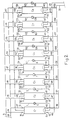
- This installation comprises, as shown in FIG. 2 of the American patent (reproduced here as FIG. 1 and for the detailed explanation of which we will refer to said American patent), eight columns or stages C1 to C8 of 200 liters each, filled of macroporous cationic resin C 150 marketed by the company PUROLITE, these resins being permuted in the potassium form, having a particle size between 400 and 1200 microns and a crosslinking rate of 7.5%.
- the closure device 106 maintains in the adopted configuration a total seal between, on the one hand zone III, which is an enrichment zone in high molecular weight polymers at the end of which the starch hydrolyzate is recovered. with a low polymolecularity index via line 146 and, on the other hand, zone I for desorption of glucose and low molecular weight glucose polymers, zone at the head of which the water of desorption is introduced.
- This closure device 106 ensures the direction of passage of the liquid phase over the resin.
- the relative share of the yield of glucose polymers of low polymolecularity index and of products of low molecular weight is ensured by the ratio of the flow rates at the outlet of the pipes 146 and 138.
- the weight yield in glucose polymers with a low polymolecularity index is substantially equal to 50% of the dry matter introduced into the chromatographic system.
- the temperature inside the columns is maintained at 75 ° C.
- the fraction X1 which is actually composed under these conditions of a part of pure water originating from the elution of the resin column of the preceding cycle is split into two sub-fractions.
- the first sub-fraction representing the first 700 seconds of the 1500-second cycle, or the first 63.5 liters of each cycle, is made up of practically pure water which is not recovered.
- This fraction which cannot be used as it is, must undergo, for its application in continuous and ambulatory peritoneal dialysis, the purification treatments which follow but which have no influence on the Mp, the Mn or the index polymolecularity of the product obtained after the chromatography step.
- the second part of fraction X1 resulting from the optionally hydrogenated or isomerized chromatography step, is concentrated under vacuum to a dry matter of 35%. It is then demineralized on a battery of ion exchange resins consisting of a strong cationic resin permuted in hydrogen form, a weak anionic resin permuted in hydroxyl form and a mixed bed of strong cationic and anionic resins also in form H+ and OH ⁇ .
- the demineralization is carried out under conditions, in particular of flow rate, such that a resistivity of the syrups greater than 106 ohms.cm is obtained.
- the syrup After demineralization, the syrup is treated with 1% ACTICARBON 3S black marketed by the company CECA in order to remove the pyrogenic substances.
- This syrup is then filtered on bacteriological filters with a 0.22 micron mesh in order to sterilize it, then it is then atomized under rigorous aseptic conditions to provide a perfectly white, odorless and flavorless powder.
- the content of DP + DP2 + DP3 is 1%, the content of glucose polymers with a molecular weight greater than 100,000 daltons is less than 0.25%.
- Mp 14600 Mn 6300 Mp / Mn 2.3
- the starch hydrolyzate with a low polymolecularity index thus purified and dehydrated is then easily redissolved in the company of other electrolytes to provide osmotic agents which are extremely effective in continuous peritoneal dialysis and ambulatory.
Landscapes
- Chemical & Material Sciences (AREA)
- Organic Chemistry (AREA)
- Engineering & Computer Science (AREA)
- Life Sciences & Earth Sciences (AREA)
- Chemical Kinetics & Catalysis (AREA)
- Biochemistry (AREA)
- Health & Medical Sciences (AREA)
- Zoology (AREA)
- Wood Science & Technology (AREA)
- Polymers & Plastics (AREA)
- Materials Engineering (AREA)
- Medicinal Chemistry (AREA)
- Crystallography & Structural Chemistry (AREA)
- General Health & Medical Sciences (AREA)
- Biotechnology (AREA)
- Genetics & Genomics (AREA)
- General Engineering & Computer Science (AREA)
- Bioinformatics & Cheminformatics (AREA)
- Microbiology (AREA)
- General Chemical & Material Sciences (AREA)
- Analytical Chemistry (AREA)
- Polysaccharides And Polysaccharide Derivatives (AREA)
- Preparation Of Compounds By Using Micro-Organisms (AREA)
- Pharmaceuticals Containing Other Organic And Inorganic Compounds (AREA)
- External Artificial Organs (AREA)
- Enzymes And Modification Thereof (AREA)
- Medicinal Preparation (AREA)
- Treatment Of Liquids With Adsorbents In General (AREA)
Applications Claiming Priority (2)
| Application Number | Priority Date | Filing Date | Title |
|---|---|---|---|
| FR9401707 | 1994-02-15 | ||
| FR9401707A FR2716199B1 (fr) | 1994-02-15 | 1994-02-15 | Procédé de fabrication d'un hydrolysat d'amidon à faible indice de polymolécularité, nouvel hydrolysat d'amidon ainsi obtenu et son utilisation en dialyse péritonéale. |
Publications (2)
| Publication Number | Publication Date |
|---|---|
| EP0667356A1 true EP0667356A1 (de) | 1995-08-16 |
| EP0667356B1 EP0667356B1 (de) | 1998-07-01 |
Family
ID=9460096
Family Applications (1)
| Application Number | Title | Priority Date | Filing Date |
|---|---|---|---|
| EP95400292A Expired - Lifetime EP0667356B1 (de) | 1994-02-15 | 1995-02-13 | Verfahren zur Herstellung eines Stärkehydrolysats mit niedrigem Polymolekularitätindex; so hergestelltes Stärkehydrolysat und seine Anwendung in der Peritonealdialyse |
Country Status (14)
| Country | Link |
|---|---|
| US (1) | US5837060A (de) |
| EP (1) | EP0667356B1 (de) |
| JP (1) | JP3983826B2 (de) |
| KR (1) | KR950032633A (de) |
| AT (1) | ATE167875T1 (de) |
| AU (1) | AU685555B2 (de) |
| CA (1) | CA2142528C (de) |
| DE (1) | DE69503157T2 (de) |
| DK (1) | DK0667356T3 (de) |
| ES (1) | ES2117837T3 (de) |
| FI (1) | FI110004B (de) |
| FR (1) | FR2716199B1 (de) |
| NO (1) | NO306904B1 (de) |
| ZA (1) | ZA951104B (de) |
Cited By (9)
| Publication number | Priority date | Publication date | Assignee | Title |
|---|---|---|---|---|
| FR2815822A1 (fr) * | 2000-10-30 | 2002-05-03 | Roquette Freres | Additif carbone pour fermentations alimentaires et compositions alimentaires le contenant |
| WO2010125315A1 (fr) * | 2009-04-30 | 2010-11-04 | Roquette Freres | Procede de purification de polymeres de glucose destines aux solutions de dialyse peritoneale |
| FR2955861A1 (fr) * | 2010-02-02 | 2011-08-05 | Roquette Freres | Polymeres solubles de glucose branches pour la dialyse peritoneale |
| WO2012129017A1 (en) * | 2011-03-18 | 2012-09-27 | Baxter International Inc. | Peritoneal dialysis solutions comprising glucose polymers |
| WO2012143647A1 (fr) | 2011-04-08 | 2012-10-26 | Roquette Freres | Méthodes de détection de contaminants dans des solutions contenants des polymères de glucose |
| WO2013178931A1 (fr) | 2012-05-29 | 2013-12-05 | Roquette Freres | Méthodes de décontamination des circuits de production de polymères de glucose et d'hydrolysats de polymères de glucose |
| WO2015140477A1 (fr) | 2014-03-21 | 2015-09-24 | Roquette Freres | Procede optimise de decontamination de production de polymeres de glucose et d'hydrolysats de polymeres de glucose |
| WO2016193634A1 (fr) | 2015-06-04 | 2016-12-08 | Roquette Freres | Procédé optimisé de décontamination de l'amidon utilisé comme matière première pour l'obtention de polymères de glucose destinés à la dialyse péritonéale |
| CN106397616A (zh) * | 2016-08-30 | 2017-02-15 | 华南理工大学 | 一种淀粉基腹膜透析液用艾考糊精的制备方法 |
Families Citing this family (14)
| Publication number | Priority date | Publication date | Assignee | Title |
|---|---|---|---|---|
| GB9810127D0 (en) | 1998-05-13 | 1998-07-08 | Ml Lab Plc | Prevention of surgical adhesions |
| JP3811008B2 (ja) | 1998-08-24 | 2006-08-16 | 黒川 清 | カルボニルストレス状態改善剤、および腹膜透析液 |
| FR2786775B1 (fr) * | 1998-12-04 | 2001-02-16 | Roquette Freres | Maltodextrines branchees et leur procede de preparation |
| JP4510184B2 (ja) * | 1999-08-27 | 2010-07-21 | 小川香料株式会社 | 粉末香料の製造方法 |
| CN1125085C (zh) * | 2000-11-08 | 2003-10-22 | 福州大学 | 一种糊精的制造方法及其装置 |
| FR2822645B1 (fr) * | 2001-03-30 | 2005-03-11 | Roquette Freres | Composition pour nutrition enterale comprenant des fibres |
| FR2840612B1 (fr) * | 2002-06-06 | 2005-05-06 | Roquette Freres | Polymeres solubles de glucose hautement branches et leur procede d'obtention |
| US7118857B2 (en) * | 2004-02-27 | 2006-10-10 | Baxter International Inc. | Methods and compositions for detection of microbial contaminants in peritoneal dialysis solutions |
| FR2871155B1 (fr) * | 2004-06-02 | 2007-04-27 | Roquette Freres | Utilisation de polysaccharides particuliers pour l'adjuvantation de matieres minerales |
| WO2006115067A1 (ja) * | 2005-04-20 | 2006-11-02 | Kabushiki Kaisha Hayashibara Seibutsu Kagaku Kenkyujo | 腹膜透析液 |
| WO2006125286A1 (en) * | 2005-05-24 | 2006-11-30 | Getec Guanabara Química Industrial S.A. | Process for the production of pyrogen-free anhydrous crystalline dextrose of high purity from sucrose |
| JP5164340B2 (ja) * | 2006-05-10 | 2013-03-21 | フタムラ化学株式会社 | 易ゲル化デンプン部分分解物 |
| JP2011130696A (ja) * | 2009-12-24 | 2011-07-07 | Nihon Cornstarch Corp | マルトデキストリンの製造方法 |
| CN114316076B (zh) * | 2020-09-29 | 2023-01-31 | 青岛力腾医药科技有限公司 | 一种肾病用源于淀粉的麦芽糖糊精的制备方法 |
Citations (5)
| Publication number | Priority date | Publication date | Assignee | Title |
|---|---|---|---|---|
| FR1548941A (de) * | 1966-12-19 | 1968-12-06 | ||
| US3974032A (en) * | 1973-03-05 | 1976-08-10 | Cpc International Inc. | Low D.E. starch hydrolysates of improved stability prepared by enzymatic hydrolysis of dextrins |
| EP0115911A1 (de) * | 1983-01-12 | 1984-08-15 | M.L. Laboratories Plc | Lösungen für Peritonäaldialyse |
| EP0207676A2 (de) * | 1985-06-22 | 1987-01-07 | M L Laboratories Plc | In kontinuierlicher Peritonealdialyse verwendete Polymere |
| WO1993007177A1 (de) * | 1991-10-01 | 1993-04-15 | Laevosan-Gesellschaft Mbh | Verfahren zur herstellung von stärkeabbauprodukten mit einer engen molekulargewichtsverteilung |
Family Cites Families (4)
| Publication number | Priority date | Publication date | Assignee | Title |
|---|---|---|---|---|
| FR2575179B1 (fr) * | 1984-12-20 | 1987-02-06 | Roquette Freres | Procede de preparation de maltitol cristallise |
| JP2926434B2 (ja) * | 1990-07-26 | 1999-07-28 | 株式会社林原生物化学研究所 | アミロース粒子とその製造方法 |
| FR2688793B1 (fr) * | 1992-03-19 | 1994-06-03 | Roquette Freres | Composition de saccharides hydrogenes hypocariogenes, procede de preparation et application de cette composition. |
| FR2697023B1 (fr) * | 1992-10-16 | 1994-12-30 | Roquette Freres | Polymère soluble hypocalorique du glucose et procédé de préparation de ce polymère . |
-
1994
- 1994-02-15 FR FR9401707A patent/FR2716199B1/fr not_active Expired - Fee Related
-
1995
- 1995-02-10 ZA ZA951104A patent/ZA951104B/xx unknown
- 1995-02-13 FI FI950614A patent/FI110004B/fi not_active IP Right Cessation
- 1995-02-13 EP EP95400292A patent/EP0667356B1/de not_active Expired - Lifetime
- 1995-02-13 DK DK95400292T patent/DK0667356T3/da active
- 1995-02-13 DE DE69503157T patent/DE69503157T2/de not_active Expired - Lifetime
- 1995-02-13 AU AU12223/95A patent/AU685555B2/en not_active Expired
- 1995-02-13 AT AT95400292T patent/ATE167875T1/de active
- 1995-02-13 ES ES95400292T patent/ES2117837T3/es not_active Expired - Lifetime
- 1995-02-14 CA CA002142528A patent/CA2142528C/en not_active Expired - Lifetime
- 1995-02-14 KR KR1019950002662A patent/KR950032633A/ko not_active Withdrawn
- 1995-02-14 JP JP02567795A patent/JP3983826B2/ja not_active Expired - Lifetime
- 1995-02-14 NO NO950546A patent/NO306904B1/no not_active IP Right Cessation
-
1998
- 1998-01-06 US US09/003,130 patent/US5837060A/en not_active Expired - Lifetime
Patent Citations (5)
| Publication number | Priority date | Publication date | Assignee | Title |
|---|---|---|---|---|
| FR1548941A (de) * | 1966-12-19 | 1968-12-06 | ||
| US3974032A (en) * | 1973-03-05 | 1976-08-10 | Cpc International Inc. | Low D.E. starch hydrolysates of improved stability prepared by enzymatic hydrolysis of dextrins |
| EP0115911A1 (de) * | 1983-01-12 | 1984-08-15 | M.L. Laboratories Plc | Lösungen für Peritonäaldialyse |
| EP0207676A2 (de) * | 1985-06-22 | 1987-01-07 | M L Laboratories Plc | In kontinuierlicher Peritonealdialyse verwendete Polymere |
| WO1993007177A1 (de) * | 1991-10-01 | 1993-04-15 | Laevosan-Gesellschaft Mbh | Verfahren zur herstellung von stärkeabbauprodukten mit einer engen molekulargewichtsverteilung |
Non-Patent Citations (1)
| Title |
|---|
| E. CORÜSLÜ ET AL.: "Starch hydrolysates with very low degrees of polydispersity", STARKE., vol. 35, WEINHEIM DE, pages 98 * |
Cited By (17)
| Publication number | Priority date | Publication date | Assignee | Title |
|---|---|---|---|---|
| FR2815822A1 (fr) * | 2000-10-30 | 2002-05-03 | Roquette Freres | Additif carbone pour fermentations alimentaires et compositions alimentaires le contenant |
| EP1201133A3 (de) * | 2000-10-30 | 2004-01-02 | Roquette FrÀ¨res | Zusatzstoff für die Gärung von Lebensmitteln und diesen enthaltende Lebensmittel |
| US6737090B2 (en) | 2000-10-30 | 2004-05-18 | Roquette Freres | Carbon-containing additive for foodstuff fermentations and food compositions containing it |
| WO2010125315A1 (fr) * | 2009-04-30 | 2010-11-04 | Roquette Freres | Procede de purification de polymeres de glucose destines aux solutions de dialyse peritoneale |
| FR2945043A1 (fr) * | 2009-04-30 | 2010-11-05 | Roquette Freres | Procede de purification de polymeres de glucose destines aux solutions de dialyse peritoneale |
| US9353192B2 (en) | 2009-04-30 | 2016-05-31 | Roquette Freres | Method for purifying glucose polymers for peritoneal dialysis solutions |
| US9200087B2 (en) | 2010-02-02 | 2015-12-01 | Roquette Freres | Branched soluble glucose polymers for peritoneal dialysis |
| WO2011095736A1 (fr) | 2010-02-02 | 2011-08-11 | Roquette Freres | Polymeres solubles de glucose branches pour la dialyse peritoneale |
| FR2955861A1 (fr) * | 2010-02-02 | 2011-08-05 | Roquette Freres | Polymeres solubles de glucose branches pour la dialyse peritoneale |
| WO2012129017A1 (en) * | 2011-03-18 | 2012-09-27 | Baxter International Inc. | Peritoneal dialysis solutions comprising glucose polymers |
| US8975240B2 (en) | 2011-03-18 | 2015-03-10 | Baxter International Inc. | Peritoneal dialysis solutions comprising glucose polymers |
| WO2012143647A1 (fr) | 2011-04-08 | 2012-10-26 | Roquette Freres | Méthodes de détection de contaminants dans des solutions contenants des polymères de glucose |
| EP3495816A1 (de) | 2011-04-08 | 2019-06-12 | Roquette Freres | Methode zur detektion von verunreinigungen in lösungen, die glukosepolymere enthalten |
| WO2013178931A1 (fr) | 2012-05-29 | 2013-12-05 | Roquette Freres | Méthodes de décontamination des circuits de production de polymères de glucose et d'hydrolysats de polymères de glucose |
| WO2015140477A1 (fr) | 2014-03-21 | 2015-09-24 | Roquette Freres | Procede optimise de decontamination de production de polymeres de glucose et d'hydrolysats de polymeres de glucose |
| WO2016193634A1 (fr) | 2015-06-04 | 2016-12-08 | Roquette Freres | Procédé optimisé de décontamination de l'amidon utilisé comme matière première pour l'obtention de polymères de glucose destinés à la dialyse péritonéale |
| CN106397616A (zh) * | 2016-08-30 | 2017-02-15 | 华南理工大学 | 一种淀粉基腹膜透析液用艾考糊精的制备方法 |
Also Published As
| Publication number | Publication date |
|---|---|
| DE69503157D1 (de) | 1998-08-06 |
| FR2716199B1 (fr) | 1996-04-26 |
| FR2716199A1 (fr) | 1995-08-18 |
| EP0667356B1 (de) | 1998-07-01 |
| FI950614L (fi) | 1995-08-16 |
| ZA951104B (en) | 1996-02-12 |
| AU1222395A (en) | 1995-08-24 |
| US5837060A (en) | 1998-11-17 |
| JPH0885701A (ja) | 1996-04-02 |
| AU685555B2 (en) | 1998-01-22 |
| DE69503157T2 (de) | 1999-01-21 |
| JP3983826B2 (ja) | 2007-09-26 |
| CA2142528C (en) | 2008-07-15 |
| ES2117837T3 (es) | 1998-08-16 |
| ATE167875T1 (de) | 1998-07-15 |
| NO950546D0 (no) | 1995-02-14 |
| CA2142528A1 (en) | 1995-08-16 |
| NO306904B1 (no) | 2000-01-10 |
| NO950546L (no) | 1995-08-16 |
| DK0667356T3 (da) | 1999-04-12 |
| FI110004B (fi) | 2002-11-15 |
| KR950032633A (ko) | 1995-12-22 |
| FI950614A0 (fi) | 1995-02-13 |
Similar Documents
| Publication | Publication Date | Title |
|---|---|---|
| EP0667356B1 (de) | Verfahren zur Herstellung eines Stärkehydrolysats mit niedrigem Polymolekularitätindex; so hergestelltes Stärkehydrolysat und seine Anwendung in der Peritonealdialyse | |
| FR2697023A1 (fr) | Polymère soluble hypocalorique du glucose et procédé de préparation de ce polymère . | |
| CA2088933C (en) | Purification of polysaccharides | |
| FI86141B (fi) | Foerfarande foer framstaellning av peritoneal dialysloesning. | |
| US4511654A (en) | Production of high sugar syrups | |
| FR2607817A1 (fr) | Procede et matiere pour la separation et la purification des cyclodextrines | |
| BE1004513A3 (fr) | Procede de preparation de sirops de fructose a partir de matieres premieres vegetales contenant de l'inuline. | |
| JP2696537B2 (ja) | 高純度マルトースの製造方法 | |
| US6663717B2 (en) | Process for the fractionation of sugar beet pulp | |
| JP2634951B2 (ja) | 曇っていない水溶液を生成するために使用されるシクロデキストリンを製造するための方法 | |
| CA2816258A1 (fr) | Procede de decontamination d'hydrolysats d'amidon pour la preparation de polymeres de glucose destines a la dialyse peritoneale | |
| JPH0154040B2 (de) | ||
| US3832285A (en) | Method of producing maltose of high purity | |
| JP2000308499A (ja) | 高いデキストロース含有量を有するデンプン加水分解物の生産法 | |
| FR2559490A1 (fr) | Procede de production d'oligoglucosylfructosides tres purs | |
| US5194094A (en) | Fractionating starch hydrolysates | |
| CA2293195A1 (fr) | .alpha.-amylase maltogenique immobilisee et son utilisation dans la fabrication d'un sirop riche en maltose | |
| JPH0689044B2 (ja) | アラビアガムの清澄方法 | |
| KR0139262B1 (ko) | 분지 덱스트린류와 직쇄 올리고당류의 제조방법 | |
| KR20090110723A (ko) | 알로에 베라 겔의 농축 방법 | |
| JPH10215893A (ja) | デキストリンの製造方法 | |
| CN119278271A (zh) | 用于生产富含麦芽四糖的组合物的酶促方法 | |
| JPH0528115B2 (de) | ||
| EP1739094A1 (de) | Verfahren zur Reinigung von elektrisch geladenen Polysacchariden | |
| WO2023180067A1 (fr) | Procédé de production de chitosane à partir de mycélium fongique |
Legal Events
| Date | Code | Title | Description |
|---|---|---|---|
| PUAI | Public reference made under article 153(3) epc to a published international application that has entered the european phase |
Free format text: ORIGINAL CODE: 0009012 |
|
| AK | Designated contracting states |
Kind code of ref document: A1 Designated state(s): AT BE CH DE DK ES FR GB IT LI NL SE |
|
| 17P | Request for examination filed |
Effective date: 19950904 |
|
| 17Q | First examination report despatched |
Effective date: 19970506 |
|
| GRAG | Despatch of communication of intention to grant |
Free format text: ORIGINAL CODE: EPIDOS AGRA |
|
| GRAG | Despatch of communication of intention to grant |
Free format text: ORIGINAL CODE: EPIDOS AGRA |
|
| GRAH | Despatch of communication of intention to grant a patent |
Free format text: ORIGINAL CODE: EPIDOS IGRA |
|
| GRAH | Despatch of communication of intention to grant a patent |
Free format text: ORIGINAL CODE: EPIDOS IGRA |
|
| GRAA | (expected) grant |
Free format text: ORIGINAL CODE: 0009210 |
|
| AK | Designated contracting states |
Kind code of ref document: B1 Designated state(s): AT BE CH DE DK ES FR GB IT LI NL SE |
|
| REF | Corresponds to: |
Ref document number: 167875 Country of ref document: AT Date of ref document: 19980715 Kind code of ref document: T |
|
| REG | Reference to a national code |
Ref country code: CH Ref legal event code: NV Representative=s name: ISLER & PEDRAZZINI AG Ref country code: CH Ref legal event code: EP |
|
| REF | Corresponds to: |
Ref document number: 69503157 Country of ref document: DE Date of ref document: 19980806 |
|
| ITF | It: translation for a ep patent filed | ||
| REG | Reference to a national code |
Ref country code: ES Ref legal event code: FG2A Ref document number: 2117837 Country of ref document: ES Kind code of ref document: T3 |
|
| GBT | Gb: translation of ep patent filed (gb section 77(6)(a)/1977) |
Effective date: 19981005 |
|
| REG | Reference to a national code |
Ref country code: DK Ref legal event code: T3 |
|
| PLBE | No opposition filed within time limit |
Free format text: ORIGINAL CODE: 0009261 |
|
| STAA | Information on the status of an ep patent application or granted ep patent |
Free format text: STATUS: NO OPPOSITION FILED WITHIN TIME LIMIT |
|
| 26N | No opposition filed | ||
| REG | Reference to a national code |
Ref country code: GB Ref legal event code: IF02 |
|
| REG | Reference to a national code |
Ref country code: CH Ref legal event code: PCAR Free format text: ISLER & PEDRAZZINI AG;POSTFACH 1772;8027 ZUERICH (CH) |
|
| PGFP | Annual fee paid to national office [announced via postgrant information from national office to epo] |
Ref country code: SE Payment date: 20140214 Year of fee payment: 20 Ref country code: CH Payment date: 20140214 Year of fee payment: 20 Ref country code: DK Payment date: 20140120 Year of fee payment: 20 Ref country code: NL Payment date: 20140123 Year of fee payment: 20 Ref country code: DE Payment date: 20140211 Year of fee payment: 20 |
|
| PGFP | Annual fee paid to national office [announced via postgrant information from national office to epo] |
Ref country code: AT Payment date: 20140122 Year of fee payment: 20 Ref country code: IT Payment date: 20140217 Year of fee payment: 20 Ref country code: BE Payment date: 20140226 Year of fee payment: 20 Ref country code: FR Payment date: 20140228 Year of fee payment: 20 Ref country code: ES Payment date: 20140221 Year of fee payment: 20 |
|
| PGFP | Annual fee paid to national office [announced via postgrant information from national office to epo] |
Ref country code: GB Payment date: 20140219 Year of fee payment: 20 |
|
| REG | Reference to a national code |
Ref country code: DE Ref legal event code: R071 Ref document number: 69503157 Country of ref document: DE |
|
| REG | Reference to a national code |
Ref country code: DK Ref legal event code: EUP Effective date: 20150213 |
|
| REG | Reference to a national code |
Ref country code: NL Ref legal event code: V4 Effective date: 20150213 |
|
| REG | Reference to a national code |
Ref country code: CH Ref legal event code: PL |
|
| REG | Reference to a national code |
Ref country code: GB Ref legal event code: PE20 Expiry date: 20150212 |
|
| REG | Reference to a national code |
Ref country code: SE Ref legal event code: EUG |
|
| REG | Reference to a national code |
Ref country code: AT Ref legal event code: MK07 Ref document number: 167875 Country of ref document: AT Kind code of ref document: T Effective date: 20150213 |
|
| REG | Reference to a national code |
Ref country code: ES Ref legal event code: FD2A Effective date: 20150424 |
|
| PG25 | Lapsed in a contracting state [announced via postgrant information from national office to epo] |
Ref country code: GB Free format text: LAPSE BECAUSE OF EXPIRATION OF PROTECTION Effective date: 20150212 |
|
| PG25 | Lapsed in a contracting state [announced via postgrant information from national office to epo] |
Ref country code: ES Free format text: LAPSE BECAUSE OF EXPIRATION OF PROTECTION Effective date: 20150214 |