EP0668201A2 - Pneumatischer Kraftverstärker mit elektromagnetischer Hilfssteuerung, insbesondere für Kraftfahrzeug-Bremsanlagen - Google Patents
Pneumatischer Kraftverstärker mit elektromagnetischer Hilfssteuerung, insbesondere für Kraftfahrzeug-Bremsanlagen Download PDFInfo
- Publication number
- EP0668201A2 EP0668201A2 EP95101623A EP95101623A EP0668201A2 EP 0668201 A2 EP0668201 A2 EP 0668201A2 EP 95101623 A EP95101623 A EP 95101623A EP 95101623 A EP95101623 A EP 95101623A EP 0668201 A2 EP0668201 A2 EP 0668201A2
- Authority
- EP
- European Patent Office
- Prior art keywords
- piston
- valve
- sealing body
- valve body
- chamber
- Prior art date
- Legal status (The legal status is an assumption and is not a legal conclusion. Google has not performed a legal analysis and makes no representation as to the accuracy of the status listed.)
- Granted
Links
Images

Classifications
-
- B—PERFORMING OPERATIONS; TRANSPORTING
- B60—VEHICLES IN GENERAL
- B60T—VEHICLE BRAKE CONTROL SYSTEMS OR PARTS THEREOF; BRAKE CONTROL SYSTEMS OR PARTS THEREOF, IN GENERAL; ARRANGEMENT OF BRAKING ELEMENTS ON VEHICLES IN GENERAL; PORTABLE DEVICES FOR PREVENTING UNWANTED MOVEMENT OF VEHICLES; VEHICLE MODIFICATIONS TO FACILITATE COOLING OF BRAKES
- B60T13/00—Transmitting braking action from initiating means to ultimate brake actuator with power assistance or drive; Brake systems incorporating such transmitting means, e.g. air-pressure brake systems
- B60T13/10—Transmitting braking action from initiating means to ultimate brake actuator with power assistance or drive; Brake systems incorporating such transmitting means, e.g. air-pressure brake systems with fluid assistance, drive, or release
- B60T13/66—Electrical control in fluid-pressure brake systems
- B60T13/72—Electrical control in fluid-pressure brake systems in vacuum systems or vacuum booster units
-
- B—PERFORMING OPERATIONS; TRANSPORTING
- B60—VEHICLES IN GENERAL
- B60T—VEHICLE BRAKE CONTROL SYSTEMS OR PARTS THEREOF; BRAKE CONTROL SYSTEMS OR PARTS THEREOF, IN GENERAL; ARRANGEMENT OF BRAKING ELEMENTS ON VEHICLES IN GENERAL; PORTABLE DEVICES FOR PREVENTING UNWANTED MOVEMENT OF VEHICLES; VEHICLE MODIFICATIONS TO FACILITATE COOLING OF BRAKES
- B60T11/00—Transmitting braking action from initiating means to ultimate brake actuator without power assistance or drive or where such assistance or drive is irrelevant
- B60T11/10—Transmitting braking action from initiating means to ultimate brake actuator without power assistance or drive or where such assistance or drive is irrelevant transmitting by fluid means, e.g. hydraulic
- B60T11/16—Master control, e.g. master cylinders
- B60T11/236—Piston sealing arrangements
-
- B—PERFORMING OPERATIONS; TRANSPORTING
- B60—VEHICLES IN GENERAL
- B60Y—INDEXING SCHEME RELATING TO ASPECTS CROSS-CUTTING VEHICLE TECHNOLOGY
- B60Y2400/00—Special features of vehicle units
- B60Y2400/81—Braking systems
Definitions
- the invention relates to a pneumatic power booster with electromagnetic auxiliary control, in particular for motor vehicle brake systems, according to the preamble of claim 1.
- the piston is designed exclusively for the transmission of actuation forces and for mechanical control of the valve body.
- the stop member is attached to the piston and extends through radial recesses of the valve body and the valve housing that are aligned with one another, where it interacts with a stop formed on the booster housing.
- the recess of the valve body is dimensioned such that its rest position is determined by the valve body being in direct contact with the stop member.
- the seal arranged between the valve body and the piston is a lip seal which is held in an annular groove of the piston and which, regardless of the position of the valve body with respect to the piston, lies sealingly against a cylindrical inner wall of the valve body.
- the valve body can be actuated electromagnetically in order to support braking which is desired by the driver and is brought about by mechanical force introduction via the actuating element, if a sensor, for example arranged on the actuating element, detects that a certain actuating speed is exceeded, which is regarded as a sign of this that the driver intends an emergency stop. If the driver then realizes that normal braking is sufficient instead of emergency braking, he will reduce the force exerted on the brake pedal and thereby trigger processes in the brake booster, which can be electronically monitored and used as an opportunity to de-energize the electromagnet and thus the valve body to return to its rest position.
- the electronic monitoring of components within the booster is problematic, however, because it is difficult to accommodate the lines required for this so that they do not interfere and are not susceptible to faults themselves.
- the invention is therefore based on the object of providing simple means which are less susceptible to faults for terminating an electromagnetically triggered emergency brake support.
- the invention enables the driver to end an emergency braking operation initiated by him at any time in a purely mechanical way, even when the electromagnet is still live and as a result the valve body cannot yet return to its rest position.
- the piston with its third valve seat temporarily takes over the task of preventing further inflow of air into the first chamber and to bring about pressure compensation between the chambers.
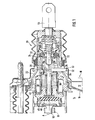
- the brake booster shown is essentially rotationally symmetrical with respect to an axis A, which when installed in a motor vehicle normally corresponds to the longitudinal direction of the vehicle.
- the brake booster has an booster housing 10 in which a first chamber 12 and a second chamber 14 are separated from one another by a movable wall 16.
- the amplifier housing 10 is held together by axially parallel tie rods 18, only one of which is shown.
- the brake booster includes a control valve 20, which is largely installed in the booster housing 10 and has a valve housing 22 that is axially movable with respect to this.
- An annular first valve seat 24 is formed in the interior of the valve housing 22 and separates a channel 26 opening into the rear chamber 12 from a channel 28 opening into the front chamber 14.
- the valve housing 22 also has an axial bore in which a sleeve-shaped valve body 30 is guided so as to be displaceable along the axis A.
- the valve body 30 is composed of a front and a rear component, which are locked together.
- a second valve seat 32 which is concentric with the first valve seat 24, is formed at the rear end of the rear component of the valve body 30, which is on the right in the drawing.
- the valve body 30 At a distance in front of the second valve seat 32, that is to say to the left of it in the drawing, the valve body 30 has a radial recess 34, which is followed by a likewise radial, but wider in the axial direction recess 36 in the valve housing 22.
- the valve body 30 is constantly pushed to the rear by an axially preloaded valve spring 38, ie to the right in FIGS. 1 and 2.
- an electromagnet 40 is installed, to which the left component of the valve body 30 is assigned as a magnet armature such that the valve body 30 is pulled forward against the resistance of the valve spring 38 when the electromagnet 40 is energized.
- a piston 42 is guided in the valve housing 22 and is connected at its rear end to a rod-shaped actuating member 44 and has a piston head 46 at its front end. Together with a rubber body 48 embedded in the valve housing 22 and a force output element 50 arranged in front of it, this forms a mechanical force transmission of the type customary in brake boosters.
- a stop member 52 is engaged in an annular groove of the piston 42 in such a way that it is connected to the piston for a common axial movement.
- the stop member 52 extends radially through the recesses 34 and 36 in the valve body 30 or valve housing 22 to the outside and is in the illustrated rest position of the piston 42 against a stop 53 which is formed on a shoulder of the booster housing 10 and thus from the position of the Valve housing 22 is independent.
- a flange-like driver 54 is formed on the piston 42, which in the illustrated rest position of the piston 42 and the valve body 30 bears against an annular abutment 55 formed on the valve body.
- An annular lip seal 56 is assigned to the abutment 55 of the valve body 30, which lies in an annular recess which is formed in the piston 42 and is open radially outwards and which seals against the abutment 55 on the end face in the rest position shown.
- the effective diameter of the seal 56 is somewhat smaller than the effective diameter of the second valve seat 32. Behind the seal 56, that is to the right of it in the drawings, there is always atmospheric pressure. In the illustrated rest position of the valve body 30, the seal 56 prevents ambient air from passing through the valve body 30 and further through the cutouts 34 and 36 into the rear chamber 12.
- the actuating element 44 is normally held in its illustrated rest position by a rear return spring 58, in which an annular sealing body 60, which is arranged inside the valve housing 22 in the usual way and is biased forwardly by a spring 62, bears against the second valve seat 24 against the second valve seat 32 but does not seal completely, with a slight pressure drop between the two chambers 12 and 14.
- the rear component of the valve body 30, which has the second valve seat 32, is connected to the front component of the valve body by resilient locking fingers 70.
- a third annular valve seat 72 is formed on the rear side of the piston 42, the effective diameter of which is somewhat smaller than that of the seal 56. In the rest position shown, the third valve seat 72 is at a distance B from the sealing body 60.
- the front chamber 14 is continuously connected to a vacuum source.
- the movable wall 16 and the valve housing 22 connected to it for common axial movement are urged into their illustrated rear end position by a front return spring 64.
- valve body 30 In the unactuated state, the stop member 52 bears against the stop 53, whereby the rest position of the piston 42 is fixed.
- the valve body 30 is supported on the driver 54 with almost the entire force of the valve spring 38 clamped between it and the piston 42, whereby the rest position of the valve body 30 is also fixed.
- the second valve seat 32 rests on the sealing body 60 with a slight residual force of the valve spring 38.
- the electromagnet 40 is excited so that it pulls the valve body 30 forward from the driver 54 and thereby the free flow cross section enlarged between the second valve seat 32 and the sealing body 60.
- Such an increased application of force to the brake booster may be desirable, for example, when a vehicle to be braked is heavily loaded or when a particularly rapid forward movement of the actuating element 44 suggests that emergency braking is desired.
- control unit which includes an acceleration sensor that monitors the actuator 44.
- valve body 30 After switching off the electromagnet 40, the valve body 30 is pushed back again by the valve spring 38, so that the abutment 55 rests against the driver 54 and the seal 56 is effective again.
- the piston 42 After the end of a mechanical application of force via the actuator 44, the piston 42 returns to the rest position together with the valve body 30.
- the movable wall 16 and the valve housing 22 do not take part in this return movement as long as there is still a pressure drop between the chambers 12 and 14.
- the pressure drop is reduced in that the valve body 30 rests on the sealing body 60 with its second valve seat 32, as a result of which the rear chamber 12 is separated from the atmosphere and then the sealing body is pushed back a small distance so that it moves away from the first valve seat 24 solves.
- the actuator 44 is withdrawn while the electromagnet 42 is still energized, the third valve seat 72 rests on the sealing body 60, so that it is the rear chamber 12 from the atmosphere separates.
- the force of the return spring 58 causes the piston 42 with its third valve seat 72 to push the sealing body 60 to the rear so that it releases the first valve seat 24.
- pressure equilibrium is established between the chambers 12 and 14, so that the movable wall 16, and with it the valve housing 22, returns to the drawn rest position.
Landscapes
- Engineering & Computer Science (AREA)
- Transportation (AREA)
- Mechanical Engineering (AREA)
- Braking Systems And Boosters (AREA)
Abstract
Description
- Die Erfindung betrifft einen pneumatischer Kraftverstärker mit elektromagnetischer Hilfssteuerung, insbesondere für Kraftfahrzeug-Bremsanlagen, nach dem Oberbegriff des Anspruchs 1.
- Bei einem bekannten Bremskraftverstärker dieser Gattung (DE-A 4211849) ist der Kolben ausschließlich zur Übertragung von Betätigungskräften und zum mechanischen Steuern des Ventilkörpers ausgebildet. Das Anschlagglied ist am Kolben befestigt und erstreckt sich durch miteinander fluchtende radiale Aussparungen des Ventilkörpers und des Ventilgehäuses nach außen, wo es mit einem am Verstärkergehäuse ausgebildeten Anschlag zusammenwirkt. Die Aussparung des Ventilkörpers ist so bemessen, daß dessen Ruhestellung durch unmittelbare Anlage des Ventilkörpers am Anschlagglied bestimmt ist. Die zwischen Ventilkörper und Kolben angeordnete Dichtung ist eine Lippendichtung, die in einer Ringnut des Kolbens gehalten ist und unabhängig von der Stellung des Ventilkörpers in bezug auf den Kolben dichtend an einer zylindrischen Innenwand des Ventilkörpers anliegt.
- Bei dieser bekannten Anordnung kann der Ventilkörper elektromagnetisch betätigt werden, um eine vom Fahrer gewollte, durch mechanische Krafteinleitung über das Betätigungsglied hervorgerufene Bremsung zu unterstützen, wenn ein beispielsweise am Betägigungsglied angeordneter Sensor feststellt, daß eine bestimmte Betätigungsgeschwindigkeit überschritten wird, was als Zeichen dafür gewertet wird, daß der Fahrer eine Notbremsung beabsichtigt. Wenn der Fahrer anschließend erkennt, daß anstelle einer Notbremsung eine normale Bremsung genügt, wird er die auf das Bremspedal ausgeübte Kraft vermindern und dadurch Vorgänge im Bremskraftverstärker auslösen, die elektronisch überwacht und zum Anlaß genommen werden können, den Elektromagneten stromlos zu machen und somit den Ventilkörper in seine Ruhestellung zurückkehren zu lassen. Die elektronische Überwachung von Bauteilen innerhalb des Kraftverstärkers ist allerdings problematisch, weil es schwierig ist, die hierzu erforderlichen Leitungen so unterzubringen, daß sie nicht stören und auch selber nicht störanfällig sind.
- Der Erfindung liegt deshalb die Aufgabe zugrunde, einfache und wenig störanfällige Mittel zum Beenden einer elektromagnetisch ausgelösten Notbremsunterstützung bereitzustellen.
- Die Aufgabe ist erfindungsgemäß mit den Merkmalen des Anspruchs 1 gelöst.
- Die Erfindung ermöglicht es dem Fahrer, eine von ihm eingeleitete Notbremsung jederzeit auf rein mechanischem Wege zu beenden, auch wenn der Elektromagnet noch unter Strom steht und infolgedessen der Ventilkörper noch nicht in seine Ruhestellung zurückkehren kann. In diesem Fall übernimmt der Kolben mit seinem dritten Ventilsitz vorübergehend die Aufgabe, das weitere Einströmen von Luft in die erste Kammer zu verhindern und einen Druckausgleich zwischen den Kammern zu bewirken.
- Vorteilhafte Weiterbildungen der Erfindung sind Gegenstand der Unteransprüche.
- Ein Ausführungsbeispiel der Erfindung wird im folgenden anhand schematischer Zeichnungen mit weiteren Einzelheiten erläutert. Es zeigen:
- Fig. 1 einen Axialschnitt durch den hinteren Teil eines pneumatischen Bremskraftverstärkers mit elektromagnetischer Hilfssteuerung und
- Fig. 2 einen vergrößerten Ausschnitt aus Fig. 1.
- Der dargestellte Bremskraftverstärker ist im wesentlichen rotationssymmetrisch in bezug auf eine Achse A, die bei Einbau in ein Kraftfahrzeug normalerweise mit der Fahrzeuglängsrichtung übereinstimmt. Der Bremskraftverstärker hat ein Verstärkergehäuse 10, in dem eine erste Kammer 12 und eine zweite Kammer 14 durch eine bewegliche Wand 16 voneinander getrennt sind. Das Verstärkergehäuse 10 ist durch achsparallele Zuganker 18 zusammengehalten, von denen nur einer dargestellt ist.
- Zum Bremskraftverstärker gehört ein Steuerventil 20, das zum größten Teil in das Verstärkergehäuse 10 eingebaut ist und ein in bezug auf dieses axial bewegliches Ventilgehäuse 22 aufweist. Im Inneren des Ventilgehäuses 22 ist ein ringförmiger erster Ventilsitz 24 ausgebildet, der einen in die hintere Kammer 12 mündenden Kanal 26 von einem in die vordere Kammer 14 mündenden Kanal 28 trennt. Das Ventilgehäuse 22 weist ferner eine axiale Bohrung auf, in der ein hülsenförmiger Ventilkörper 30 längs der Achse A verschiebbar geführt ist. Der Ventilkörper 30 ist aus einem vorderen und einem hinteren Bauteil zusammengesetzt, die miteinander verrastet sind. Am hinteren Ende des hinteren, in der Zeichnung rechten, Bauteils des Ventilkörpers 30 ist ein zum ersten Ventilsitz 24 konzentrischer zweiter Ventilsitz 32 ausgebildet.
- In einem Abstand vor dem zweiten Ventilsitz 32, in der Zeichnung also links davon, weist der Ventilkörper 30 eine radiale Aussparung 34 auf, an die sich eine ebenfalls radiale, in axialer Richtung jedoch breitere Aussparung 36 im Ventilgehäuse 22 anschließt. Der Ventilkörper 30 wird von einer axial vorgespannten Ventilfeder 38 ständig nach hinten, in Fig. 1 und 2 also nach rechts, gedrängt. In das Steuerventil 20 ist ein Elektromagnet 40 eingebaut, dem das linke Bauteil des Ventilkörpers 30 als Magnetanker derart zugeordnet ist, daß der Ventilkörper 30 gegen den Widerstand der Ventilfeder 38 nach vorne gezogen wird, wenn der Elektromagnet 40 bestromt wird.
- Im Ventilgehäuse 22 ist ein Kolben 42 geführt, der an seinem hinteren Ende mit einem stangenförmigen Betätigungsglied 44 verbunden ist und an seinem vorderen Ende einen Kolbenkopf 46 aufweist. Dieser bildet zusammen mit einem in das Ventilgehäuse 22 eingebetteten Gummikörper 48 und einem davor angeordneten Kraftabgabeglied 50 eine mechanische Kraftübersetzung von bei Bremskraftverstärkern üblicher Art.
- In eine Ringnut des Kolbens 42 ist ein Anschlagglied 52 derart eingerastet, daß es zu gemeinsamer Axialbewegung mit dem Kolben verbunden ist. Das Anschlagglied 52 erstreckt sich radial durch die Aussparungen 34 und 36 im Ventilkörper 30 bzw. Ventilgehäuse 22 nach außen und liegt in der abgebildeten Ruhestellung des Kolbens 42 an einem Anschlag 53 an, der an einer Schulter des Verstärkergehäuses 10 ausgebildet und somit von der Stelllung des Ventilgehäuses 22 unabhängig ist. In einem Abstand hinter dem Anschlagglied 52 ist am Kolben 42 ein flanschartiger Mitnehmer 54 ausgebildet, der in der abgebildeten Ruhestellung des Kolbens 42 und des Ventilkörpers 30 an einem am Ventilkörper ausgebildeten ringförmigen Widerlager 55 anliegt.
- Dem Widerlager 55 des Ventilkörpers 30 ist eine ringförmige Lippendichtung 56 zugeordnet, die in einer im Kolben 42 ausgebildeten, radial nach außen offenen ringförmigen Ausnehmung liegt und in der abgebildeten Ruhestellung stirnseitig gegen das Widerlager 55 abdichtet. Der wirksame Durchmesser der Dichtung 56 ist etwas kleiner als der wirksame Durchmesser des zweiten Ventilsitzes 32. Hinter der Dichtung 56, in den Zeichnungen also rechts davon, herrscht ständig Atmosphärendruck. Die Dichtung 56 verhindert in der abgebildeten Ruhestellung des Ventilkörpers 30, daß Umgebungsluft durch den Ventilkörper 30 hindurch und weiter durch die Aussparungen 34 und 36 in die hintere Kammer 12 gelangt.
- Das Betätigungsglied 44 ist durch eine hintere Rückstellfeder 58 normalerweise in seiner abgebildeten Ruhestellung gehalten, in der ein innerhalb des Ventilgehäuses 22 in üblicher Weise angeordneter und durch eine Feder 62 nach vorne vorgespannter ringförmiger Dichtkörper 60 am ersten Ventilsitz 24 abdichtend anliegt, gegen den zweiten Ventilsitz 32 jedoch nicht vollständig abdichtet, wobei zwischen den beiden Kammern 12 und 14 ein leichtes Druckgefälle besteht. Das hintere Bauteil des Ventilkörpers 30, das den zweiten Ventilsitz 32 aufweist, ist mit dem vorderen Bauteil des Ventilkörpers durch federnde Rastfinger 70 verbunden. An der Rückseite des Kolbens 42 ist ein dritter ringförmiger Ventilsitz 72 ausgebildet, dessen wirksamer Durchmesser etwas kleiner ist als derjenige der Dichtung 56. In der abgebildeten Ruhestellung hat der dritte Ventilsitz 72 vom Dichtkörper 60 einen Abstand B.
- Im Betrieb ist die vordere Kammer 14 ständig an eine Vakuumquelle angeschlossen. Die bewegliche Wand 16 und das mit ihr zu gemeinsamer Axialbewegung verbundene Ventilgehäuse 22 werden von einer vorderen Rückstellfeder 64 in ihre abgebildete hinteren Endstellung gedrängt.
- Im unbetätigtem Zustand liegt das Anschlagglied 52 am Anschlag 53 an, wodurch die Ruhestellung des Kolbens 42 festgelegt ist. Der Ventilkörper 30 stützt sich mit nahezu der gesamten Kraft der zwischen ihm und dem Kolben 42 eingespannten Ventilfeder 38 am Mitnehmer 54 ab, wodurch auch die Ruhestellung des Ventilkörpers 30 festgelegt ist. Dabei liegt der zweite Ventilsitz 32 mit einer geringen Restkraft der Ventilfeder 38 am Dichtkörper 60 an.
- Wenn das Betätigungsglied 44, das beispielsweise mit dem Bremspedal eines Kraftfahrzeugs verbunden ist, nach vorne verschoben wird und dadurch den Kolben 42 nach vorne schiebt, nimmt dessen Mitnehmer 54 das Widerlager 55 und somit den gesamten Ventilkörper 30 mit, sodaß dessen Ventilsitz 32 sich vom Dichtkörper 60 löst und von hinten in das Ventilgehäuse 22 einströmende Umgebungsluft durch den Kanal 26 und weiter durch die radiale Aussparung 36 im Ventilgehäuse 22 in die hintere Kammer 12 gelangen läßt. Die vordere Kammer 14 wird von der hinteren Kammer 12 getrennt, da sich der Dichtkörper 60 fest an den ersten Ventilsitz 24 anlegt. Somit entsteht zwischen den beiden Kammern 12 und 14 ein Druckgefälle, das die bewegliche Wand 16 samt dem Ventilgehäuse 22 und dem Kraftabgabeglied 50 sich nach vorne bewegen läßt. Das Kraftabgabeglied 50 überträgt die auf ihn einwirkende Kraft auf einen Hauptbremszylinder 66, dessen hinterer Endbereich in Fig. 1 dargestellt ist.
- Falls die mechanisch über den Kolben 42 bewirkte Vorwärtsbewegung des Ventilkörpers 30 und die dabei stattfindende Kraftabgabe an den Hauptbremszylinder 66 beschleunigt und verstärkt werden soll, wird der Elektromagnet 40 erregt, sodaß er den Ventilkörper 30 vom Mitnehmer 54 weg nach vorne zieht und dadurch den freien Strömungsquerschnitt zwischen dem zweiten Ventilsitz 32 und dem Dichtkörper 60 vergrößert. Eine derart verstärkte Kraftausübung des Bremskraftverstärkers kann beispielsweise wünschenswert sein, wenn ein abzubremsendes Fahrzeug stark beladen ist oder wenn eine besonders schnelle Vorwärtsbewegung des Betätigungsgliedes 44 darauf schließen läßt, daß eine Notbremsung erwünscht ist.
- In solchen Fällen wird dem Elektromagneten 40 Strom über ein Steuergerät zugeführt, zu dem ein das Betätigungsglied 44 überwachender Beschleunigungssensor gehört.
- Nach dem Abschalten des Elektromagneten 40 wird der Ventilkörper 30 von der Ventilfeder 38 wieder nach hinten gedrängt, sodaß das Widerlager 55 sich wieder an den Mitnehmer 54 anlegt und die Dichtung 56 erneut wirksam wird. Nach dem Ende einer mechanischen Krafteinleitung über das Betätigungsglied 44 kehrt der Kolben 42 zusammen mit dem Ventilkörper 30 in die Ruhestellung zurück. Die bewegliche Wand 16 und das Ventilgehäuse 22 nehmen an dieser Rückkehrbewegung solange nicht teil, wie noch ein Druckgefälle zwischen den Kammern 12 und 14 besteht. Das Druckgefälle wird dadurch abgebaut, daß der Ventilkörper 30 sich mit seinem zweiten Ventilsitz 32 an den Dichtkörper 60 anlegt, wodurch die hintere Kammer 12 von der Atmosphäre getrennt und anschließend der Dichtkörper um eine kleine Strecke nach hinten gedrängt wird, sodaß er sich vom ersten Ventilsitz 24 löst.
- Wenn nach einer mechanisch eingeleiteten und elektromagnetisch unterstützten Betätigung des Bremskraftverstärkers das Betätigungsglied 44 zurückgezogen wird, während der Elektromagnet 42 noch bestromt wird, legt sich der dritte Ventilsitz 72 an den Dichtkörper 60 an, sodaß nun er es ist der die hintere Kammer 12 von der Atmosphäre trennt. Die Kraft der Rückstellfeder 58 bewirkt, daß der Kolben 42 mit seinem dritten Ventilsitz 72 den Dichtkörper 60 soweit nach hinten drängt, daß er den ersten Ventilsitz 24 freigibt. Infolgedessen stellt sich Druckgleichgewicht zwischen den Kammern 12 und 14 ein, sodaß die bewegliche Wand 16, und mit ihr das Ventilgehäuse 22, in die gezeichnete Ruhestellung zurückkehrt.
Claims (3)
Applications Claiming Priority (2)
| Application Number | Priority Date | Filing Date | Title |
|---|---|---|---|
| DE4405076A DE4405076C2 (de) | 1994-02-17 | 1994-02-17 | Pneumatischer Bremskraftverstärker mit elektromagnetischer Hilfssteuerung, insbesondere für Kraftfahrzeug-Bremsanlagen |
| DE4405076 | 1994-02-17 |
Publications (3)
| Publication Number | Publication Date |
|---|---|
| EP0668201A2 true EP0668201A2 (de) | 1995-08-23 |
| EP0668201A3 EP0668201A3 (de) | 1996-05-08 |
| EP0668201B1 EP0668201B1 (de) | 1998-04-22 |
Family
ID=6510495
Family Applications (1)
| Application Number | Title | Priority Date | Filing Date |
|---|---|---|---|
| EP95101623A Expired - Lifetime EP0668201B1 (de) | 1994-02-17 | 1995-02-07 | Pneumatischer Kraftverstärker mit elektromagnetischer Hilfssteuerung, insbesondere für Kraftfahrzeug-Bremsanlagen |
Country Status (6)
| Country | Link |
|---|---|
| US (1) | US5483866A (de) |
| EP (1) | EP0668201B1 (de) |
| JP (1) | JPH07251733A (de) |
| KR (1) | KR950031735A (de) |
| DE (2) | DE4405076C2 (de) |
| ES (1) | ES2115997T3 (de) |
Cited By (3)
| Publication number | Priority date | Publication date | Assignee | Title |
|---|---|---|---|---|
| WO1997023374A1 (de) * | 1995-12-23 | 1997-07-03 | Itt Automotive Europe Gmbh | Bremskraftverstärker |
| WO1997035754A1 (de) * | 1996-03-23 | 1997-10-02 | Itt Manufacturing Enterprises, Inc. | Pneumatischer bremskraftverstärker |
| WO2010069740A1 (de) * | 2008-12-18 | 2010-06-24 | Robert Bosch Gmbh | Bremskraftverstärker |
Families Citing this family (24)
| Publication number | Priority date | Publication date | Assignee | Title |
|---|---|---|---|---|
| DE4422027C2 (de) * | 1994-06-23 | 1998-01-29 | Lucas Ind Plc | Pneumatischer Bremskraftverstärker und Verfahren zu dessen Herstellung |
| DE4436819C2 (de) * | 1994-10-14 | 1998-09-24 | Lucas Ind Plc | Elektronisch gesteuerte Fahrzeugbremsanlage und Verfahren zu deren Betrieb |
| JPH08239029A (ja) * | 1995-03-07 | 1996-09-17 | Aisin Seiki Co Ltd | 負圧式倍力装置 |
| JP3530987B2 (ja) * | 1995-06-22 | 2004-05-24 | アイシン精機株式会社 | 真空倍力装置 |
| FR2744084B1 (fr) * | 1996-01-30 | 1998-08-14 | Alliedsignal Europ Services | Servomoteur pneumatique d'assistance au freinage a clapet perfectionne |
| DE19641889C1 (de) * | 1996-10-10 | 1998-04-23 | Lucas Ind Plc | Bremskraftverstärker mit elektromagnetischer Betätigungseinheit |
| DE19817589A1 (de) | 1997-04-18 | 1998-10-22 | Aisin Seiki | Unterdruckbremskraftverstärker für ein Fahrzeug |
| JP3759306B2 (ja) * | 1998-01-23 | 2006-03-22 | 日信工業株式会社 | 電磁補助制御手段付き負圧ブースタ |
| DE19912493A1 (de) | 1998-03-20 | 1999-09-30 | Aisin Seiki | Unterdruckverstärker |
| JPH11301457A (ja) | 1998-04-15 | 1999-11-02 | Aisin Seiki Co Ltd | 負圧式倍力装置 |
| JP2000079877A (ja) * | 1998-06-29 | 2000-03-21 | Aisin Seiki Co Ltd | 負圧式倍力装置 |
| FR2784954B1 (fr) * | 1998-10-26 | 2000-12-15 | Bosch Syst Freinage | Servomoteur pneumatique a auto-assistance utilisant une clef basculante |
| DE19849285B4 (de) * | 1998-10-26 | 2009-04-30 | Continental Teves Ag & Co. Ohg | Pneumatischer Bremskraftverstärker |
| JP2000177578A (ja) | 1998-12-16 | 2000-06-27 | Aisin Seiki Co Ltd | 負圧式倍力装置 |
| US6164183A (en) * | 1999-02-10 | 2000-12-26 | Delphi Technologies, Inc. | Brake booster with alternate activation by rotary electric motor |
| US6321633B1 (en) * | 1999-04-30 | 2001-11-27 | Tokico Ltd. | Booster |
| ATE372908T1 (de) | 1999-10-29 | 2007-09-15 | Aisin Seiki | Unterdruckbremskraftverstärker |
| DE10010385B4 (de) * | 2000-03-03 | 2005-06-16 | Lucas Varity Gmbh | Unterdruckbremskraftverstärker mit verbesserter magnetloser Notbremshilfe |
| JP3956902B2 (ja) * | 2003-06-03 | 2007-08-08 | 株式会社アドヴィックス | 負圧式倍力装置 |
| JP4273931B2 (ja) * | 2003-11-04 | 2009-06-03 | 株式会社アドヴィックス | 負圧式倍力装置 |
| DE102005033423B4 (de) * | 2005-07-18 | 2007-04-19 | Lucas Automotive Gmbh | Gelenkverbindung, insbesondere zwischen einem Krafteingangsglied eines Bremskraftverstärkers und einem Anschlussteil, Bremskraftverstärker und Verfahren zur Herstellung einer derartigen Gelenkverbindung |
| JP5738256B2 (ja) * | 2012-10-12 | 2015-06-17 | 日信工業株式会社 | 負圧ブースタ |
| DE102014217433A1 (de) * | 2014-09-01 | 2016-03-03 | Robert Bosch Gmbh | Bremskraftverstärker für ein Bremssystem eines Fahrzeugs |
| CN105715700B (zh) * | 2016-03-16 | 2017-11-24 | 汪云峰 | 一种汽车排气式气压助力器 |
Family Cites Families (3)
| Publication number | Priority date | Publication date | Assignee | Title |
|---|---|---|---|---|
| FR2667368B1 (fr) * | 1990-09-28 | 1994-10-21 | Bendix Europ Services Tech | Servomoteur a depression. |
| DE4211849A1 (de) * | 1992-04-08 | 1993-10-14 | Lucas Ind Plc | Pneumatischer Bremskraftverstärker mit elektromagnetischer Hilfssteuerung, insbesondere für Kraftfahrzeuge |
| CZ281175B6 (cs) * | 1992-11-13 | 1996-07-17 | Itt Automotive Europe Gmbh | Podtlakový posilovač brzd |
-
1994
- 1994-02-17 DE DE4405076A patent/DE4405076C2/de not_active Expired - Fee Related
-
1995
- 1995-02-03 US US08/383,202 patent/US5483866A/en not_active Expired - Fee Related
- 1995-02-07 ES ES95101623T patent/ES2115997T3/es not_active Expired - Lifetime
- 1995-02-07 EP EP95101623A patent/EP0668201B1/de not_active Expired - Lifetime
- 1995-02-07 DE DE59501946T patent/DE59501946D1/de not_active Expired - Fee Related
- 1995-02-16 KR KR1019950002902A patent/KR950031735A/ko not_active Withdrawn
- 1995-02-17 JP JP7053386A patent/JPH07251733A/ja active Pending
Cited By (6)
| Publication number | Priority date | Publication date | Assignee | Title |
|---|---|---|---|---|
| WO1997023374A1 (de) * | 1995-12-23 | 1997-07-03 | Itt Automotive Europe Gmbh | Bremskraftverstärker |
| US6227099B1 (en) | 1995-12-23 | 2001-05-08 | Itt Manufacturing Enterprises, Inc. | Power brake for motor vehicles |
| CN1087245C (zh) * | 1995-12-23 | 2002-07-10 | Itt欧洲自动车股份公司 | 制动增力器 |
| WO1997035754A1 (de) * | 1996-03-23 | 1997-10-02 | Itt Manufacturing Enterprises, Inc. | Pneumatischer bremskraftverstärker |
| US6070514A (en) * | 1996-03-23 | 2000-06-06 | Continental Teves Ag & Co. Ohg | Pneumatic brake booster |
| WO2010069740A1 (de) * | 2008-12-18 | 2010-06-24 | Robert Bosch Gmbh | Bremskraftverstärker |
Also Published As
| Publication number | Publication date |
|---|---|
| DE59501946D1 (de) | 1998-05-28 |
| JPH07251733A (ja) | 1995-10-03 |
| DE4405076A1 (de) | 1995-08-31 |
| US5483866A (en) | 1996-01-16 |
| ES2115997T3 (es) | 1998-07-01 |
| EP0668201A3 (de) | 1996-05-08 |
| KR950031735A (ko) | 1995-12-20 |
| EP0668201B1 (de) | 1998-04-22 |
| DE4405076C2 (de) | 1997-01-02 |
Similar Documents
| Publication | Publication Date | Title |
|---|---|---|
| DE4405076C2 (de) | Pneumatischer Bremskraftverstärker mit elektromagnetischer Hilfssteuerung, insbesondere für Kraftfahrzeug-Bremsanlagen | |
| DE4405092C1 (de) | Pneumatischer Kraftverstärker mit elektromagnetischer Hilfssteuerung, insbesondere für Kraftfahrzeug-Bremsanlagen | |
| EP0633850B1 (de) | Pneumatischer kraftverstärker mit elektromagnetischer hilfssteuerung, insbesondere für kraftfahrzeug-bremsanlagen | |
| EP0620789A1 (de) | Unterdruckbremskraftverstärker. | |
| EP1613519A1 (de) | Vorrichtung zur überwachung von position und bewegung eines bremspedals | |
| EP0405603B1 (de) | Ventilbaugruppe zum Steuern eines pneumatischen Bremskraftverstärkers | |
| EP0435113A1 (de) | Fahrzeugbremsanlage | |
| DE69301611T2 (de) | Bremskraftverstärker mit verzögerter hydraulischer reaktion | |
| EP0383050A1 (de) | Unterdruck-Bremskraftverstärker | |
| DE69301604T2 (de) | Steuerventil für einen unterdruck-kraftverstärker | |
| EP0886595B1 (de) | Pneumatischer bremskraftverstärker | |
| EP0147585B1 (de) | Gleitschutzventil für druckluftgebremste Fahrzeuge | |
| DE4400688C2 (de) | Fahrzeugbremsanlage mit einem elektronisch gesteuerten Verstärker | |
| EP0435112A2 (de) | Ventil | |
| DE3832722A1 (de) | Bremsanlage | |
| DE1922024C3 (de) | Steuerventil, insbesondere für blockiergeschützte Bremsanlagen | |
| DE19802847C2 (de) | Pneumatischer Bremskraftverstärker mit verbesserter elektromagnetischer Betätigung | |
| DE2255130B2 (de) | Blockiergeschuetzte fahrzeugbremsanlage | |
| DE19850478C2 (de) | Unterdruckbremskraftverstärker mit magnetloser Notbremshilfe | |
| DE4227286C2 (de) | Pneumatischer Bremskraftverstärker, insbesondere für Kraftfahrzeuge | |
| DE3843159A1 (de) | Blockiergeschuetzte kraftfahrzeugbremsanlage | |
| EP0752944A1 (de) | Ventilbaugruppe zum steuern eines pneumatischen bremskraftverstärkers mit einer elektromagnetischen betätigungseinrichtung | |
| DE9417819U1 (de) | Ventilbaugruppe | |
| EP1259409A1 (de) | Unterdruck- bremskraftverstärker mit verbesserter, magnetloser notbremshilfe | |
| DE19703775A1 (de) | Druckregelventil |
Legal Events
| Date | Code | Title | Description |
|---|---|---|---|
| PUAI | Public reference made under article 153(3) epc to a published international application that has entered the european phase |
Free format text: ORIGINAL CODE: 0009012 |
|
| AK | Designated contracting states |
Kind code of ref document: A2 Designated state(s): DE ES FR GB IT |
|
| PUAL | Search report despatched |
Free format text: ORIGINAL CODE: 0009013 |
|
| AK | Designated contracting states |
Kind code of ref document: A3 Designated state(s): DE ES FR GB IT |
|
| 17P | Request for examination filed |
Effective date: 19960528 |
|
| GRAG | Despatch of communication of intention to grant |
Free format text: ORIGINAL CODE: EPIDOS AGRA |
|
| 17Q | First examination report despatched |
Effective date: 19970623 |
|
| GRAG | Despatch of communication of intention to grant |
Free format text: ORIGINAL CODE: EPIDOS AGRA |
|
| GRAH | Despatch of communication of intention to grant a patent |
Free format text: ORIGINAL CODE: EPIDOS IGRA |
|
| GRAH | Despatch of communication of intention to grant a patent |
Free format text: ORIGINAL CODE: EPIDOS IGRA |
|
| GRAA | (expected) grant |
Free format text: ORIGINAL CODE: 0009210 |
|
| AK | Designated contracting states |
Kind code of ref document: B1 Designated state(s): DE ES FR GB IT |
|
| GBT | Gb: translation of ep patent filed (gb section 77(6)(a)/1977) |
Effective date: 19980423 |
|
| REF | Corresponds to: |
Ref document number: 59501946 Country of ref document: DE Date of ref document: 19980528 |
|
| REG | Reference to a national code |
Ref country code: ES Ref legal event code: FG2A Ref document number: 2115997 Country of ref document: ES Kind code of ref document: T3 |
|
| ITF | It: translation for a ep patent filed | ||
| ET | Fr: translation filed | ||
| PG25 | Lapsed in a contracting state [announced via postgrant information from national office to epo] |
Ref country code: GB Free format text: LAPSE BECAUSE OF NON-PAYMENT OF DUE FEES Effective date: 19990207 |
|
| PG25 | Lapsed in a contracting state [announced via postgrant information from national office to epo] |
Ref country code: ES Free format text: LAPSE BECAUSE OF NON-PAYMENT OF DUE FEES Effective date: 19990208 |
|
| PLBE | No opposition filed within time limit |
Free format text: ORIGINAL CODE: 0009261 |
|
| STAA | Information on the status of an ep patent application or granted ep patent |
Free format text: STATUS: NO OPPOSITION FILED WITHIN TIME LIMIT |
|
| 26N | No opposition filed | ||
| GBPC | Gb: european patent ceased through non-payment of renewal fee |
Effective date: 19990207 |
|
| PG25 | Lapsed in a contracting state [announced via postgrant information from national office to epo] |
Ref country code: FR Free format text: LAPSE BECAUSE OF NON-PAYMENT OF DUE FEES Effective date: 19991029 |
|
| PG25 | Lapsed in a contracting state [announced via postgrant information from national office to epo] |
Ref country code: DE Free format text: LAPSE BECAUSE OF NON-PAYMENT OF DUE FEES Effective date: 19991201 |
|
| REG | Reference to a national code |
Ref country code: FR Ref legal event code: ST |
|
| REG | Reference to a national code |
Ref country code: ES Ref legal event code: FD2A Effective date: 20000310 |
|
| PG25 | Lapsed in a contracting state [announced via postgrant information from national office to epo] |
Ref country code: IT Free format text: LAPSE BECAUSE OF NON-PAYMENT OF DUE FEES Effective date: 20050207 |