EP0668264A2 - Schwefelorganische Goldverbindungen, Verfahren zu ihrer Herstellung und Verwendung derselben - Google Patents
Schwefelorganische Goldverbindungen, Verfahren zu ihrer Herstellung und Verwendung derselben Download PDFInfo
- Publication number
- EP0668264A2 EP0668264A2 EP95101402A EP95101402A EP0668264A2 EP 0668264 A2 EP0668264 A2 EP 0668264A2 EP 95101402 A EP95101402 A EP 95101402A EP 95101402 A EP95101402 A EP 95101402A EP 0668264 A2 EP0668264 A2 EP 0668264A2
- Authority
- EP
- European Patent Office
- Prior art keywords
- gold
- compound
- water
- compounds
- organosulfur
- Prior art date
- Legal status (The legal status is an assumption and is not a legal conclusion. Google has not performed a legal analysis and makes no representation as to the accuracy of the status listed.)
- Granted
Links
Images
Classifications
-
- C—CHEMISTRY; METALLURGY
- C07—ORGANIC CHEMISTRY
- C07C—ACYCLIC OR CARBOCYCLIC COMPOUNDS
- C07C323/00—Thiols, sulfides, hydropolysulfides or polysulfides substituted by halogen, oxygen or nitrogen atoms, or by sulfur atoms not being part of thio groups
- C07C323/50—Thiols, sulfides, hydropolysulfides or polysulfides substituted by halogen, oxygen or nitrogen atoms, or by sulfur atoms not being part of thio groups containing thio groups and carboxyl groups bound to the same carbon skeleton
- C07C323/51—Thiols, sulfides, hydropolysulfides or polysulfides substituted by halogen, oxygen or nitrogen atoms, or by sulfur atoms not being part of thio groups containing thio groups and carboxyl groups bound to the same carbon skeleton having the sulfur atoms of the thio groups bound to acyclic carbon atoms of the carbon skeleton
- C07C323/52—Thiols, sulfides, hydropolysulfides or polysulfides substituted by halogen, oxygen or nitrogen atoms, or by sulfur atoms not being part of thio groups containing thio groups and carboxyl groups bound to the same carbon skeleton having the sulfur atoms of the thio groups bound to acyclic carbon atoms of the carbon skeleton the carbon skeleton being acyclic and saturated
-
- C—CHEMISTRY; METALLURGY
- C07—ORGANIC CHEMISTRY
- C07F—ACYCLIC, CARBOCYCLIC OR HETEROCYCLIC COMPOUNDS CONTAINING ELEMENTS OTHER THAN CARBON, HYDROGEN, HALOGEN, OXYGEN, NITROGEN, SULFUR, SELENIUM OR TELLURIUM
- C07F1/00—Compounds containing elements of Groups 1 or 11 of the Periodic Table
- C07F1/12—Gold compounds
-
- A—HUMAN NECESSITIES
- A61—MEDICAL OR VETERINARY SCIENCE; HYGIENE
- A61C—DENTISTRY; APPARATUS OR METHODS FOR ORAL OR DENTAL HYGIENE
- A61C13/00—Dental prostheses; Making same
- A61C13/10—Fastening of artificial teeth to denture palates or the like
-
- A—HUMAN NECESSITIES
- A61—MEDICAL OR VETERINARY SCIENCE; HYGIENE
- A61C—DENTISTRY; APPARATUS OR METHODS FOR ORAL OR DENTAL HYGIENE
- A61C13/00—Dental prostheses; Making same
- A61C13/225—Fastening prostheses in the mouth
- A61C13/24—Fastening by suction, i.e. total dentures
-
- C—CHEMISTRY; METALLURGY
- C03—GLASS; MINERAL OR SLAG WOOL
- C03C—CHEMICAL COMPOSITION OF GLASSES, GLAZES OR VITREOUS ENAMELS; SURFACE TREATMENT OF GLASS; SURFACE TREATMENT OF FIBRES OR FILAMENTS MADE FROM GLASS, MINERALS OR SLAGS; JOINING GLASS TO GLASS OR OTHER MATERIALS
- C03C17/00—Surface treatment of glass, not in the form of fibres or filaments, by coating
- C03C17/06—Surface treatment of glass, not in the form of fibres or filaments, by coating with metals
- C03C17/10—Surface treatment of glass, not in the form of fibres or filaments, by coating with metals by deposition from the liquid phase
-
- C—CHEMISTRY; METALLURGY
- C04—CEMENTS; CONCRETE; ARTIFICIAL STONE; CERAMICS; REFRACTORIES
- C04B—LIME, MAGNESIA; SLAG; CEMENTS; COMPOSITIONS THEREOF, e.g. MORTARS, CONCRETE OR LIKE BUILDING MATERIALS; ARTIFICIAL STONE; CERAMICS; REFRACTORIES; TREATMENT OF NATURAL STONE
- C04B41/00—After-treatment of mortars, concrete, artificial stone or ceramics; Treatment of natural stone
- C04B41/45—Coating or impregnating, e.g. injection in masonry, partial coating of green or fired ceramics, organic coating compositions for adhering together two concrete elements
- C04B41/4505—Coating or impregnating, e.g. injection in masonry, partial coating of green or fired ceramics, organic coating compositions for adhering together two concrete elements characterised by the method of application
- C04B41/455—Coating or impregnating, e.g. injection in masonry, partial coating of green or fired ceramics, organic coating compositions for adhering together two concrete elements characterised by the method of application the coating or impregnating process including a chemical conversion or reaction
- C04B41/4554—Coating or impregnating, e.g. injection in masonry, partial coating of green or fired ceramics, organic coating compositions for adhering together two concrete elements characterised by the method of application the coating or impregnating process including a chemical conversion or reaction the coating or impregnating material being an organic or organo-metallic precursor of an inorganic material
-
- C—CHEMISTRY; METALLURGY
- C04—CEMENTS; CONCRETE; ARTIFICIAL STONE; CERAMICS; REFRACTORIES
- C04B—LIME, MAGNESIA; SLAG; CEMENTS; COMPOSITIONS THEREOF, e.g. MORTARS, CONCRETE OR LIKE BUILDING MATERIALS; ARTIFICIAL STONE; CERAMICS; REFRACTORIES; TREATMENT OF NATURAL STONE
- C04B41/00—After-treatment of mortars, concrete, artificial stone or ceramics; Treatment of natural stone
- C04B41/45—Coating or impregnating, e.g. injection in masonry, partial coating of green or fired ceramics, organic coating compositions for adhering together two concrete elements
- C04B41/50—Coating or impregnating, e.g. injection in masonry, partial coating of green or fired ceramics, organic coating compositions for adhering together two concrete elements with inorganic materials
- C04B41/51—Metallising, e.g. infiltration of sintered ceramic preforms with molten metal
- C04B41/5116—Ag or Au
-
- C—CHEMISTRY; METALLURGY
- C04—CEMENTS; CONCRETE; ARTIFICIAL STONE; CERAMICS; REFRACTORIES
- C04B—LIME, MAGNESIA; SLAG; CEMENTS; COMPOSITIONS THEREOF, e.g. MORTARS, CONCRETE OR LIKE BUILDING MATERIALS; ARTIFICIAL STONE; CERAMICS; REFRACTORIES; TREATMENT OF NATURAL STONE
- C04B41/00—After-treatment of mortars, concrete, artificial stone or ceramics; Treatment of natural stone
- C04B41/80—After-treatment of mortars, concrete, artificial stone or ceramics; Treatment of natural stone of only ceramics
- C04B41/81—Coating or impregnation
- C04B41/85—Coating or impregnation with inorganic materials
- C04B41/88—Metals
-
- C—CHEMISTRY; METALLURGY
- C03—GLASS; MINERAL OR SLAG WOOL
- C03C—CHEMICAL COMPOSITION OF GLASSES, GLAZES OR VITREOUS ENAMELS; SURFACE TREATMENT OF GLASS; SURFACE TREATMENT OF FIBRES OR FILAMENTS MADE FROM GLASS, MINERALS OR SLAGS; JOINING GLASS TO GLASS OR OTHER MATERIALS
- C03C2217/00—Coatings on glass
- C03C2217/20—Materials for coating a single layer on glass
- C03C2217/25—Metals
- C03C2217/251—Al, Cu, Mg or noble metals
- C03C2217/254—Noble metals
- C03C2217/255—Au
-
- C—CHEMISTRY; METALLURGY
- C03—GLASS; MINERAL OR SLAG WOOL
- C03C—CHEMICAL COMPOSITION OF GLASSES, GLAZES OR VITREOUS ENAMELS; SURFACE TREATMENT OF GLASS; SURFACE TREATMENT OF FIBRES OR FILAMENTS MADE FROM GLASS, MINERALS OR SLAGS; JOINING GLASS TO GLASS OR OTHER MATERIALS
- C03C2218/00—Methods for coating glass
- C03C2218/10—Deposition methods
- C03C2218/11—Deposition methods from solutions or suspensions
-
- H—ELECTRICITY
- H05—ELECTRIC TECHNIQUES NOT OTHERWISE PROVIDED FOR
- H05K—PRINTED CIRCUITS; CASINGS OR CONSTRUCTIONAL DETAILS OF ELECTRIC APPARATUS; MANUFACTURE OF ASSEMBLAGES OF ELECTRICAL COMPONENTS
- H05K1/00—Printed circuits
- H05K1/02—Details
- H05K1/09—Use of materials for the conductive, e.g. metallic pattern
- H05K1/092—Dispersed materials, e.g. conductive pastes or inks
Definitions
- the invention is directed to novel organic sulfur compounds and a process for their preparation. Another object is directed to the use of the new compounds for the preparation of means for producing a gold decor on baked-on supports.
- Gold preparations including so-called bright gold preparations and polished gold preparations, have long been used to produce a gold decoration, which also includes printed conductors of integrated circuits, on a baked-on substrate, such as in particular glass, porcelain and ceramics.
- Such preparations generally contain one or more organic sulfur compounds, one or more organic polymeric binders and a solvent system.
- the preparations contain other soluble and / or insoluble precious metal compounds and / or gold and one or more fluxes to adjust the desired optical and usage properties of the decor to be produced, and further to adjust the processing properties of such preparations further auxiliaries.
- the precious metal preparations are applied to the surface to be coated using conventional direct and indirect printing processes, spraying or brushing or using the decal technique.
- a firing process follows at a temperature that is matched to the substrate and the gold preparation - the maximum firing temperature is usually between 400 and 900 ° C, but higher temperatures are possible in special cases.
- a noble metal film is formed by the firing process and fixed on the surface of the substrate.
- the organic sulfur compounds for the decoration preparations mentioned were almost exclusively so-called gold sulforesins, which were obtained from a gold (III) salt and a sulfurized, in particular naturally occurring terpene.
- gold sulforesins obtained from a gold (III) salt and a sulfurized, in particular naturally occurring terpene.
- gold thiolates of the general formula Au-S-R in which R represents an alkyl, cycloalkyl, aryl or aralkyl group or a bicyclic hydrocarbon radical, the gold is in the monovalent form.
- the aforementioned gold compounds require the use of a purely organic solvent system when used in gold preparations.
- EP-A 0 514 073 discloses homogeneous compositions, preferably solutions, which form a shiny metallic noble metal film when baked.
- the compositions contain 3 to 22% by weight of a noble metal thiolate, a polymeric resin and, as a solvent system, a mixture of water and an organic solvent (cosolvent), which are preferably water-miscible alcohols, ethers or esters. Both the noble metal thiolate and the binder should be soluble in the water / cosolvent mixture.
- the gold (I) thiolates used with preference are those of the general formula Au-SRH or Au-SRX, where X is a nitro group or -COOH, -S0 2 0H, -OH, -CONH 2 , -NH 2 or -0-P (0) (OH) 2 , where the H atoms can be optionally substituted, or salts thereof and R represent a divalent organic radical.
- the object of the present invention is accordingly to show a new group of sulfur-containing gold compounds which are suitable in water-containing preparations for the production of gold decorations, in particular high-gloss gold decorations.
- the organic sulfur compounds according to the invention are characterized by a gold content in the range from 60 to 90% by weight and an atomic ratio of gold to sulfur of greater than 0.7 to 4.
- the organic sulfur compounds according to the invention can be obtained by the process described below.
- the gold compounds preferably have a gold content of between 68 and 85% by weight, in particular 73 to 80% by weight, and an atomic ratio of gold to sulfur of greater than 1 to 3, in particular 1.2 to 2, and are in water, optionally after addition of a base, readily soluble.
- the new organosulfur gold compounds have properties that distinguish them in principle from the starting compounds for their production.
- the new connections can no longer be reduced electrochemically to -1.8 volts.
- gold (I) thiolates such as the gold (I) mercaptopropionylglycine and gold (I) mercaptosuccinic acid mentioned in EP-A 0 514 073 have a half-wave reduction potential in polarographic determination in 0.05 molar sodium hydroxide solution Have -550 mV against silver / silver chloride;
- Monogold (I) -dimercapto-succinic acid which is particularly suitable for the production of the new gold compounds, can also be reduced electrochemically without problems - half-wave potential in 0.5 molar sodium hydroxide solution -700 mV against Ag / AgCl.
- the maximum of the Au4f 7/2 peak of monogold (I) -dimercaptosuccinic acid and the organosulfur gold compound according to the invention (Example 3) produced therefrom compared to elemental gold was determined with high spectrometer resolution and using a sputtered pure gold sample as calibration standard :
- the gold compounds according to the invention can be produced by a process which comprises the following steps:
- the group Y preferably represents a carboxyl group.
- Particularly preferred monogold (I) dimercaptocarboxylic acid starting materials of the formula (A) are therefore monogold (I) dimercaptosuccinic acid, monogold (I) -2,3-dimercaptoglutaric acid and monogold (I) -2,3- or -3,4- dimercaptoadipic acid;
- the cyclic starting compounds of the formula (A) are, for example, monogold (I) -3,4-dimercapto-2,5-dicarboxylic acid and Monogo! d (!) - 2,3-dimercapto-cyc! ohexane-1,4-dicarboxylic acid called.
- the production of the monogold (I) dithiolates of the formula (A), which serves as the starting compound, is carried out in a basically analogous manner, as is known from the production of known noble metal thiolates: after adding twice the equivalent amount of a thioether of the formula, tetrachloroauric acid becomes RSR 'a gold (I) complex of the formula AuCI (RSR') formed;
- a particularly suitable thioether for this reaction is methionine according to EP-B 0 491 147.
- the complex mentioned is then reacted with a solvent in the presence of a solvent essentially equivalent molar amount of the dithiol (dimercapto compound) on which the compound (A) is based, the monogold compound of the formula (A) being formed.
- the dithiol compound on which the compound (A) is based is prepared using customary process steps: for example, dimercaptoalkanedicarboxylic acids can be obtained by reacting the corresponding alkynedicarboxylic acids with thioacetic acid;
- Another access option for aliphatic and cyclic dimercapto compounds, such as those on which the gold compounds of the formula (A) are based, is to react the corresponding dihalogen compound (YQ (Hal) 2 -COOH) with an alkali metal sulfide.
- any base such as sodium hydroxide solution or an amine
- Amines are preferred, which means primary, secondary and tertiary amines with aliphatic, cycloaliphatic and / or aromatic radicals and additionally N-heterocyclic bases, such as in particular pyridine.
- Tertiary amines with identical or different lower (C i - to C 4 -) alkyl radicals are preferred; triethylamine, tri-n-propylamine and tri-iso-propylamine are particularly preferred.
- the gold compound is introduced into water and a base, preferably an amine, is added in such an amount that the gold compound dissolves.
- a water-soluble salt of the monogold (I) dimercaptocarboxylic acid compound of the general formula (A) is used directly in step (i), the addition of a base is unnecessary or the amount can be reduced if necessary.
- the addition of the base expediently sets a pH of at least 8, preferably a pH between 9 and 14.
- the monogold compound of the general formula (A) is preferably used in such an amount that a gold content of between 2 and 20% by weight results in the solution.
- step (ii) any mineral acid, preferably hydrochloric acid, is added until a pH of 2 or less than 2 is reached. During or after the addition of the mineral acid, a brown to black product precipitates, which is separated from the solution in a known manner in step (iii).
- any mineral acid preferably hydrochloric acid
- the product isolated in stage (iii) already has all the properties of the organosulfur gold compounds according to the invention.
- a further increase in the gold content and lowering of the sulfur content can be achieved by repeating steps (i) to (iii) one or more times, preferably one or two times, the starting product for step (i) being the second and following sequences, the product isolated in step (iii) of the previous sequence is used.
- the reaction stages (i) to (iii) can be carried out at room temperature or elevated temperature, preferably at 30 to 80 ° C.
- organic sulfur compounds obtainable by the process described dissolve in water in the presence of a base. Evaporation of the water from a solution thus obtained under reduced pressure immediately gives water-soluble organosulfur gold compounds with the properties which are characteristic of the new class of substances.
- organosulfur gold compounds according to the invention are outstandingly suitable for producing a gold decor on baked-on substrates, such as in particular glass, porcelain and ceramics.
- the sulfur-organic gold compounds are expediently not used per se, but in the form of agents containing them, in particular in the form of so-called bright gold and polished gold preparations and in the form of decals, the decorative layer of which contains the sulfur-organic gold compounds and organic polymeric binders.
- the agents mentioned, including so-called bright gold and polished gold preparations, for producing a gold decor on a baked-in base or for producing the decorative layer of a decal contain at least one organosulfur gold compound according to the invention, one or more polymeric organic binders and a solvent system which dissolves the polymers and the gold compound or otherwise ensures a homogeneous distribution. If necessary, such preparations additionally contain other noble metal compounds in the form of simple salts, complexes, resinates or thiolates of silver, platinum and / or palladium in order to adjust the color nuances of the desired decor. Polished gold preparations also contain gold powder and / or insoluble gold compounds.
- the preparations generally contain flux in the form of compounds, for example resinates, salts, oxides or coordination compounds, one or more of the elements boron, silicon, vanadium, chromium, indium, tin, antimony, bismuth or rhodium and other auxiliaries in order to achieve the desired
- flux in the form of compounds, for example resinates, salts, oxides or coordination compounds, one or more of the elements boron, silicon, vanadium, chromium, indium, tin, antimony, bismuth or rhodium and other auxiliaries in order to achieve the desired
- processing properties such as a screen printable viscosity and / or a high drying speed of the preparation, and to set very specific optical and usage properties, such as good adhesion of the baked decor to the substrate.
- organic sulfur compounds according to the invention can be used in preparations whose solvent system is purely organic, organic-aqueous or purely aqueous.
- the person skilled in the art will coordinate the binders and solvents to be used in the preparations in order to obtain a composition which is as homogeneous as possible, preferably a solution.
- Aqueous-organic or purely aqueous preparations with an organosulfur gold compound according to the invention contain such polymeric binders which are soluble in water or form a clear dispersion therein.
- Appropriate binders are polyacrylic acid, polymethacrylic acid, polyvinylpyrrolidone, cellulose ethers, in particular carboxyalkyl and hydroxyalkyl cellulose, polyalkylene glycol, polyvinyl acetate, polyvinyl alcohol, polyamines, alkyd resins and polyurethane resins.
- the binders can be used in the form of homopolymers or copolymers or block polymers, in each case individually or in the form of mixtures.
- Polyvinylpyrrolidone homo- or copolymers, polymethacrylic acid homo- or copolymers and resins based on cellulose ethers are particularly preferred for purely aqueous preparations or those with a high water content.
- Preparations with an aqueous-organic binder system contain one or more water-soluble organic solvents, in particular water-soluble alcohols, ethers and esters, as the organic solvent.
- Glycols having 2 to 4 carbon atoms and oligo- and poly (C 2 - to C 4 -) glycols or mono (C, - to C 4 -) alkyl ethers of the glycols or oligoglycols mentioned, and also hydroxycarboxylic acids or lower alkyl esters are particularly preferably used the same, in particular C, - to C 3 alkyl lactate.
- organosulfur gold compounds according to the invention it is surprisingly also possible, using the organosulfur gold compounds according to the invention, to produce essentially purely aqueous preparations (organic solvent content below 1% by weight) by the gold compound according to the invention, if necessary after adding an amine, in water dissolved and this solution is brought together in a manner known per se with an aqueous solution or emulsion containing water-soluble organic binders and other auxiliaries.
- aqueous preparations appropriately additionally contain an anionic, cationic, zwitterionic or nonionic surfactant in an effective amount, usually 0.01 to 2.0% by weight.
- Very effective surfactants are polyether-modified dimethylpolysiloxanes and alkylbenzenesulfonates.
- auxiliaries in the preparations according to the invention can include customary substances for changing the rheological properties of the preparation, surface-active agents, adhesion-enhancing auxiliaries and drying accelerators if a UV-curable resin is used.
- surface-active agents for changing the rheological properties of the preparation
- adhesion-enhancing auxiliaries for changing the rheological properties of the preparation
- drying accelerators if a UV-curable resin is used.
- aqueous polysulfide solution has proven to be expedient in some cases.
- Aqueous and aqueous-organic bright gold preparations containing at least one organosulfur gold compound according to the invention contain the latter in an amount of 2 to 25% by weight, preferably 5 to 15% by weight, each calculated as gold.
- the proportion of binder in the preparations is generally between 5 and 45% by weight, the weight ratio of resin to noble metal preferably being between 0.5 and 1 to 1.5 to 1.
- the water content is generally between 10 and 90% by weight, preferably between 30 and 70% by weight, and the organic solvent content between 0 and 40% by weight, based in each case on the preparation.
- the amount of flux used usually ranges between 0.01 and 2% by weight, based on the preparation.
- polished gold preparations these additionally contain gold powder and / or finely divided inorganic insoluble gold compounds. Depending on the desired effect, polished gold preparations can also contain glass frits and / or organosilicon compounds.
- the preparations containing at least one organic sulfur compound can be applied directly to the surface to be decorated by means of customary decorative processes, such as spraying, brushing and known printing processes, in particular screen printing processes, and after the solvent components have evaporated, the decor is baked at a temperature between generally 400 and 900 ° C become.
- a common decoration technique in the ceramic industry is the use of decals. Accordingly, the organic sulfur compounds according to the invention can also be used in the decorative layer of such decals.
- the decal is produced in a manner known to those skilled in the art: a decorative layer is applied to a water-soluble separating layer or a thermal separating layer applied to a carrier, the composition of which essentially corresponds to that used in the preparations described above. After the solvent has evaporated, that is to say essentially water in the case of the preferred preparations, and, if necessary, crosslinking of the binder, the decorative layer is usually film-coated.
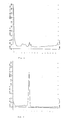
- FIG. 2 shows the voltammogram of Au-dmbs (in 0.05 nKOH) from the polarographic determination on an Hg dropping electrode against Ag / AgCI as the reference electrode.
- the abscissa ranges from -100 mV to -1800 mV, the ordinate shows the current in ⁇ A (micro A). From the curve it follows that Au-is reduced to Au 0 at -700 mV.
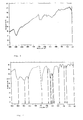
- FIG. 4 shows the IR spectrum of the monogold (I) dimercaptosuccinic acid (in KBr tablet).
- Au (I) -dmbs contains 52.09% Au and an Au / S atomic ratio of 0.5.
- FIG. 1 shows the voltammogram of the product obtained in Example 3 (in 0.05 nNaOH) from the polarographic determination on an Hg dropping electrode against Ag / AgCl as the reference electrode. Abscissa from -100 mV to -1800 mV; Ordinate in nA (nano-A). It follows from the curve that, apart from minimal contamination between -400 and -800 mV, there is no reduction up to -1800 mV, down to -1800 mV.
- FIG. 3 shows the IR spectrum of the product from Example 3, which deviates completely from that of the starting product (FIG. 4).
- thermodynamic decomposition of the black substance is 173 ° C and thus clearly below the start of decomposition of Au (1) dmbs (194 ° C).
- the preparation is applied to porcelain by screen printing and heated for 10 min at 820 ° C, the heating-up time being 1 h. A glossy, well adhering film is obtained.
- the preparation is applied to porcelain by screen printing and heated for 2 minutes at 880 ° C, the heating-up time being 30 minutes. A glossy, well adhering film is obtained.
- the preparation is brushed onto the porcelain or applied by screen printing and heated for 10 minutes at 820 ° C, the heating-up time being 1 hour. A glossy, well adhering film is obtained.
- Au (1) dmbs with an Au content of 52.09% is dissolved in water with the addition of tetraethylammonium hydroxide. After adding conc. HCl precipitates a gold compound with an Au content of 62.89% (11/1). By analogously dissolving the product 11/1 and precipitates, the Au content increases to 68.63% (11/2) and by dissolving 11/2 and precipitates to 74.68% (11/3).
- the gold compound 11/3 was tested in the bright gold preparation of Example 8 instead of the Au compound used there. A beautiful, adherent, high-gloss gold film was obtained.
- Au (1) dmbs is first dissolved in water with the addition of 2 mmol triethylamine per mmol Au (1) dmbs. Then 3 mmol of tetramethylammonium chloride are added. After adding conc. HCI precipitates a gold compound according to the invention with an Au content of 71.31%; the Au / S ratio rose from 0.54 to 1.08.
- the Au compound was tested as a component in a bright gold preparation analogous to Example 9. You get a beautiful, adherent, high-gloss gold film.
Landscapes
- Chemical & Material Sciences (AREA)
- Organic Chemistry (AREA)
- Engineering & Computer Science (AREA)
- Health & Medical Sciences (AREA)
- Ceramic Engineering (AREA)
- Materials Engineering (AREA)
- Life Sciences & Earth Sciences (AREA)
- Oral & Maxillofacial Surgery (AREA)
- Inorganic Chemistry (AREA)
- Chemical Kinetics & Catalysis (AREA)
- Structural Engineering (AREA)
- Veterinary Medicine (AREA)
- Animal Behavior & Ethology (AREA)
- Public Health (AREA)
- Epidemiology (AREA)
- Dentistry (AREA)
- General Health & Medical Sciences (AREA)
- General Chemical & Material Sciences (AREA)
- Geochemistry & Mineralogy (AREA)
- Organic Low-Molecular-Weight Compounds And Preparation Thereof (AREA)
Abstract
Description
- Die Erfindung richtet sich auf neuartige schwefelorganische Goldverbindungen sowie ein Verfahren zu ihrer Herstellung. Ein weiterer Gegenstand richtet sich auf die Verwendung der neuen Verbindungen zur Herstellung von Mitteln zur Erzeugung eines Golddekors auf einbrennfähigen Unterlagen.
- Zur Herstellung eines Golddekors, worunter auch Leiterbahnen integrierter Schaltkreise zählen, auf einem einbrennfähigen Substrat, wie insbesondere Glas, Porzellan und Keramik finden seit langem Goldpräparate, darunter sogenannte Glanzgoldpräparate und Poliergoldpräparate Anwendung. Solche Präparate enthalten im allgemeinen eine oder mehrere schwefelorganische Goldverbindungen, ein oder mehrere organische polymere Bindemittel und ein Lösungsmittelsystem. Zusätzlich enthalten die Präparate zur Einstellung gewünschter optischer und Gebrauchseigenschaften des herzustellenden Dekors andere lösliche und/oder unlösliche Edelmetallverbindungen und/oder Gold und ein oder mehrere Flußmittel, ferner zur Einstellung der Verarbeitungseigenschaften derartiger Präparate weitere Hilfsstoffe. Die Edelmetallpräparate werden mittels üblicher direkter und indirekter Druckverfahren, Sprühen oder Pinseln oder unter Verwendung der Abziehbildtechnik auf die zu beschichtende Oberfläche aufgetragen. Nach dem Abdunsten des Lösungsmittels schließt sich ein Brennvorgang bei einer auf das Substrat und das Goldpräparat abgestimmten Temperatur an - meistens liegt die maximale Brenntemperatur zwischen 400 und 900 °C, jedoch sind in Sonderfällen auch höhere Temperaturen möglich. Durch den Brennvorgang wird ein Edelmetallfilm ausgebildet und auf der Oberfläche des Substrats fixiert.
- Bei den schwefelorganischen Goldverbindungen für die genannten Dekorationspräparate handelte es sich lange Zeit fast ausschließlich um sogenannte Goldsulforesinate, welche aus einem Gold(III)-salz und einem geschwefelten, insbesondere natürlich vorkommenden Terpen, gewonnen wurden. In diesen sowie in synthetischen Gold-thiolaten der allgemeinen Formel Au-S-R, worin R für eine Alkyl-, Cycloalkyl-, Aryl- oder Aralkylgruppe oder einen bicyclischen Kohlenwasserstoffrest steht, liegt das Gold in der einwertigen Form vor. Die vorgenannten Goldverbindungen erfordern bei der Verwendung in Goldpräparaten die Verwendung eines rein organischen Lösungsmittelsystems.
- Aus arbeitshygienischen, Sicherheits- und Umweltgründen besteht ein wachsendes Interesse an Edelmetallpräparaten zum Dekorieren einbrennfähiger Substrate, in deren Lösungsmittelsystem zumindest ein Teil des organischen Lösungsmittels durch Wasser ersetzt ist. So ist aus der DE-OS 32 17 049 ein Anstrichmittel zum Auftragen einer Überglasurdekoration auf Porzellan bekannt, das 15 bis 40 Gew.-% Polyvinylpyrrolidon oder ein Gemisch aus Polyvinylpyrrolidon und wäßrigem Polyethylenoxid, 45 bis 85 Gew.-% Ethylenglykol und/oder Propylenglykol und eventuell Wasser enthält. Als färbende Stoffe werden in diesem Dokument Oxide, Gold und organische Goldverbindungen genannt, ohne jedoch irgendeine Struktur der Goldverbindungen anzugeben.
- Aus der EP-A 0 514 073 sind homogene Zusammensetzungen, vorzugsweise Lösungen, bekannt, welche beim Einbrennen einen glänzenden metallischen Edelmetallfilm ausbilden. Die Zusammensetzungen enthalten 3 bis 22 Gew.-% eines Edelmetall-thiolats, ein polymeres Harz und als Lösungsmittelsystem ein Gemisch aus Wasser und einem organischen Lösungsmittel (Cosolvens), bei welchem es sich vorzugsweise um wassermischbare Alkohole, Ether oder Ester handelt. Sowohl das Edelmetall-thiolat als auch das Bindemittel sollen in dem Wasser/Cosolvens-Gemisch löslich sein. Bei den bevorzugt eingesetzten Gold(I)-thiolaten handelt es sich um solche der allgemeinen Formel Au-S-R-H oder Au-S-R-X, wobei X für eine Nitrogruppe oder -COOH, -S020H, -OH, -CONH2, -NH2 oder -0-P(0)(OH)2, wobei die H-Atome gegebenenfalls substituiert sein können, oder Salze davon und R für einen divalenten organischen Rest stehen. Aus dem genannten Dokument geht anhand zahlreicher Beispiele und Vergleichsbeispiele deutlich hervor, daß nur ganz spezielle Gold(I)-thiolate in entsprechenden Wasser und Cosolvens enthaltenden Goldpräparaten zu Dekoren mit gutem Glanz und guter Haftfestigkeit auf der dekorierten Unterlage führen; mit anderen unter die genannten Formeln fallenden Gold(I)-thiolaten werden demgegenüber nur matte und/oder schlecht haftende Dekore erhalten.
- Aufgabe der vorliegenden Erfindung ist demgemäß, eine neue Gruppe von schwefelhaltigen Goldverbindungen aufzuzeigen, welche sich in Wasser enthaltenden Präparaten zur Herstellung von Golddekoren, insbesondere hochglänzenden Golddekoren, eignen.
- Es wurde gefunden, daß Monogold(I)-dimercaptobernsteinsäure und ähnlich strukturierte schwefelorganische Goldverbindungen nach Auflösen in Wasser in Gegenwart einer Base, vorzugsweise eines Amins, und anschließendes Ansäuern nicht in Form der ursprünglichen Verbindung ausgefällt werden, sondern überraschenderweise in Form völlig neuer schwefelorganischer Goldverbindungen. Die wie vorstehend skizziert erhältlichen neuen schwefelorganischen Goldverbindungen sind in Gegenwart einer Base wasserlöslich; aus derartigen Lösungen sind unmittelbar wasserlösliche erfindungsgemäße schwefelorganische Goldverbindungen erhältlich.
- Die erfindungsgemäßen schwefelorganischen Goldverbindungen sind gekennzeichnet durch einen Goldgehalt im Bereich von 60 bis 90 Gew.-% und ein Atomverhältnis von Gold zu Schwefel von größer 0,7 bis 4. Die erfindungsgemäßen schwefelorganischen Goldverbindungen sind durch das nachfolgend beschriebene Verfahren erhältlich. Vorzugsweise weisen die Goldverbindungen einen Goldgehalt zwischen 68 und 85 Gew.-%, insbesondere 73 bis 80 Gew.-%, und ein Atomverhältnis von Gold zu Schwefel von größer 1 bis 3, insbesondere 1,2 bis 2, auf und sind in Wasser, gegebenenfalls nach Zugabe einer Base, gut löslich.
- Die neuen schwefelorganischen Goldverbindungen weisen Eigenschaften auf, die sie von den Ausgangsverbindungen zu ihrer Herstellung prinzipiell unterscheiden. So lassen sich die neuen Verbindungen elektrochemisch bis -1,8 Volt nicht mehr reduzieren. Dies ist überraschend, weil Gold(I)-thiolate wie die in der EP-A 0 514 073 genannten Gold(I)-mercaptopropionylglycin und Gold(I)-mercaptobernsteinsäure bei der polarographischen Bestimmung in 0,05 molarer Natronlauge ein Halbwellen-Reduktionpotential von -550 mV gegen Silber/Silberchlorid aufweisen; auch die zur Herstellung der neuen Goldverbindungen besonders geeignete Monogold(I)-dimercaptobernsteinsäure läßt sich problemlos elektrochemisch reduzieren - Halbwellenpotential in 0,5 molarer Natronlauge -700 mV gegen Ag/AgCI. Die elektrochemische Nicht-Reduzierbarkeit der neuen Goldverbindungen im Vergleich zu Gold(I)-thiolaten ist ein Indiz dafür, daß es sich bei den neuen Verbindungen nicht um Gold(I)-thiolate handelt, sondern um Au-Verbindungen mit einer Wertigkeit des Goldes von kleiner + 1. Figur 1 zeigt das Voltammogramm der erfindungsgemäßen Goldverbindung gemäß Beispiel 3, Figur 2 zum Vergleich das Voltammogramm der Ausgangsverbindung gemäß Beispiel 1 - zu beachten ist, daß die Ordinate in Fig. 1 nA, diejenige in Fig. 2 aber µA angibt.
- Mittels Röntgenphotoelektronenspektroskopie/XPS/ESCA wurde bei hoher Spektrometerauflösung und Verwendung einer gesputterten Reinstgoldprobe als Kalibrierungsnormal das Maximum des Au4f7/2-Peaks von Monogold(I)-dimercaptobernsteinsäure und der daraus hergestellten erfindungsgemäßen schwefelorganischen Goldverbindung (Beispiel 3) im Vergleich zu elementarem Gold bestimmt: Das Maximum des genannten Peaks der erfindungsgemäßen Verbindung liegt mit 84,2 eV zwischen den Werten für metallisches Gold (84,0 eV) und dem als Ausgangsmaterial eingesetzten Gold(I)-thiolat (Beispiel 1)(84,46 eV). Die kleine, jedoch signifikante Signalverschiebung des Au4f7/2-Peaks zu gegenüber dem metallischen Gold höheren Bindungsenergien wird als Hinweis auf das Vorliegen eines Gold-Clusters mit einer Wertigkeit des Goldes von kleiner + 1 und größer 0 gewertet. Als weitere Indizien hierfür können der sehr hohe Goldgehalt sowie das hohe Atomverhältnis Au zu S angesehen werden. Auch bezüglich der IR-Spektren unterscheiden sich die Ausgangsverbindungen grundlegend von denen der erfindungsgemäßen Verbindungen - Figur 3 zeigt das IR-Spektrum des Produkts von Beispiel 3 und Figur 4 das IR-Spektrum des Ausgangsproduktes (Beispiel 1).
- Die erfindungsgemäßen Goldverbindungen lassen sich durch ein Verfahren herstellen, das die folgenden Stufen umfaßt:
- (i) Auflösen einer Monogold(I)-dimercaptocarbonsäureverbindung der allgemeinen Formel (A)

- (ii) Zugabe einer Mineralsäure zur Lösung der Stufe (i) bis zu einem pH-Wert von gleich oder unter 2 und
- (iii) Isolierung des in Stufe (ii) ausgefallenen Produkts.
- Die Gruppe Y steht bevorzugt für eine Carboxylgruppe. Damit sind besonders bevorzugte Monogold(I)-dimercaptocarbonsäure-Ausgangsstoffe der Formel (A) Monogold(I)-dimercaptobernsteinsäure, Monogold(I)-2,3-dimercaptoglutarsäure und Monogold(I)-2,3- oder -3,4-dimercaptoadipinsäure; unter den cyclischen Ausgangsverbindungen der Formel (A) werden beispielhaft Monogold(I)-3,4-dimercapto-2,5-dicarbonsäure und Monogo!d(!)-2,3-dimercapto-cyc!ohexan-1,4-dicarbonsäure genannt. Die Herstellung der als Ausgangsverbindung dienenden Monogold(I)-dithiolate der Formel (A) erfolgt in prinzipiell analoger Weise, wie dies aus der Herstellung vorbekannter Edelmetall-thiolate der Fachwelt bekannt ist: Aus Tetrachlorogoldsäure wird nach Zugabe der doppelt äquivalenten Menge eines Thioethers der Formel RSR' ein Gold(I)-komplex der Formel AuCI(RSR') gebildet; ein besonders geeigneter Thioether für diese Umsetzung ist Methionin gemäß EP-B 0 491 147. Der genannte Komplex wird sodann in Gegenwart eines Lösungsmittels mit einer im wesentlichen äquivalenten Molmenge des der Verbindung (A) zugrundeliegenden Dithiols (Dimercaptoverbindung) umgesetzt, wobei die Monogoldverbindung gemäß Formel (A) gebildet wird. Die Herstellung der der Verbindung (A) zugrundeliegenden Dithiolverbindung erfolgt unter Heranziehung üblicher Verfahrensstufen: Beispielsweise lassen sich Dimercaptoalkandicarbonsäuren durch Umsetzung der entsprechenden Alkindicarbonsäuren mit Thioessigsäure gewinnen; eine weitere Zugangsmöglichkeit für aliphatische und cyclische Dimercaptoverbindungen, wie sie den Goldverbindungen der Formel (A) zugrundeliegen, besteht darin, die entsprechende Dihalogenverbindung (Y-Q(Hal)2-COOH) mit einem Alkalisulfid umzusetzen.
- Im erfindungsgemäßen Verfahren kann in der Stufe (i) eine beliebige Base, wie etwa Natronlauge oder ein Amin verwendet werden. Bevorzugt werden Amine, worunter primäre, sekundäre und tertiäre Amine mit aliphatischen, cycloaliphatischen und/oder aromatischen Resten und zusätzlich N-heterocyclische Basen, wie insbesondere Pyridin, verstanden werden. Bevorzugt werden tertiäre Amine mit gleichen oder verschiedenen niederen (Ci- bis C4-)alkylresten; besonders bevorzugt werden Triethylamin, Tri-n-propylamin und Tri-iso-propylamin. In der Stufe (i) wird die Goldverbindung in Wasser eingetragen und eine Base, bevorzugt ein Amin in einer solchen Menge zugesetzt, daß sich die Goldverbindung auflöst. Sofern unmittelbar ein wasserlösliches Salz der Monogold(I)-dimercaptocarbonsäureverbindung der allgemeinen Formel (A) in der Stufe (i) eingesetzt wird, erübrigt sich die Zugabe einer Base, oder die Menge kann gegebenenfalls reduziert werden. Unter Verwendung der Monogoldverbindung der allgemeinen Formel (A) wird durch die Zugabe der Base zweckmäßigerweise ein pH-Wert von mindestens 8, vorzugsweise ein pH-Wert zwischen 9 und 14, eingestellt. Vorzugsweise wird die Monogoldverbindung der allgemeinen Formel (A) in einer solchen Menge eingesetzt, daß in der Lösung ein Goldgehalt zwischen 2 und 20 Gew.-% resultiert.
- In der Stufe (ii) wird eine beliebige Mineralsäure, vorzugsweise Salzsäure, zugesetzt, bis ein pH-Wert von 2 oder weniger als 2 erreicht ist. Während oder nach der Zugabe der Mineralsäure fällt ein braunes bis schwarzes Produkt aus, das in bekannter Weise in der Stufe (iii) von der Lösung abgetrennt wird.
- Das in der Stufe (iii) isolierte Produkt weist bereits alle Eigenschaften der erfindungsgemäßen schwefelorganischen Goldverbindungen auf. Eine weitere Steigerung des Goldgehalts und Absenkung des Schwefelgehalts läßt sich dadurch erzielen, daß die Stufen (i) bis (iii) ein- oder mehrfach, vorzugsweise ein- oder zweifach, wiederholt werden, wobei als Ausgangsprodukt für die Stufe (i) der zweiten und folgenden Sequenzen jeweils das in der Stufe (iii) der vorhergehenden Sequenz isolierte Produkt eingesetzt wird. Die Reaktionsstufen (i) bis (iii) können bei Raumtemperatur oder erhöhter Temperatur, vorzugsweise bei 30 bis 80 °C, durchgeführt werden.
- Die nach dem beschriebenen Verfahren erhältlichen schwefelorganischen Goldverbindungen lösen sich in Wasser in Gegenwart einer Base. Durch Abdampfen des Wassers aus einer so erhaltenen Lösung unter vermindertem Druck werden unmittelbar wasserlösliche schwefelorganische Goldverbindungen mit den für die neue Stoffklasse charakteristischen Eigenschaften erhalten.
- Es wurde gefunden, daß sich die erfindungsgemäßen schwefelorganischen Goldverbindungen hervorragend zur Herstellung eines Golddekors auf einbrennfähigen Unterlagen, wie insbesondere Glas, Porzellan und Keramik, eignen. Zweckmäßigerweise werden zur Erzeugung eines Golddekors die schwefelorganischen Goldverbindungen nicht per se, sondern in Form von diese enthaltenden Mitteln, insbesondere in Form sogenannter Glanzgold- und Poliergoldpräparate sowie in Form von Abziehbildern, deren Dekorschicht die schwefelorganischen Goldverbindungen und organische polymere Bindemittel enthält, verwendet.
- Die genannten Mittel, darunter sogenannte Glanzgold- und Poliergoldpräparate, zur Erzeugung eines Golddekors auf einer einbrennfähigen Unterlage oder zur Herstellung der Dekorschicht eines Abziehbilds enthalten mindestens eine erfindungsgemäße schwefelorganische Goldverbindung, ein oder mehrere polymere organische Bindemittel sowie ein Lösungsmittelsystem, das die Polymeren und die Goldverbindung löst oder anderweitig eine homogene Verteilung gewährleistet. Soweit erforderlich, enthalten derartige Präparate zusätzlich andere Edelmetallverbindungen in Form einfacher Salze, Komplexe, Resinate oder Thiolate von Silber, Platin und/oder Palladium, um Farbnuancen des gewünschten Dekors einzustellen. Poliergoldpräparate enthalten ferner noch Goldpulver und/oder unlösliche Goldverbindungen. Zusätzlich enthalten die Präparate im allgemeinen Flußmittel in Form von Verbindungen, beispielsweise Resinaten, Salzen, Oxiden oder Koordinationsverbindungen, eines oder mehrerer der Elemente Bor, Silicium, Vanadium, Chrom, Indium, Zinn, Antimon, Wismut oder Rhodium und andere Hilfsstoffe, um die gewünschten Verarbeitungseigenschaften, etwa eine siebdruckfähige Viskosität und/oder eine hohe Trocknungsgeschwindigkeit des Präparats, zu erzielen und ganz bestimmte optische und Gebrauchseigenschaften, wie gute Haftung des eingebrannten Dekors auf dem Untergrund, einzustellen.
- Die erfindungsgemäßen schwefelorganischen Goldverbindungen lassen sich in Präparaten verwenden, deren Lösungsmittelsystem rein organisch, organisch-wäßrig oder rein wäßrig ist. Der Fachmann wird die in den Präparaten zu verwendenden Bindemittel und Lösungsmittel aufeinander abstimmen, um eine möglichst homogene Zusammensetzung, vorzugsweise eine Lösung zu erhalten.
- Wäßrig-organische oder rein wäßrige Präparate mit einer erfindungsgemäßen schwefelorganischen Goldverbindung enthalten solche polymeren Bindemittel, welche in Wasser löslich sind oder darin eine klare Dispersion bilden. Zweckmäßige Bindemittel sind Polyacrylsäure, Polymethacrylsäure, Polyvinylpyrrolidon, Celluloseether, insbesondere Carboxyalkyl- und Hydroxyalkyl-Cellulose, Polyalkylenglykol, Polyvinylacetat, Polyvinylalkohol, Polyamine, Alkydharze und Polyurethanharze. Die Bindemittel können in Form von Homopolymeren oder Copolymeren oder Blockpolymeren, jeweils einzeln oder in Form von Gemischen zur Anwendung gelangen. Besonders bevorzugt für rein wäßrige Präparate oder solche mit hohem Wassergehalt werden Polyvinylpyrrolidon-homo- oder -copolymere, Polymethacrylsäure-homo- oder -copolymere sowie Harze auf der Basis von Celluloseethern.
- Präparate mit einem wäßrig-organischen Bindemittelsystem enthalten als organisches Lösungsmittel ein oder mehrere wasserlösliche organische Lösungsmittel, insbesondere wasserlösliche Alkohole, Ether und Ester. Besonders bevorzugt finden Glykole mit 2 bis 4 C-Atomen sowie Oligo- und Poly(C2- bis C4-)glykole oder Mono(C, - bis C4-)alkylether der genannten Glykole oder Oligoglykole Verwendung, ferner Hydroxycarbonsäuren oder niedere Alkylester derselben, wie insbesondere C, - bis C3-Alkyllactat.
- Wie bereits angesprochen, ist es unter Verwendung der erfindungsgemäßen schwefelorganischen Goldverbindungen überraschenderweise auch möglich, im wesentlichen rein wäßrige Präparate (Gehalt an organischen Lösungsmitteln unter 1 Gew.-%) zu erzeugen, indem die erfindungsgemäße Goldverbindung, sofern nötig nach Zugabe eines Amins, in Wasser gelöst und diese Lösung in an sich bekannter Weise mit einer wasserlösliche organische Bindemittel und übrige Hilfsstoffe enthaltenden wäßrigen Lösung oder Emulsion zusammengebracht wird. Um besonders hochglänzende Golddekore zu erzeugen, enthalten derartige wäßrige Präparate zweckmäßigerweise zusätzlich ein anionisches, kationisches, zwitterionisches oder nichtionisches Tensid in wirksamer Menge, meist 0,01 bis 2,0 Gew.-%. Sehr wirksame Tenside sind polyethermodifizierte Dimethylpolysiloxane und Alkylbenzolsulfonate.
- Weitere Hilfsstoffe in den erfindungsgemäßen Präparaten können übliche Stoffe zur Veränderung der rheologischen Eigenschaften des Präparats, oberflächenaktive Mittel, die Haftung verstärkende Hilfsstoffe sowie Trocknungsbeschleuniger im Falle der Verwendung eines UV-härtbaren Harzes. Die zusätzliche Verwendung einer wäßrigen Polysulfidlösung hat sich in manchen Fällen als zweckmäßig erwiesen.
- Wäßrige und wäßrig-organische Glanzgoldpräparate, enthaltend mindestens eine erfindungsgemäße schwefelorganische Goldverbindung, enthalten letztere in einer Menge von 2 bis 25 Gew.-%, vorzugsweise 5 bis 15 Gew.-%, jeweils berechnet als Gold. Der Bindemittelanteil in den Präparaten liegt im allgemeinen zwischen 5 und 45 Gew.-%, wobei das Gewichtsverhältnis von Harz zu Edelmetall vorzugsweise zwischen 0,5 und 1 bis 1,5 zu 1 liegt. Der Wassergehalt liegt im allgemeinen zwischen 10 und 90 Gew.-%, vorzugsweise zwischen 30 und 70 Gew.-%, und der Gehalt an organischen Lösungsmitteln zwischen 0 und 40 Gew.-%, jeweils bezogen auf das Präparat. Die Einsatzmenge der Flußmittel bewegt sich üblicherweise im Bereich zwischen 0,01 und 2 Gew.-%, bezogen auf das Präparat. Im Falle von sogenannten Poliergoldpräparaten enthalten diese zusätzlich Goldpulver und/oder feinteilige anorganische unlösliche Goldverbindungen. Je nach gewünschtem Effekt können Poliergoldpräparate zusätzlich noch Glasfritten und/oder Organosiliciumverbindungen enthalten.
- Die mindestens eine schwefelorganische Goldverbindung enthaltenden Präparate können unmittelbar mittels üblicher Dekorationsverfahren, wie Sprühen, Pinseln und bekannter Druckverfahren, insbesondere Siebdruckverfahren, auf die zu dekorierende Oberfläche aufgebracht und nach dem Abdunsten der Lösungsmittelbestandteile das Dekor bei einer Temperatur zwischen im allgemeinen 400 und 900 °C eingebrannt werden.
- Eine in der keramischen Industrie übliche Dekorationstechnik besteht auch in der Verwendung von Abziehbildern. Demgemäß lassen sich die erfindungsgemäßen schwefelorganischen Goldverbindungen auch in der Dekorschicht derartiger Abziehbilder einsetzen. Die Herstellung des Abziehbilds erfolgt in für den Fachmann bekannter Weise: Auf eine auf einen Träger aufgebrachte wasserlösliche Trennschicht oder eine Thermotrennschicht wird eine Dekorschicht aufgebracht, deren Zusammensetzung im wesentlichen derjenigen entspricht, wie sie in den zuvor beschriebenen Präparaten eingesetzt wird. Nach Abdunsten des Lösungsmittels, bei den bevorzugten Präparaten also im wesentlichen Wasser, und, sofern erforderlich, Vernetzen des Bindemittels wird die Dekorschicht üblicherweise überfilmt.
- Durch die Erfindung wurde eine völlig neue Stoffklasse schwefelorganischer Goldverbindungen zur Verfügung gestellt, welche nicht nur in konventionellen organischen oder organisch-wäßrigen Präparaten zur Herstellung von Golddekoren auf einbrennfähigen Unterlagen geeignet sind, sondern auch in im wesentlichen rein wäßrigen Präparaten zur Anwendung gelangen können. Unter Verwendung der neuen schwefelorganischen Goldverbindungen in rein wäßrigen Präparaten lassen sich hochglänzende und gut haftende Golddekore herstellen. Durch derartige wäßrige Präparate werden Nachteile, wie sie bei der Verwendung organischer Lösungsmittel enthaltender Präparate zwangsweise auftreten, überwunden.
- 0,035 mol = 18,49 g HAuCl4 (37,29 % Au) wird unter Rühren zu einer Suspension von 0,07 mol Methionin in 70 ml H20 getropft. Durch externe Kühlung wird die Temperatur auf 0 bis 5 °C gehalten. Nach Beendigung der Reaktion wird der Gold(I)-Komplex zu einer Suspension von 0,035 Mol = 6,38 g meso-2,3-Dimercaptobernsteinsäure in 150 ml Dichlormethan innerhalb einer Stunde getropft. Der Niederschlag wird abgesaugt, mehrmals mit Wasser gewaschen und im Exikkator unter Vakuum über Blaugel getrocknet. Die Ausbeute an Monogolddimercaptobernsteinsäure beträgt 96,5 %, bezogen auf das eingesetzte Gold.

- Figur 2 zeigt das Voltammogramm von Au-dmbs (in 0,05 nKOH) aus der polarographischen Bestimmung an einer Hg-Tropfelektrode gegen Ag/AgCI als Bezugselektrode. Die Abszisse reicht von -100 mV bis -1800 mV, die Ordinate zeigt den Strom in µA (mikro A). Aus dem Kurvenverlauf folgt, daß bei -700 mV Au + zu Au0 reduziert wird.
- Figur 4 zeigt das IR-Spektrum der Monogold(I)-dimercaptobernsteinsäure (in KBr-Tablette).
- Aus dem Röntgenphotoelektronenspektrum XPS/ESCA (Gerät: Leybold MAX 100) von Au(I)-dmbs folgt als Maximum des Au4f7/2-Peaks : 84,46 eV
- 6 g Au(I)-dmbs aus Beispiel 1 werden in 20 ml Wasser und ca. 3 g Triethylammin bei 60 ° C gelöst. Anschließend stellt man mit konz. HCI die Lösung auf pH 2 ein. Der sich bildende Niederschlag wird abgesaugt und mit Wasser gewaschen. Der Filterrückstand wird getrocknet. Ausbeute: 2,6 g schwarze Substanz

- Zum Vergleich: Au(I)-dmbs enthält 52,09 % Au und ein Au/S-Atomverhältnis von 0,5.
- 2,1 g der in Beispiel 2 hergestellten Verbindung werden in 15 ml Wasser und Triethylammin bei 60 °C gelöst. Anschließend stellt man mit konz. HCI die Lösung auf pH 2 ein. Der sich bildende Niederschlag wird abgesaugt und mit Wasser gewaschen. Der Filterrückstand wird getrocknet. Ausbeute: 0,88 g schwarze Substanz

- Figur 1 zeigt das Voltammogramm des in Beispiel 3 erhaltenen Produkts (in 0,05 nNaOH) aus der polarographischen Bestimmung an einer Hg-Tropfelektrode gegen Ag/AgCI als Bezugselektrode. Abszisse von -100 mV bis -1800 mV; Ordinate in nA (nano-A). Aus dem Kurvenverlauf folgt, daß bis -1800 mV, von minimalen Verunreinigungen zwischen -400 und -800 mV abgesehen, bis -1800 mV keine Reduktion erfolgt.
- Figur 3 zeigt das IR-Spektrum des Produkts aus Beispiel 3, das vollständig von demjenigen des Ausgangsprodukts (Fig. 4) abweicht.
- Aus dem Röntgenphotoelektronenspektrum XPS/ESCA (Gerät: Leybold MAX 100) folgt als Maximum des Au4f7/2-Peaks 84,2 eV (zum Vergleich: Au(I)-dmbs 84,46 eV, Au metallisch 84,0 eV). Aus der quantitativen Auswertung des XPS-Spektrums, das nur die obersten Atomlagen des Materials erfaßt, resultiert folgende Analyse:

- 50 g Au(I)-dmbs werden in 400 ml Wasser und einer entsprechenden Menge an Triethylammin bei RT (= Raumtemperatur) gelöst, so daß sich in der Lösung ein pH-Wert von größer 10 einstellt. Die Lösung wird dann mit konz. HCI auf pH 2 eingestellt. Den sich bildenden Niederschlag filtriert man und löst diesen in Wasser und Triethylammin bei RT, wobei PH-Wert von 10 eingestellt wird. Anschließend wurde mit konz. HCI auf pH 2 angesäuert. Der Niederschlag wird filtriert und getrocknet. Ausbeute: 21,42 schwarze Substanz

- 7 g der Verbindung aus Beispiel 4 werden in 25 ml Wasser und einer entsprechenden Menge an Triethylammin bei RT gelöst. Anschließend wurde mit konz. HCI auf pH 1-2 angesäuert. Der Niederschlag wird filtriert und getrocknet. Ausbeute: 6,15 g schwarze Substanz

- 10 g Au(I)-dmbs (26 mmol) werden in 200 ml Wasser und 8 g Triethylammin (79 mmol) bei RT gelöst. Die Lösung wird dann mit 6,6 ml konz. HCI ca. (79 mmol) versetzt. Der gebildete Niederschlag wird filtriert und getrocknet. Ausbeute: 7,83 g braune Substanz

- 5 g des Produktes von Beispiel 6 (enthält 15 mmol Au) werden in 100 ml Wasser und 4,5 g Triethylammin (45 mmol) bei 60 °C gelöst. Die Lösung wird dann mit 3,8 ml konz. HCI ca. (45 mmol) versetzt. Der gebildete Niederschlag wird filtriert und getrocknet. Ausbeute: 3,43 g schwarze Substanz

- Der Beginn der thermodynamischen Zersetzung von der schwarzen Substanz liegt bei 173 °C und damit deutlich unterhalb des Zersetzungsbeginns von Au(1)dmbs (194 °C).
- Folgende Bestandteile wurden gemischt:

- Das Präparat wird per Siebdruck auf Porzellan aufgetragen und 10 min bei 820 °C erhitzt, wobei die Aufheizzeit 1 h beträgt. Man erhält einen glänzenden, gut haftenden Film.
- Folgende Bestandteile wurden gemischt:

- Das Präparat wird per Siebdruck auf Porzellan aufgetragen und 2 min bei 880 °C erhitzt, wobei die Aufheizzeit 30 min beträgt. Man erhält einen glänzenden, gut haftenden Film.
- Folgende Bestandteile wurden gemischt:

- Das Präparat wird auf das Porzellan gepinselt oder mittels Siebdruck aufgetragen und 10 min bei 820 °C erhitzt, wobei die Aufheizzeit 1 h beträgt. Man erhält einen glänzenden, gut haftenden Film.
- Herstellung einer erfindungsgemäßen Goldverbindung, ausgehend von Monogold(I)-dimercaptobern- steinsäure (Au(1)dmbs).
- Au(1)dmbs mit einem Au-Gehalt von 52,09 % wird unter Zugabe von Tetraethylammoniumhydroxid in Wasser gelöst. Nach Zugabe von konz. HCI fällt eine Goldverbindung mit einem Au-Gehalt 62,89 % aus (11/1). Durch analoges Auflösen des Produktes 11/1 und Ausfällen steigt der Au-Gehalt auf 68,63 % (11/2) und durch Auflösen von 11/2 und Ausfällen auf 74,68 % (11/3) an. Das Gold-Schwefel-Verhältnis steigt von 0,54 : 1 auf 0,89 : 1 (=11/1), dann auf 1,11 : 1 (=11/2) und schließlich auf 1,25 : 1 (=11/3) an.
- Die Goldverbindung 11/3 wurde im Glanzgoldpräparat des Beispiels 8 anstelle der dort eingesetzten Au-Verbindung getestet. Erhalten wurde ein schöner, festhaftender, hochglänzender Goldfilm.
- Au(1)dmbs wird zunächst unter Zugabe von 2 mMol Triethylamin pro mMol Au(1)dmbs in Wasser gelöst. Anschließend werden 3 mMol Tetramethylammoniumchlorid zugegeben. Nach Zugabe von konz. HCI fällt eine erfindungsgemäße Goldverbindung mit einem Au-Gehalt von 71,31 % aus; das Au/S-Verhältnis stieg von 0,54 auf 1,08 an.
- Die Au-verbindung wurde als Komponente in einem Glanzgoldpräparat analog Beispiel 9 getestet. Man erhält einen schönen, festhaftenden, hochglänzenden Goldfilm.
Claims (10)

dadurch gekennzeichnet,
daß sie in Wasser, gegebenenfalls nach Zugabe einer Base, löslich ist.
dadurch gekennzeichnet,
daß sie 68 bis 85 Gew.-% Gold enthält und ein Atomverhältnis von Gold zu Schwefel von größer 1 bis 3 aufweist.
dadurch gekennzeichnet,
daß es die Stufen

umfaßt.
dadurch gekennzeichnet,
daß man die Stufen (i) bis (iii) ein oder mehrfach wiederholt, wobei als Ausgangsprodukt für die Stufe (i) der zweiten und folgenden Sequenzen jeweils das in der Stufe (iii) der vorhergehenden Sequenz isolierte Produkt eingesetzt wird.
dadurch gekennzeichnet,
daß man als Base ein Amin und/oder ein Tetraalkylammoniumhydroxid verwendet.
dadurch gekennzeichnet,
daß man der Stufe (ii) eine wäßrige Lösung der Goldverbindung der Formel A, welche durch zugesetztes Tetraalkylammoniumhydroxid oder ein Tetraalkylammoniumsalz Tetraalkylammoniumionen enthält, zuführt.
dadurch gekennzeichnet,
daß man in der Stufe (i) Monogold(I)-dimercaptobernsteinsäure in Wasser auflöst, indem man ein Tri-(C1- bis C3)alkylamin bis zu einem pH-Wert von mindestens 8, vorzugsweise 9 bis 11, zugibt.
Applications Claiming Priority (2)
| Application Number | Priority Date | Filing Date | Title |
|---|---|---|---|
| DE4405424A DE4405424C2 (de) | 1994-02-21 | 1994-02-21 | Schwefelorganische Goldverbindungen, Verfahren zu ihrer Herstellung und Verwendung derselben |
| DE4405424 | 1994-02-21 |
Publications (3)
| Publication Number | Publication Date |
|---|---|
| EP0668264A2 true EP0668264A2 (de) | 1995-08-23 |
| EP0668264A3 EP0668264A3 (de) | 1997-05-02 |
| EP0668264B1 EP0668264B1 (de) | 1999-09-22 |
Family
ID=6510723
Family Applications (1)
| Application Number | Title | Priority Date | Filing Date |
|---|---|---|---|
| EP95101402A Expired - Lifetime EP0668264B1 (de) | 1994-02-21 | 1995-02-02 | Schwefelorganische Goldverbindungen, Verfahren zu ihrer Herstellung und Verwendung derselben |
Country Status (9)
| Country | Link |
|---|---|
| US (2) | US5639901A (de) |
| EP (1) | EP0668264B1 (de) |
| JP (1) | JPH07252262A (de) |
| KR (1) | KR100346319B1 (de) |
| DE (2) | DE4405424C2 (de) |
| ES (1) | ES2139101T3 (de) |
| HK (1) | HK1000577A1 (de) |
| SG (1) | SG47817A1 (de) |
| TW (1) | TW411342B (de) |
Cited By (2)
| Publication number | Priority date | Publication date | Assignee | Title |
|---|---|---|---|---|
| EP2128113A1 (de) * | 2008-05-30 | 2009-12-02 | W.C. Heraeus GmbH | Verwendung von Goldverbindungen auf Basis cycloaliphatischer Mercaptoester in keramischen Edelmetallfarben |
| EP2329902A1 (de) * | 2004-06-25 | 2011-06-08 | Mitsubishi Materials Corporation | Metallkolloidpartikel, Metallkolloid und Verwendung des Kolloids |
Families Citing this family (7)
| Publication number | Priority date | Publication date | Assignee | Title |
|---|---|---|---|---|
| DE19546325C1 (de) * | 1995-12-12 | 1997-06-05 | Benckiser Knapsack Ladenburg | Verfahren zum Färben von Keramikoberflächen |
| EP1043294B2 (de) * | 1999-04-09 | 2005-12-07 | W.C. Heraeus GmbH | Glanzedelmetallpräparat |
| GB0006050D0 (en) * | 2000-03-14 | 2000-05-03 | Johnson Matthey Plc | Liquid gold compositions |
| JP4815586B2 (ja) * | 2005-08-12 | 2011-11-16 | 国立大学法人 筑波大学 | Au25クラスターの選択的大量合成方法 |
| JP5737726B2 (ja) * | 2013-09-26 | 2015-06-17 | 小島化学薬品株式会社 | 有機金化合物の製造方法 |
| DE102015117711A1 (de) | 2015-10-16 | 2017-04-20 | Ferro Gmbh | Abziehbild zur Erzeugung eines Dekors |
| CN107449844B (zh) * | 2017-08-30 | 2020-05-08 | 合肥立方制药股份有限公司 | 一种测定二巯丁二酸制剂溶出度的方法 |
Family Cites Families (12)
| Publication number | Priority date | Publication date | Assignee | Title |
|---|---|---|---|---|
| GB662015A (en) * | 1948-07-13 | 1951-11-28 | Ernst Albert Hermann Friedheim | Therapeutically active gold-containing organic compounds |
| DE949055C (de) * | 1951-09-06 | 1956-09-13 | Rheinpreussen Ag | Verfahren zur Herstellung von Schwermetallkomplexverbindungen der ª‡,ª‡-Dimercaptobernsteinsaeure |
| GB716647A (en) * | 1951-11-15 | 1954-10-13 | Ernst Albert Hermann Friedheim | Organic thiol derivatives of metal-containing compounds |
| DK201081A (da) * | 1981-05-06 | 1982-11-07 | Kongelige Porcelainsfabrik A S | Male- og trykmedium samt overglasurfarve og trykfarve paa basis af dette medium |
| DE3807290A1 (de) * | 1988-03-05 | 1989-09-14 | Heraeus Gmbh W C | Poliergoldpraeparat |
| JP2827360B2 (ja) * | 1989-11-30 | 1998-11-25 | 日産化学工業株式会社 | 有機金化合物 |
| EP0481143A1 (de) * | 1990-10-19 | 1992-04-22 | Yishin Engineering Co. Ltd. | Vorrichtung zur Lärmminderung beim Ausblasen verzinkter Rohre |
| DE4040446A1 (de) * | 1990-12-18 | 1992-06-25 | Degussa | Gold(i)mercaptocarbonsaeureester, verfahren zu ihrer herstellung und verwendung |
| DE4040447A1 (de) * | 1990-12-18 | 1992-06-25 | Degussa | Verfahren zur herstellung von gold(i)mercaptiden |
| US5252764A (en) * | 1990-12-18 | 1993-10-12 | Degussa Aktiengesellschaft | Preparation of gold (I) mercaptides |
| US5281635A (en) * | 1991-05-17 | 1994-01-25 | Johnson Matthey Public Limited Company | Precious metal composition |
| US5491247A (en) * | 1994-11-14 | 1996-02-13 | Elf Atochem North America, Inc. | Preparation of a precious metal salt of a nonoxidizing acid by direct reaction |
-
1994
- 1994-02-21 DE DE4405424A patent/DE4405424C2/de not_active Expired - Fee Related
-
1995
- 1995-02-02 DE DE59506861T patent/DE59506861D1/de not_active Expired - Fee Related
- 1995-02-02 EP EP95101402A patent/EP0668264B1/de not_active Expired - Lifetime
- 1995-02-02 ES ES95101402T patent/ES2139101T3/es not_active Expired - Lifetime
- 1995-02-02 SG SG1996004554A patent/SG47817A1/en unknown
- 1995-02-07 TW TW084100990A patent/TW411342B/zh not_active IP Right Cessation
- 1995-02-17 US US08/390,483 patent/US5639901A/en not_active Expired - Fee Related
- 1995-02-20 KR KR1019950003193A patent/KR100346319B1/ko not_active Expired - Fee Related
- 1995-02-21 JP JP7032574A patent/JPH07252262A/ja not_active Abandoned
-
1997
- 1997-01-28 US US08/788,438 patent/US5721303A/en not_active Expired - Fee Related
- 1997-10-31 HK HK97102068A patent/HK1000577A1/xx not_active IP Right Cessation
Cited By (3)
| Publication number | Priority date | Publication date | Assignee | Title |
|---|---|---|---|---|
| EP2329902A1 (de) * | 2004-06-25 | 2011-06-08 | Mitsubishi Materials Corporation | Metallkolloidpartikel, Metallkolloid und Verwendung des Kolloids |
| US8709296B2 (en) | 2004-06-25 | 2014-04-29 | Mitsubishi Materials Corporation | Metal colloidal particles, metal colloid and use of metal colloid |
| EP2128113A1 (de) * | 2008-05-30 | 2009-12-02 | W.C. Heraeus GmbH | Verwendung von Goldverbindungen auf Basis cycloaliphatischer Mercaptoester in keramischen Edelmetallfarben |
Also Published As
| Publication number | Publication date |
|---|---|
| SG47817A1 (en) | 1998-04-17 |
| ES2139101T3 (es) | 2000-02-01 |
| DE4405424C2 (de) | 1996-08-14 |
| EP0668264A3 (de) | 1997-05-02 |
| HK1000577A1 (en) | 2000-06-09 |
| JPH07252262A (ja) | 1995-10-03 |
| KR950032223A (ko) | 1995-12-20 |
| US5721303A (en) | 1998-02-24 |
| DE4405424A1 (de) | 1995-08-24 |
| KR100346319B1 (ko) | 2002-11-05 |
| US5639901A (en) | 1997-06-17 |
| EP0668264B1 (de) | 1999-09-22 |
| DE59506861D1 (de) | 1999-10-28 |
| TW411342B (en) | 2000-11-11 |
Similar Documents
| Publication | Publication Date | Title |
|---|---|---|
| EP0491143B1 (de) | Gold(I)mercaptocarbonsäureester, Verfahren zu ihrer Herstellung und Verwendung | |
| DE69203291T2 (de) | Edelmetallpräparat. | |
| DE60103633T2 (de) | Goldnanopartikel | |
| DE1292463B (de) | Silberhaltiges Vergoldungspraeparat | |
| DE4105635C2 (de) | Zusammensetzung, die einen dünnen Platinfilm bildet und Verfahren zur Herstellung eines Platinfilmes | |
| EP0668264B1 (de) | Schwefelorganische Goldverbindungen, Verfahren zu ihrer Herstellung und Verwendung derselben | |
| DE1284807B (de) | Vergoldungspraeparat | |
| EP0668265B1 (de) | Monoedelmetall-dithiolate und deren Verwendung zum Herstellen edelmetallhaltiger Dekore auf einbrennfähigen Unterlagen | |
| DE1290784B (de) | Versilberungspraeparat zur Herstellung eines Silberueberzuges durch thermische Zersetzung | |
| DE1298828B (de) | Vergoldungspraeparat | |
| DE1286866B (de) | Vergoldungspraeparat | |
| EP0677558B2 (de) | Verfahren zur Herstellung von Purpurpigmenten | |
| DE1293514B (de) | Palladiumpraeparat zur Herstellung von Palladiumueberzuegen durch thermische Zersetzung | |
| DE4405932C1 (de) | Wäßrige Edelmetallpräparate und deren Verwendung zur Herstellung von Edelmetalldekoren | |
| EP1559693B2 (de) | Edelmetallpräparate und Lüsterpräparate für den direkten und indirekten Siebdruck | |
| DE19941020B4 (de) | Glanzedelmetallpräparat für den Hochtemperaturbrand und Verfahren zur Herstellung von Glanzedelmetalldekoren | |
| EP2128113B1 (de) | Verwendung von Goldverbindungen auf Basis cycloaliphatischer Mercaptoester in keramischen Edelmetallfarben | |
| HK1000577B (en) | Sulfur containing organic gold compounds, process for their preparation and their use | |
| DE1284808B (de) | Vergoldungspraeparat | |
| DE1446145B2 (de) | Thermoplastisches, eine thermisch zersetzbare Edelmetallverbindung enthaltendes Präparat | |
| DE4405423C2 (de) | Monoedelmetall-dithiolate, Verfahren zu deren Herstellung und deren Verwendung | |
| EP0717013A1 (de) | Einen hohen Feststoffgehalt ermöglichendes Medium niedriger Viskosität für eine keramische Überzugsmasse | |
| DE1286867B (de) | Versilberungspraeparat | |
| DE4405933A1 (de) | Wäßrige Edelmetallpräparate und deren Verwendung zur Herstellung von Edelmetalldekoren | |
| DE1283635B (de) | Platinpraeparat zur Herstellung von Platinueberzuegen durch thermische Zersetzung |
Legal Events
| Date | Code | Title | Description |
|---|---|---|---|
| PUAI | Public reference made under article 153(3) epc to a published international application that has entered the european phase |
Free format text: ORIGINAL CODE: 0009012 |
|
| AK | Designated contracting states |
Kind code of ref document: A2 Designated state(s): BE DE ES FR GB IT PT |
|
| PUAL | Search report despatched |
Free format text: ORIGINAL CODE: 0009013 |
|
| AK | Designated contracting states |
Kind code of ref document: A3 Designated state(s): BE DE ES FR GB IT PT |
|
| 17P | Request for examination filed |
Effective date: 19970407 |
|
| GRAG | Despatch of communication of intention to grant |
Free format text: ORIGINAL CODE: EPIDOS AGRA |
|
| 17Q | First examination report despatched |
Effective date: 19981124 |
|
| GRAG | Despatch of communication of intention to grant |
Free format text: ORIGINAL CODE: EPIDOS AGRA |
|
| GRAH | Despatch of communication of intention to grant a patent |
Free format text: ORIGINAL CODE: EPIDOS IGRA |
|
| GRAH | Despatch of communication of intention to grant a patent |
Free format text: ORIGINAL CODE: EPIDOS IGRA |
|
| GRAA | (expected) grant |
Free format text: ORIGINAL CODE: 0009210 |
|
| AK | Designated contracting states |
Kind code of ref document: B1 Designated state(s): BE DE ES FR GB IT PT |
|
| REF | Corresponds to: |
Ref document number: 59506861 Country of ref document: DE Date of ref document: 19991028 |
|
| GBT | Gb: translation of ep patent filed (gb section 77(6)(a)/1977) |
Effective date: 19991026 |
|
| ITF | It: translation for a ep patent filed | ||
| ET | Fr: translation filed | ||
| REG | Reference to a national code |
Ref country code: PT Ref legal event code: SC4A Free format text: AVAILABILITY OF NATIONAL TRANSLATION Effective date: 19991025 |
|
| REG | Reference to a national code |
Ref country code: ES Ref legal event code: FG2A Ref document number: 2139101 Country of ref document: ES Kind code of ref document: T3 |
|
| PLBE | No opposition filed within time limit |
Free format text: ORIGINAL CODE: 0009261 |
|
| STAA | Information on the status of an ep patent application or granted ep patent |
Free format text: STATUS: NO OPPOSITION FILED WITHIN TIME LIMIT |
|
| 26N | No opposition filed | ||
| REG | Reference to a national code |
Ref country code: GB Ref legal event code: IF02 |
|
| PGFP | Annual fee paid to national office [announced via postgrant information from national office to epo] |
Ref country code: BE Payment date: 20040216 Year of fee payment: 10 |
|
| PG25 | Lapsed in a contracting state [announced via postgrant information from national office to epo] |
Ref country code: BE Free format text: LAPSE BECAUSE OF NON-PAYMENT OF DUE FEES Effective date: 20050228 |
|
| BERE | Be: lapsed |
Owner name: *CERDEC A.G. KERAMISCHE FARBEN Effective date: 20050228 |
|
| REG | Reference to a national code |
Ref country code: GB Ref legal event code: 732E |
|
| REG | Reference to a national code |
Ref country code: FR Ref legal event code: TP Ref country code: FR Ref legal event code: CD Ref country code: FR Ref legal event code: CA |
|
| BERE | Be: lapsed |
Owner name: *CERDEC A.G. KERAMISCHE FARBEN Effective date: 20050228 |
|
| PGFP | Annual fee paid to national office [announced via postgrant information from national office to epo] |
Ref country code: ES Payment date: 20080212 Year of fee payment: 14 |
|
| PGFP | Annual fee paid to national office [announced via postgrant information from national office to epo] |
Ref country code: PT Payment date: 20080117 Year of fee payment: 14 Ref country code: IT Payment date: 20080122 Year of fee payment: 14 Ref country code: GB Payment date: 20080118 Year of fee payment: 14 Ref country code: DE Payment date: 20080118 Year of fee payment: 14 |
|
| PGFP | Annual fee paid to national office [announced via postgrant information from national office to epo] |
Ref country code: FR Payment date: 20080114 Year of fee payment: 14 |
|
| REG | Reference to a national code |
Ref country code: PT Ref legal event code: MM4A Free format text: LAPSE DUE TO NON-PAYMENT OF FEES Effective date: 20090803 |
|
| GBPC | Gb: european patent ceased through non-payment of renewal fee |
Effective date: 20090202 |
|
| PG25 | Lapsed in a contracting state [announced via postgrant information from national office to epo] |
Ref country code: PT Free format text: LAPSE BECAUSE OF NON-PAYMENT OF DUE FEES Effective date: 20090803 |
|
| REG | Reference to a national code |
Ref country code: FR Ref legal event code: ST Effective date: 20091030 |
|
| PG25 | Lapsed in a contracting state [announced via postgrant information from national office to epo] |
Ref country code: DE Free format text: LAPSE BECAUSE OF NON-PAYMENT OF DUE FEES Effective date: 20090901 |
|
| REG | Reference to a national code |
Ref country code: ES Ref legal event code: FD2A Effective date: 20090203 |
|
| PG25 | Lapsed in a contracting state [announced via postgrant information from national office to epo] |
Ref country code: GB Free format text: LAPSE BECAUSE OF NON-PAYMENT OF DUE FEES Effective date: 20090202 Ref country code: FR Free format text: LAPSE BECAUSE OF NON-PAYMENT OF DUE FEES Effective date: 20090302 |
|
| PG25 | Lapsed in a contracting state [announced via postgrant information from national office to epo] |
Ref country code: ES Free format text: LAPSE BECAUSE OF NON-PAYMENT OF DUE FEES Effective date: 20090203 |
|
| PG25 | Lapsed in a contracting state [announced via postgrant information from national office to epo] |
Ref country code: IT Free format text: LAPSE BECAUSE OF NON-PAYMENT OF DUE FEES Effective date: 20090202 |