EP0668908B1 - Dns-sequenzen von einer nematode, verwendbare für diagnose von infektionen - Google Patents
Dns-sequenzen von einer nematode, verwendbare für diagnose von infektionen Download PDFInfo
- Publication number
- EP0668908B1 EP0668908B1 EP91915017A EP91915017A EP0668908B1 EP 0668908 B1 EP0668908 B1 EP 0668908B1 EP 91915017 A EP91915017 A EP 91915017A EP 91915017 A EP91915017 A EP 91915017A EP 0668908 B1 EP0668908 B1 EP 0668908B1
- Authority
- EP
- European Patent Office
- Prior art keywords
- dna
- nematode
- contortus
- tubulin
- primer
- Prior art date
- Legal status (The legal status is an assumption and is not a legal conclusion. Google has not performed a legal analysis and makes no representation as to the accuracy of the status listed.)
- Expired - Lifetime
Links
Images



Classifications
-
- C—CHEMISTRY; METALLURGY
- C07—ORGANIC CHEMISTRY
- C07K—PEPTIDES
- C07K14/00—Peptides having more than 20 amino acids; Gastrins; Somatostatins; Melanotropins; Derivatives thereof
- C07K14/435—Peptides having more than 20 amino acids; Gastrins; Somatostatins; Melanotropins; Derivatives thereof from animals; from humans
- C07K14/43504—Peptides having more than 20 amino acids; Gastrins; Somatostatins; Melanotropins; Derivatives thereof from animals; from humans from invertebrates
- C07K14/43536—Peptides having more than 20 amino acids; Gastrins; Somatostatins; Melanotropins; Derivatives thereof from animals; from humans from invertebrates from worms
- C07K14/4354—Peptides having more than 20 amino acids; Gastrins; Somatostatins; Melanotropins; Derivatives thereof from animals; from humans from invertebrates from worms from nematodes
-
- C—CHEMISTRY; METALLURGY
- C07—ORGANIC CHEMISTRY
- C07K—PEPTIDES
- C07K16/00—Immunoglobulins [IG], e.g. monoclonal or polyclonal antibodies
- C07K16/18—Immunoglobulins [IG], e.g. monoclonal or polyclonal antibodies against material from animals or humans
-
- A—HUMAN NECESSITIES
- A61—MEDICAL OR VETERINARY SCIENCE; HYGIENE
- A61K—PREPARATIONS FOR MEDICAL, DENTAL OR TOILETRY PURPOSES
- A61K39/00—Medicinal preparations containing antigens or antibodies
Definitions
- the present invention relates to a method for the diagnosis of a worm infection of nematodes in general and at kits for carrying out said diagnosis, in particular at the diagnosis of Haemonchus contortus .
- the invention is also directed at use of specific DNA sequences of a tubulin gene of Haemonchus contortus and parts thereof, at insertions of the sequences in vectors and microorganisms and the use thereof, inter alia for the diagnosis of infection with said nematode.
- helminths cause serious infectious diseases in humans and animals.
- infections arise at all ages and in virtually every farm.
- Haemonchus contortus This occurs worldwide, causes haemonchosis and is responsible for losses of 50 million guilders per year in sheepfarming in the Netherlands.
- H. contortus With a view to effective control of this harmful organism, a sensitive and reliable method for the detection of this worm is indispensable.
- Parasitic worm infections in sheep are usually mixed infections and a method is therefore needed which is able to differentiate between H. contortus and the other parasitic worms present.
- the methods which are currently used for the diagnosis of H. contortus are:
- a disadvantage of 1) lies in the fact that clinical diagnosis of an infection with parasitic intestinal worms is difficult to make because the symptoms of the disease cannot always be differentiated from those of other diseases or poor nutrition.
- the external symptoms inter alia anaemia and oedema
- damage loss in weight, wool loss, milk loss
- a disadvantage of method (2) lies in the fact that the eggs of various nematodes in the faeces of infected animals appear to be very similar to one another, as a result of which in the case of eggs it is not possible to make a diagnosis of the worm species. For this purpose, a larval culture must first be carried out, which takes about one week. In practice, this method is little used (Janssens, P.G., Vercruysse, J. and Jansen, J., editors: Wormen en wormziekten bij mens en dier (Worms and worm diseases in humans and animals) (1989) Samsom Stafleu, Alphen aan de Rijn/Brussels).
- the dot-blot assay is very sensitive and rapidly yields results, such as, for example, in the diagnosis of the human nematode Brugia , which causes filariasis (McReynolds, L.A., deSimone, S.M., Williams, S.A. (1986) Cloning and comparison of repeated DNA sequences from the human filarial parasite Brugia pahangi , Proc. Natl. Acad. Sci. USA 83 , 797-801). In this test, total DNA from the eggs is applied to a nylon membrane and hybridised with the specific DNA probe.
- the present invention relates to use of a DNA sequence of a tubulin gene of H. contortus or a part thereof.
- the DNA sequence of the tubulin gene or a part thereof comprises the alpha-tubulin gene of H. contortus or a part thereof or the beta-tubulin gene of H. contortus or a part thereof.
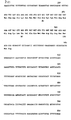
- (In figure 1 the DNA and aminoacid sequence of the ⁇ -tubulin clone, determined as described further on in the example are given.
- the numbering of the aminoacids in the ⁇ -tubulin gene is from 395-425)
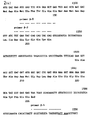
- In figure 2 DNA and amino acid sequence of the ⁇ -tubulin clone determined as described further on in the example, are illustrated).
- the numbering of the DNA bases is given above the DNA sequence, that of the amino acids is given below said sequence.
- the clone contains the 3' half of the gene and the numbering of the amino acids in the ⁇ -tubulin gene is 223-448.
- the polyadenylation signal (bases 1538-1543) is underlined.
- the site of the oligonucleotide primers is illustrated with a dashed line above the DNA sequence: ⁇ -1, bases 1-19 according to the strand illustrated here; ⁇ -2 bases 1311-1331 according to the complementary strand).
- DNA of ⁇ -tubulin is species specific for H. contortus .
- Fragments of a DNA-sequence according to the invention can be used as oligonucleotide probes for specifically determining H. contortus especially in mixed infections.
- the PCR method is used for this.
- Probes comprising a part of the sequence according to the invention react specifically with, H. contortus , whereby a probe comprising a part of the ⁇ -tubulin sequence is especially suited for use in specifically determining H. contortus in this manner.
- introns generally occur in the 5' half of the tubulin gene.
- introns also occur in the 3' half of the 3 ⁇ -tubulin genes of the nematode C. elegans . These introns can be distinguished from the introns of the ⁇ -tubulin genes of other higher eucaryotes.
- the DNA-sequence of the 3' half of the ⁇ -tubulin gene of H. contortus also contains introns.
- the 3' half of ⁇ -tubulin of H. contortus has been found to contain a lot more introns than the 3' half of ⁇ -tubulin of C. elegans and the introns also differ in length from the introns of C. elegans .
- the location and length of introns in the 3' half of the ⁇ -tubulin gene appears not to be conserved in nematodes.
- the subject invention is therefore in general directed at the use of a DNA sequence of a specific nematode as oligonucleotide probe, which probe comprises a part of the DNA sequence of the 3' half of a ⁇ -tubulin gene, for specifically determining the specific nematode.
- the subject invention is therefore not restricted to a method for specifically detecting H. contortus in which method a DNA sequence is used as oligonucleotide probe comprising a part of the 3' half of the ⁇ -tubulin gene of H. contortus .
- the detection of H. contortus in this manner serves as an example of a method for the diagnosis of an infection with a certain nematode according to the subject invention.
- Trichostrongylus colubriformis Another suitable example of a nematode which can specifically be detected using an oligonucleotide probe comprising a part of the DNA sequence of the 3' half of the ⁇ -tubulin gene is Trichostrongylus colubriformis.
- a particular embodiment of the method that has been described above comprises the use of parts of the ⁇ -tubulin gene as primers, which primers are conserved in various nematodes, whereby two sequences are selected as primers which are located in such a manner that the DNA sequence which is amplified from the total DNA of the nematode via PCR, the amplification product, has a species specific length per nematode. because the DNA sequence which is located between the primers is species specific. It is preferable to amplify DNA from the DNA sequence comprising a part of the 3' half of the ⁇ -tubulin gene, as the DNA sequence of the 3' half has been found to differ in intron length per nematode.
- ⁇ -tubulin oligonucleotides Two ⁇ -tubulin oligonucleotides, ⁇ -1 and ⁇ -2 were made on the basis of a DNA sequence of the ⁇ -tubulin gene of H. contortus as determined by the inventors and illustrated in figure 2, in order to be able to measure the difference in introns among various nematode species.
- the oligonucleotides namely contain DNA sequences coding for amino acid sequences supposed to be conserved in ⁇ -tubulin genes of all higher eucaryotes.
- Oligonucleotide ⁇ -1 comprises amino acids 1-7 of the ⁇ -tubulin gene of H. contortus and oligonucleotide ⁇ -2 comprises amino acids 198-204.
- the DNA sequence of ⁇ -1 is: 5' ACGGATCTCAACCACCTTG 3' and the sequence of ⁇ -2 on the complementary strand is 5' CTGGTACTGCTGGTATTCGGA 3'.
- the PCR carried out with these oligonucleotides always gave a positive reaction to the presence of H. contortus DNA also in mixed infections. With this PCR a DNA fragment of approximately 1300 bases was generated. This PCR always gave a positive result when H. contortus DNA was present and then the fragment of 1300 bases was found with the ⁇ -1 and ⁇ -2 primers. The PCR always gave a negative reaction when no fragment of 1300 bases was present and no H. contortus DNA was present.
- the PCR with the ⁇ -1 and ⁇ -2 primers was also tested on DNA of other prevalent sheep parasites. A positive reaction was also found with Trychostrongylus colubriformis also in mixed infections, however the DNA fragment was smaller approximately 900 bases and clearly discernable from the H. contortus fragment.
- the PCR with the ⁇ -1 and ⁇ -2 primers was also tested on DNA of Ostertagia circumcincta , Nippostrongylus brasiliensis , Trichinella spiralis and Trichinella native . No reaction was found not even with so called degenerate primers, which take into account the degenaracy of the genetic code.
- primers ⁇ -7 (albino acids 1-6) with DNA sequence: 5' (CTA)G(GC)(GTAC)GA(CT)(CT)T(GCAT)AA(CT)CA(CT)(CT)T 3' and ⁇ -8 (amino acids 199-205) on the complementary strand with DNA sequence: 5' TC(CT)TGGTA(TC)TG(CT)TG(GA)TA(CT)TC 3' (figure 2).
- the PCR with the ⁇ -7 and ⁇ -8 primers was positive with DNA of H. contortus and T. colubriformis giving the DNA fragments that were described previously.
- the used primers correspond to a DNA sequence coding for a very conserved region of the ⁇ -tubulin molecule it appears probable that the ⁇ -tubulin gene(s) of the nematode species leading to a negative result with these primers using PCR contain an intron in the sequence of the primers. This could prevent the primer from binding and could prevent any reaction taking place.
- a change in the amino acid sequence in the region of the primers could also be a possible explanation for the above mentioned result but does not seem probable considering the conservation of the amino acid sequence in this region.
- a species specific PCR can also be obtained for the nematodes giving a negative result with the primers ⁇ -1, ⁇ -2, ⁇ -7 and ⁇ -8.
- the subject invention is therefore also directed at a method for the diagnosis of a worm infection, with which method the total DNA from the eggs from the nematode is amplified preferably via PCR, which method is characterized in the use of two parts of the coding sequence of the ⁇ -tubulin gene which are conserved in various nematodes as primers, which primers are located in the DNA sequence of the ⁇ -tubulin gene in such a manner that the amplification product has a species specific length per nematode.
- the beta-tubulin probes comprising the complete 2,2 kb ⁇ -tubulin clone of H. contortus (pEMBLaB, deposited at the CBS in Baarn under Nr. CBS 335.90) or the 1,3 kb ⁇ -1/ ⁇ -2 PCR fragment always show a positive reaction to the presence of H. contortus , even in the case of a mixed infection.
- the beta-tubulin probes of H. contortus were also tested on the DNA of other frequently occurring sheep parasites and this reaction was found to be much less pronounced than with its own species. Yet specific bands were obtained with these large probes which indicates conservation. The weaker reaction could be caused by introns in conserved regions or small species specific DNA sequences within these large probes.
- the species which were tested are, inter alia: Cooperia circumcincta , Nematodirus battus , Nippostrongylus brasiliensis , Ostertagia circumcincta , Trichostrongylus colubriformis , Trichostrongylus vitrinus , Trichinella spiralis and Trichinella native .
- a specific sequence from a DNA sequence according to the invention of for example, at least 10 nucleotides from a H. contortus specific intron or the DNA sequence coding for amino acids 332-335, which under specific conditions reacts solely with H. contortus , it is possible to establish a test by means of which it is possible, in the case of a mixed infection with nematodes, to diagnose infection with H. contortus from the DNA of the eggs.
- test which can be used are those which are used in the case of other nematodes:
- the present invention also relates to a method for the diagnosis of a worm infection, in which method the total DNA from the eggs from the nematode is applied to a nylon membrane and hybridised with a DNA probe, which method is characterised in that a diagnosis of infection with Haemonchus contortus is made, using a sequence which corresponds to a specific part of a tubulin gene of H. contortus as oligonucleotide probe.
- a preferred method is a method in which specific DNA fragments from the DNA of the eggs are amplified, for example by means of PCR, and are rendered visible.
- the diagnosis of an infection with H. contortus can be made because the amplification of specific fragments is successful when H.
- contortus DNA is present in the egg sample and sequences are used, such as a primer which corresponds to at least a conserved part of a tubulin gene of H. contortus , whereby said sequences are localised in the DNA sequence of the ⁇ -tubulin gene in such a manner that the amplification product has a species specific length.
- the invention is also directed at a kit for carrying out the diagnosis of a worm infection which kit comprises at least a species specific part of the 3' half of the ⁇ -tubulin gene of the nematode to be detected as oligonucleotide probe and is also provided with other means and materials which are apparent to an expert.
- kits for carrying out a method for the diagnosis of infection with H. contortus which kit comprises at least a part of the DNA sequence according to the invention and is also provided with other means and materials apparent to an expert.
- kit shall preferably comprise a part of the 3' half of the ⁇ -tubulin gene of H. contortus .
- the invention is further directed at a kit for carrying a method for the diagnosis of infection with H . contortus , which kit comprises at least primers comprising coding DNA sequences of the ⁇ -tubulin gene which are conserved in various nematodes, which primers are located in such a manner in the DNA sequence of the ⁇ -tubulin gene of H. contortus that the amplification product has a species specific length.
- a kit shall preferably comprise primers giving a part of the 3' half of the ⁇ -tubulin gene of H. contortus as amplification product.
- Such a kit will comprise for example the ⁇ -1 and ⁇ -2 primers and/or the ⁇ -7 and ⁇ -8 primers.
- a kit is also provided with the means and materials apparent for an expert.
- sequences according to the invention can also be used if they are incorporated in a vector, an expression vector being preferred.
- the invention relates to vectors of this type and also to recombinant microorganisms which comprise a DNA sequence according to the invention.
- the invention also relates to a peptide which comprises at least one fragment of the amino acid sequence which is coded by a DNA sequence according to the invention.
- Genomic DNA was made from L3 larvae using the method of Coulson et al. (Coulson, A., Sulston, J., Brenner, S. and Karn, J. (1986) Toward a physical map of the genome of the nematode Caenorhabditis elegans , Proc. Natl. Acad. Sci. USA 83 , 7821-7825).
- the size of the DNA fragments to be cloned was 20 kb.
- a partial digestion was carried out with a restriction enzyme that cuts frequently in genomic DNA.
- concentration of the enzyme was chosen as described in Maniatis et al. (Maniatis, T., Fritsch, T.
- the infected bacteria were plated out with non-infected bacteria and after incubation at 37°C a plaque was visible at the location where infected bacteria were present (Frischholz, A.M., Lehrach, H., Poustka, A. and Murray, N. (1983) Lambda replacement vectors carrying polylinker sequences, J. Mol. Biol. 170 , 827-841).
- the plaques were then screened according to the method of Maniatis et al. (Maniatis, T., Fritsch, T. and Sambrook, J. (1982) Molecular cloning. A laboratory manual, Cold Spring Harbor Laboratory, Cold Spring Harbor, N.Y., USA).
- the tubulin probes used to isolate the alpha-tubulin DNA-containing clones were chicken alpha-tubulin [as described in Valenzuela et al. (Valenzuela, P., Quiroga, M., Zaldivar, J., Rutter, W.J., Kirshner, M.W. and Cleveland, D.W. (1981) Nucleotide and corresponding amino acid sequences encoded by alpha and beta tubulin mRNAs. Nature 289 , 650-655)] and Drosophila hydei alpha-tubulin [a gift from Dr. R. Brand of the clergymand, F., Falkenburg.
- Testis-specific beta2 tubulins are identical in Drosophila melanogaster and D. hydei but differ from the ubiquitous beta1 tubulin)].
- the beta-tubulin probes used to isolate the beta-tubulin DNA-containing clones were a beta-tubulin clone of Caenorhabditis elegans , Ben-1 [which is described in Driscoll et al. (Driscoll, M., Dean, E., Reilly, E., Bergholz, E. and Chalfie, M. (1989) Genetic and molecular analysis of a Caenorhabditis elegans beta tubulin that conveys benzimidazole sensitivity, J. Cell Biol. 109 , 2993-3003)] and a beta-tubulin clone of Drosophila hydei pTB5 [a gift from Dr. R.
- Testis-specific beta2 tubulins are identical in Drosophila melanogaster and D. hydei but differ from the ubiquitous beta1 tubulin)].
- the clone pEMBL8cA (deposited with the CBS in Baarn under No. CBS 335.90), for alpha-tubulin
- the clone pEMBL7aB (deposited with the CBS in Baarn under No. CBS 334.90), for beta-tubulin
- Subclones thereof which contain DNA fragments coding for protein, were constructed in the vectors Bluescript and M13. The DNA of these subclones was sequenced using the dideoxy method of Sanger et al. (Sanger, F., Nicklen, S. and Coulson, A.R. (1977) DNA sequencing with chain terminating inhibitors, Proc. Natl. Acad. Sci.
- the oligonucleotides ⁇ -1 and ⁇ -2 as described above were made in order to carry out a species specific PCR for DNA of H. contortus and T. colubriformis .
- the ⁇ -7 and ⁇ -8 primers were made in order to obtain a species specific PCR for the species O. circumcincta , T. spiralis and T. nativa.
- the PCR method was used according to Ehrlich et al. (Saiki, R.K., (1989) in: PCR technology, principles and applications for DNA amplification, Erlich, H.A. (ed.), Stockton Press, New York, London, pp. 7-16).
- the reaction conditions used in the present invention which were used to amplify the DNA, are: PCR with ⁇ -1 and ⁇ -2 primers with a magnesium concentration of 1,5 mM an annealing temperature of 61°C for 30 seconds, elongation at 72°C for 2 minutes and denaturing at 95°C for 30 seconds.
- This method amplifies the beta-tubulin of H. contortus and T. colubriformis from the genomic DNA, which can be rendered visible by electrophoresis in an agarose gel, whereby DNA of H. contortus gives a visible band of 1,3 kb and DNA of T. colubriformis gives a visible band of 0,9 kb.
- the PCR conditions with the ⁇ -7 and ⁇ -8 primers were: 5 cycli as follows. An annealing temperature of 37°C for 1 minute, a slow rise in 5 minutes from 37°C to the elongation temperature of 72°C, 2 minutes at 72°C, 1 minute at 95°C. Subsequently 20 cycli of 1 minute at 55°C, 2 minutes at 72°C and 1 minute at 95°C. The magnesium concentration was 1,5 mM. This PCR visualized a positive reaction with H. contortus DNA and was negative with O. circumcincta , T. spiralis and T. nativa.
Landscapes
- Health & Medical Sciences (AREA)
- Chemical & Material Sciences (AREA)
- Organic Chemistry (AREA)
- Life Sciences & Earth Sciences (AREA)
- Medicinal Chemistry (AREA)
- Biophysics (AREA)
- General Health & Medical Sciences (AREA)
- Genetics & Genomics (AREA)
- Biochemistry (AREA)
- Molecular Biology (AREA)
- Proteomics, Peptides & Aminoacids (AREA)
- Tropical Medicine & Parasitology (AREA)
- Immunology (AREA)
- Toxicology (AREA)
- Zoology (AREA)
- Gastroenterology & Hepatology (AREA)
- Measuring Or Testing Involving Enzymes Or Micro-Organisms (AREA)
Claims (19)
- Verfahren zur differenzierten Diagnose einer NematodenInfektion mit einem speziellen Nematoden-Typ, das im Fall von gemischten Nematoden-Infektionen anwendbar ist, wobei bei dem Verfahren eine DNA-Sequenz, die das β-Tubulin-Gen oder ein Teil dieses Gens dieser Nematode ist, als Oligonukleotid-Sonde und/oder Primer verwendet wird, und der Teil mindestens 10, vorzugsweise mindestens 18 Nukleotide, umfaßt.
- Verfahren nach Anspruch 1, bei dem die spezielle Nematode Haemonchus contortus und das β-Tubulin-Gen das β-Tubulin-Gen von Haemonchus contortus ist.
- Verfahren nach Anspruch 1 oder 2, bei dem die Sonde und/oder der Primer einen Teil der 3'-Hälfte des β-Tubulin-Gens umfaßt.
- Verfahren nach einem der Ansprüche 1-3, bei dem die Sonde und/oder der Primer artenspezifisch ist.
- Verfahren nach Anspruch 4, bei dem es sich bei der Sonde und/oder dem Primer um mindestens 10 Nukleotide eines für H. contortus spezifischen Introns handelt.
- Verfahren nach einem der Ansprüche 1-4, bei dem die Sonde von der DNA-Sequenz stammt, welche die Aminosäuren 332-335 des β-Tubulins von H. contortus kodiert.
- Verfahren nach einem der Ansprüche 1-6, bei dem die gesamte Nematoden-DNA auf eine Nylon-Membran aufgebracht und mit der Sonde hybridisiert wird.
- Verfahren nach einem der Ansprüche 1-3, bei dem ein Primer ausgewählt wird, der in verschiedenen Nematoden-Typen konserviert ist, wobei der Primer so lokalisiert ist, daß die von der Gesamt-DNA der Nematode amplifizierte DNA für jede Nematode eine artspezifische Länge hat.
- Verfahren nach Anspruch 8, bei dem der Primer eine kodierende Sequenz für eine konservierte Aminosäuresequenz ist.
- Verfahren nach Anspruch 9, bei dem zwei Primer ausgewählt werden, die in verschiedenen Nematoden konserviert sind, wobei die Primer in der β-Tubulin-Sequenz so lokalisiert sind, daß das Amplifikationsprodukt jeder Nematode eine artenspezifische Länge hat.
- Verfahren nach einem der Ansprüche 1-3 oder 8-10, bei dem jedes Amplifikationsprodukt der Nematoden-DNA einen Teil der 3'-Hälfte des β-Tubulin-Gens umfaßt.
- Verfahren nach einem der Ansprüche 1-3 oder 8-11, dadurch gekennzeichnet, daß β-1 und β-2 als Primer verwendet werden, wobei β-1 die Sequenz 5' ACGGATCTCAACCACCTTG 3' und β-2 die Sequenz 5' CTGGTACTGCTGGTATTCGGA 3' auf dem komplementären Strang hat, oder die Primer β-7 und β-8 verwendet werden, wobei β-7 die Aminosäuren 1-6 des β-Tubulins von H. contortus mit der DNA-Sequenzund β-8 die Aminosäuren 199-205 des β-Tubulins von H. contortus mit der DNA-Sequenz5' (CTA)G(GC)(GTAC)GA(CT)(CT)T(GCAT)AA(CT)CA(CT)(CT)T 3'auf dem komplementären Strang umfaßt.5' TC(CT)TGGTA(TC)TG(CT)(TG)(GA)TA(CT)TC 3'
- Verfahren nach einem der vorhergehenden Ansprüche, mit dem die Infektion mit H. contortus von Infektionen mit den unterschiedlichen Nematoden Cooperia circumcincta, Ostertagia circumcincta, Nematodirus battus, Nippostrongylus brasiliensis, Trichinella spiralis, Trichinella nativa, Trichostrongylus vitrinuns und Trichostrongylus colubriformis differenziert werden kann.
- Verfahren nach einem der Ansprüche 1-3 und 8-13, dadurch gekennzeichnet, daß eine für H. contortus spezifische Diagnose der Infektion durchgeführt wird, wenn das Amplifikationsprodukt eine Länge von 1,3 kb hat.
- Verfahren nach einem der Ansprüche 1-3, 8-14, dadurch gekennzeichnet, daß eine für Trichostrongylus colubriformis spezifische Diagnose der Infektion durchgeführt wird, wenn das Amplifikationsprodukt eine Länge von 0,9 kb hat.
- Kit zur Durchführung einer differenzierten Diagnose einer Infektion mit Haemonchus contortus nach einem der vorhergehenden Ansprüche, wobei der Kit mindestens einen Primer enthält, der eine kodierende DNA-Sequenz umfaßt, welche die 3'-Hälfte des β-Tubulin-Gens der Nematode Haemonchus contortus ist, das in dem unter der Zugangsnummer CBS 334.90 beim Centraal Bureau Schimmelcultures in Baarn, Niederlande, hinterlegten Plasmid enthalten ist, und wobei der Primer eine Länge von mindestens 10 Nukleotiden, vorzugsweise mindestens 18, hat und wobei der Primer eine in verschiedenen Nematoden konservierte Sequenz ist und in der DNA-Sequenz von Haemonchus contortus so lokalisiert ist, daß deren Amplifikationsprodukt eine artenspezifische Länge hat.
- Kit nach Anspruch 16, wobei der Kit die Primer mit den Nukleinsäuresequenzen β-1 und β-2 und/oder die Primer β-7 undβ-8 enthält, wobeiβ-1 = 5'ACGGATCTCAACCACCTTG 3'β-2 = 5'CTGGTACTGCTGGTATTCGGA 3'β-7 = 5'(CTA)G(GC)(GTAC)GA(CT)(CT)T(GCAT)AA(CT)CA(CT)(CT)T 3'β-8 = 5'TC(CT)TGGTA(TC)TG(CT)TG(GA)TA(CT)TC 3' ist.
- Kit zur Durchführung einer differenzierten Diagnose einer Infektion mit Haemonchus contortus nach einem der Ansprüche 1-15, wobei der Kit mindestens eine Sonde und/oder einen Primer enthält, die/der für Haemonchus contortus artenspezifisch ist, und wobei die Sonde oder der Primer von einer kodierenden DNA-Sequenz stammt, welche die 3'-Hälfte des β-Tubulin-Gens von Haemonchus contortus ist, das in dem unter der Zugangsnummer CBS 334.90 beim Centraal Bureau Schimmelcultures in Baarn, Niederlande, hinterlegten Plasmid enthalten ist.
- Kit nach Anspruch 18, wobei der Kit die Primer mit den Nukleinsäuresequenzen β-1 und β-2 und/oder die Primer β-7 und β-8 enthält, wobeiβ-1 = 5'ACGGATCTCAACCACCTTG 3'β-2 = 5'CTGGTACTGCTGGTATTCGGA 3'β-7 = 5'(CTA)G(GC)(GTAC)GA(CT)(CT)T(GCAT)AA(CT)CA(CT)(CT)T 3'β-8 = 5'TC(CT)TGGTA(TC)TG(CT)TG(GA)TA(CT)TC 3' ist.
Applications Claiming Priority (3)
| Application Number | Priority Date | Filing Date | Title |
|---|---|---|---|
| NL9001832 | 1990-08-16 | ||
| NL9001832A NL9001832A (nl) | 1990-08-16 | 1990-08-16 | Specifieke sequenties van dna van een nematode die toegepast kunnen worden bij de diagnostiek van infektie met de nematode. |
| PCT/NL1991/000153 WO1992003549A1 (en) | 1990-08-16 | 1991-08-15 | Specific dna sequences of a nematode which can be used for the diagnosis of infection with the nematode |
Publications (2)
| Publication Number | Publication Date |
|---|---|
| EP0668908A1 EP0668908A1 (de) | 1995-08-30 |
| EP0668908B1 true EP0668908B1 (de) | 2000-05-03 |
Family
ID=19857554
Family Applications (1)
| Application Number | Title | Priority Date | Filing Date |
|---|---|---|---|
| EP91915017A Expired - Lifetime EP0668908B1 (de) | 1990-08-16 | 1991-08-15 | Dns-sequenzen von einer nematode, verwendbare für diagnose von infektionen |
Country Status (8)
| Country | Link |
|---|---|
| EP (1) | EP0668908B1 (de) |
| AT (1) | ATE192491T1 (de) |
| AU (1) | AU8413691A (de) |
| DE (1) | DE69132173D1 (de) |
| NL (1) | NL9001832A (de) |
| NZ (1) | NZ239411A (de) |
| WO (1) | WO1992003549A1 (de) |
| ZA (1) | ZA916512B (de) |
Families Citing this family (5)
| Publication number | Priority date | Publication date | Assignee | Title |
|---|---|---|---|---|
| GB9209993D0 (en) * | 1992-05-08 | 1992-06-24 | Munn Edward A | Vaccines |
| EP0674659A1 (de) * | 1992-10-28 | 1995-10-04 | McGILL UNIVERSITY | Nematodentubulin abgeleitete peptide und impfstoffe |
| AU5538096A (en) * | 1995-04-10 | 1996-10-30 | Mcgill University | Peptides of nematode tubulin and methods of use |
| DE19931883A1 (de) * | 1999-07-09 | 2001-01-11 | Bayer Ag | DNA kodierend für Beta-Tubulin und deren Verwendung |
| CN111537716B (zh) * | 2020-06-04 | 2023-06-23 | 南京农业大学 | 一种捻转血矛线虫早期感染诊断试剂盒 |
-
1990
- 1990-08-16 NL NL9001832A patent/NL9001832A/nl not_active Application Discontinuation
-
1991
- 1991-08-15 AT AT91915017T patent/ATE192491T1/de not_active IP Right Cessation
- 1991-08-15 AU AU84136/91A patent/AU8413691A/en not_active Abandoned
- 1991-08-15 WO PCT/NL1991/000153 patent/WO1992003549A1/en not_active Ceased
- 1991-08-15 EP EP91915017A patent/EP0668908B1/de not_active Expired - Lifetime
- 1991-08-15 DE DE69132173T patent/DE69132173D1/de not_active Expired - Lifetime
- 1991-08-15 NZ NZ239411A patent/NZ239411A/en unknown
- 1991-08-16 ZA ZA916512A patent/ZA916512B/xx unknown
Also Published As
| Publication number | Publication date |
|---|---|
| NZ239411A (en) | 1994-02-25 |
| WO1992003549A1 (en) | 1992-03-05 |
| EP0668908A1 (de) | 1995-08-30 |
| AU8413691A (en) | 1992-03-17 |
| ATE192491T1 (de) | 2000-05-15 |
| NL9001832A (nl) | 1992-03-16 |
| ZA916512B (en) | 1992-05-27 |
| DE69132173D1 (de) | 2000-06-08 |
Similar Documents
| Publication | Publication Date | Title |
|---|---|---|
| Franco et al. | A gene deleted in Kallmann's syndrome shares homology with neural cell adhesion and axonal path-finding molecules | |
| Amparyup et al. | Molecular cloning, genomic organization and recombinant expression of a crustin-like antimicrobial peptide from black tiger shrimp Penaeus monodon | |
| Smartt et al. | The Apyrase Gene of the Vector Mosquito, Aedes eegypti, Is Expressed Specifically in the Adult Female Salivary Glands | |
| Grunclová et al. | Lysozyme from the gut of the soft tick Ornithodoros moubata: the sequence, phylogeny and post-feeding regulation | |
| Wang et al. | Biological activity of Manduca sexta paralytic and plasmatocyte spreading peptide and primary structure of its hemolymph precursor | |
| Supungul et al. | Molecular characterization and expression analysis of a c-type and two novel muramidase-deficient i-type lysozymes from Penaeus monodon | |
| Grossman et al. | The salivary glands of the vector mosquito, Aedes aegypti, express a novel member of the amylase gene family | |
| Lee et al. | Purification and molecular cloning of cDNA for an inducible antibacterial protein of larvae of a coleopteran insect, Holotrichia diomphalia | |
| Dietzel et al. | Ferritins of Schistosoma mansoni: sequence comparison and expression in female and male worms | |
| Lally et al. | Development of a polymerase chain reaction assay for the diagnosis of neosporosis using the Neospora caninum 14-3-3 gene | |
| Wang et al. | Organization and expression of the hemolin gene, a member of the immunoglobulin superfamily in an insect, Manduca sexta | |
| EP0330681A1 (de) | Impfstoffe gegen tierische parasitäre nematoden | |
| EP0668908A1 (de) | Dns-sequenzen von einer nematode, verwendbare für diagnose von infektionen | |
| Vlachou et al. | The autosomal chorion locus of the medfly Ceratitis capitata. I. Conserved synteny, amplification and tissue specificity but sequence divergence and altered temporal regulation | |
| IL84574A (en) | Beef tick antigen, its parts, homologous vapitopios with similar immune activity, process for their preparation, polynucleotide encoding them, vaccines containing them, antibodies derived from | |
| EP0652769B1 (de) | Impfstoffe gegen Metazoen-Parasiten | |
| Lin et al. | Variation in primary sequence and tandem repeat copy number among i-antigens of Ichthyophthirius multifiliis | |
| US20060189538A1 (en) | Peptides and nucleic acids of the cathelicidin family, derived from fish, and uses thereof | |
| Gottsch et al. | Cloning and sequence analysis of human and bovine corneal antigen (CO-Ag) cDNA: identification of host-parasite protein calgranulin C | |
| Miska et al. | Heat shock protein 90 genes of two species of poultry Eimeria: expression and evolutionary analysis | |
| KR100954881B1 (ko) | 넙치 유래의 항균성 펩타이드 헵시딘 | |
| Ortner et al. | Molecular analysis of two hexokinase isoenzymes from Entamoeba histolytica | |
| WO2000034476A9 (en) | Nucleic acid molecules of shrimp | |
| US6156505A (en) | Specific DNA probes for the identification of the Taenia solium and Taenia saginata species | |
| US5843710A (en) | Vaccines against animal parasitic nematodes |
Legal Events
| Date | Code | Title | Description |
|---|---|---|---|
| PUAI | Public reference made under article 153(3) epc to a published international application that has entered the european phase |
Free format text: ORIGINAL CODE: 0009012 |
|
| 17P | Request for examination filed |
Effective date: 19930216 |
|
| AK | Designated contracting states |
Kind code of ref document: A1 Designated state(s): AT BE CH DE DK ES FR GB GR IT LI LU NL SE |
|
| RAP3 | Party data changed (applicant data changed or rights of an application transferred) |
Owner name: FERRING N.V. Owner name: UNIVERSITEIT UTRECHT |
|
| 17Q | First examination report despatched |
Effective date: 19960212 |
|
| GRAG | Despatch of communication of intention to grant |
Free format text: ORIGINAL CODE: EPIDOS AGRA |
|
| RAP1 | Party data changed (applicant data changed or rights of an application transferred) |
Owner name: DRAUPNIR CORPORATION N.V. Owner name: UNIVERSITEIT UTRECHT |
|
| RIC1 | Information provided on ipc code assigned before grant |
Free format text: 6C 12N 15/12 A, 6C 12Q 1/68 B, 6G 01N 33/50 B, 6A 61K 39/00 B |
|
| GRAG | Despatch of communication of intention to grant |
Free format text: ORIGINAL CODE: EPIDOS AGRA |
|
| GRAH | Despatch of communication of intention to grant a patent |
Free format text: ORIGINAL CODE: EPIDOS IGRA |
|
| GRAH | Despatch of communication of intention to grant a patent |
Free format text: ORIGINAL CODE: EPIDOS IGRA |
|
| GRAA | (expected) grant |
Free format text: ORIGINAL CODE: 0009210 |
|
| AK | Designated contracting states |
Kind code of ref document: B1 Designated state(s): AT BE CH DE DK ES FR GB GR IT LI LU NL SE |
|
| PG25 | Lapsed in a contracting state [announced via postgrant information from national office to epo] |
Ref country code: IT Free format text: LAPSE BECAUSE OF FAILURE TO SUBMIT A TRANSLATION OF THE DESCRIPTION OR TO PAY THE FEE WITHIN THE PRESCRIBED TIME-LIMIT;WARNING: LAPSES OF ITALIAN PATENTS WITH EFFECTIVE DATE BEFORE 2007 MAY HAVE OCCURRED AT ANY TIME BEFORE 2007. THE CORRECT EFFECTIVE DATE MAY BE DIFFERENT FROM THE ONE RECORDED. Effective date: 20000503 Ref country code: GR Free format text: LAPSE BECAUSE OF NON-PAYMENT OF DUE FEES Effective date: 20000503 Ref country code: AT Free format text: LAPSE BECAUSE OF FAILURE TO SUBMIT A TRANSLATION OF THE DESCRIPTION OR TO PAY THE FEE WITHIN THE PRESCRIBED TIME-LIMIT Effective date: 20000503 Ref country code: LI Free format text: LAPSE BECAUSE OF FAILURE TO SUBMIT A TRANSLATION OF THE DESCRIPTION OR TO PAY THE FEE WITHIN THE PRESCRIBED TIME-LIMIT Effective date: 20000503 Ref country code: CH Free format text: LAPSE BECAUSE OF FAILURE TO SUBMIT A TRANSLATION OF THE DESCRIPTION OR TO PAY THE FEE WITHIN THE PRESCRIBED TIME-LIMIT Effective date: 20000503 Ref country code: FR Free format text: LAPSE BECAUSE OF FAILURE TO SUBMIT A TRANSLATION OF THE DESCRIPTION OR TO PAY THE FEE WITHIN THE PRESCRIBED TIME-LIMIT Effective date: 20000503 Ref country code: BE Free format text: LAPSE BECAUSE OF FAILURE TO SUBMIT A TRANSLATION OF THE DESCRIPTION OR TO PAY THE FEE WITHIN THE PRESCRIBED TIME-LIMIT Effective date: 20000503 Ref country code: ES Free format text: THE PATENT HAS BEEN ANNULLED BY A DECISION OF A NATIONAL AUTHORITY Effective date: 20000503 |
|
| REF | Corresponds to: |
Ref document number: 192491 Country of ref document: AT Date of ref document: 20000515 Kind code of ref document: T |
|
| REG | Reference to a national code |
Ref country code: CH Ref legal event code: EP |
|
| REF | Corresponds to: |
Ref document number: 69132173 Country of ref document: DE Date of ref document: 20000608 |
|
| PG25 | Lapsed in a contracting state [announced via postgrant information from national office to epo] |
Ref country code: SE Free format text: LAPSE BECAUSE OF FAILURE TO SUBMIT A TRANSLATION OF THE DESCRIPTION OR TO PAY THE FEE WITHIN THE PRESCRIBED TIME-LIMIT Effective date: 20000803 Ref country code: DK Free format text: LAPSE BECAUSE OF FAILURE TO SUBMIT A TRANSLATION OF THE DESCRIPTION OR TO PAY THE FEE WITHIN THE PRESCRIBED TIME-LIMIT Effective date: 20000803 |
|
| PG25 | Lapsed in a contracting state [announced via postgrant information from national office to epo] |
Ref country code: DE Free format text: LAPSE BECAUSE OF FAILURE TO SUBMIT A TRANSLATION OF THE DESCRIPTION OR TO PAY THE FEE WITHIN THE PRESCRIBED TIME-LIMIT Effective date: 20000804 |
|
| PG25 | Lapsed in a contracting state [announced via postgrant information from national office to epo] |
Ref country code: LU Free format text: LAPSE BECAUSE OF NON-PAYMENT OF DUE FEES Effective date: 20000815 |
|
| EN | Fr: translation not filed | ||
| REG | Reference to a national code |
Ref country code: CH Ref legal event code: PL |
|
| PLBE | No opposition filed within time limit |
Free format text: ORIGINAL CODE: 0009261 |
|
| STAA | Information on the status of an ep patent application or granted ep patent |
Free format text: STATUS: NO OPPOSITION FILED WITHIN TIME LIMIT |
|
| 26N | No opposition filed | ||
| PGFP | Annual fee paid to national office [announced via postgrant information from national office to epo] |
Ref country code: GB Payment date: 20010830 Year of fee payment: 11 |
|
| PGFP | Annual fee paid to national office [announced via postgrant information from national office to epo] |
Ref country code: NL Payment date: 20010831 Year of fee payment: 11 |
|
| REG | Reference to a national code |
Ref country code: GB Ref legal event code: IF02 |
|
| PG25 | Lapsed in a contracting state [announced via postgrant information from national office to epo] |
Ref country code: GB Free format text: LAPSE BECAUSE OF NON-PAYMENT OF DUE FEES Effective date: 20020815 |
|
| PG25 | Lapsed in a contracting state [announced via postgrant information from national office to epo] |
Ref country code: NL Free format text: LAPSE BECAUSE OF NON-PAYMENT OF DUE FEES Effective date: 20030301 |
|
| GBPC | Gb: european patent ceased through non-payment of renewal fee |
Effective date: 20020815 |
|
| NLV4 | Nl: lapsed or anulled due to non-payment of the annual fee |
Effective date: 20030301 |