EP0669610A1 - Alliage magnétique pour améliorer la résistance à la corrosion et la charactéristique magnétique - Google Patents
Alliage magnétique pour améliorer la résistance à la corrosion et la charactéristique magnétique Download PDFInfo
- Publication number
- EP0669610A1 EP0669610A1 EP19950300543 EP95300543A EP0669610A1 EP 0669610 A1 EP0669610 A1 EP 0669610A1 EP 19950300543 EP19950300543 EP 19950300543 EP 95300543 A EP95300543 A EP 95300543A EP 0669610 A1 EP0669610 A1 EP 0669610A1
- Authority
- EP
- European Patent Office
- Prior art keywords
- alloy
- magnetic
- layer
- coni
- corrosion resistance
- Prior art date
- Legal status (The legal status is an assumption and is not a legal conclusion. Google has not performed a legal analysis and makes no representation as to the accuracy of the status listed.)
- Ceased
Links
- 230000005291 magnetic effect Effects 0.000 title claims abstract description 42
- 229910001004 magnetic alloy Inorganic materials 0.000 title claims abstract description 31
- 238000005260 corrosion Methods 0.000 title abstract description 50
- 230000007797 corrosion Effects 0.000 title abstract description 50
- 229910045601 alloy Inorganic materials 0.000 claims abstract description 94
- 239000000956 alloy Substances 0.000 claims abstract description 94
- 239000010936 titanium Substances 0.000 claims abstract description 81
- 229910052719 titanium Inorganic materials 0.000 claims abstract description 46
- 229910052715 tantalum Inorganic materials 0.000 claims abstract description 44
- GUVRBAGPIYLISA-UHFFFAOYSA-N tantalum atom Chemical compound [Ta] GUVRBAGPIYLISA-UHFFFAOYSA-N 0.000 claims abstract description 25
- RTAQQCXQSZGOHL-UHFFFAOYSA-N Titanium Chemical compound [Ti] RTAQQCXQSZGOHL-UHFFFAOYSA-N 0.000 claims abstract description 24
- 229910052759 nickel Inorganic materials 0.000 claims abstract description 11
- 229910052796 boron Inorganic materials 0.000 claims abstract description 10
- IJGRMHOSHXDMSA-UHFFFAOYSA-N Atomic nitrogen Chemical compound N#N IJGRMHOSHXDMSA-UHFFFAOYSA-N 0.000 claims abstract description 8
- 229910017052 cobalt Inorganic materials 0.000 claims abstract description 5
- 239000010941 cobalt Substances 0.000 claims abstract description 5
- GUTLYIVDDKVIGB-UHFFFAOYSA-N cobalt atom Chemical compound [Co] GUTLYIVDDKVIGB-UHFFFAOYSA-N 0.000 claims abstract description 5
- 229910052697 platinum Inorganic materials 0.000 claims abstract description 5
- 229910052757 nitrogen Inorganic materials 0.000 claims abstract description 4
- QVGXLLKOCUKJST-UHFFFAOYSA-N atomic oxygen Chemical compound [O] QVGXLLKOCUKJST-UHFFFAOYSA-N 0.000 claims abstract description 3
- 239000001301 oxygen Substances 0.000 claims abstract description 3
- 229910052760 oxygen Inorganic materials 0.000 claims abstract description 3
- BASFCYQUMIYNBI-UHFFFAOYSA-N platinum Chemical compound [Pt] BASFCYQUMIYNBI-UHFFFAOYSA-N 0.000 claims description 61
- PXHVJJICTQNCMI-UHFFFAOYSA-N Nickel Chemical compound [Ni] PXHVJJICTQNCMI-UHFFFAOYSA-N 0.000 claims description 20
- 230000006911 nucleation Effects 0.000 claims description 10
- 238000010899 nucleation Methods 0.000 claims description 10
- 239000000758 substrate Substances 0.000 claims description 8
- ZOXJGFHDIHLPTG-UHFFFAOYSA-N Boron Chemical compound [B] ZOXJGFHDIHLPTG-UHFFFAOYSA-N 0.000 claims description 7
- 239000000314 lubricant Substances 0.000 claims description 3
- 230000001681 protective effect Effects 0.000 claims description 3
- 238000004544 sputter deposition Methods 0.000 abstract description 12
- 238000000151 deposition Methods 0.000 abstract description 3
- 230000001747 exhibiting effect Effects 0.000 abstract description 3
- 229910000990 Ni alloy Inorganic materials 0.000 abstract description 2
- 230000008021 deposition Effects 0.000 abstract description 2
- 230000000704 physical effect Effects 0.000 abstract description 2
- 238000001771 vacuum deposition Methods 0.000 abstract description 2
- 229910002070 thin film alloy Inorganic materials 0.000 abstract 1
- 239000011651 chromium Substances 0.000 description 50
- 239000010409 thin film Substances 0.000 description 15
- 229910052804 chromium Inorganic materials 0.000 description 12
- OKTJSMMVPCPJKN-UHFFFAOYSA-N Carbon Chemical compound [C] OKTJSMMVPCPJKN-UHFFFAOYSA-N 0.000 description 10
- 229910052799 carbon Inorganic materials 0.000 description 10
- 239000000203 mixture Substances 0.000 description 10
- 229910020707 Co—Pt Inorganic materials 0.000 description 9
- 239000000463 material Substances 0.000 description 9
- VYZAMTAEIAYCRO-UHFFFAOYSA-N Chromium Chemical compound [Cr] VYZAMTAEIAYCRO-UHFFFAOYSA-N 0.000 description 8
- 239000010408 film Substances 0.000 description 7
- 238000005259 measurement Methods 0.000 description 7
- 230000010287 polarization Effects 0.000 description 7
- 238000012360 testing method Methods 0.000 description 7
- XKRFYHLGVUSROY-UHFFFAOYSA-N Argon Chemical compound [Ar] XKRFYHLGVUSROY-UHFFFAOYSA-N 0.000 description 6
- QAOWNCQODCNURD-UHFFFAOYSA-N Sulfuric acid Chemical compound OS(O)(=O)=O QAOWNCQODCNURD-UHFFFAOYSA-N 0.000 description 6
- 235000011149 sulphuric acid Nutrition 0.000 description 6
- 230000005415 magnetization Effects 0.000 description 5
- 238000011160 research Methods 0.000 description 5
- MCMNRKCIXSYSNV-UHFFFAOYSA-N Zirconium dioxide Chemical compound O=[Zr]=O MCMNRKCIXSYSNV-UHFFFAOYSA-N 0.000 description 4
- 229910052782 aluminium Inorganic materials 0.000 description 4
- 238000013459 approach Methods 0.000 description 4
- 238000006056 electrooxidation reaction Methods 0.000 description 4
- 230000009467 reduction Effects 0.000 description 4
- 229910052710 silicon Inorganic materials 0.000 description 4
- 239000002253 acid Substances 0.000 description 3
- XAGFODPZIPBFFR-UHFFFAOYSA-N aluminium Chemical compound [Al] XAGFODPZIPBFFR-UHFFFAOYSA-N 0.000 description 3
- 229910052786 argon Inorganic materials 0.000 description 3
- 230000001627 detrimental effect Effects 0.000 description 3
- 238000009826 distribution Methods 0.000 description 3
- 230000003993 interaction Effects 0.000 description 3
- 239000000696 magnetic material Substances 0.000 description 3
- 229910052721 tungsten Inorganic materials 0.000 description 3
- 229910018979 CoPt Inorganic materials 0.000 description 2
- -1 CoPt.10Ta.015Cr.03) Chemical compound 0.000 description 2
- 230000002411 adverse Effects 0.000 description 2
- 150000001721 carbon Chemical class 0.000 description 2
- 230000000694 effects Effects 0.000 description 2
- 238000011156 evaluation Methods 0.000 description 2
- 238000001704 evaporation Methods 0.000 description 2
- 230000008020 evaporation Effects 0.000 description 2
- 238000002474 experimental method Methods 0.000 description 2
- 230000002349 favourable effect Effects 0.000 description 2
- 238000000034 method Methods 0.000 description 2
- 239000000523 sample Substances 0.000 description 2
- 229910000838 Al alloy Inorganic materials 0.000 description 1
- 229910000521 B alloy Inorganic materials 0.000 description 1
- 229910019222 CoCrPt Inorganic materials 0.000 description 1
- 229910019582 Cr V Inorganic materials 0.000 description 1
- 229910003271 Ni-Fe Inorganic materials 0.000 description 1
- PNEYBMLMFCGWSK-UHFFFAOYSA-N aluminium oxide Inorganic materials [O-2].[O-2].[O-2].[Al+3].[Al+3] PNEYBMLMFCGWSK-UHFFFAOYSA-N 0.000 description 1
- 230000009286 beneficial effect Effects 0.000 description 1
- 239000003575 carbonaceous material Substances 0.000 description 1
- 239000000919 ceramic Substances 0.000 description 1
- 230000008859 change Effects 0.000 description 1
- VNNRSPGTAMTISX-UHFFFAOYSA-N chromium nickel Chemical compound [Cr].[Ni] VNNRSPGTAMTISX-UHFFFAOYSA-N 0.000 description 1
- 229910052593 corundum Inorganic materials 0.000 description 1
- 230000008878 coupling Effects 0.000 description 1
- 238000010168 coupling process Methods 0.000 description 1
- 238000005859 coupling reaction Methods 0.000 description 1
- 238000013500 data storage Methods 0.000 description 1
- 230000007423 decrease Effects 0.000 description 1
- 230000003247 decreasing effect Effects 0.000 description 1
- 230000000593 degrading effect Effects 0.000 description 1
- 238000007772 electroless plating Methods 0.000 description 1
- 230000008030 elimination Effects 0.000 description 1
- 238000003379 elimination reaction Methods 0.000 description 1
- 230000005294 ferromagnetic effect Effects 0.000 description 1
- 230000004907 flux Effects 0.000 description 1
- 239000011521 glass Substances 0.000 description 1
- 239000006112 glass ceramic composition Substances 0.000 description 1
- 229910052735 hafnium Inorganic materials 0.000 description 1
- 239000001257 hydrogen Substances 0.000 description 1
- 229910052739 hydrogen Inorganic materials 0.000 description 1
- 150000002431 hydrogen Chemical class 0.000 description 1
- 238000007733 ion plating Methods 0.000 description 1
- 238000001659 ion-beam spectroscopy Methods 0.000 description 1
- 239000010687 lubricating oil Substances 0.000 description 1
- 238000004519 manufacturing process Methods 0.000 description 1
- 230000007246 mechanism Effects 0.000 description 1
- 150000001247 metal acetylides Chemical class 0.000 description 1
- 238000012986 modification Methods 0.000 description 1
- 230000004048 modification Effects 0.000 description 1
- 229910001172 neodymium magnet Inorganic materials 0.000 description 1
- 229910001120 nichrome Inorganic materials 0.000 description 1
- 150000004767 nitrides Chemical class 0.000 description 1
- 230000035515 penetration Effects 0.000 description 1
- 229910052698 phosphorus Inorganic materials 0.000 description 1
- 238000007747 plating Methods 0.000 description 1
- 229910002059 quaternary alloy Inorganic materials 0.000 description 1
- 238000001552 radio frequency sputter deposition Methods 0.000 description 1
- 229910052761 rare earth metal Inorganic materials 0.000 description 1
- 150000002910 rare earth metals Chemical class 0.000 description 1
- 239000010703 silicon Substances 0.000 description 1
- 239000007787 solid Substances 0.000 description 1
- 238000005477 sputtering target Methods 0.000 description 1
- 239000010935 stainless steel Substances 0.000 description 1
- 229910001220 stainless steel Inorganic materials 0.000 description 1
- XLYOFNOQVPJJNP-UHFFFAOYSA-N water Chemical compound O XLYOFNOQVPJJNP-UHFFFAOYSA-N 0.000 description 1
- JOLJIIDDOBNFHW-UHFFFAOYSA-N xanomeline Chemical compound CCCCCCOC1=NSN=C1C1=CCCN(C)C1 JOLJIIDDOBNFHW-UHFFFAOYSA-N 0.000 description 1
- 229950006755 xanomeline Drugs 0.000 description 1
- 229910001845 yogo sapphire Inorganic materials 0.000 description 1
- 229910052726 zirconium Inorganic materials 0.000 description 1
Images



Classifications
-
- G—PHYSICS
- G11—INFORMATION STORAGE
- G11B—INFORMATION STORAGE BASED ON RELATIVE MOVEMENT BETWEEN RECORD CARRIER AND TRANSDUCER
- G11B5/00—Recording by magnetisation or demagnetisation of a record carrier; Reproducing by magnetic means; Record carriers therefor
- G11B5/62—Record carriers characterised by the selection of the material
- G11B5/64—Record carriers characterised by the selection of the material comprising only the magnetic material without bonding agent
- G11B5/65—Record carriers characterised by the selection of the material comprising only the magnetic material without bonding agent characterised by its composition
- G11B5/657—Record carriers characterised by the selection of the material comprising only the magnetic material without bonding agent characterised by its composition containing inorganic, non-oxide compound of Si, N, P, B, H or C, e.g. in metal alloy or compound
-
- Y—GENERAL TAGGING OF NEW TECHNOLOGICAL DEVELOPMENTS; GENERAL TAGGING OF CROSS-SECTIONAL TECHNOLOGIES SPANNING OVER SEVERAL SECTIONS OF THE IPC; TECHNICAL SUBJECTS COVERED BY FORMER USPC CROSS-REFERENCE ART COLLECTIONS [XRACs] AND DIGESTS
- Y10—TECHNICAL SUBJECTS COVERED BY FORMER USPC
- Y10S—TECHNICAL SUBJECTS COVERED BY FORMER USPC CROSS-REFERENCE ART COLLECTIONS [XRACs] AND DIGESTS
- Y10S428/00—Stock material or miscellaneous articles
- Y10S428/90—Magnetic feature
-
- Y—GENERAL TAGGING OF NEW TECHNOLOGICAL DEVELOPMENTS; GENERAL TAGGING OF CROSS-SECTIONAL TECHNOLOGIES SPANNING OVER SEVERAL SECTIONS OF THE IPC; TECHNICAL SUBJECTS COVERED BY FORMER USPC CROSS-REFERENCE ART COLLECTIONS [XRACs] AND DIGESTS
- Y10—TECHNICAL SUBJECTS COVERED BY FORMER USPC
- Y10S—TECHNICAL SUBJECTS COVERED BY FORMER USPC CROSS-REFERENCE ART COLLECTIONS [XRACs] AND DIGESTS
- Y10S428/00—Stock material or miscellaneous articles
- Y10S428/922—Static electricity metal bleed-off metallic stock
- Y10S428/9265—Special properties
- Y10S428/928—Magnetic property
-
- Y—GENERAL TAGGING OF NEW TECHNOLOGICAL DEVELOPMENTS; GENERAL TAGGING OF CROSS-SECTIONAL TECHNOLOGIES SPANNING OVER SEVERAL SECTIONS OF THE IPC; TECHNICAL SUBJECTS COVERED BY FORMER USPC CROSS-REFERENCE ART COLLECTIONS [XRACs] AND DIGESTS
- Y10—TECHNICAL SUBJECTS COVERED BY FORMER USPC
- Y10T—TECHNICAL SUBJECTS COVERED BY FORMER US CLASSIFICATION
- Y10T428/00—Stock material or miscellaneous articles
- Y10T428/12—All metal or with adjacent metals
- Y10T428/12465—All metal or with adjacent metals having magnetic properties, or preformed fiber orientation coordinate with shape
-
- Y—GENERAL TAGGING OF NEW TECHNOLOGICAL DEVELOPMENTS; GENERAL TAGGING OF CROSS-SECTIONAL TECHNOLOGIES SPANNING OVER SEVERAL SECTIONS OF THE IPC; TECHNICAL SUBJECTS COVERED BY FORMER USPC CROSS-REFERENCE ART COLLECTIONS [XRACs] AND DIGESTS
- Y10—TECHNICAL SUBJECTS COVERED BY FORMER USPC
- Y10T—TECHNICAL SUBJECTS COVERED BY FORMER US CLASSIFICATION
- Y10T428/00—Stock material or miscellaneous articles
- Y10T428/12—All metal or with adjacent metals
- Y10T428/12493—Composite; i.e., plural, adjacent, spatially distinct metal components [e.g., layers, joint, etc.]
- Y10T428/12771—Transition metal-base component
- Y10T428/12861—Group VIII or IB metal-base component
-
- Y—GENERAL TAGGING OF NEW TECHNOLOGICAL DEVELOPMENTS; GENERAL TAGGING OF CROSS-SECTIONAL TECHNOLOGIES SPANNING OVER SEVERAL SECTIONS OF THE IPC; TECHNICAL SUBJECTS COVERED BY FORMER USPC CROSS-REFERENCE ART COLLECTIONS [XRACs] AND DIGESTS
- Y10—TECHNICAL SUBJECTS COVERED BY FORMER USPC
- Y10T—TECHNICAL SUBJECTS COVERED BY FORMER US CLASSIFICATION
- Y10T428/00—Stock material or miscellaneous articles
- Y10T428/31504—Composite [nonstructural laminate]
- Y10T428/31678—Of metal
Definitions
- the present invention relates generally to thin film magnetic recording media of the type used in rigid disk drives for computer data storage, and in particular relates to an improved alloy for a magnetic layer of the media providing improved corrosion resistance, and also having the necessary properties to support high recording density applications.
- PW50 is the pulse width of the bits expressed in either time or distance, defined as the width of the pulse at half-maximum.
- PW50 In order to obtain the best performance from magnetic media, PW50, noise and Ow must be optimised. This is complex as each of these performance criteria are inter-related. For example, obtaining a narrower PW50 by increasing the Hc will adversely affect OW, since increasing Hc degrades OW. A thinner media and lower remnant magnetization thickness product ("MrT”) yields a narrower PW50, however the read jitter increases because the media signal is reduced. Increasing squareness of the hysteresis loop contributes to narrower PW50 and better OW, but generally increasing squareness increases noise. Thus, the amount that PW50 may be narrowed is limited by the increase in noise.
- MrT remnant magnetization thickness product
- the remnant magnetisation-thickness product (MrT) must be reduced for better OW and PW50, but still retain sufficient signal to maintain acceptable read jitter. This is principally accomplished by reducing the film thickness, and using an alloy having a higher saturation magnetisation (“Ms").
- an optimal thin film magnetic recording media for high density recording applications i.e. that can support high bit densities, requires low noise without sacrificing the switching field distribution, S*, and S*rem. Recording density can then be increased since bit jitter is reduced.
- the individual grains of the magnetic film must be isolated to eliminate the exchange interaction, and grains must be uniform and have a tight distribution of sizes to minimise intrinsic media noise while maintaining high hysteresis squareness.
- the corrosion resistance obtained by adding such a large percentage of Cr to the Co-Pt alloy has a detrimental effect on a number of the magnetic properties of the thin film, for example a substantial reduction of the Ms of the film.
- Ta tantalum
- b boron
- the present invention aims to provide a magnetic recording media having a magnetic alloy layer which simultaneously exhibits improved corrosion resistance, higher coercivity, higher saturation magnetisation, and higher squareness.
- a magnetic alloy for use as a layer of a magnetic recording media comprising: up to 20 atomic percent platinum; up to 10 atomic percent nickel; at least 75 atomic percent cobalt; up to 10 atomic percent tantalum; and up to 10 atomic percent titanium.
- a preferred embodiment of the invention is achieved by a careful selection of the concentrations and proportions of tantalum and titanium, and the elimination of chromium, from the alloy layer.
- the invention provides for a new magnetic alloy which exhibits high Hc and Ms while exhibiting excellent corrosion resistance, thereby providing ideal physical properties for high density recording applications.
- Other parameters of the media such as SNR, pulse-width-at-half-maximum ("PW50"), and S are at least maintained, if not also improved.
- the alloy may contain up to 10 at. % of Ni, up to 20 at. % of Pt, up to 10 at. % of titanium (Ti), up to 10 at. % of tantalum (Ta), and the balance (typically at least 75 at. %) of cobalt (Co).
- the alloy contains both Ti and Ta in combination such that the total at. % of Ti and Ta is approximately 1.5-3.0 at. % each.
- the ratio of tantalum to titanium in the alloy is typically within the range of 3:1 (three parts tantalum to one part titanium) to 1:3 (one part tantalum to three parts titanium). Particularly favorable results are observed at proportional concentrations for tantalum and titanium of 3:1 and 1:1.
- one aspect of the present invention is the realization that the addition of the combination of tantalum and titanium in the proper concentrations and ratio can provide a greater degree of corrosion resistance than the comparable amount of chromium.
- the same degree of corrosion resistance provided by chromium can now be provided by a lesser amount of the tantalum/titanium combination, and thus there is less of a negative impact on the magnetic recording parameters.
- the alloy is deposited by vacuum deposition (typically sputtering) on a similarly deposited non-magnetic Ni alloy under layer.
- boron (b) may be added into the magnetic alloy in a concentration of up to about 6 at. %.
- Employing the alloys of TaTi or TaTiB with the CoPt alloy is found to provide improved corrosion resistance as compared to Cr, while at the same time providing higher Ms and other improved magnetic properties.
- TaTi is contrary to the general trend in the industry to add Cr (as per Howard et al.) or add NiCr (as per Yamashita et al.) or other Cr-based alloy to enhance corrosion resistance, yet these preferred embodiments obtain both increased corrosion resistance and improved magnetic performance.
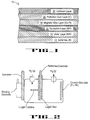
- Fig. 1 illustrates a cross section of a magnetic disk constructed in accordance with one embodiment of the invention.
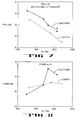
- Fig. 2 shows an EG&G PAR Model KO235 flat cell which was used to measure the corrosion current density and polarization resistance of Co-Pt alloys containing Ta and Ti.
- Fig. 3 shows results of an experiment wherein media containing different Co-Pt alloys were exposed to 1.0 N H2SO4 acid for different lengths of time.
- Fig. 4 shows the relationship between the coercivity of various sputtered alloys and the under layer thickness.
- Fig. 5 show the results of recording measurements of CoNi .07 Ta .015 Ti .015 B .02 Pt .12 and CoNi .07 Cr .04 Pt .12 , specifically Resolution vs. Hc.
- Fig. 6 show the results of recording measurements of CoNi .07 Ta .015 Ti .015 B .02 Pt .12 and CoNi .07 Cr .04 Pt .12 , specifically PW50 vs. Hc.
- Fig. 7 show the results of recording measurements of CoNi .07 Ta .015 Ti .015 B .02 Pt .12 and CoNi .07 Cr .04 Pt .12 , specifically overwrite vs. Hc.
- Fig. 8 show the results of recording measurements of CoNi .07 Ta .015 Ti .015 B .02 Pt .12 and CoNi .07 Cr .04 Pt .12 , specifically signal-to-media-noise ratio vs. Hc.
- Fig. 9 shows results of another experiment wherein media containing different Co-Pt alloys were exposed to 1.0 N H2SO4 acid for different lengths of time.
- Fig. 1 is a cross section of a rigid thin-film magnetic disk 10 constructed in accordance with the present invention.
- Disk 10 consists of an aluminum alloy substrate 12 onto which a plated layer 14, typically of NiP, is formed by electroless plating or other methods well known in the art.
- Layer 14 typically has a thickness in the range of 5 to 20 ⁇ m.
- the plated layer 14 of NiP provides strong mechanical support on the relatively soft aluminum substrate 12. After layer 14 is plated onto substrate 12, the disk is polished, textured and cleaned.
- An example of the sputtering conditions for layer 16 include a pressure of 5 to 40 mTorr and a power density between 2 and 3 watts/cm2.
- the sputtered nucleation layer 16 consists of 85 at. % Ni and 15 at. % P (represented by the notation NiP .15 , where the missing subscript denotes the balance of the alloy).
- NiP layer 16 may be deposited with or in place of NiP layer 16.
- Ni3P with 1 at. % Al2O3 for nucleation layer 16.
- nucleation layer 16 is in the range of 30 to 100 nm thick, and is employed to reduce bit shift and increase Hc.
- a nucleation layer or layers comprised of various materials other than NiP may be employed.
- a magnetic alloy layer 18 is then sputtered onto nucleation layer 16.
- layer 18 is an alloy including Co and Pt.
- the alloy further includes Ni.
- the platinum concentration is up to 20 at. %
- the nickel concentration is up to about 10 at. %
- the cobalt concentration is typically at least about 75 at. %.
- the magnetic alloy layer 18 includes Ta in a concentration up to about 10 at. %, and may also include up to about 10 at. % Ti.
- concentrations of Ta and Ti may or may not be equal.
- magnetic alloy layer 18 includes equal concentrations of 1.5 at. % Ta and Ti. (It may also be desirable to include some amount of Cr, typically less than 3 at. %, in layer 18. However, Ta, Ti, and possibly B, may displace the Cr in part or completely.)
- B may be added to the magnetic alloy layer 18, for example to increase Hc.
- concentration of B in the magnetic layer may vary up to about 6 at. %. Results of our research show that a smaller amount of B, generally 3 at. % or lower, is sufficient to enhance the coercivity and also reduce the noise (thereby improving the signal-to-noise ratio) of our selected alloy without seriously degrading the Ms of the recording medium.
- One embodiment of the present invention comprises a magnetic alloy layer 18 including 2 at. % boron together with either Ta or a combination of Ta and Ti. While the addition of boron is optional, as is shown below the alloy CoNiPtTaTiB is extremely suitable for high to very high recording density applications.
- magnetic alloy layer 18 is RF diode sputtered CoNi .07 Pt .12 Ta .015 Ti .015 B .02 , sputtered at 10 - 35 mTorr and a power density of 1.0 - 3 watts/cm2.
- alloys which can be used are CoNi .05 Ta .015 Ti .015 B .02 Pt .14 , CoNi .05 Ta .01 Ti .01 B .03 Pt .14 , CoNi .05 Ta .03 Ti .01 Pt .14 , etc.
- the Ni, Ta, Ti, and B concentrations can be varied to optimize the noise and corrosion resistance. However, the sum of the Ni, Ta, and Ti should not exceed about 20 at. % of the total alloy so as to maintain high Ms. Pt composition can be varied to adjust the Hc of the alloy.
- the coercivity, media noise, and squareness of the magnetic alloy can be altered by introducing nitrogen and/or oxygen in concentrations up to 10 percent by volume (vol. %) into the sputtering chamber, as taught for example by Yamashita et al. in U.S. Patent no. 4,749,459, and the copending application serial no. (not yet assigned) entitled "Thin Film Magnetic Alloy Having Low Noise, High Coercivity and High Squareness".
- nitrogen having a concentration of between 1 and 4 vol.% is introduced into the sputtering chamber. Water vapor in the sputtering chamber should be minimised when sputtering alloys according to the present invention, as taught by Yamashita et al. in the aforementioned patent.
- over layer 20 may be DC magnetron sputtered carbon at 1 to 10 mTorr of pressure, e.g. at about 5 mTorr, and a power density of 1 to 4 watts/cm2, e.g. about 3 watts/cm2.
- over layer 20 is carbon sputtered in the presence of hydrogen, e.g. as taught by Yamashita in US Patent No. 5,045,165.
- the carbon is sputtered in an atmosphere of about 20% by volume of H2 in argon at a flow rate of 50 to 100 SCCM.
- over layer 20 is Zr0 2P such as discussed by Yamashita et al. in US Patent No. 4,898,774.
- the ZrO2 may be RF magnetron sputtered at a pressure of 2 to 10 mTorr, and a power density of 2 to 3 watts/cm2.
- over layer of carbon is described in detail above, other over layer materials such as ceramic oxides of Zr, Hf, Si, Al, etc., nitrides of Ti, B, Si, W, etc., carbides of W, Ta, Ti, Si, etc. can also be used and are within the scope of the present invention.
- carbon sputtered in the presence of H2 or sputtered with Zr02 provides corrosion protection, as may certain other materials, for many reasons additional resistance to corrosion is desirable and/or necessary. For example, complete coverage of the magnetic alloy layer 18 by the hydrogenated carbon or Zr02 layer cannot be guaranteed, particularly when the overcoat thickness is reduced to reduce the spacing between the head and the media. Therefore, it is important and advantageous that the magnetic alloy in accordance with our invention resist corrosions as well.
- a lubricant layer 22 of a type known in the art e.g., a solid or liquid lubricant, is applied to over layer 20. Details of the lubricant layer 22 are beyond the scope of the present invention, and therefore are not discussed in detail herein.
- Table 1 shows electrochemical corrosion test measurements of a number of disks which were made in accordance with the present invention.
- An aluminum substrate 12 was used having a plated layer 14 of NiP deposited to about 10 ⁇ m thick.
- Sputtered nucleation layer 16 of NiP, magnetic alloy layer 18 of CoNiPtTaTi, and over layer 20 of carbon were sputter deposited as described above using an RF sputtering machine.
- the composition of the magnetic layer 18 was varied by changing the composition of the sputtering target.
- An incident RF power density of about 3.0 watts/cm2 was used for layers 16 and 18 on the disks for this test.
- the undercoat layer 16 of NiP was deposited to a thickness of about 50 nm, and the magnetic layer 18 was also deposited to a thickness of about 50 nm.
- the over layer 20 of carbon was deposited to a thickness of about 30 nm.
- Fig. 3 shows the results of testing the normalized saturation magnetization as a function of time of exposure to aq. 1N H2SO4 for disks which were prepared in accordance with the teachings of this invention.
- VSM Vibrating Sample Magnetometer
- the alloys labeled as CoNiPtTaTiB-A and CoNiPtTaTiB-B each had a composition of CoNi .07 Pt .12 Ta .015 Ti .015 B .02 , while the CoNiPtTaTiB-A alloy had a 20 nm thick hydrogenated carbon over layer deposited on top of the thin-film magnetic layer, and the CoNiPtTaTiB-B alloy had a 30 nm thick carbon over layer deposited on top of the thin-film magnetic layer.
- the alloy labeled as CoNiCrPt 10 had a composition of CoNi .07 Cr .06 Pt .10 .
- the alloy labeled as CoNiCrPt12 had a composition of CoNi .07 Cr .04 Pt .12 .
- the alloy labeled as CoNiCrPtB had a composition of CoNi .07 Cr .04 Pt .10 B .02 .
- the alloy labeled as CoNiPt+3%Cr had a composition of CoNi .09 Pt .10 Cr .03 .
- the alloy labeled as CoNiPt had a composition of CoNi .09 Pt .10 . Except as otherwise specified, all the media had a 30 nm thick carbon over layer deposited on top of the thin-film magnetic layer.
- each of the alloys illustrated in Fig. 3 demonstrated a reduction in MsT over time when exposed to the H2SO4. That is, each of the alloys exhibited corrosion over time, in different degrees. It is to be noted from Fig. 3 that normalized MsT remains highest over time for the CoNi .07 Ta .015 Ti .015 Pt .12 B .02 alloy. Thus, this alloy exhibits the highest resistance to corrosion of the alloys listed in Fig. 3.
- the CoNi .07 Pt .12 Ta .015 Ti .015 B .02 alloy achieved a consistently higher Hc than the CoNi .07 Cr .04 Pt .12 alloy under identical sputtering conditions, and can easily achieve an Hc of greater than 1600 Oe.
- the CoNi .07 Pt .12 Ta .015 Ti .015 B .02 alloy is superior for high Hc-high density recording applications.
- Figs. 5 through 8 there is shown therein plots of the recording properties of the two alloys CoNi .07 Pt .12 Ta .015 Ti .015 B .02 and CoNi .07 Cr .04 Pt .12 , which were sputtered in accordance with this invention.
- the media containing the two alloys were sputtered at an argon pressure of 15 ⁇ m, the under layer was sputtered NiP of thickness 50 nm, and the magnetic layer thickness was adjusted to give a remnant-magnetization-product, Mrt, of 2.7 memu/cm2.
- the results of our research indicate that the ratio of tantalum to titanium should be in the range between three parts tantalum to one part titanium (3:1) and one part tantalum to three parts titanium (1:3). Furthermore, the results of our research indicate that the overall concentration of each of the tantalum and titanium in the alloy should preferably be between 1.5 and 3.0 at.%.
- the present invention has been described in terms of thin-film sputtered media for high density recording applications, other applications are contemplated.
- the addition of Ta (and Ti) can be used to enhance the corrosion resistance of permanent magnets of such materials as NdFeB, CoSm, and other types of rare-earth magnets.
- soft magnetic materials like Ni-Fe, Fe-N, etc., which are used in the fabrication of thin-film recording heads, also suffer from poor corrosion resistance.
- These alloys may have an enhanced corrosion resistance by the addition of small amounts of Ta (and Ti).
Landscapes
- Engineering & Computer Science (AREA)
- Metallurgy (AREA)
- Magnetic Record Carriers (AREA)
- Thin Magnetic Films (AREA)
Applications Claiming Priority (4)
| Application Number | Priority Date | Filing Date | Title |
|---|---|---|---|
| US18895494A | 1994-01-28 | 1994-01-28 | |
| US188954 | 1994-01-28 | ||
| US08/348,547 US5631094A (en) | 1994-01-28 | 1994-12-01 | Magnetic alloy for improved corrosion resistance and magnetic performance |
| US348547 | 1994-12-01 |
Publications (1)
| Publication Number | Publication Date |
|---|---|
| EP0669610A1 true EP0669610A1 (fr) | 1995-08-30 |
Family
ID=26884628
Family Applications (1)
| Application Number | Title | Priority Date | Filing Date |
|---|---|---|---|
| EP19950300543 Ceased EP0669610A1 (fr) | 1994-01-28 | 1995-01-27 | Alliage magnétique pour améliorer la résistance à la corrosion et la charactéristique magnétique |
Country Status (3)
| Country | Link |
|---|---|
| US (2) | US5631094A (fr) |
| EP (1) | EP0669610A1 (fr) |
| JP (1) | JPH0849031A (fr) |
Cited By (1)
| Publication number | Priority date | Publication date | Assignee | Title |
|---|---|---|---|---|
| EP1086807A3 (fr) * | 1999-09-23 | 2001-10-31 | Lucent Technologies Inc. | Article métallique revêtu de surface moulticouche pour réduction de la porosité |
Families Citing this family (20)
| Publication number | Priority date | Publication date | Assignee | Title |
|---|---|---|---|---|
| USRE38544E1 (en) * | 1994-01-28 | 2004-07-06 | Komag, Inc. | Thin film magnetic alloy having low noise, high coercivity and high squareness |
| US5631094A (en) * | 1994-01-28 | 1997-05-20 | Komag, Incorporated | Magnetic alloy for improved corrosion resistance and magnetic performance |
| JPH0850715A (ja) * | 1994-01-28 | 1996-02-20 | Komag Inc | 低ノイズ,高い保磁力および優れた方形度を有する磁気記録媒体および磁気記録媒体形成方法 |
| KR19980702586A (ko) * | 1995-03-08 | 1998-07-15 | 미가꾸 다까하시 | 자기기록매체 및 그 제조방법 |
| JP3448698B2 (ja) | 1995-06-27 | 2003-09-22 | 株式会社日立製作所 | 磁気記憶装置及び磁気記録媒体 |
| US5858566A (en) * | 1995-10-23 | 1999-01-12 | Seagate Technology, Inc. | Seeded underlayer in magnetic thin films |
| US6169354B1 (en) | 1996-05-24 | 2001-01-02 | Halo Data Devices, Inc. | Thin film electric motors |
| US6077603A (en) * | 1996-07-03 | 2000-06-20 | Seagate Technology, Inc. | Seeded underlayer in magnetic thin films |
| US6398880B1 (en) * | 1996-11-29 | 2002-06-04 | Heraeus, Inc. | Magnetic data-storage targets and methods for preparation |
| JP4142753B2 (ja) * | 1996-12-26 | 2008-09-03 | 株式会社東芝 | スパッタターゲット、スパッタ装置、半導体装置およびその製造方法 |
| US6187408B1 (en) * | 1997-04-08 | 2001-02-13 | International Business Machines Corporation | Thin film magnetic disk with CoPtCrB layer |
| JP4082785B2 (ja) * | 1998-05-15 | 2008-04-30 | 富士通株式会社 | 磁気記録媒体及びその製造方法 |
| US6093262A (en) * | 1998-06-23 | 2000-07-25 | Pes, Inc. | Corrosion resistant solenoid valve |
| US6346339B1 (en) | 1998-09-30 | 2002-02-12 | Seagate Technology Llc | Magnetic recording media with a nialox sub-seedlayer |
| US6562488B1 (en) * | 1999-04-14 | 2003-05-13 | Seagate Technology Llc | CoCrPtTaNbB alloy for magnetic recording medium |
| US6204588B1 (en) * | 1999-05-27 | 2001-03-20 | Halo Data Devices, Inc. | Rotor capable of being used as a recording media |
| JP3686929B2 (ja) * | 2000-05-29 | 2005-08-24 | 株式会社日立グローバルストレージテクノロジーズ | 垂直磁気記録媒体及び磁気記録再生装置 |
| JP4097059B2 (ja) * | 2001-08-01 | 2008-06-04 | 富士通株式会社 | 磁気記録媒体の製造方法 |
| US6572989B2 (en) | 2001-06-06 | 2003-06-03 | International Business Machines Corporation | Thin film magnetic recording disk with a chromium-nickel pre-seed layer |
| JP2004311607A (ja) * | 2003-04-04 | 2004-11-04 | Canon Inc | 磁性体、磁気記録媒体、磁気記録再生装置、情報処理装置及びその製造方法 |
Citations (3)
| Publication number | Priority date | Publication date | Assignee | Title |
|---|---|---|---|---|
| EP0330116A2 (fr) * | 1988-02-22 | 1989-08-30 | Sony Corporation | Milieu d'enregistrement magnétique |
| US4950548A (en) * | 1988-05-27 | 1990-08-21 | Hitachi, Ltd. | Magnetic recording medium and method of producing same |
| US5112669A (en) * | 1989-03-31 | 1992-05-12 | Fuji Photo Film Co., Ltd. | Magnetic recording medium |
Family Cites Families (29)
| Publication number | Priority date | Publication date | Assignee | Title |
|---|---|---|---|---|
| US4411963A (en) * | 1976-10-29 | 1983-10-25 | Aine Harry E | Thin film recording and method of making |
| US4503125A (en) * | 1979-10-01 | 1985-03-05 | Xebec, Inc. | Protective overcoating for magnetic recording discs and method for forming the same |
| JPS6115941A (ja) * | 1984-06-30 | 1986-01-24 | Res Dev Corp Of Japan | 酸素を含む強磁性非晶質合金およびその製造法 |
| US4749459A (en) * | 1986-03-10 | 1988-06-07 | Komag, Inc. | Method for manufacturing a thin film magnetic recording medium |
| US4988578A (en) * | 1986-03-10 | 1991-01-29 | Komag, Inc. | Method for manufacturing a thin film magnetic recording medium |
| US4786553A (en) * | 1986-03-28 | 1988-11-22 | Hitachi, Ltd. | Magnetic recording medium |
| US4898774A (en) * | 1986-04-03 | 1990-02-06 | Komag, Inc. | Corrosion and wear resistant magnetic disk |
| US4789598A (en) * | 1987-01-20 | 1988-12-06 | International Business Machines Corporation | Thin film medium for horizontal magnetic recording having an improved cobalt-based alloy magnetic layer |
| US4792497A (en) * | 1987-01-29 | 1988-12-20 | Hitachi, Ltd. | Magnetic recording media for longitudinal recording |
| US4786564A (en) * | 1987-02-25 | 1988-11-22 | Komag, Inc. | Method for manufacturing a magnetic disk having reduced bit shift, minimized noise, increased resolution and uniform magnetic characteristics, and the resulting disk |
| JP2555683B2 (ja) * | 1988-04-04 | 1996-11-20 | 日本ビクター株式会社 | 磁気記録媒体 |
| US4949202A (en) * | 1988-04-04 | 1990-08-14 | Kalok Corporation | Disk track for locating zero track and generating timing for index signal |
| US5143794A (en) * | 1988-08-10 | 1992-09-01 | Hitachi, Ltd. | Magnetic recording media for longitudinal recording, process for producing the same and magnetic memory apparatus |
| US5027241A (en) * | 1989-06-01 | 1991-06-25 | Quantum Corporation | Data head load beam for height compacted, low power fixed head and disk assembly |
| US5162158A (en) * | 1989-07-24 | 1992-11-10 | Magnetic Peripherals Inc. | Low noise magnetic thin film longitudinal media |
| US5025335B1 (en) * | 1989-07-31 | 1995-12-26 | Conner Peripherals Inc | Architecture for 2 1/2 inch diameter single disk drive |
| US5025336A (en) * | 1989-11-06 | 1991-06-18 | Prairietek Corporation | Disk drive apparatus |
| US5045165A (en) * | 1990-02-01 | 1991-09-03 | Komag, Inc. | Method for sputtering a hydrogen-doped carbon protective film on a magnetic disk |
| US5004652A (en) * | 1990-08-15 | 1991-04-02 | Hmt Technology Corporation | High-coercivity thin-film recording medium and method |
| US5049451A (en) * | 1990-08-15 | 1991-09-17 | Hmt Technology Corporation | High-coercivity thin-film recording medium |
| US5180640A (en) * | 1990-10-01 | 1993-01-19 | Komag, Inc. | Magnetic recording medium comprising a magnetic alloy layer of cobalt nickel, platinum and chromium formed directly on a nickel alloy amorphous underlayer |
| US5232570A (en) * | 1991-06-28 | 1993-08-03 | Digital Equipment Corporation | Nitrogen-containing materials for wear protection and friction reduction |
| EP0535314A1 (fr) * | 1991-08-30 | 1993-04-07 | Mitsubishi Materials Corporation | Cible de pulvérisation en alliage platine-cobalt et procédé pour sa fabrication |
| JP3092290B2 (ja) * | 1992-01-29 | 2000-09-25 | 三菱化学株式会社 | 磁気記録媒体及びその製造方法と磁気記録装置及びその製造方法 |
| JPH05290352A (ja) * | 1992-04-02 | 1993-11-05 | Hitachi Metals Ltd | 磁気記録媒体とその製造方法 |
| JPH05314468A (ja) * | 1992-05-08 | 1993-11-26 | Hitachi Ltd | 磁気記録媒体とその製造方法 |
| JPH06124832A (ja) * | 1992-10-09 | 1994-05-06 | Tdk Corp | 磁気記録媒体 |
| US5631094A (en) * | 1994-01-28 | 1997-05-20 | Komag, Incorporated | Magnetic alloy for improved corrosion resistance and magnetic performance |
| US5658659A (en) * | 1994-01-28 | 1997-08-19 | Komag, Inc. | Magnetic alloy and method for manufacturing same |
-
1994
- 1994-12-01 US US08/348,547 patent/US5631094A/en not_active Expired - Fee Related
-
1995
- 1995-01-27 JP JP1114695A patent/JPH0849031A/ja active Pending
- 1995-01-27 EP EP19950300543 patent/EP0669610A1/fr not_active Ceased
-
1996
- 1996-10-24 US US08/740,211 patent/US5908514A/en not_active Expired - Fee Related
Patent Citations (3)
| Publication number | Priority date | Publication date | Assignee | Title |
|---|---|---|---|---|
| EP0330116A2 (fr) * | 1988-02-22 | 1989-08-30 | Sony Corporation | Milieu d'enregistrement magnétique |
| US4950548A (en) * | 1988-05-27 | 1990-08-21 | Hitachi, Ltd. | Magnetic recording medium and method of producing same |
| US5112669A (en) * | 1989-03-31 | 1992-05-12 | Fuji Photo Film Co., Ltd. | Magnetic recording medium |
Cited By (1)
| Publication number | Priority date | Publication date | Assignee | Title |
|---|---|---|---|---|
| EP1086807A3 (fr) * | 1999-09-23 | 2001-10-31 | Lucent Technologies Inc. | Article métallique revêtu de surface moulticouche pour réduction de la porosité |
Also Published As
| Publication number | Publication date |
|---|---|
| US5631094A (en) | 1997-05-20 |
| US5908514A (en) | 1999-06-01 |
| JPH0849031A (ja) | 1996-02-20 |
Similar Documents
| Publication | Publication Date | Title |
|---|---|---|
| US5631094A (en) | Magnetic alloy for improved corrosion resistance and magnetic performance | |
| US6670055B2 (en) | Magnetic recording medium and manufacturing method therefor | |
| US6759138B2 (en) | Antiferromagnetically coupled magnetic recording medium with dual-layered upper magnetic layer | |
| US6221508B1 (en) | Magnetic recording media | |
| US7420886B2 (en) | Magnetic recording medium, and thermal stability measuring method and apparatus of magnetic recording medium | |
| US6818331B2 (en) | Magnetic recording medium, production process thereof, and magnetic recording and reproducing apparatus | |
| EP1275110B1 (fr) | Support d'enregistrement magnetique | |
| US20030211364A1 (en) | Magnetic recording media and magnetic recording system using the same | |
| EP0751502B1 (fr) | Système d'enregistrement magnétique et support d'enregistrement magnétique utilisé pour celui-ci | |
| CA2071348C (fr) | Support d'enregistrement magnetique et sa methode de fabrication | |
| US6372367B1 (en) | Magnetic recording medium, method for producing the same and magnetic recording apparatus using the same | |
| US6686071B2 (en) | Magnetic recording medium and magnetic recording apparatus using the same | |
| US6174582B1 (en) | Thin film magnetic disk having reactive element doped refractory metal seed layer | |
| US6815097B2 (en) | Magnetic recording medium | |
| US6972157B2 (en) | Magnetic recording medium, production process thereof, and magnetic recording and reproducing apparatus | |
| US7294419B2 (en) | High density magnetic recording medium having uniform local coercivity distribution and grain size distribution and fine grains and manufacturing method thereof | |
| JP2004227618A (ja) | 垂直磁気記録媒体用ディスク基板、垂直磁気記録ディスク、並びにそれらの製造方法 | |
| US8263239B2 (en) | Laminated magnetic thin films for magnetic recording with weak ferromagnetic coupling | |
| US7029772B2 (en) | Magnetic recording medium, production process thereof, and magnetic recording and reproducing apparatus | |
| CN101178906A (zh) | 垂直磁性记录介质 | |
| US7521136B1 (en) | Coupling enhancement for medium with anti-ferromagnetic coupling | |
| USRE38544E1 (en) | Thin film magnetic alloy having low noise, high coercivity and high squareness | |
| US6562488B1 (en) | CoCrPtTaNbB alloy for magnetic recording medium | |
| US20050095421A1 (en) | Magnetic material for non-reactive process of granular perpendicular recording application | |
| US6821654B1 (en) | CrMoTa underlayer |
Legal Events
| Date | Code | Title | Description |
|---|---|---|---|
| PUAI | Public reference made under article 153(3) epc to a published international application that has entered the european phase |
Free format text: ORIGINAL CODE: 0009012 |
|
| AK | Designated contracting states |
Kind code of ref document: A1 Designated state(s): DE FR GB NL |
|
| 17P | Request for examination filed |
Effective date: 19960123 |
|
| 17Q | First examination report despatched |
Effective date: 19970515 |
|
| RAP1 | Party data changed (applicant data changed or rights of an application transferred) |
Owner name: KOMAG, INC. |
|
| GRAG | Despatch of communication of intention to grant |
Free format text: ORIGINAL CODE: EPIDOS AGRA |
|
| STAA | Information on the status of an ep patent application or granted ep patent |
Free format text: STATUS: THE APPLICATION HAS BEEN REFUSED |
|
| 18R | Application refused |
Effective date: 20011028 |