EP0669734A2 - Verfahren und Vorrichtung zur Verwaltung der Übertragung zwischen quotenbasierten Vielfachknoten-Kommunikationssystemen - Google Patents
Verfahren und Vorrichtung zur Verwaltung der Übertragung zwischen quotenbasierten Vielfachknoten-Kommunikationssystemen Download PDFInfo
- Publication number
- EP0669734A2 EP0669734A2 EP95100298A EP95100298A EP0669734A2 EP 0669734 A2 EP0669734 A2 EP 0669734A2 EP 95100298 A EP95100298 A EP 95100298A EP 95100298 A EP95100298 A EP 95100298A EP 0669734 A2 EP0669734 A2 EP 0669734A2
- Authority
- EP
- European Patent Office
- Prior art keywords
- information
- node
- communication path
- ring
- quota allocation
- Prior art date
- Legal status (The legal status is an assumption and is not a legal conclusion. Google has not performed a legal analysis and makes no representation as to the accuracy of the status listed.)
- Withdrawn
Links
Images

Classifications
-
- H—ELECTRICITY
- H04—ELECTRIC COMMUNICATION TECHNIQUE
- H04L—TRANSMISSION OF DIGITAL INFORMATION, e.g. TELEGRAPHIC COMMUNICATION
- H04L12/00—Data switching networks
- H04L12/28—Data switching networks characterised by path configuration, e.g. LAN [Local Area Networks] or WAN [Wide Area Networks]
- H04L12/46—Interconnection of networks
- H04L12/4604—LAN interconnection over a backbone network, e.g. Internet, Frame Relay
- H04L12/462—LAN interconnection over a bridge based backbone
Definitions
- the present invention generally relates to the management of information between communication systems. More particularly, the present invention relates to information management between multi-node quota-based communication systems.
- Multi-node communication systems with a shared resource exist that employ some type of global fairness algorithm regulating node access to the shared resource.
- a system is the Metaring architecture, as disclosed in U.S. Patent No. 4,926,418, entitled “Fairness Algorithm for Full-Duplex Buffer Insertion Ring", issued to Cidon et al. on May 15, 1990 and assigned to IBM (hereinafter referred to as “the Cidon patent”), which is herein incorporated by reference in its entirety.
- Global fairness in terms of access to a shared metaring resource, circulates a hardware message called the "SAT" in the direction opposite the information traffic it regulates. In response to arrival of the SAT signal at a given node on the ring, a quota is allocated thereto allowing the node limited access to the ring and giving priority to ring traffic at any given node over its own transmissions.
- Metaring structure When the Metaring structure consists of two or more distinct rings with an arbitrary topology, information exchange between the rings may be adversely affected by, for example, a difference in speed between the rings.
- a node that interconnects two rings is referred to as a switching or bridge node.
- buffers in the bridge node of a bounded size may lose information without a flow control mechanism.
- Metaring transmits information in sequenced packets. If the packets get out of order, such as when a buffer is full momentarily, they must be resequenced or put back in their original order.
- the present invention satisfies the need for information flow management between multi-node communication paths with zero information loss by providing a management scheme incorporating multiple quota allocation signals and deflection routing.
- a method for managing information flow between a first multi-node communication path and a second multi-node communication path through a bridge node employs a quota allocation scheme for controlling access thereto by nodes thereon.
- a first quota allocation signal is propagated on the first communication path for controlling access thereto by the nodes thereon.
- a second quota allocation signal is propagated on the second communication path for controlling access thereto by the nodes thereon for transmitting information to the bridge node destined for the first communication path.
- the first and second quota allocation signals are synchronized for information flow from the second communication path to the first communication path.
- Synchronization of the quota allocation signals may be accomplished by a two-part approach.
- the quota allocated to a given node on the first communication path in response to the first quota allocation signal is set equal to the total quota allocated to all the nodes on the second communication path in response to propagation of the second quota allocation signal once therethrough.
- the propagation of the second quota allocation signal is also limited such that for every complete propagation of the first quota allocation signal there is at most one complete propagation of the second quota allocation signal.
- each packet having a deflection indicator associated therewith for indicating whether a prior deflection thereof has occurred and an order therefor if so, a given packet may be deflected if currently unacceptable to the bridge node based on the deflection indicator.
- a deflection indicator associated therewith for indicating whether a prior deflection thereof has occurred and an order therefor if so
- a given packet may be deflected if currently unacceptable to the bridge node based on the deflection indicator.
- One situation where deflection may take place is where the bridge node is full with respect to that information type.
- a bridge node operating in accordance with the above principles.
- the bridge node includes a first buffer for buffering first information from a first multi-node communication path to a second multi-node communication path.
- Each communication path employs a quota allocation scheme for access thereto by the nodes thereon, the scheme for the second communication path controlling access for the purpose of transmitting information to the first path.
- the scheme for the second path also controls the release of the information in the first buffer onto the second path.
- the node includes a means for determining whether the first buffer is full with respect to the first information and a means for deflecting the first information onto the first path if so.
- the node also includes a second buffer for buffering information from the second path to the first path.
- the bridge node includes a means for accepting the first information and second information thereinto. Release of information from the second buffer onto the first path is controlled via the quota scheme employed thereby.
- the present invention also includes a multi-node quota-based communication system utilizing the above principles and including a first and second multi-node communication path, a means for synchronizing a quota allocation signal propagated on each path, a bridge node with a first buffer for buffering information from the first path to the second path, a second buffer for buffering information from the second path to the first path and a means for determining whether information is acceptable by the first buffer.
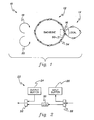
- FIG. 1 depicts a multi-node communication system 10 having a Metaring architecture.
- Communication system 10 comprises a bidirectional backbone ring 12 and a unidirectional local ring 14, connected by bridge node 16 of a bounded size.
- Backbone ring 12 comprises a clockwise ring 18 and a counterclockwise ring 20.
- FIG. 2 depicts the basic structure 22 of a given node (except bridge node 16 - see FIG. 3) in FIG. 1, operating under the buffer insertion technique known in the art.
- Structure 22 comprises output buffer 24, input buffer 26, receiver 28, insertion buffer 30 and transmitter 32.
- a given node has this structure for each type of traffic travelling through it.
- node 34 on backbone ring 12 would have two such structures; one for clockwise traffic and one for counterclockwise traffic. If ring traffic arrives at a given node during a transmission via transmitter 32, the ring traffic is stored in insertion buffer 30 until the transmission is complete. If the ring traffic is destined for that node, it enters input buffer 26 directly from receiver 28. The node cannot begin a transmission until buffer 30 is empty; that is, a non-preemptive priority is given to ring traffic. If the node is idle, the ring traffic will not be held in buffer 30, but will pass directly therethrough.
- a given node is allowed to transmit a number of information packets designated as Q between visits of the relevant SAT signal. After the SAT leaves a node, the node may transmit up to Q packets as long as the insertion buffer is empty. Once a node has transmitted Q packets, it cannot transmit any more packets of that class until refreshing its quota after the next SAT visit. If a node has not been able to transmit Q packets by the time the SAT arrives, usually due to excessive ring traffic, it will hold the SAT until exhausting its prior quota. An output buffer for a particular information type is said to be "SATisfied" when it has either exhausted its quota or its output buffer is empty. Under any other circumstance, the node is said to be not satisfied.
- FIG. 3 depicts the structure of switching node 16 in FIG. 1.
- Switching node 16 comprises insertion buffer 36 and its associated output buffer 38, insertion buffer 40 and its associated output buffers 42 and 44, and insertion buffer 46 and its associated output buffer 48.
- Information traffic between backbone ring 12 and local ring 14 may need to be buffered at bridge node 16 in case the desired output link is not available, for example, link 50.
- bridge node 16 has four buffers, each buffer being responsible for storing one particular class of traffic. Specifically, the four classes of traffic are clockwise to local, counterclockwise to local, local to clockwise and local to counterclockwise.
- Insertion buffer 36 and output buffer 38 handle information traffic destined for clockwise ring 18 from both itself and local ring 14, respectively.
- Insertion buffer 40 handles all information traffic within local ring 14.
- Output buffer 42 handles information traffic from clockwise ring 18 to local ring 14 and output buffer 44 handles information traffic from counterclockwise ring 20 to local ring 14.
- insertion buffer 46 and associated output buffer 48 handle information traffic destined for counterclockwise ring 20 from both itself and local ring 14, respectively.
- Each insertion buffer in bridge node 16 has priority over its associated output buffer or buffers.
- a SAT signal controls the amount of information traffic a particular node can transmit between visits of the SAT signal by allocating a quota thereto.
- Information traffic originating from a node in local ring 14 with a destination, apart from bridge node 16, within local ring 14 is controlled by a SAT signal referred to herein as "LLSAT”.
- Traffic from local ring 14 destined for clockwise ring 18 is regulated by a second SAT signal referred to herein as "LCSAT”.
- LCSAT second SAT signal
- traffic from local ring 14 to counterclockwise ring 20 is regulated by a third SAT signal "LCCSAT”.
- traffic on clockwise ring 18 is controlled by a fourth SAT signal “CSAT” and traffic on counterclockwise ring 20 is controlled by a fifth SAT signal "CCSAT”.
- CSAT grants Q quota to bridge node 16, controlling the number of information packets of a predetermined size that can be transmitted from output buffer 38 between successive visits of LCSAT to bridge node 16 on local ring 14. Since output buffer 38 is only guaranteed Q quota between consecutive visits of CSAT to bridge node 16, we need to ensure that the information packet traffic coming into output buffer 38 does not exceed Q at any given time. This is accomplished by a two-prong mechanism.
- the CSAT and LCSAT signals are synchronized; that is, for every complete circulation of CSAT on clockwise ring 18, there is, at most, one circulation of LCSAT on local ring 14.
- the sum of the quotas allocated by LCSAT to the nodes on local ring 14 is set equal to Q, so that the maximum traffic from local ring 14 is equal to the maximum that can be transmitted by output buffer 38 in the same time frame.
- the size of output buffer 38 needs to be no larger than twice Q.
- output buffer 42 may overflow, even if it were very large, since local ring 14 is generally slower than clockwise ring 18, due mainly to the larger bandwidth of clockwise ring 18.
- Such an overflow is avoided through the use of deflection.
- the packet When a packet from one ring destined for another encounters a full output buffer at the bridge node, the packet is circulated around the originating ring (or deflected) and will attempt to enter the bridge node when it returns. The packet will always be able to circulate, since ring traffic is given priority. Deflection also prevents other nodes from further clogging up the ring with additional traffic. An example of a way to accomplish these objectives will subsequently be described in greater detail.
- a method for managing information traffic local to backbone ring 12 has previously been presented in the Cidon patent.
- the present invention concentrates on information traffic between rings.
- a method for managing information traffic from local ring 14 to clockwise ring 18 will now be described in detail.
- the present method utilizes a status bit referred to herein as "SYNCc", which tracks the synchronization of CSAT with LCSAT as previously described.
- SYNCc a status bit referred to herein as "SYNCc”
- All information packets from local ring 14 arriving at bridge node 16 and destined for clockwise ring 18 are placed in output buffer 38.
- the bridge node holds it until output buffer 38 is satisfied, i.e., until previously allocated quota is exhausted or output buffer 38 is emptied.
- SYNCc is set to one.
- LCSAT arrives at bridge node 16 it is held until SYNCc equals one. Once SYNCc equals one, bridge node 16 releases LCSAT and sets SYNCc to zero.
- Information traffic from local ring 14 to counterclockwise ring 20 is managed in the same manner.
- This aspect of the present invention utilizes two counters: DEFLECTc tracks the number of packets that have been deflected and is initialized to zero; and ACCEPTc tracks the next deflected information packet in the sequence that will be accepted into output buffer 42 and is also initialized to zero.
- Information packets are sequenced; that is, they are arranged in a particular order when issued.
- the present aspect also utilizes a deflect field associated with each information packet to indicate an order of deflected packets. The deflect fields are normally zero, a non-zero field for a given packet indicating it has been deflected and in what order. If output buffer 42 is non-empty when LLSAT arrives at bridge node 16, LLSAT is held until buffer 42 is satisfied.
- output buffer 42 is full when a packet from clockwise ring 42 destined for local ring 14 arrives, the packet's deflection field is examined. If the field is zero, DEFLECTc is incremented by one and the packet's deflection field is reset to equal DEFLECTc. The packet is then deflected once around clockwise ring 18. If the packet's deflection field is non-zero and the buffer is full, the packet is simply deflected. If DEFLECTc exceeds a predetermined maximum, the bridge node holds the CSAT signal until output buffer 42 is satisfied.
- the packet is accepted into buffer 42 if its deflection field matches the value of ACCEPTc. If the field matches ACCEPTc and ACCEPTc is non-zero, ACCEPTc is incremented by one. After incrementing ACCEPTc, it is compared to DEFLECTc; if ACCEPTc is greater than the current value of DEFLECTc, both counters are reset to zero. If ACCEPTc does not match the deflection field, it is compared thereto to determine if the field is greater (the deflection field can never be smaller); if so, the packet is deflected. Where no deflection takes place, ACCEPTc and a given packet's deflection field will always match, since they are both zero in the absence of deflection.
Landscapes
- Engineering & Computer Science (AREA)
- Computer Networks & Wireless Communication (AREA)
- Signal Processing (AREA)
- Small-Scale Networks (AREA)
- Computer And Data Communications (AREA)
Applications Claiming Priority (2)
| Application Number | Priority Date | Filing Date | Title |
|---|---|---|---|
| US189227 | 1980-09-22 | ||
| US18922794A | 1994-01-31 | 1994-01-31 |
Publications (1)
| Publication Number | Publication Date |
|---|---|
| EP0669734A2 true EP0669734A2 (de) | 1995-08-30 |
Family
ID=22696479
Family Applications (1)
| Application Number | Title | Priority Date | Filing Date |
|---|---|---|---|
| EP95100298A Withdrawn EP0669734A2 (de) | 1994-01-31 | 1995-01-11 | Verfahren und Vorrichtung zur Verwaltung der Übertragung zwischen quotenbasierten Vielfachknoten-Kommunikationssystemen |
Country Status (3)
| Country | Link |
|---|---|
| US (1) | US5477530A (de) |
| EP (1) | EP0669734A2 (de) |
| JP (1) | JP2656741B2 (de) |
Cited By (1)
| Publication number | Priority date | Publication date | Assignee | Title |
|---|---|---|---|---|
| CN108270697A (zh) * | 2016-12-31 | 2018-07-10 | 中国移动通信集团湖北有限公司 | 一种流量配额的调整方法、装置及服务器 |
Families Citing this family (17)
| Publication number | Priority date | Publication date | Assignee | Title |
|---|---|---|---|---|
| US5467352A (en) * | 1994-02-07 | 1995-11-14 | International Business Machines Corporation | Method and apparatus for improved throughput in a multi-node communication system with a shared resource |
| US5544163A (en) * | 1994-03-08 | 1996-08-06 | Excel, Inc. | Expandable telecommunications system |
| US5651003A (en) * | 1995-06-07 | 1997-07-22 | Whitetree, Inc. | Stackable data cell switch architecture |
| US5742774A (en) * | 1995-11-03 | 1998-04-21 | Lucent Technologies Inc | Multi-ring SONET architecture having shared gateways daisy chained to complete the main and subsidiary ring controlled by a common master controller |
| US6061730A (en) * | 1995-11-13 | 2000-05-09 | Billings; Roger E. | Methods and apparatus for communicating data in computer networks with separate packet assembly and packet broadcast channels |
| US5793981A (en) * | 1995-11-13 | 1998-08-11 | Billings; Roger E. | System for communicating data in a network using both a daisy chain link and separate broadcast links |
| US5761433A (en) * | 1995-11-13 | 1998-06-02 | Billings; Roger E. | System for communicating data in a network using both a daisy chain link and separate broadcast links |
| US6076117A (en) * | 1995-11-13 | 2000-06-13 | Billings; Roger E. | Packet merging hub system for sequentially merging received data in a network hub into data packets before broadcasting to a plurality of destination computers |
| US6115747A (en) * | 1995-11-13 | 2000-09-05 | Roger E. Billings | Computer network interface that merges remote data received from other computers with local data before transmitting the merged data to a network |
| US5819047A (en) * | 1996-08-30 | 1998-10-06 | At&T Corp | Method for controlling resource usage by network identities |
| US6038228A (en) * | 1997-04-15 | 2000-03-14 | Alcatel Usa Sourcing, L.P. | Processing call information within a telecommunications network |
| US6970473B1 (en) * | 1999-02-18 | 2005-11-29 | Sony Corporation | Communication method and communication apparatus |
| US6650618B1 (en) | 1999-07-01 | 2003-11-18 | Nortel Networks Limited | Method and apparatus for managing communications between nodes in a bi-directional ring network |
| US6665495B1 (en) | 2000-10-27 | 2003-12-16 | Yotta Networks, Inc. | Non-blocking, scalable optical router architecture and method for routing optical traffic |
| US20040117636A1 (en) * | 2002-09-25 | 2004-06-17 | David Cheng | System, method and apparatus for secure two-tier backup and retrieval of authentication information |
| US9015302B2 (en) | 2011-02-16 | 2015-04-21 | The Boeing Company | Scheduled network management |
| US9509507B1 (en) | 2011-02-16 | 2016-11-29 | The Boeing Company | Information distribution system using quantum entanglement in a timed network delivery system |
Family Cites Families (7)
| Publication number | Priority date | Publication date | Assignee | Title |
|---|---|---|---|---|
| EP0109964B1 (de) * | 1982-11-26 | 1986-04-23 | International Business Machines Corporation | Synchronisierung in einem Nachrichtennetz aus miteinander verbundenen Ringen |
| JPH0630516B2 (ja) * | 1984-07-13 | 1994-04-20 | 富士通株式会社 | 自動障害排除方式 |
| JPH0618374B2 (ja) * | 1985-03-18 | 1994-03-09 | 株式会社日立製作所 | マルチネツトワ−クシステムのデ−タ伝送方法 |
| US4926418A (en) * | 1989-04-11 | 1990-05-15 | International Business Machines Corporation | Fairness algorithm for full-duplex buffer insertion ring |
| CA2011934A1 (en) * | 1989-07-19 | 1991-01-19 | Theodore Heske, Iii | Method and apparatus for source routing bridging |
| US5245605A (en) * | 1991-10-04 | 1993-09-14 | International Business Machines Corporation | Integration of synchronous and asynchronous traffic on rings |
| US5278823A (en) * | 1992-03-27 | 1994-01-11 | At&T Bell Laboratories | Method and apparatus for permitting intranework testing of internetwork functions |
-
1994
- 1994-11-24 JP JP6289381A patent/JP2656741B2/ja not_active Expired - Lifetime
- 1994-12-19 US US08/358,329 patent/US5477530A/en not_active Expired - Fee Related
-
1995
- 1995-01-11 EP EP95100298A patent/EP0669734A2/de not_active Withdrawn
Cited By (1)
| Publication number | Priority date | Publication date | Assignee | Title |
|---|---|---|---|---|
| CN108270697A (zh) * | 2016-12-31 | 2018-07-10 | 中国移动通信集团湖北有限公司 | 一种流量配额的调整方法、装置及服务器 |
Also Published As
| Publication number | Publication date |
|---|---|
| JPH07226761A (ja) | 1995-08-22 |
| JP2656741B2 (ja) | 1997-09-24 |
| US5477530A (en) | 1995-12-19 |
Similar Documents
| Publication | Publication Date | Title |
|---|---|---|
| US5477530A (en) | Method and apparatus for managing communications between multi-node quota-based communication systems | |
| US5457687A (en) | Method and apparatus for backward explicit congestion notification (BECN) in an ATM network | |
| US6658016B1 (en) | Packet switching fabric having a segmented ring with token based resource control protocol and output queuing control | |
| US5297137A (en) | Process for routing data packets around a multi-node communications network | |
| US6246692B1 (en) | Packet switching fabric using the segmented ring with resource reservation control | |
| US6628609B2 (en) | Method and apparatus for simple IP-layer bandwidth allocation using ingress control of egress bandwidth | |
| EP0577359B1 (de) | Überlastregelung in Hochgeschwindigkeitsnetzen | |
| JP3325610B2 (ja) | 高速パケットネットワークのための輻輳制御 | |
| Cidon et al. | Paris: An approach to integrated high‐speed private networks | |
| US6615271B1 (en) | Traffic control system having distributed rate calculation and link flow control | |
| US6304552B1 (en) | Memory and apparatus for input based control of discards in a lossy packet network | |
| US5475682A (en) | Method of regulating backpressure traffic in a packet switched network | |
| US6888831B1 (en) | Distributed resource reservation system for establishing a path through a multi-dimensional computer network to support isochronous data | |
| US4707693A (en) | Through-traffic priority protocol in a communications system | |
| US5898691A (en) | Method and apparatus for congestion distributed adaptive routing | |
| US4675671A (en) | Loop network system | |
| US6249819B1 (en) | Method for flow controlling ATM traffic | |
| EP0666666B1 (de) | Verfahren und Vorrichtung für verbesserten Durchfluss in einem Vielfachknoten-Kommunikationssystem mit einem gemeinsamen Betriebsmittel | |
| US5852601A (en) | Method and apparatus for reactive congestion control in an asynchronous transfer mode (ATM) network | |
| Cidon et al. | Improved fairness algorithms for rings with spatial reuse | |
| EP1506645B1 (de) | Vorrichtung, verfahren und computerprogramm für betriebsmittelreservierungen in einem kommunikationssystem | |
| JP3859721B2 (ja) | 非同期転送atmモードで情報を転送するシステムでセル情報に優先度を付与する方法 | |
| EP0839421A2 (de) | Zugeordnete und dynamische vermittlungsflusssteuerung | |
| US7130267B1 (en) | System and method for allocating bandwidth in a network node | |
| AU657176B2 (en) | Method and circuit for controlling access to an asynchronously oeprated network |
Legal Events
| Date | Code | Title | Description |
|---|---|---|---|
| PUAI | Public reference made under article 153(3) epc to a published international application that has entered the european phase |
Free format text: ORIGINAL CODE: 0009012 |
|
| AK | Designated contracting states |
Kind code of ref document: A2 Designated state(s): DE FR GB |
|
| 17P | Request for examination filed |
Effective date: 19951115 |
|
| STAA | Information on the status of an ep patent application or granted ep patent |
Free format text: STATUS: THE APPLICATION IS DEEMED TO BE WITHDRAWN |
|
| 18D | Application deemed to be withdrawn |
Effective date: 20000801 |