EP0669772A2 - Connexions entre un réseau interurbain et des réseaux locaux multiples - Google Patents
Connexions entre un réseau interurbain et des réseaux locaux multiples Download PDFInfo
- Publication number
- EP0669772A2 EP0669772A2 EP95300951A EP95300951A EP0669772A2 EP 0669772 A2 EP0669772 A2 EP 0669772A2 EP 95300951 A EP95300951 A EP 95300951A EP 95300951 A EP95300951 A EP 95300951A EP 0669772 A2 EP0669772 A2 EP 0669772A2
- Authority
- EP
- European Patent Office
- Prior art keywords
- call
- local exchange
- switch
- carrier
- terminating
- Prior art date
- Legal status (The legal status is an assumption and is not a legal conclusion. Google has not performed a legal analysis and makes no representation as to the accuracy of the status listed.)
- Granted
Links
Images




Classifications
-
- H—ELECTRICITY
- H04—ELECTRIC COMMUNICATION TECHNIQUE
- H04Q—SELECTING
- H04Q3/00—Selecting arrangements
- H04Q3/64—Distributing or queueing
- H04Q3/66—Traffic distributors
- H04Q3/665—Circuit arrangements therefor
-
- H—ELECTRICITY
- H04—ELECTRIC COMMUNICATION TECHNIQUE
- H04Q—SELECTING
- H04Q3/00—Selecting arrangements
- H04Q3/0016—Arrangements providing connection between exchanges
-
- H—ELECTRICITY
- H04—ELECTRIC COMMUNICATION TECHNIQUE
- H04Q—SELECTING
- H04Q2213/00—Indexing scheme relating to selecting arrangements in general and for multiplex systems
- H04Q2213/13097—Numbering, addressing
-
- H—ELECTRICITY
- H04—ELECTRIC COMMUNICATION TECHNIQUE
- H04Q—SELECTING
- H04Q2213/00—Indexing scheme relating to selecting arrangements in general and for multiplex systems
- H04Q2213/13102—Common translator
-
- H—ELECTRICITY
- H04—ELECTRIC COMMUNICATION TECHNIQUE
- H04Q—SELECTING
- H04Q2213/00—Indexing scheme relating to selecting arrangements in general and for multiplex systems
- H04Q2213/13103—Memory
-
- H—ELECTRICITY
- H04—ELECTRIC COMMUNICATION TECHNIQUE
- H04Q—SELECTING
- H04Q2213/00—Indexing scheme relating to selecting arrangements in general and for multiplex systems
- H04Q2213/1313—Metering, billing
-
- H—ELECTRICITY
- H04—ELECTRIC COMMUNICATION TECHNIQUE
- H04Q—SELECTING
- H04Q2213/00—Indexing scheme relating to selecting arrangements in general and for multiplex systems
- H04Q2213/13144—Searching path through number of switching stages or nodes, e.g. revertive blocking
-
- H—ELECTRICITY
- H04—ELECTRIC COMMUNICATION TECHNIQUE
- H04Q—SELECTING
- H04Q2213/00—Indexing scheme relating to selecting arrangements in general and for multiplex systems
- H04Q2213/13298—Local loop systems, access network
-
- H—ELECTRICITY
- H04—ELECTRIC COMMUNICATION TECHNIQUE
- H04Q—SELECTING
- H04Q2213/00—Indexing scheme relating to selecting arrangements in general and for multiplex systems
- H04Q2213/13353—Routing table, map memory
-
- H—ELECTRICITY
- H04—ELECTRIC COMMUNICATION TECHNIQUE
- H04Q—SELECTING
- H04Q2213/00—Indexing scheme relating to selecting arrangements in general and for multiplex systems
- H04Q2213/1338—Inter-exchange connection
-
- H—ELECTRICITY
- H04—ELECTRIC COMMUNICATION TECHNIQUE
- H04Q—SELECTING
- H04Q2213/00—Indexing scheme relating to selecting arrangements in general and for multiplex systems
- H04Q2213/13383—Hierarchy of switches, main and subexchange, e.g. satellite exchange
Definitions
- This invention relates to methods and apparatus for serving competitive access providers from a toll network.
- the U.S. telecommunications network is in a state of transition.
- CAPs competitive access providers
- NAA numbering plan area
- office code are likely to be served from different local switching systems belonging to one or more CAPs and belonging to a predominant local exchange carrier.
- interexchange carriers also called toll carriers
- LEC local exchange carrier
- LEC local exchange carrier
- the above problems are solved and an advance is made over the prior art in accordance with our invention wherein the stored program controlled switches of an IXC network are adapted to meet the new requirements in a cost effective manner.
- the office code is translated to determine whether it is used by subscribers of more than one local exchange carrier. If so, the called number is translated to determine the identity of the local exchange carrier(s) for serving the call. The call is then routed by the identified local exchange carrier.
- an exception table of telephone numbers served by CAPs and identifying the CAP serving that telephone number is provided in the toll egress switch serving the LEC that serves the bulk of the directory numbers of that office code.
- the default condition, in case a telephone number is not found in the exception list, is that the telephone number is served from the predominant LEC.
- such an arrangement minimizes the amount of storage required, especially when only a few customers are served from CAPs as is likely to be the case initially.
- the incoming trunk translations to an ingress toll IXC switch are enhanced to provide a translation to identify the CAP to which the incoming trunk of a call is connected. This data is then recorded by the ingress toll switch in the record of the toll call.
- the toll switch makes a billing/Automatic Message Accounting (AMA) record for the call. If the egress toll switch routes a call via an outgoing trunk to a CAP switch, because it has recognized from the exception list translation that the call is to be terminated via a CAP, the egress toll switch sends a message over common channel signaling system of the toll network to the ingress toll switch to record the identity of the terminating CAP.
- AMA Automatic Message Accounting
- both egress switches contain the exception translations for the office code having some customers served by one or more CAPs. It is the second egress switch which sends the billing report back to the ingress switch as described in the previous paragraph. If the second egress switch finds that it cannot complete the call either because there are no trunks available to the CAP switch, or because there are no available lines or PBX trunks connecting the CAP switch to the customer, the second egress switch returns the call to the first egress switch with an appropriate message indicating that the first egress switch should try to complete the call via the predominant LEC.
- the IXC switch will first try to route the call via the CAP switch. If the CAP switch cannot be reached because all trunks to the CAP switch are unavailable, then the IXC immediately tries to route the call via the predominant LEC. If trunks to the CAP switch are available but no lines or trunks from the CAP switch to the customer are available, the CAP switch returns a release message to the IXC with a cause code indicating line or trunk unavailability. The IXC then tries to route the call via the predominant LEC. All of this requires that the translations in the exception table indicate not only the identity of the CAP, but whether the customer is reachable via the LEC.
- the automatically applied, hard to reach control while initially being turned on in response signals from an LEC is turned off if the office code is served by both the LEC and one or more CAPs.
- a manual override is still possible in case the attempt to route calls to the few customers served by the CAP causes disruption because of the many attempts to route calls to customers served only by the LEC.
- an ingress switch queries a data base in order to determine the identity of the preferred, and, optionally, alternate terminating carriers serving the called customer.
- the call can then be routed directly to an IXC egress switch serving the preferred or alternate terminating local exchange carrier.
- a message, including the identity of the local exchange carrier(s) and the switches for serving the called customer is sent to that IXC egress switch to route the call to the called customer. If the egress toll switch successfully routes a call via an outgoing trunk to a CAP switch, the egress toll switch sends a message over common channel signaling system of the tell network to the ingress toll switch which then records the identity of the terminating CAP.
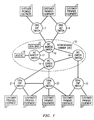
- FIG. 1 is an overall block diagram of the networks and switches used for interconnecting customer premises equipment connected to CAP switches and connected to LEC switches.
- the calls of this description are calls which are originated by one of the Customer Premises Equipments (CPEs) 1, 3, or 5 and are terminated on one of the CPEs 25-29.
- the originating CPE is connected to an originating CAP switch 7 or an originating LEC switch 9 and the terminating CPEs are connected to a terminating LEC switch 23 or one of the terminating CAP switches 21, 22.
- CPEs which are connected to two switches are private branch exchanges (PBXs) with a plurality of facilities interconnecting the private branch exchange with one or more switches.
- PBXs private branch exchanges
- the CPE shown connected to a single switch may be either a private customer telephone station or PBX or key telephone system.
- PBX private customer telephone station
- the originating and terminating local switches shown in FIG. 1 are interconnected by an interexchange carrier (IXC) network which includes an ingress switch 12 connected to the originating switches, and a pair of egress switches 14 and 16 connected to the terminating switches.
- IXC interexchange carrier
- switches 12, 14, and 16 are each both ingress and egress switches and have been labeled ingress and egress switches on FIG. 1 to illustrate the calls described herein.
- IXC egress switch 14 In IXC egress switch 14, an exception translation is made to see if the called number is served from one of the CAP switches 21, 22. If the called customer is served from CAP switch 21, then the call is routed to that switch. If it is served from CAP switch 22, the call is routed via egress switch 16 to CAP switch 22. If the called number is not found in the exception translation, IXC egress switch 14 will route the call via LEC switch 23; in effect the default translation, in case no specific translation is found for a particular called number, is that the called number is served from the LEC switch.
- the destination is a customer such as that served by CPE 27, which is connected to both terminating CAP switch 21 and terminating LEC switch 23, if all trunks between IXC egress switch 14 and terminating CAP switch 21 are busy, the call will automatically be routed via terminating LEC switch 23. If one or more trunks between egress switch 14 and CAP switch 21 are available, but no PBX trunks to CPE 27 are available from CAP switch 21 then CAP switch 21 will send a release message to IXC egress switch 14 indicating as the cause of the release the unavailability of terminating PBX trunks. In response to this release message, IXC egress switch 14 will route the call via LEC switch 23, whose identity is found in the translations of IXC egress switch 14, to the customer served by CPE 27.
- the IXC network can be arranged to have the ingress IXC switch query a data base 8 in order to identify the preferred terminating carrier, and optionally, alternate terminating carriers for serving the called customer.
- the call can then be routed directly to an IXC egress switch, such as IXC egress switch 16 which serves the preferred terminating carrier (or, if all trunks to that IXC egress switch are busy, to an IXC egress switch serving an alternate terminating carrier).
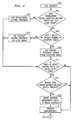
- FIG. 2 is a flow diagram of actions performed in the ingress IXC switch, a switch which also creates a billing (AMA) record for subsequently charging the customer.
- the incoming call is received from a CAP switch or an LEC switch (action block 201).
- Test 203 is used to determine whether the call was from a CAP switch. If not, test 205 is used to determine whether this is a received handoff call, i.e., a call handed off from the ingress IXC switch to handoff switch connected to an adjunct for access to the adjunct, and thereafter, for further access to the IXC network.
- a received handoff call i.e., a call handed off from the ingress IXC switch to handoff switch connected to an adjunct for access to the adjunct, and thereafter, for further access to the IXC network.
- the adjunct is used for prompting a caller, collecting DTMF digits from a caller and for deriving information for the AMA record for a call, and is used when the caller has features such as subaccount billing which require special service processing. If this is a handoff call, test 207 determines whether the call originated from a CAP, indicated by the receipt of a CAP identity from the previous IXC switch, and if so the received CAP ID is recorded in the AMA record for the call (action block 209). If the result of test 205 or 207 was negative, then no CAP ID is entered in the AMA record.
- test 211 is used to determine whether the call needs to go to a handoff switch, in this case a handoff switch in the IXC network, for handling calls that need special service processing not available at the ingress IXC switch.
- the CAP identification is sent in the initial address message (IAM) (action block 215) because this is not the recording switch.
- IAM initial address message
- the call is then processed conventionally and routed to the handoff switch for special service processing and for further routing to the destination. This is the end of actions on this call by the ingress IXC switch (end block 219). If the call does not need to go to a handoff switch, then the ingress CAP identity is recorded in the AMA record for this call (action block 213).
- test 214 is used to determine if a data base query has been implemented in the ingress switch for this type of call. If not, the actions of FIG. 3, discussed hereinafter, are initiated. If a data base query has been implemented, then the data base (date base 8, in this case) is queried (action block 216). Data base 8 returns an answer identifying the preferred, and, optionally, alternate carriers for serving the called customer (action block 218).
- the purpose of the data base query is to route the call to an IXC egress switch for serving the called customer (for example, IXC egress switch 18) instead of automatically routing the call to the IXC egress switch 16 which serves the predominant LEC carrier.
- FIG. 3 illustrates further actions performed by the ingress IXC switch for routing the call toward the egress IXC switch.
- Test 221 is used to determine whether the hard to reach control indicator is active for the called office code. If so, test 223 is used to determine whether the called office code is a shared group between multiple access switches. If so, then the network management hard to reach controls are inhibited in the ingress switch for this call (action block 225). Following action block 225 or a negative result of tests 221 or 223, the call is routed to the egress IXC switch serving the predominant terminating LEC carrier, or, if the data base query has been implemented and performed, to the IXC switch serving the preferred or alternate terminating carriers serving the called customer (action block 227).
- the call is then further processed conventionally up to address complete (action block 227).
- Address complete signifies that the call has been received and processed by the destination switch, that the customer line is available, but that the customer has not yet answered the call.
- Test 231 is then used to determine whether a CAP identification was received in the backwards signaling message from the egress IXC switch. If so, the egress CAP identification is entered in the AMA record for the call (action block 233) and if the call has been served by an operator system such as the OSPS feature described, for example, in Paper 3, Session 22C, International Switching Symposium, May, 1984, of the No. 5ESS® described, for example, in AT&T Technical Journal , Vol. 64, no. 6, part 2, pp. 1305-1564.
- the operator system will be sent the CAP identification (action block 235). Following action block 235 or a negative result of test 231, the call will continue to be processed conventionally (action block 237) until the call is completed (end block 239).
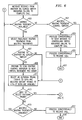
- FIGS. 4-7 illustrate the actions performed in the egress switch of the IXC network.
- Blocks 403-409 illustrate the case wherein the ingress IXC switch did not perform the data base query described in blocks 216 and 218 of FIG. 2. If such a query has been made, the preferred and alternate terminating local carriers for the call have already been selected and the initial address or other message would carry this data to the egress IXC switch, and blocks 403-409 are skipped. Alternatively, even in that case, a translation may be made to select the proper switch of the selected carrier for serving the called customer if the identity of that switch has not been provided in the common channel signaling messages received by the egress IXC switch.
- action block 401 The call is received (action block 401), digit translations are made and tested to see whether the office code includes exception routing (test 403). If not, then conventional routing treatment is used (action block 404) and test 413 (described hereinafter) is entered. If so, test 405 is used to determine whether the last four digits of the number are in the exception table. If so, the routing treatment is derived from the exception table (action block 409). Otherwise, default routing treatment is used (action block 407). In general, action block 407 is likely to represent the situation wherein an LEC serves the terminating customer. Although it is possible in the future that some CAP may handle the bulk of traffic and only a few exceptional customers are served by the LEC, in which case the default routing would be to the CAP that is handling the bulk of the traffic.
- test 411 is used to determine whether the hard to reach control is active for the called office code. If so, test 413 is used to determine whether the office code is shared between multiple access switches and if so the network management hard to reach control is inhibited (action block 415). If either test 411 or 413 is negative, then the action of block 415 is not performed. Thereafter, the call is processed conventionally (action block 417) until the process of selecting an outgoing trunk (starting with test 501) is entered.
- Test 501 of FIG. 5 determines whether multiple routing treatments are available for the call. Multiple routing treatments are clearly available if the LEC and CAP home on different IXC switches, and are also available even when the LEC and CAP home on the same switch. If not, action block 611 of FIG. 6, to be described hereinafter, is entered because the routing to the destination switch is straightforward. If multiple routing treatments are available for the call, then test 503 determines whether a routing control indicator has been received from a previous switch. If not, this egress switch becomes the multiple routing controller because it is the first of the multiple egress switches (action block 505) and in either case test 603 of FIG. 6 is entered.
- FIG. 6 relates to multiple routing treatments and is entered from FIG. 5 or from the loop resulting from the positive output of test 615 of FIG. 6.
- Action block 601 indicates that a message has been received from another egress IXC switch, indicating failure to complete the call.
- Test 603 determines whether the alternate routing treatments have been exhausted with a positive outcome indicating that untried routing treatments are still available. If that is the case, action block 605 is used to select the first or next routing treatment from the possible multiple treatments for a call to the selected destination.
- Test 607 is used to determine whether the routing for this particular treatment is via another IXC egress switch. If so, a routing control indicator is sent to the next switch and the peg count of such alternate routing is incremented.
- action block 611 which is the beginning of the actions associated with the process routing treatment is entered.
- An outgoing trunk is selected.
- the trunks to CAPs are selected before trunks to LECs if both are available because the trunks to the CAPs are direct.
- Test 613 is used to determine whether an outgoing trunk is available and can be selected. If so, indicator 701 (FIG. 7) which indicates that routing is now complete, is entered. If no outgoing trunk is available in test 613 then test 615 is used to determine whether multiple routing treatments are available for this call and, if so, test 603 is reentered. If multiple routing treatments are not available for this call, the call is processed conventionally to release the call (action block 617) because the call is blocked. This is the end of the process for that call (end symbol 619).
- test 631 is used to determine whether this is the multiple treatment control switch. If not, action block 633 is used to send an unable to complete message to the controlling switch and, in either case action block 635 is entered to release the call conventionally. Action block 635 is followed by the end symbol 637.
- FIG. 7 illustrates the actions following the recognition that routing is now complete (action block 701). This is entered following the positive result of test 613, namely, the ability to select an outgoing trunk from the egress switch.
- the call is then processed conventionally to attempt call setup (action block 702).
- a backward message is received from the switch in the terminating network (action block 704).
- Test 705 is used to determine whether the egress was to a CAP switch. If not, the call is processed conventionally (action block 711) because this is a call to an LEC switch. If the egress was to a CAP switch (positive result of test 705) test 707 is used to determine whether the egress from the CAP switch to the customer was successful.
- the CAP identification is sent back to the originating/billing switch in a backward message (action block 709) and the call is setup conventionally using the CAP switch (action block 710). If the egress from the CAP switch to the customer was not successful (negative result of test 707) then the call is released (action block 722). If the received failure message had the cause value user busy (positive result of test 721) it is an indication that the final customer was not reachable using the primary route. Test 723 is then used to determine if multiple routing treatments are available. If not, then action block 611 used to select an outgoing trunk is directly entered. If the result of test 723 is positive, then test 603 used in the loop for multiple routing treatments is entered in order to try multiple routing treatments.
- the actions performed in the CAP switches are conventional actions and are controlled, for example, by the software of the current generic program of a 5ESS switch.
- CAP switches are required to have the ability to home on a plurality of IXC switches, for service by a plurality of IXCs. Translations in the CAP switch determine which IXC switch a particular customer may access for routing outgoing calls.
- the treatment in CAP switches of AMA records is sometimes different. For example, rated records, i.e., records for which the charge rates have been determined, generated within a CAP switch are sent directly to the IXC billing systems for intra-LATA toll calls.
Landscapes
- Engineering & Computer Science (AREA)
- Computer Networks & Wireless Communication (AREA)
- Data Exchanges In Wide-Area Networks (AREA)
- Communication Control (AREA)
- Meter Arrangements (AREA)
- Telephonic Communication Services (AREA)
- Devices For Checking Fares Or Tickets At Control Points (AREA)
Applications Claiming Priority (4)
| Application Number | Priority Date | Filing Date | Title |
|---|---|---|---|
| US20310294A | 1994-02-28 | 1994-02-28 | |
| US203102 | 1994-02-28 | ||
| US08/203,110 US5475749A (en) | 1994-02-28 | 1994-02-28 | Connections between a toll network and multiple local networks |
| US203110 | 1994-02-28 |
Publications (3)
| Publication Number | Publication Date |
|---|---|
| EP0669772A2 true EP0669772A2 (fr) | 1995-08-30 |
| EP0669772A3 EP0669772A3 (fr) | 1995-11-02 |
| EP0669772B1 EP0669772B1 (fr) | 2002-10-09 |
Family
ID=26898313
Family Applications (1)
| Application Number | Title | Priority Date | Filing Date |
|---|---|---|---|
| EP95300951A Expired - Lifetime EP0669772B1 (fr) | 1994-02-28 | 1995-02-15 | Connexions entre un réseau interurbain et des réseaux locaux multiples |
Country Status (5)
| Country | Link |
|---|---|
| EP (1) | EP0669772B1 (fr) |
| JP (1) | JPH07273868A (fr) |
| AT (1) | ATE226004T1 (fr) |
| CA (1) | CA2137592C (fr) |
| DE (1) | DE69528483T2 (fr) |
Cited By (3)
| Publication number | Priority date | Publication date | Assignee | Title |
|---|---|---|---|---|
| GB2318477A (en) * | 1996-10-16 | 1998-04-22 | Ericsson Telefon Ab L M | Network architecture |
| WO1999037078A1 (fr) * | 1997-12-23 | 1999-07-22 | Nokia Networks Oy | Validation d'abonnes appelants |
| WO2002060193A1 (fr) * | 2001-01-23 | 2002-08-01 | Siemens Aktiengesellschaft | Procede pour conduire une connexion, central telephonique et programme associes |
Families Citing this family (1)
| Publication number | Priority date | Publication date | Assignee | Title |
|---|---|---|---|---|
| US8064354B1 (en) * | 2010-07-21 | 2011-11-22 | Intelepeer, Inc. | Optimized path call routing with device identifier |
Family Cites Families (2)
| Publication number | Priority date | Publication date | Assignee | Title |
|---|---|---|---|---|
| US4577066A (en) * | 1983-08-03 | 1986-03-18 | At&T Bell Laboratories | Telephone interexchange call routing |
| US5253288A (en) * | 1990-03-28 | 1993-10-12 | At&T Bell Laboratories | Alternate destination call redirection for telecommunications systems |
-
1994
- 1994-12-08 CA CA002137592A patent/CA2137592C/fr not_active Expired - Fee Related
-
1995
- 1995-02-15 AT AT95300951T patent/ATE226004T1/de not_active IP Right Cessation
- 1995-02-15 DE DE69528483T patent/DE69528483T2/de not_active Expired - Lifetime
- 1995-02-15 EP EP95300951A patent/EP0669772B1/fr not_active Expired - Lifetime
- 1995-02-28 JP JP7039747A patent/JPH07273868A/ja active Pending
Cited By (5)
| Publication number | Priority date | Publication date | Assignee | Title |
|---|---|---|---|---|
| GB2318477A (en) * | 1996-10-16 | 1998-04-22 | Ericsson Telefon Ab L M | Network architecture |
| WO1999037078A1 (fr) * | 1997-12-23 | 1999-07-22 | Nokia Networks Oy | Validation d'abonnes appelants |
| US6678368B1 (en) | 1997-12-23 | 2004-01-13 | Nokia Corporation | Calling subscriber validation |
| WO2002060193A1 (fr) * | 2001-01-23 | 2002-08-01 | Siemens Aktiengesellschaft | Procede pour conduire une connexion, central telephonique et programme associes |
| AU2002240790B2 (en) * | 2001-01-23 | 2007-10-04 | Nokia Siemens Networks Gmbh & Co. Kg | Method for controlling a connection, associated switching centre and associated program |
Also Published As
| Publication number | Publication date |
|---|---|
| DE69528483T2 (de) | 2003-08-14 |
| JPH07273868A (ja) | 1995-10-20 |
| CA2137592A1 (fr) | 1995-08-29 |
| ATE226004T1 (de) | 2002-10-15 |
| EP0669772A3 (fr) | 1995-11-02 |
| EP0669772B1 (fr) | 2002-10-09 |
| CA2137592C (fr) | 1999-11-02 |
| DE69528483D1 (de) | 2002-11-14 |
Similar Documents
| Publication | Publication Date | Title |
|---|---|---|
| US5475749A (en) | Connections between a toll network and multiple local networks | |
| US5550912A (en) | Connections between a toll network and multiple local networks | |
| EP0550975B1 (fr) | Méthode pour rediriger un appel téléphonique à une destination alternative | |
| US5943397A (en) | Network assisted callback system | |
| US5099509A (en) | Integration of voice store and forward facility | |
| EP0631447B1 (fr) | Architecture et système de réseau de télécommunications | |
| US6522743B1 (en) | Routing calls to call centers | |
| US5432845A (en) | Post answer telephone call redirection or rerouting | |
| US5661792A (en) | Completing telecommunications calls in a competitive local and toll enviroment | |
| EP0520688B1 (fr) | Méthode de détournement de trafic de télécommunication | |
| US5903639A (en) | Custom routing for multiple carrier interconnection | |
| EP0990337B1 (fr) | Procede et appareil d'acheminement d'appels bases sur l'identification de l'appelant ou de la ligne appelante | |
| US5530741A (en) | Method for providing inter-lata caller identification | |
| US5253288A (en) | Alternate destination call redirection for telecommunications systems | |
| US6330323B1 (en) | Enhanced overflow call processing | |
| JP3270612B2 (ja) | 通信交換機 | |
| EP0498593A2 (fr) | Système de détournement d'appel | |
| US5329581A (en) | Target area calling system | |
| US4896350A (en) | Arrangement for providing a call-connection service | |
| US5249219A (en) | Integration of voice store and forward facility | |
| US5784449A (en) | Telecommunications network for serving users from two switches | |
| EP0778713A2 (fr) | Réseau de télécommunication servant des utilisateurs appartenant à plusieurs systèmes de commutation | |
| US7308267B2 (en) | Wireless direct routing service | |
| EP0669772B1 (fr) | Connexions entre un réseau interurbain et des réseaux locaux multiples | |
| US6173051B1 (en) | Custom routing for multiple carrier interconnection |
Legal Events
| Date | Code | Title | Description |
|---|---|---|---|
| PUAI | Public reference made under article 153(3) epc to a published international application that has entered the european phase |
Free format text: ORIGINAL CODE: 0009012 |
|
| AK | Designated contracting states |
Kind code of ref document: A2 Designated state(s): AT BE CH DE ES FR GB IT LI NL SE |
|
| PUAL | Search report despatched |
Free format text: ORIGINAL CODE: 0009013 |
|
| AK | Designated contracting states |
Kind code of ref document: A3 Designated state(s): AT BE CH DE ES FR GB IT LI NL SE |
|
| RHK1 | Main classification (correction) |
Ipc: H04Q 3/66 |
|
| 17P | Request for examination filed |
Effective date: 19960418 |
|
| 17Q | First examination report despatched |
Effective date: 20000718 |
|
| GRAG | Despatch of communication of intention to grant |
Free format text: ORIGINAL CODE: EPIDOS AGRA |
|
| GRAG | Despatch of communication of intention to grant |
Free format text: ORIGINAL CODE: EPIDOS AGRA |
|
| GRAH | Despatch of communication of intention to grant a patent |
Free format text: ORIGINAL CODE: EPIDOS IGRA |
|
| GRAH | Despatch of communication of intention to grant a patent |
Free format text: ORIGINAL CODE: EPIDOS IGRA |
|
| GRAA | (expected) grant |
Free format text: ORIGINAL CODE: 0009210 |
|
| AK | Designated contracting states |
Kind code of ref document: B1 Designated state(s): AT BE CH DE ES FR GB IT LI NL SE |
|
| PG25 | Lapsed in a contracting state [announced via postgrant information from national office to epo] |
Ref country code: NL Free format text: LAPSE BECAUSE OF FAILURE TO SUBMIT A TRANSLATION OF THE DESCRIPTION OR TO PAY THE FEE WITHIN THE PRESCRIBED TIME-LIMIT Effective date: 20021009 Ref country code: LI Free format text: LAPSE BECAUSE OF FAILURE TO SUBMIT A TRANSLATION OF THE DESCRIPTION OR TO PAY THE FEE WITHIN THE PRESCRIBED TIME-LIMIT Effective date: 20021009 Ref country code: IT Free format text: LAPSE BECAUSE OF FAILURE TO SUBMIT A TRANSLATION OF THE DESCRIPTION OR TO PAY THE FEE WITHIN THE PRE;WARNING: LAPSES OF ITALIAN PATENTS WITH EFFECTIVE DATE BEFORE 2007 MAY HAVE OCCURRED AT ANY TIME BEFORE 2007. THE CORRECT EFFECTIVE DATE MAY BE DIFFERENT FROM THE ONE RECORDED.SCRIBED TIME-LIMIT Effective date: 20021009 Ref country code: CH Free format text: LAPSE BECAUSE OF FAILURE TO SUBMIT A TRANSLATION OF THE DESCRIPTION OR TO PAY THE FEE WITHIN THE PRESCRIBED TIME-LIMIT Effective date: 20021009 Ref country code: BE Free format text: LAPSE BECAUSE OF FAILURE TO SUBMIT A TRANSLATION OF THE DESCRIPTION OR TO PAY THE FEE WITHIN THE PRESCRIBED TIME-LIMIT Effective date: 20021009 Ref country code: AT Free format text: LAPSE BECAUSE OF FAILURE TO SUBMIT A TRANSLATION OF THE DESCRIPTION OR TO PAY THE FEE WITHIN THE PRESCRIBED TIME-LIMIT Effective date: 20021009 |
|
| REF | Corresponds to: |
Ref document number: 226004 Country of ref document: AT Date of ref document: 20021015 Kind code of ref document: T |
|
| REG | Reference to a national code |
Ref country code: GB Ref legal event code: FG4D |
|
| REG | Reference to a national code |
Ref country code: CH Ref legal event code: EP |
|
| REF | Corresponds to: |
Ref document number: 69528483 Country of ref document: DE Date of ref document: 20021114 |
|
| PG25 | Lapsed in a contracting state [announced via postgrant information from national office to epo] |
Ref country code: SE Free format text: LAPSE BECAUSE OF FAILURE TO SUBMIT A TRANSLATION OF THE DESCRIPTION OR TO PAY THE FEE WITHIN THE PRESCRIBED TIME-LIMIT Effective date: 20030109 |
|
| NLV1 | Nl: lapsed or annulled due to failure to fulfill the requirements of art. 29p and 29m of the patents act | ||
| ET | Fr: translation filed | ||
| REG | Reference to a national code |
Ref country code: CH Ref legal event code: PL |
|
| PG25 | Lapsed in a contracting state [announced via postgrant information from national office to epo] |
Ref country code: ES Free format text: LAPSE BECAUSE OF FAILURE TO SUBMIT A TRANSLATION OF THE DESCRIPTION OR TO PAY THE FEE WITHIN THE PRESCRIBED TIME-LIMIT Effective date: 20030429 |
|
| PLBE | No opposition filed within time limit |
Free format text: ORIGINAL CODE: 0009261 |
|
| STAA | Information on the status of an ep patent application or granted ep patent |
Free format text: STATUS: NO OPPOSITION FILED WITHIN TIME LIMIT |
|
| 26N | No opposition filed |
Effective date: 20030710 |
|
| PGFP | Annual fee paid to national office [announced via postgrant information from national office to epo] |
Ref country code: FR Payment date: 20100222 Year of fee payment: 16 |
|
| PGFP | Annual fee paid to national office [announced via postgrant information from national office to epo] |
Ref country code: GB Payment date: 20100107 Year of fee payment: 16 Ref country code: DE Payment date: 20100226 Year of fee payment: 16 |
|
| GBPC | Gb: european patent ceased through non-payment of renewal fee |
Effective date: 20110215 |
|
| REG | Reference to a national code |
Ref country code: FR Ref legal event code: ST Effective date: 20111102 |
|
| REG | Reference to a national code |
Ref country code: DE Ref legal event code: R119 Ref document number: 69528483 Country of ref document: DE Effective date: 20110901 |
|
| PG25 | Lapsed in a contracting state [announced via postgrant information from national office to epo] |
Ref country code: FR Free format text: LAPSE BECAUSE OF NON-PAYMENT OF DUE FEES Effective date: 20110228 |
|
| PG25 | Lapsed in a contracting state [announced via postgrant information from national office to epo] |
Ref country code: GB Free format text: LAPSE BECAUSE OF NON-PAYMENT OF DUE FEES Effective date: 20110215 |
|
| PG25 | Lapsed in a contracting state [announced via postgrant information from national office to epo] |
Ref country code: DE Free format text: LAPSE BECAUSE OF NON-PAYMENT OF DUE FEES Effective date: 20110901 |