EP0670142A1 - Überprüfungvorrichtungen - Google Patents
Überprüfungvorrichtungen Download PDFInfo
- Publication number
- EP0670142A1 EP0670142A1 EP95300683A EP95300683A EP0670142A1 EP 0670142 A1 EP0670142 A1 EP 0670142A1 EP 95300683 A EP95300683 A EP 95300683A EP 95300683 A EP95300683 A EP 95300683A EP 0670142 A1 EP0670142 A1 EP 0670142A1
- Authority
- EP
- European Patent Office
- Prior art keywords
- circuitry
- output
- housing
- vocabulary
- processing circuitry
- Prior art date
- Legal status (The legal status is an assumption and is not a legal conclusion. Google has not performed a legal analysis and makes no representation as to the accuracy of the status listed.)
- Withdrawn
Links
- 238000012216 screening Methods 0.000 title claims description 13
- 238000012545 processing Methods 0.000 claims description 38
- 239000000284 extract Substances 0.000 claims description 8
- 230000000977 initiatory effect Effects 0.000 claims description 6
- 230000004044 response Effects 0.000 claims description 6
- 210000000988 bone and bone Anatomy 0.000 claims description 2
- 230000002093 peripheral effect Effects 0.000 claims description 2
- 230000008878 coupling Effects 0.000 claims 2
- 238000010168 coupling process Methods 0.000 claims 2
- 238000005859 coupling reaction Methods 0.000 claims 2
- 238000012071 hearing screening Methods 0.000 abstract description 2
- 238000010586 diagram Methods 0.000 description 6
- 208000016354 hearing loss disease Diseases 0.000 description 5
- 238000011156 evaluation Methods 0.000 description 4
- 238000000034 method Methods 0.000 description 4
- 230000004913 activation Effects 0.000 description 3
- 206010011878 Deafness Diseases 0.000 description 2
- 210000005069 ears Anatomy 0.000 description 2
- 230000006870 function Effects 0.000 description 2
- 210000003128 head Anatomy 0.000 description 2
- 230000010370 hearing loss Effects 0.000 description 2
- 231100000888 hearing loss Toxicity 0.000 description 2
- 238000012986 modification Methods 0.000 description 2
- 230000004048 modification Effects 0.000 description 2
- 239000004020 conductor Substances 0.000 description 1
- 230000003247 decreasing effect Effects 0.000 description 1
- 230000007812 deficiency Effects 0.000 description 1
- 210000000613 ear canal Anatomy 0.000 description 1
- 230000000694 effects Effects 0.000 description 1
- 230000005674 electromagnetic induction Effects 0.000 description 1
- 230000001771 impaired effect Effects 0.000 description 1
- 238000004519 manufacturing process Methods 0.000 description 1
- 230000008569 process Effects 0.000 description 1
- 230000007115 recruitment Effects 0.000 description 1
- 230000009467 reduction Effects 0.000 description 1
- 230000035945 sensitivity Effects 0.000 description 1
- 230000002123 temporal effect Effects 0.000 description 1
Images


Classifications
-
- A—HUMAN NECESSITIES
- A61—MEDICAL OR VETERINARY SCIENCE; HYGIENE
- A61B—DIAGNOSIS; SURGERY; IDENTIFICATION
- A61B5/00—Measuring for diagnostic purposes; Identification of persons
- A61B5/12—Audiometering
-
- A—HUMAN NECESSITIES
- A61—MEDICAL OR VETERINARY SCIENCE; HYGIENE
- A61B—DIAGNOSIS; SURGERY; IDENTIFICATION
- A61B5/00—Measuring for diagnostic purposes; Identification of persons
- A61B5/12—Audiometering
- A61B5/121—Audiometering evaluating hearing capacity
Definitions
- the invention pertains to screening devices for hearing screening purposes.
- the known devices while portable, relatively inexpensive and easy to operate, are very limited in the type of output that is produced.
- the hearing process is a complex phenomenon which goes far beyond the basic ability to hear one or more tones. Individuals do not normally communicate using tones. Instead, audibly discernible words and phrases are usually used.
- Hearing impairment can also include recruitment (less loss for higher level signals than lower level signals), loss of frequency resolution, and loss of temporal resolution. All of these factors combine to affect how a person with a hearing impairment functions in his/her acoustic environment. The most important hearing tasks for a person is understanding other people talking.
- audible screening devices which provide more realistic audible outputs than a simple preselected tone or tones.
- such devices could be readily used by the general population without extensive education for the purpose of enabling an individual from time to time to determine whether or not his or her ability to hear words and phrases at normal energy levels has been impaired.
- An apparatus embodying the present invention produces words or phrases and includes a housing with a positioning member which extends therefrom.
- Vocabulary circuitry carried within the housing, digitally stores a preselected plurality of words or phrases to be reproduced.
- the words or phrases are organized as a single list. In another embodiment, two or more lists can be created.
- a manually operable switch may be carried by the housing for initiating an audible output.
- Processing circuitry carried by the housing, is responsive to the switch.
- the processing circuitry extracts at least one member of the operative plurality of words or phrases from the storage circuitry. A determination is also made as to one or more members to be extracted subsequently.
- Output circuitry carried by the housing, is responsive to the processing circuitry. Various representations of the extracted members can be produced.
- the output circuitry includes an output transducer for producing an audible output. Alternately, electromagnetic, ultrasonic, infrared or vibratory outputs can be produced.
- the processing circuitry can include a programmed logic array. Alternately, a programmed processor or wired logic could be used. Tone storage circuitry as well as noise generation circuitry can be coupled to the vocabulary circuitry.
- the apparatus can further include output control circuitry coupled to the processing circuitry.
- the positioning member of the housing can extend therefrom a predetermined distance.
- the distal end of the member defines a contact surface.
- the contact surface can be located adjacent to an ear of a person for screening purposes.
- the positioning member locates the output transducer a predetermined distance from the individual's ear.
- FIG. 1 is a block diagram of an apparatus 10 usable for audible screening purposes.
- the apparatus 10 includes a housing generally indicated at 12.
- the housing 12 carries a plurality of electronic components 14 including one or more vocabulary lists indicated at 16A through 16N. Other output stimuli could be provided.
- the lists 16A through 16N are organized to store a plurality of predetermined words or phrases usable for screening purposes.
- the vocabulary words or phrases can be stored in either a digital or an analog fashion. It will be understood that the details as to how the storage is implemented are not a limitation of the present invention. For example, the predetermined words or phrases could be stored digitally in either ROM or RAM memory. Alternately, if desired, analog storage could be used.
- any individual list such as the representative indicated list 16A
- the number of vocabulary words or phrases in any individual list can vary without departing from the spirit and scope of the present invention. What is required is that there be a sufficient number of words or phrases stored such that a user of the apparatus 10 will have an opportunity to try a large enough sample of words or phrases to experience a meaningful screening activity.
- a processing unit 18 which can be implemented as a programmable logic array. Alternately, the processing unit 18 can be implemented as a programmed processor or with hard wired logic.
- the unit 20 receives an input from the processing unit 18 and one or more of the lists 16A through 16N.
- the processing unit 18 receives an input from a clock/timer element 22.
- Output from the unit 20 is coupled to an output level control unit 24 which in turn drives an output transducer 30.
- the output transducer 30 could be implemented, for example, as a speaker to provide audible output, or as a bone conductor to provide stimulus to the ear through vibration. Alternately, instead of a transducer which generates sound waves, a transducer which utilizes ultrasonic, infrared or electromagnetic induction to couple to another transducer being worn by the individual being screened, can be used without departing from the spirit and scope of the present invention.
- the output level control unit 24 may include a manually operable adjustment 24a. This results in having a wide range of output levels available which makes the apparatus 10 effective for different purposes.
- the output level can be increased using the control element 24a.
- the degree of increase necessary will give an indication of the severity of a particular hearing loss.
- Input to the clock/timer element 22 is provided by a clock/pitch adjusting element 34 having an adjustment input 34a.
- the fundamental pitch of the audible output being produced can be increased or decreased.
- prestored tones and noise are provided in an element 36. It is useful to integrate tones and/or noise with the words or phrases being presented to a user.
- Tones could be used as signals to indicate that a word or a phrase is about to be presented. Additionally, noise signals or tones could be used for calibrating the unit or in combination with words or phrases to address specific types of hearing deficiencies.
- One or more user activatable switches or control elements 40 are carried by the housing 12 and are in turn, electrically coupled to the processing unit 18. The user is able to manipulate one or more manually operable switches or control elements to indicate to the processing unit 18 that the next word or phrase is to be presented or the apparatus 10 is to be initialized or that the unit 18 should start accessing a different prestored vocabulary list.
- the apparatus 10 is energized by a power supply 42 which could be a battery. Additionally, the unit 10 could be equipped with an AC adapter, an external power supply or other sources of electrical energy.
- the lists 16A through 16N could be alterable and could be loadable through a plug-in vocabulary loading unit 44 (illustrated in phantom in FIG. 1).
- the vocabulary loading unit 44 could incorporate, for example, a programmable computer or the like for ease of creating and/or modifying vocabulary lists.
- the words or phrases stored in the lists 16A through 16N could be in a variety of languages and could also focus on one particular type of hearing loss, such as the loss exhibited in the presence of monosyllabic high frequency emphases words, by way of example.
- the flowchart of Figure 2 illustrates one way in which the unit 10 can function.
- the unit 10 is in a standby mode waiting for a command button to be pressed. Once a command button has been pressed, a delay is provided in a step 102.
- a step 104 the next vocabulary word or phrase from the active list is accessed, such as from the list 16A for example, and processed by both the processing unit 18 and the output unit 20 to provide an output via the transducer 30. It will be understood that other forms of output stimuli could be presented.
- the unit 10 reenters the wait mode in a step mode 106 and awaits for another input command via the user activation elements 40.
- a determination is made as to whether or not the last word or phrase in the active list has been presented in a step 110. If not, after a delay in a step 112, the next element in the list is then presented via the transducer 30 in a step 114. The unit 10 then returns to the wait mode in the step 116.
- a control element In the event that a control element has not been activated within a predetermined period of time, illustrated in a step 118, corresponding to 20 seconds for example, the unit automatically returns to the standby mode and the step 100.
- the method illustrated in FIG. 2 is one of a variety of ways in which the apparatus 10 can operate.
- the time delay illustrated in step 118 can be eliminated if desired.
- one or more of the activation elements 40 can be used to specify one or more of the prestored lists 16A through 16N or to indicate whether or not a right ear or a left ear is being screened.
- FIG. 3 is a schematic diagram illustrating in more detail, various of the elements of the apparatus 10 where an audible output is desired. Elements in FIG. 3 which correspond to previously discussed elements of FIG. 1 have been identified with the same identification numeral.
- the circuitry 14 is illustrated in FIG. 3 as being implemented by means of an ESS Technology, Inc. Speech Chip No. ES2108, which is commercially available. It will be understood that the particular form of integrated circuit or circuits used to implement the circuitry 14 is not a limitation of the present invention.
- the circuitry 14 also includes an output speaker and related controls.
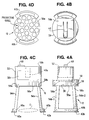
- FIG. 1 Figures 4A through 4D illustrate various views of the housing 12 along with the components illustrated in FIG. 1.
- the housing 12 is formed with a cylindrical portion 50 which defines an interior region 52 wherein the electronic components 14 can be mounted.
- the housing 12 includes one or more spacing, or positioning, members, such as the members 56a and 56b.
- the members 56a and 56b are fixedly attached to the cylindrical portion 50 at proximal end regions 58a and 58b.
- Distal end regions 60a and 60b are intended to be placed in contact with the side of the user's head adjacent to an ear with the ear positioned between the distal ends 60a and 60b.
- the positioning elements 56a and 56b are each formed with two spaced apart members, such as the members 56b-1 and 56b-2.
- the members 56b-1 and 56b-2 are fixedly attached to the cylindrical body portion 50 by proximal end regions 58b and are joined together by a distal end member 60b.
- An end surface 62b on the distal end member 60b is intended to be placed in contact with the side of the user's head.
- the elements 56b-1, 56b-2, 60b and an end surface 50a bound an open region.
- a similar open region is associated with the spacing element 56a, and is bounded by elements 56a-1, 56a-2, 60-a and surface 50a.
- the spacing elements 56a and 56b,as is illustrated in FIG. 4C, are spaced apart from one another and form an open cavity spacing element. These various openings provide a free sound field around the user's ear E.
- the distance between the end surface 60b or 62b and the end surface 50a preferably should fall in a range of 1-1/2 inches to 2-1/4 inches, preferably about 2 inches.
- the length of the element 50 can be of the order of 1-1/2 inches with its diameter of the order of 2 to 2-1/2 inches to provide an overall size which is convenient to hold and manipulate.
- the activation element 40 illustrated in FIGS. 4A through 4C, is located adjacent to a second end surface 50b of the housing 50. It will be understood that other locations are possible.
- Control element 40 could be alternatively located on a peripheral surface 50c, illustrated in FIG. 4C in phantom as element 40a. It will be understood that the exact location and number of the control elements 40 are not a limitation of the present invention.
- Figure 4D illustrates a bottom view of the housing 12.
- the end surface 50a can be perforated and/or covered with grillwork which is transparent to the audible words and phrases but which is intended to protect the transducer 30.
- a closed cavity spacing element could be used without departing from the spirit and scope of the invention.
- Such a spacing element could have a generally cylindrical, continuous exterior wall and be affixed to a housing, such as the housing 50.
- the spacing element could have an end region, displaced from said housing transmissive of outputs from the transducer 30.
- the spacing or positioning element not only can have various shapes but it need not be carried by the housing.
- an output device could extend from an end of the housing.
- the positioning element could be carried by the output device.
Landscapes
- Health & Medical Sciences (AREA)
- Life Sciences & Earth Sciences (AREA)
- Engineering & Computer Science (AREA)
- Physics & Mathematics (AREA)
- Audiology, Speech & Language Pathology (AREA)
- Heart & Thoracic Surgery (AREA)
- Molecular Biology (AREA)
- Biophysics (AREA)
- Pathology (AREA)
- Biomedical Technology (AREA)
- Acoustics & Sound (AREA)
- Medical Informatics (AREA)
- Multimedia (AREA)
- Surgery (AREA)
- Animal Behavior & Ethology (AREA)
- General Health & Medical Sciences (AREA)
- Public Health (AREA)
- Veterinary Medicine (AREA)
- Otolaryngology (AREA)
- Measurement Of The Respiration, Hearing Ability, Form, And Blood Characteristics Of Living Organisms (AREA)
Applications Claiming Priority (2)
| Application Number | Priority Date | Filing Date | Title |
|---|---|---|---|
| US19179894A | 1994-02-03 | 1994-02-03 | |
| US191798 | 1994-02-03 |
Publications (1)
| Publication Number | Publication Date |
|---|---|
| EP0670142A1 true EP0670142A1 (de) | 1995-09-06 |
Family
ID=22706974
Family Applications (1)
| Application Number | Title | Priority Date | Filing Date |
|---|---|---|---|
| EP95300683A Withdrawn EP0670142A1 (de) | 1994-02-03 | 1995-02-03 | Überprüfungvorrichtungen |
Country Status (3)
| Country | Link |
|---|---|
| US (1) | US5732396A (de) |
| EP (1) | EP0670142A1 (de) |
| JP (1) | JPH0856935A (de) |
Families Citing this family (7)
| Publication number | Priority date | Publication date | Assignee | Title |
|---|---|---|---|---|
| US7016504B1 (en) * | 1999-09-21 | 2006-03-21 | Insonus Medical, Inc. | Personal hearing evaluator |
| US7149684B1 (en) * | 2001-12-18 | 2006-12-12 | The United States Of America As Represented By The Secretary Of The Army | Determining speech reception threshold |
| US7143031B1 (en) * | 2001-12-18 | 2006-11-28 | The United States Of America As Represented By The Secretary Of The Army | Determining speech intelligibility |
| WO2010031134A1 (en) * | 2008-09-18 | 2010-03-25 | Philip Stuart Esnouf | Improved hearing testing device |
| US20110230786A1 (en) * | 2004-04-08 | 2011-09-22 | Philip Stuart Esnouf | Hearing testing device |
| NZ550380A (en) | 2004-04-08 | 2009-10-30 | Philip Stuart Esnouf | A hearing testing device |
| US20060258326A1 (en) * | 2005-05-12 | 2006-11-16 | Justin Webb | Apparatus For Enhancing The Functionality Of A Digital Device |
Citations (1)
| Publication number | Priority date | Publication date | Assignee | Title |
|---|---|---|---|---|
| US5197332A (en) * | 1992-02-19 | 1993-03-30 | Calmed Technology, Inc. | Headset hearing tester and hearing aid programmer |
Family Cites Families (4)
| Publication number | Priority date | Publication date | Assignee | Title |
|---|---|---|---|---|
| US5081441A (en) * | 1990-01-12 | 1992-01-14 | Starkey Laboratories, Inc. | Hand-held tone generator for equalizing binaural hearing aids |
| USD324913S (en) | 1990-01-12 | 1992-03-24 | Starkey Laboratories, Inc. | Hand-held tone generator |
| USD335349S (en) | 1990-08-21 | 1993-05-04 | Handtronix, Inc. | Hand-held hearing screener |
| US5291785A (en) * | 1991-09-27 | 1994-03-08 | Bam World Markets, Inc. | Method and apparatus for testing an infant for hearing defects |
-
1995
- 1995-02-03 JP JP7017016A patent/JPH0856935A/ja active Pending
- 1995-02-03 EP EP95300683A patent/EP0670142A1/de not_active Withdrawn
-
1996
- 1996-10-09 US US08/731,119 patent/US5732396A/en not_active Expired - Fee Related
Patent Citations (1)
| Publication number | Priority date | Publication date | Assignee | Title |
|---|---|---|---|---|
| US5197332A (en) * | 1992-02-19 | 1993-03-30 | Calmed Technology, Inc. | Headset hearing tester and hearing aid programmer |
Non-Patent Citations (1)
| Title |
|---|
| ALVORD ET AL.: "Reference equivalent threshold levels for the Handtronix, Oto-Screener", THE JOURNAL OF THE ACOUSTICAL SOCIETY OF AMERICA, vol. 91, no. 4, NEW YORK, US, pages 2284 - 2286, XP000267521, DOI: doi:10.1121/1.403665 * |
Also Published As
| Publication number | Publication date |
|---|---|
| US5732396A (en) | 1998-03-24 |
| JPH0856935A (ja) | 1996-03-05 |
Similar Documents
| Publication | Publication Date | Title |
|---|---|---|
| US6671381B1 (en) | Sleeve for hearing aids, and a method and apparatus for testing hearing | |
| US5928170A (en) | Audio-enhanced sexual vibrator | |
| CN103081513B (zh) | 听力装置的基于视觉的选配 | |
| JPH08501950A (ja) | 人工喉頭 | |
| US20020065477A1 (en) | Audio interactive sexual vibrator | |
| EP1886707A1 (de) | Schlafverbesserungsvorrichtung | |
| JPH0322785B2 (de) | ||
| HU214430B (hu) | Horkolásgátló készülék alvó személyek számára | |
| JP2001508667A (ja) | 音声処理装置を制御する装置及び方法、並びに、個人的なデータを前記音声処理装置に入力するための音声処理制御装置 | |
| US6101366A (en) | Sound belt for diapers | |
| JP3561787B2 (ja) | 音響振動体感付与方法ならびにその装置 | |
| US5732396A (en) | Hearing aid screening device having an elongated spacing element which extends therefrom providing for ingress of background noise | |
| Stone et al. | A technique for estimating the occlusion effect for frequencies below 125 Hz | |
| US5828758A (en) | System and method for monitoring the oral and nasal cavity | |
| US6669527B2 (en) | Doll or toy character adapted to recognize or generate whispers | |
| US6350243B1 (en) | Portable hearing threshold tester | |
| Weisenberger et al. | Comparison of two single-channel vibrotactile aids for the hearing-impaired | |
| Brown et al. | Telephone use by a multi-channel cochlear implant patient: an evaluation using open-set CID sentences | |
| US20090013787A1 (en) | Hearing testing device | |
| JPS6314835Y2 (de) | ||
| GB2162342A (en) | Alarm time-pieces | |
| EP0549840A1 (de) | Verbesserte Puppe | |
| WO1987004630A1 (en) | Sleep and relaxation promoting aid | |
| Weisenberger | Evaluation of the Siemens Minifonator vibrotactile aid | |
| JPS60114206A (ja) | 電子メロディ−発生器付き歯ブラシ |
Legal Events
| Date | Code | Title | Description |
|---|---|---|---|
| PUAI | Public reference made under article 153(3) epc to a published international application that has entered the european phase |
Free format text: ORIGINAL CODE: 0009012 |
|
| AK | Designated contracting states |
Kind code of ref document: A1 Designated state(s): CH DE DK ES FR GB IT LI |
|
| 17P | Request for examination filed |
Effective date: 19960130 |
|
| 17Q | First examination report despatched |
Effective date: 19980130 |
|
| STAA | Information on the status of an ep patent application or granted ep patent |
Free format text: STATUS: THE APPLICATION IS DEEMED TO BE WITHDRAWN |
|
| 18D | Application deemed to be withdrawn |
Effective date: 19990202 |