EP0670267A2 - Palette für Eisenbahnersatzteile - Google Patents
Palette für Eisenbahnersatzteile Download PDFInfo
- Publication number
- EP0670267A2 EP0670267A2 EP95301228A EP95301228A EP0670267A2 EP 0670267 A2 EP0670267 A2 EP 0670267A2 EP 95301228 A EP95301228 A EP 95301228A EP 95301228 A EP95301228 A EP 95301228A EP 0670267 A2 EP0670267 A2 EP 0670267A2
- Authority
- EP
- European Patent Office
- Prior art keywords
- cradle
- rib
- mechanical part
- foot
- outer sidewall
- Prior art date
- Legal status (The legal status is an assumption and is not a legal conclusion. Google has not performed a legal analysis and makes no representation as to the accuracy of the status listed.)
- Withdrawn
Links
- 238000000034 method Methods 0.000 claims abstract description 27
- 230000001681 protective effect Effects 0.000 claims description 77
- 238000010276 construction Methods 0.000 claims description 3
- 239000007788 liquid Substances 0.000 claims 4
- 238000003780 insertion Methods 0.000 claims 2
- 230000037431 insertion Effects 0.000 claims 2
- 238000012546 transfer Methods 0.000 abstract description 5
- VYZAMTAEIAYCRO-UHFFFAOYSA-N Chromium Chemical compound [Cr] VYZAMTAEIAYCRO-UHFFFAOYSA-N 0.000 description 16
- 238000012856 packing Methods 0.000 description 5
- XLYOFNOQVPJJNP-UHFFFAOYSA-N water Substances O XLYOFNOQVPJJNP-UHFFFAOYSA-N 0.000 description 4
- 238000013461 design Methods 0.000 description 2
- 230000005484 gravity Effects 0.000 description 2
- 239000002184 metal Substances 0.000 description 2
- 239000004033 plastic Substances 0.000 description 2
- 239000007787 solid Substances 0.000 description 2
- 238000011179 visual inspection Methods 0.000 description 2
- 239000004677 Nylon Substances 0.000 description 1
- 229910000831 Steel Inorganic materials 0.000 description 1
- 239000006096 absorbing agent Substances 0.000 description 1
- 238000009833 condensation Methods 0.000 description 1
- 230000005494 condensation Effects 0.000 description 1
- 230000007797 corrosion Effects 0.000 description 1
- 238000005260 corrosion Methods 0.000 description 1
- 238000006073 displacement reaction Methods 0.000 description 1
- 239000011888 foil Substances 0.000 description 1
- 238000002347 injection Methods 0.000 description 1
- 239000007924 injection Substances 0.000 description 1
- JEIPFZHSYJVQDO-UHFFFAOYSA-N iron(III) oxide Inorganic materials O=[Fe]O[Fe]=O JEIPFZHSYJVQDO-UHFFFAOYSA-N 0.000 description 1
- 239000000463 material Substances 0.000 description 1
- 229920001778 nylon Polymers 0.000 description 1
- 230000000284 resting effect Effects 0.000 description 1
- 230000000717 retained effect Effects 0.000 description 1
- 238000005096 rolling process Methods 0.000 description 1
- 230000035939 shock Effects 0.000 description 1
- 230000000087 stabilizing effect Effects 0.000 description 1
- 238000010561 standard procedure Methods 0.000 description 1
- 239000010959 steel Substances 0.000 description 1
- 238000005303 weighing Methods 0.000 description 1
Images


Classifications
-
- B—PERFORMING OPERATIONS; TRANSPORTING
- B65—CONVEYING; PACKING; STORING; HANDLING THIN OR FILAMENTARY MATERIAL
- B65D—CONTAINERS FOR STORAGE OR TRANSPORT OF ARTICLES OR MATERIALS, e.g. BAGS, BARRELS, BOTTLES, BOXES, CANS, CARTONS, CRATES, DRUMS, JARS, TANKS, HOPPERS, FORWARDING CONTAINERS; ACCESSORIES, CLOSURES, OR FITTINGS THEREFOR; PACKAGING ELEMENTS; PACKAGES
- B65D21/00—Nestable, stackable or joinable containers; Containers of variable capacity
- B65D21/02—Containers specially shaped, or provided with fittings or attachments, to facilitate nesting, stacking, or joining together
- B65D21/0209—Containers specially shaped, or provided with fittings or attachments, to facilitate nesting, stacking, or joining together stackable or joined together one-upon-the-other in the upright or upside-down position
- B65D21/0212—Containers presenting local stacking elements protruding from the upper or lower edge of a side wall, e.g. handles, lugs, ribs, grooves
-
- B—PERFORMING OPERATIONS; TRANSPORTING
- B65—CONVEYING; PACKING; STORING; HANDLING THIN OR FILAMENTARY MATERIAL
- B65D—CONTAINERS FOR STORAGE OR TRANSPORT OF ARTICLES OR MATERIALS, e.g. BAGS, BARRELS, BOTTLES, BOXES, CANS, CARTONS, CRATES, DRUMS, JARS, TANKS, HOPPERS, FORWARDING CONTAINERS; ACCESSORIES, CLOSURES, OR FITTINGS THEREFOR; PACKAGING ELEMENTS; PACKAGES
- B65D19/00—Pallets or like platforms, with or without side walls, for supporting loads to be lifted or lowered
- B65D19/38—Details or accessories
- B65D19/44—Elements or devices for locating articles on platforms
-
- Y—GENERAL TAGGING OF NEW TECHNOLOGICAL DEVELOPMENTS; GENERAL TAGGING OF CROSS-SECTIONAL TECHNOLOGIES SPANNING OVER SEVERAL SECTIONS OF THE IPC; TECHNICAL SUBJECTS COVERED BY FORMER USPC CROSS-REFERENCE ART COLLECTIONS [XRACs] AND DIGESTS
- Y10—TECHNICAL SUBJECTS COVERED BY FORMER USPC
- Y10S—TECHNICAL SUBJECTS COVERED BY FORMER USPC CROSS-REFERENCE ART COLLECTIONS [XRACs] AND DIGESTS
- Y10S206/00—Special receptacle or package
- Y10S206/804—Special receptacle or package with means to lift or draw out content
Definitions
- the present invention relates generally to a method and apparatus for storing and transporting mechanical parts and, more particularly, to a method and apparatus for stacking such parts which allows the parts to be stored and transported in close proximity to one another without coming into contact with one another.
- the invention has particular, but not exclusive, reference to railway parts in connection with which it will, in the main, be discussed.
- the loading of parts such as gears typically involves rolling with the gear by foot across the ground and onto the forks of a forklift.
- the forklift then lifts the gear onto a pallet where it is strapped down. If the part is not damaged by being rolled along the ground or by being lifted by the metal forks of the forklift, the part still may be damaged during transport if another metallic part on the same pallet shifts into contact with, and thereby scratches or otherwise damages the part.
- This method of storing and transporting large mechanical railway parts also poses a problem of access to the part. All of the labor required to secure the part must be undone to obtain access to the part, making quick and easy access to the part virtually impossible.
- Another difficulty with conventional storage and transportation methods is the large amount of space required to store and transport mechanical railway parts.
- the parts cannot be stacked on top of one another . Even if packing was provided between stacked parts, the sheer weight of the parts themselves would pose a significant risk of damage to the lower part.
- an object of the invention is to provide a method for storing and transporting railway parts which allows easy access to the parts.
- the speed and ease with which parts may be inserted into and withdrawn from the apparatus such as a cradle assures quick and easy access to the parts.
- a further object of this invention is to provide a method for transporting mechanical parts in close proximity with one another without contact with one another.
- the close proximity of parts allows many more parts to be stored and transported in a given area.
- Yet another object of the present invention is to provide a method for stacking mechanical parts above one another without subjecting the lower part to the weight of the upper part. Stacking allows many more parts to be stored and transported in a given area.
- Another object of the present invention is to provide apparatus such as a cradle which protects delicate portions of mechanical parts. Since the apparatus secures various portions of the part, the parts are prevented from contacting one another and causing damage to delicate portions of the parts.
- Still another object of the present invention is to provide a stackable apparatus for mechanical parts which is easy to lift and stack. Ribs may be provided for safe and easy stacking, while fork holes provided on the bottom of the apparatus allow the latter to be easily captured and transported.
- An additional object of the present invention is to provide a method for easily inserting a mechanical part within apparatus such as a cradle for storage or transport and for withdrawing the part from the cradle for use.
- the use of a lift strap allows the part to be inserted and withdrawn safely and easily.
- Another object of the present invention is to provide a method for locking a lifting device within a mechanical part storage or transportation apparatus such as a cradle to prevent its inadvertent removal. Wedging the lift strap between a mechanical part and the cradle assures ready access to the strap by preventing the strap from falling off or being stolen.
- Yet a further object of the present invention is to provide apparatus, such as a cradle for mechanical parts which is capable of securing various sized parts securely during transport and storage.
- the interior design of the cradle accommodates both large and small parts and secures the parts against longitudinal displacement and contact with other parts during storage and transportation.
- Other objects of the invention include visual inspection of mechanical parts within stacked apparatus such as cradles and drainage of moisture out of the cradles to prevent rusting of the parts.
- the present invention comprises a method for storing and transporting mechanical parts which allows ready access to the parts while preventing contact between the parts.
- a part cradle having a protective outer sidewall, a floor, and a vertical support having a head.
- a mechanical part is also provided, and a part lift strap is placed around the mechanical part so that the mechanical part may be lifted above the part cradle with the part lift strap.
- the mechanical part is placed within the protective outer sidewall of the part cradle, thereby securing the part lift strap between the mechanical part and the floor of the part cradle, to prevent the inadvertent removal of the part lift strap from the mechanical part.
- a second cradle having a protective outer sidewall, a floor, and a vertical support having a foot, is also provided, as is a second mechanical part and a second lift strap to lift the second part.
- the second part is lifted above the second cradle with the second lift strap.
- the second part is placed within the protective outer sidewall of the second cradle, thereby securing the second lift strap between the second part and the floor of the second cradle, to prevent the inadvertent removal of the second lift strap from the second mechanical part.
- the second cradle is lifted above the first cradle and stacked atop the first cradle by releasably engaging the foot of the vertical support of the second cradle to the head of the vertical support of the first cradle. This releasable engagement prevents the inadvertent removal of the second cradle from the first cradle.
- the mechanical part is a gear having a delicate chrome shaft and a durable body by which the gear is lifted.
- the cradle is provided with a deep forward portion and a shallow rearward portion to allow greater protection of the delicate chrome shaft, while allowing access to the durable body.
- the vertical supports consist of a series of ribs having interior seats which releasably engage and securely support the body of the gear within the cradle.
- the ribs are specially designed with interlocking feet and heads so that the cradle may be securely engaged to another, similar cradle, with force transmitted through the ribs instead of through the protective outer side wall.
- the cradle is also provided with fork holes so that the cradle may be easily engaged and lifted with a standard forklift.
- a large mechanical railway part known as a gear 10.
- the gear 10 is used as a shock absorber between railroad carriages (not shown). Gears come in many different shapes and sizes, often weighing from 750 to 1250 pounds and costing $1,500 to $3,500 apiece.
- the gear 10 is provided with a base 20, a large cylindrical body 22, a chrome shaft 24 slidably connected to the body 22, and an end block 26. Although different gears may have different types of bodies, ranging from round to rounded to even square cross-sections, the shafts are typically cylindrical.
- the chrome shaft 24 allows the gear 10 to operate more efficiently, but is extremely delicate, requiring extreme caution when handling. The delicate nature of the chrome shaft 24, combined with the bulk of the body 22 makes handling and transporting the gear 10 extremely unwieldy.
- the gear 10 is suspended above a transportation and storage cradle 12 by a lift strap 14 provided around the body 22 of the gear 10.
- the lift strap 14 is preferably constructed of a flat piece of woven nylon to allow the lift strap 14 to lie flat against the circumference of the gear 10 and to prevent the lift strap 14 from sliding longitudinally along the gear 10.
- the lift strap 14 is preferably provided with a securement loop 16 on one end and a lift loop 18 on the opposite end
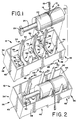
- the cradle 12 is preferably of a one-piece construction, injection molded of high strength plastic (Fig. 2).
- the cradle 12 has three main sections: an exterior shell 28; a floor 30; and ribs 50, 52, and 54.
- the shell 28 is only slightly larger than the gear 10 to allow lightweight compact storage of the gear 10.
- the shell 28 protects the gear 10 and prevents contact of the gear 10 with nearby gears or other parts (not shown).
- the shell 28 has a deep forward portion 34 and a shallow rearward portion 36 (Fig. 2).
- the deep forward portion 34 has a pair of front sides 38 and a front end 40.
- the front sides 38 and 40 are preferably of a height sufficient to protect the chrome shaft 24 of the gear 10 from side and front impact damage. In the preferred embodiment the front sides 38 and 40 do not extend above or below the ribs 50, 52, and 54 which prevents the front sides 38 and end 40 from being damaged by external weight placed on the or in the cradle 12.
- the shallow rearward portion 36 has a pair of rear sides 42 and a rear end 44. Unlike the front sides 38 and a front end 40 of the deep forward portion 34, the rear sides 42 and rear end 44 expose much of the gear 10. Preferably, the rear side 42 and rear end 44 cover only half the height of the cradle 12 to leave the upper half of the body 22 of the gear 10 exposed when the body 22 is placed within the cradle 12. This exposure facilitates access to the gear 10 when the gear 10 is placed within the cradle 12.
- the shell 28 is provided with two sets of fork holes 46 and 48 to allow the cradle 12 to be lifted and transported by a forklift.
- the front fork holes 46 are provided in the lower rear portion of the deep forward portion 34 of the shell 28 while the rear fork holes 48 are provided in the lower rear of the shallow rearward portion 36 of the shell 28.
- the fork holes 46 and 48 are preferably not centered on the cradle 12, but instead centered under the center of gravity of the cradle 12 and gear 10 assembly. Accordingly, the fork holes 46 and 48 are provided closer to the rear end of 44 of the cradle 12, centered more under the body 22 of the gear 10 than under the cradle 12, since the body 22 is significantly heavier than the chrome shaft 24.
- the three ribs 50, 52, and 54 interconnect the sides 38 and 42 of the shell 28 and divide the cradle 12 into four sections of substantially equal area (Fig. 2).
- the front rib 50 is centered within the deep forward portion 34 of the shell 28, while the rear rib 54 is centered within the shallow rearward portion 36 of the shell 28.
- the center rib 52 is provided in the center of the shell 28 between the deep forward portion 34 and the shallow rearward portion 36.
- the rear rib 54 has a head 56, a body 58 and a foot 60 (Fig. 1).
- the body 58 has a base 62 extending between the sides 42 of the shallow rearward portion 36 of the shell 28. From the base 62 the body 58 extends upward into two arms 64 forming an interior seat 66. The ends of the arms 64 form the head 56 of the rear rib 54.
- the interior seat 66 is formed with a semi-circular curve of a diameter substantially equal to the diameter of the body 22 of the gear 10.
- the foot 60 of the rear rib 54 is thicker than the base 62 of the body 58 to accommodate an interior groove 67 (Figs. 1 and 3).
- the interior groove 67 is preferably as wide and long as the front rib 82 to allow a front rib of a similar cradle to be releasably engaged within the interior groove 67 when the cradle 12 is stacked.
- Two downward projections 68 extend from the foot 60, below both sides 42 of the shallow rearward portion 36 of the shell 28.
- Two fingers 70 extend downward from the shell 28, closing off the interior groove 67 and providing the downward projections 68 with sides.
- the fingers 70 are contiguous with the shell 28 and extend to the lowermost portion of the downward projections 68.
- the center rib 52 is also provided with a head 72, a body 74, and a foot 76 having downward projections 78 (Fig. 1).
- the center rib 52 is also provided with a semi-circular interior seat 80 of a diameter equal to the diameter of the body 22 of the gear 10.
- the center rib 52 is connected to both the deep forward portion 34 and the shallow rearward portion 36 of the shell 28.
- the front rib 50 interconnects the sides 38 of the deep forward portion 34 of the shell 28 (Fig. 1).
- the front rib 50 is provided with a head 82, a body 84, and a foot 86 having downward projections 88 similar to the center rib 52 and rear rib 54.
- the front rib 50 is provided with a narrow interior 89, making the interior of the cradle 12 asymmetric. The narrow interior 89 forces the gear 10 to be loaded with the body 22 positioned within the shallow rearward portion 36 of the shell 28 and the chrome shaft 24 positioned within the deep forward portion 34 of the shell 28.
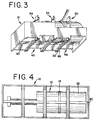
- Running the length of the floor 30 of the cradle 12 is a joist 90 (Fig. 4).
- the use of a single joist 90 allows water from rain or condensation to drain out the cradle, instead of building up next to the gear 10 where rust and corrosion are likely to occur. This "flow-through” also prevents trapped water from adding unnecessary weight the cradle 12.
- the floor 30 is provided with only a single joist 90 to allow maximum water flow-through and minimum weight. It should be noted, however, that the floor 30 may be provided with a plurality of joists interconnecting the sides of the shell 28. It is advantageous, however, to provide some type of passage through the floor 30 to allow water to escape from the cradle 12 instead of being retained against the gear 10.
- the joist 90 interconnects all three ribs 50, 52 and 54 with the front end 40 and rear end 44 of the shell 28 (Fig. 1).
- the joist 90 is provided high enough above the lowermost portion of the cradle 12 to allow forklift forks entering the fork holes 46 and 48 of the shell 28 to reach under the joist 90 to lift the cradle 12.
- the joist 90 is also placed close enough to the interior seats 66 and 80 of the ribs 54 and 52 to trap the lift strap 14 between the gear 10 and the joist 90 when the gear 10 is placed within the cradle 12.
- the lift strap 14 is wrapped around the body 22 of gear 10 near the center of gravity of the gear 10 (Fig. 1)..
- the lift loop 18 is then passed through the securement loop 16 and pulled to draw the lift strap 14 tightly around the gear.
- the lift loop 18 is then connected to forks of a forklift (not shown).
- the gear 10 is lifted with the lift strap 14 and centered above the cradle 12.
- the gear 10 is then lowered into the cradle 12 so that the body 22 of the gear 10 rests within the interior seat 66 of the rear rib 54 and the interior seat 80 of the center rib 52. In this position, the chrome shaft 24 of the gear 10 is positioned within the interior 89 of the front rib 50, but does not touch the front rib 50.
- the lift strap 14 is thereby wedged between the body 22 of the gear 10 and the joist 90 by the weight of the gear 10 (Fig. 4). This prevents the lift strap 14 from being removed from the gear 10 while the gear is resting within the cradle 12. By preventing the removal of the lift strap 14, the difficulties of locating another strap and providing the strap around the gear 10 while the gear 10 is within the cradle 12 are eliminated. Additionally, since the lift strap 14 cannot be removed from the gear 10 while in the gear 10 is in the cradle 12, the potential for theft of the lift strap is virtually eliminated.
- a forklift (not shown) slides its forks within the fork holes 46 and 48 of the cradle 12 and the cradle 12 is lifted to be loaded for either transportation or storage (Fig. 3).
- the gear 10 and the cradle 12 may be stacked for transportation or storage as shown in Fig. 5. Under present industry standards, the gear 10 and the cradle 12 may be stacked two high for transportation and four high for storage.
- a second cradle 96 is loaded with a second gear 98.
- the second cradle 96 is loaded by a second lift strap 94, in a manner similar to that described above.
- the second lift strap 94 is drawn over the additional cradle 96 to provide easy access to the second lift strap 94 after stacking.
- the cradle 12 is then lifted above the second cradle 96 and centered above the second cradle 96 with the front end 40 of the cradle 12 over a rear end 100 of the second cradle 96 and the rear end 44 of the cradle 12 over a front end 102 of the second cradle 96.
- the cradle 12 is then lowered onto the second cradle 96 so that the foot 60 of the rear rib 54 of the cradle 12 engages a head 104 of a front rib 106 of the second cradle 96.
- the low profile of the shallow rearward portion 36 of the shell 28 allows visual inspection of the gear 10 and access to the lift strap 14 even when the cradles 12 and 96 are stacked (Fig. 5).
- the downward projections 68 of the cradle 12 prevent the cradle 12 from moving longitudinally relative to the second cradle 96.
- the fingers 70 prevent the cradle 12 from moving laterally relative to the second cradle 96.
- the foot 76 of the center rib 52 and the foot 86 of the rear rib 54 on the cradle 12 are engaged to a head 108 of a center rib 110 and a head 112 of a rear rib 114 on the second cradle 96.
- the lift strap 14 is pulled over the shallow rearward portion 36 of the shell 28 to provide easy access to the lift strap 14.
- another cradle (not shown) may also be stacked on top of the cradle 12 depending on rules and regulations regarding transport of specific mechanical railway parts.
- the gear 10 may thereby be loaded above another gear 98 without danger of either of the gears 10 and 98 contacting one another or being subjected to the weight of one another.
- the unique design of the cradle 12 allows force from a cradle or similar item stacked on top of the cradle 12 to be transferred directly from the heads 56, 72, and 82 of the ribs 54, 52 and 50 through the bodies 58, 74 and 84 and directly onto the feet 60, 76 and 86 (Fig. 1). This direct transfer of force prevents the shell 28 and gear 10 from being subjected to a potentially damaging downward force and allows lighter weight and less expensive material to be used for the shell 28.
- the interior seats 66 and 80 of the rear rib 54 and center rib 52 transfer the downward force of the gear 10 through the joist 90 and onto the feet 60, 76 and 86 of all three ribs 54, 52, and 50.
- the ribs 54, 52, and 50 also transfer the force of the gear 10 through the cradle 12. The weight of the gear 10 is thereby prevented from damaging either the shell 28 or the gear 10.
- Fig. 6 shows the cradle 12 of the present invention housing a smaller gear 116.
- the gear 116 is smaller than the standard gear 10
- the cradle 12 works equally well for storage and transport of this smaller gear 116 (Figs. 1 and 6).
- the smaller gear 116 is centered within the cradle 12 so that a body 118 of the gear 116 rests within the interior seats 66 and 80 of the rear rib 54 and center rib 52, while a chrome shaft of the gear 116 rests within the interior seat 88 of the front rib 50 without touching the front rib 50.
- the smaller gear 116 may be held in place by its own weight or additional packing (not shown) may be placed at the front end 40 and rear end 44 of the cradle 12 to prevent shifting of the smaller gear 116 toward either the front end 40 or rear end 44 of the cradle 12 during storage and transport.
- FIG. 7 shows an alternative embodiment of the present invention.
- a cradle 122 is shown having an exterior shell 124, a floor 126, and three ribs 128, 130, and 132.
- the shell 124 has a deep forward portion 134 that slopes into a shallow rearward portion 136. Both portions 134 and 136 of the shell 124 extend to the bottom of the cradle 122 to foil any attempt to place forklift forks anywhere but within a pair of offset fork holes 138 and 140 provided in the shell 124.
- the fork holes 138 and 140 allow the cradle 122 to be easily captured and safely transported by a standard forklift.
- the shell 124 is provided with a front 142 and a rear 144, both of which are provided with cutaway portions. The cutaway portions are provided to decrease the weight of the cradle 122 while increasing visibility and access to a gear 150 placed within the cradle 122 (Figs. 7 and 8).
- the floor 26 comprises not only a floor joist 146, but also a pair of support panels 148.
- the support panels 148 interconnect the bottom of the shell 124 across the center and front of the cradle 122.
- the support panels 148 lend stability to the cradle 122 and prevent the shell 124 from bowing inward when struck with forklift forks or similar external forces.
- a front rib 128 surrounds and protects, but does not contact a chrome shaft 152 provided on the gear 150. Unlike the preferred embodiment, however, neither the rear rib 132 nor the front rib 128 transfer the weight of a stacked cradle 154 through the cradle 122.
- the front rib 128 is only as tall as the deep forward portion 134 and the rear rib 132 is only as tall as the shallow rearward portion 126, making both of the ribs 128 and 132 too short to shoulder the weight of the stacked cradle 154.
- the weight of the stacked cradle 154 is instead transferred by the center rib 130 and two pairs of corner supports 156 and 158 (Figs. 7 and 8).
- the corner supports 156 and 158 are solid plastic beams of a square cross-section and are molded as part of the one-piece cradle 122.
- the front pair of corner supports 156 are secured to corners 160 and 162 of the deep forward portion 134 of the shell 124 and the rear pair of corner supports 158 are secured to corners 164 and 166 of the shallow rearward portion 136 of the shell 124.
- the shell 124 slopes upward toward each pair of corner supports 156 and 158 to stabilize the corner supports 156 and 158 against lateral impact.
- the perimeter placement of the corner supports 156 and 158 allows the cradle 122 to support the stacked cradle 154 with greater stability.
- the perimeter placement also allows the corner supports 156 and 158 to be used as visible reference points for a forklift operator (not shown) when the stacked cradle 154 is placed on top of the cradle 122. Stacking is thereby made easier and quicker.
- the corner supports 156 and 158 and the center rib 130 all extend slightly beyond the top of the shell 124 to protect the shell 124 from potentially damaging external downward forces (Fig. 7).
- Both the corner supports 156 and 158 and the center rib 130 are provided with pyramidal caps 168.
- the pyramidal caps 168 are molded as part of the corner supports 156 and 158 and the center rib 130 and cover an area slightly smaller than the tops of the corner supports 156 and 158 and the center rib 130.
- Ledges 170 are thereby formed between the pyramidal caps 168 and edges of the corner supports 156 and 158 and the center rib 130.
- the corner supports 156 and 158 and the center rib 130 are provided on their bottoms with matching pyramidal recesses 172 (Figs. 7 and 9).
- the support panels 148 are provided with openings 174 to expose the pyramidal recesses 172 provided on the center rib 130 and the front pair of corner supports 156.
- the interior dimensions of the pyramidal recesses 172 are equal to the exterior dimensions of the pyramidal caps 168.
- the cradles 122 and 154 are stacked in a manner similar to that described above for the cradle 12 of the preferred embodiment. Once the cradles 122 and 154 have been loaded, the stacked cradle 154 is captured by placing forklift forks within fork holes 176 and 178 provided in a shell 180 of the stacked cradle 154 (Fig. 8).
- the stacked cradle 154 is then lifted above the cradle 122 and lowered onto the cradle 122 so that the pyramidal caps 168 of the front pair of corner supports 156 on the cradle 122 engage pyramidal recesses (not shown) provided in the bottoms of a rear pair of corner supports 182 on the stacked cradle 154 (Figs. 7 and 8).
- the pyramidal caps 168 of the rear pair of corner supports 158 on the cradle 122 engage pyramidal recesses (not shown) provided in the bottoms of a front pair of corner supports 184 on the stacked cradle 154.
- the pyramidal caps 168 of the center rib 130 on the cradle 122 also engage pyramidal recesses (not shown) provided in the bottom of a center rib 186 on the stacked cradle 154.
- the pyramidal caps 168 of the cradle 122 and the pyramidal recesses of the stacked cradle 154 prevent the stacked cradle 154 from moving laterally relative to the cradle 122 (Figs. 7 and 8).
- the ledges 170 on the corner supports 156 and 158 and the center rib 130 of the cradle 122 allow the pyramidal caps 168 to lock the cradles 122 and 154 together without damaging either cradle 122 or 154.
- the ledges 170 catch the supports panels (not shown) and the bottom of the rear corner supports 182 of the stacked cradle 154 to prevent the stacked cradle 154 from placing too much pressure on the tops of the pyramidal caps 168 and possibly damaging either the pyramidal caps 168 or the stacked cradle 154.
- the ledges 170 allow the weight of the stacked cradle 154 to be distributed more evenly, while still allowing the pyramidal caps 168 to perform their stabilizing function.
Landscapes
- Engineering & Computer Science (AREA)
- Mechanical Engineering (AREA)
- Packaging Of Machine Parts And Wound Products (AREA)
Applications Claiming Priority (2)
| Application Number | Priority Date | Filing Date | Title |
|---|---|---|---|
| US08/204,010 US5409110A (en) | 1994-03-01 | 1994-03-01 | Railway part pallet |
| US204010 | 1994-03-01 |
Publications (1)
| Publication Number | Publication Date |
|---|---|
| EP0670267A2 true EP0670267A2 (de) | 1995-09-06 |
Family
ID=22756241
Family Applications (1)
| Application Number | Title | Priority Date | Filing Date |
|---|---|---|---|
| EP95301228A Withdrawn EP0670267A2 (de) | 1994-03-01 | 1995-02-27 | Palette für Eisenbahnersatzteile |
Country Status (3)
| Country | Link |
|---|---|
| US (1) | US5409110A (de) |
| EP (1) | EP0670267A2 (de) |
| CA (1) | CA2141978A1 (de) |
Cited By (2)
| Publication number | Priority date | Publication date | Assignee | Title |
|---|---|---|---|---|
| DE19756623C1 (de) * | 1997-12-19 | 1999-04-22 | Joerg Fasbender | Zerlegbarer Behälter für hängend zu transportierendes Gut |
| EP1020368A3 (de) * | 1994-04-28 | 2000-07-26 | Globe Products Inc. | Ankerträger-Gestell |
Families Citing this family (10)
| Publication number | Priority date | Publication date | Assignee | Title |
|---|---|---|---|---|
| US5636577A (en) * | 1995-09-14 | 1997-06-10 | Gow; Robert H. | Bamboo pallet |
| US5921391A (en) * | 1997-11-26 | 1999-07-13 | Stone Container Corporation | Container for storing and transporting wire, cord and the like |
| US6874637B2 (en) * | 2001-12-27 | 2005-04-05 | Orbis Corporation | Palletized tray system |
| US7237675B2 (en) * | 2002-04-09 | 2007-07-03 | O'malley Joseph | Bottle cradle stacking support |
| DE102005023088B3 (de) * | 2005-05-13 | 2006-06-22 | Grammer Ag | Vorrichtung und Verfahren zur Federung eines Fahrzeugsitzes mittels Zusatzvolumina |
| US7874435B2 (en) * | 2005-08-23 | 2011-01-25 | Integris Rentals, L.L.C. | Pipeline pig storage rack apparatus |
| US20070264097A1 (en) * | 2006-05-11 | 2007-11-15 | Progressive Rail | Systems and methods for loading and transporting freight and dunnage on railcars |
| US20080169216A1 (en) * | 2007-01-11 | 2008-07-17 | Carroll Packaging | Nestable and stackable dunnage |
| WO2014074124A2 (en) * | 2012-11-07 | 2014-05-15 | Dana Automotive Systems Group, Llc | Rack and method of use |
| CN116135127B (zh) * | 2021-11-17 | 2025-10-21 | 深圳银星智能集团股份有限公司 | 一体式水箱和基站 |
Family Cites Families (4)
| Publication number | Priority date | Publication date | Assignee | Title |
|---|---|---|---|---|
| US4389832A (en) * | 1981-03-16 | 1983-06-28 | The Mead Corporation | Method and apparatus for loading bottles into open top bottle carriers |
| US4537304A (en) * | 1983-01-17 | 1985-08-27 | Amsted Industries Incorporated | Railway, coupler yoke, draft gear and follower assembly |
| NL8303572A (nl) * | 1983-10-17 | 1985-05-17 | Simon Johannes Veenman Plastic | Stapelbare drager voor waren of voorwerpen. |
| US4664283A (en) * | 1985-10-31 | 1987-05-12 | Liu Clark W | User assembled desk top file |
-
1994
- 1994-03-01 US US08/204,010 patent/US5409110A/en not_active Expired - Fee Related
-
1995
- 1995-02-07 CA CA002141978A patent/CA2141978A1/en not_active Abandoned
- 1995-02-27 EP EP95301228A patent/EP0670267A2/de not_active Withdrawn
Cited By (2)
| Publication number | Priority date | Publication date | Assignee | Title |
|---|---|---|---|---|
| EP1020368A3 (de) * | 1994-04-28 | 2000-07-26 | Globe Products Inc. | Ankerträger-Gestell |
| DE19756623C1 (de) * | 1997-12-19 | 1999-04-22 | Joerg Fasbender | Zerlegbarer Behälter für hängend zu transportierendes Gut |
Also Published As
| Publication number | Publication date |
|---|---|
| CA2141978A1 (en) | 1995-09-02 |
| US5409110A (en) | 1995-04-25 |
Similar Documents
| Publication | Publication Date | Title |
|---|---|---|
| US5413054A (en) | Plastic cradle pallet for loading, storing and transporting heavy steel or other metal coils in a vertical position | |
| EP3065595B1 (de) | Abroll-container-lagerhaussystem, verfahren zum lagern von cargo | |
| US5409110A (en) | Railway part pallet | |
| US4732528A (en) | Returnable skid and method and assembly using same | |
| CA2232820A1 (en) | Modular storage system for stacking cylindrical loads | |
| US9828172B2 (en) | Intermodal container | |
| KR20170107508A (ko) | 콘테이너 | |
| US4660724A (en) | Modular container | |
| US4828311A (en) | Metal form pallet | |
| US20150360810A1 (en) | Pallet having adjustable posts | |
| WO1999014137A1 (en) | Platforms for transporting cargo | |
| EP0491194A1 (de) | Palette für schwere Lasten | |
| EP3557116A1 (de) | Transportmodul zum transport einer vielzahl von gasflaschen | |
| CA1281665C (en) | Beverage case | |
| US4174045A (en) | Loading platform | |
| US20060169617A1 (en) | Modular pipe basket | |
| JP2868964B2 (ja) | 自動倉庫の入出庫設備及びそれを使っての入出庫方法 | |
| EP1571096B1 (de) | Transportsystem | |
| US5636952A (en) | Load blocker | |
| JP3336414B2 (ja) | 長尺物品の荷役装置 | |
| EP0705770B1 (de) | Behälter mit selbstverrieglenden Armen, geeignet für die Lagerung von rollenden Gegenständen | |
| EP0636091B1 (de) | Anordnung zum transport von gütern | |
| US20250368427A1 (en) | Transport platform assembly and method | |
| JPH0138034Y2 (de) | ||
| SU1687521A1 (ru) | Ящик |
Legal Events
| Date | Code | Title | Description |
|---|---|---|---|
| PUAI | Public reference made under article 153(3) epc to a published international application that has entered the european phase |
Free format text: ORIGINAL CODE: 0009012 |
|
| AK | Designated contracting states |
Kind code of ref document: A2 Designated state(s): AT BE CH DE DK ES FR GB GR IE IT LI LU MC NL PT SE |
|
| STAA | Information on the status of an ep patent application or granted ep patent |
Free format text: STATUS: THE APPLICATION HAS BEEN WITHDRAWN |
|
| 18W | Application withdrawn |
Withdrawal date: 19951030 |