EP0670830B1 - Verfahren zur herstellung dünnflüssiger, lagerstabiler amphotenside - Google Patents
Verfahren zur herstellung dünnflüssiger, lagerstabiler amphotenside Download PDFInfo
- Publication number
- EP0670830B1 EP0670830B1 EP94901844A EP94901844A EP0670830B1 EP 0670830 B1 EP0670830 B1 EP 0670830B1 EP 94901844 A EP94901844 A EP 94901844A EP 94901844 A EP94901844 A EP 94901844A EP 0670830 B1 EP0670830 B1 EP 0670830B1
- Authority
- EP
- European Patent Office
- Prior art keywords
- storage
- carboxylic acid
- imidazolines
- halogenated carboxylic
- acid
- Prior art date
- Legal status (The legal status is an assumption and is not a legal conclusion. Google has not performed a legal analysis and makes no representation as to the accuracy of the status listed.)
- Expired - Lifetime
Links
- 238000004519 manufacturing process Methods 0.000 title claims description 8
- 239000004094 surface-active agent Substances 0.000 title abstract description 6
- 239000012530 fluid Substances 0.000 title abstract 2
- 150000001734 carboxylic acid salts Chemical class 0.000 claims abstract description 10
- 125000004432 carbon atom Chemical group C* 0.000 claims abstract description 5
- 125000000217 alkyl group Chemical group 0.000 claims abstract 3
- HEMHJVSKTPXQMS-UHFFFAOYSA-M Sodium hydroxide Chemical compound [OH-].[Na+] HEMHJVSKTPXQMS-UHFFFAOYSA-M 0.000 claims description 39
- 238000000034 method Methods 0.000 claims description 16
- 239000002280 amphoteric surfactant Substances 0.000 claims description 9
- FDRCDNZGSXJAFP-UHFFFAOYSA-M sodium chloroacetate Chemical compound [Na+].[O-]C(=O)CCl FDRCDNZGSXJAFP-UHFFFAOYSA-M 0.000 claims description 9
- 230000007062 hydrolysis Effects 0.000 claims description 6
- 238000006460 hydrolysis reaction Methods 0.000 claims description 6
- 150000002462 imidazolines Chemical class 0.000 claims description 6
- 238000005956 quaternization reaction Methods 0.000 claims description 4
- 239000007795 chemical reaction product Substances 0.000 claims description 3
- 238000006243 chemical reaction Methods 0.000 abstract description 8
- MTNDZQHUAFNZQY-UHFFFAOYSA-N imidazoline Chemical compound C1CN=CN1 MTNDZQHUAFNZQY-UHFFFAOYSA-N 0.000 description 16
- 239000000047 product Substances 0.000 description 16
- 238000003860 storage Methods 0.000 description 14
- KRKNYBCHXYNGOX-UHFFFAOYSA-N citric acid Chemical compound OC(=O)CC(O)(C(O)=O)CC(O)=O KRKNYBCHXYNGOX-UHFFFAOYSA-N 0.000 description 12
- 239000000243 solution Substances 0.000 description 10
- KWIUHFFTVRNATP-UHFFFAOYSA-N glycine betaine Chemical compound C[N+](C)(C)CC([O-])=O KWIUHFFTVRNATP-UHFFFAOYSA-N 0.000 description 7
- 235000014113 dietary fatty acids Nutrition 0.000 description 6
- 239000000194 fatty acid Substances 0.000 description 6
- 229930195729 fatty acid Natural products 0.000 description 6
- 150000004665 fatty acids Chemical class 0.000 description 6
- 150000001875 compounds Chemical class 0.000 description 5
- 239000000203 mixture Substances 0.000 description 5
- XLYOFNOQVPJJNP-UHFFFAOYSA-N water Substances O XLYOFNOQVPJJNP-UHFFFAOYSA-N 0.000 description 5
- VEXZGXHMUGYJMC-UHFFFAOYSA-N Hydrochloric acid Chemical compound Cl VEXZGXHMUGYJMC-UHFFFAOYSA-N 0.000 description 4
- 239000002253 acid Substances 0.000 description 4
- 229960004106 citric acid Drugs 0.000 description 4
- LHIJANUOQQMGNT-UHFFFAOYSA-N aminoethylethanolamine Chemical compound NCCNCCO LHIJANUOQQMGNT-UHFFFAOYSA-N 0.000 description 3
- 239000007864 aqueous solution Substances 0.000 description 3
- 229960003237 betaine Drugs 0.000 description 3
- 238000004128 high performance liquid chromatography Methods 0.000 description 3
- PNCOMGLOURQBRL-UHFFFAOYSA-N 1-(2-undecyl-4,5-dihydroimidazol-1-yl)ethanol Chemical compound CCCCCCCCCCCC1=NCCN1C(C)O PNCOMGLOURQBRL-UHFFFAOYSA-N 0.000 description 2
- XDOFQFKRPWOURC-UHFFFAOYSA-N 16-methylheptadecanoic acid Chemical compound CC(C)CCCCCCCCCCCCCCC(O)=O XDOFQFKRPWOURC-UHFFFAOYSA-N 0.000 description 2
- YASYEJJMZJALEJ-UHFFFAOYSA-N Citric acid monohydrate Chemical compound O.OC(=O)CC(O)(C(O)=O)CC(O)=O YASYEJJMZJALEJ-UHFFFAOYSA-N 0.000 description 2
- 235000013162 Cocos nucifera Nutrition 0.000 description 2
- 244000060011 Cocos nucifera Species 0.000 description 2
- FAPWRFPIFSIZLT-UHFFFAOYSA-M Sodium chloride Chemical compound [Na+].[Cl-] FAPWRFPIFSIZLT-UHFFFAOYSA-M 0.000 description 2
- FZNCGRZWXLXZSZ-CIQUZCHMSA-N Voglibose Chemical compound OCC(CO)N[C@H]1C[C@](O)(CO)[C@@H](O)[C@H](O)[C@H]1O FZNCGRZWXLXZSZ-CIQUZCHMSA-N 0.000 description 2
- 229960002303 citric acid monohydrate Drugs 0.000 description 2
- 238000004140 cleaning Methods 0.000 description 2
- 230000000052 comparative effect Effects 0.000 description 2
- GHVNFZFCNZKVNT-UHFFFAOYSA-N decanoic acid Chemical compound CCCCCCCCCC(O)=O GHVNFZFCNZKVNT-UHFFFAOYSA-N 0.000 description 2
- 239000003599 detergent Substances 0.000 description 2
- UKMSUNONTOPOIO-UHFFFAOYSA-N docosanoic acid Chemical compound CCCCCCCCCCCCCCCCCCCCCC(O)=O UKMSUNONTOPOIO-UHFFFAOYSA-N 0.000 description 2
- POULHZVOKOAJMA-UHFFFAOYSA-N dodecanoic acid Chemical compound CCCCCCCCCCCC(O)=O POULHZVOKOAJMA-UHFFFAOYSA-N 0.000 description 2
- IPCSVZSSVZVIGE-UHFFFAOYSA-N hexadecanoic acid Chemical compound CCCCCCCCCCCCCCCC(O)=O IPCSVZSSVZVIGE-UHFFFAOYSA-N 0.000 description 2
- FUZZWVXGSFPDMH-UHFFFAOYSA-N hexanoic acid Chemical compound CCCCCC(O)=O FUZZWVXGSFPDMH-UHFFFAOYSA-N 0.000 description 2
- 125000002636 imidazolinyl group Chemical group 0.000 description 2
- 229910017053 inorganic salt Inorganic materials 0.000 description 2
- 239000007788 liquid Substances 0.000 description 2
- 239000003921 oil Substances 0.000 description 2
- 230000002035 prolonged effect Effects 0.000 description 2
- 239000011541 reaction mixture Substances 0.000 description 2
- 238000010992 reflux Methods 0.000 description 2
- 239000007787 solid Substances 0.000 description 2
- 239000000126 substance Substances 0.000 description 2
- 235000021357 Behenic acid Nutrition 0.000 description 1
- 239000005632 Capric acid (CAS 334-48-5) Substances 0.000 description 1
- DGAQECJNVWCQMB-PUAWFVPOSA-M Ilexoside XXIX Chemical compound C[C@@H]1CC[C@@]2(CC[C@@]3(C(=CC[C@H]4[C@]3(CC[C@@H]5[C@@]4(CC[C@@H](C5(C)C)OS(=O)(=O)[O-])C)C)[C@@H]2[C@]1(C)O)C)C(=O)O[C@H]6[C@@H]([C@H]([C@@H]([C@H](O6)CO)O)O)O.[Na+] DGAQECJNVWCQMB-PUAWFVPOSA-M 0.000 description 1
- 239000005639 Lauric acid Substances 0.000 description 1
- 235000021314 Palmitic acid Nutrition 0.000 description 1
- KWYUFKZDYYNOTN-UHFFFAOYSA-M Potassium hydroxide Chemical compound [OH-].[K+] KWYUFKZDYYNOTN-UHFFFAOYSA-M 0.000 description 1
- 235000021355 Stearic acid Nutrition 0.000 description 1
- 230000029936 alkylation Effects 0.000 description 1
- 238000005804 alkylation reaction Methods 0.000 description 1
- 238000004458 analytical method Methods 0.000 description 1
- 229940116226 behenic acid Drugs 0.000 description 1
- 230000015572 biosynthetic process Effects 0.000 description 1
- 239000012459 cleaning agent Substances 0.000 description 1
- 239000012141 concentrate Substances 0.000 description 1
- 239000007859 condensation product Substances 0.000 description 1
- 239000002537 cosmetic Substances 0.000 description 1
- 230000007423 decrease Effects 0.000 description 1
- 238000004851 dishwashing Methods 0.000 description 1
- 229940082150 encore Drugs 0.000 description 1
- 239000003925 fat Substances 0.000 description 1
- 239000012467 final product Substances 0.000 description 1
- 230000009969 flowable effect Effects 0.000 description 1
- 238000005187 foaming Methods 0.000 description 1
- 235000021588 free fatty acids Nutrition 0.000 description 1
- 239000012213 gelatinous substance Substances 0.000 description 1
- 229910052736 halogen Inorganic materials 0.000 description 1
- 150000002367 halogens Chemical class 0.000 description 1
- VKOBVWXKNCXXDE-UHFFFAOYSA-N icosanoic acid Chemical compound CCCCCCCCCCCCCCCCCCCC(O)=O VKOBVWXKNCXXDE-UHFFFAOYSA-N 0.000 description 1
- 238000011835 investigation Methods 0.000 description 1
- WQEPLUUGTLDZJY-UHFFFAOYSA-N n-Pentadecanoic acid Natural products CCCCCCCCCCCCCCC(O)=O WQEPLUUGTLDZJY-UHFFFAOYSA-N 0.000 description 1
- QIQXTHQIDYTFRH-UHFFFAOYSA-N octadecanoic acid Chemical compound CCCCCCCCCCCCCCCCCC(O)=O QIQXTHQIDYTFRH-UHFFFAOYSA-N 0.000 description 1
- OQCDKBAXFALNLD-UHFFFAOYSA-N octadecanoic acid Natural products CCCCCCCC(C)CCCCCCCCC(O)=O OQCDKBAXFALNLD-UHFFFAOYSA-N 0.000 description 1
- WWZKQHOCKIZLMA-UHFFFAOYSA-N octanoic acid Chemical class CCCCCCCC(O)=O WWZKQHOCKIZLMA-UHFFFAOYSA-N 0.000 description 1
- 159000000001 potassium salts Chemical class 0.000 description 1
- 238000002360 preparation method Methods 0.000 description 1
- 239000002994 raw material Substances 0.000 description 1
- 230000035484 reaction time Effects 0.000 description 1
- 150000003839 salts Chemical class 0.000 description 1
- 230000035945 sensitivity Effects 0.000 description 1
- 229910052708 sodium Inorganic materials 0.000 description 1
- 239000011734 sodium Substances 0.000 description 1
- 239000011780 sodium chloride Substances 0.000 description 1
- 241000894007 species Species 0.000 description 1
- 239000007858 starting material Substances 0.000 description 1
- 239000008117 stearic acid Substances 0.000 description 1
- 239000003760 tallow Substances 0.000 description 1
- TUNFSRHWOTWDNC-HKGQFRNVSA-N tetradecanoic acid Chemical compound CCCCCCCCCCCCC[14C](O)=O TUNFSRHWOTWDNC-HKGQFRNVSA-N 0.000 description 1
Classifications
-
- C—CHEMISTRY; METALLURGY
- C07—ORGANIC CHEMISTRY
- C07C—ACYCLIC OR CARBOCYCLIC COMPOUNDS
- C07C233/00—Carboxylic acid amides
- C07C233/01—Carboxylic acid amides having carbon atoms of carboxamide groups bound to hydrogen atoms or to acyclic carbon atoms
- C07C233/34—Carboxylic acid amides having carbon atoms of carboxamide groups bound to hydrogen atoms or to acyclic carbon atoms having the nitrogen atom of at least one of the carboxamide groups bound to a carbon atom of a hydrocarbon radical substituted by amino groups
- C07C233/35—Carboxylic acid amides having carbon atoms of carboxamide groups bound to hydrogen atoms or to acyclic carbon atoms having the nitrogen atom of at least one of the carboxamide groups bound to a carbon atom of a hydrocarbon radical substituted by amino groups with the substituted hydrocarbon radical bound to the nitrogen atom of the carboxamide group by an acyclic carbon atom
- C07C233/36—Carboxylic acid amides having carbon atoms of carboxamide groups bound to hydrogen atoms or to acyclic carbon atoms having the nitrogen atom of at least one of the carboxamide groups bound to a carbon atom of a hydrocarbon radical substituted by amino groups with the substituted hydrocarbon radical bound to the nitrogen atom of the carboxamide group by an acyclic carbon atom having the carbon atom of the carboxamide group bound to a hydrogen atom or to a carbon atom of an acyclic saturated carbon skeleton
-
- C—CHEMISTRY; METALLURGY
- C09—DYES; PAINTS; POLISHES; NATURAL RESINS; ADHESIVES; COMPOSITIONS NOT OTHERWISE PROVIDED FOR; APPLICATIONS OF MATERIALS NOT OTHERWISE PROVIDED FOR
- C09K—MATERIALS FOR MISCELLANEOUS APPLICATIONS, NOT PROVIDED FOR ELSEWHERE
- C09K23/00—Use of substances as emulsifying, wetting, dispersing, or foam-producing agents
- C09K23/28—Aminocarboxylic acids
-
- C—CHEMISTRY; METALLURGY
- C11—ANIMAL OR VEGETABLE OILS, FATS, FATTY SUBSTANCES OR WAXES; FATTY ACIDS THEREFROM; DETERGENTS; CANDLES
- C11D—DETERGENT COMPOSITIONS; USE OF SINGLE SUBSTANCES AS DETERGENTS; SOAP OR SOAP-MAKING; RESIN SOAPS; RECOVERY OF GLYCEROL
- C11D1/00—Detergent compositions based essentially on surface-active compounds; Use of these compounds as a detergent
- C11D1/88—Ampholytes; Electroneutral compounds
-
- Y—GENERAL TAGGING OF NEW TECHNOLOGICAL DEVELOPMENTS; GENERAL TAGGING OF CROSS-SECTIONAL TECHNOLOGIES SPANNING OVER SEVERAL SECTIONS OF THE IPC; TECHNICAL SUBJECTS COVERED BY FORMER USPC CROSS-REFERENCE ART COLLECTIONS [XRACs] AND DIGESTS
- Y10—TECHNICAL SUBJECTS COVERED BY FORMER USPC
- Y10S—TECHNICAL SUBJECTS COVERED BY FORMER USPC CROSS-REFERENCE ART COLLECTIONS [XRACs] AND DIGESTS
- Y10S516/00—Colloid systems and wetting agents; subcombinations thereof; processes of
- Y10S516/01—Wetting, emulsifying, dispersing, or stabilizing agents
- Y10S516/06—Protein or carboxylic compound containing
-
- Y—GENERAL TAGGING OF NEW TECHNOLOGICAL DEVELOPMENTS; GENERAL TAGGING OF CROSS-SECTIONAL TECHNOLOGIES SPANNING OVER SEVERAL SECTIONS OF THE IPC; TECHNICAL SUBJECTS COVERED BY FORMER USPC CROSS-REFERENCE ART COLLECTIONS [XRACs] AND DIGESTS
- Y10—TECHNICAL SUBJECTS COVERED BY FORMER USPC
- Y10S—TECHNICAL SUBJECTS COVERED BY FORMER USPC CROSS-REFERENCE ART COLLECTIONS [XRACs] AND DIGESTS
- Y10S516/00—Colloid systems and wetting agents; subcombinations thereof; processes of
- Y10S516/01—Wetting, emulsifying, dispersing, or stabilizing agents
- Y10S516/07—Organic amine, amide, or n-base containing
-
- Y—GENERAL TAGGING OF NEW TECHNOLOGICAL DEVELOPMENTS; GENERAL TAGGING OF CROSS-SECTIONAL TECHNOLOGIES SPANNING OVER SEVERAL SECTIONS OF THE IPC; TECHNICAL SUBJECTS COVERED BY FORMER USPC CROSS-REFERENCE ART COLLECTIONS [XRACs] AND DIGESTS
- Y10—TECHNICAL SUBJECTS COVERED BY FORMER USPC
- Y10S—TECHNICAL SUBJECTS COVERED BY FORMER USPC CROSS-REFERENCE ART COLLECTIONS [XRACs] AND DIGESTS
- Y10S516/00—Colloid systems and wetting agents; subcombinations thereof; processes of
- Y10S516/905—Agent composition per se for colloid system making or stabilizing, e.g. foaming, emulsifying, dispersing, or gelling
- Y10S516/909—The agent contains organic compound containing sulfoxy*
- Y10S516/91—The compound contains nitrogen, except if present solely as NH4+
- Y10S516/912—The compound contains -C[=O]NHH where substitution may be made for the hydrogen
Definitions
- the invention relates to a method for producing low-viscosity, storage-stable amphoteric surfactants, in which imiazolines quaternized within narrow pH ranges or carboxymethylated, hydrolyzed and disposed of.
- Amphoteric surfactants especially of the imidazolinium betaine type, have good foaming and cleaning properties and are becoming increasingly important as co-surfactants in hand dishwashing detergents and cosmetic cleaning and care products [ Seifen-Fette- ⁇ le-Wwachs, 108 , 373 (1982) ].
- Such surfactants are usually produced by alkylation of imidazolines with the aid of sodium chloroacetate and subsequent or simultaneous hydrolysis of the imidazoline ring.
- a particular problem in the production process is to obtain amphoteric imidazolinium surfactants which are low-viscosity even after prolonged storage and are therefore easy to pump and dose.
- the object of the invention was therefore to develop an improved process for the production of low-viscosity, storage-stable amphoteric surfactants.
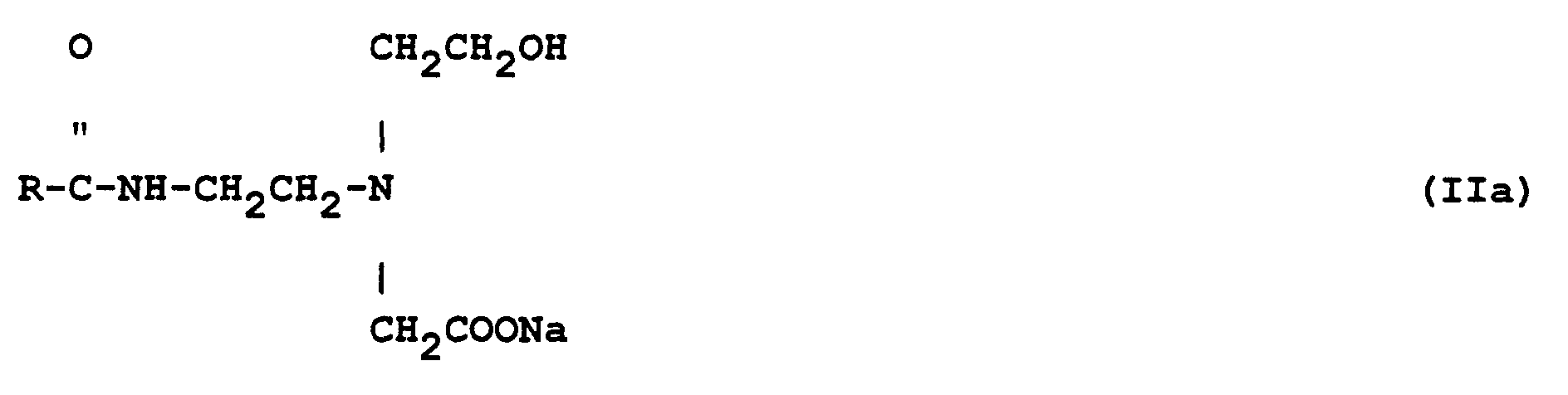
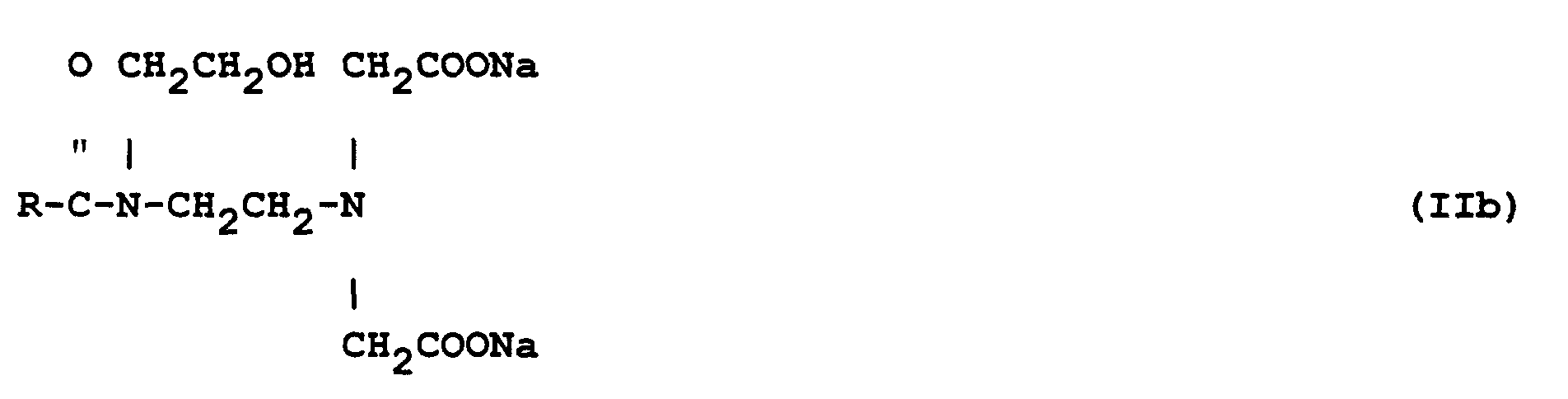
- amphoteric surfactants with the highest possible content of compounds of type (IIb) should be made available.
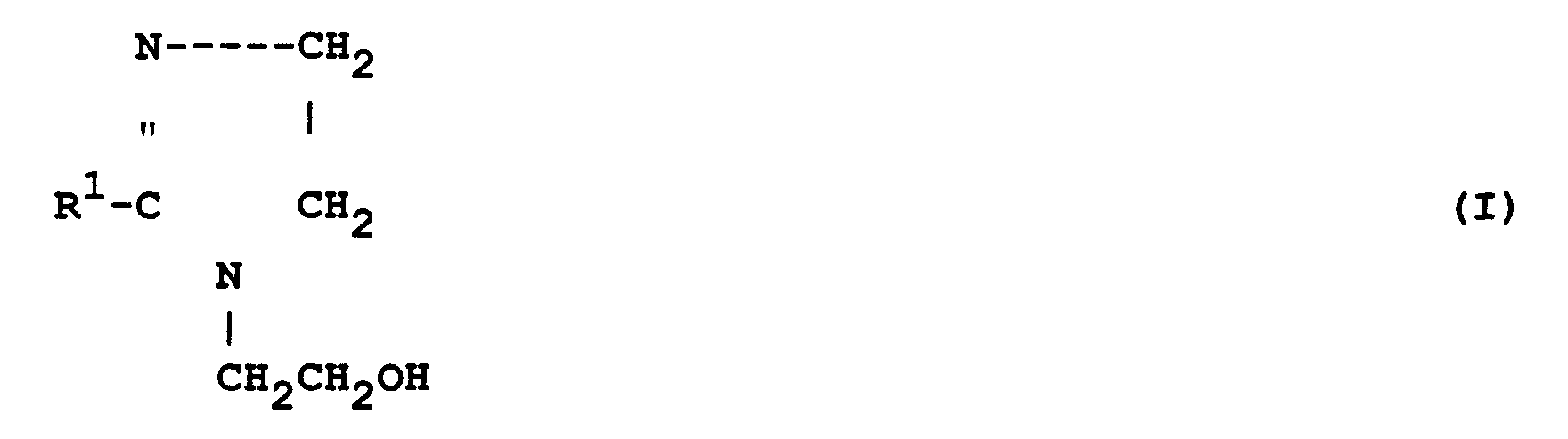
- 1-Hydroxyethyl-2-alkyl-2-imidazolines are known substances which are obtained, for example, by condensing fatty acids with aminoethylethanolamine.
- Typical examples of imidazolines which can be used as starting materials in the process according to the invention are the condensation products of aminoethylethanolamine with caproic acid, caprylic acids, capric acid, lauric acid, myristic acid, palmitic acid, stearic acid, isostearic acid, arachic acid and behenic acid and their technical mixtures, such as, for example in the pressure splitting of native fats and oils.
- Imidazolines of the formula (I) based on technical coconut or tallow fatty acids are preferred, in which R 1 represents an alkyl radical having 11 to 17 carbon atoms.
- Halogenated carboxylic acid salts are understood to mean the sodium and / or potassium salts of haloacetic acid , halopropionic acid and / or halobutyric acid .
- Sodium chloroacetate is preferably used.
- the imidazolines and the halogenated Carboxylic acid salts in molar amounts of 1: 1.5 to 1: 3, preferably 1: 1.8 to 1: 2.5 can be used.
- Sodium hydroxide solution and / or potassium hydroxide solution come in as aqueous bases Consideration; preferably 5 to 55 and in particular 30 to 50 wt .-% solutions of sodium hydroxide used.
- the amount of base depends on the content of halogenated Carboxylic acid salt.
- Base and salt are preferably combined in one molar ratio of 0.9: 1 to 1: 1.2, preferably 1: 1 up to 1: 1.1.
- the task of the base is with the halogen content the carboxylic acid salt is an inorganic salt, e.g. Sodium chloride. If it is in practice anyway should be advantageous to go beyond the equimolar ratio, so then when to maintain that as critical recognized pH range a higher base concentration is required. It has been used to buffer the mixtures also proven advantageous, for example the solutions add small amounts of citric acid.
- a solution of aqueous sodium chloroacetate and citric acid is presented. Starting at 40 ° C the imidazoline is inside of 30 min, the temperature being raised to approx. 50 ° C and the pH measured in the mixture increases to 11.65. Then the temperature is quickly increased to 70 ° C, whereby the pH value drops. In the sense of the method according to the invention the pH is now 8.5 by adding aqueous sodium hydroxide solution kept constant. HPLC analysis one at this time taken sample shows that mono- and and predominantly Dicarboxylate coexist.
- the chromatogram does not show any small parts reacted imidazoline.
- the remaining amount of base is in a Portion added.
- the adjusted to pH 8.5 by adding acid a ratio of di / monocarboxylate greater than 6; the Viscosity is below 100 mPas.
- the pH value is used for storage lowered to 6.
- reaction is carried out at pH values greater than 9, it can be determined with the aid of HPLC that the majority of the imidazoline hydrolyzes before quaternization can take place.
- the parallel carboxylmethylation provides a highly viscous product that mainly contains compounds of type (IIa) .
- amphoteric surfactant concentrates of the prior art obtained on the basis of imidazoline show, without exception, a steadily increasing viscosity during storage, the speed of which depends on the storage conditions, but in particular on the ratio of the mono- and dicarboxylates (IIa) and (IIb) .
- the di / monocarboxylate ratio decreases from 3.2 to 1.4 after a storage period of 4 weeks at 60 ° C. for products of the prior art; this results in an increase in viscosity of more than four times the initial value.
- the sensitivity to hydrolysis of (IIb) can be countered by adjusting the product to a pH of 5 to 7 for storage. HPLC investigations have shown that under these conditions the di / monocarboxylate ratio and the free fatty acid content remain constant even after prolonged storage.
- amphoteric surfactants obtainable by the process according to the invention are thin and stable over a long period of time. They are suitable for the production of surface-active Agents, especially detergents and cleaning agents, as well as products for hair and body care, in which they are used in quantities of 0.1 to 25, preferably 0.5 to 10 wt .-% - based on the Means - may be included.
- thermometer In a 400 ml four-neck mixer with reflux condenser, The thermometer, pH electrode and dropping funnel were 77.7 g (666 mmol) sodium chloroacetate dissolved in 170.2 g of water. After offer of 0.6 g of citric acid monohydrate were inside at 40 ° C 25 g 100 g (371 mmol) of 1-hydroxyethyl-2-undecyl-2-imidazoline evenly added, the temperature to 50 ° C. and the pH (measured in the reaction mixture) to 11.7 rise.
- the reaction mixture was then rapidly opened Heated to 70 ° C, a drop in pH being observed could; by adding 38.9 g (486 mmol) of sodium hydroxide in The pH became a 50% by weight aqueous solution kept constant at 8.5 and the mixture over 240 min touched. The pH was then increased to 9.0 and constant for a further 180 min by adding sodium hydroxide solution held; up to this total consumption of NaOH Time 47.5 g (593.7 mmol). After a further 120 min - the pH had meanwhile dropped to 8.3 - again 5 g (62.5 mmol) sodium hydroxide solution added and stirred for 60 min. To At the end of the reaction, 1500 g of the product obtained divided into 6 portions and with hydrochloric acid or sodium hydroxide solution pH values set in the range from 3 to 12.
Landscapes
- Chemical & Material Sciences (AREA)
- Organic Chemistry (AREA)
- Life Sciences & Earth Sciences (AREA)
- Engineering & Computer Science (AREA)
- Chemical Kinetics & Catalysis (AREA)
- Oil, Petroleum & Natural Gas (AREA)
- Wood Science & Technology (AREA)
- Health & Medical Sciences (AREA)
- Molecular Biology (AREA)
- Materials Engineering (AREA)
- Detergent Compositions (AREA)
- Organic Low-Molecular-Weight Compounds And Preparation Thereof (AREA)
Description
| Kenndaten des Produktes: | |
| Viskosität | 40 mPas |
| Di/Monocarboxylat-Verhältnis | 8,9 |
| Wassergehalt (nach Fischer) | 49,8 Gew.-% |
| Lagerverhalten erfindungsgemäßes Beispiel 2 | ||||
| pH-Wert | T °C | DMV | Fettsäure Gew.-% | Viskos. mPas |
| 3,05 | 5 | 7,2 | 0,24 | 5100 |
| 25 | 6,7 | 0,35 | 4500 | |
| 60 | 4,5 | 2,70 | 16300 | |
| 5,07 | 5 | 8,3 | 0,29 | 280 |
| 25 | 8,2 | 0,24 | 270 | |
| 60 | 6,6 | 0,40 | 1210 | |
| 7,04 | 5 | 8,3 | 0,22 | 280 |
| 25 | 8,2 | 0,25 | 250 | |
| 60 | 5,3 | 0,35 | 2150 | |
| 8,59 | 5 | 8,2 | 0,24 | 155 |
| 25 | 8,1 | 0,27 | 120 | |
| 60 | 3,3 | 1,00 | 12500 | |
| 10,46 | 5 | 8,4 | 0,32 | 130 |
| 25 | 8,4 | 0,34 | 120 | |
| 60 | 4,2 | 2,50 | 21000 | |
| 12,0 | 5 | 4,1 | 2,60 | 35000 |
| 25 | 3,8 | 3,50 | n.m. | |
| 60 | 0,7 | 8,4 | n.m. | |
| Legende: T = Temperatur DMV = Verhältnis Di/Monocarboxylat Viskos. = Viskosität Kegel/Platte-System bei 25°C mit Viskosimeter Fa.Carri-Med Ltd. n.m. = nicht meßbar |
| Lagerverhalten Vergleichsbeispiel | |||||
| pH-Wert | T °C | Lt w | DMV | Fettsäure Gew.-% | Viskos. mPa.s |
| 8,25 | - | - | 3,2 | 1,1 | 380 |
| 8,10 | 60 | 1 | 2,6 | 2,1 | 16000 |
| 7,90 | 60 | 4 | 1,4 | 4,3 | 40000 |
| Legende: Lt = Lagerzeit w = Wochen |
Claims (7)
- Verfahren zur Herstellung dünnflüssiger, lagerstabiler Amphotenside, bei dem mana) 1-Hydroxyethyl-2-alkyl-2-imidazoline der Formel (I),in der R1 für einen Alkylrest mit 5 bis 21 Kohlenstoffatomen steht, bei einem pH-Wert im Bereich von 7,5 bis 9 und genauer Kontrolle des pH-Wertes mit halogenierten Carbonsäuresalzen quaterniert bzw. carboxymethyliert und gleichzeitig mit wäßrigen Basen hydrolysiert sowie
 b) die Reaktionsendprodukte auf einen pH = 5 bis 7 einstellt.
 - Verfahren nach Anspruch 1, dadurch gekennzeichnet, daß man Imidazoline der Formel (I) einsetzt, in der R1 für einen Alkylrest mit 11 bis 17 Kohlenstoffatomen steht.
- Verfahren nach Anspruch 1, dadurch gekennzeichnet, daß man als halogeniertes Carbonsäuresalz Natriumchloracetat einsetzt.
- Verfahren nach Anspruch 1, dadurch gekennzeichnet, daß man die Imidazoline und die halogenierten Carbonsäuresalze in molaren Mengen von 1 : 1,5 bis 1 : 3 einsetzt.
- Verfahren nach Anspruch 1, dadurch gekennzeichnet, daß man die Quaternierung bzw. Carboxymethylierung sowie die Hydrolyse gleichzeitig bei Temperaturen im Bereich von 70 bis 85°C durchführt.
- Verfahren nach Anspruch 1, dadurch gekennzeichnet, daß daß man als wäßrige Basen 5 bis 55 gew.-%ige Lösungen von Natriumhydroxid einsetzt.
- Verfahren nach Anspruch 1, dadurch gekennzeichnet, daß man die halogenierten Carbonsäuresalze und die Basen im molaren Verhältnis von 0,9 : 1 bis 1 : 1,2 einsetzt.
Applications Claiming Priority (3)
| Application Number | Priority Date | Filing Date | Title |
|---|---|---|---|
| DE4240154A DE4240154A1 (de) | 1992-11-30 | 1992-11-30 | Verfahren zur Herstellung dünnflüssiger, lagerstabiler Amphotenside |
| DE4240154 | 1992-11-30 | ||
| PCT/EP1993/003273 WO1994012477A1 (de) | 1992-11-30 | 1993-11-22 | Verfahren zur herstellung dünnflüssiger, lagerstabiler amphotenside |
Publications (2)
| Publication Number | Publication Date |
|---|---|
| EP0670830A1 EP0670830A1 (de) | 1995-09-13 |
| EP0670830B1 true EP0670830B1 (de) | 2001-06-27 |
Family
ID=6473967
Family Applications (1)
| Application Number | Title | Priority Date | Filing Date |
|---|---|---|---|
| EP94901844A Expired - Lifetime EP0670830B1 (de) | 1992-11-30 | 1993-11-22 | Verfahren zur herstellung dünnflüssiger, lagerstabiler amphotenside |
Country Status (5)
| Country | Link |
|---|---|
| US (1) | US5569767A (de) |
| EP (1) | EP0670830B1 (de) |
| JP (1) | JPH08503483A (de) |
| DE (2) | DE4240154A1 (de) |
| WO (1) | WO1994012477A1 (de) |
Families Citing this family (12)
| Publication number | Priority date | Publication date | Assignee | Title |
|---|---|---|---|---|
| CA2132289A1 (en) * | 1993-10-12 | 1995-04-13 | Bharat Desai | Higher purity imidazoline based amphoacetate surfactants and processes for the preparation thereof |
| DE19505196C1 (de) * | 1995-02-16 | 1996-05-02 | Henkel Kgaa | Niedrigviskose wäßrige Konzentrate von Betaintensiden |
| DE19636205C2 (de) * | 1996-09-06 | 1998-07-09 | Henkel Kgaa | Verfahren zur Herstellung dünnflüssiger, lagerstabiler Amphotenside |
| US6121222A (en) * | 1996-12-27 | 2000-09-19 | Rhodia Inc. | Anionic surfactants having multiple hydrophobic and hydrophilic groups |
| US6030938A (en) * | 1996-12-31 | 2000-02-29 | Rhodia Inc. | Process for making salt-free amphoterics with high mono amphopropionate content |
| US5789371A (en) * | 1997-04-22 | 1998-08-04 | Rhodia Inc. | Amphoteric surfactants having multiple hydrophobic and hydrophilic groups |
| US6025522A (en) * | 1999-04-30 | 2000-02-15 | Clariant Finance (Bvi) Ltd. | Process for making secondary amphoacetates and diacetates |
| US6710038B1 (en) * | 1999-12-14 | 2004-03-23 | Kibun Food Chemifa Co., Ltd. | Emulsification method using propylene glycol hyaluronate |
| DE60012866T2 (de) * | 1999-12-14 | 2005-09-08 | Kibun Food Chemifa Co., Ltd. | Propylenglykolhyaluronat und äusserlich anzuwendendes Hautpflegemittel, das dieses enthält |
| IT1317863B1 (it) * | 2000-02-29 | 2003-07-15 | Vama Farmacosmetica S R L | Fabbricazione e utilizzo di amfoglicinati da oli e burri vegetali. |
| RU2213090C1 (ru) * | 2002-04-29 | 2003-09-27 | Щекинское открытое акционерное общество "Химволокно" | Способ получения катионных пав на основе замещенных 2-алкилимидазолинов |
| CN101254434B (zh) * | 2007-12-05 | 2010-09-15 | 天津理工大学 | 二羧基硬脂酸酰胺表面活性剂及其合成方法 |
Family Cites Families (10)
| Publication number | Priority date | Publication date | Assignee | Title |
|---|---|---|---|---|
| US2773168A (en) * | 1953-01-22 | 1956-12-04 | Firth Sterling Inc | High-speed spark machining apparatus |
| GB850514A (en) * | 1955-10-31 | 1960-10-05 | Joseph Nicholas Masci | Detergent compositions |
| GB930296A (en) * | 1959-10-01 | 1963-07-03 | Ruth A Walker | The preparation of acylamino compounds |
| DE2063424A1 (de) * | 1970-12-23 | 1972-07-20 | Rewo Chemische Fabrik Gmbh, 6497 Steinau | Verfahren zur Herstellung quarternärer Imidazolinverbindungen sowie solche Verbindungen enthaltender Tensidgemische |
| NO150275C (no) * | 1977-08-18 | 1984-09-19 | Albright & Wilson | Organiske nitrogenholdige forbindelser og fremgangsmaate til deres fremsilling, samt anvendelse av forbindelsene i sjampo |
| US4269730A (en) * | 1978-05-01 | 1981-05-26 | Stepan Chemical Company | Substituted imidazoline reactions with chloroacetate salts |
| DE3018201A1 (de) * | 1980-05-13 | 1981-11-19 | Henkel KGaA, 4000 Düsseldorf | Verfahren zur raffination des rohen kondensationsproduktes aus aminoalkylalkanolaminen und fettsaeuren sowie gewuenschtenfalls zur anschliessenden gewinnung von amphotensiden mit erhoehter lagerstabilitaet |
| JPS62126157A (ja) * | 1985-11-25 | 1987-06-08 | Kao Corp | 両性界面活性剤の製造方法 |
| DE3641871A1 (de) * | 1986-12-08 | 1988-06-09 | Henkel Kgaa | Verfahren zur herstellung duennfluessiger amphotenside |
| DE4038983A1 (de) * | 1990-12-06 | 1992-06-11 | Henkel Kgaa | Verfahren zur herstellung duennfluessiger imidazoliniumtenside durch quaternierung von 1-hydroxyethyl-2-alkylimidazolinen |
-
1992
- 1992-11-30 DE DE4240154A patent/DE4240154A1/de not_active Withdrawn
-
1993
- 1993-11-22 JP JP6512742A patent/JPH08503483A/ja active Pending
- 1993-11-22 WO PCT/EP1993/003273 patent/WO1994012477A1/de not_active Ceased
- 1993-11-22 DE DE59310184T patent/DE59310184D1/de not_active Expired - Fee Related
- 1993-11-22 EP EP94901844A patent/EP0670830B1/de not_active Expired - Lifetime
-
1995
- 1995-07-25 US US08/436,324 patent/US5569767A/en not_active Expired - Fee Related
Also Published As
| Publication number | Publication date |
|---|---|
| JPH08503483A (ja) | 1996-04-16 |
| DE4240154A1 (de) | 1994-06-01 |
| WO1994012477A1 (de) | 1994-06-09 |
| DE59310184D1 (de) | 2001-08-02 |
| EP0670830A1 (de) | 1995-09-13 |
| US5569767A (en) | 1996-10-29 |
Similar Documents
| Publication | Publication Date | Title |
|---|---|---|
| EP0302329B1 (de) | Verfahren zur Herstellung konzentrierter fliessfähiger wässriger Lösungen von Betainen | |
| DE4207386C2 (de) | Wäßrige flüssige Lösung eines Betains mit mindestens 40 Gew.-% Festkörpergehalt | |
| DE69433755T3 (de) | Verfahren zur Herstellung von Imidazolin abgeleiteten Amphoacetat-Tensiden von höherer Reinheit | |
| EP0164058B1 (de) | Fliessfähige Perlglanzdispersion mit niedrigem Tensidanteil | |
| DE69209709T2 (de) | Verfahren zur Herstellung von aus Di- oder Tri-Carboxylsäuren abgeleiteten Grenzflächenaktiven Mitteln | |
| EP0670830A1 (de) | Verfahren zur herstellung dünnflüssiger, lagerstabiler amphotenside | |
| DE2921366A1 (de) | Konzentrierte waessrige oberflaechenaktive zubereitung | |
| DE69220535T2 (de) | Oberflächenaktive, von Sulfobernsteinsäureestern abgeleitete Verbindungen | |
| DE69738570T2 (de) | Konzentrierte wässerige tensidzusammensetzungen von betaintyp und verfahren zu deren herstellung | |
| EP0647613B1 (de) | Verfahren zur Herstellung hochkonzentrierter fliessfähiger wässriger Lösungen von Betainen | |
| DE2836277A1 (de) | Verfahren zur herstellung eines fluessigwaschmittels auf waessriger basis | |
| DE2752116A1 (de) | Disubstituiertes aliphatisches carbonsaeureamidamin, verfahren zu seiner herstellung und es enthaltende mittel | |
| EP0452349B1 (de) | Verfahren zur herstellung von amphoteren grenzflächenaktiven imidazolinderivaten | |
| DE4408228C2 (de) | Verfahren zur Herstellung niedrigviskoser wäßriger Betaintensidkonzentrate | |
| EP0739878B1 (de) | Verfahren zur Herstellung hochkonzentrierter fliessfähiger wässriger Lösungen von Betainen | |
| EP0749412B1 (de) | Niedrigviskose wässrige konzentrate von betaintensiden | |
| DE3032061C1 (de) | Verfahren zur Herstellung eines verpumpbaren oberflaechenaktiven Produktes auf Basis von Polyaetheressigsaeuren | |
| EP0835863A1 (de) | Esterquats | |
| DE19636205C2 (de) | Verfahren zur Herstellung dünnflüssiger, lagerstabiler Amphotenside | |
| EP0040346A1 (de) | Verfahren zur Raffination des rohen Kondensationsproduktes aus Aminoalkylalkanolaminen und Fettsäuren sowie gewünschtenfalls zur anschliessenden Gewinnung von Amphotensiden mit erhöhter Lagerstabilität | |
| DE1959651A1 (de) | Verfahren zur Herstellung neuer Oligopeptidderivate | |
| DE2557456A1 (de) | Verfahren zur herstellung von aminoxiden | |
| DE69314698T2 (de) | Verwendung eines Amids als Verdickungsmittel und dieses enthaltende Zusammensetzung | |
| EP0492228A1 (de) | Verfahren zur Herstellung fliessfähiger wässriger Dispersionen von Betainen | |
| DE19524265C2 (de) | Verfahren zur Herstellung von Amphotensiden |
Legal Events
| Date | Code | Title | Description |
|---|---|---|---|
| PUAI | Public reference made under article 153(3) epc to a published international application that has entered the european phase |
Free format text: ORIGINAL CODE: 0009012 |
|
| 17P | Request for examination filed |
Effective date: 19950522 |
|
| AK | Designated contracting states |
Kind code of ref document: A1 Designated state(s): DE FR IT |
|
| 17Q | First examination report despatched |
Effective date: 19991116 |
|
| RAP1 | Party data changed (applicant data changed or rights of an application transferred) |
Owner name: COGNIS DEUTSCHLAND GMBH |
|
| GRAG | Despatch of communication of intention to grant |
Free format text: ORIGINAL CODE: EPIDOS AGRA |
|
| RTI1 | Title (correction) |
Free format text: PROCESS FOR PREPARING FLUID, STORAGE-STABLE AMPHOLYTIC SURFACE-ACTIVE AGENTS |
|
| GRAG | Despatch of communication of intention to grant |
Free format text: ORIGINAL CODE: EPIDOS AGRA |
|
| GRAH | Despatch of communication of intention to grant a patent |
Free format text: ORIGINAL CODE: EPIDOS IGRA |
|
| RBV | Designated contracting states (corrected) |
Designated state(s): DE FR IT |
|
| GRAH | Despatch of communication of intention to grant a patent |
Free format text: ORIGINAL CODE: EPIDOS IGRA |
|
| GRAA | (expected) grant |
Free format text: ORIGINAL CODE: 0009210 |
|
| AK | Designated contracting states |
Kind code of ref document: B1 Designated state(s): DE FR IT |
|
| PG25 | Lapsed in a contracting state [announced via postgrant information from national office to epo] |
Ref country code: IT Free format text: LAPSE BECAUSE OF FAILURE TO SUBMIT A TRANSLATION OF THE DESCRIPTION OR TO PAY THE FEE WITHIN THE PRE;WARNING: LAPSES OF ITALIAN PATENTS WITH EFFECTIVE DATE BEFORE 2007 MAY HAVE OCCURRED AT ANY TIME BEFORE 2007. THE CORRECT EFFECTIVE DATE MAY BE DIFFERENT FROM THE ONE RECORDED.SCRIBED TIME-LIMIT Effective date: 20010627 |
|
| REF | Corresponds to: |
Ref document number: 59310184 Country of ref document: DE Date of ref document: 20010802 |
|
| ET | Fr: translation filed | ||
| PLBE | No opposition filed within time limit |
Free format text: ORIGINAL CODE: 0009261 |
|
| STAA | Information on the status of an ep patent application or granted ep patent |
Free format text: STATUS: NO OPPOSITION FILED WITHIN TIME LIMIT |
|
| 26N | No opposition filed | ||
| PG25 | Lapsed in a contracting state [announced via postgrant information from national office to epo] |
Ref country code: DE Free format text: LAPSE BECAUSE OF NON-PAYMENT OF DUE FEES Effective date: 20020702 |
|
| PG25 | Lapsed in a contracting state [announced via postgrant information from national office to epo] |
Ref country code: FR Free format text: LAPSE BECAUSE OF NON-PAYMENT OF DUE FEES Effective date: 20020730 |
|
| REG | Reference to a national code |
Ref country code: FR Ref legal event code: ST |
|
| REG | Reference to a national code |
Ref country code: FR Ref legal event code: ST |