EP0671626B1 - Dispositif et procédé combinant un essai de bioaffinité et une séparation électrophorétique - Google Patents
Dispositif et procédé combinant un essai de bioaffinité et une séparation électrophorétique Download PDFInfo
- Publication number
- EP0671626B1 EP0671626B1 EP94810146A EP94810146A EP0671626B1 EP 0671626 B1 EP0671626 B1 EP 0671626B1 EP 94810146 A EP94810146 A EP 94810146A EP 94810146 A EP94810146 A EP 94810146A EP 0671626 B1 EP0671626 B1 EP 0671626B1
- Authority
- EP
- European Patent Office
- Prior art keywords
- capillary
- molecular recognition
- capillary system
- recognition elements
- analyte
- Prior art date
- Legal status (The legal status is an assumption and is not a legal conclusion. Google has not performed a legal analysis and makes no representation as to the accuracy of the status listed.)
- Expired - Lifetime
Links
- 238000000926 separation method Methods 0.000 title claims description 27
- 238000000034 method Methods 0.000 title claims description 22
- 238000003556 assay Methods 0.000 title claims description 20
- 239000012491 analyte Substances 0.000 claims description 51
- 238000005251 capillar electrophoresis Methods 0.000 claims description 13
- 239000011521 glass Substances 0.000 claims description 13
- 230000003993 interaction Effects 0.000 claims description 10
- 230000008878 coupling Effects 0.000 claims description 8
- 238000010168 coupling process Methods 0.000 claims description 8
- 238000005859 coupling reaction Methods 0.000 claims description 8
- 230000005684 electric field Effects 0.000 claims description 8
- 239000004065 semiconductor Substances 0.000 claims description 6
- VYPSYNLAJGMNEJ-UHFFFAOYSA-N Silicium dioxide Chemical compound O=[Si]=O VYPSYNLAJGMNEJ-UHFFFAOYSA-N 0.000 claims description 5
- 238000001514 detection method Methods 0.000 claims description 5
- 239000005350 fused silica glass Substances 0.000 claims description 5
- 239000003814 drug Substances 0.000 claims description 4
- 229940079593 drug Drugs 0.000 claims description 4
- 239000000203 mixture Substances 0.000 claims description 4
- 150000001720 carbohydrates Chemical class 0.000 claims description 3
- 235000014633 carbohydrates Nutrition 0.000 claims description 3
- 229920000642 polymer Polymers 0.000 claims description 3
- 239000002861 polymer material Substances 0.000 claims description 3
- 238000002218 isotachophoresis Methods 0.000 claims description 2
- 238000004377 microelectronic Methods 0.000 claims description 2
- 108090000623 proteins and genes Proteins 0.000 claims description 2
- 238000010561 standard procedure Methods 0.000 claims description 2
- 230000000063 preceeding effect Effects 0.000 claims 3
- 230000027455 binding Effects 0.000 description 10
- 239000000243 solution Substances 0.000 description 8
- 239000011324 bead Substances 0.000 description 7
- 238000002347 injection Methods 0.000 description 7
- 239000007924 injection Substances 0.000 description 7
- OKKJLVBELUTLKV-UHFFFAOYSA-N Methanol Chemical compound OC OKKJLVBELUTLKV-UHFFFAOYSA-N 0.000 description 6
- 239000011248 coating agent Substances 0.000 description 6
- 238000000576 coating method Methods 0.000 description 6
- 230000001419 dependent effect Effects 0.000 description 5
- 238000011049 filling Methods 0.000 description 5
- 241000894007 species Species 0.000 description 5
- YXFVVABEGXRONW-UHFFFAOYSA-N Toluene Chemical compound CC1=CC=CC=C1 YXFVVABEGXRONW-UHFFFAOYSA-N 0.000 description 4
- MXWJVTOOROXGIU-UHFFFAOYSA-N atrazine Chemical compound CCNC1=NC(Cl)=NC(NC(C)C)=N1 MXWJVTOOROXGIU-UHFFFAOYSA-N 0.000 description 4
- 238000010494 dissociation reaction Methods 0.000 description 4
- 230000005593 dissociations Effects 0.000 description 4
- 239000000126 substance Substances 0.000 description 4
- 241000208199 Buxus sempervirens Species 0.000 description 3
- 238000004458 analytical method Methods 0.000 description 3
- 230000008901 benefit Effects 0.000 description 3
- 230000000903 blocking effect Effects 0.000 description 3
- 229910052751 metal Inorganic materials 0.000 description 3
- 239000002184 metal Substances 0.000 description 3
- 238000004094 preconcentration Methods 0.000 description 3
- 238000001179 sorption measurement Methods 0.000 description 3
- SJECZPVISLOESU-UHFFFAOYSA-N 3-trimethoxysilylpropan-1-amine Chemical compound CO[Si](OC)(OC)CCCN SJECZPVISLOESU-UHFFFAOYSA-N 0.000 description 2
- XKRFYHLGVUSROY-UHFFFAOYSA-N Argon Chemical compound [Ar] XKRFYHLGVUSROY-UHFFFAOYSA-N 0.000 description 2
- IJGRMHOSHXDMSA-UHFFFAOYSA-N Atomic nitrogen Chemical compound N#N IJGRMHOSHXDMSA-UHFFFAOYSA-N 0.000 description 2
- SXRSQZLOMIGNAQ-UHFFFAOYSA-N Glutaraldehyde Chemical compound O=CCCCC=O SXRSQZLOMIGNAQ-UHFFFAOYSA-N 0.000 description 2
- -1 aminopropyltriethoxysilyl Chemical group 0.000 description 2
- 239000000427 antigen Substances 0.000 description 2
- 239000000872 buffer Substances 0.000 description 2
- 230000003196 chaotropic effect Effects 0.000 description 2
- 239000003795 chemical substances by application Substances 0.000 description 2
- 230000009260 cross reactivity Effects 0.000 description 2
- 230000000694 effects Effects 0.000 description 2
- GNBHRKFJIUUOQI-UHFFFAOYSA-N fluorescein Chemical compound O1C(=O)C2=CC=CC=C2C21C1=CC=C(O)C=C1OC1=CC(O)=CC=C21 GNBHRKFJIUUOQI-UHFFFAOYSA-N 0.000 description 2
- 238000011534 incubation Methods 0.000 description 2
- 238000004519 manufacturing process Methods 0.000 description 2
- 239000000463 material Substances 0.000 description 2
- 238000000746 purification Methods 0.000 description 2
- 230000035945 sensitivity Effects 0.000 description 2
- 206010013710 Drug interaction Diseases 0.000 description 1
- 239000012901 Milli-Q water Substances 0.000 description 1
- KFXKOQKIAJLZNS-UHFFFAOYSA-N [ethoxy(dimethyl)silyl]methanethiol Chemical compound CCO[Si](C)(C)CS KFXKOQKIAJLZNS-UHFFFAOYSA-N 0.000 description 1
- 239000013543 active substance Substances 0.000 description 1
- 230000000274 adsorptive effect Effects 0.000 description 1
- 238000001042 affinity chromatography Methods 0.000 description 1
- 238000002299 affinity electrophoresis Methods 0.000 description 1
- 102000036639 antigens Human genes 0.000 description 1
- 108091007433 antigens Proteins 0.000 description 1
- 238000013459 approach Methods 0.000 description 1
- 239000007864 aqueous solution Substances 0.000 description 1
- 229910052786 argon Inorganic materials 0.000 description 1
- 238000005452 bending Methods 0.000 description 1
- OMWQUXGVXQELIX-UHFFFAOYSA-N bitoscanate Chemical compound S=C=NC1=CC=C(N=C=S)C=C1 OMWQUXGVXQELIX-UHFFFAOYSA-N 0.000 description 1
- 229910021538 borax Inorganic materials 0.000 description 1
- 239000012888 bovine serum Substances 0.000 description 1
- 239000007853 buffer solution Substances 0.000 description 1
- 238000001311 chemical methods and process Methods 0.000 description 1
- 239000003153 chemical reaction reagent Substances 0.000 description 1
- 238000004140 cleaning Methods 0.000 description 1
- 238000010668 complexation reaction Methods 0.000 description 1
- 150000001875 compounds Chemical class 0.000 description 1
- 239000012141 concentrate Substances 0.000 description 1
- 238000011161 development Methods 0.000 description 1
- 230000018109 developmental process Effects 0.000 description 1
- 230000003292 diminished effect Effects 0.000 description 1
- UQGFMSUEHSUPRD-UHFFFAOYSA-N disodium;3,7-dioxido-2,4,6,8,9-pentaoxa-1,3,5,7-tetraborabicyclo[3.3.1]nonane Chemical compound [Na+].[Na+].O1B([O-])OB2OB([O-])OB1O2 UQGFMSUEHSUPRD-UHFFFAOYSA-N 0.000 description 1
- 238000001035 drying Methods 0.000 description 1
- 238000001962 electrophoresis Methods 0.000 description 1
- 230000005284 excitation Effects 0.000 description 1
- 238000000605 extraction Methods 0.000 description 1
- 239000003365 glass fiber Substances 0.000 description 1
- 239000003292 glue Substances 0.000 description 1
- 238000010438 heat treatment Methods 0.000 description 1
- 239000005556 hormone Substances 0.000 description 1
- 229940088597 hormone Drugs 0.000 description 1
- 238000009396 hybridization Methods 0.000 description 1
- 238000005286 illumination Methods 0.000 description 1
- 238000003018 immunoassay Methods 0.000 description 1
- 230000000984 immunochemical effect Effects 0.000 description 1
- 238000002372 labelling Methods 0.000 description 1
- 238000004811 liquid chromatography Methods 0.000 description 1
- 239000011159 matrix material Substances 0.000 description 1
- 238000012986 modification Methods 0.000 description 1
- 230000004048 modification Effects 0.000 description 1
- 229910052757 nitrogen Inorganic materials 0.000 description 1
- 230000009871 nonspecific binding Effects 0.000 description 1
- 230000003287 optical effect Effects 0.000 description 1
- 239000013307 optical fiber Substances 0.000 description 1
- 239000003960 organic solvent Substances 0.000 description 1
- 238000000053 physical method Methods 0.000 description 1
- 238000005498 polishing Methods 0.000 description 1
- 230000008092 positive effect Effects 0.000 description 1
- 239000008057 potassium phosphate buffer Substances 0.000 description 1
- ASHGTUMKRVIOLH-UHFFFAOYSA-L potassium;sodium;hydrogen phosphate Chemical compound [Na+].[K+].OP([O-])([O-])=O ASHGTUMKRVIOLH-UHFFFAOYSA-L 0.000 description 1
- 102000004169 proteins and genes Human genes 0.000 description 1
- 230000004850 protein–protein interaction Effects 0.000 description 1
- 238000004451 qualitative analysis Methods 0.000 description 1
- 238000011002 quantification Methods 0.000 description 1
- 238000004445 quantitative analysis Methods 0.000 description 1
- 230000002285 radioactive effect Effects 0.000 description 1
- 230000009467 reduction Effects 0.000 description 1
- 230000008929 regeneration Effects 0.000 description 1
- 238000011069 regeneration method Methods 0.000 description 1
- 239000012266 salt solution Substances 0.000 description 1
- 239000002356 single layer Substances 0.000 description 1
- 235000010339 sodium tetraborate Nutrition 0.000 description 1
- 239000004328 sodium tetraborate Substances 0.000 description 1
- 239000007790 solid phase Substances 0.000 description 1
- 230000004304 visual acuity Effects 0.000 description 1
- XLYOFNOQVPJJNP-UHFFFAOYSA-N water Substances O XLYOFNOQVPJJNP-UHFFFAOYSA-N 0.000 description 1
Images

Classifications
-
- G—PHYSICS
- G01—MEASURING; TESTING
- G01N—INVESTIGATING OR ANALYSING MATERIALS BY DETERMINING THEIR CHEMICAL OR PHYSICAL PROPERTIES
- G01N33/00—Investigating or analysing materials by specific methods not covered by groups G01N1/00 - G01N31/00
- G01N33/48—Biological material, e.g. blood, urine; Haemocytometers
- G01N33/50—Chemical analysis of biological material, e.g. blood, urine; Testing involving biospecific ligand binding methods; Immunological testing
- G01N33/53—Immunoassay; Biospecific binding assay; Materials therefor
- G01N33/558—Immunoassay; Biospecific binding assay; Materials therefor using diffusion or migration of antigen or antibody
- G01N33/561—Immunoelectrophoresis
-
- G—PHYSICS
- G01—MEASURING; TESTING
- G01N—INVESTIGATING OR ANALYSING MATERIALS BY DETERMINING THEIR CHEMICAL OR PHYSICAL PROPERTIES
- G01N2474/00—Immunochemical assays or immunoassays characterised by detection mode or means of detection
- G01N2474/20—Immunohistochemistry assay
-
- Y—GENERAL TAGGING OF NEW TECHNOLOGICAL DEVELOPMENTS; GENERAL TAGGING OF CROSS-SECTIONAL TECHNOLOGIES SPANNING OVER SEVERAL SECTIONS OF THE IPC; TECHNICAL SUBJECTS COVERED BY FORMER USPC CROSS-REFERENCE ART COLLECTIONS [XRACs] AND DIGESTS
- Y10—TECHNICAL SUBJECTS COVERED BY FORMER USPC
- Y10S—TECHNICAL SUBJECTS COVERED BY FORMER USPC CROSS-REFERENCE ART COLLECTIONS [XRACs] AND DIGESTS
- Y10S435/00—Chemistry: molecular biology and microbiology
- Y10S435/961—Chemistry: molecular biology and microbiology including a step of forming, releasing, or exposing the antigen or forming the hapten-immunogenic carrier complex or the antigen per se
-
- Y—GENERAL TAGGING OF NEW TECHNOLOGICAL DEVELOPMENTS; GENERAL TAGGING OF CROSS-SECTIONAL TECHNOLOGIES SPANNING OVER SEVERAL SECTIONS OF THE IPC; TECHNICAL SUBJECTS COVERED BY FORMER USPC CROSS-REFERENCE ART COLLECTIONS [XRACs] AND DIGESTS
- Y10—TECHNICAL SUBJECTS COVERED BY FORMER USPC
- Y10S—TECHNICAL SUBJECTS COVERED BY FORMER USPC CROSS-REFERENCE ART COLLECTIONS [XRACs] AND DIGESTS
- Y10S436/00—Chemistry: analytical and immunological testing
- Y10S436/807—Apparatus included in process claim, e.g. physical support structures
- Y10S436/81—Tube, bottle, or dipstick
Definitions
- the invention concerns a device for combined bioaffinity assay and electrophoretic separation according to the preamble of patent claim 1.
- the invention also concerns a method for accomplishing a combined bioaffinity assay and electrophoretic separation according to the preamble of patent claim 14.
- the impact is largely dependent on the relative affinity to the antibody and the relative concentration of the antibody molecule in comparison with the affinity and concentration of the analyte.
- the cross-reactivity in antigen-antibody binding of structural analogues can not always be controlled in a manner that only a single analyte will interact with the antibody.
- a positive effect of cross-reactivity of molecular recognition elements is that they are nowadays often employed for the preconcentration of analytes either off-line or on-line with chromatographic and/or spectroscopic analytical procedures.
- the binding of the analyte molecules to the antibodies is not uniform, due to the unpredictable and inhomogeneous flow conditions in the glass beads filled capillary.
- the association and dissociation kinetics is different.
- Differences in mass-transport of the analyte molecules from the solution to the antibodies can give rise to peak broadening, which results in a reduction of the resolution of the device.
- JP-A-5 172 815 describes a method for the quantification of a substance bond to receptors in the solid phase of a glass capillary by electrophoretic purification.
- FR-A-2 498 331 discloses a pipette, in which the suction pipe is fitted with a removable, transparent cone point and the interior face of the point has antibody molecules fixed to the surface.
- WO 82/02211 describes a device comprising a plurality of capillary elements, each having antibodies or antigens attached to an internal surface thereof.
- the flow conditions for the analyte within the capillaries shall be predictable and generally homogeneous. Location-dependent effects of the association and dissociation kinetics of the analyte molecule - molecular recognition element interaction shall be avoided such, that a high separation efficiency can be achieved.
- a device for combined bioaffinity assay and electrophoretic separation which comprises a capillary system having two parts, a first part in which bioaffinity assay interaction of analyte molecules and molecular recognition elements is performed and a second part, in which electrophoretic separation of the analyte molecules and subsequent detection of the separated species is accomplished.
- the molecular recognition elements are attached and immobilized to the inside capillary wall, for example, by adsorption or by covalent binding to the capillary material.
- the molecular recognition elements which are attached and immobilized to the capillary inside wall are, for example, antibodies, antigenes, receptors, drugs, DNA-strands, carbohydrates, and the like more recognition elements, or combinations of two or more of these elements.
- the attachment and immobilization of the molecular recognition elements to the inside capillary wall can easily be performed automatically such, that manual labor is reduced. In addition this automatization results in a high precision of the device, which thus can be identically mass-produced.
- the capillary system is established preferably planarely on a small slab of glass, polymer, or semiconducting material by michromachining or by standard techniques known from microelectronics industry.
- This specific embodiment of the invention has the advantage, that, if desired, even electric couplings for electrodes for establishing an electric field and for detecting signals from a detector for electrophoretically separated species can be integrated on the slab of glass, polymer, or semiconducting material.
- the molecular recognition elements are attached to the inside walls of the first part of the capillary system.
- the total length of first part of the capillary system can be enlarged in a controlled manner, for example, by providing a controlled roughness of the side walls, or by providing a meander-shaped channel.
- the flow conditions are controllable and predictable.
- the overall dimensions of this chip-embodiment of the invention are very small; such chip-solutions at the most have the size of a conventional semiconductor wafer, and usually they are considerably smaller such, that a number of chips can be established simultaneously on one wafer. This particularly contributes to an easy and cheap manufacture of the device according to the invention.
- the method for combined bioaffinity assay and electrophoretic separation according to independent claim 14 comprises flowing an analyte through a capillary system having two parts.
- the analyte molecules are captured by respective molecular recognition elements present in that part. More particularly the analyte molecules are captured by molecular recognition elements which are attached and immobilized to the inside wall of that capillary part, for example, by adsorption or by covalent binding to the capillary material.
- the analyte-molecules are dissociated from the molecular recognition elements.
- the analyte-molecules are separated in a second part of the capillary system by electrophoresis and finally the separated species are detected at the terminal part of the capillary system.
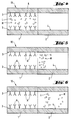
- FIG. 1 An exemplary embodiment of the device according to the invention is depicted schematically in Fig. 1 and is generally designated with the reference number 10. It comprises a capillary system of a length from about 0.1 cm to about 200 cm, preferably about 1 cm to about 50 cm and an internal cross-sectional area from about 5 ⁇ m 2 to about 100000 ⁇ m 2 .
- the shape of the internal cross-section of the capillary system can be about circular, rectangular, trapezoidal, or similar.
- the capillary system also comprises entrance and exit openings for the introduction and the removal of an analyte and a carrier medium (if required). For reasons of simplification of the schematic drawing the respective entrance and exit openings are not depicted in Fig. 1.
- the capillary system comprises a first part 1, in which bioaffinity interaction and preconcentration of analyte molecules are performed and a second part 2, in which electrophoretic separation of the preconcentrated analyte molecules and subsequent detection of the separated species is accomplished.
- the electrodes for building up an electric field along the longitudinal extension of the second part of the capillary system are not depicted in order to simplify the drawing.
- one of ordinary skill in the art will be aware of various embodiments for such electrodes, such as, for example, thin metal rings on thc inside wall 4 of the capillary tube which are connected with a thin wire that extends through the capillary wall and ends in an electric coupling provided on the outside of the capillary tube.
- the capillary system is realized on a small slab of glass or semiconducting material. In that case the electrodes and the couplings could be integrated on the "chip" applying well known manufacture techniques from microchip industry.
- molecular recognition elements A are attached and immobilized to the inside of the capillary wall 3.
- the molecular recognition elements can be attached to the capillary wall, for example, by adsorption or by covalent binding. However other physical and/or chemical techniques are equally applicable. Adsorptive binding is generally easier to achieve and theoretically opens possibilities for the regeneration of the bioaffinity part of the first part 1 of the capillary system.
- the first capillary part 1 should occupy only a limited length of the capillary.
- the capillary should be occupied by molecular recognition elements A, so that a sufficient length of the capillary is available for the actual electrophoretic separation of the analyte molecules after release from the molecular recognition elements A.
- the length of the first part 1 amounts to about 1% to about 95%, preferably less than 25% of the total length of the capillary system.
- the first and the second part are separated by a dotted line.
- the capillary system comprises two capillary tubes 1,2.
- a first capillary tube which is coated along its entire length on its inside wall 3 with molecular recognition elements, is coupled with a capillary 2 that enables optimal separation conditions.
- the length of each stage is easily controlled and can readily be adapted to the requirements.
- the capillary system comprises two capillary tubes 1,2 the dotted lines in Figs.1-6 stand for the ends of the two capillary tubes along which they are attached with each other, and are preferably glued together.
- Figs. 2-6 the method for combined bioaffinity assay and electrophoretic separation is illustrated for a single class of molecular recognition elements A and one species of analyte molecules, which consist of unlabeled analyte molecules M and labeled analyte molecules L.
- the labeling of part of the analyte molecules can be achieved by various methods. For example, luminescent, ultraviolet radiating, radioactive, or electrochemically active substances can be used.
- the device depicted for the illustration of the method according to the invention corresponds to the one shown in Fig. 1.
- It can comprise one capillary tube only, or it can comprise two or more capillary tubes, such as, for example, a first tube 1 which is coated along its inside wall 3 with the molecular recognition elements A and a second one 2 for carrying out the separation on the principle of capillary electrophoresis.
- a first tube 1 which is coated along its inside wall 3 with the molecular recognition elements A and a second one 2 for carrying out the separation on the principle of capillary electrophoresis.
- the unlabeled analyte molecules M are symbolyzed by the small rectangles while the L-shaped symbols stand for the labeled analyte molecules L.
- the molecular recognition elements A are bound to a limited length of the internal capillary wall 3 at the injection side of the capillary.
- a mixture of the unlabeled and labeled analyte molecules M and L of defined concentrations is shown injected into the first part 1 of the capillary system so, that these can interact with the molecular recognition elements A on the inside walls of the capillary.
- concentrations of the unlabeled analyte molecules M With increasing concentrations of the unlabeled analyte molecules M, the amount of the labeled analyte molecules L that is captured by the molecular recognition elements A, will decrease. After an adequate incubation time an equilibrium will be found between the bound and free fractions of the labeled analyte molecules L and of the unlabeled analyte molecules M.
- standardized assay conditions are maintained, even non-equilibrium conditions can be used.
- the bound fractions of the labeled and unlabeled analyte molecules L and M are released by the molecular recognition elements A.
- a chaotropic agent e.g. a salt-solution, an organic solvent or another buffer solution
- the dissociation-rate can be increased and reassociation can be diminished.
- the next step is the separation of the labeled analyte molecules L and the unlabeled analyte molecules M in the electrical field inside the second capillary part 2.
- the separation efficiency in capillary electrophoresis CE is, among others, dependent on the size of the injected sample plug. Therefore ist is desirable to concentrate the labeled and unlabeled analyte molecules L and M which are spread over the length of the first capillary stage after the dissociation step.
- This concentration can be achieved by various methods, for example by Isotachophoresis or by isoelectrical focussing.
- a field amplified sample concentration is accomplished using the electrical field within the second part 2.
- the conductivity of the sample with the chaotropic agent and the analyte molecules L and M is chosen smaller than the conductivity of the separation buffer. Then under the condition that the analyte molecules L and M are charged, these are concentrated due to the higher electrical field, as is indicated in Fig. 5.
- This stacking effect is essential for the efficiency of the separation in the second part 2 of the capillary system, which is indicated in Fig. 6, and for a precise quantitation of the labeled analyte molecules L.
- the separation efficiency does not play a major role.
- the separation efficiency is very important for multi-analyte assays employing different molecular recognition elements and labels.
- Atrazine, 2-ethylamino-4-chloro-6-isopropylamino-1,3,5-triazine, monoclonal antibodies against atrazine and fluoresceine labeled atrazine (FA) are obtained from internal sources of the applicant.
- Bovine Serum Albumine (BSA) can be obtained from Fluka (Buchs, Switzerland) and may be used without further purification.
- a P/ACE 2100 electropherograph equipped with a fluorescence detector or a UV detector is used (Beckman Instruments, Fullerton CA, USA).
- a 15 mW Argon laser (Spectra-Physics, Mt. View CA, USA) operating at 488 nm and a custom-build optical system, delivering 5 mW at the end of the optical fiber positioned on the detection window of the capillary can be used for excitation of the fluoresceine labeled analyte molecules.
- Electrophoretic separations can be made by applying, for example, 20 to 30 kV over the capillary, which is kept at 30°C, injections usually are made by pressure.
- Coated capillaries are custom made after cleaning fused silica capillaries with 1 M KOH for 2 h, rinsing with water for 10 min and rinsing with 0.1 M HCl for 10 min and drying for 3 h at 200°C during which the capillary is flushed with nitrogen.
- Coating with (mercaptomethyl) dimethylethoxysilane (MDS, Fluka, Buchs Switzerland) can be done by filling the capillary with this reagent and placing it for 18 h in an oven at 200°C under vacuum in order to obtain a monolayer on the capillary wall.
- Coating with 3-aminopropyltrimethoxysilane can be done by filling the capillary with a 2% solution in toluol and heating the capillary at 100°C for 3 h. After this the capillary is rinsed with methanol for 10 min.
- This aminopropyl coated capillary can be used for covalent binding of antibodies and BSA after treatment with 0.5% glutaraldehyde (Merck, Darmstadt, Germany) in PB7 for 4 hours at room temperature and subsequently the capillary is rinsed with PB7.
- Coating of capillaries with antibodies is achieved by filling the capillaries with a mixture of the antibody solution (10 ⁇ g protein/ml) and PB7 in case of capillary coupling or by pressure injection for 30 or 60 sec by means of an electropherograph. After injection the capillaries are laid horizontally in order to avoid siphoning of the antibodies through the capillaries during the 3 h incubation at room temperature. Then the capillaries are filled with a solution of BSA in PB7 (1-2 mg/ml) and incubated for another 3 hours at room temperature in an attempt to reduce non-specific binding.
- a fused silica capillary is first modified with 3-amino-propyltrimethoxysilane function.
- Glutaraldehyde is used to bind the antibodies to the capillary surface.
- the length of the capillary coating preferably equals to the length of the injected plug of antibody solution and can be calculated when the column dimensions, the viscosity of the medium and the applied pressure are known. They also can be estimated by a determination of the relation between the length of the capillary and the break through time of a continuous injection of an aqueous FA solution. Under the assumption that the viscosity of the antibody solution does not differ from that of other aqueous solutions, the injected plug length can be calculated on basis of the injection time.
- a 7 cm long coated capillary is coupled to an uncoated fused silica capillary of 30 or 40 cm length, the i.d. of both capillaries is either 50 or 75 ⁇ m.
- the capillary can be held in order to polish the capillary ends with a Beckman capillary cutter or with polishing sheets. In that way a zero dead-volume coupling can be obtained.
- the surface of the capillary end can be checked. The easiests way to position the capillaries is by using a metal wire with a diameter of 40 or 70 ⁇ m for capillaries with an i.d.
- a glass-fibre plate 10 x 15x 2 mm normally used as the basis for an electronic print, with a 360 ⁇ m deep V-shaped (90 degrees) groove, can be used for the positioning of the capillaries.
- the stability and binding properties of antibodies to the inside wall of the first stage of the capillary system are virtually unaffected by the type of immobilisation and the electrical field across the capillary system.
- Immobilisation of different antibodies, either mixed in one zone or in separate zones of the first stage of the capillary system provides for the development of combined multianalyte bioaffinity assay and capillary electrophoresis analysis.
- the advantages of both bioaffinity assay analysis and capillary electrophoresis are used.
- the claimed invention overcomes the disadvantages of the prior art approaches and provides a device and a method which is readily applicable and results in a high analytical sensitivity.
Landscapes
- Health & Medical Sciences (AREA)
- Life Sciences & Earth Sciences (AREA)
- Immunology (AREA)
- Chemical & Material Sciences (AREA)
- Molecular Biology (AREA)
- Engineering & Computer Science (AREA)
- Urology & Nephrology (AREA)
- Hematology (AREA)
- Microbiology (AREA)
- Biomedical Technology (AREA)
- Biotechnology (AREA)
- Cell Biology (AREA)
- Electrochemistry (AREA)
- Chemical Kinetics & Catalysis (AREA)
- Food Science & Technology (AREA)
- Medicinal Chemistry (AREA)
- Physics & Mathematics (AREA)
- Analytical Chemistry (AREA)
- Biochemistry (AREA)
- General Health & Medical Sciences (AREA)
- General Physics & Mathematics (AREA)
- Pathology (AREA)
- Investigating Or Analysing Biological Materials (AREA)
Claims (17)
- Dispositif de recherche de bioaffinité et de séparation électrophorétique combinées comportant un système capillaire doté de deux parties, une première partie (1) dans laquelle l'interaction par bioaffinité entre les molécules de l'analyte (L, M) et les éléments de reconnaissance moléculaire (A) est effectuée et une seconde partie (2) dans laquelle la séparation électrophorétique des molécules d'analyte (L, M) et la détection ultérieure des espèces séparées sont effectuées, caractérisé en ce que les éléments de reconnaissance moléculaire (A) sont fixés et immobilisés sur la paroi intérieure (3) de la première partie capillaire (1).
- Dispositif selon la revendication 1, dans lequel le système capillaire présente une section transversale intérieure circulaire, rectangulaire, trapézoïdale ou de forme similaire.
- Dispositif selon l'une des revendications précédentes, dans lequel le système capillaire présente une longueur totale correspondant à la somme des longueurs des première et seconde parties (1, 2) qui est d'environ 0,1 cm à environ 200 cm, de préférence d'environ 1 cm à environ 50 cm.
- Dispositif selon la revendication 3, dans lequel la longueur de la première partie (1) représente environ 1 % à 95 %, de préférence moins de 25 % de la longueur totale du système capillaire.
- Dispositif selon l'une des revendications précédentes, dans lequel le système capillaire comprend au moins un tube capillaire.
- Dispositif selon l'une des revendications 1 à 5, dans lequel le système capillaire comporte au moins deux tubes capillaires, un premier tube capillaire constituant la première partie (1) avec les éléments de reconnaissance moléculaire (A) fixés à sa paroi intérieure (3) et un second tube capillaire (2) adapté pour effectuer la séparation électrophorétique et la détection des espèces séparées, qui sont connectés entre eux et qui, de préférence, sont collés l'un à l'autre au niveau de leurs surfaces d'extrémité.
- Dispositif selon la revendication 5 ou 6, dans lequel les tubes capillaires (1, 2) sont en verre de silice et présentent une surface de section transversale d'environ 5 µm2 à environ 100 000 µm2.
- Dispositif selon l'une des revendications 1 à 5, dans lequel le système capillaire est de préférence placé de façon plane sur une petite plaque d'un matériau de verre, polymère ou semi-conducteur par micro-usinage ou selon des techniques standard utilisées dans l'industrie de la micro-électronique.
- Dispositif selon la revendication 8, dans lequel des couplages électriques des électrodes pour établir un champ électrique à travers le système capillaire et pour détecter les signaux provenant d'un détecteur d'espèces séparées par électrophorèse sont intégrés à la plaque de matériau de verre ou semi-conducteur.
- Dispositif selon la revendication 8 ou 9, dans lequel la première partie (1) du système capillaire est façonnée de telle sorte qu'un élargissement contrôlé est obtenu de la surface à laquelle les éléments de reconnaissance moléculaire (A) sont fixés, tandis que les conditions d'écoulement des molécules de l'analyte (L, M) demeurent prévisibles.
- Dispositif selon la revendication 10, dans lequel la paroi intérieure (3) de la première partie (1) du système capillaire présente une rugosité définie.
- Dispositif selon la revendication 10 ou 11, dans lequel la première partie (1) du système capillaire est de forme méandrique.
- Dispositif selon l'une quelconque des revendications précédentes, dans lequel les éléments de reconnaissance moléculaire (A) sont des anticorps, ou des antigènes, ou des récepteurs, ou des médicaments, ou des brins d'ADN, ou des hydrates de carbone, ou équivalents, ou des mélanges de deux ou de plusieurs de ces éléments.
- Procédé de recherche de bioaffinité et de séparation électrophorétique combinées, dans lequel un analyte comprenant une ou plusieurs espèce(s) de molécules d'analyte est transporté à travers un système capillaire comportant deux parties, une première partie capillaire (1) dans laquelle les molécules d'analyte (L, M) sont capturées par des éléments de reconnaissance moléculaire respectifs (A) présents dans cette partie et sont dissociécs de nouveau des éléments de reconnaissance moléculaire (A) après un temps prédéterminé et une seconde partie (2) du système capillaire dans laquelle les molécules d'analyte (L, M) sont séparées par électrophorèse capillaire, puis les espèces séparées des molécules d'analyte sont finalement détectées au niveau de la partie terminale du système capillaire, caractérisé en ce que les molécules d'analyte (L, M) sont capturées par les éléments de reconnaissance moléculaire (A) qui sont fixés et immobilisés sur la paroi intérieure (3) de cette partie capillaire (1).
- Procédé selon la revendication 14, dans lequel les molécules d'analyte (L, M) sont concentrées dans la seconde partie suivante (2) du système capillaire.
- Procédé selon la revendication 15, dans lequel la concentration des molécules d'analyte (L, M) est réalisée par isotachophorèse ou par isoélectrofocalisation ou par concentration d'échantillons à amplification de champ du fait du champ électrique présent dans la seconde partie du système capillaire.
- Procédé selon l'une quelconque des revendications 14 à 16, dans lequel on utilise en tant qu'éléments de reconnaissance moléculaire (A) des anticorps, ou des antigènes, ou des récepteurs, ou des médicaments, ou des brins d'ADN, ou des hydrates de carbone, ou équivalents, ou des mélanges de deux ou de plusieurs de ces éléments.
Priority Applications (5)
| Application Number | Priority Date | Filing Date | Title |
|---|---|---|---|
| EP94810146A EP0671626B1 (fr) | 1994-03-08 | 1994-03-08 | Dispositif et procédé combinant un essai de bioaffinité et une séparation électrophorétique |
| DE69422604T DE69422604T2 (de) | 1994-03-08 | 1994-03-08 | Vorrichtung und Verfahren, die Bioaffinitätsassay und elektrophoretische Auftrennung kombinieren |
| US08/396,310 US5741639A (en) | 1994-03-08 | 1995-02-28 | Device and method for combined bioaffinity assay and electrophoretic separation of multiple analytes |
| CA002143999A CA2143999C (fr) | 1994-03-08 | 1995-03-06 | Dispositif et methode pour essai de bioaffinite et separation par electrophorese combines |
| JP7074615A JPH07311198A (ja) | 1994-03-08 | 1995-03-07 | 組み合わされたバイオアフィニティーアッセイ及び電気泳動分離のための装置及び方法 |
Applications Claiming Priority (1)
| Application Number | Priority Date | Filing Date | Title |
|---|---|---|---|
| EP94810146A EP0671626B1 (fr) | 1994-03-08 | 1994-03-08 | Dispositif et procédé combinant un essai de bioaffinité et une séparation électrophorétique |
Publications (2)
| Publication Number | Publication Date |
|---|---|
| EP0671626A1 EP0671626A1 (fr) | 1995-09-13 |
| EP0671626B1 true EP0671626B1 (fr) | 2000-01-12 |
Family
ID=8218222
Family Applications (1)
| Application Number | Title | Priority Date | Filing Date |
|---|---|---|---|
| EP94810146A Expired - Lifetime EP0671626B1 (fr) | 1994-03-08 | 1994-03-08 | Dispositif et procédé combinant un essai de bioaffinité et une séparation électrophorétique |
Country Status (5)
| Country | Link |
|---|---|
| US (1) | US5741639A (fr) |
| EP (1) | EP0671626B1 (fr) |
| JP (1) | JPH07311198A (fr) |
| CA (1) | CA2143999C (fr) |
| DE (1) | DE69422604T2 (fr) |
Cited By (5)
| Publication number | Priority date | Publication date | Assignee | Title |
|---|---|---|---|---|
| US9423397B2 (en) | 2006-03-10 | 2016-08-23 | Indx Lifecare, Inc. | Waveguide-based detection system with scanning light source |
| US9528939B2 (en) | 2006-03-10 | 2016-12-27 | Indx Lifecare, Inc. | Waveguide-based optical scanning systems |
| US9976192B2 (en) | 2006-03-10 | 2018-05-22 | Ldip, Llc | Waveguide-based detection system with scanning light source |
| US10018566B2 (en) | 2014-02-28 | 2018-07-10 | Ldip, Llc | Partially encapsulated waveguide based sensing chips, systems and methods of use |
| US11181479B2 (en) | 2015-02-27 | 2021-11-23 | Ldip, Llc | Waveguide-based detection system with scanning light source |
Families Citing this family (56)
| Publication number | Priority date | Publication date | Assignee | Title |
|---|---|---|---|---|
| US5824478A (en) * | 1996-04-30 | 1998-10-20 | Vysis, Inc. | Diagnostic methods and probes |
| US6379515B1 (en) | 1996-05-24 | 2002-04-30 | Novartis Ag | Process for separating mixtures of substances using capillary affinity gel electrophoresis |
| US6074827A (en) | 1996-07-30 | 2000-06-13 | Aclara Biosciences, Inc. | Microfluidic method for nucleic acid purification and processing |
| US6020209A (en) | 1997-04-28 | 2000-02-01 | The United States Of America As Represented By The Secretary Of The Navy | Microcapillary-based flow-through immunosensor and displacement immunoassay using the same |
| ATE335845T1 (de) * | 1997-05-16 | 2006-09-15 | Exact Sciences Corp | Elektrophoretische analyse von molekülen mit immobilisierten sonden |
| US6368871B1 (en) * | 1997-08-13 | 2002-04-09 | Cepheid | Non-planar microstructures for manipulation of fluid samples |
| AU1384299A (en) | 1997-11-06 | 1999-05-31 | Mosaic Technologies | Multiple sequential polynucleotide displacement reactions for signal amplification and processing |
| US6251660B1 (en) | 1997-11-25 | 2001-06-26 | Mosaic Technologies, Inc. | Devices and methods for detecting target molecules in biological samples |
| EP1179585B1 (fr) | 1997-12-24 | 2008-07-09 | Cepheid | Dispositif et procédé de Lyse |
| WO1999066078A1 (fr) | 1998-06-18 | 1999-12-23 | Mosaic Technologies | Electrophorese par denaturation selon l'affinite d'un gradient et ses procedes d'utilisation |
| CA2330732A1 (fr) * | 1998-06-19 | 1999-12-23 | Mosaic Technologies | Detection d'organismes non viraux ayant un arn srp |
| EP1115424A1 (fr) | 1998-08-28 | 2001-07-18 | Febit Ferrarius Biotechnology GmbH | Procede et dispositif de mesure pour la determination d'une pluralite d'analytes dans un echantillon |
| WO2000020643A1 (fr) | 1998-10-05 | 2000-04-13 | Mosaic Technologies | Analyse par deplacement inverse pour la detection de sequences d'acide nucleique |
| US7914994B2 (en) * | 1998-12-24 | 2011-03-29 | Cepheid | Method for separating an analyte from a sample |
| US6431476B1 (en) | 1999-12-21 | 2002-08-13 | Cepheid | Apparatus and method for rapid ultrasonic disruption of cells or viruses |
| ATE265040T1 (de) * | 1999-02-26 | 2004-05-15 | Exact Sciences Corp | Biochemische reinigungsgeräte mit immobilisierten fangsonden und ihre anwendungen |
| JP3957118B2 (ja) * | 1999-05-18 | 2007-08-15 | 富士フイルム株式会社 | 試験片およびこの試験片からの画像情報読取装置 |
| US9073053B2 (en) | 1999-05-28 | 2015-07-07 | Cepheid | Apparatus and method for cell disruption |
| DE60022025T2 (de) | 1999-05-28 | 2006-06-29 | Cepheid, Sunnyvale | Anlage zum brechen von zellen |
| US8815521B2 (en) | 2000-05-30 | 2014-08-26 | Cepheid | Apparatus and method for cell disruption |
| US20040200909A1 (en) * | 1999-05-28 | 2004-10-14 | Cepheid | Apparatus and method for cell disruption |
| US6878540B2 (en) * | 1999-06-25 | 2005-04-12 | Cepheid | Device for lysing cells, spores, or microorganisms |
| US6294392B1 (en) | 1999-07-21 | 2001-09-25 | The Regents Of The University Of California | Spatially-encoded analyte detection |
| EP1218743B1 (fr) | 1999-07-26 | 2006-05-31 | THE GOVERNMENT OF THE UNITED STATES OF AMERICA, as represented by THE SECRETARY, DEPARTMENT OF HEALTH AND HUMAN SERVICES | Dispositif a couches avec des regions de capture pour l'analyse cellulaire |
| US7838222B2 (en) * | 1999-07-26 | 2010-11-23 | United States of America/ NIH | Methods, devices and kits for multiplex blotting of biological samples from multi-well plates |
| US7214477B1 (en) | 1999-07-26 | 2007-05-08 | The United States Of America As Represented By The Secretary Of The Department Of Health And Human Services | Layered device with capture regions for cellular analysis |
| US6969615B2 (en) * | 1999-07-26 | 2005-11-29 | 20/20 Genesystems, Inc. | Methods, devices, arrays and kits for detecting and analyzing biomolecules |
| US6423536B1 (en) * | 1999-08-02 | 2002-07-23 | Molecular Dynamics, Inc. | Low volume chemical and biochemical reaction system |
| US7329388B2 (en) * | 1999-11-08 | 2008-02-12 | Princeton Biochemicals, Inc. | Electrophoresis apparatus having staggered passage configuration |
| US6406604B1 (en) * | 1999-11-08 | 2002-06-18 | Norberto A. Guzman | Multi-dimensional electrophoresis apparatus |
| US6676815B1 (en) * | 1999-12-30 | 2004-01-13 | Roche Diagnostics Corporation | Cell for electrochemical analysis of a sample |
| AU2001242928A1 (en) * | 2000-03-16 | 2001-09-24 | Biacore Ab | Method for capturing analytes eluted from surface-bound ligands |
| DE10051396A1 (de) | 2000-10-17 | 2002-04-18 | Febit Ferrarius Biotech Gmbh | Verfahren und Vorrichtung zur integrierten Synthese und Analytbestimmung an einem Träger |
| US7691645B2 (en) * | 2001-01-09 | 2010-04-06 | Agilent Technologies, Inc. | Immunosubtraction method |
| SE526185C2 (sv) | 2001-11-07 | 2005-07-19 | Prolight Diagnostics Ab | Metod och anordning för immunanalys |
| US20060147926A1 (en) * | 2002-11-25 | 2006-07-06 | Emmert-Buck Michael R | Method and apparatus for performing multiple simultaneous manipulations of biomolecules in a two-dimensional array |
| US8007724B2 (en) | 2003-11-07 | 2011-08-30 | Princeton Biochemicals, Inc. | Electrophoresis apparatus having at least one auxiliary buffer passage |
| JP2007510935A (ja) * | 2003-11-07 | 2007-04-26 | プリンストン・バイオケミカルズ・インコーポレーテッド | 多次元電気泳動装置 |
| FR2862134B1 (fr) * | 2003-11-12 | 2007-07-27 | Sebia Sa | Analyse et typage de proteines monoclonales par electrophorese capillaire et immunodeplacement |
| JP4646809B2 (ja) * | 2003-12-26 | 2011-03-09 | パナソニック株式会社 | 生体サンプル判別装置、生体サンプル判別方法、及び生体サンプル判別用プレート |
| US7632687B2 (en) * | 2004-03-23 | 2009-12-15 | Quidel Corporation | Hybrid phase lateral flow assay |
| US7378054B2 (en) * | 2004-04-16 | 2008-05-27 | Savvipharm Inc | Specimen collecting, processing and analytical assembly |
| EP1776581B1 (fr) * | 2004-07-19 | 2015-05-06 | ProteinSimple | Procédé de détection de protéines |
| US7211184B2 (en) * | 2004-08-04 | 2007-05-01 | Ast Management Inc. | Capillary electrophoresis devices |
| US20060160210A1 (en) * | 2004-11-26 | 2006-07-20 | Matsushita Electric Industrial Co., Ltd. | Biological sample analysis plate |
| WO2006062149A1 (fr) * | 2004-12-08 | 2006-06-15 | Matsushita Electric Industrial Co., Ltd. | Plaque d’analyse d’echantillons biologiques |
| JP5592606B2 (ja) | 2005-10-04 | 2014-09-17 | ヘッドウェイ テクノロジーズ,インク. | 被分析物のマイクロ流体的検出 |
| JP4749867B2 (ja) | 2006-01-13 | 2011-08-17 | パナソニック株式会社 | 電気泳動装置 |
| US8658093B2 (en) * | 2007-07-06 | 2014-02-25 | Applied Biosystems, Llc | Devices and methods for the detection of analytes |
| DE102010011560B4 (de) * | 2010-03-16 | 2021-09-16 | Gilupi Gmbh | Biodetektor |
| US9696299B2 (en) | 2010-11-01 | 2017-07-04 | Norberto Guzman | Integrated modular unit including an analyte concentrator microreactor device connected to a cartridge-cassette |
| US8865075B2 (en) | 2010-11-01 | 2014-10-21 | Princeton Biochemicals, Inc. | Multi-task immunoaffinity device secured to a peripheral box and integrated to a capillary electrophoresis apparatus |
| US9927399B2 (en) | 2013-11-12 | 2018-03-27 | Nichiei Industry Co., Ltd. | Capillary device for separation and analysis, microfluidic chip for separation and analysis, analysis method for proteins or peptides, electrophoresis instrument, and microfluidic chip electrophoresis instrument for separation and analysis |
| US11198118B2 (en) | 2017-03-29 | 2021-12-14 | Princeton Biochemicals, Inc. | Integrated modular unit containing one or more analyte concentrator-microreactor devices to be coupled to a cartridge-cassette and methods of operation |
| CN110579603B (zh) * | 2019-08-27 | 2022-08-30 | 武汉纺织大学 | 一种病毒检测传感器、一种检测病毒浓度的装置和方法 |
| WO2021168245A1 (fr) * | 2020-02-20 | 2021-08-26 | FemtoDx | Micro-séparation pour multiplexage |
Family Cites Families (6)
| Publication number | Priority date | Publication date | Assignee | Title |
|---|---|---|---|---|
| NZ199286A (en) * | 1980-12-22 | 1986-05-09 | Commw Serum Lab Commission | A method of detecting antibodies or an antigenic or haptenic substance in a sample |
| FR2498331A1 (fr) * | 1981-01-20 | 1982-07-23 | Kadouche Jean | Recipient reactif pour analyse notamment immunologique |
| US4865707A (en) * | 1986-10-21 | 1989-09-12 | Northeastern University | Capillary gel electrophoresis columns |
| US5013669A (en) * | 1988-06-01 | 1991-05-07 | Smithkline Diagnostics, Inc. | Mass producible biologically active solid phase devices |
| US5135627A (en) * | 1990-10-15 | 1992-08-04 | Soane Technologies, Inc. | Mosaic microcolumns, slabs, and separation media for electrophoresis and chromatography |
| JPH05172815A (ja) * | 1991-12-26 | 1993-07-13 | Hitachi Ltd | 免疫分析方法及びその分析装置 |
-
1994
- 1994-03-08 EP EP94810146A patent/EP0671626B1/fr not_active Expired - Lifetime
- 1994-03-08 DE DE69422604T patent/DE69422604T2/de not_active Expired - Fee Related
-
1995
- 1995-02-28 US US08/396,310 patent/US5741639A/en not_active Expired - Fee Related
- 1995-03-06 CA CA002143999A patent/CA2143999C/fr not_active Expired - Fee Related
- 1995-03-07 JP JP7074615A patent/JPH07311198A/ja active Pending
Cited By (7)
| Publication number | Priority date | Publication date | Assignee | Title |
|---|---|---|---|---|
| US9423397B2 (en) | 2006-03-10 | 2016-08-23 | Indx Lifecare, Inc. | Waveguide-based detection system with scanning light source |
| US9528939B2 (en) | 2006-03-10 | 2016-12-27 | Indx Lifecare, Inc. | Waveguide-based optical scanning systems |
| US9976192B2 (en) | 2006-03-10 | 2018-05-22 | Ldip, Llc | Waveguide-based detection system with scanning light source |
| US10551318B2 (en) | 2006-03-10 | 2020-02-04 | Ldip, Llc | Waveguide-based optical scanning systems |
| US10590493B2 (en) | 2006-03-10 | 2020-03-17 | Ldip, Llc | Waveguide-based detection system with scanning light source |
| US10018566B2 (en) | 2014-02-28 | 2018-07-10 | Ldip, Llc | Partially encapsulated waveguide based sensing chips, systems and methods of use |
| US11181479B2 (en) | 2015-02-27 | 2021-11-23 | Ldip, Llc | Waveguide-based detection system with scanning light source |
Also Published As
| Publication number | Publication date |
|---|---|
| US5741639A (en) | 1998-04-21 |
| CA2143999C (fr) | 2005-10-18 |
| EP0671626A1 (fr) | 1995-09-13 |
| DE69422604D1 (de) | 2000-02-17 |
| DE69422604T2 (de) | 2000-06-08 |
| JPH07311198A (ja) | 1995-11-28 |
| CA2143999A1 (fr) | 1995-09-09 |
Similar Documents
| Publication | Publication Date | Title |
|---|---|---|
| EP0671626B1 (fr) | Dispositif et procédé combinant un essai de bioaffinité et une séparation électrophorétique | |
| US11262330B2 (en) | Disease detection system and method | |
| US7329388B2 (en) | Electrophoresis apparatus having staggered passage configuration | |
| US10408789B2 (en) | Disease detection system and method | |
| EP0670999B1 (fr) | Analyse utilisant la focalisation isoelectrique | |
| JP3035357B2 (ja) | 超高速電気分離分析のための組成物、方法、および装置 | |
| US6406604B1 (en) | Multi-dimensional electrophoresis apparatus | |
| US4939098A (en) | Immunoassay and measurement kit used therefor | |
| Ensing et al. | Immobilization of antibodies as a versatile tool in hybridized capillary electrophoresis | |
| Wang et al. | Integration of capillary isoelectric focusing with monolithic immobilized pH gradient, immobilized trypsin microreactor and capillary zone electrophoresis for on‐line protein analysis | |
| Wang et al. | Enhancement of immunocomplex detection and application to assays for DNA adduct of benzo [a] pyrene | |
| Dalluge et al. | Precolumn affinity capillary electrophoresis for the identification of clinically relevant proteins in human serum: application to human cardiac troponin I | |
| Thomas et al. | Selective trace enrichment by immunoaffinity capillary electrochromatography on‐line with capillary zone electrophoresis—laser‐induced fluorescence | |
| JP2002257721A (ja) | 検体分析方法及び検体分析装置 | |
| Shahdeo et al. | Combining immunoassays with chromatographic and electrophoretic separation techniques—A review | |
| JP2002543388A (ja) | 既知リガンドを用いる連続流バイオアッセイのための質量分析に基づく技術 | |
| EP0848251A2 (fr) | Dosages homogènes en ligne utilisant l'électrophorèse | |
| Tsukagoshi et al. | Development of an immune microanalysis system by use of peroxyoxalate chemiluminescence detection | |
| Chiem | Microfluidic systems for immunoassays. |
Legal Events
| Date | Code | Title | Description |
|---|---|---|---|
| PUAI | Public reference made under article 153(3) epc to a published international application that has entered the european phase |
Free format text: ORIGINAL CODE: 0009012 |
|
| AK | Designated contracting states |
Kind code of ref document: A1 Designated state(s): DE FR GB IT SE |
|
| 17P | Request for examination filed |
Effective date: 19960220 |
|
| RAP1 | Party data changed (applicant data changed or rights of an application transferred) |
Owner name: NOVARTIS AG |
|
| 17Q | First examination report despatched |
Effective date: 19981124 |
|
| GRAG | Despatch of communication of intention to grant |
Free format text: ORIGINAL CODE: EPIDOS AGRA |
|
| GRAG | Despatch of communication of intention to grant |
Free format text: ORIGINAL CODE: EPIDOS AGRA |
|
| GRAH | Despatch of communication of intention to grant a patent |
Free format text: ORIGINAL CODE: EPIDOS IGRA |
|
| GRAH | Despatch of communication of intention to grant a patent |
Free format text: ORIGINAL CODE: EPIDOS IGRA |
|
| RAP1 | Party data changed (applicant data changed or rights of an application transferred) |
Owner name: ZEPTOSENS AG |
|
| GRAA | (expected) grant |
Free format text: ORIGINAL CODE: 0009210 |
|
| AK | Designated contracting states |
Kind code of ref document: B1 Designated state(s): DE FR GB IT SE |
|
| REF | Corresponds to: |
Ref document number: 69422604 Country of ref document: DE Date of ref document: 20000217 |
|
| ET | Fr: translation filed | ||
| ITF | It: translation for a ep patent filed | ||
| PLBE | No opposition filed within time limit |
Free format text: ORIGINAL CODE: 0009261 |
|
| STAA | Information on the status of an ep patent application or granted ep patent |
Free format text: STATUS: NO OPPOSITION FILED WITHIN TIME LIMIT |
|
| 26N | No opposition filed | ||
| REG | Reference to a national code |
Ref country code: GB Ref legal event code: IF02 |
|
| PGFP | Annual fee paid to national office [announced via postgrant information from national office to epo] |
Ref country code: GB Payment date: 20050228 Year of fee payment: 12 |
|
| PGFP | Annual fee paid to national office [announced via postgrant information from national office to epo] |
Ref country code: DE Payment date: 20050309 Year of fee payment: 12 |
|
| PGFP | Annual fee paid to national office [announced via postgrant information from national office to epo] |
Ref country code: SE Payment date: 20050310 Year of fee payment: 12 |
|
| PGFP | Annual fee paid to national office [announced via postgrant information from national office to epo] |
Ref country code: FR Payment date: 20050311 Year of fee payment: 12 |
|
| PG25 | Lapsed in a contracting state [announced via postgrant information from national office to epo] |
Ref country code: GB Free format text: LAPSE BECAUSE OF NON-PAYMENT OF DUE FEES Effective date: 20060308 |
|
| PG25 | Lapsed in a contracting state [announced via postgrant information from national office to epo] |
Ref country code: SE Free format text: LAPSE BECAUSE OF NON-PAYMENT OF DUE FEES Effective date: 20060309 |
|
| PGFP | Annual fee paid to national office [announced via postgrant information from national office to epo] |
Ref country code: IT Payment date: 20060331 Year of fee payment: 13 |
|
| PG25 | Lapsed in a contracting state [announced via postgrant information from national office to epo] |
Ref country code: DE Free format text: LAPSE BECAUSE OF NON-PAYMENT OF DUE FEES Effective date: 20061003 |
|
| EUG | Se: european patent has lapsed | ||
| GBPC | Gb: european patent ceased through non-payment of renewal fee |
Effective date: 20060308 |
|
| REG | Reference to a national code |
Ref country code: FR Ref legal event code: ST Effective date: 20061130 |
|
| PG25 | Lapsed in a contracting state [announced via postgrant information from national office to epo] |
Ref country code: FR Free format text: LAPSE BECAUSE OF NON-PAYMENT OF DUE FEES Effective date: 20060331 |
|
| PG25 | Lapsed in a contracting state [announced via postgrant information from national office to epo] |
Ref country code: IT Free format text: LAPSE BECAUSE OF NON-PAYMENT OF DUE FEES Effective date: 20070308 |