EP0673600A1 - Procédé et installation pour la distribution automatique et dosée d'aliments aux animaux - Google Patents
Procédé et installation pour la distribution automatique et dosée d'aliments aux animaux Download PDFInfo
- Publication number
- EP0673600A1 EP0673600A1 EP95200731A EP95200731A EP0673600A1 EP 0673600 A1 EP0673600 A1 EP 0673600A1 EP 95200731 A EP95200731 A EP 95200731A EP 95200731 A EP95200731 A EP 95200731A EP 0673600 A1 EP0673600 A1 EP 0673600A1
- Authority
- EP
- European Patent Office
- Prior art keywords
- feed
- size
- time
- animals
- delivery
- Prior art date
- Legal status (The legal status is an assumption and is not a legal conclusion. Google has not performed a legal analysis and makes no representation as to the accuracy of the status listed.)
- Granted
Links
Images


Classifications
-
- A—HUMAN NECESSITIES
- A01—AGRICULTURE; FORESTRY; ANIMAL HUSBANDRY; HUNTING; TRAPPING; FISHING
- A01K—ANIMAL HUSBANDRY; AVICULTURE; APICULTURE; PISCICULTURE; FISHING; REARING OR BREEDING ANIMALS, NOT OTHERWISE PROVIDED FOR; NEW BREEDS OF ANIMALS
- A01K29/00—Other apparatus for animal husbandry
-
- A—HUMAN NECESSITIES
- A01—AGRICULTURE; FORESTRY; ANIMAL HUSBANDRY; HUNTING; TRAPPING; FISHING
- A01K—ANIMAL HUSBANDRY; AVICULTURE; APICULTURE; PISCICULTURE; FISHING; REARING OR BREEDING ANIMALS, NOT OTHERWISE PROVIDED FOR; NEW BREEDS OF ANIMALS
- A01K5/00—Feeding devices for stock or game ; Feeding wagons; Feeding stacks
- A01K5/02—Automatic devices
Definitions
- the invention relates to a method and a device for the metered automatic delivery of feed to animals, in particular pigs, according to the preamble of claim 1.
- a method is known from the American patent 4,517,923.
- a predetermined amount of feed in a more or less liquid form is introduced into a feed trough of a relatively large length.
- the feed flows out over the entire length of the trough to a height that is the same everywhere.
- This method is particularly suitable for feeding a large number of animals at the same time, the number of animals that can eat from the feed trough at the same time being determined by the length of this trough.
- it is ensured that the animals that eat together from a single trough are of approximately the same age and weight, so that it can be assumed that all animals receive an equal part of the amount of feed put into the feed trough.
- the feed In the case of dry feeding, the feed is introduced into the feed trough in a dry form, usually in the form of a grain. Because of the dry nature of the feed, it will not flow evenly over the bottom of the trough, so that in order to deliver feed to a large number of animals in a feed trough of a relatively large length, additional means are required to feed the feed evenly over the length of the trough distribute, e.g. a variety of outlets. In practice, this method of automatic feed distribution is therefore only used in combination with a feed trough of a relatively short length, each trough being suitable for one or a few animals.
- a predetermined amount of feed becomes one introduced predetermined composition in the feed trough, said predetermined amount depending on the time, ie the age of the animals to be fed.
- This predetermined amount, divided by the number of animals to be fed, is hereinafter referred to as "portion".
- the course of a portion over time is referred to as the "feed curve”.
- a feed curve is considered a given size that is characteristic of a particular species.
- a feed curve can be freely adjusted (programmable), but for this it is always necessary for the operator to intervene. Such programming may take place when entering the data of a new animal, but a feed curve once entered for a particular animal will not be changed during the life of that animal.
- the feed curve has a characteristic that is comparable to a flowing line, with the daily feed delivery slowly increasing with the age of an animal in relation to that animal's genetically determined growth performance. This is based on the idea that the need for food is proportional to body weight and growth rate (amount of weight gain).
- the invention aims to eliminate the disadvantages mentioned and to provide a method and a device for the metered automatic delivery of feed, with which a more effective use of feed is possible.
- the invention aims to achieve these goals at the lowest possible cost.
- the animal can detect a change in the feed requirement by a corresponding change in its feeding speed, in such a way that the feeding speed or the related parameter feeding time have proven to be reliable and suitable parameters for indicating the current feeding requirement of this animal to have.
- the size of a feed delivery is therefore determined according to the characterizing part of claim 1.
- Dutch patent application 75.09922 describes a system for feeding a group of animals, with the problem that the fastest eating animals steal the food of the slower eating animals.
- This patent application describes a solution to this problem, which is based on feeding all the animals in the group by means of separate troughs for each individual animal in the group, feeding the separate troughs at a rate per unit time that is based on the slowest feeding rate Animal based.
- the invention will be discussed below in relation to the dry feeding of pigs; however, it is expressly noted that the invention is not restricted to applications in pigs and can also be applied to porridge feeding.
- Fig. 1 shows schematically an adaptable feed delivery device 1, provided with a feed trough 10, a storage container 11 for the feed, a feed line 12 for conveying feed from the storage container 11 to the feed trough 10 and a metering flap 13 arranged in the feed line 12, which via a metering control line 14 from a control device 20, for example a computer that can be controlled.
- a control device 20 for example a computer that can be controlled.
- the feed trough 10 is intended for feeding a group of pigs which are all of the same age and, in principle, will have the same feed needs among themselves.
- the number of pigs (A) in this group is already known and in principle constant. Typically, this number A can be 10.
- the pigs cannot all eat from the feed trough 10 at the same time.
- a pig will go to the feed trough when it gets "appetite", and there it will eat for a short time (about 5 minutes), after which it leaves the feed trough to drink go.
- the control device 20 is set up to operate at predetermined times, e.g. three times a day, by appropriately controlling the metering flap 13, to introduce a portion of feed into the feed trough. Since the type and construction of the metering flap 13 do not form part of the subject matter of the present invention and knowledge thereof is not necessary for a person skilled in the art to correctly understand the present invention, these will not be described in more detail here. The same applies to the way in which the metering flap 13 can be controlled by the control device 20. It suffices to note that a metering flap known per se and a control method known per se can be used for this.
- the size V (i) of the i-th portion of feed to be introduced into the feed trough 10, expressed in weight units, is generally dependent on the number A and the age of the pigs, and the course of this with this age is referred to as the feed curve.
- Such a feed curve is stored in a memory 30 of the control device 20, e.g. in the form of a formula or a table as a function of time.
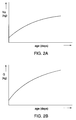
- Figure 2A shows an example of a conventional feed curve for a particular type of pig.
- the feed curve has been determined as the optimal amount for a certain group of test animals with corresponding properties by the test route and is considered to be characteristic of this specific group and to be applicable when feeding feed to individual animals whose properties correspond to those of this specific group.
- FIG. 2B shows the course of the weight G of the type of pig mentioned as a function of time. Broadly, it can be said that the size of a portion of feed is proportional to the weight of the animal.
- FIG. 3 shows in more detail the course of the growth rate ⁇ G (weight gain per day) of a certain type of pig.
- the curve shown is by daily Determination of the weight of a test animal representative of this species was obtained. It is clear from FIG. 3 that the animal in question knows periods of normal growth, denoted by the letter "N", alternating with relatively short periods of reduced growth, denoted by the letter "L".
- FIG. 4 shows, for the same period and for a group of the same test animals, the eating time T (i) of a portion V (i) as determined by the conventional feed curve.
- eating time means the time the group needs to eat up the food portion.
- T N is almost constant during the periods of normal growth and that the eating time T L is considerably longer during the periods of reduced growth; in practice, T L can be twice as large as T N.
- Figure 4 therefore explains that the eating time is a suitable parameter for determining the feeding requirement.
- the feeding speed V / T to be derived from this is a suitable parameter for determining the feed requirement.
- the adaptable feed delivery device 1 is provided with means for adapting the size V (i) of the feed portions to the feed requirement.
- a feed detector 40 is arranged in the feed trough 10 and is connected to the control device 20 via a signal line 41.
- the feed detector 40 sends a signal to the control device 20 via this signal line 41, which indicates the point in time at which the feed has been eaten in the feed trough 10, at least indicating that the feed trough 10 is practically empty.
- detectors which are suitable for serving as a feed detector are: a weight detector which detects the weight of the feed lying on the bottom of the feed trough 10; an optical detector that detects the presence of matter between a light source and a light sensor.
- the former example has the side advantage that the control device 20 receives a signal that is always indicates the amount of feed present in the feed trough 10 so that the feeding speed can be determined for any short period of time, for example every quarter of an hour, from which additional information about the animal's need for feed can be obtained.
- the control device 20 is configured to calculate the eating time T (i) on the basis of a first time T1 at which the control device 20 opens the metering flap 13 in order to introduce feed into the feed trough 10 and a second time T2 at which the control device 20 of the Detector 40 receives the signal that the feed trough 10 is (almost) empty.
- the control device 20 can read a system clock at the aforementioned times and calculate the elapsed time T (i) by subtracting the read times from one another.
- the control device 20 can also start a timer at time T1, stop this timer at time T2 and read the elapsed time T (i) directly from the timer.
- the eating time T (i) calculated by controller 20 may be expressed in time units such as seconds or minutes, but it is also possible that this time is expressed in system units such as "number of pulses counted by a system clock" is.
- the control device 20 is further configured to compare the measured eating time T (i) with the reference value T N , that is to say the eating time which the group needs during periods N of normal growth, by the standard position indicated by V ref according to the feed curve previously entered (see Figure 2A) to eat.
- "significant" means that in practice T N within a certain area, for example can fluctuate between 10 and 12 hours and therefore does not need to be corrected for fluctuations within this area. It will be apparent to those skilled in the art that the size of such an area for a particular type of pig can be easily determined by trial.
- the control device 20 controls the metering flap 13 for the next feed delivery such that the size V (i + 1) of the next feed delivery is less than V ref (i + 1).
- the control device 20 can be programmed to calculate the size V (i + 1) of the next feed delivery according to the following formula (3): If the measured feeding time T (i) becomes significantly shorter than the reference time T N , the control device 20 controls the metering flap 13 for the next feed delivery in such a way that the size V (i + 1) of the next feed delivery is larger than the size V (i) the previous feed levy is. The control device 20 can still use the above formula (3), but it is also possible that the control device 20 then directly adjusts V ref (i + 1).
- V (i + 1) M x V ref (i + 1)
- M can be chosen to be 1, which is equivalent to V ref (i + 1), which value is to be regarded as the upper limit for feed delivery.
- an indicator 42 can be provided near the feed trough 10, e.g. a lamp which can be controlled directly by the feed detector 40 or by the control device 20, as indicated in FIG. 1 by an indicator line 43.
- control device 20 will be used to control the feed delivery to a plurality of troughs 10, the control device 20 and a data input unit coupled to it such as a keypad 21, and a data input unit coupled to the control device 20 such as a screen 22 and / or a printer 23 are arranged at a central point in order to provide operating personnel with a quick overview of the current situation in a simple manner.
- the control device 20 can be set up, in response to a specific command, in relation to a specific feed trough 10, a historical overview of the times of filling, the quantities introduced, the times of "feed trough empty", the measured feeding times, etc. on the Play back screen 22 and / or print it using printer 23.
- FIG. 5 shows a graphical representation of a part of such a historical overview, curve V representing the amount of feed given and curve T the measured eating time.
- a reduced need for feed can also be caused by illness of one or more of the animals concerned.
- a secondary advantage of the invention is therefore that it is possible to obtain an indication at an early stage that an animal is or will be sick, even if there is nothing externally noticeable about the animal. Such an indication can be found by the operating personnel in the historical overview of the measured feeding times and / or the quantities of feed given. Regardless of the cause of a reduced need for feed, however, the advantage according to the invention will always be achieved that the feed is used as optimally as possible and that the amount of manure produced has decreased.
- feed curves can be stored in the memory 30, each of which is characteristic of a specific group, and the associated group can be entered by entering the specific group to which the animal to be fed belongs Feed curve can be selected.
- a plurality of reference times T N can be stored in the memory 30 and can be increased by entering the specific group who owns the animal to be fed, the associated reference time can be selected.
Landscapes
- Life Sciences & Earth Sciences (AREA)
- Environmental Sciences (AREA)
- Animal Husbandry (AREA)
- Biodiversity & Conservation Biology (AREA)
- Birds (AREA)
- Feeding And Watering For Cattle Raising And Animal Husbandry (AREA)
Applications Claiming Priority (2)
| Application Number | Priority Date | Filing Date | Title |
|---|---|---|---|
| NL9400465 | 1994-03-23 | ||
| NL9400465A NL9400465A (nl) | 1994-03-23 | 1994-03-23 | Werkwijze en inrichting voor het gedoseerd automatisch afgeven van voer aan dieren. |
Publications (2)
| Publication Number | Publication Date |
|---|---|
| EP0673600A1 true EP0673600A1 (fr) | 1995-09-27 |
| EP0673600B1 EP0673600B1 (fr) | 1997-10-01 |
Family
ID=19863985
Family Applications (1)
| Application Number | Title | Priority Date | Filing Date |
|---|---|---|---|
| EP19950200731 Expired - Lifetime EP0673600B1 (fr) | 1994-03-23 | 1995-03-23 | Procédé et installation pour la distribution automatique et dosée d'aliments aux animaux |
Country Status (3)
| Country | Link |
|---|---|
| EP (1) | EP0673600B1 (fr) |
| DE (1) | DE59500730D1 (fr) |
| NL (1) | NL9400465A (fr) |
Cited By (5)
| Publication number | Priority date | Publication date | Assignee | Title |
|---|---|---|---|---|
| EP0715806A1 (fr) * | 1994-11-25 | 1996-06-12 | Maschinenfabrik Meyer-Lohne GmbH | Procédé d'alimentation d'animaux, spécialement des bêtes à l'engrais |
| EP3076784A4 (fr) * | 2013-12-08 | 2017-07-12 | The State of Israel - Ministry of Agriculture & Rural Development, Agricultural Research Organization (ARO) (Volcani Center) | Procédé et système de suivi de la consommation de nourriture d'animaux d'élevage |
| WO2018004429A1 (fr) * | 2016-07-01 | 2018-01-04 | Delaval Holding Ab | Dispositif de surveillance et procédé conduit par celui-ci pour déterminer si un animal est correctement alimenté |
| CN115281105A (zh) * | 2022-07-25 | 2022-11-04 | 共享智能装备有限公司 | 基于agv的撒料控制方法 |
| US12048295B2 (en) | 2017-11-22 | 2024-07-30 | The State Of Israel, Ministry Of Agriculture & Rural Development, Agricultural Research Organization (Aro) (Volcani Center) | Method and apparatus for monitoring food intake of livestock animals |
Citations (6)
| Publication number | Priority date | Publication date | Assignee | Title |
|---|---|---|---|---|
| NL7509922A (nl) * | 1974-08-21 | 1976-02-24 | Alfa Laval Ab | Werkwijze voor het voederen van vee, in het bij- zonder tijdens het opfokken van de dieren, als- mede inrichting voor het uitvoeren van de werk- wijze. |
| WO1982003159A1 (fr) * | 1981-03-17 | 1982-09-30 | Steen Blicher | Procede d'alimentation et alimentation utilisee dans ce procede |
| US4493290A (en) * | 1982-05-27 | 1985-01-15 | Dataface Limited | Milk yield recording and concentrate feed ration calculation for dairy cows |
| US4517923A (en) * | 1983-07-07 | 1985-05-21 | Key Systems, Inc. | Animal feeding system |
| DE3623816A1 (de) * | 1985-07-16 | 1987-01-22 | Vogl Gerhard | Fuetterungsanlage fuer tiere |
| WO1991003930A1 (fr) * | 1989-09-21 | 1991-04-04 | Newsham Hybrid Pigs Limited | Ameliorations relatives a l'elevage d'animaux |
-
1994
- 1994-03-23 NL NL9400465A patent/NL9400465A/nl not_active Application Discontinuation
-
1995
- 1995-03-23 DE DE59500730T patent/DE59500730D1/de not_active Expired - Fee Related
- 1995-03-23 EP EP19950200731 patent/EP0673600B1/fr not_active Expired - Lifetime
Patent Citations (6)
| Publication number | Priority date | Publication date | Assignee | Title |
|---|---|---|---|---|
| NL7509922A (nl) * | 1974-08-21 | 1976-02-24 | Alfa Laval Ab | Werkwijze voor het voederen van vee, in het bij- zonder tijdens het opfokken van de dieren, als- mede inrichting voor het uitvoeren van de werk- wijze. |
| WO1982003159A1 (fr) * | 1981-03-17 | 1982-09-30 | Steen Blicher | Procede d'alimentation et alimentation utilisee dans ce procede |
| US4493290A (en) * | 1982-05-27 | 1985-01-15 | Dataface Limited | Milk yield recording and concentrate feed ration calculation for dairy cows |
| US4517923A (en) * | 1983-07-07 | 1985-05-21 | Key Systems, Inc. | Animal feeding system |
| DE3623816A1 (de) * | 1985-07-16 | 1987-01-22 | Vogl Gerhard | Fuetterungsanlage fuer tiere |
| WO1991003930A1 (fr) * | 1989-09-21 | 1991-04-04 | Newsham Hybrid Pigs Limited | Ameliorations relatives a l'elevage d'animaux |
Non-Patent Citations (1)
| Title |
|---|
| ENGELHARDT: "Automatisierte Gewichtserfassung von Rindern 165910", LANDTECHNIK, vol. 45, no. 11, LEHRTE (DE), pages 411 - 412, XP000165910 * |
Cited By (6)
| Publication number | Priority date | Publication date | Assignee | Title |
|---|---|---|---|---|
| EP0715806A1 (fr) * | 1994-11-25 | 1996-06-12 | Maschinenfabrik Meyer-Lohne GmbH | Procédé d'alimentation d'animaux, spécialement des bêtes à l'engrais |
| EP3076784A4 (fr) * | 2013-12-08 | 2017-07-12 | The State of Israel - Ministry of Agriculture & Rural Development, Agricultural Research Organization (ARO) (Volcani Center) | Procédé et système de suivi de la consommation de nourriture d'animaux d'élevage |
| US10595513B2 (en) | 2013-12-08 | 2020-03-24 | The State Of Israel, Ministry Of Agriculture & Rural Development, Agricultural Research Organization (Aro) (Volcani Center) | Method and system for monitoring food intake of livestock animals |
| WO2018004429A1 (fr) * | 2016-07-01 | 2018-01-04 | Delaval Holding Ab | Dispositif de surveillance et procédé conduit par celui-ci pour déterminer si un animal est correctement alimenté |
| US12048295B2 (en) | 2017-11-22 | 2024-07-30 | The State Of Israel, Ministry Of Agriculture & Rural Development, Agricultural Research Organization (Aro) (Volcani Center) | Method and apparatus for monitoring food intake of livestock animals |
| CN115281105A (zh) * | 2022-07-25 | 2022-11-04 | 共享智能装备有限公司 | 基于agv的撒料控制方法 |
Also Published As
| Publication number | Publication date |
|---|---|
| EP0673600B1 (fr) | 1997-10-01 |
| DE59500730D1 (de) | 1997-11-06 |
| NL9400465A (nl) | 1995-11-01 |
Similar Documents
| Publication | Publication Date | Title |
|---|---|---|
| DE69317897T2 (de) | Geflügelfütterungseinrichtung | |
| EP0126240B1 (fr) | Procédé et dispositif pour affourager de grands cheptels, en particulier de porcs | |
| DE69102868T2 (de) | Verfahren und vorrichtung zur fütterung von kühen. | |
| DE69700249T2 (de) | Verfahren zur behandlung von tieren, insbesondere zur deren fütterung | |
| EP0094618A2 (fr) | Procédé pour nourrir des animaux, en particulier des cochons | |
| WO2003094605A1 (fr) | Procede permettant de determiner une quantite d'aliments liquides absorbee par les animaux | |
| DE1910053C3 (de) | Verteilervorrichtung für künstliches Futter zur Jungviehfütterung | |
| DE69518688T2 (de) | Materialzuführungsgerät mit einem Gehäuse | |
| DE2639423A1 (de) | Verfahren und einrichtung zum fuettern von haustieren | |
| DE60205800T2 (de) | Vorrichtung zum Zuführen von Futter zu Tieren | |
| EP0673600B1 (fr) | Procédé et installation pour la distribution automatique et dosée d'aliments aux animaux | |
| EP0615406B1 (fr) | Procede et dispositif d'approvisionnement d'animaux en forage | |
| DE3602048A1 (de) | Vorrichtung zur aufbereitung und/oder dosierten abgabe von futter, insbesondere fluessig-mischfutter | |
| EP2434867B1 (fr) | Station de traite et procédé pour faire fonctionner cette station de traite d'après des données de débit de lait | |
| EP0163079B1 (fr) | Dispositif d'affouragement pour fourrage avec susceptibilité d'être pompé | |
| DE19756367C2 (de) | Fütterungsanlage für die Tierhaltung | |
| DE2536365A1 (de) | Verfahren zum fuettern von haustieren, insbesondere waehrend der aufzucht der tiere und vorrichtung zum durchfuehren des verfahrens | |
| EP1067833B1 (fr) | Procede d'etalonnage automatique d'un appareil pour alimenter des animaux domestiques | |
| EP0599047B1 (fr) | Procédé pour déterminer le débit de matière retirée par une extrudeuse d'une trémie d'alimentation | |
| EP0715806A1 (fr) | Procédé d'alimentation d'animaux, spécialement des bêtes à l'engrais | |
| DE60112365T3 (de) | Vorrichtung zum nacheinander aufnehmen und/oder behandeln von einzelnen tieren aus einer tierherde | |
| DE19938637C2 (de) | Verfahren zum automatischen Kalibrieren einer Vorrichtung zum Versorgen von Haustieren | |
| DE3030334A1 (de) | Verfahren und vorrichtung zum fuettern einer mehrzahl nichtangebundener tiere | |
| EP0738467A1 (fr) | Installation de distribution de nourriture | |
| DE3316434A1 (de) | Verfahren zur fuetterung von vieh |
Legal Events
| Date | Code | Title | Description |
|---|---|---|---|
| PUAI | Public reference made under article 153(3) epc to a published international application that has entered the european phase |
Free format text: ORIGINAL CODE: 0009012 |
|
| AK | Designated contracting states |
Kind code of ref document: A1 Designated state(s): BE DE NL |
|
| 17P | Request for examination filed |
Effective date: 19960320 |
|
| 17Q | First examination report despatched |
Effective date: 19960422 |
|
| GRAG | Despatch of communication of intention to grant |
Free format text: ORIGINAL CODE: EPIDOS AGRA |
|
| GRAH | Despatch of communication of intention to grant a patent |
Free format text: ORIGINAL CODE: EPIDOS IGRA |
|
| GRAH | Despatch of communication of intention to grant a patent |
Free format text: ORIGINAL CODE: EPIDOS IGRA |
|
| GRAA | (expected) grant |
Free format text: ORIGINAL CODE: 0009210 |
|
| AK | Designated contracting states |
Kind code of ref document: B1 Designated state(s): BE DE NL |
|
| REF | Corresponds to: |
Ref document number: 59500730 Country of ref document: DE Date of ref document: 19971106 |
|
| PLBQ | Unpublished change to opponent data |
Free format text: ORIGINAL CODE: EPIDOS OPPO |
|
| PLBI | Opposition filed |
Free format text: ORIGINAL CODE: 0009260 |
|
| PLBF | Reply of patent proprietor to notice(s) of opposition |
Free format text: ORIGINAL CODE: EPIDOS OBSO |
|
| 26 | Opposition filed |
Opponent name: MAASLAND N.V. Effective date: 19980629 |
|
| NLR1 | Nl: opposition has been filed with the epo |
Opponent name: MAASLAND N.V. |
|
| PLBF | Reply of patent proprietor to notice(s) of opposition |
Free format text: ORIGINAL CODE: EPIDOS OBSO |
|
| PLBQ | Unpublished change to opponent data |
Free format text: ORIGINAL CODE: EPIDOS OPPO |
|
| PLAB | Opposition data, opponent's data or that of the opponent's representative modified |
Free format text: ORIGINAL CODE: 0009299OPPO |
|
| R26 | Opposition filed (corrected) |
Opponent name: MAASLAND N.V. Effective date: 19980629 |
|
| PGFP | Annual fee paid to national office [announced via postgrant information from national office to epo] |
Ref country code: NL Payment date: 19990331 Year of fee payment: 5 |
|
| NLR1 | Nl: opposition has been filed with the epo |
Opponent name: MAASLAND N.V. |
|
| PLBL | Opposition procedure terminated |
Free format text: ORIGINAL CODE: EPIDOS OPPC |
|
| PLBM | Termination of opposition procedure: date of legal effect published |
Free format text: ORIGINAL CODE: 0009276 |
|
| STAA | Information on the status of an ep patent application or granted ep patent |
Free format text: STATUS: OPPOSITION PROCEDURE CLOSED |
|
| 27C | Opposition proceedings terminated |
Effective date: 19990829 |
|
| NLR2 | Nl: decision of opposition | ||
| PG25 | Lapsed in a contracting state [announced via postgrant information from national office to epo] |
Ref country code: NL Free format text: LAPSE BECAUSE OF NON-PAYMENT OF DUE FEES Effective date: 20001001 |
|
| NLV4 | Nl: lapsed or anulled due to non-payment of the annual fee |
Effective date: 20001001 |
|
| PGFP | Annual fee paid to national office [announced via postgrant information from national office to epo] |
Ref country code: BE Payment date: 20010417 Year of fee payment: 7 |
|
| PGFP | Annual fee paid to national office [announced via postgrant information from national office to epo] |
Ref country code: DE Payment date: 20010530 Year of fee payment: 7 |
|
| PG25 | Lapsed in a contracting state [announced via postgrant information from national office to epo] |
Ref country code: BE Free format text: LAPSE BECAUSE OF NON-PAYMENT OF DUE FEES Effective date: 20020331 |
|
| BERE | Be: lapsed |
Owner name: *AGMAT B.V. Effective date: 20020331 |
|
| PG25 | Lapsed in a contracting state [announced via postgrant information from national office to epo] |
Ref country code: DE Free format text: LAPSE BECAUSE OF NON-PAYMENT OF DUE FEES Effective date: 20021001 |