EP0673726A2 - Système de commande de Robot - Google Patents
Système de commande de Robot Download PDFInfo
- Publication number
- EP0673726A2 EP0673726A2 EP95104021A EP95104021A EP0673726A2 EP 0673726 A2 EP0673726 A2 EP 0673726A2 EP 95104021 A EP95104021 A EP 95104021A EP 95104021 A EP95104021 A EP 95104021A EP 0673726 A2 EP0673726 A2 EP 0673726A2
- Authority
- EP
- European Patent Office
- Prior art keywords
- shell
- robot
- instructions
- instruction
- program
- Prior art date
- Legal status (The legal status is an assumption and is not a legal conclusion. Google has not performed a legal analysis and makes no representation as to the accuracy of the status listed.)
- Withdrawn
Links
Images


Classifications
-
- G—PHYSICS
- G05—CONTROLLING; REGULATING
- G05B—CONTROL OR REGULATING SYSTEMS IN GENERAL; FUNCTIONAL ELEMENTS OF SUCH SYSTEMS; MONITORING OR TESTING ARRANGEMENTS FOR SUCH SYSTEMS OR ELEMENTS
- G05B19/00—Program-control systems
- G05B19/02—Program-control systems electric
- G05B19/18—Numerical control [NC], i.e. automatically operating machines, in particular machine tools, e.g. in a manufacturing environment, so as to execute positioning, movement or co-ordinated operations by means of program data in numerical form
- G05B19/408—Numerical control [NC], i.e. automatically operating machines, in particular machine tools, e.g. in a manufacturing environment, so as to execute positioning, movement or co-ordinated operations by means of program data in numerical form characterised by data handling or data format, e.g. reading, buffering or conversion of data
-
- B—PERFORMING OPERATIONS; TRANSPORTING
- B25—HAND TOOLS; PORTABLE POWER-DRIVEN TOOLS; MANIPULATORS
- B25J—MANIPULATORS; CHAMBERS PROVIDED WITH MANIPULATION DEVICES
- B25J9/00—Program-controlled manipulators
- B25J9/16—Program controls
- B25J9/1656—Program controls characterised by programming, planning systems for manipulators
- B25J9/1661—Program controls characterised by programming, planning systems for manipulators characterised by task planning, object-oriented languages
-
- G—PHYSICS
- G05—CONTROLLING; REGULATING
- G05B—CONTROL OR REGULATING SYSTEMS IN GENERAL; FUNCTIONAL ELEMENTS OF SUCH SYSTEMS; MONITORING OR TESTING ARRANGEMENTS FOR SUCH SYSTEMS OR ELEMENTS
- G05B2219/00—Program-control systems
- G05B2219/30—Nc systems
- G05B2219/34—Director, elements to supervisory
- G05B2219/34332—Program execution as function of direction, forward or backward
-
- G—PHYSICS
- G05—CONTROLLING; REGULATING
- G05B—CONTROL OR REGULATING SYSTEMS IN GENERAL; FUNCTIONAL ELEMENTS OF SUCH SYSTEMS; MONITORING OR TESTING ARRANGEMENTS FOR SUCH SYSTEMS OR ELEMENTS
- G05B2219/00—Program-control systems
- G05B2219/30—Nc systems
- G05B2219/35—Nc in input of data, input till input file format
- G05B2219/35262—Macro instruction, canned cycles, subroutines, subprogram
-
- G—PHYSICS
- G05—CONTROLLING; REGULATING
- G05B—CONTROL OR REGULATING SYSTEMS IN GENERAL; FUNCTIONAL ELEMENTS OF SUCH SYSTEMS; MONITORING OR TESTING ARRANGEMENTS FOR SUCH SYSTEMS OR ELEMENTS
- G05B2219/00—Program-control systems
- G05B2219/30—Nc systems
- G05B2219/36—Nc in input of data, input key till input tape
- G05B2219/36558—Forward and backward reading of tape, reverse execution program
-
- G—PHYSICS
- G05—CONTROLLING; REGULATING
- G05B—CONTROL OR REGULATING SYSTEMS IN GENERAL; FUNCTIONAL ELEMENTS OF SUCH SYSTEMS; MONITORING OR TESTING ARRANGEMENTS FOR SUCH SYSTEMS OR ELEMENTS
- G05B2219/00—Program-control systems
- G05B2219/30—Nc systems
- G05B2219/40—Robotics, robotics mapping to robotics vision
- G05B2219/40397—Programming language for robots, universal, user oriented
Definitions
- the present invention relates to a control system for an industrial robot according to the precharacterising part of claim 1 and to a method for controlling an industrial robot comprising such a control system.
- a robot program for spot welding comprises a series of robot instructions which instruct the robot as to what points to move to, how it should move between the points, and what to do at the points. Before it is possible to start using the robot program, it has to be test-run.
- a number of things have to be corrected in the robot program before it is finished, for example the positions of the points and the speed at which the robot is to move between the points.
- the robot program is stepped such that one instruction at a time can be test run.
- the robot program After carrying out a change in a robot instruction, the robot program must be capable of being reversed such that the changed instruction can be test run again. Repeated changes in the instruction may be needed before it is approved.
- a welding instruction which is run forwards may comprise the following steps:
- robot language When programming an industrial robot, usually some form of robot language is used.
- the robot language is formed such that it is simple to use for the robot user, who may be a person without knowledge or experience of programming.
- An instruction in the robot language a robot instruction, consists of a call to a routine which comprises a set of instructions written in some programming language.
- the traditional way of developing a robot language means that the robot manufacturer himself develops the robot language while using a general high-level language.
- a robot instruction then consists of a call to a set of instructions written in the high-level language.
- Developing a robot instruction in high-level language requires on the one hand a programmer with sufficient knowledge of the high-level language, and on the other hand that the developed instruction is carried out in a system development environment on an external computer.
- a fixed robot instruction is supplied by the robot manufacturer, and it cannot be changed by a robot user who has neither knowledge of the high-level language nor access to the external computer.
- a robot is used in a wide variety of applications, for example spray-painting, welding, and assembly.
- Each application has its specific need of robot instructions. It is impossible for the robot manufacturer to develop robot instructions for all of these different needs. It is, therefore, desirable both for the robot manufacturer and the robot user to be able to develop new robot instructions in a simple way without having to use traditional system development.
- the object of the invention is to develop a robot control system which enables a person without knowledge of high-level programming and without access to an external computer to obtain new robot instructions in a rapid and simple manner.
- the invention further aims at developing a method for controlling an industrial robot comprising a control system according to the invention.
- a method for controlling an industrial robot with a control system according to the invention is characterized by the features of claim 5.
- control system comprises a program storage which is adapted for storage of user programs which comprise a series of robot instructions at least of which is arranged as a so-called shell routine.
- the shell routine is associated with a number of optional attributes and comprises
- the control system also comprises a program executor which is adapted, for forward running of a user program comprising so-called shell instructions, to execute the shell instructions in accordance with the forward list, and, for running the user program backwards, to execute the shell instructions in accordance with the backward list.
- a program executor which is adapted, for forward running of a user program comprising so-called shell instructions, to execute the shell instructions in accordance with the forward list, and, for running the user program backwards, to execute the shell instructions in accordance with the backward list.
- the method according to the invention entails creating and testing a number of shell routines in advance.
- the finished shell routines are stored in the program storage.
- shell instructions are used which constitute calls to the shell routines created in advance.
- the user programs are executed by the program executor, and when running forwards, the shell instructions are executed in accordance with the forward list and when running backwards, the shell instructions are executed in accordance with the backward list.
- a shell instruction is a robot instruction which, instead of constituting a call to a series of instructions written in a high-level language, constitute a call to a series of instructions written in the robot language itself.
- One advantage of the invention is that the robot users themselves may develop their own instructions and that the robot manufacturer can supply instructions in which the user himself can make changes.
- the invention also facilitates the production of fixed routines, since a prototype can first be developed and test run as a shell routine and then, when it functions, be rewritten as a fixed routine.
- the optional attribute may be set such that a shell routine behaves just like a fixed routine. An operator running a user program will not notice any difference when running a shell instruction compared with when running a fixed robot instruction.
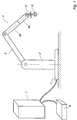
- Figure 1 shows an example of a known industrial robot.
- the mechanical part of the robot comprises a fixed bottom plate 1, in relation to which the lower part 2 of the robot is rotatable about a vertical axis.
- the lower arm 3 of the robot is rotatable in relation to the lower part 2 about a horizontal axis.
- the upper arm 4 of the robot is rotatable in relation to the lower arm about a second horizontal axis.
- the upper robot arm 4 consists of two parts 4a and 4b, the outer part 4b being rotatable in relation to the inner part 4a about a rotary axis coinciding with the longitudinal axis of the upper arm.
- the hand 5 of the robot is mounted, which may be rotatable in, for example, two or three degrees of freedom in relation to the upper arm 4.
- a working tool 6 is attached to the robot hand, and as schematically shown in the figure this working tool may consist of a gripper, or alternatively a welding device, a glue gun, or a measuring tool.
- the mechanical part of the robot is connected, via a cable, to the control system 7 which comprises the electronic, computer, and drive equipment which is required for control of the mechanical part of the robot.
- the control unit is connected to a programming unit 8 for programming and other operation of the robot.
- FIG. 2 shows those parts of the control system 7 which are of interest to the invention.
- a user program comprises a set of robot instructions.
- a robot instruction may be of two types, fixed robot instructions and so-called shell instructions.
- the fixed robot instructions consist of calls to fixed routines, which comprise a set of instructions written in a general high-level language, for example C or Pascal.
- a fixed routine is developed and translated into machine code in an external computer, whereupon it is stored in an application library 10.
- Shell instructions consist of calls to so-called shell routines, which comprise a set of robot instructions.
- a shell routine is translated into an intermediate code by a compiler 12 and is then stored in the program storage 11. In the same way, a user program is translated by the compiler and stored into the program storage.
- the user program is executed by a program executor 13. Depending on the type of instruction that is to be executed, the program executor retrieves routines from the application library or from the program storage.
- the programming unit 8 is provided with a button 14 for setting the program to run forwards or backwards.
- the tasks of a robot user can be divided into two groups, namely, those of a program preparer and those of an operator.
- the tasks of the program preparer are, among other things, to develop new user programs and to make changes in existing programs before new applications.
- the tasks of the operator mainly comprise running the user programs, for example, starting, stopping and reversing them, and to make minor changes in the programs.
- the program preparer and the operator are normally different persons. In those cases when the program preparer and the operator are not the same person, it is important that all the robot instructions behave in the same way to the operator, irrespective of whether they are developed in the traditional way or written in the robot language itself.
- One condition for the invention to be applicable to a robot is that the robot has a robot language which allows procedure calls with arguments, and that it is possible to link attributes to procedures.
- An attribute is a property which may be imparted to the shell routine, and each attribute may be switched on or off, i.e. activated or deactivated as required. Usually, the attributes are switched off during development and testing of the routine, that is, as long as there is a need to make a change in the routine. When the routine is considered to be finished, the attributes are switched on.
- One important property of a shell instruction is that an operator who is running a user program does not notice any difference between a shell routine and a fixed robot instruction.
- the shell routine must be provided with two important attributes, namely, "view-only” and "no-step in”. If the attribute "view-only” is switched on, this means that the shell routine can only be read, that is, it is not allowed to make changes in it.
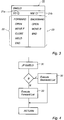
- FIG 3 shows an example of a shell routine 20 with two attributes.
- the first attribute 21a consists of "view-only” (VO) and the second attribute 21b is "no-step-in” (NSI).
- Each shell routine has an individual name.
- the shell routine in Figure 3 has the name SWELD and causes the robot to carry out a spot welding operation.
- the shell routine consists of two different lists of robot instructions, that is, one forward list 22, and one backward list 23. For the program executor to be able to find the forward list and the backward list, the forward list always starts with the word FORWARD and the backward list with the word BACKWARD. These words constitute reserved words in the robot language and may not be used in any other connection.
- Figure 4 shows, by way of a flow diagram, an example of the appearance of that part of the program executor which executes the shell routine in Figure 3.
- the program executor arrives at the instruction SWELD in the user program, it carries out in block 31 a jump to the shell routine SWELD which is stored in the program storage. If the program unit is set at backward, the instructions in the backward list are executed, block 32, otherwise the forward list is executed, block 33.
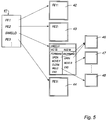
- Figure 5 shows an example of a user program 41 which comprises the shell instruction SWELD and the fixed robot instructions RI1, RI2 and RI3.
- the corresponding fixed routines 42, 43 and 44 are called.
- the shell routine 45 is called, whereupon the backward list or the forward list is executed depending on whether the programming unit is set at forward or backward.
- the instructions in the shell routine consist of fixed robot instructions and when these are executed, fixed routines are called, for example 46, 47 and 48.
- the shell routine comprises a set of robot instructions where all the robot instructions are fixed instructions.
- a robot instruction in a shell routine may also consist of a shell instruction.
- a shell routine comprises a set of robot instructions, wherein a robot instructions may be either a fixed instruction or a shell instruction.
- the forward list and the backward list may also contain logic clauses such as "if-then-else” clauses and "while” clauses.
- the names of the forward and backward lists are there to distinguish between the two lists.
- the name of the forward list may be omitted. Unless backward execution has been requested, the forward list is always executed.
- the control system described above comprises a compiler for translating the shell routines into an intermediate code or a machine code.
- the compiler may be omitted, and then the executor instead carries out shell routines and user programs directly.
- the shell routine in this embodiment has two attributes, but it is also possible to have more attributes.
- Such a shell instruction may then be provided with an attribute, a so-called system attribute, which means that the module is stored more permanently in order to prevent unintentional erasure. Changes of the shell routine may then only be made by the robot manufacturer, or by a person authorized by the robot manufacturer. This attribute is stronger than the "view-only" attribute, which may, for example, be set by the program preparer to prevent the operator from making changes in the program.
- a plurality of shell routines may be brought together into one module with attributes common to these shell routines.
- Figure 6 shows an example of a module 50 with three attributes, "view-only” (VO) 21a, "no-step-in” (NSI) 21b and system attribute (SA) 21c.
- the module comprises three shell routines 20 which are all associated with the common attributes.
Landscapes
- Engineering & Computer Science (AREA)
- Human Computer Interaction (AREA)
- Manufacturing & Machinery (AREA)
- Physics & Mathematics (AREA)
- General Physics & Mathematics (AREA)
- Automation & Control Theory (AREA)
- Robotics (AREA)
- Mechanical Engineering (AREA)
- Numerical Control (AREA)
- Manipulator (AREA)
Applications Claiming Priority (2)
| Application Number | Priority Date | Filing Date | Title |
|---|---|---|---|
| SE9401012A SE9401012L (sv) | 1994-03-25 | 1994-03-25 | Robotstyrsystem |
| SE9401012 | 1994-03-25 |
Publications (2)
| Publication Number | Publication Date |
|---|---|
| EP0673726A2 true EP0673726A2 (fr) | 1995-09-27 |
| EP0673726A3 EP0673726A3 (fr) | 1996-07-31 |
Family
ID=20393423
Family Applications (1)
| Application Number | Title | Priority Date | Filing Date |
|---|---|---|---|
| EP95104021A Withdrawn EP0673726A3 (fr) | 1994-03-25 | 1995-03-18 | Système de commande de Robot. |
Country Status (4)
| Country | Link |
|---|---|
| US (1) | US5608619A (fr) |
| EP (1) | EP0673726A3 (fr) |
| JP (1) | JPH07302109A (fr) |
| SE (1) | SE9401012L (fr) |
Cited By (5)
| Publication number | Priority date | Publication date | Assignee | Title |
|---|---|---|---|---|
| EP0845725A4 (fr) * | 1996-06-20 | 1998-09-30 | Fanuc Ltd | Dispositif servant a commander le deplacement d'un robot vers l'arriere |
| US6587749B2 (en) * | 2000-03-28 | 2003-07-01 | Matsushita Electric Industrial Co., Ltd. | Industrial robot and method of operating same |
| WO2005061187A1 (fr) * | 2003-12-22 | 2005-07-07 | Abb Ab | Systeme permettant de commander un robot industriel |
| DE102007056117A1 (de) * | 2007-11-15 | 2009-05-28 | Kuka Roboter Gmbh | Industrieroboter und Verfahren zum Steuern der Bewegung eines Industrieroboters |
| DE102012008073A1 (de) * | 2012-04-24 | 2013-10-24 | Kuka Roboter Gmbh | Verfahren und Mittel zum Vorgeben und/oder Steuern eines Manipulatorprozesses |
Families Citing this family (5)
| Publication number | Priority date | Publication date | Assignee | Title |
|---|---|---|---|---|
| US7643907B2 (en) | 2005-02-10 | 2010-01-05 | Abb Research Ltd. | Method and apparatus for developing a metadata-infused software program for controlling a robot |
| US7343209B2 (en) * | 2005-11-08 | 2008-03-11 | The Boeing Company | Attribute-based item information grouping, such as for use in generating manufacturing instructions |
| US20080058990A1 (en) * | 2006-08-31 | 2008-03-06 | General Electric Company | Robotic programming control using multiple binary input |
| US10518409B2 (en) * | 2014-09-02 | 2019-12-31 | Mark Oleynik | Robotic manipulation methods and systems for executing a domain-specific application in an instrumented environment with electronic minimanipulation libraries |
| WO2019111413A1 (fr) * | 2017-12-08 | 2019-06-13 | 株式会社Fuji | Dispositif de commande, dispositif d'opération sur pièce à usiner, système d'opération sur pièce à usiner et procédé de commande |
Family Cites Families (6)
| Publication number | Priority date | Publication date | Assignee | Title |
|---|---|---|---|---|
| EP0075792B1 (fr) * | 1981-09-24 | 1987-08-26 | Hitachi, Ltd. | Système de commande pour la main d'un robot |
| SE452719B (sv) * | 1982-06-29 | 1987-12-14 | Asea Ab | Industrirobot |
| DE3853253T2 (de) * | 1987-10-30 | 1995-06-29 | Nissan Motor | Verfahren und System zur Sequenzsteuerung. |
| DE58908998D1 (de) * | 1988-11-11 | 1995-03-23 | Siemens Ag | Verfahren zum Betrieb eines Industrieroboters. |
| JP2815606B2 (ja) * | 1989-04-25 | 1998-10-27 | 株式会社トキメック | コンクリート床仕上ロボットの制御方式 |
| JP2526709B2 (ja) * | 1990-05-08 | 1996-08-21 | 三菱電機株式会社 | プログラマブルコントロ―ラおよびプログラマブルコントロ―ラのsfcプログラム実行方法 |
-
1994
- 1994-03-25 SE SE9401012A patent/SE9401012L/xx not_active Application Discontinuation
-
1995
- 1995-03-13 US US08/402,502 patent/US5608619A/en not_active Expired - Lifetime
- 1995-03-18 EP EP95104021A patent/EP0673726A3/fr not_active Withdrawn
- 1995-03-24 JP JP7066336A patent/JPH07302109A/ja active Pending
Cited By (7)
| Publication number | Priority date | Publication date | Assignee | Title |
|---|---|---|---|---|
| EP0845725A4 (fr) * | 1996-06-20 | 1998-09-30 | Fanuc Ltd | Dispositif servant a commander le deplacement d'un robot vers l'arriere |
| US6285921B1 (en) | 1996-06-20 | 2001-09-04 | Fanuc, Ltd. | Robot control apparatus with function for robot backward operation |
| US6587749B2 (en) * | 2000-03-28 | 2003-07-01 | Matsushita Electric Industrial Co., Ltd. | Industrial robot and method of operating same |
| WO2005061187A1 (fr) * | 2003-12-22 | 2005-07-07 | Abb Ab | Systeme permettant de commander un robot industriel |
| DE102007056117A1 (de) * | 2007-11-15 | 2009-05-28 | Kuka Roboter Gmbh | Industrieroboter und Verfahren zum Steuern der Bewegung eines Industrieroboters |
| DE102012008073A1 (de) * | 2012-04-24 | 2013-10-24 | Kuka Roboter Gmbh | Verfahren und Mittel zum Vorgeben und/oder Steuern eines Manipulatorprozesses |
| US9446516B2 (en) | 2012-04-24 | 2016-09-20 | Kuka Roboter Gmbh | Method and means for providing and/or controlling a manipulator process |
Also Published As
| Publication number | Publication date |
|---|---|
| US5608619A (en) | 1997-03-04 |
| SE9401012D0 (sv) | 1994-03-25 |
| EP0673726A3 (fr) | 1996-07-31 |
| JPH07302109A (ja) | 1995-11-14 |
| SE9401012L (sv) | 1995-09-26 |
Similar Documents
| Publication | Publication Date | Title |
|---|---|---|
| US4204253A (en) | Device for generating and correcting a user program | |
| US7505817B2 (en) | Programming automation by demonstration | |
| US9063535B2 (en) | Numerical control program execution by robot | |
| US7076332B2 (en) | System and method for invoking execution of a sequence of operations that includes motion control, machine vision, and data acquisition (DAQ) functionality | |
| US20180178380A1 (en) | Method for extending end user programming of an industrial robot with third party contributions | |
| US20020191023A1 (en) | System and method for graphically creating a sequence of motion control operations | |
| EP1018071A1 (fr) | Systeme de recherche et d'affichage des programmes de commande | |
| WO2000025185A1 (fr) | Planification de processus robotises utilisant des gabarits | |
| US5608619A (en) | Robot control system | |
| Nilsson | Industrial robot programming | |
| Halt et al. | Intuitive constraint-based robot programming for robotic assembly tasks | |
| US20050137727A1 (en) | Controller for a machine-tool or production machine | |
| US5008834A (en) | Robot control apparatus | |
| US20020082483A1 (en) | Apparatus and method for commissioning and diagnosing control systems | |
| US5239476A (en) | Multi-level state language controller for multi-threaded machine control | |
| CN118092317A (zh) | 一种基于OpenPLC和LinuxCNC的数控方法 | |
| KR100434612B1 (ko) | 모듈을 이용한 로봇 오프라인 프로그래밍 방법 | |
| US20020046234A1 (en) | Method for the organization of a process having at least one processing device for carrying out a predefinable subprocess | |
| Weston et al. | A new concept in machine control | |
| US20030093165A1 (en) | Programming method for creating a control program of an industrial machine | |
| Bernhardt et al. | The realistic robot simulation (rrs) interface | |
| JP2537418B2 (ja) | 制御プログラム作成装置 | |
| US20040049622A1 (en) | Programming tool | |
| Morales et al. | A generalised software control system for industrial robots | |
| JP2683072B2 (ja) | 工業用ロボットにおける作業プログラムの修正方法 |
Legal Events
| Date | Code | Title | Description |
|---|---|---|---|
| PUAI | Public reference made under article 153(3) epc to a published international application that has entered the european phase |
Free format text: ORIGINAL CODE: 0009012 |
|
| AK | Designated contracting states |
Kind code of ref document: A2 Designated state(s): DE ES FR GB IT SE |
|
| PUAL | Search report despatched |
Free format text: ORIGINAL CODE: 0009013 |
|
| AK | Designated contracting states |
Kind code of ref document: A3 Designated state(s): DE ES FR GB IT SE |
|
| 17P | Request for examination filed |
Effective date: 19961010 |
|
| 17Q | First examination report despatched |
Effective date: 19970610 |
|
| STAA | Information on the status of an ep patent application or granted ep patent |
Free format text: STATUS: THE APPLICATION IS DEEMED TO BE WITHDRAWN |
|
| 18D | Application deemed to be withdrawn |
Effective date: 19971223 |