EP0673989A2 - Procédé pour la conversion d'huile hydrocarbonée résiduelle - Google Patents
Procédé pour la conversion d'huile hydrocarbonée résiduelle Download PDFInfo
- Publication number
- EP0673989A2 EP0673989A2 EP95200676A EP95200676A EP0673989A2 EP 0673989 A2 EP0673989 A2 EP 0673989A2 EP 95200676 A EP95200676 A EP 95200676A EP 95200676 A EP95200676 A EP 95200676A EP 0673989 A2 EP0673989 A2 EP 0673989A2
- Authority
- EP
- European Patent Office
- Prior art keywords
- dao
- process according
- thermal cracking
- hydrocarbon oil
- refinery
- Prior art date
- Legal status (The legal status is an assumption and is not a legal conclusion. Google has not performed a legal analysis and makes no representation as to the accuracy of the status listed.)
- Ceased
Links
Images

Classifications
-
- C—CHEMISTRY; METALLURGY
- C10—PETROLEUM, GAS OR COKE INDUSTRIES; TECHNICAL GASES CONTAINING CARBON MONOXIDE; FUELS; LUBRICANTS; PEAT
- C10G—CRACKING HYDROCARBON OILS; PRODUCTION OF LIQUID HYDROCARBON MIXTURES, e.g. BY DESTRUCTIVE HYDROGENATION, OLIGOMERISATION, POLYMERISATION; RECOVERY OF HYDROCARBON OILS FROM OIL-SHALE, OIL-SAND, OR GASES; REFINING MIXTURES MAINLY CONSISTING OF HYDROCARBONS; REFORMING OF NAPHTHA; MINERAL WAXES
- C10G55/00—Treatment of hydrocarbon oils, in the absence of hydrogen, by at least one refining process and at least one cracking process
- C10G55/02—Treatment of hydrocarbon oils, in the absence of hydrogen, by at least one refining process and at least one cracking process plural serial stages only
- C10G55/04—Treatment of hydrocarbon oils, in the absence of hydrogen, by at least one refining process and at least one cracking process plural serial stages only including at least one thermal cracking step
Definitions
- the present invention relates to a process for the conversion of a residual hydrocarbon oil.
- Thermal cracking is a widely and commonly applied route for converting residual hydrocarbon oils into lighter products. It usually involves preheating the feedstock to the appropriate temperature, thermally cracking the preheated feedstock and fractionating the effluent, which often is quenched prior to fractionation in order to stop the cracking reactions. Fractionation may for instance be conducted by atmospheric distillation solely or by a combination of atmospheric and vacuum distillation.
- thermal cracking is a relatively simple process requiring a relatively low capital investment and having relatively low operating costs. This makes thermal cracking an attractive option from both a manufacturing and an economic point of view. For this reason there is a continuous effort for further improving the efficiency of thermal cracking. In the past, several methods have been proposed for achieving this goal.
- a process for producing hydrocarbon mixtures from an oil residue wherein the oil residue is first deasphalted, after which the deasphalted oil is subjected to a cracking process, eventually producing one or more distillate fractions.
- the asphaltic bitumen fraction is partially oxidised using oxygen to produce a gasmixture containing carbon monoxide and hydrogen, which gasmixture is subsequently used in a catalytic hydrocarbon synthesis to produce synthetic hydrocarbons.
- These synthetic hydrocarbons are then mixed, suitably after having been separated by atmospheric distillation, with at least a part of the said distillate fractions produced in the cracking of the deasphalted oil.
- the cracking process, to which the deasphalted oil is subjected most suitably is a catalytic cracking process, because the quality of the light naphtha produced by catalytic cracking is stated to be excellent.
- a light naphtha produced by thermal cracking has to be subjected to an additional hydrogenation step for converting dienes into olefins in order to obtain a light naphtha having the desired quality.
- EP-A-0,372,652 as a disadvantage of the type of process according to NL-A-8400074 is mentioned that the asphaltenes removed from the residual oil in the deasphalting step can no longer contribute to the production of distillates and the yield of distillates is consequently not optimal. Accordingly, the process disclosed in EP-A-0,372,652 for converting a heavy hydrocarbonaceous feedstock, such as the vacuum residue of a crude oil, into lighter products involves first preheating the heavy feedstock, after which the preheated feedstock is passed through a thermal cracking zone under such conditions that a conversion of at least 35% by weight, suitably up to 70% by weight, of hydrocarbons having a boiling point of 520 °C or higher is accomplished.
- the effluent from the cracking zone is subsequently separated into one or more distillate fractions -to be recovered as products- and a residual fraction, which is deasphalted to obtain an asphalt and a deasphalted oil.
- This deasphalted oil can be further treated, e.g. by catalytic cracking, hydrotreatment, hydrocracking or thermal cracking, thus yielding more useful distillate fractions.
- the process disclosed involves thermal cracking under relatively severe conditions followed by deasphalting of the residual fraction.
- this process is again confronted with the fact that the asphaltenes present in the feedstock for thermal cracking limit the final yield of distillate fractions due to the formation of insoluble and/or coke material, despite the relatively severe cracking conditions.
- the deasphalted oil fraction obtained from the deasphalting treatment of the thermally cracked residual oil fraction still needs further upgrading in additional conversion process units in order to attain conversion into useful distillate products.
- the present invention relates to a process for the conversion of a residual hydrocarbon oil comprising the steps of:
- 520 °C+ conversion as used throughout this specification is meant the conversion of the hydrocarbons having a boiling point of 520 °C and higher present in the thermal cracking feedstock.
- the 520 °C+ conversion is conveniently expressed in a weight percentage based on thermal cracking feedstock, i.e. DAO, and is determined as follows: It will be evident that "520 °C+” refers to the amount of hydrocarbons having a boiling point of 520 °C or higher.
- An immediate advantage of the process according to the present invention is the fact that the formation of insoluble material during thermal cracking is greatly reduced due to the removal of the heavier asphaltenes from the residual hydrocarbon oil prior to thermal cracking by the deasphalting treatment.
- the maximum achievable conversion level is now primarily determined by the production of synthetic asphaltenic components formed in condensation reactions occurring during thermal cracking instead of by the asphaltenic components present in the residual hydrocarbon oil prior to deasphalting. This implies that higher conversion levels with higher distillate productions can be achieved according to the process of the present invention than is the case with severe thermal cracking of residual oils without prior deasphalting this residual oil.
- distillate fractions from the thermal cracking zone are very good: the distillate fractions have an excellent H/C ratio and a low content of sulphur- and nitrogen-containing contaminants.
- Such contaminants, which are present in the residual hydrocarbon oil feedstock, were found to mainly concentrate in the asphalt phase produced in the deasphalting treatment rather than in the DAO. Therefore, the said contaminants, concentrated in the asphalt phase, can no longer end up in the distillate fractions produced in the thermal cracking of the DAO.
- the process has an excellent synergy potential when included in a thermal cracker refinery, a hydrocracker refinery or a catalytic cracker refinery, while incorporation in a refinery which is a combination of two or more of such refinery configurations may offer an even higher synergy potential.
- a refinery which is a combination of two or more of such refinery configurations may offer an even higher synergy potential.
- this will be discussed and illustrated in greater detail below by figures 2, 3 and 4.
- the residual hydrocarbon oil used as the feedstock for the process of the present invention in principle may be any residual fraction resulting from a fractionation treatment. Consequently, the residual hydrocarbon oil in any event has a relatively high content of asphaltenes.
- the residual hydrocarbon oil is a heavy asphaltenes-containing hydrocarbonaceous feedstock comprising at least 35% by weight, preferably at least 75% by weight and more preferably at least 90% by weight, of hydrocarbons having a boiling point of 520 °C or higher.
- a particularly suitable hydrocarbonaceous feedstock meeting this requirement is a vacuum residue of a crude oil, also commonly referred to as a short residue.
- the deasphalting of the residual hydrocarbon oil prior to thermal cracking may be carried out in any conventional manner, such as by physical separation using membranes or by adsorption techniques. However, for the purpose of the present invention it is preferred to use the well known solvent deasphalting method.
- the residual hydrocarbon oil to be deasphalted is treated countercurrently with an extracting medium which is usually a light hydrocarbon solvent containing paraffinic compounds.
- an extracting medium which is usually a light hydrocarbon solvent containing paraffinic compounds.
- Commonly applied paraffinic compounds include C3 ⁇ 8 paraffinic hydrocarbons, suitably C3-C5 paraffinic hydrocarbons, such as propane, butane, isobutane, pentane, isopentane or mixtures of two or more of these.
- butane, pentane or a mixture thereof is used as the extracting solvent, whereby the use of pentane is most preferred.
- the extraction depth increases at increasing number of carbon atoms of the extracting solvent.
- the total amount of heavy hydrocarbons being extracted together with the lighter hydrocarbons from the residual hydrocarbon oil increases as well, while the asphaltene fraction is smaller but heavier and hence more viscous. Accordingly, the extraction depth cannot be too high as this would result in a very viscous, very heavy asphaltene raction, which can hardly be processed any further.
- a rotating disc contactor or a plate column can be used with the residual hydrocarbon oil entering at the top and the extracting solvent entering at the bottom.
- the lighter hydrocarbons with an overall paraffinic solvency behaviour present in the residual hydrocarbon oil dissolve in the extracting solvent and are withdrawn at the top of the apparatus.
- the asphaltenic components which are insoluble in the extracting solvent are withdrawn at the bottom of the apparatus.
- deasphalting is carried out at a total extracting solvent to residual hydrocarbon oil ratio of 1.5 to 8 wt/wt, a pressure of from 1 to 50 bar and a temperature of from 40 to 230 °C.
- the deasphalting of the residual hydrocarbon oil is carried out such that a DAO is obtained at an extraction depth of at least 50% by weight, preferably from 60 to 90% by weight, more preferably 65 to 85% by weight, the balance up to 100% by weight being formed by the asphalt fraction.
- extraction depth indicates the yield of DAO after deasphalting by solvent extraction and is expressed in a weight percentage based on total weight of the initial residual hydrocarbon oil prior to deasphalting.
- the thermal cracking of the DAO in accordance with the present invention can be carried out by the conventional thermal cracking processes.
- the exact conditions under which the thermal cracking is carried out can be varied and the person skilled in the art will be able to select the temperature, the pressure and the residence time in such way that the desired conversion occurs. It will be understood that the same conversion can be obtained at a high temperature and a short residence time on the one hand and a lower temperature but longer residence time on the other hand.
- the thermal cracking of the deasphalted oil in the thermal cracking zone is suitably conducted at a temperature of from 350 to 600 °C, a pressure of from 1 to 100 bar and average residence time of from 0.5 to 60 minutes.
- This residence time relates to the cold feedstock, i.e. the cold oil feedstock at ambient temperature.
- the effluent from the thermal cracking zone may be quenched prior to its separation into one or more distillate fractions and a cracked residual fraction. Quenching may for instance be effected by contacting the effluent with a colder quench fluid. Suitable quench fluids include relatively light hydrocarbon oils, such as gasoline or a recycled cool residual fraction obtained from the effluent. After the optional quench, the effluent is suitably fractionated into one or more distillate fractions and a cracked residual fraction, for instance by atmospheric and/or vacuum distillation. This cracked residual fraction is rather viscous due to the presence of heavy asphaltenic components, but is considerably less viscous than the heavy asphalt phase separated from the residual hydrocarbon oil in the deasphalting step.
- the said cracked residual fraction is, in part or in total, recycled to the residual oil feedstock and/or to the DAO in order to maximise the use of plant capacity and to optimise the distillate production.
- the cracked residual fraction is blended with the more viscous asphalt fraction from the deasphalting treatment and the resulting blendstream is subsequently subjected to partial oxidation (gasification).
- the blending ratio should be adjusted such that the viscosity of the blendstream meets the viscosity specification of the gasification equipment.
- the production of a cracked residue which is available as diluent for the more viscous asphalt fraction in the gasifier feedstock, offers the possibility to produce an asphalt in the deasphalting treatment with a viscosity exceeding the gasifier feedstock viscosity specification. This implies that a DAO can be produced at higher yield on residual hydrocarbon oil feed and consequently, the final production of distillates in the thermal cracking step is higher.
- Gasification is suitably carried out using any well known partial oxidation process, wherein a heavy hydrocarbonaceous feedstock is partially oxidised using oxygen in the presence of steam, usually high pressure steam, thus resulting in clean gas after gas treatment.
- This clean gas in return, can be applied as clean fuel gas in the refinery or for cogeneration of power and steam, hydrogen manufacture and hydrocarbon synthesis processes.
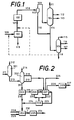
- Figure 1 depicts a typical line up of the process of the present invention.
- Figure 2 depicts a line up of a thermal cracking refinery.
- Figure 3 depicts a line up of a catalytic cracker refinery.
- Figure 4 depicts a line up of a hydrocracker refinery.
- residual hydrocarbon oil (106), preferably a short residue, is passed into deasphalting zone (101), resulting in a DAO (107) and an asphalt fraction (119), which is further referred to as "pentane-asphalt".
- the DAO (107) is led into thermal cracking zone (102), where it is heated and where the cracking reactions take place.
- the reaction zone (102) may suitably consist of a furnace alone or of a combination of a furnace plus one or more soaker vessels.
- the "cracked DAO" (108) is passed into cyclone (103), where it is quenched and separated into a cracked residue fraction (110) and a lighter fraction (109).
- This lighter fraction (109) is separated in atmospheric fractionator (104) into a naphtha minus fraction (111), kerosine fraction (112), gasoil fraction (113) and bottom fraction (114).
- This bottom fraction (114) is blended with the beforementioned cracked residue fraction (110) and the resulting blend stream is fed into vacuum distillation unit (105), where fractionation takes place into a vacuum gas oil fraction (115), a light flashed distillate (116), a heavy flashed distillate (117) and a vacuum flashed cracked residue (118).
- the flashed distillates (116) and (117) can be recovered as a product component or can be further upgraded, e.g. by further thermal cracking, by hydrocracking or by catalytic cracking, optionally followed by hydrotreatment.
- the cracked residue (118) may be partially or totally recycled to residual hydrocarbon oil feed (106) and/or to DAO (107) in order to maximise the use of plant capacity and to optimise distillate production.
- crude oil (211) is passed into atmospheric distillation unit (201) and separated into one or more distillate fractions (212), covering all fractions ranging from naphtha minus to heavy gasoil, and long residue (213).
- This long residue (213) is further separated in (high) vacuum distillation unit (202) in vacuum gasoil (214), light flashed distillate (215), heavy flashed distillate (216) and short residue (217). Flashed distillates (215) and (216) are combined and passed into distillate cracking unit (207).
- Short residue (217) is deasphalted in deasphalting zone (203), resulting in DAO (219) and pentane-asphalt (218).
- DAO (219) is subsequently subjected to severe thermal cracking (TC) in TC-zone (206) producing -after separation (distillation)- distillate fractions (220), which are passed into distillate cracking unit (207), and bottom product (221), which is subsequently passed into vacuum flashing unit (208) together with the bottom product (222) produced in the distillate cracking unit (207).
- TC-zone (206) produces -after separation (distillation)- distillate fractions (220), which are passed into distillate cracking unit (207), and bottom product (221), which is subsequently passed into vacuum flashing unit (208) together with the bottom product (222) produced in the distillate cracking unit (207).
- vacuum flashing unit (208) separation into thermally cracked flashed distillates (223) and vacuum flashed cracked residue (224) takes place.
- the thermally cracked flashed distillate fraction (223) is routed to distillate cracking unit (207) and the vacuum flashed cracked residue (224) is added as a diluent to the pentane-asphalt (218), so that the resulting blendstream meets the viscosity specification of gasification unit (204).
- the distillate cracking unit (207) there are further produced naphtha minus fraction (225) and gasoil fraction (226), which -after hydrodesulphurization in hydrodesulphurization unit (209)- is recovered as valuable automotive gasoil and industrial gasoil components (227).
- Gasification of the before-mentioned blendstream (218/224) takes place by passing this blendstream as well as oxygen (228) and steam (229) into gasification unit (204), where partial oxidation of the heavy hydrocarbons present in the said blendstream takes place to produce a gas mixture (230) mainly consisting of carbon monoxide and hydrogen, which mixture is subsequently purified in gas treatment unit (205).
- the purified gas (231) can be partially or totally recovered as clean fuel gas in the refinery or can be applied for the cogeneration of power and steam, hydrogen manufacture and/or hydrocarbon synthesis processes.
- the thermal conversion refinery according to figure 2 produces more distillates and less vacuum flashed cracked residue.
- pentane as the extracting solvent
- the production of pentane-asphalt is also relatively low.
- the low production of both vacuum flashed cracked reside and pentane-asphalt means that less gasification capacity is required than with straight severe thermal cracking of short residues, which is attractive from both refinery margin and capital investment point of view.
- a crude oil (310) is separated in atmospheric distillation unit (301) into one or more distillate fractions (311), covering all fractions ranging from naphtha minus to heavy gasoil, and long residue (312), which is further separated in (high) vacuum distillation unit (302) into vacuum gasoil (313), light flashed distillate (314), heavy flashed distillate (315) and short residue (316).
- Short residue (316) is then deasphalted in deasphalting unit (303), resulting in pentane-asphalt (317) and DAO (318), which is passed to TC-zone (306) where thermal cracking reactions occur producing (after separation) naphtha minus (319), gasoil fraction (320) and bottom product (321).
- Bottom product (321) is separated in vacuum flashing unit (307) into thermally cracked flashed distillate fraction (322) and vacuum flashed cracked residue fraction (323).
- Thermally cracked flashed distillate fraction (322) and light and heavy flashed distillates (314) and (315) are passed into catalytic cracking zone (309), where tops (324), naphtha (325), kerosine (326), light cycle oil (327) and heavy cycle oil/clarified slurry oil (328) are produced.
- the light cycle oil (327) and gasoil fraction (320) are both passed through hydrodesulphurization unit (308) resulting in valuable automotive and industrial gasoil components (329).
- Heavy cycle oil/clarified slurry oil (328), pentane-asphalt (317) and vacuum flashed cracked residue fraction (323) are blended, so that the resulting blendstream meets the viscosity specification of gasifier (304).
- the blendstream, oxygen (330) and steam (331) are passed into the gasifier (304) where the heavy hydrocarbons are partially oxidised to produce a gas mixture (332) mainly consisting of carbon monoxide and hydrogen, which gas mixture is subsequently purified in gas treatment unit (305).
- the purified gas (333) can be partially or totally recovered as clean fuel gas in the refinery or can be applied for the cogeneration of power and steam, hydrogen manufacture and/or hydrocarbon synthesis processes.
- a refinery with a flashed distillate fluid catalytic cracker (FDFCC) and severe thermal cracking of DAO -as illustrated by figure 3- has the advantage that no catalyst cooling capacity is required on the FDFCC, which means a significant cost saving. Additionally, contrary to an LRFCC refinery, metals present in the crude oil no longer end up on the FCC catalyst in the FDFCC refinery, thus reducing costs for FCC catalyst replacement and spent catalyst disposal or rejuvenation. Another advantage is the fact that SOx emissions are strongly reduced in the FDFCC refinery, since the major part of the sulphur present in the long residue ends up in the pentane-asphalt after deasphalting. Sulphur removal in this case takes place in the gasifier gas treating step after partial oxidation of the gasifier feedstock mixture.
- hydrowax (439) can suitably be used as a feedstock for a chemical complex, e.g. for producing lower olefins.
- thermally cracked flashed distillate (423) may also be partially or totally used as a feed for the hydrocracking zone (434) instead of being passed into distillate cracking zone (407).
- the flashed distillate hydrocracker refinery with severe thermal cracking of DAO ( FD/HCU+DAO/TC refinery ) according to figure 4 has the advantage that a smaller hydraulic capacity of the expensive high pressure HCU is required and that due to the absence of the DAO feed it can be operated at a lower combined feedratio, which in return results in a lower reactor volume and hence lower capital investment and operating costs.
- no expensive high pressure guard bed reactor is required to protect the hydrocracker from metal contaminants and high Conradson Carbon Residue material present in the DAO feedstock.
- Another important advantage of the FD/HCU+DAO/TC refinery according to figure 4 is that due to the upgrading of the DAO via severe thermal cracking, the optimum DAO yield on short residue is mainly determined by the blending of the pentane-asphalt with the vacuum flashed cracked residue to meet the maximum viscosity specification of the gasifier feedstock.
- This optimum DAO yield is higher than the optimum DAO yield on short residue in the case of the FD/DAO HCU, the latter being predominantly determined by the maximum guard bed reactor Conradson Carbon Residue specification. Therefore, with the HCU refinery including the severe thermal cracking of DAO more DAO is available for upgrading into valuable distillates, resulting in a lower asphalt production, a lower capacity requirement for the gasifier unit and hence lower capital investment and operating costs.
- AHSR C5-DAO Arabian Heavy Short Residue
- the extraction was carried out at a total solvent/feed ratio of 2.0 (wt/wt) and a feedstock predilution of 0.5 (wt/wt) at 193 °C and 40 bar pressure.
- the AHSR C5-DAO was subsequently subjected to severe thermal cracking at a pressure of 5.0 bar and at outlet temperatures of 470, 480, 490 and 500 °C.
- Example 2 The same AHSR as used in Example 1 was subjected to thermal cracking at a pressure of 5.0 bar. Outlet temperatures were 460, 465, 470, 475 and 481 °C.
Landscapes
- Chemical & Material Sciences (AREA)
- Oil, Petroleum & Natural Gas (AREA)
- Physics & Mathematics (AREA)
- Thermal Sciences (AREA)
- Engineering & Computer Science (AREA)
- Chemical Kinetics & Catalysis (AREA)
- General Chemical & Material Sciences (AREA)
- Organic Chemistry (AREA)
- Production Of Liquid Hydrocarbon Mixture For Refining Petroleum (AREA)
Priority Applications (1)
| Application Number | Priority Date | Filing Date | Title |
|---|---|---|---|
| EP95200676A EP0673989A3 (fr) | 1994-03-22 | 1995-03-20 | Procédé pour la conversion d'huile hydrocarbonée résiduelle. |
Applications Claiming Priority (3)
| Application Number | Priority Date | Filing Date | Title |
|---|---|---|---|
| EP94200740 | 1994-03-22 | ||
| EP94200740 | 1994-03-22 | ||
| EP95200676A EP0673989A3 (fr) | 1994-03-22 | 1995-03-20 | Procédé pour la conversion d'huile hydrocarbonée résiduelle. |
Publications (2)
| Publication Number | Publication Date |
|---|---|
| EP0673989A2 true EP0673989A2 (fr) | 1995-09-27 |
| EP0673989A3 EP0673989A3 (fr) | 1996-02-14 |
Family
ID=26136103
Family Applications (1)
| Application Number | Title | Priority Date | Filing Date |
|---|---|---|---|
| EP95200676A Ceased EP0673989A3 (fr) | 1994-03-22 | 1995-03-20 | Procédé pour la conversion d'huile hydrocarbonée résiduelle. |
Country Status (1)
| Country | Link |
|---|---|
| EP (1) | EP0673989A3 (fr) |
Cited By (11)
| Publication number | Priority date | Publication date | Assignee | Title |
|---|---|---|---|---|
| GR980100301A (el) * | 1997-08-13 | 1999-04-30 | Ormat Process Technologies Inc. | Μεθοδος και μεσο για την αναβαθμιση υδρογονανθρακων που περιεχουν μεταλλα και ασφαλτενια |
| EP1096002A3 (fr) * | 1999-11-01 | 2002-05-29 | Ormat Industries, Ltd. | Procédé et installation pour le traitement de charges hydrocarbonées lourdes |
| US6673234B2 (en) * | 2000-09-25 | 2004-01-06 | China Petroleum And Chemical Corporation | Combined process of low degree solvent deasphalting and delayed coking |
| RU2273658C2 (ru) * | 2001-04-05 | 2006-04-10 | Джей Джи Си КОРПОРЕЙШН | Способ очистки тяжелой нефтяной фракции |
| FR2906812A1 (fr) * | 2006-10-06 | 2008-04-11 | Inst Francais Du Petrole | Procede de conversion de residu desasphalte par craquage thermique |
| WO2014131040A1 (fr) * | 2013-02-25 | 2014-08-28 | Foster Wheeler Usa Corporation | Production augmentée de carburants par intégration d'une distillation sous vide avec désasphaltage au solvant |
| WO2018122274A1 (fr) * | 2016-12-28 | 2018-07-05 | Shell Internationale Research Maatschappij B.V. | Procédé de production de distillats moyens |
| US10221365B2 (en) | 2012-01-27 | 2019-03-05 | Saudi Arabian Oil Company | Integrated solvent deasphalting and steam pyrolysis system for direct processing of a crude oil |
| US10233400B2 (en) | 2012-01-27 | 2019-03-19 | Saudi Arabian Oil Company | Integrated hydrotreating, solvent deasphalting and steam pyrolysis system for direct processing of a crude oil |
| US10246651B2 (en) | 2012-01-27 | 2019-04-02 | Saudi Arabian Oil Company | Integrated solvent deasphalting, hydrotreating and steam pyrolysis system for direct processing of a crude oil |
| US11001762B2 (en) | 2017-04-06 | 2021-05-11 | Suncor Energy Inc. | Partial upgrading of bitumen with thermal treatment and solvent deasphalting |
Families Citing this family (2)
| Publication number | Priority date | Publication date | Assignee | Title |
|---|---|---|---|---|
| KR100800286B1 (ko) * | 2000-11-30 | 2008-02-04 | 닛끼 가부시끼가이샤 | 석유 정제 방법 |
| JP4657467B2 (ja) * | 2001-02-20 | 2011-03-23 | 日揮株式会社 | 重質油の精製方法および重質油の精製装置 |
Family Cites Families (4)
| Publication number | Priority date | Publication date | Assignee | Title |
|---|---|---|---|---|
| US4428824A (en) * | 1982-09-27 | 1984-01-31 | Mobil Oil Corporation | Process for visbreaking resid deasphaltenes |
| FR2566795A1 (fr) * | 1984-07-02 | 1986-01-03 | Raffinage Cie Francaise | Procede de conversion d'une charge hydrocarbonee lourde |
| US4767521A (en) * | 1986-12-18 | 1988-08-30 | Lummus Crest, Inc. | Treatment of feed for high severity visbreaking |
| GB8828335D0 (en) * | 1988-12-05 | 1989-01-05 | Shell Int Research | Process for conversion of heavy hydrocarbonaceous feedstock |
-
1995
- 1995-03-20 EP EP95200676A patent/EP0673989A3/fr not_active Ceased
Cited By (15)
| Publication number | Priority date | Publication date | Assignee | Title |
|---|---|---|---|---|
| GR980100301A (el) * | 1997-08-13 | 1999-04-30 | Ormat Process Technologies Inc. | Μεθοδος και μεσο για την αναβαθμιση υδρογονανθρακων που περιεχουν μεταλλα και ασφαλτενια |
| EP1096002A3 (fr) * | 1999-11-01 | 2002-05-29 | Ormat Industries, Ltd. | Procédé et installation pour le traitement de charges hydrocarbonées lourdes |
| US6673234B2 (en) * | 2000-09-25 | 2004-01-06 | China Petroleum And Chemical Corporation | Combined process of low degree solvent deasphalting and delayed coking |
| DE10147093B4 (de) * | 2000-09-25 | 2007-09-06 | China Petroleum And Chemical Corporation | Kombiniertes Verfahren der Asphaltentziehung und des verzögerten Verkokens eines Lösungsmittels mit geringem Gehalt |
| RU2273658C2 (ru) * | 2001-04-05 | 2006-04-10 | Джей Джи Си КОРПОРЕЙШН | Способ очистки тяжелой нефтяной фракции |
| FR2906812A1 (fr) * | 2006-10-06 | 2008-04-11 | Inst Francais Du Petrole | Procede de conversion de residu desasphalte par craquage thermique |
| US10221365B2 (en) | 2012-01-27 | 2019-03-05 | Saudi Arabian Oil Company | Integrated solvent deasphalting and steam pyrolysis system for direct processing of a crude oil |
| US10246651B2 (en) | 2012-01-27 | 2019-04-02 | Saudi Arabian Oil Company | Integrated solvent deasphalting, hydrotreating and steam pyrolysis system for direct processing of a crude oil |
| US10233400B2 (en) | 2012-01-27 | 2019-03-19 | Saudi Arabian Oil Company | Integrated hydrotreating, solvent deasphalting and steam pyrolysis system for direct processing of a crude oil |
| WO2014131040A1 (fr) * | 2013-02-25 | 2014-08-28 | Foster Wheeler Usa Corporation | Production augmentée de carburants par intégration d'une distillation sous vide avec désasphaltage au solvant |
| RU2661875C2 (ru) * | 2013-02-25 | 2018-07-20 | ФОСТЕР ВИЛЕР ЮЭсЭй КОРПОРЕЙШН | Повышение производства топлив путем интеграции процессов вакуумной перегонки и деасфальтизации растворителем |
| US9273256B2 (en) | 2013-02-25 | 2016-03-01 | Foster Wheeler Usa Corporation | Increased production of fuels by integration of vacuum distillation with solvent deasphalting |
| ES2552736R1 (es) * | 2013-02-25 | 2015-12-21 | Foster Wheeler Usa Corporation | Incremento de producción de combustibles mediante la integración de destilación al vacío con desasfaltado con disolventes |
| WO2018122274A1 (fr) * | 2016-12-28 | 2018-07-05 | Shell Internationale Research Maatschappij B.V. | Procédé de production de distillats moyens |
| US11001762B2 (en) | 2017-04-06 | 2021-05-11 | Suncor Energy Inc. | Partial upgrading of bitumen with thermal treatment and solvent deasphalting |
Also Published As
| Publication number | Publication date |
|---|---|
| EP0673989A3 (fr) | 1996-02-14 |
Similar Documents
| Publication | Publication Date | Title |
|---|---|---|
| EP0121376B1 (fr) | Procédé pour la valorisation d'hydrocarbures lourds visqueux | |
| US4065379A (en) | Process for the production of normally gaseous olefins | |
| CA2326259C (fr) | Production de coke de grade anode | |
| US7297250B2 (en) | Method of and apparatus for processing heavy hydrocarbon feeds | |
| US9296959B2 (en) | Integration of solvent deasphalting with resin hydroprocessing and with delayed coking | |
| CN110114445A (zh) | 用于生产中间馏出物的方法 | |
| KR0148566B1 (ko) | 중 탄화수소성 공급 원료의 전환 방법 | |
| KR20210007893A (ko) | 열분해 오일을 함유한 공급원료의 전환 방법 | |
| WO2013019687A1 (fr) | Intégration du désasphaltage au solvant à l'hydrotraitement de résine | |
| EP0697455B1 (fr) | Procédé de préparation d'une cire hydrogénée | |
| CA2104112C (fr) | Methode de valorisation de residus | |
| EP0683218B1 (fr) | Procédé de conversion d'une huile résiduelle hydrocarbonée | |
| JP3460151B2 (ja) | 接触分解法 | |
| US20150322364A1 (en) | Process for preparing a hydrowax | |
| CA2145060C (fr) | Methode pour la conversion d'hydrocarbures residuels | |
| WO2012170082A1 (fr) | Procédé d'hydroconversion, en deux étapes, à commande directe et à deux catalyseurs, du pétrole lourd | |
| CA2154313C (fr) | Methode de production d'hydrowax | |
| CA2199045C (fr) | Procede de craquage thermique d'une huile residuelle d'hydrocarbure | |
| EP1199347B1 (fr) | Procede de raffinage de petrol brut | |
| WO2020043758A1 (fr) | Procédé de production de carburants hydrocarbonés à partir de deux charges de départ lourdes | |
| CA2149595C (fr) | Procede pour la conversion d'une huile residuelle d'hydrocarbures | |
| JPWO2000069992A1 (ja) | 原油の処理方法 | |
| WO1999037737A1 (fr) | Traitement des cires | |
| WO1996026992A9 (fr) | Procede de conversion d'une huile hydrocarbure | |
| WO1996026992A1 (fr) | Procede de conversion d'une huile hydrocarbure |
Legal Events
| Date | Code | Title | Description |
|---|---|---|---|
| PUAI | Public reference made under article 153(3) epc to a published international application that has entered the european phase |
Free format text: ORIGINAL CODE: 0009012 |
|
| AK | Designated contracting states |
Kind code of ref document: A2 Designated state(s): DE FR GB IT NL |
|
| PUAL | Search report despatched |
Free format text: ORIGINAL CODE: 0009013 |
|
| AK | Designated contracting states |
Kind code of ref document: A3 Designated state(s): DE FR GB IT NL |
|
| 17P | Request for examination filed |
Effective date: 19960611 |
|
| 17Q | First examination report despatched |
Effective date: 19980703 |
|
| APAB | Appeal dossier modified |
Free format text: ORIGINAL CODE: EPIDOS NOAPE |
|
| APAB | Appeal dossier modified |
Free format text: ORIGINAL CODE: EPIDOS NOAPE |
|
| APAD | Appeal reference recorded |
Free format text: ORIGINAL CODE: EPIDOS REFNE |
|
| APCB | Communication from the board of appeal sent |
Free format text: ORIGINAL CODE: EPIDOS OBAPE |
|
| APCB | Communication from the board of appeal sent |
Free format text: ORIGINAL CODE: EPIDOS OBAPE |
|
| APCB | Communication from the board of appeal sent |
Free format text: ORIGINAL CODE: EPIDOS OBAPE |
|
| STAA | Information on the status of an ep patent application or granted ep patent |
Free format text: STATUS: THE APPLICATION HAS BEEN REFUSED |
|
| 18R | Application refused |
Effective date: 20000326 |
|
| APAF | Appeal reference modified |
Free format text: ORIGINAL CODE: EPIDOSCREFNE |