EP0675111A2 - Process for the preparation of 6-hydroxymethyl-quinolines - Google Patents
Process for the preparation of 6-hydroxymethyl-quinolines Download PDFInfo
- Publication number
- EP0675111A2 EP0675111A2 EP95104361A EP95104361A EP0675111A2 EP 0675111 A2 EP0675111 A2 EP 0675111A2 EP 95104361 A EP95104361 A EP 95104361A EP 95104361 A EP95104361 A EP 95104361A EP 0675111 A2 EP0675111 A2 EP 0675111A2
- Authority
- EP
- European Patent Office
- Prior art keywords
- bis
- und
- bar
- temperatures
- von
- Prior art date
- Legal status (The legal status is an assumption and is not a legal conclusion. Google has not performed a legal analysis and makes no representation as to the accuracy of the status listed.)
- Withdrawn
Links
- 0 *c1c(*)c(*)c2nc(*)c(*)c(*)c2c1* Chemical compound *c1c(*)c(*)c2nc(*)c(*)c(*)c2c1* 0.000 description 1
Classifications
-
- C—CHEMISTRY; METALLURGY
- C07—ORGANIC CHEMISTRY
- C07D—HETEROCYCLIC COMPOUNDS
- C07D215/00—Heterocyclic compounds containing quinoline or hydrogenated quinoline ring systems
- C07D215/02—Heterocyclic compounds containing quinoline or hydrogenated quinoline ring systems having no bond between the ring nitrogen atom and a non-ring member or having only hydrogen atoms or carbon atoms directly attached to the ring nitrogen atom
- C07D215/12—Heterocyclic compounds containing quinoline or hydrogenated quinoline ring systems having no bond between the ring nitrogen atom and a non-ring member or having only hydrogen atoms or carbon atoms directly attached to the ring nitrogen atom with substituted hydrocarbon radicals attached to ring carbon atoms
-
- C—CHEMISTRY; METALLURGY
- C07—ORGANIC CHEMISTRY
- C07D—HETEROCYCLIC COMPOUNDS
- C07D215/00—Heterocyclic compounds containing quinoline or hydrogenated quinoline ring systems
- C07D215/02—Heterocyclic compounds containing quinoline or hydrogenated quinoline ring systems having no bond between the ring nitrogen atom and a non-ring member or having only hydrogen atoms or carbon atoms directly attached to the ring nitrogen atom
- C07D215/12—Heterocyclic compounds containing quinoline or hydrogenated quinoline ring systems having no bond between the ring nitrogen atom and a non-ring member or having only hydrogen atoms or carbon atoms directly attached to the ring nitrogen atom with substituted hydrocarbon radicals attached to ring carbon atoms
- C07D215/14—Radicals substituted by oxygen atoms
-
- C—CHEMISTRY; METALLURGY
- C07—ORGANIC CHEMISTRY
- C07D—HETEROCYCLIC COMPOUNDS
- C07D215/00—Heterocyclic compounds containing quinoline or hydrogenated quinoline ring systems
- C07D215/02—Heterocyclic compounds containing quinoline or hydrogenated quinoline ring systems having no bond between the ring nitrogen atom and a non-ring member or having only hydrogen atoms or carbon atoms directly attached to the ring nitrogen atom
- C07D215/16—Heterocyclic compounds containing quinoline or hydrogenated quinoline ring systems having no bond between the ring nitrogen atom and a non-ring member or having only hydrogen atoms or carbon atoms directly attached to the ring nitrogen atom with hetero atoms or with carbon atoms having three bonds to hetero atoms with at the most one bond to halogen, e.g. ester or nitrile radicals, directly attached to ring carbon atoms
- C07D215/48—Carbon atoms having three bonds to hetero atoms with at the most one bond to halogen
Definitions
- EP-A-222 249 describes a process for the preparation of aromatic nitriles, in particular phthaloyl dinitriles, from corresponding alkyl-substituted aromatic hydrocarbons by catalytic oxidation with gases containing oxygen and oxygen in the presence of ammonia at elevated temperature in the vapor phase in the presence of a catalyst, which contains vanadium pentoxide, antimony trioxide and alkali oxide as well as aluminum oxide.
- DE-A-19 48 714 discloses a process for the preparation of catalysts by preparing mixtures which contain antimony and vanadium as compounds or in elemental form and, if appropriate, a carrier, and heating the mixtures in the presence of oxygen, the mixtures of which are antimony and vanadium in a molar ratio of 1.1: 1 to 50: 1.
- DE-A-12 90 125 discloses a process for the preparation of benzonitriles by reacting alkyl-substituted benzene derivatives in which the reaction is carried out with the aid of a catalyst composed of antimony and vanadium oxide, optionally with the addition of alkali compounds at a temperature of 250 to 500 ° C. E.g. yields of up to 86.1% isophthalonitrile in this catalyst system in the ammoxidation of m-xylene.
- the object of the present invention was therefore to remedy the disadvantages mentioned above.
- Suitable hydrogenation catalysts are all common hydrogenation catalysts for a) and b).
- the reaction can either be suspension catalyzed e.g. on Pd / C, Rh / C, Ru / C, Re / C, Pt / C, Raney nickel or Raney cobalt, preferably Raney cobalt, Raney nickel or Pd / C, particularly preferably Pd / C or Raney Nickel or fixed bed catalysed on precious metal supported catalysts such as Pd / C, Pd / Al203, Re / TiO2 or Ru / C or cobalt, nickel or copper full contacts can be carried out.
- the suspension procedure is preferred, it being possible to use the suspension catalyst several times.
- Suitable solvents or suspending agents in the hydrogenation for a) and b) are all solvents which are inert under the hydrogenation conditions and do not poison the catalyst, such as For example, C5 to C30 hydrocarbons, C1 to C8 alkanols such as methanol and ethanol, C1 to C20 alkylformamides such as dimethylformamide, C2 to C20 ethers, preferably cyclic ethers such as tetrahydrofuran or acyclic ethers such as methyl tert-butyl ether and methyl isopropyl ether, carboxylic acids such as formic acid, acetic acid and propionic acid, carboxylic acid esters such as methyl acetate and ethyl acetate, cyclic amides such as N-methylpyrrolidone.
- C5 to C30 hydrocarbons such as C1 to C8 alkanols such as methanol and ethanol
- C1 to C20 alkylformamides
- the crude alcohol can be worked up according to a) or b) either by extraction or by distillation.
- unwanted by-products can first be extracted at pH 2 and then the desired alcohol in high purity (> 95%) at pH 7.
- the by-product 6-aminomethylquinoline is not extracted at this pH, but can also be obtained in high purity (> 95%) by subsequent extraction at pH 14.
- Suitable extractants are ethers, ketones or aromatic or aliphatic hydrocarbons. Preference is given to methyl tert-butyl ether, methyl isopropyl ether, toluene, cyclohexane, 2-ethylhexanol, particularly preferably methyl tert-butyl ether and 2-ethylhexanol.
- the products can be obtained in crystalline form and then e.g. be recrystallized from toluene, ethyl acetate, methyl tert-butyl ether, methyl isopropyl ether or tetrahydrofuran, particularly preferably toluene.
- the 6-alkylquinolines IV can be mixed with oxygen-containing gases and ammonia in the presence of a catalyst whose catalytically active composition contains vanadium, antimony and cesium at temperatures from 100 to 55 ° C., preferably 300 to 520 ° C., particularly preferably 400 to 500 ° C. C and pressures of 0.1 to 50 bar, preferably 0.5 to 5 bar, particularly preferably normal pressure (atmospheric pressure) discontinuously or continuously.
- the gas which contains 6-alkylquinoline, oxygen, ammonia and possibly other components, is passed over a catalyst.
- the catalyst can be in the form of spheres, rings, further shaped bodies or powder, a fluidized bed preferably being selected in the latter case.
- Suitable oxygen-containing gases are oxygen, air, or a mixture of oxygen and air, which contains at least 2 mol% oxygen, preferably at least 5 mol% and particularly preferably at least 8 mol% oxygen.
- Suitable catalysts whose catalytically active composition contains vanadium, antimony and alkali metal are suitable as catalysts with a catalytically active composition containing 5 to 95% by weight of vanadium, preferably 10 to 90% by weight, particularly preferably 10 to 80% by weight, 5 to 95% by weight, preferably 10 to 90% by weight, particularly preferably 10 to 80% by weight of antimony and 0 to 20% by weight of an alkali metal, preferably 0 to 10% by weight, particularly preferably 0 contains up to 5 wt .-%.
- alkali metals are lithium, sodium, potassium, ruthenium and cesium, preferably sodium, potassium and cesium, particularly preferably cesium.
- catalysts can be used as full contacts or preferably applied to a support, preferably a porous support.
- the catalytically active mass is usually applied in the form of oxides e.g. applied by soaking, impregnating or spraying.
- Titanium dioxide, aluminum oxide, silicon dioxide or zirconium dioxide or a mixture thereof are suitable as carriers.
- the supported catalysts generally have a BET surface area of 10 to 350 m2 / g, preferably 40 to 250 m2 / g, particularly preferably 60 to 200 m2 / g.
- the average particle size is generally 20 to 500 ⁇ m, preferably 50 to 350 ⁇ m, particularly preferably 70 to 180 ⁇ m, with generally less than 10% by weight of the particles having a diameter below 30 ⁇ m and in generally less than 10 wt .-% of the particles have a diameter of over 200 microns.
- the main part of the pores is usually in the range between 2 nm and 1 ⁇ m.
- the active mass precursor consisting of solutions of complex salts such as antimony tartrate and vanadium oxalate and of an alkali salt solution can be applied to the support, for example by immersion and intimate mixing.
- the moist powder is generally dried for several hours from 2 to 10 hours at elevated temperatures of 60 to 200 ° C., preferably from 80 to 180 ° C., particularly preferably from 100 to 140 ° C., and then for 2 hours to 10 hours at elevated temperatures of Calcined 300 to 900 ° C, preferably 400 to 750 ° C, particularly preferably 450 to 700 ° C for 3 h in an oven, rotary tube or fluidized bed.
- the calcined catalyst powder thus obtained can be used in a fluidized bed reactor for synthesis.
- 6-cyanoquinoline 100 g were suspended in 500 ml of tetrahydrofuran and hydrogenated in the presence of 500 ml of ammonia and 20 g of Raney nickel at 50 bar and 50 ° C. for 10 hours. The hydrogen uptake ceased after 3 hours.
- Ammonia and tetrahydrofuran were distilled off, and the 6-aminomethylquinoline obtained was dissolved in 2200 g of acetic acid (50% strength) and 48 g of sodium nitrite, dissolved in 250 ml of water, were added dropwise at 10 ° C. in the course of 40 minutes. The pH was then adjusted to 14 with 20% sodium hydroxide solution and the mixture was stirred at 60 ° C. for 2 h.
- 6-cyanoquinoline 200 g were suspended in 500 ml of methanol and hydrogenated in the presence of 500 ml of ammonia and 40 g of Raney nickel at 50 bar and 50 ° C. for 3 hours. After removal of ammonia and methanol, the 6-aminomethylquinoline obtained was dissolved in 800 g of acetic acid (25% strength) and 90 g of sodium nitrite, dissolved in 200 ml of water, were added dropwise at 10 ° C. in the course of 60 minutes. The pH was then adjusted to 12 using 50% sodium hydroxide solution and the mixture was stirred at 50 ° C. for 2 h. By extraction with methyl tert-butyl ether, removal of the solvent i. Vac. and recrystallization from toluene gave 148 g (72%) of 6-hydroxymethylquinoline (mp: 75 to 77 ° C).
- 6-cyanoquinoline 75 g were suspended in 450 ml of water and 450 ml of acetic acid and hydrogenated on 37 g of 5% palladium on carbon for 4 h at 12 ° C. with vigorous stirring and normal pressure with hydrogen. After filtering off the catalyst and distilling off the aqueous acetic acid and low-boiling secondary components, the 6-hydroxymethylquinoline was distilled off at 5 mbar and a bottom temperature of 200 ° C., and the resulting crystalline crude product was recrystallized from toluene. 48.9 g (63%) of 6-hydroxymethylquinoline (mp: 74 ° C.) were obtained.
- 6-methylquinoline 105 g / h of 6-methylquinoline were evaporated and passed over the fluidized bed reactor at 450 ° C. together with 780 Nl / h ammonia and 60 Nl / h oxygen. 650 g of catalyst powder were used. The catalyst was made by impregnating an alumina powder with vanadium, antimony and cesium salt solutions. The crude catalyst powder was calcined at 500 ° C for 2 hours. When 6-methylquinoline was reacted, a molar yield of 80% 6-cyanoquinoline was obtained. The rest were total oxidation products CO and CO2 as well as unreacted 6-methylquinoline.
Landscapes
- Chemical & Material Sciences (AREA)
- Organic Chemistry (AREA)
- Low-Molecular Organic Synthesis Reactions Using Catalysts (AREA)
- Quinoline Compounds (AREA)
- Catalysts (AREA)
Abstract
Verfahren zur Herstellung von 6-Hydroxymethylchinolinen der allgemeinen Formel I
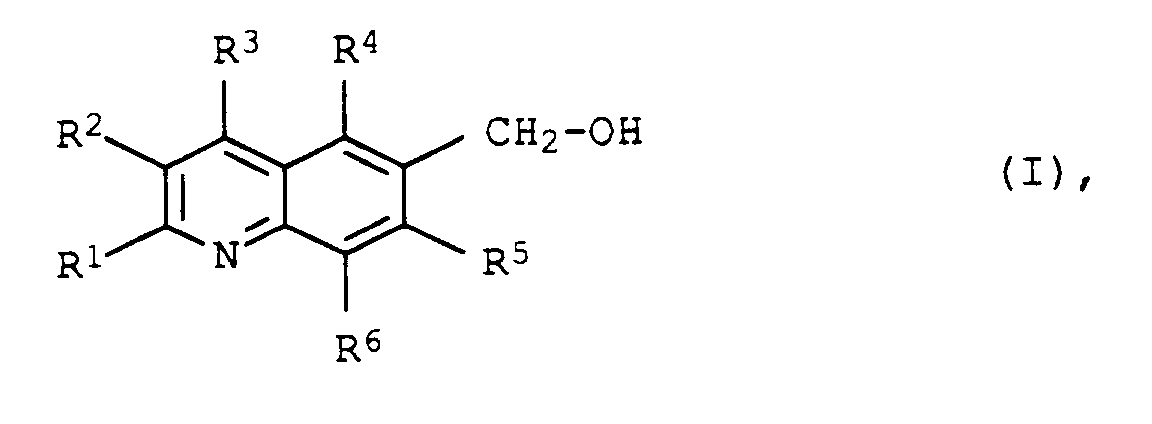
in der
- R¹,R²,R³,R⁴,R⁵,R⁶
- Wasserstoff, tert.-Butyl, C₁- bis C₂₀-Alkoxy, Aryl, Aryloxy, Halogen und Hydroxy,
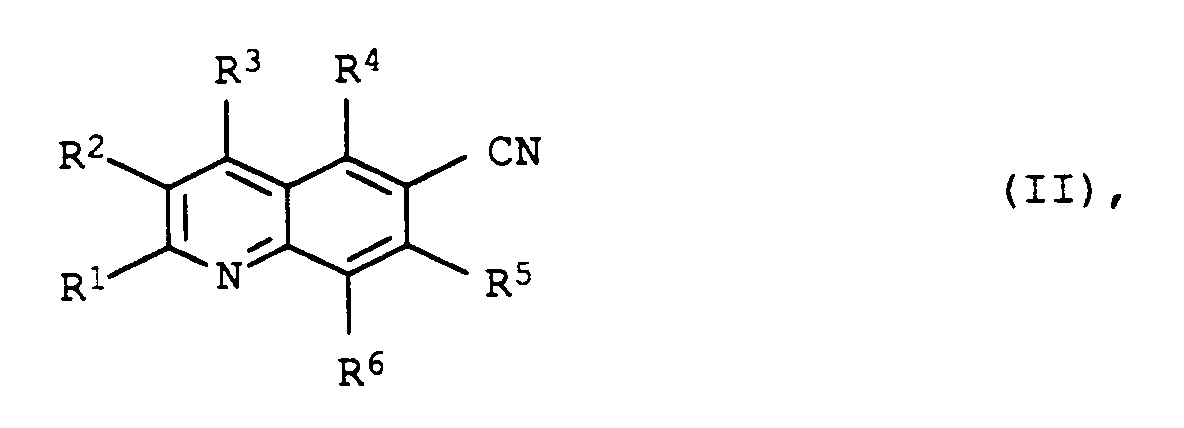
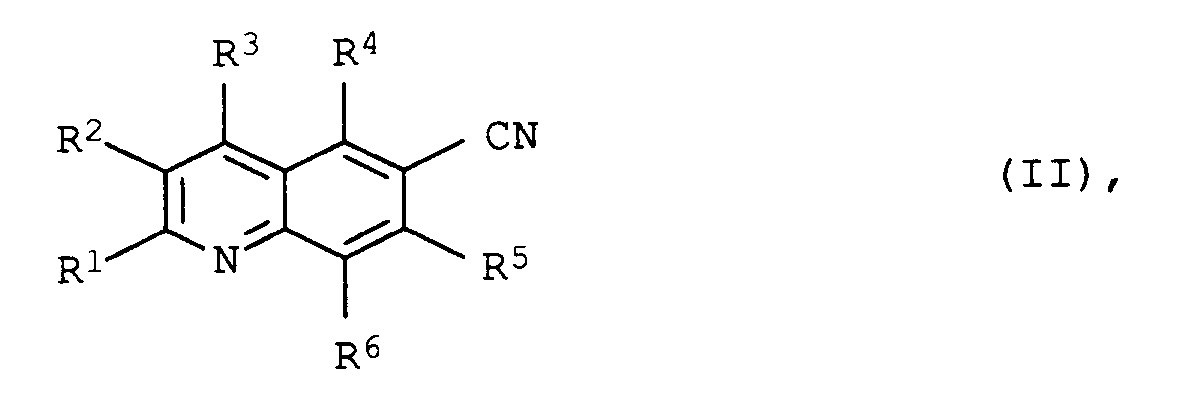
in der R¹, R², R³, R⁴, R⁵ und R⁶ die oben genannten Bedeutungen haben,
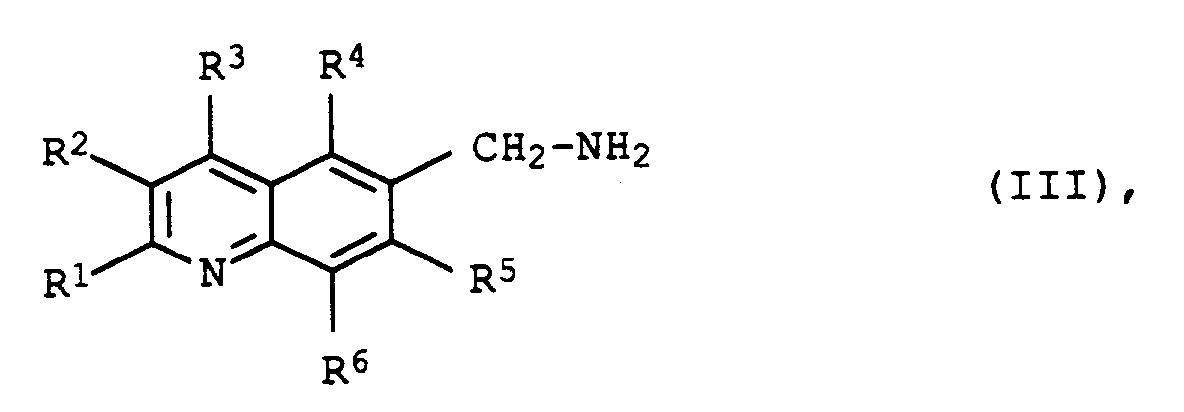
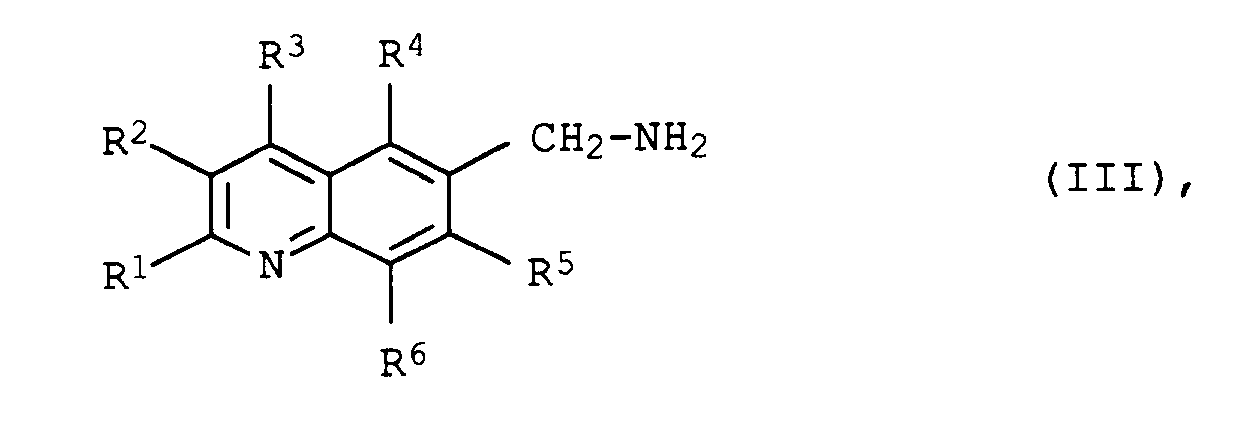
- a) in Gegenwart eines Hydrierkatalysators bei Temperaturen von 10 bis 100°C und Drücken von 1 bis 200 bar, das entstandene 6-Aminomethylchinolin der allgemeinen Formel III
- b) in Gegenwart von Wasser und einer Mineralsäure oder einer C₁- bis C₂₀-Carbonsäure und einem Hydrierkatalysator bei Temperaturen von 0 bis 50°C und Drücken von 1 bis 50 bar umsetzt,
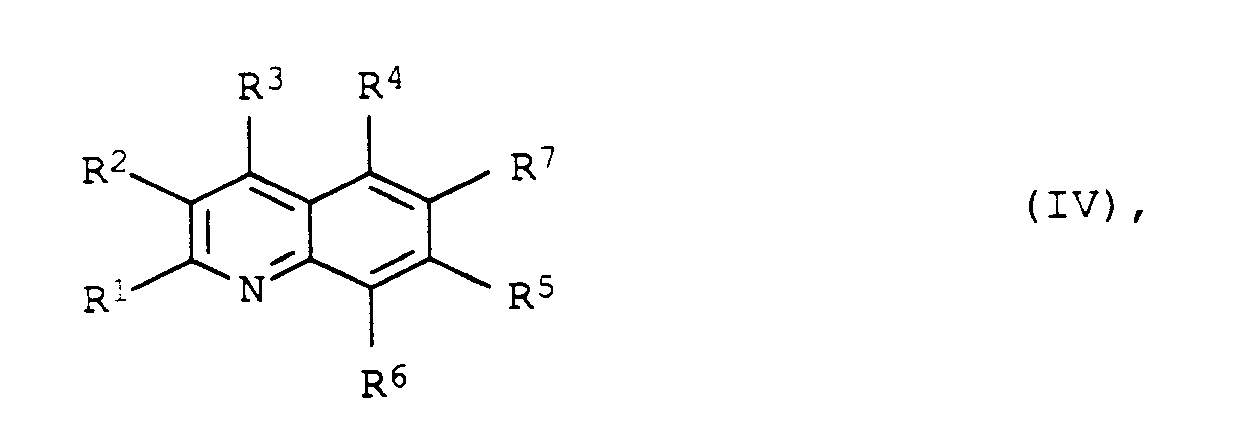
in der R¹, R², R³, R⁴, R⁵ und R⁶ die oben genannten Bedeutungen haben, und R⁷ für C₁- bis C₄-Alkyl steht, mit sauerstoffenthaltenden Gasen und Ammoniak in Gegenwart eines Katalysators, dessen katalytisch aktive Masse 5 bis 95 Gew.-% Vanadium, 5 bis 95 Gew.-% Antimon und 0 bis 20 Gew.-% Alkalimetall enthält, bei Temperaturen von 100 bis 550°C und Drücken von 0,1 bis 50 bar zu den 6-Cyanochinolinen der allgemeinen Formel II.Process for the preparation of 6-hydroxymethylquinolines of the general formula I.
in the
- R¹, R², R³, R⁴, R⁵, R⁶
- Hydrogen, tert-butyl, C₁- to C₂₀-alkoxy, aryl, aryloxy, halogen and hydroxy,
in which R¹, R², R³, R⁴, R⁵ and R⁶ have the meanings given above,
- a) in the presence of a hydrogenation catalyst at temperatures from 10 to 100 ° C and pressures from 1 to 200 bar, the resulting 6-aminomethylquinoline of the general formula III
- b) in the presence of water and a mineral acid or a C₁- to C₂₀ carboxylic acid and a hydrogenation catalyst at temperatures from 0 to 50 ° C and pressures from 1 to 50 bar,
in which R¹, R², R³, R⁴, R⁵ and R⁶ have the meanings given above, and R⁷ is C₁- to C₄-alkyl, with oxygen-containing gases and ammonia in the presence of a catalyst, the catalytically active composition of which is 5 to 95% by weight. % Vanadium, 5 to 95 wt .-% antimony and 0 to 20 wt .-% alkali metal, at temperatures from 100 to 550 ° C and pressures from 0.1 to 50 bar to the 6-cyanoquinolines of the general formula II.
Description
Die vorliegende Erfindung betrifft ein Verfahren zur Herstellung von 6-Hydroxymethylchinolinen durch Umsetzung von 6-Cyanochinolinen
- a) in Gegenwart eines Hydrierkatalysators, Diazotierung der entstandenen 6-Aminomethylchinoline in mineralsaurer oder carbonsaurer wäßriger Lösung und gegebenenfalls anschließende Basenbehandlung der entstandenen Acetate oder
- b) in Gegenwart von Wasser und einer Mineralsäure oder einer Carbonsäure und einem Hydrierkatalysator,
- a) in the presence of a hydrogenation catalyst, diazotization of the resulting 6-aminomethylquinolines in mineral acid or carboxylic acid aqueous solution and optionally subsequent base treatment of the acetates formed or
- b) in the presence of water and a mineral acid or a carboxylic acid and a hydrogenation catalyst,
Aus der EP-A-222 249 ist ein Verfahren zur Herstellung von aromatischen Nitrilen, insbesondere von Phthalsäuredinitrilen, aus entsprechend alkylsubstituierten aromatischen Kohlenwasserstoffen durch katalytische Oxidation mit Sauerstoff und Sauerstoff enthaltenden Gasen in Gegenwart von Ammoniak bei erhöhter Temperatur in der Dampfphase in Gegenwart eines Katalysators, der Vanadiumpentoxid, Antimontrioxid und Alkalioxid sowie Aluminiumoxid enthält, bekannt.EP-A-222 249 describes a process for the preparation of aromatic nitriles, in particular phthaloyl dinitriles, from corresponding alkyl-substituted aromatic hydrocarbons by catalytic oxidation with gases containing oxygen and oxygen in the presence of ammonia at elevated temperature in the vapor phase in the presence of a catalyst, which contains vanadium pentoxide, antimony trioxide and alkali oxide as well as aluminum oxide.
Aus der DE-A-19 48 714 ist ein Verfahren zur Herstellung von Katalysatoren durch Bereitung von Mischungen, die Antimon und Vanadium als Verbindungen oder in elementarer Form und gegebenenfalls eine Trägersubstanz enthalten, und Erhitzen der Mischungen in Gegenwart von Sauerstoff bekannt, deren Mischungen Antimon und Vanadium im molaren Verhältnis von 1,1 : 1 bis 50 : 1 enthalten.DE-A-19 48 714 discloses a process for the preparation of catalysts by preparing mixtures which contain antimony and vanadium as compounds or in elemental form and, if appropriate, a carrier, and heating the mixtures in the presence of oxygen, the mixtures of which are antimony and vanadium in a molar ratio of 1.1: 1 to 50: 1.
Aus der US-A-3 957 297 ist ein Verfahren zur Herstellung von 3-Cyanpyridin durch Ammonoxidation von 2-Methyl-5-ethylpyridin durch Reaktion mit Ammoniak und Sauerstoff in der Gasphase bei erhöhter Temperatur bekannt, in dem ein Katalysator bestehend aus einem Träger mit niedriger Oberfläche, auf dem Vanadiumoxid und andere Metalloxide abgeschieden worden sind, verwendet wird, wobei die Reaktion in Anwesenheit von wasserdampf durchgeführt wird.From US-A-3 957 297 a process for the preparation of 3-cyanopyridine by ammoxidation of 2-methyl-5-ethylpyridine by reaction with ammonia and oxygen in the gas phase at elevated temperature is known, in which a catalyst consisting of a support with a low surface area on which vanadium oxide and other metal oxides have been deposited, the reaction being carried out in the presence of water vapor.
Aus der DE-A-12 90 125 ist ein Verfahren zur Herstellung von Benzonitrilen durch Umsetzung von Alkyl-substituierten Benzolderivaten bekannt in dem die Umsetzung mit Hilfe eines Katalysators aus Antimon- und Vanadiumoxid, gegebenenfalls unter Zusatz von Alkaliverbindungen bei einer Temperatur von 250 bis 500°C durchführt. Es werden z.B. bei der Ammonoxidation von m-Xylol Ausbeuten bis zu 86,1 % Isophthalodinitril an diesem Katalysatorsystem erreicht.DE-A-12 90 125 discloses a process for the preparation of benzonitriles by reacting alkyl-substituted benzene derivatives in which the reaction is carried out with the aid of a catalyst composed of antimony and vanadium oxide, optionally with the addition of alkali compounds at a temperature of 250 to 500 ° C. E.g. yields of up to 86.1% isophthalonitrile in this catalyst system in the ammoxidation of m-xylene.
Aus Liebigs Ann. Chem. (1979) 1952 bis 1959 und J. Med. Chem. 13 (1970), 878 bis 882 ist die Reduktion von Cyano-Gruppen in Nachbarstellung zu einem aromatischen System in die entsprechende Alkohole durch hydrolysierende Hydrierung in hochkonzentrierten Mineralsäuren bekannt.From Liebigs Ann. Chem. (1979) 1952 to 1959 and J. Med. Chem. 13 (1970), 878 to 882, the reduction of cyano groups adjacent to an aromatic system into the corresponding alcohols by hydrolyzing hydrogenation in highly concentrated mineral acids is known.
Aus Chem. Abstr. Vol 103, 215195, ist die Herstellung von 2-Hydroxymethylpyrridin aus 2-Cyanopyrridin als 18%ige Lösung in halbkonzentrierter Schwefelsäure an Raney-Nickel bei 20 bar und 30°C mit einer Ausbeute von 69 % bekannt. Das als Nebenprodukt entstehende 2-Aminomethylpyrridin wird in einem weiteren Schritt durch Diazotierung und anschließender Verkochung ebenfalls zum Alkohol umgewandelt, wodurch sich die Ausbeute auf 83,5 % erhöht.From Chem. Abstr. Vol 103, 215195, the preparation of 2-hydroxymethylpyrridine from 2-cyanopyrridine as an 18% solution in semi-concentrated sulfuric acid on Raney nickel at 20 bar and 30 ° C. is known with a yield of 69%. The 2-aminomethylpyrridine formed as a by-product is also converted to alcohol in a further step by diazotization and subsequent boiling, which increases the yield to 83.5%.
Aus der EP-A-369 208 ist die Herstellung von 2-Hydroxymethyl-3,5-dimethyl-4-methoxypyridin aus der entsprechenden Cyanoverbindung bekannt. Die Cyanoverbindung wird als 3% Lösung in Methanol an Raney-Nickel 3 Tage bei Raumtemperatur und Normaldruck hydriert, das erhaltene Amin durch Destillation isoliert und anschließend in 10%iger Essigsäure bei 0°C mit Natriumnitrit diazotiert und verkocht. Die Gesamtausbeute an destilliertem Alkohol und die Raum-Zeit-Ausbeute ist unbefriedigend.The production of 2-hydroxymethyl-3,5-dimethyl-4-methoxypyridine from the corresponding cyano compound is known from EP-A-369 208. The cyano compound is hydrogenated as a 3% solution in methanol on Raney nickel for 3 days at room temperature and atmospheric pressure, the amine obtained is isolated by distillation and then diazotized and boiled in 10% acetic acid at 0 ° C. with sodium nitrite. The overall yield of distilled alcohol and the space-time yield is unsatisfactory.
In DE-A-35 09 618 und EP-A-381 375 wird die Herstellung von 6-Hydroxymethylchinolin aus Chinolin-6-carbonsäureester durch Reduktion mit komplexen Aluminiumhydriden beschrieben. Die Nachteile dieses Verfahrens liegen in dem langen Syntheseweg (Carbonsäure - Carbonsäureester - Alkohol), dem teuren Reduktionsmittel und zusätzlich in der problematischen Aufarbeitung durch die anfallenden Hydrolyseprodukte des Reduktionsmittels.DE-A-35 09 618 and EP-A-381 375 describe the preparation of 6-hydroxymethylquinoline from quinoline-6-carboxylic acid esters by reduction with complex aluminum hydrides. The disadvantages of this process lie in the long synthesis route (carboxylic acid - carboxylic acid ester - alcohol), the expensive reducing agent and in addition in the problematic workup due to the hydrolysis products of the reducing agent.
Der vorliegenden Erfindung lag daher die Aufgabe zugrunde, den zuvor genannten Nachteilen abzuhelfen.The object of the present invention was therefore to remedy the disadvantages mentioned above.
Demgemäß wurde ein neues und verbessertes Verfahren zur Herstellung von 6-Hydroxymethylchinolinen der allgemeinen Formel I
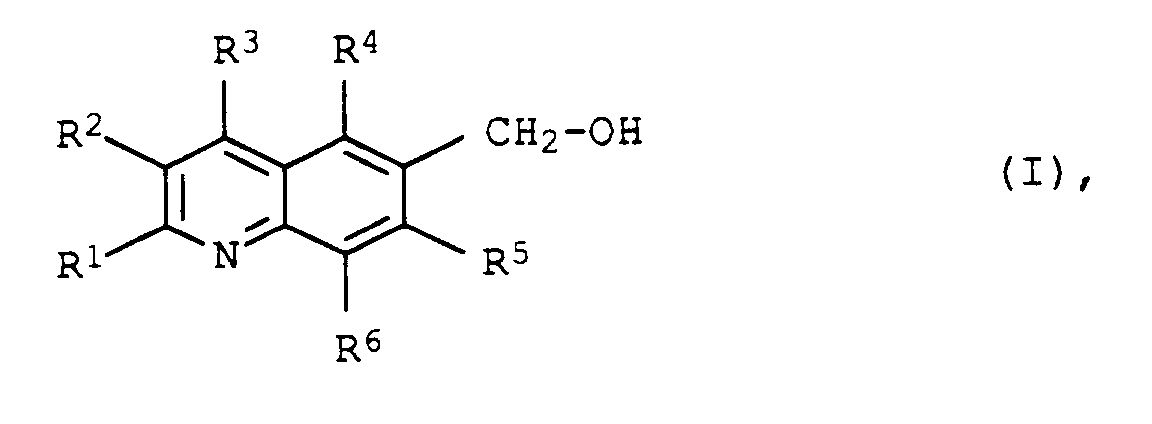
in der
- R¹,R²,R³,R⁴,R⁵,R⁶
- Wasserstoff, tert.-Butyl, C₁- bis C₂₀-Alkoxy, Aryl, Aryloxy, Halogen und Hydroxy,

in der R¹, R², R³, R⁴, R⁵ und R⁶ die oben genannten Bedeutungen haben,
- a) in Gegenwart eines Hydrierkatalysators bei Temperaturen von 10 bis 100°C und Drücken von 1 bis 200 bar, das entstandene 6-Aminomethylchinolin der allgemeinen Formel III

- b) in Gegenwart von Wasser und einer Mineralsäure oder einer C₁-bis C₂₀-Carbonsäure und einem Hydrierkatalysator bei Temperaturen von 0 bis 50°C und Drücken von 1 bis 50 bar umsetzt,

in der R¹, R², R³, R⁴, R⁵ und R⁶ die oben genannten Bedeutungen haben, und R⁷ für C₁- bis C₄-Alkyl steht, mit sauerstoffenthaltenden Gasen und Ammoniak in Gegenwart eines Katalysators, dessen katalytisch aktive Masse 5 bis 95 Gew.-% Vanadium, 5 bis 95 Gew.-% Antimon und 0 bis 20 Gew.-% Cäsium enthält, bei Temperaturen von 100 bis 550°C und Drücken von 0,1 bis 50 bar zu den 6-Cyanochinolinen der allgemeinen Formel II.Accordingly, a new and improved process for the preparation of 6-hydroxymethylquinolines of the general formula I
in the
- R¹, R², R³, R⁴, R⁵, R⁶
- Hydrogen, tert-butyl, C₁- to C₂₀-alkoxy, aryl, aryloxy, halogen and hydroxy,
in which R¹, R², R³, R⁴, R⁵ and R⁶ have the meanings given above,
- a) in the presence of a hydrogenation catalyst at temperatures from 10 to 100 ° C and pressures from 1 to 200 bar, the resulting 6-aminomethylquinoline of the general formula III
- b) in the presence of water and a mineral acid or a C₁ to C₂₀ carboxylic acid and a hydrogenation catalyst at temperatures from 0 to 50 ° C and pressures from 1 to 50 bar,
in which R¹, R², R³, R⁴, R⁵ and R⁶ have the meanings given above, and R⁷ is C₁- to C₄-alkyl, with oxygen-containing gases and ammonia in the presence of a catalyst, the catalytically active composition of which is 5 to 95% by weight. % Vanadium, 5 to 95 wt .-% antimony and 0 to 20 wt .-% cesium, at temperatures from 100 to 550 ° C and pressures from 0.1 to 50 bar to the 6-cyanoquinolines of the general formula II.
Das erfindungsgemäße Verfahren wird wie folgt durchgeführt:The process according to the invention is carried out as follows:
-
a) Die Cyanochinoline II können in die Hydrierung in Lösung oder Suspension eingesetzt werden.
Die heterogen, bevorzugt suspensionskatalysierte Hydrierung kann bei Drücken von 1 bis 200 bar, bevorzugt 5 bis 80 bar, besonders bevorzugt 30 bis 60 bar und Temperaturen von 10 und 100°C, bevorzugt 30 bis 70°C durchgeführt werden.
Die Hydrierung kann bevorzugt unter Zusatz von Ammoniak zum 6-Cyanochinolin von 0,5 : 1 bis 10 : 1, bevorzugt 1 : 1 bis 2 : 1 durchgeführt werden.
Nach Abtrennen des Katalysators und Abdestillieren des Ammoniaks und des Lösungsmittels kann das erhaltene Aminomethylchinolin aufdestilliert und somit in reiner Form gewonnen werden. Bevorzugt wird das Produkt ohne weitere Aufarbeitung in die Diazotierung eingesetzt.
Die Diazotierung/Verkochung kann bei Temperaturen von -10 bis 40°C, bevorzugt 5 bi 20°C, besonders bevorzugt 5 bis 15°C und Drücken von 0,01 bis 5 bar, bevorzugt 0,1 bis 2 bar, besonders bevorzugt Normaldruck (Atmosphärendruck) mit einem Diazotierungsmittel durchgeführt werden.
Als Diazotierungsmittel eignen sich Natriumnitrit, Silbernitrit, Silbernitrit oder Alkylnitrite, bevorzugt wäßriges Natriumnitrit in mineralsaurer oder carbonsaurer wäßriger Lösung, besonders bevorzugt in Essigsäure.
Die Konzentration der Mineralsäure oder Carbonsäure in wäßriger Lösung beträgt in der Regel 10 bis 80 Gew.-%, bevorzugt 10 bis 30 Gew.-%, besonders bevorzugt 15 bis 25 Gew.-%.
Anschließend kann die Reaktionsmischung durch Einstellen mit einer organischen oder anorganischen Base wie Tetraalkylammoniumhydroxid, Kalilauge und Natronlauge, bevorzugt Kalilauge und Natronlauge, besonders bevorzugt Natronlauge auf einen pH-Wert zwischen 10 bis 14 bei einer Temperatur zwischen 30 bis 80°C, bevorzugt 40 bis 60°C verseift werden.a) The cyanoquinolines II can be used in the hydrogenation in solution or suspension.
The heterogeneous, preferably suspension-catalyzed, hydrogenation can be carried out at pressures of 1 to 200 bar, preferably 5 to 80 bar, particularly preferably 30 to 60 bar and temperatures of 10 and 100 ° C., preferably 30 to 70 ° C.
The hydrogenation can preferably be carried out with the addition of ammonia to the 6-cyanoquinoline from 0.5: 1 to 10: 1, preferably 1: 1 to 2: 1.
After separating off the catalyst and distilling off the ammonia and the solvent, the aminomethylquinoline obtained can be distilled off and thus obtained in pure form. The product is preferably used in the diazotization without further working up.
The diazotization / boiling can be carried out at temperatures from -10 to 40 ° C., preferably 5 to 20 ° C., particularly preferably 5 to 15 ° C. and pressures of 0.01 to 5 bar, preferably 0.1 to 2 bar, particularly preferably normal pressure (Atmospheric pressure) with a diazotizing agent.
Suitable diazotizing agents are sodium nitrite, silver nitrite, silver nitrite or alkyl nitrites, preferably aqueous sodium nitrite in mineral acid or carboxylic acid aqueous solution, particularly preferably in acetic acid.
The concentration of the mineral acid or carboxylic acid in aqueous solution is generally 10 to 80% by weight, preferably 10 to 30% by weight, particularly preferably 15 to 25% by weight.
The reaction mixture can then be adjusted to a pH between 10 to 14 at a temperature between 30 to 80 ° C., preferably 40 to 60 by adjusting with an organic or inorganic base such as tetraalkylammonium hydroxide, potassium hydroxide solution and sodium hydroxide solution, preferably potassium hydroxide solution and sodium hydroxide solution, particularly preferably sodium hydroxide solution ° C can be saponified. -
b) Die 6-Cyanochinoline II können in Lösung oder Suspension eingesetzt werden. Als Lösungs- oder Suspensionsmittel kommen wäßrige Mineralsäuren wie Salzsäure, Schwefelsäure und Phosphorsäure oder wäßrige organische Säuren wie p-Toluolsulfonsäure, Ameisensäure, Essigsäure oder Gemische aus diesen, bevorzugt wäßrige organische Säuren, besonders bevorzugt wäßrige Essigsäure zum Einsatz. Die Säurekonzentration liegt in der Regel bei 10 bis 90 Gew.-%, bevorzugt 20 bis 50 Gew.-%. Die Säure kann auch in Form eines sauren Ionenaustauschers zugegeben werden.
Die Hydrierung kann in der Regel bei Drücken zwischen 1 und 50 bar, bevorzugt zwischen 1 und 20 bar, besonders bevorzugt bei Normaldruck (Atmosphärendruck) und bei Temperaturen zwischen 0 und 50°C, bevorzugt zwischen 10 und 20°C durchgeführt werden.b) The 6-cyanoquinolines II can be used in solution or suspension. Aqueous mineral acids such as hydrochloric acid, sulfuric acid and phosphoric acid or aqueous organic acids such as p-toluenesulfonic acid, formic acid, acetic acid or mixtures of these, preferably aqueous organic acids, particularly preferably aqueous acetic acid, are used as solvents or suspending agents. The acid concentration is generally 10 to 90% by weight, preferably 20 to 50% by weight. The acid can also be added in the form of an acidic ion exchanger.
The hydrogenation can generally be carried out at pressures between 1 and 50 bar, preferably between 1 and 20 bar, particularly preferably at normal pressure (atmospheric pressure) and at temperatures between 0 and 50 ° C., preferably between 10 and 20 ° C.
Als Hydrierkatalysatoren (Reduktionskatalysatoren) kommen für a) und b) alle gängigen Hydrierkatalysatoren in Frage. Die Reaktion kann entweder suspensionskatalysiert z.B. an Pd/C, Rh/C, Ru/C, Re/C, Pt/C, Raney-Nickel oder Raney-Cobalt, bevorzugt Raney-Cobalt, Raney-Nickel oder Pd/C, besonders bevorzugt Pd/C oder Raney-Nickel oder festbettkatalysiert an Edelmetall-Trägerkatalysatoren wie z.B. Pd/C, Pd/Al₂0₃, Re/TiO₂ oder Ru/C oder Cobalt, Nickel oder Kupfer-Vollkontakten durchgeführt werden. Bevorzugt wird die Suspensionsfahrweise, wobei sich der Suspensionskatalysator mehrfach verwenden läßt.Suitable hydrogenation catalysts (reduction catalysts) are all common hydrogenation catalysts for a) and b). The reaction can either be suspension catalyzed e.g. on Pd / C, Rh / C, Ru / C, Re / C, Pt / C, Raney nickel or Raney cobalt, preferably Raney cobalt, Raney nickel or Pd / C, particularly preferably Pd / C or Raney Nickel or fixed bed catalysed on precious metal supported catalysts such as Pd / C, Pd / Al₂0₃, Re / TiO₂ or Ru / C or cobalt, nickel or copper full contacts can be carried out. The suspension procedure is preferred, it being possible to use the suspension catalyst several times.
Als Lösungs- oder Suspensionsmittel in der Hydrierung für a) und b) kommen alle Lösungsmittel in Frage, die unter den Hydrierbedingungen inert sind und den Katalysator nicht vergiften wie z.B. C₅- bis C₃₀-Kohlenwasserstoffe, C₁- bis C₈-Alkanole wie Methanol und Ethanol, C₁- bis C₂₀-Alkylformamide wie Dimethylformamid, C₂- bis C₂₀-Ether, bevorzugt cyclische Ether wie Tetrahydrofuran oder acyclische Ether wie Methyl-tert.-butylether und Methyl-iso-propylether, Carbonsäuren wie Ameisensäure, Essigsäure und Propionsäure, Carbonsäureester wie Essigsäuremethylester und Essigsäureethylester, cyclische Amide wie N-Methylpyrrolidon.Suitable solvents or suspending agents in the hydrogenation for a) and b) are all solvents which are inert under the hydrogenation conditions and do not poison the catalyst, such as For example, C₅ to C₃₀ hydrocarbons, C₁ to C₈ alkanols such as methanol and ethanol, C₁ to C₂₀ alkylformamides such as dimethylformamide, C₂ to C₂₀ ethers, preferably cyclic ethers such as tetrahydrofuran or acyclic ethers such as methyl tert-butyl ether and methyl isopropyl ether, carboxylic acids such as formic acid, acetic acid and propionic acid, carboxylic acid esters such as methyl acetate and ethyl acetate, cyclic amides such as N-methylpyrrolidone.
Die Aufarbeitung des Rohalkohols nach a) oder b) kann entweder durch Extraktion oder durch Destillation erfolgen.The crude alcohol can be worked up according to a) or b) either by extraction or by distillation.
Bei der Extraktion können zuerst bei pH 2 ungewünschte Nebenprodukte, und anschließend bei pH 7 der gewünschte Alkohol in hoher Reinheit (> 95%) extrahiert werden. Das Nebenprodukt 6-Aminomethylchinolin wird bei diesem pH-Wert nicht mitextrahiert, kann jedoch durch anschließende Extraktion bei pH 14 ebenfalls in hoher Reinheit (> 95%) erhalten werden.During the extraction, unwanted by-products can first be extracted at pH 2 and then the desired alcohol in high purity (> 95%) at pH 7. The by-product 6-aminomethylquinoline is not extracted at this pH, but can also be obtained in high purity (> 95%) by subsequent extraction at pH 14.
Als Extraktionsmittel kommen Ether, Ketone oder aromatische oder aliphatische Kohlenwasserstoffe in Frage. Bevorzugt werden Methyl-tert.-butylether, Methyl-iso-propylether, Toluol, Cyclohexan, 2-Ethylhexanol, besonders bevorzugt Methyl-tert.-butylether und 2-Ethylhexanol.Suitable extractants are ethers, ketones or aromatic or aliphatic hydrocarbons. Preference is given to methyl tert-butyl ether, methyl isopropyl ether, toluene, cyclohexane, 2-ethylhexanol, particularly preferably methyl tert-butyl ether and 2-ethylhexanol.
Nach Entfernung des Lösungsmittels können die Produkte in kristalliner Form erhalten und anschließend z.B. aus Toluol, Essigester, Methyl-tert.-butylether, Methyl-iso-propylether oder Tetrahydrofuran, besonders bevorzugt Toluol umkristallisiert werden.After removal of the solvent, the products can be obtained in crystalline form and then e.g. be recrystallized from toluene, ethyl acetate, methyl tert-butyl ether, methyl isopropyl ether or tetrahydrofuran, particularly preferably toluene.
Man kann die 6-Alkylchinoline IV mit sauerstoffenthaltenden Gasen und Ammoniak in Gegenwart eines Katalysators, dessen katalytisch aktive Masse Vanadium, Antimon und Cäsium enthält, bei Temperaturen von 100 bis 55°C, bevorzugt 300 bis 520°C, besonders bevorzugt 400 bis 500°C und Drücken von 0,1 bis 50 bar, bevorzugt 0,5 bis 5 bar, besonders bevorzugt Normaldruck (Atmosphärendruck) diskontinuierlich oder kontinuierlich umsetzen. Dazu wird das Gas, welches 6-Alkylchinolin, Sauerstoff, Ammoniak und möglicherweise weitere Komponenten enthält, über einen Katalysator geleitet. Der Katalysator kann in Form von Kugeln, Ringen, weiteren Formkörpern oder Pulver vorliegen, wobei im letzten Fall bevorzugt eine Wirbelschicht gewählt wird.The 6-alkylquinolines IV can be mixed with oxygen-containing gases and ammonia in the presence of a catalyst whose catalytically active composition contains vanadium, antimony and cesium at temperatures from 100 to 55 ° C., preferably 300 to 520 ° C., particularly preferably 400 to 500 ° C. C and pressures of 0.1 to 50 bar, preferably 0.5 to 5 bar, particularly preferably normal pressure (atmospheric pressure) discontinuously or continuously. For this purpose, the gas, which contains 6-alkylquinoline, oxygen, ammonia and possibly other components, is passed over a catalyst. The catalyst can be in the form of spheres, rings, further shaped bodies or powder, a fluidized bed preferably being selected in the latter case.
Als sauerstoffhaltige Gase eignen sich Sauerstoff, Luft, oder ein Gemisch aus Sauerstoff und Luft, welches mindestens 2 Mol-% Sauerstoff, bevorzugt mindestens 5 Mol-% und besonders bevorzugt mindestens 8 Mol-% Sauerstoff enthält.Suitable oxygen-containing gases are oxygen, air, or a mixture of oxygen and air, which contains at least 2 mol% oxygen, preferably at least 5 mol% and particularly preferably at least 8 mol% oxygen.
Als Katalysatoren deren katalytisch aktive Masse Vanadium, Antimon und Alkalimetall enthält, eignen sich Katalysatoren mit einer katalytisch aktive Masse mit 5 bis 95 Gew.-% Vanadium, bevorzugt 10 bis 90 Gew.-%, besonders bevorzugt 10 bis 80 Gew.-%, 5 bis 95 Gew.-%, bevorzugt 10 bis 90 Gew.-%, besonders bevorzugt 10 bis 80 Gew.-% Antimon und 0 bis 20 Gew.-% eines Alkalimetalls, bevorzugt 0 bis 10 Gew.-%, besonders bevorzugt 0 bis 5 Gew.-% enthält.Suitable catalysts whose catalytically active composition contains vanadium, antimony and alkali metal are suitable as catalysts with a catalytically active composition containing 5 to 95% by weight of vanadium, preferably 10 to 90% by weight, particularly preferably 10 to 80% by weight, 5 to 95% by weight, preferably 10 to 90% by weight, particularly preferably 10 to 80% by weight of antimony and 0 to 20% by weight of an alkali metal, preferably 0 to 10% by weight, particularly preferably 0 contains up to 5 wt .-%.
Unter den Alkalimetallen eignen sich Lithium, Natrium, Kalium, Ruthenium und Cäsium, bevorzugt Natrium, Kalium und Cäsium, besonders bevorzugt Cäsium.Among the alkali metals are lithium, sodium, potassium, ruthenium and cesium, preferably sodium, potassium and cesium, particularly preferably cesium.
Man kann diese Katalysatoren als Vollkontakte oder bevorzugt auf einem Träger, bevorzugt einem porösen Träger aufgebracht verwenden. Die katalytisch aktive Masse wird in der Regel in Form von Oxiden auf den Träger z.B. durch Tränken, Imprägnieren oder Aufsprühen aufgebracht.These catalysts can be used as full contacts or preferably applied to a support, preferably a porous support. The catalytically active mass is usually applied in the form of oxides e.g. applied by soaking, impregnating or spraying.
Als Träger eignen sich Titandioxid, Aluminiumoxid, Siliciumdioxid oder Zirkondioxid oder ein Gemisch davon.Titanium dioxide, aluminum oxide, silicon dioxide or zirconium dioxide or a mixture thereof are suitable as carriers.
Die Trägerkatalysatoren haben in der Regel eine BET-Oberfläche von 10 bis 350 m²/g, bevorzugt 40 bis 250 m²/g, besonders bevorzugt 60 bis 200 m²/g. Falls die Wirbelschichtvariante gewählt wird, beträgt die mittlere Partikelgröße in der Regel 20 bis 500 µm, bevorzugt 50 bis 350 µm, besonders bevorzugt 70 bis 180 µm, wobei in der Regel weniger als 10 Gew-% der Teilchen einen Durchmesser unter 30 µm und in der Regel weniger als 10 Gew.-% der Teilchen einen Durchmesser über 200 µm haben. Der Hauptteil der Poren liegt in der Regel im Bereich zwischen 2 nm und 1 µm.The supported catalysts generally have a BET surface area of 10 to 350 m² / g, preferably 40 to 250 m² / g, particularly preferably 60 to 200 m² / g. If the fluidized bed variant is selected, the average particle size is generally 20 to 500 μm, preferably 50 to 350 μm, particularly preferably 70 to 180 μm, with generally less than 10% by weight of the particles having a diameter below 30 μm and in generally less than 10 wt .-% of the particles have a diameter of over 200 microns. The main part of the pores is usually in the range between 2 nm and 1 µm.
Bei imprägnierten Trägerkatalysatoren kann der Aktivmassenvorläufer bestehend aus Lösungen von Komplexsalzen wie Antimon-Tartrat und Vanadium-Oxalat sowie aus einer Alkalisalzlösung z.B. durch Eintauchen und inniges Vermischen auf den Träger aufgebracht werden. Das feuchte Pulver wird in der Regel mehrere Stunden 2 bis 10 h bei erhöhten Temperaturen von 60 bis 200°C, bevorzugt 80 bis 180°C, besonders bevorzugt 100 bis 140°C getrocknet und anschließend mehrere Stunden 2 bis 10 h bei erhöhten Temperaturen von 300 bis 900°C, bevorzugt 400 bis 750°C, besonders bevorzugt 450 bis 700°C 3 h in einem Ofen, Drehrohr oder Wirbelbett calciniert. Das so erhaltene calcinierte Katalysatorpulver kann in einem Wirbelschichtreaktor für die Synthese verwendet werden.In the case of impregnated supported catalysts, the active mass precursor consisting of solutions of complex salts such as antimony tartrate and vanadium oxalate and of an alkali salt solution can be applied to the support, for example by immersion and intimate mixing. The moist powder is generally dried for several hours from 2 to 10 hours at elevated temperatures of 60 to 200 ° C., preferably from 80 to 180 ° C., particularly preferably from 100 to 140 ° C., and then for 2 hours to 10 hours at elevated temperatures of Calcined 300 to 900 ° C, preferably 400 to 750 ° C, particularly preferably 450 to 700 ° C for 3 h in an oven, rotary tube or fluidized bed. The calcined catalyst powder thus obtained can be used in a fluidized bed reactor for synthesis.
Die Substituenten R¹, R², R³, R⁴, R⁵, R⁶ und R⁷ in den Verbindungen I, II, III und IV haben folgende Bedeutungen:
- R¹,R²,R³,R⁴,R⁵,R⁶,R⁷
-
- unabhängig voneinander
- Wasserstoff,
- tert.-Butyl,
- C₁- bis C₂₀-Alkoxy, bevorzugt C₁- bis C₈-Alkoxy wie Methoxy, Ethoxy, n-Propoxy, iso-Propoxy, n-Butoxy, iso-Butoxy, sec.-Butoxy, tert.-Butoxy, n-Pentoxy, iso-Pentoxy, sec.-Pentoxy, neo-Pentoxy, 1,2-Dimethylpropoxy, n-Hexoxy, iso-Hexoxy, sec.-Hexoxy, n-Heptoxy, iso-Heptoxy, n-Octoxy, iso-Octoxy, besonders bevorzugt C₁- bis C₄-Alkoxy wie Methoxy, Ethoxy, n-Propoxy, iso-Propoxy, n-Butoxy, iso-Butoxy, sec.-Butoxy und tert.-Butoxy,
- Aryl wie Phenyl, 1-Naphthyl, 2-Naphthyl, 1-Anthryl, 2-Anthryl und 9-Anthryl, bevorzugt Phenyl, 1-Naphthyl und 2-Naphthyl, besonders bevorzugt Phenyl,
- Aryloxy wie Phenoxy, 1-Naphthoxy, 2-Naphthoxy, 1-Anthroxy, 2-Anthroxy und 9-Anthroxy, bevorzugt Phenoxy, 1-Naphthoxy und 2-Naphthoxy, besonders bevorzugt Phenoxy,
- Halogen wie Fluor, Chlor, Brom und Jod, bevorzugt Fluor, Chlor und Brom, besonders bevorzugt Fluor und Chlor und
- Hydroxy,
- R⁷
-
- C₁- bis C₄-Alkyl wie Methyl, Ethyl, n-Propyl, iso-Propyl, n-Butyl, iso-Butyl, sec.-Butyl und tert.-Butyl, bevorzugt C₁- bis C₃-Alkyl wie Methyl, Ethyl, n-Propyl und iso-Propyl, besonders bevorzugt Methyl und Ethyl,
- R¹, R², R³, R⁴, R⁵, R⁶, R⁷
-
- independently of each other
- Hydrogen,
- tert-butyl,
- C₁- to C₂₀-alkoxy, preferably C₁- to C₈-alkoxy such as methoxy, ethoxy, n-propoxy, iso-propoxy, n-butoxy, iso-butoxy, sec.-butoxy, tert.-butoxy, n-pentoxy, iso -Pentoxy, sec.-pentoxy, neo-pentoxy, 1,2-dimethylpropoxy, n-hexoxy, iso-hexoxy, sec.-hexoxy, n-heptoxy, iso-heptoxy, n-octoxy, iso-octoxy, particularly preferably C₁ - to C₄-alkoxy such as methoxy, ethoxy, n-propoxy, iso-propoxy, n-butoxy, iso-butoxy, sec-butoxy and tert-butoxy,
- Aryl such as phenyl, 1-naphthyl, 2-naphthyl, 1-anthryl, 2-anthryl and 9-anthryl, preferably phenyl, 1-naphthyl and 2-naphthyl, particularly preferably phenyl,
- Aryloxy such as phenoxy, 1-naphthoxy, 2-naphthoxy, 1-anthroxy, 2-anthroxy and 9-anthroxy, preferably phenoxy, 1-naphthoxy and 2-naphthoxy, particularly preferably phenoxy,
- Halogen such as fluorine, chlorine, bromine and iodine, preferably fluorine, chlorine and bromine, particularly preferably fluorine and chlorine and
- Hydroxy,
- R⁷
-
- C₁ to C₄ alkyl such as methyl, ethyl, n-propyl, isopropyl, n-butyl, iso-butyl, sec-butyl and tert-butyl, preferably C₁ to C₃ alkyl such as methyl, ethyl, n Propyl and isopropyl, particularly preferably methyl and ethyl,
100 g 6-Cyanochinolin wurden in 500 ml Tetrahydrofuran suspendiert und in Gegenwart von 500 ml Ammoniak und 20 g Raney-Nickel bei 50 bar und 50°C 10 h hydriert. Nach 3 h war die Wasserstoffaufnahme beendet. Ammoniak und Tetrahydrofuran wurden abdestilliert, und das erhaltene 6-Aminomethylchinolin in 2200 g Essigsäure (50%ig) gelöst und 48 g Natriumnitrit, gelöst in 250 ml Wasser, innerhalb 40 Minuten bei 10°C zugetropft. Anschließend wurde mit 20%iger Natronlauge auf pH 14 gestellt und 2 h bei 60°C gerührt. Durch Extraktion mit Methyl-tert.-butylether und Destillation erhielt man 71 g (69 %) 6-Hydroxymethyl-chinolin (Sdp.: 195°C/10 mbar; Smp.: 74 bis 76°C [79 bis 80°C nach J. Org. Chem. 18 (1953) 55]).100 g of 6-cyanoquinoline were suspended in 500 ml of tetrahydrofuran and hydrogenated in the presence of 500 ml of ammonia and 20 g of Raney nickel at 50 bar and 50 ° C. for 10 hours. The hydrogen uptake ceased after 3 hours. Ammonia and tetrahydrofuran were distilled off, and the 6-aminomethylquinoline obtained was dissolved in 2200 g of acetic acid (50% strength) and 48 g of sodium nitrite, dissolved in 250 ml of water, were added dropwise at 10 ° C. in the course of 40 minutes. The pH was then adjusted to 14 with 20% sodium hydroxide solution and the mixture was stirred at 60 ° C. for 2 h. Extraction with methyl tert-butyl ether and distillation gave 71 g (69%) of 6-hydroxymethyl-quinoline (bp: 195 ° C / 10 mbar; mp: 74 to 76 ° C [79 to 80 ° C after J. Org. Chem. 18 (1953) 55]).
200 g 6-Cyanochinolin wurden in 500 ml Methanol suspendiert und in Gegenwart von 500 ml Ammoniak und 40 g Raney-Nickel bei 50 bar und 50°C 3 h hydriert. Nach Entfernung von Ammoniak und Methanol wurde das erhaltene 6-Aminomethylchinolin in 800 g Essigsäure (25%ig) gelöst und 90 g Natriumnitrit, gelöst in 200 ml Wasser, innerhalb 60 Minuten bei 10°C zugetropft. Anschließend wurde mit 50%iger Natronlauge auf pH 12 gestellt und 2 h bei 50°C gerührt. Durch Extraktion mit Methyl-tert.-butylether, Entfernung des Lösungsmittels i. Vak. und Umkristallisation aus Toluol erhielt man 148 g (72 %) 6-Hydroxymethylchinolin (Smp.: 75 bis 77°C).200 g of 6-cyanoquinoline were suspended in 500 ml of methanol and hydrogenated in the presence of 500 ml of ammonia and 40 g of Raney nickel at 50 bar and 50 ° C. for 3 hours. After removal of ammonia and methanol, the 6-aminomethylquinoline obtained was dissolved in 800 g of acetic acid (25% strength) and 90 g of sodium nitrite, dissolved in 200 ml of water, were added dropwise at 10 ° C. in the course of 60 minutes. The pH was then adjusted to 12 using 50% sodium hydroxide solution and the mixture was stirred at 50 ° C. for 2 h. By extraction with methyl tert-butyl ether, removal of the solvent i. Vac. and recrystallization from toluene gave 148 g (72%) of 6-hydroxymethylquinoline (mp: 75 to 77 ° C).
40 g 6-Cyanochinolin wurden in 500 ml Wasser und 500 ml Essigsäure gelöst und an 20 g Katalysator (10% Palladium auf Kohle) 8 h bei 10°C unter starkem Rühren bei Normaldruck mit Wasserstoff hydriert. Nach Abfiltrieren des Katalysators und Abdestillieren der wäßrigen Essigsäure wurde der ölige Rückstand mit Wasser versetzt, mit konz. Schwefelsäure auf pH 2 gestellt, mit Methyl-tert.-butyl-ether extrahiert und der Extrakt verworfen. Der Extraktionsrück-stand wurde mit 50%iger Natronlauge auf pH 7 gestellt, das 6-Hydroxymethyl-chinolin mit Methyl-tert.-butylether extrahiert und i. Vak. vom Lösungsmittel befreit. Das erhaltene kristalline Rohprodukt wurde mit n-Hexan digeriert. Man erhielt 28,7 g (70 %) 6-Hydroxymethyl-chinolin (Fp.: 76°C).40 g of 6-cyanoquinoline were dissolved in 500 ml of water and 500 ml of acetic acid and hydrogenated over 20 g of catalyst (10% palladium on carbon) for 8 hours at 10 ° C. with vigorous stirring under normal pressure with hydrogen. After filtering off the catalyst and distilling off the aqueous acetic acid, the oily residue was mixed with water, with conc. Adjusted sulfuric acid to pH 2 with methyl tert-butyl ether extracted and the extract discarded. The extraction residue was adjusted to pH 7 with 50% sodium hydroxide solution, the 6-hydroxymethyl-quinoline was extracted with methyl tert-butyl ether and i. Vac. freed from the solvent. The crystalline crude product obtained was digested with n-hexane. 28.7 g (70%) of 6-hydroxymethyl-quinoline (mp: 76 ° C.) were obtained.
100 g 6-Cyanochinolin wurden in 250 ml Wasser und 250 ml Essigsäure suspendiert und an 50 g Katalysator (10% Palladium auf Kohle) 2 h bei 25°C unter starkem Rühren bei Normaldruck mit Wasserstoff hydriert. Nach Abfiltrieren des Katalysators und Abdestillieren der wäßrigen Essigsäure wurde der ölige Rückstand mit Wasser versetzt, mit konz. Schwefelsäure auf pH 2 gestellt, mit Methyl-tert.-butylether extrahiert und der Extrakt verworfen. Der Extraktionsrückstand wurde mit 50%iger Natronlauge auf pH 7 gestellt, 6-Hydroxymethylchinolin mit Methyl-t-Butylether extrahiert und i. Vak. vom Lösungsmittel befreit. Das erhaltene kristalline Rohprodukt wurde aus Toluol umkristallisiert. Man erhielt 53,9 g (52 %) 6-Hydroxymethylchinolin (Fp.: 74°C).100 g of 6-cyanoquinoline were suspended in 250 ml of water and 250 ml of acetic acid and hydrogenated over 50 g of catalyst (10% palladium on carbon) for 2 hours at 25 ° C. with vigorous stirring under normal pressure with hydrogen. After filtering off the catalyst and distilling off the aqueous acetic acid, the oily residue was mixed with water, with conc. Adjusted sulfuric acid to pH 2, extracted with methyl tert-butyl ether and discarded the extract. The extraction residue was adjusted to pH 7 with 50% sodium hydroxide solution, 6-hydroxymethylquinoline was extracted with methyl t-butyl ether and i. Vac. freed from the solvent. The crystalline crude product obtained was recrystallized from toluene. 53.9 g (52%) of 6-hydroxymethylquinoline (mp: 74 ° C.) were obtained.
75 g 6-Cyanochinolin wurden in 450 ml Wasser und 450 ml Essigsäure suspendiert und an 37 g 5% Palladium auf Kohle 4 h bei 12°C unter starkem Rühren und Normaldruck mit Wasserstoff hydriert. Nach Abfiltrieren des Katalysators und Abdestillieren der wäßrigen Essigsäure und leichtsiedender Nebenkomponenten wurde das 6-Hydroxymethylchinolin bei 5 mbar und einer Sumpftemperatur von 200°C abdestilliert, das so erhaltene kristalline Rohprodukt wurde aus Toluol umkristallisiert. Man erhielt 48,9 g (63 %) 6-Hydroxymethylchinolin (Fp.: 74°C).75 g of 6-cyanoquinoline were suspended in 450 ml of water and 450 ml of acetic acid and hydrogenated on 37 g of 5% palladium on carbon for 4 h at 12 ° C. with vigorous stirring and normal pressure with hydrogen. After filtering off the catalyst and distilling off the aqueous acetic acid and low-boiling secondary components, the 6-hydroxymethylquinoline was distilled off at 5 mbar and a bottom temperature of 200 ° C., and the resulting crystalline crude product was recrystallized from toluene. 48.9 g (63%) of 6-hydroxymethylquinoline (mp: 74 ° C.) were obtained.
Wie Beispiel 3, nur wurde der Katalysator aus Beispiel 3 eingesetzt. Man erhielt:
- a) 1. Rückführung: 60 % Ausbeute (isoliert)
- b) 2. Rückführung: 58 % Roh-Ausbeute (GC-Gew%)
- c) 3. Rückführung: 62 % Roh-Ausbeute (GC-Gew%)
- a) 1st recycling: 60% yield (isolated)
- b) 2nd recycling: 58% raw yield (GC% by weight)
- c) 3rd recycling: 62% raw yield (GC% by weight)
8 g 6-Cyanochinolin wurden in 100 g Wasser/100g Essigsäure gelöst und über eine Rieselsäule - gefüllt mit 40 g Katalysator (4 mm Stränge, 5% Pd auf Kohle) - 5 h im Kreislauf gefahren (70 ml/h, 25°C, Normaldruck). Im Gegenstrom wurden 20 l Wasserstoff/h zugeleitet. Die Ausbeute laut GC-Gew.-% betrug 52%.8 g of 6-cyanoquinoline were dissolved in 100 g of water / 100 g of acetic acid and circulated over a trickle column - filled with 40 g of catalyst (4 mm strands, 5% Pd on carbon) - for 5 h (70 ml / h, 25 ° C. , Normal pressure). 20 l hydrogen / h were fed in countercurrent. The GC weight% yield was 52%.
105 g/h 6-Methylchinolin wurden verdampft und bei 450°C zusammen mit 780 Nl/h Ammoniak und 60 Nl/h Sauerstoff über den Wirbelschichtreaktor gefahren. Es wurden 650 g Katalysatorpulver eingesetzt. Der Katalysator wurde durch Imprägnieren eines Aluminiumoxidpulvers mit Vanadium-, Antimon- und Cäsiumsalzlösungen hergestellt. Das Rohkatalysatorpulver wurde bei 500°C über 2 Stunden calciniert. Bei der Umsetzung von 6-Methylchinolin wurde eine molare Ausbeute von 80 % 6-Cyanchinolin erhalten. Der Rest waren Totaloxidationsprodukte CO und CO₂ sowie nicht umgesetztes 6-Methylchinolin.105 g / h of 6-methylquinoline were evaporated and passed over the fluidized bed reactor at 450 ° C. together with 780 Nl / h ammonia and 60 Nl / h oxygen. 650 g of catalyst powder were used. The catalyst was made by impregnating an alumina powder with vanadium, antimony and cesium salt solutions. The crude catalyst powder was calcined at 500 ° C for 2 hours. When 6-methylquinoline was reacted, a molar yield of 80% 6-cyanoquinoline was obtained. The rest were total oxidation products CO and CO₂ as well as unreacted 6-methylquinoline.
Claims (3)



Applications Claiming Priority (2)
| Application Number | Priority Date | Filing Date | Title |
|---|---|---|---|
| DE4411657 | 1994-04-02 | ||
| DE19944411657 DE4411657A1 (en) | 1994-04-02 | 1994-04-02 | Process for the preparation of 6-hydroxymethylquinolines |
Publications (2)
| Publication Number | Publication Date |
|---|---|
| EP0675111A2 true EP0675111A2 (en) | 1995-10-04 |
| EP0675111A3 EP0675111A3 (en) | 1995-11-15 |
Family
ID=6514632
Family Applications (1)
| Application Number | Title | Priority Date | Filing Date |
|---|---|---|---|
| EP95104361A Withdrawn EP0675111A3 (en) | 1994-04-02 | 1995-03-24 | Process for the preparation of 6-hydroxymethyl-quinolines |
Country Status (2)
| Country | Link |
|---|---|
| EP (1) | EP0675111A3 (en) |
| DE (1) | DE4411657A1 (en) |
Cited By (2)
| Publication number | Priority date | Publication date | Assignee | Title |
|---|---|---|---|---|
| RU2161605C2 (en) * | 1995-06-05 | 2001-01-10 | Американ Цианамид Компани | Substituted quinolines as semiproducts for herbicide production and method of their synthesis |
| US7576215B2 (en) | 2003-12-12 | 2009-08-18 | Wyeth | Quinolines and pharmaceutical compositions thereof |
Family Cites Families (6)
| Publication number | Priority date | Publication date | Assignee | Title |
|---|---|---|---|---|
| DE1290125C2 (en) * | 1963-11-06 | 1974-04-11 | PROCESS FOR THE PREPARATION OF BENZONITRILE | |
| DE3509618A1 (en) * | 1985-03-16 | 1986-09-18 | Bayer Ag, 5090 Leverkusen | SS LACTAM ANTIBIOTICS, METHOD FOR THE PRODUCTION AND THEIR USE AS A MEDICINAL PRODUCT |
| DE3540517A1 (en) * | 1985-11-15 | 1987-05-21 | Basf Ag | METHOD FOR PRODUCING AROMATIC NITRILES |
| AT391693B (en) * | 1988-11-15 | 1990-11-12 | Cl Pharma | METHOD FOR PRODUCING 3-5-DIMETHYL-4METHOXYPYRIDINE DERIVATIVES AND NEW INTERMEDIATE PRODUCT THEREFOR |
| US5089495A (en) * | 1989-01-30 | 1992-02-18 | Imperial Chemical Industries Plc | Heterocyclic thiazole derivatives and pharmaceutical compositions comprising said derivatives |
| EP0632027A1 (en) * | 1993-07-01 | 1995-01-04 | BASF Aktiengesellschaft | 6-(Carbonyloxymethylene)-quinolines |
-
1994
- 1994-04-02 DE DE19944411657 patent/DE4411657A1/en not_active Withdrawn
-
1995
- 1995-03-24 EP EP95104361A patent/EP0675111A3/en not_active Withdrawn
Cited By (2)
| Publication number | Priority date | Publication date | Assignee | Title |
|---|---|---|---|---|
| RU2161605C2 (en) * | 1995-06-05 | 2001-01-10 | Американ Цианамид Компани | Substituted quinolines as semiproducts for herbicide production and method of their synthesis |
| US7576215B2 (en) | 2003-12-12 | 2009-08-18 | Wyeth | Quinolines and pharmaceutical compositions thereof |
Also Published As
| Publication number | Publication date |
|---|---|
| EP0675111A3 (en) | 1995-11-15 |
| DE4411657A1 (en) | 1995-10-05 |
Similar Documents
| Publication | Publication Date | Title |
|---|---|---|
| EP0004920A1 (en) | Derivatives of carbazolyl-4-oxypropanolamine, methods for their preparation and medicines containing them | |
| CH622235A5 (en) | ||
| DE60002949T2 (en) | Process for the preparation of the neuraminidase inhibitor ro-64-0796 | |
| EP1197483A2 (en) | Process for the catalytic reduction of alkyne compounds | |
| EP1159252A1 (en) | Method for the racemization of optically active amines | |
| EP0494455B1 (en) | Process for the preparation of diphenylamines | |
| EP0229947B1 (en) | Novel crystalline salts of aryloxy-propanolamines, their preparation and their use | |
| EP0082461B1 (en) | Substituted phenoxyalkanol amines and phenoxyalkanol-cycloalkyl amines, process for their preparation, pharmaceutical compositions containing them and intermediates | |
| EP0675111A2 (en) | Process for the preparation of 6-hydroxymethyl-quinolines | |
| EP0089417B1 (en) | Process for the preparation of phthalide | |
| EP0165322A1 (en) | Method for the preparation of phenylacetonitrile substituted by a basic radical | |
| DE4442138A1 (en) | Process for the preparation of benzophenone imine | |
| DE19524337C1 (en) | Process for the preparation of beta-amino-alpha-hydroxycarboxylic acids and their derivatives | |
| EP1268400B1 (en) | Method for producing n-butyryl-4-amino-3-methyl-methyl benzoate and the novel compound n-(4-bromine-2-methylphenyl)-butanamide | |
| EP0716070B1 (en) | Process for the preparation of aldehydes | |
| EP0470375B1 (en) | Process for the preparation of aromatic amines substituted in the p position by C1-4 alkoxy | |
| CH626347A5 (en) | Process for the preparation of 4-hydroxy-2-quinolinone-3-carboxylic esters | |
| EP0673917A1 (en) | Process for the preparation of arylbenzamines | |
| EP0423595B1 (en) | Process for the preparation of 3-trichloromethyl pyridine | |
| EP0394644A2 (en) | Halobenzene derivatives | |
| DE4428994A1 (en) | Prodn. of aromatic aldehyde from corresp. acid (ester) | |
| DE2264663C3 (en) | Unsaturated sulfoxides and process for their preparation | |
| EP0065733B1 (en) | Process for preparing 3-alkylaminophenols | |
| EP0002719A2 (en) | Process for the preparation of 3-pyridazinones | |
| DE102024115190A1 (en) | 2-[(3,4,5-Triphenyl)phenyl]acetic acid and derivatives and their preparation |
Legal Events
| Date | Code | Title | Description |
|---|---|---|---|
| PUAI | Public reference made under article 153(3) epc to a published international application that has entered the european phase |
Free format text: ORIGINAL CODE: 0009012 |
|
| PUAL | Search report despatched |
Free format text: ORIGINAL CODE: 0009013 |
|
| AK | Designated contracting states |
Kind code of ref document: A2 Designated state(s): BE DE FR GB |
|
| AK | Designated contracting states |
Kind code of ref document: A3 Designated state(s): BE DE FR GB |
|
| 17P | Request for examination filed |
Effective date: 19951019 |
|
| 17Q | First examination report despatched |
Effective date: 19980430 |
|
| STAA | Information on the status of an ep patent application or granted ep patent |
Free format text: STATUS: THE APPLICATION HAS BEEN WITHDRAWN |
|
| 18W | Application withdrawn |
Withdrawal date: 19980717 |