EP0675172B1 - Composés azoiques solables dans l'eau, procédé pour leur préparation et leur utilisation comme colorants - Google Patents
Composés azoiques solables dans l'eau, procédé pour leur préparation et leur utilisation comme colorants Download PDFInfo
- Publication number
- EP0675172B1 EP0675172B1 EP95100784A EP95100784A EP0675172B1 EP 0675172 B1 EP0675172 B1 EP 0675172B1 EP 95100784 A EP95100784 A EP 95100784A EP 95100784 A EP95100784 A EP 95100784A EP 0675172 B1 EP0675172 B1 EP 0675172B1
- Authority
- EP
- European Patent Office
- Prior art keywords
- carbon atoms
- formula
- alkyl
- sulfo
- amino
- Prior art date
- Legal status (The legal status is an assumption and is not a legal conclusion. Google has not performed a legal analysis and makes no representation as to the accuracy of the status listed.)
- Expired - Lifetime
Links
- 0 CC1=*CCC1 Chemical compound CC1=*CCC1 0.000 description 10
- SHNNSKZFRBBTNW-UHFFFAOYSA-N CCC(C)(CC)N=N Chemical compound CCC(C)(CC)N=N SHNNSKZFRBBTNW-UHFFFAOYSA-N 0.000 description 2
- BTPCYYMPBHBBHX-CCEZHUSRSA-N CC1(C=C=C(CC(N)=O)C(C)=CC1)/N=N/C Chemical compound CC1(C=C=C(CC(N)=O)C(C)=CC1)/N=N/C BTPCYYMPBHBBHX-CCEZHUSRSA-N 0.000 description 1
- LMHDQZXZBUSYJN-OUKQBFOZSA-N CC1(CC=C(C)C(C)=CC1)/N=N/C Chemical compound CC1(CC=C(C)C(C)=CC1)/N=N/C LMHDQZXZBUSYJN-OUKQBFOZSA-N 0.000 description 1
Classifications
-
- C—CHEMISTRY; METALLURGY
- C07—ORGANIC CHEMISTRY
- C07D—HETEROCYCLIC COMPOUNDS
- C07D417/00—Heterocyclic compounds containing two or more hetero rings, at least one ring having nitrogen and sulfur atoms as the only ring hetero atoms, not provided for by group C07D415/00
- C07D417/02—Heterocyclic compounds containing two or more hetero rings, at least one ring having nitrogen and sulfur atoms as the only ring hetero atoms, not provided for by group C07D415/00 containing two hetero rings
- C07D417/12—Heterocyclic compounds containing two or more hetero rings, at least one ring having nitrogen and sulfur atoms as the only ring hetero atoms, not provided for by group C07D415/00 containing two hetero rings linked by a chain containing hetero atoms as chain links
-
- C—CHEMISTRY; METALLURGY
- C07—ORGANIC CHEMISTRY
- C07D—HETEROCYCLIC COMPOUNDS
- C07D401/00—Heterocyclic compounds containing two or more hetero rings, having nitrogen atoms as the only ring hetero atoms, at least one ring being a six-membered ring with only one nitrogen atom
- C07D401/02—Heterocyclic compounds containing two or more hetero rings, having nitrogen atoms as the only ring hetero atoms, at least one ring being a six-membered ring with only one nitrogen atom containing two hetero rings
- C07D401/12—Heterocyclic compounds containing two or more hetero rings, having nitrogen atoms as the only ring hetero atoms, at least one ring being a six-membered ring with only one nitrogen atom containing two hetero rings linked by a chain containing hetero atoms as chain links
-
- C—CHEMISTRY; METALLURGY
- C07—ORGANIC CHEMISTRY
- C07D—HETEROCYCLIC COMPOUNDS
- C07D403/00—Heterocyclic compounds containing two or more hetero rings, having nitrogen atoms as the only ring hetero atoms, not provided for by group C07D401/00
- C07D403/02—Heterocyclic compounds containing two or more hetero rings, having nitrogen atoms as the only ring hetero atoms, not provided for by group C07D401/00 containing two hetero rings
- C07D403/12—Heterocyclic compounds containing two or more hetero rings, having nitrogen atoms as the only ring hetero atoms, not provided for by group C07D401/00 containing two hetero rings linked by a chain containing hetero atoms as chain links
-
- C—CHEMISTRY; METALLURGY
- C07—ORGANIC CHEMISTRY
- C07D—HETEROCYCLIC COMPOUNDS
- C07D413/00—Heterocyclic compounds containing two or more hetero rings, at least one ring having nitrogen and oxygen atoms as the only ring hetero atoms
- C07D413/02—Heterocyclic compounds containing two or more hetero rings, at least one ring having nitrogen and oxygen atoms as the only ring hetero atoms containing two hetero rings
- C07D413/12—Heterocyclic compounds containing two or more hetero rings, at least one ring having nitrogen and oxygen atoms as the only ring hetero atoms containing two hetero rings linked by a chain containing hetero atoms as chain links
-
- C—CHEMISTRY; METALLURGY
- C09—DYES; PAINTS; POLISHES; NATURAL RESINS; ADHESIVES; COMPOSITIONS NOT OTHERWISE PROVIDED FOR; APPLICATIONS OF MATERIALS NOT OTHERWISE PROVIDED FOR
- C09B—ORGANIC DYES OR CLOSELY-RELATED COMPOUNDS FOR PRODUCING DYES, e.g. PIGMENTS; MORDANTS; LAKES
- C09B62/00—Reactive dyes, i.e. dyes which form covalent bonds with the substrates or which polymerise with themselves
- C09B62/02—Reactive dyes, i.e. dyes which form covalent bonds with the substrates or which polymerise with themselves with the reactive group directly attached to a heterocyclic ring
- C09B62/04—Reactive dyes, i.e. dyes which form covalent bonds with the substrates or which polymerise with themselves with the reactive group directly attached to a heterocyclic ring to a triazine ring
- C09B62/08—Azo dyes
-
- C—CHEMISTRY; METALLURGY
- C09—DYES; PAINTS; POLISHES; NATURAL RESINS; ADHESIVES; COMPOSITIONS NOT OTHERWISE PROVIDED FOR; APPLICATIONS OF MATERIALS NOT OTHERWISE PROVIDED FOR
- C09B—ORGANIC DYES OR CLOSELY-RELATED COMPOUNDS FOR PRODUCING DYES, e.g. PIGMENTS; MORDANTS; LAKES
- C09B62/00—Reactive dyes, i.e. dyes which form covalent bonds with the substrates or which polymerise with themselves
- C09B62/44—Reactive dyes, i.e. dyes which form covalent bonds with the substrates or which polymerise with themselves with the reactive group not directly attached to a heterocyclic ring
- C09B62/4401—Reactive dyes, i.e. dyes which form covalent bonds with the substrates or which polymerise with themselves with the reactive group not directly attached to a heterocyclic ring with two or more reactive groups at least one of them being directly attached to a heterocyclic system and at least one of them being directly attached to a non-heterocyclic system
- C09B62/4403—Reactive dyes, i.e. dyes which form covalent bonds with the substrates or which polymerise with themselves with the reactive group not directly attached to a heterocyclic ring with two or more reactive groups at least one of them being directly attached to a heterocyclic system and at least one of them being directly attached to a non-heterocyclic system the heterocyclic system being a triazine ring
- C09B62/4411—Azo dyes
-
- C—CHEMISTRY; METALLURGY
- C09—DYES; PAINTS; POLISHES; NATURAL RESINS; ADHESIVES; COMPOSITIONS NOT OTHERWISE PROVIDED FOR; APPLICATIONS OF MATERIALS NOT OTHERWISE PROVIDED FOR
- C09B—ORGANIC DYES OR CLOSELY-RELATED COMPOUNDS FOR PRODUCING DYES, e.g. PIGMENTS; MORDANTS; LAKES
- C09B62/00—Reactive dyes, i.e. dyes which form covalent bonds with the substrates or which polymerise with themselves
- C09B62/44—Reactive dyes, i.e. dyes which form covalent bonds with the substrates or which polymerise with themselves with the reactive group not directly attached to a heterocyclic ring
- C09B62/503—Reactive dyes, i.e. dyes which form covalent bonds with the substrates or which polymerise with themselves with the reactive group not directly attached to a heterocyclic ring the reactive group being an esterified or non-esterified hydroxyalkyl sulfonyl or mercaptoalkyl sulfonyl group, a quaternised or non-quaternised aminoalkyl sulfonyl group, a heterylmercapto alkyl sulfonyl group, a vinyl sulfonyl or a substituted vinyl sulfonyl group, or a thiophene-dioxide group
- C09B62/507—Azo dyes
-
- D—TEXTILES; PAPER
- D06—TREATMENT OF TEXTILES OR THE LIKE; LAUNDERING; FLEXIBLE MATERIALS NOT OTHERWISE PROVIDED FOR
- D06P—DYEING OR PRINTING TEXTILES; DYEING LEATHER, FURS OR SOLID MACROMOLECULAR SUBSTANCES IN ANY FORM
- D06P1/00—General processes of dyeing or printing textiles, or general processes of dyeing leather, furs, or solid macromolecular substances in any form, classified according to the dyes, pigments, or auxiliary substances employed
- D06P1/38—General processes of dyeing or printing textiles, or general processes of dyeing leather, furs, or solid macromolecular substances in any form, classified according to the dyes, pigments, or auxiliary substances employed using reactive dyes
Definitions
- the invention is in the technical field of fiber-reactive dyes.
- the object of the present invention was to develop new fiber-reactive Find dyes that meet the increased requirements of technology and Quality is enough and coloring with brilliant shades and very good ones Deliver fastness to use with a high degree of fixation.
- the radical R 10 is preferably methyl, ethyl, phenyl, monosulfophenyl, disulfophenyl, trisulfophenyl, naphthyl, monosulfonaphthyl, disulfonaphthyl or trisulfonaphthyl and particularly preferably hydrogen.
- radicals of the general formulas (2a) to (2h) those of the formulas (2a), (2b) and (2e) should be mentioned as preferred.
- Fiber-reactive radicals Z are those from the halogen-substituted pyrimidine series, such as a difluorochloropyrimidino, Trichloropyrimidino, methylsulfonylchloropyrimidino and methylfluorochloropyrimidino radical, and further the rest of the dichloroquinoxaline.
- Formulas (1) to (5) and in the following general ones can be the individual formula elements, both different and same name within a general formula, in the context of their Meaning mutually identical or different meanings to have.
- Alkaline eliminable substituents which are in the ⁇ position of the ethyl group of A are, for example halogen atoms such as bromine and chlorine, ester groups organic carboxylic and sulfonic acids, such as alkyl carboxylic acids, optionally substituted benzene carboxylic acids and optionally substituted benzenesulfonic acids, such as the alkanoyloxy groups from 2 to 5 Carbon atoms, of which in particular acetyloxy, benzoyloxy, sulfobenzoyloxy, Phenylsulfonyloxy and Toluylsulfonyloxy, further acidic ester groups inorganic acids such as phosphoric acid, sulfuric acid and Thiosulfuric acid (phosphato, sulfato and thiosulfato groups) as well Dialkylamino groups with alkyl groups of 1 to 4 carbon atoms each, such as Dimethylamino and diethylamino. A is
- R 1 is preferably hydrogen, methyl or ethyl, in particular hydrogen.
- R 2 is preferably hydrogen, methyl, ethyl or phenyl.
- Residues of the formula (5) are preferably phenylamino, which is substituted by 1, 2 or 3, preferably 1 or 2, substituents from the group halogen, such as chlorine and bromine, hydroxy, cyano, ethoxy, methoxy, methyl, ethyl, carboxy and sulfo, preferably sulfo, may be substituted, or naphthylamino, preferably naphth-2-yl-amino, which is substituted by 1, 2 or 3 sulfo groups, or is preferably morpholino or a group of the general formula (4) given above or a group of the general Formula (4a) in which W and A have the above-mentioned, particularly preferred, meanings.
- Residues -KN (R 1 ) -Z of coupling components of the general formula HKN (R 1 ) -Z (or residues derived therefrom of the general formula HKN (R 1 ) H, into which the fiber-reactive radical Z must be introduced subsequently) are, for example Residues of the general formulas (7a) to (7f) in which mean: P 1 , P 2 , M, m, R 1 and Z have the above-mentioned, particularly preferred, meanings;
- Groups corresponding to the general formulas (4) and (4a) are, for example: N- [ ⁇ - ( ⁇ '-chloroethylsulfonyl) propyl] amino, N- [ ⁇ - ( ⁇ '-sulfatoethylsulfonyl) propyl] amino, N- [ ⁇ - (vinylsulfonyl) propyl] amino, N- [ ⁇ - ( ⁇ '-chloroethylsulfonyl) ethyl] amino, N- [ ⁇ - ( ⁇ '-sulfatoethylsulfonyl) ethyl] amino, N- [ ⁇ - (vinylsulfonyl) ethyl] amino, N-methyl- N- [ ⁇ - ( ⁇ '-chloroethylsulfonyl) ethyl] amino, N-ethyl-N- [ ⁇ - ( ⁇ '-chloroethylsulfonyl) prop
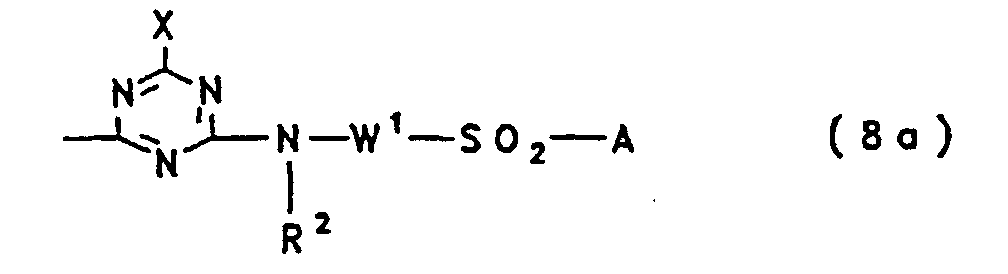
- Further fiber-reactive radicals Z are, for example: 2,4-dichloro-1,3,5-triazin-6-yl, 2,4-difluoro-5-chloropyrimidin-6-yl, 2,4,5-trichloropyrimidine -6-yl, 2-methylsulfonyl-5-chloro-4-methyl-pyrimidin-6-yl, 4-methyl-2-fluoro-5-chloropyrimidin-6-yl, 2,3-dichloro-quinoxaline-6-carbonyl and 2,4-difluoropyrimidin-6-yl, furthermore radicals corresponding to the general formula (8a) in which X is chlorine, fluorine or cyanoamino, A has one of the particularly preferred meanings mentioned above, R 2 is hydrogen, ethyl, methyl, ⁇ -hydroxyethyl, ⁇ -sulfatoethyl, phenyl, 3-sulfophenyl or 4-sulfophenyl and W 1 1,2-
- azo compounds of the general formula (1) are particularly preferred, in which R is hydrogen, methyl or methoxy, B is -0- or -N (R 10 ) - with R 10 of the above, particularly preferred meaning, a is the number 1 or 2, Ar by 1 or 2 sulfo groups is substituted phenyl or naphthyl, preferably mono- or disulfonaphthyl, substituted by 1, 2 or 3 sulfo groups and the radical K 10 is a group of the general formula (8A) is in which E, v, K, R 1 , Z and n have one of the above-mentioned, particularly preferred meanings.
- Y is preferably morpholino, monosulfophenylamino, disulfophenylamino, monosulfophenylamino substituted by methoxy, methyl, carboxy, sulfo, hydroxy, chlorine or bromine, a group of the general formula (11c) of the abovementioned meaning or a group of the general formula (11b) in which n and A has the meanings mentioned and R 0 is phenyl or monosulfophenyl or in which R 0 is a radical of the formula - (CH 2 ) n -SO 2 -A with n and A of the abovementioned meaning.
- the present invention further relates to processes for the preparation of the azo compounds of the general formula (1) according to the invention, which are characterized in that a compound of the general formula (12) in which R and G have one of the above-mentioned, particularly preferred meanings, diazotized and with a compound of the general formula (13) in which E, v, K, R 1 , Z and n have one of the above-mentioned, particularly preferred meanings, couples, or that a compound of the general formula (14) diazotized with G, R, E and v of one of the above-mentioned, particularly preferred meanings and coupled with a compound of the general formula HKZ with K and Z of the above-mentioned meaning, or that a compound of the general formula (15) in which G, R, v, K, R 1 and n have one of the abovementioned, particularly preferred, meanings, with a compound of the general formula X 0 -Z, in which X 0 is chlorine, bromine or fluorine and Z
- the diazotization reactions take place in a manner known per se Procedure in aqueous medium at a pH less than 2 and at a temperature between -5 ° C and + 15 ° C.
- the coupling reactions are also carried out in a manner known per se in aqueous Solution or in an aqueous organic medium at a pH between 4 and 9, preferably between 5 and 7, and at a temperature between 0 ° C and 40 ° C, preferably between 5 ° C and 25 ° C.
- condensation reactions between the compounds of the general formula (15) and the fiber-reactive starting compound of the general formula X 0 -Z with X 0 and Z of the abovementioned meaning, such as preferably the general formula (16) defined above likewise take place in aqueous or aqueous - organic medium in suspension or solution. If these reactions are carried out in an aqueous-organic medium, the organic medium is, for example, acetone, dimethylformamide, dimethyl sulfoxide or N-methyl-pyrrolidone.
- the hydrogen halide liberated during the reaction is advantageously continuously neutralized by adding aqueous alkali metal or alkaline earth metal hydroxides, carbonates or bicarbonates.
- the reaction takes place at a temperature between -5 ° C. and + 95 ° C. and at a pH between 3 and 11, preferably between 4 and 6, in the case of X 0 or Hal, preferably fluorine, preferably at one temperature between 20 and 40 ° C and at a pH between 4 and 10, particularly preferably between 4 and 7.
- the starting compounds of the general formula (12) are known from the literature (see, for example, Dyes and Pigments 21 (1993), 123, and Ann. Chim. 49 (1959), 1809); if individual compounds are not described, they can be prepared analogously to the procedure of the prior art.
- compounds of the general formula (12) in which G for a radical of the general formula (2a) or (2e) with R 10 having a meaning other than hydrogen can be prepared by starting from compounds of the general formula (a) given below with R 10 the meaning given above (which are known, for example, from Fierz-David & Blangley, “Farbenchemie", 8th edition (1952), Springer Verlag, Table 5 of the system) and these with phosgene, dialkyl carbonate or alkyl chloroformate or with Oxalyl chloride at a temperature between 0 and 100 ° C and a pH between 6 and 10 and in the heterocyclic compound of the general formula (b) thus obtained in which R 10 has the abovementioned meaning and G 1 represents the group -CO- or -CO-CO-, the nitro group is reduced to the amino group in a known manner, for example by means of hydrogen and a nickel, palladium or platinum catalyst.
- the rest of the starting compounds such as the compounds of the general formulas HE-NH 2 and HKN (R 1 ) H and the fiber-reactive starting compounds of the general formula X 0 -Z, have been described in large numbers in the literature and are widely used for the production of fiber-reactive dyes (see. For example, European Patent Application Publications Nos. 0 541 057, 0 542 214 and 0 548 795) or can be prepared analogously to the procedures given there with corresponding starting compounds.
- Starting compounds of the general formula (12) are, for example 4-amino-benzimidazolin-2-one, 5-amino-benzimidazolin-2-one, 1-N- (4'-sulfophenyl) -5-amino-benzimidazolin-2-one, 1-N- (3'-sulfophenyl) -5-amino-benzimidazolin-2-one, 1-N- (6 ', 8'-disulfonaphth-2'-yl) -5-aminobenzimidazolin-2-one, 6-amino-quinoxaline-2,3-dione, 7-methyl-6-amino-quinoxaline-2,3-dione, 7-methoxy-6-amino-quinoxaline-2,3-dione, 7-ethoxy-6-amino-quinoxaline-2,3-dione, 4-N- (4'-sulfophenyl) -6-amino-quinoxaline
- the starting compounds according to the general formula (17) with R 2 , W and A of the meanings mentioned above, which are present as amino residues in the starting compounds of the general formulas (13) and (16) and are used for their synthesis, are known in some cases, for example from European patent application publications Nos. 0 070 806, 0 070 807, 0 374 758, 0 499 588, 0 541 057 and 0 568 860 as well as from US Pat. Nos. 4 908 436 and 5 138 041 and British Patent 1 576 237.
- the amino compounds of the general formula ( 17), in which R 2 represents an optionally substituted phenyl radical and W is the 1,3-propylene radical, have not been described per se, however.
- N-allyl-N-acetylaniline see J. Org. Chem. 14 , 1099 (1949)
- 2-mercaptoethanol in the presence of a radical initiator, the resulting N- [ ⁇ - ( ⁇ '-hydroxyethylthio) propyl] -N-acetylaniline compound oxidized to the sulfonyl compound, for example by means of hydrogen peroxide in the presence of a catalytic amount of a transition metal compound, such as tungsten oxide.
- the acetyl group in the alkaline or acidic range preferably in hydrochloric acid aqueous solution, such as in 5 to 30% aqueous hydrochloric acid, is split off hydrolytically at a temperature between 80 and 100 ° C.
- the N-phenyl-N- [ ⁇ - (ß'-hydroxyethylsulfonyl) propyl] amine thus obtained can be separated from the aqueous phase from the neutral aqueous synthesis solution.
- Whose ß-hydroxyethylsulfonyl group can be esterified by conventional methods, for example by means of concentrated sulfuric acid at a temperature between 10 and 30 ° C in the ß-sulfatoethylsulfonyl compound or with thionyl chloride or gaseous hydrogen chloride in the ß-chloroethylsulfonyl compound.
- Starting compounds of the general formula (17) are, for example N- [ ⁇ - ( ⁇ '-chloroethylsulfonyl) propyl] amine, N- [ ⁇ - ( ⁇ '-sulfatoethylsulfonyl) propyl] amine, N- [ ⁇ - (vinylsulfonyl) propyl] amine, N- [ ⁇ - ( ⁇ '-chloroethylsulfonyl) ethyl] amine, N- [ ⁇ - [ ⁇ '-sulfatoethylsulfonyl) ethyl] amine, N- [ ⁇ - (vinylsulfonyl) ethyl] amine, N-methyl-N- [ ⁇ - ( ⁇ '-chloroethylsulfonyl) ethyl] amine, N-ethyl-N- [ ⁇ - ( ⁇ '-chloroethylsulfonyl) propy
- Starting compounds which serve to prepare dis- and trisazo compounds of the general formula (1) according to the invention first as a coupling component and then, in the form of the aminoazo compound formed, as a diazo component and correspond to the general formula HE-NH 2 are, for example, aniline, 3-methyl-aniline , 2-methoxy-5-methyl-aniline, 2,5-dimethyl-aniline, 3-ureido-aniline, 3-acetylamino-aniline, 3-propionylamino-aniline, 3-butyrylamino-aniline, 3-methoxy-aniline, 2 -Methyl-5-acetylamino-aniline, 2-methoxy-5-acetylamino-aniline, 2-methoxy-5-methyl-aniline, 3- (hydroxyacetylamino) aniline, 1,3-diaminobenzene, 1,3-diaminobenzene-4 sulfonic acid, 2- and 3-sulfo-aniline, 3-hydroxy-aniline, 1-a
- Coupling components corresponding to the general formula HKN (R 1 ) H which can be used to build up the azo compounds according to the invention and in whose amino groups the rest of the fiber-reactive grouping can be introduced, are, for example, aniline, 3-methyl-aniline, 2,5-dimethyl-aniline , 2,5-dimethoxy-aniline, 3-methoxy-aniline, 3-acetylamino-aniline, 3-propionylamino-aniline, 3-butyrylamino-aniline, 3-benzoylamino-aniline, 3- (hydroxyacetylamino) -aniline, 3-ureido-aniline , 2-methyl-5-acetylamino-aniline, 2-methoxy-5-acetylaminoaniline, 2-methoxy-5-methyl-aniline, 1-amino-naphthalene-6-sulfonic acid, 1-aminonaphthalene-7-sulfonic acid, 4-sulfo -1,3-dia
- the azo compounds of the general formula (1) - in the following dyes (1) - are suitable for dyeing and printing a wide variety Materials such as silk, leather, wool, polyamide fibers and polyurethanes, and in particular cellulose-containing fiber materials of all kinds. Such fiber materials are, for example, the natural cellulose fibers such as cotton, linen and Hemp, as well as cellulose and regenerated cellulose.
- the dyes (1) are too suitable for dyeing or printing fibers containing hydroxy groups, which in Blended fabrics are included, e.g. of blends of cotton with Polyester fibers or polyamide fibers.
- the dyes (1) can be applied to the fiber material in different ways apply and fix on the fiber, especially in the form of aqueous Dye solutions and printing pastes. They are suitable for both Exhaust process as well as for dyeing according to the foulard dyeing process, after which the goods with aqueous, optionally saline dye solutions impregnated and the dye after an alkali treatment or in the presence of alkali, optionally under the action of heat. Especially the dyes according to the invention are suitable for the so-called Cold residence process, after which the dye together with the alkali on the Foulard applied and then by storage for several hours Room temperature is fixed.
- the present invention therefore also relates to the use of Dyes (1) for dyeing (including printing) these materials or Process for dyeing (and printing) such materials in and of itself usual procedure in which a dye (1) is used as the colorant is by placing the dye (1) in an aqueous medium on the material applied and using heat or an alkaline Connection or by means of both fixed on the material.
- the dyes (1) are notable for high reactivity and good fixing properties and a very good build-up ability. You can therefore after Pull-out dyeing processes are used at low dyeing temperatures and require only short steaming times with pad-steam processes.
- the degrees of fixation are high, and the unfixed portions can be washed out easily the difference between the degree of extension and the degree of fixation is remarkably small, i.e. the soap loss is very low.
- the dyes (1) are also particularly suitable for printing, especially on cotton, but also for printing on nitrogen-containing fibers, e.g. of wool or silk or of mixed fabrics, that contain wool or silk.
- the dyes (1) are also particularly suitable for low-salt exhaust dyeing processes, which are characterized in that the dyeing liquor one or several electrolyte salts, such as sodium chloride, potassium chloride and sodium sulfate, from a total of 20 to 40 g / l (instead of the usual 50 to 80 g / l in technology) contain.
- electrolyte salts such as sodium chloride, potassium chloride and sodium sulfate
- the dyeings and prints produced with the dyes (1) have especially on cellulose fiber materials, a high color strength and a high Fiber-dye binding stability in both acidic and alkaline Area, continue to have good lightfastness and very good Wet fastness properties, such as washing, water, sea water, overdyeing and Sweat fastness, as well as good pleating fastness, ironing fastness and Fastness to rubbing.
- Parts by weight relate to parts by volume such as kilograms to liters.
- the compounds described by formula in the examples are in the form of specified free acid; generally they are in the form of their Alkali metal salts, such as lithium, sodium or potassium salts, are produced and isolated and used in the form of their salts for coloring.
- Alkali metal salts such as lithium, sodium or potassium salts
- the absorption maxima ( ⁇ max ) in the visible range specified for the dyes according to the invention were determined on the basis of their alkali metal salts in aqueous solution.
- the ⁇ max values are given in brackets when specifying the color; the wavelength specification refers to nm.
- the monoazo compound according to the invention shows very good fiber-reactive Dye properties and delivers according to the technology for fiber reactive Dyes usual dyeing and printing processes on the in the description mentioned fiber materials, in particular on cellulose fiber materials, such as Cotton, strong red dyeing and prints with good fastness properties.
- the azo compound according to the invention which, written in the form of the free acid, has the formula is isolated from the synthesis solution in a conventional manner, for example by salting out with sodium chloride, as the alkali metal salt (sodium salt).
- the azo compound of the formula (written in the form of the free acid) is then isolated as an alkali metal salt (sodium salt) in a conventional manner, for example by spray drying the aqueous synthesis solution or by salting out the compound from the synthesis solution with sodium chloride.
- the azo compound according to the invention shows very good fiber-reactive Dye properties and colors the materials mentioned in the description, in particular cellulose-containing fiber materials, such as cotton, according to the in the Technology for fiber-reactive dyes usual application methods in strong, reddish brown tones with good fastness properties.
- the azo dye according to the invention which, written in the form of the free acid, has the formula has, is isolated in the usual way as an alkali metal salt. It shows very good fiber-reactive properties and dyes, for example, cotton in brilliant violet shades with good fastness properties.
- a diazonium salt solution prepared in accordance with Example 1 from 14 parts of 5-amino-benzimidazolin-2-one is added.
- the mixture is stirred for about a further 12 hours and then the azo dye according to the invention of the formula written in the form of the free acid is isolated has, in the usual way as an alkali metal salt. It shows very good fiber-reactive dye properties and dyes, for example, cotton in red shades with good fastness properties.
- a diazonium salt suspension prepared according to Example 7 from 23 parts of 7-methoxy-6-amino-quinoxaline-2,3-dione is stirred into a solution of 51.1 parts of the sodium salt of the compound 1-N- (2 ', 4'-dichloro -1 ', 3', 5'-triazin-6'-yl) amino-8-hydroxy-3,6-disulfonaphthalene in 1000 parts of water and carries out the coupling reaction at a temperature between 18 and 25 ° C and one pH from 5 to 6 through.
- the azo compound according to the invention is isolated from the synthesis solution in a conventional manner, for example by salting out with sodium chloride. Written in the form of free acid, it has the formula shows very good fiber-reactive dye properties and dyes, for example, cellulose fiber materials according to the dyeing processes customary in industry in strong, reddish blue tones with a high degree of fixation.
- the amino compound obtained now serves as a diazo component for the preparation of an azo compound according to the invention. Without isolating it from the aqueous synthesis solution, 30 parts of a 31% aqueous hydrochloric acid are added to this solution after filtration, and the amino compound is diazotized in the usual manner using 7 parts of sodium nitrite.
- This diazonium salt suspension is then added while maintaining a pH of 5 to 6 to a solution of 77.8 parts of the sodium salt of the compound 1-N- [2 '- (4''- ß-sulfatoethylsulfonyl) -4'-chloro 1 ', 3', 5'-triazin-6'-yl] amino-8-hydroxy-3,6-disulfonaphthalene in 500 parts of water.
- the coupling reaction is completed at a pH of 5 to 6 and a temperature between 18 and 25 ° C. and the azo compound of the invention obtained (written in the form of the free acid) is isolated for example by salting out with sodium chloride.
- the azo compound according to the invention provides, as a dye with good fiber-reactive dye properties, for example on cellulose fiber materials, strong dyeings and prints of violet shades with a high degree of fixation.
- the diazonium salt suspension obtained is then added Maintaining a pH of 5 to 6 to a solution of 23.0 parts 3-amino-8-hydroxy-6-sulfo-naphthalene and leads to the coupling reaction 18 to 25 ° C and a pH of 5 to 6 to the end.
- the azo compound thus obtained is isolated by salting out with sodium chloride and then dissolved in 500 parts of water. It is added with good stirring at a temperature of 0 to 5 ° C a suspension of 18 parts of cyanuric chloride in Add 150 parts of ice water and maintain the pH at a value of 5 to 6. After Completion of the reaction is 27 parts of 4- ( ⁇ -sulfatoethylsulfonyl) aniline adds, sets a pH of 6 and leads the reaction at 50 ° C. Maintaining this pH to the end.
- the azo compound according to the invention obtained which has the formula (written in the form of the free acid) corresponds, is isolated in a conventional manner, for example by spray drying the synthesis solution. It has very good fiber-reactive dye properties and dyes, for example, cellulose fiber materials in strong red shades with a high degree of fixation.
- the solution obtained is freed from the Raney nickel by filtration and the amino compound in solution after the addition of 30 parts of a 31% aqueous hydrochloric acid in the usual way with 7 parts of sodium nitrite diazotized.
- the diazonium salt suspension obtained is given with observance a pH of 5 to 6 to a solution of 67.5 parts of the sodium salt the compound 3-N- [2 '- (4 "- ⁇ -sulfatoethylsulfonyl) phenylamino-4'-chloro-1', 3 ', 5'-triazin-6'-yl] amino-8-hydroxy-6 -sulfonaphthalene in 500 parts of water.
- the coupling reaction is carried out at a pH of 5 to 6 and one Temperature from 18 to 25 ° C to the end and then isolates the invention Azo compound in the usual way, for example by salting out with Sodium chloride.
- the azo compound according to the invention is isolated from the synthesis solution in a conventional manner, for example by salting out with sodium chloride.
- a conventional manner for example by salting out with sodium chloride.
- free acid Written in the form of free acid, it has the formula and delivers, for example on cellulose fiber materials such as cotton, strong, brilliant red dyeings with a high degree of fixation according to the dyeing methods customary for fiber-reactive dyes.
- the azo compound according to the invention is isolated from the aqueous synthesis solution, for example by salting out.
- aqueous synthesis solution for example by salting out.
- free acid it has the formula shows very good fiber-reactive dye properties and dyes, for example, cellulose fiber materials, such as cotton, according to the application methods customary in the art for fiber-reactive dyes in strong, brilliant bluish red tones with a high degree of fixation.
- the second condensation reaction with the difluorotriazinylamino compound obtained is then carried out after adjusting the pH to 6 by adding 27 parts of 3- ( ⁇ -chloroethylsulfonyl) propylamine at a pH of 8 to 9 and a temperature of 10 to 15 ° C.
- the azo compound of the formula (written in the form of the free acid) is isolated in the usual way from the aqueous synthesis solution, for example by salting out with sodium chloride. It shows very good dye properties and provides, for example, the dyeing and printing processes customary in the art for fiber-reactive dyes on the materials mentioned in the description, in particular cellulose fiber materials, such as cotton, for example, strong dyeings and prints in brilliant red tones with a high degree of fixation.
- the azo compound of the formula (written in the form of the free acid) is isolated in the usual way by salting out with sodium chloride. It shows good dye properties and dyes cellulose fiber materials such as cotton, for example, in strong, brilliant red tones with a high degree of fixation.
- the aminoazo compound obtained is salted out with sodium chloride isolated from the aqueous synthesis solution and then with the addition of a commercial dispersant in 1000 parts of water with good stirring solved.
- 42 parts of the compound N-phenyl-N- (2,4-difluoro-1,3,5-triazin-6-yl) -N- [ ⁇ - ( ⁇ '-sulfatoethylsulfonyl) ethyl] amine are added (known from EP-A-0 568 876) offset; the reaction takes place at a temperature of 10 to 15 ° C and a pH of 6.
- the azo compound of the formula (written in the form of the free acid) is isolated from the aqueous synthesis solution by salting out with sodium chloride.
- the azo compound provides, by the application methods customary in the art for fiber-reactive dyes, for example on cellulose fiber materials, such as cotton, strong orange colorings with a high degree of fixation.
- the azo compound of the formula obtained according to the invention (written in the form of the free acid) can be isolated in a conventional manner, for example by salting out with sodium chloride. It shows good dye properties and, on the materials mentioned in the description, such as, in particular, cellulose fiber materials, such as, for example, cotton, gives brilliant orange colors with a high degree of fixation.
- the azo compound of the formula (written in the form of the free acid) is isolated using sodium chloride. It gives you brilliant red colorations and prints with a high degree of fixation using the dyeing and printing processes customary in the art for fiber-reactive dyes on the fiber materials mentioned in the description, such as cellulose fiber materials such as cotton, for example.
Landscapes
- Chemical & Material Sciences (AREA)
- Organic Chemistry (AREA)
- Engineering & Computer Science (AREA)
- Textile Engineering (AREA)
- Coloring (AREA)
- Organic Low-Molecular-Weight Compounds And Preparation Thereof (AREA)
Claims (19)
- Composé azoïque correspondant à la formule générale (1)dans laquelle :
 G forme, à côté du cycle benzénique, le radical d'un hétérocycle exempt de doubles liaisons oléfiniques, qui contient au moins un groupement carbonamide de formule -CO-N(R10)-, dans laquelle R10 est un hydrogène, un alkyle de 1 à 4 atomes de carbone ou, le cas échéant, un aryle de 6 à 10 atomes de carbone substitué par 1 à 3 substituants parmi le groupe des sulfo, carboxy, alcoxy de 1 à 4 atomes de carbone, alkyle de 1 à 4 atomes de carbone, halogène, cyano, nitro et amino et qui possède, le cas échéant, 1 ou 2 autres groupements à hétéroatome de la série-O-, -S- et -N(R10)- avec R10 ayant la signification susmentionnée;R est un hydrogène, un alkyle de 1 à 4 atomes de carbone, un alcoxy de 1 à 4 atomes de carbone, un halogène ou un sulfo;R1 est un hydrogène, un alkyle de 1 à 4 atomes de carbone ou un alkyle de 1 à 4 atomes de carbone qui est substitué par un hydroxy, un cyano, un alcoxy de 1 à 4 atomes de carbone, un carboxy, un sulfo, un sulfato ou un phosphato, ou est un phényle ou un naphtyle, qui peuvent tous deux être substitués par 1, 2 ou 3 substituants parmi le groupe des halogène, hydroxy, cyano, alcoxy de 1 à 4 atomes de carbone, alkyle de 1 à 4 atomes de carbone, alcoxycarbonyle de 2 à 5 atomes de carbone, carboxy, sulfamoyle, sulfo et alkylsufonyle avec un radical alkyle de 1 à 4 atomes de carbone;E est le radical divalent exempt de groupement amino d'un composé pouvant être diazoté et copulé, de la série aniline ou naphtylamine;V signifie le nombre zéro, 1 ou 2;K est le radical divalent exempt de groupement aminé d'un composant de copulation de la série aniline ou naphtylamine ou le radical divalent d'un composant de copulation de la série hétérocyclique;n est le nombre 1, 2, 3 ou 4;Z est le radical réagissant avec des fibres d'un groupement réagissant avec des fibres ou d'un groupement -N(R1)-Z, les radicaux -N(R1)-Z pouvant avoir des significations différentes les unes des autres dans le cas où n est plus grand que 1;les composés de formule (1) possèdent au moins un groupement sulfo.
 - Composé azoïque suivant la revendication 1, caractérisé en ce que G est un radical de formule (2a), (2b), (2c), (2d), (2e), (2f), (2g) ou (2h)
 dans lesquelles R10 a la signification citée à la revendication 1 et, à la formule (2h), l'indice a signifie le nombre 1 ou 2.
- Composé azoïque suivant la revendication 1, caractérisé en ce que Z est un radical de formule générale (3)dans laquelle :
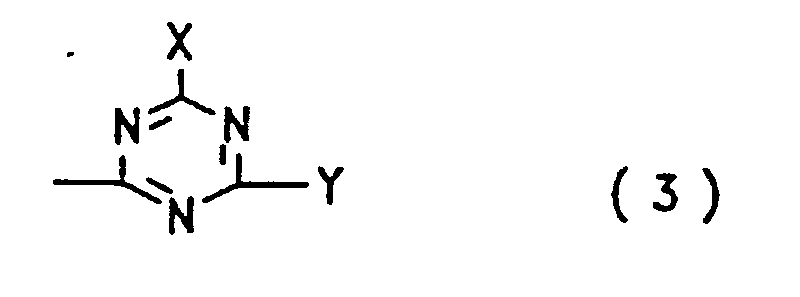 X est un halogène ou un groupement de formule générale (4)
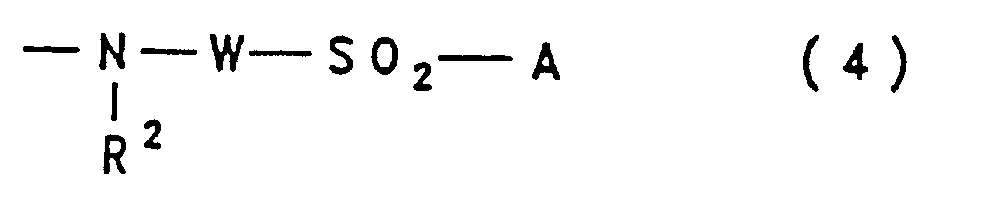 dans laquelleR2 signifie un hydrogène ou un alkyle de 1 à 4 atomes de carbone ou un alkyle de 1 à 4 atomes de carbone qui est substitué par un hydroxy, un cyano, un alcoxy de 1 à 4 atomes de carbone, un carboxy, un sulfo, un sulfato ou un phosphato, ou est un phényle ou un naphtyle qui peuvent tous deux être substitués par 1, 2 ou 3 substituants parmi le groupe des halogène, hydroxy, cyano, alcoxy de 1 à 4 atomes de carbone, alkyle de 1 à 4 atomes de carbone, alcoxycarbonyle de 2 à 5 atomes de carbone, carboxy, sulfamoyle, sulfo et alkylsulfonyle avec un radical alkyle de 1 à 4 atomes de carbone;W est un alkylène de 2 à 4 atomes de carbone ou est un alkylène de 3 à 6 atomes de carbone qui est interrompu par 1 ou 2 groupements à hétéroatome parmi le groupe des formules -O-, -NH-, -SO2-, -CO- et-N(R10)- avec R10 ayant la signification citée à la revendication 1, ou signifie un phénylène ou un naphtylène, qui peuvent tous deux être substitués par 1, 2 ou 3 substituants parmi le groupe des halogène, hydroxy, cyano, nitro, alcoxy de 1 à 4 atomes de carbone, alkyle de 1 à 4 atomes de carbone, alcoxycarbonyle de 2 à 5 atomes de carbone, carboxy, sulfamoyle et sulfo, ou est un phénylènealkylène ou un alkylènephénylène avec un radical alkylène de, chaque fois, 1 à 4 atomes de carbone, etA est un vinyle ou signifie un éthyle, qui est substitué en position β par un substituant séparable au moyen d'un alcali avec formation d'un groupement vinyle;Y est un chlore, un cyanoamino ou un groupement de formule générale (5)
 dans laquelleR3 signifie un hydrogène ou un alkyle de 1 à 4 atomes de carbone ou un alkyle de 1 à 4 atomes de carbone qui est substitué par un halogène, un hydroxy, un cyano, un alcoxy de 1 à 4 atomes de carbone, un alcoxycarbonyle de 2 à 5 atomes de carbone, un carboxy, un sulfo, un sulfato ou un phoshato, ou est un groupement de formule -W-SO2-A- avec W et A ayant l'une des significations susmentionnées;R4 est un hydrogène ou un alkyle de 1 à 4 atomes de carbone ou signifie un alkyle de 1 à 4 atomes de carbone qui est substitué par un halogène, un hydroxy, un cyano, un alcoxy de 1 à 4 atomes de carbone, un alcoxycarbonyle de 2 à 5 atomes de carbone, un carboxy, un sulfo, un sulfato ou un phosphato, ou est un cycloalkyle de 5 à 8 atomes de carbone ou un groupement de formule -W-SO2-A avec W et A ayant l'une des significations susmentionnées, ou est un phényle ou un naphtyle qui peuvent tous deux être substitués par 1, 2 ou 3 substituants parmi le groupe des halogène, hydroxy, cyano, alcoxy de 1 à 4 atomes de carbone, alkyle de 1 à 4 atomes de carbone, alcoxycarbonyle de 2 à 5 atomes de carbone, carboxy, sulfamoyle, sulfo et alkylsulfonyle avec un radical alkyle de 1 à 4 atomes de carbone, ouR3 et R4 représentent ensemble un radical alkylène de 3 à 6 atomes de carbone ou un radical alkylène de 3 à 6 atomes de carbone interrompu par un groupement -NH-, -O-, -CO-, -S-, -SO2- ou -N(R5)- (dans lequel R5 est un alkyle de 1 à 4 atomes de carbone substitué par un sulfo ou un sulfato, comme un éthyle), qui forment, avec l'atome d'azote, un radical hétérocyclique.
 - Composé azoïque suivant au moins l'une des revendications 1 à 3, caractérisé en ce que R1 est un hydrogène, un méthyle ou un éthyle.
- Composé azoïque suivant la revendication 3 ou 4, caractérisé en ce que X est un chlore ou un fluor.
- Composé azoïque suivant au moins l'une des revendications 3 à 5, caractérisé en ce que Y est un groupement de formule générale (4)dans laquelle
 R2 est un hydrogène, un alkyle de 1 à 4 atomes de carbone ou un alkyle de 1 à 4 atomes de carbone qui est substitué par un hydroxy, un cyano, un alcoxy de 1 à 4 atomes de carbone, un carboxy, un sulfo, un sulfato ou un phosphato, ou est un phényle ou un naphtyle qui peuvent tous deux être substitués par 1, 2 ou 3 substituants parmi le groupe des halogène, hydroxy, cyano, alcoxy de 1 à 4 atomes de carbone, alkyle de 1 à 4 atomes de carbone, alcoxycarbonyle de 2 à 5 atomes de carbone, carboxy, sulfamoyle, sulfo et alkylsulfonyle avec un radical alkyle de 1 à 4 atomes de carbone;W est un alkylène de 2 à 4 atomes de carbone ou est un alkylène de 3 à 6 atomes de carbone qui est interrompu par 1 ou 2 groupements à hétéroatome parmi le groupe des formules -O-, -NH-, -SO2-, -CO- et-N(R10)- avec R10 ayant la signification citée à la revendication 1, ou signifie un phénylène ou un naphtylène, qui peuvent tous deux être substitués par 1, 2 ou 3 substituants parmi le groupe des halogène, hydroxy, cyano, nitro, alcoxy de 1 à 4 atomes de carbone, alkyle de 1 à 4 atomes de carbone, alcoxycarbonyle de 2 à 5 atomes de carbone, carboxy, sulfamoyle et sulfo, ou est un phénylènealkylène ou un alkylènephénylène avec un radical alkylène de, chaque fois, 1 à 4 atomes de carbone, etA est un vinyle ou signifie un éthyle, qui est substitué en position β par un substituant séparable au moyen d'un alcali avec formation d'un groupement vinyle.
 - Composé azoïque suivant au moins l'une des revendications 3 à 5, caractérisé en ce que Y est un morpholino.
- Composé azoïque suivant au moins l'une des revendications 3 à 5, caractérisé en ce que Y est un mono- ou un disulfophényle ou un mono-, di- ou trisulfonaphtyle.
- Composé azoïque suivant la revendication 3, caractérisé en ce que Z est un radical de formule générale (8a)dans laquelle X est un chlore, un fluor ou un cyanoamino, A a, en particulier de préférence, l'une des significations citées à la revendication 2, R2 est un hydrogène, un éthyle, un méthyle, un β-hydroxyéthyle, un β-sulfatoéthyle, un phényle, un 3-sulfophényle ou un 4-sulfophényle et W1 est un 1,2-éthylène, un 1,3-propylène, un 2-méthyl-1,2-éthylène, un 2-méthyl-1,3-propylène, un 1,4-phénylène, un 1,3-phénylène, un 2-méthoxy-1,5-phénylène, un 2,5-diméthoxy-1,4-phénylène, un 2-méthoxy-5-méthyl-1,4-phénylène, un 2-sulfo-1,4-phénylène, un 2-hydroxy-1,5-phénylène, un 2-bromo-1,5-phénylène ou un 4-(2'-éthyl)-phén-1,1'-ylène, la position 1 étant liée à l'atome d'azote dans ces groupements, ou est un 1-sulfonapht-2,6-ylène, un 6-sulfonapht-2,8-ylène, un napht-2,6-ylène ou un napht-2,8-ylène, la position 2 étant liée à l'atome d'azote dans ces groupements.
- Composé azoïque suivant la revendication 1 de formule générale (1A)dans laquelle E, v, K, R1 et n ont les significations citées à la revendication 1, Z possède l'une des significations citées dans au moins l'une des revendications 1 à 9 et B signifie -O- ou -N(R10)-, R10 étant un hydrogène, un phényle, un monosulfophényle, un disulfophényle, un trisulfophényle, un naphtyle, un monosulfonaphtyle, un disulfonaphtyle ou un trisulfonaphtyle.

- Composé azoïque suivant la revendication 1 de formule générale (1B)dans laquelle E, v, K, R1 et n ont les significations citées à la revendication 1 et Z possède l'une des significations citées dans au moins l'une des revendications 1 à 9.

- Composé azoïque suivant la revendication 1 de formule générale (1C)dans laquelle E, v, K, R1 et n ont les significations citées à la revendication 1 et Z possède l'une des significations citées dans au moins l'une des revendications 1 à 9 et R est un hydrogène, un méthyle ou un méthoxy.

- Composé azoïque suivant la revendication 1 de formule générale (1E)dans laquelle Ar est un phényle substitué par 1 ou 2 groupements sulfo ou un naphtyle substitué par 1, 2 ou 3 groupements sulfo et K10 est un groupement de formule générale (8A)
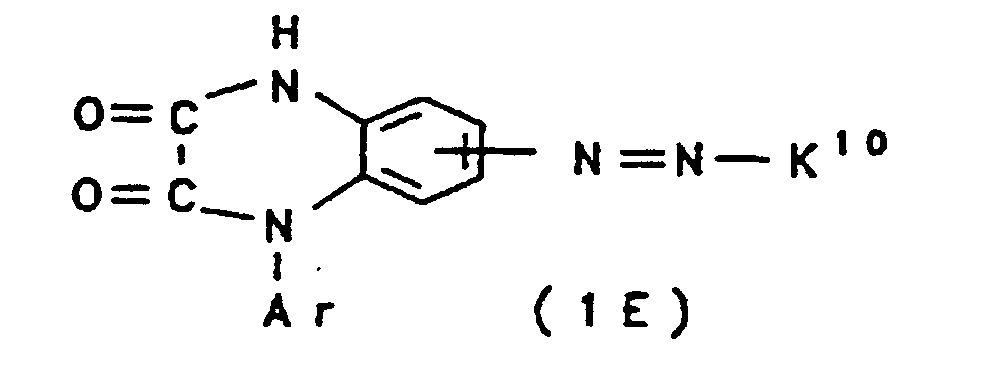 dans laquelle E, v, K, R1 et n ont les significations citées à la revendication 1 et Z possède l'une des significations citées dans au moins l'une des revendications 1 à 9.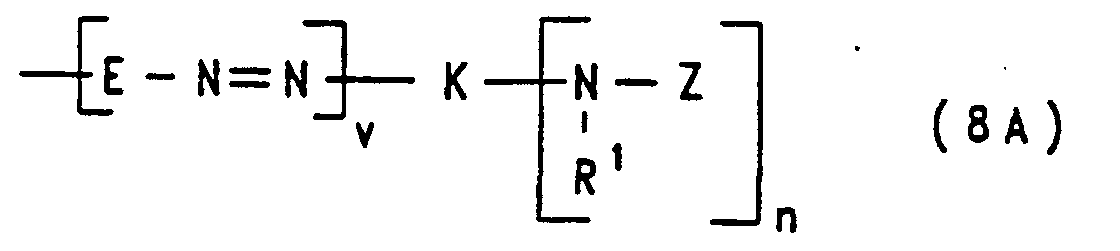
- Composé azoïque suivant la revendication 1 de formule générale (1F)dans laquelle K10 est un groupement de formule générale (8A)
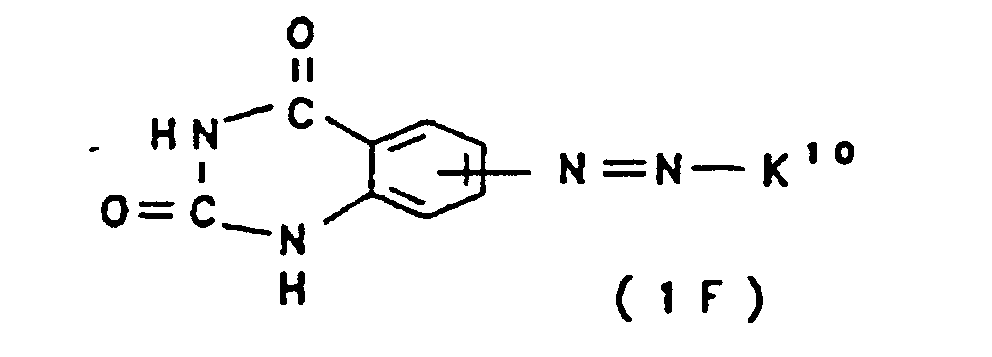 dans laquelle E, v, K, R1 et n ont les significations citées à la revendication 1 et Z possède l'une des significations citées dans au moins l'une des revendications 1 à 9.
- Composé azoïque suivant la revendication 1 de formule générale (1G)dans laquelle a est le nombre 1 ou 2 et K10 un groupement de formule générale (8A)
 dans laquelle E, v, K, R1 et n ont les significations citées à la revendication 1 et Z possède l'une des significations citées dans au moins l'une des revendications 1 à 9.
- Composé azoïque suivant la revendication 1 de formule générale (1H)dans laquelle K10 est un groupement de formule générale (8A)
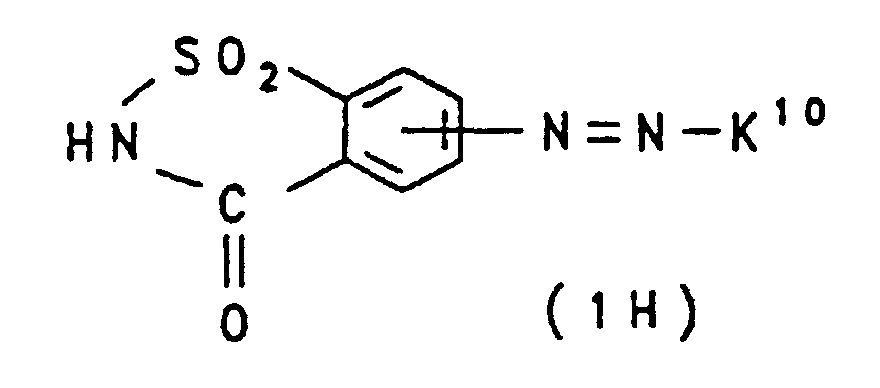 dans laquelle E, v, K, R1 et n ont les significations citées à la revendication 1 et Z possède l'une des significations citées dans au moins l'une des revendications 1 à 9.
- Procédé de préparation d'un composé azoïque de formule générale (1) définie et citée à la revendication 1, caractérisé en ce qu'un composé de formule générale (12)dans laquelle R et G ont l'une des significations citées à la revendication 1, est diazoté et est soumis à la copulation avec un composé de formule générale (13)
 dans laquelle E, v, K, R1, Z et n ont l'une des significations citées à la revendication 1, ou en ce qu'un composé de formule générale (14)
 avec G, R, E et v ayant l'une des significations citées à la revendication 1, est diazoté et est soumis à la copulation avec un composé de formule générale H-K-N(R1)-Z avec K, R1 et Z ayant la signification citée à la revendication 1, ou en ce qu'un composé de formule générale (15)
 dans laquelle G, R, v, K, R1 et n ont l'une des significations citées à la revendication 1, est transformé avec un composé de formule générale X0-Z, dans laquelle X0 signifie un chlore, un brome ou un fluor et Z possède la signification citée à la revendication 1.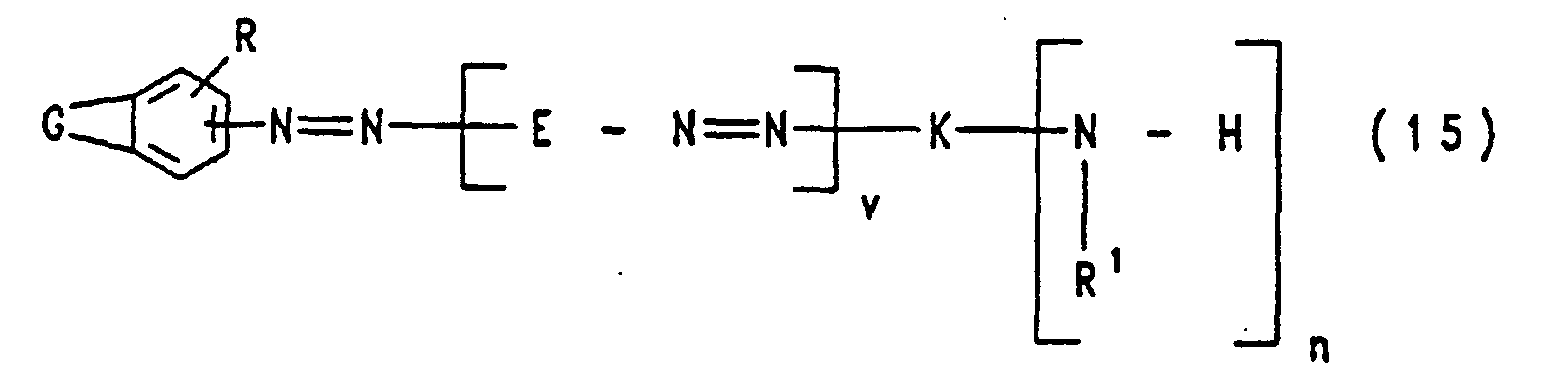
- Utilisation d'un colorant de la revendication 1 ou d'un colorant préparé suivant la revendication 17, pour teindre (y compris imprimer) du matériau contenant des groupements hydroxy et/ou carbonamide, en particulier un matériau fibreux.
- Procédé pour teindre (y compris imprimer) du matériau contenant des groupements hydroxy et/ou carbonamide, en particulier un matériau fibreux, dans lequel on applique un colorant sur le matériau et on fixe thermiquement le colorant sur le matériau ou à l'aide d'un agent à action alcaline ou au moyen des deux mesures, caractérisé en ce que l'on utilise, comme colorant, un colorant de la revendication 1 ou un colorant préparé suivant la revendication 17.
Applications Claiming Priority (4)
| Application Number | Priority Date | Filing Date | Title |
|---|---|---|---|
| DE19944403395 DE4403395A1 (de) | 1994-02-04 | 1994-02-04 | Wasserlösliche Azoverbindungen, Verfahren zu ihrer Herstellung und ihre Verwendung als Farbstoffe |
| DE4403395 | 1994-02-04 | ||
| DE4442947 | 1994-12-02 | ||
| DE19944442947 DE4442947A1 (de) | 1994-12-02 | 1994-12-02 | Wasserlösliche Azoverbindungen, Verfahren zu ihrer Herstellung und ihre Verwendung als Farbstoffe |
Publications (3)
| Publication Number | Publication Date |
|---|---|
| EP0675172A2 EP0675172A2 (fr) | 1995-10-04 |
| EP0675172A3 EP0675172A3 (fr) | 1998-03-25 |
| EP0675172B1 true EP0675172B1 (fr) | 2001-04-11 |
Family
ID=25933540
Family Applications (1)
| Application Number | Title | Priority Date | Filing Date |
|---|---|---|---|
| EP95100784A Expired - Lifetime EP0675172B1 (fr) | 1994-02-04 | 1995-01-20 | Composés azoiques solables dans l'eau, procédé pour leur préparation et leur utilisation comme colorants |
Country Status (6)
| Country | Link |
|---|---|
| US (1) | US5539088A (fr) |
| EP (1) | EP0675172B1 (fr) |
| JP (1) | JPH07316451A (fr) |
| CN (1) | CN1108674A (fr) |
| BR (1) | BR9500430A (fr) |
| DE (1) | DE59509166D1 (fr) |
Families Citing this family (11)
| Publication number | Priority date | Publication date | Assignee | Title |
|---|---|---|---|---|
| DE19636483C2 (de) * | 1996-09-09 | 2000-12-14 | Dystar Textilfarben Gmbh & Co | Wasserlösliche Azoverbindungen, Verfahren zu ihrer Herstellung und ihre Verwendung als Farbstoffe |
| DE19643306A1 (de) * | 1996-10-21 | 1998-04-23 | Dystar Textilfarben Gmbh & Co | Wasserlösliche faserreaktive Farbstoffe, Verfahren zu ihrer Herstellung und ihre Verwendung |
| US6475501B1 (en) | 1997-06-04 | 2002-11-05 | The Procter & Gamble Company | Antiviral compositions for tissue paper |
| US6617453B1 (en) | 1997-10-24 | 2003-09-09 | Clariant Finance (Bvi) Limited | Triphendioxazine compounds |
| DE19747175A1 (de) | 1997-10-24 | 1999-04-29 | Clariant Int Ltd | Chlorhaltige Triphendioxazin-Verbindungen |
| DE19913401A1 (de) | 1999-03-25 | 2000-09-28 | Clariant Gmbh | Verfahren zur Herstellung von Dioxazin-Verbindungen |
| US6200963B1 (en) | 1999-03-31 | 2001-03-13 | American Home Products Corporation | Aryl sulfonic acids as FSH antagonists |
| CN1173988C (zh) * | 1999-09-13 | 2004-11-03 | 道农业科学公司 | 杀虫剂大环内酯 |
| US6517849B1 (en) | 1999-10-19 | 2003-02-11 | The Procter & Gamble Company | Tissue products containing antiviral agents which are mild to the skin |
| PT2513229E (pt) * | 2009-12-16 | 2014-07-14 | Huntsman Adv Mat Switzerland | Corantes azo dispersos, um processo para o seu fabrico e o seu uso |
| CN103305025B (zh) * | 2013-05-15 | 2014-10-29 | 大连理工大学 | 苯并咪唑酮偶氮型黄色活性染料 |
Family Cites Families (4)
| Publication number | Priority date | Publication date | Assignee | Title |
|---|---|---|---|---|
| JPS6057465B2 (ja) * | 1977-10-25 | 1985-12-14 | 三菱化学株式会社 | モノアゾ染料の製造法 |
| DE2935720A1 (de) * | 1979-09-04 | 1981-03-12 | Bayer Ag, 5090 Leverkusen | Azofarbstoffe, zwischenprodukte und verfahren zu ihrer herstellung sowie verfahren zum pigmentieren von organischem material. |
| EP0112285B1 (fr) * | 1982-11-19 | 1987-03-18 | Ciba-Geigy Ag | Colorants réactifs, leur préparation et leur utilisation |
| DE4042290A1 (de) * | 1990-12-31 | 1992-07-02 | Hoechst Ag | Wasserloesliche azoverbindungen, verfahren zu deren herstellung und ihre verwendung als farbstoffe |
-
1995
- 1995-01-20 EP EP95100784A patent/EP0675172B1/fr not_active Expired - Lifetime
- 1995-01-20 DE DE59509166T patent/DE59509166D1/de not_active Expired - Lifetime
- 1995-02-01 CN CN95101444A patent/CN1108674A/zh active Pending
- 1995-02-02 US US08/382,645 patent/US5539088A/en not_active Expired - Fee Related
- 1995-02-03 BR BR9500430A patent/BR9500430A/pt not_active Application Discontinuation
- 1995-02-03 JP JP7017293A patent/JPH07316451A/ja not_active Withdrawn
Also Published As
| Publication number | Publication date |
|---|---|
| US5539088A (en) | 1996-07-23 |
| CN1108674A (zh) | 1995-09-20 |
| BR9500430A (pt) | 1995-10-31 |
| EP0675172A3 (fr) | 1998-03-25 |
| EP0675172A2 (fr) | 1995-10-04 |
| DE59509166D1 (de) | 2001-05-17 |
| JPH07316451A (ja) | 1995-12-05 |
Similar Documents
| Publication | Publication Date | Title |
|---|---|---|
| EP0471702B1 (fr) | Colorants reactifs solubles dans l'eau pour fibres, leur preparation et leur utilisation | |
| EP0538785B1 (fr) | Colorants réactifs avec les fibres et solubles dans l'eau, procédé pour leur préparation et leur utilisation | |
| EP0629667A1 (fr) | Colorants réactifs sur la fibre, solubles dans l'eau, procédé pour leur préparation et leur utilisation | |
| EP0497174A1 (fr) | Colorants réactifs bifonctionnels contenant des groupes vinylsulfones et pyrimidines | |
| EP0675172A2 (fr) | Composés azoiques solables dans l'eau, procédé pour leur préparation et leur utilisation comme colorants | |
| EP0542214B1 (fr) | Colorants réactifs avec les fibres et solubles dans l'eau, procédé pour leur préparation et leur utilisation | |
| EP0271883B1 (fr) | Composés colorés solubles dans l'eau, leur procédé de préparation et leur utilisation comme colorants | |
| EP0345577B1 (fr) | Colorants réactifs | |
| EP0377166B1 (fr) | Colorants solubles dans l'eau réagissant avec des fibres, procédés de leur fabrication et leur application | |
| EP0285571A2 (fr) | Colorants réactifs, leur préparation et leur emploi | |
| DE3843014A1 (de) | Wasserloesliche farbstoffe, verfahren zu ihrer herstellung und ihre verwendung | |
| DE19636483C2 (de) | Wasserlösliche Azoverbindungen, Verfahren zu ihrer Herstellung und ihre Verwendung als Farbstoffe | |
| EP0603595A1 (fr) | Colorants réactifs pour fibres, procédé pour leur préparation et leur utilisation | |
| EP1055710B1 (fr) | Colorants réactifs sur la fibre solubles dans l'eau, procédé pour leur préparation et leur utilisation | |
| EP0511246B1 (fr) | Colorants solubles dans l'eau et reagissant avec les fibres, procede de fabrication et application | |
| DE3943287A1 (de) | Azoverbindungen, verfahren zu deren herstellung und ihre verwendung als farbstoffe | |
| DE3825658A1 (de) | Wasserloesliche faserreaktive farbstoffe, verfahren zu ihrer herstellung und ihre verwendung | |
| DE4403395A1 (de) | Wasserlösliche Azoverbindungen, Verfahren zu ihrer Herstellung und ihre Verwendung als Farbstoffe | |
| EP0385204A1 (fr) | Colorants azoiques solubles dans l'eau et réactifs avec des fibres, leur précurseurs bis(carbonamido)-benzèniques, procédés pour leur fabrication et leur utilisation | |
| EP0624630A1 (fr) | Colorants réactifs sur la fibre, solubles dans l'eau, procédé pour leur préparation et leur utilisation | |
| EP0548792A2 (fr) | Colorants réactifs solubles, leur préparation et leur utilisation | |
| DE3943286A1 (de) | Azoverbindungen, verfahren zu deren herstellung und ihre verwendung als farbstofe | |
| DE4442947A1 (de) | Wasserlösliche Azoverbindungen, Verfahren zu ihrer Herstellung und ihre Verwendung als Farbstoffe | |
| DE3906778A1 (de) | Wasserloesliche faserreaktive farbstoffe, verfahren zu ihrer herstellung und ihre verwendung | |
| DE19643306A1 (de) | Wasserlösliche faserreaktive Farbstoffe, Verfahren zu ihrer Herstellung und ihre Verwendung |
Legal Events
| Date | Code | Title | Description |
|---|---|---|---|
| PUAI | Public reference made under article 153(3) epc to a published international application that has entered the european phase |
Free format text: ORIGINAL CODE: 0009012 |
|
| AK | Designated contracting states |
Kind code of ref document: A2 Designated state(s): BE CH DE FR GB LI NL |
|
| RAP1 | Party data changed (applicant data changed or rights of an application transferred) |
Owner name: DYSTAR TEXTILFARBEN GMBH & CO. DEUTSCHLAND KG |
|
| PUAL | Search report despatched |
Free format text: ORIGINAL CODE: 0009013 |
|
| AK | Designated contracting states |
Kind code of ref document: A3 Designated state(s): BE CH DE FR GB LI NL |
|
| 17P | Request for examination filed |
Effective date: 19980925 |
|
| GRAG | Despatch of communication of intention to grant |
Free format text: ORIGINAL CODE: EPIDOS AGRA |
|
| 17Q | First examination report despatched |
Effective date: 20000414 |
|
| GRAG | Despatch of communication of intention to grant |
Free format text: ORIGINAL CODE: EPIDOS AGRA |
|
| GRAH | Despatch of communication of intention to grant a patent |
Free format text: ORIGINAL CODE: EPIDOS IGRA |
|
| GRAH | Despatch of communication of intention to grant a patent |
Free format text: ORIGINAL CODE: EPIDOS IGRA |
|
| GRAA | (expected) grant |
Free format text: ORIGINAL CODE: 0009210 |
|
| AK | Designated contracting states |
Kind code of ref document: B1 Designated state(s): BE CH DE FR GB LI NL |
|
| REG | Reference to a national code |
Ref country code: CH Ref legal event code: EP |
|
| REF | Corresponds to: |
Ref document number: 59509166 Country of ref document: DE Date of ref document: 20010517 |
|
| ET | Fr: translation filed | ||
| GBT | Gb: translation of ep patent filed (gb section 77(6)(a)/1977) |
Effective date: 20010808 |
|
| PGFP | Annual fee paid to national office [announced via postgrant information from national office to epo] |
Ref country code: NL Payment date: 20011218 Year of fee payment: 8 |
|
| PGFP | Annual fee paid to national office [announced via postgrant information from national office to epo] |
Ref country code: GB Payment date: 20011224 Year of fee payment: 8 Ref country code: CH Payment date: 20011224 Year of fee payment: 8 |
|
| PGFP | Annual fee paid to national office [announced via postgrant information from national office to epo] |
Ref country code: FR Payment date: 20011226 Year of fee payment: 8 |
|
| REG | Reference to a national code |
Ref country code: GB Ref legal event code: IF02 |
|
| PG25 | Lapsed in a contracting state [announced via postgrant information from national office to epo] |
Ref country code: DE Free format text: LAPSE BECAUSE OF THE APPLICANT RENOUNCES Effective date: 20020115 |
|
| PGFP | Annual fee paid to national office [announced via postgrant information from national office to epo] |
Ref country code: BE Payment date: 20020125 Year of fee payment: 8 |
|
| PLBE | No opposition filed within time limit |
Free format text: ORIGINAL CODE: 0009261 |
|
| STAA | Information on the status of an ep patent application or granted ep patent |
Free format text: STATUS: NO OPPOSITION FILED WITHIN TIME LIMIT |
|
| 26N | No opposition filed | ||
| PG25 | Lapsed in a contracting state [announced via postgrant information from national office to epo] |
Ref country code: GB Free format text: LAPSE BECAUSE OF NON-PAYMENT OF DUE FEES Effective date: 20030120 |
|
| PG25 | Lapsed in a contracting state [announced via postgrant information from national office to epo] |
Ref country code: LI Free format text: LAPSE BECAUSE OF NON-PAYMENT OF DUE FEES Effective date: 20030131 Ref country code: CH Free format text: LAPSE BECAUSE OF NON-PAYMENT OF DUE FEES Effective date: 20030131 Ref country code: BE Free format text: LAPSE BECAUSE OF NON-PAYMENT OF DUE FEES Effective date: 20030131 |
|
| PG25 | Lapsed in a contracting state [announced via postgrant information from national office to epo] |
Ref country code: NL Free format text: LAPSE BECAUSE OF NON-PAYMENT OF DUE FEES Effective date: 20030801 |
|
| GBPC | Gb: european patent ceased through non-payment of renewal fee | ||
| REG | Reference to a national code |
Ref country code: CH Ref legal event code: PL |
|
| PG25 | Lapsed in a contracting state [announced via postgrant information from national office to epo] |
Ref country code: FR Free format text: LAPSE BECAUSE OF NON-PAYMENT OF DUE FEES Effective date: 20030930 |
|
| NLV4 | Nl: lapsed or anulled due to non-payment of the annual fee |
Effective date: 20030801 |
|
| REG | Reference to a national code |
Ref country code: FR Ref legal event code: ST |