EP0675176A2 - Verdickungsmittel auf der Basis mindestens eines synthetischen Schichtsilicats - Google Patents
Verdickungsmittel auf der Basis mindestens eines synthetischen Schichtsilicats Download PDFInfo
- Publication number
- EP0675176A2 EP0675176A2 EP95103549A EP95103549A EP0675176A2 EP 0675176 A2 EP0675176 A2 EP 0675176A2 EP 95103549 A EP95103549 A EP 95103549A EP 95103549 A EP95103549 A EP 95103549A EP 0675176 A2 EP0675176 A2 EP 0675176A2
- Authority
- EP
- European Patent Office
- Prior art keywords
- additive
- formula
- layered silicate
- thickener
- thickener according
- Prior art date
- Legal status (The legal status is an assumption and is not a legal conclusion. Google has not performed a legal analysis and makes no representation as to the accuracy of the status listed.)
- Granted
Links
Classifications
-
- C—CHEMISTRY; METALLURGY
- C09—DYES; PAINTS; POLISHES; NATURAL RESINS; ADHESIVES; COMPOSITIONS NOT OTHERWISE PROVIDED FOR; APPLICATIONS OF MATERIALS NOT OTHERWISE PROVIDED FOR
- C09C—TREATMENT OF INORGANIC MATERIALS, OTHER THAN FIBROUS FILLERS, TO ENHANCE THEIR PIGMENTING OR FILLING PROPERTIES ; PREPARATION OF CARBON BLACK ; PREPARATION OF INORGANIC MATERIALS WHICH ARE NO SINGLE CHEMICAL COMPOUNDS AND WHICH ARE MAINLY USED AS PIGMENTS OR FILLERS
- C09C1/00—Treatment of specific inorganic materials other than fibrous fillers; Preparation of carbon black
- C09C1/28—Compounds of silicon
-
- A—HUMAN NECESSITIES
- A61—MEDICAL OR VETERINARY SCIENCE; HYGIENE
- A61K—PREPARATIONS FOR MEDICAL, DENTAL OR TOILETRY PURPOSES
- A61K8/00—Cosmetics or similar toiletry preparations
- A61K8/18—Cosmetics or similar toiletry preparations characterised by the composition
- A61K8/19—Cosmetics or similar toiletry preparations characterised by the composition containing inorganic ingredients
- A61K8/26—Aluminium; Compounds thereof
-
- A—HUMAN NECESSITIES
- A61—MEDICAL OR VETERINARY SCIENCE; HYGIENE
- A61K—PREPARATIONS FOR MEDICAL, DENTAL OR TOILETRY PURPOSES
- A61K8/00—Cosmetics or similar toiletry preparations
- A61K8/18—Cosmetics or similar toiletry preparations characterised by the composition
- A61K8/30—Cosmetics or similar toiletry preparations characterised by the composition containing organic compounds
- A61K8/55—Phosphorus compounds
-
- A—HUMAN NECESSITIES
- A61—MEDICAL OR VETERINARY SCIENCE; HYGIENE
- A61Q—SPECIFIC USE OF COSMETICS OR SIMILAR TOILETRY PREPARATIONS
- A61Q11/00—Preparations for care of the teeth, of the oral cavity or of dentures; Dentifrices, e.g. toothpastes; Mouth rinses
-
- A—HUMAN NECESSITIES
- A61—MEDICAL OR VETERINARY SCIENCE; HYGIENE
- A61Q—SPECIFIC USE OF COSMETICS OR SIMILAR TOILETRY PREPARATIONS
- A61Q19/00—Preparations for care of the skin
-
- C—CHEMISTRY; METALLURGY
- C09—DYES; PAINTS; POLISHES; NATURAL RESINS; ADHESIVES; COMPOSITIONS NOT OTHERWISE PROVIDED FOR; APPLICATIONS OF MATERIALS NOT OTHERWISE PROVIDED FOR
- C09C—TREATMENT OF INORGANIC MATERIALS, OTHER THAN FIBROUS FILLERS, TO ENHANCE THEIR PIGMENTING OR FILLING PROPERTIES ; PREPARATION OF CARBON BLACK ; PREPARATION OF INORGANIC MATERIALS WHICH ARE NO SINGLE CHEMICAL COMPOUNDS AND WHICH ARE MAINLY USED AS PIGMENTS OR FILLERS
- C09C1/00—Treatment of specific inorganic materials other than fibrous fillers; Preparation of carbon black
- C09C1/40—Compounds of aluminium
- C09C1/42—Clays
-
- C—CHEMISTRY; METALLURGY
- C09—DYES; PAINTS; POLISHES; NATURAL RESINS; ADHESIVES; COMPOSITIONS NOT OTHERWISE PROVIDED FOR; APPLICATIONS OF MATERIALS NOT OTHERWISE PROVIDED FOR
- C09C—TREATMENT OF INORGANIC MATERIALS, OTHER THAN FIBROUS FILLERS, TO ENHANCE THEIR PIGMENTING OR FILLING PROPERTIES ; PREPARATION OF CARBON BLACK ; PREPARATION OF INORGANIC MATERIALS WHICH ARE NO SINGLE CHEMICAL COMPOUNDS AND WHICH ARE MAINLY USED AS PIGMENTS OR FILLERS
- C09C3/00—Treatment in general of inorganic materials, other than fibrous fillers, to enhance their pigmenting or filling properties
- C09C3/08—Treatment with low-molecular-weight non-polymer organic compounds
-
- C—CHEMISTRY; METALLURGY
- C09—DYES; PAINTS; POLISHES; NATURAL RESINS; ADHESIVES; COMPOSITIONS NOT OTHERWISE PROVIDED FOR; APPLICATIONS OF MATERIALS NOT OTHERWISE PROVIDED FOR
- C09D—COATING COMPOSITIONS, e.g. PAINTS, VARNISHES OR LACQUERS; FILLING PASTES; CHEMICAL PAINT OR INK REMOVERS; INKS; CORRECTING FLUIDS; WOODSTAINS; PASTES OR SOLIDS FOR COLOURING OR PRINTING; USE OF MATERIALS THEREFOR
- C09D7/00—Features of coating compositions, not provided for in group C09D5/00; Processes for incorporating ingredients in coating compositions
- C09D7/40—Additives
- C09D7/43—Thickening agents
-
- C—CHEMISTRY; METALLURGY
- C01—INORGANIC CHEMISTRY
- C01P—INDEXING SCHEME RELATING TO STRUCTURAL AND PHYSICAL ASPECTS OF SOLID INORGANIC COMPOUNDS
- C01P2004/00—Particle morphology
- C01P2004/60—Particles characterised by their size
- C01P2004/61—Micrometer sized, i.e. from 1-100 micrometer
-
- C—CHEMISTRY; METALLURGY
- C01—INORGANIC CHEMISTRY
- C01P—INDEXING SCHEME RELATING TO STRUCTURAL AND PHYSICAL ASPECTS OF SOLID INORGANIC COMPOUNDS
- C01P2006/00—Physical properties of inorganic compounds
- C01P2006/22—Rheological behaviour as dispersion, e.g. viscosity, sedimentation stability
-
- C—CHEMISTRY; METALLURGY
- C08—ORGANIC MACROMOLECULAR COMPOUNDS; THEIR PREPARATION OR CHEMICAL WORKING-UP; COMPOSITIONS BASED THEREON
- C08K—Use of inorganic or non-macromolecular organic substances as compounding ingredients
- C08K3/00—Use of inorganic substances as compounding ingredients
- C08K3/34—Silicon-containing compounds
Definitions
- the invention relates to thickeners based on at least one synthetic layered silicate.
- Layered silicates are used in liquid or flowable coating systems, such as paints, varnishes, adhesives, printing inks, underbody protection compounds, drilling fluids, cosmetic and pharmaceutical formulations, to solve a number of problems, such as the deposition of heavy pigments or active ingredients during storage, and the provision of them the necessary layer thickness for protection reasons, the provision of the viscosity suitable for the application, etc.
- too much water can be introduced into a formulation, which can lead, among other things, to the fact that the desired thickening effect of the layered silicate is negated by the high additional amount of water. The thinning effect can then cancel the effect.
- the good dispersion of powders is a problem with all layered silicates. Either the dispersion is incomplete and the material is only partially used (which also leads to other problems such as specks, thickening, loss of gloss and efficiency), or it is due to the lack of water and therefore the possibility of the lack of mechanical dispersing forces to compensate by swelling with water, not possible in the formulation. In many cases, even if the required mechanical dispersion energy is available, the dispersion cannot be carried out completely, since the formulation components are not always shear stable. The result is uncontrollable thickening effects; speck formation, agglomerates and loss of gloss also occur.
- dispersants to improve dispersion is also state of the art; however, this addition is normally only carried out after the layered silicate has been prewetted in water.
- the reason for this is the fact that most dispersing aids are highly polar and can attach themselves to the edges of the layered silicate lamellae in such a way that the hydration is even suppressed and the opposite effect is achieved.
- Dispersing aids e.g. on the basis of acrylate or acrylamide, even have a tendency to flocculate suspensions, which naturally lowers the viscosity of a layered silicate gel, but misses the actual goal of good delamination and dispersion.
- a flame retardant lubricant which contains a mixture of alkoxy and phenyl triesters of a phosphorus oxyacid and a finely divided thickener containing silica, e.g. Contains clay and silica.
- silica e.g. Contains clay and silica.
- organophilic clays which represent the reaction product of a smectitic clay of a first organic cation and a second organic cation made from a polyalkoxylated quaternary ammonium salt.
- the clay is no longer in a hydrophilic form.
- a gel-forming organophilic clay is known from DE-C-3 145 452 which comprises the reaction product of a smectite-type clay with an organic anion (e.g. from a phosphite or phosphate) and an organic cation, e.g. from a quaternary ammonium or phosphonium compound.
- an organic anion e.g. from a phosphite or phosphate
- an organic cation e.g. from a quaternary ammonium or phosphonium compound.
- the reaction product is no longer hydrophilic.
- DE-A-3 914 916 discloses an agent for increasing viscosity in non-aqueous liquid phases, which is formed from finely dispersed particles of an inorganic layered compound with a positive layer charge based on two-dimensional inorganic polycations (polycationic layered compounds) and mono- and / or polybasic acid anions with a pronounced oleophilic character is. This agent is also not swellable in water.
- a gel-forming organophilic clay which represents the reaction product of an organic cation, an organic anion and a smectite-type clay, the organic cation being selected from the group of quaternary ammonium salts, phosphonium salts and / or Sulfonium salts is selected.
- This product is also not swellable in water.
- DE-A-3 930 687 discloses the use of phosphoric acid esters and their salts as dispersants and dispersion stabilizers for pigments in paints, varnishes and synthetic resins.
- Aluminum hydroxide, zinc stearate, calcium carbonate, magnesium oxide and carbon black are mentioned as pigments.
- the object of the invention was therefore to improve the dispersibility of layered silicates in such a way that a powdery material can be readily dispersed without specks even at low to medium shear forces. Furthermore, pumpable pastes that are easy to dose and in which the layered silicate is completely dispersed are to be provided.
- the object can be achieved in that these novel products can either be dispersed directly into the finished formulation as powders without specks, or that the viscosity of these thickening agents in water is reduced so that also Pumpable yet highly concentrated pastes can be produced without reducing the efficiency of the thickener in the system.
- the thickeners according to the invention also make it possible to subsequently incorporate powders into finished systems without having to use extreme shear forces.
- the invention further relates to a stock paste which is produced from the thickener according to the invention and which contains up to about 35% by weight, preferably about 5 to 25% by weight, in particular about 10 to 20% by weight, of solid.
- the subject of the invention is the use of the thickening agent according to the invention or the stock paste in liquid or flowable, i.e. coating systems that can be applied by brushing, spraying, rolling, etc., e.g. Paints and varnishes, cosmetic and pharmaceutical preparations (such as creams and toothpastes), sealant suspensions, pesticide spray systems, underbody protection compounds, bitumen emulsions, lubricating greases, polishing agents, printing inks, structural plasters, etc.
- 3% by weight of a synthetic hectorite is dispersed in 97% by weight of demineralized water.
- the viscosity in the dispersion is measured in mPa.s (Viscolab LC 10, from Physica).
- Example 2 Analogously to Example 1, a 3% gel of synthetic hectorite is produced in demineralized water; in comparison, gels are made with 3% by weight of additive (0.09% of the total).
- Examples 1 and 2 show that the organic phosphorus compounds according to the invention reduce the viscosity of the dispersions substantially more than the conventional dispersing agents based on Na polyphosphate or Na acrylate. It can also be seen that increasing the amount added from 1% to 3% of the additive increases the liquefying effect.
- Synthetic hectorite from Example 1 is dispersed in demineralized water (dissolver, 5 min, 2800 rpm, Pendraulik) and the viscosity of the gel obtained is measured in mPa.s after 1 h or 24 h in the Brookfield DV-II.
- the synthetic hectorite is mixed with the Na salt of hydroxyethane-1,1-diphosphonic acid, homogenized and dispersed in demineralized water.
- Example 3 Analogously to Example 3, the synthetic hectorite is mixed with phosphonic acid (Sapetin D100 from Woellner) or with Na polyphosphate, homogenized and dispersed in demineralized water. The viscosity is measured in the Viscolab LC 10 from Physica.
- the synthetic hectorite is mixed homogeneously with the additives and a gel is prepared in tap water with the mixed product (stirred in a dissolver at 2800 rpm for 5 min) and the viscosity is measured (Vicolab LC 10).
- Examples 4 and 5 clearly show that the viscosity can be reduced, especially in tap water, even by adding standard dispersion aids. However, the liquefying effect of the additive according to Example 3 is far from being achieved.
- the thickener can also be used in the finished system, e.g. a varnish, actually unfolds its effectiveness.
- Example (d) shows the excellent action of the thickener in the system.
- the effect of the homogenized mixed products was also checked in a commercially available, water-dilutable acrylic radiator paint.
- the thickener was incorporated as a powder (in a dissolver, 15 minutes stirring, 2800 rpm) into this purchased paint (commercial product from Südwest Lacke & Maschinen).
- the rheological additives according to the invention were also tested in a wood protection glaze in the following formulation:
- Examples 6 to 8 clearly show that the rheological thickeners which have been modified from a synthetic layered silicate by adding an additive also have an excellent action in coating systems. Despite the sometimes very pronounced “liquefaction” (lower viscosity) of the stock paste, the effect is retained in the system or the effect becomes even better compared to the unmodified variant.
Landscapes
- Health & Medical Sciences (AREA)
- Life Sciences & Earth Sciences (AREA)
- Chemical & Material Sciences (AREA)
- Animal Behavior & Ethology (AREA)
- General Health & Medical Sciences (AREA)
- Public Health (AREA)
- Veterinary Medicine (AREA)
- Organic Chemistry (AREA)
- Birds (AREA)
- Epidemiology (AREA)
- Dispersion Chemistry (AREA)
- Dermatology (AREA)
- Oral & Maxillofacial Surgery (AREA)
- Inorganic Chemistry (AREA)
- Engineering & Computer Science (AREA)
- Materials Engineering (AREA)
- Wood Science & Technology (AREA)
- Silicates, Zeolites, And Molecular Sieves (AREA)
- Paints Or Removers (AREA)
- Inks, Pencil-Leads, Or Crayons (AREA)
- Detergent Compositions (AREA)
- Pharmaceuticals Containing Other Organic And Inorganic Compounds (AREA)
- Compositions Of Macromolecular Compounds (AREA)
- Curing Cements, Concrete, And Artificial Stone (AREA)
- Aftertreatments Of Artificial And Natural Stones (AREA)
Abstract
- a) Phosphonsäuren mit der Formel R - P - (OH)2
- b) Phosphinsäuren mit der Formel

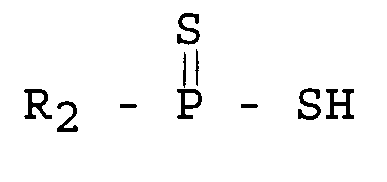
- c) Thiophosphinsäuren mit der Formel
- d) Diester der phosphorigen Säure mit der Formel HO - P (OR)2
- e) Diester der Phosphorsäure mit der Formel

- f) Diphosphonsäuren mit der Formel
Description
- Die Erfindung betrifft Verdickungsmittel auf der Basis mindestens eines synthetischen Schichtsilicats.
- In flüssigen oder fließfähigen Beschichtungssystemen, wie Farben, Lacken, Klebstoffen, Druckfarben, Unterbodenschutzmassen, Bohrspülungen, kosmetischen und pharmazeutischen Rezepturen, werden Schichtsilicate eingesetzt, um eine Reihe von Problemen zu lösen, wie das Absetzen von schweren Pigmenten oder Wirkstoffen bei der Lagerung, die Bereitstellung der notwendigen Schichtdicke aus Schutzgründen, die Bereitstellung der für die Anwendung geeigneten Viskosität usw..
- Diese Schichtsilicate können thixotrope Kartenhausstrukturen ausbilden, die die gewünschten Eigenschaften in das System bringen. Da diese Produkte selbst stark verdickend wirken, was ja der Grund für ihren Einsatz ist, werden die Materialien nicht in vordispergierter Form angeboten und in den Handel gebracht. Der wesentliche Grund dafür ist die Tatsache, daß nur 2 bis 8%ige Pasten als Suspension herstellbar und handhabbar sind. Damit würde im wesentlichen Wasser transportiert, was ökonomisch nicht sinnvoll ist.
- Außerdem kann zuviel Wasser in eine Formulierung eingeschleppt werden, was unter anderem dazu führen kann, daß der gewünschte Verdickungseffekt des Schichtsilicats durch die hohe zusätzliche Wassermenge wieder zunichte gemacht wird. Der Verdünnungseffekt kann dann die Wirkung wieder aufheben.
- Die gute Dispergierung von Pulvern ist jedoch bei allen Schichtsilicaten ein Problem. Entweder ist die Dispergierung nicht vollständig, und das Material wird nur teilweise ausgenutzt (was zudem auch zu anderen Problemen führt, wie Stippenbildung, Nachverdickungserscheinungen, Glanz- und Effizienzverlust), oder aber sie ist aufgrund fehlender Wasseranteile und damit der Möglichkeit, die fehlenden mechanischen Dispergierkräfte durch eine Anquellung mit Wasser auszugleichen, in der Formulierung nicht möglich. Selbst wenn die erforderliche mechanische Dispergierenergie zur Verfügung steht, kann in vielen Fällen die Dispergierung nicht vollständig durchgeführt werden, da die Rezepturbestandteile nicht immer scherstabil sind. Unkontrollierbare Nachverdickungseffekte sind daher die Folge; auch Stippenbildung, Agglomerate und Glanzverluste treten auf.
- Die Zugabe von Dispergiermitteln zur Verbesserung der Dispergierung ist zwar ebenfalls Stand der Technik; diese Zugabe erfolgt aber im Normalfall erst, nachdem das Schichtsilicat in Wasser vorbenetzt ist. Der Grund hierfür ist die Tatsache, daß die meisten Dispergierhilfsmittel hochpolar sind uns sich so an die Kanten der Schichtsilicatlamellen anlagern können, daß die Hydratisierung sogar unterdrückt und der gegenteilige Effekt erreicht wird. Dispergierhilfsmittel, z.B. auf Acrylatbasis oder Acrylamidbasis, haben sogar die Tendenz, Suspensioner zu flocken, was natürlich die Viskosität eines Schichtsilicat-Gels senkt, aber am eigentlichen Ziel der guten Delaminierung und Dispergierung vorbeigeht.
- Aus der US-A-4 382 868 ist ein Verfahren zur Herstellung von organophilen Tonen mit verbesserter Dispergierbarkeit in organischen Flüssigkeiten bekannt, wobei ein Gemisch aus einem smektitischen Ton, einer quaternären Ammonium- oder Phosphoniumverbindung, Wasser und einem Alkohol mit 1 bis 5 Kohlenstoffatomen extrudiert und das erhaltene Organoton-Gelmittel ohne Entfernung des Wassers oder Alkohols vermahlen wird. Bei dem Produkt handelt es sich nicht mehr um einen in Wasser quellbaren Ton.
- Aus der US-A-5 128 067 ist ein flammhemmendes Schmiermittel bekannt, welches ein Gemisch aus Alkoxy und Phenyl-Triestern einer Phosphor-Oxysäure und ein feinteiliges kieselsäurehaltiges Verdickungsmittel, z.B. Ton und Kieselsäure, enthält. Es handelt sich hierbei aber nicht um ein Umsetzungsprodukt.
- Aus der US-A-5 336 647 sind organophile Tone bekannt, die das Reaktionsprodukt eines smektitischen Tons eines ersten organischen Kations und eines zweiten organischen Kations aus einem polyalkoxilierten quaternären Ammoniumsalz darstellen. Der Ton liegt nicht mehr in hydrophiler Form vor.
- Aus der DE-C-3 145 452 ist ein gelbildender organophiler Ton bekannt, der das Reaktionsprodukt eines Tons vom Smektit-Typ mit einem organischen Anion (z.B. aus einem Phosphit oder Phosphat) und einem organischen Kation, z.B. aus einer quaternären Ammonium- oder Phosphoniumverbindung, darstellt. Das Umsetzungsprodukt ist auch hier nicht mehr hydrophil.
- Aus der DE-A-3 914 916 ist ein Mittel zum Viskositätsaufbau in nichtwäßrigen Flüssigphasen bekannt, das aus feindispersen Teilchen einer anorganischen Schichtverbindung mit positiver Schichtladung auf Basis zweidimensionaler anorganischer Polykationen (polykationische Schichtverbindungen) und ein-und/oder mehrbasische Säureanionen ausgeprägt oleophilen Charakters gebildet ist. Auch dieses Mittel ist nicht in Wasser quellbar.
- Aus der DE-A-3 145 475 ist ein gelbildender organophiler Ton bekannt, der das Reaktionsprodukt eines organischen Kations, eines organischen Anions und eines Tons von Smektit-Typ darstellt, wobei das organische Kation aus der Gruppe der quaternären Ammoniumsalze, Phosphoniumsalze und/oder Sulfoniumsalze ausgewählt ist. Auch dieses Produkt ist nicht in Wasser quellbar.
- Aus der DE-A-3 930 687 ist die Verwendung von Phosphorsäureestern und deren Salzen als Dispergiermittel und Dispersionsstabilisatoren für Pigmente in Farben, Lacken und Kunstharzen bekannt. Als Pigmente sind Aluminiumhydroxid, Zinkstearat, Calciumcarbonat, Magnesmiumoxid und Ruß genannt.
- Aus der DE-C-3 230 476 sind leicht dispergierbare Organosmektite bekannt, deren austauschbare Kationen zu 50% durch organische Kationen ersetzt sind und deren Oberfläche mit einem Peptisierungsmittel belegt ist, das aus der Gruppe Natriumtetrapolyphosphat, Natriumtripolyphosphat, Natriumsilicat, Pyrogallol, Gallussäure und Tannat ausgewählt ist. Auch dieses Produkt ist nicht mehr in Wasser quellbar.
- Aus der Literaturstelle Kittel, Hans: Lehrbuch der Lacke und Beschichtungen, Verlag W.A.Colomb in der H.Heenemann GmbH, Berlin-Oberschwandorf, 1974, Bd. 11, S. 340, 341, ist bekannt, daß Silicate, z.B. Mineralien vom Typ Montmorillonit, als Additive für Lacke verwendet werden können. Über eine Modifizierung dieser Substanzen zwecks besserer Dispergierbarkeit finden sich keine Angaben.
- Aus der Literaturstelle Van Doren, Robert E.; et al.: The Role of Rheological Additives in Protective Coatings. In: Jornal of Protective Coatings & Linings, May 1989, S. 47-52, sind rheologische Zusätze oder Verdickungsmittel für pigmenthaltige Schutzüberzüge bekannt, wobei u.a. pyrogene Kieselsäuren, celluloshaltige Verdickungsmittel, Acrylate und Polyether-Polyurethane genannt sind.
- Die Aufgabe der Erfindung war daher, die Dispergierbarkeit von Schichtsilicaten so zu verbessern, daß ein pulverförmiges Material auch bei niedrigen bis mittleren Scherkräften ohne weiteres stippenfrei dispergiert werden kann. Weiterhin sollen pumpbare Pasten, die leicht dosierbar sind und in denen das Schichtsilicat vollkommen dispergiert vorliegt, bereitgestellt werden.
- Gegenstand der Erfindung ist ein Verdickungsmittel auf der Basis mindestens eines synthetischen Schichtsilicats, das dadurch gekennzeichnet ist, daß es mindestens einen Zusatz aus der Gruppe der nachstehend angegebenen organischen Phosphorverbindungen
- a) Phosphonsäuren mit der Formel

- b) Phosphinsäuren mit der Formel

- c) Thiophosphinsäuren mit der Formel

- d) Diester der phosphorigen Säure mit der Formel HO - P (OR)2
- e) Diester der Phosphorsäure

- f) Diphosphonsäuren mit der Formel

- Überraschenderweise wurde gefunden, daß durch die Verwendung der erfindungsgemäßen Verdikkungsmittel die gestellte Aufgabe dadurch gelöst werden kann, daß diese neuartigen Produkte entweder als Pulver direkt in die fertige Formulierung stippenfrei eindispergiert werden können, oder daß die Viskosität dieser Verdickungsmittel in Wasser so reduziert wird, daß auch pumpbare und dennoch hochkonzentrierte Pasten herstellbar sind, ohne daß die Effizienz des Verdickungsmittels im System geschmälert wird.
- Durch die erfindungsgemäßen Verdickungsmittel ist es auch möglich, Pulver in fertige Systeme nachträglich einzuarbeiten, ohne extreme Scherkräfte anwenden zu müssen.
- Gegenstand der Erfindung ist ferner ein Verfahren zur Herstellung des erfindungsgemäßen Verdikkungsmittels, wobei der Zusatz entweder
- (a) als Pulver zum trockenen Pulver des Schichtsilicats gegeben wird; oder
- (b) als Pulver oder in gelöster Form als Flüssigkeit auf einer geeigneten Stufe bei der Synthese des Schichtsilicats, vorzugsweie dem Filterkuchen, zugesetzt wird.
- Gegenstand der Erfindung ist ferner eine Stammpaste, die aus dem erfindungsgemäßen Verdickungsmittel hergestellt wird und die bis zu etwa 35 Gew.-%, vorzugsweise etwa 5 bis 25 Gew.-%, insbesondere etwa 10 bis 20 Gew.-% Feststoff enthält.
- Schließlich ist Gegenstand der Erfindung die Verwendung des erfindungsgemäßen Verdickungsmittels bzw. der Stammpaste in flüssigen oder fließfähigen, d.h. durch Streichen, Spritzen, Rollen usw. auftragbaren Beschichtungssystemen, wie z.B. Farben und Lacken, kosmetischen und pharmazeutischen Präparaten (wie Cremes und Zahnpasten), Dügenmittelsuspensionen, Pestizidsprühsystemen, Unterbodenschutzmassen Bitumenemulsionen, Schmierfetten, Poliermitteln, Druckfarben, Strukturputzen usw.. Damit wird die Rheologie eingestellt; insbesondere wird die Viskosität, die Stabilität (Antiabsetzwirkung, Synerese) und die Schichtdicke (Antiablaufwirkung) kontrolliert.
- Bevorzugte Ausführungsformen der Erfindung sind in den Unteransprüchen angegeben.
- Die Erfindung ist durch die nachstehenden Beispiele näher erläutert.
- 3 Gew.-% eines synthetischen Hectorits werden in 97 Gew.-% entmineralisiertem Wasser dispergiert. Im Vergleich dazu werden 3 Gew.-% synthetischer Hectorit in entmineralisiertem Wasser mit 1 Gew.-% eines Zusatzmittels, bezogen auf die Hectorit-Zugabemenge (=0,03 % der Gesamtmenge) dispergiert. Gemessen wird die Viskosität in der Dispersion in mPa.s (Viscolab LC 10, Fa. Physica).
- Die Ergebnisse sind in Tabelle I angegeben.

- Analog Beispiel 1 wird ein 3%iges Gel aus synthetischem Hektorit in entmineralisiertem Wasser hergetellt; im Vergleich dazu werden Gele mit 3 Gew.-% Zusatzmittel (0,09 % der Gesamtmenge) hergestellt.
- Die Viskosität der Gele ist in Tabelle 11 angegeben.

- Die Ergebnisse der Beispiele 1 und 2 zeigen, daß die erfindungsgemäßen organischen Phosphorverbindungen die Viskosität der Dispersionen wesentlich stärker herabsetzen als die üblichen Dispergierhilsfmittel auf Basis Na-Polyphosphat oder Na-Acrylat. Erkennbar ist auch, daß durch Erhöhung der Zugabemenge von 1 % auf 3% des Zusatzmittels die verflüssigende Wirkung noch verstärkt wird.
- Synthetischer Hectorit von Beispiel 1 wird in entmineralisiertem Wasser dispergiert (Dissolver, 5 min, 2800 UpM, Fa. Pendraulik) und die Viskosität des erhaltenen Gels wird nach 1 h bzw. 24 h im Brookfield DV-II in mPa.s gemessen.
- Im Vergleich dazu wird der synthetische Hektorit mit dem Na-Salz der Hydroxyethan-1,1-diphosphonsäure gemischt, homogenisiert und in entmineralisiertem Wasser dispergiert.
- Die Ergebnisse sind in Tabelle III angegeben.

- Analog Beispiel 3 wird der synthetische Hectorit mit Phosphonsäure (Sapetin D100 der Firma Woellner) bzw. mit Na-Polyphosphat versetzt, homogenisiert und in entmineralisiertem Wasser dispergiert. Die Viskosität wird gemessen im Viscolab LC 10 der Fa. Physica.
- Die Ergebnisse sind in Tabelle IV angegeben.

- Analog Beispiel 3 und 4 wird der synthetische Hektorit mit den Zusatzmitteln homogen vermischt und mit dem Mischprodukt ein Gel in Leitungswasser (im Dissolver 5 min bei 2800 UpM gerührt) hergestellt und die Viskosität gemessen (Vicolab LC 10).
- Die Ergebnisse sind in Tabelle V angegeben.
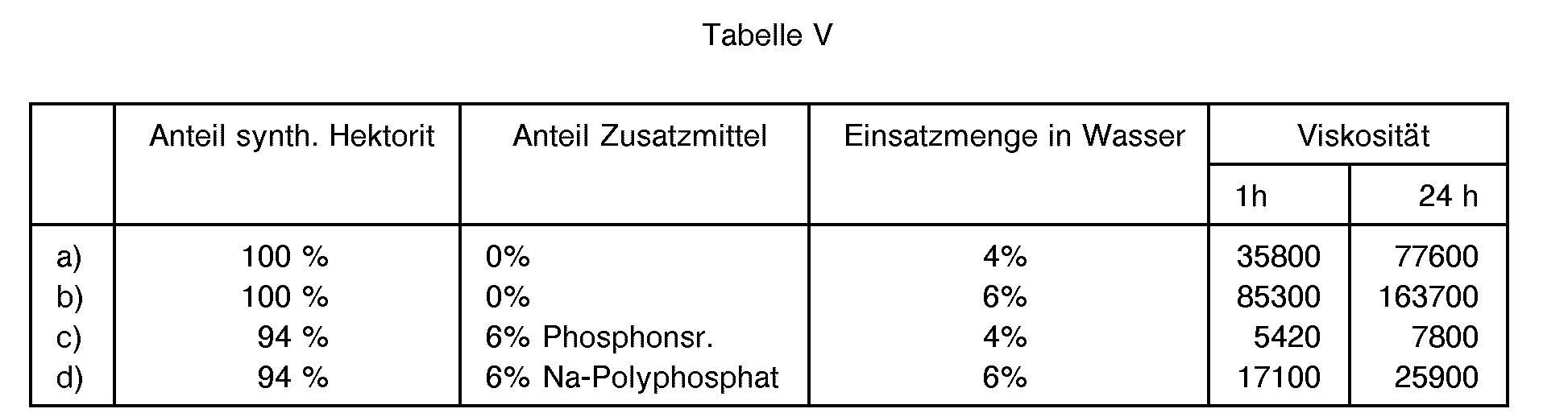
- Die Beispiele 4 und 5 zeigen deutlich, daß zwar auch durch Zugabe von Standard-Dispergierhilfsmitteln die Viskosität - vor allem im Leitungswasser - reduzierbar ist. Die verflüssigende Wirkung des Zusatzmittels nach Beispiel 3 wird jedoch bei weitem nicht erreicht.
- Da durch die Zusatzmittel die Viskosität der Stammpasten, d.h. der in Wasser dispergierten Verdikkungsmittel, stark abgesenkt wird, bleibt nachzuweisen, daß das Verdickungsmittel auch im fertigen System, wie z.B. einem Lack, tatsächlich seine Wirksamkeit entfaltet.
- Dies wurde mit nachfolgender Dekorfarbe (Richtrezeptur C-823 der Fa. ICI) getestet:
- Rezeptur: - Propylenglykol 5,50 Gew.-Teile
- - Wasser 7,75 "
- - AMP-95 ® 0,50
- - Dehydran 1293 ° 1,25
- - Surfynol 104 E ® 1,00
- - Neocryl BT-24 ® 7,25
- - Ti02 (Tioxide TR-92) 56,25
- Dispergieren auf < 10 µm
- - Wasser 8,50
- - Neocryl AH-24-C ® 25,00 3 min, 930 UpM
- - Rheol. Zus. s. Tab. VI x 10 min, 3720 UpM
- - Neocryl AH-24-C ® 113,75 5 min, 930-2800 UpM
- - Diethylenglykol ® 15,50 5 min, 930-1865 UpM
- - Dehydron 1293 ® 2,25
- - Byk 154 ° 1,75 5 min, 930-1865 UpM

- Die Einarbeitung erfolgte als Pulver. Vor allem Beispiel (d) zeigt die ausgezeichnete Wirkung des Verdickungsmittels im System.
- Die Wirkung der homogenisierten Mischprodukte wurde auch in einem handelsüblichen, wasserverdünnbaren Acryl-Heizkörperlack überprüft. In diesen gekauften Lack (Handelsprodukt der Firma Südwest Lacke & Farben) wurde das Verdickungsmittel als Pulver (im Dissolver, 15 min. Rühren, 2800 UpM) eingearbeitet.
- Heizkörperlack unverdünnt: 1700 mPa.s Glanz (60 °<): 79,5
-

- Die erfindungsgemäßen rheologischen Additive wurden auch in einer Holzschutzlasur in folgender Formulierung getestet:


- Die Beispiele 6 bis 8 zeigen eindeutig, daß die rheologischen Verdickungsmittel, die aus einem synthetischen Schichtsilicat durch Zugabe eines Zusatzmittels modifiziert wurden, auch in Beschichtungssystemen eine ausgezeichnete Wirkung aufweisen. Trotz der zum Teil sehr stark ausgeprägten "Verflüssigung" (Viskositätserniedrigung) der Stammpaste bleibt im System die Wirkung erhalten bzw. es wird die Wirkung im Vergleich zur unmodifizierten Variante sogar besser.
Claims (9)


Applications Claiming Priority (2)
| Application Number | Priority Date | Filing Date | Title |
|---|---|---|---|
| DE4410727 | 1994-03-28 | ||
| DE4410727A DE4410727A1 (de) | 1994-03-28 | 1994-03-28 | Verdickungsmittel auf der Basis mindestens eines synthetischen Schichtsilicats |
Publications (3)
| Publication Number | Publication Date |
|---|---|
| EP0675176A2 true EP0675176A2 (de) | 1995-10-04 |
| EP0675176A3 EP0675176A3 (de) | 1997-05-07 |
| EP0675176B1 EP0675176B1 (de) | 1999-07-28 |
Family
ID=6514057
Family Applications (1)
| Application Number | Title | Priority Date | Filing Date |
|---|---|---|---|
| EP95103549A Expired - Lifetime EP0675176B1 (de) | 1994-03-28 | 1995-03-11 | Verdickungsmittel auf der Basis mindestens eines synthetischen Schichtsilicats |
Country Status (6)
| Country | Link |
|---|---|
| US (1) | US5582638A (de) |
| EP (1) | EP0675176B1 (de) |
| AT (1) | ATE182605T1 (de) |
| DE (2) | DE4410727A1 (de) |
| DK (1) | DK0675176T3 (de) |
| ES (1) | ES2135608T3 (de) |
Cited By (3)
| Publication number | Priority date | Publication date | Assignee | Title |
|---|---|---|---|---|
| WO2007017199A3 (de) * | 2005-08-05 | 2007-05-18 | Eckart Gmbh & Co Kg | Oberflächenbelegte perlglanzpigmente, verfahren zu deren herstellung und deren verwendung |
| US7819966B2 (en) | 2005-08-05 | 2010-10-26 | Eckart Gmbh | Surface-coated pearlescent pigments, process for preparing them, and their use |
| US7955772B2 (en) | 2004-11-22 | 2011-06-07 | Eckart Gmbh | Dry toner, processes for the production thereof, and the use thereof |
Families Citing this family (15)
| Publication number | Priority date | Publication date | Assignee | Title |
|---|---|---|---|---|
| TW572965B (en) * | 2000-08-04 | 2004-01-21 | Sued Chemie Ag | Use of amphiphilic polymers or copolymers for the surface modification of reactive inorganic fillers |
| MXPA01013126A (es) * | 2001-01-08 | 2004-02-12 | Elementis Specialities Inc | Suspensiones de arcilla esmectita de viscosidad estable y mezclas de la arcilla esmectita y uno o mas fosfonatos utiles para hacer tales suspensiones. |
| US20020144630A1 (en) | 2001-01-08 | 2002-10-10 | Elementis Specialties, Inc. | Viscosity stable smectite clay slurries |
| US7081483B2 (en) * | 2001-07-03 | 2006-07-25 | The University Of Chicago | Polyfunctional dispersants for controlling viscosity of phyllosilicates |
| US6822035B2 (en) * | 2002-02-20 | 2004-11-23 | The University Of Chicago | Process for the preparation of organoclays |
| US6790896B2 (en) * | 2002-03-18 | 2004-09-14 | The University Of Chicago | Composite materials with improved phyllosilicate dispersion |
| US7135508B2 (en) * | 2002-02-20 | 2006-11-14 | The University Of Chicago | Coatings and films derived from clay/wax nanocomposites |
| US7160942B2 (en) * | 2002-07-12 | 2007-01-09 | Uchicago Argonne, Llc | Polymer-phyllosilicate nanocomposites and their preparation |
| US6867165B2 (en) * | 2002-09-09 | 2005-03-15 | W. R. Grace & Co. -Conn. | Calcium hydroxide absorbent with rheology modifier and process involving same |
| CA2530044C (en) | 2003-06-17 | 2012-09-25 | Phibro-Tech, Inc. | Particulate wood preservative and method for producing same |
| EP1636303A2 (de) * | 2003-06-23 | 2006-03-22 | The University Of Chicago | Polyolefin-nanoverbundwerkstoff |
| US20050109239A1 (en) * | 2003-11-21 | 2005-05-26 | Elementis Specialties, Inc. | Paint formulations containing hectorite compositions |
| US20050252408A1 (en) | 2004-05-17 | 2005-11-17 | Richardson H W | Particulate wood preservative and method for producing same |
| WO2006044218A2 (en) | 2004-10-14 | 2006-04-27 | Osmose, Inc. | Micronized wood preservative formulations in organic carriers |
| US7420071B2 (en) * | 2005-05-04 | 2008-09-02 | Uchicago Argonne, Llc | Thermally stable surfactants and compositions and methods of use thereof |
Family Cites Families (18)
| Publication number | Priority date | Publication date | Assignee | Title |
|---|---|---|---|---|
| SU899617A1 (ru) * | 1980-06-26 | 1982-01-23 | Проектный Институт Научно-Производственного Объединения "Лакокраспокрытие" | Состав дл коагул ции алкидно-акриловых лакокрасочных материалов |
| US4434075A (en) * | 1981-10-19 | 1984-02-28 | Nl Industries, Inc. | Anionically modified organophilic clays and their preparation |
| DE3145452A1 (de) * | 1980-11-17 | 1982-06-24 | NL Industries, Inc., 10020 New York, N.Y. | Gelbildender, orgaophiler ton und verfahren zu dessen herstellung |
| US4434076A (en) * | 1981-10-19 | 1984-02-28 | Nl Industries, Inc. | Clay cation complexes and their use to increase viscosity of liquid organic systems |
| DE3145457A1 (de) * | 1980-11-17 | 1982-09-09 | NL Industries, Inc., 10020 New York, N.Y. | Fluid auf oelbasis enthaltend kationische organophile tone |
| US4412018A (en) * | 1980-11-17 | 1983-10-25 | Nl Industries, Inc. | Organophilic clay complexes, their preparation and compositions comprising said complexes |
| US4382868A (en) * | 1981-08-13 | 1983-05-10 | Venture Innovations, Inc. | Organophilic clay gellants |
| US4517112A (en) * | 1982-02-18 | 1985-05-14 | Nl Industries, Inc. | Modified organophilic clay complexes, their preparation and non-aqueous systems containing them |
| DE3230476A1 (de) * | 1982-08-17 | 1984-02-23 | Hoechst Ag, 6230 Frankfurt | Leicht dispergierbare organo-smectite und verfahren zu ihrer herstellung |
| US4588515A (en) * | 1984-09-27 | 1986-05-13 | The Procter & Gamble Company | Granular automatic dishwasher detergent compositions containing smectite clay |
| US4801395A (en) * | 1986-08-07 | 1989-01-31 | Colgate-Palmolive Company | Thixotropic clay aqueous suspensions containing long chain saturated fatty acid stabilizers |
| US4800041A (en) * | 1985-11-04 | 1989-01-24 | Armstrong World Industries, Inc. | Suspensions of sheet silicate materials and products made therefrom |
| DE3914916A1 (de) * | 1989-05-06 | 1990-11-08 | Henkel Kgaa | Mittel zum viskositaetsaufbau in nichtwaessrigen fluessigphasen, verfahren zu ihrer herstellung und ihre verwendung |
| US5151218A (en) * | 1989-09-14 | 1992-09-29 | Byk-Chemie Gmbh | Phosphoric acid esters, method of producing them, and use thereof as dispersants |
| DE3930687A1 (de) * | 1989-09-14 | 1991-04-11 | Byk Chemie Gmbh | Phosphorsaeureester, verfahren zu deren herstellung und deren verwendung als dispergiermittel |
| US5336647A (en) * | 1991-11-14 | 1994-08-09 | Rheox, Inc. | Organoclay compositions prepared with a mixture of two organic cations and their use in non-aqueous systems |
| US5128067A (en) * | 1991-12-19 | 1992-07-07 | Fmc Corporation | Fire resistant low temperature grease |
| DE4404218A1 (de) * | 1994-02-10 | 1995-08-17 | Bayer Ag | Anorganische Feststoff-Suspensionen |
-
1994
- 1994-03-28 DE DE4410727A patent/DE4410727A1/de not_active Withdrawn
-
1995
- 1995-03-11 DE DE59506434T patent/DE59506434D1/de not_active Expired - Lifetime
- 1995-03-11 DK DK95103549T patent/DK0675176T3/da active
- 1995-03-11 EP EP95103549A patent/EP0675176B1/de not_active Expired - Lifetime
- 1995-03-11 AT AT95103549T patent/ATE182605T1/de not_active IP Right Cessation
- 1995-03-11 ES ES95103549T patent/ES2135608T3/es not_active Expired - Lifetime
- 1995-03-27 US US08/410,828 patent/US5582638A/en not_active Expired - Lifetime
Cited By (4)
| Publication number | Priority date | Publication date | Assignee | Title |
|---|---|---|---|---|
| US7955772B2 (en) | 2004-11-22 | 2011-06-07 | Eckart Gmbh | Dry toner, processes for the production thereof, and the use thereof |
| WO2007017199A3 (de) * | 2005-08-05 | 2007-05-18 | Eckart Gmbh & Co Kg | Oberflächenbelegte perlglanzpigmente, verfahren zu deren herstellung und deren verwendung |
| US7819966B2 (en) | 2005-08-05 | 2010-10-26 | Eckart Gmbh | Surface-coated pearlescent pigments, process for preparing them, and their use |
| CN101309979B (zh) * | 2005-08-05 | 2012-07-04 | 埃卡特有限公司 | 表面涂布的珠光颜料、其制备方法及用途 |
Also Published As
| Publication number | Publication date |
|---|---|
| DE59506434D1 (de) | 1999-09-02 |
| EP0675176A3 (de) | 1997-05-07 |
| DE4410727A1 (de) | 1995-10-05 |
| DK0675176T3 (da) | 1999-11-29 |
| ATE182605T1 (de) | 1999-08-15 |
| ES2135608T3 (es) | 1999-11-01 |
| EP0675176B1 (de) | 1999-07-28 |
| US5582638A (en) | 1996-12-10 |
Similar Documents
| Publication | Publication Date | Title |
|---|---|---|
| EP0675176B1 (de) | Verdickungsmittel auf der Basis mindestens eines synthetischen Schichtsilicats | |
| DE69513439T2 (de) | Organotonzusammensetzungen, die zwei oder mehr Kationen und ein oder mehr organische Anionen enthalten, ihre Herstellung und ihre Verwendung in nicht-wässrigen Systemen | |
| DE3208052C2 (de) | ||
| DE3636473B4 (de) | Voraktiviertes organophiles Tongeliermittel für Schmierfette und dessen Verwendung | |
| DE2446460C2 (de) | Tetraalkyl-phosphonium-tone, Verfahren zu ihrer Herstellung und ihre Verwendung zur Gelierung organischer Flüssigkeiten | |
| DE69208210T2 (de) | Organotonzusammensetzungen, hergestellt aus einer Mischung von zwei organischen Kationen sowie ihre Verwendung in nichtwässrigen Systemen | |
| DE3689518T2 (de) | Organoton-zusammensetzung. | |
| DE69633068T2 (de) | Verbesserte organische tone mit quaternärem ammoniumion mit verzweigter alkylkette | |
| DE60209202T2 (de) | Behandlung von Metallplättchen mit Phosphonsäurederivat | |
| DE2912069A1 (de) | Viskositaetserhoehendes additiv fuer nicht-waessrige fluide systeme | |
| EP0339310A1 (de) | Wässrige Dispersion von Gips und deren Verwendung als Füllstoff und Streichpigment bei der Papier- und Kartonherstellung | |
| DE69609423T2 (de) | Phosphatester von polyalkylenetherblockcopolymeren und ihre anwendung als dispergiermittel | |
| DE69220089T2 (de) | Wasserbeständige metallpigmentteilchen | |
| DE10225122A1 (de) | Hochkonzentrierte wässrige Dispersionen enthaltend hydrophobe mikrofeine Metalloxidpartikel und Dispergierhilfsmittel | |
| DE3731919C2 (de) | ||
| DE69402623T2 (de) | Rostschutzzusammensetzung | |
| DE2334542A1 (de) | Korrosionsinhibierendes pigment und verfahren zur herstellung desselben | |
| WO2023094379A1 (de) | Pigmentpaste und ihre verwendung | |
| EP0340583B1 (de) | Wässrige Dispersionen mit einer synergistischen Dispergiermittelkombination | |
| DE2647672C3 (de) | Gelierte Kohlenwasserstoffzubereitungen und Verfahren zu ihrer Herstellung | |
| DE2012924B2 (de) | In Wasser stabiles Titanchelat | |
| DE4140733C2 (de) | Fassadenanstrichmittel und Putze mit hoher Frühwasserbeständigkeit | |
| CH643876A5 (de) | Bei der aufbewahrung bestaendige waessrige dispersionen von dispersionsfarbstoffen. | |
| DE68918120T2 (de) | Polyaluminiumdialkylphosphat, dieses enthaltende Ölgeliermittel und dieses enthaltende Mittel zur äusserlichen Anwendung. | |
| EP1533346B1 (de) | Anstrichzusammensetzungen enthaltend Hectorit-Ton und Phosphonat-Zusätze |
Legal Events
| Date | Code | Title | Description |
|---|---|---|---|
| PUAI | Public reference made under article 153(3) epc to a published international application that has entered the european phase |
Free format text: ORIGINAL CODE: 0009012 |
|
| AK | Designated contracting states |
Kind code of ref document: A2 Designated state(s): AT BE CH DE DK ES FR GB IT LI NL SE |
|
| PUAL | Search report despatched |
Free format text: ORIGINAL CODE: 0009013 |
|
| AK | Designated contracting states |
Kind code of ref document: A3 Designated state(s): AT BE CH DE DK ES FR GB IT LI NL SE |
|
| RHK1 | Main classification (correction) |
Ipc: C09D 17/00 |
|
| 17P | Request for examination filed |
Effective date: 19970516 |
|
| 17Q | First examination report despatched |
Effective date: 19971016 |
|
| GRAG | Despatch of communication of intention to grant |
Free format text: ORIGINAL CODE: EPIDOS AGRA |
|
| GRAG | Despatch of communication of intention to grant |
Free format text: ORIGINAL CODE: EPIDOS AGRA |
|
| GRAH | Despatch of communication of intention to grant a patent |
Free format text: ORIGINAL CODE: EPIDOS IGRA |
|
| GRAH | Despatch of communication of intention to grant a patent |
Free format text: ORIGINAL CODE: EPIDOS IGRA |
|
| GRAA | (expected) grant |
Free format text: ORIGINAL CODE: 0009210 |
|
| AK | Designated contracting states |
Kind code of ref document: B1 Designated state(s): AT BE CH DE DK ES FR GB IT LI NL SE |
|
| REF | Corresponds to: |
Ref document number: 182605 Country of ref document: AT Date of ref document: 19990815 Kind code of ref document: T |
|
| REG | Reference to a national code |
Ref country code: CH Ref legal event code: EP |
|
| REG | Reference to a national code |
Ref country code: CH Ref legal event code: NV Representative=s name: KELLER & PARTNER PATENTANWAELTE AG |
|
| ET | Fr: translation filed | ||
| REF | Corresponds to: |
Ref document number: 59506434 Country of ref document: DE Date of ref document: 19990902 |
|
| ITF | It: translation for a ep patent filed | ||
| REG | Reference to a national code |
Ref country code: ES Ref legal event code: FG2A Ref document number: 2135608 Country of ref document: ES Kind code of ref document: T3 |
|
| GBT | Gb: translation of ep patent filed (gb section 77(6)(a)/1977) |
Effective date: 19991101 |
|
| REG | Reference to a national code |
Ref country code: DK Ref legal event code: T3 |
|
| PLBE | No opposition filed within time limit |
Free format text: ORIGINAL CODE: 0009261 |
|
| STAA | Information on the status of an ep patent application or granted ep patent |
Free format text: STATUS: NO OPPOSITION FILED WITHIN TIME LIMIT |
|
| 26N | No opposition filed | ||
| REG | Reference to a national code |
Ref country code: GB Ref legal event code: IF02 |
|
| PGFP | Annual fee paid to national office [announced via postgrant information from national office to epo] |
Ref country code: CH Payment date: 20020218 Year of fee payment: 8 |
|
| PGFP | Annual fee paid to national office [announced via postgrant information from national office to epo] |
Ref country code: BE Payment date: 20020327 Year of fee payment: 8 |
|
| PG25 | Lapsed in a contracting state [announced via postgrant information from national office to epo] |
Ref country code: LI Free format text: LAPSE BECAUSE OF NON-PAYMENT OF DUE FEES Effective date: 20030331 Ref country code: CH Free format text: LAPSE BECAUSE OF NON-PAYMENT OF DUE FEES Effective date: 20030331 Ref country code: BE Free format text: LAPSE BECAUSE OF NON-PAYMENT OF DUE FEES Effective date: 20030331 |
|
| BERE | Be: lapsed |
Owner name: *SUD-CHEMIE A.G. Effective date: 20030331 |
|
| REG | Reference to a national code |
Ref country code: CH Ref legal event code: PL |
|
| PGFP | Annual fee paid to national office [announced via postgrant information from national office to epo] |
Ref country code: ES Payment date: 20060306 Year of fee payment: 12 |
|
| PGFP | Annual fee paid to national office [announced via postgrant information from national office to epo] |
Ref country code: NL Payment date: 20060315 Year of fee payment: 12 |
|
| PGFP | Annual fee paid to national office [announced via postgrant information from national office to epo] |
Ref country code: DK Payment date: 20060321 Year of fee payment: 12 Ref country code: AT Payment date: 20060321 Year of fee payment: 12 |
|
| REG | Reference to a national code |
Ref country code: GB Ref legal event code: 732E |
|
| NLS | Nl: assignments of ep-patents |
Owner name: ROCKWOOD CLAY ADDITIVES GMBH Effective date: 20060425 |
|
| REG | Reference to a national code |
Ref country code: FR Ref legal event code: TP |
|
| PG25 | Lapsed in a contracting state [announced via postgrant information from national office to epo] |
Ref country code: SE Free format text: LAPSE BECAUSE OF NON-PAYMENT OF DUE FEES Effective date: 20070312 |
|
| REG | Reference to a national code |
Ref country code: DK Ref legal event code: EBP |
|
| EUG | Se: european patent has lapsed | ||
| PG25 | Lapsed in a contracting state [announced via postgrant information from national office to epo] |
Ref country code: AT Free format text: LAPSE BECAUSE OF NON-PAYMENT OF DUE FEES Effective date: 20070311 |
|
| NLV4 | Nl: lapsed or anulled due to non-payment of the annual fee |
Effective date: 20071001 |
|
| PG25 | Lapsed in a contracting state [announced via postgrant information from national office to epo] |
Ref country code: NL Free format text: LAPSE BECAUSE OF NON-PAYMENT OF DUE FEES Effective date: 20071001 |
|
| PGFP | Annual fee paid to national office [announced via postgrant information from national office to epo] |
Ref country code: SE Payment date: 20060309 Year of fee payment: 12 |
|
| PG25 | Lapsed in a contracting state [announced via postgrant information from national office to epo] |
Ref country code: DK Free format text: LAPSE BECAUSE OF NON-PAYMENT OF DUE FEES Effective date: 20070402 |
|
| PGFP | Annual fee paid to national office [announced via postgrant information from national office to epo] |
Ref country code: IT Payment date: 20080326 Year of fee payment: 14 |
|
| REG | Reference to a national code |
Ref country code: ES Ref legal event code: FD2A Effective date: 20070312 |
|
| PG25 | Lapsed in a contracting state [announced via postgrant information from national office to epo] |
Ref country code: ES Free format text: LAPSE BECAUSE OF NON-PAYMENT OF DUE FEES Effective date: 20070312 |
|
| PG25 | Lapsed in a contracting state [announced via postgrant information from national office to epo] |
Ref country code: IT Free format text: LAPSE BECAUSE OF NON-PAYMENT OF DUE FEES Effective date: 20090311 |
|
| REG | Reference to a national code |
Ref country code: FR Ref legal event code: CD Owner name: BYK ADDITIVES GMBH, DE Effective date: 20140320 Ref country code: FR Ref legal event code: CA Effective date: 20140320 |
|
| PGFP | Annual fee paid to national office [announced via postgrant information from national office to epo] |
Ref country code: DE Payment date: 20140324 Year of fee payment: 20 |
|
| REG | Reference to a national code |
Ref country code: DE Ref legal event code: R082 Ref document number: 59506434 Country of ref document: DE Representative=s name: ANDRAE WESTENDORP PATENTANWAELTE PARTNERSCHAFT, DE |
|
| PGFP | Annual fee paid to national office [announced via postgrant information from national office to epo] |
Ref country code: FR Payment date: 20140109 Year of fee payment: 20 |
|
| REG | Reference to a national code |
Ref country code: DE Ref legal event code: R082 Ref document number: 59506434 Country of ref document: DE Representative=s name: ANDRAE WESTENDORP PATENTANWAELTE PARTNERSCHAFT, DE Effective date: 20140507 Ref country code: DE Ref legal event code: R081 Ref document number: 59506434 Country of ref document: DE Owner name: BYK ADDITIVES GMBH, DE Free format text: FORMER OWNER: ROCKWOOD CLAY ADDITIVES GMBH, 85368 MOOSBURG, DE Effective date: 20140507 |
|
| PGFP | Annual fee paid to national office [announced via postgrant information from national office to epo] |
Ref country code: GB Payment date: 20140325 Year of fee payment: 20 |
|
| REG | Reference to a national code |
Ref country code: DE Ref legal event code: R071 Ref document number: 59506434 Country of ref document: DE |
|
| REG | Reference to a national code |
Ref country code: GB Ref legal event code: PE20 Expiry date: 20150310 |
|
| PG25 | Lapsed in a contracting state [announced via postgrant information from national office to epo] |
Ref country code: GB Free format text: LAPSE BECAUSE OF EXPIRATION OF PROTECTION Effective date: 20150310 |