EP0675521A2 - Lampe à mercure à haute pression - Google Patents
Lampe à mercure à haute pression Download PDFInfo
- Publication number
- EP0675521A2 EP0675521A2 EP95103687A EP95103687A EP0675521A2 EP 0675521 A2 EP0675521 A2 EP 0675521A2 EP 95103687 A EP95103687 A EP 95103687A EP 95103687 A EP95103687 A EP 95103687A EP 0675521 A2 EP0675521 A2 EP 0675521A2
- Authority
- EP
- European Patent Office
- Prior art keywords
- pressure mercury
- mercury lamp
- lamp according
- ppm
- quartz glass
- Prior art date
- Legal status (The legal status is an assumption and is not a legal conclusion. Google has not performed a legal analysis and makes no representation as to the accuracy of the status listed.)
- Withdrawn
Links
Images
Classifications
-
- G—PHYSICS
- G03—PHOTOGRAPHY; CINEMATOGRAPHY; ANALOGOUS TECHNIQUES USING WAVES OTHER THAN OPTICAL WAVES; ELECTROGRAPHY; HOLOGRAPHY
- G03F—PHOTOMECHANICAL PRODUCTION OF TEXTURED OR PATTERNED SURFACES, e.g. FOR PRINTING, FOR PROCESSING OF SEMICONDUCTOR DEVICES; MATERIALS THEREFOR; ORIGINALS THEREFOR; APPARATUS SPECIALLY ADAPTED THEREFOR
- G03F7/00—Photomechanical, e.g. photolithographic, production of textured or patterned surfaces, e.g. printing surfaces; Materials therefor, e.g. comprising photoresists; Apparatus specially adapted therefor
- G03F7/70—Microphotolithographic exposure; Apparatus therefor
- G03F7/70008—Production of exposure light, i.e. light sources
- G03F7/70016—Production of exposure light, i.e. light sources by discharge lamps
-
- H—ELECTRICITY
- H01—ELECTRIC ELEMENTS
- H01J—ELECTRIC DISCHARGE TUBES OR DISCHARGE LAMPS
- H01J61/00—Gas-discharge or vapour-discharge lamps
- H01J61/02—Details
- H01J61/12—Selection of substances for gas fillings; Specified operating pressure or temperature
- H01J61/18—Selection of substances for gas fillings; Specified operating pressure or temperature having a metallic vapour as the principal constituent
- H01J61/20—Selection of substances for gas fillings; Specified operating pressure or temperature having a metallic vapour as the principal constituent mercury vapour
-
- H—ELECTRICITY
- H01—ELECTRIC ELEMENTS
- H01J—ELECTRIC DISCHARGE TUBES OR DISCHARGE LAMPS
- H01J61/00—Gas-discharge or vapour-discharge lamps
- H01J61/02—Details
- H01J61/30—Vessels; Containers
- H01J61/302—Vessels; Containers characterised by the material of the vessel
-
- H—ELECTRICITY
- H01—ELECTRIC ELEMENTS
- H01J—ELECTRIC DISCHARGE TUBES OR DISCHARGE LAMPS
- H01J61/00—Gas-discharge or vapour-discharge lamps
- H01J61/02—Details
- H01J61/38—Devices for influencing the colour or wavelength of the light
- H01J61/40—Devices for influencing the colour or wavelength of the light by light filters; by coloured coatings in or on the envelope
-
- H—ELECTRICITY
- H01—ELECTRIC ELEMENTS
- H01J—ELECTRIC DISCHARGE TUBES OR DISCHARGE LAMPS
- H01J61/00—Gas-discharge or vapour-discharge lamps
- H01J61/82—Lamps with high-pressure unconstricted discharge having a cold pressure > 400 Torr
- H01J61/822—High-pressure mercury lamps
Definitions
- the invention is based on a high-pressure mercury lamp according to the preamble of claim 1.
- Such lamps are preferably used for the exposure of photoresists in the production of semiconductors.
- a fundamental problem of such lamps is the undesired radiation at wavelengths below the useful wavelength, which stress the overall system and should therefore be suppressed if possible.
- the path that is usually taken for this is to introduce an absorption filter into the beam path, see again DE-OS 35 27 855. It is an interference filter or color filter.
- a disadvantage of the former solution is the occurrence of absorption gaps due to secondary maxima of the layer stack, while in the second solution intensity losses have to be accepted.
- the problems that are caused by this undesired short-wave radiation have become increasingly acute.
- the specific problem of the present invention is that usable emission lines ( ⁇ 365 nm) and undesired emission lines below 365 nm are very close together, so that known measures are not sufficient.
- incandescent lamps it is known to use dopants for the bulb glass (made of Vycor or hard glass) to suppress the UV component.
- this is low-intensity continuum radiation that decreases sharply towards short wavelengths.
- vanadium, cerium or molybdenum are used as the doping metal ion in an amount of 300-3000 ppm by weight.
- a glass bulb thickness of 1 mm is used.
- the field of application of this doping is the range below 300 nm.
- these dopings have proven to be unsuitable for the present problem because they already noticeably dampen the useful wavelength of 365 nm.
- Another previously known measure is the use of a Ti02 coating (US Pat. No. 4,985,275). However, this material only absorbs substantially below approx. 240 nm and is therefore at most suitable as an additive because of the large distance from the useful wavelength.
- a flask made of quartz glass is used, to which a small amount of vanadium (as oxide) is added.
- a quantity of 250 ppm (by weight) has proven to be sufficient, based on 1 mm wall thickness. With larger wall thicknesses, the doping content can be reduced accordingly (approximately linearly).
- a preferred upper limit is 200 ppm. Especially with low lamp power, less than 150 ppm is often sufficient. A value of 20 ppm has proven to be a practical lower limit for the effectiveness of the absorption. In general, higher doping should be selected for higher lamp power.
- the absorption behavior at very short wavelengths can be improved by adding the oxides of tin or titanium in a total amount of up to 500 ppm (by weight), based on 1 mm wall thickness.
- both materials can also be used simultaneously.
- At least one of these materials can also be applied to the piston wall as a coating.
- Preferred wall thicknesses of the piston are 1 to 5 mm, in particular 1.5 to 4.0 mm.
- the filling preferably contains 0.5 to 15 mg / cm3 of mercury.
- xenon with a cold filling pressure of between 0.1 and 3.0 bar, preferably below 2.0 bar, has proven itself as the starting gas.
- the electrode spacing for this special lamp is between 2 and 9 mm.
- the operating temperature measured on the outer wall of the piston, reaches values between 400 and 950 o C. It must be taken into account because it is known that the exact position of the absorption edge of the vanadium depends on it. The use of vanadium in a small amount is also possible with other types of discharge lamps in which only part of the UV emission is to be used.
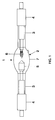
- FIG. 1 schematically shows a high-pressure mercury lamp 1 with a discharge vessel 2, two shaft sections 3 and bases 4 fastened thereon.
- the lamp is operated with a power of 1000 W under direct current.
- the anode 5 and the cathode 6 face each other at a distance of 3 mm.
- the discharge vessel 2 is made of quartz glass with a wall thickness of approximately 2.8 mm, which is doped with vanadium oxide.
- the vanadium content is around 35 ppm.
- the piston is coated with Ti02; the thickness of layer 7 is 1 ⁇ m.
- the flask is filled with 8 mg / cm3 mercury and xenon with a cold filling pressure of 1.7 bar.
- the operating temperature of the piston reaches values of up to 750 o C.
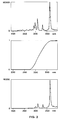
- FIG. 2 shows a section of the lamp spectrum between 200 and 400 nm.
- a lamp spectrum without doping the quartz glass is shown at the top.
- the absorption behavior of the doping according to the invention is shown in the middle.
- the improved lamp spectrum (with doping) is shown below.
- the useful wavelength at 365 nm is actually unattenuated, while the undesired line group is strongly attenuated by 300 nm. If necessary, it can be suppressed even more by adding Sn02.
- Another embodiment is a 3300 W lamp with a mercury filling of 3 mg / cm3 and a xenon cold filling pressure of 0.8 bar.
- the electrode spacing is 6.5 mm.
- the flask is doped with vanadium (50 ppm) and titanium (40 ppm) in the form of their oxides with a wall thickness of 3.7 mm.
- lamps according to the invention allow a considerable reduction in the cost of the overall system, since not only can external filters for the UV range be simplified or omitted entirely, but also the system efficiency, its throughput and also the service life are increased.
- a positive side effect is that the increased absorption in the short-wave UV heats up the bulb. Conversely, this effect can be used to increase the lamp volume without the risk of mercury condensation. This reduces the risk of piston blackening.
Landscapes
- Physics & Mathematics (AREA)
- Engineering & Computer Science (AREA)
- Plasma & Fusion (AREA)
- General Physics & Mathematics (AREA)
- Vessels And Coating Films For Discharge Lamps (AREA)
- Glass Compositions (AREA)
- Discharge Lamp (AREA)
Applications Claiming Priority (2)
| Application Number | Priority Date | Filing Date | Title |
|---|---|---|---|
| DE4410968A DE4410968A1 (de) | 1994-03-29 | 1994-03-29 | Quecksilberhochdrucklampe |
| DE4410968 | 1994-03-29 |
Publications (2)
| Publication Number | Publication Date |
|---|---|
| EP0675521A2 true EP0675521A2 (fr) | 1995-10-04 |
| EP0675521A3 EP0675521A3 (fr) | 1997-04-16 |
Family
ID=6514198
Family Applications (1)
| Application Number | Title | Priority Date | Filing Date |
|---|---|---|---|
| EP95103687A Withdrawn EP0675521A3 (fr) | 1994-03-29 | 1995-03-14 | Lampe à mercure à haute pression. |
Country Status (4)
| Country | Link |
|---|---|
| US (1) | US5650630A (fr) |
| EP (1) | EP0675521A3 (fr) |
| JP (1) | JP3016061U (fr) |
| DE (1) | DE4410968A1 (fr) |
Cited By (1)
| Publication number | Priority date | Publication date | Assignee | Title |
|---|---|---|---|---|
| EP0704881A3 (fr) * | 1994-09-27 | 1998-09-23 | Ushiodenki Kabushiki Kaisha | Lampe à décharge |
Families Citing this family (5)
| Publication number | Priority date | Publication date | Assignee | Title |
|---|---|---|---|---|
| US5751896A (en) * | 1996-02-22 | 1998-05-12 | Micron Technology, Inc. | Method and apparatus to compensate for non-uniform film growth during chemical vapor deposition |
| JP2000123786A (ja) * | 1998-10-13 | 2000-04-28 | Matsushita Electronics Industry Corp | 高圧水銀ランプ、この高圧水銀ランプを用いた照明光学装置、およびこの照明光学装置を用いた画像表示装置 |
| DE19905108A1 (de) * | 1998-12-16 | 2000-06-21 | Nienburger Glas Gmbh | Ultraviolettes Licht absorbierendes Glas, Verfahren zur Herstellung und Verwendung desselben |
| US6622524B1 (en) | 1998-12-16 | 2003-09-23 | Nienburger Glas Gmbh | Glass which absorbs ultraviolet light, method for producing said glass and use of the same |
| JP7593536B1 (ja) * | 2023-04-28 | 2024-12-03 | 東ソー株式会社 | 石英ガラス |
Family Cites Families (10)
| Publication number | Priority date | Publication date | Assignee | Title |
|---|---|---|---|---|
| US2862131A (en) * | 1951-02-27 | 1958-11-25 | Saint Gobain | Glass for glow discharge lamps such as fluorescent luminescent lamps and the like |
| NL289728A (fr) * | 1962-03-15 | |||
| US3848152A (en) * | 1972-06-06 | 1974-11-12 | Corning Glass Works | Electric lamp having a fused silica glass envelope |
| USRE30165E (en) * | 1973-01-19 | 1979-12-11 | Thorn Lighting Limited | Electric discharge lamp |
| GB1456242A (en) * | 1973-01-19 | 1976-11-24 | Thorn Lighting Ltd | Incandescent lamp |
| JPS61189636A (ja) * | 1985-02-19 | 1986-08-23 | Ushio Inc | キセノン・水銀放電灯による半導体ウエハ−の露光方法 |
| GB2191888A (en) * | 1986-06-05 | 1987-12-23 | Ushio Electric Inc | Fused silica envelope for discharge lamp |
| US4985275A (en) * | 1986-06-05 | 1991-01-15 | Ushio Denki Kabushiki Kaisha | Method for producing a fused silica envelope for discharge lamp |
| JPH04368768A (ja) * | 1991-06-17 | 1992-12-21 | Matsushita Electric Ind Co Ltd | メタルハライドランプ |
| JP3255664B2 (ja) * | 1991-09-06 | 2002-02-12 | 旭テクノグラス株式会社 | 照明装置 |
-
1994
- 1994-03-29 DE DE4410968A patent/DE4410968A1/de not_active Withdrawn
-
1995
- 1995-03-14 EP EP95103687A patent/EP0675521A3/fr not_active Withdrawn
- 1995-03-22 JP JP1995003307U patent/JP3016061U/ja not_active Expired - Lifetime
- 1995-03-27 US US08/410,724 patent/US5650630A/en not_active Expired - Fee Related
Cited By (1)
| Publication number | Priority date | Publication date | Assignee | Title |
|---|---|---|---|---|
| EP0704881A3 (fr) * | 1994-09-27 | 1998-09-23 | Ushiodenki Kabushiki Kaisha | Lampe à décharge |
Also Published As
| Publication number | Publication date |
|---|---|
| EP0675521A3 (fr) | 1997-04-16 |
| JP3016061U (ja) | 1995-09-26 |
| DE4410968A1 (de) | 1995-10-05 |
| US5650630A (en) | 1997-07-22 |
Similar Documents
| Publication | Publication Date | Title |
|---|---|---|
| EP0338637B1 (fr) | Lampe à décharge à vapeur de mercure à haute pression | |
| DE69501490T2 (de) | Dielektrikumbegrenzte Entladungslampe | |
| EP2128888B1 (fr) | Lampe à décharge à haute tension à halogénures métalliques sans mercure | |
| DE69514710T2 (de) | Metallhalogenidlampe | |
| EP1417720B1 (fr) | Puce emettant un rayonnement et composant emettant un rayonnement | |
| DE69402641T2 (de) | Cadmiumentladungslampe | |
| EP0706201A2 (fr) | Lampe à arc court à vapeur de mercure | |
| DE3336421A1 (de) | Kolbenlampe fuer den fernen uv-bereich | |
| EP1447615B1 (fr) | Simulateur du soleil pulsé à homogénéité améliorée | |
| DE1911985C3 (de) | Hochdruck-Bogenentladungslampe | |
| DE2845890C3 (de) | Quecksilber-Edelgas-Entladungslampe | |
| DE69921901T2 (de) | Cermet und keramische Entladungslampe | |
| DE69409154T2 (de) | Entladungslampe | |
| EP0675521A2 (fr) | Lampe à mercure à haute pression | |
| DE69117316T2 (de) | Leuchtstofflampe und ihr Herstellungsverfahren | |
| DE69413439T2 (de) | Metalldampf Entladungslampe | |
| DE69926706T2 (de) | Niederdruckquecksilberdampfeentladungslampe | |
| DE60033299T2 (de) | Hochdruckentladungslampe | |
| DE10356762B4 (de) | Entladungslampe vom Kurzbogentyp | |
| DE69807266T2 (de) | Kurzbogen-Quecksilberlampe | |
| DE3024438A1 (de) | Niederdruckquecksilberdampfentladungslampe | |
| DE69201339T2 (de) | Metalldampfentladungslampe. | |
| EP2981984B1 (fr) | Luminaire | |
| DE69810683T2 (de) | Kurzbogenentladungslampe | |
| DE4036122A1 (de) | Koronaentladungs-lichtquellenzelle |
Legal Events
| Date | Code | Title | Description |
|---|---|---|---|
| PUAI | Public reference made under article 153(3) epc to a published international application that has entered the european phase |
Free format text: ORIGINAL CODE: 0009012 |
|
| AK | Designated contracting states |
Kind code of ref document: A2 Designated state(s): BE DE FR GB IT NL |
|
| PUAL | Search report despatched |
Free format text: ORIGINAL CODE: 0009013 |
|
| AK | Designated contracting states |
Kind code of ref document: A3 Designated state(s): BE DE FR GB IT NL |
|
| 17P | Request for examination filed |
Effective date: 19970505 |
|
| 17Q | First examination report despatched |
Effective date: 19971211 |
|
| STAA | Information on the status of an ep patent application or granted ep patent |
Free format text: STATUS: THE APPLICATION IS DEEMED TO BE WITHDRAWN |
|
| 18D | Application deemed to be withdrawn |
Effective date: 19980422 |