EP0675634A2 - System zur Übertragung digitaler Daten zwischen einem Bildeingabeterminal und einem Hostterminal - Google Patents
System zur Übertragung digitaler Daten zwischen einem Bildeingabeterminal und einem Hostterminal Download PDFInfo
- Publication number
- EP0675634A2 EP0675634A2 EP95302179A EP95302179A EP0675634A2 EP 0675634 A2 EP0675634 A2 EP 0675634A2 EP 95302179 A EP95302179 A EP 95302179A EP 95302179 A EP95302179 A EP 95302179A EP 0675634 A2 EP0675634 A2 EP 0675634A2
- Authority
- EP
- European Patent Office
- Prior art keywords
- data
- scanlines
- image
- image data
- host terminal
- Prior art date
- Legal status (The legal status is an assumption and is not a legal conclusion. Google has not performed a legal analysis and makes no representation as to the accuracy of the status listed.)
- Granted
Links
- 238000012546 transfer Methods 0.000 claims abstract description 84
- 239000000872 buffer Substances 0.000 claims description 110
- 238000000034 method Methods 0.000 claims description 17
- 238000005070 sampling Methods 0.000 claims description 13
- 230000000737 periodic effect Effects 0.000 claims description 5
- 230000003213 activating effect Effects 0.000 claims description 2
- 230000001360 synchronised effect Effects 0.000 abstract description 15
- 230000010354 integration Effects 0.000 description 39
- 230000002457 bidirectional effect Effects 0.000 description 13
- 238000010586 diagram Methods 0.000 description 11
- 238000001444 catalytic combustion detection Methods 0.000 description 10
- 230000004044 response Effects 0.000 description 9
- 230000008569 process Effects 0.000 description 7
- 230000003139 buffering effect Effects 0.000 description 6
- 230000006870 function Effects 0.000 description 4
- 230000003287 optical effect Effects 0.000 description 4
- 230000008859 change Effects 0.000 description 2
- 238000012545 processing Methods 0.000 description 2
- 238000013459 approach Methods 0.000 description 1
- 238000003491 array Methods 0.000 description 1
- 210000001217 buttock Anatomy 0.000 description 1
- 239000002131 composite material Substances 0.000 description 1
- 230000003111 delayed effect Effects 0.000 description 1
- 230000001419 dependent effect Effects 0.000 description 1
- 238000005286 illumination Methods 0.000 description 1
- 230000000873 masking effect Effects 0.000 description 1
- 238000012986 modification Methods 0.000 description 1
- 230000004048 modification Effects 0.000 description 1
- 229920006395 saturated elastomer Polymers 0.000 description 1
Images



Classifications
-
- H—ELECTRICITY
- H04—ELECTRIC COMMUNICATION TECHNIQUE
- H04N—PICTORIAL COMMUNICATION, e.g. TELEVISION
- H04N1/00—Scanning, transmission or reproduction of documents or the like, e.g. facsimile transmission; Details thereof
- H04N1/32—Circuits or arrangements for control or supervision between transmitter and receiver or between image input and image output device, e.g. between a still-image camera and its memory or between a still-image camera and a printer device
- H04N1/32358—Circuits or arrangements for control or supervision between transmitter and receiver or between image input and image output device, e.g. between a still-image camera and its memory or between a still-image camera and a printer device using picture signal storage, e.g. at transmitter
- H04N1/32491—Circuits or arrangements for control or supervision between transmitter and receiver or between image input and image output device, e.g. between a still-image camera and its memory or between a still-image camera and a printer device using picture signal storage, e.g. at transmitter alternate storage in and retrieval from two parallel memories, e.g. using ping-pong buffers
-
- H—ELECTRICITY
- H04—ELECTRIC COMMUNICATION TECHNIQUE
- H04N—PICTORIAL COMMUNICATION, e.g. TELEVISION
- H04N1/00—Scanning, transmission or reproduction of documents or the like, e.g. facsimile transmission; Details thereof
- H04N1/32—Circuits or arrangements for control or supervision between transmitter and receiver or between image input and image output device, e.g. between a still-image camera and its memory or between a still-image camera and a printer device
- H04N1/32358—Circuits or arrangements for control or supervision between transmitter and receiver or between image input and image output device, e.g. between a still-image camera and its memory or between a still-image camera and a printer device using picture signal storage, e.g. at transmitter
-
- H—ELECTRICITY
- H04—ELECTRIC COMMUNICATION TECHNIQUE
- H04N—PICTORIAL COMMUNICATION, e.g. TELEVISION
- H04N1/00—Scanning, transmission or reproduction of documents or the like, e.g. facsimile transmission; Details thereof
- H04N1/00127—Connection or combination of a still picture apparatus with another apparatus, e.g. for storage, processing or transmission of still picture signals or of information associated with a still picture
- H04N1/00204—Connection or combination of a still picture apparatus with another apparatus, e.g. for storage, processing or transmission of still picture signals or of information associated with a still picture with a digital computer or a digital computer system, e.g. an internet server
-
- H—ELECTRICITY
- H04—ELECTRIC COMMUNICATION TECHNIQUE
- H04N—PICTORIAL COMMUNICATION, e.g. TELEVISION
- H04N2201/00—Indexing scheme relating to scanning, transmission or reproduction of documents or the like, and to details thereof
- H04N2201/0077—Types of the still picture apparatus
- H04N2201/0081—Image reader
-
- H—ELECTRICITY
- H04—ELECTRIC COMMUNICATION TECHNIQUE
- H04N—PICTORIAL COMMUNICATION, e.g. TELEVISION
- H04N2201/00—Indexing scheme relating to scanning, transmission or reproduction of documents or the like, and to details thereof
- H04N2201/32—Circuits or arrangements for control or supervision between transmitter and receiver or between image input and image output device, e.g. between a still-image camera and its memory or between a still-image camera and a printer device
- H04N2201/3285—Circuits or arrangements for control or supervision between transmitter and receiver or between image input and image output device, e.g. between a still-image camera and its memory or between a still-image camera and a printer device using picture signal storage, e.g. at transmitter
- H04N2201/329—Storage of less than a complete document page or image frame
- H04N2201/3292—Storage of less than a complete document page or image frame of one or two complete lines
Definitions
- the present invention is directed to a device and method for transferring scanned digital or video data between an image input terminal and a host terminal. More specifically, the present invention is directed to controlling the scanning speed of an image input terminal when the internal data rate of the image input terminal exceeds the clock rate of the host interface.
- Raster input scanners typically employ one or more arrays, such as CCDs, for scanning. Each array converts each scanned image line into a series of charges which, following suitable processing, are output as image signals or pixels to an end user.
- the scanning array for example, may be carried on a carriage which traverses back and forth under a platen to provide the necessary relative motion between the image and array. Other arrangements such as a lamp scanning array with a movable document, etc., may also be utilized.
- An optical system focuses the reflected image onto the array, and one or more lamps provide illumination of the image.
- the image area viewed by each array of photosensors is converted into a charge potential representative of the image's gray level. Scanning takes place during an integration period of a preset duration. Following integration, the image charges are transferred to a pair of analog shift registers, the operating sequence being such that during the integration period, the image charges (image data) from a previous scanline are clocked from the shift registers, leaving the shift registers free to receive the image charges from the next integration period.
- the duration of the integration period which must be sufficiently long to fully integrate the image line being scanned and yet not so long as to allow the array of of photosensors to become saturated, is measured by a periodic fixed rate clock signal or shift pulses.
- the relative scanning movement between the array and image is not fixed, but random and changes with demand.
- the signals are produced in response to the movement of the array or document.
- the timing of the integration signal timing can vary and not be in synchronism with the fixed rate shift pulses. This can reduce the integration period, resulting in an incomplete integration of the image line being scanned.
- the optical system or documents are slowed down or stopped completely until an output buffer in the image input terminal is empty enough to resume scanning.
- the video data timing is not synchronous to a fixed clock, but is dependent upon the motion control system. This involves a more complex control system and has motion and image quality issues associated therewith.
- a large memory buffer can be used in the image input terminal to address the problem of differing transfer rates.
- a complete page can be stored in resident memory and transferred at the rate utilized by the interface of the host.
- this technique increases the cost to the system in terms of additional components, increased power consumption, and the physical space required by the page memory.
- An example of such a situation is when the output of the scanner is gray video which is many times the volume of a threshold binary image. This produces a data rate mismatch, which can result in a truncated or corrupted page.
- Another problem associated with transferring of data between known image input terminals and host terminals is the limited bandwidth of a synchronous clock image input terminal/host interface when used with an image input terminal which is capable of producing a wide range of data volumes and rates.
- An example is an image input terminal capable of producing binary and gray video data at various resolutions. In a binary mode, the data rates can be managed; however, when used in a gray output mode, the data rates become prohibited. This is especially true when the interface is governed by the host terminal which receives the data. Also, when the image input terminal produces video data which exceeds the synchronous host interface rate, such as in a gray output mode, the output video page is corrupted.
- One aspect of the present invention is a system for transferring digital data from an image input terminal to a host terminal, the host terminal having a transfer rate slower than a data transfer rate of the image input terminal, comprising: control means for selecting a scan rate and a line sampling rate; image means, operatively connected to said control means, for scanning a document at the selected scan rate and for producing a set of N scanlines of valid image data therefrom, N being equal to two or more; buffer means, operatively connected to said control means, for storing less than N scanlines of valid image data according to the selected line sampling rate; and interface means, operatively connected to said buffer means, for outputting the stored scanlines of image data to the host terminal.
- Another aspect of the present invention is a method for transferring video data from an image input terminal to a host terminal.
- the host terminal has a transfer rate slower than an internal data transfer rate of the image input terminal.
- the method selects a scan rate and a line sampling rate. An original is scanned at the selected scan rate to produce lines of image data. Only a portion of the produced lines of valid image data are selected and stored. The remaining portion of produced lines of valid image data are skipped. The stored lines of image data are output to the host terminal.
- a third aspect of the present invention is a method of transferring video data from an image input terminal to a host terminal.
- the host terminal has a transfer rate slower than an internal data transfer rate of the image input terminal.
- the method generates a set or multiple sets of N lines of valid image data wherein N is two or more.
- One line of any set of N lines of valid image data is stored, while N - 1 lines of valid image data from any set of N lines of valid image data are discarded.
- the stored line of valid image data is output to the host terminal.
- a fourth aspect of the present invention is a system for transferring video data from an image input terminal to a host terminal.
- the host terminal has a transfer rate slower than an internal data transfer rate of the image input terminal.
- the system includes an image device for generating a set or multiple sets of N lines of valid image data wherein N is equal to two or more.
- a buffer stores one line of any set of N lines of valid image data.
- the system further includes a skipping circuit for preventing the buffer from storing N - 1 lines of valid image data from any set of N lines of image data.
- An interface outputs the stored line of image data to the host terminal.
- the present invention scans at a slower speed with the same integration time; i.e., a higher resolution, and periodically discards or skips a selected number of scanlines of valid image data in order to cause the scanner to realize a virtual or apparent data transfer rate which is equal to or less than the data transfer rate of the host terminal.
- the internal data transfer rate of the scanner is masked such that the transfer rate as perceived externally is equal to or less than the data transfer rate of the host terminal.
- Figure 1 illustrates a relationship between an image input terminal 100 and a host terminal 200.
- the image input terminal (ITT) 100 converts an image reflected from a document into electrical signals. These electrical signals (video data) are then transferred to the host terminal 200 serially or in parallel.
- the host terminal 200 can be either a print engine, a computer processor, file server, an electronic storage device, or any electronic device capable of receiving or processing image data.
- the ITT 100 and host terminal 200 communicate back and forth indicating when the host is ready for transfer as well as providing the necessary synchronization signals to bring about the transfer.
- the effective data transfer rate of the ITT terminal 100 must be equal to the transfer rate of the host terminal 200.
- a synchronous transfer of data from the ITT 100 to the host terminal 200 implies that scanner of the ITT 100 scans the image at a constant rate, using a constant integration time, without having to wait or stop the scanning process to allow the host terminal an opportunity to receive all the image data of a previous scanline prior to the scanner producing the next new scanline of valid image data.
- Figure 2 illustrates a circuit used in buffering the video data received from an image sensor 80 before the video data is transferred to an output interface 50.
- video data generated by the image sensor 80 is input to a line buffer 40.
- Line buffer 40 includes a line buffer memory 60 and a line buffer control circuit 70.
- the line buffer memory 60 in one embodiment of the present invention, is two separate scanline buffers which act in tandem to ensure proper transfer of the video data from the image sensor to the output interface 50.
- the separate scanline buffers of the preferred embodiment of the present invention are illustrated in Figure 5.
- one of the scanline buffers receives video data from the image sensor 80 and temporarily stores this video data within its memory array, while the other scanline buffer outputs video data from a previous scanline to the output interface 50.
- the operations of the scanline buffers are controlled by the line buffer control circuit 70, in accordance with received image input terminal pixel clock signal and linesync 1 of N signal.
- the input terminal pixel clock signal enables the line buffer control circuit 70 to write individual pixels of video data into the scanline buffer 60.
- the linesync 1 of N signal informs the line buffer control circuit 70 when the next scanline of video data will be input for buffering.
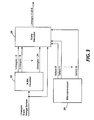
- Figure 3 illustrates a circuit for determining which scanlines of video data from the image sensor 80 are to be transferred to the host terminal and thus which scanlines of video data will be temporarily stored by an output scanline buffer.
- a linesync signal from the image sensor 80 is input into an N-bit counter 10 and a state decoder 20.
- the N-bit counter 10 outputs binary signals representing a relative scanline number within a set of scanlines.
- the N-bit counter will output a logically active signal on the linesync/2 data line.
- the N-bit counter 10 will output a logically active signal on the linesync/2 data line and the linesync/4 data line.
- the state decoder 20 receives the input signals from the N-bit counter 10 and input signals from a microprocessor 30.
- the state decoder 20 indicates that the scanline of valid image data being presented to a scanline buffer should be temporarily stored in this buffer.
- the number of scanlines N is predetermined according to the difference between the normal or typical internal data transfer rate of the IIT and the data transfer rate of the host terminal.
- the resolution at which the image is to be scanned, the size of the image and the number of bits per pixel are also factors in determining N.
- the microprocessor produces signals which causes the state decoder to produce an active level logical state image sensor linesync signal for every second state of the N-bit counter. If every fourth line of video is desired, the microprocessor produces signals which causes the decoder to select an image sensor linesync signal corresponding to every fourth state of the N-bit counter. Moreover, if a 400 line per inch image is desired at half of the normal scanline rate of the image input terminal, the optical system or the document is moved at a velocity which would generate a 800 line per inch image of which every other scanline of valid image data is discarded.
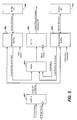
- FIG. 5 illustrates a scanline buffer data transfer circuit for a preferred embodiment of the present invention.
- Pixel data from the image input terminal (IIT) is input into a latch circuit 201 which latches the data in response to an IIT pixel clock signal.
- the pixel data from latch 201 is output to a bidirectional buffer 202 and a bidirectional buffer 205.
- Bidirectional buffer 202 controls the flow of data between the IIT and Buffer(A) 184 as well as the flow of data from Buffer(A) 184 to the host terminal 200 through the output interface 50.
- An A/B select signal controls whether Buffer(A) 184 is receiving data from the IIT or is outputting data. If Buffer(A) 184 is outputting data, the data from Buffer(A) 184 is passed through bidirectional buffer 202 and input into a multiplexer (MUX) 203.
- MUX multiplexer
- Bidirectional buffer 205 operates in the same manner as bidirectional buffer 202 except that the flow of data is controlled by an inverted A/B select signal.
- bidirectional buffer 205 is allowing the data stored in Buffer(B) 194 to be transferred to the host terminal 200 through the output interface 50.
- the data from Buffer(B) 194 passes through bidirectional buffer 205 and is input to the multiplexer 203 when the pixel data residing in Buffer(B) 194 is to be transferred to the host terminal 200.
- Multiplexer 203 selects either the data from Buffer(A) 184 or the data from Buffer(B) 194 (through the bidirectional buffers 202 and 205) in accordance with the A/B select signal.
- the data selected by multiplexer 203 is latched in latch circuit 204 to enable the proper transfer of the pixel data to the host terminal 200.
- the data from latch 204 is transferred to the host terminal 200 in accordance with the transfer rate required by the particular host terminal.
- Figure 6 illustrates a circuit utilized to generate the sensor linesync signal.
- a linesync signal from the IIT is input into a 32 pixel clock delay circuit 110 along with the IIT pixel clock signal.
- the 32 pixel clock delay circuit 110 ignores the first 32 pixels from the CCD before it produces a sensor linesync signal which indicates valid data from the CCD.
- the linesync signal that is input to the clock delay circuit 110 is also used to clock a counter 120 which produces, in the preferred embodiment, two binary outputs that can be used to determine which one line of a set of four lines is to be processed.
- the outputs of counter 120 are input to the circuit of Figure 7 where they are used to select or discard sensor linesync signals.
- Figure 7 illustrates a circuit which produces the linesync 1 of N signal. More specifically, AND gates 130, 140, and 150 produce the signals linesync 1 of 1, linesync 1 of 2, and linesync 1 of 4, respectively. These signals are fed into a NOR gate 160, which produces the linesync 1 of N signal to be utilized by a buffer control unit. For example the linesync 1 of 4 signal is the result of discarding 3 of every 4 sensor linesync signals. It is noted that Figure 7 only illustrates the generation of three separate linesync signals. This circuit can be easily modified to include any number of linesync signals by increasing the number of AND gates and adding more select (control) bits and increasing the size of the counter 120.
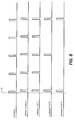
- Figure 8 illustrates the timing diagram of the signals generated in Figure 7 for three separate situations.
- the linesync signal corresponds to the signal generated by the IIT and the sensor linesync signal corresponds to the signal generated by the 32 pixel clock delay circuit 110.
- the sensor linesync signal has the same periodicity as the linesync signal, but is delayed by 32 pixel clock cycles.
- the linesync 1 of 1 signal indicates the situation where every scanline from the image input terminal is transferred to the host terminal in a synchronous manner. In other words, the linesync 1 of 1 signal corresponds directly to the sensor linesync signal.
- the linesync 1 of 2 signal corresponds to the situation where every other scanline of valid image data from the IIT is transferred to the host terminal.
- the linesync 1 of 2 signal is generated for every two linesync 1 of 1 signals.
- the linesync 1 of 4 signal corresponds to the situation where one out of every four scanlines of valid image data generated by the IIT is transmitted to the host terminal.
- a linesync 1 of 4 signal is generated for every four linesync 1 of 1 signals.
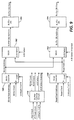
- Figure 9 illustrates a scanline buffer address control circuit without 180 degree rotation.
- a buffer control circuit 170 controls the various operations of the address control circuit in response to a host terminal clock signal, a IIT pixel clock signal, and a linesync 1 of N signal.
- the buffer control circuit 170 in response to the input signals, produces a write clock signal, a read clock signal, an A/B select signal, and an A/B select inverted signal.
- the scanline buffer address control circuit includes two counters 180 and 190.
- Counter 180 is utilized to generate the write address for either Buffer(A) 184 or Buffer(B) 194.
- Counter 180 is loaded with a predetermined write start address in response to the load function being activated by the linesync 1 of N signal.
- a write clock signal is also fed into counter 180 in order to change the write address.
- the write clock signal is derived from the the IIT pixel clock input to the buffer control circuit 170.
- the write address output from counter 180 is fed into multiplexer 182 and multiplexer 192.
- Multiplexer 182 and 192 determine whether the write address is fed to either Buffer(A) 184 or Buffer(B) 194 in response to the A/B select signal and A/B select inverted signal, respectively.
- Counter 190 produces the read address to be utilized by Buffer(A) 184 and Buffer(B) 194.
- a predetermined read start address is loaded into counter 190 in accordance with the linesync 1 of N signal activating the load function.
- a read clock signal is also fed into counter 190 in order to change the read address.
- the read clock signal is derived from the the host clock input to the buffer control circuit 170.
- the read address output from the counter 190 is fed into multiplexer 182 and multiplexer 192.
- the selection of the read address for either Buffer(A) 184 or Buffer(B) 194 is controlled by the A/B select signal and A/B select inverted signal, respectively.
- Buffer(A) can be storing image data from the IIT, while Buffer(B) can be transferring image data to the host terminal.
- Figure 10 illustrates a preferred embodiment of the output buffer which allows for 180° rotation in the IIT.
- a buffer control circuit 270 receives a host clock signal, an IIT pixel clock signal, and a linesync 1 of N signal. From these input signals, the buffer control circuit 270 produces a write clock signal, a read clock signal, and an A/B select signal.
- Figure 10 operates in much the same manner as Figure 9, except that Figure 10 has two separate counters to produce the write addresses. More specifically, Figure 10 illustrates the utilization of a write-down counter 280 and a write-up counter 295. The read counter 290 in Figure 10 operates in the same manner as counter 190 of Figure 9.
- Figure 10 includes two multiplexers 282 and 292. Each multiplexer receives a read address from read counter 290 and a write-up address and a write-down address from counters 295 and 280, respectively. An A/B select signal is also fed to the two multiplexers 282 and 292 to enable the multiplexers to choose between the read address or the write addresses. Thus, the A/B select signal operates in essentially the same manner as the A/B select signal and A/B select inverted signal of Figure 9.
- a bidirectional scan select control signal is fed to each multiplexer 282 and 292.
- the bidirectional scan select control signal enables the selection of either the write-down address when rotation is not desired or the write-up address when 180° rotation is desired.
- the image data from the IIT is written into the buffer in the opposite direction from which it is read out.
- the proper addresses as selected by the multiplexers 282 and 292 are fed to Buffer(A) 184 and Buffer(B) 194 so that the proper operations can be carried out as described above.
- the bidirectional scan select control signal can be generated by either a control unit or user interface when establishing the status of the rotation state.
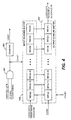
- FIG 4 illustrates another embodiment of the scanline buffer circuit 40 of Figure 2.
- video data from the image sensor 80 is fed into an input scanline buffer 105 containing a plurality of memory locations. More specifically, each memory address 105(1), 105(2), 105(3) . . . to 105(x-2), 105(x-1), 105(x), stores data for an individual pixel within a scanline. Data corresponding to the first pixel of a scanline is input into the memory address 105(x) and then the pixel data is shifted to the next memory location (105(x-1)) in the array in response to a pixel clock signal.
- the input scanline buffer 105 operates like a shift register having the capacity to hold one scanline of image data.
- the contents of input scanline buffer 105 are loaded into output scanline buffer 107 with the contents of 105(x) being transferred to 107(x), the contents of 105(x-1) being transferred to 107(x-1), and the contents of 105(x-2) being transferred to 107(x-2), etc.
- the video data After being loaded into the output scanline buffer 107, the video data is again shifted right in response to a second clock signal corresponding to the clock rate of the host terminal such that the video data output from the register 107(1) is serial input to the output interface 50.
- Table 1 shows the situation when the internal transfer rate of the image input terminal is equal to the data transfer rate of the host terminal, a normal synchronous operation.
- image data is formed by the CCD sensors and stored in the buffer.
- the stored image data in the buffer is transferred to the host terminal.
- the array of CCD sensors outputs a single scanline of valid image data, d1.
- this single scanline of valid image data, d1 is stored in a first buffer.
- the first buffer begins transferring the data, d1, to the host terminal to be carried out during integration period 2, while the array of CCD sensors outputs another single scanline of valid image data, d2, wherein this single scanline of valid image data, d2, is stored in a second buffer.
- the contents of output scanline buffer 107 are fully transferred to the host terminal.
- the second buffer begins transferring data, d2, to the host terminal while the first buffer begins receiving data, d3.
- the process begins again.
- the host terminal only requires a single integration period to receive all the valid image data for a single scanline.
- the internal transfer rate of the image input terminal is equal to the data transfer rate of the host terminal, and a synchronous transfer can be realized.
- Table 2 shows an operation where the internal transfer rate of the image input terminal is greater than the data transfer rate of the host terminal.
- image data is formed by the CCD sensors.
- not all the valid image data is stored in the buffer.
- the host terminal requires two integration periods to properly transfer a single scanline of valid image data from the image input terminal.
- the array of CCD sensors outputs a single scanline of valid image data, d1.
- this single scanline of valid image data, d1 is stored in a first buffer.
- the first buffer begins transferring the data, d1, to the host terminal to be carried out during integration period 2, while the array of CCD sensors outputs another single scanline of valid image data, d2. It is noted that during integration period 2, a portion of the contents of the first buffer is transferred to the host terminal.
- the single scanline of valid image data, d2, produced during integration period 2 is not stored in a buffer, but is actually skipped or discarded.
- the array of CCD sensors outputs another single scanline of valid image data, d3, wherein this single scanline of valid image data, d3, is stored in a second buffer during integration period 3. Moreover, the final portion of the contents of the first buffer is transferred to the host terminal. At the end of integration period 3, the second buffer begins transferring its contents, d3, to the host terminal, and the process begins again.
- the host terminal requires two integration periods to receive all the valid image data for a single scanline.
- the internal transfer rate of the image input terminal is as much as twice the data transfer rate of the host terminal.
- skipping every other scanline of valid image data and maintaining the integration period at a constant rate a synchronous transfer can be realized.
- Table 3 shows another operation where the internal transfer rate of the image input terminal is greater than the data transfer rate of the host terminal.
- the host terminal requires four integration periods to properly transfer a single scanline of valid image data from the image input terminal.
- Table 3 The situation shown in Table 3 is similar to that shown by Table 2, thus only the differences will be discussed for the sake of brevity.
- a buffer transfers approximately one fourth of its contents each integration period; therefore, the data transfer buffer circuit only stores one out of four scanlines of valid image data.
- the host terminal requires four integration periods to receive all the valid image data for a single scanline.
- the internal transfer rate of the image input terminal is as much as four times the data transfer rate of the host terminal.
- skipping three out of four scanlines of valid image data and maintaining the integration period at a constant rate a synchronous transfer can be realized.
- the present invention reduces the data transfer rate of the image input terminal while leaving integration time of the image sensor unchanged. This is accomplished by moving the optical system or document at a slower speed and skipping a selected number of scanlines of valid image data in a periodic manner. Thus, the image is sampled at a higher (slow scan) resolution and the data is only output periodically to allow the output interface to keep up with the data transfer rate of the image input terminal.
- the slow scan speed and periodic line sampling rates are selected by the image input terminals microprocessor based on the volume of data which is to be produced. The volume is known based on the document size, resolution, and mode, i.e., gray or binary.
- the present invention utilizes a binary counter and state decoder to count scanlines from the image sensing circuitry.
- the buffer is used to absorb the image input terminal video or image data, and a line signal from the image sensor 80 is used to clock a counter.
- the outputs of the counter are used in conjunction with a microprocessor which outputs signals used to derive the linesync 1 of N signal.
- the linesync 1 of N signal is generated by selecting one of every N image sensor linesync cycles where (N-1) is a number of scanlines of the valid video data to be discarded.
- a buffer when the linesync 1 of N signal is inactive, will not store or clock-in any data from the image sensor 80.
- the scan speed of the optics or document is changed by the ratio of the selected lines of video data to the actual lines of video produced by the sensor.
- the function of the scanline buffer is to accept image data at the system internal data transfer rate and output image data to the image input terminal interface at the clock rate of the host terminal interface.
- the scanline buffer control circuitry is used to generate two sets of timing signals for the buffer.
- the input side of the buffer is filled with a scanline of image data in synchronism with the internal pixel transfer rate of the image input terminal.
- the output side of the buffer provides data to the interface synchronously with a slower clock which is compatible with the host terminal.
- Image data is read from a buffer and during the entire period which the linesync 1 of N signal is both logically active and inactive.
- a scanline buffer is filled only while the linesync 1 of N signal is logically active. Therefore, the amount of time available to move a scanline of image data over to the interface is increased without sacrificing synchronization.
- the present invention addresses the situation of differing transfer rates by utilizing a synchronous approach.
- the present invention synchronously transfers image data which is scanned at a rate exceeding the transfer rate of a host terminal without experiencing the problems associated with the utilization of an asynchronous operation; the interruption of the integration period or process; and the interpolation of image data to ensure a composite line of image data.
- the image input terminal scans the entire document at a constant, but slower, rate, while maintaining and not interrupting the integration period.
- This scanning process increases the number of scanlines of available valid image data and enables an apparent or virtual internal transfer (scan) rate equal to the data transfer rate of the host terminal, thereby providing synchronized transfer of data between devices wherein the internal transfer rate of the image input terminal exceeds the data transfer rate of the host terminal.
- the present invention has been described with respect to the number of discarded scanlines being equal to N -1.
- the number of scanlines to be discarded from the predetermined set can be determined by the image input terminal based on the specifications of the data to be transferred and the transfer rate of the host terminal. If the difference is a fraction of period that is required for the image input terminal to present a scanline of data to the buffer, the discard number is rounded up to insure proper transfer to the host terminal. In other words, the transfer rate of the host terminal domi nates the determination of the discard ratio.
Landscapes
- Engineering & Computer Science (AREA)
- Multimedia (AREA)
- Signal Processing (AREA)
- Image Input (AREA)
- Facsimile Transmission Control (AREA)
- Facsimiles In General (AREA)
Applications Claiming Priority (2)
| Application Number | Priority Date | Filing Date | Title |
|---|---|---|---|
| US222200 | 1981-01-02 | ||
| US08/222,200 US5572335A (en) | 1994-04-01 | 1994-04-01 | Method and system for transferring image data between two devices having different bandwidths |
Publications (3)
| Publication Number | Publication Date |
|---|---|
| EP0675634A2 true EP0675634A2 (de) | 1995-10-04 |
| EP0675634A3 EP0675634A3 (de) | 1996-03-27 |
| EP0675634B1 EP0675634B1 (de) | 2001-01-03 |
Family
ID=22831290
Family Applications (1)
| Application Number | Title | Priority Date | Filing Date |
|---|---|---|---|
| EP95302179A Expired - Lifetime EP0675634B1 (de) | 1994-04-01 | 1995-03-31 | System und Verfahren zur Übertragung digitaler Daten zwischen einem Bildeingabeterminal und einem Hostterminal |
Country Status (6)
| Country | Link |
|---|---|
| US (1) | US5572335A (de) |
| EP (1) | EP0675634B1 (de) |
| JP (1) | JPH07311843A (de) |
| BR (1) | BR9501405A (de) |
| DE (1) | DE69519759T2 (de) |
| MX (1) | MX9501506A (de) |
Cited By (3)
| Publication number | Priority date | Publication date | Assignee | Title |
|---|---|---|---|---|
| WO1998020671A1 (en) * | 1996-11-06 | 1998-05-14 | Tangate Limited | Apparatus for capturing a frame of video data for sending to a printer |
| EP0865191A3 (de) * | 1997-03-11 | 2000-10-25 | Murata Kikai Kabushiki Kaisha | Faksimilegerät |
| EP0895400A3 (de) * | 1997-07-29 | 2001-03-07 | Canon Kabushiki Kaisha | Informationsverarbeitungsgerät und -verfahren sowie Speichermedium dafür |
Families Citing this family (35)
| Publication number | Priority date | Publication date | Assignee | Title |
|---|---|---|---|---|
| JPH0723190A (ja) * | 1993-07-05 | 1995-01-24 | Canon Inc | ファクシミリ装置 |
| JP3372748B2 (ja) * | 1995-03-22 | 2003-02-04 | キヤノン株式会社 | 画像処理装置 |
| US6256106B1 (en) * | 1997-04-30 | 2001-07-03 | Ricoh Company, Ltd. | Two-way image processing system and image forming apparatus in such a system |
| JPH11177777A (ja) * | 1997-12-15 | 1999-07-02 | Ricoh Co Ltd | デジタル画像読取装置 |
| US6335807B1 (en) * | 1998-11-30 | 2002-01-01 | Agfa Corporation | Scanner carriage stop/start artifact suppression system and method |
| JP3860394B2 (ja) * | 2000-06-20 | 2006-12-20 | 株式会社リコー | 情報再生方法及び情報再生装置 |
| US7248387B2 (en) * | 2001-07-31 | 2007-07-24 | Umax Data Systems, Inc. | Scanning speed control device and method |
| US8218183B2 (en) * | 2001-07-31 | 2012-07-10 | Transpacific Systems, Llc | Scanning speed control device and method |
| US7136200B2 (en) * | 2002-08-28 | 2006-11-14 | Cheng-Kuei Chen | Method for determining restored scanning position |
| US7361171B2 (en) | 2003-05-20 | 2008-04-22 | Raydiance, Inc. | Man-portable optical ablation system |
| WO2005018062A2 (en) * | 2003-08-11 | 2005-02-24 | Raydiance, Inc. | Optical pulse stretching and compressing |
| US7143769B2 (en) | 2003-08-11 | 2006-12-05 | Richard Stoltz | Controlling pulse energy of an optical amplifier by controlling pump diode current |
| US9022037B2 (en) | 2003-08-11 | 2015-05-05 | Raydiance, Inc. | Laser ablation method and apparatus having a feedback loop and control unit |
| US7367969B2 (en) | 2003-08-11 | 2008-05-06 | Raydiance, Inc. | Ablative material removal with a preset removal rate or volume or depth |
| US7115514B2 (en) | 2003-10-02 | 2006-10-03 | Raydiance, Inc. | Semiconductor manufacturing using optical ablation |
| US8173929B1 (en) | 2003-08-11 | 2012-05-08 | Raydiance, Inc. | Methods and systems for trimming circuits |
| US7413847B2 (en) | 2004-02-09 | 2008-08-19 | Raydiance, Inc. | Semiconductor-type processing for solid-state lasers |
| US7349452B2 (en) | 2004-12-13 | 2008-03-25 | Raydiance, Inc. | Bragg fibers in systems for the generation of high peak power light |
| US8135050B1 (en) | 2005-07-19 | 2012-03-13 | Raydiance, Inc. | Automated polarization correction |
| US7245419B2 (en) | 2005-09-22 | 2007-07-17 | Raydiance, Inc. | Wavelength-stabilized pump diodes for pumping gain media in an ultrashort pulsed laser system |
| US7308171B2 (en) | 2005-11-16 | 2007-12-11 | Raydiance, Inc. | Method and apparatus for optical isolation in high power fiber-optic systems |
| US7436866B2 (en) | 2005-11-30 | 2008-10-14 | Raydiance, Inc. | Combination optical isolator and pulse compressor |
| US7444049B1 (en) | 2006-01-23 | 2008-10-28 | Raydiance, Inc. | Pulse stretcher and compressor including a multi-pass Bragg grating |
| US8189971B1 (en) | 2006-01-23 | 2012-05-29 | Raydiance, Inc. | Dispersion compensation in a chirped pulse amplification system |
| US8232687B2 (en) | 2006-04-26 | 2012-07-31 | Raydiance, Inc. | Intelligent laser interlock system |
| US9130344B2 (en) | 2006-01-23 | 2015-09-08 | Raydiance, Inc. | Automated laser tuning |
| US7822347B1 (en) | 2006-03-28 | 2010-10-26 | Raydiance, Inc. | Active tuning of temporal dispersion in an ultrashort pulse laser system |
| JP5111811B2 (ja) * | 2006-09-07 | 2013-01-09 | ジーイー・メディカル・システムズ・グローバル・テクノロジー・カンパニー・エルエルシー | 画像運用履歴管理システム、モダリティ及びサーバ装置 |
| US7903326B2 (en) | 2007-11-30 | 2011-03-08 | Radiance, Inc. | Static phase mask for high-order spectral phase control in a hybrid chirped pulse amplifier system |
| US8125704B2 (en) | 2008-08-18 | 2012-02-28 | Raydiance, Inc. | Systems and methods for controlling a pulsed laser by combining laser signals |
| US8498538B2 (en) | 2008-11-14 | 2013-07-30 | Raydiance, Inc. | Compact monolithic dispersion compensator |
| US9120181B2 (en) | 2010-09-16 | 2015-09-01 | Coherent, Inc. | Singulation of layered materials using selectively variable laser output |
| US10239160B2 (en) | 2011-09-21 | 2019-03-26 | Coherent, Inc. | Systems and processes that singulate materials |
| JP2014117885A (ja) * | 2012-12-17 | 2014-06-30 | Canon Inc | 印刷装置およびその制御方法、画像処理装置、画像処理方法、並びにプログラム |
| CN105096790B (zh) * | 2014-04-24 | 2018-10-09 | 敦泰电子有限公司 | 驱动电路、驱动方法、显示装置和电子设备 |
Family Cites Families (19)
| Publication number | Priority date | Publication date | Assignee | Title |
|---|---|---|---|---|
| US3428744A (en) * | 1965-07-14 | 1969-02-18 | Xerox Corp | Facsimile line skipping system |
| US3436474A (en) * | 1965-10-01 | 1969-04-01 | Xerox Corp | Facsimile optional double skipping |
| GB1189982A (en) * | 1966-06-15 | 1970-04-29 | Xerox Corp | Binary Encoding |
| US3502803A (en) * | 1967-05-12 | 1970-03-24 | Xerox Corp | Facsimile line skipping apparatus |
| US3902009A (en) * | 1974-06-17 | 1975-08-26 | Xerox Corp | Multi aperture scanning and printing for facsimile line skipping |
| US4367493A (en) * | 1981-04-02 | 1983-01-04 | Xerox Corporation | Raster scanner apparatus and method |
| US4587415A (en) * | 1982-07-23 | 1986-05-06 | Canon Kabushiki Kaisha | Photo-detecting device with storage time control |
| US4541061A (en) * | 1982-10-13 | 1985-09-10 | Minnesota Mining And Manufacturing Company | Data clocking circuitry for a scanning apparatus |
| JPS6018061A (ja) * | 1983-07-12 | 1985-01-30 | Fuji Xerox Co Ltd | 原稿読取装置の副走査方法 |
| JP2733220B2 (ja) * | 1986-09-30 | 1998-03-30 | シャープ株式会社 | 複合型画像処理装置 |
| US4748514A (en) * | 1986-12-22 | 1988-05-31 | Xerox Corporation | Variable rate scanning control |
| US4878119A (en) * | 1988-02-29 | 1989-10-31 | Xerox Corporation | System for synchronizing integration pulses with integration signal in an asynchronous raster input scanner |
| JPH01264062A (ja) * | 1988-04-14 | 1989-10-20 | Tokyo Electric Co Ltd | 原稿移動型画像読取装置 |
| US5043827A (en) * | 1989-08-03 | 1991-08-27 | Xerox Corporation | Combined asynchronous-synchronous document scanner |
| US5239387A (en) * | 1989-11-30 | 1993-08-24 | Hewlett-Packard Company | Buffering control for accommodating variable data exchange rates |
| US5278974A (en) * | 1989-12-04 | 1994-01-11 | Digital Equipment Corporation | Method and apparatus for the dynamic adjustment of data transfer timing to equalize the bandwidths of two buses in a computer system having different bandwidths |
| US5113260A (en) * | 1990-12-24 | 1992-05-12 | Xerox Corporation | Sensor array for both synchronous and asynchronous operation |
| JP3289933B2 (ja) * | 1991-12-11 | 2002-06-10 | 株式会社リコー | 画像送信装置 |
| US5369504A (en) * | 1992-04-09 | 1994-11-29 | Xerox Corporation | Method and apparatus for reducing image distortion in an asynchronous input scanner |
-
1994
- 1994-04-01 US US08/222,200 patent/US5572335A/en not_active Expired - Lifetime
-
1995
- 1995-03-24 MX MX9501506A patent/MX9501506A/es unknown
- 1995-03-30 JP JP7073948A patent/JPH07311843A/ja active Pending
- 1995-03-31 DE DE69519759T patent/DE69519759T2/de not_active Expired - Lifetime
- 1995-03-31 EP EP95302179A patent/EP0675634B1/de not_active Expired - Lifetime
- 1995-03-31 BR BR9501405A patent/BR9501405A/pt not_active IP Right Cessation
Cited By (4)
| Publication number | Priority date | Publication date | Assignee | Title |
|---|---|---|---|---|
| WO1998020671A1 (en) * | 1996-11-06 | 1998-05-14 | Tangate Limited | Apparatus for capturing a frame of video data for sending to a printer |
| EP0865191A3 (de) * | 1997-03-11 | 2000-10-25 | Murata Kikai Kabushiki Kaisha | Faksimilegerät |
| EP0895400A3 (de) * | 1997-07-29 | 2001-03-07 | Canon Kabushiki Kaisha | Informationsverarbeitungsgerät und -verfahren sowie Speichermedium dafür |
| US6580827B2 (en) | 1997-07-29 | 2003-06-17 | Canon Kabushiki Kaisha | Information processing apparatus, method and memory medium therefor |
Also Published As
| Publication number | Publication date |
|---|---|
| DE69519759T2 (de) | 2001-06-13 |
| JPH07311843A (ja) | 1995-11-28 |
| DE69519759D1 (de) | 2001-02-08 |
| EP0675634B1 (de) | 2001-01-03 |
| EP0675634A3 (de) | 1996-03-27 |
| US5572335A (en) | 1996-11-05 |
| MX9501506A (es) | 1997-08-30 |
| BR9501405A (pt) | 1995-12-19 |
Similar Documents
| Publication | Publication Date | Title |
|---|---|---|
| EP0675634B1 (de) | System und Verfahren zur Übertragung digitaler Daten zwischen einem Bildeingabeterminal und einem Hostterminal | |
| MXPA95001506A (en) | Device and method for controlling the exploring speed of a deimagen entry terminal for balancing the de-synchronization speed of a principle interface | |
| US4193092A (en) | Image interpolation system | |
| US5901274A (en) | Method for enlargement/reduction of image data in digital image processing system and circuit adopting the same | |
| EP0411954B1 (de) | Dokumentabtaster | |
| GB2183961A (en) | Image reading and/or recording apparatus with enlarging and reducing function | |
| US5101282A (en) | Variable magnification image | |
| US5604608A (en) | Device and method for controlling the scan speed of an image input terminal to match the throughput constraints of an image processing module | |
| US6914632B1 (en) | Apparatus for panning and scaling window in image sensor | |
| US4947267A (en) | Image reading apparatus | |
| US5712714A (en) | Image processing apparatus | |
| EP0767577B1 (de) | Bildverarbeitungsvorrichtung mit Bildvergrösserungsfunktion | |
| US20050134944A1 (en) | Image capturing device with duplex scan function and method therefor | |
| JP2882532B2 (ja) | 画像データ処理装置 | |
| US5764370A (en) | Enlargement and reduction apparatus for an image forming apparatus | |
| JP3913533B2 (ja) | デジタル複写装置 | |
| GB2288946A (en) | Image enlargement/reduction method | |
| EP0546507A2 (de) | Anordnung zur Steuerung eines FIFO-Speichers | |
| US20020134915A1 (en) | Multi-resolution charge-coupled device (CCD) sensing apparatus | |
| KR100211838B1 (ko) | 화상이미지 축소장치 | |
| JP2505170B2 (ja) | 画像読取り装置 | |
| KR100242116B1 (ko) | 임의배율변환이가능한화상기록장치 | |
| JPH047965A (ja) | プリンタコントローラ | |
| KR930006938B1 (ko) | 팩시밀리에 있어서 화상신호의 원고 크기 확대회로 | |
| JPS61198872A (ja) | 画情報入力装置 |
Legal Events
| Date | Code | Title | Description |
|---|---|---|---|
| PUAI | Public reference made under article 153(3) epc to a published international application that has entered the european phase |
Free format text: ORIGINAL CODE: 0009012 |
|
| AK | Designated contracting states |
Kind code of ref document: A2 Designated state(s): DE FR GB |
|
| PUAL | Search report despatched |
Free format text: ORIGINAL CODE: 0009013 |
|
| AK | Designated contracting states |
Kind code of ref document: A3 Designated state(s): DE FR GB |
|
| 17P | Request for examination filed |
Effective date: 19960927 |
|
| 17Q | First examination report despatched |
Effective date: 19980604 |
|
| GRAG | Despatch of communication of intention to grant |
Free format text: ORIGINAL CODE: EPIDOS AGRA |
|
| RTI1 | Title (correction) |
Free format text: SYSTEM AND METHOD FOR TRANSFERRING DIGITAL DATA BETWEEN AN IMAGE INPUT TERMINAL AND A HOST TERMINAL |
|
| GRAG | Despatch of communication of intention to grant |
Free format text: ORIGINAL CODE: EPIDOS AGRA |
|
| GRAG | Despatch of communication of intention to grant |
Free format text: ORIGINAL CODE: EPIDOS AGRA |
|
| GRAH | Despatch of communication of intention to grant a patent |
Free format text: ORIGINAL CODE: EPIDOS IGRA |
|
| GRAH | Despatch of communication of intention to grant a patent |
Free format text: ORIGINAL CODE: EPIDOS IGRA |
|
| GRAA | (expected) grant |
Free format text: ORIGINAL CODE: 0009210 |
|
| AK | Designated contracting states |
Kind code of ref document: B1 Designated state(s): DE FR GB |
|
| REF | Corresponds to: |
Ref document number: 69519759 Country of ref document: DE Date of ref document: 20010208 |
|
| ET | Fr: translation filed | ||
| PLBE | No opposition filed within time limit |
Free format text: ORIGINAL CODE: 0009261 |
|
| STAA | Information on the status of an ep patent application or granted ep patent |
Free format text: STATUS: NO OPPOSITION FILED WITHIN TIME LIMIT |
|
| REG | Reference to a national code |
Ref country code: GB Ref legal event code: IF02 |
|
| 26N | No opposition filed | ||
| REG | Reference to a national code |
Ref country code: GB Ref legal event code: 746 Effective date: 20041130 |
|
| REG | Reference to a national code |
Ref country code: FR Ref legal event code: D6 |
|
| PGFP | Annual fee paid to national office [announced via postgrant information from national office to epo] |
Ref country code: DE Payment date: 20140220 Year of fee payment: 20 |
|
| PGFP | Annual fee paid to national office [announced via postgrant information from national office to epo] |
Ref country code: GB Payment date: 20140226 Year of fee payment: 20 |
|
| PGFP | Annual fee paid to national office [announced via postgrant information from national office to epo] |
Ref country code: FR Payment date: 20140328 Year of fee payment: 20 |
|
| REG | Reference to a national code |
Ref country code: DE Ref legal event code: R071 Ref document number: 69519759 Country of ref document: DE |
|
| REG | Reference to a national code |
Ref country code: GB Ref legal event code: PE20 Expiry date: 20150330 |
|
| PG25 | Lapsed in a contracting state [announced via postgrant information from national office to epo] |
Ref country code: GB Free format text: LAPSE BECAUSE OF EXPIRATION OF PROTECTION Effective date: 20150330 |