EP0677540A2 - Verfahren zur Herstellung von Polyurethan-Schaumstoffen in Gegenwart von Aminoalkyl- oder Aminophenyl-imidazolen als Katalysator sowie die Verwendung dieser Katalysatoren zur Herstellung von Polyisocyanat-polyadditionsprodukten - Google Patents
Verfahren zur Herstellung von Polyurethan-Schaumstoffen in Gegenwart von Aminoalkyl- oder Aminophenyl-imidazolen als Katalysator sowie die Verwendung dieser Katalysatoren zur Herstellung von Polyisocyanat-polyadditionsprodukten Download PDFInfo
- Publication number
- EP0677540A2 EP0677540A2 EP95105077A EP95105077A EP0677540A2 EP 0677540 A2 EP0677540 A2 EP 0677540A2 EP 95105077 A EP95105077 A EP 95105077A EP 95105077 A EP95105077 A EP 95105077A EP 0677540 A2 EP0677540 A2 EP 0677540A2
- Authority
- EP
- European Patent Office
- Prior art keywords
- carbon atoms
- catalysts
- radical
- mixtures
- weight
- Prior art date
- Legal status (The legal status is an assumption and is not a legal conclusion. Google has not performed a legal analysis and makes no representation as to the accuracy of the status listed.)
- Granted
Links
Classifications
-
- C—CHEMISTRY; METALLURGY
- C08—ORGANIC MACROMOLECULAR COMPOUNDS; THEIR PREPARATION OR CHEMICAL WORKING-UP; COMPOSITIONS BASED THEREON
- C08G—MACROMOLECULAR COMPOUNDS OBTAINED OTHERWISE THAN BY REACTIONS ONLY INVOLVING UNSATURATED CARBON-TO-CARBON BONDS
- C08G18/00—Polymeric products of isocyanates or isothiocyanates
- C08G18/06—Polymeric products of isocyanates or isothiocyanates with compounds having active hydrogen
- C08G18/08—Processes
- C08G18/16—Catalysts
- C08G18/18—Catalysts containing secondary or tertiary amines or salts thereof
- C08G18/20—Heterocyclic amines; Salts thereof
- C08G18/2009—Heterocyclic amines; Salts thereof containing one heterocyclic ring
- C08G18/2027—Heterocyclic amines; Salts thereof containing one heterocyclic ring having two nitrogen atoms in the ring
-
- C—CHEMISTRY; METALLURGY
- C08—ORGANIC MACROMOLECULAR COMPOUNDS; THEIR PREPARATION OR CHEMICAL WORKING-UP; COMPOSITIONS BASED THEREON
- C08G—MACROMOLECULAR COMPOUNDS OBTAINED OTHERWISE THAN BY REACTIONS ONLY INVOLVING UNSATURATED CARBON-TO-CARBON BONDS
- C08G18/00—Polymeric products of isocyanates or isothiocyanates
- C08G18/06—Polymeric products of isocyanates or isothiocyanates with compounds having active hydrogen
- C08G18/08—Processes
- C08G18/16—Catalysts
- C08G18/18—Catalysts containing secondary or tertiary amines or salts thereof
- C08G18/1825—Catalysts containing secondary or tertiary amines or salts thereof having hydroxy or primary amino groups
-
- C—CHEMISTRY; METALLURGY
- C08—ORGANIC MACROMOLECULAR COMPOUNDS; THEIR PREPARATION OR CHEMICAL WORKING-UP; COMPOSITIONS BASED THEREON
- C08J—WORKING-UP; GENERAL PROCESSES OF COMPOUNDING; AFTER-TREATMENT NOT COVERED BY SUBCLASSES C08B, C08C, C08F, C08G or C08H
- C08J9/00—Working-up of macromolecular substances to porous or cellular articles or materials; After-treatment thereof
- C08J9/04—Working-up of macromolecular substances to porous or cellular articles or materials; After-treatment thereof using blowing gases generated by a previously added blowing agent
- C08J9/12—Working-up of macromolecular substances to porous or cellular articles or materials; After-treatment thereof using blowing gases generated by a previously added blowing agent by a physical blowing agent
- C08J9/125—Water, e.g. hydrated salts
-
- C—CHEMISTRY; METALLURGY
- C08—ORGANIC MACROMOLECULAR COMPOUNDS; THEIR PREPARATION OR CHEMICAL WORKING-UP; COMPOSITIONS BASED THEREON
- C08J—WORKING-UP; GENERAL PROCESSES OF COMPOUNDING; AFTER-TREATMENT NOT COVERED BY SUBCLASSES C08B, C08C, C08F, C08G or C08H
- C08J9/00—Working-up of macromolecular substances to porous or cellular articles or materials; After-treatment thereof
- C08J9/04—Working-up of macromolecular substances to porous or cellular articles or materials; After-treatment thereof using blowing gases generated by a previously added blowing agent
- C08J9/12—Working-up of macromolecular substances to porous or cellular articles or materials; After-treatment thereof using blowing gases generated by a previously added blowing agent by a physical blowing agent
- C08J9/14—Working-up of macromolecular substances to porous or cellular articles or materials; After-treatment thereof using blowing gases generated by a previously added blowing agent by a physical blowing agent organic
- C08J9/141—Hydrocarbons
-
- C—CHEMISTRY; METALLURGY
- C08—ORGANIC MACROMOLECULAR COMPOUNDS; THEIR PREPARATION OR CHEMICAL WORKING-UP; COMPOSITIONS BASED THEREON
- C08G—MACROMOLECULAR COMPOUNDS OBTAINED OTHERWISE THAN BY REACTIONS ONLY INVOLVING UNSATURATED CARBON-TO-CARBON BONDS
- C08G2101/00—Manufacture of cellular products
-
- C—CHEMISTRY; METALLURGY
- C08—ORGANIC MACROMOLECULAR COMPOUNDS; THEIR PREPARATION OR CHEMICAL WORKING-UP; COMPOSITIONS BASED THEREON
- C08G—MACROMOLECULAR COMPOUNDS OBTAINED OTHERWISE THAN BY REACTIONS ONLY INVOLVING UNSATURATED CARBON-TO-CARBON BONDS
- C08G2290/00—Compositions for creating anti-fogging
Definitions
- the invention relates to a process for the production of polyurethane foams, preferably flexible polyurethane foams, with reduced fogging values by reacting organic and / or modified organic polyisocyanates (a) with higher molecular weight polyhydroxyl compounds (b) and optionally low molecular weight chain extenders and / or crosslinking agents ( c) in the presence of blowing agents (d), aminoalkyl or aminophenyl imidazoles, in particular 1- (3-aminopropyl) imidazoles optionally additionally substituted on the imidazole ring, as catalysts (e) and optionally additives (f).
- organic and / or modified organic polyisocyanates a) with higher molecular weight polyhydroxyl compounds (b) and optionally low molecular weight chain extenders and / or crosslinking agents ( c) in the presence of blowing agents (d), aminoalkyl or aminophenyl imidazoles, in particular 1- (3-aminopropyl) imidazoles optionally additionally substituted
- the invention further relates to the use of such aminoalkyl or aminophenyl imidazoles as a catalyst for the preparation of polyisocyanate polyaddition products.
- PU foams e.g. PU flexible, semi-rigid or rigid foams, in open or closed molds or the corresponding PU integral foams by reacting organic and / or modified organic polyisocyanates with higher molecular weight compounds with at least two reactive hydrogen atoms and optionally chain extenders and / or crosslinking agents in The presence of blowing agents, catalysts and optionally additives are known and are described in numerous literature and patent publications.
- a comprehensive overview of the production of PU foams is e.g. in Kunststoff-Handbuch, Volume VII, "Polyurethane", 1st edition, 1966, published by Dr. R. Vieweg and Dr. A. Höchtlen and 2nd edition, 1983, published by Dr. G. Oertel (Carl Hanser Verlag, Kunststoff).
- At least one catalyst is advantageously added to the reaction mixture.
- Tertiary amines such as e.g. Dimethylbenzylamine, dicyclohexylmethylamine, dimethylcyclohexylamine, N, N, N ', N'-tetramethyldiamino-diethyl ether, N, N, N', N'-tetramethyl-butanediamine, N, N, N ', N ", N" -pentamethyl-diethylene -triamine, bis- (dimethylaminopropyl) urea, 1-azabicyclo- (2,2,0) -octane, 1,4-diaza-bicyclo- (2.2.2) -octane (triethylene diamine, DABCO @), di- ( 4-dimethylaminocyclohexyl) methane, N, N ', N "-Tris- (dialkylaminoalkyl) hexahydrotriazines, for example N, N', N" -Tris-
- amidine-metal complexes are used as catalysts for the preparation of polyisocyanate polyaddition products, the amidines being N-alkylimidazoles, such as N-methyl- or N-butylimidazole can have.
- N-alkyl-2-methylimidazoles are mentioned in DE-A-41 16 562 as suitable curing catalysts for urethane prepolymers with an isocyanate content of 8 to 20% by weight.
- 1,2-dimethylimidazole is part of a catalyst combination for the production of PU elastomers and PU foams.
- 1,2,4,5-tetraalkylimidazoles are strong bases and, according to DE-A-21 61 770, are effective catalysts for the production of polyurethanes.
- EP-A-0 566 247 describes 1,2-dialkylimidazoles having 1 to 4 carbon atoms in the preparation of flexible PU foams by reacting isocyanate prepolymers and compositions which are reactive with isocyanate groups and contain at least 50% by weight of water Alkyl group.
- N-substituted imidazoles e.g. N-alkyl-, N-benzyl-, N-vinyl-, N-dimethylaminopropylimidazoles are mentioned in EP-A-0 451 826 as catalysts for the production of flexible PU foams.
- tertiary amines and imidazoles are notable for good catalytic activity.
- a disadvantage is that they are often relatively volatile and odor-intensive and often migrate from the polyaddition product.
- tertiary amines in particular could be analytically detected as a component.
- very strict limit values for "fogging" made of polyurethane molded parts were set for the automotive industry.
- the fogging values must be less than the maximum limit of 1 mg condensate, measured according to DIN 75 201, method B. This summary value results from the individual values for the volatile constituents in the polyisocyanates and the NCO-reactive compounds, stabilizers, e.g. Silicones, and catalyst systems.
- catalysts which have residues reactive with NCO groups, react with isocyanate groups and can be incorporated into the polyurethane matrix, e.g. N-Unsubstituted imidazoles, for example 1-H-imidazole or 2-methylimidazole.
- imidazoles react with isocyanate groups to give ureas, which, however, are thermally labile and can split back into the starting components.
- the imidazole which has regressed here can be migrated again at this stage.
- This reaction forms the basis for the production of imidazole ureas which, according to US Pat. No. 4,041,019, are used as heat-activatable PU catalysts or can be used as blocked isocyanates.
- N-hydroxyalkyl substituted imidazoles as PU catalysts are described, for example, in US Pat. No. 3,448,065.
- EP-A-0 451 826 describes, among other things, as a PU catalyst for the production of flexible PU foams.
- N-hydroxyalkylimidazole with 1 to 3 carbon atoms in the alkyl radical called.
- One disadvantage of such catalysts is that, as monofunctional compounds, they are potential chain terminators for the polyisocyanate polyaddition reaction and form urethanes.
- urethanes of this structure can be catalytically split back into the starting components under the production conditions present in the reaction mixture, in particular at elevated temperatures, and can therefore be migrated out of the polyurethane.
- the object of the present invention was to produce polyurethane foams in the presence of catalysts or catalyst systems which, without reducing their catalytic activity, have little or no volatility.
- This object was surprisingly achieved by using aminoalkyl or aminophenyl imidazoles as a PU catalyst.
- Another object of the invention relates to the use of aminoalkyl or aminophenyl imidazoles of the formulas in which R 1 , R 2 , R 3 , R 4 , X, Y and Z have the meaning given above, as catalysts for the preparation of polyisocyanate polyaddition products.
- the reaction of the aminoalkyl or aminophenyl groups with polyisocyanates forms stable urea groups, which are not split back into the starting components under the reaction conditions which occur during foam formation.
- the urea groups formed can be converted into addition products containing biuret groups, which in turn contain two free isocyanate groups bound.
- the polyaddition reaction is not disturbed by the formation of difunctional addition products and the catalytic activity of the imidazole residue remains unchanged.
- N, N-di (hydroxyalkyl) aminoalkyl or N, N-di (hydroxypolyoxyalkylene) aminoalkyl or phenylimidazoles which can be used according to the invention have two catalytically active centers, namely the tertiary amino group and the imidazole radical. Even when these urethane bonds formed with polyisocyanates are split back, the molar mass of the PU catalysts which can be used according to the invention is so high that the dihydroxy compounds practically do not diffuse out of the polyurethane and contribute to fogging.
- the PU foams and in particular the flexible PU foams preferably the PU foams and in particular the flexible PU foams, using the process according to the invention, with the exception of the catalysts (e), the known structural components (a) to (c), blowing agents (d) and optionally additives (f) use to which the following can be carried out.
- organic polyisocyanates (a) come e.g. aliphatic, cycloaliphatic, araliphatic and preferably aromatic polyvalent isocyanates in question.
- alkylene diisocyanates with 4 to 12 carbon atoms in the alkylene radical, such as 1,12-dodecane diisocyanate, 2-ethyl-tetramethylene-1,4-diisocyanate, 1,5-2-methyl-pentamethylene-diisocyanate, tetramethylene-diisocyanate- 1,4 and preferably 1,6-hexamethylene diisocyanate; cycloaliphatic diisocyanates, such as cyclohexane-1,3- and -1,4-diisocyanate and any mixtures of these isomers, 1-isocyanato-3,3,5-trimethyl-5-isocyanatomethyl-cyclohexane (isophorone diisocyanate), 2,4- and 2,6-hexahydrotoluylene diisocyanate and the corresponding isomer mixtures, 4,4'-, 2,2'- and 2,4'-dicyclohexylmethane
- modified polyvalent isocyanates ie products obtained by chemical reaction of organic di- and / or polyisocyanates, are also frequently used. Examples include ester, urea, biuret, allophanate, carbodiimide, isocyanurate, uretdione and / or urethane groups containing di- and / or polyisocyanates.
- Prepolymers containing NCO groups and having NCO contents of 30 to 9% by weight, preferably 21 to 14% by weight, based on the total weight, produced from the polyester and / or preferably polyether polyols described below are also suitable and 4,4'-diphenylmethane diisocyanate, mixtures of 2,4'- and 4,4'-diphenylmethane diisocyanate, 2,4- and / or 2,6-tolylene diisocyanates or crude MDI.
- modified polyisocyanates can be used together or with unmodified organic polyisocyanates, e.g. 2,4'-, 4,4'-diphenylmethane diisocyanate, crude MDI, 2,4- and / or 2,6-tolylene diisocyanate are optionally mixed.
- unmodified organic polyisocyanates e.g. 2,4'-, 4,4'-diphenylmethane diisocyanate, crude MDI, 2,4- and / or 2,6-tolylene diisocyanate are optionally mixed.
- Organic polyisocyanates have proven particularly useful and are therefore preferably used for the production of PU foams, in particular flexible PU foams: prepolymers containing NCO groups with an NCO content of 30 to 9% by weight, in particular based on polyether or polyester polyols and one or more diphenylmethane diisocyanate isomers, advantageously 4,4'-diphenylmethane diisocyanate and / or modified urethane groups containing organic polyisocyanates with an NCO content of 33.6 to 15% by weight, in particular based of 4,4'-diphenylmethane diisocyanate or diphenylmethane diisocyanate isomer mixtures, mixtures of 2,4- and 2,6-tolylene diisocyanates, mixtures of tolylene diisocyanates and crude MDI or in particular mixtures of the aforementioned prepolymers based on Diphenylmethane diisocyanate isomers and crude MDI.
- the higher molecular weight polyhydroxyl compounds b) with at least two reactive hydrogen atoms are expediently those with a functionality of 2 to 4, preferably 2 to 3 and in particular 2.0 to 2.6 and a molecular weight of 500 to 8500, preferably from 1500 to 6500 and in particular 1800 to 5000 used (the molecular weights were calculated using the experimentally measured hydroxyl number).
- Hydroxyl compounds selected from the group of polyether polyols, polyester polyols, polythioether polyols, hydroxyl group-containing polyesteramides, hydroxyl group-containing polyacetals, hydroxyl group-containing aliphatic polycarbonates and polymer-modified polyether polyols or mixtures of at least two of the polyols mentioned have proven particularly useful. Polyester polyols and / or in particular polyether polyols are preferably used.
- Suitable polyester polyols can be prepared, for example, from organic dicarboxylic acids with 2 to 12 carbon atoms, preferably aliphatic dicarboxylic acids with 4 to 6 carbon atoms and polyhydric alcohols, preferably diols, with 2 to 12 carbon atoms, preferably 2 to 6 carbon atoms.
- suitable dicarboxylic acids are: succinic acid, glutaric acid, adipic acid, suberic acid, azelaic acid, sebacic acid, decanedicarboxylic acid, maleic acid, fumaric acid, phthalic acid, isophthalic acid and terephthalic acid.
- the dicarboxylic acids can be used both individually and in a mixture with one another.
- dicarboxylic acid derivatives such as, for example, mono- and / or diesters of dicarboxylic acids of alcohols having 1 to 4 carbon atoms or dicarboxylic acid anhydrides, can also be used.
- Dicarboxylic acid mixtures of succinic, glutaric and adipic acid are preferably used in proportions of, for example, 20 to 35:35 to 50:20 to 32 parts by weight, and in particular adipic acid.
- dihydric and polyhydric alcohols especially diols and alkylene glycols are: ethanediol , Diethylene glycol, 1,2- or 1,3-propanediol, dipropylene glycol, 1,4-butanediol, 1,5-pentanediol, 1,6-hexanediol, 1,10-decanediol, glycerol and trimethylolpropane.
- Ethanediol diethylene glycol, 1,4-butanediol, 1,5-pentanediol, 1,6-hexanediol or mixtures of at least two of the diols mentioned, in particular mixtures of 1,4-butanediol, 1,5-pentanediol and 1, are preferably used. 6-hexanediol.
- Polyester polyols from lactones, for example E- caprolactone or hydroxycarboxylic acids, for example w-hydroxycaproic acid, can also be used.
- the organic, for example aromatic and preferably aliphatic, polycarboxylic acids and / or derivatives and polyhydric alcohols can be catalyst-free or preferred as in the presence of esterification catalysts, advantageously in an atmosphere of inert gases such as nitrogen, helium, argon, etc. in the melt at temperatures of 150 to 250 ° C, preferably 180 to 220 ° C, optionally under reduced pressure to the desired acid number, the is advantageously less than 10, preferably less than 2, can be polycondensed.
- inert gases such as nitrogen, helium, argon, etc.
- the esterification mixture is polycondensed at the above-mentioned temperatures up to an acid number of 80 to 30, preferably 40 to 30, under normal pressure and then under a pressure of less than 500 mbar, preferably 50 to 150 mbar.
- suitable esterification catalysts are iron, cadmium, cobalt, lead, zinc, antimony, magnesium, titanium and tin catalysts in the form of metals, metal oxides or metal salts.
- the polycondensation can also be carried out in the liquid phase in the presence of diluents and / or entraining agents, such as, for example, benzene, toluene, xylene or chlorobenzene, for azeotropic distillation of the water of condensation.
- diluents and / or entraining agents such as, for example, benzene, toluene, xylene or chlorobenzene, for azeotropic distillation of the water of condensation.
- the organic polycarboxylic acids and / or derivatives and polyhydric alcohols are advantageously polycondensed in a molar ratio of 1: 1 to 1.8, preferably 1: 1.05 to 1.2.
- the polyester polyols obtained preferably have a functionality of 2 to 3, in particular 2 to 2.6 and a molecular weight of 500 to 3600, preferably 1500 to 3000 and in particular 1800 to 2500 and can, if this is advantageous for the formation of low-fogging polyisocyanate polyaddition products , another cleaning, e.g. by distillation under reduced pressure in a thin film evaporator or downflow evaporator.
- polyether polyols are used in particular as polyhydroxyl compounds, which, according to known processes, for example by anionic polymerization with alkali hydroxides, such as sodium or potassium hydroxide, or alkali alcoholates, such as sodium methylate, sodium or potassium ethylate or potassium isopropylate, as catalysts and with the addition of at least one starter molecule Contains 2 to 4, preferably 2 or 3 reactive hydrogen atoms bound, or by cationic polymerization with Lewis acids, such as antimony pentachloride, boron fluoride etherate and others or bleaching earth as catalysts from one or more alkylene oxides having 2 to 4 carbon atoms in the alkylene radical.
- alkali hydroxides such as sodium or potassium hydroxide
- alkali alcoholates such as sodium methylate, sodium or potassium ethylate or potassium isopropylate
- Lewis acids such as antimony pentachloride, boron fluoride etherate and others or bleaching earth as catalysts from one or more
- Suitable alkylene oxides are, for example, tetrahydrofuran, 1,3-propylene oxide, 1,2- or 2,3-butylene oxide, styrene oxide and preferably ethylene oxide and 1,2-propylene oxide.
- the alkylene oxides can be used individually, alternately in succession or as mixtures.
- starter molecules are: water, organic dicarboxylic acids, such as succinic acid, adipic acid, phthalic acid and terephthalic acid, aliphatic and aromatic, optionally N-mono-, N, N- and N, N'-dialkyl-substituted diamines having 1 to 4 carbon atoms in the alkyl radical , such as optionally mono- and dialkyl-substituted ethylenediamine, 1,3-propylenediamine, 1,3- or 1,4-butylenediamine, 1,2-, 1,3-, 1,4-, 1,5- and 1,6 -Hexamethylenediamine, phenylenediamines, 2,3-, 2,4- and 2,6-toluenediamine and 4,4'-, 2,4'- and 2,2'-diamino-diphenylmethane.
- organic dicarboxylic acids such as succinic acid, adipic acid, phthalic acid and terephthalic acid,
- alkanolamines such as Ethanolamine, N-methyl and N-ethylethanolamine
- dialkanolamines such as e.g. Diethanolamine, N-methyl and N-ethyl-diethanolamine and trialkanolamines, e.g. Triethanolamine and ammonia.
- Polyhydric, in particular di- and / or trihydric alcohols such as ethanediol, 1,2-and 1,3-propanediol, diethylene glycol, dipropylene glycol, 1,4-butanediol, 1,6-hexanediol, glycerol, trimethylol-propane and are preferably used Pentaerythritol.
- the polyether polyols preferably polyoxypropylene and polyoxypropylene polyoxyethylene polyols, have a functionality of preferably 2 to 3 and in particular 2.0 to 2.6 and molecular weights from 500 to 8500, preferably from 2200 to 6500 and suitable polyoxytetramethylene glycols Molecular weight up to about 4500, preferably from 650 to 2200.
- polyether polyols are polymer-modified polyether polyols, preferably graft polyether polyols, in particular those based on styrene and / or acrylonitrile, which are obtained by in situ polymerization of acrylonitrile, styrene or preferably mixtures of styrene and acrylonitrile, e.g.
- polyether polyols analogous to the information given in German patents 11 11 394, 12 22 669 (US 3 304 273, 3 383 351, 3 523 093), 11 52 536 (GB 10 40 452) and 11 52 537 (GB 987 618), and polyether polyol dispersions, which are used as a disperse phase, usually in an amount of 1 to 50% by weight, preferably 2 to 25 % By weight, contain: e.g. Polyureas, polyhydrazides, tertiary amino groups-containing polyurethanes and / or melamine and e.g. are described in EP-B-011 752 (US 4 304 708), US-A-4 374 209 and DE-A-32 31 497.
- the polyether polyols can be used individually or in the form of mixtures. They can also be used with the polymer-modified polyether polyols or polyester polyols and with the hydroxyl-containing polyester amides, polyacetals and / or polycarbonates to be mixed.
- hydroxyl-containing polyacetals include the compounds which can be prepared from glycols, such as diethylene glycol, triethylene glycol, 4,4'-dihydroxyethoxy-diphenyldimethylmethane, hexanediol and formaldehyde. Suitable polyacetals can also be prepared by polymerizing cyclic acetals.
- Suitable polycarbonates containing hydroxyl groups are those of the type known per se, which can be obtained, for example, by reacting diols such as 1,3-propanediol, 1,4-butanediol and / or 1,6-hexanediol, diethylene glycol, trioxyethylene glycol or tetraoxyethylene glycol with dialkyl carbonates, e.g. Diethyl carbonate, diaryl carbonates, e.g. Diphenyl carbonate, or phosgene can be produced.
- diols such as 1,3-propanediol, 1,4-butanediol and / or 1,6-hexanediol
- diethylene glycol trioxyethylene glycol or tetraoxyethylene glycol
- dialkyl carbonates e.g. Diethyl carbonate
- diaryl carbonates e.g. Diphenyl carbonate
- phosgene phosgene
- the hydroxyl-containing polyester amides include e.g. those obtained from polyhydric, saturated and / or unsaturated carboxylic acids or their anhydrides and polyvalent saturated and / or unsaturated amino alcohols or mixtures of polyhydric alcohols and amino alcohols and / or polyamines, predominantly linear condensates.
- the polyisocyanate polyaddition products and preferably PU foams, in particular PU flexible foams, can be produced with or without the use of chain extenders and / or crosslinking agents (c).
- chain extenders and / or crosslinking agents c
- chain extenders e.g. the hardness
- chain extenders, crosslinking agents or, if appropriate, mixtures thereof may prove to be advantageous.
- Low molecular weight, polyhydric alcohols, preferably diols and / or triols, with molecular weights less than 480, preferably from 60 to 300, are used as chain extenders and / or crosslinking agents.
- aliphatic, cycloaliphatic and / or araliphatic diols with 2 to 4 are suitable as chain extenders 14 carbon atoms, preferably 4 to 10 carbon atoms, such as Ethylene glycol, 1,3-propanediol, 1,10-decanediol, o-, m-, p-dihydroxycyclohexane, diethylene glycol, dipropylene glycol and preferably 1,3-butanediol, 1,4-butanediol, 1,6-hexanediol and bis- ( 2-hydroxyethyl) hydroquinone and as crosslinking agents, triols, such as 1,2,4-, 1,3,5-trihydroxycyclohexane, trimethylolethane, glycerin and trimethylolpropane.
- Suitable chain extenders or crosslinking agents are also low molecular weight hydroxyl-containing polyalkylene oxides, e.g. with molecular weights up to 480, based on ethylene and / or 1,2-propylene oxide and the aforementioned diols or triols as starter molecules.
- ethylene glycol, 1,3-butanediol, 1,4-butanediol, 1,6-hexanediol and mixtures of at least two of the diols mentioned are used as chain extenders.
- the compounds of component (c) are also used, they can be used in the form of mixtures or individually and are advantageously used in amounts of 1 to 40 parts by weight, preferably 5 to 20 parts by weight, based on 100 parts by weight. Parts of the higher molecular weight polyhydroxyl compounds (b) applied.
- the higher molecular weight polyhydroxyl compounds with at least 2 reactive hydrogen atoms (b) or mixtures of (b) and low molecular weight chain extenders and / or crosslinking agents (c) for producing the PU foams advantageously have a hydroxyl number of less than 300 mg KOH / g, preferably less than 280 mg KOH / g and in particular from 28 to 200 mg KOH / g.
- Water is preferably used as blowing agent (d), which reacts with the organic, optionally modified polyisocyanates (a) to form carbon dioxide and urea groups and thereby influences the compressive strength of the end products.
- the water is usually used in amounts of 0.05 to 6% by weight, preferably 0.1 to 5% by weight, based on the weight of the structural components (a) to (c).
- Low-boiling liquids which evaporate under the influence of the exothermic polyaddition reaction and advantageously have a boiling point under normal pressure in the range from -40 to 90 ° C., preferably from 10 to 50 ° C., can also be used as blowing agent (d) instead of water or preferably in combination with water own, or gases are used.
- the liquids of the above-mentioned type and gases suitable as blowing agents can e.g. selected from the group of alkanes such as Propane, n- and iso-butane, n- and iso-pentane and preferably the technical pentane mixtures, cycloalkanes such as e.g. Cyclobutane, cyclopentene, cyclohexene and preferably cyclopentane and / or cyclohexane, dialkyl ethers such as e.g. Dimethyl ether, methyl ethyl ether and diethyl ether, cycloalkylene ether such as e.g. Furan, ketones, e.g.
- Trifluoromethane difluoromethane, difluoroethane, tetrafluoroethane and heptafluoroethane
- gases such as e.g. Nitrogen, carbon monoxide and noble gases such as Helium, neon and krypton.
- low-boiling liquid and gases which can be used individually as liquid or gas mixtures or as gas-liquid mixtures, depends on the Density you want to achieve and the amount of water used.
- the required quantities can easily be determined by simple manual tests. Satisfactory results usually provide amounts of liquid from 0.5 to 20 parts by weight, preferably from 2 to 10 parts by weight and gas amounts from 0.01 to 30 parts by weight, preferably from 2 to 20 parts by weight, based on each per 100 parts by weight of component (b) and optionally (c).
- perfluorochlorohydrocarbons are not used as blowing agents.
- the catalysts (e) used for the preparation of the polyisocyanate polyadducts and preferably for the production of PU foams, in particular PU flexible foams are aminoalkyl or aminophenyl imidazoles of the formulas (I) and / or (11 ) Use where the groups R 1 , R 2 , R 3 , R 4 , X, Y and Z have the abovementioned meaning. If the groups R 1 , R 2 , R 3 , R 4 , Y and Z consist of alkyl groups with 1 to 10 or 1 to 4 carbon atoms, the n- and iso-propyl, n- and sec.
- Alkoxy radicals are, for example, the n- and iso-propoxy, n-butoxy and preferably the methoxy and ethoxy radical; the alkylene radicals are the ethylene, 2-propylene and preferably the n-propylene and n-butylene radical.
- hydroxyalkyl radical having 2 to 4 carbon atoms examples are the 4-hydroxybutyl, 2-hydroxybutyl, 3-hydroxybutyl and preferably the 2-hydroxyethyl and 2-hydroxypropyl radicals and as hydroxypolyoxyalkylene radicals, for example hydroxyl-containing polyoxyethylene, polyoxypropylene, polyoxybutylene , Polyoxyethylene-polyoxypropylene, polyoxybutylene-polyoxypropylene and polyoxybutylene-polyoxyethylene radical.
- alkylene radicals X are the ethylene, propylene, butylene, pentamethylene and hexamethylene radical, alkylene radicals having 3 or more carbon atoms, in particular the propylene and butylene radical, being preferred.
- Catalysts according to the invention are e.g. 4-chloro-2,5-dimethyl-1- (N-methylaminoethyl) imidazole, 2-aminopropyl-4,5-dimethoxy-1-methylimidazole, 1-aminopropyl-2,4,5-tributylimidazole, 1-aminoethyl 4-hexylimidazole and 1-aminobutyl-2,5-dimethyl imidazole.
- the 1- (3-aminopropylimidazole) which is optionally substituted on the imidazole ring, such as 1- (3-aminopropyl) -2-methylimidazole, 1- (3-aminopropyl) -2-ethyl-4-methylimidazole, the N, N-ethoxylation product made from 1 mole of 1- (3-aminopropyl) -2-methylimidazole and 2 to 20 moles, especially 10 moles of ethylene oxide and especially 1- (3-aminopropyl) imidazole.
- the PU catalysts used are preferably exclusively aminophenyl- or in particular aminoalkyl-imidazoles of the formulas (I) and / or (11).
- the aminoalkyl and / or aminophenyl imidazoles which can be used according to the invention can also be used in combination with other polyurethane catalysts.
- Suitable combinations can for example consist of aminoalkyl or aminophenyl imidazoles and organic metal compounds, preferably organic tin compounds, such as tin (II) salts of organic carboxylic acids, e.g.
- the aminoalkyl or aminophenyl imidazoles which can be used according to the invention can be used as catalysts mixed with strongly basic amines.
- suitable strongly basic amines are amidines, such as 2,3-dimethyl-3,4,5,6-tetrahydropyrimidine, tertiary amines, such as triethylamine, tributylamine, dimethylbenzylamine, N-methyl-, N-ethyl-, N-cyclohexylmorp holin, N, N, N'-N'-tetramethylethylenediamine, N, N, N ', N'-tetramethyl-butanediamine, pentamethyl-diethylenetriamine, tetramethyl-diaminoethyl ether, bis- (dimethylaminopropyl) urea, dimethylpiperazine, 1,2- Dimethylimidazole, 1-aza-bicyclo- (3,3,0) -octane and
- aminophenyl imidazoles according to the invention preferably aminoalkyl imidazoles or mixtures of aminophenyl and aminoalkylimidazoles, can be used, for example, in amounts of 0.1 to 10% by weight, preferably 0.5 to 5% by weight and in particular 0.6 to 2 wt .-%, based on the weight of the polyhydroxy compounds (b) are used. If the aminophenyl and / or aminoalkyl imidazoles are combined with other PU catalysts, in particular the aforementioned organic metal compounds and / or strongly basic amines, the amounts used for the catalyst combination are usually also in the aforementioned range.
- Additives (f) can optionally be used to produce the PU foams, preferably flexible PU foams, by the process according to the invention.
- additives are: surface-active juices, foam stabilizers, cell regulators, lubricants, fillers, dyes, pigments, flame retardants, hydrolysis protection agents, fungistatic and bacteriostatic juices.
- the surface-active juices are e.g. Compounds into consideration which serve to support the homogenization of the starting materials and, if appropriate, are also suitable for regulating the cell structure.
- emulsifiers such as the sodium salts of castor oil sulfates or of fatty acids and salts of fatty acids with amines, e.g. oleic acid diethylamine, stearic acid diethanolamine, ricinoleic acid diethanolamine, salts of sulfonic acids, e.g.
- Foam stabilizers such as siloxane-oxalkylene copolymers and other organopolysiloxanes, ethoxylated alkylphenols, ethoxylated fatty alcohols, paraffin oils, castor oil or ricinoleic acid esters, turkish red oil and peanut oil and cell regulators, such as paraffins, fatty alcohols and dimethylpolysiloxanes.
- Oligomeric polyacrylates with polyoxyalkylene and fluoroalkane radicals as side groups are also suitable for improving the emulsifying action, the cell structure and / or stabilizing the foam.
- the surface-active juices are usually used in amounts of 0.01 to 5 parts by weight, based on 100 parts by weight of component (b).
- fillers in particular reinforcing fillers, are e.g. to understand the conventional organic and inorganic fillers, reinforcing agents and weighting agents known per se.
- examples include: inorganic fillers such as silicate minerals, for example layered silicates such as antigorite, serpentine, hornblende, amphibole, chrisotile, talc; Metal oxides such as kaolin, aluminum oxides, aluminum silicate, titanium oxides and iron oxides, metal salts such as chalk, heavy spar and inorganic pigments such as cadmium sulfide, zinc sulfide and glass particles.
- suitable organic fillers are carbon black, melamine, rosin, cyclopentadienyl resins and graft polymers.
- the inorganic and organic fillers can be used individually or as mixtures and are advantageously added to the reaction mixture in amounts of 0.5 to 50% by weight, preferably 1 to 40% by weight, based on the weight of components (a) to ( c), incorporated.
- Suitable flame retardants are, for example, tricresyl phosphate, tris - (- 2-chloroethyl) phosphate, tris (2-chloropropyl) phosphate, tris (1,3-dichloropropyl) phosphate, tris (2,3-dibromopropyl) phosphate and tetrakis (2 - chloroethyl) ethylene diphosphate.
- inorganic flame retardants such as red phosphorus, expandable graphite, aluminum oxide hydrate, antimony trioxide, arsenic oxide, ammonium polyphosphate, ammonium sulfate and calcium sulfate or cyanuric acid derivatives, e.g. Melamine and dicyandiamide, or mixtures of at least two flame retardants, e.g. Expandable graphite and ammonium polyphosphate, ammonium polyphosphates and melamine and optionally expandable graphite or starch can be used to flame retard the flexible PU foams.
- the organic, optionally modified polyisocyanates (a), higher molecular weight polyhydroxyl compounds with at least two reactive hydrogen atoms (b) and optionally low molecular weight chain extenders and / or crosslinking agents (c) can be reacted in amounts such that the equivalence Ratio of NCO groups of the polyisocyanates (a) to the sum of the reactive hydrogen atoms of components (b) and optionally (c) 0.70 to 1.50: 1, preferably 0.85 to 1.15: 1 and in particular 0, 9 to 1.1: 1.
- the PU foams can be prepared by the prepolymer or preferably by the one shot process with the aid of the low-pressure technique or the high-pressure technique in open or closed, suitably temperature-controlled molds, for example metallic molds, e.g. made of aluminum, cast iron or steel, or molds made of fiber-reinforced polyester or epoxy molding compounds.
- the starting components are usually mixed at a temperature of from 15 to 80 ° C., preferably from 25 to 55 ° C., and can be introduced without pressure into an open mold or, if appropriate, under increased pressure into a closed mold.
- the mixing can be carried out mechanically by means of a stirrer or back screw or under high pressure in the so-called countercurrent injection process.
- the mold temperature is advantageously 20 to 1200 ° C, preferably 30 to 80 ° C and in particular 45 to 60 ° C.
- E.g. PU foam molded articles produced with compression the degrees of compression are usually in the range from 1.1 to 8.3, preferably from 2 to 7 and in particular from 2.4 to 4.5.
- the amount of the reaction mixture introduced into the mold is advantageously such that the moldings obtained have a total density of 0.03 to 0.9 g / cm 3 , preferably 0.03 to 0.7 g / cm 3 .
- the PU foams can also be produced using the block foam process.
- the block foams usually have densities of 0.02 to 0.06 g / cm 3.
- the block foams and PU (soft) foam molded articles produced by the process according to the invention are used, for example, in the motor vehicle industry, e.g. as armrests, headrests and safety cladding in the motor vehicle interior, as well as a bicycle or motorcycle saddle, shoe soles and as an inner shoe for ski boots. They are also suitable as upholstery materials in the furniture and automotive industries.
- a component mixture consisting of
- a component mixture consisting of
Landscapes
- Chemical & Material Sciences (AREA)
- Health & Medical Sciences (AREA)
- Chemical Kinetics & Catalysis (AREA)
- Medicinal Chemistry (AREA)
- Polymers & Plastics (AREA)
- Organic Chemistry (AREA)
- Engineering & Computer Science (AREA)
- Materials Engineering (AREA)
- Polyurethanes Or Polyureas (AREA)
- Manufacture Of Porous Articles, And Recovery And Treatment Of Waste Products (AREA)
Abstract
Description
- Gegenstand der Erfindung ist ein Verfahren zur Herstellung von Polyurethan-Schaumstoffen, vorzugsweise Polyurethan-Weichschaumstoffen, mit verminderten Foggingwerten durch Umsetzung von organischen und/oder modifizierten organischen Polyisocyanaten (a) mit höhermolekularen Polyhydroxylverbindungen (b) und gegebenenfalls niedermolekularen Kettenverlängerungs- und/oder Vernetzungsmitteln (c) in Gegenwart von Treibmitteln (d), Aminoalkyl- oder Aminophenyl-imidazolen, insbesondere gegebenenfalls zusätzlich am Imidazolring substituierten 1-(3-Aminopropyl)-imidazolen, als Katalysatoren (e) und gegebenenfalls Zusatzstoffen (f).
- Gegenstand der Erfindung ist ferner die Verwendung derartiger Aminoalkyl- oder Aminophenyl-imidazole als Katalysator zur Herstellung von Polyisocyanat-polyadditionsprodukten.
- Verfahren zur Herstellung von Polyurethan (PU)-Schaumstoffen, wie z.B. PU-Weich-, -Halbhart- oder -Hartschaumstoffen, in offenen oder geschlossenen Formwerkzeugen oder der entsprechenden PU-Integralschaumstoffe durch Umsetzung von organischen und/oder modifizierten organischen Polyisocyanaten mit höhermolekularen Verbindungen mit mindestens zwei reaktiven Wasserstoffatomen und gegebenenfalls Kettenverlängerungs- und/oder Vernetzungsmitteln in Gegenwart von Treibmitteln, Katalysatoren und gegebenenfalls Zusatzstoffen sind bekannt und werden in zahlreichen Literatur- und Patentpublikationen beschrieben. Eine zusammenfassende Übersicht über die Herstellung von PU-Schaumstoffen wird z.B. in Kunststoff-Handbuch, Band VII, "Polyurethane", 1. Auflage, 1966, herausgegeben von Dr. R. Vieweg und Dr. A. Höchtlen und 2. Auflage, 1983, herausgegeben von Dr. G. Oertel (Carl Hanser Verlag, München) gegeben.
- Zur Beschleunigung der Umsetzung zwischen den gegebenenfalls modifizierten organischen Polyisocyanaten und den Verbindungen mit reaktiven Wasserstoffatomen, vorzugsweise Polyhydroxylverbindungen, wird der Reaktionsmischung zweckmäßigerweise mindestens ein Katalysator hinzugefügt.
- Als Katalysatoren bewährt haben sich beispielsweise tertiäre Amine wie z.B. Dimethylbenzylamin, Dicyclohexylmethylamin, Dimethylcyclohexylamin, N,N,N',N'-Tetramethyldiamino-diethylether, N,N,N',N'-Tetramethyl-butandiamin, N,N,N',N",N"-Pentamethyl-diethylen-triamin, Bis-(dimethylaminopropyl)-harnstoff, 1-Azabicyclo-(2,2,0)-octan, 1,4-Diaza-bicyclo-(2.2.2)-octan (Triethylendiamin, DABCO@), Di-(4-dimethylami- nocyclohexyl)-methan, N,N',N"-Tris-(dialkylaminoalkyl)-hexahydrotriazine, z.B. N,N',N"-Tris-(dimethylaminopropyl)-s-hexahydrotriazin, N-Methyl- bzw. N-Ethylmorpholin, Dimethylpiperazin, Dimethylaminoethylpiperidin und gegebenenfalls substituierte Imidazole.
- Nach Angaben der DE-A-24 34 185 (US 4.006.124) finden als Katalysatoren zur Herstellung von Polyisocyanat-polyadditionsprodukten Amidin-Metall-Komplexe Verwendung, die als Amidine N-Alkyl-imidazole, wie N-Methyl- oder N-Butylimidazol aufweisen können. N-Alkyl-2-methylimidazole werden in der DE-A-41 16 562 als geeignete Härtungskatalysatoren für Urethanprepolymere mit einem Isocyanatgehalt von 8 bis 20 Gew.-% genannt. 1,2-Dimethylimidazol ist gemäß US-A-4 431 753 Bestandteil einer Katalysatorkombination zur Herstellung von PU-Elastomeren und PU-Schaumstoffen. 1,2,4,5-Tetraalkylimidazole sind starke Basen und nach Angaben der DE-A-21 61 770 wirksame Katalysatoren zur Herstellung von Polyurethanen. Zur Herstellung von flexiblen PU-Schaumstoffen durch Umsetzung von Isocyanatprepolymeren und mit Isocyanatgruppen reaktiven Zusammensetzungen, die mindestens 50 Gew.-% Wasser enthalten, beschreibt die EP-A-0 566 247 als geeignete Katalysatoren 1,2-Dialkylimidazole mit 1 bis 4 Kohlenstoffatomen im Alkylrest. N-substituierte Imidazole, wie z.B. N-Alkyl-, N-Benzyl-, N-Vinyl-, N-Dimethylaminopropylimidazole werden in der EP-A-0 451 826 als Katalysatoren zur Herstellung von flexiblen PU-Schaumstoffen genannt.
- Derartige tertiären Amine und Imidazole zeichnen sich durch eine gute katalytische Wirksamkeit aus. Nachteilig ist jedoch, daß sie vielfach relativ leicht flüchtig und geruchsintensiv sind und häufig aus dem Polyadditionsprodukt migrieren. In den durch Fogging in Automobilen auf Windschutzscheiben gebildeten Filmen und Belägen konnten insbesondere tertiäre Amine als Bestandteil analytisch nachgewiesen werden. Aufgrund dieser Analysenergebnisse wurden für die Automobilindustrie sehr strenge Grenzwerte für das "Fogging" aus Polyurethan-Formteilen festgelegt. Die Foggingwerte müssen kleiner sein als der Grenzwert von maximal 1 mg Kondensat, gemessen nach DIN 75 201, Verfahren B. Dieser summarische Wert ergibt sich aus den Einzelwerten für die flüchtigen Bestandteile in den Polyisocyanaten und den NCO-reaktiven Verbindungen, Stabilisatoren, wie z.B. Silikonen, und Katalysatorsystemen.
- Zur Reduzierung der Migration des Katalysators aus dem PU-Formteil und dessen Geruch fanden Katalysatoren Verwendung, die mit NCO-Gruppen reaktive Reste aufweisen, mit Isocyanatgruppen reagieren und in die Polyurethanmatrix eingebunden werden können, z.B. N-unsubstituierte Imidazole, beispielsweise 1-H-lmidazol oder 2-Methylimidazol Derartige Imidazole reagieren mit Isocyanatgruppen zu Harnstoffen, die jedoch thermisch labil sind und in die Ausgangskomponenten zurückspalten können. Das hierbei zurückgebildete Imidazol ist in diesem Stadium wieder migrierfähig. Diese Reaktion bildet die Grundlage zur Herstellung von Imidazolharnstoffen, die nach US-A-4 041 019 als durch Hitze aktivierbare PU-Katalysatoren verwendet werden oder als verkappte Isocyanate eingesetzt werden können.
- Bekannt ist auch die Verwendung von Hydroxylgruppen enthaltenden Imidazolen zur Verminderung des Geruchs von PU-Schaumstoffen. N-Hydroxyalkyl substituierte Imidazole als PU-Katalysatoren werden beispielsweise in der US-A-3 448 065 beschrieben. In der EP-A-0 451 826 wird als PU-Katalysator zur Herstellung von flexiblen PU-Schaumstoffen u.a. N-Hydroxyalkylimidazol mit 1 bis 3 Kohlenstoffatomen im Alkylrest genannt. Nachteilig an derartigen Katalysatoren ist u.a., daß sie als monofunktionelle Verbindungen potentielle Kettenabbrecher für die Polyisocyanatpolyadditionsreaktion sind und Urethane bilden. Urethane dieser Struktur sind jedoch unter den in der Reaktionsmischung vorliegenden Herstellungsbedingungen katalytisch, insbesondere bei erhöhten Temperaturen, in die Ausgangskomponenten rückspaltbar und daher aus dem Polyurethan migrierfähig.
- Die Aufgabe der vorliegenden Erfindung bestand darin, Polyurethan-Schaumstoffe in Gegenwart von Katalysatoren oder Katalysatorsystemen herzustellen, die, ohne Verminderung ihrer katalytischen Wirksamkeit, keine oder eine nur geringere Flüchtigkeit besitzen.
- Diese Aufgabe konnte überraschenderweise durch die Verwendung von Aminoalkyl- oder Aminophenyl-imidazolen als PU-Katalysator gelöst werden.
- Gegenstand der Erfindung ist daher ein Verfahren zur Herstellung von PU-Schaumstoffen durch Umsetzung von
- a) organischen Polyisocyanaten, modifizierten organischen Polyisocyanaten oder Mischungen aus organischen und modifizierten organischen Polyisocyanaten mit
- b) höhermolekularen Polyhydroxylverbindungen mit mindestens zwei reaktiven Wasserstoffatomen und
- c) gegebenenfalls niedermolekularen Kettenverlängerungsmitteln, Vernetzungsmitteln oder Mischungen aus Kettenverlängerungs- und Vernetzungsmitteln in Gegenwart von
- d) Treibmitteln,
- e) Katalysatoren und
- f) gegebenenfalls Zusatzstoffen,
- Rl,R2,R3 gleiche oder verschiedene Reste aus der Gruppe der linearen oder verzweigten Alkylreste mit 1 bis 10 Kohlenstoffatomen, vorzugsweise 1 bis 4 Kohlenstoffatomen und insbesondere 1 bis 2 Kohlenstoffatomen, der Alkoxyreste mit 1 bis 4 Kohlenstoffatomen, vorzugsweise 1 bis 2 Kohlenstoffatomen, der N-Mono- und N,N-Dialkylaminoreste mit 1 bis 4 Kohlenstoffatomen, vorzugsweise 1 bis 2 Kohlenstoffatomen im Alkylrest, der N-Mono- und N,N-Dialkylaminoalkylenreste mit 1 bis 4 Kohlenstoffatomen, vorzugsweise 1 bis 2 Kohlenstoffatomen im Alkylrest und 2 bis 4 Kohlenstoffatomen, vorzugsweise 2 bis 3 Kohlenstoffatomen im Alkylenrest, den Phenylrest, Halogen oder Wasserstoff,
- R4 gleich R1 mit Ausnahme des Halogens und des Alkoxyrestes,
- X einen Alkylenrest mit 2 bis 6 Kohlenstoffatomen, vorzugsweise 3 bis 4 Kohlenstoffatomen oder einen Phenylenrest,
- Y Wasserstoff, einen Hydroxyalkylrest mit 2 bis 4 Kohlenstoffatomen, vorzugsweise 2 bis 3 Kohlenstoffatomen oder einen Hydroxypolyoxyalkylenrest mit 2 bis 20 Alkylenoxideinheiten, vorzugsweise 2 bis 10 Alkylenoxideinheiten und
- Z Wasserstoff, einen Alkylenrest mit 1 bis 4 Kohlenstoffatomen, vorzugsweise 1 bis 2 Kohlenstoffatomen, den Phenylrest, einen Hydroxyalkylrest mit 2 bis 4 Kohlenstoffatomen, vorzugsweise 2 bis 3 Kohlenstoffatomen oder einen Hydroxypolyoxyalkylenrest mit 2 bis 20 Alkylenoxideneinheiten, vorzugsweise 2 bis 10 Alkylenoxideinheiten.
- Ein anderer Gegenstand der Erfindung betrifft die Verwendung von Aminoalkyl- oder Aminophenyl-imidazolen der Formeln

- Durch die Verwendung der erfindungsgemäßen Aminoalkyl- oder Aminophenyl-imidazole können die vorgenannten Nachteile vermieden oder zumindest vermindert werden.
- Durch die Umsetzung der Aminoalkyl- oder Aminophenylgruppen mit Polyisocyanaten werden stabile Harnstoffgruppen gebildet, die unter den bei der Schaumbildung auftretenden Reaktionsbedingungen nicht in die Ausgangskomponenten zurückgespalten werden. Die gebildeten Harnstoffgruppen können in Folgereaktionen in Biuretgruppen enthaltende Additionsprodukte, die ihrerseits zwei freie Isocyanatgruppen gebunden enthalten, übergeführt werden. Durch die Bildung von difunktionellen Additionsprodukten wird die Polyadditionsreaktion nicht gestört und die katalytische Wirksamkeit des Imidazolrestes bleibt unverändert erhalten.
- Die erfindungsgemäß verwendbaren N,N-Di-(hydroxyalkyl)aminoalkyl- oder N,N-Di-(hydroxypolyoxyalky- len)aminoalkyl- oder -phenylimidazole besitzen zwei katalytisch wirksame Zentren, nämlich die tertiäre Aminogruppe und den Imidazolrest. Selbst bei einer Rückspaltung dieser mit Polyisocyanaten gebildeten Urethanbindungen ist die Molmasse der erfindungsgemäß verwendbaren PU-Katalysatoren so hoch, daß die Dihydroxyverbindungen praktisch nicht aus dem Polyurethan ausdiffundieren und zum Fogging beitragen.
- Zur Herstellung der Polyisocyanat-polyadditionsprodukte, vorzugsweise der PU-Schaumstoffe und insbesondere der PU-Weichschaumstoffe nach dem erfindungsgemäßen Verfahren, finden, mit Ausnahme der Katalysatoren (e), die an sich bekannten Aufbaukomponenten (a) bis (c), Treibmittel (d) und gegebenenfalls Zusatzstoffe (f) Verwendung, zu denen folgendes ausgeführt werden kann.
- Als organische Polyisocyanate (a) kommen z.B. aliphatische, cycloaliphatische, araliphatische und vorzugsweise aromatische mehrwertige Isocyanate in Frage.
- Im einzelnen seien beispielhaft genannt: Alkylendiisocyanate mit 4 bis 12 Kohlenstoffatomen im Alkylenrest, wie 1,12-Dodecan-diisocyanat, 2-Ethyl-tetramethylen-diisocyanat-1,4, 2-Methyl-pentamethylendiisocyanat-1,5, Tetramethylen-diisocyanat-1,4 und vorzugsweise Hexamethylendiisocyanat-1,6; cycloaliphatische Diisocyanate, wie Cyclohexan-1,3- und -1,4-diisocyanat sowie beliebige Gemische dieser Isomeren, 1-Isocyanato-3,3,5-trimethyl-5-isocyanatomethyl-cyclohexan (Isophoron-diisocyanat), 2,4- und 2,6-Hexahydrotoluylen-diisocyanat sowie die entsprechenden Isomerengemische, 4,4'-, 2,2'- und 2,4'-Dicyclohexylmethan-diisocyanat sowie die entsprechenden Isomerengemische und vorzugsweise aromatischen Di- und Polyisocyanate, wie z.B. 4,4'-Diisocyanato-diphenyl-ethan-1,2, 2,4- und 2,6-Toluylen-diisocyanat und die entsprechenden Isomerengemische, 4,4'-, 2,4'- und 2,2'-Diphenylmethan-diisocyanat und die entsprechenden Isomerengemische, Mischungen aus 4,4'- und 2,4'-Diphenylmethan-diisocyanaten, Polyphenyl-polymethylen-polyisocyanate, Mischungen aus 4,4'-, 2,4'- und 2,2'-Diphenylmethan-diisocyanaten und Polyphenyl-polymethylen-polyisocyanaten(Roh-MDI) und Mischungen aus Roh-MDI und Toluylen-diisocyanaten. Die organischen Di- und Polyisocyanate können einzeln oder in Form von Mischungen eingesetzt werden.
- Häufig werden auch sogenannte modifizierte mehrwertige Isocyanate, d.h. Produkte, die durch chemische Umsetzung organischer Di- und/oder Polyisocyanate erhalten werden, verwendet. Beispielhaft genannt seien Ester-, Harnstoff-, Biuret-, Allophanat-, Carbodiimid-, Isocyanurat-, Uretdion- und/oder Urethangruppen enthaltende Di- und/oder Polyisocyanate. Im einzelnen kommen beispielsweise in Betracht: Urethangruppen enthaltende organische, vorzugsweise aromatische Polyisocyanate mit NCO-Gehalten von 33,6 bis 15 Gew.- %, vorzugsweise von 31 bis 21 Gew.-%, bezogen auf das Gesamtgewicht, beispielsweise mit niedermolekularen Diolen, Triolen, Dialkylenglykolen, Trialkylenglykolen oder Polyoxyalkylen-glykolen mit Molekulargewichten bis 8500 modifiziertes 4,4'-Diphenylmethan-diisocyanat oder 2,4- bzw. 2,6-Toluylen-diisocyanat, wobei als Di- bzw. Polyoxyalkylen-glykole, die einzeln oder als Gemische eingesetzt werden können, beispielsweise genannt seien: Diethylen-, Dipropylen-, Polyoxyethylen-, Polyoxypropylen- und Polyoxypropylen-polyoxyethylen-glykole. Geeignet sind auch NCO-Gruppen enthaltende Prepolymere mit NCO-Gehalten von 30 bis 9 Gew.-%, vorzugsweise von 21 bis 14 Gew.-%, bezogen auf das Gesamtgewicht, hergestellt aus den nachfolgend beschriebenen Polyester- und/oder vorzugsweise Polyether-polyolen und 4,4'-Diphenylmethan-diisocyanat, Mischungen aus 2,4'- und 4,4'-Diphenylmethan-diisocyanat, 2,4- und/oder 2,6-Toluylendiisocyanaten oder Roh-MDI. Bewährt haben sich ferner flüssige Carbodiimidgruppen und/oder Isocyanuratringe enthaltende Polyisocyanate mit NCO-Gehalten von 33,6 bis 15 Gew.-%, vorzugsweise 31 bis 21 Gew.-%, bezogen auf das Gesamtgewicht, z.B. auf Basis von 4,4'-, 2,4'- und/oder 2,2'-Diphenylmethan-diisocyanat und/oder 2,4- und/oder 2,6-Toluylen-diisocyanat.
- Die modifizierten Polyisocyanate können miteinander oder mit unmodifizierten organischen Polyisocyanaten, wie z.B. 2,4'-, 4,4'-Diphenylmethan-diisocyanat, Roh-MDI, 2,4- und/oder 2,6-Toluylen-diisocyanat gegebenenfalls gemischt werden.
- Besonders bewährt haben sich als organische Polyisocyanate und kommen daher vorzugsweise zur Herstellung der PU-Schaumstoffe, insbesondere PU-Weichschaumstoffe zur Anwendung: NCO-Gruppen enthaltende Prepolymere mit einem NCO-Gehalt von 30 bis 9 Gew.-%, insbesondere auf Basis von Polyether- oder Polyester-polyolen und einem oder mehreren Diphenylmethan-diisocyanat-Isomeren, vorteilhafterweise 4,4'-Diphenylmethan-diisocyanat und/oder modifizierte Urethangruppen enthaltende organische Polyisocyanate mit einem NCO-Gehalt von 33,6 bis 15 Gew.-%, insbesondere auf Basis von 4,4'-Diphenylmethan-diisocyanat oder Diphenylmethan-diisocyanat-Isomerengemischen, Mischungen aus 2,4-und 2,6-Toluylen-diisocyanaten, Mischungen aus Toluylen-diisocyanaten und Roh-MDI oder insbesondere Mischungen aus den vorgenannten Prepolymeren auf Basis von Diphenylmethan-diisocyanat-Isomeren und Roh-MDI. Die aromatischen Polyisocyanate, modifizierten aromatischen Polyisocyanate oder Polyisocyanatmischungen besitzen zur Herstellung der PU-Weichschaumstoffe zweckmäßigerweise eine durchschnittliche Funktionalität von 2 bis 2,6, vorzugsweise von 2 bis 2,4.
- Als höhermolekulare Polyhydroxylverbindungen b) mit mindestens zwei reaktiven Wasserstoffatomen werden zweckmäßigerweise solche mit einer Funktionalität von 2 bis 4, vorzugsweise 2 bis 3 und insbesondere 2,0 bis 2,6 und einem Molekulargewicht von 500 bis 8500, vorzugsweise von 1500 bis 6500 und insbesondere 1800 bis 5000 verwendet (die Molekulargewichte wurden berechnet mit Hilfe der experimentell gemessenen Hydroxylzahl). Besonders bewährt haben sich Hydroxylverbindungen, ausgewählt aus der Gruppe der Polyether-polyole, Polyester-polyole, Polythioether-polyole, hydroxylgruppenhaltigen Polyesteramide, hydroxylgruppenhaltigen Polyacetale, hydroxylgruppenhaltigen aliphatischen Polycarbonate und polymermodifizierten Polyether-polyole oder Mischungen aus mindestens zwei der genannten Polyole. Vorzugsweise Anwendung finden Polyester-polyole und/oder insbesondere Polyether-polyole.
- Geeignete Polyester-polyole können beispielsweise aus organischen Dicarbonsäuren mit 2 bis 12 Kohlenstoffatomen, vorzugsweise aliphatischen Dicarbonsäuren mit 4 bis 6 Kohlenstoffatomen und mehrwertigen Alkoholen, vorzugsweise Diolen, mit 2 bis 12 Kohlenstoffatomen, vorzugsweise 2 bis 6 Kohlenstoffatomen hergestellt werden. Als Dicarbonsäuren kommen beispielsweise in Betracht: Bernsteinsäure, Glutarsäure, Adipinsäure, Korksäure, Azelainsäure, Sebacinsäure, Decandicarbonsäure, Maleinsäure, Fumarsäure, Phthalsäure, Isophthalsäure und Terephthalsäure. Die Dicarbonsäuren können dabei sowohl einzeln als auch im Gemisch untereinander verwendet werden. Anstelle der freien Dicarbonsäuren können auch die entsprechenden Dicarbonsäurederivate, wie z.B. Dicarbonsäure-mono- und/oder -diester von Alkoholen mit 1 bis 4 Kohlenstoffatomen oder Dicarbonsäureanhydride eingesetzt werden. Vorzugsweise verwendet werden Dicarbonsäuregemische aus Bernstein-, Glutar- und Adipinsäure in Mengenverhältnissen von beispielsweise 20 bis 35:35 bis 50:20 bis 32 Gew.-Teilen, und insbesondere Adipinsäure Beispiele für zwei-und mehrwertige Alkohole, insbesondere Diole und Alkylenglykole sind: Ethandiol, Diethylenglykol, 1,2- bzw. 1,3-Propandiol, Dipropylenglykol, 1,4-Butandiol, 1,5-Pentandiol, 1,6-Hexandiol, 1,10-Decandiol, Glycerin und Trimethylolpropan. Vorzugsweise verwendet werden Ethandiol, Diethylenglykol, 1,4-Butandiol, 1,5-Pentandiol, 1,6-Hexandiol oder Mischungen aus mindestens zwei der genannten Diole, insbesondere Mischungen aus 1,4-Butandiol, 1,5-Pentandiol und 1,6-Hexandiol. Eingesetzt werden können ferner Polyester-polyole aus Lactonen, z.B. E-Caprolacton oder Hydroxycarbonsäuren, z.B. w-Hydroxycapronsäure.
- Zur Herstellung der Polyester-polyole können die organischen, z.B. aromatischen und vorzugsweise aliphatischen Polycarbonsäuren und/oder -derivate und mehrwertigen Alkohole katalysatorfrei oder vorzugsweise in Gegenwart von Veresterungskatalysatoren, zweckmäßigerweise in einer Atmosphäre aus Inertgasen, wie z.B. Stickstoff, Helium, Argon u.a. in der Schmelze bei Temperaturen von 150 bis 250 °C, vorzugsweise 180 bis 220 ° C gegebenenfalls unter vermindertem Druck bis zu der gewünschten Säurezahl, die vorteilhafterweise kleiner als 10, vorzugsweise kleiner als 2 ist, polykondensiert werden. Nach einer bevorzugten Ausführungsform wird das Veresterungsgemisch bei den obengenannten Temperaturen bis zu einer Säurezahl von 80 bis 30, vorzugsweise 40 bis 30, unter Normaldruck und anschließend unter einem Druck von kleiner als 500 mbar, vorzugsweise 50 bis 150 mbar, polykondensiert. Als Veresterungskatalysatoren kommen beispielsweise Eisen-, Cadmium-, Kobalt-, Blei-, Zink-, Antimon-, Magnesium-, Titan- und Zinnkatalysatoren in Form von Metallen, Metalloxiden oder Metallsalzen in Betracht. Die Polykondensation kann jedoch auch in flüssiger Phase in Gegenwart von Verdünnungs- und/oder Schleppmitteln, wie z.B. Benzol, Toluol, Xylol oder Chlorbenzol, zur azeotropen Abdestillation des Kondensationswassers durchgeführt werden.
- Zur Herstellung der Polyester-polyole werden die organischen Polycarbonsäuren und/oder -derivate und mehrwertigen Alkohole vorteilhafterweise im Molverhältnis von 1:1 bis 1,8, vorzugsweise 1:1,05 bis 1,2 polykondensiert.
- Die erhaltenen Polyester-polyole besitzen vorzugsweise eine Funktionalität von 2 bis 3, insbesondere 2 bis 2,6 und ein Molekulargewicht von 500 bis 3600, vorzugsweise 1500 bis 3000 und insbesondere 1800 bis 2500 und können, sofern dies zur Bildung foggingarmer Polyisocyanat-polyadditionsprodukte vorteilhaft ist, einer nochmaligen Reinigung, z.B. durch Destillation unter vermindertem Druck in einem Dünnschichtverdampfer oder Fallstromverdampfer, unterworfen werden.
- Insbesondere als Polyhydroxylverbindungen verwendet werden jedoch Polyether-polyole, die nach bekannten Verfahren, beispielsweise durch anionische Polymerisation mit Alkalihydroxiden, wie Natrium-oder Kaliumhydroxid, oder Alkalialkoholaten, wie Natriummethylat, Natrium- oder Kaliumethylat oder Kaliumisopropylat, als Katalysatoren und unter Zusatz mindestens eines Startermoleküls das 2 bis 4, vorzugsweise 2 oder 3 reaktive Wasserstoffatome gebunden enthält, oder durch kationische Polymerisation mit Lewis-Säuren, wie Antimonpentachlorid, Borfluorid-Etherat u.a. oder Bleicherde als Katalysatoren aus einem oder mehreren Alkylenoxiden mit 2 bis 4 Kohlenstoffatomen im Alkylenrest hergestellt werden.
- Geeignete Alkylenoxide sind beispielsweise Tetrahydrofuran, 1,3-Propylenoxid, 1,2- bzw. 2,3-Butylenoxid, Styroloxid und vorzugsweise Ethylenoxid und 1,2-Propylenoxid. Die Alkylenoxide können einzeln, alternierend nacheinander oder als Mischungen verwendet werden. Als Startermoleküle kommen beispielsweise in Betracht: Wasser, organische Dicarbonsäuren, wie Bernsteinsäure, Adipinsäure, Phthalsäure und Terephthalsäure, aliphatische und aromatische, gegebenenfalls N-mono-, N,N- und N,N'-dialkylsubstituierte Diamine mit 1 bis 4 Kohlenstoffatomen im Alkylrest, wie gegebenenfalls mono- und dialkylsubstituiertes Ethylendiamin, 1,3-Propylendiamin, 1,3- bzw. 1,4-Butylendiamin, 1,2-, 1,3-, 1,4-, 1,5- und 1,6-Hexamethylendiamin, Phenylendiamine, 2,3-, 2,4- und 2,6-Toluylendiamin und 4,4'-, 2,4'- und 2,2'-Diamino-diphenylmethan.
- Als Startermoleküle kommen ferner in Betracht: Alkanolamine, wie z.B. Ethanolamin, N-Methyl- und N-Ethyl-ethanolamin, Dialkanolamine, wie z.B. Diethanolamin, N-Methyl- und N-Ethyl-diethanolamin und Trialkanolamine, wie z.B. Triethanolamin und Ammoniak. Vorzugsweise verwendet werden mehrwertige, insbesondere zwei- und/oder dreiwertige Alkohole, wie Ethandiol, Propandiol-1,2 und -1,3, Diethylenglykol, Dipropylenglykol, Butandiol-1,4, Hexandiol-1,6, Glycerin, Trimethylol-propan und Pentaerythrit.
- Die Polyether-polyole, vorzugsweise Polyoxypropylen- und Polyoxypropylen-polyoxyethylen-polyole, besitzen eine Funktionalität von vorzugsweise 2 bis 3 und insbesondere 2,0 bis 2,6 und Molekulargewicht von 500 bis 8500, vorzugsweise von 2200 bis 6500 und geeignete Polyoxytetramethylen-glykole ein Molekulargewicht bis ungefähr 4500, vorzugsweise von 650 bis 2200.
- Als Polyether-polyole eignen sich ferner polymermodifizierte Polyetherpolyole, vorzugsweise Pfropfpolyether-polyole, insbesondere solche auf Styrol- und/oder Acrylnitrilbasis, die durch in situ Polymerisation von Acrylnitril, Styrol oder vorzugsweise Mischungen aus Styrol und Acrylnitril, z.B. im Gewichtsverhältnis 90:10 bis 10:90, vorzugsweise 70:30 bis 30:70, in zweckmäßigerweise den vorgenannten Polyether-polyolen analog den Angaben der deutschen Patentschriften 11 11 394, 12 22 669 (US 3 304 273, 3 383 351, 3 523 093), 11 52 536 (GB 10 40 452) und 11 52 537 (GB 987 618) hergestellt werden, sowie Polyetherpolyoldispersionen, die als disperse Phase, üblicherweise in einer Menge von 1 bis 50 Gew.-%, vorzugsweise 2 bis 25 Gew.-%, enthalten: z.B. Polyharnstoffe, Polyhydrazide, tert.-Aminogruppen gebunden enthaltende Polyurethane und/oder Melamin und z.B. beschrieben werden in der EP-B-011 752 (US 4 304 708), US-A-4 374 209 und DE-A-32 31 497.
- Die Polyether-polyole können ebenso wie die Polyester-polyole einzeln oder in Form von Mischungen verwendet werden. Ferner können sie mit den polymermodifizierten Polyether-polyolen oder Polyester-polyolen sowie den hydroxylgruppenhaltigen Polyesteramiden, Polyacetalen und/oder Polycarbonaten gemischt werden.
- Als hydroxylgruppenhaltige Polyacetale kommen z.B. die aus Glykolen, wie Diethylenglykol, Triethylenglykol, 4,4'-Dihydroxyethoxy-diphenyl-dimethylmethan, Hexandiol und Formaldehyd herstellbaren Verbindungen in Frage. Auch durch Polymerisation cyclischer Acetale lassen sich geeignete Polyacetale herstellen.
- Als Hydroxylgruppen aufweisende Polycarbonate kommen solche der an sich bekannten Art in Betracht, die beispielsweise durch Umsetzen von Diolen, wie Propandiol-1,3, Butandiol-1,4 und/oder Hexandiol-1,6, Diethylenglykol, Trioxyethylenglykol oder Tetraoxyethylenglykol mit Dialkylcarbonaten, z.B. Diethylcarbonat, Diarylcarbonaten, z.B. Diphenylcarbonat, oder Phosgen hergestellt werden können.
- Zu den hydroxylgruppenhaltigen Polyesteramiden zählen z.B. die aus mehrwertigen, gesättigten und/oder ungesättigten Carbonsäuren bzw. deren Anhydriden und mehrwertigen gesättigten und/oder ungesättigten Aminoalkoholen oder Mischungen aus mehrwertigen Alkoholen und Aminoalkoholen und/oder Polyaminen gewonnen, vorwiegend linearen Kondensate.
- Die Polyisocyanat-polyadditionsprodukte und vorzugsweise PU-Schaumstoffe, insbesondere PU-Weichschaumstoffe können ohne oder unter Mitverwendung von Kettenverlängerungs- und/oder Vernetzungsmitteln (c) hergestellt werden. Zur Modifizierung der mechanischen Eigenschaften, z.B. der Härte, kann sich jedoch der Zusatz von Kettenverlängerungsmitteln, Vernetzungsmitteln oder gegebenenfalls auch Gemischen davon als vorteilhaft erweisen. Als Kettenverlängerungs- und/oder Vernetzungsmittel verwendet werden niedermolekulare, mehrwertige Alkohole, vorzugsweise Diole und/oder Triole, mit Molekulargewichten kleiner als 480, vorzugsweise von 60 bis 300. In Betracht kommen beispielsweise als Kettenverlängerungsmittel aliphatische, cycloaliphatische und/oder araliphatische Diole mit 2 bis 14 Kohlenstoffatomen, vorzugsweise 4 bis 10 Kohlenstoffatomen, wie z.B. Ethylenglykol, Propandiol-1,3, Decandiol-1,10, o-, m-, p-Dihydroxycyclohexan, Diethylenglykol, Dipropylenglykol und vorzugsweise Butandiol-1,3, Butandiol-1,4, Hexandiol-1,6 und Bis-(2-hydroxyethyl)-hydrochinon und als Vernetzungsmittel, Triole, wie z.B. 1,2,4-, 1,3,5-Trihydroxycyclohexan, Trimethylolethan, Glycerin und Trimethylolpropan. Geeignete Kettenverlängerungs- bzw. Vernetzungmittel sind ferner niedermolekulare hydroxylgruppenhaltige Polyalkylenoxide, z.B. mit Molekulargewichten bis 480, auf Basis Ethylen- und/oder 1,2-Propylenoxid und den vorgenannten Diolen bzw. Triolen als Startermoleküle.
- Insbesondere Anwendung finden als Kettenverlängerungsmittel Ethylenglykol, Butandiol-1,3, Butandiol-1,4, Hexandiol-1,6 sowie Mischungen aus mindestens zwei der genannten Diole.
- Sofern die Verbindungen der Komponente (c) mitverwendet werden, können diese in Form von Mischungen oder einzeln eingesetzt werden und werden vorteilhafterweise in Mengen von 1 bis 40 Gew.-Teilen, vorzugsweise von 5 bis 20 Gew.-Teilen, bezogen auf 100 Gew.-Teile der höhermolekularen Polyhydroxylverbindungen (b), angewandt.
- Die höhermolekularen Polyhydroxylverbindungen mit mindestens 2 reaktiven Wasserstoffatomen (b) oder Mischungen aus (b) und niedermolekularen Kettenverlängerungs- und/oder Vernetzungsmitteln (c) zur Herstellung der PU-Schaumstoffe besitzen vorteilhafterweise eine Hydroxylzahl von kleiner als 300 mg KOH/g, vorzugsweise von kleiner als 280 mg KOH/g und insbesondere von 28 bis 200 mg KOH/g.
- Als Treibmittel (d) findet vorzugsweise Wasser Verwendung, das mit den organischen, gegebenenfalls modifizierten Polyisocyanaten (a) unter Bildung von Kohlendioxid und Harnstoffgruppen reagiert und dadurch die Druckfestigkeit der Endprodukte beeinflußt. Zur Erzielung des gewünschten Raumgewichts wird das Wasser üblicherweise in Mengen von 0,05 bis 6 Gew.-%, vorzugsweise von 0,1 bis 5 Gew.-%, bezogen auf das Gewicht der Aufbaukomponente (a) bis (c) verwendet.
- Als Treibmittel (d) können anstelle von Wasser oder vorzugsweise in Kombination mit Wasser auch niedrigsiedende Flüssigkeiten, die unter dem Einfluß der exothermen Polyadditionsreaktion verdampfen und vorteilhafterweise einen Siedepunkt unter Normaldruck im Bereich von -40 bis 90 °C, vorzugsweise von 10 bis 50 ° C besitzen, oder Gase eingesetzt werden.
- Die als Treibmittel geeigneten Flüssigkeiten der oben genannten Art und Gase können z.B. ausgewählt werden aus der Gruppe der Alkane wie z.B. Propan, n- und iso-Butan, n- und iso-Pentan und vorzugsweise der technischen Pentangemische, Cycloalkane wie z.B. Cyclobutan, Cyclopenten, Cyclohexen und vorzugsweise Cyclopentan und/oder Cyclohexan, Dialkylether, wie z.B. Dimethylether, Methylethylether und Diethylether, Cycloalkylenether, wie z.B. Furan, Ketone, wie z.B. Aceton, Methylethylketon, Carbonsäureester, wie Ethylacetat und Methylformiat, Carbonsäuren wie Ameisensäure, Essigsäure und Propionsäure, Fluoralkane, die in der Troposphäre abgebaut werden und deshalb für die Ozonschicht unschädlich sind, wie z.B. Trifluormethan, Difluormethan, Difluorethan, Tetrafluorethan und Heptafluorethan und Gase, wie z.B. Stickstoff, Kohlenmonoxid und Edelgase wie z.B. Helium, Neon und Krypton.
- Die zweckmäßigste Menge an niedrigsiedender Flüssigkeit und Gase, die jeweils einzeln als Flüssigkeits- oder Gasmischungen oder als Gasflüssigkeitsgemische eingesetzt werden können, hängt ab von der Dichte, die man erreichen will und der eingesetzten Menge Wasser. Die erforderlichen Mengen können durch einfache Handversuche leicht ermittelt werden. Zufriedenstellende Ergebnisse liefern üblicherweise Flüssigkeitsmengen von 0,5 bis 20 Gew.-Teilen, vorzugsweise von 2 bis 10 Gew.-Teilen und Gasmengen von 0,01 bis 30 Gew.-Teilen, vorzugsweise von 2 bis 20 Gew.-Teilen, jeweils bezogen auf 100 Gew.-Teile der Komponente (b) und gegebenenfalls (c).
- Als Treibmittel (d) vorzugsweise verwendet werden Wasser, Alkane mit 3 bis 7 Kohlenstoffatome, Cycloalkane mit 4 bis 7 Kohlenstoffatome oder Mischung aus mindestens zwei der als bevorzugte Treibmittel genannten Verbindungen.
- Als Treibmittel keine Anwendung finden, wie bereits ausgeführt wurde, Perfluorchlorkohlenwasserstoffe.
- Wie bereits dargelegt wurde, finden als Katalysatoren (e) zur Herstellung der Polyisocyanat-polyadditionsprodukte und vorzugsweise zur Herstellung von PU-Schaumstoffen, insbesondere PU-Weichschaumstoffen nach dem erfindungsgemäßen Verfahren Aminoalkyl- oder Aminophenyl-imidazole der Formeln (I) und/oder (11) Verwendung

- Erfindungsgemäße Katalysatoren sind z.B. 4-Chlor-2,5-dimethyl-1-(N-methylaminoethyl)-imidazol, 2-Aminopropyl-4,5-dimethoxy-1-methylimidazol, 1-Aminopropyl-2,4,5-tributylimidazol, 1-Aminoethyl-4-hexyli- midazol und 1-Aminobutyl-2,5-dimethyl imidazol.
- Vorzugsweise Verwendung finden die gegebenenfalls am Imidazolring substituierten 1-(3-Aminopropyli- midazole, wie z.B. 1-(3-Aminopropyl)-2-methylimidazol, 1-(3-Aminopropyl)-2-ethyl-4-methylimidazol, das N,N-Ethoxylierungsprodukt, hergestellt aus 1 Mol 1-(3-Aminopropyl)-2-methylimidazol und 2 bis 20 Molen, insbesondere 10 Molen Ethylenoxid und insbesondere 1-(3-Aminopropyl)imidazol.
- Als PU-Katalysatoren werden gemäß der Erfindung vorzugsweise ausschließlich Aminophenyl- oder insbesondere Aminoalkyl-imidazole der Formeln (I) und/oder (11) verwendet. Die erfindungsgemäß verwendbaren Aminoalkyl- und/oder Aminophenyl-imidazole können jedoch auch in Kombination mit anderen Polyurethankatalysatoren eingesetzt werden. Geeignete Kombinationen können beispielsweise aus Aminoalkyl- oder Aminophenyl-imidazolen und organischen Metallverbindungen, vorzugsweise organischen Zinnverbindungen, wie Zinn-(II)salzen von organischen Carbonsäuren, z.B. Zinn-(II)-diacetat, Zinn-(II)-dioctoat, Zinn-(II)-diethylhexoat und Zinn-(II)-dilaurat und Dialkylzinn-(IV)-salzen von organischen Carbonsäuren, z.B. Dibutyl-zinndiacetat, Dibutylzinn-dilaurat, Dibutylzinn-maleat und Dioctylzinn-diacetat, bestehen.
- Nach einer anderen Ausführungsform können die erfindungsgemäß verwendbaren Aminoalkyl- oder Aminophenyl-imidazole mit stark basischen Aminen gemischt als Katalysatoren verwendet werden. Als stark basische Amine in Betracht kommen beispielsweise Amidine, wie 2,3-Dimethyl-3,4,5,6-tetrahydropyrimidin, tertiäre Amine, wie Triethylamin, Tributylamin, Dimethylbenzylamin, N-Methyl-, N-Ethyl-, N-Cyclohexylmorpholin, N,N,N'-N'-Tetramethylethylendiamin, N,N,N',N'-Tetramethyl-butandiamin, Pentamethyl-diethylentriamin, Tetramethyl-diaminoethylether, Bis-(dimethylaminopropyl)-harnstoff, Dimethylpiperazin, 1,2-Dimethylimidazol, 1-Aza-bicyclo-(3,3,0)-octan und vorzugsweise 1,4-Diaza-bicyclo-(2,2,2)-octan und Alkanolaminverbindungen, wie Triethanolamin, Triisopropanolamin, N-Methyl- und N-Ethyl-diethanolamin und Dimethylethanolamin.
- Die erfindungsgemäßen Aminophenyl-imidazole, vorzugsweise Aminoalkyl-imidazole oder Mischungen aus Aminophenyl- und Aminoalkylimidazolen können beispielsweise in Mengen von 0,1 bis 10 Gew.-%, vorzugsweise von 0,5 bis 5 Gew.-% und insbesondere von 0,6 bis 2 Gew.-%, bezogen auf das Gewicht der Polyhydroxylverbindungen (b) verwendet werden. Sofern die Aminophenyl- und/oder Aminoalkyl-imidazole mit anderen PU-Katalysatoren, insbesondere den vorgenannten organischen Metallverbindungen und/oder stark basischen Aminen, kombiniert werden, liegen die eingesetzten Mengen für die Katalysatorkombination üblicherweise ebenfalls im vorgenannten Mengenbereich.
- Zur Herstellung der PU-Schaumstoffe, vorzugsweise PU-Weichschaumstoffe nach dem erfindungsgemäßen Verfahren können gegebenenfalls Zusatzstoffe (f) Verwendung finden. Als derartige Zusatzstoffe seien beispielsweise genannt: oberflächenaktive Sübstanzen, Schaumstabilisatoren, Zellregler, Gleitmittel, Füllstoffe, Farbstoffe, Pigmente, Flammschutzmittel, Hydrolyseschutzmittel, fungistatisch und bakteriostatisch wirkende Sübstanzen.
- Als oberflächenaktive Sübstanzen kommen z.B. Verbindungen in Betracht, welche zur Unterstützung der Homogenisierung der Ausgangsstoffe dienen und gegebenenfalls auch geeignet sind die Zellstruktur zu regulieren. Genannt seien beispielsweise Emulgatoren, wie die Natriumsalze von Ricinusölsulfaten oder von Fettsäuren sowie Salze von Fettsäuren mit Aminen, z.B. ölsaures Diethylamin, stearinsaures Diethanolamin, ricinolsaures Diethanolamin, Salze von Sulfonsäuren, z.B. Alkali- oder Ammoniumsalze von Dodecylbenzol-oder Dinaphthylmethandisulfonsäure und Ricinolsäure; Schaumstabilisatoren, wie Siloxan-Oxalkylen-Mischpolymerisate und andere Organopolysiloxane, oxethylierte Alkylphenole, oxethylierte Fettalkohole, Paraffinöle, Ricinusöl- bzw. Ricinolsäureester, Türkischrotöl und Erdnußöl und Zellregler, wie Paraffine, Fettalkohole und Dimethylpolysiloxane. Zur Verbesserung der Emulgierwirkung, der Zellstruktur und/oder Stabilisierung des Schaumes eignen sich ferner oligomere Polyacrylate mit Polyoxyalkylen- und Fluoralkanresten als Seitengruppen. Die oberflächenaktiven Sübstanzen werden üblicherweise in Mengen von 0,01 bis 5 Gew.-Teilen, bezogen auf 100 Gew.-Teile der Komponente (b), angewandt.
- Als Gleitmittel hat sich der Zusatz eines Ricinolsäurepolyesters mit einem Molekulargewicht von 1500 bis 3500, vorzugsweise von 2000 bis 3000 besonders bewährt, der zweckmäßigerweise in einer Menge von 0,5 bis 10 Gew.-%, vorzugsweise 5 bis 8 Gew.-%, bezogen auf das Gewicht der Komponente (b) oder der Komponenten (b) und (c) eingesetzt wird.
- Als Füllstoffe, insbesondere verstärkend wirkende Füllstoffe, sind z.B. die an sich bekannten, üblichen organischen und anorganischen Füllstoffe, Verstärkungsmittel und Beschwerungsmittel zu verstehen. Im einzelnen seien beispielhaft genannt: anorganische Füllstoffe wie silikatische Mineralien, beispielsweise Schichtsilikate wie Antigorit, Serpentin, Hornblenden, Amphibole, Chrisotil, Talkum; Metalloxide, wie Kaolin, Aluminiumoxide, Aluminiumsilikat, Titanoxide und Eisenoxide, Metallsalze wie Kreide, Schwerspat und anorganische Pigmente, wie Cadmiumsulfid, Zinksulfid sowie Glaspartikel. Als organische Füllstoffe kommen beispielsweise in Betracht: Ruß, Melamin, Kollophonium, Cyclopentadienylharze und Pfropfpolymerisate.
- Die anorganischen und organischen Füllstoffe können einzeln oder als Gemische verwendet werden und werden der Reaktionsmischung vorteilhafterweise in Mengen von 0,5 bis 50 Gew.-%, vorzugsweise 1 bis 40 Gew.-%, bezogen auf das Gewicht der Komponenten (a) bis (c), einverleibt.
- Geeignete Flammschutzmittel sind beispielsweise Trikresylphosphat, Tris-(-2-chlorethyl)phosphat, Tris-(2-chlorpropyl)phosphat, Tris(1,3-dichlorpropyl)phosphat, Tris-(2,3-dibrompropyl)phosphat und Tetrakis-(2- chlorethyl)-ethylendiphosphat.
- Außer den bereits genannten halogensubstituierten Phosphaten können auch anorganische Flammschutzmittel, wie roter Phosphor, Blähgraphit, Aluminiumoxidhydrat, Antimontrioxid, Arsenoxid, Ammoniumpolyphosphat, Ammoniumsulfat und Calciumsulfat oder Cyanursäurederivate, wie z.B. Melamin und Dicyandiamid, oder Mischungen aus mindestens zwei Flammschutzmitteln, wie z.B. Blähgraphit und Ammoniumpolyphosphat, Ammoniumpolyphosphaten und Melamin sowie gegebenenfalls Blähgraphit oder Stärke zum Flammfestmachen der PU-Weichschaumstoffe verwendet werden. Im allgemeinen hat es sich als zweckmäßig erwiesen, 2 bis 50 Gew.-Teile, vorzugsweise 5 bis 25 Gew.-Teile der genannten Flammschutzmittel oder -mischungen für jeweils 100 Gew.-Teile der Komponenten (a) bis (c) zu verwenden.
- Nähere Angaben über die oben genannten anderen Zusatzstoffe sind er Fachliteratur, beispielsweise der Monographie von J.H. Saunders und K.C. Frisch "High Polymers" Band XVI, Polyurethanes, Teil 1 und 2, Verlag Interscience Püblishers 1962 bzw. 1964, oder dem Kunststoff-Handbuch, Polyurethane, Band VII, Carl-Hanser-Verlag, München, Wien, 1. und 2. Auflage, 1966 und 1983 zu entnehmen.
- Zur Herstellung der PU-Schaumstoffe können die organischen, gegebenenfalls modifizierten Polyisocyanate (a), höhermolekularen Polyhydroxylverbindungen mit mindestens zwei reaktiven Wasserstoffatomen (b) und gegebenenfalls niedermolekularen Kettenverlängerungs- und/oder Vernetzungsmittel (c) in solchen Mengen zur Umsetzung gebracht werden, daß das Äquivalenz-Verhältnis von NCO-Gruppen der Polyisocyanate (a) zur Summe der reaktiven Wasserstoffatome der Komponenten (b) und gegebenenfalls (c) 0,70 bis 1,50:1, vorzugsweise 0,85 bis 1,15:1 und insbesondere 0,9 bis 1,1:1 beträgt.
- Die PU-Schaumstoffe können nach dem Prepolymer oder vorzugsweise nach dem one shot-Verfahren mit Hilfe der Niederdruck-Technik oder der Hochdrucktechnik in offenen oder geschlossenen, zweckmäßigerweise temperierbaren Formwerkzeugen, beispielsweise metallischen Formwerkzeugen, z.B. aus Aluminium, Gußeisen oder Stahl, oder Formwerkzeugen aus faserverstärkten Polyester- oder Epoxidformmassen hergestellt werden.
- Als besonders vorteilhaft hat es sich erwiesen, nach dem Zweikomponenten-Verfahren zur arbeiten und die Aufbaukomponenten (b), (d), (e) und gegebenenfalls (c) und (f) in der Komponente (A) zu vereinigen und als Komponente (B) die organischen Polyisocyanate, modifizierten Polyisocyanate (a) oder Mischungen aus den genannten Polyisocyanaten und gegebenenfalls Treibmittel (d) zu verwenden.
- Die Ausgangskomponenten werden üblicherweise bei einer Temperatur von 15 bis 80 °C, vorzugsweise von 25 bis 55°C gemischt und können drucklos in ein offenes Formwerkzeug oder gegebenenfalls unter erhöhtem Druck in ein geschlossenes Formwerkzeug eingebracht werden. Die Vermischung kann mechanisch mittels eines Rührers oder einer Rückschnecke oder unter hohem Druck im sogenannten Gegenstrominjektionsverfahren durchgeführt werden. Die Formwerkzeugtemperatur beträgt zweckmäßigerweise 20 bis 1200 C' vorzugsweise 30 bis 80 °C und insbesondere 45 bis 60 °C. Werden z.B. PU-Schaumstoff-Formkörper unter Verdichtung hergestellt, liegen die Verdichtungsgrade üblicherweise im Bereich von 1,1 bis 8,3, vorzugsweise von 2 bis 7 und insbesondere von 2,4 bis 4,5.
- Die Menge des in das Formwerkzeug eingebrachten Reaktionsgemisches wird vorteilhafterweise so bemessen, daß die erhaltenen Formkörper eine Gesamtdichte von 0,03 bis 0,9 g/cm3, vorzugsweise von 0,03 bis 0,7 g/cm3 besitzen. Die PU-Schaumstoffe können auch nach dem Blockschaumverfahren hergestellt werden. Die Blockschaumstoffe besitzen üblicherweise Dichten von 0,02 bis 0,06 g/cm3.
- Die nach dem erfindungsgemäßen Verfahren hergestellten Blockschaumstoffe und PU-(Weich)-schaumstoff-Formkörper finden beispielsweise Verwendung in der Kraftfahrzeugindustrie, z.B. als Armlehnen, Kopfstützen und Sicherheitsverkleidungen im Kraftfahrzeuginnenraum, sowie als Fahrrad- oder Motorradsattel, Schuhsohlen und als Innenschuh für Skistiefel. Sie eignen sich ferner als Polstermaterialien in der Möbelindustrie und Automobilindustrie.
- 97,5 Gew.-Teilen eines mit Glycerin gestarteten Polyoxypropylen(86 Gew.-%)-polyoxyethylen(14 Gew.-%)-polyols mit einem Molekulargewicht von 6000, 2,0 Gew.-Teilen Wasser und p Gew.-Teilen eines Katalysators.
- 40 Gew.-Teilen eines Quasiprepolymeren mit einem NCO-Gehalt von 23 Gew.-%, hergestellt durch Umsetzung einer Mischung aus 2,4'- und 4,4'-Diphenylmethan-diisocyanat und eines mit Glycerin gestarteten Polyoxypropylen(90 Gew.-%)-polyoxyethylen(10 Gew.-%)-polyols mit einem Molekulargewicht von 3000 und
- 60 Gew.-Teilen einer Mischung, die enthielt, bezogen auf das Gesamtgewicht, 43,3 Gew.-% Diphenylmethan-diisocyanat-Isomere und 56,7 Gew.-% höherkondensierten Polyphenyl-polymethylen-polyisocyanate.
- Zur Herstellung der PU-Weichschaumstoffe wurden 100 Gew.-Teile der A-Komponente und 40,9 Gew.-Teile der B-Komponente, entsprechend einem Isocyanatindex von 100, bei 23 ° C intensiv gemischt und die erhaltene Reaktionsmischung in einen offenen Polyethyleneimer eingefüllt und dort frei aufschäumen und aushärten gelassen.
- Die in der A-Komponente enthaltenen Katalysatoren und die eingesetzten -mengen sowie die an den hergestellten PU-Weichschaumstoffen gemessenen Foggingwerte nach DIN 75 201, Verfahren B werden in der nachfolgenden Tabelle 1 genannt.
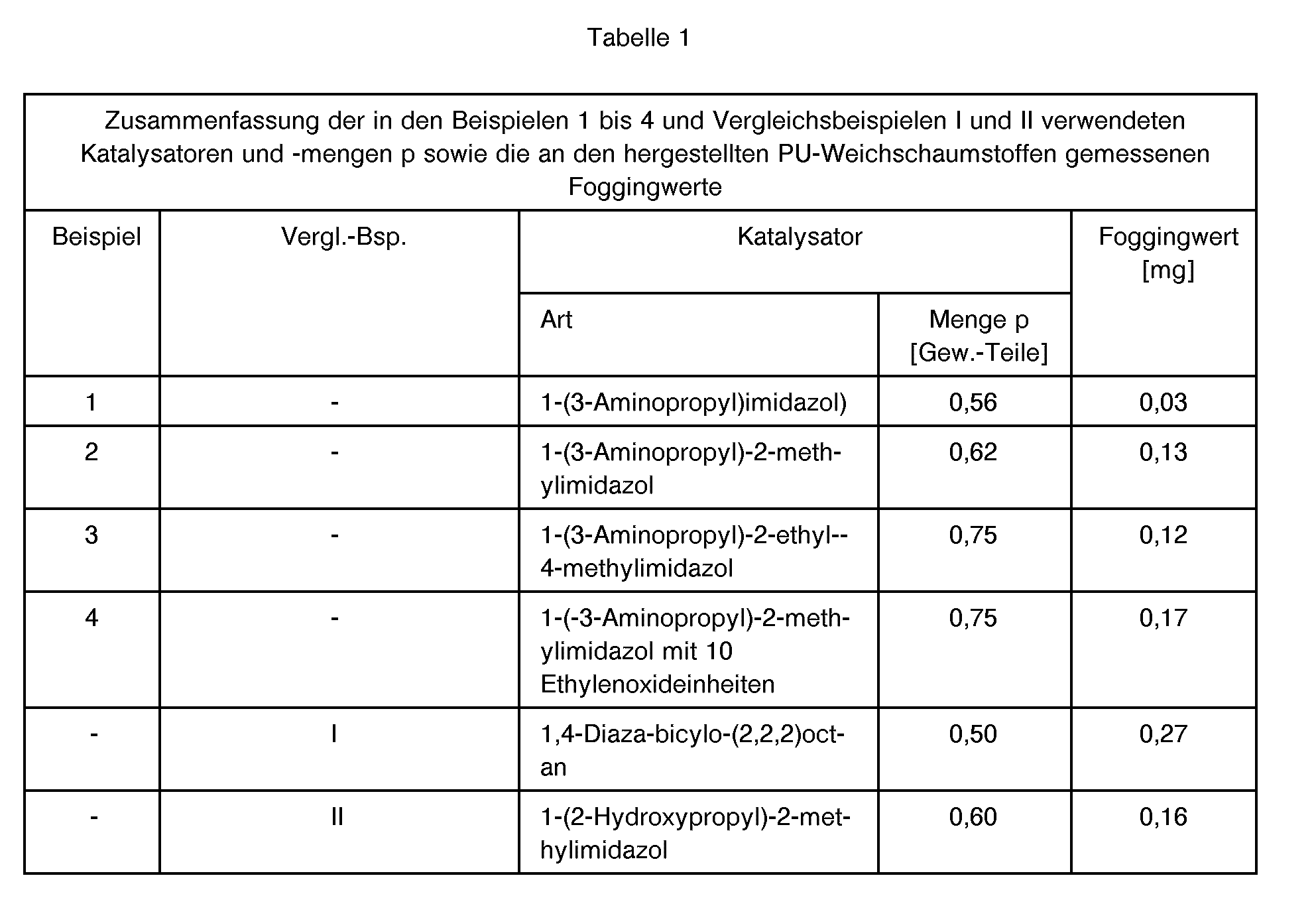
-
- 65,63 Gew.-Teilen eines mit Glycerin gestarten Polyoxypropylen(86 Gew.-%)-polyoxyethylen(14 Gew.-%)-polyols mit einem Molekulargewicht von 6000,
- 27,40 Gew.-Teilen eines mit wäßrigem Glycerin gestarteten Polyoxypropylen(94 Gew.-%)-polyoxyethylen(6 Gew.-%)-polyols mit einer Funktionalität von 2,1 und einem Molekulargewicht von 3900,
- 2,00 Gew.-Teilen eines mit Glycerin gestarteten Polyoxypropylen (25 Gew.-%)-polyoxyethylen(75 Gew.-%)-polyols mit einem Molekulargewicht von 4000,
- 0,50 Gew.-Teilen Diethanolamin;
- 0,12 Gew.-Teilen einer 70 gew.-%igen Lösung von Bis-(dimethylaminoethyl)ether in Dipropylenglykol,
- 0,70 Gew.-Teilen Dimethylaminopropylamin und
- p Gew.-Teilen eines Imidazolkatalysators
- Zur Herstellung der PU-Weichschaumstoffe wurden 100 Gew.-Teile der A-Komponente und 58 Gew.-Teile der B-Komponente, entsprechend einem Isocyanatindex von 80, bei 23 ° C intensiv gemischt und die erhaltene Reaktionsmischung in einen Polyethyleneimer eingefüllt und dort frei aufschäumen und aushärten gelassen.
- Zur Messung der Foggingwerte nach DIN 75 201, Verfahren B wurden bei sämtlichen Beispielen und Vergleichsbeispielen Formkörper mit gleicher Raumform und Dichte verwendet. Die Dichte der PU-Weichschaumstoffe und damit das Formkörpergewicht bleiben nach DIN 75 201 unberücksichtigt. Die in der nachfolgenden Tabelle 2 genannten Foggingwerte beziehen sich daher auf PU-Weichschaumstoffe mit vergleichbaren Dichten, um eine Vergleichbarkeit zu gewährleisten. In Tabelle 2 genannt werden ferner die verwendeten Katalysatoren und -mengen p
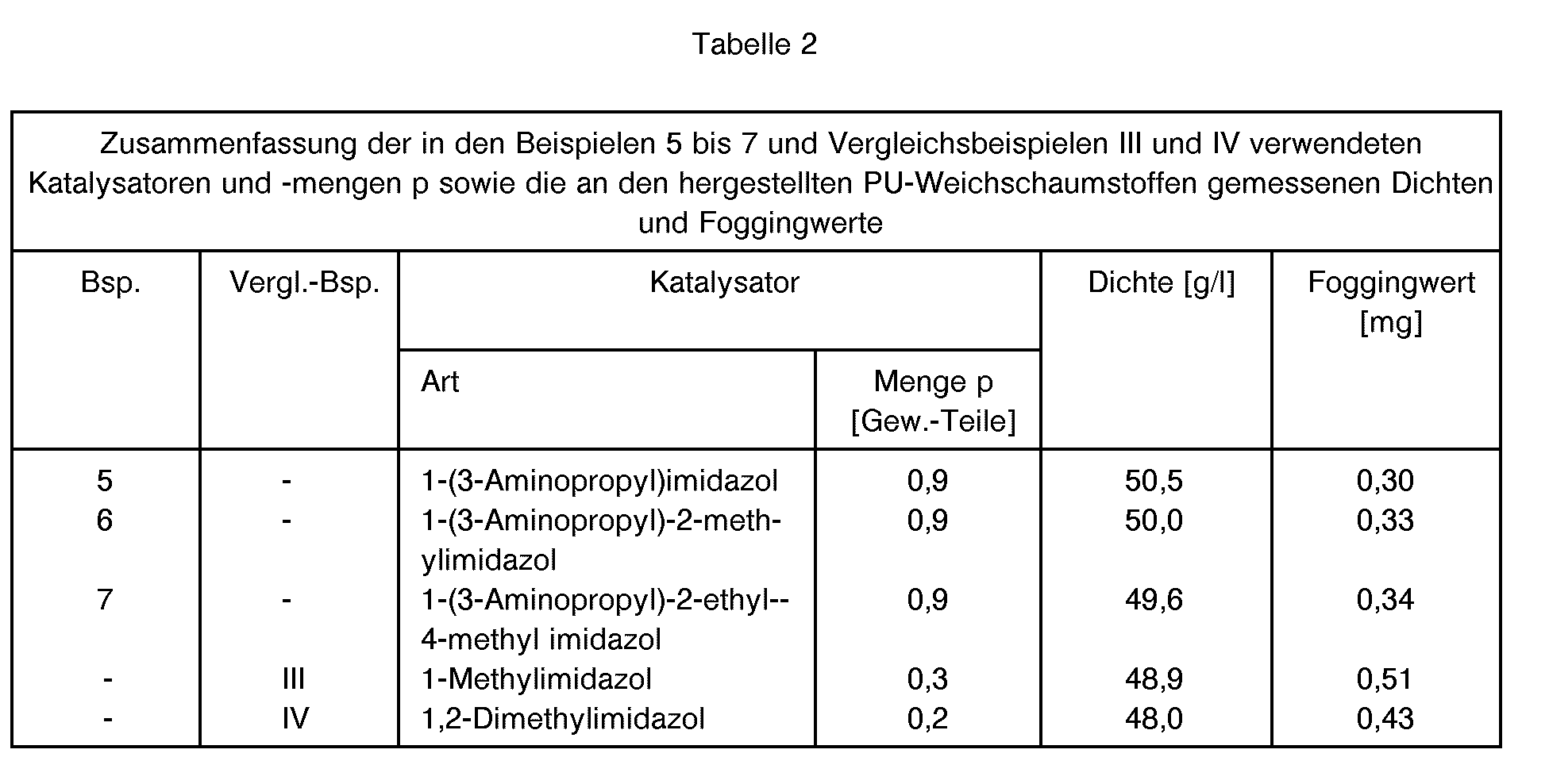
- Die höheren Foggingwerte der PU-Weichschaumstoffe, hergestellt nach den Beispielen 5 bis 7 (Tabelle 2) im Vergleich zu den Beispielen 1 bis 3 (Tabelle 1) zeigen, daß die mitverwendeten nicht erfindungsgemäßen tertiären Aminkatalysatoren Bis-(dimethylaminoethyl)ether und Dimethylaminopropylamin zu einer unerwünschten Erhöhung der Foggingwerte beitragen.
- Ein Vergleich der Vergleichsbeispiele 111 und IV mit den Beispielen 5 bis 7 zeigt, daß der Ersatz der nicht erfindungsgemäßen Imidazolkatalysatoren in konventionellen Katalysatorkombinationen durch die erfindungsgemäßen Aminoalkylimidazole zu einer beträchtlichen Verminderung der Foggingwerte führt.
das dadurch gekennzeichnet ist, daß man als Katalysatoren (e) Aminoalkyl- oder Aminophenyl-imidazole der Formeln

Claims (7)
dadurch gekennzeichnet, daß man als Katalysatoren (e) Aminoalkyl- oder Aminophenyl-imidazole der Formeln


Applications Claiming Priority (2)
| Application Number | Priority Date | Filing Date | Title |
|---|---|---|---|
| DE4412677 | 1994-04-13 | ||
| DE4412677A DE4412677A1 (de) | 1994-04-13 | 1994-04-13 | Verfahren zur Herstellung von Polyurethan-Schaumstoffen in Gegenwart von Aminoalkyl- oder Aminophenyl-imidazolen als Katalysator sowie die Verwendung dieser Katalysatoren zur Herstellung von Polyisocyanat-polyadditionsprodukten |
Publications (3)
| Publication Number | Publication Date |
|---|---|
| EP0677540A2 true EP0677540A2 (de) | 1995-10-18 |
| EP0677540A3 EP0677540A3 (de) | 1996-06-05 |
| EP0677540B1 EP0677540B1 (de) | 1999-01-27 |
Family
ID=6515260
Family Applications (1)
| Application Number | Title | Priority Date | Filing Date |
|---|---|---|---|
| EP95105077A Expired - Lifetime EP0677540B1 (de) | 1994-04-13 | 1995-04-05 | Verfahren zur Herstellung von Polyurethan-Schaumstoffen in Gegenwart von Aminoalkyl- oder Aminophenyl-imidazolen als Katalysator sowie die Verwendung dieser Katalysatoren zur Herstellung von Polyisocyanat-polyadditionsprodukten |
Country Status (9)
| Country | Link |
|---|---|
| US (1) | US5786402A (de) |
| EP (1) | EP0677540B1 (de) |
| JP (1) | JPH0841157A (de) |
| KR (1) | KR950032357A (de) |
| AT (1) | ATE176254T1 (de) |
| CA (1) | CA2146910A1 (de) |
| DE (2) | DE4412677A1 (de) |
| DK (1) | DK0677540T3 (de) |
| ES (1) | ES2127430T3 (de) |
Cited By (4)
| Publication number | Priority date | Publication date | Assignee | Title |
|---|---|---|---|---|
| EP1022298A1 (de) * | 1999-01-22 | 2000-07-26 | Basf Aktiengesellschaft | Foggingarme Katalysatoren für die Herstellung von Polyurethanen |
| EP1630185A1 (de) | 2004-08-25 | 2006-03-01 | Basf Aktiengesellschaft | Verfahren zur Herstellung von Polyurethan-Weichschaumstoffen |
| DE19902982B4 (de) * | 1999-01-26 | 2007-02-08 | Basf Ag | Verfahren zur Herstellung von Schaumstoffen auf der Basis von Polyurethanen |
| WO2020157063A1 (en) * | 2019-02-01 | 2020-08-06 | Basf Se | Method for preparing polyurethane foams |
Families Citing this family (19)
| Publication number | Priority date | Publication date | Assignee | Title |
|---|---|---|---|---|
| KR100676118B1 (ko) * | 1999-03-09 | 2007-02-01 | 카오카부시키가이샤 | 반경질 폴리우레탄 발포체 |
| US6262134B1 (en) | 1999-06-03 | 2001-07-17 | Gaska Tape, Inc. | Low volatility cellular foam |
| DE19930098A1 (de) * | 1999-07-01 | 2001-01-11 | Performance Chemicals Handels | Emissionsarme Polyurethan-Schaumstoffe |
| US6881791B2 (en) * | 2000-06-16 | 2005-04-19 | Basf Corporation | Poly-electrolyte free block copolymers and their use in crosslinking coatings applications |
| IL140429A (en) * | 2000-12-20 | 2007-06-03 | Orycle Applic Ltd | Polyurethane preparations are useful as energy absorbers and a method for their preparation |
| JP4784033B2 (ja) * | 2001-09-28 | 2011-09-28 | 東ソー株式会社 | ポリウレタン樹脂製造用のアミン触媒組成物及びそれを用いたポリウレタン樹脂の製造法 |
| US6858654B1 (en) * | 2003-10-27 | 2005-02-22 | Air Products And Chemicals, Inc. | Catalyst blends for producing low thermal desorption polyurethane foams |
| CN100528922C (zh) * | 2004-04-30 | 2009-08-19 | 陶氏环球技术公司 | 用于具有改进老化特性的低密度聚氨酯泡沫的自催化多元醇的助催化 |
| EP2383304A1 (de) | 2010-04-27 | 2011-11-02 | de Schrijver, Aster | Zusammensetzung für Einkomponenten-Polyurethanschaumstoffe |
| JP5706525B2 (ja) * | 2010-07-09 | 2015-04-22 | エア プロダクツ アンド ケミカルズ インコーポレイテッドAir Products And Chemicals Incorporated | ポリウレタンフォームの性能を改良するための添加剤 |
| PL2643378T3 (pl) * | 2010-11-22 | 2015-02-27 | Bayer Ip Gmbh | Sposób wytwarzania miękkiej pianki poliuretanowej |
| JP5776182B2 (ja) * | 2010-12-22 | 2015-09-09 | 東ソー株式会社 | ポリウレタン樹脂製造用触媒組成物、及びそれを用いたポリウレタン樹脂の製造方法 |
| WO2012077728A1 (ja) * | 2010-12-08 | 2012-06-14 | 東ソー株式会社 | ポリウレタン樹脂製造用触媒組成物、及びそれを用いたポリウレタン樹脂の製造方法 |
| EP2481764A1 (de) | 2011-01-27 | 2012-08-01 | de Schrijver, Aster | Zusammensetzung für Einkomponenten-Polyurethanschaumstoffe mit niedrigem freiem monomerischem MDI-Gehalt |
| WO2015035068A1 (en) | 2013-09-04 | 2015-03-12 | Ghassan Dehni | Flexible polyurethane and polyurethane/polyorganosiloxane foam materials that absorb impact energy |
| US10414921B1 (en) | 2013-09-04 | 2019-09-17 | Virfex, LLC | Polyurethane foam based ballistic armor |
| BR112019000637A2 (pt) * | 2016-07-11 | 2019-04-24 | Evonik Degussa Gmbh | catalisador, composição catalisadora para produzir espuma de poliuretano, composição de poliuretano, produto de espuma de poliuretano e método para preparar uma espuma de poliuretano |
| PL3677616T3 (pl) * | 2019-01-04 | 2022-10-31 | Henkel Ag & Co. Kgaa | Sposób wytwarzania bezizocyjanianowych poliuretanów |
| CN110591052A (zh) * | 2019-09-09 | 2019-12-20 | 优麦化学(山东)有限公司 | 一种低气味异氰酸酯混合物、制备方法及应用 |
Family Cites Families (4)
| Publication number | Priority date | Publication date | Assignee | Title |
|---|---|---|---|---|
| DE2116535A1 (de) * | 1970-04-09 | 1971-12-09 | Dow Chemical Co | Polyurethanprodukte und Verfahren zu ihrer Hersteilung |
| US4517313A (en) * | 1984-04-11 | 1985-05-14 | Abbott Laboratories | Method of making polyurethane foam |
| JP3044261B2 (ja) * | 1990-04-11 | 2000-05-22 | 東ソー株式会社 | 通気性に優れた軟質ポリウレタンフォ−ムの製造法 |
| DE4030515A1 (de) * | 1990-09-27 | 1992-04-02 | Bayer Ag | Neue urethane, ein verfahren zu ihrer herstellung und ihre verwendung als katalysatoren fuer das isocyanat-polyadditionsverfahren |
-
1994
- 1994-04-13 DE DE4412677A patent/DE4412677A1/de not_active Withdrawn
-
1995
- 1995-04-03 US US08/415,290 patent/US5786402A/en not_active Expired - Lifetime
- 1995-04-05 ES ES95105077T patent/ES2127430T3/es not_active Expired - Lifetime
- 1995-04-05 EP EP95105077A patent/EP0677540B1/de not_active Expired - Lifetime
- 1995-04-05 DK DK95105077T patent/DK0677540T3/da active
- 1995-04-05 DE DE59504948T patent/DE59504948D1/de not_active Expired - Lifetime
- 1995-04-05 AT AT95105077T patent/ATE176254T1/de not_active IP Right Cessation
- 1995-04-11 JP JP7085394A patent/JPH0841157A/ja active Pending
- 1995-04-12 CA CA002146910A patent/CA2146910A1/en not_active Abandoned
- 1995-04-13 KR KR1019950008612A patent/KR950032357A/ko not_active Ceased
Cited By (4)
| Publication number | Priority date | Publication date | Assignee | Title |
|---|---|---|---|---|
| EP1022298A1 (de) * | 1999-01-22 | 2000-07-26 | Basf Aktiengesellschaft | Foggingarme Katalysatoren für die Herstellung von Polyurethanen |
| DE19902982B4 (de) * | 1999-01-26 | 2007-02-08 | Basf Ag | Verfahren zur Herstellung von Schaumstoffen auf der Basis von Polyurethanen |
| EP1630185A1 (de) | 2004-08-25 | 2006-03-01 | Basf Aktiengesellschaft | Verfahren zur Herstellung von Polyurethan-Weichschaumstoffen |
| WO2020157063A1 (en) * | 2019-02-01 | 2020-08-06 | Basf Se | Method for preparing polyurethane foams |
Also Published As
| Publication number | Publication date |
|---|---|
| DE59504948D1 (de) | 1999-03-11 |
| EP0677540A3 (de) | 1996-06-05 |
| JPH0841157A (ja) | 1996-02-13 |
| ATE176254T1 (de) | 1999-02-15 |
| EP0677540B1 (de) | 1999-01-27 |
| CA2146910A1 (en) | 1995-10-14 |
| ES2127430T3 (es) | 1999-04-16 |
| DE4412677A1 (de) | 1995-10-19 |
| US5786402A (en) | 1998-07-28 |
| DK0677540T3 (da) | 1999-09-13 |
| KR950032357A (ko) | 1995-12-20 |
Similar Documents
| Publication | Publication Date | Title |
|---|---|---|
| EP0677540B1 (de) | Verfahren zur Herstellung von Polyurethan-Schaumstoffen in Gegenwart von Aminoalkyl- oder Aminophenyl-imidazolen als Katalysator sowie die Verwendung dieser Katalysatoren zur Herstellung von Polyisocyanat-polyadditionsprodukten | |
| EP0433878B1 (de) | Verfahren zur Herstellung von flexiblen Polyurethan-Weichschaumstoffen mit viskoelastischen, körperschalldämpfenden Eigenschaften und hierzu verwendbare Polyoxyalkylen-polyol-Mischungen | |
| DE19506671C2 (de) | Verfahren zur Herstellung von Polyurethan-Schaumstoffen | |
| EP0153639B1 (de) | Verfahren zur Herstellung von zelligen oder kompakten Polyurethan-Polyharnstoff-Formkörpern mit verbesserten Entformungseigenschaften sowie innere Formtrennmittel für das Polyisocyanat-Polyadditions-verfahren | |
| EP0555742B1 (de) | Verfahren zur Herstellung von Fluorchlorkohlenwasserstoff freien Polyurethan-Weichschaumstoffen unter Verwendung von Urethangruppen enthaltenden Polyisocyanatmischungen auf Diphenylmethan-diisocyanatbasis sowie derartige modifizierte Polyisocyanatmischungen | |
| EP0545175B1 (de) | Verfahren zur Herstellung von Fluorchlorkohlenwasserstoff freien, Urethangruppen enthaltenden Formkörpern mit einem zelligen Kern und einer verdichteten Randzone | |
| EP0624611B1 (de) | Verfahren zur Herstellung von Polyurethan-Schaumstoffen | |
| EP0557792B1 (de) | Verfahren zur Herstellung von Fluorchlorkohlenwasserstoff freien, niedrigdichten Polyurethan Weichschaumstoffen und weichelastischen Polyurethan-Formschaumstoffen sowie hierfür verwendbare, mit Urethangruppen modifizierte Polyisocyanatmischungen auf Diphenylmethan-diisocyanatbasis | |
| EP1293524A1 (de) | Verfahren zur Herstellung von reaktionsverzögerten Polyurethanhartschaumstoffen | |
| EP0433889A2 (de) | Verfahren zur Herstellung von Polyurethan-Weichschaumstoffen mit geringer Stauchhärte und hierfür verwendbare Blockpolyoxypropylen-polyoxyethylen-polyolgemische | |
| EP0243832A2 (de) | Verfahren zur Herstellung von elastischen, kompakten oder zelligen Polyurethan- oder Polyurethan-Polyharnstoff-Form-Körpern | |
| DE3405680A1 (de) | Verfahren zur herstellung von gegebenenfalls zelligen polyurethan-polyharnstoff-formkoerpern mit verbessertem entformungsverhalten | |
| EP0676434A1 (de) | Verfahren zur Herstellung von fluorchlorkohlenwasserstoff freien, hochelastischen Polyurethan-Weichschaumstoffen und hierfür verwendbare, mit Urethangruppen modifizierte Polyisocyanatmischungen auf Diphenylmethan-diisocyanatbasis | |
| DE3638488A1 (de) | Verfahren zur herstellung von kompakten oder zelligen polyurethan-elastomeren in gegenwart eines titan- und/oder zinnverbindungen enthaltenden polyester-polyols als katalysator sowie die verwendung dieses katalysators | |
| EP0822208A1 (de) | Verfahren zur Herstellung von Polyurethanen mit verbesserter Aushärtung | |
| EP0745626A1 (de) | Verfahren zur Herstellung von Ester- und Urethangruppen enthaltenden Formkörpern, estergruppenhaltige Isocyanat-Semiprepolymere hierfür und ihre Verwendung | |
| EP1090055B1 (de) | Isocyanatgruppenhaltige prepolymere und verfahren zu ihrer herstellung | |
| EP0248183A1 (de) | Bei Raumtemperatur flüssige Polyester-polyole auf Basis von 2-Methylbutandiol-1,4, Verfahren zu deren Herstellung und deren Verwendung zur Herstellung von Kunststoffen nach dem Polyisocyanat-polyadditionsverfahren | |
| EP0075758B1 (de) | Verfahren zur Herstellung von elastischen Polyurethan-Weichschaumstoffen | |
| EP0826707A1 (de) | Lagerstabile, flammschutzmittelhaltige Polyolkomponente | |
| DE4001044C2 (de) | Verfahren zur Herstellung von viskoelastischen Polyurethan-Weichschaumstoffen mit einem verbesserten Schallabsorptionsvermögen sowie hierzu verwendbare Polyether-polyol-Polyester-polyol-Mischungen | |
| EP0657482A1 (de) | Verfahren zur Herstellung von kompakten oder zelligen Polyurethanen, hierfür verwendbare Urethangruppen enthaltende Polyisocyanatzusammensetzungen und deren Verwendung | |
| DE4112793A1 (de) | Verfahren zur herstellung von hydrolysestabilen, estergruppen gebunden enthaltenden polyurethanen und phenylen-bis-oxazoline enthaltende polyurethan elastomere | |
| DE3526413A1 (de) | Verfahren zur herstellung von hochtemperaturbestaendigen, kompakten oder zelligen polyurethan-elastomeren | |
| DE19961973A1 (de) | Verfahren zur Herstellung von Polyurethanen mit verbesserter Aushärtung |
Legal Events
| Date | Code | Title | Description |
|---|---|---|---|
| PUAI | Public reference made under article 153(3) epc to a published international application that has entered the european phase |
Free format text: ORIGINAL CODE: 0009012 |
|
| AK | Designated contracting states |
Kind code of ref document: A2 Designated state(s): AT BE CH DE DK ES FR GB IT LI NL PT SE |
|
| PUAL | Search report despatched |
Free format text: ORIGINAL CODE: 0009013 |
|
| AK | Designated contracting states |
Kind code of ref document: A3 Designated state(s): AT BE CH DE DK ES FR GB IT LI NL PT SE |
|
| 17P | Request for examination filed |
Effective date: 19960508 |
|
| GRAG | Despatch of communication of intention to grant |
Free format text: ORIGINAL CODE: EPIDOS AGRA |
|
| GRAG | Despatch of communication of intention to grant |
Free format text: ORIGINAL CODE: EPIDOS AGRA |
|
| GRAH | Despatch of communication of intention to grant a patent |
Free format text: ORIGINAL CODE: EPIDOS IGRA |
|
| 17Q | First examination report despatched |
Effective date: 19980629 |
|
| GRAH | Despatch of communication of intention to grant a patent |
Free format text: ORIGINAL CODE: EPIDOS IGRA |
|
| GRAA | (expected) grant |
Free format text: ORIGINAL CODE: 0009210 |
|
| AK | Designated contracting states |
Kind code of ref document: B1 Designated state(s): AT BE CH DE DK ES FR GB IT LI NL PT SE |
|
| REF | Corresponds to: |
Ref document number: 176254 Country of ref document: AT Date of ref document: 19990215 Kind code of ref document: T |
|
| REG | Reference to a national code |
Ref country code: CH Ref legal event code: EP |
|
| GBT | Gb: translation of ep patent filed (gb section 77(6)(a)/1977) |
Effective date: 19990211 |
|
| REF | Corresponds to: |
Ref document number: 59504948 Country of ref document: DE Date of ref document: 19990311 |
|
| ITF | It: translation for a ep patent filed | ||
| REG | Reference to a national code |
Ref country code: ES Ref legal event code: FG2A Ref document number: 2127430 Country of ref document: ES Kind code of ref document: T3 |
|
| ET | Fr: translation filed | ||
| REG | Reference to a national code |
Ref country code: DK Ref legal event code: T3 |
|
| PLBE | No opposition filed within time limit |
Free format text: ORIGINAL CODE: 0009261 |
|
| STAA | Information on the status of an ep patent application or granted ep patent |
Free format text: STATUS: NO OPPOSITION FILED WITHIN TIME LIMIT |
|
| 26N | No opposition filed | ||
| PGFP | Annual fee paid to national office [announced via postgrant information from national office to epo] |
Ref country code: SE Payment date: 20010319 Year of fee payment: 7 |
|
| PGFP | Annual fee paid to national office [announced via postgrant information from national office to epo] |
Ref country code: PT Payment date: 20010320 Year of fee payment: 7 |
|
| PGFP | Annual fee paid to national office [announced via postgrant information from national office to epo] |
Ref country code: CH Payment date: 20010323 Year of fee payment: 7 Ref country code: AT Payment date: 20010323 Year of fee payment: 7 |
|
| REG | Reference to a national code |
Ref country code: GB Ref legal event code: IF02 |
|
| PG25 | Lapsed in a contracting state [announced via postgrant information from national office to epo] |
Ref country code: AT Free format text: LAPSE BECAUSE OF NON-PAYMENT OF DUE FEES Effective date: 20020405 |
|
| PG25 | Lapsed in a contracting state [announced via postgrant information from national office to epo] |
Ref country code: SE Free format text: LAPSE BECAUSE OF NON-PAYMENT OF DUE FEES Effective date: 20020406 |
|
| PG25 | Lapsed in a contracting state [announced via postgrant information from national office to epo] |
Ref country code: LI Free format text: LAPSE BECAUSE OF NON-PAYMENT OF DUE FEES Effective date: 20020430 Ref country code: CH Free format text: LAPSE BECAUSE OF NON-PAYMENT OF DUE FEES Effective date: 20020430 |
|
| PG25 | Lapsed in a contracting state [announced via postgrant information from national office to epo] |
Ref country code: PT Free format text: LAPSE BECAUSE OF NON-PAYMENT OF DUE FEES Effective date: 20021031 |
|
| EUG | Se: european patent has lapsed |
Ref document number: 95105077.2 |
|
| REG | Reference to a national code |
Ref country code: CH Ref legal event code: PL |
|
| REG | Reference to a national code |
Ref country code: PT Ref legal event code: MM4A Free format text: LAPSE DUE TO NON-PAYMENT OF FEES Effective date: 20021031 |
|
| PGFP | Annual fee paid to national office [announced via postgrant information from national office to epo] |
Ref country code: NL Payment date: 20030325 Year of fee payment: 9 |
|
| PGFP | Annual fee paid to national office [announced via postgrant information from national office to epo] |
Ref country code: DK Payment date: 20030404 Year of fee payment: 9 |
|
| PGFP | Annual fee paid to national office [announced via postgrant information from national office to epo] |
Ref country code: BE Payment date: 20030425 Year of fee payment: 9 |
|
| PG25 | Lapsed in a contracting state [announced via postgrant information from national office to epo] |
Ref country code: DK Free format text: LAPSE BECAUSE OF NON-PAYMENT OF DUE FEES Effective date: 20040430 Ref country code: BE Free format text: LAPSE BECAUSE OF NON-PAYMENT OF DUE FEES Effective date: 20040430 |
|
| BERE | Be: lapsed |
Owner name: *BASF A.G. Effective date: 20040430 |
|
| PG25 | Lapsed in a contracting state [announced via postgrant information from national office to epo] |
Ref country code: NL Free format text: LAPSE BECAUSE OF NON-PAYMENT OF DUE FEES Effective date: 20041101 |
|
| NLV4 | Nl: lapsed or anulled due to non-payment of the annual fee |
Effective date: 20041101 |
|
| PGFP | Annual fee paid to national office [announced via postgrant information from national office to epo] |
Ref country code: ES Payment date: 20120530 Year of fee payment: 18 |
|
| PGFP | Annual fee paid to national office [announced via postgrant information from national office to epo] |
Ref country code: GB Payment date: 20130430 Year of fee payment: 19 |
|
| PGFP | Annual fee paid to national office [announced via postgrant information from national office to epo] |
Ref country code: FR Payment date: 20130529 Year of fee payment: 19 Ref country code: IT Payment date: 20130420 Year of fee payment: 19 |
|
| PGFP | Annual fee paid to national office [announced via postgrant information from national office to epo] |
Ref country code: DE Payment date: 20130628 Year of fee payment: 19 |
|
| REG | Reference to a national code |
Ref country code: DE Ref legal event code: R119 Ref document number: 59504948 Country of ref document: DE |
|
| GBPC | Gb: european patent ceased through non-payment of renewal fee |
Effective date: 20140405 |
|
| REG | Reference to a national code |
Ref country code: FR Ref legal event code: ST Effective date: 20141231 |
|
| PG25 | Lapsed in a contracting state [announced via postgrant information from national office to epo] |
Ref country code: DE Free format text: LAPSE BECAUSE OF NON-PAYMENT OF DUE FEES Effective date: 20141101 Ref country code: GB Free format text: LAPSE BECAUSE OF NON-PAYMENT OF DUE FEES Effective date: 20140405 |
|
| REG | Reference to a national code |
Ref country code: DE Ref legal event code: R119 Ref document number: 59504948 Country of ref document: DE Effective date: 20141101 |
|
| PG25 | Lapsed in a contracting state [announced via postgrant information from national office to epo] |
Ref country code: FR Free format text: LAPSE BECAUSE OF NON-PAYMENT OF DUE FEES Effective date: 20140430 |
|
| PG25 | Lapsed in a contracting state [announced via postgrant information from national office to epo] |
Ref country code: IT Free format text: LAPSE BECAUSE OF NON-PAYMENT OF DUE FEES Effective date: 20140405 |
|
| REG | Reference to a national code |
Ref country code: ES Ref legal event code: FD2A Effective date: 20150526 |
|
| PG25 | Lapsed in a contracting state [announced via postgrant information from national office to epo] |
Ref country code: ES Free format text: LAPSE BECAUSE OF NON-PAYMENT OF DUE FEES Effective date: 20140406 |