EP0677754A1 - Outil de diagraphie du trou de sondage comportant une source accélératrice de neutrons - Google Patents
Outil de diagraphie du trou de sondage comportant une source accélératrice de neutrons Download PDFInfo
- Publication number
- EP0677754A1 EP0677754A1 EP95302295A EP95302295A EP0677754A1 EP 0677754 A1 EP0677754 A1 EP 0677754A1 EP 95302295 A EP95302295 A EP 95302295A EP 95302295 A EP95302295 A EP 95302295A EP 0677754 A1 EP0677754 A1 EP 0677754A1
- Authority
- EP
- European Patent Office
- Prior art keywords
- neutrons
- neutron
- detector
- source
- neutron source
- Prior art date
- Legal status (The legal status is an assumption and is not a legal conclusion. Google has not performed a legal analysis and makes no representation as to the accuracy of the status listed.)
- Granted
Links
Images



Classifications
-
- G—PHYSICS
- G01—MEASURING; TESTING
- G01V—GEOPHYSICS; GRAVITATIONAL MEASUREMENTS; DETECTING MASSES OR OBJECTS; TAGS
- G01V5/00—Prospecting or detecting by the use of ionising radiation, e.g. of natural or induced radioactivity
- G01V5/04—Prospecting or detecting by the use of ionising radiation, e.g. of natural or induced radioactivity specially adapted for well-logging
- G01V5/08—Prospecting or detecting by the use of ionising radiation, e.g. of natural or induced radioactivity specially adapted for well-logging using primary nuclear radiation sources or X-rays
- G01V5/10—Prospecting or detecting by the use of ionising radiation, e.g. of natural or induced radioactivity specially adapted for well-logging using primary nuclear radiation sources or X-rays using neutron sources
- G01V5/107—Prospecting or detecting by the use of ionising radiation, e.g. of natural or induced radioactivity specially adapted for well-logging using primary nuclear radiation sources or X-rays using neutron sources and detecting reflected or back-scattered neutrons
Definitions
- the present invention relates to a method and apparatus for well logging to determine a characteristic of an underground formation through which the well passes.
- the invention relates to a logging technique which uses an accelerator neutron source.
- a neutron source in a logging tool for obtaining a characteristic of a formation surrounding a borehole is well known, particularly in the derivation of formation porosity.
- Certain techniques involve the use of a chemical source such as 252Cf AmBe or PuBe to provide neutrons to irradiate the formation such that scattered neutrons returning to the borehole can be detected and the formation characteristic (porosity) inferred.
- a chemical source such as 252Cf AmBe or PuBe to provide neutrons to irradiate the formation such that scattered neutrons returning to the borehole can be detected and the formation characteristic (porosity) inferred.
- Such tools and methods are described in US 3,483,376 and US 3,566,117.
- chemical neutron sources have several disadvantages due to the problems in handling and shipping sources containing radioactive materials due to concerns over radioactive safety and other such matters.
- accelerator neutron sources are those base on the deuterium-tritium (D-T) reaction which produces 14MeV neutrons, the deuterium-deuterium (D-D) reaction which produces 2.5 MeV neutrons and the tritium-tritium (T-T) reaction which produces neutrons in the range 1-10 MeV with an average energy of about 5 MeV.
- D-T deuterium-tritium
- D-D deuterium-deuterium
- T-T tritium-tritium
- the '252 patent describes a neutron porosity logging tool in which an accelerator source is used to irradiate the underground formation and epithermal and thermal neutrons returning from the formation are detected. Scattering of neutrons in the formation at epithermal and thermal energies is due to interaction of the neutrons with hydrogen nuclei and so monitoring the neutrons at these energies is used to estimate the porosity of the formation since hydrogen is only associated with pore fluids rather than the rock matrix.
- the neutron porosity measurement is essentially a measurement of hydrogen density in the formation.
- an increase in matrix density for a formation can result in a decrease in count rate for a neutron porosity tool in much the same way that an increase in porosity would cause a decrease in count rate. Since it is not possible to determine which effect is causing the change merely by considering the neutron count, it is necessary to obtain an independent determination of the formation density.
- the formation density is obtained from a tool which makes use of Compton scattering of ⁇ rays by electrons to make formation matrix density measurements.
- the density tool requires a source of ⁇ rays, typically a 137Cs isotopic source.
- the tool described in the '252 patent uses 3He filled proportional counters to detect neutrons.
- Such counters are typically filled with 3He at pressures in the 10-15 atmospheres range although it has been proposed to use pressures as high as 20 atmospheres in proportional neutron counters (see US 3,102,198) and even up to 40 atmospheres, and are sensitive mainly to epithermal and thermal neutrons.
- 3He proportional counters suffer from certain problems.
- the signal in a 3He counter is produced by a proton which is the result of the reaction between a He nucleus and a neutron.
- signals can also be produced by the interaction of a 3He nucleus with a ⁇ ray and this interferes with the signal produced by neutron interactions.
- the normal approach to discriminating between neutron and ⁇ ray induced events is by peak height/signal strength analysis since the neutron induced events occur at different energies to ⁇ ray events.
- This problem is compounded by increasing the He pressure inside the counter which, while increasing the sensitivity of the counter to neutron events, makes the counter comparatively more sensitive to ⁇ ray induced events and so the interfering effect is greater. This problem is particularly significant in a borehole environment where the naturally occurring ⁇ ray activity is high.
- 4He has been used in proportional counters for detecting neutrons having MeV energies. However, 4He has a strong resonance at 1MeV which makes the neutron response highly energy dependent. Furthermore, 4He has a cutoff in the response below 1 MeV which makes it insensitive to epithermal neutrons. For this reason, 4He has not been considered as generally acceptable for proportional counters in neutron detectors.
- the present invention comprises a borehole neutron logging tool including neutron detectors which are sensitive to neutrons with energies higher than epithermal, typically in the MeV energy region.
- a first aspect of the present invention comprises a method of determining a characteristic of an underground formation through which a borehole passes comprising irradiating the underground formation with neutrons using a tool comprising a neutron source and a neutron detector, detecting neutrons originating from the source with the neutron detector at energies higher than epithermal so as to produce a signal, and using the signal to determine the characteristic of the underground formation.
- a second aspect of the invention comprises an apparatus for determining a characteristic of an underground formation through which a borehole passes comprising a neutron source for irradiating the underground formation with neutrons when the apparatus is positioned in the borehole and a neutron detector for detecting neutrons originating from the source having energies higher than epithermal so as to produce a signal related to the characteristic of the underground formation.
- a third aspect of the invention comprises the use of a 4He detector in a neutron logging tool.
- the invention comprises a technique for determining the nature of the underground formation matrix, comprising irradiating the formation with 14 MeV neutrons from a D-T accelerator and detecting neutrons at about 1MeV which have passed through the formation and have been slowed down by scattering with nuclei in the formation so as to determine the slowing down length for the 14-1MeV transport which can be used to give useful information about the composition of the formation and the presence of gas.
- the invention comprises a technique for monitoring the flow of neutrons directly from the accelerator source, typically a D-T accelerator producing 14 MeV neutrons, and which have not passed through the underground formation.
- the accelerator source typically a D-T accelerator producing 14 MeV neutrons
- the detector comprises a high pressure 4He proportional counter and that the 4He pressure in the counter be as high as possible, typically in the region of 40 atmospheres. Where the detector is used to detect neutrons which have been scattered by the formation, the high Z shielding is absent.
- FIG. 1 shows a schematic view of a prior art tool as described in US 4,760,252.
- the tool comprises a tool body or sonde 10 which can be lowered into a borehole and logged using a wireline cable in the conventional manner.
- the sonde 10 includes a DT accelerator neutron source 12, a source monitor 14 for monitoring the neutron output of the source 12, a near epithermal neutron detector 16, a thermal/epithermal neutron detector array 17, a far epithermal neutron detector 18 and a thermal neutron detector 20.
- the monitor 14 can typically comprise a scintillator and photo multiplier tube arrangement and the detectors 16, 17, 18 and 20 are 15 atm 3He proportional counters having appropriate shielding in the form of Cd metal and B4C epoxy.
- a tool according to the present invention will have generally the same configurations this prior art tool, but with the differences which will be described below.
- FIG. 2 shows a schematic view of a tool according one embodiment of the present invention.
- the tool comprises a sonde 30 including a D-T accelerator neutron source 32 which produces 14 MeV neutrons when activated, a near neutron detector 34 comprising a 40 atm 4He proportional counter shielded with a layer of tungsten 36 (or other high -Z material such as tantalum, uranium, lead and bismuth).
- tungsten 36 or other high -Z material such as tantalum, uranium, lead and bismuth.
- the path length of 14 MeV neutrons through the shielding material should be at least 1 mean-free-path for an (n, 2n) reaction, which for tungsten is 7.9 cm.
- a far neutron detector 38 comprises a further 40 atm 4He proportional counter.
- the counters 34 and 38 are located 5''-9'' and 20''-75'' from the source 32, respectively.
- the near detector can comprise some form of source monitor other than a 4He counter such as a scintillator in which case the high-Z shielding might not be required.
- Another alternative comprises 3He proportional counters as well as 4He proportional counters as the near and/or far detectors in order to measure epithermal and thermal neutrons as well as those of MeV energies.
- An intermediate detector array 37 can also be present.
- the 40 atm 4He proportional counters 34, 38 are of similar size and shape to the conventional 15 atm 3He counters and the output signal is in a generally similar form. Certain aspects of the counter construction may need to be different to withstand the higher pressure inside the counter. 40 atm 4He proportional counter of the type described can be obtained from GE Reuter Stokes Inc. of Twinsburg, Ohio, USA.
- the 4He scattering cross section for neutrons in the 0-14 MeV energy range is shown in Figure 3.
- the scattering spectrum does not have any strong peaks which can be used for gain stabilization so an internal ⁇ -source, such as 234U may be added.
- gain stabilization requires a pulsed accelerator so that the a-source counts can be accumulated during source-off periods.
- the 1 MeV resonance might normally be considered detrimental to the performance of a neutron detector.
- this feature can be put to use when using a 14 MeV neutron source both when attempting to obtain the characteristics of the formation matrix and when attempting to discriminate against epithermal neutrons.
- the neutrons interact with tungsten nuclei in the shielding to produce two product neutrons (another possible reaction produces three product neutrons).
- This reaction has a negative Q value equal to the binding energy of a neutron, approximately -6.5 MeV. The remaining 7.5 MeV is shared among the product neutrons.
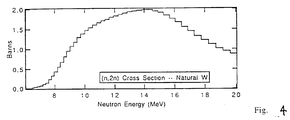
- the cross section for this reaction is shown in Figure 4 and given the high nuclear density in metallic tungsten, the interaction probability is large (mean free path for an (n,2n) reaction is 7.9 cm).
- the effect of the shielding not only increases the number of neutrons entering the counter due to the (n, 2n) reaction, but also brings these neutrons into the highly sensitive range of the counter around 1 MeV.
- the high threshold for the reaction discriminates against neutrons which have scattered many times, such as in the formation, with a corresponding loss in energy and the low energy cut off in the detector response described above means that the detector is less sensitive to neutrons which a have not traveled directly from the source.
- a conventional 3He source monitor about 50% of the detected neutrons have been scattered by the formation rather than emanating directly from the source whereas in the tungsten shielded high pressure 4He detector this figure is reduced to about 20%.
- the other effect of shielding the source monitor in this manner is to reduce the flow of 14 MeV neutrons along the tool to the far detector.
- hydrogenous shielding material may be placed between the source monitor and the far detector. This means that substantially all 1 MeV neutrons detected at the far detector result from interaction with the formation. If the near detector/source monitor is not a 4He counter with tungsten shielding, it may be necessary to place some high-Z and hydrogenous shielding in the sonde to reduce the neutron flux through the tool directly from the source to the far detector.
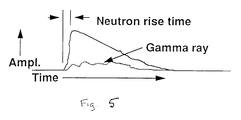
- Figure 5 shows the amplitude of the high pressure 4He detector response against time with both signals due to neutrons and ⁇ rays shown.
- the neutron induced signal is predominantly fast ( ⁇ 150 ns), low energy 4He recoil with some slower, high energy 4He recoil.
- the ⁇ ray signal is predominantly slow (up to 10 ns).
- One way to discriminate between neutron and ⁇ ray signals is to monitor only the first section of the signal, the fast signal, since this is mainly due to neutrons with little contribution from ⁇ rays.
- the portion of the signal to be measured can be determined from the variation in neutron signal with time and the time required up to the peak in the neutron signal is chosen. This is typically in the 100-150 ns range.
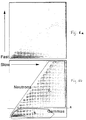
- Figure 6a comprises a cross plot of fast signals and slow signals when the source is not active, i.e. the signals are due to formation activity and thermal capture ⁇ rays only. As will be seen, most of the signal is present in a localized region ⁇ .
- Figure 6b shows the corresponding cross plot with the neutron source active.
- the 14-1 MeV transport in the formation is due to non-elastic reactions (mostly inelastic scattering, (n,p) and (n, ⁇ ) reactions) of the neutrons with nuclei such as C, O, Si, etc. contained in the rock matrix rather than hydrogen nuclei in the pore fluid which affect the transport below 1 MeV to epithermal and thermal energies.
- nuclei such as C, O, Si, etc. contained in the rock matrix rather than hydrogen nuclei in the pore fluid which affect the transport below 1 MeV to epithermal and thermal energies.
- neutrons with about 1 MeV energy have had to traverse the entire 14 - 1 MeV region where the non-elastic cross section is large and so show the greatest sensitivity to matrix effects (with some dependence also on hydrogen). Consequently, by determining the 14-1 MeV slowing down length L h , which is possible with the present invention, it is possible to obtain formation matrix information which is not available in the prior art techniques.
- Simple diffusion theory predicts a radial falloff of flux ⁇ h with distance r from the source according to: where S is the source strength and ⁇ rs is the macroscopic cross section for removal from the energy range 1 - 14 MeV. Given two measurements of the 1 MeV flux at different source/detector spacings r 1 and r 2, one can measure L h directly:
- the epithermal flux ⁇ epi follows a similar law in one group diffusion theory: where L s is the length for slowing down from 14 MeV to 0.5 eV (the cadmium cutoff). Although L has some dependence on the matrix, flux dependence on these variations vanishes at a source/detector spacing of 2 L s .
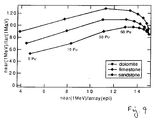
- the source factor S can be eliminated by taking a ratio with a 1 MeV flux measurement at a short source/detector spacing.
- 3He epithermal detector
- 4He 1 MeV detectors
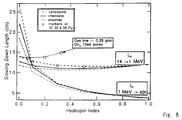
- a crossplot of these two can determine matrix and identify gas as shown in Figure 8.
- the three curves shown correspond to the three major rock matrices: dolomite (2.87 g/cc), limestone (2.71 g/cc) and sandstone (2.65 g/cc).
- dolomite (2.87 g/cc)
- limestone (2.71 g/cc)
- sandstone (2.65 g/cc).
- the near/far and near/array ratios provide almost independent measures of matrix type and porosity, respectively.
Landscapes
- Physics & Mathematics (AREA)
- High Energy & Nuclear Physics (AREA)
- Life Sciences & Earth Sciences (AREA)
- General Life Sciences & Earth Sciences (AREA)
- General Physics & Mathematics (AREA)
- Geophysics (AREA)
- Analysing Materials By The Use Of Radiation (AREA)
- Geophysics And Detection Of Objects (AREA)
- Measurement Of Radiation (AREA)
- Particle Accelerators (AREA)
Applications Claiming Priority (2)
| Application Number | Priority Date | Filing Date | Title |
|---|---|---|---|
| US22673794A | 1994-04-12 | 1994-04-12 | |
| US226737 | 1994-04-12 |
Publications (2)
| Publication Number | Publication Date |
|---|---|
| EP0677754A1 true EP0677754A1 (fr) | 1995-10-18 |
| EP0677754B1 EP0677754B1 (fr) | 2004-12-15 |
Family
ID=22850192
Family Applications (1)
| Application Number | Title | Priority Date | Filing Date |
|---|---|---|---|
| EP95302295A Expired - Lifetime EP0677754B1 (fr) | 1994-04-12 | 1995-04-06 | Outil de diagraphie du trou de sondage comportant une source accélératrice de neutrons |
Country Status (5)
| Country | Link |
|---|---|
| US (1) | US5532482A (fr) |
| EP (1) | EP0677754B1 (fr) |
| CA (1) | CA2146618C (fr) |
| DE (1) | DE69533850D1 (fr) |
| NO (1) | NO319373B1 (fr) |
Cited By (3)
| Publication number | Priority date | Publication date | Assignee | Title |
|---|---|---|---|---|
| US20130034198A1 (en) * | 2011-08-02 | 2013-02-07 | Chandrasekharan Rico S | Noble gas detector for fissile content determination |
| EP2548053A4 (fr) * | 2010-04-21 | 2013-10-30 | Schlumberger Technology Bv | Outil de fond de trou à porosité à neutrons offrant une précision optimisée et des effets lithologiques réduits |
| EP2924473A1 (fr) * | 2014-03-26 | 2015-09-30 | General Electric Company | Enregistrement d'événement de particules |
Families Citing this family (19)
| Publication number | Priority date | Publication date | Assignee | Title |
|---|---|---|---|---|
| GB9624899D0 (en) * | 1996-11-29 | 1997-01-15 | Schlumberger Ltd | Method and apparatus for measuring flow in a horizontal borehole |
| US5973328A (en) * | 1997-10-29 | 1999-10-26 | Lockheed Martin Energy Research Corporation | Neutron detector using sol-gel absorber |
| US7582880B2 (en) * | 2002-03-20 | 2009-09-01 | Neutron Sciences, Inc. | Neutron detector using lithiated glass-scintillating particle composite |
| US20050135535A1 (en) * | 2003-06-05 | 2005-06-23 | Neutron Sciences, Inc. | Neutron detector using neutron absorbing scintillating particulates in plastic |
| US7439519B2 (en) * | 2006-09-18 | 2008-10-21 | Nova Scientific, Inc. | Neutron detection based on coincidence signal |
| US8173967B2 (en) * | 2007-03-07 | 2012-05-08 | Nova Scientific, Inc. | Radiation detectors and related methods |
| US7791017B2 (en) * | 2007-07-23 | 2010-09-07 | Schlumberger Technology Corporation | Method to simultaneously determine pore hydrocarbon density and water saturation from pulsed neutron measurements |
| CA2763285C (fr) | 2009-05-22 | 2018-01-09 | Schlumberger Canada Limited | Optimisation d'instruments emetteurs de neutron-gamma pour diagraphie a rayon gamma inelastique |
| RU2397513C1 (ru) * | 2009-07-27 | 2010-08-20 | Учреждение Российской академии наук Институт нефтегазовой геологии и геофизики им. А.А. Трофимука Сибирского отделения РАН (ИНГГ СО РАН) | Способ нейтронного гамма-каротажа и устройство для его осуществления |
| RU2442146C1 (ru) * | 2011-03-18 | 2012-02-10 | Общество с ограниченной ответственностью "Нейтронные технологии" | Переносное устройство для идентификации скрытых веществ (варианты) |
| RU2457469C1 (ru) * | 2011-06-23 | 2012-07-27 | Общество с ограниченной ответственностью "Нейтронные технологии" | Мобильное устройство для идентификации скрытых веществ (варианты) |
| RU2476864C1 (ru) * | 2011-12-06 | 2013-02-27 | Общество с ограниченной ответственностью "Нейтронные технологии" | Переносной обнаружитель опасных скрытых веществ |
| RU2503955C1 (ru) * | 2012-07-27 | 2014-01-10 | Общество с ограниченной ответственностью "Детекторы взрывчатки и наркотиков" | Устройство для обнаружения и идентификации скрытых опасных веществ под водой |
| RU2503954C1 (ru) * | 2012-08-27 | 2014-01-10 | Общество с ограниченной ответственностью "Детекторы взрывчатки и наркотиков" | Устройство для обнаружения и индентификации скрытых опасных веществ под водой (варианты) |
| RU2505801C1 (ru) * | 2012-09-07 | 2014-01-27 | Федеральное государственное унитарное предприятие "Всероссийский научно-исследовательский институт автоматики им. Н.Л. Духова" | Устройство нейтронной радиографии |
| RU2502986C1 (ru) * | 2012-09-07 | 2013-12-27 | Федеральное государственное унитарное предприятие "Всероссийский научно-исследовательский институт автоматики им. Н.Л. Духова" | Способ нейтронной радиографии |
| RU2524754C1 (ru) * | 2013-01-22 | 2014-08-10 | Вячеслав Михайлович Быстрицкий | Мобильный обнаружитель опасных скрытых веществ (варианты) |
| RU2549680C2 (ru) * | 2013-01-22 | 2015-04-27 | Вячеслав Михайлович Быстрицкий | Досмотровый комплекс обнаружения опасных скрытых веществ (варианты) |
| CN116125522A (zh) * | 2021-11-12 | 2023-05-16 | 中国科学院国家空间科学中心 | 一种基于硅探测器模块的空间粒子探测器及其探测方法 |
Citations (3)
| Publication number | Priority date | Publication date | Assignee | Title |
|---|---|---|---|---|
| GB828917A (en) * | 1956-04-19 | 1960-02-24 | Schlumberger Well Surv Corp | Improvements in or relating to well logging apparatus |
| WO1987007733A1 (fr) * | 1986-06-05 | 1987-12-17 | Prad Research And Development N.V. | Outil de diagraphie du trou de sondage comportant une source acceleratrice de neutrons |
| EP0387449A2 (fr) * | 1989-01-10 | 1990-09-19 | Mobil Oil Corporation | Mesure de la porosité avec jets discrets de neutrons |
Family Cites Families (17)
| Publication number | Priority date | Publication date | Assignee | Title |
|---|---|---|---|---|
| US3102198A (en) * | 1961-11-16 | 1963-08-27 | Socony Mobil Oil Co Inc | Sensitive low voltage proportional counter for neutron detection containing he3 at superatmospheric pressure |
| US3240971A (en) * | 1962-05-29 | 1966-03-15 | Texas Nuclear Corp | Helium-3 thermal neutron proportional counter |
| US3483376A (en) * | 1966-08-03 | 1969-12-09 | Schlumberger Technology Corp | Two neutron detector earth formation porosity logging technique |
| US3775216A (en) * | 1967-03-31 | 1973-11-27 | Schlumberger Technology Corp | Neutron generating systems |
| US3566117A (en) * | 1968-01-05 | 1971-02-23 | Schlumberger Technology Corp | Measuring technique |
| US4005290A (en) * | 1975-06-25 | 1977-01-25 | Mobil Oil Corporation | Neutron-neutron logging |
| US4097737A (en) * | 1976-11-01 | 1978-06-27 | Mobil Oil Corporation | Epithermal die-away porosity logging |
| US4268749A (en) * | 1978-10-16 | 1981-05-19 | Mobil Oil Corporation | Method for directly monitoring the output of a neutron source in a borehole logging system |
| US4476391A (en) * | 1982-03-08 | 1984-10-09 | Mobil Oil Corporation | Method for improving accuracy in a neutron detector |
| US4556793A (en) * | 1983-04-07 | 1985-12-03 | Mobil Oil Corporation | Epithermal neutron lifetime logging |
| US4760252A (en) * | 1983-06-28 | 1988-07-26 | Schlumberger Technology Corporation | Well logging tool with an accelerator neutron source |
| US4638161A (en) * | 1983-10-24 | 1987-01-20 | Halliburton Company | Epithermal neutron porosity measurement |
| US4641028A (en) * | 1984-02-09 | 1987-02-03 | Taylor James A | Neutron logging tool |
| US4581532A (en) * | 1984-07-06 | 1986-04-08 | Mobil Oil Corporation | Directional epithermal neutron detector |
| US4604522A (en) * | 1984-11-05 | 1986-08-05 | Halliburton Company | Method and apparatus for logging a borehole employing dual radiation detectors |
| US4631405A (en) * | 1984-12-05 | 1986-12-23 | Halliburton Company | Method and apparatus for dual-spaced fast/epithermal neutron porosity measurements |
| US5160844A (en) * | 1990-10-24 | 1992-11-03 | Schlumberger Technology Corporation | Gain stabilized neutron detector |
-
1995
- 1995-04-06 EP EP95302295A patent/EP0677754B1/fr not_active Expired - Lifetime
- 1995-04-06 DE DE69533850T patent/DE69533850D1/de not_active Expired - Lifetime
- 1995-04-07 CA CA002146618A patent/CA2146618C/fr not_active Expired - Fee Related
- 1995-04-11 NO NO19951420A patent/NO319373B1/no not_active IP Right Cessation
- 1995-06-26 US US08/494,497 patent/US5532482A/en not_active Expired - Lifetime
Patent Citations (3)
| Publication number | Priority date | Publication date | Assignee | Title |
|---|---|---|---|---|
| GB828917A (en) * | 1956-04-19 | 1960-02-24 | Schlumberger Well Surv Corp | Improvements in or relating to well logging apparatus |
| WO1987007733A1 (fr) * | 1986-06-05 | 1987-12-17 | Prad Research And Development N.V. | Outil de diagraphie du trou de sondage comportant une source acceleratrice de neutrons |
| EP0387449A2 (fr) * | 1989-01-10 | 1990-09-19 | Mobil Oil Corporation | Mesure de la porosité avec jets discrets de neutrons |
Non-Patent Citations (1)
| Title |
|---|
| ATWATER,HF: "MONTE CARLO CALCULATION OF RECOIL SPECTRA IN HE-4 PROPORTIONAL COUNTERS", NUCLEAR INSTRUMENTS AND METHODS, vol. 100, AMSTERDAM, pages 453 - 457 * |
Cited By (8)
| Publication number | Priority date | Publication date | Assignee | Title |
|---|---|---|---|---|
| EP2548053A4 (fr) * | 2010-04-21 | 2013-10-30 | Schlumberger Technology Bv | Outil de fond de trou à porosité à neutrons offrant une précision optimisée et des effets lithologiques réduits |
| US9372277B2 (en) | 2010-04-21 | 2016-06-21 | Schlumberger Technology Corporation | Neutron porosity downhole tool with improved precision and reduced lithology effects |
| US20130034198A1 (en) * | 2011-08-02 | 2013-02-07 | Chandrasekharan Rico S | Noble gas detector for fissile content determination |
| US9632188B2 (en) * | 2011-08-02 | 2017-04-25 | Raytheon Company | Noble gas detector for fissile content determination |
| EP2924473A1 (fr) * | 2014-03-26 | 2015-09-30 | General Electric Company | Enregistrement d'événement de particules |
| CN105116432A (zh) * | 2014-03-26 | 2015-12-02 | 通用电气公司 | 粒子事件记录 |
| CN105116432B (zh) * | 2014-03-26 | 2019-06-14 | 通用电气公司 | 粒子事件记录 |
| US10444304B2 (en) | 2014-03-26 | 2019-10-15 | General Electric Company | Particle event recordation |
Also Published As
| Publication number | Publication date |
|---|---|
| DE69533850D1 (de) | 2005-01-20 |
| CA2146618A1 (fr) | 1995-10-13 |
| NO319373B1 (no) | 2005-07-25 |
| NO951420D0 (no) | 1995-04-11 |
| NO951420L (no) | 1995-10-13 |
| US5532482A (en) | 1996-07-02 |
| CA2146618C (fr) | 2004-06-08 |
| EP0677754B1 (fr) | 2004-12-15 |
Similar Documents
| Publication | Publication Date | Title |
|---|---|---|
| US5532482A (en) | Method and apparatus for well logging using an accelerator neutron source | |
| US4760252A (en) | Well logging tool with an accelerator neutron source | |
| AU733374C (en) | Formation density measurement utilizing pulsed neutrons | |
| CA2375604C (fr) | Detecteur de neutrons rapides geometriquement optimise | |
| US7081616B2 (en) | Downhole gamma-ray detection | |
| US6495837B2 (en) | Geometrically optimized fast neutron detector | |
| CA2356742C (fr) | Methode de synchronisation de bouffees de neutrons et systeme de mesures multiples pour l'evaluation de la formation de neutrons pulses | |
| EP0269620B1 (fr) | Outil de diagraphie du trou de sondage comportant une source acceleratrice de neutrons | |
| SA98181077B1 (ar) | طريقة لتحديد كثافة تكوين أرضي | |
| US3925659A (en) | Inelastic gamma ray logging system | |
| US5521378A (en) | Method and apparatus for gamma ray logging of underground formations | |
| US5789752A (en) | Thermal neutron porosity measurement apparatus and method using an accelerator type high-energy neutron source | |
| CA1095635A (fr) | Diagraphie de neutrons instantanes pour la detection de l'uranium | |
| US4556793A (en) | Epithermal neutron lifetime logging | |
| US4568510A (en) | Method and system for uranium exploration | |
| CA1243783A (fr) | Appareil de diaghraphie de sondages avec source d'activation neutronique | |
| US4180729A (en) | Uranium logging in earth formations | |
| Antkiw et al. | A well logging tool with an accelerator neutron source | |
| MXPA98001701A (en) | Method to determine the density of the terrest formations |
Legal Events
| Date | Code | Title | Description |
|---|---|---|---|
| PUAI | Public reference made under article 153(3) epc to a published international application that has entered the european phase |
Free format text: ORIGINAL CODE: 0009012 |
|
| AK | Designated contracting states |
Kind code of ref document: A1 Designated state(s): DE DK FR GB IT NL |
|
| 17P | Request for examination filed |
Effective date: 19960326 |
|
| 17Q | First examination report despatched |
Effective date: 19970822 |
|
| APAB | Appeal dossier modified |
Free format text: ORIGINAL CODE: EPIDOS NOAPE |
|
| APAB | Appeal dossier modified |
Free format text: ORIGINAL CODE: EPIDOS NOAPE |
|
| APAD | Appeal reference recorded |
Free format text: ORIGINAL CODE: EPIDOS REFNE |
|
| APBT | Appeal procedure closed |
Free format text: ORIGINAL CODE: EPIDOSNNOA9E |
|
| GRAP | Despatch of communication of intention to grant a patent |
Free format text: ORIGINAL CODE: EPIDOSNIGR1 |
|
| GRAS | Grant fee paid |
Free format text: ORIGINAL CODE: EPIDOSNIGR3 |
|
| GRAA | (expected) grant |
Free format text: ORIGINAL CODE: 0009210 |
|
| AK | Designated contracting states |
Kind code of ref document: B1 Designated state(s): DE DK FR GB IT NL |
|
| PG25 | Lapsed in a contracting state [announced via postgrant information from national office to epo] |
Ref country code: NL Free format text: LAPSE BECAUSE OF FAILURE TO SUBMIT A TRANSLATION OF THE DESCRIPTION OR TO PAY THE FEE WITHIN THE PRESCRIBED TIME-LIMIT Effective date: 20041215 Ref country code: IT Free format text: LAPSE BECAUSE OF FAILURE TO SUBMIT A TRANSLATION OF THE DESCRIPTION OR TO PAY THE FEE WITHIN THE PRESCRIBED TIME-LIMIT;WARNING: LAPSES OF ITALIAN PATENTS WITH EFFECTIVE DATE BEFORE 2007 MAY HAVE OCCURRED AT ANY TIME BEFORE 2007. THE CORRECT EFFECTIVE DATE MAY BE DIFFERENT FROM THE ONE RECORDED. Effective date: 20041215 Ref country code: FR Free format text: LAPSE BECAUSE OF NON-PAYMENT OF DUE FEES Effective date: 20041215 |
|
| REG | Reference to a national code |
Ref country code: GB Ref legal event code: FG4D |
|
| REF | Corresponds to: |
Ref document number: 69533850 Country of ref document: DE Date of ref document: 20050120 Kind code of ref document: P |
|
| PG25 | Lapsed in a contracting state [announced via postgrant information from national office to epo] |
Ref country code: DK Free format text: LAPSE BECAUSE OF FAILURE TO SUBMIT A TRANSLATION OF THE DESCRIPTION OR TO PAY THE FEE WITHIN THE PRESCRIBED TIME-LIMIT Effective date: 20050315 |
|
| PG25 | Lapsed in a contracting state [announced via postgrant information from national office to epo] |
Ref country code: DE Free format text: LAPSE BECAUSE OF FAILURE TO SUBMIT A TRANSLATION OF THE DESCRIPTION OR TO PAY THE FEE WITHIN THE PRESCRIBED TIME-LIMIT Effective date: 20050316 |
|
| NLV1 | Nl: lapsed or annulled due to failure to fulfill the requirements of art. 29p and 29m of the patents act | ||
| APAH | Appeal reference modified |
Free format text: ORIGINAL CODE: EPIDOSCREFNO |
|
| PLBE | No opposition filed within time limit |
Free format text: ORIGINAL CODE: 0009261 |
|
| STAA | Information on the status of an ep patent application or granted ep patent |
Free format text: STATUS: NO OPPOSITION FILED WITHIN TIME LIMIT |
|
| 26N | No opposition filed |
Effective date: 20050916 |
|
| EN | Fr: translation not filed | ||
| PGFP | Annual fee paid to national office [announced via postgrant information from national office to epo] |
Ref country code: GB Payment date: 20120404 Year of fee payment: 18 |
|
| GBPC | Gb: european patent ceased through non-payment of renewal fee |
Effective date: 20130406 |
|
| PG25 | Lapsed in a contracting state [announced via postgrant information from national office to epo] |
Ref country code: GB Free format text: LAPSE BECAUSE OF NON-PAYMENT OF DUE FEES Effective date: 20130406 |