EP0678538B1 - Utilisation d'acide abiétique hydrogené comme agent de terminaison de chaíne dans la préparation de polycarbonates et de polyestercarbonates - Google Patents
Utilisation d'acide abiétique hydrogené comme agent de terminaison de chaíne dans la préparation de polycarbonates et de polyestercarbonates Download PDFInfo
- Publication number
- EP0678538B1 EP0678538B1 EP95105092A EP95105092A EP0678538B1 EP 0678538 B1 EP0678538 B1 EP 0678538B1 EP 95105092 A EP95105092 A EP 95105092A EP 95105092 A EP95105092 A EP 95105092A EP 0678538 B1 EP0678538 B1 EP 0678538B1
- Authority
- EP
- European Patent Office
- Prior art keywords
- hydroxyphenyl
- bis
- polycarbonates
- aromatic
- diphenols
- Prior art date
- Legal status (The legal status is an assumption and is not a legal conclusion. Google has not performed a legal analysis and makes no representation as to the accuracy of the status listed.)
- Expired - Lifetime
Links
- 229920000515 polycarbonate Polymers 0.000 title claims description 42
- 239000004417 polycarbonate Substances 0.000 title claims description 42
- BTXXTMOWISPQSJ-UHFFFAOYSA-N 4,4,4-trifluorobutan-2-one Chemical class CC(=O)CC(F)(F)F BTXXTMOWISPQSJ-UHFFFAOYSA-N 0.000 title claims description 20
- 238000002360 preparation method Methods 0.000 title description 2
- 238000000034 method Methods 0.000 claims description 43
- YMWUJEATGCHHMB-UHFFFAOYSA-N Dichloromethane Chemical compound ClCCl YMWUJEATGCHHMB-UHFFFAOYSA-N 0.000 claims description 22
- 125000003118 aryl group Chemical group 0.000 claims description 18
- 238000004519 manufacturing process Methods 0.000 claims description 16
- 229920001169 thermoplastic Polymers 0.000 claims description 15
- 239000004416 thermosoftening plastic Substances 0.000 claims description 15
- BVKZGUZCCUSVTD-UHFFFAOYSA-L Carbonate Chemical compound [O-]C([O-])=O BVKZGUZCCUSVTD-UHFFFAOYSA-L 0.000 claims description 10
- -1 aromatic dicarboxylic acid derivatives Chemical class 0.000 claims description 10
- 230000005501 phase interface Effects 0.000 claims description 9
- 239000000155 melt Substances 0.000 claims description 8
- 238000005809 transesterification reaction Methods 0.000 claims description 7
- YPGLTKHJEQHKSS-ASZLNGMRSA-N (1r,4ar,4bs,7r,8as,10ar)-1,4a-dimethyl-7-propan-2-yl-2,3,4,4b,5,6,7,8,8a,9,10,10a-dodecahydrophenanthrene-1-carboxylic acid Chemical compound [C@H]1([C@](CCC2)(C)C(O)=O)[C@@]2(C)[C@H]2CC[C@@H](C(C)C)C[C@@H]2CC1 YPGLTKHJEQHKSS-ASZLNGMRSA-N 0.000 claims description 5
- 239000006085 branching agent Substances 0.000 claims description 5
- 239000012456 homogeneous solution Substances 0.000 claims description 5
- IISBACLAFKSPIT-UHFFFAOYSA-N bisphenol A Chemical compound C=1C=C(O)C=CC=1C(C)(C)C1=CC=C(O)C=C1 IISBACLAFKSPIT-UHFFFAOYSA-N 0.000 description 10
- MVPPADPHJFYWMZ-UHFFFAOYSA-N chlorobenzene Chemical compound ClC1=CC=CC=C1 MVPPADPHJFYWMZ-UHFFFAOYSA-N 0.000 description 8
- 239000012071 phase Substances 0.000 description 8
- 229920000728 polyester Polymers 0.000 description 8
- 150000004649 carbonic acid derivatives Chemical class 0.000 description 7
- 239000000203 mixture Substances 0.000 description 7
- 239000000243 solution Substances 0.000 description 7
- JUJWROOIHBZHMG-UHFFFAOYSA-N Pyridine Chemical compound C1=CC=NC=C1 JUJWROOIHBZHMG-UHFFFAOYSA-N 0.000 description 6
- 239000002253 acid Substances 0.000 description 6
- 125000004432 carbon atom Chemical group C* 0.000 description 6
- 239000003054 catalyst Substances 0.000 description 5
- 239000003960 organic solvent Substances 0.000 description 5
- VEORPZCZECFIRK-UHFFFAOYSA-N 3,3',5,5'-tetrabromobisphenol A Chemical compound C=1C(Br)=C(O)C(Br)=CC=1C(C)(C)C1=CC(Br)=C(O)C(Br)=C1 VEORPZCZECFIRK-UHFFFAOYSA-N 0.000 description 4
- UMPGNGRIGSEMTC-UHFFFAOYSA-N 4-[1-(4-hydroxyphenyl)-3,3,5-trimethylcyclohexyl]phenol Chemical compound C1C(C)CC(C)(C)CC1(C=1C=CC(O)=CC=1)C1=CC=C(O)C=C1 UMPGNGRIGSEMTC-UHFFFAOYSA-N 0.000 description 4
- ODJUOZPKKHIEOZ-UHFFFAOYSA-N 4-[2-(4-hydroxy-3,5-dimethylphenyl)propan-2-yl]-2,6-dimethylphenol Chemical compound CC1=C(O)C(C)=CC(C(C)(C)C=2C=C(C)C(O)=C(C)C=2)=C1 ODJUOZPKKHIEOZ-UHFFFAOYSA-N 0.000 description 4
- SDDLEVPIDBLVHC-UHFFFAOYSA-N Bisphenol Z Chemical compound C1=CC(O)=CC=C1C1(C=2C=CC(O)=CC=2)CCCCC1 SDDLEVPIDBLVHC-UHFFFAOYSA-N 0.000 description 4
- YGYAWVDWMABLBF-UHFFFAOYSA-N Phosgene Chemical compound ClC(Cl)=O YGYAWVDWMABLBF-UHFFFAOYSA-N 0.000 description 4
- KYPYTERUKNKOLP-UHFFFAOYSA-N Tetrachlorobisphenol A Chemical compound C=1C(Cl)=C(O)C(Cl)=CC=1C(C)(C)C1=CC(Cl)=C(O)C(Cl)=C1 KYPYTERUKNKOLP-UHFFFAOYSA-N 0.000 description 4
- 238000006243 chemical reaction Methods 0.000 description 4
- 150000001875 compounds Chemical class 0.000 description 4
- RSWGJHLUYNHPMX-UHFFFAOYSA-N Abietic-Saeure Natural products C12CCC(C(C)C)=CC2=CCC2C1(C)CCCC2(C)C(O)=O RSWGJHLUYNHPMX-UHFFFAOYSA-N 0.000 description 3
- WEVYAHXRMPXWCK-UHFFFAOYSA-N Acetonitrile Chemical compound CC#N WEVYAHXRMPXWCK-UHFFFAOYSA-N 0.000 description 3
- UHOVQNZJYSORNB-UHFFFAOYSA-N Benzene Chemical compound C1=CC=CC=C1 UHOVQNZJYSORNB-UHFFFAOYSA-N 0.000 description 3
- QIGBRXMKCJKVMJ-UHFFFAOYSA-N Hydroquinone Chemical compound OC1=CC=C(O)C=C1 QIGBRXMKCJKVMJ-UHFFFAOYSA-N 0.000 description 3
- OFOBLEOULBTSOW-UHFFFAOYSA-N Malonic acid Chemical compound OC(=O)CC(O)=O OFOBLEOULBTSOW-UHFFFAOYSA-N 0.000 description 3
- HEMHJVSKTPXQMS-UHFFFAOYSA-M Sodium hydroxide Chemical compound [OH-].[Na+] HEMHJVSKTPXQMS-UHFFFAOYSA-M 0.000 description 3
- ZMANZCXQSJIPKH-UHFFFAOYSA-N Triethylamine Chemical compound CCN(CC)CC ZMANZCXQSJIPKH-UHFFFAOYSA-N 0.000 description 3
- RSWGJHLUYNHPMX-ONCXSQPRSA-N abietic acid Chemical group C([C@@H]12)CC(C(C)C)=CC1=CC[C@@H]1[C@]2(C)CCC[C@@]1(C)C(O)=O RSWGJHLUYNHPMX-ONCXSQPRSA-N 0.000 description 3
- 150000002148 esters Chemical class 0.000 description 3
- 125000002887 hydroxy group Chemical group [H]O* 0.000 description 3
- OJURWUUOVGOHJZ-UHFFFAOYSA-N methyl 2-[(2-acetyloxyphenyl)methyl-[2-[(2-acetyloxyphenyl)methyl-(2-methoxy-2-oxoethyl)amino]ethyl]amino]acetate Chemical compound C=1C=CC=C(OC(C)=O)C=1CN(CC(=O)OC)CCN(CC(=O)OC)CC1=CC=CC=C1OC(C)=O OJURWUUOVGOHJZ-UHFFFAOYSA-N 0.000 description 3
- 239000012074 organic phase Substances 0.000 description 3
- ISWSIDIOOBJBQZ-UHFFFAOYSA-N phenol group Chemical group C1(=CC=CC=C1)O ISWSIDIOOBJBQZ-UHFFFAOYSA-N 0.000 description 3
- UMJSCPRVCHMLSP-UHFFFAOYSA-N pyridine Natural products COC1=CC=CN=C1 UMJSCPRVCHMLSP-UHFFFAOYSA-N 0.000 description 3
- GHMLBKRAJCXXBS-UHFFFAOYSA-N resorcinol Chemical compound OC1=CC=CC(O)=C1 GHMLBKRAJCXXBS-UHFFFAOYSA-N 0.000 description 3
- 125000001424 substituent group Chemical group 0.000 description 3
- YIYBRXKMQFDHSM-UHFFFAOYSA-N 2,2'-Dihydroxybenzophenone Chemical compound OC1=CC=CC=C1C(=O)C1=CC=CC=C1O YIYBRXKMQFDHSM-UHFFFAOYSA-N 0.000 description 2
- VPVTXVHUJHGOCM-UHFFFAOYSA-N 2,4-bis[2-(4-hydroxyphenyl)propan-2-yl]phenol Chemical compound C=1C=C(O)C(C(C)(C)C=2C=CC(O)=CC=2)=CC=1C(C)(C)C1=CC=C(O)C=C1 VPVTXVHUJHGOCM-UHFFFAOYSA-N 0.000 description 2
- UIAFKZKHHVMJGS-UHFFFAOYSA-N 2,4-dihydroxybenzoic acid Chemical compound OC(=O)C1=CC=C(O)C=C1O UIAFKZKHHVMJGS-UHFFFAOYSA-N 0.000 description 2
- MAQOZOILPAMFSW-UHFFFAOYSA-N 2,6-bis[(2-hydroxy-5-methylphenyl)methyl]-4-methylphenol Chemical compound CC1=CC=C(O)C(CC=2C(=C(CC=3C(=CC=C(C)C=3)O)C=C(C)C=2)O)=C1 MAQOZOILPAMFSW-UHFFFAOYSA-N 0.000 description 2
- VXHYVVAUHMGCEX-UHFFFAOYSA-N 2-(2-hydroxyphenoxy)phenol Chemical compound OC1=CC=CC=C1OC1=CC=CC=C1O VXHYVVAUHMGCEX-UHFFFAOYSA-N 0.000 description 2
- BLDLRWQLBOJPEB-UHFFFAOYSA-N 2-(2-hydroxyphenyl)sulfanylphenol Chemical compound OC1=CC=CC=C1SC1=CC=CC=C1O BLDLRWQLBOJPEB-UHFFFAOYSA-N 0.000 description 2
- XSVZEASGNTZBRQ-UHFFFAOYSA-N 2-(2-hydroxyphenyl)sulfinylphenol Chemical compound OC1=CC=CC=C1S(=O)C1=CC=CC=C1O XSVZEASGNTZBRQ-UHFFFAOYSA-N 0.000 description 2
- QUWAJPZDCZDTJS-UHFFFAOYSA-N 2-(2-hydroxyphenyl)sulfonylphenol Chemical compound OC1=CC=CC=C1S(=O)(=O)C1=CC=CC=C1O QUWAJPZDCZDTJS-UHFFFAOYSA-N 0.000 description 2
- XBQRPFBBTWXIFI-UHFFFAOYSA-N 2-chloro-4-[2-(3-chloro-4-hydroxyphenyl)propan-2-yl]phenol Chemical compound C=1C=C(O)C(Cl)=CC=1C(C)(C)C1=CC=C(O)C(Cl)=C1 XBQRPFBBTWXIFI-UHFFFAOYSA-N 0.000 description 2
- YMTYZTXUZLQUSF-UHFFFAOYSA-N 3,3'-Dimethylbisphenol A Chemical compound C1=C(O)C(C)=CC(C(C)(C)C=2C=C(C)C(O)=CC=2)=C1 YMTYZTXUZLQUSF-UHFFFAOYSA-N 0.000 description 2
- SUCTVKDVODFXFX-UHFFFAOYSA-N 4-(4-hydroxy-3,5-dimethylphenyl)sulfonyl-2,6-dimethylphenol Chemical compound CC1=C(O)C(C)=CC(S(=O)(=O)C=2C=C(C)C(O)=C(C)C=2)=C1 SUCTVKDVODFXFX-UHFFFAOYSA-N 0.000 description 2
- AZZWZMUXHALBCQ-UHFFFAOYSA-N 4-[(4-hydroxy-3,5-dimethylphenyl)methyl]-2,6-dimethylphenol Chemical compound CC1=C(O)C(C)=CC(CC=2C=C(C)C(O)=C(C)C=2)=C1 AZZWZMUXHALBCQ-UHFFFAOYSA-N 0.000 description 2
- BRPSWMCDEYMRPE-UHFFFAOYSA-N 4-[1,1-bis(4-hydroxyphenyl)ethyl]phenol Chemical compound C=1C=C(O)C=CC=1C(C=1C=CC(O)=CC=1)(C)C1=CC=C(O)C=C1 BRPSWMCDEYMRPE-UHFFFAOYSA-N 0.000 description 2
- BWCAVNWKMVHLFW-UHFFFAOYSA-N 4-[1-(4-hydroxy-3,5-dimethylphenyl)cyclohexyl]-2,6-dimethylphenol Chemical compound CC1=C(O)C(C)=CC(C2(CCCCC2)C=2C=C(C)C(O)=C(C)C=2)=C1 BWCAVNWKMVHLFW-UHFFFAOYSA-N 0.000 description 2
- XJGTVJRTDRARGO-UHFFFAOYSA-N 4-[2-(4-hydroxyphenyl)propan-2-yl]benzene-1,3-diol Chemical compound C=1C=C(O)C=C(O)C=1C(C)(C)C1=CC=C(O)C=C1 XJGTVJRTDRARGO-UHFFFAOYSA-N 0.000 description 2
- RQTDWDATSAVLOR-UHFFFAOYSA-N 4-[3,5-bis(4-hydroxyphenyl)phenyl]phenol Chemical compound C1=CC(O)=CC=C1C1=CC(C=2C=CC(O)=CC=2)=CC(C=2C=CC(O)=CC=2)=C1 RQTDWDATSAVLOR-UHFFFAOYSA-N 0.000 description 2
- OBZFGWBLZXIBII-UHFFFAOYSA-N 4-[3-(4-hydroxy-3,5-dimethylphenyl)-3-methylbutyl]-2,6-dimethylphenol Chemical compound CC1=C(O)C(C)=CC(CCC(C)(C)C=2C=C(C)C(O)=C(C)C=2)=C1 OBZFGWBLZXIBII-UHFFFAOYSA-N 0.000 description 2
- NIRYBKWMEWFDPM-UHFFFAOYSA-N 4-[3-(4-hydroxyphenyl)-3-methylbutyl]phenol Chemical compound C=1C=C(O)C=CC=1C(C)(C)CCC1=CC=C(O)C=C1 NIRYBKWMEWFDPM-UHFFFAOYSA-N 0.000 description 2
- CIEGINNQDIULCT-UHFFFAOYSA-N 4-[4,6-bis(4-hydroxyphenyl)-4,6-dimethylheptan-2-yl]phenol Chemical compound C=1C=C(O)C=CC=1C(C)CC(C)(C=1C=CC(O)=CC=1)CC(C)(C)C1=CC=C(O)C=C1 CIEGINNQDIULCT-UHFFFAOYSA-N 0.000 description 2
- IQNDEQHJTOJHAK-UHFFFAOYSA-N 4-[4-[2-[4,4-bis(4-hydroxyphenyl)cyclohexyl]propan-2-yl]-1-(4-hydroxyphenyl)cyclohexyl]phenol Chemical compound C1CC(C=2C=CC(O)=CC=2)(C=2C=CC(O)=CC=2)CCC1C(C)(C)C(CC1)CCC1(C=1C=CC(O)=CC=1)C1=CC=C(O)C=C1 IQNDEQHJTOJHAK-UHFFFAOYSA-N 0.000 description 2
- LIDWAYDGZUAJEG-UHFFFAOYSA-N 4-[bis(4-hydroxyphenyl)-phenylmethyl]phenol Chemical compound C1=CC(O)=CC=C1C(C=1C=CC(O)=CC=1)(C=1C=CC(O)=CC=1)C1=CC=CC=C1 LIDWAYDGZUAJEG-UHFFFAOYSA-N 0.000 description 2
- BQACOLQNOUYJCE-FYZZASKESA-N Abietic acid Natural products CC(C)C1=CC2=CC[C@]3(C)[C@](C)(CCC[C@@]3(C)C(=O)O)[C@H]2CC1 BQACOLQNOUYJCE-FYZZASKESA-N 0.000 description 2
- CSCPPACGZOOCGX-UHFFFAOYSA-N Acetone Chemical compound CC(C)=O CSCPPACGZOOCGX-UHFFFAOYSA-N 0.000 description 2
- 229930185605 Bisphenol Natural products 0.000 description 2
- KKEYFWRCBNTPAC-UHFFFAOYSA-N Terephthalic acid Chemical compound OC(=O)C1=CC=C(C(O)=O)C=C1 KKEYFWRCBNTPAC-UHFFFAOYSA-N 0.000 description 2
- 239000000654 additive Substances 0.000 description 2
- QMKYBPDZANOJGF-UHFFFAOYSA-N benzene-1,3,5-tricarboxylic acid Chemical compound OC(=O)C1=CC(C(O)=O)=CC(C(O)=O)=C1 QMKYBPDZANOJGF-UHFFFAOYSA-N 0.000 description 2
- 230000015572 biosynthetic process Effects 0.000 description 2
- VCCBEIPGXKNHFW-UHFFFAOYSA-N biphenyl-4,4'-diol Chemical group C1=CC(O)=CC=C1C1=CC=C(O)C=C1 VCCBEIPGXKNHFW-UHFFFAOYSA-N 0.000 description 2
- 230000000052 comparative effect Effects 0.000 description 2
- ROORDVPLFPIABK-UHFFFAOYSA-N diphenyl carbonate Chemical compound C=1C=CC=CC=1OC(=O)OC1=CC=CC=C1 ROORDVPLFPIABK-UHFFFAOYSA-N 0.000 description 2
- 125000005843 halogen group Chemical group 0.000 description 2
- 125000005842 heteroatom Chemical group 0.000 description 2
- 125000004464 hydroxyphenyl group Chemical group 0.000 description 2
- 238000009863 impact test Methods 0.000 description 2
- QQVIHTHCMHWDBS-UHFFFAOYSA-N isophthalic acid Chemical compound OC(=O)C1=CC=CC(C(O)=O)=C1 QQVIHTHCMHWDBS-UHFFFAOYSA-N 0.000 description 2
- QCDYQQDYXPDABM-UHFFFAOYSA-N phloroglucinol Chemical compound OC1=CC(O)=CC(O)=C1 QCDYQQDYXPDABM-UHFFFAOYSA-N 0.000 description 2
- 229960001553 phloroglucinol Drugs 0.000 description 2
- 238000012545 processing Methods 0.000 description 2
- 229960001755 resorcinol Drugs 0.000 description 2
- 239000002904 solvent Substances 0.000 description 2
- 230000007704 transition Effects 0.000 description 2
- KYGLCUAXJICESS-UHFFFAOYSA-N 2-[2,3-di(propan-2-yl)phenyl]phenol Chemical class CC(C)C1=CC=CC(C=2C(=CC=CC=2)O)=C1C(C)C KYGLCUAXJICESS-UHFFFAOYSA-N 0.000 description 1
- ZEKCYPANSOJWDH-UHFFFAOYSA-N 3,3-bis(4-hydroxy-3-methylphenyl)-1H-indol-2-one Chemical compound C1=C(O)C(C)=CC(C2(C3=CC=CC=C3NC2=O)C=2C=C(C)C(O)=CC=2)=C1 ZEKCYPANSOJWDH-UHFFFAOYSA-N 0.000 description 1
- UZZYXZWSOWQPIS-UHFFFAOYSA-N 3-fluoro-5-(trifluoromethyl)benzaldehyde Chemical compound FC1=CC(C=O)=CC(C(F)(F)F)=C1 UZZYXZWSOWQPIS-UHFFFAOYSA-N 0.000 description 1
- CIIUIRUKNKELEO-UHFFFAOYSA-N 4-[2,5-di(propan-2-yl)phenyl]-2,6-dimethylphenol Chemical compound CC(C)C1=CC=C(C(C)C)C(C=2C=C(C)C(O)=C(C)C=2)=C1 CIIUIRUKNKELEO-UHFFFAOYSA-N 0.000 description 1
- BOCLKUCIZOXUEY-UHFFFAOYSA-N 4-[tris(4-hydroxyphenyl)methyl]phenol Chemical compound C1=CC(O)=CC=C1C(C=1C=CC(O)=CC=1)(C=1C=CC(O)=CC=1)C1=CC=C(O)C=C1 BOCLKUCIZOXUEY-UHFFFAOYSA-N 0.000 description 1
- 125000004203 4-hydroxyphenyl group Chemical group [H]OC1=C([H])C([H])=C(*)C([H])=C1[H] 0.000 description 1
- GIXXQTYGFOHYPT-UHFFFAOYSA-N Bisphenol P Chemical compound C=1C=C(C(C)(C)C=2C=CC(O)=CC=2)C=CC=1C(C)(C)C1=CC=C(O)C=C1 GIXXQTYGFOHYPT-UHFFFAOYSA-N 0.000 description 1
- 238000012696 Interfacial polycondensation Methods 0.000 description 1
- HTLZVHNRZJPSMI-UHFFFAOYSA-N N-ethylpiperidine Chemical compound CCN1CCCCC1 HTLZVHNRZJPSMI-UHFFFAOYSA-N 0.000 description 1
- 239000004698 Polyethylene Substances 0.000 description 1
- KHPCPRHQVVSZAH-HUOMCSJISA-N Rosin Natural products O(C/C=C/c1ccccc1)[C@H]1[C@H](O)[C@@H](O)[C@@H](O)[C@@H](CO)O1 KHPCPRHQVVSZAH-HUOMCSJISA-N 0.000 description 1
- 230000000996 additive effect Effects 0.000 description 1
- 150000001335 aliphatic alkanes Chemical class 0.000 description 1
- 239000008346 aqueous phase Substances 0.000 description 1
- 229940114055 beta-resorcylic acid Drugs 0.000 description 1
- 230000001588 bifunctional effect Effects 0.000 description 1
- 229940106691 bisphenol a Drugs 0.000 description 1
- AOGYCOYQMAVAFD-UHFFFAOYSA-N chlorocarbonic acid Chemical class OC(Cl)=O AOGYCOYQMAVAFD-UHFFFAOYSA-N 0.000 description 1
- 238000009833 condensation Methods 0.000 description 1
- 230000005494 condensation Effects 0.000 description 1
- MGNCLNQXLYJVJD-UHFFFAOYSA-N cyanuric chloride Chemical compound ClC1=NC(Cl)=NC(Cl)=N1 MGNCLNQXLYJVJD-UHFFFAOYSA-N 0.000 description 1
- 150000001924 cycloalkanes Chemical class 0.000 description 1
- 150000001990 dicarboxylic acid derivatives Chemical class 0.000 description 1
- 238000001035 drying Methods 0.000 description 1
- 238000001125 extrusion Methods 0.000 description 1
- 239000000945 filler Substances 0.000 description 1
- 239000003063 flame retardant Substances 0.000 description 1
- 239000011521 glass Substances 0.000 description 1
- 238000005984 hydrogenation reaction Methods 0.000 description 1
- 238000001746 injection moulding Methods 0.000 description 1
- 238000009413 insulation Methods 0.000 description 1
- 150000002500 ions Chemical class 0.000 description 1
- 239000000463 material Substances 0.000 description 1
- 125000002496 methyl group Chemical group [H]C([H])([H])* 0.000 description 1
- 239000006082 mold release agent Substances 0.000 description 1
- 238000000465 moulding Methods 0.000 description 1
- 230000003287 optical effect Effects 0.000 description 1
- 239000000049 pigment Substances 0.000 description 1
- 229920000573 polyethylene Polymers 0.000 description 1
- 229920000642 polymer Polymers 0.000 description 1
- 238000006116 polymerization reaction Methods 0.000 description 1
- 229920000098 polyolefin Polymers 0.000 description 1
- 238000012552 review Methods 0.000 description 1
- 239000003381 stabilizer Substances 0.000 description 1
- 230000001954 sterilising effect Effects 0.000 description 1
- 238000004659 sterilization and disinfection Methods 0.000 description 1
- 238000003786 synthesis reaction Methods 0.000 description 1
- 150000003510 tertiary aliphatic amines Chemical class 0.000 description 1
- 150000003512 tertiary amines Chemical class 0.000 description 1
- KHPCPRHQVVSZAH-UHFFFAOYSA-N trans-cinnamyl beta-D-glucopyranoside Natural products OC1C(O)C(O)C(CO)OC1OCC=CC1=CC=CC=C1 KHPCPRHQVVSZAH-UHFFFAOYSA-N 0.000 description 1
- IMFACGCPASFAPR-UHFFFAOYSA-N tributylamine Chemical compound CCCCN(CCCC)CCCC IMFACGCPASFAPR-UHFFFAOYSA-N 0.000 description 1
- 238000010626 work up procedure Methods 0.000 description 1
Classifications
-
- C—CHEMISTRY; METALLURGY
- C08—ORGANIC MACROMOLECULAR COMPOUNDS; THEIR PREPARATION OR CHEMICAL WORKING-UP; COMPOSITIONS BASED THEREON
- C08G—MACROMOLECULAR COMPOUNDS OBTAINED OTHERWISE THAN BY REACTIONS ONLY INVOLVING UNSATURATED CARBON-TO-CARBON BONDS
- C08G64/00—Macromolecular compounds obtained by reactions forming a carbonic ester link in the main chain of the macromolecule
- C08G64/04—Aromatic polycarbonates
- C08G64/06—Aromatic polycarbonates not containing aliphatic unsaturation
- C08G64/14—Aromatic polycarbonates not containing aliphatic unsaturation containing a chain-terminating or -crosslinking agent
-
- C—CHEMISTRY; METALLURGY
- C08—ORGANIC MACROMOLECULAR COMPOUNDS; THEIR PREPARATION OR CHEMICAL WORKING-UP; COMPOSITIONS BASED THEREON
- C08G—MACROMOLECULAR COMPOUNDS OBTAINED OTHERWISE THAN BY REACTIONS ONLY INVOLVING UNSATURATED CARBON-TO-CARBON BONDS
- C08G63/00—Macromolecular compounds obtained by reactions forming a carboxylic ester link in the main chain of the macromolecule
- C08G63/64—Polyesters containing both carboxylic ester groups and carbonate groups
Definitions
- the present invention relates to the use of hydrogenated Abietic acid as a chain terminator for the production of thermoplastic aromatic polycarbonates.
- Hydrogenated abietic acid i.e. dihydro- and tetrahydroabietic acid is also known and is obtained by hydrogenation of rosin (see for example Ullmann's Encyclopedia of Technical Chemistry, Verlag Chemie Weinheim, 4th edition, volume 12, pages 529 to 536, especially page 532).
- Polycarbonates with abietate end groups are known from US Pat. No. 4,358,563. They show better compatibility with polyethylene. Therefore, in the US PS 4,358,563, especially also blends of the abietate end group-containing polycarbonates described with polyolefins. However, the abietate-terminated polycarbonates yellow-brown colored and not temperature stable.
- thermoplastic aromatic polycarbonates using of hydrogenated abietic acid as a chain terminator can according to the known Methods of polycarbonate synthesis take place, i.e. both according to the phase interface method, according to the procedure for homogeneous solution (the so-called Pyridine process) as well as after the melt transesterification process.
- the present invention thus also relates to a method for the production of thermoplastic, aromatic polycarbonates from diphenols, Carbonate dispensers, chain terminators and, if necessary, branches according to the known methods of the phase boundary process, the process in homogeneous Solution or the melt transesterification process, which is characterized is that as a chain terminator, hydrogenated abietic acid, preferably tetrahydroabietic acid in amounts from 0.6 mol% to 12 mol%, preferably from 2 mol% to 7 mol%, based on moles of diphenols used.
- the polycarbonates obtainable according to the invention have molecular weights M w (weight average, determined via the relative solution viscosity in CH 2 Cl 2 at 25 ° C. and 0.5 g per 100 ml CH 2 Cl 2 ) between 10,000 and 200,000, preferably between 30,000 and 70,000.
- the present invention thus also relates to the aromatic polycarbonates with average molecular weights obtainable by the process according to the invention M w (weight average determined as above) from 10,000 to 200,000, preferably from 30,000 to 70,000.
- the present invention also relates to thermoplastic, aromatic, optionally branched polycarbonates with weight average molecular weights M w (determined as above) from 10,000 to 200,000, preferably from 30,000 to 70,000 with end groups of the formula (I).
- Suitable diphenols are in principle all diphenols, the OH groups of which Conditions of the phase boundary process or the process in homogeneous Phase or the melt transesterification process with polycarbonate formation react, for example not by steric disabilities or other molecular factors are prevented from reacting, and otherwise either are unsubstituted or have only those substituents which are mentioned under the Polycarbonate manufacturing conditions are inert, such as alkyl substituents or halogen substituents.
- the diphenols of the formula (II) can be unsubstituted or the above have inert substituents mentioned, for example those mentioned Halogen substituents or the alkyl substituents mentioned, where the C atoms potential substituents, for example the alkyl substituents below the to subsume the aforementioned 50 carbon atoms or diphenols of the formula (II) are.
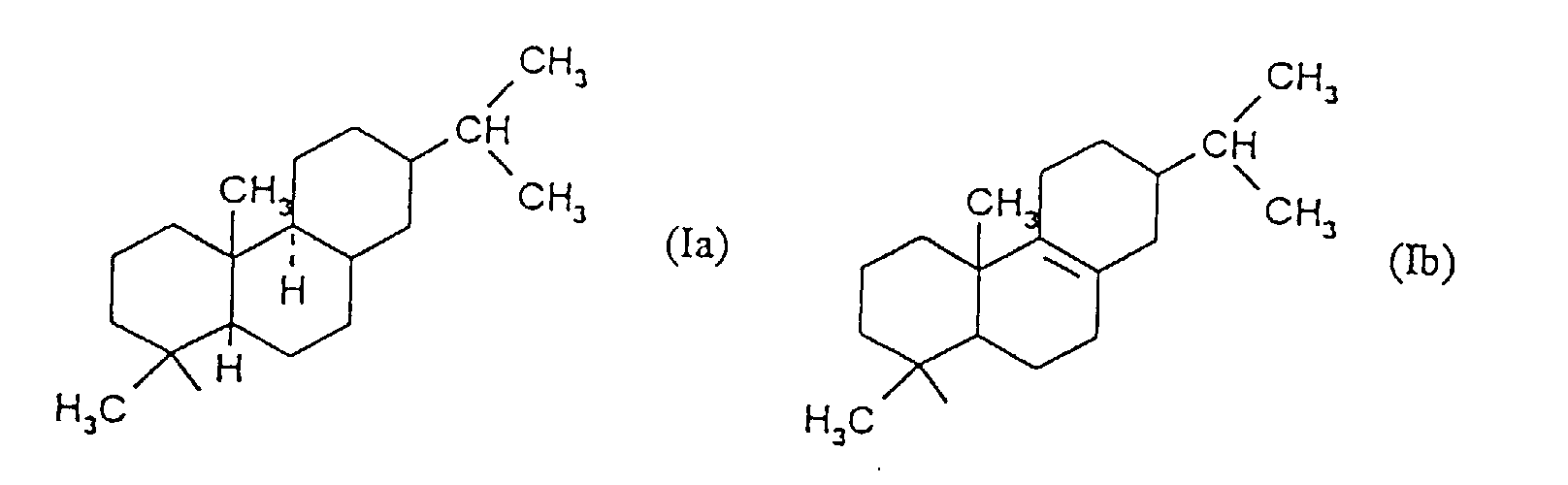
- the present invention thus preferably relates to polycarbonates M w (weight average molecular weights determined via the relative solution viscosity in CH 2 Cl 2 at 25 ° C. and 0.5 g per 100 ml CH 2 Cl 2 ) from 10,000 to 200,000, preferably from 30,000 to 70,000, of the formula (III) where HAb is the hydrogenated radical of formula (Ia), -D- is the divalent radical of formula (II) and "n" is the degree of polymerization from the weight average molecular weights M w from 10,000 to 200,000, preferably from 30,000 to 70,000 results.
- Suitable carbonate donors are preferably phosgene and diphenyl carbonate, but also the bischlorocarbonic acid esters of the diphenols to be used and the bis-phenyl carbonates the diphenols to be used.
- trifunctional compounds are 2,4-dihydroxybenzoic acid, Trimesic acid, cyanuric chloride and 3,3-bis (3-methyl-4-hydroxyphenyl) -2-oxo-2,3-dihydroindole.
- phase interface process solvent, aqueous alkaline phase, catalyst, temperature, pressure, workup are the usual, known. The same applies to the process in homogeneous phase (Pyridine process).
- the conditions of the melt transesterification process, temperature control, setting the reaction pressures, type and time of addition of the catalysts and Reactor types are also common.
- the polycarbonates according to the invention are preferably produced by the phase interface method (see H. Schnell, "Chemistry and Physics of Polycarbonates ", Polymer Reviews, Vol. IX, page 33ff., Interscience Publ., 1964).
- the diphenols, preferably of formula (II) are alkaline in aqueous Phase solved.
- those for the production of the invention Polycarbonates required amounts of hydrogenated abietic acid in one dissolved organic solvent, added.
- one inert, preferably polycarbonate-dissolving, organic phase with phosgene implemented the method of phase interface condensation.
- the reaction temperature lies between 0 and 40 ° C.
- Diphenols used on branching can either with the diphenols in be submitted to the aqueous alkaline phase or with the chain terminators in dissolved in the organic solvent before the phosgenation are added.
- diphenols instead of the diphenols to be used, their mono- and / or bischlorocarbonic acid esters can also be used can also be used, these in organic solvents be added solved.
- the amount of chain terminators as well Branching then depends on moles of diphenolate structural units, ie for example -O-D-O-; Likewise, when using chlorocarbonic acid ester The amount of phosgene can be reduced accordingly in a known manner.
- the hydrogenated abietic acid can also in the aqueous alkaline phase be presented along with the diphenols at the start of the reaction, however also added dissolved in organic solvent during phosgenation become.
- Suitable organic solvents for the solution of the hydrogenated Abietic acid and optionally for the branching agents and the chlorocarbonic acid esters are, for example, methylene chloride, chlorobenzene, acetone, Acetonitrile and mixtures of these solvents, especially mixtures of Methylene chloride and chlorobenzene.
- the production of the polycarbonates according to the invention by the phase interface process can in the usual way by catalysts such as tertiary Amines, especially tertiary aliphatic amines such as tributylamine or triethylamine catalyzed; the catalysts can be used in amounts from 0.05 to 10 mol%, based on moles of diphenols or moles used Diphenolate structural units can be used.
- the catalysts can Beginning of phosgenation or during or after phosgenation be added.
- polycarbonates according to the invention are isolated in a known manner.
- the polycarbonates according to the invention can be the usual ones for polycarbonates Contain additives in the usual amounts, e.g. stabilizers, Fillers, mold release agents, pigments and / or flame retardants. One can add them in a known manner during or after the polycarbonate production.
- the polycarbonates according to the invention can be used in any known manner Shaped bodies via extrusion or injection molding on the known processing machines are processed.
- the polycarbonates according to the invention and the moldings produced therefrom are characterized by the good combination of properties mentioned at the beginning.
- the process according to the invention for producing the aromatic polycarbonates with the end groups of the formula (I) can also be used to prepare stretch aromatic polyester carbonates by adding a portion of the carbonate donor by reactive aromatic dicarboxylic acid derivatives, preferably by aroamtic Dicarboxylic acid dichloride or aromatic dicarboxylic acid dimethyl ester is replaced, depending on whether you are in solution (phase interface method, pyridine method) or works in the melt.
- the present invention thus also relates to the use of hydrogenated abietic acid as chain terminator for the production of thermoplastic, aromatic polyester carbonates.
- the present invention thus also relates to a method for Production of thermoplastic, aromatic polyester carbonates from Diphenols, carbonate donors, reactive aromatic dicarboxylic acid derivatives, Chain breakers and optionally branching according to the known methods the phase boundary process, the process in homogeneous solution or the Melt transesterification process, which is characterized in that as Chain terminator hydrogenated abietic acid, preferably tetrahydroabietic acid in Amounts of 0.6 to 12 mol%, preferably 2 to 7 mol%, based on moles uses diphenols.
- Chain terminator hydrogenated abietic acid preferably tetrahydroabietic acid in Amounts of 0.6 to 12 mol%, preferably 2 to 7 mol%, based on moles uses diphenols.
- Reactive aromatic dicarboxylic acid derivatives are those which are among the React bifunctional conditions of polycarbonate production. Are preferred as already mentioned, the di-acid dichloride and the di-acid dimethyl ester.
- Preferred aromatic dicarboxylic acids are isophthalic acid and terephthalic acid and their mixtures, the preferred derivatives of which are dichlorides and Dimethyl ester.
- polyester carbonates according to the invention are again produced preferably according to the phase interface method as already for the production the corresponding polycarbonates described, part of the Phosgens is replaced by aroamtic dicarboxylic acid dichlorides.
- the ratio of carbonate donor to reactive aromatic dicarboxylic acid derivative can vary within wide limits, preferably up to 40 mol%, based on the molar sum of carbonate donor + dicarboxylic acid derivative, by the reactive aromatic dicarboxylic acid derivatives can be replaced, depending on how much the polycarbonates according to the invention lead to even higher heat resistance should be modified.
- the present invention thus also relates to the aromatic polyester carbonates with average molecular weights obtainable by the process according to the invention M w (weight average, determined from 10,000 to 200,000, preferably from 30,000 to 70,000
- the present invention also relates to thermoplastic, aromatic, optionally branched polyester carbonates with weight average molecular weights M w (determined as above) from 10,000 to 200,000, preferably from 30,000 to 70,000, with end groups of the formula (I).
- the polyester carbonates according to the invention have increased heat resistance with increased low-temperature impact strength at the same time.
- the Material is transparent and temperature stable like common polycarbonate.
- Polyester carbonate is preferred for medical applications wherever steam sterilization is used for optical applications and Information store.
- polycarbonates according to the invention can be advantageous anywhere there be used where higher heat resistance is desired.
- the polycarbonate terminated with hydrogenated abietic acid had a heat resistance (Vicat B) of 155 ° C and a transition between toughness and brittle fracture at -20 ° C in the impact test.
- the product is transparent and borderless and does not change color when heated to 280 ° C (2 min under N 2 ).
- Interfacial polycarbonate with a relative solution viscosity of 1.28 has a heat resistance (Vicat B) of 149 ° C and in the impact test, a transition between tough and brittle fracture between 0 ° C and -10 ° C.
- the procedure was as described in the exemplary embodiment, except that 0.912 g of abietic acid was used instead of the hydrogenated abietic acid.
- the product showed a relative solution viscosity of 1.28 and had a heat resistance (Vicat B) of 155 ° C, but the inherent color of the products was yellowish and turned brown when heated to 280 ° C (2 min under N 2 ).
Landscapes
- Chemical & Material Sciences (AREA)
- Health & Medical Sciences (AREA)
- Chemical Kinetics & Catalysis (AREA)
- Medicinal Chemistry (AREA)
- Polymers & Plastics (AREA)
- Organic Chemistry (AREA)
- Polyesters Or Polycarbonates (AREA)
Claims (8)
- Utilisation d'acide abiétique hydrogéné à titre d'agent de rupture de chaíne pour la préparation de polycarbonates aromatiques thermoplastiques.
- Procédé pour la préparation de polycarbonates aromatiques thermoplastiques à partir de phénols, de générateurs de carbonates, d'agents de rupture de chaínes et, le cas échéant, d'agents de ramification conformément aux méthodes connues du procédé à l'interface, du procédé en solution homogène ou du procédé de trans-estérification en fusion, caractérisé en ce qu'on met en oeuvre, à titre d'agent de rupture de chaíne, de l'acide abiétique hydrogéné, de préférence l'acide tétrahydroabiétique dans des quantités de 0,6 à 12 moles % rapportés au nombre de moles des diphénols mis en oeuvre.
- Polycarbonates possédant des poids moléculaires
M w (moyenne pondérale, déterminée [sic] de 10.000 à 200.000, que l'on obtient conformément au procédé selon la revendication 2. - Polycarbonates aromatiques thermoplastiques, le cas échéant ramifiés, possédant des poids moléculaires moyens en poids
M w (déterminés comme indiqué à la revendication 3) de 10.000 à 200.000, contenant des groupes terminaux répondant à la formule (I)dans laquelle
- HAb
- représente le radical hydrogéné répondant à la
formule (Ia) et/ou à la formule (Ib)
- Utilisation d'acide abiétique hydrogéné à titre d'agent de rupture de chaíne pour la préparation de polyestercarbonates aromatiques thermoplastiques.
- Procédé pour la préparation de polyestercarbonates aromatiques thermoplastiques à partir de diphénols, de générateurs de carbonates, de dérivés réactifs d'acides dicarboxyliques aromatiques, d'agents de rupture de chaínes et, le cas échéant, d'agents de ramification conformément aux méthodes connues du procédé à l'interface, du procédé en solution homogène ou du procédé de trans-estérification en fusion, caractérisé en ce qu'on met en oeuvre, à titre d'agent de rupture de chaíne, de l'acide abiétique hydrogéné, de préférence l'acide tétrahydroabiétique dans des quantités de 0,6 à 12 moles % rapportés au nombre de moles des diphénols mis en oeuvre.
- Polyestercarbonates possédant des poids moléculaires moyens
M w (moyenne pondérale, déterminée via la viscosité relative en solution dans du CH2Cl2 à 25°C et à concurrence de 0,5 g par 100 ml de CH2Cl2) de 10.000 à 200.000, que l'on obtient conformément au procédé selon la revendication 6. - Polyestercarbonates aromatiques thermoplastiques, le cas échéant ramifiés, possédant des poids moléculaires moyens en poids
M w (déterminés comme indiqué à la revendication 7) de 10.000 à 200.000, contenant des groupes terminaux répondant à la formule (I) selon la revendication 4.
Applications Claiming Priority (2)
| Application Number | Priority Date | Filing Date | Title |
|---|---|---|---|
| DE4413397 | 1994-04-18 | ||
| DE4413397A DE4413397A1 (de) | 1994-04-18 | 1994-04-18 | Verwendung von hydrierter Abietinsäure als Kettenabbrecher für die Herstellung von Polycarbonaten und von Polyestercarbonaten |
Publications (3)
| Publication Number | Publication Date |
|---|---|
| EP0678538A2 EP0678538A2 (fr) | 1995-10-25 |
| EP0678538A3 EP0678538A3 (fr) | 1996-03-20 |
| EP0678538B1 true EP0678538B1 (fr) | 1999-03-03 |
Family
ID=6515743
Family Applications (1)
| Application Number | Title | Priority Date | Filing Date |
|---|---|---|---|
| EP95105092A Expired - Lifetime EP0678538B1 (fr) | 1994-04-18 | 1995-04-05 | Utilisation d'acide abiétique hydrogené comme agent de terminaison de chaíne dans la préparation de polycarbonates et de polyestercarbonates |
Country Status (6)
| Country | Link |
|---|---|
| US (1) | US5554716A (fr) |
| EP (1) | EP0678538B1 (fr) |
| JP (1) | JP3329421B2 (fr) |
| CN (2) | CN1068610C (fr) |
| DE (2) | DE4413397A1 (fr) |
| HK (1) | HK1044786A1 (fr) |
Families Citing this family (1)
| Publication number | Priority date | Publication date | Assignee | Title |
|---|---|---|---|---|
| JP5734779B2 (ja) * | 2010-12-24 | 2015-06-17 | 富士フイルム株式会社 | ポリエステル重合体、樹脂組成物、成形体、及びフィルム |
Family Cites Families (3)
| Publication number | Priority date | Publication date | Assignee | Title |
|---|---|---|---|---|
| US4358563A (en) * | 1981-02-17 | 1982-11-09 | General Electric Company | Polycarbonate composition |
| JPH04168103A (ja) * | 1990-10-31 | 1992-06-16 | Takeda Chem Ind Ltd | 樹脂 |
| JPH1014266A (ja) * | 1996-06-21 | 1998-01-16 | Sony Corp | 静電チャック装置及び静電チャックを用いたウエハの保持方法及び静電チャックからのウエハの脱着方法 |
-
1994
- 1994-04-18 DE DE4413397A patent/DE4413397A1/de not_active Withdrawn
-
1995
- 1995-04-05 EP EP95105092A patent/EP0678538B1/fr not_active Expired - Lifetime
- 1995-04-05 DE DE59505163T patent/DE59505163D1/de not_active Expired - Fee Related
- 1995-04-06 US US08/417,821 patent/US5554716A/en not_active Expired - Fee Related
- 1995-04-13 CN CN95104210A patent/CN1068610C/zh not_active Expired - Fee Related
- 1995-04-14 JP JP11260895A patent/JP3329421B2/ja not_active Expired - Fee Related
-
2000
- 2000-10-24 CN CN00133193A patent/CN1348967A/zh active Pending
-
2002
- 2002-08-26 HK HK02106288.6A patent/HK1044786A1/zh unknown
Also Published As
| Publication number | Publication date |
|---|---|
| CN1068610C (zh) | 2001-07-18 |
| EP0678538A2 (fr) | 1995-10-25 |
| JP3329421B2 (ja) | 2002-09-30 |
| CN1348967A (zh) | 2002-05-15 |
| CN1112574A (zh) | 1995-11-29 |
| DE4413397A1 (de) | 1995-10-19 |
| HK1044786A1 (zh) | 2002-11-01 |
| EP0678538A3 (fr) | 1996-03-20 |
| US5554716A (en) | 1996-09-10 |
| JPH07292090A (ja) | 1995-11-07 |
| DE59505163D1 (de) | 1999-04-08 |
Similar Documents
| Publication | Publication Date | Title |
|---|---|---|
| EP0010602B1 (fr) | Polycarbonates à groupes terminaux alcoylphényl et leur préparation | |
| WO2008037364A1 (fr) | polycarbonates et copolycarbonates à adhérence améliorée sur les métaux | |
| EP0078943A1 (fr) | Procédé pour la fabrication de polycarbonates avec un processus de vieillissement | |
| DE3308691A1 (de) | Willkuerlich verzweigtes polycarbonat aus einem bisphenol und einem polyolchlorformiat und verfahren zu seiner herstellung | |
| EP0065728B1 (fr) | Copolyestercarbonates et leur mélange avec des polycarbonates connus pour former des masses à mouler thermoplastiques | |
| EP1203044A1 (fr) | Polycarbonates contenant des silicones a fonction d'ester d'acide aspartique | |
| EP0102573B1 (fr) | Polycarbonates contenant des groupements terminaux renfermant des doubles liaisons conjuguées, leur mélange avec des polycarbonates aromatiques connus, leur procédé de préparation et leurs utilisations | |
| EP0678538B1 (fr) | Utilisation d'acide abiétique hydrogené comme agent de terminaison de chaíne dans la préparation de polycarbonates et de polyestercarbonates | |
| EP0432580B1 (fr) | Procédé en deux étapes pour la préparation de polycarbonates à partir de dihydroxydiphényl alcanes particuliers | |
| EP0423562B1 (fr) | Polycarbonates ayant une stabilité dimensionnelle à chaud plus élevée | |
| EP0472064A2 (fr) | Mélanges ternaires | |
| EP0327951B1 (fr) | Polycarbonates ayant des groupes terminaux d'arylalcoylphényls, leur préparation et leur utilisation | |
| DE3513715A1 (de) | Polycarbonate mit dichlormaleinimid-endgruppen, ihre herstellung und modifizierung | |
| US5212280A (en) | Polycarbonate from special dihydroxydiphenyl bicycloalkane | |
| EP1242501B1 (fr) | Polyether-carbonates | |
| EP0457102A2 (fr) | Bisphénols à fonction ester d'alkyle tertiaire, leur procédé de préparation et leur utilisation | |
| EP0676436B1 (fr) | Polycarbonates aromatiques avec des groupes terminaux cétocarboxyliques polyoléfiniques mélangés avec des polycarbonates connus | |
| EP0183144A2 (fr) | Polycarbonates à groupes terminaux diméthylmaléinimides mélangés éventuellement avec des polycarbonates aromatiques connus, leur préparation et leur modification | |
| DE10128705A1 (de) | Polycarbonate, Polyestercarbonate und Polyester mit verzweigten Endgruppen | |
| DE2716304A1 (de) | Verfahren zur herstellung von polycarbonatgemischen | |
| DE4424399A1 (de) | Polycarbonate mit aliphatischen, Ketocarboxyl-Endgruppen, gegebenenfalls im Gemisch mit bekannten aromatischen Polycarbonaten, ihre Herstellung und ihre Verwendung | |
| DE4003437A1 (de) | Spezielle dihydroxydiphenylcycloalkane, ihre herstellung und ihre verwendung zur herstellung von hochmolekularen polycarbonaten | |
| DE4033098A1 (de) | Sulfongruppenhaltige dihydroxydiphenylverbindungen, ihre herstellung und ihre verwendung zur herstellung von hochmolekularen polycarbonaten | |
| DE4413002A1 (de) | Verfahren zur Verklebung von Formteilen aus Polycarbonat | |
| EP0340522A2 (fr) | Polyester et polyester carbonate aromatique ayant des groupes terminaux d'aralkylphenyle, sa préparation et son utilisation |
Legal Events
| Date | Code | Title | Description |
|---|---|---|---|
| PUAI | Public reference made under article 153(3) epc to a published international application that has entered the european phase |
Free format text: ORIGINAL CODE: 0009012 |
|
| AK | Designated contracting states |
Kind code of ref document: A2 Designated state(s): BE DE FR GB IT NL |
|
| PUAL | Search report despatched |
Free format text: ORIGINAL CODE: 0009013 |
|
| AK | Designated contracting states |
Kind code of ref document: A3 Designated state(s): BE DE FR GB IT NL |
|
| 17P | Request for examination filed |
Effective date: 19960823 |
|
| GRAG | Despatch of communication of intention to grant |
Free format text: ORIGINAL CODE: EPIDOS AGRA |
|
| 17Q | First examination report despatched |
Effective date: 19980415 |
|
| GRAG | Despatch of communication of intention to grant |
Free format text: ORIGINAL CODE: EPIDOS AGRA |
|
| GRAH | Despatch of communication of intention to grant a patent |
Free format text: ORIGINAL CODE: EPIDOS IGRA |
|
| GRAH | Despatch of communication of intention to grant a patent |
Free format text: ORIGINAL CODE: EPIDOS IGRA |
|
| GRAA | (expected) grant |
Free format text: ORIGINAL CODE: 0009210 |
|
| AK | Designated contracting states |
Kind code of ref document: B1 Designated state(s): BE DE FR GB IT NL |
|
| REF | Corresponds to: |
Ref document number: 59505163 Country of ref document: DE Date of ref document: 19990408 |
|
| ITF | It: translation for a ep patent filed | ||
| ET | Fr: translation filed | ||
| GBT | Gb: translation of ep patent filed (gb section 77(6)(a)/1977) |
Effective date: 19990525 |
|
| PLBE | No opposition filed within time limit |
Free format text: ORIGINAL CODE: 0009261 |
|
| STAA | Information on the status of an ep patent application or granted ep patent |
Free format text: STATUS: NO OPPOSITION FILED WITHIN TIME LIMIT |
|
| 26N | No opposition filed | ||
| REG | Reference to a national code |
Ref country code: GB Ref legal event code: IF02 |
|
| PGFP | Annual fee paid to national office [announced via postgrant information from national office to epo] |
Ref country code: GB Payment date: 20020404 Year of fee payment: 8 |
|
| PGFP | Annual fee paid to national office [announced via postgrant information from national office to epo] |
Ref country code: FR Payment date: 20020411 Year of fee payment: 8 |
|
| PGFP | Annual fee paid to national office [announced via postgrant information from national office to epo] |
Ref country code: DE Payment date: 20030314 Year of fee payment: 9 |
|
| PGFP | Annual fee paid to national office [announced via postgrant information from national office to epo] |
Ref country code: NL Payment date: 20030331 Year of fee payment: 9 |
|
| PG25 | Lapsed in a contracting state [announced via postgrant information from national office to epo] |
Ref country code: GB Free format text: LAPSE BECAUSE OF NON-PAYMENT OF DUE FEES Effective date: 20030405 |
|
| PGFP | Annual fee paid to national office [announced via postgrant information from national office to epo] |
Ref country code: BE Payment date: 20030430 Year of fee payment: 9 |
|
| GBPC | Gb: european patent ceased through non-payment of renewal fee |
Effective date: 20030405 |
|
| PG25 | Lapsed in a contracting state [announced via postgrant information from national office to epo] |
Ref country code: FR Free format text: LAPSE BECAUSE OF NON-PAYMENT OF DUE FEES Effective date: 20031231 |
|
| REG | Reference to a national code |
Ref country code: FR Ref legal event code: ST |
|
| PG25 | Lapsed in a contracting state [announced via postgrant information from national office to epo] |
Ref country code: BE Free format text: LAPSE BECAUSE OF NON-PAYMENT OF DUE FEES Effective date: 20040430 |
|
| BERE | Be: lapsed |
Owner name: *BAYER A.G. Effective date: 20040430 |
|
| PG25 | Lapsed in a contracting state [announced via postgrant information from national office to epo] |
Ref country code: NL Free format text: LAPSE BECAUSE OF NON-PAYMENT OF DUE FEES Effective date: 20041101 |
|
| PG25 | Lapsed in a contracting state [announced via postgrant information from national office to epo] |
Ref country code: DE Free format text: LAPSE BECAUSE OF NON-PAYMENT OF DUE FEES Effective date: 20041103 |
|
| NLV4 | Nl: lapsed or anulled due to non-payment of the annual fee |
Effective date: 20041101 |
|
| PG25 | Lapsed in a contracting state [announced via postgrant information from national office to epo] |
Ref country code: IT Free format text: LAPSE BECAUSE OF NON-PAYMENT OF DUE FEES Effective date: 20050405 |