EP0678809A2 - System zur Automatisierung der Stapelverarbeitung von Datenanalysen - Google Patents
System zur Automatisierung der Stapelverarbeitung von Datenanalysen Download PDFInfo
- Publication number
- EP0678809A2 EP0678809A2 EP95104991A EP95104991A EP0678809A2 EP 0678809 A2 EP0678809 A2 EP 0678809A2 EP 95104991 A EP95104991 A EP 95104991A EP 95104991 A EP95104991 A EP 95104991A EP 0678809 A2 EP0678809 A2 EP 0678809A2
- Authority
- EP
- European Patent Office
- Prior art keywords
- protocols
- processor
- batch
- data analysis
- user
- Prior art date
- Legal status (The legal status is an assumption and is not a legal conclusion. Google has not performed a legal analysis and makes no representation as to the accuracy of the status listed.)
- Withdrawn
Links
Images



Classifications
-
- G—PHYSICS
- G06—COMPUTING OR CALCULATING; COUNTING
- G06F—ELECTRIC DIGITAL DATA PROCESSING
- G06F9/00—Arrangements for program control, e.g. control units
- G06F9/06—Arrangements for program control, e.g. control units using stored programs, i.e. using an internal store of processing equipment to receive or retain programs
- G06F9/44—Arrangements for executing specific programs
Definitions
- a central problem in the automation of data analysis applied to large batches of datafiles is the manner in which the workload gets delegated to the computer.
- the specification of process should support incremental delegation , i.e., the ability to extend the repertoire of autonomous behavior by building off of simpler behaviors which have already been successfully delegated. This process should ideally emulate the way a supervisor hands off increasingly complex work to his or her subordinate with the accumulation of work experience.
- Implicit to incremental delegation is the ability to assign names to familiar tasks, treating them as abstract units deserving either no elaboration, or only slight modification. Novel combinations of familiar behaviors thus may be pieced together without having to re-specify the familiar behaviors.
- This invention presents a new approach to data analysis by use of a multilayer protocol-document system, for use in applications where data is analyzed especially where large volumes of data are analyzed.
- An example of such an application is the one described in U.S. Patent Application Serial No. 751,020 filed August 28, 1991 which application is incorporated herein by reference.
- the system obliges the user to specify a given process in terms of a set of protocols. These protocols depend on a generic process-engine which "knows" very generally the basics of the process to be carried out, but which needs to be filled in with specifics before it can do anything; These specifics are retained in the protocol.
- each document consists of a set of objects, where each object consists of a related set of fields, and whereby every field of every object is editable.
- the same protocol-engine architecture can be repeated at a higher level of process abstraction.
- a variety of levels of processes can be downloaded by the same generic batch process engine, which engine is instructed by the downloaded protocol.
- the multilayer architecture is tied together by virtue of the fact that the batch protocol specifies a sequence of lower-level protocols to be downloaded in their lower-level process engine.
- multilayer protocol-document systems represent an advance over formal programming language and scripting systems (easier to learn to use, more robust in the hands of non-programmers), and over record-playback systems (process components are editable and thus more easily reusable).
- process components are editable and thus more easily reusable.
- multilayer protocol-document systems represent a significant advance over prior art in the arena of automation systems software for batch data analysis process control.
- the user will define a plurality of fully editable protocols, each of which comprises a set of instructions capable of being run by a generic process-engine contained within the processor (e.g., a computer). These protocols are then loaded into the processor and combined by the user to define fields, which fields can be grouped into sets to define objects. These objects are accessible to the user by means of a user-processor interface (e.g., keyboard, mouse, etc.). Thus, the user can "instruct" the system to run a set of protocols by accessing the object. Further, since the protocols are editable, modifications of the object processes can be easily achieved.
- Figure 1 presents an illustration of the principal user-interface controls for batch data analysis.
- Figure 2 presents an illustration of the user-interface of Figure 1, modified by varying high level parameters.
- Figure 3 presents the plots obtained from the CD3, CD4, CD8, A1 protocol of Figure 2.
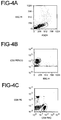
- Figure 4 presents the plots obtained from the protocol illustrated in Figure 3, modified by the addition of an additional cell population to the method.
- Figure 5 presents a flow diagram for the batch processing engine.
- Figure 1 illustrates the principal user-interface controls for specifying a batch data analysis protocol at a high-level of abstraction. For example, on the right side of the dialog, the user assigns finished low-level analysis protocols to slots for processing a sequence of stained cell preparation recordings. None other than the name of each protocol and its sequence position is known at this high-level of specification (a file system path is specified in the internals of the high-level, batch protocol).
- an underlying analysis protocol document may be opened and modified. The batch process may be rerun, and the underlying analysis protocol will reflect the new behavior.
- Figure 2 presents the principal user interface, modified by a change to high level parameters.
- Several high level editions to the batch process from the previous configuration in ( Figure 1) are on the right-hand side.
- An additional analysis protocol document has been added to the existing list of protocols.
- other input and output parameters have been changed for the batch protocol.
- the input parameter specifying the target data folder has been changed, thus redirecting the batch process to analyze a different input fileset.
- the output parameters have been changed to request printer output instead of spreadsheet and Attractor outlines.
- Figure 3 illustrates one of the analysis protocols during execution of the batch process specified in Figure 2.
- the CD3,CD4,CD8,A1 protocol consists of a set of data views and a set of populations (a population hierarchy).
- a generic low-level engine executing the CD3,CD4,CD8,A1 protocol on the VN09013001 data file classifies the data, and renders colored scatter plots and population statistics (not shown).
- the Cancel, Resume, and Pause buttons offer high-level interrupt control over the batch process flow of control.
- Figure 4 shows the same batch process employing a slightly modified version of the same analysis method. There is an additional target population added to the analysis method (Untitled, yellow population). The change to the analysis method required no change to the batch process protocol.
Landscapes
- Engineering & Computer Science (AREA)
- Software Systems (AREA)
- Theoretical Computer Science (AREA)
- Physics & Mathematics (AREA)
- General Engineering & Computer Science (AREA)
- General Physics & Mathematics (AREA)
- Stored Programmes (AREA)
- Machine Translation (AREA)
Applications Claiming Priority (2)
| Application Number | Priority Date | Filing Date | Title |
|---|---|---|---|
| US22692594A | 1994-04-13 | 1994-04-13 | |
| US226925 | 1994-04-13 |
Publications (2)
| Publication Number | Publication Date |
|---|---|
| EP0678809A2 true EP0678809A2 (de) | 1995-10-25 |
| EP0678809A3 EP0678809A3 (de) | 1997-07-09 |
Family
ID=22851018
Family Applications (1)
| Application Number | Title | Priority Date | Filing Date |
|---|---|---|---|
| EP95104991A Withdrawn EP0678809A3 (de) | 1994-04-13 | 1995-04-04 | System zur Automatisierung der Stapelverarbeitung von Datenanalysen. |
Country Status (2)
| Country | Link |
|---|---|
| EP (1) | EP0678809A3 (de) |
| CA (1) | CA2146710A1 (de) |
Cited By (1)
| Publication number | Priority date | Publication date | Assignee | Title |
|---|---|---|---|---|
| US8615378B2 (en) | 2010-04-05 | 2013-12-24 | X&Y Solutions | Systems, methods, and logic for generating statistical research information |
Families Citing this family (1)
| Publication number | Priority date | Publication date | Assignee | Title |
|---|---|---|---|---|
| CN110557377B (zh) * | 2019-08-01 | 2021-08-27 | 福建星云电子股份有限公司 | 动力电池配对修复设备兼容多种通信协议的方法及系统 |
Family Cites Families (3)
| Publication number | Priority date | Publication date | Assignee | Title |
|---|---|---|---|---|
| US5297288A (en) * | 1989-11-28 | 1994-03-22 | United States Biochemical Corporation | System for use with a high resolution scanner for scheduling a sequence of software tools for determining the presence of bands in DNA sequencing samples |
| JPH05503180A (ja) * | 1989-12-13 | 1993-05-27 | バイオ―ロジック・システムズ・コーポレーション | コンピュータ支援による睡眠の分析 |
| DE69125041T2 (de) * | 1990-03-19 | 1997-10-09 | Del Mar Avionics | Verfahren und Gerät zur Spektralanalyse von elektrokardiographischen Signalen |
-
1995
- 1995-04-04 EP EP95104991A patent/EP0678809A3/de not_active Withdrawn
- 1995-04-10 CA CA002146710A patent/CA2146710A1/en not_active Abandoned
Cited By (1)
| Publication number | Priority date | Publication date | Assignee | Title |
|---|---|---|---|---|
| US8615378B2 (en) | 2010-04-05 | 2013-12-24 | X&Y Solutions | Systems, methods, and logic for generating statistical research information |
Also Published As
| Publication number | Publication date |
|---|---|
| EP0678809A3 (de) | 1997-07-09 |
| CA2146710A1 (en) | 1995-10-14 |
Similar Documents
| Publication | Publication Date | Title |
|---|---|---|
| Tatham et al. | The MED-PC experimental apparatus programming system | |
| Moher | PROVIDE: A process visualization and debugging environment | |
| Ossher et al. | Hyper/J: multi-dimensional separation of concerns for Java | |
| US5237688A (en) | Software packaging structure having hierarchical replaceable units | |
| Lauer et al. | The Impact of Mesa on System Design. | |
| EP0642077A1 (de) | Offenes Prozesssteuerungssystem | |
| Eisenstein et al. | Agents and GUIs from task models | |
| Walker et al. | The symbolics Genera programming environment | |
| EP0678809A2 (de) | System zur Automatisierung der Stapelverarbeitung von Datenanalysen | |
| Taylor et al. | Arcadia, a software development environment research project | |
| Rosson et al. | Climbing the smalltalk mountain | |
| Trammell et al. | The incremental development process in cleanroom software engineering | |
| Christie | A practical guide to the technology and adoption of software process automation | |
| Bellman | An approach to integrating and creating flexible software environments supporting the design of complex systems. | |
| Puerta et al. | Interactively mapping task models to interfaces in MOBI-D | |
| US20090031294A1 (en) | Methodology for Generating Accessing Functions for Programmed Execution of Panel-Driven Business Applications | |
| Hilderink et al. | A new Java thread model for concurrent programming of real-time systems | |
| Fulton | Configuration management in the X Window system | |
| Kifer et al. | OSP: an environment for operating system projects | |
| Christian et al. | An open-source XML framework for authoring curricular material | |
| TWI774469B (zh) | 程式編譯管理系統與其作業方法 | |
| Geppert et al. | Combining SDL Patterns with Continuous Quality Improvement: An Experience Factory Tailored to SDL Patterns | |
| Rose et al. | The N. mPc system description facility | |
| Greene et al. | A flexible programming language for generating stimulus lists for cognitive psychology experiments | |
| Eisenstein et al. | TIMM: Exploring Task-Interface Links in MOBI-D |
Legal Events
| Date | Code | Title | Description |
|---|---|---|---|
| PUAI | Public reference made under article 153(3) epc to a published international application that has entered the european phase |
Free format text: ORIGINAL CODE: 0009012 |
|
| AK | Designated contracting states |
Kind code of ref document: A2 Designated state(s): DE ES FR GB IT NL |
|
| PUAL | Search report despatched |
Free format text: ORIGINAL CODE: 0009013 |
|
| AK | Designated contracting states |
Kind code of ref document: A3 Designated state(s): DE ES FR GB IT NL |
|
| STAA | Information on the status of an ep patent application or granted ep patent |
Free format text: STATUS: THE APPLICATION IS DEEMED TO BE WITHDRAWN |
|
| 18D | Application deemed to be withdrawn |
Effective date: 19980110 |