EP0678994A2 - Übertragungssteuersverfahren und -gerät - Google Patents
Übertragungssteuersverfahren und -gerät Download PDFInfo
- Publication number
- EP0678994A2 EP0678994A2 EP95302698A EP95302698A EP0678994A2 EP 0678994 A2 EP0678994 A2 EP 0678994A2 EP 95302698 A EP95302698 A EP 95302698A EP 95302698 A EP95302698 A EP 95302698A EP 0678994 A2 EP0678994 A2 EP 0678994A2
- Authority
- EP
- European Patent Office
- Prior art keywords
- simultaneous
- command
- simultaneous command
- received
- terminal
- Prior art date
- Legal status (The legal status is an assumption and is not a legal conclusion. Google has not performed a legal analysis and makes no representation as to the accuracy of the status listed.)
- Granted
Links
Images




Classifications
-
- H—ELECTRICITY
- H04—ELECTRIC COMMUNICATION TECHNIQUE
- H04L—TRANSMISSION OF DIGITAL INFORMATION, e.g. TELEGRAPHIC COMMUNICATION
- H04L12/00—Data switching networks
- H04L12/28—Data switching networks characterised by path configuration, e.g. LAN [Local Area Networks] or WAN [Wide Area Networks]
- H04L12/40—Bus networks
- H04L12/407—Bus networks with decentralised control
- H04L12/413—Bus networks with decentralised control with random access, e.g. carrier-sense multiple-access with collision detection [CSMA-CD]
-
- H—ELECTRICITY
- H04—ELECTRIC COMMUNICATION TECHNIQUE
- H04L—TRANSMISSION OF DIGITAL INFORMATION, e.g. TELEGRAPHIC COMMUNICATION
- H04L12/00—Data switching networks
- H04L12/02—Details
- H04L12/16—Arrangements for providing special services to substations
- H04L12/18—Arrangements for providing special services to substations for broadcast or conference, e.g. multicast
-
- H—ELECTRICITY
- H04—ELECTRIC COMMUNICATION TECHNIQUE
- H04L—TRANSMISSION OF DIGITAL INFORMATION, e.g. TELEGRAPHIC COMMUNICATION
- H04L12/00—Data switching networks
- H04L12/28—Data switching networks characterised by path configuration, e.g. LAN [Local Area Networks] or WAN [Wide Area Networks]
- H04L12/2803—Home automation networks
-
- H—ELECTRICITY
- H04—ELECTRIC COMMUNICATION TECHNIQUE
- H04L—TRANSMISSION OF DIGITAL INFORMATION, e.g. TELEGRAPHIC COMMUNICATION
- H04L12/00—Data switching networks
- H04L12/28—Data switching networks characterised by path configuration, e.g. LAN [Local Area Networks] or WAN [Wide Area Networks]
- H04L12/2803—Home automation networks
- H04L12/2816—Controlling appliance services of a home automation network by calling their functionalities
-
- H—ELECTRICITY
- H04—ELECTRIC COMMUNICATION TECHNIQUE
- H04L—TRANSMISSION OF DIGITAL INFORMATION, e.g. TELEGRAPHIC COMMUNICATION
- H04L12/00—Data switching networks
- H04L12/28—Data switching networks characterised by path configuration, e.g. LAN [Local Area Networks] or WAN [Wide Area Networks]
- H04L12/2803—Home automation networks
- H04L12/2823—Reporting information sensed by appliance or service execution status of appliance services in a home automation network
-
- H—ELECTRICITY
- H04—ELECTRIC COMMUNICATION TECHNIQUE
- H04L—TRANSMISSION OF DIGITAL INFORMATION, e.g. TELEGRAPHIC COMMUNICATION
- H04L12/00—Data switching networks
- H04L12/28—Data switching networks characterised by path configuration, e.g. LAN [Local Area Networks] or WAN [Wide Area Networks]
- H04L12/40—Bus networks
- H04L12/40143—Bus networks involving priority mechanisms
-
- H—ELECTRICITY
- H04—ELECTRIC COMMUNICATION TECHNIQUE
- H04L—TRANSMISSION OF DIGITAL INFORMATION, e.g. TELEGRAPHIC COMMUNICATION
- H04L12/00—Data switching networks
- H04L12/28—Data switching networks characterised by path configuration, e.g. LAN [Local Area Networks] or WAN [Wide Area Networks]
- H04L12/2803—Home automation networks
- H04L2012/2847—Home automation networks characterised by the type of home appliance used
- H04L2012/2849—Audio/video appliances
Definitions
- the present invention relates to communication control methods and apparatus.
- the VTRs exchange commands among each other.
- the receiving terminal provides a response packet to the transmitting terminal; this response packet informs the transmitting terminal that the receiving terminal has received the command.
- the terminals in the network generate two types of commands: commands that can be performed simultaneously at any one particular terminal and commands that cannot be performed simultaneously at any one particular terminal.
- the first type of command is referred to as a simultaneous command
- the second type of command is referred to as a non-simultaneous command.
- a simultaneous command can be performed alone, or simultaneously with any other command to be performed at that terminal, including a non-simultaneous command.
- a non-simultaneous command is never performed simultaneously with another non-simultaneous command.
- a non-simultaneous command is performed at the terminal either alone or simultaneously with a simultaneous command.
- Examples of simultaneous commands are a counter reset command and an input switching command.
- non-simultaneous commands are a reproduction command, a recording command, a fast forward command, and a rewind command.
- Fig. 12 shows the implementation of the command communication technique described above.
- terminal (A) transmits to terminal (B) a plurality of non-simultaneous commands. Assuming that non-simultaneous command 1 is received first by terminal (B), terminal (B) begins executing non-simultaneous command 1. Terminal (B) also transmits to terminal (A) a busy signal 1, which indicates that terminal (B) is currently processing a command transmitted by terminal (A).
- terminal (B) If terminal (B) receives a second non-simultaneous command while it is processing non-simultaneous command 1, terminal (B) stops processing non-simultaneous command 1 and issues a reject signal 1, which indicates that terminal (B) has ceased processing non-simultaneous command 1. After transmitting reject signal 1, terminal (B) processes non-simultaneous command 2, and transmits busy signal 2. After terminal (B) has processed non-simultaneous command 2, terminal (B) transmits a complete signal 2 to terminal (A). Reference numeral "2" is used, instead of "1", because this complete signal corresponds to the completion of the second non-simultaneous command received at terminal (B). In this example, six packet signals were generated in order to execute one command.
- terminal (A) transmits to terminal (B) a non-simultaneous command 1 and a simultaneous command 2.
- terminal (B) After receiving non-simultaneous command 1 from terminal (A), terminal (B) transmits to terminal (A) a busy signal 1.
- terminal (B) After receiving simultaneous command 2 during the processing of non-simultaneous command 1, terminal (B) generates busy signal 2. In this situation, the non-simultaneous command 1 and simultaneous command 2 are performed concurrently. If non-simultaneous command 3 is then transmitted to terminal (B), terminal (B) halts the processing of non-simultaneous command 1 and issues a reject signal 1 to terminal (A).
- Terminal (B) then processes non-simultaneous command 3 and issues a busy signal 3 to terminal (A). After terminal (B) completes simultaneous command 2 and non-simultaneous command 3, it issues a complete signal 2 and a complete signal 3 to terminal (A). In such a case, nine packets are transmitted and received.
- This invention provides a terminal apparatus comprising: means for receiving at least one simultaneous command or at least one non-simultaneous command; means for selecting one of said received non-simultaneous commands; and means for executing said selected non-simultaneous commands.
- a communication control technique in which a plurality of terminals are connected to a common data bus. These terminals transmit and receive commands formed as packets, and these commands are categorized either as simultaneous commands or non-simultaneous commands. Every terminal includes a command selection communication control section which causes a receiving terminal to store the most recently received non-simultaneous command and to erase any previously stored non-simultaneous command.
- a receiving terminal does not provide to the transmitting terminal an acknowledgement of receipt for every received non-simultaneous command.
- the receiving terminal provides such a response only with respect to non-simultaneous commands that are executed.
- a reject signal is issued in order to inform the transmitting terminal that the corresponding command has not been executed. Consequently, the number of packets which are transmitted and received over the network is reduced.
- a command execution processing section of the receiving terminal executes the stored non-simultaneous command in the next predetermined period. With respect to received simultaneous commands, a receiving terminal executes such commands either in the same predetermined period in which they are received or in the next predetermined period, and such commands are executed simultaneously with any other commands that are currently being executed in the receiving terminal.
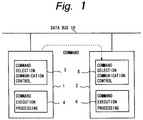
- Fig. 1 illustrates a network to which is applied the communication control method.
- the network comprises terminal 1, terminal 2, and data bus 10.
- Other terminals may be added to bus 10 since Fig. 1 merely illustrates an example of the preferred embodiment.
- These terminals may individually comprise various audio-video devices, such as VTRs, computers, or video displays.
- Terminal 1 includes a command selection communication control section 3 and a command execution processing section 4.
- terminal 2 also includes a command selection communication control section 5 and a command execution processing section 6.
- the command selection communication control section 5 of terminal 2 accepts any commands transmitted by terminal 1 over bus 10.
- the command selection communication control section 5 selects the command to be executed from among the commands received within a predetermined timing period.
- the predetermined timing period may be arbitrarily set to a particular duration; in this embodiment, the predetermined timing period is 17 ms.
- the command selection communication control section 5 supplies the selected command to the command execution processing section 6 for execution.
- terminal 2 executes a command transmitted by terminal 1.
- terminal 2 sends an acknowledgement signal, busy 1, back to terminal 1 and executes the received command within the same predetermined timing period in which the command was received.
- a non-simultaneous command transmitted by terminal 1 is first stored in the buffer of terminal 2 within a predetermined period. If the buffer already stores a previously received non-simultaneous command, the newly received non-simultaneous command is written over the previously stored non-simultaneous command. Furthermore, terminal 2 returns to terminal 1 a reject signal corresponding to the erased non-simultaneous command.
- terminal 2 executes the most recently stored non-simultaneous command and simultaneously transmits to terminal 1 a busy signal acknowledging receipt of the executed command. Terminal 2 sends to terminal 1 a complete signal when the command execution is finished.
- this embodiment confers the highest priority to the most recently received non-simultaneous command
- other embodiments of the present invention also provide for terminals that give the highest priority to the earliest received non-simultaneous command. In such a case, the receiving terminals would not store a new non-simultaneous command until the presently stored command had been fully executed.
- embodiments of the present invention also provide terminals that execute all received non-simultaneous commands according to a predetermined order.
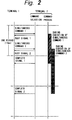
- Fig. 2 shows the operation where two simultaneous commands are received by terminal 2 within a predetermined period.
- terminal 2 receives simultaneous command 1, transmits busy signal 1, and begins executing the simultaneous command 1.
- Terminal 2 also receives simultaneous command 2 during period 1 and, as in the case of simultaneous command 1, terminal 2 transmits busy signal 2 and begins executing simultaneous command 2.
- the respective periods of execution of these commands may overlap one another to some extent, as indicated.
- the respective periods of execution of these commands are independent of the predetermined period of the command selection communication control section of each terminal.
- terminal 2 transmits complete signal 1 after the execution of simultaneous command 1 is completed.
- terminal 2 transmits complete signal 2 after the execution of simultaneous command 2 is completed.
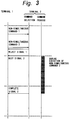
- Fig. 3 shows the operation where two non-simultaneous commands are received by terminal 2 within a predetermined period.
- terminal 2 receives, within a predetermined period of 17 ms, non-simultaneous command 1 first and then non-simultaneous command 2.
- This particular embodiment confers the highest priority to the most recently received non-simultaneous command and, therefore, terminal 2 stores in the buffer non-simultaneous command 2.
- terminal 2 Upon the receipt of non-simultaneous command 2, terminal 2 also transmits reject signal 1, which indicates to terminal 1 that terminal 2 will not execute non-simultaneous command 1.
- terminal 2 begins executing non-simultaneous command 2 and transmits busy signal 2 to terminal 1.
- terminal 2 issues a complete signal 2 after the execution of non-simultaneous command 2 has been completed. This signal indicates to terminal 1 that non-simultaneous command 2 has been executed.
- the method shown in Fig. 3 does not transmit the busy signal 1 because a busy signal in this method is transmitted only with respect to non-simultaneous commands that are expected to be completely executed.
- Fig. 3 does not transmit the busy signal 1 because a busy signal in this method is transmitted only with respect to non-simultaneous commands that are expected to be completely executed.
- non-simultaneous command 1 was displaced by non-simultaneous command 2 received during the same predetermined period, which was executed by terminal 2. Therefore, terminal 2 need not transmit the busy signal corresponding to non-simultaneous command 1 because this command was never executed. Consequently, the method of Fig. 3 uses one less packet than the previously proposed method of Fig. 12.
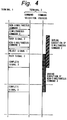
- Fig. 4 shows the operation where terminal 2 receives non-simultaneous command 1 within one predetermined period. If only one non-simultaneous command is received by terminal 2 within a predetermined period, then terminal 2 executes non-simultaneous command 1. On the other hand, if non-simultaneous command 3 also is received within this predetermined period, then only non-simultaneous command 3 is executed and reject signal 1 is issued with respect to the displaced non-simultaneous signal 1. Also, busy signal 3 is issued when terminal 2 begins executing non-simultaneous command 3 during the next predetermined period.
- a simultaneous command 2 that is received subsequent to non-simultaneous command 1 is executed independently of any other commands.
- terminal 2 receives simultaneous command 2
- terminal 2 returns busy signal 2 to terminal 1 and begins executing simultaneous command 2.
- complete signal 2 is issued after the execution of simultaneous command 2 is completed
- complete signal 3 issues after the execution of non-simultaneous command 3 is completed.
- Fig. 5 illustrates a command selection communication control microcomputer 13 and the command execution processing microcomputer 14 of terminal 12, which may comprise a VTR.
- a command is transmitted from a terminal 11 to VTR 12 and a response is transmitted from the VTR 12 to the terminal 11.
- the communication between the command selection communication control microcomputer 13 and the command execution processing microcomputer 14 is performed during a predetermined timing period (about 17 msec) in the VTR.
- the command selection communication control microcomputer 13 and command execution processing microcomputer 14 do not communicate, as in the case when a plurality of non-simultaneous commands reaches the VTR 12, the command to be actually executed is selected by the command selection communication control microcomputer 13 to be the most recently received non-simultaneous command.
- This selected command is then supplied at a subsequent communication timing to command execution processing microcomputer 14. In the case of a received simultaneous command, it too is supplied to the command execution processing microcomputer for execution.
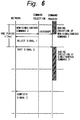
- Fig. 6 illustrates how the execution of one non-simultaneous command is interrupted upon the reception of a subsequent non-simultaneous command.
- the command selection communication control microcomputer 13 and command execution processing microcomputer 14 perform the transmission and reception of the commands and the responses during the predetermined timing period of the command execution processing microcomputer 14.
- a non-simultaneous command 1 is received at VTR 12, it is stored in a buffer. Only one non-simultaneous command can be stored in the buffer at any one time.
- non-simultaneous command 1 is sent to the command execution processing microcomputer 14 and a busy signal corresponding to this command is sent to terminal 11.
- the command execution processing microcomputer 14 interrupts the execution of non-simultaneous command 1 and issues a reject signal 1 corresponding to this command. After issuing reject signal 1, the microcomputer 14 executes the non-simultaneous command 2 and issues a busy signal 2. Once this command 2 has been executed, the microcomputer 14 issues a complete signal 2 at the next communication timing period.
- Fig. 7 shows the operation where two simultaneous commands arrive at terminal 1 within a single predetermined period.
- simultaneous command 1 is received before simultaneous command 2.
- the execution of simultaneous command 1 begins, and a busy signal 1 is issued.
- the execution of this command ends in the third period, during which a complete signal 1 is issued when the execution of simultaneous command 1 is concluded.
- the execution of simultaneous command 2 begins in period 3 and ends in period 4.
- busy signal 2 issues, and during period 4, complete signal 2 issues once the execution of simultaneous command 2 is completed.
- the simultaneous commands of Fig. 7 are executed independently of the communication period of the command selection communication control.
- a non-simultaneous command 1 is received before non-simultaneous command 2 but both are received in the same period.
- the receiving terminal stores and executes only the most recently received non-simultaneous command. Therefore, in Fig. 8, once non-simultaneous command 2 is received, previously stored non-simultaneous command 1 is deleted from the buffer and a reject signal 1 corresponding to this deleted command is issued. During the next period, the execution of non-simultaneous command 2 begins and busy signal 2 is issued with respect thereto. When the execution of non-simultaneous command 2 is finished during the third period, complete signal 2 is issued. Since non-simultaneous command 1 was never executed, no busy signal is issued with respect thereto. Therefore, this method uses one less packet then the previously proposed method discussed in conjunction with Figs. 12 and 13.
- a non-simultaneous command 1 is received before simultaneous command 2 within a predetermined period. After being received by terminal 2, non-simultaneous command 1 is stored in the buffer. However, if non-simultaneous command 3 is received after simultaneous command 2 but before execution of non-simultaneous command 1 begins, then non-simultaneous command 1 is displaced from terminal 2, which issues reject signal 1 in response thereto. During the second period, terminal 2 begins to execute simultaneous command 2 and issues busy signal 2 with respect thereto. When the execution of simultaneous command 2 is completed during the third period, terminal 2 issues complete signal 2 within the same period. As for non-simultaneous command 3, terminal 2 begins executing this command during the third period and finishes this execution during the fourth period, during which a complete signal 3 is issued.
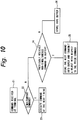
- Fig. 10 is a flowchart that describes how a terminal processes a received command.
- a terminal receives a command (step 21)
- it determines if the command is a simultaneous command or a non-simultaneous command (step 22). If the received command is a simultaneous command, then the terminal executes this command during the next timing period (step 23). If the received command is a non-simultaneous command, then the terminal determines in step 24 whether the buffer already stores a previously received non-simultaneous command. If yes, then the later-received command is stored in place of the earlier command, and the terminal issues a reject signal with respect to the displaced command (step 25). If the buffer does not store any command, then the current non-simultaneous command is stored (step 26).
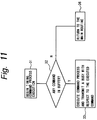
- Fig. 11 is a flowchart exhibiting the timing of the command execution processing.
- step 31 the timing of a command process execution begins.
- step 32 the terminal determines whether any command is stored in the buffer. If yes, then the terminal executes the stored command and issues a busy signal with respect thereto. If the buffer does not contain any signal, then the terminal returns to the main routine (step 32).
- the terminals include respective VTRs. If a video display is included in each terminal, however, only one particular channel control and only one particular volume control operation may be selected at any one time. By providing a buffer for the channel command and a buffer for the volume command, therefore, the video display can operate in a manner similar to that of the VTR in the above embodiments. For instance, when a command to increase the channel is received in the same period as a command to decrease the channel, it is self-evident that these two inconsistent commands cannot be executed simultaneously. In this instance, these commands are arranged in accordance with a predetermined priority. For example, the terminal may be programmed to execute the most recent or least recent command.
- This priority of commands may also be used with respect to a command to increase the volume and a command to reduce the volume.
- the techniques are also applicable generally to an apparatus having an operating state (a channel, a volume, or the like) that is uniquely decided.
- embodiments of the invention provide communication control methods and apparatus which can reduce the number of messages exchanged among data processing terminals such as VTRs, computers, video displays and the like, and in particular which can reduce the amount of data exchanged between a command transmitting terminal and a command receiving terminal.
Landscapes
- Engineering & Computer Science (AREA)
- Computer Networks & Wireless Communication (AREA)
- Signal Processing (AREA)
- Automation & Control Theory (AREA)
- Computer And Data Communications (AREA)
- Communication Control (AREA)
- Small-Scale Networks (AREA)
- Vehicle Body Suspensions (AREA)
- Selective Calling Equipment (AREA)
- Measuring Pulse, Heart Rate, Blood Pressure Or Blood Flow (AREA)
- Telephone Function (AREA)
- Manipulator (AREA)
- Radar Systems Or Details Thereof (AREA)
Applications Claiming Priority (3)
| Application Number | Priority Date | Filing Date | Title |
|---|---|---|---|
| JP107910/94 | 1994-04-22 | ||
| JP10791094A JP3358291B2 (ja) | 1994-04-22 | 1994-04-22 | 通信制御方法 |
| JP10791094 | 1994-04-22 |
Publications (3)
| Publication Number | Publication Date |
|---|---|
| EP0678994A2 true EP0678994A2 (de) | 1995-10-25 |
| EP0678994A3 EP0678994A3 (de) | 1995-12-27 |
| EP0678994B1 EP0678994B1 (de) | 2003-03-19 |
Family
ID=14471165
Family Applications (1)
| Application Number | Title | Priority Date | Filing Date |
|---|---|---|---|
| EP95302698A Expired - Lifetime EP0678994B1 (de) | 1994-04-22 | 1995-04-21 | Übertragungssteuerungsverfahren und -gerät |
Country Status (10)
| Country | Link |
|---|---|
| US (2) | US5742770A (de) |
| EP (1) | EP0678994B1 (de) |
| JP (1) | JP3358291B2 (de) |
| KR (1) | KR100383691B1 (de) |
| CN (1) | CN1076557C (de) |
| AT (1) | ATE235127T1 (de) |
| AU (1) | AU683351B2 (de) |
| CA (1) | CA2147563A1 (de) |
| DE (1) | DE69529935T2 (de) |
| MY (1) | MY113165A (de) |
Cited By (1)
| Publication number | Priority date | Publication date | Assignee | Title |
|---|---|---|---|---|
| EP2869500A1 (de) * | 2013-10-29 | 2015-05-06 | Toshiba Lighting & Technology Corporation | Kommunikationsvorrichtung, -system und -verfahren |
Families Citing this family (1)
| Publication number | Priority date | Publication date | Assignee | Title |
|---|---|---|---|---|
| CN107509291A (zh) * | 2017-09-04 | 2017-12-22 | 西安建艺设计制作策划有限公司 | 灯、开关型智能灯光控制终端、控制系统及控制方法 |
Family Cites Families (8)
| Publication number | Priority date | Publication date | Assignee | Title |
|---|---|---|---|---|
| GB8413598D0 (en) * | 1984-05-29 | 1984-07-04 | Thorn Emi Ferguson | Mainsborne network |
| JPS61281791A (ja) * | 1985-06-07 | 1986-12-12 | Sony Corp | デイジタルコンバ−ジエンス装置 |
| US4855730A (en) * | 1987-05-08 | 1989-08-08 | Rca Licensing Corporation | Component audio/video system with timed control of plural peripheral devices |
| US4989081A (en) * | 1988-11-14 | 1991-01-29 | Sony Corporation | Home-bus-information system |
| GB2229022B (en) * | 1989-03-06 | 1993-03-31 | Creda Ltd | Controlling remote electrical appliances via the mains supply |
| US5446919A (en) * | 1990-02-20 | 1995-08-29 | Wilkins; Jeff K. | Communication system and method with demographically or psychographically defined audiences |
| JP2773386B2 (ja) * | 1990-05-16 | 1998-07-09 | ソニー株式会社 | モニタ・テレビジョン装置 |
| EP0501343A3 (en) * | 1991-02-28 | 1994-09-07 | Toshiba Kk | Use management apparatus for a plurality of cassettes |
-
1994
- 1994-04-22 JP JP10791094A patent/JP3358291B2/ja not_active Expired - Fee Related
-
1995
- 1995-04-13 US US08/421,943 patent/US5742770A/en not_active Expired - Fee Related
- 1995-04-18 MY MYPI95000999A patent/MY113165A/en unknown
- 1995-04-21 EP EP95302698A patent/EP0678994B1/de not_active Expired - Lifetime
- 1995-04-21 CA CA002147563A patent/CA2147563A1/en not_active Abandoned
- 1995-04-21 AU AU16587/95A patent/AU683351B2/en not_active Ceased
- 1995-04-21 DE DE69529935T patent/DE69529935T2/de not_active Expired - Fee Related
- 1995-04-21 KR KR1019950009877A patent/KR100383691B1/ko not_active Expired - Fee Related
- 1995-04-21 AT AT95302698T patent/ATE235127T1/de not_active IP Right Cessation
- 1995-04-22 CN CN95105750A patent/CN1076557C/zh not_active Expired - Fee Related
-
1998
- 1998-02-20 US US09/027,005 patent/US6105058A/en not_active Expired - Fee Related
Cited By (1)
| Publication number | Priority date | Publication date | Assignee | Title |
|---|---|---|---|---|
| EP2869500A1 (de) * | 2013-10-29 | 2015-05-06 | Toshiba Lighting & Technology Corporation | Kommunikationsvorrichtung, -system und -verfahren |
Also Published As
| Publication number | Publication date |
|---|---|
| JPH07297882A (ja) | 1995-11-10 |
| DE69529935T2 (de) | 2004-02-05 |
| AU683351B2 (en) | 1997-11-06 |
| CN1114452A (zh) | 1996-01-03 |
| EP0678994A3 (de) | 1995-12-27 |
| CA2147563A1 (en) | 1995-10-23 |
| KR950035194A (ko) | 1995-12-30 |
| DE69529935D1 (de) | 2003-04-24 |
| US6105058A (en) | 2000-08-15 |
| KR100383691B1 (ko) | 2003-07-10 |
| US5742770A (en) | 1998-04-21 |
| EP0678994B1 (de) | 2003-03-19 |
| CN1076557C (zh) | 2001-12-19 |
| AU1658795A (en) | 1995-11-02 |
| ATE235127T1 (de) | 2003-04-15 |
| JP3358291B2 (ja) | 2002-12-16 |
| MY113165A (en) | 2001-12-31 |
Similar Documents
| Publication | Publication Date | Title |
|---|---|---|
| JPH0642221B2 (ja) | 端末装置セション管理プロトコル | |
| US5313408A (en) | Multistation display system for controlling a display monitor associated with plural audio video devices | |
| US6272278B1 (en) | Video data storage and playback scheme with automatic playback continuation after overtaking | |
| JPH05160841A (ja) | 状態情報返答方法 | |
| US5206937A (en) | Data communication system having plural stations connected to a single transmission path | |
| EP0606754B1 (de) | Übertragungsverfahren und -vorrichtung | |
| EP0678994B1 (de) | Übertragungssteuerungsverfahren und -gerät | |
| CN108366129A (zh) | Usb数据传输方法、装置及usb适配器 | |
| US6727799B1 (en) | Communication control method and electronic equipments | |
| JP2697588B2 (ja) | 通信タスク管理方式 | |
| EP0533229B1 (de) | Verfahren zur Nachrichtenwegidentifizierung und Nachrichtenverarbeitungsgerät | |
| US20050281225A1 (en) | Hybrid coordination function implementation | |
| JP3629778B2 (ja) | 通信システム、通信方法及び制御機器 | |
| US5559972A (en) | Method and apparatus for supporting byte-mode devices and non-byte-mode devices on a bus | |
| JPS615647A (ja) | ポ−リング制御方式 | |
| JP2002208912A (ja) | データ通信装置およびデータ受信側機器のファームウェア書き換え装置 | |
| JP3817741B2 (ja) | 編集装置 | |
| JP2561366B2 (ja) | 機能確認機能を有するデータ転送装置 | |
| JP3076109B2 (ja) | 複数呼の付加サービス制御方式 | |
| JPS5830256A (ja) | 通信制御装置 | |
| JPH058902B2 (de) | ||
| JPS6032461A (ja) | 伝送システム | |
| JPH04331535A (ja) | データ転送制御装置 | |
| JPS62299145A (ja) | リモ−トステ−シヨンアダプタ制御方式 | |
| JPH03282627A (ja) | プログラム間のデータ転送制御方法 |
Legal Events
| Date | Code | Title | Description |
|---|---|---|---|
| PUAI | Public reference made under article 153(3) epc to a published international application that has entered the european phase |
Free format text: ORIGINAL CODE: 0009012 |
|
| AK | Designated contracting states |
Kind code of ref document: A2 Designated state(s): AT DE FR GB IT NL |
|
| PUAL | Search report despatched |
Free format text: ORIGINAL CODE: 0009013 |
|
| AK | Designated contracting states |
Kind code of ref document: A3 Designated state(s): AT DE FR GB IT NL |
|
| 17P | Request for examination filed |
Effective date: 19960510 |
|
| 17Q | First examination report despatched |
Effective date: 20000620 |
|
| GRAG | Despatch of communication of intention to grant |
Free format text: ORIGINAL CODE: EPIDOS AGRA |
|
| GRAG | Despatch of communication of intention to grant |
Free format text: ORIGINAL CODE: EPIDOS AGRA |
|
| GRAH | Despatch of communication of intention to grant a patent |
Free format text: ORIGINAL CODE: EPIDOS IGRA |
|
| GRAH | Despatch of communication of intention to grant a patent |
Free format text: ORIGINAL CODE: EPIDOS IGRA |
|
| GRAA | (expected) grant |
Free format text: ORIGINAL CODE: 0009210 |
|
| AK | Designated contracting states |
Designated state(s): AT DE FR GB IT NL |
|
| REG | Reference to a national code |
Ref country code: GB Ref legal event code: FG4D |
|
| REF | Corresponds to: |
Ref document number: 69529935 Country of ref document: DE Date of ref document: 20030424 Kind code of ref document: P |
|
| ET | Fr: translation filed | ||
| PLBE | No opposition filed within time limit |
Free format text: ORIGINAL CODE: 0009261 |
|
| STAA | Information on the status of an ep patent application or granted ep patent |
Free format text: STATUS: NO OPPOSITION FILED WITHIN TIME LIMIT |
|
| 26N | No opposition filed |
Effective date: 20031222 |
|
| PGFP | Annual fee paid to national office [announced via postgrant information from national office to epo] |
Ref country code: NL Payment date: 20090405 Year of fee payment: 15 Ref country code: IT Payment date: 20090422 Year of fee payment: 15 Ref country code: FR Payment date: 20090417 Year of fee payment: 15 Ref country code: DE Payment date: 20090420 Year of fee payment: 15 Ref country code: AT Payment date: 20090415 Year of fee payment: 15 |
|
| PGFP | Annual fee paid to national office [announced via postgrant information from national office to epo] |
Ref country code: GB Payment date: 20090415 Year of fee payment: 15 |
|
| REG | Reference to a national code |
Ref country code: NL Ref legal event code: V1 Effective date: 20101101 |
|
| GBPC | Gb: european patent ceased through non-payment of renewal fee |
Effective date: 20100421 |
|
| REG | Reference to a national code |
Ref country code: FR Ref legal event code: ST Effective date: 20101230 |
|
| PG25 | Lapsed in a contracting state [announced via postgrant information from national office to epo] |
Ref country code: NL Free format text: LAPSE BECAUSE OF NON-PAYMENT OF DUE FEES Effective date: 20101101 Ref country code: AT Free format text: LAPSE BECAUSE OF NON-PAYMENT OF DUE FEES Effective date: 20100421 |
|
| PG25 | Lapsed in a contracting state [announced via postgrant information from national office to epo] |
Ref country code: DE Free format text: LAPSE BECAUSE OF NON-PAYMENT OF DUE FEES Effective date: 20101103 |
|
| PG25 | Lapsed in a contracting state [announced via postgrant information from national office to epo] |
Ref country code: GB Free format text: LAPSE BECAUSE OF NON-PAYMENT OF DUE FEES Effective date: 20100421 Ref country code: IT Free format text: LAPSE BECAUSE OF NON-PAYMENT OF DUE FEES Effective date: 20100421 |
|
| PG25 | Lapsed in a contracting state [announced via postgrant information from national office to epo] |
Ref country code: FR Free format text: LAPSE BECAUSE OF NON-PAYMENT OF DUE FEES Effective date: 20100430 |