EP0679497A1 - Filière d'extrusion avec paroi latérale recuits - Google Patents
Filière d'extrusion avec paroi latérale recuits Download PDFInfo
- Publication number
- EP0679497A1 EP0679497A1 EP95302513A EP95302513A EP0679497A1 EP 0679497 A1 EP0679497 A1 EP 0679497A1 EP 95302513 A EP95302513 A EP 95302513A EP 95302513 A EP95302513 A EP 95302513A EP 0679497 A1 EP0679497 A1 EP 0679497A1
- Authority
- EP
- European Patent Office
- Prior art keywords
- die
- coating
- extrusion
- end dam
- dam
- Prior art date
- Legal status (The legal status is an assumption and is not a legal conclusion. Google has not performed a legal analysis and makes no representation as to the accuracy of the status listed.)
- Granted
Links
- 238000001125 extrusion Methods 0.000 title claims abstract description 52
- 238000000576 coating method Methods 0.000 claims abstract description 81
- 239000011248 coating agent Substances 0.000 claims abstract description 62
- 229910001369 Brass Inorganic materials 0.000 claims abstract description 46
- 239000010951 brass Substances 0.000 claims abstract description 46
- 239000008199 coating composition Substances 0.000 claims abstract description 42
- 238000000034 method Methods 0.000 claims abstract description 32
- 239000000758 substrate Substances 0.000 claims abstract description 32
- 238000000137 annealing Methods 0.000 claims abstract description 15
- 238000003754 machining Methods 0.000 claims abstract description 15
- 239000011247 coating layer Substances 0.000 claims abstract description 11
- 239000000463 material Substances 0.000 claims description 38
- 229910000831 Steel Inorganic materials 0.000 claims description 8
- 239000010959 steel Substances 0.000 claims description 8
- 238000001816 cooling Methods 0.000 claims description 7
- 238000010438 heat treatment Methods 0.000 claims description 7
- RYGMFSIKBFXOCR-UHFFFAOYSA-N Copper Chemical compound [Cu] RYGMFSIKBFXOCR-UHFFFAOYSA-N 0.000 claims description 5
- HCHKCACWOHOZIP-UHFFFAOYSA-N Zinc Chemical compound [Zn] HCHKCACWOHOZIP-UHFFFAOYSA-N 0.000 claims description 5
- 239000012080 ambient air Substances 0.000 claims description 5
- 229910052802 copper Inorganic materials 0.000 claims description 5
- 239000010949 copper Substances 0.000 claims description 5
- 239000011701 zinc Substances 0.000 claims description 5
- 229910052725 zinc Inorganic materials 0.000 claims description 5
- XEEYBQQBJWHFJM-UHFFFAOYSA-N Iron Chemical compound [Fe] XEEYBQQBJWHFJM-UHFFFAOYSA-N 0.000 claims description 4
- PXHVJJICTQNCMI-UHFFFAOYSA-N Nickel Chemical compound [Ni] PXHVJJICTQNCMI-UHFFFAOYSA-N 0.000 claims description 4
- 229910001220 stainless steel Inorganic materials 0.000 claims description 4
- 239000010935 stainless steel Substances 0.000 claims description 4
- VYZAMTAEIAYCRO-UHFFFAOYSA-N Chromium Chemical compound [Cr] VYZAMTAEIAYCRO-UHFFFAOYSA-N 0.000 claims description 3
- 229910052742 iron Inorganic materials 0.000 claims description 2
- 229910052759 nickel Inorganic materials 0.000 claims description 2
- 239000011324 bead Substances 0.000 description 41
- 239000010410 layer Substances 0.000 description 15
- 238000003384 imaging method Methods 0.000 description 10
- YMWUJEATGCHHMB-UHFFFAOYSA-N Dichloromethane Chemical compound ClCCl YMWUJEATGCHHMB-UHFFFAOYSA-N 0.000 description 9
- 229920006362 Teflon® Polymers 0.000 description 9
- 239000002904 solvent Substances 0.000 description 9
- 239000000203 mixture Substances 0.000 description 7
- YXFVVABEGXRONW-UHFFFAOYSA-N Toluene Chemical compound CC1=CC=CC=C1 YXFVVABEGXRONW-UHFFFAOYSA-N 0.000 description 6
- 229920000642 polymer Polymers 0.000 description 6
- 238000004140 cleaning Methods 0.000 description 5
- 238000000227 grinding Methods 0.000 description 5
- 239000007788 liquid Substances 0.000 description 5
- 238000004519 manufacturing process Methods 0.000 description 5
- 238000005498 polishing Methods 0.000 description 5
- WYURNTSHIVDZCO-UHFFFAOYSA-N Tetrahydrofuran Chemical compound C1CCOC1 WYURNTSHIVDZCO-UHFFFAOYSA-N 0.000 description 4
- 238000000151 deposition Methods 0.000 description 4
- 239000000243 solution Substances 0.000 description 4
- XLYOFNOQVPJJNP-UHFFFAOYSA-N water Substances O XLYOFNOQVPJJNP-UHFFFAOYSA-N 0.000 description 4
- ZWEHNKRNPOVVGH-UHFFFAOYSA-N 2-Butanone Chemical compound CCC(C)=O ZWEHNKRNPOVVGH-UHFFFAOYSA-N 0.000 description 3
- OKKJLVBELUTLKV-UHFFFAOYSA-N Methanol Chemical compound OC OKKJLVBELUTLKV-UHFFFAOYSA-N 0.000 description 3
- 230000002411 adverse Effects 0.000 description 3
- 230000015572 biosynthetic process Effects 0.000 description 3
- 239000004020 conductor Substances 0.000 description 3
- 238000005520 cutting process Methods 0.000 description 3
- 230000008021 deposition Effects 0.000 description 3
- 238000007765 extrusion coating Methods 0.000 description 3
- 239000004033 plastic Substances 0.000 description 3
- 229920003023 plastic Polymers 0.000 description 3
- KFZMGEQAYNKOFK-UHFFFAOYSA-N Isopropanol Chemical compound CC(C)O KFZMGEQAYNKOFK-UHFFFAOYSA-N 0.000 description 2
- IMNFDUFMRHMDMM-UHFFFAOYSA-N N-Heptane Chemical compound CCCCCCC IMNFDUFMRHMDMM-UHFFFAOYSA-N 0.000 description 2
- 241000364021 Tulsa Species 0.000 description 2
- 239000012790 adhesive layer Substances 0.000 description 2
- JHIVVAPYMSGYDF-UHFFFAOYSA-N cyclohexanone Chemical compound O=C1CCCCC1 JHIVVAPYMSGYDF-UHFFFAOYSA-N 0.000 description 2
- 230000000694 effects Effects 0.000 description 2
- 239000002184 metal Substances 0.000 description 2
- 229910052751 metal Inorganic materials 0.000 description 2
- 229920005668 polycarbonate resin Polymers 0.000 description 2
- 239000004431 polycarbonate resin Substances 0.000 description 2
- 229920000728 polyester Polymers 0.000 description 2
- 229920001225 polyester resin Polymers 0.000 description 2
- 239000004645 polyester resin Substances 0.000 description 2
- 230000000750 progressive effect Effects 0.000 description 2
- 230000001105 regulatory effect Effects 0.000 description 2
- 229920005989 resin Polymers 0.000 description 2
- 239000011347 resin Substances 0.000 description 2
- 238000007789 sealing Methods 0.000 description 2
- 239000000126 substance Substances 0.000 description 2
- YLQBMQCUIZJEEH-UHFFFAOYSA-N tetrahydrofuran Natural products C=1C=COC=1 YLQBMQCUIZJEEH-UHFFFAOYSA-N 0.000 description 2
- UJOBWOGCFQCDNV-UHFFFAOYSA-N Carbazole Natural products C1=CC=C2C3=CC=CC=C3NC2=C1 UJOBWOGCFQCDNV-UHFFFAOYSA-N 0.000 description 1
- 229910001018 Cast iron Inorganic materials 0.000 description 1
- HSFWRNGVRCDJHI-UHFFFAOYSA-N alpha-acetylene Natural products C#C HSFWRNGVRCDJHI-UHFFFAOYSA-N 0.000 description 1
- 229910052782 aluminium Inorganic materials 0.000 description 1
- XAGFODPZIPBFFR-UHFFFAOYSA-N aluminium Chemical compound [Al] XAGFODPZIPBFFR-UHFFFAOYSA-N 0.000 description 1
- 238000005452 bending Methods 0.000 description 1
- 239000000969 carrier Substances 0.000 description 1
- 239000000919 ceramic Substances 0.000 description 1
- 238000007796 conventional method Methods 0.000 description 1
- 230000007812 deficiency Effects 0.000 description 1
- 238000005137 deposition process Methods 0.000 description 1
- 238000002845 discoloration Methods 0.000 description 1
- 239000006185 dispersion Substances 0.000 description 1
- 229920001971 elastomer Polymers 0.000 description 1
- 239000000839 emulsion Substances 0.000 description 1
- 125000002534 ethynyl group Chemical group [H]C#C* 0.000 description 1
- 239000012530 fluid Substances 0.000 description 1
- PCHJSUWPFVWCPO-UHFFFAOYSA-N gold Chemical compound [Au] PCHJSUWPFVWCPO-UHFFFAOYSA-N 0.000 description 1
- 239000010931 gold Substances 0.000 description 1
- 229910052737 gold Inorganic materials 0.000 description 1
- 238000007757 hot melt coating Methods 0.000 description 1
- 238000009434 installation Methods 0.000 description 1
- 238000012423 maintenance Methods 0.000 description 1
- 238000003801 milling Methods 0.000 description 1
- 238000013021 overheating Methods 0.000 description 1
- 108091008695 photoreceptors Proteins 0.000 description 1
- 239000000049 pigment Substances 0.000 description 1
- 229920001088 polycarbazole Polymers 0.000 description 1
- 229920000515 polycarbonate Polymers 0.000 description 1
- 239000004417 polycarbonate Substances 0.000 description 1
- -1 polyethylene terephthalate Polymers 0.000 description 1
- 229920000139 polyethylene terephthalate Polymers 0.000 description 1
- 239000005020 polyethylene terephthalate Substances 0.000 description 1
- 238000012545 processing Methods 0.000 description 1
- 230000000284 resting effect Effects 0.000 description 1
- 230000000717 retained effect Effects 0.000 description 1
- 239000005060 rubber Substances 0.000 description 1
- 239000002356 single layer Substances 0.000 description 1
- 238000003860 storage Methods 0.000 description 1
- 238000006467 substitution reaction Methods 0.000 description 1
- 239000012815 thermoplastic material Substances 0.000 description 1
- 229920005992 thermoplastic resin Polymers 0.000 description 1
- 239000002699 waste material Substances 0.000 description 1
- 239000001993 wax Substances 0.000 description 1
Images


Classifications
-
- B—PERFORMING OPERATIONS; TRANSPORTING
- B05—SPRAYING OR ATOMISING IN GENERAL; APPLYING FLUENT MATERIALS TO SURFACES, IN GENERAL
- B05C—APPARATUS FOR APPLYING FLUENT MATERIALS TO SURFACES, IN GENERAL
- B05C5/00—Apparatus in which liquid or other fluent material is projected, poured or allowed to flow on to the surface of the work
- B05C5/02—Apparatus in which liquid or other fluent material is projected, poured or allowed to flow on to the surface of the work the liquid or other fluent material being discharged through an outlet orifice by pressure, e.g. from an outlet device in contact or almost in contact, with the work
- B05C5/0254—Coating heads with slot-shaped outlet
-
- B—PERFORMING OPERATIONS; TRANSPORTING
- B29—WORKING OF PLASTICS; WORKING OF SUBSTANCES IN A PLASTIC STATE IN GENERAL
- B29C—SHAPING OR JOINING OF PLASTICS; SHAPING OF MATERIAL IN A PLASTIC STATE, NOT OTHERWISE PROVIDED FOR; AFTER-TREATMENT OF THE SHAPED PRODUCTS, e.g. REPAIRING
- B29C48/00—Extrusion moulding, i.e. expressing the moulding material through a die or nozzle which imparts the desired form; Apparatus therefor
- B29C48/25—Component parts, details or accessories; Auxiliary operations
- B29C48/30—Extrusion nozzles or dies
- B29C48/305—Extrusion nozzles or dies having a wide opening, e.g. for forming sheets
-
- B—PERFORMING OPERATIONS; TRANSPORTING
- B29—WORKING OF PLASTICS; WORKING OF SUBSTANCES IN A PLASTIC STATE IN GENERAL
- B29C—SHAPING OR JOINING OF PLASTICS; SHAPING OF MATERIAL IN A PLASTIC STATE, NOT OTHERWISE PROVIDED FOR; AFTER-TREATMENT OF THE SHAPED PRODUCTS, e.g. REPAIRING
- B29C48/00—Extrusion moulding, i.e. expressing the moulding material through a die or nozzle which imparts the desired form; Apparatus therefor
- B29C48/03—Extrusion moulding, i.e. expressing the moulding material through a die or nozzle which imparts the desired form; Apparatus therefor characterised by the shape of the extruded material at extrusion
- B29C48/07—Flat, e.g. panels
- B29C48/08—Flat, e.g. panels flexible, e.g. films
-
- B—PERFORMING OPERATIONS; TRANSPORTING
- B29—WORKING OF PLASTICS; WORKING OF SUBSTANCES IN A PLASTIC STATE IN GENERAL
- B29C—SHAPING OR JOINING OF PLASTICS; SHAPING OF MATERIAL IN A PLASTIC STATE, NOT OTHERWISE PROVIDED FOR; AFTER-TREATMENT OF THE SHAPED PRODUCTS, e.g. REPAIRING
- B29C48/00—Extrusion moulding, i.e. expressing the moulding material through a die or nozzle which imparts the desired form; Apparatus therefor
- B29C48/03—Extrusion moulding, i.e. expressing the moulding material through a die or nozzle which imparts the desired form; Apparatus therefor characterised by the shape of the extruded material at extrusion
- B29C48/12—Articles with an irregular circumference when viewed in cross-section, e.g. window profiles
-
- Y—GENERAL TAGGING OF NEW TECHNOLOGICAL DEVELOPMENTS; GENERAL TAGGING OF CROSS-SECTIONAL TECHNOLOGIES SPANNING OVER SEVERAL SECTIONS OF THE IPC; TECHNICAL SUBJECTS COVERED BY FORMER USPC CROSS-REFERENCE ART COLLECTIONS [XRACs] AND DIGESTS
- Y10—TECHNICAL SUBJECTS COVERED BY FORMER USPC
- Y10S—TECHNICAL SUBJECTS COVERED BY FORMER USPC CROSS-REFERENCE ART COLLECTIONS [XRACs] AND DIGESTS
- Y10S29/00—Metal working
- Y10S29/026—Method or apparatus with machining
-
- Y—GENERAL TAGGING OF NEW TECHNOLOGICAL DEVELOPMENTS; GENERAL TAGGING OF CROSS-SECTIONAL TECHNOLOGIES SPANNING OVER SEVERAL SECTIONS OF THE IPC; TECHNICAL SUBJECTS COVERED BY FORMER USPC CROSS-REFERENCE ART COLLECTIONS [XRACs] AND DIGESTS
- Y10—TECHNICAL SUBJECTS COVERED BY FORMER USPC
- Y10T—TECHNICAL SUBJECTS COVERED BY FORMER US CLASSIFICATION
- Y10T29/00—Metal working
- Y10T29/49—Method of mechanical manufacture
- Y10T29/49401—Fluid pattern dispersing device making, e.g., ink jet
-
- Y—GENERAL TAGGING OF NEW TECHNOLOGICAL DEVELOPMENTS; GENERAL TAGGING OF CROSS-SECTIONAL TECHNOLOGIES SPANNING OVER SEVERAL SECTIONS OF THE IPC; TECHNICAL SUBJECTS COVERED BY FORMER USPC CROSS-REFERENCE ART COLLECTIONS [XRACs] AND DIGESTS
- Y10—TECHNICAL SUBJECTS COVERED BY FORMER USPC
- Y10T—TECHNICAL SUBJECTS COVERED BY FORMER US CLASSIFICATION
- Y10T29/00—Metal working
- Y10T29/49—Method of mechanical manufacture
- Y10T29/49995—Shaping one-piece blank by removing material
Definitions
- This invention relates to apparatus for applying to a surface of a support member at least one ribbon-like stream of a coating composition to form a unitary layer on the surface of the support member, and to processes for fabricating and using the apparatus.
- One of these techniques involves the use of an extrusion die from which the coating composition is extruded onto the substrate.
- the extrusion die For fabrication of web type, flexible electrophotographic imaging members, the extrusion die must lay down very thin coatings meeting extremely precise, critical tolerances in the single or double digit micrometer ranges.
- a plurality of dies may be needed to lay down up to three extruded coatings which are conventionally employed for flexible electrophotographic imaging members.
- the flexible electrophotographic imaging members may also comprise additional coatings applied by non-extrusion coating techniques so that the finished electrophotographic imaging member can contain as many as 5 different coatings.
- the extrusion die usually comprises spaced walls, each having a surface facing each other. These spaced walls form a narrow, elongated, passageway.
- a coating composition is supplied by a reservoir to one side of the passageway and the coating composition travels through the passageway to an exit slot on the side of the passageway opposite the reservoir.
- Dams are provided at opposite ends of the passageway to confine the coating composition within the passageway as the coating travels from the reservoir to the exit slot.
- the surface of the dams facing the coating composition is generally perpendicular to the exit slot.
- Each end dam seals one end of the die.
- These end dams have a sharp corner positioned at each end of the exit slot. This sharp corner is formed at the intersection of two adjacent sides of the end dam and is important for the proper operation of the coating process. More specifically, the extruded coating material pins to the sharp corner as the material emerges from the exit slot thereby creating a small, relatively flat edge bead for the deposited coated layer.
- the expression "pin” as employed herein is defined as the attachment of the coating composition to the extrusion die or end dam.
- Soft Teflon® type materials have been used for extrusion die end dams. Teflon® extrusion die end dams have excellent sealing attributes and resistance to the chemicals utilized for fabricating electrophotographic imaging members.
- Teflon® also cannot be machined and the edge radius cannot be accurately controlled.
- Teflon® extrusion die end dams require time to stabilize when coming on line immediately after installation thereby creating unacceptable coated material that must be scrapped.
- the sharp corner of Teflon® extrusion die end dams deteriorates due to dents and cuts caused by cleaning operations and shimming of the die lip opening during coating runs. Dents and cuts can occur during the cleaning operation due to collisions with thin metal or plastic material which inserted through the die exit slot and slid back along the die passageway.
- the extruded coating materials loses its ability to pin to the corner leading to edge bead instability which in turn creates a thicker and wider edge bead due to the necking in, and movement of, the coating material back on the radius of the corner.
- edge bead build up causes a ridge to form above the overlapped edge beads as well as in the substrate below the overlapped edge beads when the coated support member is a flexible electrophotographic imaging web which is subsequently rolled for storage, shipment or for further processing.
- This ridge is undesirable in precision machines and can cause adverse effects such as electrical arcing and coating damage due to contact with closely spaced machine components.
- edge bead build up tends to promote the formation of blisters when the coatings are applied as solutions containing volatile carrier liquids.
- Unduly thick and wide edge beads also present coating problems for subsequently applied layers and introduce handling and fabricating problems later in the manufacturing process.
- production line down time is high because the Teflon® extrusion die end dams must be replaced frequently. Substitution of ordinary brass end dams for Teflon® extrusion die end dams results in leakage of the coating material from the ends of the extrusion dies.
- Aluminum end dams form particulates which contaminate the coating composition which in turn forms electrophotographically unacceptable layers.
- Stainless steel end dams do not seal well and leak. Many plastic end dam materials are dissolved by the solvents employed in the extruded coating compositions. Further, the extruded coating compositions will not pin to many end dam materials thereby causing the formation of unstable edge beads. Thus the characteristics of common extrusion systems utilizing end dams exhibit deficiencies for processes for manufacturing coated articles having precise tolerance requirements.
- the invention provides a process for fabricating an extrusion die comprising providing hard brass stock, machining the stock to form a thick rigid machined die end dam having a sharp corner, annealing the machined die end dam, providing a die body having at least one open end and an extrusion exit slot, and securing the machined end dam to the open end of the die to form an extrusion die assembly, the sharp corner being adjacent one end of the exit slot.
- This die assembly is employed to form a coating on a surface of a substrate by establishing relative motion between the surface of the substrate and the extrusion die assembly and extruding a ribbon-like stream of coating composition from the die through the extrusion exit slot onto the surface of the substrate to form a coating layer. Because of the relative movement between the die assembly and the surface of the substrate, the ribbon-like stream of coating material extends in the direction of relative movement of the surface of the substrate and the source of the ribbon-like stream of coating material to form a continuous coating layer having a relatively flat edge bead. Since the continuous coating layer has a small edge bead, coated flexible substrates may be rolled without attendant problems caused by beads at the boundaries.
- the edge beads are smaller and flatter, the built up edge bead formed by the deposition of multiple coatings has a correspondingly small edge bead.
- the coatings of this invention are particularly useful for electrical applications such as adhesive layers, charge generating layers and charge transport layers for electrostatographic photoreceptors utilizing multiple layers.
- precise control of the dimensions of the deposited coatings may be achieved.
- this process may be employed to coat the surface of support members of various configurations including webs, sheets, plates, drums, and the like.
- the support member may be flexible, rigid, uncoated, precoated, as desired.
- the support members may comprise a single layer or be made up of multiple layers.
- the coating compositions applied to the support member may comprise molten thermoplastic materials, solutions of film forming materials, curable resins and rubbers, and the like.
- FIG. 1 is a schematic, isometric, sectional view showing an extrusion die comprising a die body fitted with end dams.
- FIG. 2 is a schematic, sectional end view of a die body from which a ribbon-like stream of a coating composition is extruded.
- FIG. 3 is a schematic, sectional side view of a die body of this invention from which a ribbon-like stream of a coating composition is extruded.
- FIG. 4 is a schematic, sectional side view of an undesirable die body from which a ribbon-like stream of a coating composition is extruded.
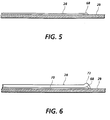
- FIG. 5 is a schematic, sectional view of a deposited extruded single coating layer having an edge bead.
- FIG. 6 is a schematic, sectional view of two deposited extruded coating layers, the combination forming a large edge bead.
- Die assembly 10 comprises a die body 12 equipped with clamping flanges 13, 14, 15 and 16. Die body 12 comprises and upper lip 18 and lower lip 20 which are spaced apart to form a flat narrow passageway 22 (see FIG. 2) which leads from inlet 24 to exit slot 26 through which a coating composition 28 is extruded as a ribbon-like stream in the direction shown by the arrows (see FIG. 1) onto substrate 29 (see FIG. 2) moving in the direction shown by the arrow.
- the width, thickness, and the like of the ribbon-like stream can be varied in accordance with factors such as the viscosity of the coating composition, thickness of the coating desired, and width of the substrate 29 on which the coating composition is applied, and the like.
- End dams 30 and 32 are secured to the ends of upper lip 18 and lower lip 20 of die body 12 to confine coating composition 28 within passageway 22 as coating composition 28 travels from inlet 24 to exit slot 24.
- the length of passageway 22 should be sufficiently long also ensure laminar flow. Control of the distance of exit slot 26 from substrate 29 enables coating composition 28 to bridge the gap between each exit slot 26 and substrate 29 depending upon the viscosity and rate of flow of coating composition 28 and the relative rate movement between die assembly 10 and substrate 29.
- coating composition 28 is supplied from a reservoir (not shown) under pressure using a conventional pump or other suitable well known means such as a gas pressure system (not shown).
- Clamping flanges 14 and 16 contain threaded holes 34, 36, 38 and 40 into which set screws 42 are screwed to secure end dams 30 and 32 between backing plates 44 and 46, respectively, and the adjacent ends of upper lip 18 and lower lip 20 of die body 12.
- any suitable means such as screws 43 or the like, such as bolts, studs, or clamps (not shown), may be utilized to fasten upper lip 18 and lower lip 20 together.
- Inner lip surfaces 45 and 47 (see FIG. 2) of upper lip 18 and lower lip 20, respectively, are precision ground to ensure accurate control of the deposited coating thickness and uniformity.
- the extruded coating materials pins or clings to the outer lip surfaces 48 and 49 of upper lip 18 and lower lip 20, respectively.
- Outer lip surfaces 48 and 49 may be of any suitable configuration including squared, knife and the like. A flat squared end is preferred for the coating embodiment illustrated. The flat outer lip surfaces 48 and 49 appear to further support and stabilize the beads during bead coating operations.
- End dam 32 has a sharp corner 50 formed at the intersection of two adjacent perpendicular sides 52 and 54 of the end dam 32. Sharp corner 50 of end dam 32 is located at one end of exit slot 26.
- sharp corner 50 has a radius of curvature of less than about 400 ⁇ m, the extruded coating material 28 pins or clings to the sharp corner 50 as the material emerges from exit slot 26 resulting stable coating conditions and the formation of a small, relatively flat edge bead in the deposited coated layer.
- End dam 58 has a rounded corner 60 formed at the intersection of two adjacent perpendicular sides 62 and 64 of end dam 58.
- Rounded corner 60 of end dam 58 is located at one end of exit slot 26.
- the rounded shape may be due to the manner in dam 58 originally fabricated or due to damage during handling, cleaning or use.
- rounded corner 60 When rounded corner 60 has a radius of curvature of greater than about 400 ⁇ m, the extruded coating material 18 causes coating instability and the edge bead of the deposited coating 18 becomes wide and thicker because coating material 28 moves back and forth along the curved surface of rounded corner 60 and tends to neck and pin to the inner base of the curved surface of rounded corner 60 at location 66 where the coating material must span a larger gap.
- rounded corner 60 has a very adverse effect on deposited coatings, particularly when formed on webs which are further processed, e.g. wound into rolls, coated with additional materials and the like.
- FIG. 5 an enlarged sectional view is shown of substrate 29 coated with a coating composition 28 having an edge bead 68 formed with an extrusion die assembly containing an end dam having a shape similar to the shape of end dam 64 illustrated in FIG. 4.
- the rounded corner 60 of end dam 64 presents a poor pinning surface which causes this edge bead 68 to be wide and tall due to coating instabilities. A smaller and flatter edge bead is more desirable.
- FIG. 6 Shown in FIG. 6 is an enlarged sectional view is shown of substrate 29 coated with a coating composition 28 having an edge bead 68 described with reference to FIG. 5 above, but bearing a second extruded coating 70 and edge bead 72 formed with another extrusion die assembly containing an end dam having a shape similar to the shape of end dam 64 depicted in FIG. 4.
- the edge bead build up can become even more extreme thereby causing coating and material handling problems, if the edge bead build up is not minimized.
- any suitable rigid material may be utilized for the main die body.
- Typical rigid materials include, for example, stainless steel, chrome plated steel, ceramics, or any other metal or plastic capable of maintaining precise machining tolerances.
- Stainless steel and plated steel having a nickel plated intermediate coating and a chrome plated outer coating are preferred because of their long wear characteristics and capability of maintaining precise machining tolerances.
- the main die body may comprise separate top and bottom sections. To achieve the extremely precise coating thickness profiles and exceptional surface quality requirements desired for electrophotgraphic imaging member coatings, the finish grinding of the die should be accomplished consistently under high tolerance constraints across the entire die width, e.g. widths as high as 102 cm (40 inches).
- a preferred way to achieve such precision is to continue to move a die grinding wheel beyond the die body at the end of each grinding pass, i.e. the grinding wheel should not stop or slow down at any point while in contact with the die body.
- the use of separate end dams are necessary to seal both ends of the die body.
- any suitable machinable and annealable brass stock material may be used for the brass end dams of this invention.
- Typical brass stock compositions comprise between about 58 percent and about 85 percent by weight copper and between about 15 percent and about 42 percent by weight zinc, based on the total weight of the brass stock.
- the brass stock comprises between about 60 percent and about 65 percent by weight copper, between about 33 percent and about 38 percent by weight zinc, between about 0.5 percent and about 3.5 percent by weight lead, and less than about 0.5 percent by weight iron based on the total weight of the brass stock.
- the brass stock is a hard brass which preferably has a tensile strength of between about 70,000 psi (490 MPa) and about 80,000 psi (560 MPa).
- the brass end dam should be a soft or 1/2 hard brass after the annealing step and have a tensile strength of between about 40,000 psi (280 MPa) and about 55,000 psi (385 MPa). Brass end dams having a tensile strength outside this range tend to leak.
- the tensile strength of the soft brass end dam after the annealing step is between about 45,000 psi (315 MPa) and about 50,000 psi (350 MPa).
- a preferred hard brass stock for machining is a free-cutting brass such as CDA360 from Progressive Brass in Tulsa, Oklahoma.
- any suitable and conventional technique may be utilized to machine the brass stock material to form the brass end dams of this invention.
- Typical machining techniques include, for example, milling, grinding, die cutting, and the like.
- the end dams are machined to achieve the desired shape by using a programmable end mill operated at high spindle speeds to form a good surface finish on the dam edges.
- the brass stock is preferably supported with a suitable fixture while machining to prevent distortion and bending.
- the machined die end dam should be rigid and have a thickness of at least about 800 ⁇ m. Preferably, the thickness is between about 800 ⁇ m and about 3200 ⁇ m. Optimum results are achieved with a thickness of about 1500 ⁇ m. A machined end dam thickness of less than about 800 ⁇ m thick is very difficult to machine without distortion, can encounter warpage during the annealing process, and which can deform under the pressures applied during coating extrusion. Excellent results are achieved a machined end dam thickness of about 1500 ⁇ m. Machined end dams having a thickness greater than about 3200 ⁇ m can be used, but would be more expensive and would offer no advantages over thinner material.
- machined end dam of this invention is secured to at least one open end of the die body, the sharp corner being adjacent one end of the exit slot of the die body.
- This sharp corner is formed at the intersection of two adjacent sides of the end dam and is important to the proper operation of the coating process.
- the adjacent, intersecting sides of the die are preferably positioned at an angle with each other between about 94 degrees and about 86 degrees. Since the exit slot of the die is normally positioned only about 150 ⁇ m to 230 ⁇ m from the electrophotographic imaging member substrate during coating, an angle greater about 94 degrees can cause the machined end dam to strike and damage the substrate. In other words, the corner angle should be less than about 94 degrees to provide sufficient clearance with the substrate being coated.
- a corner angle of less than about 86 degrees is more difficult to machine and is less resistant to damage when struck by cleaning devices. Optimum results are achieved with a corner angle of about 90 degrees. Also, by machining the corner angle on each side of the end dam to 90 degrees, the machined end dam can be interchangeably used at either end of the die body. Further, a 90 degree angle is easier to machine.
- the extreme edge of the sharp corner has a radius of curvature of less than about 800 ⁇ m.
- the extreme edge of the sharp corner preferably has a radius of curvature of less than about 400 ⁇ m to ensure that the coating material consistently pins to the interior side of the end dam during extrusion thereby forming the flattest possible edge bead in the deposited coating.
- the radius of curvature of the sharp corner is greater than about 400 ⁇ m, the likelihood of the extruded coating material breaking away from the corner begins to increase and the resulting coating bead becomes more and more unstable.
- the end dam After the machining of the end dams is completed, the end dam must be annealed. Any suitable annealing technique may be used. Annealing involves slowly heating of the machined end dam followed by gradual cooling. Any suitable heating means may be employed to heat the end dam after machining. Typical heating means include, for example, an oven, a torch, and the like. Generally, heat is evenly applied until the brass end dam changes to a brownish color. Overheating of the brass end dam beyond the point where the brownish discoloration occurs will also result in an end dam that too soft. Heating may be effected while the end dam rests on a support comprising a large mass of thermally conductive material such as steel, cast iron, and the like.
- the end dam After the brass changes from a brass or gold color to a brownish color during the heating step, the end dam is cooled gradually. Rapid cooling can adversely affect the final hardness properties of the end dam. For example, cooling in ambient air after removal of the end dam from a support comprising a large mass of thermally conductive material results in an end plate that remains too hard. Thus, when cooling in ambient air, the rate of cooling may be suitably reduced by keeping the end dam in contact with the support of thermally conductive material used during the heating step. The rate of cooling can be regulated by any other suitable means such as a oven controlled by an automatic thermostat. If the the end dam is quenched in water to cool, the brass material becomes too soft.
- the end dam is heated slowly and evenly with a torch while the end dam is supported on a flat steel plate. Heat is applied until the brass end plate changes to a brownish color. The heat source is then removed and the end plate is allowed to cool in ambient air while the end plate remains supported by the steel plate.
- the annealing process should be sufficient to provide a brass that is ductile enough to seal the sides of the die, yet be tough enough to resist damage during cleaning and shimming of the die.
- the brass end dam has a a tensile strength between about 40,000 psi (280 MPa) and about 55,000 psi (385 MPa).
- the sharp corner of the end dam is preferably deburred.
- Deburring may be accomplished by any suitable technique, e.g. by hand using 30 ⁇ m polishing paper on a surface plate. This removes any machining burrs and leaves a maximum radius of curvature on the sharp corner of less than about 400 ⁇ m.
- a suitable polishing paper is the type of paper used by the computer industry for preparing computer hard drive disks.
- the annealed brass material for the end dams of this invention are resistant to the chemicals used during extrusion coating and provide excellent sealing of the ends of the dies. Moreover, the annealed dams exhibit much longer end dam life provide improved coatings.
- the machined sharp corner creates a very good point for the extruded material to pin to.
- This arrangement creates a thin, flat, crisp edge bead that is very desirable for electrophotographic imaging member coating layers.
- dies with the end dam of this invention can be brought on line easier and more rapidly because the extruded coatings stabilized much faster than with the Teflon® end dams thereby creating less scrap and waste. In addition, less die maintenance is required.
- the annealed brass end dam of this invention is fastened to at least one end of the the die body by any suitable fastening means.
- suitable fastening means include, machine screws inserted through holes in the end dam and screwed into threaded holes in the die body; threaded studs mounted in threaded holes in the die body and extending through holes in the end dam to receive nuts; set screws screwed into threaded holes in frame members or die body clamping flanges to press and clamp the end dam against an end of the die body; and the like.
- any suitable coating composition may applied to a substrate with the extrusion die of this invention.
- the coating composition comprises a film forming polymer and a liquid carrier for the film forming polymer.
- the liquid carrier may be a solvent which dissolves the film forming polymer or a non-solvent in which the film forming polymer is dispersed or emulsified.
- Any suitable film forming polymer may be used.
- Typical film forming polymers include, for example, polycarbonates, polyesters, and the like.
- Typical solvents or liquid carriers include, for example, methylene chloride, tetrahydrofuran, toluene, methyl ethyl ketone, isopropanol, methanol, cyclohexanone, heptane, other chlorinated solvents, water, and the like. Water is an example of a common non-solvent liquid carrier.
- the compositions of layers normally extruded onto substrates during the fabrication of electrophotographic imaging members are well known in the art and described in the patent literature. These layers include, for example, adhesive layers, charge generating layers, charge transport layers, anticurl backing layers, and the like.
- the selection of the narrow die passageway and exit slot height generally depends upon factors such as the fluid viscosity, flow rate, distance to the surface of the support member, relative movement between the die and the substrate and the thickness of the coating desired. Generally, satisfactory results may be achieved with narrow passageway and exit slot heights between about 25 ⁇ m and about 750 ⁇ m. It is believed, however, that heights greater than 750 ⁇ m will also provide satisfactory results. Good coating results have been achieved with slot heights between about 100 ⁇ m and about 250 ⁇ m. Optimum control of coating uniformity and edge to edge contact are achieved with slot heights between about 150 ⁇ m and about 200 ⁇ m.
- the roof, sides and floor of the narrow die passageway should preferably be parallel and smooth to ensure achievement of laminar flow.
- the length of the narrow extrusion slot from the entrance opening to the outlet opening should be at least as long as the spacing member to ensure achievement of laminar flow.
- the gap distance between the die outer lip surface adjacent the exit slot and the surface of the substrate to be coated depends upon variables such as viscosity of the coating material, the velocity of the coating material and the angle of the narrow extrusion passageway relative to the surface of the support member. Generally speaking, a smaller gap is desirable for lower flow rates. Regardless of the technique employed, the flow rate and distance should be regulated to avoid splashing, dripping, puddling of the coating material.
- the flow velocities or flow rate per unit width of the narrow die passageway for the ribbon-like stream of coating material should be sufficient to fill the die to prevent dribbling and to bridge the gap as a continuous stream moves to the surface of the substrate.
- the flow velocity should not exceed the point where non-uniform coating thicknesses are obtained due to splashing or puddling of the coating composition. Varying the die to substrate surface distance and the relative die to support member surface speed will help compensate for high or low coating composition flow velocities.
- the coating technique of this invention can accommodate an unexpectedly wide range of coating compositions viscosities from viscosities comparable to that of water to viscosities of molten waxes and molten thermoplastic resins.
- lower coating composition viscosities tend to form thinner wet coatings whereas coating compositions having high viscosities tend to form thicker wet coatings.
- wet coating thickness will form thin dry coatings when the coating compositions employed are in the form of solutions, dispersions or emulsions.
- the pressures utilized to extrude the coating compositions through the narrow die passageway depends upon the size of the passageway and viscosity of the coating composition.
- any suitable temperature may be employed in the coating deposition process. Generally, ambient temperatures are preferred for deposition of solution coatings. However, higher temperatures may be necessary for depositing coatings such as hot melt coatings.
- a coating composition was prepared containing about 1.3 kilograms of a photoconductive pigment, about 3.1 kilograms of polycarbazole resin, and about 39.6 kilograms of toluene and tetrahydrofuran solvents. This composition had a viscosity of about 85 cp and was applied by means of an extrusion die assembly (similar to the die illustrated in FIGS. 1 and 2) to a metalized polyethylene terephthalate film coated with a polyester coating.
- the extrusion die assembly utilized annealed brass end dams secured to each end of a die body.
- the annealed brass dams were prepared by machining free-cutting brass stock (CDA360, available from Progressive Brass in Tulsa, Oklahoma) having a tensile strength of about 70,000 psi (490 MPa) to form a rigid end dam having a thickness of 1500 ⁇ m and a sharp corner formed at the intersection of two adjacent sides of each end dam.
- the adjacent, intersecting sides of the end dam were at 90 degrees to each other.
- the extreme edge of the sharp corner of each end dam had a radius of curvature of less than 400 ⁇ m.
- Each brass end dam was placed on a steel plate and slowly heated with an acetylene torch with a wide flame until the initial brass color changed to a brownish color. The torch was extinguished and the heated brass end dams were allowed to slowly cool while resting on the steel plate by exposure to ambient air temperature. After the end dam annealing process was completed, it is believed that the annealed end dam had a tensile strength of less than about 50,000 psi (350 MPa).
- the sharp corner of each end dam was deburred by hand using a 30 ⁇ m polishing paper on a surface plate.
- the polishing paper was of the type of paper used by the computer industry for preparing computer hard drive disks. The polishing step removed any machining burrs present but retained a sharp corner having a radius of curvature on the sharp corner of 300 - 400 ⁇ m.
- the film was transported beneath the die assembly at about 21 meters per minute.
- the length, width, and height of the narrow extrusion passageway in the die was about 30 mm, 830 mm, and 200 ⁇ m respectively.
- the deposited coating was dried in a first zone at about 93 °C. and thereafter dried in a second zone at about _143 °C.
- the deposited dried coating was 828 mm wide and 1.6 ⁇ m thick with an edge bead about 700 ⁇ m wide and 3 ⁇ m thick.
- Example II The procedures described in Example I were repeated except that a coating composition comprising about 4 kilograms of a co-polyester resin, about 4.02 kilograms of polycarbonate resin, and about 45.4 kilograms of methylene chloride solvent.
- This composition had a viscosity of about 600 cp and was applied to the coated film described in Example I by means of an extrusion die assembly similar to the die described in Example 1, except that the length, width, and height of the narrow extrusion passageway in the die utilized to apply this second coating was about 30 mm, 850 mm, and 450 ⁇ m respectively.
- the deposited coating was dried in a first zone at about 49°C., dried in a second zone at about 55 °C, and thereafter dried in a third zone at about 68 °C.
- the deposited dried coating layer was 848 mm wide and 15.5 ⁇ m thick with an edge bead about 500 ⁇ m wide and 18 ⁇ m thick.
- Example II The procedures described in Example I were repeated except that the die employed utilized Teflon® end dams having a rounded corner formed at the intersection of two adjacent sides of each end dam.
- the rounded corner of each dam had a radius of curvature of 800 ⁇ m.
- the deposited dried coating layer was 824 mm wide and 1.6 ⁇ m thick with an edge bead about 2000 ⁇ m wide and 4 ⁇ m thick with bead position fluctuation.
- Example III The procedures described in Example III were repeated except that a coating composition comprising about 4 kilograms of a co-polyester resin, about 4.02 kilograms of polycarbonate resin, and about 45.4 kilograms of methylene chloride solvent.
- This composition had a viscosity of about 600 cp and was applied to the coated film described in Example I by means of an extrusion die assembly similar to the die described in Example III, except that the length, width, and height of the narrow extrusion passageway in the die utilized to apply this second coating was about 30 millimeter, 850 mm, and 450 ⁇ m respectively.
- the deposited coating was dried in a first zone at about 49°C, dried in a second zone at about 55 °C, and thereafter dried in a third zone at about 68 °C.
- the dry coating layer was 847 mm wide and 15.5 ⁇ m thick with an edge bead about 900 ⁇ m wide and 20 ⁇ m thick, but did not show bead position fluctuation.
- Example II The procedures described in Example I were repeated except that the brass end dams were not annealed. The end dams leaked during an attempt to use the die assembly for extrusion coating.
Landscapes
- Engineering & Computer Science (AREA)
- Manufacturing & Machinery (AREA)
- Mechanical Engineering (AREA)
- Extrusion Moulding Of Plastics Or The Like (AREA)
- Photoreceptors In Electrophotography (AREA)
- Moulds For Moulding Plastics Or The Like (AREA)
Applications Claiming Priority (2)
| Application Number | Priority Date | Filing Date | Title |
|---|---|---|---|
| US08/234,204 US5421085A (en) | 1994-04-28 | 1994-04-28 | Extrusion nozzle with annealed end dam |
| US234204 | 1994-04-28 |
Publications (2)
| Publication Number | Publication Date |
|---|---|
| EP0679497A1 true EP0679497A1 (fr) | 1995-11-02 |
| EP0679497B1 EP0679497B1 (fr) | 2001-01-31 |
Family
ID=22880381
Family Applications (1)
| Application Number | Title | Priority Date | Filing Date |
|---|---|---|---|
| EP95302513A Expired - Lifetime EP0679497B1 (fr) | 1994-04-28 | 1995-04-13 | Filière d'extrusion avec paroi latérale recuite,son procédé de fabrication, procédé d'enduction |
Country Status (4)
| Country | Link |
|---|---|
| US (1) | US5421085A (fr) |
| EP (1) | EP0679497B1 (fr) |
| JP (1) | JPH07314527A (fr) |
| DE (1) | DE69520011T2 (fr) |
Families Citing this family (6)
| Publication number | Priority date | Publication date | Assignee | Title |
|---|---|---|---|---|
| US5882564A (en) * | 1996-06-24 | 1999-03-16 | Andersen Corporation | Resin and wood fiber composite profile extrusion method |
| US6132923A (en) * | 1999-12-10 | 2000-10-17 | Xerox Corporation | Anticurl backing layer in electrostatographic imaging members |
| DE602005019541D1 (de) * | 2004-01-23 | 2010-04-08 | Du Pont | Verfahren zu herstellung von polyvinylbutyral-rollen |
| US10478347B2 (en) * | 2017-06-21 | 2019-11-19 | The Procter & Gamble Company | Nozzle assembly used to manufacture absorbent articles |
| JP7284665B2 (ja) * | 2018-11-09 | 2023-05-31 | 芝浦機械株式会社 | Tダイ、tダイ用パッキン、側方密閉機構、およびシート・フィルム製造装置 |
| KR102891881B1 (ko) | 2020-07-16 | 2025-11-26 | 주식회사 엘지에너지솔루션 | 듀얼 슬롯 다이 코터 |
Citations (2)
| Publication number | Priority date | Publication date | Assignee | Title |
|---|---|---|---|---|
| US4693677A (en) * | 1985-04-24 | 1987-09-15 | Mitsui Petrochemical Industries, Ltd. | Flat die neck-in control device |
| WO1992022418A1 (fr) * | 1991-06-14 | 1992-12-23 | Eastman Kodak Company | Filieres |
Family Cites Families (4)
| Publication number | Priority date | Publication date | Assignee | Title |
|---|---|---|---|---|
| JPS583802B2 (ja) * | 1979-09-12 | 1983-01-22 | 株式会社日本自動車部品総合研究所 | ハニカム成型用ダイスの製造方法 |
| DE3034068C2 (de) * | 1979-09-12 | 1984-10-04 | Nippon Soken, Inc., Nishio, Aichi | Extrusionswerkzeug für die Herstellung von honigwaben-ähnlichen Profilen, insbesondere als Katalysatorträger, sowie Verfahren zu dessen Herstellung |
| US4486934A (en) * | 1982-01-11 | 1984-12-11 | General Motors Corporation | Monolith extrusion die construction method |
| US4521457A (en) * | 1982-09-21 | 1985-06-04 | Xerox Corporation | Simultaneous formation and deposition of multiple ribbon-like streams |
-
1994
- 1994-04-28 US US08/234,204 patent/US5421085A/en not_active Expired - Fee Related
-
1995
- 1995-04-13 DE DE69520011T patent/DE69520011T2/de not_active Expired - Fee Related
- 1995-04-13 EP EP95302513A patent/EP0679497B1/fr not_active Expired - Lifetime
- 1995-04-21 JP JP7097277A patent/JPH07314527A/ja not_active Withdrawn
Patent Citations (2)
| Publication number | Priority date | Publication date | Assignee | Title |
|---|---|---|---|---|
| US4693677A (en) * | 1985-04-24 | 1987-09-15 | Mitsui Petrochemical Industries, Ltd. | Flat die neck-in control device |
| WO1992022418A1 (fr) * | 1991-06-14 | 1992-12-23 | Eastman Kodak Company | Filieres |
Also Published As
| Publication number | Publication date |
|---|---|
| JPH07314527A (ja) | 1995-12-05 |
| DE69520011T2 (de) | 2001-06-07 |
| DE69520011D1 (de) | 2001-03-08 |
| EP0679497B1 (fr) | 2001-01-31 |
| US5421085A (en) | 1995-06-06 |
Similar Documents
| Publication | Publication Date | Title |
|---|---|---|
| EP0104089B1 (fr) | Formation et dépôt simultané de courants multiples en stries | |
| US7615175B2 (en) | Method of improving coating uniformity | |
| US4828779A (en) | Coating method | |
| US4424762A (en) | Coating apparatus | |
| KR100359958B1 (ko) | 다층슬라이드다이피복방법및장치 | |
| AU755954B2 (en) | Method and device for continuously coating at least a metal strip with a crosslinkable polymer fluid film | |
| JP2942938B2 (ja) | 塗布方法 | |
| US6592701B1 (en) | Method and device for continuous coating of at least one metal strip with a fluid cross-linkable polymer film | |
| US5421085A (en) | Extrusion nozzle with annealed end dam | |
| EP0557769B1 (fr) | Procédé pour fabriquer un milieu d'enregistrement magnétique | |
| US5614260A (en) | Extrusion system with slide dies | |
| NZ292030A (en) | Knife coating of viscoelastic liquids to webs by ascending liquid flow from trough and with sufficient distance between upstream trough/liquid separation line and web wetting line | |
| JP2630522B2 (ja) | 塗布方法及び装置 | |
| US6418604B1 (en) | Method of fabricating die coater parts | |
| US5922408A (en) | Coating method using extrusion die having predetermined gap | |
| US6376012B1 (en) | Control of coating thickness in sheet article coaters | |
| EP0627661B1 (fr) | Appareil d'enduction et procédé d'usinage | |
| EP0720873B1 (fr) | Procédé de revêtement par extrusion | |
| US7104778B2 (en) | International die deckle with flow control | |
| US5846599A (en) | Coating strip material with protective/decorative layers while avoiding use of solvents | |
| EP4494767A1 (fr) | Dispositif de revêtement et procédé de fabrication d?un voile pourvu d?un film de revêtement | |
| EP1736311A1 (fr) | Méthode et appareil pour la fabrication de laminés | |
| Rosato | Calendering | |
| WO1996015858A1 (fr) | Enduction de bandes de metal avec des couches protectrices/decoratives sans dissolvants | |
| JPH0824770A (ja) | エクストルージョン型のコータヘッドを用いた塗工方法 |
Legal Events
| Date | Code | Title | Description |
|---|---|---|---|
| PUAI | Public reference made under article 153(3) epc to a published international application that has entered the european phase |
Free format text: ORIGINAL CODE: 0009012 |
|
| AK | Designated contracting states |
Kind code of ref document: A1 Designated state(s): DE FR GB |
|
| 17P | Request for examination filed |
Effective date: 19960502 |
|
| 17Q | First examination report despatched |
Effective date: 19970325 |
|
| GRAG | Despatch of communication of intention to grant |
Free format text: ORIGINAL CODE: EPIDOS AGRA |
|
| RIC1 | Information provided on ipc code assigned before grant |
Free format text: 7B 29C 47/14 A, 7B 05C 5/02 B |
|
| RTI1 | Title (correction) |
Free format text: EXTRUSION NOZZLE WITH ANNEALED END DAM,PROCESS FOR FABRICATING SAME, COATING METHOD |
|
| GRAG | Despatch of communication of intention to grant |
Free format text: ORIGINAL CODE: EPIDOS AGRA |
|
| GRAH | Despatch of communication of intention to grant a patent |
Free format text: ORIGINAL CODE: EPIDOS IGRA |
|
| GRAH | Despatch of communication of intention to grant a patent |
Free format text: ORIGINAL CODE: EPIDOS IGRA |
|
| GRAA | (expected) grant |
Free format text: ORIGINAL CODE: 0009210 |
|
| AK | Designated contracting states |
Kind code of ref document: B1 Designated state(s): DE FR GB |
|
| PG25 | Lapsed in a contracting state [announced via postgrant information from national office to epo] |
Ref country code: FR Free format text: LAPSE BECAUSE OF FAILURE TO SUBMIT A TRANSLATION OF THE DESCRIPTION OR TO PAY THE FEE WITHIN THE PRESCRIBED TIME-LIMIT Effective date: 20010131 |
|
| REF | Corresponds to: |
Ref document number: 69520011 Country of ref document: DE Date of ref document: 20010308 |
|
| PGFP | Annual fee paid to national office [announced via postgrant information from national office to epo] |
Ref country code: GB Payment date: 20010313 Year of fee payment: 7 |
|
| PGFP | Annual fee paid to national office [announced via postgrant information from national office to epo] |
Ref country code: DE Payment date: 20010329 Year of fee payment: 7 |
|
| PGFP | Annual fee paid to national office [announced via postgrant information from national office to epo] |
Ref country code: FR Payment date: 20010423 Year of fee payment: 7 |
|
| EN | Fr: translation not filed | ||
| PLBE | No opposition filed within time limit |
Free format text: ORIGINAL CODE: 0009261 |
|
| STAA | Information on the status of an ep patent application or granted ep patent |
Free format text: STATUS: NO OPPOSITION FILED WITHIN TIME LIMIT |
|
| REG | Reference to a national code |
Ref country code: GB Ref legal event code: IF02 |
|
| 26N | No opposition filed | ||
| PG25 | Lapsed in a contracting state [announced via postgrant information from national office to epo] |
Ref country code: GB Free format text: LAPSE BECAUSE OF NON-PAYMENT OF DUE FEES Effective date: 20020413 |
|
| REG | Reference to a national code |
Ref country code: FR Ref legal event code: RN |
|
| PG25 | Lapsed in a contracting state [announced via postgrant information from national office to epo] |
Ref country code: DE Free format text: LAPSE BECAUSE OF NON-PAYMENT OF DUE FEES Effective date: 20021101 |
|
| GBPC | Gb: european patent ceased through non-payment of renewal fee |
Effective date: 20020413 |
|
| REG | Reference to a national code |
Ref country code: FR Ref legal event code: IC |