EP0680005A2 - Schnellheits- und Erkennungsverbesserung für OCR mittels normalisierter Höhen-/Breitenposition - Google Patents
Schnellheits- und Erkennungsverbesserung für OCR mittels normalisierter Höhen-/Breitenposition Download PDFInfo
- Publication number
- EP0680005A2 EP0680005A2 EP95104984A EP95104984A EP0680005A2 EP 0680005 A2 EP0680005 A2 EP 0680005A2 EP 95104984 A EP95104984 A EP 95104984A EP 95104984 A EP95104984 A EP 95104984A EP 0680005 A2 EP0680005 A2 EP 0680005A2
- Authority
- EP
- European Patent Office
- Prior art keywords
- character
- normalized
- characters
- values
- library
- Prior art date
- Legal status (The legal status is an assumption and is not a legal conclusion. Google has not performed a legal analysis and makes no representation as to the accuracy of the status listed.)
- Granted
Links
Images


Classifications
-
- G—PHYSICS
- G06—COMPUTING OR CALCULATING; COUNTING
- G06V—IMAGE OR VIDEO RECOGNITION OR UNDERSTANDING
- G06V30/00—Character recognition; Recognising digital ink; Document-oriented image-based pattern recognition
- G06V30/10—Character recognition
- G06V30/16—Image preprocessing
- G06V30/166—Normalisation of pattern dimensions
-
- G—PHYSICS
- G06—COMPUTING OR CALCULATING; COUNTING
- G06V—IMAGE OR VIDEO RECOGNITION OR UNDERSTANDING
- G06V30/00—Character recognition; Recognising digital ink; Document-oriented image-based pattern recognition
- G06V30/10—Character recognition
Definitions
- the present invention is directed generally to optical character recognition, and more particularly, to automated methods and apparatus for reducing recognition errors, especially those resulting from an inability to distinguish between upper and lower case characters, or other characters of similar shape but dissimilar size or position.
- a word processing "document” is one example of a data file containing character code values which a computer is able to interpret and reproduce in human-readable form on a CRT or as a printed document.
- ASCII American Standard Code for Information Interchange
- optical character recognition systems utilize information on size and position for discrimination, they still suffer from recognition errors, particularly when encountering the many kinds of electronic fonts currently in use. Thus, it would be desirable to provide a system that utilizes size and position information in a fashion that enhances the speed and recognition rate of optical character recognition.
- an automated optical character recognition method of novel design for use in conjunction with a programmable digital processing device.
- the method inputs a sequence of values representing one or more characters in an array of characters to be optically recognized.
- the input values define one or more dimensional characteristics of the characters.
- a standard dimensional value is determined from a frequency distribution of a selected one of the character dimensional characteristics.
- a set of normalized values is determined from the standard dimensional value.
- the normalized values correspond to the one or more character dimensional characteristics.
- Optical character recognition is thereafter performed using the normalized values.
- optical character recognition in accordance with the present invention may be performed by the illustrated data processing apparatus, which includes a programmable computer 10 having a keyboard (not shown), a data storage resource 20, a display monitor 30 and an optical scanning device 40.
- a programmable computer 10 having a keyboard (not shown), a data storage resource 20, a display monitor 30 and an optical scanning device 40.
- These components are conventionally known and may include a wide variety of component types and system arrangements.
- the data processing apparatus is controlled by an OCR software system 50 which is resident during program operation in random access memory within the programmable computer.
- the software system 50 When the software system 50 is not operational, it is maintained within the data storage resource 20, which may be considered to generically represent one or more of a variety of data storage devices including floppy magnetic disks, optical disks, magnetic tapes, portable hard disks, and other apparatus.
- the software system 50 includes an executable instruction set for controlling the data processing apparatus for automatic recognition of characters formed as an array of characters on a sheet of printed text representing an input document 60.
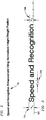
- Figs. 2 and 3 illustrate one line 70 of printed text which might appear in the input document 60 and require character recognition.
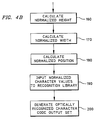
- Figs. 4A and 4B illustrate the steps to be performed in the optical character recognition method of the present invention.
- the method enhances the speed and recognition rate required for optically recognizing the characters in a line of text by dynamically normalizing such attributes as character height, character width and character position relative to a baseline reference using a standard attribute determined from the characters themselves.
- Step 80 of the method begins with a bit map file as input.
- the bit map file may exist in the data storage resource 20 or may be generated by and input directly from the optical scanning device 40.
- the optical scanning device 40 can be selected from several commercially available products capable of producing a bi-level (binary) image or "bit map" at a continuity that preserves visual quality when the image is displayed on a screen or reprinted on paper.
- the binary image or bit map is stored in the computer's random access memory, and/or the data storage resource 30, and defines a two dimensional array of 0's and 1's representing white and black, respectively.
- the 0's and 1's are in one to one correspondence with the cells of a grid that can be imagined to overlay the printed page. Because automatic methods for the interpretation of text are less discriminating than human recognition processes, the number of cells per unit area has to be greater than, for example, the resolution used in facsimile transmission of documents, which typically does not exceed 200 cells per inch. Resolutions of 300 samples per inch are suitable, however, and character recognition is not significantly improved with higher resolutions.
- the OCR software system 50 operates on the input bit map data structure by segmenting the bit map array into single horizontal text lines for processing one line of characters at a time. Each line is processed as a sequence of binary input values representing one or more characters extracted from the array of characters resident on the input document 60 as a whole.
- the binary input values being part of a two-dimensional array definition of the input characters, necessarily define one or more dimensional characteristics of the characters, such as character height, character width and character position relative to a baseline reference.
- the baseline reference is calculated after text line segmentation in step 100 of Fig. 4A as a theoretical line passing through the bottom of a predetermined percentage of the characters.
- Fig. 3 illustrates a baseline reference 102 that has been estimated by the OCR software system 50. There are various known methods which may be utilized to calculate such a baseline and any one method could be utilized in conjunction with the present invention.
- character position (starting from the bottom of the characters) can be determined relative to the baseline as a character attribute in addition to character height and width. The nature of these dimensional characteristics is graphically illustrated in Figs. 2 and 3.
- Fig. 2 illustrates the single line of text 70 reading "Speed and Recognition Enhancement Using Normalized Height/Width Position.”
- FIG. 3 is a partially enlarged view of the text line 70 of Fig. 2. It illustrates the baseline reference 102, an uppercase height attribute (H u ) 104, a lowercase height attribute (H l ) 106 and a width attribute (W) 108.
- step 110 of Fig. 4A the maximum character height, character width and character position relative to the baseline reference is calculated for each character of the input character line.
- the next step is to normalize these attribute values so that meaningful recognition comparisons can be made relative to a reference library database. Normalization is performed using a "standard” attribute such as character height. Standard height may be thought of as an estimate of the height of typical upper case characters. This estimation is based on the "mode” in a statistical sense, which is used in preference to the highest value or an average value of the text because the heights of ordinary upper case, numeric, and some lower case characters (such as "b",”d” and "h") have a small variation and are fairly stable.
- Standard height is calculated from a sequence of text assumed to be printed in only one font. The process thus estimates standard height for each line of text although standard height for a paragraph or page of text could also be used. If a line contains only a relatively small amount of text printed in a secondary font, the estimate of standard height need not be greatly affected, since the calculation is statistical in nature, as explained below.
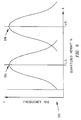
- the first step 120 (see Fig. 4A) in the calculation of standard height is to construct a histogram of character height.
- a size constraint is imposed so that very small characters such as hyphens are eliminated from the count.
- the result is a distribution graph 122, shown in Fig. 5, in which the "x" axis represents quantized character height ("h") and the "y” axis represents the frequency of occurrence ("f(h)") of the quantized height.
- F(h) f(h-1) + f(h) + f(h+1)
- peaks 124 and 126 correspond to tall characters such as capital letters or letters with ascenders at one value of height (peak 126), and another peak for small lower case letters such as 'a' or 'e' at a smaller value of height (peak 124).
- the process must also take into account the possibility that the text is printed in upper case only, i.e., that there is no lower case peak.
- an initial peak h1 is first detected by determining the global maximum of F(h). This peak may be either the desired upper case peak (i.e., the desired standard height) or else the lower case peak.
- the peak identification step 140 thus proceeds to search for a second lower case peak h2 in the region: h1 * (1-d2) ⁇ h2 ⁇ h1 and a third upper case peak h3, in the region: h1 ⁇ h3 ⁇ h1 * (1 + d3)
- the value d3 is a predetermined positive parameter representing an estimate of the largest factor by which upper case height can exceed lower case height over the range of fonts considered.
- F(h2) or F(h3) must be at least 10% (or some other reliable percentage) of N. In view of the definition of F(h), this means that at least 10% of the character heights must be within plus or minus one pixel of h2 or h3. If h3 passes this test and has amplitude greater than that of h2, it is selected for standard height. Otherwise h1 is returned for standard height.
- the n-dimensional feature vector used for comparisons between the input characters and the recognition library can be augmented using the normalized character values determined above as an extension of the vector.
- the normalized character values are perhaps best used to pre-screen the library recognition template patterns to eliminate patterns unlikely to yield a positive n-dimensional comparison.
- the recognition library is configured to include six additional features for use in pre-screening comparisons. They are: minimum normalized height, maximum normalized height, minimum normalized position, maximum normalized position, minimum normalized width and maximum normalized width. At first the normalized height, normalized position and normalized width are compared with the minimum and maximum values of each template (prototype) in the library (the order H-P-W is preferable, because width has the most variations and is least reliable among the three).
- the template is immediately ignored. If the six comparisons are satisfied, the comparison of n-dimensional features is executed for detailed classification. It has been observed that the six parameter comparison reduces the number of candidates very quickly to less than half. It also excludes upper/lower case and apostrophe/comma confusion and increases the recognition rate.
Landscapes
- Engineering & Computer Science (AREA)
- Computer Vision & Pattern Recognition (AREA)
- Physics & Mathematics (AREA)
- General Physics & Mathematics (AREA)
- Multimedia (AREA)
- Theoretical Computer Science (AREA)
- Character Input (AREA)
- Character Discrimination (AREA)
Applications Claiming Priority (2)
| Application Number | Priority Date | Filing Date | Title |
|---|---|---|---|
| US234525 | 1994-04-28 | ||
| US08/234,525 US6256408B1 (en) | 1994-04-28 | 1994-04-28 | Speed and recognition enhancement for OCR using normalized height/width position |
Publications (3)
| Publication Number | Publication Date |
|---|---|
| EP0680005A2 true EP0680005A2 (de) | 1995-11-02 |
| EP0680005A3 EP0680005A3 (de) | 1996-04-03 |
| EP0680005B1 EP0680005B1 (de) | 2002-12-04 |
Family
ID=22881722
Family Applications (1)
| Application Number | Title | Priority Date | Filing Date |
|---|---|---|---|
| EP95104984A Expired - Lifetime EP0680005B1 (de) | 1994-04-28 | 1995-04-04 | Schnelligkeits- und Erkennungsverbesserung für OCR mittels normalisierter Höhen-/Breitenposition |
Country Status (3)
| Country | Link |
|---|---|
| US (1) | US6256408B1 (de) |
| EP (1) | EP0680005B1 (de) |
| DE (1) | DE69529015T2 (de) |
Cited By (1)
| Publication number | Priority date | Publication date | Assignee | Title |
|---|---|---|---|---|
| WO2000041128A1 (en) * | 1999-01-07 | 2000-07-13 | Topscan Ltd. | Optical scanner and software therefor |
Families Citing this family (14)
| Publication number | Priority date | Publication date | Assignee | Title |
|---|---|---|---|---|
| CA2375355A1 (en) * | 2002-03-11 | 2003-09-11 | Neo Systems Inc. | Character recognition system and method |
| US8873890B2 (en) * | 2004-04-02 | 2014-10-28 | K-Nfb Reading Technology, Inc. | Image resizing for optical character recognition in portable reading machine |
| US7689531B1 (en) * | 2005-09-28 | 2010-03-30 | Trend Micro Incorporated | Automatic charset detection using support vector machines with charset grouping |
| US8155444B2 (en) * | 2007-01-15 | 2012-04-10 | Microsoft Corporation | Image text to character information conversion |
| US8175388B1 (en) | 2009-01-30 | 2012-05-08 | Adobe Systems Incorporated | Recognizing text at multiple orientations |
| US8437557B2 (en) * | 2010-05-11 | 2013-05-07 | Microsoft Corporation | Auto classifying images as “image not available” images |
| CN101937312B (zh) * | 2010-09-15 | 2014-03-19 | 中兴通讯股份有限公司 | 一种电子书的标记方法及移动终端 |
| US9256795B1 (en) | 2013-03-15 | 2016-02-09 | A9.Com, Inc. | Text entity recognition |
| US9934526B1 (en) | 2013-06-27 | 2018-04-03 | A9.Com, Inc. | Text recognition for search results |
| US9569428B2 (en) * | 2013-08-30 | 2017-02-14 | Getgo, Inc. | Providing an electronic summary of source content |
| US9430766B1 (en) * | 2014-12-09 | 2016-08-30 | A9.Com, Inc. | Gift card recognition using a camera |
| US9684844B1 (en) * | 2016-07-15 | 2017-06-20 | StradVision, Inc. | Method and apparatus for normalizing character included in an image |
| DE102019101132A1 (de) * | 2019-01-17 | 2020-07-23 | Technische Hochschule Deggendorf | Verfahren und System zur Erfassung von Maschinendaten |
| CN110942067A (zh) * | 2019-11-29 | 2020-03-31 | 上海眼控科技股份有限公司 | 文本识别方法、装置、计算机设备和存储介质 |
Family Cites Families (13)
| Publication number | Priority date | Publication date | Assignee | Title |
|---|---|---|---|---|
| US3781799A (en) * | 1972-01-03 | 1973-12-25 | Ibm | Control system employing microprogram discrete logic control routines |
| IL38603A (en) | 1972-01-21 | 1975-10-15 | Bar Lev H | Automatic pattern recognition method and apparatus particularly for optically recognizing alphanumeric characters |
| US4030068A (en) * | 1976-01-12 | 1977-06-14 | Decision Data Computer Corporation | Optical character recognition system |
| JPH0743755B2 (ja) * | 1985-10-09 | 1995-05-15 | 日本電気株式会社 | 文字認識装置 |
| US4897880A (en) | 1987-02-17 | 1990-01-30 | Soricon Corporation | Data acquisition control method and system for a hand held reader |
| JPH07104909B2 (ja) | 1987-03-04 | 1995-11-13 | シャープ株式会社 | 文字認識方法 |
| US5253303A (en) * | 1988-02-15 | 1993-10-12 | Nec Corporation | Character recognizing method and apparatus thereof |
| US4998285A (en) | 1988-03-11 | 1991-03-05 | Kabushiki Kaisha Toshiba | Character recognition apparatus |
| JP2822189B2 (ja) * | 1988-05-19 | 1998-11-11 | ソニー株式会社 | 文字認識装置及び方法 |
| US5060290A (en) * | 1989-09-05 | 1991-10-22 | Dole Dried Fruit And Nut Company | Algorithm for gray scale analysis especially of fruit or nuts |
| DE69132789T2 (de) | 1990-05-14 | 2002-05-23 | Canon K.K., Tokio/Tokyo | Verfahren und Gerät zur Bildverarbeitung |
| US5373566A (en) * | 1992-12-24 | 1994-12-13 | Motorola, Inc. | Neural network-based diacritical marker recognition system and method |
| US5396566A (en) * | 1993-03-04 | 1995-03-07 | International Business Machines Corporation | Estimation of baseline, line spacing and character height for handwriting recognition |
-
1994
- 1994-04-28 US US08/234,525 patent/US6256408B1/en not_active Expired - Lifetime
-
1995
- 1995-04-04 DE DE69529015T patent/DE69529015T2/de not_active Expired - Lifetime
- 1995-04-04 EP EP95104984A patent/EP0680005B1/de not_active Expired - Lifetime
Cited By (2)
| Publication number | Priority date | Publication date | Assignee | Title |
|---|---|---|---|---|
| WO2000041128A1 (en) * | 1999-01-07 | 2000-07-13 | Topscan Ltd. | Optical scanner and software therefor |
| US6965703B1 (en) | 1999-01-07 | 2005-11-15 | Topscan Ltd. | Optical scanner and software for correcting distorted images |
Also Published As
| Publication number | Publication date |
|---|---|
| DE69529015D1 (de) | 2003-01-16 |
| EP0680005B1 (de) | 2002-12-04 |
| EP0680005A3 (de) | 1996-04-03 |
| DE69529015T2 (de) | 2003-10-09 |
| US6256408B1 (en) | 2001-07-03 |
Similar Documents
| Publication | Publication Date | Title |
|---|---|---|
| US6687401B2 (en) | Pattern recognizing apparatus and method | |
| US6178263B1 (en) | Method of estimating at least one run-based font attribute of a group of characters | |
| US6661919B2 (en) | Method and apparatus for producing a hybrid data structure for displaying a raster image | |
| US6385350B1 (en) | Method and apparatus for producing a hybrid data structure for displaying a raster image | |
| US5539841A (en) | Method for comparing image sections to determine similarity therebetween | |
| US6970601B1 (en) | Form search apparatus and method | |
| US5828771A (en) | Method and article of manufacture for determining whether a scanned image is an original image or fax image | |
| EP0649113B1 (de) | Optische Mehrfontzeichenerkennung mit einem Verbindungsschachtelansatz | |
| EP0680005B1 (de) | Schnelligkeits- und Erkennungsverbesserung für OCR mittels normalisierter Höhen-/Breitenposition | |
| US5848191A (en) | Automatic method of generating thematic summaries from a document image without performing character recognition | |
| US7233697B2 (en) | Character recognition device and a method therefor | |
| US5850476A (en) | Automatic method of identifying drop words in a document image without performing character recognition | |
| JP2005242579A (ja) | 文書処理装置、文書処理方法、および文書処理プログラム | |
| JP2001167131A (ja) | 文書シグネチュアを使用する文書の自動分類方法 | |
| US5835634A (en) | Bitmap comparison apparatus and method using an outline mask and differently weighted bits | |
| WO1993020533A1 (en) | Character-recognition systems and methods with means to measure endpoint features in character bit-maps | |
| Yin | Skew detection and block classification of printed documents | |
| EP0457534A2 (de) | Verfahren und Gerät zur Bildverarbeitung | |
| US20010043742A1 (en) | Communication document detector | |
| JP2007058882A (ja) | パターン認識装置 | |
| US5119441A (en) | Optical character recognition apparatus and method using masks operation | |
| JPH08272902A (ja) | 異字体異品質文字の認識方法 | |
| JPH0916715A (ja) | 文字認識装置および方法 | |
| JP4079333B2 (ja) | 文書画像の日本語英語判定方法および記録媒体 | |
| JP2007026470A (ja) | パターン認識装置 |
Legal Events
| Date | Code | Title | Description |
|---|---|---|---|
| PUAI | Public reference made under article 153(3) epc to a published international application that has entered the european phase |
Free format text: ORIGINAL CODE: 0009012 |
|
| AK | Designated contracting states |
Kind code of ref document: A2 Designated state(s): DE FR GB |
|
| PUAL | Search report despatched |
Free format text: ORIGINAL CODE: 0009013 |
|
| AK | Designated contracting states |
Kind code of ref document: A3 Designated state(s): DE FR GB |
|
| 17P | Request for examination filed |
Effective date: 19960213 |
|
| 17Q | First examination report despatched |
Effective date: 20010719 |
|
| GRAG | Despatch of communication of intention to grant |
Free format text: ORIGINAL CODE: EPIDOS AGRA |
|
| GRAG | Despatch of communication of intention to grant |
Free format text: ORIGINAL CODE: EPIDOS AGRA |
|
| GRAH | Despatch of communication of intention to grant a patent |
Free format text: ORIGINAL CODE: EPIDOS IGRA |
|
| GRAH | Despatch of communication of intention to grant a patent |
Free format text: ORIGINAL CODE: EPIDOS IGRA |
|
| GRAA | (expected) grant |
Free format text: ORIGINAL CODE: 0009210 |
|
| AK | Designated contracting states |
Kind code of ref document: B1 Designated state(s): DE FR GB |
|
| REG | Reference to a national code |
Ref country code: GB Ref legal event code: FG4D |
|
| REF | Corresponds to: |
Ref document number: 69529015 Country of ref document: DE Date of ref document: 20030116 |
|
| ET | Fr: translation filed | ||
| PLBE | No opposition filed within time limit |
Free format text: ORIGINAL CODE: 0009261 |
|
| STAA | Information on the status of an ep patent application or granted ep patent |
Free format text: STATUS: NO OPPOSITION FILED WITHIN TIME LIMIT |
|
| 26N | No opposition filed |
Effective date: 20030905 |
|
| REG | Reference to a national code |
Ref country code: GB Ref legal event code: 746 Effective date: 20090316 |
|
| PGFP | Annual fee paid to national office [announced via postgrant information from national office to epo] |
Ref country code: FR Payment date: 20110420 Year of fee payment: 17 |
|
| REG | Reference to a national code |
Ref country code: FR Ref legal event code: ST Effective date: 20121228 |
|
| PG25 | Lapsed in a contracting state [announced via postgrant information from national office to epo] |
Ref country code: FR Free format text: LAPSE BECAUSE OF NON-PAYMENT OF DUE FEES Effective date: 20120430 |
|
| PGFP | Annual fee paid to national office [announced via postgrant information from national office to epo] |
Ref country code: GB Payment date: 20140428 Year of fee payment: 20 |
|
| PGFP | Annual fee paid to national office [announced via postgrant information from national office to epo] |
Ref country code: DE Payment date: 20140429 Year of fee payment: 20 |
|
| REG | Reference to a national code |
Ref country code: DE Ref legal event code: R071 Ref document number: 69529015 Country of ref document: DE |
|
| REG | Reference to a national code |
Ref country code: GB Ref legal event code: PE20 Expiry date: 20150403 |
|
| PG25 | Lapsed in a contracting state [announced via postgrant information from national office to epo] |
Ref country code: GB Free format text: LAPSE BECAUSE OF EXPIRATION OF PROTECTION Effective date: 20150403 |