EP0680160B1 - Procédé et dispositif de contrôle de la puissance de transmission d'une station mobile pendant une commutation douce dans un système à accès multiple par division de code - Google Patents
Procédé et dispositif de contrôle de la puissance de transmission d'une station mobile pendant une commutation douce dans un système à accès multiple par division de code Download PDFInfo
- Publication number
- EP0680160B1 EP0680160B1 EP19950302771 EP95302771A EP0680160B1 EP 0680160 B1 EP0680160 B1 EP 0680160B1 EP 19950302771 EP19950302771 EP 19950302771 EP 95302771 A EP95302771 A EP 95302771A EP 0680160 B1 EP0680160 B1 EP 0680160B1
- Authority
- EP
- European Patent Office
- Prior art keywords
- transmission power
- base station
- mobile station
- power control
- sir
- Prior art date
- Legal status (The legal status is an assumption and is not a legal conclusion. Google has not performed a legal analysis and makes no representation as to the accuracy of the status listed.)
- Expired - Lifetime
Links
Images


Classifications
-
- H—ELECTRICITY
- H04—ELECTRIC COMMUNICATION TECHNIQUE
- H04W—WIRELESS COMMUNICATION NETWORKS
- H04W36/00—Hand-off or reselection arrangements
- H04W36/08—Reselecting an access point
-
- H—ELECTRICITY
- H04—ELECTRIC COMMUNICATION TECHNIQUE
- H04W—WIRELESS COMMUNICATION NETWORKS
- H04W36/00—Hand-off or reselection arrangements
- H04W36/08—Reselecting an access point
- H04W36/083—Reselecting an access point wherein at least one of the access points is a moving node
-
- H—ELECTRICITY
- H04—ELECTRIC COMMUNICATION TECHNIQUE
- H04W—WIRELESS COMMUNICATION NETWORKS
- H04W52/00—Power management, e.g. Transmission Power Control [TPC] or power classes
- H04W52/04—Transmission power control [TPC]
- H04W52/18—TPC being performed according to specific parameters
- H04W52/24—TPC being performed according to specific parameters using SIR [Signal to Interference Ratio] or other wireless path parameters
-
- H—ELECTRICITY
- H04—ELECTRIC COMMUNICATION TECHNIQUE
- H04W—WIRELESS COMMUNICATION NETWORKS
- H04W52/00—Power management, e.g. Transmission Power Control [TPC] or power classes
- H04W52/04—Transmission power control [TPC]
- H04W52/38—TPC being performed in particular situations
- H04W52/40—TPC being performed in particular situations during macro-diversity or soft handoff
-
- H—ELECTRICITY
- H04—ELECTRIC COMMUNICATION TECHNIQUE
- H04W—WIRELESS COMMUNICATION NETWORKS
- H04W36/00—Hand-off or reselection arrangements
- H04W36/16—Performing reselection for specific purposes
- H04W36/18—Performing reselection for specific purposes for allowing seamless reselection, e.g. soft reselection
-
- Y—GENERAL TAGGING OF NEW TECHNOLOGICAL DEVELOPMENTS; GENERAL TAGGING OF CROSS-SECTIONAL TECHNOLOGIES SPANNING OVER SEVERAL SECTIONS OF THE IPC; TECHNICAL SUBJECTS COVERED BY FORMER USPC CROSS-REFERENCE ART COLLECTIONS [XRACs] AND DIGESTS
- Y02—TECHNOLOGIES OR APPLICATIONS FOR MITIGATION OR ADAPTATION AGAINST CLIMATE CHANGE
- Y02D—CLIMATE CHANGE MITIGATION TECHNOLOGIES IN INFORMATION AND COMMUNICATION TECHNOLOGIES [ICT], I.E. INFORMATION AND COMMUNICATION TECHNOLOGIES AIMING AT THE REDUCTION OF THEIR OWN ENERGY USE
- Y02D30/00—Reducing energy consumption in communication networks
- Y02D30/70—Reducing energy consumption in communication networks in wireless communication networks
Definitions
- the present invention relates to a transmission power control method for radio communications using a CDMA (Code Division Multiple Access) system, and a mobile station using this method.
- CDMA Code Division Multiple Access
- transmission power control is an essential technique. This is because SIRs (Signal-to-Interference Ratios) of signals which are transmitted from mobile stations and received by a base station within a cell must be kept equal to each other at the base station to prevent the reduction in the capacity in terms of the number of subscribers. In addition, SIRs of signals which are transmitted from the base station and received by the mobile stations must be made equal.
- SIRs Signal-to-Interference Ratios
- CDMA systems can use a characteristic channel transfer method called soft handoff.
- the soft handoff is characterized by commencing communications with a new base station before terminating communications with the old base station. Specifically, a mobile station transmits a signal simultaneously to the old base station and a new base station in the same code and at the same frequency, in different codes and at the same frequency, in the same code and at different frequencies, or in different codes and at different frequencies, and transfers communications from the old base station to the new base station in accordance with received power of signals independently received from the two base stations. Therefore, the soft handoff is an effective method for reducing transmission power of the mobile stations and base stations.
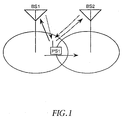
- Fig. 1 schematically illustrates a soft handoff.
- the reference character BS1 designates an old base station
- BS2 designates a new base station
- PS1 denotes a mobile station that transmits a signal or signals to the two base stations BS1 and BS2.
- the mobile station transmits one wave when the same code and the same frequency are used, and two waves when different codes and different frequencies are used.
- the base stations BS1 and BS2 transmit independent signals of the same content to the mobile station PS1.
- the mobile station PS1 is transferring its communications with the old base station BS1 to communications with the new base station BS2.
- Fig. 2 shows a conventional transmission power control method during a soft handoff.
- the mobile station PS1 in the cell linked to the base station BS1 is moving as shown in Fig. 1, it starts a soft handoff from the old base station BS1 to the new base station BS2. More specifically, the mobile station PS1 detects the reduction in the received power in the perch channel from the old base station BS1, and starts the soft handoff to a new base station having a perch channel which provides the mobile station PS1 with highest received power among neighboring cells.
- a perch channel refers to a channel used when a mobile station selects a new base station. Each base station transmits through its perch channel.
- the mobile station measures received powers sent through the perch channels of respective base stations, and begins to change the connection to the base station which provides the mobile station with the maximum received power. Thus, the mobile station selects the new base station that provides the maximum received power.
- the transmission power control is performed by open loop control.
- Fig. 2 illustrates this.
- the mobile station PS1 measures received power levels from the base stations BS1 and BS2 at step S1, and controls its transmission power levels to the base stations BS1 and BS2 independently at step S2 on the basis of the received power levels.
- the base stations BS1 and BS2 measure received power levels from the mobile station at steps S3 and S4, respectively, and control their transmission power levels to the mobile station PS1 at steps S5 and S6 independently.
- the open loop transmission power control is used in the conventional soft handoff.
- highly accurate transmission power control cannot be achieved in the case where there is little correlation between a forward (from base station to mobile station) channel and a reverse (from mobile station to base station) channel. This presents a problem in that the capacity in terms of the number of subscribers is reduced.
- US patent 5,267,261 describes such a system, including soft handoff from communications between a mobile station and a first base station to communications between the mobile station and a second base station.
- an object of the present invention is to provide a transmission power control method in a CDMA system, and a mobile station using the same, which can increase the capacity in terms of the number of subscribers by implementing highly accurate, power reduced transmission power control.
- a transmission power control method for implementation by a mobile station communicating with multiple base stations, in which, during a handoff period, the mobile station communicates with two base stations, the mobile station implementing a closed loop transmission power control during a soft handoff which transfers communication between the mobile station and an old base station to communication between the mobile station and a new base station in a CDMA system
- the transmission power control method being characterised by comprising the steps of: measuring, at the mobile.station, a first SIR of a signal transmitted by the old base station; measuring, at the mobile station, a second SIR of a signal transmitted by the new base station; comparing, at the mobile station, the first SIR with the second SIR; selecting, at the mobile station, from said first SIR and said second SIR, the greater SIR; deciding, at the mobile station, in accordance with the selected SIR, a first transmission power control bit for designating transmission power of the old base station and the new base station; and transmitting the first transmission power control bit from
- a mobile station communicating, during a handoff period, with an old base station in a cell of which the mobile station exists, and a new base station to which the mobile station transfers to implement closed loop transmission power control in a CDMA system
- the mobile station being characterised by comprising: a first desired wave received power detector for detecting received power of a desired wave of a signal transmitted by the old base station; a first interference wave received power detector for detecting received power of an interference wave to the desired wave of the signal transmitted by the old base station; a first SIR calculator for calculating a first SIR based on the received power detected by the first desired wave received power detector and the received power detected by the first interference wave received power detector; a second desired wave received power detector for detecting received power of a desired wave of a signal transmitted by the new base station; a second interference wave received power detector for detecting received power of an interference wave to the desired wave of the signal transmitted by the new base station; a second SIR calculator for calculating a second SIR
- Fig. 3 illustrates a first method in accordance with the present invention.
- the mobile station PS1 When the mobile station PS1 is carrying out a soft handoff with respect to the base stations BS1 and BS2, the mobile station determines its transmission power level to the base stations BS1 and BS2 in accordance with the transmission power control bits transmitted from these base stations BS1 and BS2, thereby performing a closed loop transmission power control.
- the mobile station compares the transmission power control bit from the base stations BS1 with that from the base station BS2 at step S11. Since the transmission power control bit from the base station BS1 and that from the base station BS2 are independent of each other, the values of the bits may differ from each other. In such a case, the mobile station PS1 determines its transmission power in accordance with the transmission power control bit that indicates lower transmission power to the mobile station PS1 at step S12.
- the transmission power control of the mobile station is performed in accordance with the transmission power control bit transmitted from the base station having greater received SIR than the other base station.
- the received SIR at the old base station BS1 is rapidly reduced, and the channel between the old base station BS1 and the mobile station is disconnected. This makes it possible to complete the soft handoff in a short time, and to reduce the transmission power, as well.
- Reduction in the transmission power of the mobile station PS1 thus achieved makes it possible to reduce the interference to other cells, and hence, to increase the capacity in terms of the number of subscribers.
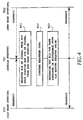
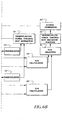
- Fig. 4 illustrates a second method in accordance with the present invention.
- the base stations BS1 and BS2 determine their own transmission power levels to the mobile station PS1 in accordance with the transmission power control bit for the base stations which is transmitted from the mobile station, thereby performing a closed loop transmission power control as in the case of Fig. 3.
- the transmission power control bit is used to determined the transmission power of the base stations BS1 and BS2. Since the base stations BS1 and BS2 transmit independent waves to the mobile station PS1, the received SIRs at the mobile station will differ from each other. Taking account of this, the transmission power control bit for the base stations is determined as shown in Fig. 4.
- the mobile station PS1 measures the received SIR from the old base station BS1 and that from the new base station BS2 at step S21. Subsequently, the mobile station PS1 compares the two SIRs at step S22, and determines the transmission power control bit for the base stations in accordance with the SIR having a greater value at step S23.
- the mobile station PS1 determines the transmission power control bit for the base station on the basis of the greater received SIR at the mobile station.
- the received SIR from the old base station BS1 is rapidly reduced, and the channel between the old base station BS1 and the mobile station PS1 is disconnected.
- This makes it possible to complete the soft handoff in a short time, and to reduce the transmission power, as well.
- Reduction in the transmission power of the base stations thus achieved makes it possible to prevent the base stations from becoming interference sources to other cells, and hence, to increase the capacity in terms of the number of subscribers.
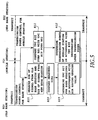
- Fig. 5 illustrates a third method in accordance with the present invention, which is normally employed in actual transmission power control.
- the transmission power of the mobile station PS1 is determined at steps S11 and S12 as in Fig. 3, and the transmission power control bit for the base stations, which is used to determine the transmission power of the base stations BS1 and BS2, is determined at steps S21 - S23 as in Fig. 4.
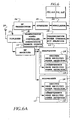
- Figs. 6A and 6B are block diagrams showing an embodiment of the mobile station PS1 in accordance with the present invention.
- the reference numeral 10 designates an antenna
- the reference numeral 11 designates a diplexer
- the reference numeral 12 designates an RF receiver
- the reference numerals 13 and 13' designate despreaders
- the reference numerals 14 and 14' designate demodulators
- the reference numeral 15- designates a transmission power control (TPC) bit extractor
- the reference numeral 16 designates a transmission power control bit selector
- the reference numeral 17 designates a transmission power controller
- the reference numerals 18 and 18' designate desired wave received power detectors provided in the despreaders 13 and 13'
- the reference numerals 19 and 19' designate interference wave received power detectors provided in the despreaders 13 and 13'
- the reference numerals 20 and 20' designate SIR calculators
- the reference numeral 21 designates an SIR selector
- the reference numeral 22 designates
- a spread-spectrum signals transmitted from the base stations BS1 and BS2 are received by the antenna 10.
- the received signals are inputted to the RF receiver 12 via the diplexer 11.
- the received signals are passed through a bandpass filter (BPF) to remove components outside the pass band, and are amplified by an amplifier.
- BPF bandpass filter
- the amplified signal is downconverted to an intermediate frequency (IF) signal by a signal generated by a local oscillator.
- IF intermediate frequency
- the IF signal is passed through a bandpass filter, and its levels is corrected to an appropriate signal level by an automatic gain control circuit (AGC).
- AGC automatic gain control circuit
- the output of the AGC undergoes a quasi-coherent detection, and is frequency-converted into a baseband signal.
- the baseband signal is passed though a lowpass filter. (LPF), undergoes an analog-to-digital (A/D) conversion, and is outputted as a digital signal.
- LPF lowpass filter
- A/D analog-to-digital
- the digital signal outputted from the RF receiver 12 is despread by the despreaders 13 and 13', and are outputted as narrow band modulated signals similar to those generated at the base stations BS1 and BS2.
- the modulated signals are demodulated by the demodulators 14 and 14'.
- the outputs of the demodulators 14 and 14' are supplied to the transmission power control bit extractor 15 which extracts from the demodulated signals the transmission power control bits transmitted from the base stations BS1 and BS2.
- the extracted transmission power control bits are compared by the TPC selector 16, and the TPC bit that indicates smaller transmission power of the mobile station is selected when the two TPC bits differ.
- the selected TPC bit is supplied to the transmission power controller 17, which determines the transmission power of the mobile station on the basis of the selected transmission power control bit, and provides the RF transmitter 26 with the transmission power control information.
- the desired wave received power detectors 18 and 18' and the interference wave received power detectors 19 and 19' in the despreaders 13 and 13' detect the desired wave received powers from the base stations BS1 and BS2, and the interference wave received powers to the desired received waves from the base stations, respectively.
- the SIR calculators 20 and 20' obtain the received SIRs of the signals transmitted from the base stations BS1 and BS2, respectively.
- the SIR selector 21 compares the two received SIRs, and selects the received SIR whose value is greater than the other.
- the transmission power control bit decision portion 22 compares the selected received SIR with a predetermined reference SIR, and produces a transmission power control bit which commands an increase in the transmission power of the base stations when the received SIR is less than the reference SIR, or produces a transmission power control bit which commands a decrease in the transmission power when the received SIR is greater than the reference SIR, and supplies the transmission power control bit to the signal generator 23.
- the signal generator 23 forms a frame to be transmitted, which includes the transmission power control bit supplied from the transmission power control bit decision portion 22, and provides it to the modulator 24 as a transmitted signal.
- the transmitted signal is modulated by the modulator 24, spread by the spreader 25, and is supplied to the RF transmitter 26.
- the transmitted signal which is frequency converted to an IF and then to an RF band by the RF transmitter 26 is transmitted at the transmission power based on the control information outputted from the transmission power controller 16.
Landscapes
- Engineering & Computer Science (AREA)
- Computer Networks & Wireless Communication (AREA)
- Signal Processing (AREA)
- Mobile Radio Communication Systems (AREA)
Claims (6)
- Procédé de commande de puissance de transmission pour une mise en oeuvre par un poste (PS1) mobile communiquant avec des postes de base multiple, dans lequel, pendant une période d'attente, le poste mobile (PSI) communique avec deux postes (BS1, BS2) de base, le poste (PS1) mobile mettant en oeuvre une commande de puissance de transmission à boucle fermée pendant une pause logicielle qui transfère la communication entre le poste (PS1) mobile et un ancien poste (BS1) de base à la communication entre le poste (PS1) mobile et un nouveau poste (BS2) de base dans un système CDMA, le procédé de commande de puissance de transmission étant caractérisé par le fait de comporter des étapes qui consistent :à mesurer, au poste (PS1) mobile, un premier SIR d'un signal transmis par l'ancien poste (BS1) de base (S21);à mesure, au poste (PS1) mobile, un deuxième SIR d'un signal transmis par le nouveau poste (BS2) de base (S21);à comparer, au poste (PS1) mobile, le premier SIR au deuxième SIR (S22);à sélectionner, au poste (PS1) mobile, à partir du premier SIR et du deuxième SIR, le SIR le plus grand ;à décider, au poste (PS1) mobile, conformément au SIR sélectionné, un premier bit de commande de puissance de transmission pour désigner la puissance de transmission du poste (BS1) de base ancien et du nouveau poste (BS2) de base (S23) ; età transmettre le premier bit de commande de puissance de transmission du poste (PS1) mobile au poste (BS1) de base ancien et au nouveau poste (BS2) de base.
- Procédé de commande de puissance de transmission suivant la revendication 1, comportant en outre les étapes qui consistent :à extraire, au poste (PS1) mobile, un deuxième bit de commande de puissance de transmission, qui désigne la puissance de transmission du poste (PS1) mobile, à partir d'un signal transmis par l'ancien poste (BS1) de base ;à extraire, au poste (PS1) mobile, un troisième bit de commande de puissance de transmission, qui désigne la puissance de transmission du poste (PS1) mobile, à partir d'un signal transmis par le nouveau poste (BS2) de base ;à comparer, au poste (PS1) mobile, la puissance de transmission désignée par le deuxième bit de commande de puissance de transmission et la puissance de transmission désignée par le troisième bit de commande de puissance de transmission (S11) ;à sélectionner, au poste (PS1) mobile, à partir du deuxième bit de commande de puissance de transmission et du troisième bit de commande de puissance de transmission, le bit de commande de puissance de transmission désignant la puissance de transmission la plus faible ; età commande, au poste (PS1) mobile, la puissance de transmission du poste (PS1) mobile conformément au bit de commande de puissance de transmission sélectionné (S12).
- Procédé de commande de puissance de transmission suivant la revendication 1 ou 2, dans lequel
le poste (PS1) mobile transmet un signal à l'ancien poste (BS1) de base et au nouveau poste (BS2) de base en utilisant un code d'étalement identique et une fréquence de transmission identique, différents codes d'étalement et une fréquence de transmission identique, un code d'étalement identique et différentes fréquences de transmission, ou différents codes d'étalement et différentes fréquences de transmission, et
le poste (PS1) mobile passe d'une communication de l'ancien poste (BS1) de base au nouveau poste (BS2) de base conformément à la puissance reçue d'un signal reçu à partir de chaque poste de l'ancien poste (BS1) de base et du nouveau poste (BS2) de base. - Poste mobile agencé pour communiquer, pendant une période de pause, avec un ancien poste (BS1) de base dans une cellule duquel existe le poste (PS1) mobile, et un nouveau poste (BS2) de base auquel le poste (BS2) mobile transfert pour mettre en oeuvre une commande de puissance de transmission à boucle fermée dans un système CDMA, le poste (PS1) mobile étant caractérisé par le fait de comporter :un premier détecteur (18) de puissance reçue à onde souhaitée pour détecter la puissance reçue d'une onde souhaitée d'un signal transmis par l'ancien poste (BS1) de base ;un premier détecteur (19) de puissance reçue d'onde d'interférence pour détecter la puissance reçue d'une onde d'interférence à l'onde souhaitée du signal transmis par l'ancien poste (BS1) de base ;un premier calculateur (20) de SIR pour calculer un premier SIR sur la base de la puissance reçue détectée par le premier détecteur (18) de puissance reçue d'onde souhaitée et de la puissance reçue détectée par le premier détecteur (19) de puissance reçue d'onde d'interférence ;un deuxième détecteur (18') de puissance reçue d'onde souhaitée pour détecter une puissance reçue d'une onde souhaitée d'un signal transmis par le nouveau poste (BS2) de base ;un deuxième détecteur (19') de puissance reçue d'onde d'interférence pour détecter la puissance reçue d'une onde d'interférence à l'onde souhaitée du signal transmis par le nouveau poste (BS2) de base ;un deuxième calculateur (20') de SIR pour calculer un deuxième SIR sur la base de la puissance reçue détectée par le deuxième détecteur (18') de puissance reçue d'onde souhaitée et de la puissance reçue détectée par le deuxième détecteur (19') de puissance reçue d'onde d'interférence ;un sélecteur (21) de SIR pour comparer le premier SIR et le deuxième SIR et sélectionner parmi le premier SIR et le deuxième SIR le SIR le plus grand ;des moyens (22) agencés pour décider, conformément au SIR sélectionné, un premier bit de commande de puissance de transmission pour désigner la puissance de transmission de l'ancien poste (BS1) de base et du nouveau poste (BS2) de base ; etun émetteur (26) pour émettre le premier bit de commande de puissance de transmission vers l'ancien poste (BS1) de base et le nouveau poste (BS2) de base.
- Poste mobile suivant la revendication 4, comportant en outre :un extracteur (15) de bits de commande de puissance de transmission pour extraire un deuxième bit de commande de puissance de transmission qui désigne la puissance de transmission du poste (PS1) mobile, à partir d'un signal transmis par l'ancien poste (BS1) de base et un troisième bit de commande de puissance de transmission qui désigne la puissance de transmission du poste (PS1) mobile, à partir d'un signal transmis par le nouveau poste (BS2) de base ;un sélecteur (16) de bits de commande de puissance de transmission pour comparer la puissance de transmission désignée par le deuxième bit de commande de puissance de transmission et la puissance de transmission désignée par le troisième bit de commande de puissance de transmission, et sélectionner à partir du deuxième bit de commande de puissance de transmission et du troisième bit de commande de puissance de transmission, le bit de commande de puissance de transmission désignant la puissance de transmission la plus faible ; etun dispositif (17) de commande de puissance de transmission pour commander la puissance de transmission du poste (PS1) mobile conformément au bit de commande de puissance de transmission sélectionné.
- Poste mobile suivant la revendication 4 ou 5, dans lequel
le poste (PS1) mobile est agencé pour transmettre un signal à l'ancien poste (BS1) de base et au nouveau poste (BS2) de base en utilisant un code d'étalement identique et une fréquence de transmission identique, différents codes d'étalement et une fréquence de transmission identique, un code d'étalement identique et différentes fréquences de transmission ou différents codes d'étalement et différentes fréquences de transmission, et
le poste (PS1) mobile est agencé pour transférer la communication du poste (BS1) de base ancien au poste (BS2) de base nouveau conformément à la puissance reçue d'un signal reçu à partir de chacun du poste (BS1) de base ancien et du poste (BS2) de base nouveau.
Applications Claiming Priority (6)
| Application Number | Priority Date | Filing Date | Title |
|---|---|---|---|
| JP9035094 | 1994-04-27 | ||
| JP90350/94 | 1994-04-27 | ||
| JP9035094 | 1994-04-27 | ||
| JP7077934A JP2904335B2 (ja) | 1994-04-27 | 1995-04-03 | 送信電力制御方法および移動局装置 |
| JP77934/95 | 1995-04-03 | ||
| JP7793495 | 1995-04-03 |
Publications (3)
| Publication Number | Publication Date |
|---|---|
| EP0680160A2 EP0680160A2 (fr) | 1995-11-02 |
| EP0680160A3 EP0680160A3 (fr) | 1996-05-15 |
| EP0680160B1 true EP0680160B1 (fr) | 2004-02-11 |
Family
ID=26418984
Family Applications (1)
| Application Number | Title | Priority Date | Filing Date |
|---|---|---|---|
| EP19950302771 Expired - Lifetime EP0680160B1 (fr) | 1994-04-27 | 1995-04-25 | Procédé et dispositif de contrôle de la puissance de transmission d'une station mobile pendant une commutation douce dans un système à accès multiple par division de code |
Country Status (6)
| Country | Link |
|---|---|
| EP (1) | EP0680160B1 (fr) |
| JP (1) | JP2904335B2 (fr) |
| KR (1) | KR100235855B1 (fr) |
| CN (1) | CN1092458C (fr) |
| CA (1) | CA2147922A1 (fr) |
| DE (1) | DE69532544T2 (fr) |
Cited By (1)
| Publication number | Priority date | Publication date | Assignee | Title |
|---|---|---|---|---|
| US9564963B2 (en) | 1995-06-30 | 2017-02-07 | Interdigital Technology Corporation | Automatic power control system for a code division multiple access (CDMA) communications system |
Families Citing this family (61)
| Publication number | Priority date | Publication date | Assignee | Title |
|---|---|---|---|---|
| JP3078216B2 (ja) * | 1995-12-13 | 2000-08-21 | 株式会社エヌ・ティ・ティ・ドコモ | 基地局選択方法 |
| JP2959458B2 (ja) * | 1996-01-19 | 1999-10-06 | 日本電気株式会社 | 送信電力制御方法 |
| JP3352593B2 (ja) * | 1996-05-22 | 2002-12-03 | 株式会社エヌ・ティ・ティ・ドコモ | 移動通信システムおよび移動通信システムにおけるソフトハンドオーバ中送信電力制御方法 |
| JP2830911B2 (ja) * | 1996-06-07 | 1998-12-02 | 日本電気株式会社 | 移動通信システムおよびその送信電力制御方法、基地局無線装置とそれに使用される上位局 |
| JP2785809B2 (ja) * | 1996-06-21 | 1998-08-13 | 日本電気株式会社 | リバースチャネル送信電力制御方式 |
| JP2839014B2 (ja) * | 1996-07-05 | 1998-12-16 | 日本電気株式会社 | 符号分割多重方式セルラシステムの送信電力制御方法 |
| KR100289568B1 (ko) * | 1996-07-29 | 2001-05-02 | 다치카와 게이지 | 사이트 다이버시티를 이용한 이동 통신 시스템에 있어서의 다운링크 송신 전력 제어 방법 및 장치 |
| US5903554A (en) * | 1996-09-27 | 1999-05-11 | Qualcomm Incorporation | Method and apparatus for measuring link quality in a spread spectrum communication system |
| JP3369063B2 (ja) * | 1996-10-18 | 2003-01-20 | 松下電器産業株式会社 | 移動通信端末 |
| EP0878973B1 (fr) | 1996-10-18 | 2005-03-02 | Matsushita Electric Industrial Co., Ltd | Système de communication radio et procédé pour la mise en oeuvre d'un transfert des terminals mobiles par évaluation des signaux TPC |
| US6021328A (en) * | 1996-12-19 | 2000-02-01 | Northern Telecom Limited | Radio link quality handoff trigger |
| US6628630B1 (en) | 1997-04-15 | 2003-09-30 | Matsushita Electric Industrial Co., Ltd. | Spread spectrum communication method |
| US6002933A (en) * | 1997-04-29 | 1999-12-14 | Qualcomm Incorporated | Inter-system soft handoff |
| JP3628145B2 (ja) * | 1997-05-21 | 2005-03-09 | 松下電器産業株式会社 | 送信電力制御装置及び送信電力制御方法 |
| EP0983642B1 (fr) | 1997-05-22 | 2002-01-23 | Siemens Aktiengesellschaft | Procede et dispositif de regulation de la puissance d'emission pour des liaisons entre une station de base et des stations mobiles d'un systeme de radiocommunication |
| DE19721500C1 (de) * | 1997-05-22 | 1999-04-15 | Siemens Ag | Verfahren und Vorrichtung zum Verarbeiten von Steuersignalen in einer Mobilstation eines Mobilfunksystems |
| US6259927B1 (en) | 1997-06-06 | 2001-07-10 | Telefonaktiebolaget Lm Ericsson | Transmit power control in a radio communication system |
| US6085108A (en) * | 1997-12-15 | 2000-07-04 | Telefonaktiebolaget Lm Ericsson | Modified downlink power control during macrodiversity |
| US6304562B1 (en) * | 1997-06-26 | 2001-10-16 | Samsung Electronics Co., Ltd. | Asymmetric forward power control in a CDMA communication |
| DE69817950T2 (de) | 1997-08-12 | 2004-05-13 | Nec Corp. | Mobilstation und Verfahren zur Sendeleistungsregelung und Interferenzverminderung in Funkkommunikationssystemen |
| US6097972A (en) * | 1997-08-29 | 2000-08-01 | Qualcomm Incorporated | Method and apparatus for processing power control signals in CDMA mobile telephone system |
| US6708041B1 (en) | 1997-12-15 | 2004-03-16 | Telefonaktiebolaget Lm (Publ) | Base station transmit power control in a CDMA cellular telephone system |
| FI106667B (fi) * | 1998-02-16 | 2001-03-15 | Nokia Networks Oy | Menetelmä, radioverkko-ohjain ja järjestelmä ainakin kahden radioverkko-ohjaimen kautta kulkevan makrodiversiteettiyhteyden kontrolloimiseksi solukkoradiojärjestelmässä |
| US6539226B1 (en) | 1998-02-16 | 2003-03-25 | Nec Corporation | Base station transmission power control system mobile station and base station |
| EP1004217B1 (fr) * | 1998-02-19 | 2005-06-15 | QUALCOMM Incorporated | Procede et appareil de maximisation du temps de veille utilisant un canal rapide de radiomessagerie |
| JP3295369B2 (ja) * | 1998-03-10 | 2002-06-24 | 松下電器産業株式会社 | 無線通信システム及び基地局装置 |
| JP3125776B2 (ja) | 1998-03-27 | 2001-01-22 | 日本電気株式会社 | セルラシステムにおける送信電力制御方法及び基地局装置 |
| US6144861A (en) * | 1998-04-07 | 2000-11-07 | Telefonaktiebolaget Lm Ericsson | Downlink power control in a cellular mobile radio communications system |
| CA2604069C (fr) * | 1998-05-07 | 2014-08-12 | Qualcomm Incorporated | Procede et appareil permettant de coordonner la transmission de messages courts avec des recherches de transfert difficile dans un systeme de communications sans fil |
| KR100326330B1 (ko) * | 1998-05-08 | 2002-06-26 | 윤종용 | 이동통신시스템의핸드오프장치및방법 |
| US6438116B1 (en) * | 1998-07-16 | 2002-08-20 | Telefonaktiebolaget L M Ericsson (Publ) | Adaptive power margin for hard handoffs in code division multiple access based systems |
| US7248572B2 (en) | 1998-09-22 | 2007-07-24 | Qualcomm Incorporated | Distributed infrastructure for wireless data communications |
| US6215779B1 (en) * | 1998-09-22 | 2001-04-10 | Qualcomm Inc. | Distributed infrastructure for wireless data communications |
| GB2343330A (en) * | 1998-10-29 | 2000-05-03 | Fujitsu Ltd | Soft handoff method using a backup link |
| JP3589879B2 (ja) * | 1998-11-26 | 2004-11-17 | 松下電器産業株式会社 | 無線基地局装置及び送信電力制御方法 |
| US6269239B1 (en) * | 1998-12-11 | 2001-07-31 | Nortel Networks Corporation | System and method to combine power control commands during soft handoff in DS/CDMA cellular systems |
| JP3968190B2 (ja) * | 1999-03-06 | 2007-08-29 | 松下電器産業株式会社 | 送受信装置 |
| EP1058407A1 (fr) | 1999-04-01 | 2000-12-06 | Alcatel | Correction de la puissance d'émission dans un système de communication mobile |
| US6334047B1 (en) | 1999-04-09 | 2001-12-25 | Telefonaktiebolaget Lm Ericsson (Publ) | Adaptive power control in a mobile radio communications system |
| WO2000074260A1 (fr) | 1999-05-26 | 2000-12-07 | Koninklijke Philips Electronics N.V. | Commande de puissance en boucle fermee dans un systeme de radiocommunications |
| EP1063787A1 (fr) | 1999-06-18 | 2000-12-27 | Alcatel | Exploitation d'un système de télécommunication cellulaire |
| US7206580B2 (en) * | 1999-11-04 | 2007-04-17 | Qualcomm Incorporated | Method and apparatus for performing handoff in a high speed communication system |
| US6553016B1 (en) * | 1999-12-20 | 2003-04-22 | Telfonaktiebolaget Lm Ericsson (Publ) | Downlink power control at soft handover |
| US6823193B1 (en) | 2000-02-28 | 2004-11-23 | Telefonaktiebolaget Lm Ericsson (Publ) | Downlink transmit power synchronization during diversity communication with a mobile station |
| CN1722634B (zh) * | 2000-08-12 | 2015-04-29 | 三星电子株式会社 | 无线网络中控制发送设备的发送功率的装置及其方法 |
| JP3829051B2 (ja) | 2000-09-19 | 2006-10-04 | 株式会社日立コミュニケーションテクノロジー | ハンドオーバの制御方法、基地局制御装置および移動体端末 |
| SE0101169D0 (sv) | 2000-10-17 | 2001-03-30 | Ericsson Telefon Ab L M | Method and system of transmission power control |
| JP4193109B2 (ja) | 2000-11-16 | 2008-12-10 | ソニー株式会社 | 情報処理装置および方法、通信装置および方法、通信システムおよび方法、プログラム、並びに記録媒体 |
| EP1223769B1 (fr) * | 2001-01-13 | 2010-10-06 | Samsung Electronics Co., Ltd. | Procédé et appareil de commande de puissance pour un système de communication à accès multiple à large bande à repartition par code utilisant un schema d'accès pour paquets descendants à grande vitesse |
| US6970716B2 (en) | 2001-02-22 | 2005-11-29 | Telefonaktiebolaget Lm Ericsson (Publ) | Power control for downlink shared channel in radio access telecommunications network |
| KR100474689B1 (ko) * | 2001-08-30 | 2005-03-08 | 삼성전자주식회사 | 이동통신 시스템에서 소프트 핸드오프 도중의 전력제어 방법 |
| JP4025979B2 (ja) * | 2002-04-24 | 2007-12-26 | 日本電気株式会社 | Cdma移動通信方式における送信電力制御方法および無線基地局とcdma通信システム |
| CN2857337Y (zh) | 2002-08-01 | 2007-01-10 | 美商内数位科技公司 | 通过一特定频道传送数据至多个使用者的基地台 |
| CN1518258B (zh) * | 2003-01-13 | 2010-04-28 | 华为技术有限公司 | 手机在基站间软切换中实现功率匹配的方法 |
| JP3779303B2 (ja) * | 2003-12-16 | 2006-05-24 | 株式会社東芝 | 移動局、移動通信システムおよび同システムの基地局 |
| KR100945336B1 (ko) * | 2003-12-30 | 2010-03-08 | 엘지노텔 주식회사 | 역방향링크 전력 제어 방법 |
| JP4418334B2 (ja) | 2004-09-13 | 2010-02-17 | パナソニック株式会社 | 移動局装置および上り回線送信電力制御方法 |
| CN101180804B (zh) * | 2005-04-20 | 2011-06-08 | 三菱电机株式会社 | 通信质量判断方法、移动台、基站以及通信系统 |
| WO2007126373A2 (fr) | 2006-04-27 | 2007-11-08 | Telefonaktiebolaget Lm Ericsson (Publ) | Procédé et système de communication |
| JP4337006B1 (ja) * | 2008-05-22 | 2009-09-30 | 日本電気株式会社 | 無線通信システム、基地局、端末、無線通信方法、プログラム |
| CN114697970B (zh) * | 2022-04-02 | 2025-12-12 | 沈阳邦粹科技有限公司 | 面向巷道类场景的无线网络系统 |
Family Cites Families (9)
| Publication number | Priority date | Publication date | Assignee | Title |
|---|---|---|---|---|
| IT1224648B (it) * | 1987-12-23 | 1990-10-18 | Telettra Lab Telefon | Controllo automatico della potenza di trasmissione in collegamenti radio. |
| JPH0319532A (ja) * | 1989-06-16 | 1991-01-28 | Fujitsu Ltd | 加入者無線方式 |
| JPH0728259B2 (ja) * | 1989-10-18 | 1995-03-29 | 日本電気株式会社 | 送信電力制御装置 |
| CA2031551C (fr) * | 1990-12-05 | 1998-06-30 | Leo Strawczynski | Commutation des appels entre les cellules dans les systemes de radiocommunication a attribution dynamique des canaux |
| GB9028108D0 (en) * | 1990-12-27 | 1991-02-13 | British Telecomm | Mobile radio handover initiation determination |
| GB2269966B (en) * | 1991-04-01 | 1995-08-02 | Motorola Inc | Target channel verification in a radiotelephone system |
| EP0548939B1 (fr) * | 1991-12-26 | 2000-09-13 | Nec Corporation | Système de commande de puissance d'émission permettant de garder une qualité constante du signal dans un réseau de communication mobile |
| US5267261A (en) * | 1992-03-05 | 1993-11-30 | Qualcomm Incorporated | Mobile station assisted soft handoff in a CDMA cellular communications system |
| DE69325844T2 (de) * | 1992-04-17 | 2000-08-31 | Ericsson Inc., Research Triangle Park | Mobil unterstütztes Weiterreichen mit Kodemultiplex-Vielfachzugriff |
-
1995
- 1995-04-03 JP JP7077934A patent/JP2904335B2/ja not_active Expired - Lifetime
- 1995-04-25 EP EP19950302771 patent/EP0680160B1/fr not_active Expired - Lifetime
- 1995-04-25 DE DE1995632544 patent/DE69532544T2/de not_active Expired - Lifetime
- 1995-04-26 KR KR1019950010659A patent/KR100235855B1/ko not_active Expired - Lifetime
- 1995-04-26 CN CN95105736A patent/CN1092458C/zh not_active Expired - Lifetime
- 1995-04-26 CA CA 2147922 patent/CA2147922A1/fr not_active Abandoned
Cited By (1)
| Publication number | Priority date | Publication date | Assignee | Title |
|---|---|---|---|---|
| US9564963B2 (en) | 1995-06-30 | 2017-02-07 | Interdigital Technology Corporation | Automatic power control system for a code division multiple access (CDMA) communications system |
Also Published As
| Publication number | Publication date |
|---|---|
| DE69532544T2 (de) | 2004-12-23 |
| CN1115555A (zh) | 1996-01-24 |
| CA2147922A1 (fr) | 1995-10-28 |
| KR950030507A (ko) | 1995-11-24 |
| JP2904335B2 (ja) | 1999-06-14 |
| JPH0818503A (ja) | 1996-01-19 |
| DE69532544D1 (de) | 2004-03-18 |
| EP0680160A3 (fr) | 1996-05-15 |
| CN1092458C (zh) | 2002-10-09 |
| KR100235855B1 (ko) | 1999-12-15 |
| EP0680160A2 (fr) | 1995-11-02 |
Similar Documents
| Publication | Publication Date | Title |
|---|---|---|
| EP0680160A2 (fr) | Procédé et dispositif de contrôle de la puissance de transmission d'une station mobile pendant une commutation douce dans un système à accès multiple par division de code | |
| JP2980156B2 (ja) | 送信電力制御方法および該制御方法を用いたスペクトル拡散通信装置 | |
| KR100270454B1 (ko) | 코드 분할 다중 접속 이동 통신 시스템에서 소프트 핸드오브(softhandover)중 송신 전력을 제어하는 방법 | |
| US7120457B2 (en) | Transmission control method and apparatus for mobile communication system | |
| EP0682418B1 (fr) | Contrôle de puissance de transmission pour radio mobile | |
| US5930242A (en) | Transmitting power control method and apparatus | |
| KR100233981B1 (ko) | 송신전력 제어방법 및 송신전력 제어장치 | |
| US6912405B2 (en) | Mobile station apparatus and transmission power control method | |
| US6865397B2 (en) | Forward link power control device and methods for a mobile communication system supporting transmission diversity | |
| US20020191582A1 (en) | Radio infrared apparatus | |
| US20030076796A1 (en) | CDMA mobile communication system, base station, mobile station and communication control method during soft handover | |
| JP2002510933A (ja) | セルラ移動無線通信システムにおけるダウンリンク電力制御 | |
| KR20000013025A (ko) | 이동통신 시스템의 순방향 초기 송신전력 제어장치 및 방법 | |
| EP0872140B1 (fr) | Procede de selection de la maniere d'effectuer un handover et systeme de radiocommunications cellulaire | |
| US6434387B1 (en) | Method for controlling handoff in mobile communications systems | |
| KR19990088557A (ko) | 확산스펙트럼통신시스템및기지국 | |
| US20060014558A1 (en) | Mobile communications system, method of controlling the transmission power in the system, and mobile station in the system | |
| EP0999657B1 (fr) | Commande de la puissance de transmission dans un système CDMA capable de prévenir la déconnexion d'appel et la dégradation de la capacité d'abonnés | |
| JP3723121B2 (ja) | Cdma端末装置及びその送信電力制御方法 | |
| JP2004208177A (ja) | ハンドオーバ方法及び無線通信装置 | |
| JP3430986B2 (ja) | 送信電力制御回路及び制御方法 | |
| JP2003133997A (ja) | スペクトル直接拡散通信システムにおける受信回路およびそれを用いた携帯無線端末 | |
| JP2003304189A (ja) | 無線基地局装置及び通信端末装置 |
Legal Events
| Date | Code | Title | Description |
|---|---|---|---|
| PUAI | Public reference made under article 153(3) epc to a published international application that has entered the european phase |
Free format text: ORIGINAL CODE: 0009012 |
|
| AK | Designated contracting states |
Kind code of ref document: A2 Designated state(s): DE FR GB IT SE |
|
| PUAL | Search report despatched |
Free format text: ORIGINAL CODE: 0009013 |
|
| AK | Designated contracting states |
Kind code of ref document: A3 Designated state(s): DE FR GB IT SE |
|
| 17P | Request for examination filed |
Effective date: 19960612 |
|
| 17Q | First examination report despatched |
Effective date: 19990610 |
|
| RAP1 | Party data changed (applicant data changed or rights of an application transferred) |
Owner name: NTT DOCOMO, INC. |
|
| GRAP | Despatch of communication of intention to grant a patent |
Free format text: ORIGINAL CODE: EPIDOSNIGR1 |
|
| GRAS | Grant fee paid |
Free format text: ORIGINAL CODE: EPIDOSNIGR3 |
|
| GRAA | (expected) grant |
Free format text: ORIGINAL CODE: 0009210 |
|
| RIN1 | Information on inventor provided before grant (corrected) |
Inventor name: UMEDA, NARUMI Inventor name: HIGASHI, AKIHIRO Inventor name: SAWAHASHI, MAMORU Inventor name: OHNO, KOJI Inventor name: DOHI, TOMOHIRO |
|
| AK | Designated contracting states |
Kind code of ref document: B1 Designated state(s): DE FR GB IT SE |
|
| REG | Reference to a national code |
Ref country code: GB Ref legal event code: FG4D |
|
| REF | Corresponds to: |
Ref document number: 69532544 Country of ref document: DE Date of ref document: 20040318 Kind code of ref document: P |
|
| REG | Reference to a national code |
Ref country code: SE Ref legal event code: TRGR |
|
| ET | Fr: translation filed | ||
| PLBQ | Unpublished change to opponent data |
Free format text: ORIGINAL CODE: EPIDOS OPPO |
|
| PLBI | Opposition filed |
Free format text: ORIGINAL CODE: 0009260 |
|
| PLAX | Notice of opposition and request to file observation + time limit sent |
Free format text: ORIGINAL CODE: EPIDOSNOBS2 |
|
| 26 | Opposition filed |
Opponent name: QUALCOMM INCORPORATED Effective date: 20041111 |
|
| PLAX | Notice of opposition and request to file observation + time limit sent |
Free format text: ORIGINAL CODE: EPIDOSNOBS2 |
|
| PLBB | Reply of patent proprietor to notice(s) of opposition received |
Free format text: ORIGINAL CODE: EPIDOSNOBS3 |
|
| PLCK | Communication despatched that opposition was rejected |
Free format text: ORIGINAL CODE: EPIDOSNREJ1 |
|
| PLBN | Opposition rejected |
Free format text: ORIGINAL CODE: 0009273 |
|
| 27O | Opposition rejected |
Effective date: 20061120 |
|
| PLAE | Information related to rejection of opposition modified |
Free format text: ORIGINAL CODE: 0009299REJO |
|
| STAA | Information on the status of an ep patent application or granted ep patent |
Free format text: STATUS: OPPOSITION REJECTED |
|
| R27O | Information related to the rejection of opposition modified: opposition rejected |
Effective date: 20060928 |
|
| PGFP | Annual fee paid to national office [announced via postgrant information from national office to epo] |
Ref country code: GB Payment date: 20140423 Year of fee payment: 20 |
|
| PGFP | Annual fee paid to national office [announced via postgrant information from national office to epo] |
Ref country code: DE Payment date: 20140430 Year of fee payment: 20 Ref country code: SE Payment date: 20140411 Year of fee payment: 20 Ref country code: IT Payment date: 20140415 Year of fee payment: 20 Ref country code: FR Payment date: 20140409 Year of fee payment: 20 |
|
| REG | Reference to a national code |
Ref country code: DE Ref legal event code: R071 Ref document number: 69532544 Country of ref document: DE |
|
| REG | Reference to a national code |
Ref country code: GB Ref legal event code: PE20 Expiry date: 20150424 |
|
| REG | Reference to a national code |
Ref country code: SE Ref legal event code: EUG |
|
| PG25 | Lapsed in a contracting state [announced via postgrant information from national office to epo] |
Ref country code: GB Free format text: LAPSE BECAUSE OF EXPIRATION OF PROTECTION Effective date: 20150424 |