EP0680187A2 - Dispositif de sécurité pour réseaux de communication de données - Google Patents
Dispositif de sécurité pour réseaux de communication de données Download PDFInfo
- Publication number
- EP0680187A2 EP0680187A2 EP95301347A EP95301347A EP0680187A2 EP 0680187 A2 EP0680187 A2 EP 0680187A2 EP 95301347 A EP95301347 A EP 95301347A EP 95301347 A EP95301347 A EP 95301347A EP 0680187 A2 EP0680187 A2 EP 0680187A2
- Authority
- EP
- European Patent Office
- Prior art keywords
- security
- node
- network
- warden
- data
- Prior art date
- Legal status (The legal status is an assumption and is not a legal conclusion. Google has not performed a legal analysis and makes no representation as to the accuracy of the status listed.)
- Withdrawn
Links
- 238000004891 communication Methods 0.000 title claims abstract description 34
- 238000012384 transportation and delivery Methods 0.000 description 14
- 238000000034 method Methods 0.000 description 12
- 230000008569 process Effects 0.000 description 11
- 238000012546 transfer Methods 0.000 description 11
- 230000005540 biological transmission Effects 0.000 description 9
- 238000012545 processing Methods 0.000 description 8
- 238000007726 management method Methods 0.000 description 6
- 238000012012 milestone trend analyses Methods 0.000 description 5
- 230000011664 signaling Effects 0.000 description 5
- 238000012986 modification Methods 0.000 description 4
- 230000004048 modification Effects 0.000 description 4
- 230000008859 change Effects 0.000 description 3
- 239000003795 chemical substances by application Substances 0.000 description 3
- 238000012790 confirmation Methods 0.000 description 3
- 230000002146 bilateral effect Effects 0.000 description 2
- 238000002372 labelling Methods 0.000 description 2
- 238000010276 construction Methods 0.000 description 1
- 238000013497 data interchange Methods 0.000 description 1
- 230000003247 decreasing effect Effects 0.000 description 1
- 230000007547 defect Effects 0.000 description 1
- 238000012217 deletion Methods 0.000 description 1
- 230000037430 deletion Effects 0.000 description 1
- 238000013461 design Methods 0.000 description 1
- 238000011161 development Methods 0.000 description 1
- 238000010586 diagram Methods 0.000 description 1
- 239000000835 fiber Substances 0.000 description 1
- 239000003999 initiator Substances 0.000 description 1
- 230000007774 longterm Effects 0.000 description 1
- 230000007246 mechanism Effects 0.000 description 1
- 230000008520 organization Effects 0.000 description 1
- 238000004321 preservation Methods 0.000 description 1
- 230000009467 reduction Effects 0.000 description 1
- 230000004044 response Effects 0.000 description 1
- 238000012163 sequencing technique Methods 0.000 description 1
- 238000006467 substitution reaction Methods 0.000 description 1
- 238000013519 translation Methods 0.000 description 1
- 230000007723 transport mechanism Effects 0.000 description 1
Images


Classifications
-
- H—ELECTRICITY
- H04—ELECTRIC COMMUNICATION TECHNIQUE
- H04L—TRANSMISSION OF DIGITAL INFORMATION, e.g. TELEGRAPHIC COMMUNICATION
- H04L63/00—Network architectures or network communication protocols for network security
- H04L63/02—Network architectures or network communication protocols for network security for separating internal from external traffic, e.g. firewalls
- H04L63/0227—Filtering policies
- H04L63/0245—Filtering by information in the payload
-
- H—ELECTRICITY
- H04—ELECTRIC COMMUNICATION TECHNIQUE
- H04L—TRANSMISSION OF DIGITAL INFORMATION, e.g. TELEGRAPHIC COMMUNICATION
- H04L63/00—Network architectures or network communication protocols for network security
- H04L63/02—Network architectures or network communication protocols for network security for separating internal from external traffic, e.g. firewalls
- H04L63/0281—Proxies
-
- H—ELECTRICITY
- H04—ELECTRIC COMMUNICATION TECHNIQUE
- H04L—TRANSMISSION OF DIGITAL INFORMATION, e.g. TELEGRAPHIC COMMUNICATION
- H04L63/00—Network architectures or network communication protocols for network security
- H04L63/04—Network architectures or network communication protocols for network security for providing a confidential data exchange among entities communicating through data packet networks
- H04L63/0428—Network architectures or network communication protocols for network security for providing a confidential data exchange among entities communicating through data packet networks wherein the data content is protected, e.g. by encrypting or encapsulating the payload
-
- H—ELECTRICITY
- H04—ELECTRIC COMMUNICATION TECHNIQUE
- H04L—TRANSMISSION OF DIGITAL INFORMATION, e.g. TELEGRAPHIC COMMUNICATION
- H04L63/00—Network architectures or network communication protocols for network security
- H04L63/12—Applying verification of the received information
-
- H—ELECTRICITY
- H04—ELECTRIC COMMUNICATION TECHNIQUE
- H04L—TRANSMISSION OF DIGITAL INFORMATION, e.g. TELEGRAPHIC COMMUNICATION
- H04L51/00—User-to-user messaging in packet-switching networks, transmitted according to store-and-forward or real-time protocols, e.g. e-mail
Definitions
- This invention relates to security in data communications networks.
- a data communications network consists of a number of network switches, or nodes, distributed in different locations, interconnected by transmission links. These links can be for example wires, cables, radio, satellite, or fibre optics facilities.
- a network can accommodate a large number of users up to the limit a switch can handle. Users who desire to communicate must thus have their respective traffic routed or switched, by the network nodes along an appropriate routing path.
- Each network uses a defined communication protocol to provide a standard way of allowing their users to communicate through the network. This requires that each node of the network has a communication system which is able to support such a communication protocol for the data interchange. But the number of communication systems which support incompatible network-control protocols used in the different networks is still high, consequently the different networks are interconnected via so called gateways which provide the necessary protocol translation and interfacing between disparate networks of possibly different bit-rates as well as different message formats.
- the sender may desire to verify to the receiver the source and the original content of a transmitted document, reducing the risks that unauthorized parties masquerading as authorized users can intercept and read or modify mail items.
- This invention is directed to the problem of improving security in data communications networks, in which messages are exchanged according to a predetermined standard in which security functions are not necessarily mandatory.
- Another solution is to modify the software of the node itself so that it carries out the functions required to provide the security elements of services.
- these modifications are complex, and may involve changes to many of the components of such software. If the developer of the software does not make the modifications, they must be made by other parties. This may result in problem with maintaining the modifications when the software is improved or changed, and can cause disputes over the true source of defects and error in the software's operation.
- building a secure network requires all the nodes to support the security elements of service and often the recommendations of a standard do not define in detail all the processes needed to provide the elements of service: the details are left to be decided by a security policy which is chosen by the user outside the scope of the recommendations. This means that some nodes might not use the same security elements as others, resulting in conflict or incorrect and thus insecure operation.
- a security device adapted for connection between a first node and a second node in a data communications network supporting a predefined standard, the device being responsive to control data in messages passed between the first node and the second node to perform on behalf of the first node security functions defined by a security policy agreed between the users of the first and second nodes , so that the combination of the device and the first node appears to the second node as a node of the network in which the security functions are implemented according to the security policy.
- the security device is similar to a gateway. However, unlike a gateway, the device is connected between components in the same network, so that it is not necessary to provide functions to translate from one communication standard to another.
- the security device provides the security elements of the services and lets the node perform the other, non-security elements of services without any changes to the software which manages the protected node.
- the security elements are implemented according to a security policy which is a bilateral agreement agreed by two users of the network, the originator and the recipient of the transmitted data.
- a security policy which is a bilateral agreement agreed by two users of the network, the originator and the recipient of the transmitted data.
- Such security policy defines the choice of a set of rules which will be used by both the users to protect the data during the transmission. For example, they may agree to choose a mutual ciphering algorithm or to define some rules to create a digital signature to be appended to the transmitted data.
- This arrangement improves the security of data transmission in a network, because the security device can be easily locked and protected, keeping it separate from the node itself, improving the physical security of the network.
- the security device comprises means being responsive to store and forward the received messages.
- This embodiment allows the security device to become a store and forward node so that it is possible to adopt a security policy which requires a user to answer a question. This improves the security of the network, avoiding the need to stop the security device communication processing to wait for the user's answer.
- the security device is used in a network wherein messages are interchanged according to a security policy comprising a selection of security functions defined in a standard.
- the security device comprises programmable means responsive to control data in messages passed between the first node the second node to perform the security functions.
- programmable means can include a control file, in which security elements of the standard are stored, to implement the security functions according to the standard.
- the security device can also comprise means enabling a user to edit the control file to modify the security elements, to implement the security functions according to a different standard.
- the security device is used in a network wherein messages are interchanged according to a security policy which comprise a selection of security functions defined according to the X.400 standard.
- a data communications network comprises a security device connected between a first node and a second node of the network, wherein said first node is a node which separates the user from the rest of the network. This allows to protect the sender and or the receiver of a non-secure network, avoiding the need to protect every single node of the non-secure network itself.
- a data communications network comprises a security device connected between a first node and a second node wherein said first node is a gateway.
- Figures 1A and 1B depict a Message Handling System.
- Figure 2 depicts a node protected by a security device.
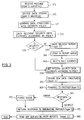
- Figure 3 depicts a block diagram of message processing in a security device.
- Figure 4 depicts security devices directly connected to user agents.
- Figure 5 depicts a warden attached to a gateway protecting the user of a proprietary network.
- the OSI model defines a X.400 Message Handling System 100 which consists of a network of processing nodes and connections.
- the node are of three types, User Agent 120 (UA), Message store 140 (MS) and Message Transfer Agent 110 (MTA). Therefore, Message Handling System 100 consists of a set of connected MTAs 110 which transfer messages through the network.
- Message Handling System users 130 operate UAs 120.
- a group of UAs 120 can be connected to one MTA 110.
- the connections are known as associations.
- User 130 creates a message at UA 120, and commands UA 120 to submit it using the association with the connected MTA 110.
- MTA 110 stores the parts of the message until it is complete, and then returns confirmation of receipt to UA 120.
- MTA 110 is connected to at least one other MTA 110, usually several. It determines which association is responsible for sending the message towards its destination and uses it to send the message to other MTA 110 (forwarding).
- the receiving MTA 110 stores the message, and when complete, returns a confirmation. This process is known as store and forward operation. It repeats until the message arrives at the MTA 110 connected to the recipient UA 120.
- This MTA 110 now delivers the message using the association to UA 120.
- the system controllers may decide to add a Message Store 140 (MS) to MTA 110. This acts on behalf of UA 120; MTA 110 delivers to MS 140, which stores the message. When UA 120 later connects to MS 140, MS 140 transfers the message to UA.
- MS Message Store 140
- MTAs 110 and UAs 120 operate according to protocol specified in the CCITT Recommendations X.400 - X.420 (X.400) and other recommendations, which specify elements of service which define the services available to Message Handling System users 130, what functions these elements perform, and the data structures and processing needed to carry to the services.
- the recommendations classify these elements of service as either optional or mandatory requirements for any Message Handling System.
- FIG. 1B describes a X.400 Message Handling System 100 connected to a network 170 using a different communications protocol.
- IBM Open Network Distribution Services 150 (ONDS) gateway acts as a specialized MTA in an X.400 network to provide connection services to proprietary electronic mail systems.
- the Distributed Office Support System (DISOSS) or Professional Office System (PROFS) connections 160 with ONDS provide an application level gateway to allow users 131 of DISOSS and PROFS network systems 170 to exchange messages with users 130 of public and private electronic mail facilities based on the X.400 recommendations.
- DISOSS Distributed Office Support System
- PROFS Professional Office System
- X.400 defines many services; it groups these services in two classes: base services, which all X.400 software must provide and optional services.
- User groups such as national governments, defined profiles which specify that conforming software must provide certain services from the optional class.
- GOSIP Global System for Mobile Communications
- US GOSIP United States Organization
- the available software usually chooses to conform to some set of profiles. This means the software has to provide services from the base class, and a selection from the optional class, but none of the profiles of the available software includes the services to counter security threats.
- the NATO Standards Agreement STANAG 4406 defines a military profile which does include these services, but at present little available software conforms to it. This means that a secure Message Handling System cannot be built easily using existing software; thus it is necessary either to wait for new software to be written, or to modify existing available software.
- X.400 defines several security threats, and services to counter them. It also defines several Message Handling System functions which will provide these services. X.400 allows the user to mark the data associated with elements of services as Critical for submission, Critical for Transfer, Critical for Delivery, or other combinations of these. If a node receives an element of services for which it does not perform the required functions, and the element is critical for the operation in progress, the node must reject the operation. However, sometimes there is more than one way to provide a service. Three security profiles, S0, S1 and S2 define various levels of security function. The threats and services defined include:
- X.400 While the profiles (such as GOSIP) select which services the software must offer the user, they do not control which ones the user selects.
- X.400 expects the sender and receiver to share a common security policy. This defines the circumstances under which the sender and receiver select each service, and which Message Handling System security functions they use to provide those services.
- the security policy must be agreed between the two participants in the electronic mail. X.400 simplifies this by allowing a security policy to be registered and assigned a unique identifier (name). The sender quotes the security policy identifier in the message, and the recipient can then use this identifier to understand which functions the sender used, and the manner of their use. For example, the policy may indicate that the sender ciphered the message before sending it and also indicate how the recipient retrieves the key to decipher the message.
- the warden is a new component in the Message Handling System. It is separate from all the other components. Its purpose is to perform all the X.400 security functions, while not performing any other X.400 functions. This allows a Message Handling System to be constructed in which the X.400 components provide none of the security functions, but all of the other electronic mail functions, while the warden provides all of the security functions and none of the electronic mail functions. This has two benefits: the Message Handling System can be built using software which does not provide the security functions. This avoids using specially written or modified software; the security functions are separated from the electronic mail functions.
- OSI defines 7 layers of software and hardware to make a communicating network, as represented in table 1.
- Physical such as cables, plugs and sockets and signalling voltages and frequencies.
- Data link point-to-point links between network components and the signalling protocols used.
- Network using point-to-point links to build end-to-end links between two network components which might not be at opposite ends of the same link, and the signalling protocols used.
- Transport the end-to-end signalling used to detect and correct transmission errors in the network.
- Session the protocols to start, control, operate and finish a long-term end-to-end communication path through the network. For example, the rules for signalling the start, middle and end of a data transfer which is so large the network must transfer it in several pieces.
- Presentation the standard means to code data before transmission and decode it on reception, so that the meaning is maintained even though the sender and receiver may be using different computer systems. For example, the rules for coding numbers and character strings.
- Application the data constructions to build and interpret coded data to provide standard application services. For example, defining the character strings used in an electronic mail message.
- X.400 defines electronic mail in terms of layer 7. It assumes the lower layers exist as part of an OSI stack of other software. An X.400 application does not need to use lower layers directly: it builds the data structures required by the X.400 layer 7 definitions, passes them to layer 6 to create the coded data, and then to layer 5 to send them across the session to the recipient. This structure allows a choice of software at each layer. In particular, the user can often change layers 1, 2 and 3 (that is, the transport mechanisms used) without changing layer 4 and above (that is, without changing the network). For example, if the session layer uses the UNIX X/Open Transport Interface (XTI), this may allow the network to operate over UNIX TCP/IP connections, or OSI X.25 connections, or IBM SNA connections.
- XTI UNIX X/Open Transport Interface
- a warden 200 which is not defined in X.400, sits in an association, connected to the two Message Handling System components 210, 220 at each end of that association.
- the warden acts with and reacts to one component as if it were the other. This means the Message Handling System components do not notice that there is a non-X.400 component in the network.
- warden is protecting a non-secure Message Handling System component 210, and the other Message Handling System component 220 is secure, which can be either non-secure but protected by another warden, or a component which implements the security functions directly.
- the warden 200 When the warden 200 starts, it has no association with either of the Message Handling System components 210, 220 to which it is connected. When one component needs to communicate with the other, it starts an association using the session layer, layer 5, OSI stack component with what it believes is the other component. In fact it is the warden, which in turn starts an association with the other Message Handling System component. The other component either returns a confirmation or an error, and the warden passes it back to the association initiator. From now on, the warden will receive data from one of the two partners. If it comes from the non-secure partner it protects, the warden will add data elements which are required for the other partner to perform the relevant security functions.
- data from the secure partner will contain elements for the security functions; the warden performs the required processing, and either rejects the data if it detects a security violation, or passes it to the non-secure partner.
- the warden will change the data elements, either removing the security elements, or marking them non-critical. This is a X.400 feature which allows an Message Handling System component to ignore data elements if it does not offer the relevant services.
- a warden may have several roles, depending on the direction of message flow, and on whether the non-secure component which it protects is a UA, a MS, an MTA or a gateway.
- an MS or a gateway When it protects a UA, an MS or a gateway, it acts for one of the two ends of the message transfer, and therefore performs the end to end security function, whereas for an MTA it performs only hop to hop security functions. Irrespective of its role, the warden's processing follows one of two patterns depending on which partner sends it mail.
- step 310 the warden receives data from one of the two partners.
- Such partner can be either a non-secure node protected by the warden or an unprotected secure node.
- step 315 the warden decodes the data structure using the OSI presentation layer (layer 6) services.
- step 320 its processing is now defined by the security policy in force. This policy specifies:
- the warden includes a set of control files containing different security profiles which define various levels of security functions, as previously described.
- the security manager of the network is able to edit such control files to modify the stored security profiles according to new security constraints.
- step 325 the warden checks some data elements according to the security policy. If, in step 330, a conflict is detected, the control is passed to step 335, where the warden generates one or more delivery reports to return to the sender to explain the error. In step 340, the warden places any such reports on a queue. Then in step 345 the bad elements of the message are deleted. If there was no conflict detected in step 330 the warden omits steps 340 and 245 making and queuing no delivering reports. In step 350, if all or part of the message is still acceptable, data elements, which are required for the other partner to perform the relevant security functions, are added.
- step 355 it rebuilds the data stream using the presentation layer services, and then, in step 360, it forwards this data stream, together with the changes required by the security policy, to the other association partner.
- step 365 if the partner responds with an error report, the warden in step 370 deletes any delivery reports and then, in step 375, returns the error indication to the protected partner, ending the process in step 390.
- step 365 the partner responds with a successful indication
- the warden in step 375, returns that to the protected partner.
- step 380 follows it with the queued delivery reports, if any, ending the process in step 390.
- the protected partner gets the indications and reports from the warden which it expects from the secure partner and, at the same time, the secure partner receives mail from the warden which it expects from a secure partner.
- step 320 it compares the data structures of the message with the security policy. Then in step 325, it checks the data elements according to the security policy and the X.400 definitions of those data elements. If it finds problems, in step 330, the control is passed to step 325 to build delivery reports as before, and preferably, it generates security violation alerts on the security manager's display terminal. In step 340, the warden places any such reports on a queue. Therefore, in step 345, it deletes the elements which caused the problem, so the remaining parts will be processed correctly.
- the warden As before, if there is no problem the warden generates no delivery reports, omitting steps 340 and 345. It modifies, in step 350, the data stream to mark all of the security data elements as not critical for whatever process is about to occur (delivery, transfer etc.). Then in step 355 it encodes the new data and sends, in step 360, this version to the protected non-secure partner. That partner ignores the non-critical elements, and processes the mail as if it came from a non-secure system. The rest of the process is the same as that for mail from the protected partner.
- the component protected by the warden thus thinks it has an association with another non-secure component.
- the unprotected secure component thinks it has an association with a secure component. Again, neither can detect the presence of the warden.
- the intermediate MTAs 110 are all secure: if not, they could be protected by wardens. However, this is not too significant a difference, as the only security services at intermediate an intermediate MTA 110 are the hop to hop ones which essentially protect the network. The end to end services protect the user, and these are provided by wardens 200 at each end of the associations. In this case, when the sending UA 120 submits mail to its connected MTA 110, the security policy tells the warden to:
- Gateway 180 appears to the Message Handling System as if it were an MTA 150 with several attached UAs 160. It is not possible to place a warden 200 between UA 160 and the MTA 150 because the communication between them uses network protocols different from X.400. So the warden has to be put between gateway 180 and the next MTA 110. Warden 200 therefore acts both for the MTA 150 and for the UA 160.
- gateway 180a converts it to X.400 and transfers it over the association from MTA 150a to warden 200a.
- Warden 200a first acts for the UA 160a, ciphering the data and adding the security data elements as before. It then acts for the MTA 150a, and checks the security label, before transferring the results to the next MTA 110.
- the final MTA 110 transfers the mail to warden 200b next to the delivering gateway 180b.
- Warden 200b acts first for the MTA 150b, and checks the security label. Then warden 200b acts for the UA 160b, as above, checking signatures and deciphering the contents. If all is well, it transfers the result to gateway 180b which in turn delivers the mail to the user 131b. If warden 200b detects an error, it generates the delivery report which an MTA 150b would have generated had the error been detected by a UA 160b attached to that MTA 150b. Warden 200b generates this delivery so it appears to be generated by the gateway 180b which would itself have generated as if in response to an error indication from a UA 160b, as required by X.400.
- the warden contains an MTA component instead of protecting a non secure MTA.
- the warden can act not only to protect an MTA, or MTA and MS, but also to protect a UA. Therefore a warden which contains an MTA replaces a secure, or non secure, MTA, thereby providing protection for the attached UAs, whilst a secure MTA cannot.
- This embodiment allows a security policy to be used which requires input from the user at the UA, because including an MTA in the warden, it becomes a store and forward node and the communication can complete before the warden asks any question. This enables more powerful and useful security policies to be used.
- a security device (warden) for data communications networks has been described. It is a new component in a Message Handling System (MHS), which performs all the X.400 security functions, while not performing any other X.400 functions.
- MHS Message Handling System
- the warden (200) sits in an association, connected to the two MHS components (210, 220) at each end of that association and it protects the non-secure MHS component (210), while the secure component (220) can be either non-secure but protected by another warden or a component which implements the security functions directly.
- the warden acts with and reacts to one component as if it were the other. This means the MHS components do not notice that there is a non-X.400 component in the network.
Landscapes
- Engineering & Computer Science (AREA)
- Computer Security & Cryptography (AREA)
- Computer Hardware Design (AREA)
- Computing Systems (AREA)
- General Engineering & Computer Science (AREA)
- Computer Networks & Wireless Communication (AREA)
- Signal Processing (AREA)
- Data Exchanges In Wide-Area Networks (AREA)
- Computer And Data Communications (AREA)
Applications Claiming Priority (2)
| Application Number | Priority Date | Filing Date | Title |
|---|---|---|---|
| GB9404112 | 1994-03-03 | ||
| GB9404112A GB2287619A (en) | 1994-03-03 | 1994-03-03 | Security device for data communications networks |
Publications (1)
| Publication Number | Publication Date |
|---|---|
| EP0680187A2 true EP0680187A2 (fr) | 1995-11-02 |
Family
ID=10751236
Family Applications (1)
| Application Number | Title | Priority Date | Filing Date |
|---|---|---|---|
| EP95301347A Withdrawn EP0680187A2 (fr) | 1994-03-03 | 1995-03-02 | Dispositif de sécurité pour réseaux de communication de données |
Country Status (3)
| Country | Link |
|---|---|
| EP (1) | EP0680187A2 (fr) |
| JP (1) | JPH07250058A (fr) |
| GB (1) | GB2287619A (fr) |
Cited By (5)
| Publication number | Priority date | Publication date | Assignee | Title |
|---|---|---|---|---|
| WO1999005814A3 (fr) * | 1997-07-24 | 1999-04-22 | Worldtalk Corp | Filtre securitaire de courrier electronique comportant en memoire une cle de cryptage/decryptage |
| GB2365729A (en) * | 2000-04-17 | 2002-02-20 | Ibm | Protocols for anonymous electronic communication and double-blind transactions |
| US7127741B2 (en) | 1998-11-03 | 2006-10-24 | Tumbleweed Communications Corp. | Method and system for e-mail message transmission |
| US7162738B2 (en) | 1998-11-03 | 2007-01-09 | Tumbleweed Communications Corp. | E-mail firewall with stored key encryption/decryption |
| US9338026B2 (en) | 2003-09-22 | 2016-05-10 | Axway Inc. | Delay technique in e-mail filtering system |
Families Citing this family (10)
| Publication number | Priority date | Publication date | Assignee | Title |
|---|---|---|---|---|
| US5864683A (en) | 1994-10-12 | 1999-01-26 | Secure Computing Corporartion | System for providing secure internetwork by connecting type enforcing secure computers to external network for limiting access to data based on user and process access rights |
| US5913024A (en) * | 1996-02-09 | 1999-06-15 | Secure Computing Corporation | Secure server utilizing separate protocol stacks |
| US5918018A (en) | 1996-02-09 | 1999-06-29 | Secure Computing Corporation | System and method for achieving network separation |
| GB2317793B (en) * | 1996-09-18 | 2001-03-28 | Secure Computing Corp | System and method of electronic mail filtering |
| US6072942A (en) * | 1996-09-18 | 2000-06-06 | Secure Computing Corporation | System and method of electronic mail filtering using interconnected nodes |
| US5915087A (en) * | 1996-12-12 | 1999-06-22 | Secure Computing Corporation | Transparent security proxy for unreliable message exchange protocols |
| US6321336B1 (en) | 1998-03-13 | 2001-11-20 | Secure Computing Corporation | System and method for redirecting network traffic to provide secure communication |
| US6182226B1 (en) | 1998-03-18 | 2001-01-30 | Secure Computing Corporation | System and method for controlling interactions between networks |
| US6453419B1 (en) | 1998-03-18 | 2002-09-17 | Secure Computing Corporation | System and method for implementing a security policy |
| KR20120005363A (ko) * | 2010-07-08 | 2012-01-16 | 정보통신산업진흥원 | 전자문서 유통 시스템 및 전자문서 유통 방법 |
Family Cites Families (2)
| Publication number | Priority date | Publication date | Assignee | Title |
|---|---|---|---|---|
| US5392357A (en) * | 1991-12-09 | 1995-02-21 | At&T Corp. | Secure telecommunications |
| US5276735A (en) * | 1992-04-17 | 1994-01-04 | Secure Computing Corporation | Data enclave and trusted path system |
-
1994
- 1994-03-03 GB GB9404112A patent/GB2287619A/en not_active Withdrawn
- 1994-11-30 JP JP6296236A patent/JPH07250058A/ja active Pending
-
1995
- 1995-03-02 EP EP95301347A patent/EP0680187A2/fr not_active Withdrawn
Cited By (16)
| Publication number | Priority date | Publication date | Assignee | Title |
|---|---|---|---|---|
| US8806191B2 (en) | 1997-07-24 | 2014-08-12 | Axway Inc. | Policy-based messaging firewall |
| US8255683B2 (en) | 1997-07-24 | 2012-08-28 | Axway Inc. | E-mail firewall with policy-based cryptosecurity |
| US6609196B1 (en) | 1997-07-24 | 2003-08-19 | Tumbleweed Communications Corp. | E-mail firewall with stored key encryption/decryption |
| US9838358B2 (en) | 1997-07-24 | 2017-12-05 | Axway Inc. | E-mail firewall with policy-based cryptosecurity |
| WO1999005814A3 (fr) * | 1997-07-24 | 1999-04-22 | Worldtalk Corp | Filtre securitaire de courrier electronique comportant en memoire une cle de cryptage/decryptage |
| US7380274B2 (en) | 1997-07-24 | 2008-05-27 | Tumbleweed Communications Corp. | E-mail firewall |
| US7401356B2 (en) | 1997-07-24 | 2008-07-15 | Tumbleweed Communications Corp. | Method and system for e-mail message transmission |
| USRE43302E1 (en) | 1997-07-24 | 2012-04-03 | Axway, Inc. | E-mail firewall with stored key encryption/decryption |
| US7127741B2 (en) | 1998-11-03 | 2006-10-24 | Tumbleweed Communications Corp. | Method and system for e-mail message transmission |
| US7162738B2 (en) | 1998-11-03 | 2007-01-09 | Tumbleweed Communications Corp. | E-mail firewall with stored key encryption/decryption |
| GB2365729A (en) * | 2000-04-17 | 2002-02-20 | Ibm | Protocols for anonymous electronic communication and double-blind transactions |
| US6952769B1 (en) | 2000-04-17 | 2005-10-04 | International Business Machines Corporation | Protocols for anonymous electronic communication and double-blind transactions |
| GB2365729B (en) * | 2000-04-17 | 2004-05-12 | Ibm | Protocols for anonymous electronic communication and double-blind transactions |
| US8407780B2 (en) | 2001-06-22 | 2013-03-26 | Axway Inc. | Method and system for messaging security |
| US10116621B2 (en) | 2001-06-22 | 2018-10-30 | Axway Inc. | Method and system for messaging security |
| US9338026B2 (en) | 2003-09-22 | 2016-05-10 | Axway Inc. | Delay technique in e-mail filtering system |
Also Published As
| Publication number | Publication date |
|---|---|
| JPH07250058A (ja) | 1995-09-26 |
| GB9404112D0 (en) | 1994-04-20 |
| GB2287619A (en) | 1995-09-20 |
Similar Documents
| Publication | Publication Date | Title |
|---|---|---|
| US5414833A (en) | Network security system and method using a parallel finite state machine adaptive active monitor and responder | |
| US5680461A (en) | Secure network protocol system and method | |
| US6067620A (en) | Stand alone security device for computer networks | |
| US6760768B2 (en) | Method and system for establishing a security perimeter in computer networks | |
| US5577209A (en) | Apparatus and method for providing multi-level security for communication among computers and terminals on a network | |
| US5640456A (en) | Computer network encryption/decryption device | |
| US6704866B1 (en) | Compression and encryption protocol for controlling data flow in a network | |
| US6717943B1 (en) | System and method for routing and processing data packets | |
| AU717901B2 (en) | Improving security of packet-mode transmission in a mobile communication system | |
| GB2287619A (en) | Security device for data communications networks | |
| JPH0731648B2 (ja) | 分散型マルチレベル・コンピュータ機密保護システムとその方法 | |
| US20060070122A1 (en) | Method and apparatus for a distributed firewall | |
| US7281129B2 (en) | Secure computer network with a network screen | |
| JPH05274266A (ja) | 遠隔システム管理のための機密保護機能を提供するための方法 | |
| US20040054886A1 (en) | E-mail firewall with stored key encryption/decryption | |
| WO1998031124A1 (fr) | Serveur mandataire a action inverse | |
| WO1998031124A9 (fr) | Serveur mandataire a action inverse | |
| JP2001203761A (ja) | 中継装置、および同装置を備えたネットワークシステム | |
| Verschuren et al. | ISO-OSI security architecture | |
| Sidhu et al. | A multilevel secure local area network | |
| Nelson et al. | SDNS Architecture and End-to-end Encryption | |
| JPH0522282A (ja) | エンドシステム間の通信デ−タ暗号方式 | |
| JP4538325B2 (ja) | 複数の管理対象エンティティーの安全な無線管理のためのプロキシ方法及びシステム | |
| KR100250457B1 (ko) | 인터넷 프로토콜을 이용하는 네트워크에서 발신측 및착신측의 통신 방법 | |
| JPH0669962A (ja) | ネットワーク接続装置およびネットワーク通信方式 |
Legal Events
| Date | Code | Title | Description |
|---|---|---|---|
| PUAI | Public reference made under article 153(3) epc to a published international application that has entered the european phase |
Free format text: ORIGINAL CODE: 0009012 |
|
| AK | Designated contracting states |
Kind code of ref document: A2 Designated state(s): DE FR GB |
|
| STAA | Information on the status of an ep patent application or granted ep patent |
Free format text: STATUS: THE APPLICATION IS DEEMED TO BE WITHDRAWN |
|
| 18D | Application deemed to be withdrawn |
Effective date: 19971001 |