EP0680975A1 - Acylierte gamma-Cyclodextrine - Google Patents
Acylierte gamma-Cyclodextrine Download PDFInfo
- Publication number
- EP0680975A1 EP0680975A1 EP95105919A EP95105919A EP0680975A1 EP 0680975 A1 EP0680975 A1 EP 0680975A1 EP 95105919 A EP95105919 A EP 95105919A EP 95105919 A EP95105919 A EP 95105919A EP 0680975 A1 EP0680975 A1 EP 0680975A1
- Authority
- EP
- European Patent Office
- Prior art keywords
- acylated
- anhydride
- cyclodextrin
- acetyl
- cyclodextrin derivatives
- Prior art date
- Legal status (The legal status is an assumption and is not a legal conclusion. Google has not performed a legal analysis and makes no representation as to the accuracy of the status listed.)
- Granted
Links
- 229920000858 Cyclodextrin Polymers 0.000 title claims abstract description 32
- GDSRMADSINPKSL-HSEONFRVSA-N gamma-cyclodextrin Chemical class OC[C@H]([C@H]([C@@H]([C@H]1O)O)O[C@H]2O[C@@H]([C@@H](O[C@H]3O[C@H](CO)[C@H]([C@@H]([C@H]3O)O)O[C@H]3O[C@H](CO)[C@H]([C@@H]([C@H]3O)O)O[C@H]3O[C@H](CO)[C@H]([C@@H]([C@H]3O)O)O[C@H]3O[C@H](CO)[C@H]([C@@H]([C@H]3O)O)O[C@H]3O[C@H](CO)[C@H]([C@@H]([C@H]3O)O)O3)[C@H](O)[C@H]2O)CO)O[C@@H]1O[C@H]1[C@H](O)[C@@H](O)[C@@H]3O[C@@H]1CO GDSRMADSINPKSL-HSEONFRVSA-N 0.000 claims abstract description 30
- -1 2-alkoxyacetyl Chemical group 0.000 claims abstract description 16
- 239000003795 chemical substances by application Substances 0.000 claims abstract description 15
- 229940080345 gamma-cyclodextrin Drugs 0.000 claims abstract description 12
- 229940097362 cyclodextrins Drugs 0.000 claims abstract description 10
- 125000002777 acetyl group Chemical group [H]C([H])([H])C(*)=O 0.000 claims abstract description 9
- 239000003054 catalyst Substances 0.000 claims abstract description 7
- 125000004063 butyryl group Chemical group O=C([*])C([H])([H])C([H])([H])C([H])([H])[H] 0.000 claims abstract description 5
- 125000001501 propionyl group Chemical group O=C([*])C([H])([H])C([H])([H])[H] 0.000 claims abstract description 5
- 125000003647 acryloyl group Chemical group O=C([*])C([H])=C([H])[H] 0.000 claims abstract description 3
- WFDIJRYMOXRFFG-UHFFFAOYSA-N Acetic anhydride Chemical compound CC(=O)OC(C)=O WFDIJRYMOXRFFG-UHFFFAOYSA-N 0.000 claims description 36
- 239000008186 active pharmaceutical agent Substances 0.000 claims description 33
- 238000000034 method Methods 0.000 claims description 17
- HFHDHCJBZVLPGP-UHFFFAOYSA-N schardinger α-dextrin Chemical class O1C(C(C2O)O)C(CO)OC2OC(C(C2O)O)C(CO)OC2OC(C(C2O)O)C(CO)OC2OC(C(O)C2O)C(CO)OC2OC(C(C2O)O)C(CO)OC2OC2C(O)C(O)C1OC2CO HFHDHCJBZVLPGP-UHFFFAOYSA-N 0.000 claims description 15
- 239000000203 mixture Substances 0.000 claims description 11
- 238000002360 preparation method Methods 0.000 claims description 8
- 125000001424 substituent group Chemical group 0.000 claims description 7
- 238000009826 distribution Methods 0.000 claims description 6
- 238000005160 1H NMR spectroscopy Methods 0.000 claims description 4
- WQZGKKKJIJFFOK-GASJEMHNSA-N Glucose Natural products OC[C@H]1OC(O)[C@H](O)[C@@H](O)[C@@H]1O WQZGKKKJIJFFOK-GASJEMHNSA-N 0.000 claims description 4
- 239000008103 glucose Substances 0.000 claims description 4
- 125000002887 hydroxy group Chemical group [H]O* 0.000 claims description 4
- WYVAMUWZEOHJOQ-UHFFFAOYSA-N propionic anhydride Chemical compound CCC(=O)OC(=O)CC WYVAMUWZEOHJOQ-UHFFFAOYSA-N 0.000 claims description 3
- PNVPNXKRAUBJGW-UHFFFAOYSA-N (2-chloroacetyl) 2-chloroacetate Chemical compound ClCC(=O)OC(=O)CCl PNVPNXKRAUBJGW-UHFFFAOYSA-N 0.000 claims description 2
- KLLYGDXCCNXESW-UHFFFAOYSA-N (2-fluoroacetyl) 2-fluoroacetate Chemical compound FCC(=O)OC(=O)CF KLLYGDXCCNXESW-UHFFFAOYSA-N 0.000 claims description 2
- YHASWHZGWUONAO-UHFFFAOYSA-N butanoyl butanoate Chemical compound CCCC(=O)OC(=O)CCC YHASWHZGWUONAO-UHFFFAOYSA-N 0.000 claims description 2
- 239000001257 hydrogen Substances 0.000 claims description 2
- 229910052739 hydrogen Inorganic materials 0.000 claims description 2
- 125000004435 hydrogen atom Chemical group [H]* 0.000 claims description 2
- DCUFMVPCXCSVNP-UHFFFAOYSA-N methacrylic anhydride Chemical compound CC(=C)C(=O)OC(=O)C(C)=C DCUFMVPCXCSVNP-UHFFFAOYSA-N 0.000 claims description 2
- ARJOQCYCJMAIFR-UHFFFAOYSA-N prop-2-enoyl prop-2-enoate Chemical compound C=CC(=O)OC(=O)C=C ARJOQCYCJMAIFR-UHFFFAOYSA-N 0.000 claims description 2
- 238000006467 substitution reaction Methods 0.000 abstract description 11
- 238000004519 manufacturing process Methods 0.000 abstract description 4
- QTBSBXVTEAMEQO-UHFFFAOYSA-N Acetic acid Chemical compound CC(O)=O QTBSBXVTEAMEQO-UHFFFAOYSA-N 0.000 description 41
- XLYOFNOQVPJJNP-UHFFFAOYSA-N water Substances O XLYOFNOQVPJJNP-UHFFFAOYSA-N 0.000 description 31
- 229910001868 water Inorganic materials 0.000 description 30
- 239000000047 product Substances 0.000 description 21
- 238000006243 chemical reaction Methods 0.000 description 16
- 229960000583 acetic acid Drugs 0.000 description 14
- VMHLLURERBWHNL-UHFFFAOYSA-M Sodium acetate Chemical compound [Na+].CC([O-])=O VMHLLURERBWHNL-UHFFFAOYSA-M 0.000 description 11
- 239000001632 sodium acetate Substances 0.000 description 11
- 235000017281 sodium acetate Nutrition 0.000 description 11
- 239000000243 solution Substances 0.000 description 11
- HVYWMOMLDIMFJA-DPAQBDIFSA-N cholesterol Chemical compound C1C=C2C[C@@H](O)CC[C@]2(C)[C@@H]2[C@@H]1[C@@H]1CC[C@H]([C@H](C)CCCC(C)C)[C@@]1(C)CC2 HVYWMOMLDIMFJA-DPAQBDIFSA-N 0.000 description 10
- 108090001060 Lipase Proteins 0.000 description 9
- 230000007928 solubilization Effects 0.000 description 9
- 238000005063 solubilization Methods 0.000 description 9
- HEDRZPFGACZZDS-UHFFFAOYSA-N Chloroform Chemical compound ClC(Cl)Cl HEDRZPFGACZZDS-UHFFFAOYSA-N 0.000 description 8
- DTQVDTLACAAQTR-UHFFFAOYSA-N Trifluoroacetic acid Chemical compound OC(=O)C(F)(F)F DTQVDTLACAAQTR-UHFFFAOYSA-N 0.000 description 8
- 239000002904 solvent Substances 0.000 description 8
- IJGRMHOSHXDMSA-UHFFFAOYSA-N Atomic nitrogen Chemical compound N#N IJGRMHOSHXDMSA-UHFFFAOYSA-N 0.000 description 6
- JYGXADMDTFJGBT-VWUMJDOOSA-N hydrocortisone Chemical compound O=C1CC[C@]2(C)[C@H]3[C@@H](O)C[C@](C)([C@@](CC4)(O)C(=O)CO)[C@@H]4[C@@H]3CCC2=C1 JYGXADMDTFJGBT-VWUMJDOOSA-N 0.000 description 6
- 239000011541 reaction mixture Substances 0.000 description 6
- 102000004882 Lipase Human genes 0.000 description 5
- 239000004367 Lipase Substances 0.000 description 5
- 235000012000 cholesterol Nutrition 0.000 description 5
- 235000019421 lipase Nutrition 0.000 description 5
- 239000012429 reaction media Substances 0.000 description 5
- 239000000126 substance Substances 0.000 description 5
- 108010089254 Cholesterol oxidase Proteins 0.000 description 4
- IAZDPXIOMUYVGZ-UHFFFAOYSA-N Dimethylsulphoxide Chemical compound CS(C)=O IAZDPXIOMUYVGZ-UHFFFAOYSA-N 0.000 description 4
- 102100031375 Endothelial lipase Human genes 0.000 description 4
- 206010018910 Haemolysis Diseases 0.000 description 4
- TWRXJAOTZQYOKJ-UHFFFAOYSA-L Magnesium chloride Chemical compound [Mg+2].[Cl-].[Cl-] TWRXJAOTZQYOKJ-UHFFFAOYSA-L 0.000 description 4
- JUJWROOIHBZHMG-UHFFFAOYSA-N Pyridine Chemical compound C1=CC=NC=C1 JUJWROOIHBZHMG-UHFFFAOYSA-N 0.000 description 4
- 238000001816 cooling Methods 0.000 description 4
- XBDQKXXYIPTUBI-UHFFFAOYSA-N dimethylselenoniopropionate Natural products CCC(O)=O XBDQKXXYIPTUBI-UHFFFAOYSA-N 0.000 description 4
- 230000008588 hemolysis Effects 0.000 description 4
- 230000007062 hydrolysis Effects 0.000 description 4
- 238000006460 hydrolysis reaction Methods 0.000 description 4
- 238000010992 reflux Methods 0.000 description 4
- 239000000725 suspension Substances 0.000 description 4
- 238000012360 testing method Methods 0.000 description 4
- WEVYAHXRMPXWCK-UHFFFAOYSA-N Acetonitrile Chemical compound CC#N WEVYAHXRMPXWCK-UHFFFAOYSA-N 0.000 description 3
- YMWUJEATGCHHMB-UHFFFAOYSA-N Dichloromethane Chemical compound ClCCl YMWUJEATGCHHMB-UHFFFAOYSA-N 0.000 description 3
- 108090000371 Esterases Proteins 0.000 description 3
- ZMXDDKWLCZADIW-UHFFFAOYSA-N N,N-Dimethylformamide Chemical compound CN(C)C=O ZMXDDKWLCZADIW-UHFFFAOYSA-N 0.000 description 3
- UIIMBOGNXHQVGW-UHFFFAOYSA-M Sodium bicarbonate Chemical class [Na+].OC([O-])=O UIIMBOGNXHQVGW-UHFFFAOYSA-M 0.000 description 3
- ZMANZCXQSJIPKH-UHFFFAOYSA-N Triethylamine Chemical compound CCN(CC)CC ZMANZCXQSJIPKH-UHFFFAOYSA-N 0.000 description 3
- 239000007864 aqueous solution Substances 0.000 description 3
- 150000001244 carboxylic acid anhydrides Chemical class 0.000 description 3
- 150000001875 compounds Chemical class 0.000 description 3
- 230000002255 enzymatic effect Effects 0.000 description 3
- 239000007789 gas Substances 0.000 description 3
- 125000002791 glucosyl group Chemical group C1([C@H](O)[C@@H](O)[C@H](O)[C@H](O1)CO)* 0.000 description 3
- 229960000890 hydrocortisone Drugs 0.000 description 3
- 229910052757 nitrogen Inorganic materials 0.000 description 3
- 238000001556 precipitation Methods 0.000 description 3
- 239000000523 sample Substances 0.000 description 3
- 230000003381 solubilizing effect Effects 0.000 description 3
- LENZDBCJOHFCAS-UHFFFAOYSA-N tris Chemical compound OCC(N)(CO)CO LENZDBCJOHFCAS-UHFFFAOYSA-N 0.000 description 3
- DLFVBJFMPXGRIB-UHFFFAOYSA-N Acetamide Chemical compound CC(N)=O DLFVBJFMPXGRIB-UHFFFAOYSA-N 0.000 description 2
- CSCPPACGZOOCGX-UHFFFAOYSA-N Acetone Chemical compound CC(C)=O CSCPPACGZOOCGX-UHFFFAOYSA-N 0.000 description 2
- 241000228245 Aspergillus niger Species 0.000 description 2
- FERIUCNNQQJTOY-UHFFFAOYSA-N Butyric acid Chemical compound CCCC(O)=O FERIUCNNQQJTOY-UHFFFAOYSA-N 0.000 description 2
- 108010025880 Cyclomaltodextrin glucanotransferase Proteins 0.000 description 2
- RTZKZFJDLAIYFH-UHFFFAOYSA-N Diethyl ether Chemical compound CCOCC RTZKZFJDLAIYFH-UHFFFAOYSA-N 0.000 description 2
- 102000004190 Enzymes Human genes 0.000 description 2
- 108090000790 Enzymes Proteins 0.000 description 2
- ZHNUHDYFZUAESO-UHFFFAOYSA-N Formamide Chemical compound NC=O ZHNUHDYFZUAESO-UHFFFAOYSA-N 0.000 description 2
- ATHHXGZTWNVVOU-UHFFFAOYSA-N N-methylformamide Chemical compound CNC=O ATHHXGZTWNVVOU-UHFFFAOYSA-N 0.000 description 2
- 102000003992 Peroxidases Human genes 0.000 description 2
- 229920002472 Starch Polymers 0.000 description 2
- 239000007983 Tris buffer Substances 0.000 description 2
- HIYBFMAWCFPXHH-VFQQELCFSA-N acetic acid;(2r,3r,4r,5s)-hexane-1,2,3,4,5,6-hexol Chemical class CC(O)=O.OC[C@H](O)[C@@H](O)[C@H](O)[C@H](O)CO HIYBFMAWCFPXHH-VFQQELCFSA-N 0.000 description 2
- 230000021736 acetylation Effects 0.000 description 2
- 238000006640 acetylation reaction Methods 0.000 description 2
- 125000002252 acyl group Chemical group 0.000 description 2
- OHDRQQURAXLVGJ-HLVWOLMTSA-N azane;(2e)-3-ethyl-2-[(e)-(3-ethyl-6-sulfo-1,3-benzothiazol-2-ylidene)hydrazinylidene]-1,3-benzothiazole-6-sulfonic acid Chemical compound [NH4+].[NH4+].S/1C2=CC(S([O-])(=O)=O)=CC=C2N(CC)C\1=N/N=C1/SC2=CC(S([O-])(=O)=O)=CC=C2N1CC OHDRQQURAXLVGJ-HLVWOLMTSA-N 0.000 description 2
- 230000015572 biosynthetic process Effects 0.000 description 2
- 239000007853 buffer solution Substances 0.000 description 2
- 150000001732 carboxylic acid derivatives Chemical class 0.000 description 2
- 229920002678 cellulose Polymers 0.000 description 2
- 229920001429 chelating resin Polymers 0.000 description 2
- 238000004140 cleaning Methods 0.000 description 2
- 239000002537 cosmetic Substances 0.000 description 2
- 238000000502 dialysis Methods 0.000 description 2
- 238000010790 dilution Methods 0.000 description 2
- 239000012895 dilution Substances 0.000 description 2
- GUVUOGQBMYCBQP-UHFFFAOYSA-N dmpu Chemical compound CN1CCCN(C)C1=O GUVUOGQBMYCBQP-UHFFFAOYSA-N 0.000 description 2
- 239000011521 glass Substances 0.000 description 2
- 230000002949 hemolytic effect Effects 0.000 description 2
- 239000012442 inert solvent Substances 0.000 description 2
- TWNIBLMWSKIRAT-VFUOTHLCSA-N levoglucosan Chemical group O[C@@H]1[C@@H](O)[C@H](O)[C@H]2CO[C@@H]1O2 TWNIBLMWSKIRAT-VFUOTHLCSA-N 0.000 description 2
- 229910001629 magnesium chloride Inorganic materials 0.000 description 2
- 108040007629 peroxidase activity proteins Proteins 0.000 description 2
- SCVFZCLFOSHCOH-UHFFFAOYSA-M potassium acetate Chemical compound [K+].CC([O-])=O SCVFZCLFOSHCOH-UHFFFAOYSA-M 0.000 description 2
- 238000012545 processing Methods 0.000 description 2
- 235000019260 propionic acid Nutrition 0.000 description 2
- UMJSCPRVCHMLSP-UHFFFAOYSA-N pyridine Natural products COC1=CC=CN=C1 UMJSCPRVCHMLSP-UHFFFAOYSA-N 0.000 description 2
- IUVKMZGDUIUOCP-BTNSXGMBSA-N quinbolone Chemical compound O([C@H]1CC[C@H]2[C@H]3[C@@H]([C@]4(C=CC(=O)C=C4CC3)C)CC[C@@]21C)C1=CCCC1 IUVKMZGDUIUOCP-BTNSXGMBSA-N 0.000 description 2
- 239000008107 starch Substances 0.000 description 2
- 235000019698 starch Nutrition 0.000 description 2
- 150000003431 steroids Chemical class 0.000 description 2
- 238000004809 thin layer chromatography Methods 0.000 description 2
- 230000002110 toxicologic effect Effects 0.000 description 2
- 231100000723 toxicological property Toxicity 0.000 description 2
- NJVBTKVPPOFGAT-UHFFFAOYSA-N 2,3,4,5,6-pentaacetyloxyhexyl acetate Chemical compound CC(=O)OCC(OC(C)=O)C(OC(C)=O)C(OC(C)=O)C(OC(C)=O)COC(C)=O NJVBTKVPPOFGAT-UHFFFAOYSA-N 0.000 description 1
- UWKQJZCTQGMHKD-UHFFFAOYSA-N 2,6-di-tert-butylpyridine Chemical compound CC(C)(C)C1=CC=CC(C(C)(C)C)=N1 UWKQJZCTQGMHKD-UHFFFAOYSA-N 0.000 description 1
- 229920001450 Alpha-Cyclodextrin Polymers 0.000 description 1
- BTBUEUYNUDRHOZ-UHFFFAOYSA-N Borate Chemical compound [O-]B([O-])[O-] BTBUEUYNUDRHOZ-UHFFFAOYSA-N 0.000 description 1
- UXVMQQNJUSDDNG-UHFFFAOYSA-L Calcium chloride Chemical compound [Cl-].[Cl-].[Ca+2] UXVMQQNJUSDDNG-UHFFFAOYSA-L 0.000 description 1
- FXHOOIRPVKKKFG-UHFFFAOYSA-N N,N-Dimethylacetamide Chemical compound CN(C)C(C)=O FXHOOIRPVKKKFG-UHFFFAOYSA-N 0.000 description 1
- SECXISVLQFMRJM-UHFFFAOYSA-N N-Methylpyrrolidone Chemical compound CN1CCCC1=O SECXISVLQFMRJM-UHFFFAOYSA-N 0.000 description 1
- OHLUUHNLEMFGTQ-UHFFFAOYSA-N N-methylacetamide Chemical compound CNC(C)=O OHLUUHNLEMFGTQ-UHFFFAOYSA-N 0.000 description 1
- 238000006887 Ullmann reaction Methods 0.000 description 1
- OFLLMJLGIPARRK-YYIAUSFCSA-N [(2s,3r,4r,5r)-2,3,4,5-tetraacetyloxy-6-methoxyhexyl] acetate Chemical compound COC[C@@H](OC(C)=O)[C@@H](OC(C)=O)[C@H](OC(C)=O)[C@@H](OC(C)=O)COC(C)=O OFLLMJLGIPARRK-YYIAUSFCSA-N 0.000 description 1
- RFZVFYLLLYGOTQ-YLFCFFPRSA-N [(2s,3r,4r,5r)-2,4,5,6-tetraacetyloxy-3-methoxyhexyl] acetate Chemical compound CC(=O)OC[C@H](OC(C)=O)[C@@H](OC)[C@H](OC(C)=O)[C@@H](COC(C)=O)OC(C)=O RFZVFYLLLYGOTQ-YLFCFFPRSA-N 0.000 description 1
- BWFYMIDEWZXNAH-QKPAOTATSA-N [(2s,3r,4r,5r)-2,4,5-triacetyloxy-3,6-dimethoxyhexyl] acetate Chemical compound COC[C@@H](OC(C)=O)[C@@H](OC(C)=O)[C@H](OC)[C@@H](OC(C)=O)COC(C)=O BWFYMIDEWZXNAH-QKPAOTATSA-N 0.000 description 1
- ICWCFTONPLAURK-YLFCFFPRSA-N [(2s,3r,4r,5r)-3,4,5,6-tetraacetyloxy-2-methoxyhexyl] acetate Chemical compound CC(=O)OC[C@H](OC)[C@@H](OC(C)=O)[C@H](OC(C)=O)[C@@H](COC(C)=O)OC(C)=O ICWCFTONPLAURK-YLFCFFPRSA-N 0.000 description 1
- UZCWYWPMTQZNMH-ZJIFWQFVSA-N [(2s,3r,4r,5r)-3,4,5-triacetyloxy-2,6-dimethoxyhexyl] acetate Chemical compound COC[C@@H](OC(C)=O)[C@@H](OC(C)=O)[C@H](OC(C)=O)[C@@H](OC)COC(C)=O UZCWYWPMTQZNMH-ZJIFWQFVSA-N 0.000 description 1
- UUPZYXOWVJCPJT-ZJIFWQFVSA-N [(2s,3r,4r,5r)-4,5,6-triacetyloxy-2,3-dimethoxyhexyl] acetate Chemical compound CC(=O)OC[C@H](OC)[C@@H](OC)[C@H](OC(C)=O)[C@@H](COC(C)=O)OC(C)=O UUPZYXOWVJCPJT-ZJIFWQFVSA-N 0.000 description 1
- ATVQUEJOBOKGCC-GBJTYRQASA-N [(2s,3r,4r,5r)-4,5-diacetyloxy-2,3,6-trimethoxyhexyl] acetate Chemical compound COC[C@@H](OC(C)=O)[C@@H](OC(C)=O)[C@H](OC)[C@@H](OC)COC(C)=O ATVQUEJOBOKGCC-GBJTYRQASA-N 0.000 description 1
- JVFGXECLSQXABC-UHFFFAOYSA-N ac1l3obq Chemical class O1C(C(C2O)O)C(COCC(C)O)OC2OC(C(C2O)O)C(COCC(C)O)OC2OC(C(C2O)O)C(COCC(C)O)OC2OC(C(C2O)O)C(COCC(C)O)OC2OC(C(C2O)O)C(COCC(C)O)OC2OC(C(O)C2O)C(COCC(O)C)OC2OC(C(C2O)O)C(COCC(C)O)OC2OC2C(O)C(O)C1OC2COCC(C)O JVFGXECLSQXABC-UHFFFAOYSA-N 0.000 description 1
- ZCHPKWUIAASXPV-UHFFFAOYSA-N acetic acid;methanol Chemical compound OC.CC(O)=O ZCHPKWUIAASXPV-UHFFFAOYSA-N 0.000 description 1
- 125000003668 acetyloxy group Chemical group [H]C([H])([H])C(=O)O[*] 0.000 description 1
- 239000002253 acid Substances 0.000 description 1
- 150000007513 acids Chemical class 0.000 description 1
- 239000012868 active agrochemical ingredient Substances 0.000 description 1
- 230000010933 acylation Effects 0.000 description 1
- 238000005917 acylation reaction Methods 0.000 description 1
- 239000003905 agrochemical Substances 0.000 description 1
- 229910052783 alkali metal Inorganic materials 0.000 description 1
- 229930013930 alkaloid Natural products 0.000 description 1
- BFNBIHQBYMNNAN-UHFFFAOYSA-N ammonium sulfate Chemical compound N.N.OS(O)(=O)=O BFNBIHQBYMNNAN-UHFFFAOYSA-N 0.000 description 1
- 229910052921 ammonium sulfate Inorganic materials 0.000 description 1
- 235000011130 ammonium sulphate Nutrition 0.000 description 1
- 238000004458 analytical method Methods 0.000 description 1
- 230000003356 anti-rheumatic effect Effects 0.000 description 1
- 239000003435 antirheumatic agent Substances 0.000 description 1
- 238000013459 approach Methods 0.000 description 1
- 239000008346 aqueous phase Substances 0.000 description 1
- 230000009286 beneficial effect Effects 0.000 description 1
- 238000007664 blowing Methods 0.000 description 1
- 239000006227 byproduct Substances 0.000 description 1
- 239000001110 calcium chloride Substances 0.000 description 1
- 229910001628 calcium chloride Inorganic materials 0.000 description 1
- 235000011148 calcium chloride Nutrition 0.000 description 1
- 150000001735 carboxylic acids Chemical class 0.000 description 1
- 229940097217 cardiac glycoside Drugs 0.000 description 1
- 239000002368 cardiac glycoside Substances 0.000 description 1
- 239000001913 cellulose Substances 0.000 description 1
- 239000003153 chemical reaction reagent Substances 0.000 description 1
- 238000013375 chromatographic separation Methods 0.000 description 1
- 239000011248 coating agent Substances 0.000 description 1
- 238000000576 coating method Methods 0.000 description 1
- 238000004440 column chromatography Methods 0.000 description 1
- 238000013270 controlled release Methods 0.000 description 1
- 238000005238 degreasing Methods 0.000 description 1
- 239000008367 deionised water Substances 0.000 description 1
- 229910021641 deionized water Inorganic materials 0.000 description 1
- 238000004821 distillation Methods 0.000 description 1
- 238000001035 drying Methods 0.000 description 1
- 239000000839 emulsion Substances 0.000 description 1
- 238000000605 extraction Methods 0.000 description 1
- 239000000706 filtrate Substances 0.000 description 1
- 238000001914 filtration Methods 0.000 description 1
- 238000009472 formulation Methods 0.000 description 1
- 239000003205 fragrance Substances 0.000 description 1
- 238000004108 freeze drying Methods 0.000 description 1
- 239000000417 fungicide Substances 0.000 description 1
- 238000004817 gas chromatography Methods 0.000 description 1
- 210000001035 gastrointestinal tract Anatomy 0.000 description 1
- 239000012362 glacial acetic acid Substances 0.000 description 1
- 238000004128 high performance liquid chromatography Methods 0.000 description 1
- 230000003301 hydrolyzing effect Effects 0.000 description 1
- 230000002209 hydrophobic effect Effects 0.000 description 1
- 238000010348 incorporation Methods 0.000 description 1
- 239000002917 insecticide Substances 0.000 description 1
- 238000004255 ion exchange chromatography Methods 0.000 description 1
- 150000002500 ions Chemical class 0.000 description 1
- 239000010985 leather Substances 0.000 description 1
- 210000004185 liver Anatomy 0.000 description 1
- 230000000873 masking effect Effects 0.000 description 1
- 239000012528 membrane Substances 0.000 description 1
- UYVXZUTYZGILQG-UHFFFAOYSA-N methoxyboronic acid Chemical compound COB(O)O UYVXZUTYZGILQG-UHFFFAOYSA-N 0.000 description 1
- OIRDBPQYVWXNSJ-UHFFFAOYSA-N methyl trifluoromethansulfonate Chemical compound COS(=O)(=O)C(F)(F)F OIRDBPQYVWXNSJ-UHFFFAOYSA-N 0.000 description 1
- 230000001035 methylating effect Effects 0.000 description 1
- 230000011987 methylation Effects 0.000 description 1
- 238000007069 methylation reaction Methods 0.000 description 1
- 230000004048 modification Effects 0.000 description 1
- 238000012986 modification Methods 0.000 description 1
- 229920001542 oligosaccharide Polymers 0.000 description 1
- 239000003960 organic solvent Substances 0.000 description 1
- 230000003647 oxidation Effects 0.000 description 1
- 238000007254 oxidation reaction Methods 0.000 description 1
- 210000000496 pancreas Anatomy 0.000 description 1
- 239000000123 paper Substances 0.000 description 1
- 239000003444 phase transfer catalyst Substances 0.000 description 1
- 235000015277 pork Nutrition 0.000 description 1
- 235000011056 potassium acetate Nutrition 0.000 description 1
- BWILYWWHXDGKQA-UHFFFAOYSA-M potassium propanoate Chemical compound [K+].CCC([O-])=O BWILYWWHXDGKQA-UHFFFAOYSA-M 0.000 description 1
- 239000004331 potassium propionate Substances 0.000 description 1
- 235000010332 potassium propionate Nutrition 0.000 description 1
- RWMKSKOZLCXHOK-UHFFFAOYSA-M potassium;butanoate Chemical compound [K+].CCCC([O-])=O RWMKSKOZLCXHOK-UHFFFAOYSA-M 0.000 description 1
- 239000002244 precipitate Substances 0.000 description 1
- 238000002953 preparative HPLC Methods 0.000 description 1
- 229940001470 psychoactive drug Drugs 0.000 description 1
- 239000004089 psychotropic agent Substances 0.000 description 1
- 238000000746 purification Methods 0.000 description 1
- 239000000376 reactant Substances 0.000 description 1
- 230000035484 reaction time Effects 0.000 description 1
- 238000000518 rheometry Methods 0.000 description 1
- 150000003839 salts Chemical group 0.000 description 1
- 239000012488 sample solution Substances 0.000 description 1
- 238000000926 separation method Methods 0.000 description 1
- 239000011734 sodium Substances 0.000 description 1
- 235000017557 sodium bicarbonate Nutrition 0.000 description 1
- 229910000030 sodium bicarbonate Inorganic materials 0.000 description 1
- MFBOGIVSZKQAPD-UHFFFAOYSA-M sodium butyrate Chemical compound [Na+].CCCC([O-])=O MFBOGIVSZKQAPD-UHFFFAOYSA-M 0.000 description 1
- NRHMKIHPTBHXPF-TUJRSCDTSA-M sodium cholate Chemical compound [Na+].C([C@H]1C[C@H]2O)[C@H](O)CC[C@]1(C)[C@@H]1[C@@H]2[C@@H]2CC[C@H]([C@@H](CCC([O-])=O)C)[C@@]2(C)[C@@H](O)C1 NRHMKIHPTBHXPF-TUJRSCDTSA-M 0.000 description 1
- JXKPEJDQGNYQSM-UHFFFAOYSA-M sodium propionate Chemical compound [Na+].CCC([O-])=O JXKPEJDQGNYQSM-UHFFFAOYSA-M 0.000 description 1
- 239000004324 sodium propionate Substances 0.000 description 1
- 235000010334 sodium propionate Nutrition 0.000 description 1
- 229960003212 sodium propionate Drugs 0.000 description 1
- 238000001694 spray drying Methods 0.000 description 1
- 230000000087 stabilizing effect Effects 0.000 description 1
- 229930002534 steroid glycoside Natural products 0.000 description 1
- 150000008143 steroidal glycosides Chemical class 0.000 description 1
- 150000003512 tertiary amines Chemical class 0.000 description 1
- 239000004753 textile Substances 0.000 description 1
- 239000003204 tranquilizing agent Substances 0.000 description 1
- 230000002936 tranquilizing effect Effects 0.000 description 1
- WVLBCYQITXONBZ-UHFFFAOYSA-N trimethyl phosphate Chemical compound COP(=O)(OC)OC WVLBCYQITXONBZ-UHFFFAOYSA-N 0.000 description 1
- 230000007306 turnover Effects 0.000 description 1
- 239000011782 vitamin Substances 0.000 description 1
- 229940088594 vitamin Drugs 0.000 description 1
- 229930003231 vitamin Natural products 0.000 description 1
- 235000013343 vitamin Nutrition 0.000 description 1
Classifications
-
- C—CHEMISTRY; METALLURGY
- C11—ANIMAL OR VEGETABLE OILS, FATS, FATTY SUBSTANCES OR WAXES; FATTY ACIDS THEREFROM; DETERGENTS; CANDLES
- C11D—DETERGENT COMPOSITIONS; USE OF SINGLE SUBSTANCES AS DETERGENTS; SOAP OR SOAP-MAKING; RESIN SOAPS; RECOVERY OF GLYCEROL
- C11D3/00—Other compounding ingredients of detergent compositions covered in group C11D1/00
- C11D3/16—Organic compounds
- C11D3/20—Organic compounds containing oxygen
- C11D3/22—Carbohydrates or derivatives thereof
- C11D3/222—Natural or synthetic polysaccharides, e.g. cellulose, starch, gum, alginic acid or cyclodextrin
- C11D3/226—Natural or synthetic polysaccharides, e.g. cellulose, starch, gum, alginic acid or cyclodextrin esterified
-
- C—CHEMISTRY; METALLURGY
- C08—ORGANIC MACROMOLECULAR COMPOUNDS; THEIR PREPARATION OR CHEMICAL WORKING-UP; COMPOSITIONS BASED THEREON
- C08B—POLYSACCHARIDES; DERIVATIVES THEREOF
- C08B37/00—Preparation of polysaccharides not provided for in groups C08B1/00 - C08B35/00; Derivatives thereof
- C08B37/0006—Homoglycans, i.e. polysaccharides having a main chain consisting of one single sugar, e.g. colominic acid
- C08B37/0009—Homoglycans, i.e. polysaccharides having a main chain consisting of one single sugar, e.g. colominic acid alpha-D-Glucans, e.g. polydextrose, alternan, glycogen; (alpha-1,4)(alpha-1,6)-D-Glucans; (alpha-1,3)(alpha-1,4)-D-Glucans, e.g. isolichenan or nigeran; (alpha-1,4)-D-Glucans; (alpha-1,3)-D-Glucans, e.g. pseudonigeran; Derivatives thereof
- C08B37/0012—Cyclodextrin [CD], e.g. cycle with 6 units (alpha), with 7 units (beta) and with 8 units (gamma), large-ring cyclodextrin or cycloamylose with 9 units or more; Derivatives thereof
-
- D—TEXTILES; PAPER
- D06—TREATMENT OF TEXTILES OR THE LIKE; LAUNDERING; FLEXIBLE MATERIALS NOT OTHERWISE PROVIDED FOR
- D06M—TREATMENT, NOT PROVIDED FOR ELSEWHERE IN CLASS D06, OF FIBRES, THREADS, YARNS, FABRICS, FEATHERS OR FIBROUS GOODS MADE FROM SUCH MATERIALS
- D06M15/00—Treating fibres, threads, yarns, fabrics, or fibrous goods made from such materials, with macromolecular compounds; Such treatment combined with mechanical treatment
- D06M15/01—Treating fibres, threads, yarns, fabrics, or fibrous goods made from such materials, with macromolecular compounds; Such treatment combined with mechanical treatment with natural macromolecular compounds or derivatives thereof
- D06M15/03—Polysaccharides or derivatives thereof
Definitions
- the invention relates to acylated ⁇ -cyclodextrins, processes for their preparation and their use.
- Cyclodextrins are cyclic oligosaccharides that are made up of 6, 7 or 8 ⁇ (1-4) -linked anhydroglucose units.
- the ⁇ -, ⁇ - or ⁇ -cyclodextrins produced by enzymatic starch conversion differ in the diameter of their cavity. They are generally suitable for the inclusion of numerous hydrophobic guest molecules of different sizes.
- ⁇ -CD ethers such as those mentioned by way of example, are also disadvantageously poorly biodegradable.
- the object of the invention was to provide ⁇ -CD derivatives which have better solubilization properties than hydroxypropyl- ⁇ -CD derivatives, at the same time have good hemolysis properties, are readily water-soluble and, moreover, readily biodegradable.
- acylated cyclodextrins of the formula: where R is hydrogen or R1 and R1 is the same or different and means acetyl, propionyl, butyryl, 2-alkoxyacetyl, 2-chloroacetyl, 2-fluoroacetyl, 2-N-acetylaminoacetyl, methacryloyl or acryloyl and the DS for R1, measured by 1 H-NMR spectroscopy, is between 0 , 3 and 2.0.
- R1 in formula I is preferably acetyl, propionyl or butyryl, particularly preferably R1 in formula I is acetyl.
- the DS for R1 is preferably between 0.4 and 1.6, particularly preferably between 0.6 and 1.4.
- the distribution of substituents in the cyclodextrin derivatives according to the invention is preferably randomized and the hydroxyl group in position 6 of the glucose is less than 90% substituted.
- the hydroxyl group in position 6 of the glucose is particularly preferably substituted to less than 85%, in particular to less than 80%.
- the ⁇ -cyclodextrin derivatives according to the invention simultaneously show good water solubility, good solubilization properties and good hemolysis properties. They are also biodegradable and are metabolized by esterases and lipases, i.e. in the wild and also in the gastrointestinal tract, to ⁇ -cyclodextrin, which is known to have beneficial toxicological properties (G.Antlsperger, Minutes of the 6th International Symposium on Cyclodextrins , Chicago, April 21-24, 1992, Editions de Sante, Paris, 277)
- the cyclodextrin derivatives according to the invention thus combine good product properties with good toxicological properties, the derivatives with a DS for R1 between 0.90 and 1.20 being particularly suitable.
- acylated cyclodextrins are their average degree of substitution (DS value; average d egree of s ubstitution) characterized.
- the DS value indicates how many substituents are bound per anhydroglucose on average.
- the DS value can be determined, for example, by means of 1 H-NMR spectroscopy in a suitable solvent such as dimethyl sulfoxide / trifluoroacetic acid.
- a suitable solvent such as dimethyl sulfoxide / trifluoroacetic acid.
- the signals of the acyl groups (Int.-Ac) and the sugar protons (Int.-Zu) are integrated, divided by the number of protons of the acyl substituent and the sugar protons, respectively, and compared.
- DS can also be determined from the distribution of substituents. Due to their structure, cyclodextrins can be substituted at the O2, O3 and / or at the O6 position.
- the DS value can be determined, for example, by methylating the products and then hydrolyzing them to the glucose units and converting them to the D-glucitol acetates by reduction and acetylation (P. Mischnick, Analysis of the Substitution Pattern of Chemically Modified Cyclodextrins in Dominique Duchene , New Trends in Cyclodextrins and Derivatives, Editions des Santes, Paris).
- the average degree of substitution of the individual positions can also be calculated from the mol% proportions of the respective glucose units determined.
- the average degrees of substitution for a substitution in the O2 and O3 positions can be calculated analogously. over the distribution of substituents can also determine the degree of substitution.
- the invention further relates to processes for the preparation of acylated ⁇ -cyclodextrin derivatives, which are characterized in that ⁇ -cyclodextrin is reacted with at least one acylating agent in the presence of a basic catalyst.
- ⁇ -cyclodextrin can be used in commercial quality with a water content between 0 and 16%.
- the cyclodextrin can also be produced in a manner known per se, for example by enzymatically reacting starch with cyclodextrin glycosyltransferase (CGTase E.C.2.4.1.19).
- CGTase E.C.2.4.1.19 cyclodextrin glycosyltransferase
- ⁇ -cyclodextrin with a water content of approx. 6 to 12% is advantageously used (available, for example, under the name GAMMA W8 from Wacker-Chemie GmbH, Kunststoff).
- At least one carboxylic acid anhydride or one carboxylic acid is preferably used as the acylating agent.
- Acetic anhydride, propionic anhydride, butyric anhydride, 2-chloroacetic anhydride, 2-fluoroacetic anhydride, acrylic acid anhydride, methacrylic acid anhydride, or the corresponding carboxylic acids, individually or in any mixture, are particularly preferably used.
- acetic anhydride or acetic acid is used.
- the alkali metal salts of the acids corresponding to the carboxylic anhydrides are preferably used as the catalyst, for example sodium acetate, potassium acetate, sodium propionate, potassium propionate, sodium butyrate, potassium butyrate and / or tertiary amines such as triethylamine or pyridine and / or basic ion exchangers (eg Amberlyst A21 or Amberlite IRA-93 from Rohm & Haas) are used. Sodium acetate is particularly preferably used.
- the acylation is possible directly in the acylating agent, without additional solvent.
- solvent does not mean that all reaction components must dissolve in it.
- the reaction can also be carried out in a suspension or emulsion of one or more reactants.
- suitable inert solvents are acetic acid, propionic acid, butyric acid, formamide, methylformamide, dimethylformamide, N-methylpyrrolidone, DMPU (1,3-dimethyl-3,4,5,6-tetrahydro-2 (1H) -pyrimidinone), acetamide, Methylacetamide or dimethylacetamide.
- the carboxylic acid corresponding to the acylating agent is used, that is to say, for example, in the case of acetic anhydride as the acylating agent, and acetic acid as the solvent.
- acylating agent Preferably 2-35 mol, preferably 3-20 mol, particularly preferably 5-15 mol, of the acylating agent are used per mol of ⁇ -cyclodextrin.
- the molar ratios used are chosen depending on the degree of substitution and the water content of the cyclodextrin used.
- ⁇ -Cyclodextrin and reaction medium are preferably used in a ratio ⁇ -CD / reaction medium of 1: 0.5 to 1:10, preferably about 1: 1 to 1: 6, the reaction medium being understood to mean the sum in grams of acylating agent and solvent is.
- the reaction medium is preferably used largely anhydrous.
- cyclodextrin, acylating agent, catalyst and reaction medium are combined in the ratios given either simultaneously or in succession.
- the removal of the water of reaction favors the rate of incorporation of acylating agent.
- the acylating agent is preferably added dropwise to the mixture of the other components at elevated temperature (about 80 ° C. to 120 ° C.) in order to keep the exothermic reaction under control.
- the reaction mixture usually a suspension, is stirred at elevated temperature (temp. Approx. 80 ° C to 150 ° C).
- the end of the reaction is usually characterized by clearing up the reaction mixture since the initial suspension goes into solution.
- the mixture is worked up by distilling off the volatile components in a partial vacuum, the residue is taken up in water and again evaporated in a partial vacuum. These method steps are preferably repeated several times, for example three times.
- the aqueous solution obtained in this way, containing the acylated ⁇ -cyclodextrins according to the invention can be prepared using known processes (for example for removing salts or solvent residues by precipitation methods or dialysis) further cleaned and dried (for example freeze drying, spray drying).
- the process according to the invention is thus a simple production process for acylated ⁇ -cyclodextrin derivatives without complex purification steps. It enables the direct production of acylated CD in one reaction step by reacting native CD with acylating agents in the presence of a catalyst.
- the process according to the invention is advantageous because, according to the processes previously used in cellulose chemistry (for example K. Blaser et al., "Cellulose Esters” in Ullmanns Encyklopedia of Industrial Chemistry, 5th Edition Ed. E. Gerhartz, VCH Verlagsgesellschaft, Weinheim, 1986 , pp. 419-459), normally initially highly acylated products which are subsequently hydrolyzed to the desired degree of substitution.
- the process according to the invention avoids the formation of hydrolysis products by bypassing the hydrolysis step and thus reduces cleaning problems.
- the process according to the invention is flexible and generally usable.
- the process is economical. It works catalytically, as stoichiometric by-products, volatile compounds are formed which can easily be separated off by distillation. The turnover achieved by the process is quantitative.
- the cyclodextrin derivatives are further purified by methods known per se, for example by precipitation, ion exchange chromatography, dialysis, column chromatography or preparative HPLC.
- cyclodextrin derivatives according to the invention are suitable for all known applications of cyclodextrins and cyclodextrin derivatives.
- Acetyl- ⁇ -cyclodextrins are particularly suitable for use in the pharmaceutical field.
- they are suitable for solubilizing active pharmaceutical ingredients such as steroids, alkaloids, vitamins, antirheumatic compounds, cardiac glycosides or psychotropic drugs such as tranquilizers or neuroleptics.
- Example 1 As described in Example 1, 100 g (67.7 mmol) of ⁇ -CD (12.2% water), 45 g (441 mmol) of acetic anhydride, 220 ml of acetic acid and 10 g (122.1 mmol) of sodium acetate were reacted. The reaction was complete after about 14 hours. Further processing was carried out as described in Example 1. The product had a DS of 0.83.
- Example 2 As described in Example 1, 200 g (135.4 mmol) of ⁇ -CD (12.4% water), 130 g (1274 mmol) of acetic anhydride, 382 ml of acetic acid and 20 g (244.3 mmol) of sodium acetate were reacted. The reaction was complete after about 16 hours. Further processing was carried out as described in Example 1. The product had a DS of 0.95.
- acetyl- ⁇ -CD derivatives with a DS of 1.11, 1.00, 1.36, 0.90 were produced.
- DS 1.11 100 g (72.5 mmol) ⁇ -CD (water content 6%), 52.1 g (511 mmol) acetic anhydride, 180 ml acetic acid, 6 g (73 mmol) sodium acetate; 117 ° C; 24 H)
- (DS 1.00: 200 g (134.1 mmol) ⁇ -CD (13% water) 82.1 g (800 mmol) acetic anhydride, 382 ml acetic acid, 20 g (243 mmol) sodium acetate; 105 ° C; 20 h )
- DS 1.36 200 g (134.1 mmol) ⁇ -CD (13% water), 191.6 g (1880 mmol) acetic anhydride, 382 ml acetic acid, 20 g (243 mmol) sodium acetate; 117 ° C; 16
- the product was dissolved in 200 ml of water and evaporated. This was done three times in total. Finally, the product was dissolved in 400 g of water.
- the product thus obtained had a DS of 0.95.
- the product thus obtained had a DS of 0.85.
- Example 7 Determination of the substituent distribution of the products prepared according to Examples 1 to 5.
- the bottom layer was drained into a reactive vial and evaporated to dryness at room temperature with N2 gas.
- the sample from the methylation step was made up to the 4ml mark with trifluoroacetic acid, sealed and heated at 110 ° C. for 4 hours. After cooling to about 60 ° C, the trifluoroacetic acid was blown off with nitrogen (dry). The residue was mixed 3 times with about 25 ml of dichloromethane and blown off with nitrogen.
- the cholesterol content of the solution is determined photometrically after suitable dilution (730 nm).
- Hemolytic activity was determined as in EP-B-0149197.
- the enzymatic degradability was determined using the following approach. 2.5 ml 0.1M Tris buffer 22.5 ml of water 10 micro-liters of acetonitrile 200 micro liter acetyl gamma CD solution (500 mg / ml) 100 units of enzyme Biodegradability was determined using the Zahn-Wellens test (OECD Guidelines for testing of Chemicals 302B, Adopted by the Council on 17th July 1992).
Landscapes
- Chemical & Material Sciences (AREA)
- Health & Medical Sciences (AREA)
- Life Sciences & Earth Sciences (AREA)
- Engineering & Computer Science (AREA)
- Molecular Biology (AREA)
- Organic Chemistry (AREA)
- Chemical Kinetics & Catalysis (AREA)
- Wood Science & Technology (AREA)
- Oil, Petroleum & Natural Gas (AREA)
- Emergency Medicine (AREA)
- General Health & Medical Sciences (AREA)
- Biochemistry (AREA)
- Materials Engineering (AREA)
- Medicinal Chemistry (AREA)
- Polymers & Plastics (AREA)
- Textile Engineering (AREA)
- Polysaccharides And Polysaccharide Derivatives (AREA)
- Medicinal Preparation (AREA)
- Pharmaceuticals Containing Other Organic And Inorganic Compounds (AREA)
Abstract
Description
- Die Erfindung betrifft acylierte γ-Cyclodextrine, Verfahren zu ihrer Herstellung und ihre Verwendung.
- Cyclodextrine sind cyclische Oligosaccharide, die aus 6, 7 oder 8 α(1-4)-verknüpften Anhydroglucoseeinheiten aufgebaut sind. Die durch enzymatische Stärkekonversion hergestellten α-, β- oder γ-Cyclodextrine unterscheiden sich in dem Durchmesser ihrer Kavität. Sie eignen sich generell zum Einschluß von zahlreichen hydrophoben Gastmolekülen unterschiedlicher Größe.
- Natives γ-Cyclodextrin (γ-CD) ist mit einer Löslichkeit von 18,7 Gew.% allerdings vergleichsweise schlecht wasserlöslich und auch seine Solubilisierungskapazität ist vergleichsweise gering. So ist beispielsweise aus US 4,764,604 Spalte 1, letzter Abschnitt, Spalte 7/8 Tabelle bekannt, daß γ-CD nur im unteren Konzentrationsbereich solubilisiert und daß bei höheren Konzentrationen die Komplexe häufig ausfallen. Aus US-4,764,604 ist ferner bekannt, daß Löslichkeit und Solubilisierungseigenschaften von γ-CD durch Etherbildung verbessert werden können. Bekannt ist, daß Methyl-γ-CD eine hohe Wasserlöslichkeit und mittlere Solubilisierungseigenschaften besitzt. Hydroxypropyl-γ-CD-Derivate zeigen gute Hämolyseeigenschaften aber nur mittlere Solubilisierungseigenschaften.
- γ-CD Ether, wie die beispielhaft genannten, sind zudem nachteiligerweise biologisch schlecht abbaubar.
- Aufgabe der Erfindung war es, γ-CD-Derivate zur Verfügung zu stellen, die bessere Solubilisierungseigenschaften haben als Hydroxypropyl-γ-CD-Derivate, gleichzeitig gute Hämolyseeigenschaften besitzen, gut wasserlöslich und zudem biologisch gut abbaubar sind.
- Die Aufgabe wird gelöst durch acylierte Cyclodextrine der Formel:

wobei R Wasserstoff oder R1 bedeutet und
R1 gleich oder verschieden ist und Acetyl, Propionyl, Butyryl, 2-Alkoxyacetyl, 2-Chloracetyl, 2-Fluoracetyl, 2-N-Acetylaminoacetyl, Methacryloyl oder Acryloyl bedeutet und der DS für R1, gemessen mittels ¹H-NMR-Spektroskopie, zwischen 0,3 und 2,0 liegt. - Vorzugsweise bedeutet R1 in Formel I Acetyl, Propionyl, oder Butyryl, besonders bevorzugt bedeutet R1 in Formel I Acetyl.
- Vorzugsweise liegt der DS für R1 zwischen 0,4 und 1,6, besonders bevorzugt zwischen 0,6 und 1,4.
- Vorzugsweise ist bei den erfindungsgemäßen Cyclodextrinderivaten die Substituentenverteilung randomisiert und die Hydroxygruppe in Position 6 der Glucosen ist zu weniger als 90% substituiert. Besonders bevorzugt sind die Hydroxygruppe in Position 6 der Glucosen zu weniger als 85% insbesondere zu weniger als 80 % substituiert.
- Die erfindungsgemäßen γ-Cyclodextrin-Derivate zeigen gleichzeitig gute Wasserlöslichkeit, gute Solubilisierungseigenschaften und gute Hämolyseeigenschaften. Zudem sind sie biologisch abbaubar und werden durch Esterasen und Lipasen, also in der freien Natur und auch im Magen-Darm-Trakt zum γ-Cyclodextrin metabolisiert, welches bekanntermaßen günstige toxikologische Eigenschaften hat (G.Antlsperger, Minutes of the 6th International Symposium on Cyclodextrins, Chicago, 21-24 April 1992, Editions de Sante, Paris, 277)
Die erfindungsgemäßen Cyclodextrin-Derivate vereinigen somit gute Produkteigenschaften mit guten toxikologischen Eigenschaften, wobei insbesondere die Derivate mit einem DS für R1 zwischen 0,90 und 1,20 besonders geeignet sind. - Gemische aus acylierten Cyclodextrinen werden durch ihren durchschnittlichen Substitutionsgrad (DS-Wert; average degree of substitution) charakterisiert. Der DS-Wert gibt an, wieviele Substituenten im Schnitt pro Anhydroglucose gebunden sind.
- Die Bestimmung des DS-Wertes kann beispielsweise mittels ¹H-NMR-Spektroskopie in einem geeigneten Lösungsmittel wie Dimethylsulfoxid/Trifluoressigsäure erfolgen. Zur Bestimmung des DS-Wertes werden die Signale der Acylgruppen (Int.-Ac) und der Zuckerprotonen (Int.-Zu) integriert, durch die Zahl der Protonen des Acylsubstituenten bzw. der Zuckerprotonen geteilt und ins Verhältnis gesetzt.
- Die Bestimmung des DS ist ebenso aus der Substituentenverteilung heraus möglich. Auf Grund ihrer Struktur können Cyclodextrine an der O2-, O3- und/oder an der O6-Position substituiert werden. Die Bestimmung des DS-Wertes ist beispielsweise dadurch möglich, daß die Produkte methyliert und anschließend zu den Glucoseeinheiten hydrolysiert und durch Reduktion und Acetylierung zu den D-Glucitolacetaten umgewandelt werden (P. Mischnick, Analysis of the Substitution Pattern of Chemically Modified Cyclodextrins in Dominique Duchene, New Trends in Cyclodextrins and Derivatives, Editions des Santes, Paris). Eine gaschromatographische Auftrennung liefert die molaren Anteile der im folgenden aufgelisteten, insgesamt 8 theoretisch möglichen Glucoseeinheiten in den jeweiligen Cyclodextrin-Derivaten.
Anzahl der Acetoxygruppen Bezeichnung D-Glucitolacetat 3 S2,3,6 D-Glucitol-hexaacetat 2 S3,6 1,3,4,5,6-Penta-O-acetyl-2-mono-O-methyl-D-Glucitol 2 S2,6 1,2,4,5,6-Penta-O-acetyl-3-mono-O-methyl-D-Glucitol 2 S2,3 1,2,3,4,5-Penta-O-acetyl-6-mono-O-methyl-D-Glucitol 1 S6 1,4,5,6-Tetra-O-acetyl-2,3-di-O-methyl-D-Glucitol 1 S3 1,3,4,5-Tetra-O-acetyl-2,6-di-O-methyl-D-Glucitol 1 S2 1,2,4,5-Tetra-O-acetyl-3,6-di-O-methyl-D-Glucitol 0 S0 1,4,5-Tri-O-acetyl-2,3,6-tri-O-methyl-D-Glucitol - Aus den ermittelten mol%-Anteilen der jeweiligen Glucoseeinheiten läßt sich auch der durchschnittliche Substitutionsgrad der einzelnen Positionen errechnen. Diese mittlere Wahrscheinlichkeit X einer Substitution in einer bestimmten Position errechnet sich wie im folgenden für X6 (mittlere Wahrscheinlichkeit einer Substitution in der O6-Position) dargestellt:

- Die Erfindung betrifft ferner Verfahren zur Herstellung von acylierten γ-Cyclodextrinderivaten, die dadurch gekennzeichnet sind, daß γ-Cyclodextrin mit mindestens einem Acylierungsmittel in Gegenwart eines basischen Katalysators umgesetzt wird.
- Im erfindungsgemäßen Verfahren ist γ-Cyclodextrin in handelsüblicher Qualität mit einem Wassergehalt zwischen 0 und 16 % einsetzbar. Das Cyclodextrin kann jedoch ebenso in an sich bekannter Weise, beispielsweise durch enzymatische Umsetzung von Stärke mit Cyclodextrin Glycosyltransferase (CGTase E.C.2.4.1.19), hergestellt werden. Aus Kostengründen wird vorteilhafterweise γ-Cyclodextrin mit einem Wassergehalt von ca. 6 bis 12 % wie es handelsüblich ist, eingesetzt (erhältlich z.B. unter der Bezeichnung GAMMA W8 bei der Wacker-Chemie GmbH, München).
- Als Acylierungsmittel wird vorzugsweise mindestens ein Carbonsäureanhydrid oder eine Carbonsäure eingesetzt. Besonders bevorzugt werden Essigsäureanhydrid, Propionsäureanhydrid, Buttersäureanhydrid, 2-Chloressigsäureanhydrid, 2-Fluoressigsäureanhydrid, Acrylsäureanhydrid, Methacrylsäureanhydrid, oder die korrespondierenden Carbonsäuren, einzeln oder in beliebiger Mischung eingesetzt. Insbesondere wird Essigsäureanhydrid oder Essigsäure eingesetzt.
- Als Katalysator werden vorzugsweise die Alkalisalze der zu den Carbonsäureanhydriden korrespondierenden Säuren beispielsweise Natriumacetat, Kaliumacetat, Natriumpropionat, Kaliumpropionat, Natriumbutyrat, Kaliumbutyrat und/oder tertiäre Amine wie beispielsweise Triethylamin oder Pyridin und/oder basische Ionenaustauscher (z.B. Amberlyst A21 oder Amberlite IRA-93 der Fa. Rohm & Haas) eingesetzt. Besonders bevorzugt wird Natriumacetat eingesetzt.
- Die Acylierung ist direkt im Acylierungsmittel, ohne zusätzliches Lösungsmittel möglich.
- Vorteilhaft hinsichtlich der Produktfärbung ist es, wenn man mit mindestens einem inerten Lösungsmittel verdünnt.
Die Bezeichnung Lösungsmittel bedeutet nicht, daß sich alle Reaktionskomponenten in diesem lösen müssen. Die Reaktion kann auch in einer Suspension oder Emulsion eines oder mehrerer Reaktionspartner durchgeführt werden. Beispiele für geeignete inerte Lösungsmittel sind Essigsäure, Propionsäure, Buttersäure, Formamid, Methylformamid, Dimethylformamid, N-Methylpyrrolidon, DMPU (1,3-Dimethyl-3,4,5,6-tetrahydro-2(1H)-pyrimidinon), Acetamid, Methylacetamid oder Dimethylacetamid. - Besonders vorteilhaft ist es, wenn man bei Verwendung von Carbonsäureanhydrid als Acylierungsmittel zur Verdünnung als Lösungsmittel die dem Acylierungsmittel entsprechende Carbonsäure einsetzt, also beispielsweise bei Essigsäureanhydrid als Acylierungsmittel, Essigsäure als Lösungsmittel.
- Vorzugsweise werden pro Mol γ-Cyclodextrin 2-35 mol, bevorzugt 3 - 20 mol, besonders bevorzugt 5 - 15 mol, des Acylierungsmittels eingesetzt. Die eingesetzten Molverhältnisse werden dabei je nach angestrebtem Substitutionsgrad und Wassergehalt des verwendeten Cyclodextrins gewählt.
- Vorzugsweise werden pro Mol γ-Cyclodextrin 0,01-5 mol, bevorzugt 0,5 - 3 mol mindestens eines der genannten Katalysatoren eingesetzt.
- Vorzugsweise werden γ-Cyclodextrin und Reaktionsmedium in einem Mengenverhältnis γ-CD/Reaktionsmedium von 1:0,5 bis 1:10, vorzugsweise etwa 1:1 bis 1:6 eingesetzt, wobei unter Reaktionsmedium die Summe in Gramm aus Acylierungsmittel und Lösungsmittel zu verstehen ist. Das Reaktionsmedium wird vorzugsweise weitgehend wasserfrei eingesetzt.
- Zur Herstellung der erfindungsgemäßen γ-Cyclodextrine werden Cyclodextrin, Acylierungsmittel, Katalysator und Reaktionsmedium in den angegebenen Verhältnissen entweder gleichzeitig oder nacheinander zusammengegeben. Die Entfernung des Reaktionswassers begünstigt die Einbaurate an Acylierungsmittel.
- Vorzugsweise wird das Acylierungsmittel zum Gemisch der übrigen Komponenten bei erhöhter Temperatur (ca. 80°C bis 120°C) zugetropft, um die exotherme Reaktion unter Kontrolle zu halten.
- Das Reaktionsgemisch, in der Regel eine Suspension wird bei erhöhter Temperatur (Temp. ca. 80°C bis 150°C ) gerührt. Das Ende der Reaktion ist in der Regel durch das Aufklaren des Reaktionsgemisches charakterisiert, da die anfängliche Suspension in Lösung geht.
- Die Aufarbeitung erfolgt durch Abdestillieren der flüchtigen Komponenten im Teilvakuum, der Rückstand wird in Wasser aufgenommen und erneut im Teilvakuum eingedampft. Diese Verfahrensschritte werden vorzugsweise mehrfach, beispielsweise dreifach wiederholt.
- Die so erhaltene wäßrige Lösung enthaltend die erfindungsgemäßen acylierten γ-Cyclodextrine, kann mittels bekannter Verfahren (beispielsweise zur Entfernung von Salzen oder Lösungsmittel-Resten durch Fällungsmethoden oder Dialyse) weiter gereinigt und getrocknet (beispielsweise Gefriertrocknung, Sprühtrocknung) werden.
- Das erfindungsgemäße Verfahren ist somit ein einfaches Herstellungsverfahren für acylierte γ-Cyclodextrin-Derivate ohne aufwendige Reinigungsschritte. Es ermöglicht die direkte Herstellung von acylierten CD in nur einem Reaktionsschritt durch die Umsetzung von nativem CD mit Acylierungsmitteln in Gegenwart eines Katalysators.
- Das erfindungsgemäße Verfahren ist vorteilhaft, weil gemäß den in der Cellulosechemie bisher verwendeten Verfahren (z.B. K. Blaser et al., "Cellulose Esters" in Ullmanns Encyklopedia of Industrial Chemistry, 5. Edition Ed. E.Gerhartz, VCH Verlagsgesellschaft, Weinheim, 1986, pp. 419-459) normalerweise zunächst hoch acylierte Produkte hergestellt werden, welche nachträglich bis zum gewünschten Substitutionsgrad hydrolysiert werden.
- Das erfindungsgemäße Verfahren vermeidet die Bildung von Hydrolyseprodukten durch die Umgehung des Hydrolyseschrittes und vermindert damit Reinigungsprobleme.
- Durch einfache Variation des Acyldonors ist das erfindungsgemäße Verfahren flexibel und allgemein verwendbar. Das Verfahren ist wirtschaftlich. Es arbeitet katalytisch, als stöchiometrische Nebenprodukte entstehen leicht flüchtige Verbindungen, welche einfach destillativ abgetrennt werden können. Der durch das Verfahren erzielte Umsatz ist quantitativ.
- Eine weitere Aufreinigung der Cyclodextrin-Derivate erfolgt, falls erwünscht, mittels an sich bekannter Verfahren wie beispielsweise durch Fällung, Ionenaustauscherchromatographie, Dialyse, Säulenchromatographie oder präparative HPLC.
- Die erfindungsgemäßen Cyclodextrin-Derivate eignen sich für alle bekannten Anwendungen von Cyclodextrinen und Cyclodextrin-Derivaten.
- Sie eignen sich insbesondere
- zur Solubilisierung von schwer wasserlöslichen Verbindungen wie beispielsweise Steroiden,
- als Formulierungshilfsmittel vorzugsweise in pharmazeutischen, kosmetischen und agrochemischen Produkten,
- zur Stabilisierung von licht-, wärme-, oder oxidationsempfindlichen Stoffen,
- zur kontrollierten Freisetzung von pharmazeutischen Wirkstoffen, agrochemischen Wirkstoffen wie Insektiziden oder Fungiziden und Duftstoffen, insbesondere für Kosmetik oder Haushalt,
- zur Entfettung und Reinigung von beliebigen Oberflächen,
- zum Ersatz von organischen Lösungsmitteln insbesondere bei der Trennung und Extraktion von Substanzen aus lipophilen Medien,
- als Hilfsstoffe, insbesondere bei der Beschichtung und/oder Haftvermittlung in der Papier-, Leder- und Textilindustrie,
- zur Rheologie-Modifikation
- als Phasentransfer-Katalysator
- sowie zur Geschmacks- und Geruchsmaskierung.
- Insbesondere Acetyl-γ-Cyclodextrine eignen sich ausgezeichnet zur Verwendung im pharmazeutischen Bereich. Beispielsweise eignen sie sich zur Solubilisierung von Pharmawirkstoffen wie beispielsweise Steroiden, Alkaloiden, Vitaminen, antirheumatischen Verbindungen, Herzglycosiden oder Psychopharmaka etwa Tranquilizern oder Neuroleptika.
- Die folgenden Beispiele dienen der weiteren Erläuterung der Erfindung.
- Der Reaktionsverlauf der in den Beispielen beschriebenen Umsetzungen wurde mittels Dünnschichtchromatographie kontrolliert. Die Substanzen müssen vor der Dünnschichtchromatographie beispielsweise durch Fällung mit Aceton isoliert werden. Die in den Beispielen genannten DS Werte wurden mittels ¹H-NMR-Spektroskopie (Lösungsmittel Dimethylsulfoxid/Trifluoressigsäure) ermittelt.
- 200 g (135,4 mmol) γ-CD (12,2% Wasser) und 20 g (244,3 mmol) Natriumacetat wurden in 282 ml Essigsäure suspendiert und auf 105°C erwärmt. 141 g (1382 mmol) Essigsäureanhydrid wurden zur gut gerührten Suspension über einen Zeitraum von etwa einer Stunde langsam zugetropft. Der Ansatz erwärmte sich dabei auf Rückflußtemperatur (117°C). Anschließend wurde unter Rückfluß gekocht, wobei das Reaktionsgemisch langsam in Lösung ging. Nach ca. 13 h war die Umsetzung beendet. Der Ansatz kühlte auf Raumtemperatur ab.
- Zum Reaktionsgemisch wurden 50 ml Wasser zugetropft. Die Essigsäure wurde weitgehend einrotiert. (T= 80° C, 100 mm Hg). Dann wurde das Produkt in 200 ml Wasser gelöst und einrotiert. Dieser Schritt wurde insgesamt 3 mal durchgeführt. Zum Schluß wurde das Produkt in 400 g Wasser gelöst. Das so erhaltene Produkt hatte einen DS von 1,17.
- Wie in Beispiel 1 beschrieben, wurden 100 g (67,7 mmol) γ-CD (12,2% Wasser), 45 g (441 mmol) Essigsäureanhydrid, 220 ml Essigsäure und 10 g (122,1 mmol) Natriumacetat umgesetzt. Nach ca. 14 h war die Umsetzung beendet. Die weitere Aufarbeitung erfolgte wie in Beispiel 1 beschrieben. Das Produkt hatte einen DS von 0,83.
- Wie in Beispiel 1 beschrieben, wurden 200 g (135,4 mmol) γ-CD (12,4% Wasser), 130 g (1274 mmol) Essigsäureanhydrid, 382 ml Essigsäure und 20 g (244,3 mmol) Natriumacetat umgesetzt. Nach ca. 16 h war die Umsetzung beendet. Die weitere Aufarbeitung erfolgte wie in Beispiel 1 beschrieben. Das Produkt hatte einen DS von 0,95.
- Wie in Beispiel 1 beschrieben, wurden Acetyl-γ-CD Derivaten mit einem DS von 1,11, 1,00, 1,36, 0,90 hergestellt.
(DS 1,11: 100 g (72,5 mmol) γ-CD (Wassergehalt 6%), 52,1 g (511 mmol) Essigsäureanhydrid, 180 ml Essigsäure, 6 g (73 mmol) Natriumacetat; 117°C; 24 h)
(DS 1,00: 200 g (134,1 mmol) γ-CD (13% Wasser) 82,1 g (800 mmol) Essigsäureanhydrid, 382 ml Essigsäure, 20 g (243 mmol) Natriumacetat; 105°C; 20 h)
(DS 1,36: 200 g (134,1 mmol) γ-CD (13% Wasser), 191,6 g (1880 mmol) Essigsäureanhydrid, 382 ml Essigsäure, 20 g (243 mmol) Natriumacetat; 117°C; 16 h)
(DS 0,90: 100 g (67,1 mmol) γ-CD, 55,5 g (544 mmol) Essigsäureanhydrid, 200 ml Essigsäure, 10 g (122 mmol) Natriumacetat; 117°C; 20 h) - 100 g (73,08 mmol) γ-CD (5,2% Wasser) und 15 g (244,3 mmol) Natriumacetat wurden in 350 ml Essigsäure suspendiert und auf T = 117°C (Rückflußtemperatur) erwärmt. Es wurde unter Rückfluß gekocht, wobei das Reaktionsgemisch langsam in Lösung ging (ca. 18,5 h). Nach Aufklaren der Reaktionsmischung wurde noch 1 h weitergekocht. Der Ansatz wurde auf Raumtemperatur abgekühlt.
- Die Essigsäure wurde weitgehend einrotiert (T = 80°C, 100 mm Hg). Das Produkt wurde in 200 ml Wasser gelöst und einrotiert. Dieser Vorgang wurde insgesamt dreimal durchgeführt. Zum Schluß wurde das Produkt in 400 g Wasser gelöst. Das so erhaltene Produkt hatte einen DS von 0,95.
- 100 g (67,7 mmol) γ-CD (12,3 % Wasser), 109,7 g (843 mmol) Propionsäureanhydrid, 6 g (73,8 mmol) Natriumacetat und 100 ml Propionsäure wurden analog Beispiel 1 umgesetzt und aufgearbeitet. Die Reaktionstemperatur betrug 140°C, die Reaktionszeit war 15 h.
- Das so erhaltene Produkt hatte einen DS von 0,85.
-
- 5 mg der Probe gemäß Beispiel 1 bis 5 wurden in ein 4 ml Reacti-Vial (Reaktionsgefäß) eingewogen dazu wurde 1 ml Trimethylphosphat pipettiert. Der Ansatz wurde gegebenenfalls im Ultraschallbad für kurze Zeit gelöst.
- Es wurden 100 µl Methyltrifluormethansulfonat und 150 µl 2,6-di-tertbutylpyridin hinzugefügt, jeweils mit 1 Rührer versehen, gut verschlossen und im Wasserbad bei 50°C zwei Stunden reagieren gelassen. Das Gemisch wurde mit 20 ml Wasser bidest. quantitativ in einen 50 ml Schütteltrichter gespült und mit 5 ml Chloroform 1 mal gut ausgeschüttelt.
- Die unterste Schicht wurde in ein Reacti-Vial abgelassen und mit N₂-Gas bis zur Trockene bei Raumtemperatur verdampft.
- Die Probe aus dem Methylierungsschritt wurde mit Trifluoressigsäure bis zur Marke 4ml aufgefüllt, verschlossen und 4 Stunden bei 110°C erhitzt. Nach dem Abkühlen auf ca. 60°C wurde die Trifluoressigsäure mit Stickstoff abgeblasen (trocken). Den Rückstand versetzte man 3 mal mit ca. 25 ml Dichlormethan und blies jeweils mit Stickstoff ab.
- Zum Hydrolyse-Rückstand gab man 0,25 ml einer 0,5 m Na-Borhydridlösung in NH₄OH und erwärmt mindestens 1 Stunde bei 60°C. Das überschüssige Reagenz wurde nach Erkalten, durch Zugabe von Eisessig zerstört, bis zum Umschütteln keine Gasentwicklung mehr auftrat. Durch wiederholte Zugabe von ca. 2%igem essigsauren Methanol und anschließendem Abblasen mit Stickstoff wurde das Borat als Borsäuremethylester entfernt: 6 mal wurde jeweils bis zur Marke 4 ml aufgefüllt, und jeweils bis (fast) zur Trockene eingeengt.
- Nach dem Abkühlen wurden 25 µl Pyridin und 200 µl Acetanhydrid zugegeben. Das Reacti-Vial wurde verschlossen 3 h bei 100°C in den Trockenschrank gestellt.
- Nach dem Abkühlen wurde vorsichtig ca. 1-2 ml gesättigte Natriumhydrogencarbonatlösung hinzugefügt und schnell verschlossen. In ein zweites Reaktionsgefäß kamen 1 ml CHCl₃ und etwas NaHCO₃-Lösung. Die Lösung aus dem ersten Gefäß wurde vorsichtig in das zweite gegossen, verschlossen, etwas geschüttelt, gelüftet, dann gut geschüttelt. Die wässrige Phase wurde abpipettiert und verworfen. Das erste Gefäß wurde zweimal ausgespült und damit wurde der Ausschüttelungsvorgang ca. 3 mal wiederholt. Dem so gereinigten Chloroform wurde CaCl₂ zugesetzt, evtl. noch etwas CHCl₃ zugefügt und mit einer Glasspitze die Lösung herausgeholt, um sie in ein Probengläschen zu pipettieren. Anschließend erfolgte die GC-Analyse.
- Die Substituentenverteilung ist in Tabelle 1 wiedergegeben.


- Es wurden die Wasserlöslichkeit, die Solubilisierungskapazität, die hämolytische Aktivität, die enzymatische Abbaubarkeit und die biologische Abbaubarkeit der Produkte bestimmt. Als Produkte des Standes der Technik wurden Methyl-γ-Cyclodextrin (DS 1,8) (Me-gamma CD)und zwei Hydroxypropyl-γ-Cyclodextrinderivate (DS 0,9; DS 0,6) (Hp-gamma-CD) verwendet.
- Die Wasserlöslichkeit wurde bei 25°C bestimmt.
- Zur Bestimmung der Solubilisierungskapazität für Hydrocortison wurden 30%ige wäßrige Lösungen der Cyclodextrinderivate hergestellt und mit einem Überschuß an Hydrocortison 24h bei 25°C geschüttelt. Nicht gelöstes Inklusionsprodukt wurde durch Filtration mit einem Membranfilter (0.2 µm) abgetrennt. Im Filtrat wurde die Hydrocortison-Konzentration mittels HPLC bestimmt.
- Zur Bestimmung der Solubilisierungskapazität für Cholesterin wurden zu je einem ml der 30%igen wäßrigen Lösungen der Cyclodextrinderivate 40 mg Cholesterin zugegeben und über Nacht geschüttelt. Danach wurde der Niederschlag abzentrifugiert.
- Zur Cholesterinbestimmung wurden folgende Lösungen angefertigt:
- a) Pufferlösung: 1,21 g Tris-Puffer, 430 mg Cholsäure-Natriumsalz und 100 mg ABTS wurden in ca. 80 ml VE-Wasser gelöst und mit 1 M HCl auf pH 7,7 eingestellt. 1,02 g MgCl₂ · 6 H₂O und 40 U Peroxidase wurden zugegeben, der pH-Wert wurde mit 0,1 M HCl auf pH 7,7 korrigiert. Im Meßkolben wurde auf 100 ml mit VE-Wasser aufgefüllt.
- b) Cholesterinoxidaselösung:
15000 U Cholesteroloxidase (Sigma (815) (E.C.1.1.3.6) wurde in 1000 ml 1M (NH₄)₂SO₄ gegeben. - Zur Cholesterinbestimmung wurden 50 µl der Probenlösung, 3 ml Pufferlösung und 20 µl Cholesterinoxidase-Lösung in ein Reagenzglas pipettiert, mit Parafilm verschlossen, gut durchmischt und 1 h im Wasserbad bei 37-40°C inkubiert.
- Der Cholesteringehalt der Lösung wird nach geeigneter Verdünnung photometrisch bestimmt (730 nm).
- Die hämolytische Aktivität wurde wie in EP-B-0149197 bestimmt.
- Die enzymatische Abbaubarkeit wurde mittels folgenden Ansatzes bestimmt.
2,5 ml 0,1M Tris-Puffer
22,5 ml Wasser
10 mikro-Liter Acetonitril
200 mikro-Liter Acetyl-gamma-CD-Lösung (500 mg/ml)
100 units Enzym
Die biologische Abbaubarkeit wurde mittels des Zahn-Wellens-Tests (OECD Guidelines for testing of Chemicals 302B, Adopted by the Council on 17th July 1992) bestimmt. - Die Wasserlöslichkeit, die Solubilisierungsergebnisse, die Ergebnisse des Zahn-Wellens-Tests (ZaWe-14d) sowie die Hämolyseergebnisse sind in Tabelle 2 aufgeführt.

- Ac-γ-CD ist durch folgende Enzyme abbaubar:
- Lipolase 100L (Novo Industri, Copenhagen)
- Lipase Pankreas (EC 3.1.1.3), Fa. Sigma Chem. Company
- Esterase aus Schweineleber, Fa. Boehringer Mannheim
- Lipase from Aspergillus Niger, EC 3.1.1.3, Fluka
Claims (8)
- Acylierte Cyclodextrine der Formel:
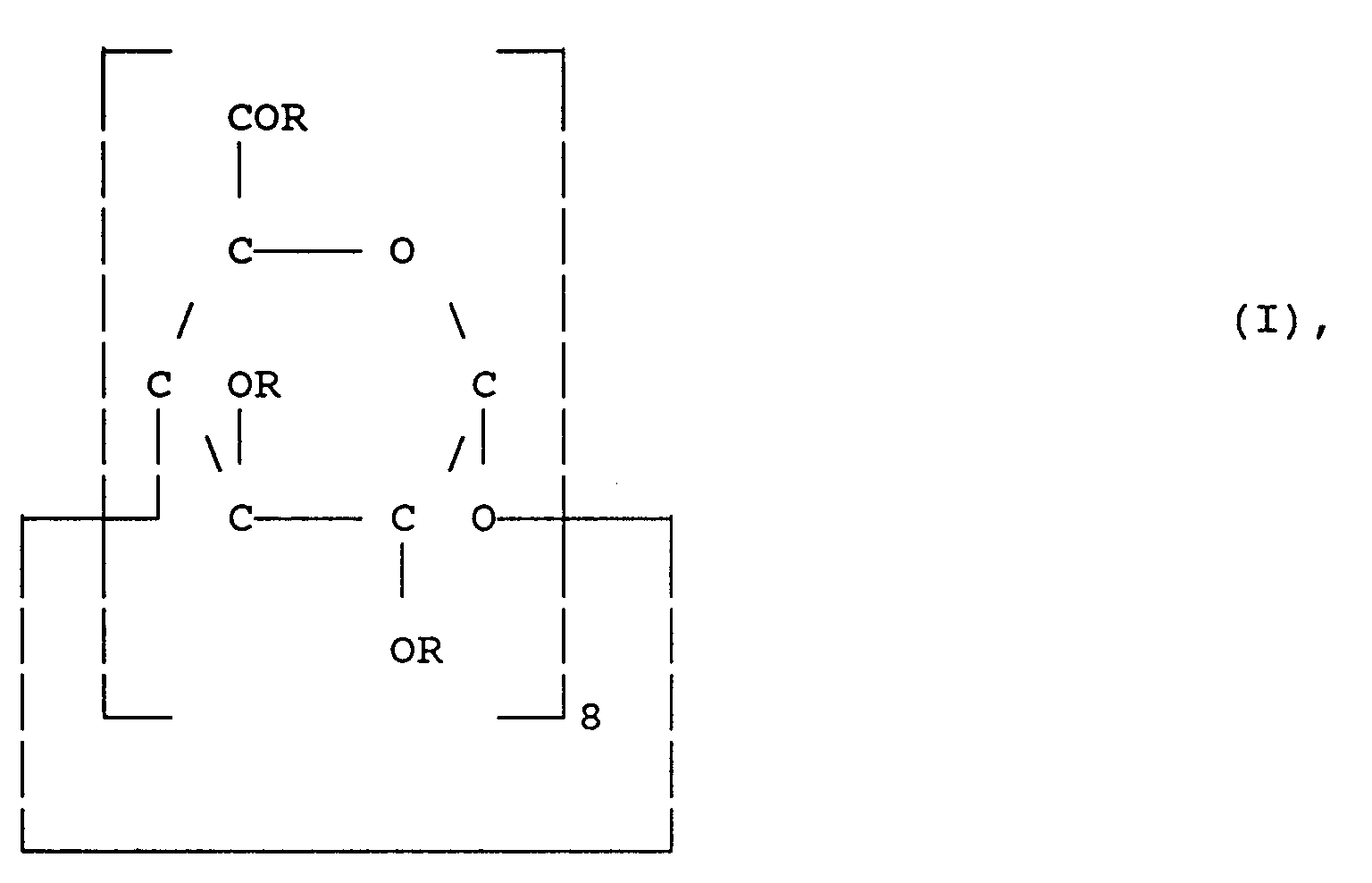
R1 gleich oder verschieden ist und Acetyl, Propionyl, Butyryl, 2-Alkoxyacetyl, 2-Chloracetyl, 2-Fluoracetyl, 2-N-Acetylaminoacetyl, Methacryloyl oder Acryloyl bedeutet und
der DS für R1, gemessen mittels ¹H-NMR-Spektroskopie, zwischen 0,3 und 2,0 liegt. - Acylierte Cyclodextrin-Derivate gemäß Anspruch 1, dadurch gekennzeichnet, daß R1 in Formel I Acetyl, Propionyl oder Butyryl bedeutet und DS für R1 zwischen 0,4 und 1,6 liegt.
- Acylierte Cyclodextrin-Derivate gemäß Anspruch 1, dadurch gekennzeichnet, daß R1 in Formel I Acetyl bedeutet und der DS zwischen 0,6 und 1,4 liegt.
- Acylierte Cyclodextrin-Derivate gemäß Anspruch 1, dadurch gekennzeichnet, daß die Substituentenverteilung randomisiert und die Hydroxygruppe in Position 6 der Glucosen zu weniger als 90% substituiert ist.
- Acylierte Cyclodextrin-Derivate gemäß Anspruch 4, dadurch gekennzeichnet, daß die Hydroxygruppe in Position 6 der Glucosen zu weniger als 85% substituiert ist.
- Verfahren zur Herstellung von acylierten γ-Cyclodextrinderivaten, dadurch gekennzeichnet, daß γ-Cyclodextrin mit mindestens einem Acylierungsmittel in Gegenwart eines basischen Katalysators umgesetzt wird.
- Verfahren nach Anspruch 6, dadurch gekennzeichnet, daß als Acylierungsmittel Essigsäureanhydrid, Propionsäureanhydrid, Buttersäureanhydrid, 2-Chloressigsäureanhydrid, 2-Fluoressigsäureanhydrid, Acrylsäureanhydrid, Methacrylsäureanhydrid, einzeln oder in beliebiger Mischung eingesetzt werden.
- Verwendung von Acetyl-γ-CD im pharmazeutischen Bereich.
Applications Claiming Priority (2)
| Application Number | Priority Date | Filing Date | Title |
|---|---|---|---|
| DE4414138A DE4414138A1 (de) | 1994-04-22 | 1994-04-22 | Acylierte gamma-Cyclodextrine |
| DE4414138 | 1994-04-22 |
Publications (2)
| Publication Number | Publication Date |
|---|---|
| EP0680975A1 true EP0680975A1 (de) | 1995-11-08 |
| EP0680975B1 EP0680975B1 (de) | 1998-01-28 |
Family
ID=6516200
Family Applications (1)
| Application Number | Title | Priority Date | Filing Date |
|---|---|---|---|
| EP95105919A Expired - Lifetime EP0680975B1 (de) | 1994-04-22 | 1995-04-20 | Acylierte gamma-Cyclodextrine |
Country Status (6)
| Country | Link |
|---|---|
| US (1) | US5654422A (de) |
| EP (1) | EP0680975B1 (de) |
| JP (1) | JP2574665B2 (de) |
| CN (1) | CN1102154C (de) |
| CA (1) | CA2144675C (de) |
| DE (2) | DE4414138A1 (de) |
Cited By (4)
| Publication number | Priority date | Publication date | Assignee | Title |
|---|---|---|---|---|
| EP0769843A1 (de) | 1995-10-17 | 1997-04-23 | BITRON S.p.A. | Verfahren und Vorrichtung zur Regelung statisch-elektronischer Komponenten für das Umschalten der Phasen in driephasigen bürstenlosen elektrischen Motoren |
| WO1998023648A1 (en) * | 1996-11-29 | 1998-06-04 | Societa' Cooperativa Centro Ricerche Poly-Tech A Responsabilita' Limitata | New butyric esters with antiproliferative activity and the pharmaceutical compositions containing them |
| WO1999024073A1 (en) * | 1997-11-10 | 1999-05-20 | Thissen Laboratoires S.A. | Pharmaceutical compositions containing cyclodextrins and taxoids |
| DE102005046237A1 (de) * | 2005-09-28 | 2007-04-05 | Südzucker Aktiengesellschaft Mannheim/Ochsenfurt | Buttersäureester von Kohlenhydraten und Kohlenhydratpolyolen |
Families Citing this family (17)
| Publication number | Priority date | Publication date | Assignee | Title |
|---|---|---|---|---|
| FR2741079B1 (fr) * | 1995-11-13 | 1997-12-26 | Oreal | Nouveaux composes, derives de cyclodextrine et leur utilisation, notamment en cosmetique |
| AR020650A1 (es) * | 1998-08-10 | 2002-05-22 | Poly Med Inc | Polimeros fosforilados y conjugados de los mismos |
| US8614291B2 (en) * | 1999-08-10 | 2013-12-24 | Poly-Med, Inc. | Phosphorylated polymers and conjugates thereof |
| US6613703B1 (en) | 2000-04-27 | 2003-09-02 | Kimberly-Clark Worldwide, Inc. | Thermoplastic nonwoven web chemically reacted with a cyclodextrin compound |
| GB0028575D0 (en) * | 2000-11-23 | 2001-01-10 | Elan Corp Plc | Oral pharmaceutical compositions containing cyclodextrins |
| US6566556B2 (en) * | 2000-12-19 | 2003-05-20 | Nippon Shokubai Co., Ltd. | Method for production of alkanolamine and apparatus therefor |
| DE10155781A1 (de) * | 2001-11-14 | 2003-05-22 | Deutsches Textilforschzentrum | Verfahren zur Herstellung von reaktiven Cyclodextrinen, ein damit ausgerüstetes textiles Material und deren Verwendung |
| US7141540B2 (en) * | 2001-11-30 | 2006-11-28 | Genta Salus Llc | Cyclodextrin grafted biocompatible amphilphilic polymer and methods of preparation and use thereof |
| EP2173942A1 (de) * | 2007-06-28 | 2010-04-14 | Buckman Laboratories International, Inc. | Verwendung von cyclodextrinen zur geruchssteuerung in papierherstellungsschlämmen sowie desodorierter schlamm und produkte daraus |
| JP2009040873A (ja) * | 2007-08-08 | 2009-02-26 | Lintec Corp | 部分アシル化シクロデキストリンの製造方法および部分アシル化ロタキサンの製造方法 |
| CN103539871B (zh) * | 2013-10-18 | 2016-03-02 | 浙江大学 | 对全三甲基硅基保护环糊精的伯位选择性乙酰化的方法 |
| EP3474908A1 (de) * | 2016-06-24 | 2019-05-01 | The Procter and Gamble Company | Saugfähige artikel mit verkapselungsmitteln |
| CN108997513B (zh) * | 2017-06-07 | 2021-05-25 | 庄宸 | 改性环糊精及其应用 |
| DE102017127320A1 (de) | 2017-11-20 | 2019-05-23 | Johannes-Gutenberg-Universität Mainz | Per-substituierte cyclodextrine zur selektiven und reversiblen adsorption von trichlorfluormethan |
| KR102009982B1 (ko) * | 2018-03-08 | 2019-08-12 | 재단법인대구경북과학기술원 | 개질 사이클로덱스트린, 이를 이용한 기능성 섬유 및 이의 제조방법 |
| CN112759667A (zh) * | 2021-01-05 | 2021-05-07 | 淄博千汇生物科技有限公司 | 一种三乙酰基-β-环糊精的制备方法 |
| CN117286600B (zh) * | 2023-11-24 | 2024-03-08 | 广东荣昌纺织实业有限公司 | 一种基于棉纤维素的溶解再生技术制备纤维的方法、纤维及应用 |
Citations (2)
| Publication number | Priority date | Publication date | Assignee | Title |
|---|---|---|---|---|
| JPH069709A (ja) * | 1992-04-30 | 1994-01-18 | Toppan Printing Co Ltd | シクロデキストリン誘導体及びその製造方法 |
| US5288916A (en) * | 1993-03-25 | 1994-02-22 | Bend Research, Inc. | Enantiomeric resolution of 4-(3,4-dichlorophenyl)-3,4-dihydro-1(2H)-naphthalenone |
Family Cites Families (4)
| Publication number | Priority date | Publication date | Assignee | Title |
|---|---|---|---|---|
| DE3346123A1 (de) * | 1983-12-21 | 1985-06-27 | Janssen Pharmaceutica, N.V., Beerse | Pharmazeutische praeparate von in wasser schwerloeslichen oder instabilen arzneistoffen und verfahren zu ihrer herstellung |
| GB8506792D0 (en) * | 1985-03-15 | 1985-04-17 | Janssen Pharmaceutica Nv | Derivatives of y-cyclodextrin |
| US5017566A (en) * | 1987-12-30 | 1991-05-21 | University Of Florida | Redox systems for brain-targeted drug delivery |
| US5002935A (en) * | 1987-12-30 | 1991-03-26 | University Of Florida | Improvements in redox systems for brain-targeted drug delivery |
-
1994
- 1994-04-22 DE DE4414138A patent/DE4414138A1/de not_active Withdrawn
-
1995
- 1995-03-15 CA CA002144675A patent/CA2144675C/en not_active Expired - Fee Related
- 1995-03-15 US US08/404,536 patent/US5654422A/en not_active Expired - Fee Related
- 1995-04-20 DE DE59501350T patent/DE59501350D1/de not_active Expired - Fee Related
- 1995-04-20 EP EP95105919A patent/EP0680975B1/de not_active Expired - Lifetime
- 1995-04-21 JP JP7097279A patent/JP2574665B2/ja not_active Expired - Fee Related
- 1995-04-22 CN CN95104764A patent/CN1102154C/zh not_active Expired - Fee Related
Patent Citations (2)
| Publication number | Priority date | Publication date | Assignee | Title |
|---|---|---|---|---|
| JPH069709A (ja) * | 1992-04-30 | 1994-01-18 | Toppan Printing Co Ltd | シクロデキストリン誘導体及びその製造方法 |
| US5288916A (en) * | 1993-03-25 | 1994-02-22 | Bend Research, Inc. | Enantiomeric resolution of 4-(3,4-dichlorophenyl)-3,4-dihydro-1(2H)-naphthalenone |
Non-Patent Citations (3)
| Title |
|---|
| D. FRENCH ET AL.: "Studies on the Schardinger Dextrins.", JOURNAL OF THE AMERICAN CHEMICAL SOCIETY, vol. 71, no. 1, 26 January 1949 (1949-01-26), DC US, pages 353 - 356 * |
| DATABASE WPI Week 9407, Derwent World Patents Index; AN 053986 * |
| PATENT ABSTRACTS OF JAPAN vol. 18, no. 209 (C - 1190)<6549> 13 April 1994 (1994-04-13) * |
Cited By (4)
| Publication number | Priority date | Publication date | Assignee | Title |
|---|---|---|---|---|
| EP0769843A1 (de) | 1995-10-17 | 1997-04-23 | BITRON S.p.A. | Verfahren und Vorrichtung zur Regelung statisch-elektronischer Komponenten für das Umschalten der Phasen in driephasigen bürstenlosen elektrischen Motoren |
| WO1998023648A1 (en) * | 1996-11-29 | 1998-06-04 | Societa' Cooperativa Centro Ricerche Poly-Tech A Responsabilita' Limitata | New butyric esters with antiproliferative activity and the pharmaceutical compositions containing them |
| WO1999024073A1 (en) * | 1997-11-10 | 1999-05-20 | Thissen Laboratoires S.A. | Pharmaceutical compositions containing cyclodextrins and taxoids |
| DE102005046237A1 (de) * | 2005-09-28 | 2007-04-05 | Südzucker Aktiengesellschaft Mannheim/Ochsenfurt | Buttersäureester von Kohlenhydraten und Kohlenhydratpolyolen |
Also Published As
| Publication number | Publication date |
|---|---|
| CA2144675A1 (en) | 1995-10-23 |
| DE4414138A1 (de) | 1995-10-26 |
| DE59501350D1 (de) | 1998-03-05 |
| CA2144675C (en) | 2002-06-25 |
| JPH07300502A (ja) | 1995-11-14 |
| US5654422A (en) | 1997-08-05 |
| EP0680975B1 (de) | 1998-01-28 |
| CN1112935A (zh) | 1995-12-06 |
| CN1102154C (zh) | 2003-02-26 |
| JP2574665B2 (ja) | 1997-01-22 |
Similar Documents
| Publication | Publication Date | Title |
|---|---|---|
| EP0680975B1 (de) | Acylierte gamma-Cyclodextrine | |
| EP0678525B1 (de) | Teilweise acylierte beta-Cyclodextrine | |
| EP0646602B1 (de) | Verfahren zur Herstellung von alkylierten Cyclodextrin-Derivaten, nach dem Verfahren herstellbare methylierte Cyclodextrin-Derivate und die Verwendung der Produkte | |
| EP0792888B1 (de) | Aliphatische Carbonsäureester von Inulin | |
| DE69113713T2 (de) | Verfahren zur Herstellung von Komplexen aus mehrfachungesättigten Fettsäuren mit langer Kette und Cyclodextrinen und die so erhaltenen Komplexe. | |
| DE69526182T2 (de) | Verfahren zur Herstellung von Trehalosederivaten | |
| DE60107833T2 (de) | Veresterte polysaccharidprodukte, beta-lacton ringgeöffnete ketendimer-produkte enthaltende zusammensetzungen und verfahren zur deren herstellung | |
| DE2822364A1 (de) | Amylasebestimmung | |
| DE3712246A1 (de) | Verfahren zum herstellen modifizierter cyclodextrine | |
| EP0668293B1 (de) | Thermoplastische biologisch abbaubare Polysaccharidderivate, Verfahren zu ihrer Herstellung und ihre Verwendung | |
| DE60210457T2 (de) | Neue hyaluronan-derivate | |
| EP2220126B1 (de) | Cyclodextrin-silankomplexe | |
| DE68916878T2 (de) | Selektiv O-acylierte Glycosaminoglykane. | |
| DE69903442T2 (de) | Verfahren zur bereitung von optisch reinen derivaten der (s)-3,4-dihydroxybuttersäure | |
| DE4223471C2 (de) | Stärkezwischenprodukt, Verfahren zu dessen Herstellung sowie Verfahren zu dessen Weiterverarbeitung | |
| DE69315734T2 (de) | Neue verzweigte Cyclodextrine und Verfahren zu ihrer Herstellung | |
| EP1035135B1 (de) | Regioselektiv substituierte Ester von Oligo- und Polysacchariden und Verfahren zu ihrer Herstellung | |
| DE3626213A1 (de) | Enzymatische synthese von cyclodextrinen mit (alpha)-glucosylfluorid als substrat fuer cyclodextrin-(alpha)(1->4)glucosyltransferase | |
| DE10033197C1 (de) | Verfahren zur Herstellung von hochsubstituierter Carboxymethylstärke | |
| EP0774469B1 (de) | Acylierte Saccharosemonocarbonsäuren | |
| EP0584677B1 (de) | Thermoplastische, biologisch abbaubare Celluloseester und Verfahren zu ihrer Herstellung | |
| DE19951734A1 (de) | Regioselektiv substituierte Ester von Oligo- und Polysacchariden und Verfahren zu ihrer Herstellung | |
| DE4325057C2 (de) | Verfahren zur Herstellung von verzweigten Cyclodextrinen | |
| EP0761689A1 (de) | Thermoplastische biologisch abbaubare Polysaccharidderivate, Verfahren zu ihrer Herstellung und ihre Verwendung | |
| DE60133011T2 (de) | Verfahren zur herstellung von disaccharid und trisaccharid c6-c12 fettsäure-estern mit hohem alpha gehalt und materialien davon |
Legal Events
| Date | Code | Title | Description |
|---|---|---|---|
| PUAI | Public reference made under article 153(3) epc to a published international application that has entered the european phase |
Free format text: ORIGINAL CODE: 0009012 |
|
| 17P | Request for examination filed |
Effective date: 19950420 |
|
| AK | Designated contracting states |
Kind code of ref document: A1 Designated state(s): BE DE FR GB IT NL |
|
| 17Q | First examination report despatched |
Effective date: 19960131 |
|
| GRAG | Despatch of communication of intention to grant |
Free format text: ORIGINAL CODE: EPIDOS AGRA |
|
| GRAG | Despatch of communication of intention to grant |
Free format text: ORIGINAL CODE: EPIDOS AGRA |
|
| GRAH | Despatch of communication of intention to grant a patent |
Free format text: ORIGINAL CODE: EPIDOS IGRA |
|
| GRAH | Despatch of communication of intention to grant a patent |
Free format text: ORIGINAL CODE: EPIDOS IGRA |
|
| GRAA | (expected) grant |
Free format text: ORIGINAL CODE: 0009210 |
|
| AK | Designated contracting states |
Kind code of ref document: B1 Designated state(s): BE DE FR GB IT NL |
|
| ITF | It: translation for a ep patent filed | ||
| REF | Corresponds to: |
Ref document number: 59501350 Country of ref document: DE Date of ref document: 19980305 |
|
| ET | Fr: translation filed | ||
| GBT | Gb: translation of ep patent filed (gb section 77(6)(a)/1977) |
Effective date: 19980226 |
|
| PLBE | No opposition filed within time limit |
Free format text: ORIGINAL CODE: 0009261 |
|
| STAA | Information on the status of an ep patent application or granted ep patent |
Free format text: STATUS: NO OPPOSITION FILED WITHIN TIME LIMIT |
|
| 26N | No opposition filed | ||
| REG | Reference to a national code |
Ref country code: GB Ref legal event code: IF02 |
|
| PGFP | Annual fee paid to national office [announced via postgrant information from national office to epo] |
Ref country code: NL Payment date: 20030403 Year of fee payment: 9 |
|
| PGFP | Annual fee paid to national office [announced via postgrant information from national office to epo] |
Ref country code: GB Payment date: 20030416 Year of fee payment: 9 |
|
| PGFP | Annual fee paid to national office [announced via postgrant information from national office to epo] |
Ref country code: FR Payment date: 20030418 Year of fee payment: 9 |
|
| PGFP | Annual fee paid to national office [announced via postgrant information from national office to epo] |
Ref country code: DE Payment date: 20030430 Year of fee payment: 9 |
|
| PGFP | Annual fee paid to national office [announced via postgrant information from national office to epo] |
Ref country code: BE Payment date: 20030514 Year of fee payment: 9 |
|
| PG25 | Lapsed in a contracting state [announced via postgrant information from national office to epo] |
Ref country code: GB Free format text: LAPSE BECAUSE OF NON-PAYMENT OF DUE FEES Effective date: 20040420 |
|
| PG25 | Lapsed in a contracting state [announced via postgrant information from national office to epo] |
Ref country code: BE Free format text: LAPSE BECAUSE OF NON-PAYMENT OF DUE FEES Effective date: 20040430 |
|
| BERE | Be: lapsed |
Owner name: *CONSORTIUM FUR ELEKTROCHEMISCHE INDUSTRIE G.M.B.H Effective date: 20040430 |
|
| PG25 | Lapsed in a contracting state [announced via postgrant information from national office to epo] |
Ref country code: NL Free format text: LAPSE BECAUSE OF NON-PAYMENT OF DUE FEES Effective date: 20041101 |
|
| PG25 | Lapsed in a contracting state [announced via postgrant information from national office to epo] |
Ref country code: DE Free format text: LAPSE BECAUSE OF NON-PAYMENT OF DUE FEES Effective date: 20041103 |
|
| GBPC | Gb: european patent ceased through non-payment of renewal fee |
Effective date: 20040420 |
|
| PG25 | Lapsed in a contracting state [announced via postgrant information from national office to epo] |
Ref country code: FR Free format text: LAPSE BECAUSE OF NON-PAYMENT OF DUE FEES Effective date: 20041231 |
|
| NLV4 | Nl: lapsed or anulled due to non-payment of the annual fee |
Effective date: 20041101 |
|
| REG | Reference to a national code |
Ref country code: FR Ref legal event code: ST |
|
| PG25 | Lapsed in a contracting state [announced via postgrant information from national office to epo] |
Ref country code: IT Free format text: LAPSE BECAUSE OF NON-PAYMENT OF DUE FEES;WARNING: LAPSES OF ITALIAN PATENTS WITH EFFECTIVE DATE BEFORE 2007 MAY HAVE OCCURRED AT ANY TIME BEFORE 2007. THE CORRECT EFFECTIVE DATE MAY BE DIFFERENT FROM THE ONE RECORDED. Effective date: 20050420 |