EP0681768B1 - Procede et appareil pour generer une suite de donnees chiffree - Google Patents
Procede et appareil pour generer une suite de donnees chiffree Download PDFInfo
- Publication number
- EP0681768B1 EP0681768B1 EP94903705A EP94903705A EP0681768B1 EP 0681768 B1 EP0681768 B1 EP 0681768B1 EP 94903705 A EP94903705 A EP 94903705A EP 94903705 A EP94903705 A EP 94903705A EP 0681768 B1 EP0681768 B1 EP 0681768B1
- Authority
- EP
- European Patent Office
- Prior art keywords
- stream
- sequence
- cipher
- values
- linear
- Prior art date
- Legal status (The legal status is an assumption and is not a legal conclusion. Google has not performed a legal analysis and makes no representation as to the accuracy of the status listed.)
- Expired - Lifetime
Links
Images


Classifications
-
- H—ELECTRICITY
- H04—ELECTRIC COMMUNICATION TECHNIQUE
- H04L—TRANSMISSION OF DIGITAL INFORMATION, e.g. TELEGRAPHIC COMMUNICATION
- H04L9/00—Cryptographic mechanisms or cryptographic arrangements for secret or secure communications; Network security protocols
- H04L9/06—Cryptographic mechanisms or cryptographic arrangements for secret or secure communications; Network security protocols the encryption apparatus using shift registers or memories for block-wise or stream coding, e.g. DES systems or RC4; Hash functions; Pseudorandom sequence generators
- H04L9/065—Encryption by serially and continuously modifying data stream elements, e.g. stream cipher systems, RC4, SEAL or A5/3
- H04L9/0656—Pseudorandom key sequence combined element-for-element with data sequence, e.g. one-time-pad [OTP] or Vernam's cipher
- H04L9/0662—Pseudorandom key sequence combined element-for-element with data sequence, e.g. one-time-pad [OTP] or Vernam's cipher with particular pseudorandom sequence generator
- H04L9/0668—Pseudorandom key sequence combined element-for-element with data sequence, e.g. one-time-pad [OTP] or Vernam's cipher with particular pseudorandom sequence generator producing a non-linear pseudorandom sequence
Definitions
- This invention relates a method and apparatus for generating a cipher stream.
- Embodiments of the invention may find use in enciphering or encrypting of digital messages, such as in telecommunications and computer communications systems.
- Stream ciphers act by dividing the plain text into characters, each of which is enciphered utilising a time varying function whose time dependency is governed by the internal state of the stream cipher.
- the time varying function is produced by a key stream generator, which generates a digital cipher stream in accordance with key data which is kept secret.
- the key stream generator is constructed such that the cipher stream produced is a pseudo random bit stream which is cyclic, but has a period which is much greater than the length of key data provided.
- the device changes state according to a rule, such that two occurrences of the same character in the plain text message will usually not result in the same cipher text character.
- the security of a stream cipher depends on the "randomness" of the output cipher key stream. Assuming an interceptor (cryptoanalyst) has knowledge of the plaintext message, the cryptoanalyst may therefore have full access to the running key stream.
- the cipher stream must be unpredictable: regardless of the number of cipher stream digits observed, the subsequent cipher stream digits must be no better predictable than by just randomly guessing them. This implies that it is unfeasible for the cryptanalyst to determine the true key as he would be able to reliably predict the cipher stream. A necessary requirement for unpredictability is a long period of the cipher stream.
- the period defines a linear recursion, thus knowing the value of the period and the first period of the cipher stream determines completely the remainder of the cipher stream.
- Finding the shortest non-linear feedback shift register able to produce a given sequence is in general a difficult task, however algorithms or methods do exist for doing so. Consequently, for the cipher stream to be unpredictable, it is necessary that its linear complexity (which is the length of the shortest linear feedback shift register able to produce the cipher stream) also be large. Unpredictability also requires that, independent of the preceding digit, the next key cipher digit appears to be drawn from a uniform distribution. Therefore the cipher stream necessarily must have uniform statistics, i.e. an equal distribution of single digits, of pairs, triples of digits, etc.
- a message authentication code determined from the content of the plain text message, is often transmitted with the cipher text to enable the receiver to determine whether the received deciphered plain text corresponds with the plain text originally transmitted, i.e. whether the cipher text has been altered during transmission.
- cryptographic systems it may be possible for a cryptoanalyst to alter both the cipher text message and the enciphered MAC in such a way that the change is not apparent to the receiver, even though the cryptoanalyst is unable to determine the meaning of the cipher text which has been altered. Therefore, it is also advantageous for cryptographic systems to provide integrity checking which prevents such alterations during transmission from taking place without detection.
- a digital data stream generator for generating a cipher stream, comprising a feedback shift register structure for producing at least one pseudo-random data stream, and a processing structure, including a means which stores a sequence of combination values derived from a number of preceding values of the at least one data stream, for producing a cipher stream from said at least one data stream, characterized in that the processing structure includes processing means for producing said cipher stream by multiplying pairs of said combination values and summing said multiplied pairs, wherein the difference in sequence position between the combination values for each pair is different.
- Preferred embodiments of the invention also provide a digital data stream generator for generating a cipher stream comprising at least one linear feedback shift register (LFSR), a summing means for producing a sequence of sums of the outputs of said at least one LFSR, a non-linear feedback processing means for producing a sequence of non-linear values in accordance with the outputs of said at least one LFSR and at least one previous value of said non-linear output value sequence, and an output processing means for generating a data stream in accordance with a Bent function utilising a plurality of pairs of said sequence of sums and at least one of said sequence of non-linear values, wherein the difference in the sequence position of the members of each pair is different as between each pair.
- LFSR linear feedback shift register
- a system for encrypting or decrypting a digital message comprising a linear driving sub-system for generating a pseudo random data sequence, a non-linear feedback sub-system for producing a cipher stream from said pseudo random data sequence, and an encryption processor for encrypting or decrypting a message by combining it with said cipher stream,
- the non-linear feedback subsystem comprising a non-linear feedback processing means for generating a feedback sequence by applying a non-linear function to at least one value from said pseudo-random data sequence and at least one previous value of the feedback sequence, and a cipher stream generating means for generating said cipher stream by summing products of pairs of values of said pseudo random data sequence together with a value from said feedback sequence, the pairs of values being chosen such that the difference in sequence position as between each member of a pair is different as between each pair.
- the invention also extends to a method for generating a cipher stream utilising a pseudo random data stream sequence, characterized by generating the cipher stream by summing products of pairs of values of said data stream sequence with a value derived from a non-linear feedback function of values from the data stream sequence, the pairs of values being chosen such that the difference in sequence position as between each member of a pair is different as between each pair.
- the invention provides a method of encrypting or decrypting a digital message comprising generating a pseudo random data stream sequence, performing a non-linear feed back transformation on said data stream sequence, generating a cipher stream in which correlations to linear forms are minimised by summing products of pairs of values of said data stream sequence with a value of said non-linear feedback transformation, the pairs of values being chosen such that the difference in sequence position as between each member of a pair is different as between each pair, and encrypting or decrypting the message on the basis of said cipher stream.
- pseudo random data stream sequence is producted by a combination of outputs from a plurality of linear feedback shift registers.
- values of said non-linear feedback transformations are combined with the digital message, and an integrity function applied to the combination to produce an integrity check value (ICV).
- an integrity check value (ICV)
- the integrity check value is appended to the digital message and encrypted therewith.
- a method of generating a cipher stream comprising a pseudo random number stream sequence m j , generating a number stream sequence s j in accordance with a non-linear feedback scheme, and generating an output cipher stream sequence z j according to: where c, d are predetermined integers with c ⁇ d ⁇ j and a k b k are integers ⁇ j such that (a e -b e ) ⁇ (a f - b f ) for all e, f ⁇ [c,d].
- the invention also extends, in a preferred form, to a stream cipher comprising a linear driving system which in use generates at least one pseudo random data stream, a non-linear combining system including a feed-back data stream, which generates a cipher stream by performing a non-linear operation on said at least one pseudo random data stream, an integrity system which in use combines a digital message with said feed-back data stream and applies an integrity function thereto so as to generate an integrity check value, and an output system wherein the integrity check value is appended to said digital message and the message and appended check value is enciphered by use of said cipher stream.
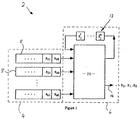
- a cipher stream generator 2 which comprises generally a linear driving subsystem 4 and a non-linear combining subsystem 6.
- the linear driving subsystem 4 comprises a plurality of n linear feedback shift registers 8, prestored with key data x am .
- Outputs from the LFSR's 8 are received by a non-linear processor 10 of the non-linear combining subsystem 6.
- the non-linear processor 10 includes a feedback system 12 having memory bits s j .
- An output 14 from the non-linear combining subsystem 6 produces a data sequence z j which comprises the cipher stream.
- the basis of operation of the cipher stream generator 2 is that secret key data x am is provided to the stream cipher 2, which combines the linear pseudo random data sequences produced by LFSR's 8, performs a non-linear transformation thereon, and a cipher stream is output at 14, for combination with a message to be enciphered.
- the terminal receiving the enciphered message is also provided with a cipher stream generator 2, such that a transformation involving the cipher stream z j and the enciphered message can be utilised to decipher the message. Equations (1) and (2), below, give a general definition of the functions performed by the non-linear combining subsystem 6.
- z j g(x 1j, ...,x nj ,s 1 j ,...,s m j ) in GF(2)
- s i j+1 f i (x 1j ,...,x nj ,s 1 j ,...,s m j ) in GF(2).
- the corresponding connection polynomials of the LFSR's 8 are chosen to be primitive and of relatively prime degrees.
- the m memory bits s 1 j ,...,s m j are used to link the jth phase of respective LFSR's 8 with the j+1th phase.
- this scheme can produce an output stream z with the following properties:
- a specific example of a stream cipher is given by the so called summation combiner, with f defined to be the least significant carry bit of the sum of its arguments in (3) and (4). This may be expressed as, Calculated linear complexities resulting from the system defined by (6) and (7) are provided in Table 1, below. Each line of the table gives a combination of two or three LFSR's of lengths L i . The corresponding numbers under P refer to the period of the output stream z j . MinComp gives the smallest linear complexity found among all combinations of primitive polynomials of the given lengths. Finally the data under % represents the difference between P and Min Comp as a percentage of P. Note that each register is initialised to be all 1's, and the initial carry S 0 is set to 0.
- the carry s j in such a system suffers from bias.
- the carry is balanced for N even, and biased for N odd.
- the carry is biased in runs of equal output digits.
- Table 2 shows that f is biased, and that g and k are balanced (both overall and conditionally).
- g specifies a balanced function
- z j has a given value of 0 or 1 for eight of the sixteen rows of the table. Furthermore corresponding to each set of these eight rows the value of the column under g is 0 and 1 four times each. The same is true for the function k.
- This is an undesirable feature for a cipher stream as knowledge Z j +z j-1 allows an attacker to predict z j from z j-1 .
- the following example illustrates a correlation of the summation combiner with a linear function of the inputs. Example. Consider the three cipher systems defined by (8), (9) and (10).
- the preferred embodiment of the invention is based on the system defined by equations (3) and (4), including means to make correlations between linear forms in the output cipher stream z j and the input terms x 1j to x aj uniformly small.
- x j be considered fixed for i not equal to one of j-1, j-3, j-6, . . . , j-1/2k(k+1) or j-2, j-5, j-9, j-1/2k(k+3).
- boolean constants a 1 , a 2 ,..., a k , and b 1 , b 2 , ..., b k can be expressed as a linear form in u j and v j .
- x j -2 v 1 + b 1
- the speed of cipher stream production of the stream cipher generator 2 may also be improved over the conventional output at a rate of one bit per cycle. If the output is produced at the rate of one word (say 32 bits) per cycle then the speed at which the cipher could be implemented is increased by a factor of 32. In order to achieve this the stream cipher generator 2 may be modified so that each cell variable is a word rather than a bit, such that the operations of addition and multiplication over GF(2) in equations (13), (14) and (15) apply bit-wise between words. The effect is identical to the running of 32 ciphers in parallel and interleaving the outputs together. Thus the nth bit of each output word corresponds to the output of a similar cipher operating a bit at a time.
- Each of these bit ciphers are identical in structure and differ only in the initial vectors of the LFSR's.
- the output can be made to correspond to the output of one full period of a given bit per cycle cipher, the only difference being that the output bits are re-ordered in a straightforward way.
- the advantage is that the word per cycle cipher can produce the output in 1/32 of the number of cycles.
- the stream cipher in contrast to block ciphers, with stream ciphers there is no established mode of operating that provides integrity.
- the stream cipher in accordance with the embodiments of the invention, however, can be utilised in the implementation of a message authentication code (MAC) that provides an integrity check value (ICV).
- MAC message authentication code
- IMV integrity check value
- FIG 2 illustrates a block diagram of a preferred embodiment of the invention which includes a first example of an integrity checking mechanism.
- a message enciphering system 20 which incorporates a cipher stream generator 2 of the type described hereinbefore, and illustrated in Figure 1.
- the enciphering system 20 also includes an integrity check value generator 18, an encryption processor 26 and a plain text message source 22.
- Plain text message data is received from the message source 22 by the integrity check value generator 18 where the message data stream is combined with a memory data stream s j 16 from the non-linear processor 10.
- An integrity function is then applied to the combined streams so as to result in an integrity check value (ICV).
- IOV integrity check value
- the ICV is forwarded to the encryption processor 26, whereupon it is appended as a message authentication code onto the end of the plain text message also forwarded to the enciphering processing means 26 from the message source 22.
- the message and MAC are then enciphered by combination with the cipher stream from output 14, and the enciphered message is output on line 30.
- a 32 bit word is produced every cycle.
- a message M consist of k words M 1 , M 2 , M 3 , M k .
- the integrity function is such that the memory bits produced by the cipher (s j , s j+1 , s j+2 ...) are woven into the integrity function.
- the steps involved in encrypting and applying integrity to the message M are outlined below, where the symbol " ⁇ " refers to bit-wise exclusive or, and "c ⁇ r” refers to the word c cyclically left rotated by r bits. Assume also that the stream cipher has gone through j cycles and so is in state j.
- Step 1 If necessary pad the message stream with "zero" words so that it contains at least 16 words.
- Step 2 Run the cipher q+1 cycles and store the outputs z j+1 , z j+2 ..., z j+q+1 and memory words s j+1 , s j+2 ..., s j+q .
- Step 4 Pad the new message stream with 32 extra words by repeating the first 16 words twice over.
- a modified example of the integrity and enciphering systems 18 and 26 is described in algorithmic form hereinbelow, and illustrated as a block diagram in Figure 3.
- the same assumptions made for the purposes of the previous example apply, however instead of the feedback stream (s j , s j+1i , s j+2 ...) it is memory bits (m j , m j+1 , m j+2 %) (see equations (13) and (14)) which are woven into the integrity function.
- Step 1 If necessary pad the message stream with zero words so that it contains a multiple of 16 words.
- Step 4 Apply the integrity function in three rounds as follows:
- step 6 If integrity without encryption is required then exactly the same procedure may be used except that in step 6 only M n+1 is encrypted. Furthermore, the sequence of numbers (7, 12, 17, 22, 5, ..., 23) which are utilised in the three rounds of step 4 may be chosen at will, however the sequence given has been shown experimentally to produce excellent integrity checking results.
- the length of the key k is at least 512 bits in length while the icv is only 32 bits long.
- the ability of an attacker to calculate the correct k from M and Mac k (M) is only about one chance in 2 480 (>10 144 ) even if the Mac function is easily reversible. So only a negligible amount of information about k is obtainable from M and Mac k (M). It may be argued that from M an attacker could calculate z j and so find m j , however the small level of correlation between z j and m j makes such an attack impractical.
- the vector of binary variables in F' have the same values with period P. It follows that z j has period a divisor of P for j at least M+1.//
Landscapes
- Engineering & Computer Science (AREA)
- Physics & Mathematics (AREA)
- Nonlinear Science (AREA)
- Computer Security & Cryptography (AREA)
- Computer Networks & Wireless Communication (AREA)
- Signal Processing (AREA)
- Storage Device Security (AREA)
- Signal Processing For Digital Recording And Reproducing (AREA)
- Programmable Controllers (AREA)
- Transition And Organic Metals Composition Catalysts For Addition Polymerization (AREA)
- Developing Agents For Electrophotography (AREA)
- Chair Legs, Seat Parts, And Backrests (AREA)
- Two-Way Televisions, Distribution Of Moving Picture Or The Like (AREA)
- Reverberation, Karaoke And Other Acoustics (AREA)
Claims (26)
- Générateur d'une suite de données numériques pour produire une suite de chiffrement, comprenant une structure à registres à décalage à réaction (4) servant à produire au moins une suite de données pseudo-aléatoires, et une structure de traitement (6), incluant des moyens (12) qui mémorisent une séquence de valeurs de combinaison dérivées d'un nombre de valeurs précédentes d'au moins une suite de données, pour produire une suite de chiffrement à partir de ladite au moins une suite de données,
caractérisé en ce que la structure de traitement comprend des moyens de traitement (10) pour produire ladite suite de chiffrement par multiplication de couples desdites valeurs de combinaison et sommation desdits couples multipliés, la différence de position dans la séquence entre les valeurs de combinaison pour chaque couple étant différente. - Générateur de suite de données numériques selon la revendication 1, dans lequel la structure de traitement (6) comprend un système de réaction non linéaire pour produire une séquence de valeurs de mémoire (S1) à partir de valeurs de ladite au moins une suite de données et d'au moins une valeur précédente, au moins l'une des valeurs de mémoire étant additionnée avec lesdits couples multipliés de manière à produire ladite suite de chiffrement.
- Générateur de suite de données numériques selon la revendication 1 ou 2, dans lequel la structure à registres à décalage à réaction (4) comprend une pluralité de n registres à décalage à réaction linéaire (8), qui transmettent une suite de données pseudo-aléatoires à la structure de traitement (6).
- Générateur de suite de données numériques selon la revendication 2, dans lequel le système de réaction non linéaire produit une valeur de mémoire par application d'une fonction non linéaire à des valeurs de la au moins une suite de données et à au moins une valeur de mémoire précédente.
- Générateur de suite de données numériques selon la revendication 4, dans lequel chacune desdites valeurs de combinaison sont dérivées par sommation de valeurs provenant d'au moins une suite de données.
- Générateur de suite de données numériques selon la revendication 5, dans lequel la structure (4) à registres à décalage à réaction comprend n registres à décalage à réaction linéaire (8), qui produisent des suites de bits xij...,xnj, et dans lequel ledit système de réaction (12) produit une séquence de bits s de mémoire conformément à sj+1 = f (x1j...xnj, sj), f étant une fonction non linéaire.
- Générateur de suite de données numériques selon la revendication 6, dans lequel lesdites valeurs de combinaison mj sont produites conformément à

- Générateur de suite de données numériques selon la revendication 7, dans lequel la suite de chiffrement (14) comporte des valeurs zj qui sont produites conformément àk étant un entier supérieur à 1.

- Système pour crypter ou décrypter un message numérique, comprenant un générateur de suite de données numériques selon la revendication 1 pour produire une suite de chiffrement, et un processeur de cryptage (26) pour crypter ou décrypter un message en le combinant à ladite suite de chiffrement.
- Système selon la revendication 9, dans lequel la structure (4) à registres à décalage à réaction comprend une pluralité de registres à décalage à réaction linéaire (8) qui sont préalablement mémorisés avec des données de code secret et qui produisent des séquences séparées de données, qui sont combinées de manière à fournir ladite séquence de données pseudo-aléatoires.
- Système selon la revendication 10, dans lequel la structure de traitement (6) comprend un système de traitement à réaction non linéaire qui, en fonctionnement, produit une séquence de réaction par application d'une fonction non linéaire à des valeurs provenant desdites séquences séparées de données, conjointement avec une valeur précédente de la séquence de réaction.
- Système selon la revendication 11, dans lequel ledit processeur de cryptage (26) crypte une suite formant message en texte clair (24) en appliquant une opération OU-Exclusif bit-à-bit à la suite formant message avec ladite suite de chiffrement.
- Système selon la revendication 11, dans lequel ledit processeur de cryptage (26) décrypte une suite de messages cryptés en appliquant une opération OU-Exclusif bit-à-bit à la suite formant message cryptée à l'aide de ladite suite de chiffrement.
- Système selon la revendication 11 ou 12, comportant en outre un sous-système de contrôle d'intégrité (18) pour produire une valeur de contrôle d'intégrité à partir d'un message en texte clair par combinaison de valeurs provenant de ladite séquence de réaction avec la suite formant message et application d'une fonction d'intégrité au résultat.
- Procédé pour produire une suite de chiffrement moyennant l'utilisation d'une séquence formant suite de données pseudo-aléatoires, caractérisé par la production de la suite de chiffrement par sommation de produits de couples de valeurs de ladite séquence formant suite de données par une valeur dérivée d'une fonction de réaction non linéaire de valeurs provenant de la séquence formant suite de données, les couples de valeurs étant choisis de telle sorte que la différence de la position de séquence entre des éléments d'un couple est différente de celle présente entre les différents couples.
- Procédé selon la revendication 15, incluant la production de la séquence formant suite de données pseudo-aléatoires par sommation de sortie séparée de séquences de données à partir d'une pluralité de registres à décalage à réaction linéaire.
- Procédé selon la revendication 16, selon lequel ladite fonction de réaction non linéaire agit sur des valeurs provenant desdites sorties de séquences de données séparées.
- Procédé selon la revendication 17, selon lequel les valeurs de sortie desdites séquences séparées de données sont des mots de telle sorte que les opérations de sommation et de multiplication sont appliquées bit par bit entre des mots.
- Procédé selon la revendication 17, selon lequel ladite séquence mj de données pseudo-aléatoires est produite à partir des sorties séparées de séquences de données xij conformément àet selon lequel la suite de chiffrement zj est produite conformément à :
 k étant un entier supérieur à 1, et sj étant une valeur de ladite fonction de réaction non linéaire f, avec
- Procédé selon l'une quelconque des revendications 15 à 19, incluant l'étape consistant à appliquer la suite de chiffrement à une suite formant message en texte clair pour produire une suite formant message cryptée.
- Procédé selon l'une quelconque des revendications 15 à 19, incluant l'étape consistant à appliquer la suite de chiffrement à une suite formant message cryptée pour obtenir une suite formant message en texte clair décrypté.
- Procédé selon la revendication 20 incluant l'étape consistant à combiner des valeurs dérivées de ladite fonction de réaction non linéaire avec ladite suite formant message en texte clair et appliquer une fonction d'intégrité à cette suite de manière à obtenir une valeur de contrôle d'intégrité.
- Procédé selon la revendication 22, comprenant l'étape consistant à annexer la valeur de contrôle d'intégrité à la suite formant message en texte en clair avant l'application de la suite de chiffrement à cette suite.
- Procédé selon la revendication 21 incluant l'étape consistant à combiner des valeurs dérivés de ladite fonction de réaction non linéaire avec ladite suite formant message en texte clair décrypté et appliquer une fonction d'intégration au résultat de manière à obtenir une valeur de contrôle d'intégrité.
- Procédé selon la revendication 24, comprenant l'étape consistant à comparer la valeur de contrôle d'intégrité obtenue à partir de la suite formant message en texte clair avec une valeur annexée à cette suite, de manière déterminer l'intégrité du message en texte clair décrypté.
- Procédé pour produire une suite de chiffrement selon la revendication 15 en utilisant un dispositif de traitement numérique, dans lequel la suite de chiffrement comprend une séquence de valeur zj déterminée conformément à
 ma,mb étant des valeurs de ladite séquence de suite de données,sd ladite valeur de réaction non linéairec,d des entiers prédéterminés avec c < d ≤ j, etak, bk étant des entiers ≤ jde telle sorte que (ac - bc) ≠ (af - bf) pour tous les e,f ∈ [c,d].
Applications Claiming Priority (4)
| Application Number | Priority Date | Filing Date | Title |
|---|---|---|---|
| AUPL657792 | 1992-12-30 | ||
| AUPL657792 | 1992-12-30 | ||
| AUPL6577/92 | 1992-12-30 | ||
| PCT/AU1993/000687 WO1994016509A1 (fr) | 1992-12-30 | 1993-12-30 | Procede et appareil pour generer une suite de donnees chiffree |
Publications (3)
| Publication Number | Publication Date |
|---|---|
| EP0681768A1 EP0681768A1 (fr) | 1995-11-15 |
| EP0681768A4 EP0681768A4 (fr) | 1998-02-04 |
| EP0681768B1 true EP0681768B1 (fr) | 2001-03-28 |
Family
ID=3776631
Family Applications (1)
| Application Number | Title | Priority Date | Filing Date |
|---|---|---|---|
| EP94903705A Expired - Lifetime EP0681768B1 (fr) | 1992-12-30 | 1993-12-30 | Procede et appareil pour generer une suite de donnees chiffree |
Country Status (10)
| Country | Link |
|---|---|
| US (1) | US5703952A (fr) |
| EP (1) | EP0681768B1 (fr) |
| JP (1) | JPH08505275A (fr) |
| AT (1) | ATE200169T1 (fr) |
| CA (1) | CA2150681C (fr) |
| DE (1) | DE69330070T2 (fr) |
| FI (1) | FI953232L (fr) |
| NO (1) | NO952595L (fr) |
| SG (1) | SG48838A1 (fr) |
| WO (1) | WO1994016509A1 (fr) |
Families Citing this family (43)
| Publication number | Priority date | Publication date | Assignee | Title |
|---|---|---|---|---|
| US6014445A (en) * | 1995-10-23 | 2000-01-11 | Kabushiki Kaisha Toshiba | Enciphering/deciphering apparatus and method incorporating random variable and keystream generation |
| DE19622533A1 (de) * | 1996-06-05 | 1997-12-11 | Deutsche Telekom Ag | Verfahren und Vorrichtung zum Laden von Inputdaten in einen Algorithmus bei der Authentikation |
| TW401573B (en) * | 1997-01-10 | 2000-08-11 | Victor Company Of Japan | Methods, apparatuse, and systems for producing and writing cipher keys, reproducing information with a cipher key, and for permitting reproduction of information with a cipher key, and optical disc recorded with a cipher key |
| CA2210199A1 (fr) * | 1997-07-11 | 1999-01-11 | Mitel Corporation | Methode et dispositif de production de donnees de confusion non lineaires |
| US6252958B1 (en) | 1997-09-22 | 2001-06-26 | Qualcomm Incorporated | Method and apparatus for generating encryption stream ciphers |
| US6510228B2 (en) * | 1997-09-22 | 2003-01-21 | Qualcomm, Incorporated | Method and apparatus for generating encryption stream ciphers |
| US6009135A (en) * | 1997-10-10 | 1999-12-28 | Interdigtal Technology Corporation | Method and apparatus for generating a stream cipher |
| NL1007495C2 (nl) * | 1997-11-07 | 1999-05-12 | Koninkl Kpn Nv | Werkwijze voor het beveiligd uitlezen van een vercijferd, opgeslagen cryptografische sleutel en communicatieapparaten daarvoor. |
| US5864491A (en) * | 1997-11-10 | 1999-01-26 | Telefonaktiebolaget L M Ericsson | Apparatus and associated method for generating a pseudo random number |
| US6560338B1 (en) | 1998-08-28 | 2003-05-06 | Qualcomm Incorporated | Limiting delays associated with the generation of encryption stream ciphers |
| US6490357B1 (en) | 1998-08-28 | 2002-12-03 | Qualcomm Incorporated | Method and apparatus for generating encryption stream ciphers |
| US6351539B1 (en) * | 1998-09-18 | 2002-02-26 | Integrated Device Technology, Inc. | Cipher mixer with random number generator |
| FI112315B (fi) * | 1999-05-11 | 2003-11-14 | Nokia Corp | Integriteetin suojausmenetelmä radioverkkosignalointia varten |
| US6778670B1 (en) * | 1999-08-13 | 2004-08-17 | Legerity, Inc. | Method and apparatus for encryption and decryption |
| TW556111B (en) * | 1999-08-31 | 2003-10-01 | Toshiba Corp | Extended key generator, encryption/decryption unit, extended key generation method, and storage medium |
| WO2001039429A1 (fr) * | 1999-11-22 | 2001-05-31 | Intel Corporation | Valeurs de verification d'integrite fondees sur des matrices binaires pseudo-aleatoires |
| US7190787B1 (en) * | 1999-11-30 | 2007-03-13 | Intel Corporation | Stream cipher having a combiner function with storage based shuffle unit |
| US6760440B1 (en) * | 1999-12-11 | 2004-07-06 | Honeywell International Inc. | One's complement cryptographic combiner |
| WO2002021760A1 (fr) * | 2000-09-07 | 2002-03-14 | Ivan Vesely | Procede de chiffrement a chaine en cascade |
| US7277543B1 (en) * | 2000-11-14 | 2007-10-02 | Honeywell International Inc. | Cryptographic combiner using two sequential non-associative operations |
| DE10158003B4 (de) * | 2001-11-22 | 2007-03-08 | Key2Crypt Gmbh | Verfahren zur Erzeugung von Schlüsseln für die Datenverschlüsselung sowie Verfahren zur Datenverschlüsselung |
| US7089419B2 (en) | 2002-04-18 | 2006-08-08 | International Business Machines Corporation | Control function with multiple security states for facilitating secure operation of an integrated system |
| US7266842B2 (en) * | 2002-04-18 | 2007-09-04 | International Business Machines Corporation | Control function implementing selective transparent data authentication within an integrated system |
| US6851056B2 (en) | 2002-04-18 | 2005-02-01 | International Business Machines Corporation | Control function employing a requesting master id and a data address to qualify data access within an integrated system |
| US6715085B2 (en) * | 2002-04-18 | 2004-03-30 | International Business Machines Corporation | Initializing, maintaining, updating and recovering secure operation within an integrated system employing a data access control function |
| ATE377303T1 (de) * | 2003-09-08 | 2007-11-15 | Abb Research Ltd | Datenverschlüsselung in der physikalischen schicht eines datenübertragungssystems |
| US7340496B2 (en) * | 2003-12-17 | 2008-03-04 | International Business Machines Corporation | System and method for determining the Nth state of linear feedback shift registers |
| US7461268B2 (en) * | 2004-07-15 | 2008-12-02 | International Business Machines Corporation | E-fuses for storing security version data |
| TW200708027A (en) * | 2005-04-29 | 2007-02-16 | Sean O'neil | Process of and apparatus for hashing |
| JP4905000B2 (ja) * | 2006-09-01 | 2012-03-28 | ソニー株式会社 | 暗号処理装置、および暗号処理方法、並びにコンピュータ・プログラム |
| KR100885994B1 (ko) | 2006-11-09 | 2009-03-03 | 한국전자통신연구원 | 비선형 필터링된 t함수에 기반한 스트림 암호화 장치 및방법 |
| DE102009061045B4 (de) * | 2009-06-10 | 2012-05-03 | Infineon Technologies Ag | Erzeugung eines Session-Schlüssels zur Authentisierung und sicheren Datenübertragung |
| US9002004B2 (en) * | 2010-08-27 | 2015-04-07 | Tektronix, Inc. | Appending pseudo-random sub-LSB values to prevent intensity banding |
| JP5559011B2 (ja) * | 2010-11-02 | 2014-07-23 | Kddi株式会社 | ストリーム暗号の暗号化装置、ストリーム暗号の暗号化方法およびプログラム |
| WO2013069392A1 (fr) * | 2011-11-09 | 2013-05-16 | Kddi株式会社 | Processeur non linéaire, dispositifs de cryptage et de décryptage pour chiffrement de flux, procédé de traitement de masquage, procédés de cryptage et de décryptage pour chiffrement de flux et programme |
| US9703945B2 (en) | 2012-09-19 | 2017-07-11 | Winbond Electronics Corporation | Secured computing system with asynchronous authentication |
| RU2661564C2 (ru) * | 2013-02-28 | 2018-07-19 | Конинклейке Филипс Н.В. | Генератор случайных чисел и поточный шифр |
| US9455962B2 (en) | 2013-09-22 | 2016-09-27 | Winbond Electronics Corporation | Protecting memory interface |
| EP3893229B1 (fr) * | 2013-10-10 | 2024-06-19 | Nippon Telegraph And Telephone Corporation | Dispositif de traitement parallèle de secrets, procédé de traitement parallèle de secrets, et programme |
| JP2015114434A (ja) * | 2013-12-10 | 2015-06-22 | Kddi株式会社 | ストリーム暗号の暗号化装置、ストリーム暗号の復号化装置、ストリーム暗号の暗号化方法、ストリーム暗号の復号化方法およびプログラム |
| EP3235162B1 (fr) * | 2014-12-17 | 2021-02-17 | Telefonaktiebolaget LM Ericsson (publ) | Technique de chiffrement de flux |
| US10019571B2 (en) | 2016-03-13 | 2018-07-10 | Winbond Electronics Corporation | Protection from side-channel attacks by varying clock delays |
| US11610004B2 (en) | 2021-04-14 | 2023-03-21 | Bank Of America Corporation | System for implementing enhanced file encryption technique |
Family Cites Families (5)
| Publication number | Priority date | Publication date | Assignee | Title |
|---|---|---|---|---|
| CH411983A (de) * | 1963-10-18 | 1966-04-30 | Gretag Ag | Verfahren zum Ver- und Entschlüsseln von impulsförmigen Nachrichten |
| DE1216921C2 (de) * | 1963-12-24 | 1976-05-13 | Gretag Ag | Verfahren zur Synchronisierung der Ver- und Entschluesselung von impulsfoermigen, binaer codierten Nachrichten, bei welchem sendeseitig die Nachrichtenklarimpulse mit Schluessel-impulsen gemischt werden |
| JPS63308432A (ja) * | 1986-05-15 | 1988-12-15 | Toyo Commun Equip Co Ltd | 系列生成方法 |
| JPS62281537A (ja) * | 1986-05-30 | 1987-12-07 | Hitachi Ltd | デ−タ保護方式 |
| US4860353A (en) * | 1988-05-17 | 1989-08-22 | General Instrument Corporation | Dynamic feedback arrangement scrambling technique keystream generator |
-
1993
- 1993-12-30 EP EP94903705A patent/EP0681768B1/fr not_active Expired - Lifetime
- 1993-12-30 FI FI953232A patent/FI953232L/fi unknown
- 1993-12-30 US US08/448,420 patent/US5703952A/en not_active Expired - Lifetime
- 1993-12-30 WO PCT/AU1993/000687 patent/WO1994016509A1/fr not_active Ceased
- 1993-12-30 AT AT94903705T patent/ATE200169T1/de not_active IP Right Cessation
- 1993-12-30 SG SG1996002611A patent/SG48838A1/en unknown
- 1993-12-30 CA CA002150681A patent/CA2150681C/fr not_active Expired - Fee Related
- 1993-12-30 JP JP6515531A patent/JPH08505275A/ja active Pending
- 1993-12-30 DE DE69330070T patent/DE69330070T2/de not_active Expired - Fee Related
-
1995
- 1995-06-28 NO NO952595A patent/NO952595L/no not_active Application Discontinuation
Also Published As
| Publication number | Publication date |
|---|---|
| FI953232A0 (fi) | 1995-06-29 |
| FI953232A7 (fi) | 1995-06-29 |
| NO952595L (no) | 1995-08-30 |
| CA2150681C (fr) | 1999-09-14 |
| DE69330070T2 (de) | 2001-11-08 |
| NO952595D0 (no) | 1995-06-28 |
| CA2150681A1 (fr) | 1994-07-21 |
| EP0681768A1 (fr) | 1995-11-15 |
| ATE200169T1 (de) | 2001-04-15 |
| SG48838A1 (en) | 1998-05-18 |
| DE69330070D1 (de) | 2001-05-03 |
| EP0681768A4 (fr) | 1998-02-04 |
| WO1994016509A1 (fr) | 1994-07-21 |
| FI953232L (fi) | 1995-06-29 |
| US5703952A (en) | 1997-12-30 |
| JPH08505275A (ja) | 1996-06-04 |
Similar Documents
| Publication | Publication Date | Title |
|---|---|---|
| EP0681768B1 (fr) | Procede et appareil pour generer une suite de donnees chiffree | |
| US4471164A (en) | Stream cipher operation using public key cryptosystem | |
| EP0635956B1 (fr) | Procédé et système de communication utilisant un dispositif cryptographique | |
| US8259934B2 (en) | Methods and devices for a chained encryption mode | |
| US7200232B2 (en) | Method and apparatus for symmetric-key decryption | |
| US7110539B1 (en) | Method and apparatus for encrypting and decrypting data | |
| EP3563512A1 (fr) | Système de confidentialité dynamique d'augmentation d'équivoque | |
| EP1302022A2 (fr) | Procede et systemes d'authentification pour la protection de l'integrite des donnees | |
| US12388623B2 (en) | Method for processing encrypted data | |
| Djordjevic | Conventional cryptography fundamentals | |
| Prajapati et al. | KBC: Multiple key generation using key block chaining | |
| WO1994021066A1 (fr) | Procede et appareil pour generer un code d'authentification d'un message numerique | |
| Kumar et al. | Expansion of Round Key generations in Advanced Encryption Standard for secure communication | |
| EP1456997B1 (fr) | Systeme et procede de cryptographie symetrique | |
| AU670355B2 (en) | A method and apparatus for generating a cipher stream | |
| Gohel | Introduction to Network & Cybersecurity | |
| Kumar et al. | A novel stream cipher based on quasigroups and QG-PRNG | |
| Guerreiro et al. | A neural key generator for a public block cipher | |
| AU683646B2 (en) | A method and apparatus for generating a digital message authentication code | |
| Scripcariu et al. | Modified Data Encryption Standard Defined on Galois Fields | |
| Shmatikov | Overview of Symmetric Encryption | |
| Pinkas | Topics in Cryptography Lecture 3 | |
| Uyoo et al. | A SURVEY AND APPLICATION ON SECURED DATA COMMUNICATION NETWORK USING FOUR CRYPTOGRAPHIC ALGORITHMS | |
| Knudsen | 2 New Approach | |
| BRINCAT et al. | Egham, Surrey TW20 0EX |
Legal Events
| Date | Code | Title | Description |
|---|---|---|---|
| PUAI | Public reference made under article 153(3) epc to a published international application that has entered the european phase |
Free format text: ORIGINAL CODE: 0009012 |
|
| 17P | Request for examination filed |
Effective date: 19950526 |
|
| AK | Designated contracting states |
Kind code of ref document: A1 Designated state(s): AT BE CH DE DK ES FR GB GR IE IT LI LU MC NL PT SE |
|
| A4 | Supplementary search report drawn up and despatched | ||
| AK | Designated contracting states |
Kind code of ref document: A4 Designated state(s): AT BE CH DE DK ES FR GB GR IE IT LI LU MC NL PT SE |
|
| 17Q | First examination report despatched |
Effective date: 19980803 |
|
| GRAG | Despatch of communication of intention to grant |
Free format text: ORIGINAL CODE: EPIDOS AGRA |
|
| GRAG | Despatch of communication of intention to grant |
Free format text: ORIGINAL CODE: EPIDOS AGRA |
|
| GRAH | Despatch of communication of intention to grant a patent |
Free format text: ORIGINAL CODE: EPIDOS IGRA |
|
| GRAH | Despatch of communication of intention to grant a patent |
Free format text: ORIGINAL CODE: EPIDOS IGRA |
|
| GRAA | (expected) grant |
Free format text: ORIGINAL CODE: 0009210 |
|
| AK | Designated contracting states |
Kind code of ref document: B1 Designated state(s): AT BE CH DE DK ES FR GB GR IE IT LI LU MC NL PT SE |
|
| PG25 | Lapsed in a contracting state [announced via postgrant information from national office to epo] |
Ref country code: NL Free format text: LAPSE BECAUSE OF FAILURE TO SUBMIT A TRANSLATION OF THE DESCRIPTION OR TO PAY THE FEE WITHIN THE PRESCRIBED TIME-LIMIT Effective date: 20010328 Ref country code: LI Free format text: LAPSE BECAUSE OF FAILURE TO SUBMIT A TRANSLATION OF THE DESCRIPTION OR TO PAY THE FEE WITHIN THE PRESCRIBED TIME-LIMIT Effective date: 20010328 Ref country code: IT Free format text: LAPSE BECAUSE OF FAILURE TO SUBMIT A TRANSLATION OF THE DESCRIPTION OR TO PAY THE FEE WITHIN THE PRE;WARNING: LAPSES OF ITALIAN PATENTS WITH EFFECTIVE DATE BEFORE 2007 MAY HAVE OCCURRED AT ANY TIME BEFORE 2007. THE CORRECT EFFECTIVE DATE MAY BE DIFFERENT FROM THE ONE RECORDED.SCRIBED TIME-LIMIT Effective date: 20010328 Ref country code: GR Free format text: LAPSE BECAUSE OF NON-PAYMENT OF DUE FEES Effective date: 20010328 Ref country code: FR Free format text: LAPSE BECAUSE OF FAILURE TO SUBMIT A TRANSLATION OF THE DESCRIPTION OR TO PAY THE FEE WITHIN THE PRESCRIBED TIME-LIMIT Effective date: 20010328 Ref country code: CH Free format text: LAPSE BECAUSE OF FAILURE TO SUBMIT A TRANSLATION OF THE DESCRIPTION OR TO PAY THE FEE WITHIN THE PRESCRIBED TIME-LIMIT Effective date: 20010328 Ref country code: BE Free format text: LAPSE BECAUSE OF FAILURE TO SUBMIT A TRANSLATION OF THE DESCRIPTION OR TO PAY THE FEE WITHIN THE PRESCRIBED TIME-LIMIT Effective date: 20010328 Ref country code: AT Free format text: LAPSE BECAUSE OF FAILURE TO SUBMIT A TRANSLATION OF THE DESCRIPTION OR TO PAY THE FEE WITHIN THE PRESCRIBED TIME-LIMIT Effective date: 20010328 |
|
| REF | Corresponds to: |
Ref document number: 200169 Country of ref document: AT Date of ref document: 20010415 Kind code of ref document: T |
|
| REG | Reference to a national code |
Ref country code: CH Ref legal event code: EP |
|
| REG | Reference to a national code |
Ref country code: IE Ref legal event code: FG4D |
|
| REF | Corresponds to: |
Ref document number: 69330070 Country of ref document: DE Date of ref document: 20010503 |
|
| PG25 | Lapsed in a contracting state [announced via postgrant information from national office to epo] |
Ref country code: SE Free format text: LAPSE BECAUSE OF FAILURE TO SUBMIT A TRANSLATION OF THE DESCRIPTION OR TO PAY THE FEE WITHIN THE PRESCRIBED TIME-LIMIT Effective date: 20010628 Ref country code: PT Free format text: LAPSE BECAUSE OF FAILURE TO SUBMIT A TRANSLATION OF THE DESCRIPTION OR TO PAY THE FEE WITHIN THE PRESCRIBED TIME-LIMIT Effective date: 20010628 Ref country code: DK Free format text: LAPSE BECAUSE OF FAILURE TO SUBMIT A TRANSLATION OF THE DESCRIPTION OR TO PAY THE FEE WITHIN THE PRESCRIBED TIME-LIMIT Effective date: 20010628 |
|
| EN | Fr: translation not filed | ||
| NLV1 | Nl: lapsed or annulled due to failure to fulfill the requirements of art. 29p and 29m of the patents act | ||
| PG25 | Lapsed in a contracting state [announced via postgrant information from national office to epo] |
Ref country code: ES Free format text: LAPSE BECAUSE OF FAILURE TO SUBMIT A TRANSLATION OF THE DESCRIPTION OR TO PAY THE FEE WITHIN THE PRESCRIBED TIME-LIMIT Effective date: 20010927 |
|
| REG | Reference to a national code |
Ref country code: CH Ref legal event code: PL |
|
| PGFP | Annual fee paid to national office [announced via postgrant information from national office to epo] |
Ref country code: DE Payment date: 20011212 Year of fee payment: 9 |
|
| PGFP | Annual fee paid to national office [announced via postgrant information from national office to epo] |
Ref country code: GB Payment date: 20011224 Year of fee payment: 9 |
|
| PG25 | Lapsed in a contracting state [announced via postgrant information from national office to epo] |
Ref country code: MC Free format text: LAPSE BECAUSE OF NON-PAYMENT OF DUE FEES Effective date: 20011230 Ref country code: LU Free format text: LAPSE BECAUSE OF NON-PAYMENT OF DUE FEES Effective date: 20011230 |
|
| PG25 | Lapsed in a contracting state [announced via postgrant information from national office to epo] |
Ref country code: IE Free format text: LAPSE BECAUSE OF FAILURE TO SUBMIT A TRANSLATION OF THE DESCRIPTION OR TO PAY THE FEE WITHIN THE PRESCRIBED TIME-LIMIT Effective date: 20011231 |
|
| REG | Reference to a national code |
Ref country code: GB Ref legal event code: IF02 |
|
| PLBE | No opposition filed within time limit |
Free format text: ORIGINAL CODE: 0009261 |
|
| STAA | Information on the status of an ep patent application or granted ep patent |
Free format text: STATUS: NO OPPOSITION FILED WITHIN TIME LIMIT |
|
| 26N | No opposition filed | ||
| REG | Reference to a national code |
Ref country code: IE Ref legal event code: MM4A |
|
| PG25 | Lapsed in a contracting state [announced via postgrant information from national office to epo] |
Ref country code: GB Free format text: LAPSE BECAUSE OF NON-PAYMENT OF DUE FEES Effective date: 20021230 |
|
| PG25 | Lapsed in a contracting state [announced via postgrant information from national office to epo] |
Ref country code: DE Free format text: LAPSE BECAUSE OF NON-PAYMENT OF DUE FEES Effective date: 20030701 |
|
| GBPC | Gb: european patent ceased through non-payment of renewal fee |
Effective date: 20021230 |