EP0683151A1 - Verfahren zur Herstellung von vielflächigen Teilchen eines Seltenerd-Ammoniumdoppeloxalates - Google Patents
Verfahren zur Herstellung von vielflächigen Teilchen eines Seltenerd-Ammoniumdoppeloxalates Download PDFInfo
- Publication number
- EP0683151A1 EP0683151A1 EP95106613A EP95106613A EP0683151A1 EP 0683151 A1 EP0683151 A1 EP 0683151A1 EP 95106613 A EP95106613 A EP 95106613A EP 95106613 A EP95106613 A EP 95106613A EP 0683151 A1 EP0683151 A1 EP 0683151A1
- Authority
- EP
- European Patent Office
- Prior art keywords
- rare earth
- preparation
- oxalate
- aqueous
- aqueous solution
- Prior art date
- Legal status (The legal status is an assumption and is not a legal conclusion. Google has not performed a legal analysis and makes no representation as to the accuracy of the status listed.)
- Granted
Links
- MUBZPKHOEPUJKR-UHFFFAOYSA-N Oxalic acid Chemical compound OC(=O)C(O)=O MUBZPKHOEPUJKR-UHFFFAOYSA-N 0.000 title claims abstract description 166
- 239000002245 particle Substances 0.000 title claims abstract description 120
- 229910052761 rare earth metal Inorganic materials 0.000 title claims abstract description 52
- 238000002360 preparation method Methods 0.000 title claims abstract description 32
- QGZKDVFQNNGYKY-UHFFFAOYSA-O Ammonium Chemical compound [NH4+] QGZKDVFQNNGYKY-UHFFFAOYSA-O 0.000 title claims abstract description 24
- 238000000034 method Methods 0.000 title claims abstract description 24
- 150000002910 rare earth metals Chemical class 0.000 title claims abstract description 24
- 239000007864 aqueous solution Substances 0.000 claims abstract description 98
- 230000032683 aging Effects 0.000 claims abstract description 46
- 239000002244 precipitate Substances 0.000 claims abstract description 42
- 239000002002 slurry Substances 0.000 claims abstract description 38
- 238000002156 mixing Methods 0.000 claims abstract description 33
- VBIXEXWLHSRNKB-UHFFFAOYSA-N ammonium oxalate Chemical compound [NH4+].[NH4+].[O-]C(=O)C([O-])=O VBIXEXWLHSRNKB-UHFFFAOYSA-N 0.000 claims abstract description 21
- QGZKDVFQNNGYKY-UHFFFAOYSA-N Ammonia Chemical compound N QGZKDVFQNNGYKY-UHFFFAOYSA-N 0.000 claims description 40
- 235000006408 oxalic acid Nutrition 0.000 claims description 32
- 229910021529 ammonia Inorganic materials 0.000 claims description 20
- XLYOFNOQVPJJNP-UHFFFAOYSA-N water Substances O XLYOFNOQVPJJNP-UHFFFAOYSA-N 0.000 claims description 17
- 239000012736 aqueous medium Substances 0.000 claims description 13
- VEXZGXHMUGYJMC-UHFFFAOYSA-N Hydrochloric acid Chemical compound Cl VEXZGXHMUGYJMC-UHFFFAOYSA-N 0.000 claims description 12
- 150000003839 salts Chemical class 0.000 claims description 12
- GRYLNZFGIOXLOG-UHFFFAOYSA-N Nitric acid Chemical compound O[N+]([O-])=O GRYLNZFGIOXLOG-UHFFFAOYSA-N 0.000 claims description 11
- 239000002253 acid Substances 0.000 claims description 11
- 229910017604 nitric acid Inorganic materials 0.000 claims description 11
- 230000000694 effects Effects 0.000 claims description 6
- 229910002651 NO3 Inorganic materials 0.000 claims description 4
- NHNBFGGVMKEFGY-UHFFFAOYSA-N Nitrate Chemical compound [O-][N+]([O-])=O NHNBFGGVMKEFGY-UHFFFAOYSA-N 0.000 claims description 4
- 229910052727 yttrium Inorganic materials 0.000 claims description 4
- 150000001805 chlorine compounds Chemical group 0.000 claims description 3
- VWQVUPCCIRVNHF-UHFFFAOYSA-N yttrium atom Chemical compound [Y] VWQVUPCCIRVNHF-UHFFFAOYSA-N 0.000 claims description 3
- 229960000443 hydrochloric acid Drugs 0.000 claims 1
- 235000011167 hydrochloric acid Nutrition 0.000 claims 1
- 239000000843 powder Substances 0.000 abstract description 22
- -1 rare earth salt Chemical class 0.000 abstract description 19
- 229910001404 rare earth metal oxide Inorganic materials 0.000 abstract description 11
- 238000001354 calcination Methods 0.000 abstract description 5
- 238000006243 chemical reaction Methods 0.000 description 31
- 239000000243 solution Substances 0.000 description 22
- 239000011541 reaction mixture Substances 0.000 description 21
- 238000005259 measurement Methods 0.000 description 16
- SIWVEOZUMHYXCS-UHFFFAOYSA-N oxo(oxoyttriooxy)yttrium Chemical compound O=[Y]O[Y]=O SIWVEOZUMHYXCS-UHFFFAOYSA-N 0.000 description 16
- 238000002474 experimental method Methods 0.000 description 15
- 238000001914 filtration Methods 0.000 description 14
- 238000001556 precipitation Methods 0.000 description 9
- 238000010586 diagram Methods 0.000 description 8
- 238000002441 X-ray diffraction Methods 0.000 description 7
- 230000000052 comparative effect Effects 0.000 description 7
- DVWVIBBZDICGQY-UHFFFAOYSA-N N.[Y+3] Chemical compound N.[Y+3] DVWVIBBZDICGQY-UHFFFAOYSA-N 0.000 description 6
- NGDQQLAVJWUYSF-UHFFFAOYSA-N 4-methyl-2-phenyl-1,3-thiazole-5-sulfonyl chloride Chemical compound S1C(S(Cl)(=O)=O)=C(C)N=C1C1=CC=CC=C1 NGDQQLAVJWUYSF-UHFFFAOYSA-N 0.000 description 5
- 230000001788 irregular Effects 0.000 description 5
- OBOSXEWFRARQPU-UHFFFAOYSA-N 2-n,2-n-dimethylpyridine-2,5-diamine Chemical compound CN(C)C1=CC=C(N)C=N1 OBOSXEWFRARQPU-UHFFFAOYSA-N 0.000 description 4
- 238000013019 agitation Methods 0.000 description 3
- GPRLSGONYQIRFK-UHFFFAOYSA-N hydron Chemical compound [H+] GPRLSGONYQIRFK-UHFFFAOYSA-N 0.000 description 3
- 239000000047 product Substances 0.000 description 3
- 230000003679 aging effect Effects 0.000 description 2
- 230000002596 correlated effect Effects 0.000 description 2
- 238000001035 drying Methods 0.000 description 2
- 238000010438 heat treatment Methods 0.000 description 2
- 229910052739 hydrogen Inorganic materials 0.000 description 2
- 239000001257 hydrogen Substances 0.000 description 2
- 239000007791 liquid phase Substances 0.000 description 2
- 230000003287 optical effect Effects 0.000 description 2
- 239000002243 precursor Substances 0.000 description 2
- 238000000926 separation method Methods 0.000 description 2
- VHUUQVKOLVNVRT-UHFFFAOYSA-N Ammonium hydroxide Chemical compound [NH4+].[OH-] VHUUQVKOLVNVRT-UHFFFAOYSA-N 0.000 description 1
- VEXZGXHMUGYJMC-UHFFFAOYSA-M Chloride anion Chemical compound [Cl-] VEXZGXHMUGYJMC-UHFFFAOYSA-M 0.000 description 1
- 238000009825 accumulation Methods 0.000 description 1
- 230000002378 acidificating effect Effects 0.000 description 1
- 150000003868 ammonium compounds Chemical class 0.000 description 1
- 235000011114 ammonium hydroxide Nutrition 0.000 description 1
- 229910010293 ceramic material Inorganic materials 0.000 description 1
- 150000001875 compounds Chemical class 0.000 description 1
- 230000001276 controlling effect Effects 0.000 description 1
- 238000001816 cooling Methods 0.000 description 1
- 230000003247 decreasing effect Effects 0.000 description 1
- 239000010419 fine particle Substances 0.000 description 1
- 229910001938 gadolinium oxide Inorganic materials 0.000 description 1
- 229940075613 gadolinium oxide Drugs 0.000 description 1
- MWFSXYMZCVAQCC-UHFFFAOYSA-N gadolinium(iii) nitrate Chemical compound [Gd+3].[O-][N+]([O-])=O.[O-][N+]([O-])=O.[O-][N+]([O-])=O MWFSXYMZCVAQCC-UHFFFAOYSA-N 0.000 description 1
- CMIHHWBVHJVIGI-UHFFFAOYSA-N gadolinium(iii) oxide Chemical compound [O-2].[O-2].[O-2].[Gd+3].[Gd+3] CMIHHWBVHJVIGI-UHFFFAOYSA-N 0.000 description 1
- 239000011521 glass Substances 0.000 description 1
- 239000012535 impurity Substances 0.000 description 1
- 239000007788 liquid Substances 0.000 description 1
- 239000000463 material Substances 0.000 description 1
- 239000000203 mixture Substances 0.000 description 1
- IBSDADOZMZEYKD-UHFFFAOYSA-H oxalate;yttrium(3+) Chemical compound [Y+3].[Y+3].[O-]C(=O)C([O-])=O.[O-]C(=O)C([O-])=O.[O-]C(=O)C([O-])=O IBSDADOZMZEYKD-UHFFFAOYSA-H 0.000 description 1
- 229910052573 porcelain Inorganic materials 0.000 description 1
- 238000005245 sintering Methods 0.000 description 1
- 239000007787 solid Substances 0.000 description 1
- 238000005406 washing Methods 0.000 description 1
Images

Classifications
-
- C—CHEMISTRY; METALLURGY
- C07—ORGANIC CHEMISTRY
- C07C—ACYCLIC OR CARBOCYCLIC COMPOUNDS
- C07C51/00—Preparation of carboxylic acids or their salts, halides or anhydrides
- C07C51/41—Preparation of salts of carboxylic acids
- C07C51/412—Preparation of salts of carboxylic acids by conversion of the acids, their salts, esters or anhydrides with the same carboxylic acid part
Definitions
- the present invention relates to a method for the preparation of angular or polyhedral particles of a rare earth ammonium double oxalate as a precursor of a rare earth oxide used in a wide field of applications as a base material of various kinds of phosphors, sintering aid of ceramic materials and so on.
- the precipitated particles of the double oxalate which are separated from the aqueous medium, washed with water, dried and calcined to give a rare earth oxide, may have different particle configuration or morphology depending on the conditions of the precipitation reaction while it is known that the double oxalate as a precursor of a rare earth oxide should desirably have an angular or polyhedral particle configuration.
- the rare earth oxide particles While rare earth oxides are widely used in various applications, it is desirable that the rare earth oxide particles have a particle configuration and particle size as uniform as possible in order for the rare earth oxide powder to be imparted with greatly enhanced utilizability.
- the method of calcination of a rare earth ammonium double oxalate to give an oxide is a desirable process but this method is not always quite satisfactory with poor reproducibility in respect of the uniformity of the particle configuration and particle size depending on the conditions of the precipitation reaction.
- the present invention accordingly has an object to provide a novel and reliable method for the preparation of particles of a rare earth ammonium double oxalate having a polyhedral particle configuration with good stability and reproducibility.
- the method of the present invention for the preparation of polyhedral particles of a rare earth ammonium double oxalate represented by the general formula NH4R(C2O4)2 ⁇ nH2O, in which R is an atom of the rare earth element selected from the group consisting of yttrium and the elements having atomic numbers in the range from 57 to 71 or a combination thereof and n is a positive number, comprises the steps of:
- the length of time h in hours for the aging treatment of the precipitates in step (d), which naturally depends on the temperature t in °C and other factors, is defined by the inequalities: 34000 ⁇ exp ⁇ -8(2a-c+e)/f ⁇ ⁇ exp(-0.14t) ⁇ h ⁇ 60000 ⁇ exp ⁇ -8(2a-c+e)/f ⁇ ⁇ exp(-0.14t), in which a, c and e each have the same meaning as defined above.
- the upper limit of the treatment time h given by the right-hand side of the inequalities is not critical in respect of the product quality but given merely in consideration of the productivity because extension of the treatment time to exceed this upper limit has no particular advantages in the product quality rather with a disadvantage due to the decrease in the productivity.
- the water-soluble salt of the rare earth element is a chloride or nitrate of the rare earth element and the acid other than oxalic acid optionally added to the first and/or second aqueous solutions should hydrochloric acid or nitric acid, respectively.
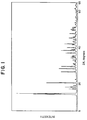
- Figures 1 and 2 are each an X-ray diffraction diagram of the yttrium ammonium double oxalate particles of the stable type and metastable type, respectively, prepared in the Examples.
- the present invention it is essential in order to obtain polyhedral particles of a rare earth oxide to first prepare polyhedral particles of a rare earth ammonium double oxalate with stability and in good efficiency, according to the findings obtained by the inventors, by satisfying several requirements 1) that certain relationships are held among the amounts of the rare earth ions, oxalate ions, ammonium ions and hydrogen ions in the reaction mixture including the amounts contained in the liquid phase and the amounts already fixed in the precipitates of the respective ionic species so that it is ensured that the precipitates entirely are in the form of the rare earth ammonium double oxalate, 2) that a certain length of time must be taken for the complete conversion of the double oxalate particles, which are in the form of relatively fine flaky particles in the early stage of the precipitation, into polyhedral particles as a result of an aging effect, and 3) that the conversion of the precipitates into polyhedral particles during the aging process is accelerated by keeping the aqueous medium in an acidic condition.
- the most characteristic advantage obtained according to the inventive method consists in that a reproducible method is provided for the preparation of particles of a rare earth ammonium double oxalate having good flowability and a narrow particle size distribution, of which the particles have a polyhedral particle configuration or, namely, a configuration of a rectangular parallelepiped close to a cube, from which polyhedral particles of a rare earth oxide having good flowability and a narrow particle size distribution can be obtained by calcination.
- a first aqueous solution is prepared by dissolving ammonium oxalate or two or three selected from ammonium oxalate, oxalic acid and ammonia in water.
- a second aqueous solution is prepared by dissolving a water-soluble salt, such as chloride and nitrate, of a rare earth element in water. If necessary, an acid other than oxalic acid is added to either one or both of the first and second aqueous solutions.
- the requirement given by the first inequality (I) is that the molar amount of the oxalate ions C2O42 ⁇ provided by the oxalic acid and/or ammonium oxalate in the first aqueous solution or, namely, the oxalate ions contained in the liquid phase and already fixed in the solid precipitates as combined after the precipitation reaction must be at least twice of that of the rare earth ions R3+ in the second aqueous solution.
- this requirement of the inequality (I) is not satisfied, complete conversion of the precipitates into the rare earth ammonium double oxalate can hardly be accomplished.
- the excess of a+b over 2d should not be unduly large and it is sufficient to have a value of a+b in a slight excess over 2d since an overly increase of a+b over 2d has no particular additional advantages.
- the requirement given by the second inequality (II) is that the hydrogen ion concentration in the aqueous medium after mixing of the first and second aqueous solutions is at least 0.01 mole/liter.
- the requirement given by the third inequality (III) is that the amount of the ammonium ions in the first aqueous solution must be at least twice of that of the rare earth ions in the second aqueous solution. This condition is essential in order for the precipitates to be completely converted into the rare earth ammonium double oxalate.
- the requirement given by the fourth inequality (IV) is that the amount of the ammonium ions provided by the first aqueous solution must be equal to or larger than the amount of the hydrogen ions in the aqueous medium after mixing the first and second aqueous solutions.
- a disadvantage is caused that a part of the rare earth ions is precipitated in the form of a rare earth oxalate R2(C2O4)3 ⁇ nH2O or the rare earth ammonium double oxalate once precipitated in the aqueous medium is partly decomposed into the rare earth oxalate in the course of the aging treatment.
- the first and second aqueous solution can be performed by introducing the first solution into the second solution or vice versa to give approximately identical results.
- the length of time taken for completion of mixing of the solutions is not particularly limitative in principle although the time preferably should not exceed 1 hour from the standpoint of controlling the particle diameter of the precipitates.
- the temperature of the aqueous solutions to be admixed can be room temperature or higher. It is preferable that each of the first and second aqueous solutions is kept at a temperature at or about the same temperature as the temperature of the subsequent aging treatment of the aqueous slurry because the reaction mixture after mixing of the solutions can be rapidly brought to the aging temperature.
- the precipitates are subjected to aging by keeping the reaction mixture under agitation at a temperature in the range from 30 to 80 °C. Proceeding of aging can be examined microscopically by using an optical microscope for a drop of the slurry periodically taken from the reaction mixture and put on a slide glass plate. While the particles of the double oxalate as precipitated have a fine particle diameter and the particle configuration thereof is irregular or flaky, the particle configuration is gradually changed into a polyhedral form as the aging proceeds to be entirely polyhedral after a sufficiently long time of aging.
- the yttrium ammonium double oxalate particles in the stage after complete conversion into polyhedral particle configuration have a crystallographic structure identified to be NH4R(C2O4)2 ⁇ H2O, referred to hereinafter as the stable type double oxalate, by making reference to the literature data appearing in Journal of Inorganic and Nuclear Chemistry, volume 26, pages 931 to 936(1964).
- the crystallographic structure of the oxalate particles as precipitated or still under the aging procedure containing irregular or flaky particles referred to hereinafter as the metastable type double oxalate
- the metastable type double oxalate is different from that of the stable type double oxalate as is shown in the X-ray diffraction diagram of Figure 2 which was taken for the yttrium ammonium double oxalate particles immediately after precipitation at 40 °C.
- the X-ray diffraction diagram shown in Figure 2 contains a number of sharp peaks not found in the diagram of Figure 1 or in the above mentioned literature data.
- the diffraction peaks characteristic in the metastable type of the double oxalate are also found in the X-ray distraction diagrams of the particles obtained from the slurry still under the procedure of aging.
- the above described results suggest that the changes in the morphology and the crystallographic structure of the double oxalate particles are closely correlated to each other.
- the conversion time is decreased as the temperature of the reaction mixture is increased assuming that the other conditions are identical.
- the ultimate particle diameter of the precipitated double oxalate is increased as the acidity of the aqueous medium or the hydrogen ion concentration therein is increased.
- the temperature of the reaction mixture is brought to the temperature of aging as quickly as possible by external heating or cooling or by the addition of a volume of water at a higher or lower temperature although such a temperature-controlling means has no particular effect if undertaken after conversion of a substantial portion of the particles from the metastable type to the stable type which rapidly takes place when the precipitation reaction is performed at a relatively high temperature.
- the ultimate particle size of the precipitates after complete conversion is smaller when the aging temperature is higher assuming identical conditions of the composition of the reaction mixture. It is essential in the method of the present invention that the aging treatment of the aqueous slurry is performed under agitation until complete conversion of the metastable type into the stable type of the rare earth ammonium double oxalate in order to obtain high uniformity in the particle configuration and a narrow particle size distribution of the double oxalate product which naturally reflect on the particle properties of the rare earth oxide to be obtained by the calcination of the double oxalate. As a measure, the conversion time is given by the inequalities (V) given before.
- the polyhedral particles of the rare earth ammonium double oxalate obtained by undertaking the above described precipitation reaction and aging treatment are separated from the aqueous medium by a known method of solid-liquid separation such as filtration and washed with water to be freed from any impurities dissolved in the aqueous medium.
- the polyhedral particles of the rare earth ammonium double oxalate thus obtained are dried and calcined in air at a temperature of 600 °C or higher, for example, in an electric furnace so that a rare earth oxide powder consisting predominantly of polyhedral particles having a narrow particle size distribution is obtained.
- a first aqueous solution was prepared in a 3-liter beaker by dissolving 0.76 mole of oxalic acid and ammonia water in an amount of 1.44 moles as the ammonium ions in water followed by the addition of an additional volume of water to make up a volume of 1400 ml.
- the solution was kept at a temperature of 37 °C.
- a second aqueous solution was prepared in a 1-liter beaker by dissolving 0.36 mole of yttrium nitrate and 0.72 mole of nitric acid in water followed by the addition of an additional volume of water to make up a volume of 600 ml so that the concentration of the yttrium ions in the solution was 0.60 mole/liter.
- This second aqueous solution was kept also at a temperature of 37 °C.
- the second aqueous solution was introduced into the 3-liter beaker dropwise taking about 5 minutes to effect the precipitation reaction giving an aqueous slurry at a temperature of 37 °C.
- the aqueous slurry was further agitated at a temperature of 37 °C with a possible deviation of ⁇ 1 °C to effect aging of the precipitated particles for 15 hours and the particles were collected by filtration and washed with 2000 ml of water followed by drying to give a powder of yttrium ammonium double oxalate consisting of polyhedral particles.
- the yttrium ammonium double oxalate powder was transferred into a porcelain crucible and calcined in an electric furnace at 900 °C for 1 hour in air to give a yttrium oxide powder consisting of polyhedral particles in a yield of at least 99%.
- the yttrium oxide powder thus obtained was subjected to the laser diffractometric determination of the particle size distribution for the values of ⁇ 50 in ⁇ m and ⁇ /m and measurement of the average particle diameter in ⁇ m by using a Fischer Subsieve-Sizer to give the results shown in Table 1 below.
- the above mentioned parameter ⁇ 50 or, generally, ⁇ n obtained by the laser diffractometric method is defined as follows.
- ⁇ n is given by the particle diameter when n% by volume of the whole particle volume is occupied by the particles having a particle diameter of ⁇ ⁇ m or smaller.
- X ⁇ m of the ⁇ 50 parameter means that 50% by volume of the whole particles is occupied by the particles having a diameter of X ⁇ m or smaller.
- the parameter ⁇ /m is correlated to the particle size distribution, in which ⁇ is the standard deviation of the distribution and m is the average particle diameter.
- the experimental procedure was substantially the same as in Example 1 except that the first and second aqueous solutions were kept each at a temperature of 45 °C and the temperature of the reaction mixture after completion of mixing of the solutions was brought to 47 °C at which the aging treatment of the aqueous slurry was continued for 2.7 hours before filtration to collect the precipitates.
- the conversion from the metastable type to the stable type of the double oxalate particles was still incomplete but already complete at moments 2.0 hours and 2.5 hours, respectively, after completion of mixing of the aqueous solutions.
- the experimental procedure was substantially the same as in Example 1 except that the first aqueous solution was prepared from 0.04 mole of oxalic acid and 0.72 mole of ammonium oxalate instead of 0.76 mole of oxalic acid and 1.44 moles of ammonia and the first and second aqueous solutions were kept each at a temperature of 60 °C and the temperature of the reaction mixture after completion of mixing of the solutions was brought to 59 °C at which the aging treatment of the aqueous slurry was continued for 0.6 hour before filtration to collect the precipitates.
- the conversion from the metastable type to the stable type of the double oxalate particles was still incomplete but already complete at moments 0.3 hour and 0.5 hour, respectively, after completion of mixing of the aqueous solutions.
- the experimental procedure was substantially the same as in Example 1 except that the first aqueous solution was prepared from 0.76 mole of ammonium oxalate and 0.46 mole of ammonia instead of 0.76 mole of oxalic acid and 1.44 moles of ammonia, the yttrium nitrate and nitric acid for the second aqueous solution were replaced each with the same molar amount of yttrium chloride and hydrochloric acid, respectively, and the temperatures of the first and second aqueous solutions were 55 °C and 60 °C, respectively, so that the reaction mixture after completion of mixing of the solutions had a temperature of 59 °C at which the aging treatment of the aqueous slurry was continued for 3.8 hours before filtration to collect the precipitates.
- the conversion from the metastable type to the stable type of the double oxalate particles was still incomplete but already complete at moments 3.0 hours and 3.5 hours, respectively, after completion of mixing of the aqueous solutions.
- the experimental procedure was substantially the same as in Example 1 except that the amount of the nitric acid for the second aqueous solution was 0.36 mole instead of 0.72 mole and the temperature of each of the first and second aqueous solutions was 58 °C so that the reaction mixture after completion of mixing of the solutions had a temperature of 58 °C at which the aging treatment of the aqueous slurry was continued for 2.0 hours before filtration to collect the precipitates.
- the conversion from the metastable type to the stable type of the double oxalate particles was still incomplete but already complete at moments 1.5 hours and 2.0 hours, respectively, after completion of mixing of the aqueous solutions.
- the experimental procedure was substantially the same as in Example 5 except that the amount of the ammonia for the first aqueous solution was 1.08 moles instead of 1.44 moles and the temperatures of the first and second aqueous solutions were 39 °C and 36 °C , respectively, so that the reaction mixture after completion of mixing of the solutions had a temperature of 37 °C at which the aging treatment of the aqueous slurry was continued for 8.5 hours before filtration to collect the precipitates.
- the conversion from the metastable type to the stable type of the double oxalate particles was still incomplete but already complete at moments 6.0 hours and 8.0 hours, respectively, after completion of mixing of the aqueous solutions.
- the experimental procedure was substantially the same as in Example 1 except that the amount of the ammonia for the first aqueous solution was 1.06 moles instead of 1.44 moles, the second aqueous solution was prepared from the same molar amount of yttrium chloride instead of yttrium nitrate and 0.12 mole of hydrochloric acid instead of 0.72 mole of nitric acid and the temperatures of the first and second aqueous solutions were 45 °C and 48 °C, respectively, so that the reaction mixture after completion of mixing of the solutions had a temperature of 47 °C at which the aging treatment of the aqueous slurry was continued for 8.0 hours before filtration to collect the precipitates.
- the conversion from the metastable type to the stable type of the double oxalate particles was still incomplete but already complete at moments 5.5 hours and 7.0 hours, respectively, after completion of mixing of the aqueous solutions.
- the experimental procedure was substantially the same as in Example 1 except that the amount of the ammonia for the first aqueous solution was 0.84 mole instead of 1.44 moles, the amount of the nitric acid for the second aqueous solution was 0.12 mole instead of 0.72 mole and the temperature of each of the first and second aqueous solutions was 50 °C so that the reaction mixture after completion of mixing of the solutions had a temperature of 48 °C at which the aging treatment of the aqueous slurry was continued for 2.2 hours before filtration to collect the precipitates.
- the conversion from the metastable type to the stable type of the double oxalate particles was still incomplete but already complete at moments 1.5 hours and 2.0 hours, respectively, after completion of mixing of the aqueous solutions.
- the experimental procedure was substantially the same as in Example 1 except that the first aqueous solution was prepared from 0.06 mole of oxalic acid and 0.70 mole of ammonium oxalate instead of 0.76 mole of oxalic acid and 1.44 moles of ammonia, nitric acid was not added to the second aqueous solution and the temperature of each of the first and second aqueous solutions was 60 °C so that the reaction mixture after completion of mixing of the solutions had a temperature of 60 °C at which the aging treatment of the aqueous slurry was continued for 6.0 hours before filtration to collect the precipitates.
- the conversion from the metastable type to the stable type of the double oxalate particles was still incomplete but already complete at moments 5.0 hours and 6.0 hours, respectively, after completion of mixing of the aqueous solutions.
- the experimental procedure was substantially the same as in Example 1 except that the yttrium nitrate was replaced with the same molar amount of gadolinium nitrate and the temperatures of each of the first and second aqueous solutions were 45 °C and 46 °C , respectively, so that the reaction mixture after completion of mixing of the solutions had a temperature of 46 °C at which the aging treatment of the aqueous slurry was continued for 4.2 hours before filtration to collect the precipitates.
- the conversion from the metastable type to the stable type of the double oxalate particles was still incomplete but already complete at moments 3.3 hours and 4.0 hours, respectively, after completion of mixing of the aqueous solutions.
- the experimental procedure was substantially the same as in Example 1 except that the yttrium nitrate and nitric acid were replaced each with the same molar amount of yttrium chloride and hydrochloric acid, respectively, and the temperature of each of the first and second aqueous solutions was 35 °C followed by increase of the temperature of the reaction mixture after completion of mixing of the solutions 38 °C at which the aging treatment of the aqueous slurry was continued for 6.2 hours, when conversion of the metastable type to the stable type of the double oxalate particles was still incomplete, before filtration to collect the precipitates.
- the experimental procedure was substantially the same as in Example 2 except that the aqueous slurry of the double oxalate precipitates was filtered after 0.1 hour of aging, when conversion of the metastable type to the stable type of the double oxalate particles had little proceeded, to collect the precipitates.
- the experimental procedure was substantially the same as in Example 1 except that the first aqueous solution was prepared from 0.24 mole of oxalic acid and 0.52 mole of ammonium oxalate instead of 0.76 mole of oxalic acid and 1.44 moles of ammonia, the temperatures of the first and second aqueous solutions were 42 °C and 41 °C, respectively, so that the temperature of the reaction mixture after completion of mixing of the solutions was 41 °C and the aqueous slurry of the double oxalate precipitates was filtered after 4.0 hours of aging at 40 °C, when the double oxalate precipitates consisted mainly of rod-like particles, to collect the precipitates.
- the experimental procedure was substantially the same as in Example 1 except that the first aqueous solution was prepared from 0.04 mole of oxalic acid and 0.72 mole of ammonium oxalate instead of 0.76 mole of oxalic acid and 1.44 moles of ammonia, the amount of nitric acid added to the second aqueous solution was 1.41 moles instead of 0.72 mole, the temperature of each of the first and second aqueous solutions was 40 °C so that the temperature of the reaction mixture after completion of mixing of the solutions was 40 °C and the aqueous slurry of the double oxalate precipitates was filtered after 5.0 hours of aging at 40 °C.
- the double oxalate particles after 4.0 hours of aging mainly had a rod-like configuration and the X-ray diffraction diagram contained diffraction peaks which could be identified to belong to yttrium oxalate of the formula Y2(C2O4)3 ⁇ 9H2O.
- the experimental procedure was substantially the same as in Example 1 except that the amount of the ammonia for the first aqueous solution was 0.66 mole instead of 1.44 moles, the second aqueous solution was prepared from the same molar amount of yttrium chloride and 0.06 mole of hydrochloric acid instead of 0.72 mole of nitric acid, the temperatures of the first and second aqueous solutions were 39 °C and 41 °C, respectively, so that the temperature of the reaction mixture after completion of mixing of the solutions was 40 °C at which aging of the aqueous slurry of the double oxalate precipitates was performed for 4.5 hours before filtration of the aqueous slurry.
- the double oxalate particles after 4.0 hours of aging mainly had a rod-like configuration.
- the experimental procedure was substantially the same as in Example 1 except that the first aqueous solution was prepared from 0.76 mole of ammonium oxalate and 0.72 mole of ammonia instead of 0.76 mole of oxalic acid and 1.44 moles of ammonia, the temperatures of the first and second aqueous solutions were 54 °C and 49 °C, respectively, and the temperature of the reaction mixture after completion of mixing of the solutions was brought to 60 °C at which aging of the aqueous slurry of the double oxalate precipitates was performed for 6 hours before filtration of the aqueous slurry.
- the double oxalate particles after 5.5 hours of aging mainly had a fine and flaky particle configuration.
- Table 1 ⁇ 50, ⁇ m ⁇ /m Particle diameter, ⁇ m
- Example 1 7.66 0.32 2.60 2 4.68 0.31 1.60 3 3.58 0.28 1.15 4 2.54 0.27 0.90 5 2.45 0.27 0.85 6 7.10 0.33 2.45 7 4.34 0.31 1.30 8 5.29 0.32 1.70 9 2.15 0.24 0.95 10 4.50 0.34 1.50
- Comparative Example 1 6.07 0.58 1.45 2 3.48 0.54 1.00 3 8.86 0.42 1.65 4 9.22 0.44 1.75 5 9.03 0.44 1.70 6 3.36 0.48 0.95
Landscapes
- Chemical & Material Sciences (AREA)
- Organic Chemistry (AREA)
- Engineering & Computer Science (AREA)
- Oil, Petroleum & Natural Gas (AREA)
- Compounds Of Alkaline-Earth Elements, Aluminum Or Rare-Earth Metals (AREA)
Applications Claiming Priority (3)
| Application Number | Priority Date | Filing Date | Title |
|---|---|---|---|
| JP10374794 | 1994-05-18 | ||
| JP103747/94 | 1994-05-18 | ||
| JP6103747A JPH07309623A (ja) | 1994-05-18 | 1994-05-18 | 角状希土類元素蓚酸アンモニウム複塩および角状希土類元素酸化物の製造方法 |
Publications (2)
| Publication Number | Publication Date |
|---|---|
| EP0683151A1 true EP0683151A1 (de) | 1995-11-22 |
| EP0683151B1 EP0683151B1 (de) | 1999-09-08 |
Family
ID=14362184
Family Applications (1)
| Application Number | Title | Priority Date | Filing Date |
|---|---|---|---|
| EP95106613A Expired - Lifetime EP0683151B1 (de) | 1994-05-18 | 1995-05-03 | Verfahren zur Herstellung von vielflächigen Teilchen eines Seltenerd-Ammoniumdoppeloxalates |
Country Status (4)
| Country | Link |
|---|---|
| US (1) | US5644037A (de) |
| EP (1) | EP0683151B1 (de) |
| JP (1) | JPH07309623A (de) |
| DE (1) | DE69511934T2 (de) |
Families Citing this family (3)
| Publication number | Priority date | Publication date | Assignee | Title |
|---|---|---|---|---|
| US5985356A (en) * | 1994-10-18 | 1999-11-16 | The Regents Of The University Of California | Combinatorial synthesis of novel materials |
| US6596397B2 (en) * | 2001-04-06 | 2003-07-22 | Shin-Etsu Chemical Co., Ltd. | Thermal spray particles and sprayed components |
| CN102502760B (zh) * | 2011-10-28 | 2014-12-03 | 内蒙古科技大学 | 制备大颗粒、片状氧化镨钕的方法 |
Citations (3)
| Publication number | Priority date | Publication date | Assignee | Title |
|---|---|---|---|---|
| GB2018760A (en) * | 1978-04-14 | 1979-10-24 | Sjeldne Jordarter Forskning | Method tor producing yttrium oxide particularly in large particles |
| EP0455529A1 (de) * | 1990-05-04 | 1991-11-06 | Rhone-Poulenc Chimie | Verfahren zur Herstellung von Doppeloxalaten der seltenen Erden und Ammonium und ihre Verwendung zur Herstellung von Oxiden der seltenen Erden, Doppeloxalate und die erhaltene Oxide |
| EP0486351A1 (de) * | 1990-11-13 | 1992-05-20 | Rhone-Poulenc Chimie | Verfahren zur Herstellung von gemischten Oxalaten von Ammonium und seltenen Erden und deren Anwendung zur Herstellung von Oxyden der seltenen Erden |
Family Cites Families (2)
| Publication number | Priority date | Publication date | Assignee | Title |
|---|---|---|---|---|
| JPH0710730B2 (ja) * | 1990-11-22 | 1995-02-08 | 信越化学工業株式会社 | 希土類元素酸化物の製造方法 |
| US5382452A (en) * | 1992-12-18 | 1995-01-17 | E. I. Du Pont De Nemours And Company | Luminescent materials prepared by coating luminescent compositions onto substrate particles |
-
1994
- 1994-05-18 JP JP6103747A patent/JPH07309623A/ja active Pending
-
1995
- 1995-05-02 US US08/433,925 patent/US5644037A/en not_active Expired - Lifetime
- 1995-05-03 EP EP95106613A patent/EP0683151B1/de not_active Expired - Lifetime
- 1995-05-03 DE DE69511934T patent/DE69511934T2/de not_active Expired - Lifetime
Patent Citations (3)
| Publication number | Priority date | Publication date | Assignee | Title |
|---|---|---|---|---|
| GB2018760A (en) * | 1978-04-14 | 1979-10-24 | Sjeldne Jordarter Forskning | Method tor producing yttrium oxide particularly in large particles |
| EP0455529A1 (de) * | 1990-05-04 | 1991-11-06 | Rhone-Poulenc Chimie | Verfahren zur Herstellung von Doppeloxalaten der seltenen Erden und Ammonium und ihre Verwendung zur Herstellung von Oxiden der seltenen Erden, Doppeloxalate und die erhaltene Oxide |
| EP0486351A1 (de) * | 1990-11-13 | 1992-05-20 | Rhone-Poulenc Chimie | Verfahren zur Herstellung von gemischten Oxalaten von Ammonium und seltenen Erden und deren Anwendung zur Herstellung von Oxyden der seltenen Erden |
Non-Patent Citations (1)
| Title |
|---|
| BARRETT ET AL, JOURNAL OF INORGANIC AND NUCLEAR CHEMISTRY, vol. 26, no. 6, pages 931 - 936 * |
Also Published As
| Publication number | Publication date |
|---|---|
| JPH07309623A (ja) | 1995-11-28 |
| DE69511934T2 (de) | 2000-05-18 |
| US5644037A (en) | 1997-07-01 |
| EP0683151B1 (de) | 1999-09-08 |
| DE69511934D1 (de) | 1999-10-14 |
Similar Documents
| Publication | Publication Date | Title |
|---|---|---|
| DE69409497T2 (de) | Verbundpulver aus metalloxid und verfahren zur herstellung desselben | |
| KR950003421B1 (ko) | 암모늄 희토류 이중 옥살레이트의 제조방법 및 그것의 희토류 산화물의 제조에 관한 용도 | |
| RU2687730C1 (ru) | Ионопроводящий оксид со структурой граната и способ получения спеченного тела оксидного электролита | |
| EP0353926B1 (de) | Verfahren zur Herstellung von feinen Teilchen aus Yttrium-Aluminium-Granat und aus Phosphor enthaltendem Yttrium-Aluminium-Granat | |
| EP0212935A2 (de) | Barium- und Strontiumtitanate und Verfahren zu deren Herstellung | |
| US5783165A (en) | Method of making barium titanate | |
| US4350559A (en) | Process for the manufacture of polycrystalline garnet and corresponding monocrystal | |
| US5332558A (en) | Rare earth oxide powder and method for the preparation thereof | |
| Huizing et al. | Hydrates of manganese (II) oxalate | |
| US4339511A (en) | Preparation of powders suitable for conversion to useful β-aluminas | |
| EP0683151A1 (de) | Verfahren zur Herstellung von vielflächigen Teilchen eines Seltenerd-Ammoniumdoppeloxalates | |
| EP0187383B1 (de) | Verfahren zur Herstellung von feinen Wismuttitanatpulvern | |
| JP3250243B2 (ja) | ジルコニア系ゾルの製造方法 | |
| JPH06305726A (ja) | 希土類元素酸化物粉末の製造方法 | |
| JP2673161B2 (ja) | イットリウムアルミニウムガーネットの製造方法 | |
| JP2001270775A (ja) | Yag透明焼結体の製造法 | |
| JPH05262518A (ja) | 蓚酸稀土類アンモニウム複塩の製造方法及びそれらの稀土類酸化物製造への利用、及び得られた稀土類酸化物 | |
| JP2005247673A (ja) | Dyドープナノセリア系焼結体およびその製造方法 | |
| EP0163739B1 (de) | VERFAHREN ZUR HERSTELLUNG FEINER TEILCHEN EINER BA (ZRX TI 1-X)O3-FESTEN LöSUNG | |
| US20020025294A1 (en) | Production of cationically-homogeneous nanostructured refractory oxides at reduced temperatures | |
| US4889706A (en) | Method of manufacturing fine powder of lead stannate | |
| JP2655014B2 (ja) | 希土類元素−アンモニウム複合蓚酸塩の製造方法及び得られる複合蓚酸塩 | |
| JPH11278935A (ja) | 新規な酸化イットリウムの焼結体及びその製造方法 | |
| JPH0388719A (ja) | シュウ酸チタニルバリウム粒子の製造方法 | |
| STENGER et al. | Pb (SC1/2Nb1/2) Os and Pb (SC1/2Ta1/2) 03 |
Legal Events
| Date | Code | Title | Description |
|---|---|---|---|
| PUAI | Public reference made under article 153(3) epc to a published international application that has entered the european phase |
Free format text: ORIGINAL CODE: 0009012 |
|
| AK | Designated contracting states |
Kind code of ref document: A1 Designated state(s): DE FR GB |
|
| 17P | Request for examination filed |
Effective date: 19960515 |
|
| 17Q | First examination report despatched |
Effective date: 19970502 |
|
| GRAG | Despatch of communication of intention to grant |
Free format text: ORIGINAL CODE: EPIDOS AGRA |
|
| GRAG | Despatch of communication of intention to grant |
Free format text: ORIGINAL CODE: EPIDOS AGRA |
|
| GRAH | Despatch of communication of intention to grant a patent |
Free format text: ORIGINAL CODE: EPIDOS IGRA |
|
| GRAH | Despatch of communication of intention to grant a patent |
Free format text: ORIGINAL CODE: EPIDOS IGRA |
|
| GRAA | (expected) grant |
Free format text: ORIGINAL CODE: 0009210 |
|
| AK | Designated contracting states |
Kind code of ref document: B1 Designated state(s): DE FR GB |
|
| REF | Corresponds to: |
Ref document number: 69511934 Country of ref document: DE Date of ref document: 19991014 |
|
| ET | Fr: translation filed | ||
| PLBE | No opposition filed within time limit |
Free format text: ORIGINAL CODE: 0009261 |
|
| STAA | Information on the status of an ep patent application or granted ep patent |
Free format text: STATUS: NO OPPOSITION FILED WITHIN TIME LIMIT |
|
| 26N | No opposition filed | ||
| PGFP | Annual fee paid to national office [announced via postgrant information from national office to epo] |
Ref country code: FR Payment date: 20010518 Year of fee payment: 7 |
|
| REG | Reference to a national code |
Ref country code: GB Ref legal event code: IF02 |
|
| PG25 | Lapsed in a contracting state [announced via postgrant information from national office to epo] |
Ref country code: FR Free format text: LAPSE BECAUSE OF NON-PAYMENT OF DUE FEES Effective date: 20030131 |
|
| REG | Reference to a national code |
Ref country code: FR Ref legal event code: ST |
|
| PGFP | Annual fee paid to national office [announced via postgrant information from national office to epo] |
Ref country code: GB Payment date: 20120502 Year of fee payment: 18 |
|
| PGFP | Annual fee paid to national office [announced via postgrant information from national office to epo] |
Ref country code: DE Payment date: 20130515 Year of fee payment: 19 |
|
| GBPC | Gb: european patent ceased through non-payment of renewal fee |
Effective date: 20130503 |
|
| PG25 | Lapsed in a contracting state [announced via postgrant information from national office to epo] |
Ref country code: GB Free format text: LAPSE BECAUSE OF NON-PAYMENT OF DUE FEES Effective date: 20130503 |
|
| REG | Reference to a national code |
Ref country code: DE Ref legal event code: R119 Ref document number: 69511934 Country of ref document: DE |
|
| REG | Reference to a national code |
Ref country code: DE Ref legal event code: R119 Ref document number: 69511934 Country of ref document: DE Effective date: 20141202 |
|
| PG25 | Lapsed in a contracting state [announced via postgrant information from national office to epo] |
Ref country code: DE Free format text: LAPSE BECAUSE OF NON-PAYMENT OF DUE FEES Effective date: 20141202 |