EP0683218A2 - Procédé de conversion d'une huile résiduelle hydrocarbonée - Google Patents
Procédé de conversion d'une huile résiduelle hydrocarbonée Download PDFInfo
- Publication number
- EP0683218A2 EP0683218A2 EP95201314A EP95201314A EP0683218A2 EP 0683218 A2 EP0683218 A2 EP 0683218A2 EP 95201314 A EP95201314 A EP 95201314A EP 95201314 A EP95201314 A EP 95201314A EP 0683218 A2 EP0683218 A2 EP 0683218A2
- Authority
- EP
- European Patent Office
- Prior art keywords
- dao
- hydrocracking
- hydrocarbon oil
- process according
- fraction
- Prior art date
- Legal status (The legal status is an assumption and is not a legal conclusion. Google has not performed a legal analysis and makes no representation as to the accuracy of the status listed.)
- Granted
Links
Images

Classifications
-
- C—CHEMISTRY; METALLURGY
- C10—PETROLEUM, GAS OR COKE INDUSTRIES; TECHNICAL GASES CONTAINING CARBON MONOXIDE; FUELS; LUBRICANTS; PEAT
- C10G—CRACKING HYDROCARBON OILS; PRODUCTION OF LIQUID HYDROCARBON MIXTURES, e.g. BY DESTRUCTIVE HYDROGENATION, OLIGOMERISATION, POLYMERISATION; RECOVERY OF HYDROCARBON OILS FROM OIL-SHALE, OIL-SAND, OR GASES; REFINING MIXTURES MAINLY CONSISTING OF HYDROCARBONS; REFORMING OF NAPHTHA; MINERAL WAXES
- C10G67/00—Treatment of hydrocarbon oils by at least one hydrotreatment process and at least one process for refining in the absence of hydrogen only
- C10G67/02—Treatment of hydrocarbon oils by at least one hydrotreatment process and at least one process for refining in the absence of hydrogen only plural serial stages only
- C10G67/04—Treatment of hydrocarbon oils by at least one hydrotreatment process and at least one process for refining in the absence of hydrogen only plural serial stages only including solvent extraction as the refining step in the absence of hydrogen
- C10G67/0454—Solvent desasphalting
Definitions
- the present invention relates to a process for the conversion of a residual hydrocarbon oil. More specifically, the present invention relates to a process for the conversion of a residual hydrocarbon oil involving the hydrocracking of upgraded deasphalted oil.
- residual hydrocarbon oils such as those obtained in the distillation of crude oils at atmospheric or reduced pressure, contain considerable amounts of non-distillable compounds having a high molecular weight.
- specific examples of such compounds are asphaltenes and metal compounds, in particular vanadium and nickel compounds.
- demetallisation catalysts are known. They usually consist of oxidic carriers such as alumina, silica or silica-alumina, on which one or more metals or metal compounds having hydrogenation activity are optionally deposited. Metals from Groups VIB and VIII of the Periodic Table of Elements are widely known to be suitable for this purpose. Examples of suitable demetallisation catalysts are disclosed in inter alia U.S. Patents Nos.
- U.S. Patent No. 4,564,439 discloses a two-stage catalytic hydroconversion process, wherein a heavy hydrocarbonaceous feedstock containing more than 100 parts per million by weight (ppmw) of metallic contaminants is first hydrodemetallised and then hydrocracked. Hydrodemetallisation is carried out by mixing the heavy hydrocarbonaceous feedstock, which might be a deasphalted tar or oil, with up to 10% by weight based on feedstock of solid particles which have sufficient catalytic activity to suppress the adverse coke formation and which induce substantial demetallisation. The resulting slurry, suitably in the form of a dispersion, is subsequently introduced into a first-stage hydrothermal zone, wherein hydrogen is introduced as well.
- ppmw parts per million by weight
- the reactant mixture is heated and as a result, demetallisation as well as conversion of hydrocarbons having a boiling point above 1000 °F (538 °C) into lower boiling hydrocarbons occurs.
- the effluent is then, without substantial reduction of pressure, rapidly passed through a cooling zone into a second-stage hydrocatalytic reaction zone, where hydrogenation and cracking occurs.
- a major disadvantage of the process according to U.S. Patent No. 4,564,439 is the fact that the contaminated solid particles resulting from the first stage of the process are passed into the hydrocatalytic reaction zone together with the demetallised feedstock. This will usually cause a more rapid and highly unwanted decrease of the activity of the hydrocracking catalyst. Moreover, in said U.S. patent a clear preference for heavy hydrocarbonaceous feedstocks containing very high amounts of metallic contaminants is expressed. Since a deasphalting treatment generally causes a substantial amount of the metallic contaminants present in the feed as high-molecular weight complexes to accumulate in the asphaltic bitumen fraction rather than in the deasphalted oil fraction, the metals content of a deasphalted oil is usually lower than 100 ppmw.
- the present invention relates to a process for the conversion of a residual hydrocarbon oil, preferably a vacuum hydrocarbon oil residue, comprising the following steps:
- the residual hydrocarbon oil feed and the flashed distillate fraction(s) used in step (c) may originate from different sources and may be supplied as separate feedstocks. It is, however, preferred that said residual hydrocarbon oil and said flashed distillate fraction(s) used in step (c) are both produced in a vacuum distillation step prior to step (a). Accordingly, in a preferred embodiment of the present invention a hydrocarbon oil, suitably an atmospheric residue, is converted via the subsequent steps of:
- Vacuum distillation can be carried out by any conventional technique known in the art. Suitable techniques then, include high vacuum distillation using steam ejectors and vacuum flash distillation.
- the deasphalting of the heavy residual fraction obtained from the vacuum distillation may be carried out in any conventional manner.
- a well known and suitable deasphalting method is solvent deasphalting, wherein the hydrocarbon feed is treated counter-currently with an extracting medium which is usually a light hydrocarbon solvent containing paraffinic compounds.
- Commonly applied paraffinic compounds include C3 ⁇ 8 paraffinic hydrocarbons, such as propane, butane, isobutane, pentane, isopentane, hexane or mixtures of two or more of these.
- C3-C5 paraffinic hydrocarbons most preferably butane, pentane or a mixture thereof, are used as the extracting solvent.
- the extraction depth increases at increasing number of carbon atoms of the extracting solvent.
- the higher the extraction depth the larger the amount of hydrocarbons being extracted from the hydrocarbon feed, the smaller and more viscous the asphaltene fraction and the heavier the asphaltenes being present in said asphaltene fraction.
- a rotating disc contactor or a plate column can be used with the hydrocarbon feed entering at the top and the extracting solvent entering at the bottom.
- the lighter hydrocarbons which are present in the residual hydrocarbon oil dissolve in the extracting solvent and are withdrawn at the top of the apparatus.
- the asphaltenes which are insoluble in the extracting solvent are withdrawn at the bottom of the apparatus.
- deasphalting is carried out at a total extracting solvent to residual hydrocarbon oil ratio of 1.5 to 8 wt/wt, a pressure of from 1 to 50 bar and a temperature of from 160 to 230 °C.
- Demetallisation of the DAO in accordance with step (b) of the process according to the present invention can be achieved by any well known demetallisation process wherein the hydrocarbon feed to be demetallised is passed at elevated temperature and pressure and in the presence of hydrogen in an upward, downward or radial direction, through one or more vertically disposed reactors containing a fixed or moving bed of demetallisation catalyst particles.
- Well known demetallisation operations are the bunker flow operation, the fixed bed operation, the fixed bed swing operation and the movable bed operation.
- suitable demetallisation catalyst usually consist of oxidic carriers such as alumina, silica or silica-alumina, on which one or more Group VIB or Group VIII metals or metal compounds may be deposited.
- oxidic carriers such as alumina, silica or silica-alumina, on which one or more Group VIB or Group VIII metals or metal compounds may be deposited.
- Such demetallisation catalysts are commercially available from many catalyst suppliers.
- Particularly suitable demetallisation catalysts are those having as the active agent one of the combinations nickel/molybdenum (NiMo) or cobalt/molybdenum (CoMo), optionally promoted with phosphorus (P), on an alumina (Al2O3) carrier.
- catalysts are CoMo/Al2O3, CoMoP/Al2O3 and NiMo/Al2O3 and NiMoP/Al2O3 catalysts. It is well known that the type of catalysts described hereinbefore in practice will also exhibit some upgrading activity in terms of hydrodenitrification and/or hydrodesulphurization, removal of heavy hydrocarbons and conversion of hydrocarbons having a boiling point above 520 °C into lower boiling components. For this reason the DAO leaving the hydrodemetallisation zone is referred to as "upgraded DAO" instead of demetallised DAO.
- Hydrodemetallisation is usually carried out at a hydrogen partial pressure of 20-250 bar, a temperature of 300-470 °C, preferably 310-440 °C, and a space velocity of 0.1-10 l.l ⁇ 1hr ⁇ 1, preferably 0.2 to 7 l.l ⁇ 1hr ⁇ 1.
- the blending ratio of the upgraded DAO and the flashed distillate fractions is not particularly critical and is mainly determined by factors such as hydrocracking catalyst choice, viscosity specification of the hydrocracking equipment and desired product distribution in the hydrocarbon effluent.
- the weight ratio flashed distillates to upgraded DAO is in the range of from 10/90 to 90/10, preferably 25/75 to 75/25 and even more preferably 40/60 to 70/30.
- the hydrocracking performed in step (c) of the process according to the present invention may be conducted in any way known in the art, provided that at least one of the catalysts used in the hydrocracking zone is acidic. Generally, such process is carried out in the presence of hydrogen and a suitable hydrocracking catalyst at elevated temperature and pressure.
- Hydrocracking catalysts usually consist of one or more metals from nickel, tungsten, cobalt and molybdenum in elemental, oxidic or sulphidic form on a suitable carrier such as alumina, silica, silica-alumina or a zeolite.
- a suitable carrier such as alumina, silica, silica-alumina or a zeolite.
- hydrocracking catalysts which can be suitably applied in the process of the present invention.
- At least one of the catalysts used in the hydrocracking zone must be acidic, i.e. must contain a silica-alumina and/or zeolitic component.
- the hydrocracking process can be a single- or multiple-staged process.
- a stacked bed of a hydrodenitrification/first-stage hydrocracking catalyst on top of a conversion catalyst can suitably be used.
- Particularly suitable hydrodenitrification/first-stage hydrocracking catalysts are NiMo/Al2O3 and CoMo/Al2O3, optionally promoted with phosphorus and/or fluor.
- Preferred conversion catalysts are those based on NiW/zeolite or NiW/zeolite/silica-alumina.
- Common hydrocracking conditions are an operating pressure of 80-250 bar, preferably 100-200 bar, and a temperature of 300-500 °C, preferably 350-475 °C.
- the hydrodemetallisation of the DAO in step (b) is carried out at a hydrogen partial pressure which is at most 30 bar and suitably less than 20 bar higher than the operating pressure of the hydrocracking in step (c).
- the hydrogen partial pressure in step (b) is from 0 to about 10 bar higher than the operating pressure in step (c).
- the operation pressure in the hydrocracking zone is suitably in the range of from 120 to about 200 bar, preferably from 140 to 180 bar.
- a heavy fraction in the hydrocracking of step (c) can suitably be recycled in order to be subjected to hydrocracking and/or hydrodemetallisation once again.
- said heavy fraction could also be suitably applied as a feed for a fluidised bed catalytic cracking (FCC) unit or as a feedstock for lubricating oil manufacture.
- FCC fluidised bed catalytic cracking
- a combination of these options is possible as well.
- the asphaltic fraction resulting from the solvent deasphalting treatment in step (a) of the process according to the present invention may be used in several ways. It can for instance be combusted for cogeneration of power and steam. Alternatively, it can be partially combusted for clean fuel gas production, cogeneration of power and steam, hydrogen manufacture or hydrocarbon synthesis. Still another option is application in bitumen, emulsion fuels or solid fuels by means of pelletizing. A preferred option is to subject the asphaltic fraction resulting from the deasphalting treatment in step (a) to partial combustion.
- Figure 1 depicts a preferred embodiment of the process according to the present invention, wherein the vacuum distillation step has been integrated.
- Figure 2 depicts a further preferred embodiment of the process according to the present invention.
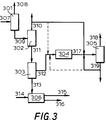
- Figure 3 shows how the process according to the present invention can be suitably integrated in a complex hydrocracker refinery line-up.
- an atmospheric hydrocarbon oil residue (105) is passed into vacuum distillation zone (101), where it is separated in one or more flashed distillate fractions (106) and a vacuum residue fraction (107). At least a part of the flashed distillate fractions (106) is routed to upgraded DAO stream (110).
- the vacuum residue fraction (107) is deasphalted in deasphalting zone (102), resulting in an asphaltic fraction (109) and a DAO (108) which is subsequently hydrodemetallised in hydrodemetallisation zone (103).
- the upgraded DAO (110) is blended with at least a part of the flashed distillate fraction(s) (106) and the resulting blendstream is then passed into hydrocracking zone (104), thus producing one or more distillate fractions (111) and optionally a heavy fraction (112).
- Figure 2 is in fact an extension of Figure 1 in three aspects. Firstly, in that at least a part of the heavy fraction (212) produced in hydrocracking zone (204) is recirculated by routing it to upgraded DAO (210) and blending it therewith prior to being led into hydrocracking zone (204). Secondly, part of the heavy fraction (212) routed to upgraded DAO (210) is routed to DAO (208) and blended therewith in order to be subjected to hydrodemetallisation in hydrodemetallisation zone (203) once again. This option is indicated by a dotted line in figure 2. The third aspect, finally, is also indicated with a dotted line and embodies the option of routing part of the flashed distillate fractions (206) to DAO (208) and blending it therewith. The other reference numbers used in Figure 2 correspond with those used in Figure 1 having the same last two numbers.
- Figure 3 shows the line-up of a hydrocracker refinery.
- a crude oil (307) is passed into atmospheric distillation zone (301), where a first separation into one or more distillate fractions (308) and a residual fraction or "long residue” (309).
- This long residue (309) is further separated in vacuum distillation zone (302) into one or more flashed distillate fractions (310), at least part of which is blended with upgraded DAO (317), and a vacuum residue fraction or "short residue” (311), which is deasphalted in deasphalting zone (303).
- a part of the flashed distillate fractions (310) is blended with DAO (312).
- the DAO (312) is passed into hydrodemetallisation zone (304) and the upgraded DAO is led into hydrocracking zone (305).
- the asphaltic fraction (313) resulting from the deasphalting treatment is passed into gasification zone (306) where it is partially oxidised using oxygen, supplied via stream (314), eventually producing clean fuel gas (315) and hydrogen (316).
- This hydrogen can for instance be passed into hydrodemetallisation zone (304) and/or hydrocracking zone (305) in order to increase the overall process efficiency.
- Hydrocracking in hydrocracking zone (305) results in one or more distillate fractions (318) and a heavy fraction (319), which is at least partially recirculated into hydrocracking zone (305) via blending with upgraded DAO (317).
- a part of the heavy fraction (319) is blended with DAO (312).
- the invention is further illustrated by the following example.
- a crude oil feed was subjected to conventional crude distillation; the long residue produced was subjected to conventional vacuum flashing, producing a flashed distillate (FD) and short residue (SR).
- the SR was subsequently subjected to solvent deasphalting using butane as extracting solvent to produce a DAO at a yield of 70% by weight based on SR.
- the DAO and FD were coprocessed in an integrated hydro-demetallization/hydrocracking (HDM/HCU) pilot plant for about 5000 hours.
- the DAO was upgraded in the HDM reactor over a conventional NiMoP/alumina catalyst.
- Upgraded DAO and FD were subsequently coprocessed in the HCU reactor over a catalyst system including an acidic catalyst, producing hydrowax, gasoil, kerosene, naphtha and gaseous products. Both HDM and HCU reactors were operated at the same pressure.
Landscapes
- Chemical & Material Sciences (AREA)
- Oil, Petroleum & Natural Gas (AREA)
- Engineering & Computer Science (AREA)
- Chemical Kinetics & Catalysis (AREA)
- General Chemical & Material Sciences (AREA)
- Organic Chemistry (AREA)
- Production Of Liquid Hydrocarbon Mixture For Refining Petroleum (AREA)
Priority Applications (1)
| Application Number | Priority Date | Filing Date | Title |
|---|---|---|---|
| EP19950201314 EP0683218B1 (fr) | 1994-05-19 | 1995-05-18 | Procédé de conversion d'une huile résiduelle hydrocarbonée |
Applications Claiming Priority (3)
| Application Number | Priority Date | Filing Date | Title |
|---|---|---|---|
| EP94201423 | 1994-05-19 | ||
| EP94201423 | 1994-05-19 | ||
| EP19950201314 EP0683218B1 (fr) | 1994-05-19 | 1995-05-18 | Procédé de conversion d'une huile résiduelle hydrocarbonée |
Publications (3)
| Publication Number | Publication Date |
|---|---|
| EP0683218A2 true EP0683218A2 (fr) | 1995-11-22 |
| EP0683218A3 EP0683218A3 (fr) | 1996-03-20 |
| EP0683218B1 EP0683218B1 (fr) | 2001-04-11 |
Family
ID=26136276
Family Applications (1)
| Application Number | Title | Priority Date | Filing Date |
|---|---|---|---|
| EP19950201314 Expired - Lifetime EP0683218B1 (fr) | 1994-05-19 | 1995-05-18 | Procédé de conversion d'une huile résiduelle hydrocarbonée |
Country Status (1)
| Country | Link |
|---|---|
| EP (1) | EP0683218B1 (fr) |
Cited By (11)
| Publication number | Priority date | Publication date | Assignee | Title |
|---|---|---|---|---|
| WO1999013024A1 (fr) * | 1997-09-11 | 1999-03-18 | Atlantic Richfield Company | Utilisation d'un procede de desasphaltage en dissolution pour transformer du petrole brut lourd en distillat ion a partir d'une formation souterraine, a travers un puits de forage |
| WO2000006670A1 (fr) * | 1998-07-29 | 2000-02-10 | Texaco Development Corporation | Integration de processus de desasphaltage en dissolution et de gazeification |
| EP1731588A1 (fr) * | 2005-06-08 | 2006-12-13 | Shell Internationale Researchmaatschappij B.V. | Procédé de valorisation d'huile brute |
| WO2008065182A1 (fr) * | 2006-12-01 | 2008-06-05 | Shell Internationale Research Maatschappij B.V. | Procédé de préparation d'un mélange d'hydrogène et de monoxyde de carbone à partir d'un stock d'alimentation d'hydrocarbure liquide contenant une certaine quantité de cendres |
| US8052864B2 (en) | 2006-12-01 | 2011-11-08 | Shell Oil Company | Process to prepare a sweet crude |
| CN102453545A (zh) * | 2010-10-15 | 2012-05-16 | 中国石油化工股份有限公司 | 一种渣油轻质化的方法 |
| CN102453541A (zh) * | 2010-10-15 | 2012-05-16 | 中国石油化工股份有限公司 | 一种处理渣油的联合加工方法 |
| CN101633848B (zh) * | 2009-08-31 | 2012-11-21 | 中煤能源黑龙江煤化工有限公司 | 一种中低温煤焦油深加工方法 |
| US8475546B2 (en) | 2008-12-04 | 2013-07-02 | Shell Oil Company | Reactor for preparing syngas |
| CN103540358A (zh) * | 2012-07-12 | 2014-01-29 | 中国石油天然气股份有限公司 | 渣油转化-芳烃抽提组合工艺 |
| CN113166659A (zh) * | 2018-10-22 | 2021-07-23 | 沙特阿拉伯石油公司 | 残油的催化脱金属和气相氧化脱硫 |
Families Citing this family (3)
| Publication number | Priority date | Publication date | Assignee | Title |
|---|---|---|---|---|
| US9051522B2 (en) | 2006-12-01 | 2015-06-09 | Shell Oil Company | Gasification reactor |
| US8960651B2 (en) | 2008-12-04 | 2015-02-24 | Shell Oil Company | Vessel for cooling syngas |
| CN103059998B (zh) * | 2011-10-21 | 2014-08-20 | 中国石油化工股份有限公司 | 一种处理渣油的组合工艺方法 |
Citations (10)
| Publication number | Priority date | Publication date | Assignee | Title |
|---|---|---|---|---|
| US3876523A (en) | 1973-08-29 | 1975-04-08 | Mobil Oil Corp | Catalyst for residua demetalation and desulfurization |
| US3891541A (en) | 1973-08-29 | 1975-06-24 | Mobil Oil Corp | Process for demetalizing and desulfurizing residual oil with hydrogen and alumina-supported catalyst |
| GB1438645A (en) | 1972-07-07 | 1976-06-09 | Shell Int Research | Hydrocarbon conversion process |
| DE2638498A1 (de) | 1975-08-28 | 1977-03-03 | Mobil Oil Corp | Katalysator fuer die hydrierende entfernung von metallen und schwefel, dessen herstellung und dessen verwendung |
| GB1522629A (en) | 1974-09-18 | 1978-08-23 | Shell Int Research | Process for the preparation of catalysts |
| GB1548722A (en) | 1975-09-05 | 1979-07-18 | Shell Int Research | Process for the conversion of hydrocarbons |
| NL7901734A (nl) | 1978-03-08 | 1979-09-11 | Mobil Oil Corp | Katalysator voor het demetalleren en desulfureren van koolwaterstofolieen, alsmede werkwijze voor het demetalleren en desulfureren van koolwaterstofolieen. |
| GB1560590A (en) | 1976-07-08 | 1980-02-06 | Shell Int Research | Process for demetallizing hydrocarbon oils |
| GB1560599A (en) | 1976-07-08 | 1980-02-06 | Shell Int Research | Process for demetallizing hydrocarbon oils |
| US4564439A (en) | 1984-06-29 | 1986-01-14 | Chevron Research Company | Two-stage, close-coupled thermal catalytic hydroconversion process |
Family Cites Families (3)
| Publication number | Priority date | Publication date | Assignee | Title |
|---|---|---|---|---|
| FR1423627A (fr) * | 1963-04-11 | 1966-01-07 | Inst Francais Du Petrole | Procédé de conversion d'hydrocarbures lourds |
| NL159135B (nl) * | 1967-12-27 | 1979-01-15 | Shell Int Research | Werkwijze voor de bereiding van lager kokende koolwaterstoffen of fracties, die deze bevatten, uit residuale olien door deze te ontasfalteren en de ontasfalteerde olie te hydrokraken in aanwezigheid van waterstof, die is verkregen door partiele verbranding van de bij de ontasfaltering afgescheiden asfaltenen. |
| US4165274A (en) * | 1978-06-13 | 1979-08-21 | Shell Oil Company | Process for the preparation of synthetic crude oil |
-
1995
- 1995-05-18 EP EP19950201314 patent/EP0683218B1/fr not_active Expired - Lifetime
Patent Citations (10)
| Publication number | Priority date | Publication date | Assignee | Title |
|---|---|---|---|---|
| GB1438645A (en) | 1972-07-07 | 1976-06-09 | Shell Int Research | Hydrocarbon conversion process |
| US3876523A (en) | 1973-08-29 | 1975-04-08 | Mobil Oil Corp | Catalyst for residua demetalation and desulfurization |
| US3891541A (en) | 1973-08-29 | 1975-06-24 | Mobil Oil Corp | Process for demetalizing and desulfurizing residual oil with hydrogen and alumina-supported catalyst |
| GB1522629A (en) | 1974-09-18 | 1978-08-23 | Shell Int Research | Process for the preparation of catalysts |
| DE2638498A1 (de) | 1975-08-28 | 1977-03-03 | Mobil Oil Corp | Katalysator fuer die hydrierende entfernung von metallen und schwefel, dessen herstellung und dessen verwendung |
| GB1548722A (en) | 1975-09-05 | 1979-07-18 | Shell Int Research | Process for the conversion of hydrocarbons |
| GB1560590A (en) | 1976-07-08 | 1980-02-06 | Shell Int Research | Process for demetallizing hydrocarbon oils |
| GB1560599A (en) | 1976-07-08 | 1980-02-06 | Shell Int Research | Process for demetallizing hydrocarbon oils |
| NL7901734A (nl) | 1978-03-08 | 1979-09-11 | Mobil Oil Corp | Katalysator voor het demetalleren en desulfureren van koolwaterstofolieen, alsmede werkwijze voor het demetalleren en desulfureren van koolwaterstofolieen. |
| US4564439A (en) | 1984-06-29 | 1986-01-14 | Chevron Research Company | Two-stage, close-coupled thermal catalytic hydroconversion process |
Cited By (15)
| Publication number | Priority date | Publication date | Assignee | Title |
|---|---|---|---|---|
| WO1999013024A1 (fr) * | 1997-09-11 | 1999-03-18 | Atlantic Richfield Company | Utilisation d'un procede de desasphaltage en dissolution pour transformer du petrole brut lourd en distillat ion a partir d'une formation souterraine, a travers un puits de forage |
| WO2000006670A1 (fr) * | 1998-07-29 | 2000-02-10 | Texaco Development Corporation | Integration de processus de desasphaltage en dissolution et de gazeification |
| US6241874B1 (en) | 1998-07-29 | 2001-06-05 | Texaco Inc. | Integration of solvent deasphalting and gasification |
| EP1731588A1 (fr) * | 2005-06-08 | 2006-12-13 | Shell Internationale Researchmaatschappij B.V. | Procédé de valorisation d'huile brute |
| US9487400B2 (en) | 2006-11-01 | 2016-11-08 | Shell Oil Company | Process to prepare a mixture of hydrogen and carbon monoxide from a liquid hydrocarbon feedstock containing a certain amount of ash |
| WO2008065182A1 (fr) * | 2006-12-01 | 2008-06-05 | Shell Internationale Research Maatschappij B.V. | Procédé de préparation d'un mélange d'hydrogène et de monoxyde de carbone à partir d'un stock d'alimentation d'hydrocarbure liquide contenant une certaine quantité de cendres |
| US8052864B2 (en) | 2006-12-01 | 2011-11-08 | Shell Oil Company | Process to prepare a sweet crude |
| US8475546B2 (en) | 2008-12-04 | 2013-07-02 | Shell Oil Company | Reactor for preparing syngas |
| CN101633848B (zh) * | 2009-08-31 | 2012-11-21 | 中煤能源黑龙江煤化工有限公司 | 一种中低温煤焦油深加工方法 |
| CN102453541A (zh) * | 2010-10-15 | 2012-05-16 | 中国石油化工股份有限公司 | 一种处理渣油的联合加工方法 |
| CN102453545B (zh) * | 2010-10-15 | 2013-11-06 | 中国石油化工股份有限公司 | 一种渣油轻质化的方法 |
| CN102453541B (zh) * | 2010-10-15 | 2013-11-20 | 中国石油化工股份有限公司 | 一种处理渣油的联合加工方法 |
| CN102453545A (zh) * | 2010-10-15 | 2012-05-16 | 中国石油化工股份有限公司 | 一种渣油轻质化的方法 |
| CN103540358A (zh) * | 2012-07-12 | 2014-01-29 | 中国石油天然气股份有限公司 | 渣油转化-芳烃抽提组合工艺 |
| CN113166659A (zh) * | 2018-10-22 | 2021-07-23 | 沙特阿拉伯石油公司 | 残油的催化脱金属和气相氧化脱硫 |
Also Published As
| Publication number | Publication date |
|---|---|
| EP0683218B1 (fr) | 2001-04-11 |
| EP0683218A3 (fr) | 1996-03-20 |
Similar Documents
| Publication | Publication Date | Title |
|---|---|---|
| EP0434799B1 (fr) | Hydrotraitement de petrole residuel a l'aide de resines extraites au solvant et desasphaltees | |
| RU2360944C2 (ru) | Комплексный способ конверсии содержащего уголь сырья в жидкие продукты | |
| US8123932B2 (en) | Process for the conversion of heavy feedstocks such as heavy crude oils and distillation residues | |
| US7691256B2 (en) | Process for the conversion of heavy charges such as heavy crude oils and distillation residues | |
| JP4639290B2 (ja) | 重質粗油及び蒸留残渣のような重質原料油の転化方法 | |
| US3287254A (en) | Residual oil conversion process | |
| AU2005318443B2 (en) | Process for the conversion of heavy charge stocks such as heavy crude oils and distillation residues | |
| CN105008494B (zh) | 渣油加氢裂化和溶剂脱沥青的整合 | |
| US9650312B2 (en) | Integration of residue hydrocracking and hydrotreating | |
| KR101716989B1 (ko) | 잔유물의 하이드로크랙킹 | |
| US20090127161A1 (en) | Process and Apparatus for Integrated Heavy Oil Upgrading | |
| KR102005137B1 (ko) | 잔사유 수소첨가분해 공정 | |
| EP0683218B1 (fr) | Procédé de conversion d'une huile résiduelle hydrocarbonée | |
| KR20180137410A (ko) | 2-단계 히드로크래킹 및 수소처리 공정의 통합 공정 | |
| DE112013001538T5 (de) | Integration einer Lösungsmittelentasphaltierung mit einer Harzhydroverarbeitung und einer verzögerten Verkokung | |
| EP0697455B1 (fr) | Procédé de préparation d'une cire hydrogénée | |
| EP3087162B1 (fr) | Procédé de production de distillats intermédiaires | |
| CA2149595C (fr) | Procede pour la conversion d'une huile residuelle d'hydrocarbures | |
| CA2154313C (fr) | Methode de production d'hydrowax | |
| US20130327682A1 (en) | Method for converting hydrocarbon feedstock comprising a shale oil by decontamination, hydroconversion in an ebullating bed, and fractionation by atmospheric distillation | |
| EP1731588A1 (fr) | Procédé de valorisation d'huile brute | |
| US20250283004A1 (en) | Process for producing middle distillates | |
| CN116024006B (zh) | 一种脱沥青油的加氢裂化方法 | |
| KR20250136205A (ko) | 수소화분해된 피치를 전환하는 방법 |
Legal Events
| Date | Code | Title | Description |
|---|---|---|---|
| PUAI | Public reference made under article 153(3) epc to a published international application that has entered the european phase |
Free format text: ORIGINAL CODE: 0009012 |
|
| AK | Designated contracting states |
Kind code of ref document: A2 Designated state(s): DE FR GB IT NL |
|
| PUAL | Search report despatched |
Free format text: ORIGINAL CODE: 0009013 |
|
| AK | Designated contracting states |
Kind code of ref document: A3 Designated state(s): DE FR GB IT NL |
|
| 17P | Request for examination filed |
Effective date: 19960712 |
|
| 17Q | First examination report despatched |
Effective date: 19980629 |
|
| GRAG | Despatch of communication of intention to grant |
Free format text: ORIGINAL CODE: EPIDOS AGRA |
|
| GRAG | Despatch of communication of intention to grant |
Free format text: ORIGINAL CODE: EPIDOS AGRA |
|
| GRAH | Despatch of communication of intention to grant a patent |
Free format text: ORIGINAL CODE: EPIDOS IGRA |
|
| GRAH | Despatch of communication of intention to grant a patent |
Free format text: ORIGINAL CODE: EPIDOS IGRA |
|
| GRAA | (expected) grant |
Free format text: ORIGINAL CODE: 0009210 |
|
| AK | Designated contracting states |
Kind code of ref document: B1 Designated state(s): DE FR GB IT NL |
|
| ITF | It: translation for a ep patent filed | ||
| REF | Corresponds to: |
Ref document number: 69520616 Country of ref document: DE Date of ref document: 20010517 |
|
| ET | Fr: translation filed | ||
| REG | Reference to a national code |
Ref country code: GB Ref legal event code: IF02 |
|
| PLBE | No opposition filed within time limit |
Free format text: ORIGINAL CODE: 0009261 |
|
| STAA | Information on the status of an ep patent application or granted ep patent |
Free format text: STATUS: NO OPPOSITION FILED WITHIN TIME LIMIT |
|
| 26N | No opposition filed | ||
| PGFP | Annual fee paid to national office [announced via postgrant information from national office to epo] |
Ref country code: IT Payment date: 20080421 Year of fee payment: 14 |
|
| PGFP | Annual fee paid to national office [announced via postgrant information from national office to epo] |
Ref country code: FR Payment date: 20080331 Year of fee payment: 14 |
|
| REG | Reference to a national code |
Ref country code: FR Ref legal event code: ST Effective date: 20100129 |
|
| PG25 | Lapsed in a contracting state [announced via postgrant information from national office to epo] |
Ref country code: FR Free format text: LAPSE BECAUSE OF NON-PAYMENT OF DUE FEES Effective date: 20090602 |
|
| PG25 | Lapsed in a contracting state [announced via postgrant information from national office to epo] |
Ref country code: IT Free format text: LAPSE BECAUSE OF NON-PAYMENT OF DUE FEES Effective date: 20090518 |
|
| PGFP | Annual fee paid to national office [announced via postgrant information from national office to epo] |
Ref country code: NL Payment date: 20110517 Year of fee payment: 17 Ref country code: GB Payment date: 20110415 Year of fee payment: 17 |
|
| PGFP | Annual fee paid to national office [announced via postgrant information from national office to epo] |
Ref country code: DE Payment date: 20110519 Year of fee payment: 17 |
|
| REG | Reference to a national code |
Ref country code: NL Ref legal event code: V1 Effective date: 20121201 |
|
| GBPC | Gb: european patent ceased through non-payment of renewal fee |
Effective date: 20120518 |
|
| REG | Reference to a national code |
Ref country code: DE Ref legal event code: R119 Ref document number: 69520616 Country of ref document: DE Effective date: 20121201 |
|
| PG25 | Lapsed in a contracting state [announced via postgrant information from national office to epo] |
Ref country code: NL Free format text: LAPSE BECAUSE OF NON-PAYMENT OF DUE FEES Effective date: 20121201 |
|
| PG25 | Lapsed in a contracting state [announced via postgrant information from national office to epo] |
Ref country code: GB Free format text: LAPSE BECAUSE OF NON-PAYMENT OF DUE FEES Effective date: 20120518 |
|
| PG25 | Lapsed in a contracting state [announced via postgrant information from national office to epo] |
Ref country code: DE Free format text: LAPSE BECAUSE OF NON-PAYMENT OF DUE FEES Effective date: 20121201 |