EP0683430A2 - Compositions de traitement photographiques incluant un agent éprassissant hydrophobiquement modifié - Google Patents
Compositions de traitement photographiques incluant un agent éprassissant hydrophobiquement modifié Download PDFInfo
- Publication number
- EP0683430A2 EP0683430A2 EP95101799A EP95101799A EP0683430A2 EP 0683430 A2 EP0683430 A2 EP 0683430A2 EP 95101799 A EP95101799 A EP 95101799A EP 95101799 A EP95101799 A EP 95101799A EP 0683430 A2 EP0683430 A2 EP 0683430A2
- Authority
- EP
- European Patent Office
- Prior art keywords
- image
- composition
- layer
- thickening agent
- photographic
- Prior art date
- Legal status (The legal status is an assumption and is not a legal conclusion. Google has not performed a legal analysis and makes no representation as to the accuracy of the status listed.)
- Granted
Links
- 239000000203 mixture Substances 0.000 title claims abstract description 106
- 238000012545 processing Methods 0.000 title claims abstract description 96
- 239000002562 thickening agent Substances 0.000 title claims abstract description 40
- 238000012546 transfer Methods 0.000 claims abstract description 30
- 238000009792 diffusion process Methods 0.000 claims abstract description 25
- 239000000975 dye Substances 0.000 claims description 52
- -1 silver halide Chemical class 0.000 claims description 46
- 229910052709 silver Inorganic materials 0.000 claims description 40
- 239000004332 silver Substances 0.000 claims description 40
- 239000000463 material Substances 0.000 claims description 36
- 125000000217 alkyl group Chemical group 0.000 claims description 28
- 239000000178 monomer Substances 0.000 claims description 23
- 239000000839 emulsion Substances 0.000 claims description 21
- 125000004432 carbon atom Chemical group C* 0.000 claims description 18
- 239000002253 acid Substances 0.000 claims description 13
- 229910052739 hydrogen Inorganic materials 0.000 claims description 13
- SMZOUWXMTYCWNB-UHFFFAOYSA-N 2-(2-methoxy-5-methylphenyl)ethanamine Chemical compound COC1=CC=C(C)C=C1CCN SMZOUWXMTYCWNB-UHFFFAOYSA-N 0.000 claims description 11
- NIXOWILDQLNWCW-UHFFFAOYSA-N 2-Propenoic acid Natural products OC(=O)C=C NIXOWILDQLNWCW-UHFFFAOYSA-N 0.000 claims description 11
- 239000001257 hydrogen Substances 0.000 claims description 11
- 229920005604 random copolymer Polymers 0.000 claims description 8
- 150000001732 carboxylic acid derivatives Chemical class 0.000 claims description 7
- 150000001875 compounds Chemical class 0.000 claims description 7
- CERQOIWHTDAKMF-UHFFFAOYSA-N Methacrylic acid Chemical compound CC(=C)C(O)=O CERQOIWHTDAKMF-UHFFFAOYSA-N 0.000 claims description 6
- 125000002496 methyl group Chemical group [H]C([H])([H])* 0.000 claims description 6
- HMZGPNHSPWNGEP-UHFFFAOYSA-N octadecyl 2-methylprop-2-enoate Chemical compound CCCCCCCCCCCCCCCCCCOC(=O)C(C)=C HMZGPNHSPWNGEP-UHFFFAOYSA-N 0.000 claims description 6
- UFHFLCQGNIYNRP-UHFFFAOYSA-N Hydrogen Chemical group [H][H] UFHFLCQGNIYNRP-UHFFFAOYSA-N 0.000 claims description 5
- BQCADISMDOOEFD-UHFFFAOYSA-N Silver Chemical compound [Ag] BQCADISMDOOEFD-UHFFFAOYSA-N 0.000 claims description 5
- 229920001577 copolymer Polymers 0.000 claims description 5
- 238000004132 cross linking Methods 0.000 claims description 5
- 125000004435 hydrogen atom Chemical group [H]* 0.000 claims description 5
- ZAWQXWZJKKICSZ-UHFFFAOYSA-N 3,3-dimethyl-2-methylidenebutanamide Chemical compound CC(C)(C)C(=C)C(N)=O ZAWQXWZJKKICSZ-UHFFFAOYSA-N 0.000 claims description 4
- 125000002877 alkyl aryl group Chemical group 0.000 claims description 4
- 125000003710 aryl alkyl group Chemical group 0.000 claims description 4
- 229910052799 carbon Inorganic materials 0.000 claims description 4
- WROUWQQRXUBECT-UHFFFAOYSA-N 2-ethylacrylic acid Chemical compound CCC(=C)C(O)=O WROUWQQRXUBECT-UHFFFAOYSA-N 0.000 claims description 3
- 150000003242 quaternary ammonium salts Chemical class 0.000 claims description 2
- 150000002431 hydrogen Chemical group 0.000 claims 1
- 238000000034 method Methods 0.000 abstract description 27
- 230000008569 process Effects 0.000 abstract description 22
- 239000000470 constituent Substances 0.000 abstract description 14
- 239000008240 homogeneous mixture Substances 0.000 abstract 1
- 239000010410 layer Substances 0.000 description 118
- GWEVSGVZZGPLCZ-UHFFFAOYSA-N Titan oxide Chemical compound O=[Ti]=O GWEVSGVZZGPLCZ-UHFFFAOYSA-N 0.000 description 20
- 108010010803 Gelatin Proteins 0.000 description 16
- 229920000159 gelatin Polymers 0.000 description 16
- 239000008273 gelatin Substances 0.000 description 16
- 235000019322 gelatine Nutrition 0.000 description 16
- 235000011852 gelatine desserts Nutrition 0.000 description 16
- 239000000049 pigment Substances 0.000 description 12
- 238000011176 pooling Methods 0.000 description 11
- 239000004408 titanium dioxide Substances 0.000 description 10
- 238000011161 development Methods 0.000 description 9
- 230000006870 function Effects 0.000 description 9
- 239000003795 chemical substances by application Substances 0.000 description 8
- 238000009826 distribution Methods 0.000 description 8
- 239000000126 substance Substances 0.000 description 7
- KWYUFKZDYYNOTN-UHFFFAOYSA-M Potassium hydroxide Chemical compound [OH-].[K+] KWYUFKZDYYNOTN-UHFFFAOYSA-M 0.000 description 6
- HEMHJVSKTPXQMS-UHFFFAOYSA-M Sodium hydroxide Chemical compound [OH-].[Na+] HEMHJVSKTPXQMS-UHFFFAOYSA-M 0.000 description 6
- 239000003153 chemical reaction reagent Substances 0.000 description 6
- 230000003287 optical effect Effects 0.000 description 6
- 230000015572 biosynthetic process Effects 0.000 description 5
- 229920000663 Hydroxyethyl cellulose Polymers 0.000 description 4
- 239000004354 Hydroxyethyl cellulose Substances 0.000 description 4
- 229920002125 Sokalan® Polymers 0.000 description 4
- PPBRXRYQALVLMV-UHFFFAOYSA-N Styrene Chemical compound C=CC1=CC=CC=C1 PPBRXRYQALVLMV-UHFFFAOYSA-N 0.000 description 4
- 239000011248 coating agent Substances 0.000 description 4
- 238000000576 coating method Methods 0.000 description 4
- 235000019447 hydroxyethyl cellulose Nutrition 0.000 description 4
- OMNKZBIFPJNNIO-UHFFFAOYSA-N n-(2-methyl-4-oxopentan-2-yl)prop-2-enamide Chemical compound CC(=O)CC(C)(C)NC(=O)C=C OMNKZBIFPJNNIO-UHFFFAOYSA-N 0.000 description 4
- UKOVZLWSUZKTRL-UHFFFAOYSA-N naphthalid Chemical compound C1=CC(C(=O)OC2)=C3C2=CC=CC3=C1 UKOVZLWSUZKTRL-UHFFFAOYSA-N 0.000 description 4
- 229920000642 polymer Polymers 0.000 description 4
- 230000000717 retained effect Effects 0.000 description 4
- KFDVPJUYSDEJTH-UHFFFAOYSA-N 4-ethenylpyridine Chemical compound C=CC1=CC=NC=C1 KFDVPJUYSDEJTH-UHFFFAOYSA-N 0.000 description 3
- 230000005540 biological transmission Effects 0.000 description 3
- CQEYYJKEWSMYFG-UHFFFAOYSA-N butyl acrylate Chemical compound CCCCOC(=O)C=C CQEYYJKEWSMYFG-UHFFFAOYSA-N 0.000 description 3
- 150000001721 carbon Chemical group 0.000 description 3
- 239000001768 carboxy methyl cellulose Substances 0.000 description 3
- 238000005859 coupling reaction Methods 0.000 description 3
- 239000011229 interlayer Substances 0.000 description 3
- 239000004816 latex Substances 0.000 description 3
- 229920000126 latex Polymers 0.000 description 3
- 230000003647 oxidation Effects 0.000 description 3
- 238000007254 oxidation reaction Methods 0.000 description 3
- 229920000139 polyethylene terephthalate Polymers 0.000 description 3
- 239000005020 polyethylene terephthalate Substances 0.000 description 3
- 238000000926 separation method Methods 0.000 description 3
- 125000006850 spacer group Chemical group 0.000 description 3
- 230000007480 spreading Effects 0.000 description 3
- 238000003892 spreading Methods 0.000 description 3
- AZQWKYJCGOJGHM-UHFFFAOYSA-N 1,4-benzoquinone Chemical compound O=C1C=CC(=O)C=C1 AZQWKYJCGOJGHM-UHFFFAOYSA-N 0.000 description 2
- SIQZJFKTROUNPI-UHFFFAOYSA-N 1-(hydroxymethyl)-5,5-dimethylhydantoin Chemical compound CC1(C)N(CO)C(=O)NC1=O SIQZJFKTROUNPI-UHFFFAOYSA-N 0.000 description 2
- GGZHVNZHFYCSEV-UHFFFAOYSA-N 1-Phenyl-5-mercaptotetrazole Chemical compound SC1=NN=NN1C1=CC=CC=C1 GGZHVNZHFYCSEV-UHFFFAOYSA-N 0.000 description 2
- 229920002134 Carboxymethyl cellulose Polymers 0.000 description 2
- VVQNEPGJFQJSBK-UHFFFAOYSA-N Methyl methacrylate Chemical compound COC(=O)C(C)=C VVQNEPGJFQJSBK-UHFFFAOYSA-N 0.000 description 2
- 239000004372 Polyvinyl alcohol Substances 0.000 description 2
- FOIXSVOLVBLSDH-UHFFFAOYSA-N Silver ion Chemical compound [Ag+] FOIXSVOLVBLSDH-UHFFFAOYSA-N 0.000 description 2
- CDBYLPFSWZWCQE-UHFFFAOYSA-L Sodium Carbonate Chemical compound [Na+].[Na+].[O-]C([O-])=O CDBYLPFSWZWCQE-UHFFFAOYSA-L 0.000 description 2
- PCSMJKASWLYICJ-UHFFFAOYSA-N Succinic aldehyde Chemical compound O=CCCC=O PCSMJKASWLYICJ-UHFFFAOYSA-N 0.000 description 2
- YSMRWXYRXBRSND-UHFFFAOYSA-N TOTP Chemical compound CC1=CC=CC=C1OP(=O)(OC=1C(=CC=CC=1)C)OC1=CC=CC=C1C YSMRWXYRXBRSND-UHFFFAOYSA-N 0.000 description 2
- 238000010521 absorption reaction Methods 0.000 description 2
- 239000003513 alkali Substances 0.000 description 2
- 230000008901 benefit Effects 0.000 description 2
- 235000010948 carboxy methyl cellulose Nutrition 0.000 description 2
- 239000008112 carboxymethyl-cellulose Substances 0.000 description 2
- 238000003776 cleavage reaction Methods 0.000 description 2
- 230000008878 coupling Effects 0.000 description 2
- 238000010168 coupling process Methods 0.000 description 2
- 239000006185 dispersion Substances 0.000 description 2
- 238000001035 drying Methods 0.000 description 2
- 239000012530 fluid Substances 0.000 description 2
- FDGQSTZJBFJUBT-UHFFFAOYSA-N hypoxanthine Chemical compound O=C1NC=NC2=C1NC=N2 FDGQSTZJBFJUBT-UHFFFAOYSA-N 0.000 description 2
- 238000003384 imaging method Methods 0.000 description 2
- 239000000543 intermediate Substances 0.000 description 2
- 230000020477 pH reduction Effects 0.000 description 2
- 238000005191 phase separation Methods 0.000 description 2
- 239000004584 polyacrylic acid Substances 0.000 description 2
- 229920002451 polyvinyl alcohol Polymers 0.000 description 2
- BWHMMNNQKKPAPP-UHFFFAOYSA-L potassium carbonate Chemical compound [K+].[K+].[O-]C([O-])=O BWHMMNNQKKPAPP-UHFFFAOYSA-L 0.000 description 2
- 230000035945 sensitivity Effects 0.000 description 2
- ZUNKMNLKJXRCDM-UHFFFAOYSA-N silver bromoiodide Chemical compound [Ag].IBr ZUNKMNLKJXRCDM-UHFFFAOYSA-N 0.000 description 2
- 239000004094 surface-active agent Substances 0.000 description 2
- 238000003786 synthesis reaction Methods 0.000 description 2
- XLYOFNOQVPJJNP-UHFFFAOYSA-N water Substances O XLYOFNOQVPJJNP-UHFFFAOYSA-N 0.000 description 2
- 239000001043 yellow dye Substances 0.000 description 2
- NJVOHKFLBKQLIZ-UHFFFAOYSA-N (2-ethenylphenyl) prop-2-enoate Chemical compound C=CC(=O)OC1=CC=CC=C1C=C NJVOHKFLBKQLIZ-UHFFFAOYSA-N 0.000 description 1
- AAXGLZUUHYACNA-UHFFFAOYSA-N (2-methoxy-2-oxoethyl) prop-2-enoate Chemical compound COC(=O)COC(=O)C=C AAXGLZUUHYACNA-UHFFFAOYSA-N 0.000 description 1
- FQKSRGCBHCFRTN-UHFFFAOYSA-N (4-nonylphenyl) prop-2-enoate Chemical compound CCCCCCCCCC1=CC=C(OC(=O)C=C)C=C1 FQKSRGCBHCFRTN-UHFFFAOYSA-N 0.000 description 1
- OGYGFUAIIOPWQD-UHFFFAOYSA-N 1,3-thiazolidine Chemical compound C1CSCN1 OGYGFUAIIOPWQD-UHFFFAOYSA-N 0.000 description 1
- QIGBRXMKCJKVMJ-UHFFFAOYSA-N 1,4-Benzenediol Natural products OC1=CC=C(O)C=C1 QIGBRXMKCJKVMJ-UHFFFAOYSA-N 0.000 description 1
- OSNILPMOSNGHLC-UHFFFAOYSA-N 1-[4-methoxy-3-(piperidin-1-ylmethyl)phenyl]ethanone Chemical compound COC1=CC=C(C(C)=O)C=C1CN1CCCCC1 OSNILPMOSNGHLC-UHFFFAOYSA-N 0.000 description 1
- QJUCCGSXGKTYBT-UHFFFAOYSA-N 2,4,4-trimethylpent-2-enamide Chemical compound NC(=O)C(C)=CC(C)(C)C QJUCCGSXGKTYBT-UHFFFAOYSA-N 0.000 description 1
- HPQJFOIEZIJQRN-UHFFFAOYSA-N 2-(2h-tetrazol-5-ylsulfanyl)phenol Chemical compound OC1=CC=CC=C1SC1=NNN=N1 HPQJFOIEZIJQRN-UHFFFAOYSA-N 0.000 description 1
- GOXQRTZXKQZDDN-UHFFFAOYSA-N 2-Ethylhexyl acrylate Chemical compound CCCCC(CC)COC(=O)C=C GOXQRTZXKQZDDN-UHFFFAOYSA-N 0.000 description 1
- FECNOIODIVNEKI-UHFFFAOYSA-N 2-[(2-aminobenzoyl)amino]benzoic acid Chemical class NC1=CC=CC=C1C(=O)NC1=CC=CC=C1C(O)=O FECNOIODIVNEKI-UHFFFAOYSA-N 0.000 description 1
- SHKUUQIDMUMQQK-UHFFFAOYSA-N 2-[4-(oxiran-2-ylmethoxy)butoxymethyl]oxirane Chemical compound C1OC1COCCCCOCC1CO1 SHKUUQIDMUMQQK-UHFFFAOYSA-N 0.000 description 1
- MPNXSZJPSVBLHP-UHFFFAOYSA-N 2-chloro-n-phenylpyridine-3-carboxamide Chemical compound ClC1=NC=CC=C1C(=O)NC1=CC=CC=C1 MPNXSZJPSVBLHP-UHFFFAOYSA-N 0.000 description 1
- PQAMFDRRWURCFQ-UHFFFAOYSA-N 2-ethyl-1h-imidazole Chemical compound CCC1=NC=CN1 PQAMFDRRWURCFQ-UHFFFAOYSA-N 0.000 description 1
- DWYHDSLIWMUSOO-UHFFFAOYSA-N 2-phenyl-1h-benzimidazole Chemical compound C1=CC=CC=C1C1=NC2=CC=CC=C2N1 DWYHDSLIWMUSOO-UHFFFAOYSA-N 0.000 description 1
- LMTFPVZLTNOKRP-UHFFFAOYSA-N 2-tert-butyl-3-phenylbenzene-1,4-diol Chemical compound CC(C)(C)C1=C(O)C=CC(O)=C1C1=CC=CC=C1 LMTFPVZLTNOKRP-UHFFFAOYSA-N 0.000 description 1
- SDXAWLJRERMRKF-UHFFFAOYSA-N 3,5-dimethyl-1h-pyrazole Chemical compound CC=1C=C(C)NN=1 SDXAWLJRERMRKF-UHFFFAOYSA-N 0.000 description 1
- FXJVNINSOKCNJP-UHFFFAOYSA-N 4-methylbenzenesulfinic acid Chemical compound CC1=CC=C(S(O)=O)C=C1 FXJVNINSOKCNJP-UHFFFAOYSA-N 0.000 description 1
- JTHZUSWLNCPZLX-UHFFFAOYSA-N 6-fluoro-3-methyl-2h-indazole Chemical compound FC1=CC=C2C(C)=NNC2=C1 JTHZUSWLNCPZLX-UHFFFAOYSA-N 0.000 description 1
- SHVCSCWHWMSGTE-UHFFFAOYSA-N 6-methyluracil Chemical compound CC1=CC(=O)NC(=O)N1 SHVCSCWHWMSGTE-UHFFFAOYSA-N 0.000 description 1
- LVGFPWDANALGOY-UHFFFAOYSA-N 8-methylnonyl prop-2-enoate Chemical compound CC(C)CCCCCCCOC(=O)C=C LVGFPWDANALGOY-UHFFFAOYSA-N 0.000 description 1
- UGQMRVRMYYASKQ-UHFFFAOYSA-N Hypoxanthine nucleoside Natural products OC1C(O)C(CO)OC1N1C(NC=NC2=O)=C2N=C1 UGQMRVRMYYASKQ-UHFFFAOYSA-N 0.000 description 1
- DGAQECJNVWCQMB-PUAWFVPOSA-M Ilexoside XXIX Chemical compound C[C@@H]1CC[C@@]2(CC[C@@]3(C(=CC[C@H]4[C@]3(CC[C@@H]5[C@@]4(CC[C@@H](C5(C)C)OS(=O)(=O)[O-])C)C)[C@@H]2[C@]1(C)O)C)C(=O)O[C@H]6[C@@H]([C@H]([C@@H]([C@H](O6)CO)O)O)O.[Na+] DGAQECJNVWCQMB-PUAWFVPOSA-M 0.000 description 1
- QAQJMLQRFWZOBN-LAUBAEHRSA-N L-ascorbyl-6-palmitate Chemical compound CCCCCCCCCCCCCCCC(=O)OC[C@H](O)[C@H]1OC(=O)C(O)=C1O QAQJMLQRFWZOBN-LAUBAEHRSA-N 0.000 description 1
- 239000011786 L-ascorbyl-6-palmitate Substances 0.000 description 1
- 239000002202 Polyethylene glycol Substances 0.000 description 1
- VYPSYNLAJGMNEJ-UHFFFAOYSA-N Silicium dioxide Chemical compound O=[Si]=O VYPSYNLAJGMNEJ-UHFFFAOYSA-N 0.000 description 1
- QAOWNCQODCNURD-UHFFFAOYSA-L Sulfate Chemical compound [O-]S([O-])(=O)=O QAOWNCQODCNURD-UHFFFAOYSA-L 0.000 description 1
- GYDJEQRTZSCIOI-UHFFFAOYSA-N Tranexamic acid Chemical compound NCC1CCC(C(O)=O)CC1 GYDJEQRTZSCIOI-UHFFFAOYSA-N 0.000 description 1
- DPXJVFZANSGRMM-UHFFFAOYSA-N acetic acid;2,3,4,5,6-pentahydroxyhexanal;sodium Chemical compound [Na].CC(O)=O.OCC(O)C(O)C(O)C(O)C=O DPXJVFZANSGRMM-UHFFFAOYSA-N 0.000 description 1
- 150000007513 acids Chemical class 0.000 description 1
- 230000009471 action Effects 0.000 description 1
- PNEYBMLMFCGWSK-UHFFFAOYSA-N aluminium oxide Inorganic materials [O-2].[O-2].[O-2].[Al+3].[Al+3] PNEYBMLMFCGWSK-UHFFFAOYSA-N 0.000 description 1
- 150000008064 anhydrides Chemical group 0.000 description 1
- 230000003466 anti-cipated effect Effects 0.000 description 1
- 125000003118 aryl group Chemical group 0.000 description 1
- 235000010385 ascorbyl palmitate Nutrition 0.000 description 1
- TZCXTZWJZNENPQ-UHFFFAOYSA-L barium sulfate Chemical class [Ba+2].[O-]S([O-])(=O)=O TZCXTZWJZNENPQ-UHFFFAOYSA-L 0.000 description 1
- 239000002585 base Substances 0.000 description 1
- XFOZBWSTIQRFQW-UHFFFAOYSA-M benzyl-dimethyl-prop-2-enylazanium;chloride Chemical compound [Cl-].C=CC[N+](C)(C)CC1=CC=CC=C1 XFOZBWSTIQRFQW-UHFFFAOYSA-M 0.000 description 1
- 150000001642 boronic acid derivatives Chemical class 0.000 description 1
- 239000006229 carbon black Substances 0.000 description 1
- 125000003178 carboxy group Chemical group [H]OC(*)=O 0.000 description 1
- 229920002678 cellulose Polymers 0.000 description 1
- 239000001913 cellulose Substances 0.000 description 1
- 239000008119 colloidal silica Substances 0.000 description 1
- 239000003086 colorant Substances 0.000 description 1
- 230000000295 complement effect Effects 0.000 description 1
- FWLDHHJLVGRRHD-UHFFFAOYSA-N decyl prop-2-enoate Chemical compound CCCCCCCCCCOC(=O)C=C FWLDHHJLVGRRHD-UHFFFAOYSA-N 0.000 description 1
- 230000001419 dependent effect Effects 0.000 description 1
- KHAYCTOSKLIHEP-UHFFFAOYSA-N docosyl prop-2-enoate Chemical compound CCCCCCCCCCCCCCCCCCCCCCOC(=O)C=C KHAYCTOSKLIHEP-UHFFFAOYSA-N 0.000 description 1
- 230000000694 effects Effects 0.000 description 1
- 230000007613 environmental effect Effects 0.000 description 1
- PPWUVXSIILSHKU-UHFFFAOYSA-N ethanol;2-nonyl-2-phenoxyoxirane Chemical compound CCO.C=1C=CC=CC=1OC1(CCCCCCCCC)CO1 PPWUVXSIILSHKU-UHFFFAOYSA-N 0.000 description 1
- YYXLGGIKSIZHSF-UHFFFAOYSA-N ethene;furan-2,5-dione Chemical compound C=C.O=C1OC(=O)C=C1 YYXLGGIKSIZHSF-UHFFFAOYSA-N 0.000 description 1
- 238000001704 evaporation Methods 0.000 description 1
- 230000008020 evaporation Effects 0.000 description 1
- 238000009472 formulation Methods 0.000 description 1
- 229920000578 graft copolymer Polymers 0.000 description 1
- 230000007062 hydrolysis Effects 0.000 description 1
- 238000006460 hydrolysis reaction Methods 0.000 description 1
- 125000000687 hydroquinonyl group Chemical group C1(O)=C(C=C(O)C=C1)* 0.000 description 1
- 125000004464 hydroxyphenyl group Chemical group 0.000 description 1
- 238000002329 infrared spectrum Methods 0.000 description 1
- 230000003993 interaction Effects 0.000 description 1
- 150000002596 lactones Chemical group 0.000 description 1
- 238000004519 manufacturing process Methods 0.000 description 1
- 230000004048 modification Effects 0.000 description 1
- 238000012986 modification Methods 0.000 description 1
- FJYACARVIOXIAK-UHFFFAOYSA-N n'-hydroxyprop-2-enimidamide Chemical compound C=CC(N)=NO FJYACARVIOXIAK-UHFFFAOYSA-N 0.000 description 1
- YRDNVESFWXDNSI-UHFFFAOYSA-N n-(2,4,4-trimethylpentan-2-yl)prop-2-enamide Chemical compound CC(C)(C)CC(C)(C)NC(=O)C=C YRDNVESFWXDNSI-UHFFFAOYSA-N 0.000 description 1
- FGXRRPRAWBHDQV-UHFFFAOYSA-N n-(7h-purin-6-yl)benzamide;zinc Chemical compound [Zn].N=1C=NC=2N=CNC=2C=1NC(=O)C1=CC=CC=C1.N=1C=NC=2N=CNC=2C=1NC(=O)C1=CC=CC=C1 FGXRRPRAWBHDQV-UHFFFAOYSA-N 0.000 description 1
- AJDUTMFFZHIJEM-UHFFFAOYSA-N n-(9,10-dioxoanthracen-1-yl)-4-[4-[[4-[4-[(9,10-dioxoanthracen-1-yl)carbamoyl]phenyl]phenyl]diazenyl]phenyl]benzamide Chemical compound O=C1C2=CC=CC=C2C(=O)C2=C1C=CC=C2NC(=O)C(C=C1)=CC=C1C(C=C1)=CC=C1N=NC(C=C1)=CC=C1C(C=C1)=CC=C1C(=O)NC1=CC=CC2=C1C(=O)C1=CC=CC=C1C2=O AJDUTMFFZHIJEM-UHFFFAOYSA-N 0.000 description 1
- PWHLTKPTRZWDMA-UHFFFAOYSA-N n-benzyl-7h-purin-6-amine;zinc Chemical compound [Zn].N=1C=NC=2N=CNC=2C=1NCC1=CC=CC=C1.N=1C=NC=2N=CNC=2C=1NCC1=CC=CC=C1 PWHLTKPTRZWDMA-UHFFFAOYSA-N 0.000 description 1
- 229920005615 natural polymer Polymers 0.000 description 1
- 150000002923 oximes Chemical class 0.000 description 1
- RVTZCBVAJQQJTK-UHFFFAOYSA-N oxygen(2-);zirconium(4+) Chemical class [O-2].[O-2].[Zr+4] RVTZCBVAJQQJTK-UHFFFAOYSA-N 0.000 description 1
- 239000002245 particle Substances 0.000 description 1
- 229920003229 poly(methyl methacrylate) Polymers 0.000 description 1
- 229920002037 poly(vinyl butyral) polymer Polymers 0.000 description 1
- 229920002401 polyacrylamide Polymers 0.000 description 1
- 229920000728 polyester Polymers 0.000 description 1
- 229920001223 polyethylene glycol Polymers 0.000 description 1
- 239000004926 polymethyl methacrylate Substances 0.000 description 1
- 229920000036 polyvinylpyrrolidone Polymers 0.000 description 1
- 239000001267 polyvinylpyrrolidone Substances 0.000 description 1
- 235000013855 polyvinylpyrrolidone Nutrition 0.000 description 1
- 229910000027 potassium carbonate Inorganic materials 0.000 description 1
- 230000002028 premature Effects 0.000 description 1
- 238000003825 pressing Methods 0.000 description 1
- 230000002035 prolonged effect Effects 0.000 description 1
- YBTLJLASGKDJSG-UHFFFAOYSA-N prop-2-enoyl dodecanoate Chemical compound CCCCCCCCCCCC(=O)OC(=O)C=C YBTLJLASGKDJSG-UHFFFAOYSA-N 0.000 description 1
- 230000005855 radiation Effects 0.000 description 1
- 239000002516 radical scavenger Substances 0.000 description 1
- 238000006479 redox reaction Methods 0.000 description 1
- 239000000837 restrainer Substances 0.000 description 1
- 150000003839 salts Chemical class 0.000 description 1
- 230000007017 scission Effects 0.000 description 1
- 238000007789 sealing Methods 0.000 description 1
- DCKVNWZUADLDEH-UHFFFAOYSA-N sec-butyl acetate Chemical compound CCC(C)OC(C)=O DCKVNWZUADLDEH-UHFFFAOYSA-N 0.000 description 1
- 229910052708 sodium Inorganic materials 0.000 description 1
- 239000011734 sodium Substances 0.000 description 1
- 229910000029 sodium carbonate Inorganic materials 0.000 description 1
- 235000019812 sodium carboxymethyl cellulose Nutrition 0.000 description 1
- 229920001027 sodium carboxymethylcellulose Polymers 0.000 description 1
- 159000000000 sodium salts Chemical class 0.000 description 1
- 238000007711 solidification Methods 0.000 description 1
- 230000008023 solidification Effects 0.000 description 1
- 230000003595 spectral effect Effects 0.000 description 1
- 238000001228 spectrum Methods 0.000 description 1
- 238000003860 storage Methods 0.000 description 1
- 125000000542 sulfonic acid group Chemical group 0.000 description 1
- 239000002344 surface layer Substances 0.000 description 1
- 229920001059 synthetic polymer Polymers 0.000 description 1
- 238000012360 testing method Methods 0.000 description 1
- 229920006029 tetra-polymer Polymers 0.000 description 1
- 235000014692 zinc oxide Nutrition 0.000 description 1
- RNWHGQJWIACOKP-UHFFFAOYSA-N zinc;oxygen(2-) Chemical class [O-2].[Zn+2] RNWHGQJWIACOKP-UHFFFAOYSA-N 0.000 description 1
- 229910001928 zirconium oxide Inorganic materials 0.000 description 1
Images
Classifications
-
- G—PHYSICS
- G03—PHOTOGRAPHY; CINEMATOGRAPHY; ANALOGOUS TECHNIQUES USING WAVES OTHER THAN OPTICAL WAVES; ELECTROGRAPHY; HOLOGRAPHY
- G03C—PHOTOSENSITIVE MATERIALS FOR PHOTOGRAPHIC PURPOSES; PHOTOGRAPHIC PROCESSES, e.g. CINE, X-RAY, COLOUR, STEREO-PHOTOGRAPHIC PROCESSES; AUXILIARY PROCESSES IN PHOTOGRAPHY
- G03C8/00—Diffusion transfer processes or agents therefor; Photosensitive materials for such processes
- G03C8/32—Development processes or agents therefor
- G03C8/36—Developers
- G03C8/38—Developers containing viscosity increasing substances
-
- G—PHYSICS
- G03—PHOTOGRAPHY; CINEMATOGRAPHY; ANALOGOUS TECHNIQUES USING WAVES OTHER THAN OPTICAL WAVES; ELECTROGRAPHY; HOLOGRAPHY
- G03C—PHOTOSENSITIVE MATERIALS FOR PHOTOGRAPHIC PURPOSES; PHOTOGRAPHIC PROCESSES, e.g. CINE, X-RAY, COLOUR, STEREO-PHOTOGRAPHIC PROCESSES; AUXILIARY PROCESSES IN PHOTOGRAPHY
- G03C2200/00—Details
- G03C2200/21—Developer or developing
-
- G—PHYSICS
- G03—PHOTOGRAPHY; CINEMATOGRAPHY; ANALOGOUS TECHNIQUES USING WAVES OTHER THAN OPTICAL WAVES; ELECTROGRAPHY; HOLOGRAPHY
- G03C—PHOTOSENSITIVE MATERIALS FOR PHOTOGRAPHIC PURPOSES; PHOTOGRAPHIC PROCESSES, e.g. CINE, X-RAY, COLOUR, STEREO-PHOTOGRAPHIC PROCESSES; AUXILIARY PROCESSES IN PHOTOGRAPHY
- G03C2200/00—Details
- G03C2200/47—Polymer
-
- G—PHYSICS
- G03—PHOTOGRAPHY; CINEMATOGRAPHY; ANALOGOUS TECHNIQUES USING WAVES OTHER THAN OPTICAL WAVES; ELECTROGRAPHY; HOLOGRAPHY
- G03C—PHOTOSENSITIVE MATERIALS FOR PHOTOGRAPHIC PURPOSES; PHOTOGRAPHIC PROCESSES, e.g. CINE, X-RAY, COLOUR, STEREO-PHOTOGRAPHIC PROCESSES; AUXILIARY PROCESSES IN PHOTOGRAPHY
- G03C8/00—Diffusion transfer processes or agents therefor; Photosensitive materials for such processes
- G03C8/02—Photosensitive materials characterised by the image-forming section
- G03C8/08—Photosensitive materials characterised by the image-forming section the substances transferred by diffusion consisting of organic compounds
- G03C8/10—Photosensitive materials characterised by the image-forming section the substances transferred by diffusion consisting of organic compounds of dyes or their precursors
-
- Y—GENERAL TAGGING OF NEW TECHNOLOGICAL DEVELOPMENTS; GENERAL TAGGING OF CROSS-SECTIONAL TECHNOLOGIES SPANNING OVER SEVERAL SECTIONS OF THE IPC; TECHNICAL SUBJECTS COVERED BY FORMER USPC CROSS-REFERENCE ART COLLECTIONS [XRACs] AND DIGESTS
- Y10—TECHNICAL SUBJECTS COVERED BY FORMER USPC
- Y10S—TECHNICAL SUBJECTS COVERED BY FORMER USPC CROSS-REFERENCE ART COLLECTIONS [XRACs] AND DIGESTS
- Y10S516/00—Colloid systems and wetting agents; subcombinations thereof; processes of
- Y10S516/01—Wetting, emulsifying, dispersing, or stabilizing agents
- Y10S516/06—Protein or carboxylic compound containing
-
- Y—GENERAL TAGGING OF NEW TECHNOLOGICAL DEVELOPMENTS; GENERAL TAGGING OF CROSS-SECTIONAL TECHNOLOGIES SPANNING OVER SEVERAL SECTIONS OF THE IPC; TECHNICAL SUBJECTS COVERED BY FORMER USPC CROSS-REFERENCE ART COLLECTIONS [XRACs] AND DIGESTS
- Y10—TECHNICAL SUBJECTS COVERED BY FORMER USPC
- Y10S—TECHNICAL SUBJECTS COVERED BY FORMER USPC CROSS-REFERENCE ART COLLECTIONS [XRACs] AND DIGESTS
- Y10S516/00—Colloid systems and wetting agents; subcombinations thereof; processes of
- Y10S516/01—Wetting, emulsifying, dispersing, or stabilizing agents
- Y10S516/07—Organic amine, amide, or n-base containing
Definitions
- the subject invention relates to photographic processing compositions, film units, and processes for use in photographic diffusion transfer systems. More particularly, the subject invention relates to products and processes utilizing aqueous alkaline processing compositions including thickening agents therein.
- diffusion transfer photographic products include film units having a photosensitive system including at least one silver halide emulsion layer usually integrated with an image-providing material.
- the photosensitive system After photoexposure, the photosensitive system is developed to establish an imagewise distribution of a diffusible image-providing material, at least a portion of which is transferred by diffusion to an image-receiving layer capable of mordanting or otherwise fixing the transferred image-providing material.
- a diffusible image-providing material In some diffusion transfer products, the transfer image is viewed by reflection after separation of an image-receiving element from the photosensitive system. Such products are often referred to as "peel-apart" film units. In other diffusion transfer products, such separation is not required and the transfer image is viewed against a reflecting background, usually provided by a dispersion of a white, light-reflecting pigment such as titanium dioxide. Such products are often referred to as "integral negative-positive" film units or simply "integral" film units.
- Such a photographic laminate will comprise a pair of outer polymeric layers, e.g., polyester, having therebetween a developed photosensitive system and a suitable image-carrying layer.
- the image-carrying layer is separated from the developed silver halide photosensitive system by a light-reflecting layer (e.g., a layer containing titanium dioxide positioned between the developed silver halide emulsion system and the image-carrying layer) and at least one of the outer polymeric layers is transparent to permit viewing of the photographic image against the light-reflecting layer.
- a light-reflecting layer e.g., a layer containing titanium dioxide positioned between the developed silver halide emulsion system and the image-carrying layer
- aqueous alkaline processing composition including a light-reflecting agent, e.g. titanium dioxide.
- a processing composition is typically spread from a rupturable container by passage of the film unit between a pair of rollers to distribute a layer of processing composition between the sheet elements of the film unit.
- the distributed layer of processing composition forms a light-reflecting layer which provides a background for viewing of the photographic image and upon drying, may also serve to bond the layers of the film unit together to form the desired permanent laminate.
- Photographic processing compositions suited to such purposes are described, for example, in U.S. Pat. Nos.
- a thickening agent (also referred to as a viscosity-increasing reagent/agent or viscosity-imparting reagent/agent), is usually included in such processing compositions to facilitate uniform spreading of the composition, e.g., a polymeric film-forming material such as sodium carboxymethyl cellulose, hydroxyethyl carboxymethyl cellulose, hydroxyethyl cellulose, carboxymethyl cellulose, polymeric oximes such as polydiacetone acrylamide oxime, and various blends thereof.
- a polymeric film-forming material such as sodium carboxymethyl cellulose, hydroxyethyl carboxymethyl cellulose, hydroxyethyl cellulose, carboxymethyl cellulose, polymeric oximes such as polydiacetone acrylamide oxime, and various blends thereof.
- thickening agents remain stable, that is, not hydrolyze, in the typically high pH of the processing composition. Furthermore, thickening agents must have stable shelf lives and absorb as little light as possible, thereby not significantly contributing to the minimum optical density (D min ) of the film unit.
- polyacrylic acid thickening agents such as Carbopol 940TM (available from B.F. Goodrich, Specialty Polymers and Chemicals Division), have been used as thickening agents in processing composition resulting in improved shelf lives and reduced minimum optical density values.
- phase separation of the constituents of the processing composition that is, a condition wherein heterogenous layers of the constituents of the processing composition form, e.g. between a light-reflecting pigment-rich phase and other constituents of the composition.
- a phase separation forms in the rupturable container and is referred to as "pooling."
- This separation of constituents manifests itself when the processing composition is spread between the sheet elements of the film, and may result in an inconsistently developed photograph which includes portions having inaccurate image and color formation due to non-uniform development.
- the present invention is directed toward photographic diffusion transfer products and processes, and particularly, photographic processing compositions used therewith.
- the subject invention includes a photographic processing composition comprising an aqueous alkaline medium having therein a hydrophobically modified thickening agent for increasing the viscosity of the composition.
- the thickening agent comprises a copolymer polymerized from a monomer system comprising:
- An advantage of the present invention is pooling of the constituents of the processing composition is reduced.
- a further advantage of the present invention is photographic film units having improved photographic quality.
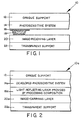
- FIG. 1 is an enlarged schematic cross-sectional view of an arrangement of essential elements of a preferred film unit of the present invention.
- FIG. 2 is an enlarged schematic cross-sectional view of a photographic laminate of the invention formed by the processing of the film unit of FIG. 1.
- the present invention is directed toward photographic diffusion transfer products and processes.
- the present invention is applicable to products and processes wherein an image-receiving layer is separated from a photosensitive layer(s), (i.e. "peel-apart” film units), and those products and processes wherein a layer containing a diffusion transfer image, is not separated from the developed photosensitive layers after processing but is retained with the developed photosensitive layers as part of a permanent laminate, i.e. "integral film units.”
- Integral film units generally include a light-reflecting layer including a light-reflecting pigment positioned in the laminate between the developed photosensitive layer or layers and the image-carrying layer which serves to mask the developed photosensitive layer or layers and provides a light-reflecting background against which the photographic image can be viewed.
- These layers are part of a permanent laminate which includes outer or support layers at least one of which is transparent to permit the viewing therethrough of the photographic image.
- the light-reflecting layer may be provided in the photographic laminate as the result of the spreading between the photographic emulsion layer (or layers) and the image-receiving layer of the photographic film unit, a processing composition including the light-reflecting pigment and a thickening agent.
- the layer of processing composition distributed during processing of the film unit forms the light-reflecting layer which also may be designed so as to bond the layers of the film unit together in forming the desired permanent laminate.
- the present invention is particularly concerned with the nature of the photographic processing composition utilized in the photographic film units of the invention.
- the light-reflecting pigments employed in the processing compositions of the invention include any of a variety of light-reflecting pigments suited to the provision of a white background for the viewing thereagainst of a diffusion transfer photographic image.
- the light-reflecting pigment serves to mask the developed silver halide emulsion layer or layers and helps to provide opacification protection for the developing emulsion layer or layers in the event in-light processing of a film unit is desired.
- titanium dioxide is preferred
- other suitable light-reflecting pigments are known and include barium sulfates, zinc oxides, alumina, zirconium oxides or the like, as described, for example, in aforementioned U.S. Pat. No. 3,647,437.
- the light-reflecting pigments can be suitably employed.
- the specific nature of the processing composition and the specific film unit often dictate the choice of light reflecting material.
- titanium dioxide having a particle size of 0.18 microns available from the Dupont Corporation under the tradename R101 is preferred.
- the light-reflecting pigment will constitute a major component of such processing compositions, usually at least 25% by weight and preferably in the range of about 35% to about 60% by weight.
- the processing compositions of the present invention are aqueous alkaline compositions having a pH in excess of about 10, and frequently in the order of about 14.
- alkaline materials such as sodium hydroxide and potassium hydroxide may be used.
- alkaline materials such as sodium carbonate, potassium carbonate, and borates may be used.
- the processing compositions of the present invention include a thickening agent which constitutes a film-forming material of the type which, when the composition is spread and dried, forms a relatively firm and stable film.
- the subject processing composition comprises between 0.5 and 2.0% by weight of thickening agent - an amount sufficient to impart the processing composition with a viscosity in excess of 100 cps. (as measured at a temperature of approximately 24°C with a Brookfield Viscometer at 2 r.p.m. using a T-shaped C spindle).
- the viscosity of the processing composition is preferably in the order of 100,000 cps. to 250,000 cps. A viscosity of about 200,000 cps. at approximately 24°C has been consistently reported and has been found to be satisfactory.
- the thickening agents of the present invention comprise copolymers polymerized from monomer systems comprising:
- the hydrophobe constitutes up to about 40% by weight of the thickening agent, and more preferably, from about 10-25% by weight of the thickening agent.
- the thickening agent also preferably includes up to about 5% by weight of a crosslinking compound, preferably a polyunsaturated crosslinking compound. Examples of suitable crosslinking compounds and methods for preparing polymers described above can be found by reference to U.S. Patent No.s 5,004,598; 4,996,274; 4,923,940; 4,911,736; 4,421,902; and 4,062,817.
- the hydrophobe portion of the thickening agent forms intermolecular associations with the other constituents of the processing composition.
- the hydrophobically modified thickening agent tends to stabilize the entire composition thereby reducing pooling, i.e. preventing the formation of heterogenous layers or phases.
- Hydrophobes of the present invention must be stable, i.e. not substantially hydrolyze, in the high pH of photographic processing composition used therewith.
- the pH value of the composition will dictate the selection of the hydrophobe along with other various constituents of the processing composition and film unit.
- N-substituted acrylamides having alkyl groups of 1-18 carbon atoms wherein the carbon atom of attachment of the alkyl group is tertiary tend to be stable at pH values as high as 14. Consequently, these hydrophobes are generally preferred for processing compositions having very high pH values.
- Specific examples of such hydrophobes include: t-butyl acrylamide, t-butyl methacrylamide, tert-octyl acrylamide, and diacetone acrylamide.
- acrylic ester hydrophobes may also be used in the present invention.
- hydrophobes include: decyl acrylate, isodecyl acrylate, lauroyl acrylate, stearyl acrylate, behenyl acrylate, stearyl methacrylate, 2-ethylhexyl acrylate, and nonyl phenylacrylate.
- the preferred thickening agent for a high pH (in the range of about 13 to 14) photographic processing composition for use in connection with an integral film unit as described in detail below is a crosslinked random copolymer of acrylic acid and 20% by weight of t-butyl acrylamide, e.g. ISX 1993TM sold by the B.F. Goodrich Company.
- Other examples of a thickening agents within the scope of the present invention include: crosslinked random copolymers of acrylic acid and stearyl methacrylate, e.g. ISX 2390TM and ISX 1790TM, both sold by the B.F. Goodrich Company. It has been observed that some processing compositions including acrylic ester thickening agents (e.g.
- stearyl methacrylate may exhibit some undesirable textural properties after prolonged storage in processing compositions having pH values of about 14, i.e. the formation of a mealy-type structure.
- pH values of about 14 i.e. the formation of a mealy-type structure.
- these thickening agents provide advantageous results in accordance with the subject invention, particularly at processing compositions having lower pH values.
- the processing compositions of the present invention may additionally include known silver halide developing agents, development restrainers, opacification dyes, tint dyes and other photographic agents typically included in such compositions.
- the selection of constituents of the processing composition along with dyes and other components of a film unit are generally dependent upon the pH environment of the film unit.
- Some preferred processing compositions for integral film units operating at pH values around 13 to 14 are provided below in TABLE 1.
- processing compositions for peel apart film units will generally not include opacification dyes but may include small quantities of light-reflecting pigments.
- compositions can be incorporated into rupturable or frangible containers to facilitate spreading in diffusion transfer processing.
- suitable rupturable containers and their methods of manufacture can be found, for example, in U.S. Pat. Nos. 2,543,181; 2,634,886; 3,653,732 and 3,056,491.
- Image dye-providing materials which may be employed in the present invention generally may be characterized as either (1) initially soluble or diffusible in the processing composition but are selectively rendered non-diffusible in an imagewise pattern as a function of development; or (2) initially insoluble or non-diffusible in the processing composition but which are selectively rendered diffusible or provide a diffusible product in an imagewise distribution as a function of development.
- These materials may be complete dyes or dye intermediates, e.g., color couplers.
- the requisite differential in mobility or solubility may, for example, be obtained by a chemical action such as a redox reaction, a coupling reaction or a silver ion assisted cleavage reaction.
- a particularly useful system for forming color images by diffusion transfer is that described in U.S. Patent No. 2,983,606, employing dye developers (dyes which are also silver halide developing agents) as the image dye-providing materials.
- a photosensitive element comprising at least one silver halide layer having a dye developer associated therewith (in the same or in an adjacent layer) is developed by applying an aqueous alkaline processing composition.
- Dye developers are compounds which contain the chromophoric system of a dye and also a silver halide developing function.
- a silver halide developing function is meant a grouping adapted to develop exposed silver halide.
- a preferred silver halide developing function is a hydroquinonyl group.
- Other suitable developing functions include ortho-dihydroxyphenyl and ortho- and para-amino substituted hydroxyphenyl groups.
- the development function includes a benzenoid developing function, that is, an aromatic developing group which forms a quinoid or quinone substance when oxidized.
- the photographic processing compositions of the present invention can be employed in a variety of diffusion transfer processes including those relating to both peel apart and integral film products and processes.
- the arrangement and order of the individual layers of the film units used in such processes can vary in manners known in the art.
- the more specific descriptions of the invention hereinafter set forth will be by use of particular dye-image providing materials in a diffusion transfer color process and of integral film units of the type previously described. Details relating to integral film units of the type herein can be found, for example, in U.S. Pat. Nos. 3,415,644 and 3,647,437.
- image-forming reagents may be used, e.g., dye developers, color couplers, coupling dyes, or compounds which release a diffusible dye or dye intermediate as a result of coupling, oxidation or silver ion-assisted cleavage.
- FIG. 1 shows a photographic diffusion transfer film unit of the invention adapted to the provision of an integral positive-negative photographic laminate.
- the film unit 10 includes a photosensitive element comprising an opaque support 12 carrying a photosensitive system 14 which may include one or more photosensitive layers.
- Film unit 10 includes an image-receiving element comprising a transparent support material 22 carrying an image-receiving layer 20 .
- the nature of support materials 12 and 22 can vary among a class of known sheet materials.
- a preferred support material is polyethylene terephthalate.
- a rupturable container 16 Positioned between the photosensitive and image-receiving elements is shown a rupturable container 16 containing a processing composition 18 of the invention. After photoexposure of photosensitive system 14 through transparent support 22 and image-receiving layer 20 as shown, film unit 10 can be passed between a pair of camera rolls so as to uniformly distribute processing composition 18 between photosensitive system 14 and image-receiving layer 20 .
- FIG. 2 a photographic laminate of the invention 10 a formed by exposure and processing of film unit 10 of FIG. 1 .
- processing composition 18 of FIG. 1 is distributed over photosensitive system 14 , development of photoexposed photosensitive system 14 is initiated to establish an imagewise distribution of diffusible image-providing material which can comprise one or more dye or dye intermediate image-providing materials.
- the imagewise distribution of image-providing material diffuses through the spread processing composition 18 to the image-carrying layer 20a where it is mordanted, precipitated or otherwise retained.
- the spread processing composition 18 provides a light-reflecting layer 18a , against which the image is viewed through the transparent support 22 .
- a photographic film unit can comprise a temporary laminate including the several layers of the photographic film unit confined between two suitable supports and having the bond between a predetermined pair of layers being weaker than the bond between other pairs of layers.
- image-receiving layer 20 can be temporarily bonded to the photosensitive layer 14 prior to exposure.
- the rupturable container or pod 16 can then be positioned such that, upon its rupture, the processing composition will delaminate the temporary bond and be distributed between the aforesaid layers 14 and 20 .
- the distributed layer of processing composition upon drying forms light-reflecting layer 18 a which serves to bond the layers together to form the desired permanent laminate.
- prelaminated film units i.e., film units in which the several elements are temporarily laminated together prior to exposure
- a particularly useful and preferred prelamination utilizes a water-soluble polyethylene glycol as described and claimed in U.S. Pat. No. 3,793,023.
- the film unit shown in FIG. 1 may utilize a transparent support instead of the opaque support 12 shown therein.
- an opaque layer e.g., pressure-sensitive
- photoexposure is effected through the image-receiving element. While this is a particularly useful and preferred embodiment, it will be understood that the image-receiving element may be initially positioned out of the exposure path and superposed upon the photosensitive element after photoexposure, in which event the processing and final stages would be the same as in FIG. 1 .
- the film unit illustrated in FIG. 1 has, for convenience, been shown as a monochrome film.
- Multicolor images may be obtained by providing the requisite number of differentially exposable silver halide emulsions, and said silver halide emulsions are most commonly provided as individual layers coated in superposed relationship.
- Film units intended to provide multicolor images comprise two or more selectively sensitized silver halide layers each having associated therewith an appropriate image dye-providing material providing an image dye having spectral absorption characteristics substantially complementary to the light by which the associated silver halide is exposed.
- the most commonly employed negative components for forming multicolor images are of the "tri-pack" structure and contain blue-, green-, and red-sensitive silver halide layers each having associated therewith in the same or in a contiguous layer a yellow, a magenta and a cyan image dye-providing material, respectively. Interlayers or spacer layers may, if desired, be provided between the respective silver halide layers and associated image dye-providing materials or between other layers. Integral multicolor photosensitive elements of this general type are disclosed in U.S. Pat. No. 3,345,163 as well as in the previously noted U.S. Pat. Nos., e.g., in FIG. 9 of the U.S. Pat. No. 2,983,606.
- film units may also utilize silver halide layers sensitized to light substantially different than the image dye-providing material associated therewith.
- Such systems often- referred to as “false color systems” may utilize for example, silver halide layers sensitized to infra-red wavelengths of light (generated by way of laser) for releasing visibly colored image dye-providing materials.
- the dye developers are preferably selected for their ability to provide colors that are useful in carrying out subtractive color photography, that is, the previously mentioned cyan, magenta and yellow. They may be incorporated in the respective silver halide emulsion or, in the preferred embodiment, in a separate layer behind the respective silver halide emulsion.
- a dye developer may, for example, be in a coating or layer behind the respective silver halide emulsion and such a layer of dye developer may be applied by use of a coating solution containing the respective dye developer distributed, in a concentration calculated to give the desired coverage of dye developer per unit area, in a film-forming natural, or synthetic polymer, for example, gelatin, polyvinyl alcohol, and the like, adapted to be permeated by the processing composition.
- color transfer images are obtained by exposing a photosensitive element, sometimes referred to as a "negative component", comprising at least a light-sensitive layer, e.g., a gelatin silver halide emulsion layer, having an image dye-providing material associated therewith in the same or in an adjacent layer, to form a developable image; developing this exposed element with a processing composition to form an imagewise distribution of a diffusible image dye-providing material; and transferring this imagewise distribution, at least in part, by diffusion, to a superposed image-receiving layer, often referred to as a "positive component", comprising at least a dyeable stratum to provide a color transfer image.
- a photosensitive element sometimes referred to as a "negative component”
- a light-sensitive layer e.g., a gelatin silver halide emulsion layer
- an image dye-providing material associated therewith in the same or in an adjacent layer
- the negative and positive components initially may be carried on separate supports which are brought together during processing and thereafter retained together as the final integral negative-positive reflection print, or they may initially comprise a unitary structure, e.g., integral negative-positive film units as previously described herein. These components may be laminated together or otherwise secured together in physical juxtaposition.
- the image-receiving layer may comprise any of the materials known in the art, such as polyvinyl alcohol, gelatin, etc., preferably containing a mordant for the transferred image dye(s). If the color of the transferred image dye(s) is affected by changes in pH, the pH of the image layer may be adjusted to provide a pH affording the desired color.
- polymeric acids may be polymers which contain acid groups, e.g., carboxylic acid and sulfonic acid groups, which are capable of forming salts with alkali; or potentially acid-yielding groups such as anhydrides or lactones.
- acid polymer may contain free carboxyl groups.
- the acid-reacting reagent may be in a layer adjacent the silver halide most distant from the image-receiving layer, as disclosed in U.S. Patent No. 3,573,043. Another system for providing an acid-reacting reagent is disclosed in U.S. Patent No. 3,576,625.
- the concentration of opacifying dye(s) is selected to provide the optical transmission density required, in combination with the other layers between the silver halide emulsion layer(s) and the incident radiation, to prevent non-imagewise exposure, i.e., fogging by incident actinic light during performance of the particular photographic process.
- the transmission density and the concentration of opacifying dye(s) necessary to provide the requisite protection from incident light may be readily determined for any photographic process by routine experimentation, as a function of film speed or sensitivity, thickness of opacification layer, processing time, anticipated incident light intensity, etc., as described in said U.S. Patent No. 3,647,437.
- a particular transmission density may not be required for all portions of the spectrum, lesser density being sufficient in wavelength regions corresponding to lesser sensitivities of the particular photosensitive material.
- a mixture of opacifying dyes may be used to obtain absorption in all critical areas of the visible and near infrared spectrum for which the silver halide emulsions being used are exposable. Examples of suitable opacification dyes are found in U.S. Pat. Nos. 3,647,347; 4,615,966; 4,891,298; and 5,244,771.
- the processing composition of the preferred integral film unit as described in detail below includes a combination of the following two opacification dyes: 3-(7-n-hexadecylsulfonamidoindoindol-3-yl)-(6- dimethylsulfamoylindol -3 yl) naphthalide, represented by the formula: the synthesis of which may be readily determined by those skilled in the art with reference to U.S. Patent No.
- the processing compositions of the present invention may also include the following active quaternary ammonium salts: Where a light-absorbing optical filter agent (e.g. opacifying dye) is present in the processing composition, it is advantageous to utilize an image-receiving component having a surface layer adapted to decolorize the optical filter agent adjacent the interface between said component and the layer of processing composition. Suitable decolorizing layers are described in U.S. Patent Nos. 4,298,674; 4,294,907 and 4,367,277.
- integral photographic film units were prepared utilizing the subject processing compositions as described in the examples presented hereinbelow.
- All of the examples presented herein are multicolor photosensitive elements comprising three photosensitive emulsion layers of the type generally described in U.S. Patent No. 4,740,448, wherein each example includes a blue-sensitive silver halide emulsion which controls the yellow dye density, a green-sensitive silver halide emulsion which controls the magenta dye density, and a red sensitive silver halide emulsion which controls the cyan dye density.
- Each of the examples represent substantially identical photographic film units but for the presence of different thickening agents utilized in the processing compositions thereof. It is noted, that although efforts to keep the constituents of each component of the example film units identical, there are small variances in the actual amounts and coverages between examples.
- An image-receiving element may be prepared by obtaining an approximately 3.5 mil polyethylene terephthalate film base including cyan and magenta an anti-light piping dyes and an ultra violet absorbing dye (available from the Imperial Chemical Industries Americas Co.), upon which the following layers are coated in succession:
- the photosensitive element is placed in a superposed relationship with the image receiving element with their respective supports outermost and a rupturable container retaining an aqueous alkaline processing composition fixedly mounted at the leading edge of the superposed elements, by pressure-sensitive or heat-sensitive tapes to make a film unit, so that, upon application of compressive force to the container to rupture the marginal seal of the container, the contents thereof would be distributed between the superposed elements.
- the aqueous alkaline processing composition of the examples provided herein all comprised the constituents and relative amounts as provided in TABLE 1.
- TABLE 1 Constituents Parts by weight % Water 42.7 Titanium dioxide 43.0 Potassium hydroxide 5.7 Colloidal silica 0.6 *Thickening agent 1.0 N-ethyl dioxanyl alpha picolinium bromide 1.3 N-phenyl propyl alpha picolinium bromide 0.3 Transexamic acid (trans-4-aminomethyl cyclohexane carboxylic acid) 0.2 6-methyl uracil 0.5 Hypoxanthine 0.7 Hydroxy PMT (hydroxy phenyl mercaptotetrazole) 0.02 2-ethylimidazole 1.5 3,5-dimethyl pyrazole 0.06 PMT (phenyl mercaptotetrazole) 0.0005 Sodium salt of paratoluene sulfinic acid 0.5 3-(7-n-hexadecylsulf
- pooling of each of the example photographic processing compositions was measured and is recorded in TABLE 2. Pooling was measured by measuring out equal volumes of each processing composition into individual 3 mm diameter Wintrobe tubes, sealing each tube and centrifuging for approximately 10 minutes. (The particular centrifuge used for the examples provided herein positioned the sample tubes at a 45 degree angle, and was operated at a rotational speed which subjected the top portion of each tube to a force of approximately 380 G and the bottom of each tube to approximately 1090 G.) Subsequently, the tubes were removed and both the total height of the contents of the inside of the tube and the height of the pooled fluid were measured. The amount of pooling is expressed as percent pooling by dividing the pool height by the total height and multiplying the resulting number by 100.
- pooling was significantly reduced in processing compositions utilizing thickening agents which were hydrophobically modified. More specifically, utilization of thickening agents copolymerized with the hydrophobe and carboxylic acid monomers of the present invention, resulted in a photographic processing compositions having lower percentages of pooling.
Landscapes
- Physics & Mathematics (AREA)
- General Physics & Mathematics (AREA)
- Silver Salt Photography Or Processing Solution Therefor (AREA)
- Compositions Of Macromolecular Compounds (AREA)
Applications Claiming Priority (2)
| Application Number | Priority Date | Filing Date | Title |
|---|---|---|---|
| US243974 | 1994-05-17 | ||
| US08/243,974 US5422233A (en) | 1994-05-17 | 1994-05-17 | Photographic processing compositions including hydrophobically modified thickening agent |
Publications (3)
| Publication Number | Publication Date |
|---|---|
| EP0683430A2 true EP0683430A2 (fr) | 1995-11-22 |
| EP0683430A3 EP0683430A3 (fr) | 1996-12-27 |
| EP0683430B1 EP0683430B1 (fr) | 1999-03-31 |
Family
ID=22920866
Family Applications (1)
| Application Number | Title | Priority Date | Filing Date |
|---|---|---|---|
| EP95101799A Expired - Lifetime EP0683430B1 (fr) | 1994-05-17 | 1995-02-09 | Compositions de traitement photographiques incluant un agent éprassissant hydrophobiquement modifié |
Country Status (5)
| Country | Link |
|---|---|
| US (1) | US5422233A (fr) |
| EP (1) | EP0683430B1 (fr) |
| JP (1) | JP2875963B2 (fr) |
| CA (1) | CA2138915C (fr) |
| DE (1) | DE69508652T2 (fr) |
Cited By (1)
| Publication number | Priority date | Publication date | Assignee | Title |
|---|---|---|---|---|
| WO1997029405A1 (fr) * | 1996-02-09 | 1997-08-14 | Polaroid Corporation | Systeme photographique |
Families Citing this family (10)
| Publication number | Priority date | Publication date | Assignee | Title |
|---|---|---|---|---|
| JP2888755B2 (ja) * | 1994-04-28 | 1999-05-10 | 株式会社メガチップス | 半導体装置 |
| GB2304200B (en) * | 1995-07-07 | 1999-04-14 | Kodak Ltd | Processing liquid for lamination processing |
| US5858608A (en) * | 1997-10-16 | 1999-01-12 | Polaroid Corporation | Diffusion transfer photosensitive film unit for silver transfer image |
| US6001531A (en) * | 1997-12-23 | 1999-12-14 | Polaroid Corporation | Photographic processing composition and film unit |
| US6100005A (en) * | 1998-05-29 | 2000-08-08 | Polaroid Corporation | Photographic element and method |
| US7101928B1 (en) * | 1999-09-17 | 2006-09-05 | Landec Corporation | Polymeric thickeners for oil-containing compositions |
| US6296993B1 (en) * | 2000-06-13 | 2001-10-02 | Eastman Kodak Company | Method of providing digitized photographic image |
| US6309810B1 (en) * | 2000-06-13 | 2001-10-30 | Eastman Kodak Company | Photochemical delivery article and method of use |
| EP3526801B1 (fr) | 2016-10-14 | 2022-12-07 | C3Nano Inc. | Films conducteurs stabilisés en métal épars et solutions pour obtention de composés stabilisants |
| JP7156259B2 (ja) * | 2019-11-26 | 2022-10-19 | Jfeスチール株式会社 | 金属板およびその製造方法 |
Family Cites Families (20)
| Publication number | Priority date | Publication date | Assignee | Title |
|---|---|---|---|---|
| BE514708A (fr) * | 1951-10-10 | |||
| US3390990A (en) * | 1965-09-20 | 1968-07-02 | Polaroid Corp | Novel photographic products and processes |
| US3856521A (en) * | 1972-04-24 | 1974-12-24 | Polaroid Corp | Diffusion transfer color film and process |
| JPS5034233A (fr) * | 1973-07-26 | 1975-04-02 | ||
| JPS5048923A (fr) * | 1973-08-31 | 1975-05-01 | ||
| US4062817A (en) * | 1977-04-04 | 1977-12-13 | The B.F. Goodrich Company | Water absorbent polymers comprising unsaturated carboxylic acid, acrylic ester containing alkyl group 10-30 carbon atoms, and another acrylic ester containing alkyl group 2-8 carbon atoms |
| US4202694A (en) * | 1977-04-21 | 1980-05-13 | Polaroid Corporation | Pendant oxime polymers and photographic use thereof |
| US4324853A (en) * | 1979-07-18 | 1982-04-13 | Polaroid Corporation | Photographic processing composition containing polyol |
| US4294907A (en) * | 1980-04-24 | 1981-10-13 | Polaroid Corporation | Image-receiving elements |
| US4397996A (en) * | 1981-05-22 | 1983-08-09 | Polaroid Corporation | Process for preparing polymeric oximes and compositions containing same |
| US4421902A (en) * | 1982-09-30 | 1983-12-20 | Rohm And Haas Company | Alkyl, poly(oxyethylene) poly(carbonyloxyethylene) acrylate emulsion copolymers for thickening purposes |
| US4496651A (en) * | 1983-07-25 | 1985-01-29 | Polaroid Corporation | Color transfer photographic processes and products |
| US4911736A (en) * | 1985-09-18 | 1990-03-27 | The Standard Oil Company | Emulsifier and stabilizer for water base emulsions and dispersions of hydrocarbonaceous materials |
| US4680247A (en) * | 1986-03-31 | 1987-07-14 | Polaroid Corporation, Patent Dept. | Photographic processing composition with poly(diacetone acrylamide) oxime and styrene-butadiene latex |
| US5004598A (en) * | 1986-11-10 | 1991-04-02 | The B. F. Goodrich Company | Stable and quick-breaking topical skin compositions |
| JPH01100552A (ja) * | 1987-10-13 | 1989-04-18 | Mitsubishi Paper Mills Ltd | 平版印刷版用現像液 |
| US4923940A (en) * | 1988-02-19 | 1990-05-08 | The B.F. Goodrich Company | Polycarboxylic acids with higher thickening capacity and better clarity |
| US4996274A (en) * | 1988-02-19 | 1991-02-26 | The B. F. Goodrich Company | Polycarboxylic acids with higher thickening capacity and better clarity |
| DE4009310A1 (de) * | 1990-03-23 | 1991-09-26 | Agfa Gevaert Ag | Granulierte fotochemikalien |
| JP2687043B2 (ja) * | 1990-04-27 | 1997-12-08 | 富士写真フイルム株式会社 | ハロゲン化銀カラー写真感光材料の処理方法 |
-
1994
- 1994-05-17 US US08/243,974 patent/US5422233A/en not_active Expired - Lifetime
- 1994-12-22 CA CA002138915A patent/CA2138915C/fr not_active Expired - Fee Related
-
1995
- 1995-02-09 EP EP95101799A patent/EP0683430B1/fr not_active Expired - Lifetime
- 1995-02-09 DE DE69508652T patent/DE69508652T2/de not_active Expired - Fee Related
- 1995-02-21 JP JP7032007A patent/JP2875963B2/ja not_active Expired - Lifetime
Cited By (1)
| Publication number | Priority date | Publication date | Assignee | Title |
|---|---|---|---|---|
| WO1997029405A1 (fr) * | 1996-02-09 | 1997-08-14 | Polaroid Corporation | Systeme photographique |
Also Published As
| Publication number | Publication date |
|---|---|
| JPH07309991A (ja) | 1995-11-28 |
| DE69508652D1 (de) | 1999-05-06 |
| JP2875963B2 (ja) | 1999-03-31 |
| EP0683430A3 (fr) | 1996-12-27 |
| CA2138915C (fr) | 1998-09-29 |
| DE69508652T2 (de) | 1999-07-29 |
| CA2138915A1 (fr) | 1995-11-18 |
| US5422233A (en) | 1995-06-06 |
| EP0683430B1 (fr) | 1999-03-31 |
Similar Documents
| Publication | Publication Date | Title |
|---|---|---|
| US3594165A (en) | Novel photographic products and processes | |
| JPS602654B2 (ja) | 写真組体 | |
| EP0683430B1 (fr) | Compositions de traitement photographiques incluant un agent éprassissant hydrophobiquement modifié | |
| US3615422A (en) | Photographic products and processes | |
| CA1305347C (fr) | Films couleur hybrides | |
| US3888669A (en) | Photographic products and processes with barrier layers for diffusable dyes | |
| US4377632A (en) | Diffusion transfer film units with application of processing composition between dye developer layer and silver halide emulsion layer | |
| US3778265A (en) | Novel photographic products and processes | |
| US4347301A (en) | Novel diffusion transfer film units | |
| US3816125A (en) | Photographic products and processes | |
| US4503138A (en) | Image-receiving element with unitary image-receiving and decolorizing layer | |
| US4456674A (en) | Color transfer photographic processes and products | |
| US4839257A (en) | Color diffusion transfer photographic film unit | |
| US3996050A (en) | Whitening agents in color diffusion transfer film units | |
| US3856522A (en) | Spacer layer for dye diffusion transfer film | |
| US4777112A (en) | Polyoxyalkylene overcoats for image-receiving elements | |
| US4032349A (en) | High molecular weight mercapto compound in color diffusion transfer processing composition | |
| US3726675A (en) | Film units comprising light reflecting materials and 9-(2-(n-alkyl)-pyridyl)-fluorene optical filter agents and processes for their use | |
| JPS6147413B2 (fr) | ||
| US4088487A (en) | Diffusion transfer integral film units with flare reducing layers | |
| US3794485A (en) | Color diffusion transfer film with incorporated dye and desensitizing agent precursor | |
| US4542087A (en) | Use of reflecting agent in yellow dye image-providing material layer | |
| US3620724A (en) | Photographic color diffusion transfer processes and elements for use therein | |
| US5858608A (en) | Diffusion transfer photosensitive film unit for silver transfer image | |
| US3647434A (en) | Integral negative/positive color diffusion transfer process film unit employing in situ generated visible light-reflecting agent |
Legal Events
| Date | Code | Title | Description |
|---|---|---|---|
| PUAI | Public reference made under article 153(3) epc to a published international application that has entered the european phase |
Free format text: ORIGINAL CODE: 0009012 |
|
| AK | Designated contracting states |
Kind code of ref document: A2 Designated state(s): DE FR GB NL |
|
| PUAL | Search report despatched |
Free format text: ORIGINAL CODE: 0009013 |
|
| AK | Designated contracting states |
Kind code of ref document: A3 Designated state(s): DE FR GB NL |
|
| 17P | Request for examination filed |
Effective date: 19970214 |
|
| 17Q | First examination report despatched |
Effective date: 19971222 |
|
| GRAG | Despatch of communication of intention to grant |
Free format text: ORIGINAL CODE: EPIDOS AGRA |
|
| GRAG | Despatch of communication of intention to grant |
Free format text: ORIGINAL CODE: EPIDOS AGRA |
|
| GRAH | Despatch of communication of intention to grant a patent |
Free format text: ORIGINAL CODE: EPIDOS IGRA |
|
| GRAH | Despatch of communication of intention to grant a patent |
Free format text: ORIGINAL CODE: EPIDOS IGRA |
|
| GRAA | (expected) grant |
Free format text: ORIGINAL CODE: 0009210 |
|
| AK | Designated contracting states |
Kind code of ref document: B1 Designated state(s): DE FR GB NL |
|
| PG25 | Lapsed in a contracting state [announced via postgrant information from national office to epo] |
Ref country code: NL Free format text: LAPSE BECAUSE OF FAILURE TO SUBMIT A TRANSLATION OF THE DESCRIPTION OR TO PAY THE FEE WITHIN THE PRESCRIBED TIME-LIMIT Effective date: 19990331 Ref country code: FR Free format text: LAPSE BECAUSE OF FAILURE TO SUBMIT A TRANSLATION OF THE DESCRIPTION OR TO PAY THE FEE WITHIN THE PRESCRIBED TIME-LIMIT Effective date: 19990331 |
|
| REF | Corresponds to: |
Ref document number: 69508652 Country of ref document: DE Date of ref document: 19990506 |
|
| EN | Fr: translation not filed | ||
| NLV1 | Nl: lapsed or annulled due to failure to fulfill the requirements of art. 29p and 29m of the patents act | ||
| PLBE | No opposition filed within time limit |
Free format text: ORIGINAL CODE: 0009261 |
|
| STAA | Information on the status of an ep patent application or granted ep patent |
Free format text: STATUS: NO OPPOSITION FILED WITHIN TIME LIMIT |
|
| 26N | No opposition filed | ||
| REG | Reference to a national code |
Ref country code: GB Ref legal event code: IF02 |
|
| PGFP | Annual fee paid to national office [announced via postgrant information from national office to epo] |
Ref country code: GB Payment date: 20040115 Year of fee payment: 10 |
|
| PGFP | Annual fee paid to national office [announced via postgrant information from national office to epo] |
Ref country code: DE Payment date: 20040116 Year of fee payment: 10 |
|
| PG25 | Lapsed in a contracting state [announced via postgrant information from national office to epo] |
Ref country code: GB Free format text: LAPSE BECAUSE OF NON-PAYMENT OF DUE FEES Effective date: 20050209 |
|
| PG25 | Lapsed in a contracting state [announced via postgrant information from national office to epo] |
Ref country code: DE Free format text: LAPSE BECAUSE OF NON-PAYMENT OF DUE FEES Effective date: 20050901 |
|
| GBPC | Gb: european patent ceased through non-payment of renewal fee |
Effective date: 20050206 |