EP0683980A2 - Fungizide Mittel - Google Patents
Fungizide Mittel Download PDFInfo
- Publication number
- EP0683980A2 EP0683980A2 EP95111985A EP95111985A EP0683980A2 EP 0683980 A2 EP0683980 A2 EP 0683980A2 EP 95111985 A EP95111985 A EP 95111985A EP 95111985 A EP95111985 A EP 95111985A EP 0683980 A2 EP0683980 A2 EP 0683980A2
- Authority
- EP
- European Patent Office
- Prior art keywords
- active ingredient
- active
- acid
- acid addition
- formula
- Prior art date
- Legal status (The legal status is an assumption and is not a legal conclusion. Google has not performed a legal analysis and makes no representation as to the accuracy of the status listed.)
- Granted
Links
Classifications
-
- A—HUMAN NECESSITIES
- A01—AGRICULTURE; FORESTRY; ANIMAL HUSBANDRY; HUNTING; TRAPPING; FISHING
- A01N—PRESERVATION OF BODIES OF HUMANS OR ANIMALS OR PLANTS OR PARTS THEREOF; BIOCIDES, e.g. AS DISINFECTANTS, AS PESTICIDES OR AS HERBICIDES; PEST REPELLANTS OR ATTRACTANTS; PLANT GROWTH REGULATORS
- A01N43/00—Biocides, pest repellants or attractants, or plant growth regulators containing heterocyclic compounds
- A01N43/64—Biocides, pest repellants or attractants, or plant growth regulators containing heterocyclic compounds having rings with three nitrogen atoms as the only ring hetero atoms
- A01N43/647—Triazoles; Hydrogenated triazoles
- A01N43/653—1,2,4-Triazoles; Hydrogenated 1,2,4-triazoles
-
- A—HUMAN NECESSITIES
- A01—AGRICULTURE; FORESTRY; ANIMAL HUSBANDRY; HUNTING; TRAPPING; FISHING
- A01N—PRESERVATION OF BODIES OF HUMANS OR ANIMALS OR PLANTS OR PARTS THEREOF; BIOCIDES, e.g. AS DISINFECTANTS, AS PESTICIDES OR AS HERBICIDES; PEST REPELLANTS OR ATTRACTANTS; PLANT GROWTH REGULATORS
- A01N43/00—Biocides, pest repellants or attractants, or plant growth regulators containing heterocyclic compounds
- A01N43/72—Biocides, pest repellants or attractants, or plant growth regulators containing heterocyclic compounds having rings with nitrogen atoms and oxygen or sulfur atoms as ring hetero atoms
- A01N43/84—Biocides, pest repellants or attractants, or plant growth regulators containing heterocyclic compounds having rings with nitrogen atoms and oxygen or sulfur atoms as ring hetero atoms six-membered rings with one nitrogen atom and either one oxygen atom or one sulfur atom in positions 1,4
Definitions
- the present invention relates to new combinations of active ingredients for combating plant diseases and methods for using such mixtures for leaf, soil and pickling application.
- Component a) has become known under the name of cyproconazole. Their synthesis and fungicidal properties are described in DE-OS 34 06 993.
- Component b) has become known under the name fenpropidin. Their syntheses and fungicidal properties are described in DE-OS 2 752 135.
- the fungicidal activity of the active compound combination according to the invention is significantly higher than the sum of the effects of the individual active compounds. There is therefore an unforeseeable, synergistically increased effect, and not just an addition to the effect that could have been expected from the combination of two active ingredients.
- the active ingredient combinations according to the invention thus represent an enrichment of the technology.
- the weight ratios of the active substances in the active substance combinations can be varied within a relatively wide range depending on the application.
- 0.2-20 parts by weight, preferably 0.5-10 parts by weight of active compound of the formula (III) are present per part by weight of active compound of the formula (I).
- Mixing ratios of a): b) 2: 3; 2: 5; Called 1: 2 and 1: 3.
- the corresponding proportions are suitable for acid addition salts or metal complexes of the active ingredients.
- hydrohalic acids such as hydrobromic acid and hydrochloric acid, furthermore phosphoric acid, nitric acid and sulfuric acid, furthermore mono-, bi- and trifunctional carboxylic acids and hydroxycarboxylic acids such as formic acid, succinic acid , Acetic acid, glycolic acid, fumaric acid, lactic acid, oxalic acid, propionic acid, sorbic acid, trichloroacetic acid, trifluoroacetic acid, citric acid, also sulfonic acids such as benzenesulfonic acid, 1,5-naphthalenedisulfonic acid and p-toluenesulfonic acid and (thio) saccharin.
- hydrohalic acids such as hydrobromic acid and hydrochloric acid, furthermore phosphoric acid, nitric acid and sulfuric acid, furthermore mono-, bi- and trifunctional carboxylic acids and hydroxycarboxylic acids
- succinic acid Acetic acid, glycolic acid, fumaric acid,
- Metal complexes consist of the underlying organic molecule and an inorganic or organic metal salt, for example the halides, nitrates, sulfates, phosphates, acetates, trifluoroacetates, trichloroacetates, propionates, tartrates, Sulfonates, salicylates, benzoates etc. of the elements of the second main group such as aluminum, tin or lead and the first to eighth subgroups such as chromium, manganese, iron, cobalt, nickel, copper, zinc etc. The subgroup elements of the 4th period are preferred .
- the metals can be present in the various valences that they have.
- the active substance mixtures according to the invention are particularly suitable for combating ascomycetes (Erysiphe graminis, Uncinula necator, Venturia, Sphaerotheca pannosa, Erysiphe betae) and Basidiomycetes, which include rust diseases, such as those of the genera Puccinia, Uromyces and Hemileia (especially Puccinia recondita, especially Puccinia recondita striiformis, Puccinia graminis, Puccinia coronata, Uromyces fabae, Uromyces appendiculatus, Hemileia vastatrix).
- the active compound combinations according to the invention act against fungi imperfecti of the genera Helminthosporium (e.g. Helminthosporium oryzae, Helminthosporium teres, Helminthosporium sativum, Helminthosporium tritici-repentis), Alternaria (e.g. Alternaria brassicola, Alternaria brassicae), Septoria (e.g. Septoria (e.g. Septoria ), Ceratocystis (e.g. Ceratocystis ulmi), Pyricularia (e.g. Pyricularia oryzae and Mycosphaerella fijiensis).
- Helminthosporium e.g. Helminthosporium oryzae, Helminthosporium teres, Helminthosporium sativum, Helminthosporium tritici-repentis
- Alternaria e.g. Alternaria brassicola, Alternaria brass
- the active compound combinations according to the invention are also particularly suitable for combating fungal strains which have developed a certain resistance to active compounds from the triazole class.
- the fungicide combinations according to the invention are notable for their systemic, curative and preventive action.
- the active substance mixtures according to the invention can be formulated into various types of agents, for example solutions, suspensions, emulsions, emulsifiable concentrates and powdered preparations.
- Such fungicidal compositions form an object of the present invention.
- the fungicidal compositions according to the invention are characterized in that they contain an effective amount of cyproconazole and fenpropimorph and / or fenpropidine or acid addition salts or metal complexes of these active ingredients and formulation auxiliaries.
- the agents expediently contain at least one of the following formulation auxiliaries: Solid carriers; Solvents or dispersants; Surfactants (wetting agents and emulsifiers); Dispersant (without surfactant); and other additives, such as stabilizers.
- the following are essentially suitable as solid carriers: natural minerals, such as kaolin, clays, kieselguhr, talc, bentonite, chalk, e.g. Sludge chalk, magnesium carbonate, limestone, quartz, dolomite, atta pulgite, montmorillonite and diatomaceous earth; synthetic minerals such as finely divided silica, aluminum oxide and silicates; organic substances such as cellulose, starch, urea and synthetic resins; and fertilizers such as phosphates and nitrates, such carriers e.g. can be present as granules or powder.
- natural minerals such as kaolin, clays, kieselguhr, talc, bentonite, chalk, e.g. Sludge chalk, magnesium carbonate, limestone, quartz, dolomite, atta pulgite, montmorillonite and diatomaceous earth
- synthetic minerals such as finely divided silica, aluminum oxide and silicates
- organic substances such as cellulose, starch,
- solvents or dispersing agents aromatics, such as toluene, xylenes, higher alkylated benzenes and alkylnaphthalenes; chlorinated aromatics and chlorinated aliphatic hydrocarbons such as chlorobenzenes, chloroethylene and methylene chloride; (cyclo) aliphatic hydrocarbons, such as cyclohexane and paraffins, for example petroleum fractions; Alcohols, such as butanol and glycol, and their ethers and esters; Ketones such as acetone, methyl ethyl ketone, methyl isobutyl ketone, isophorone and cyclohexanone; and strongly polar solvents or dispersing agents, such as dimethylformamide, N-methylpyrrolidone and dimethyl sulfoxide, such solvents or dispersing agents preferably having flash points of at least 30 ° C.
- aromatics such as toluene, xylenes, higher
- liquefied gaseous extenders or carriers are also suitable among the solvents or dispersants. These are products that are gaseous at room temperature and under normal pressure. If water is used as the solvent, organic solvents can also be used can be used as auxiliary solvents.
- the surfactants can be non-ionic compounds, such as condensation products of fatty acids, fatty alcohols or fat-substituted phenols with ethylene oxide; Fatty acid esters and ethers of sugars or polyhydric alcohols; the products obtained from sugars or polyhydric alcohols by condensation with ethylene oxide; Block polymers of ethylene oxide and propylene oxide; or alkyldimethylamine oxides.
- the surfactants can be cationic compounds, such as alkyldimethylbenzylammonium chlorides, dialkyldimethylammonium chlorides, alkyltrimethylammonium chlorides and ethoxylated quaternary ammonium chlorides.
- the following are essentially suitable as dispersants (without a surfactant effect): sodium and ammonium salts of lignosulfonic acid, sodium salts of maleic anhydride-diisobutylene copolymers, sodium and ammonium salts of sulfonated polycondensation products from naphthalene and formaldehyde, sodium salts of polymeric carboxylic acids and sulfite waste liquors.
- dispersants which are particularly suitable as thickening or anti-settling agents, e.g. Methyl cellulose, carboxymethyl cellulose, hydroxyethyl cellulose, polyvinyl alcohol, alginates, caseinates and blood albumin can be used.
- Suitable stabilizers are acid-binding agents, for example epichlorohydrin, phenylglycidyl ether and soya epoxides; Antioxidants, for example gallic acid esters and butylated hydroxytoluene; UV absorbers, for example substituted benzophenones, diphenylacrylonitrile acid esters and cinnamic acid esters; and deactivators, for example salts of ethylenediaminetetraacetic acid and polyglycols.
- acid-binding agents for example epichlorohydrin, phenylglycidyl ether and soya epoxides
- Antioxidants for example gallic acid esters and butylated hydroxytoluene
- UV absorbers for example substituted benzophenones, diphenylacrylonitrile acid esters and cinnamic acid esters
- deactivators for example salts of ethylenediaminetetraacetic acid and polyglycol
- the fungicidal compositions according to the invention can also comprise other active compounds, e.g. other fungicidal agents [active component c) or d)], insecticidal and acaricidal agents, bactericides, plant growth regulators and fertilizers.
- active component c) or d) fungicidal agents
- insecticidal and acaricidal agents bactericides
- plant growth regulators and fertilizers e.g. other fungicidal agents [active component c) or d)]
- Combination agents of this type are suitable for broadening the spectrum of action or otherwise having a beneficial effect on plant growth.
- the fungicidal compositions according to the invention contain, depending on their type, between 0.0001 and 95 percent by weight of the active compound combination according to the invention.
- the drug concentration is usually in the higher range of the above concentration interval.
- These forms can then be diluted with the same or different formulation adjuvants to active ingredient concentrations that are suitable for practical use, and such concentrations are normally in the lower range of the above concentration interval.
- Emulsifiable concentrates generally contain 5 to 95 percent by weight, preferably 25 to 85 percent by weight, of the active ingredient combination according to the invention.
- forms of application come i.a. ready-to-use solutions, emulsions and suspensions, which are suitable, for example, as spray liquors. In such spray liquors e.g.
- spray liquors can be formulated in which the active compound concentration is preferably from 0.5 to 20 percent by weight, while the spray liquors formulated in the low-volume process and in the high-volume process preferably have an active compound concentration of 0. 02 to 1.0 or 0.002 to 0.1 percent by weight.
- the fungicidal compositions according to the invention can be prepared by mixing an active ingredient combination according to the invention with formulation auxiliaries.
- the active ingredients can be mixed with a solid carrier are mixed, for example by grinding together; or you can impregnate the solid carrier with a solution or suspension of the active ingredients and then remove the solvent or dispersant by evaporation, heating or by suction under reduced pressure.
- surfactants or dispersing agents such powdery agents can be made easily wettable with water, so that they can be converted into aqueous suspensions, which are suitable, for example, as spraying agents.
- the active compound mixtures according to the invention can also be mixed with a surfactant and a solid carrier to form a wettable powder which is dispersible in water, or they can be mixed with a solid pregranulated carrier to form a granular product.
- the active compound mixtures according to the invention can be dissolved in a water-immiscible solvent, such as, for example, an alicyclic ketone, which expediently contains dissolved emulsifier, so that the solution has a self-emulsifying effect when added to water.
- a water-immiscible solvent such as, for example, an alicyclic ketone, which expediently contains dissolved emulsifier, so that the solution has a self-emulsifying effect when added to water.
- the active ingredient combinations can be mixed with an emulsifier and the mixture can then be diluted with water to the desired concentration.
- the active ingredient combinations can be dissolved in a solvent and then mixed with an emulsifier.
- Such a mixture can also be diluted with water to the desired concentration. In this way, emulsifiable concentrates or ready-to-use emulsions are obtained.
- the agents according to the invention can be used according to the application methods customary in crop protection or in agriculture.
- the method according to the invention for combating harmful fungi is characterized in that the place of plant growth to be protected or the crop to be protected, for example plants, parts of plants or propagation material (for example seeds), is treated with an effective amount of an active compound combination according to the invention or an agent according to the invention.
- Example 1 wettable powder (WP)
- fenpropidine and nonylphenol polyethoxylate are mixed in a first working process and sprayed onto the submitted silica in a powder mixer.
- the other components are then mixed in and e.g. finely ground with a pencil mill.
- the resulting wettable powder when stirred into water, gives a fine suspension in the desired dilution, which is suitable as a ready-to-use spray mixture, e.g. for dressing plant propagation material, such as plant tubers, roots and foliage of seedlings or plant seeds.
- the fungus strain is cultivated for 7 days at 18 ° C. and 16 hours / day of simulated sunlight irradiation on potato dextrose agar (PDA) which contains one or both of the active ingredients or is free of active ingredients (control).
- PDA potato dextrose agar
- the active ingredients I and II are each dissolved in pure ethanol and mixed and diluted according to the desired proportions. Then a certain amount is added to the liquid PDA medium at 50 ° C. and mixed intimately.
- the ethanol concentration in the medium is a uniform 0.1%.
- the liquid culture medium is then poured into Petri dishes (9 cm ⁇ ) and inoculated in the center with an agarrondelle (5 mm ⁇ ) which has been punched out from a 7-day-old mushroom culture.
- the inoculated dishes are incubated for 5 days at 18 ° C in a climate chamber in the dark. Each attempt runs in 3 or 4 repetitions.
Landscapes
- Life Sciences & Earth Sciences (AREA)
- Agronomy & Crop Science (AREA)
- Pest Control & Pesticides (AREA)
- Plant Pathology (AREA)
- Health & Medical Sciences (AREA)
- Engineering & Computer Science (AREA)
- Dentistry (AREA)
- General Health & Medical Sciences (AREA)
- Wood Science & Technology (AREA)
- Zoology (AREA)
- Environmental Sciences (AREA)
- Agricultural Chemicals And Associated Chemicals (AREA)
- Organic Low-Molecular-Weight Compounds And Preparation Thereof (AREA)
- Apparatus Associated With Microorganisms And Enzymes (AREA)
- External Artificial Organs (AREA)
- Preparation Of Compounds By Using Micro-Organisms (AREA)
Abstract
Description
- Gegenstand der vorliegenden Erfindung sind neue Wirkstoffkombinationen zur Bekämpfung von Pflanzenkrankheiten und Verfahren zur Anwendung solcher Gemische zur Blatt-, Boden- und Beizapplikation.
- Die erfindungsgemässen Kombinationen sind gekennzeichnet durch einen Gehalt an
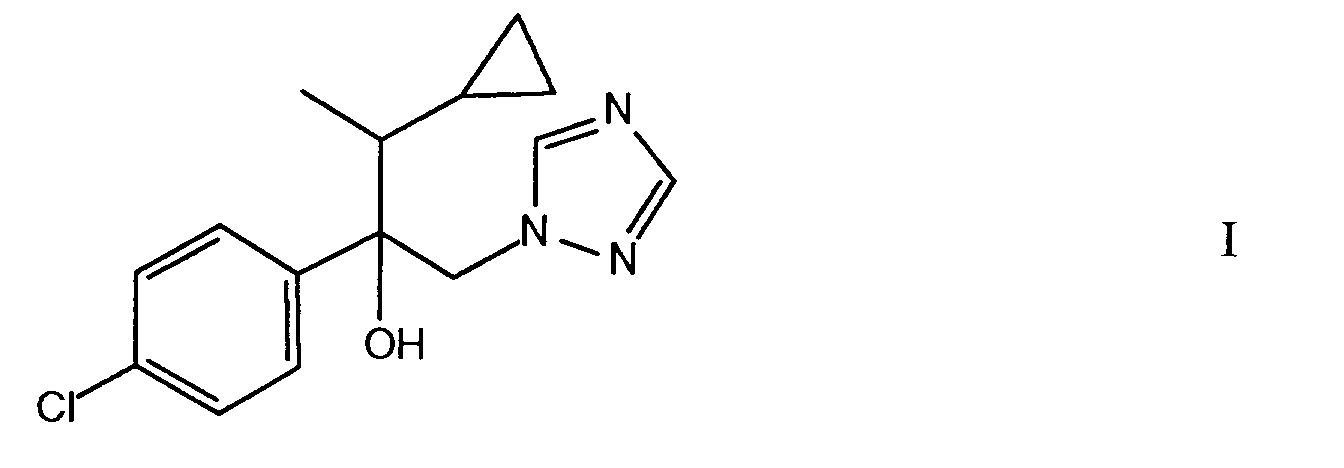
- a) 2-(4-Chlorphenyl)-3-cyclopropyl-1-[(1H-1,2,4-thiazol-1-yl)butan-2-ol der Formel I
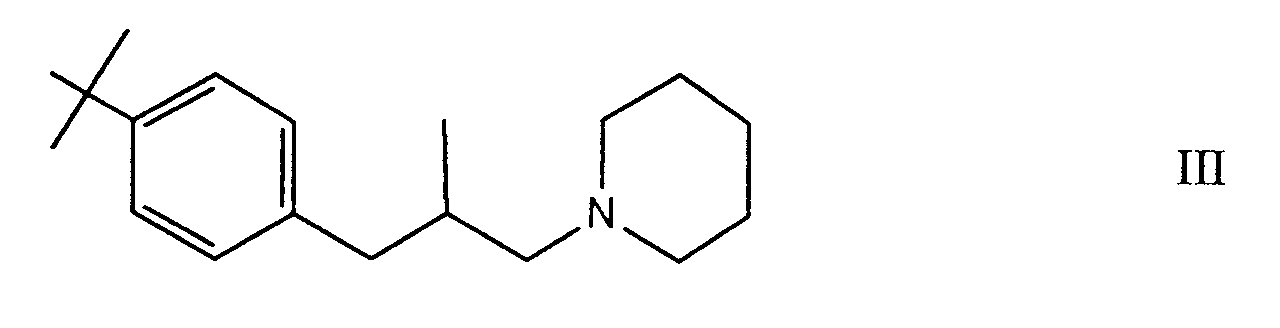
- b) 1-[3-(4-tert.Butylphenyl)-2-methylpropyl]-piperidin der Formel III
- Die Komponente a) ist unter den, Namen Cyproconazol bekannt geworden. Ihre Synthese und fungiziden Eigenschaften sind in der DE-OS 34 06 993 beschrieben.
- Die Komponente b) ist unter dem Namen Fenpropidin bekanntgeworden. Ihre Synthesen und fungiziden Eigenschaften sind in der DE-OS 2 752 135 beschrieben.
- Es wurde überraschenderweise gefunden, dass die fungizide Wirkung der erfindungsgemässen Wirkstoffkombination wesentlich höher ist als die Summe der Wirkungen der einzelnen Wirkstoffe. Es liegt also eine nicht vorhersehbare synergistisch gesteigerte Wirkung vor und nicht nur eine Wirkungsergänzung, wie sie durch die Kombination zweier Wirkstoffe hätte erwartet werden können. Die erfindungsgemässen Wirkstoffkombinationen stellen somit eine Bereicherung der Technik dar.
- Wenn die Wirkstoffe in den erfindungsgemässen Wirkstoffkombinationen in bestimmten Gewichtsverhältnissen vorhanden sind, zeigt sich der synergistische Effekt besonders deutlich. Jedoch können die Gewichtsverhältnisse der Wirkstoffe in den Wirkstoffkombinationen je nach Anwendung in einem relativ grossen Bereich variiert werden. Im allgemeinen entfallen auf einen Gewichtsteil an Wirkstoff der Formel (I) 0,2-20 Gewichtsteile, vorzugsweise 0,5-10 Gewichtsteile an Wirkstoff der Formel (III). Dies entspricht einem Gewichtsverhältnis der Komponente a) zur Komponente b) von 5:1 bis 1:20. Besonders bevorzugt sind Kombinationen in denen auf einen Gewichtsteil der Formel (I) 1 bis 8 Gewichtsteile an Wirkstoff der Formel III entfallen, besonders a):b) = 2:1 bis 1:10 und ganz besonders 1:1 bis 1:4. Als Beispiele seien auch für die Praxis besonders geeignete Mischungsverhältnisse von a):b) = 2:3; 2:5; 1:2 und 1:3 genannt. Für Säureadditionssalze bzw. Metallkomplexe der Wirkstoffe kommen die entsprechenden Mengenverhältnisse in Frage.
- Unter den Säuren, die zur Herstellung von Salzen der Formel I oder III verwendet werden können, sind zu nennen: Halogenwasserstoffsäuren wie Bromwasserstoffsäure und Chlorwasserstoffsäure, ferner Phosphorsäure, Salpetersäure und Schwefelsäure, ferner mono-, bi- und trifunktionelle Carbonsäuren und Hydroxycarbonsäuren wie Ameisensäure, Bernsteinsäure, Essigsäure, Glycolsäure, Fumarsäure, Milchsäure, Oxalsäure, Propionsäure, Sorbinsäure, Trichloressigsäure, Trifluoressigsäure, Zitronensäure, ferner Sulfonsäuren wie Benzolsulfonsäure, 1,5-Naphthalindisulfonsäure und p-Toluolsulfonsäure sowie (Thio)Saccharin.
- Metallkomplexe bestehen aus dem zugrundeliegenden organischen Molekül und einem anorganischen oder organischen Metallsalz, beispielsweise den Halogeniden, Nitraten, Sulfaten, Phosphaten, Acetaten, Trifluoracetaten, Trichloracetaten, Propionaten, Tartraten, Sulfonaten, Salicylaten, Benzoaten usw. der Elemente der zweiten Hauptgruppe wie Aluminium, Zinn oder Blei sowie der ersten bis achten Nebengruppe wie Chrom, Mangan, Eisen, Kobalt, Nickel, Kupfer, Zink usw. Bevorzugt sind die Nebengruppen-Elemente der 4. Periode. Die Metalle können dabei in den verschiedenen ihnen zukommenden Wertigkeiten vorliegen.
- Die erfindungsgemässen Wirkstoffmischungen und deren Säureadditionssalze besitzen pflanzenfungizide Wirkung und können dementsprechend zur Bekämpfung von Pilzen in der Landwirtschaft und im Gartenbau Verwendung finden. Sie eignen sich insbesondere zur Hemmung des Wachstums oder zur Vernichtung von phytopathogenen Pilzen auf Pflanzenteilen, z.B. Blättern, Stengeln, Wurzeln, Knollen , Früchten oder Blüten, und auf Saatgut sowie von im Erdboden auftretenden Schadpilzen.
- Die erfindungsgemässen Wirkstoffmischungen eignen sich besonders zur Bekämpfung von Ascomyceten (Erysiphe graminis, Uncinula necator, Venturia, Sphaerotheca pannosa, Erysiphe betae) und Basidiomyceten, zu denen die Rostkrankheiten zählen, wie beispielsweise solche der Gattungen Puccinia, Uromyces und Hemileia (insbesondere Puccinia recondita, Puccinia striiformis, Puccinia graminis, Puccinia coronata, Uromyces fabae, Uromyces appendiculatus, Hemileia vastatrix). Ferner wirken die erfindungsgemässen Wirkstoffkombinationen gegen Fungi imperfecti der Gattungen Helminthosporium (z.B. Helminthosporium oryzae, Helminthosporium teres, Helminthosporium sativum, Helminthosporium tritici-repentis), Alternaria (z.B. Alternaria brassicola, Alternaria brassicae), Septoria (z.B. Septoria avenae), Cercospora (z.B. Cercospora beticola), Ceratocystis (z.B. Ceratocystis ulmi), Pyricularia (z.B. Pyricularia oryzae und Mycosphaerella fijiensis).
- Die erfindungsgemässen Wirkstoffkombinationen eignen sich insbesondere auch zur Bekämpfung von Pilzstämmen, die eine gewisse Resistenz gegen Wirkstoffe aus der Triazolklasse entwickelt haben.
- Im Freiland werden bevorzugt Dosierungen von 75 bis 1000 g Wirkstoffmischung pro Hektar und Behandlung zur Anwendung gebracht. Zur Bekämpfung von Pilzen im Samenbeizverfahren werden mit Vorteil Dosierungen von 0,01 g bis 1,0 g Wirkstoffmischung pro kg Samen verwendet. Sinngemäss gelten diese Angaben für Pflanzenvermehrungsgut allgemein also auch für kg-Mengen an Stecklingen, Knollen, Wurzelwerk etc.
- Die erfindungsgemässen Fungizidkombinationen zeichnen sich durch systemische, kurative und präventive Wirkung aus.
- Die erfindungsgemässen Wirkstoffgemische können zu verschiedenartigen Mitteln, z.B. Lösungen, Suspensionen, Emulsionen, emulgierbaren Konzentraten und pulverförmigen Präparaten, formuliert werden. Solche fungiziden Mittel bilden einen Gegenstand der vorliegenden Erfindung. Die erfindungsgemässen fungiziden Mittel sind dadurch gekennzeichnet, dass sie eine wirksame Menge von Cyproconazol und Fenpropimorph und/oder Fenpropidin bzw. Säureadditionssalze oder Metallkomplexe dieser Wirkstoffe sowie Formulierungshilfsstoffe enthalten. Die Mittel enthalten zweckmässigerweise zumindest einen der folgenden Formulierungshilfsstoffe:
Feste Trägerstoffe; Lösungs- bzw. Dispersionsmittel; Tenside (Netzmittel und Emulagtoren); Dispergiermittel (ohne Tensidwirkung); und andersartige Zusatzstoffe, wie beispielsweise Stäbilisatoren. - Als feste Trägerstoffe kommen im wesentlichen in Frage: natürliche Mineralstoffe, wie Kaolin, Tonerden, Kieselgur, Talkum, Bentonit, Kreide, z.B. Schlämmkreide, Magnesiumcarbonat, Kalkstein, Quarz, Dolomit, Attäpulgit, Montmorillonit und Diatomeenerde; synthetische Mineralstoffe, wie hochdisperse Kieselsäure, Aluminiumoxid und Silikate; organische Stoffe, wie Cellulose, Stärke, Harnstoff und Kunstharze; und Düngemittel, wie Phosphate und Nitrate, wobei solche Trägerstoffe z.B. als Granulate oder Pulver vorliegen können.
- Als Lösungs- bzw. Dispersionsmittel kommen im wesentlichen in Frage: Aromaten, wie Toluol, Xylole, höher alkylierte Benzole und Alkylnaphthaline; chlorierte Aromaten und chlorierte aliphatische Kohlenwasserstoffe, wie Chlorbenzole, Chloräthylene und Methylenchlorid; (cyclo)aliphatische Kohlenwasserstoffe, wie Cyclohexan und Paraffine, z.B. Erdölfraktionen; Alkohole, wie Butanol und Glykol, sowie deren Aether und Ester; Ketone, wie Aceton, Methyläthylketon, Methylisobutylketon, Isophoron und Cyclohexanon; und stark polare Lösungs- bzw. Dispersionsmittel, wie Dimethylformamid, N-Methylpyrrolidon und Dimethylsulfoxid, wobei solche Lösungs- bzw. Dispersionsmittel vorzugsweise Flammpunkte von mindestens 30°C und Siedepunkte von mindestens 50°C aufweisen, und Wasser. Unter den Lösungs- bzw. Dispersionsmitteln kommen auch sogenannte verflüssigte gasförmige Streckmittel oder Trägerstoffe in Frage. Das sind solche Produkte, welche bei Raumtemperatur und unter Normaldruck gasförmig sind. Im Falle der Benutzung von Wasser als Lösungsmittel können z.B. auch organische Lösungsmittel als Hilfslösungsmittel verwendet werden.
- Die Tenside (Netzmittel und Emulgatoren) können nicht-ionische Verbindungen sein, wie Kondensationsprodukte von Fettsäuren, Fettalkoholen oder fettsubstituierten Phenolen mit Aethylenoxid; Fettsäureester und -äther von Zuckern oder mehrwertigen Alkoholen; die Produkte, die aus Zuckern oder mehrwertigen Alkoholen durch Kondensation mit Aethylenoxid erhalten werden; Blockpolymere von Aethylenoxid und Propylenoxid; oder Alkyldimethylaminoxide.
- Die Tenside können auch anionische Verbindungen darstellen, wie Seifen; Fettsulfatester, z.B. Dodecylnatriumsulfat, Octadecylnatriumsulfat und Cetylnatriumsulfat; Alkylsulfonate, Arylsulfonate und fettaromatische Sulfonate, wie Alkylbenzolsulfonate, z.B. Calcium-dodecylbenzolsulfonat, und Butylnaphthalinsulfonate; und komplexere Fettsulfonate, z.B. die Amidkondensationsprodukte von Oelsäure und N-Methyltaurin und das Natriumsulfonat von Dioctylsuccinat.
- Die Tenside können schliesslich kationische Verbindungen sein, wie Alkyldimethylbenzylammoniumchloride, Dialkyldimethylammoniumchloride, Alkyltrimethylammoniumchloride und äthoxylierte quaternäre Ammoniumchloride.
- Als Dispergiermittel (ohne Tensidwirkung) kommen im wesentlichen in Frage: Natrium- und Ammoniumsalze von Ligninsulfonsäure, Natriumsalze von Maleinsäureanhydrid-Diisobutylen-Copolymeren, Natrium- und Ammoniumsalze von sulfonierten Polykondensationsprodukten aus Naphthalin und Formaldehyd, Nathumsalze von polymeren Carbonsäuren und Sulfitablaugen.
- Als Dispergiermittel, die sich insbesondere als Verdickungs- bzw. Antiabsetzmittel eignen, können z.B. Methylcellulose, Carboxymethylcellulose, Hydroxyäthylcellulose, Polyvinylalkohol, Alginate, Caseinate und Blutalbumin eingesetzt werden.
- Beispiele von geeigneten Stabilisatoren sind säurebindende Mittel, z.B. Epichlorhydrin, Phenylglycidäther und Soyaepoxide; Antioxidantien, z.B. Gallussäureester und Butylhydroxytoluol; UV-Absorber, z.B. substituierte Benzophenone, Diphenylacrylnitrilsäureester und Zimtsäureester; und Deaktivatoren, z.B. Salze der Aethylendiamintetraessigsäure und Polyglykole.
- Die erfindungsgemässen fungiziden Mittel können neben den erfindungsgemässen Kombinationen auch andere Wirkstoffe enthalten, z.B. anderweitige fungizide Mittel [Wirkstoffkomponente c) oder d)], insektizide und akarizide Mittel, Bakterizide, Pflanzenwachstumsregulatoren und Düngemittel. Solche Kombinationsmittel eignen sich zur Verbreiterung des Wirkungsspektrums oder anderweitigen, günstigen Beeinflussung des Pflanzenwachstums.
- Im allgemeinen enthalten die erfindungsgemässen fungiziden Mittel, je nach deren Art, zwischen 0,0001 und 95 Gewichtsprozent an erfindungsgemässer Wirkstoffkombination. In Konzentraten ist die Wirkstoffkonzentration normalerweise im höheren Bereich des obigen Konzentrationsintervalls. Diese Formen können dann mit gleichen oder verschiedenen Formulierungshilfsstoffen bis zu Wirkstoffkonzentrationen verdünnt werden, die sich für den praktischen Gebrauch eignen, und solche Konzentrationen liegen normalerweise im niedrigeren Bereich des obigen Konzentrationsintervalls. Emulgierbare Konzentrate enthalten im allgemeinen 5 bis 95 Gewichtsprozent, vorzugsweise 25 bis 85 Gewichtsprozent, der erfindungsgemässen Wirkstoffkombination. Als Anwendungsformen kommen u.a. gebrauchsfertige Lösungen, Emulsionen und Suspensionen, die sich beispielsweise als Spritzbrühen eignen, in Frage. In solchen Spritzbrühen können z.B. Konzentrationen zwischen 0,0001 und 20 Gewichtsprozent vorliegen. Im Ultra-Low-Volume-Verfahren können Spritzbrühen formuliert werden, in denen die Wirkstoffkonzentration vorzugsweise von 0,5 bis 20 Gewichtsprozent beträgt, während die im Low-Volume-Verfahren und im High-Volume-Verfahren formulierten Spritzbrühen vorzugsweise eine Wirkstoffkonzentration von 0,02 bis 1,0 bzw. 0,002 bis 0,1 Gewichtsprozent aufweisen.
- Die erfindungsgemässen fungiziden Mittel können dadurch hergestellt werden, dass man eine erfindungsgemässe Wirkstoff-Kombination mit Formulierungshilfsstoffen vermischt.
- Die Herstellung der Mittel kann in bekannter Weise durchgeführt werden, z.B. durch inniges Vermischen der Wirkstoffe mit festen Trägerstoffen, durch Auflösen oder Suspendieren in geeigneten Lösungs- bzw. Dispersionsmitteln, eventuell unter Verwendung von Tensiden als Netzmitteln oder Emulgatoren oder von Dispergiermitteln, durch Verdünnen bereits vorbereiteter emulgierbarer Konzentrate mit Lösungs- bzw. Dispersionsmitteln, usw.
- Im Falle von pulverförmigen Mitteln können die Wirkstoffe mit einem festen Trägerstoff vermischt werden, z.B. durch Zusammenmahlen; oder man kann den festen Trägerstoff mit einer Lösung oder Suspension der Wirkstoffe imprägnieren und dann das Lösungs- bzw. Dispersionsmittel durch Abdunsten, Erhitzen oder durch Absaugen unter vermindertem Druck entfernen. Durch Zusatz von Tensiden bzw. Dispergiermitteln kann man solche pulverförmige Mittel mit Wasser leicht benetzbar machen, so dass sie in wässrige Suspensionen, die sich z.B. als Spritzmittel eignen, übergeführt werden können.
- Die erfindungsgemässen Wirkstoffmischungen können auch mit einem Tensid und einem festen Trägerstoff zur Bildung eines netzbaren Pulvers vermischt werden, welches in Wasser dispergierbar ist, oder sie können mit einem festen vorgranulierten Trägerstoff zur Bildung eines granulatförmigen Produktes vermischt werden.
- Wenn gewünscht, können die erfindungsgemässen Wirkstoffmischungen in einem mit Wasser nicht mischbaren Lösungsmittel, wie beispielsweise einem alicyclischen Keton, gelöst werden, das zweckmässigerweise gelösten Emulgator enthält, so dass die Lösung bei Zugabe zu Wasser selbstemulgierend wirkt. Andernfalls können die Wirkstoffkombinationen mit einem Emulgator vermischt und das Gemisch dann mit Wasser auf die gewünschte Konzentration verdünnt werden. Zudem können die Wirkstoffkombinationen in einem Lösungsmittel gelöst und danach mit einem Emulgator gemischt werden. Ein solches Gemisch kann ebenfalls mit Wasser auf die gewünschte Konzentration verdünnt werden. Auf diese Weise erhält man emulgierbare Konzentrate bzw. gebrauchsfertige Emulsionen.
- Die Verwendung der erfindungsgemässen Mittel kann nach den im Pflanzenschutz bzw. in der Landwirtschaft üblichen Applikationsmethoden erfolgen. Das erfindungsgemässe Verfahren zur Bekämpfung von Schadpilzen ist dadurch gekennzeichnet, dass man den zu schützenden Ort des Pflanzenwachstums oder das zu schützende Pflanzengut, z.B. Pflanzen, Pflanzenteile oder Vermehrungsgut (z.B. Samen), mit einer wirksamen Menge einer erfindungsgemässen Wirkstoffkombination bzw. einem erfindungsgemässen Mittel behandelt.
-
Fenpropidin 25 %w/w Cyproconazol 25 %w/w Kieselsäure hydratisiert (Silica-Trägerstoff) 25 %w/w Nonylphenol-polyethoxylat (Netzmittel) 4 %w/w Na-Polycarboxylat (Dispergiermittel) 4 %w/w Calciumcarbonat (Inertstoff, Träger) 17 %w/w - Zur Herstellung dieses Spritzpulvers werden in einem ersten Arbeitsprozess Fenpropidin und Nonylphenol-polyethoxylat gemischt und in einem Pulvermischer auf die vorgelegte Kieselsäure aufgesprüht.
- Anschliessend werden die weiteren Komponenten zugemischt und z.B. mit einer Stiftenmühle fein gemahlen.
- Das resultierende Spritzpulver ergibt beim Einrühren in Wasser eine feine Suspension in gewünschter Verdünnung, die sich als gebrauchsfertige Spritzbrühe eignet, z.B. zum Beizen von Pflanzenvermehrungsgut, wie Pflanzenknollen, Wurzelwerk und Blattwerk von Setzlingen oder von Pflanzensamen.
- Der Pilzstamm wird während 7 Tagen bei 18°C und 16 Std./Tag simulierter Sonnenlichtbestrahlung auf Potato-Dextrose-Agar (PDA) kultiviert, das einen der beiden oder beide Wirkstoffe enthält oder wirkstoffrei (Kontrolle) ist. Hierzu werden die Wirkstoffe I und II je in reinem Ethanol gelöst und den gewünschten Mengenverhältnissen entsprechend gemischt und verdünnt Dann wird eine bestimmte Menge bei 50°C dem flüssigen PDA-Medium zugefügt und innig vermischt. Es werden Agar-Medien mit Wirkstoffkonzentrationen von 30; 10; 3; 1; 0,3; 0,1; 0,03 und 0,01 mg AS/Liter hergestellt. Die Ethanolkonzentration im Medium beträgt einheitlich 0,1 %.
- Das flüssige Kulturmedium wird dann in Petrischalen gegossen (9 cm ⌀) und im Zentrum mit einer Agarrondelle (5 mm ⌀) beimpft, die aus einer 7 Tage alten Pilzkultur ausgestanzt wurde. Die beimpften Schalen werden während 5 Tagen bei 18°C in einer Klimakammer im Dunkeln inkubiert. Jeder Versuch läuft in 3 bzw. 4 Wiederholungen.
- Nach der Inkubationsperiode wird der Koloniedurchmesser bestimmt. Die Fungizidwirkungen nach Abbott werden in Probitwerte (Bliss, C.I. 1935)* transformiert und gegen die Logarithmen der Fungizidkonzentrationen in eine Dosis-Wirkungsbeziehung gesetzt. Mit Hilfe der probit-log Darstellung wird die Dosis/Wirkung-Kurve in eine Gerade umgewandelt (D.L. Finney 1971 "Probit analysis", 3rd ed., Cambridge, UK: Cambridge University Press. Die lineare Regression und die ED-50 Werte (effektive Dosierung) werden aus dieser Geraden bestimmt.
- Die theoretische Wirkung (EDth) einer Mischung kann mit Hilfe der Formel von Wadley (**) berechnet werden, wenn die ED-Werte der Einzelkomponenten der Mischung bekannt sind:

a, b = Verhältnisse der Fungizide in der Mischung
** Gisi, U., Binder, H., Rimbach, E. (1985)
Synergistic interactions of fungicides with different modes of action.
Trans. Br. mycol. Soc. 85 (2), 299-306
Levy, Y. et al. (1986)
The joint action of fungicides in mixture:
comparison of two methods of synergy calculation.
Bulletin OEPP 16, 651-657 (1986) - Das Verhältnis aus theoretisch berechneter Wirkung (EDth) und tatsächlich beobachteter Wirkung (EDob) der Mischung ergibt den Synergiefaktor (SF).

- SF > 1,2
- synergistische Interaktion
- SF > 0,5 < 1,2
- additive Interaktion
- SF < 0,5
- antagonistische Interaktion
- Die Grenzen des Synergiefaktors einer bestimmten Mischung werden mit Hilfe der Standardabweichung der beobachteten ED-Werte bestimmt. SF-Werte grösser als 1,2 geben statistisch signifikanten Synergismus.
-

- Die Testmethode und ihre Auswertung gleichen der des biologischen Beispiels B- 1.
- Aktivitäten der Einzelkomponenten und des Gemisches (ED-50)

- Die Werte der Tabellen 1 und 2 zeigen für jeden der zwei bzw. vier unabhängig gelaufenen Versuche, dass die Fungizid-Wirkung sowohl eines Gemisches aus Wirkstoff I und Wirkstoff III eine signifikante Steigerung erfährt, d.h. es liegt eine synergistisch gesteigerte Wirkung vor. Wie ersichtlich, sind diese Wirkungen jederzeit reproduzierbar.
- Aehnliche Ergebnisse werden auch gegen Helminthosporium teres erzielt.
*** Gisi, U., Binder, H., Rimbach, E. (1985)
Synergistic interactions of fungicides with different modes of action.
Trans. Br. mycol. Soc. 85 (2), 299-306
Levy, Y. et al. (1986)
The joint action of fungicides in mixture:
comparison of two methods of synergy calculation.
Bulletin OEPP 16, 651-657 (1986)
Claims (7)
- Fungizides Mittel auf der Basis von mindestens zwei Wirkstoff-Komponenten, dadurch gekennzeichnet, dass a) die eine Wirkstoff-Komponente 2-(4-Chlorphenyl)-3-cyclopropyl-1-[(1H-1,2,4-triazol-1-yl)butan-2-ol der Formel I


- Mittel nach Anspruch 1, dadurch gekennzeichnet, dass das Gewichtsverhältnis der Wirkstoff-Komponenten a) : b) = 5:1 bis 1:20 beträgt.
- Mittel nach Anspruch 1, dadurch gekennzeichnet, dass das Gewichtsverhältnis der Wirkstoff-Komponenten a) : b) = 2:1 bis 1:10 beträgt.
- Mittel nach Anspruch 1, dadurch gekennzeichnet, dass das Gewichtsverhältnis der Wirkstoff-Komponenten a) : b) = 1:1 bis 1:4 beträgt.
- Verwendung einer Wirkstoffkombination gemäss Anspruch 1 zur Bekämpfung von Pilzen oder zur Verhütung von Pilzbefall.
- Verfahren zur Bekämpfung von Pilzen, dadurch gekennzeichnet, dass man in beliebiger Reihenfolge oder gleichzeitig eine durch Pilze befallene oder gefährdete Stelle mit a) dem Wirkstoff der Formel I, 2-(4-Chlorphenyl)-3-cyclopropyl-1-[(1H-1,2,4-thazol-1-yl)butan-2-ol (= Cyproconazol) oder einem seiner Säureadditionssalze oder Metallkomplexe und mit b) dem Wirkstoff Fenpropidin der Formel III bzw. dessen Säureadditionssalz behandelt.
- Verfahren gemäss Anspruch 6, dadurch gekennzeichnet, dass Pflanzenvermehrungsgut behandelt wird.
Applications Claiming Priority (3)
| Application Number | Priority Date | Filing Date | Title |
|---|---|---|---|
| CH3489/90 | 1990-11-02 | ||
| CH348990 | 1990-11-02 | ||
| EP91810821A EP0484279B1 (de) | 1990-11-02 | 1991-10-24 | Fungizide Mittel |
Related Parent Applications (2)
| Application Number | Title | Priority Date | Filing Date |
|---|---|---|---|
| EP91810821A Division EP0484279B1 (de) | 1990-11-02 | 1991-10-24 | Fungizide Mittel |
| EP91810821.8 Division | 1991-10-24 |
Publications (3)
| Publication Number | Publication Date |
|---|---|
| EP0683980A2 true EP0683980A2 (de) | 1995-11-29 |
| EP0683980A3 EP0683980A3 (de) | 1996-05-01 |
| EP0683980B1 EP0683980B1 (de) | 1999-03-24 |
Family
ID=4257105
Family Applications (2)
| Application Number | Title | Priority Date | Filing Date |
|---|---|---|---|
| EP91810821A Expired - Lifetime EP0484279B1 (de) | 1990-11-02 | 1991-10-24 | Fungizide Mittel |
| EP95111985A Expired - Lifetime EP0683980B1 (de) | 1990-11-02 | 1991-10-24 | Fungizide Mittel |
Family Applications Before (1)
| Application Number | Title | Priority Date | Filing Date |
|---|---|---|---|
| EP91810821A Expired - Lifetime EP0484279B1 (de) | 1990-11-02 | 1991-10-24 | Fungizide Mittel |
Country Status (20)
| Country | Link |
|---|---|
| US (2) | US5407934A (de) |
| EP (2) | EP0484279B1 (de) |
| AT (2) | ATE134478T1 (de) |
| AU (1) | AU652000B2 (de) |
| CA (1) | CA2054614A1 (de) |
| CZ (1) | CZ279824B6 (de) |
| DE (2) | DE59107460D1 (de) |
| DK (1) | DK0484279T3 (de) |
| EE (1) | EE9400350A (de) |
| ES (2) | ES2084140T3 (de) |
| GR (2) | GR3019150T3 (de) |
| HU (1) | HU209696B (de) |
| IE (1) | IE913842A1 (de) |
| LT (1) | LT3728B (de) |
| LV (1) | LV10745B (de) |
| MD (1) | MD255C2 (de) |
| MX (1) | MX9101874A (de) |
| NZ (1) | NZ240426A (de) |
| RU (1) | RU2043717C1 (de) |
| ZA (1) | ZA918703B (de) |
Cited By (2)
| Publication number | Priority date | Publication date | Assignee | Title |
|---|---|---|---|---|
| WO2002015696A3 (en) * | 2000-08-18 | 2002-07-04 | Univ Montana Res Dev Inst | Pseudomycins useful against plant diseases |
| WO2003073850A1 (de) * | 2002-03-01 | 2003-09-12 | Basf Aktiengesellschaft | Fungizide mischungen auf der basis von prothioconazol |
Families Citing this family (9)
| Publication number | Priority date | Publication date | Assignee | Title |
|---|---|---|---|---|
| DE4203090A1 (de) * | 1992-02-04 | 1993-08-19 | Hoechst Holland Nv | Synergistische kombinationen von cyproconazol |
| GB9204878D0 (en) * | 1992-03-05 | 1992-04-22 | Sandoz Ltd | Fungicidal compositions |
| DE4233337A1 (de) * | 1992-10-05 | 1994-04-07 | Bayer Ag | Mikrobizide Mittel |
| NZ260462A (en) * | 1994-05-05 | 1996-04-26 | Horticulture & Food Res Inst | Tree treatment and composition comprising phosphorous acid, a bioprecursor or a salt thereof and a triazole |
| GB9709907D0 (en) * | 1997-05-15 | 1997-07-09 | Ciba Geigy Ag | Novel combinations |
| ES2191953T3 (es) * | 1997-06-16 | 2003-09-16 | Syngenta Participations Ag | Composiciones pesticidas. |
| FR2829362B1 (fr) * | 2001-09-10 | 2003-11-07 | Aventis Cropscience Sa | Composition fongicide a base de derives d'arylamidine et de composes fongicides connus |
| FR2939068A1 (fr) * | 2008-12-01 | 2010-06-04 | Intace Internat Sarl | Procede pour lutter contre le bleuissement du bois |
| RU2446686C1 (ru) * | 2010-12-22 | 2012-04-10 | Государственное учреждение "Научно-исследовательский технологический институт гербицидов и регуляторов роста растений с опытно-экспериментальным производством Академии наук Республики Башкортостан" | Фунгицидное средство и способ его получения |
Citations (2)
| Publication number | Priority date | Publication date | Assignee | Title |
|---|---|---|---|---|
| DE2752135A1 (de) | 1976-11-22 | 1978-05-24 | Hoffmann La Roche | Heterocyclische verbindungen |
| DE3406993A1 (de) | 1983-03-04 | 1984-09-06 | Sandoz-Patent-GmbH, 7850 Lörrach | Neue azolderivate |
Family Cites Families (8)
| Publication number | Priority date | Publication date | Assignee | Title |
|---|---|---|---|---|
| US4434165A (en) * | 1980-09-30 | 1984-02-28 | Hoffmann-La Roche Inc. | Fungicidal compositions |
| EP0072156B1 (de) * | 1981-07-31 | 1984-11-28 | Fbc Limited | Prochloraz enthaltende fungizide Zusammensetzungen |
| DE3333412A1 (de) * | 1983-09-16 | 1985-04-04 | Bayer Ag, 5090 Leverkusen | Fungizide mittel |
| DD256072A1 (de) * | 1985-03-04 | 1988-04-27 | Adl Der Ddr Inst Fuer Pflanzen | Fungizide und pflanzenwachstumsregulierende mittel |
| EP0235082B1 (de) * | 1986-02-14 | 1989-07-26 | Ciba-Geigy Ag | Mikrobizide |
| JPS62212307A (ja) * | 1986-03-06 | 1987-09-18 | チバ−ガイギ− アクチエンゲゼルシヤフト | 殺菌剤組成物及びその使用方法 |
| GB8629360D0 (en) * | 1986-12-09 | 1987-01-21 | Sandoz Ltd | Fungicides |
| DE3736651C2 (de) * | 1987-10-29 | 1995-11-23 | Bayer Ag | Fungizide Wirkstoffkombinationen |
-
1991
- 1991-10-24 ES ES91810821T patent/ES2084140T3/es not_active Expired - Lifetime
- 1991-10-24 DE DE59107460T patent/DE59107460D1/de not_active Expired - Fee Related
- 1991-10-24 EP EP91810821A patent/EP0484279B1/de not_active Expired - Lifetime
- 1991-10-24 EP EP95111985A patent/EP0683980B1/de not_active Expired - Lifetime
- 1991-10-24 ES ES95111985T patent/ES2130479T3/es not_active Expired - Lifetime
- 1991-10-24 AT AT91810821T patent/ATE134478T1/de not_active IP Right Cessation
- 1991-10-24 DE DE59109117T patent/DE59109117D1/de not_active Expired - Lifetime
- 1991-10-24 DK DK91810821.8T patent/DK0484279T3/da active
- 1991-10-24 AT AT95111985T patent/ATE177902T1/de not_active IP Right Cessation
- 1991-10-30 CZ CS913292A patent/CZ279824B6/cs not_active IP Right Cessation
- 1991-10-31 MX MX9101874A patent/MX9101874A/es not_active IP Right Cessation
- 1991-10-31 RU SU915001861A patent/RU2043717C1/ru active
- 1991-10-31 CA CA002054614A patent/CA2054614A1/en not_active Abandoned
- 1991-10-31 NZ NZ240426A patent/NZ240426A/en unknown
- 1991-11-01 AU AU86960/91A patent/AU652000B2/en not_active Ceased
- 1991-11-01 ZA ZA918703A patent/ZA918703B/xx unknown
- 1991-11-01 HU HU913452A patent/HU209696B/hu unknown
- 1991-11-01 IE IE384291A patent/IE913842A1/en not_active IP Right Cessation
-
1993
- 1993-05-25 LV LVP-93-412A patent/LV10745B/en unknown
- 1993-11-30 LT LTIP1505A patent/LT3728B/lt not_active IP Right Cessation
-
1994
- 1994-04-21 US US08/231,954 patent/US5407934A/en not_active Expired - Fee Related
- 1994-05-26 MD MD94-0195A patent/MD255C2/ro unknown
- 1994-11-03 EE EE9400350A patent/EE9400350A/xx unknown
-
1995
- 1995-01-04 US US08/368,689 patent/US5521195A/en not_active Expired - Fee Related
-
1996
- 1996-02-29 GR GR960400224T patent/GR3019150T3/el unknown
-
1999
- 1999-05-14 GR GR990401313T patent/GR3030226T3/el unknown
Patent Citations (2)
| Publication number | Priority date | Publication date | Assignee | Title |
|---|---|---|---|---|
| DE2752135A1 (de) | 1976-11-22 | 1978-05-24 | Hoffmann La Roche | Heterocyclische verbindungen |
| DE3406993A1 (de) | 1983-03-04 | 1984-09-06 | Sandoz-Patent-GmbH, 7850 Lörrach | Neue azolderivate |
Non-Patent Citations (3)
| Title |
|---|
| D.L. FINNEY: "Probit analysis", 1971, CAMBRIDGE UNIVERSITY PRESS, CAMBRIDGE, UK |
| GISI U., BINDER H., RIMBACH E.: "Synergistic interactions of fungicides with different modes of action", TRANS. BR. MYCOL. SOC., vol. 85, no. 2, 1985, pages 299 - 306 |
| LEVY ET AL.: "The joint action of fungicides in mixture: Comparison of two methods of synergy calculation", BULLETIN OEPP, vol. 16, 1986, pages 651 - 657, XP001115001 |
Cited By (4)
| Publication number | Priority date | Publication date | Assignee | Title |
|---|---|---|---|---|
| WO2002015696A3 (en) * | 2000-08-18 | 2002-07-04 | Univ Montana Res Dev Inst | Pseudomycins useful against plant diseases |
| US7326689B2 (en) | 2000-08-18 | 2008-02-05 | Eli Lilly And Company | Pseudomycins useful against plant diseases |
| WO2003073850A1 (de) * | 2002-03-01 | 2003-09-12 | Basf Aktiengesellschaft | Fungizide mischungen auf der basis von prothioconazol |
| US9179677B2 (en) | 2002-03-01 | 2015-11-10 | Basf Aktiengesellschaft | Fungicidal mixtures based on prothioconazole |
Also Published As
Similar Documents
| Publication | Publication Date | Title |
|---|---|---|
| WO1998047367A1 (de) | Fungizide wirkstoffkombinationen | |
| EP1691612A1 (de) | Verwendung von fungiziden mitteln zur beizung von getreidesaatgut | |
| EP0316970A2 (de) | Fungizide Mittel | |
| EP0683980B1 (de) | Fungizide Mittel | |
| DE1695270B2 (de) | Mittel zur bekaempfung von pilzen bei pflanzen | |
| DE4139637A1 (de) | Fungizide wirkstoffkombinationen | |
| DE3208142A1 (de) | Fungizide mittel | |
| EP0167776B1 (de) | Pflanzenwachstumsregulierende Mittel | |
| EP0048997B1 (de) | Fungizide Mittel, enthaltend heterocyclische Verbindungen und die Herstellung und Verwendung solcher Mittel | |
| DE3234624A1 (de) | Fungizide mittel | |
| EP0425857B1 (de) | Fungizide Mischung | |
| EP0485330B1 (de) | Fungizide Mittel | |
| WO2002069715A2 (de) | Beizmittel | |
| DE2736892C2 (de) | ||
| DE3736651C2 (de) | Fungizide Wirkstoffkombinationen | |
| EP0437744A2 (de) | Fungizide Wirkstoffkombinationen | |
| EP0276666A2 (de) | Fungizide Wirkstoffkombinationen | |
| DE69608806T2 (de) | Mikrobizide zusammensetzungen | |
| EP1562428A1 (de) | Fungizide mischungen auf der basis eines triazolopyrimidin-derivates und azolen | |
| EP1202627A2 (de) | Fungizide wirkstoffkombinationen | |
| DE3235050A1 (de) | Fungizide mittel | |
| EP0316024B1 (de) | Fungizide Mittel | |
| DE3333449A1 (de) | Fungizide mittel | |
| DE1695270C3 (de) | Mittel zur Bekämpfung von Pilzen bei Pflanzen | |
| EP0370951A1 (de) | Mikrobizide Mittel |
Legal Events
| Date | Code | Title | Description |
|---|---|---|---|
| PUAI | Public reference made under article 153(3) epc to a published international application that has entered the european phase |
Free format text: ORIGINAL CODE: 0009012 |
|
| AC | Divisional application: reference to earlier application |
Ref document number: 484279 Country of ref document: EP |
|
| AK | Designated contracting states |
Kind code of ref document: A2 Designated state(s): AT BE CH DE DK ES FR GB GR IT LI LU NL SE |
|
| PUAL | Search report despatched |
Free format text: ORIGINAL CODE: 0009013 |
|
| AK | Designated contracting states |
Kind code of ref document: A3 Designated state(s): AT BE CH DE DK ES FR GB GR IT LI LU NL SE |
|
| 17P | Request for examination filed |
Effective date: 19960927 |
|
| RAP1 | Party data changed (applicant data changed or rights of an application transferred) |
Owner name: NOVARTIS AG |
|
| 17Q | First examination report despatched |
Effective date: 19970702 |
|
| GRAG | Despatch of communication of intention to grant |
Free format text: ORIGINAL CODE: EPIDOS AGRA |
|
| GRAG | Despatch of communication of intention to grant |
Free format text: ORIGINAL CODE: EPIDOS AGRA |
|
| GRAH | Despatch of communication of intention to grant a patent |
Free format text: ORIGINAL CODE: EPIDOS IGRA |
|
| GRAH | Despatch of communication of intention to grant a patent |
Free format text: ORIGINAL CODE: EPIDOS IGRA |
|
| RAP1 | Party data changed (applicant data changed or rights of an application transferred) |
Owner name: NOVARTIS-ERFINDUNGEN VERWALTUNGSGESELLSCHAFT M.B.H |
|
| GRAA | (expected) grant |
Free format text: ORIGINAL CODE: 0009210 |
|
| RAP1 | Party data changed (applicant data changed or rights of an application transferred) |
Owner name: NOVARTIS-ERFINDUNGEN VERWALTUNGSGESELLSCHAFT M.B. Owner name: NOVARTIS AG |
|
| AC | Divisional application: reference to earlier application |
Ref document number: 484279 Country of ref document: EP |
|
| AK | Designated contracting states |
Kind code of ref document: B1 Designated state(s): AT BE CH DE DK ES FR GB GR IT LI LU NL SE |
|
| PG25 | Lapsed in a contracting state [announced via postgrant information from national office to epo] |
Ref country code: SE Free format text: THE PATENT HAS BEEN ANNULLED BY A DECISION OF A NATIONAL AUTHORITY Effective date: 19990324 |
|
| REF | Corresponds to: |
Ref document number: 177902 Country of ref document: AT Date of ref document: 19990415 Kind code of ref document: T |
|
| REG | Reference to a national code |
Ref country code: CH Ref legal event code: EP |
|
| GBT | Gb: translation of ep patent filed (gb section 77(6)(a)/1977) |
Effective date: 19990406 |
|
| REF | Corresponds to: |
Ref document number: 59109117 Country of ref document: DE Date of ref document: 19990429 |
|
| ET | Fr: translation filed | ||
| PG25 | Lapsed in a contracting state [announced via postgrant information from national office to epo] |
Ref country code: DK Free format text: LAPSE BECAUSE OF FAILURE TO SUBMIT A TRANSLATION OF THE DESCRIPTION OR TO PAY THE FEE WITHIN THE PRESCRIBED TIME-LIMIT Effective date: 19990624 |
|
| REG | Reference to a national code |
Ref country code: ES Ref legal event code: FG2A Ref document number: 2130479 Country of ref document: ES Kind code of ref document: T3 |
|
| PLBE | No opposition filed within time limit |
Free format text: ORIGINAL CODE: 0009261 |
|
| STAA | Information on the status of an ep patent application or granted ep patent |
Free format text: STATUS: NO OPPOSITION FILED WITHIN TIME LIMIT |
|
| 26N | No opposition filed | ||
| EUG | Se: european patent has lapsed |
Ref document number: 95111985.8 |
|
| REG | Reference to a national code |
Ref country code: GB Ref legal event code: IF02 |
|
| REG | Reference to a national code |
Ref country code: GB Ref legal event code: 732E |
|
| REG | Reference to a national code |
Ref country code: CH Ref legal event code: PUE Owner name: SYNGENTA PARTICIPATIONS AG Free format text: NOVARTIS AG#SCHWARZWALDALLEE 215#4058 BASEL (CH) -TRANSFER TO- SYNGENTA PARTICIPATIONS AG#SCHWARZWALDALLEE 215#4058 BASEL (CH) |
|
| NLS | Nl: assignments of ep-patents |
Owner name: SYNGENTA PARTICIPATIONS AG |
|
| REG | Reference to a national code |
Ref country code: FR Ref legal event code: TP |
|
| PGFP | Annual fee paid to national office [announced via postgrant information from national office to epo] |
Ref country code: GR Payment date: 20100915 Year of fee payment: 20 |
|
| PGFP | Annual fee paid to national office [announced via postgrant information from national office to epo] |
Ref country code: NL Payment date: 20101009 Year of fee payment: 20 Ref country code: FR Payment date: 20101020 Year of fee payment: 20 Ref country code: AT Payment date: 20101014 Year of fee payment: 20 |
|
| PGFP | Annual fee paid to national office [announced via postgrant information from national office to epo] |
Ref country code: LU Payment date: 20101111 Year of fee payment: 20 Ref country code: DE Payment date: 20101020 Year of fee payment: 20 Ref country code: CH Payment date: 20101012 Year of fee payment: 20 |
|
| PGFP | Annual fee paid to national office [announced via postgrant information from national office to epo] |
Ref country code: IT Payment date: 20101021 Year of fee payment: 20 Ref country code: GB Payment date: 20101020 Year of fee payment: 20 Ref country code: BE Payment date: 20101020 Year of fee payment: 20 |
|
| PGFP | Annual fee paid to national office [announced via postgrant information from national office to epo] |
Ref country code: ES Payment date: 20101122 Year of fee payment: 20 |
|
| REG | Reference to a national code |
Ref country code: DE Ref legal event code: R071 Ref document number: 59109117 Country of ref document: DE |
|
| REG | Reference to a national code |
Ref country code: DE Ref legal event code: R071 Ref document number: 59109117 Country of ref document: DE |
|
| BE20 | Be: patent expired |
Owner name: *SYNGENTA PARTICIPATIONS A.G. Effective date: 20111024 |
|
| REG | Reference to a national code |
Ref country code: CH Ref legal event code: PL |
|
| REG | Reference to a national code |
Ref country code: NL Ref legal event code: V4 Effective date: 20111024 |
|
| REG | Reference to a national code |
Ref country code: GB Ref legal event code: PE20 Expiry date: 20111023 |
|
| REG | Reference to a national code |
Ref country code: AT Ref legal event code: MK07 Ref document number: 177902 Country of ref document: AT Kind code of ref document: T Effective date: 20111024 |
|
| REG | Reference to a national code |
Ref country code: GR Ref legal event code: MA Ref document number: 990401313 Country of ref document: GR Effective date: 20111025 |
|
| PG25 | Lapsed in a contracting state [announced via postgrant information from national office to epo] |
Ref country code: NL Free format text: LAPSE BECAUSE OF EXPIRATION OF PROTECTION Effective date: 20111024 |
|
| PG25 | Lapsed in a contracting state [announced via postgrant information from national office to epo] |
Ref country code: GB Free format text: LAPSE BECAUSE OF EXPIRATION OF PROTECTION Effective date: 20111023 |
|
| REG | Reference to a national code |
Ref country code: ES Ref legal event code: FD2A Effective date: 20120511 |
|
| PG25 | Lapsed in a contracting state [announced via postgrant information from national office to epo] |
Ref country code: ES Free format text: LAPSE BECAUSE OF EXPIRATION OF PROTECTION Effective date: 20111025 |
|
| PG25 | Lapsed in a contracting state [announced via postgrant information from national office to epo] |
Ref country code: DE Free format text: LAPSE BECAUSE OF EXPIRATION OF PROTECTION Effective date: 20111025 |