EP0684507A2 - Désintégration avec des moyens de broyage sans forme de petites particules - Google Patents
Désintégration avec des moyens de broyage sans forme de petites particules Download PDFInfo
- Publication number
- EP0684507A2 EP0684507A2 EP95106646A EP95106646A EP0684507A2 EP 0684507 A2 EP0684507 A2 EP 0684507A2 EP 95106646 A EP95106646 A EP 95106646A EP 95106646 A EP95106646 A EP 95106646A EP 0684507 A2 EP0684507 A2 EP 0684507A2
- Authority
- EP
- European Patent Office
- Prior art keywords
- media
- milling
- mill
- dyes
- couplers
- Prior art date
- Legal status (The legal status is an assumption and is not a legal conclusion. Google has not performed a legal analysis and makes no representation as to the accuracy of the status listed.)
- Granted
Links
Images





Classifications
-
- B—PERFORMING OPERATIONS; TRANSPORTING
- B02—CRUSHING, PULVERISING, OR DISINTEGRATING; PREPARATORY TREATMENT OF GRAIN FOR MILLING
- B02C—CRUSHING, PULVERISING, OR DISINTEGRATING IN GENERAL; MILLING GRAIN
- B02C17/00—Disintegrating by tumbling mills, i.e. mills having a container charged with the material to be disintegrated with or without special disintegrating members such as pebbles or balls
- B02C17/18—Details
- B02C17/20—Disintegrating members
-
- G—PHYSICS
- G03—PHOTOGRAPHY; CINEMATOGRAPHY; ANALOGOUS TECHNIQUES USING WAVES OTHER THAN OPTICAL WAVES; ELECTROGRAPHY; HOLOGRAPHY
- G03C—PHOTOSENSITIVE MATERIALS FOR PHOTOGRAPHIC PURPOSES; PHOTOGRAPHIC PROCESSES, e.g. CINE, X-RAY, COLOUR, STEREO-PHOTOGRAPHIC PROCESSES; AUXILIARY PROCESSES IN PHOTOGRAPHY
- G03C1/00—Photosensitive materials
- G03C1/005—Silver halide emulsions; Preparation thereof; Physical treatment thereof; Incorporation of additives therein
-
- G—PHYSICS
- G03—PHOTOGRAPHY; CINEMATOGRAPHY; ANALOGOUS TECHNIQUES USING WAVES OTHER THAN OPTICAL WAVES; ELECTROGRAPHY; HOLOGRAPHY
- G03C—PHOTOSENSITIVE MATERIALS FOR PHOTOGRAPHIC PURPOSES; PHOTOGRAPHIC PROCESSES, e.g. CINE, X-RAY, COLOUR, STEREO-PHOTOGRAPHIC PROCESSES; AUXILIARY PROCESSES IN PHOTOGRAPHY
- G03C7/00—Multicolour photographic processes or agents therefor; Regeneration of such processing agents; Photosensitive materials for multicolour processes
- G03C7/30—Colour processes using colour-coupling substances; Materials therefor; Preparing or processing such materials
- G03C7/388—Processes for the incorporation in the emulsion of substances liberating photographically active agents or colour-coupling substances; Solvents therefor
Definitions
- This invention relates to milling material using small particle milling media.
- it relates to milling compounds useful in imaging elements using small particle milling media.
- dispersion particle sizes as small as 100 nanometers (nm) are easily attainable with conventional media mills using media 350 mm and larger.
- Advantages of further size reduction may include improved performance of photographic addenda such as filter dyes, sensitizing dyes, antifoggants and image forming couplers.
- a method of preparing particles of a compound useful in imaging elements which comprises milling the agent in the presence of grinding media having a mean particle size of less than about 100 ⁇ m.
- Still another advantageous feature of this invention is that there is provided a method of milling compounds useful in imaging elements to obtain extremely fine particles, which method generates less heat and reduces potential heat related problems such as chemical instability and contamination.
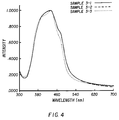
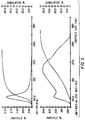
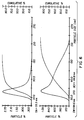
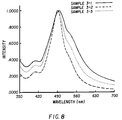
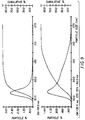
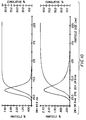
- Figs. 1 through 14 are graphs presenting the data obtained in the examples set forth below.
- This invention is based partly on the discovery that materials, such as pigments for paints and compounds useful in imaging elements, can be prepared in extremely fine particles by the use of milling media having a particle size less than about 100 ⁇ m.
- the term "compounds useful in imaging elements” refers to compounds that can be used in photographic elements, electrophotographic elements, thermal transfer elements, and the like. While this invention is described primarily in terms of its application to compounds useful in imaging, it is to be understood that the invention can be applied to a wide variety of materials.
- a compound useful in imaging elements is prepared in the form of submicron particles by milling the compound in the presence of a milling media having a mean particle size of less than about 100 microns.
- the grinding media can comprise particles, preferably substantially spherical in shape, e.g., beads, consisting essentially of a polymeric resin.
- polymeric resins suitable for use herein are chemically and physically inert, substantially free of metals, solvent and monomers, and of sufficient hardness and friability to enable them to avoid being chipped or crushed during milling.
- Suitable polymeric resins include crosslinked polystyrenes, such as polystyrene crosslinked with divinylbenzene, styrene copolymers, polyacrylates such as polymethyl methylacrylate, polycarbonates, polyacetals, such as DerlinTM, vinyl chloride polymers and copolymers, polyurethanes, polyamides, poly(tetrafluoroethylenes), e.g., TeflonTM, and other flouropolymers, high density polyethylenes, polypropylenes, cellulose ethers and esters such as cellulose acetate, polyhydroxymethacrylate, polyhydroxyethyl acrylate, silicone containing polymers such as polysiloxanes and the like.
- the polymer can be biodegradable.
- biodegradable polymers include poly(lactides), poly(glycolids) copolymers of lactides and glycolide, polyanhydrides, poly(hydroxyethyl methacrylate), poly(imino carbonates), poly(N-acylhydroxyproline) esters, poly(N-palmitoyl hydroxyprolino)esters, ethylene-vinyl acetate copolymers, poly(orthoesters), poly(caprolactones), and poly(phosphazenes).
- the polymeric resin can have a density from 0.9 to 3.0 g/cm3. Higher density resins are preferred inasmuch as it is believed that these provide more efficient particle size reduction.
- the preferred method of making polymeric grinding media is by suspension polymerization of acrylic and styrenic monomers.
- Methyl methacrylate and styrene are preferred monomers because they are inexpensive, commercially available materials which make acceptable polymeric grinding media.
- Other acrylic and styrenic monomers have also been demonstrated to work.
- Styrene is preferred.
- free radical addition polymerization in general, and suspension polymerization in particular can not be carried to 100% completion. Residual monomers remain in the beads which can leach out during the milling process and contaminate the product dispersion.
- Removal of the residual monomers can be accomplished by any number of methods common to polymer synthesis such as thermal drying, stripping by inert gases such as air or nitrogen, solvent extraction or the like. Drying and stripping processes are limited by the low vapor pressure of the residual monomers and large bead sizes resulting in long diffusion paths. Solvent extraction is therefore preferred. Any solvent can be used such as acetone, toluene, alcohols such as methanol, alkanes such as hexane, supercrital carbon dioxide and the like. Acetone is preferred. However, solvents which are effective in removing residual monomers typically dissolve the polymer made from the monomer, or make the polymer sticky and difficult to handle. Therefore, it is preferred to crosslink the polymer and make it insoluble in the solvent which has an affinity for the monomer.
- Such media include zirconium oxide, such as 95% ZrO stabilized with magnesia, zirconium silicate, glass, stainless steel, titania, alumina, and 95% Zro stabilized with yttrium.
- the media can range in size up to about 100 microns.
- the particles preferably are less than about 90 microns, more preferably, less than about 75 microns in size and most preferably less that about 50 microns.
- Excellent particle size reduction has been achieved with media having a particle size of about 25 microns, and media milling with media having a particle size of 5 microns or less is contemplated.
- the milling process can be a dry process, e.g., a dry roller milling process, or a wet process, i.e., wet-milling.
- this invention is practiced in accordance with the wet-milling process described in U.S. Patent No. 5,145,684 and European Patent Application 498,492.
- the wet milling process can be practiced in conjunction with a liquid dispersion medium and surface modifier such as described in these publications.
- Useful liquid dispersion media include water, aqueous salt solutions, ethanol, butanol, hexane, glycol and the like.
- the surface modifier can be selected from known organic and inorganic materials such as described in these publications.
- the surface modifier can be present in an amount 0.1 - 90%, preferably 1 - 80% by weight based on the total weight of the dry particles.
- Milling can take place in any suitable grinding mill. Suitable mills include an airjet mill, a roller mill, a ball mill, an attritor mill, a vibratory mill, a planetary mill, a sand mill and a bead mill.
- a high energy media mill is preferred when the grinding media consists essentially of the polymeric resin.
- the mill can contain a rotating shaft.
- the preferred proportions of the milling media, the compound useful in imaging, the optional liquid dispersion medium and surface modifier can vary within wide limits and depends, for example, upon the particular material selected, the size and density of the milling media, the type of mill selected, etc.
- the process can be carried out in a continuous, batch or semi-batch mode. Such process comprise, for example:
- a slurry of milling media, ⁇ 100 ⁇ m, liquid, active material (i.e.,material to reduced to sub-micron size dispersed in the liquid and stabilized by the stabilizer) and stabilizer is prepared using simple mixing.
- This slurry may be milled in conventional high energy batch milling processes such as high speed attritor mills, vibratory mills, ball mills, etc.
- This slurry is milled for a predetermined length of time to allow comminution of the active material to a minimum particle size.
- the dispersion of active material is separated from the grinding media by a simple sieving or filtration.
- a slurry of ⁇ 100 ⁇ m milling media, liquid, active material and stabilizer as indicated above may be continuously recirculated from a holding vessel through a conventional media mill which has a media separator screen adjusted to >100 ⁇ m to allow free passage of the media throughout the circuit. After milling is complete, the dispersion of active material is separated from the grinding media by simple sieving or filtration.
- a slurry of ⁇ 100 ⁇ m milling media, liquid, active material and stabilizer as indicated above may be continuously recirculated from a holding vessel through a conventional media mill containing milling media >250mm.
- This mill should have a screen separator to retain the large media in the milling chamber while allowing passage of the small media through the milling chamber.
- the dispersion of active material is separated from the grinding media by simple sieving or filtration.
- the milling vessel In high energy media mills, it frequently is desirable to leave the milling vessel up to half filled with air, the remaining volume comprising the milling media and the liquid dispersion media, if present. This permits a cascading effect within the vessel on the rollers which permits efficient milling. However, when foaming is a problem during wet milling, the vessel can be completely filled with the liquid dispersion medium.
- the attrition time can vary widely and depends primarily upon the particular compound useful in imaging (or other material), mechanical means and residence conditions selected, the initial and desired final particle size and so forth. For ball mills, processing times from several days to weeks may be required. On the other hand, residence times of less than about 8 hours are generally required using high energy media mills.
- the milling media is separated from the milled particulate product (in either a dry or liquid dispersion form) using conventional separation techniques, such as by filtration, sieving through a mesh screen, and the like.
- the process can be practiced with a wide variety of materials, in particular pigments useful in paints and especially compounds useful in imaging elements.
- the compound useful in imaging elements should be capable of being formed into solid particles.
- the compound useful in imaging elements should be poorly soluble and dispersible in at least one liquid medium.
- “poorly soluble” it is meant that the compound useful in imaging elements has a solubility in the liquid dispersion medium, e.g., water, of less that about 10 mg/ml, and preferably of less than about 1 mg/ml.
- the preferred liquid dispersion medium is water. additionally, the invention can be practiced with other liquid media.
- the compound useful in imaging elements is dispersed in water and the resulting dispersion is used in the preparation of the imaging element.
- the liquid dispersion medium preferably comprises water and a surfactant.
- the surfactant used can be, for example, a polymeric dispersing aid, as well as conventional ionic and nonionic surfactants.
- Suitable compounds useful in imaging elements include for example, dye-forming couplers, development inhibitor release couplers (DIR's), development inhibitor anchimeric release couplers (DI(A)R's), masking couplers, filter dyes, thermal transfer dyes, optical brighteners, nucleators, development accelerators, oxidized developer scavengers, ultraviolet radiation absorbing compounds, sensitizing dyes, development inhibitors, antifoggants, bleach accelerators, magnetic particles, lubricants, matting agents, etc.
- DIR's development inhibitor release couplers
- DI(A)R's development inhibitor anchimeric release couplers
- masking couplers filter dyes, thermal transfer dyes, optical brighteners, nucleators, development accelerators, oxidized developer scavengers, ultraviolet radiation absorbing compounds, sensitizing dyes, development inhibitors, antifoggants, bleach accelerators, magnetic particles, lubricants, matting agents, etc.
- Preferred compounds useful in imaging elements that can be used in dispersions in accordance with this invention are filter dyes, thermal transfer dyes, and sensitizing dyes, such as those described below.
- filter dyes that can be used in accordance with this invention are those described in European patent applications EP 549,089 of Texter et al, and EP 430,180 and U.S. Patents Nos. U.S. 4,803,150; U.S. 4,855,221; U.S. 4,857,446; U.S. 4,900,652; U.S. 4,900,653; U.S. 4,940,654; U.S. 4,948,717; U.S. 4,948,718; U.S. 4,950,586; U.S. 4,988,611; U.S. 4,994,356; U.S. 5,098,820; U.S. 5,213,956; U.S. 5,260,179; and U.S. 5,266,454.
- sensitizing dyes that can be used in accordance with this invention include cyanine dyes, merocyanine dyes, complex cyanine dyes, complex merocyanine dyes, homopolar cyanine dyes, hemicyanine dyes, styryl dyes, and hemioxonol dyes.
- cyanine dyes, merocyanine dyes and complex merocyanine dyes are particularly useful.
- nuclei for cyanine dyes are applicable to these dyes as basic heterocyclic nuclei. That is, a pyrroline nucleus, an oxazoline nucleus, a thiazoline nucleus, a pyrrole nucleus, an oxazole nucleus, a thiazole nucleus, a selenazole nucleus, an imidazole nucleus, a tetrazole nucleus, a pyridine nucleus, etc., and further, nuclei formed by condensing alicyclic hydrocarbon rings with these nuclei and nuclei formed by condensing aromatic hydrocarbon rings with these nuclei, that is, an indolenine nucleus, a benzindolenine nucleus, an indole nucleus, a benzoxazole nucleus, a naphthoxazole nucleus, a benzothiazole nucleus, a naph
- the merocyanine dyes and the complex merocyanine dyes that can be employed contain 5- or 6-membered heterocyclic nuclei such as pyrazolin-5-one nucleus, a thiohydantoin nucleus, a 2-thioxazolidin-2,4-dione nucleus, a thiazolidine-2,4-dione nucleus, a rhodanine nucleus, a thiobarbituric acid nucleus, and the like.
- Solid particle dispersions of sensitizing dyes may be added to a silver halide emulsion together with dyes which themselves do not give rise to spectrally sensitizing effects but exhibit a supersensitizing effect or materials which do not substantially absorb visible light but exhibit a supersensitizing effect.
- dyes which themselves do not give rise to spectrally sensitizing effects but exhibit a supersensitizing effect or materials which do not substantially absorb visible light but exhibit a supersensitizing effect.
- aminostilbene compounds substituted with a nitrogen-containing heterocyclic group e.g., those described in U.S. Patent Nos. 2,933,390 and 3,635,721
- aromatic organic acid-formaldehyde condensates e.g., those described in U.S. Patent No, 3,743,510
- cadmium salts e.g., those described in U.S. Patent No, 3,743,510
- the sensitizing dye may be added to an emulsion comprising silver halide grains and, typically, a hydrophilic colloid at any time prior to (e.g., during or after chemical sensitization) or simultaneous with the coating of the emulsion on a photographic support).
- the dye/silver halide emulsion may be mixed with a dispersion of color image-forming coupler immediately before coating or in advance of coating (for example, 2 hours).
- the above-described sensitizing dyes can be used individually, or may be used in combination, e.g. to also provide the silver halide with additional sensitivity to wavelengths of light outside that provided by one dye or to supersensitize the silver halide.
- the compound useful in imaging elements is a sensitizing dye, thermal transfer dye or filter dye as illustrated below: It is to be understood that this list is representative only, and not meant to be exclusive.
- a color photographic element comprises at least one layer comprising a dispersion of this invention.
- the photographic element comprises other components typically used in photographic elements.
- the dispersions of the invention can be used in any of the ways and in any of the combinations known in the art.
- the invention dispersions are incorporated in a silver halide emulsion and the emulsion coated as a layer on a support to form part of a photographic element.
- the photographic elements can be single color elements or multicolor elements.
- Multicolor elements contain image dye-forming units sensitive to each of the three primary regions of the spectrum.
- Each unit can comprise a single emulsion layer or multiple emulsion layers sensitive to a given region of the spectrum.
- the layers of the element, including the layers of the image-forming units, can be arranged in various orders as known in the art.
- the emulsions sensitive to each of the three primary regions of the spectrum can be disposed as a single segmented layer.
- a typical multicolor photographic element comprises a support bearing a cyan dye image-forming unit comprised of at least one red-sensitive silver halide emulsion layer having associated therewith at least one cyan dye-forming coupler, a magenta dye image-forming unit comprising at least one green-sensitive silver halide emulsion layer having associated therewith at least one magenta dye-forming coupler, and a yellow dye image-forming unit comprising at least one blue-sensitive silver halide emulsion layer having associated therewith at least one yellow dye-forming coupler.
- the element can contain additional layers, such as filter layers, interlayers, overcoat layers, subbing layers, and the like.
- the photographic element can be used in conjunction with an applied magnetic layer as described in Research Disclosure , November 1992, Item 34390 published by Kenneth Mason Publications, Ltd., Dudley Annex, 12a North Street, Emsworth, Hampshire P010 7DQ, ENGLAND.
- the silver halide emulsions employed in the photographic elements of this invention can be either negative-working or positive-working. Suitable emulsions and their preparation as well as methods of chemical and spectral sensitization are described in Sections I through IV. Color materials and development modifiers are described in Sections V and XXI. Vehicles are described in Section IX, and various additives such as brighteners, antifoggants, stabilizers, light absorbing and scattering materials, hardeners, coating aids, plasticizers, lubricants and matting agents are described , for example, in Sections V, VI, VIII, X, XI, XII, and XVI. Manufacturing methods are described in Sections XIV and XV, other layers and supports in Sections XIII and XVII, processing methods and agents in Sections XIX and XX, and exposure alternatives in Section XVIII.
- Image dye-forming couplers may be included in the element such as couplers that form cyan dyes upon reaction with oxidized color developing agents which are described in such representative patents and publications as: U.S. Pat. Nos. 2,772,162, 2,895,826, 3,002,836, 3,034,892, 2,474,293, 2,423,730, 2,367,531, 3,041,236, 4,883,746 and "Farbkuppler-eine LiteratureUbersicht,” published in Agfa Mitannonen, Band III, pp. 156-175 (1961).
- couplers are phenols and naphthols that form cyan dyes on reaction with oxidized color developing agent.
- Couplers that form magenta dyes upon reaction with oxidized color developing agent are described in such representative patents and publications as: U.S. Pat. Nos. 2,600,788, 2,369,489, 2,343,703, 2,311,082, 3,152,896, 3,519,429, 3,062,653, 2,908,573 and "Farbkuppler-eine LiteratureUbersicht,” published in Agfa Mitannonen, Band III, pp. 126-156 (1961).
- couplers are pyrazolones, pyrazolotriazoles, or pyrazolobenzimidazoles that form magenta dyes upon reaction with oxidized color developing agents.
- Couplers that form yellow dyes upon reaction with oxidized and color developing agent are described in such representative patents and publications as: U.S. Pat. Nos. 2,875,057, 2,407,210, 3,265,506, 2,298,443, 3,048,194, 3,447,928 and "Farbkuppler-eine LiteratureUbersicht,” published in Agfa Mitannonen, Band III, pp. 112-126 (1961).
- Such couplers are typically open chain ketomethylene compounds.
- couplers any of which may contain known ballasts or coupling-off groups such as those described in U.S. Patent 4,301,235; U.S. Patent 4,853,319 and U.S. Patent 4,351,897.
- the coupler may also be used in association with "wrong" colored couplers (e.g. to adjust levels of interlayer correction) and, in color negative applications, with masking couplers such as those described in EP 213.490; Japanese Published Application 58-172,647; U.S. Patent 2,983,608; German Application DE 2,706,117C; U.K. Patent 1,530,272; Japanese Application A-113935; U.S. Patents 4,070,191 and 4,273,861; and German Application DE 2,643,965.
- the masking couplers may be shifted or blocked.
- the invention dispersions may also be used in association with materials that accelerate or otherwise modify the processing steps e.g. of bleaching or fixing to improve the quality of the image.
- Bleach accelerator releasing couplers such as those described in EP 193,389; EP 301,477; U.S. 4,163,669; U.S. 4,865,956; and U.S. 4,923,784, may be useful.
- Also contemplated is use of the compositions in association with nucleating agents, development accelerators or their precursors (UK Patent 2,097,140; U.K. Patent 2,131,188); electron transfer agents (U.S. 4,859,578; U.S.
- antifogging and anti color-mixing agents such as derivatives of hydroquinones, aminophenols, amines, gallic acid; catechol; ascorbic acid; hydrazides; sulfonamidophenols; and non color-forming couplers.
- the invention dispersions may also be used in combination with filter dye layers comprising colloidal silver sol or yellow, cyan, and/or magenta filter dyes, either as oil-in-water dispersions, latex dispersions or as solid particle dispersions. Additionally, they may be used with "smearing" couplers (e.g. as described in U.S. 4,366,237; EP 96,570; U.S. 4,420,556; and U.S. 4,543,323.) Also, the compositions may be blocked or coated in protected form as described, for example, in Japanese Application 61/258,249 or U.S. 5,019,492.
- the invention dispersions may further be used in combination with image-modifying compounds such as "Developer Inhibitor-Releasing” compounds (DIR's).
- DIR's useful in conjunction with the compositions of the invention are known in the art and examples are described in U.S. Patent Nos.
- Dispersions of the invention may be coated on pH adjusted support as described in U.S. 4,917,994; with epoxy solvents (EP 0 164 961); with nickel complex stabilizers (U.S. 4,346,165; U.S. 4,540,653 and U.S. 4,906,559 for example); with ballasted chelating agents such as those in U.S.
- tabular grain silver halide emulsions are particularly useful in this invention.
- Suitable tabular grain emulsions can be selected from among a variety of conventional teachings, such as those of the following: Research Disclosure, Item 22534, January 1983, published by Kenneth Mason Publications, Ltd., Emsworth, Hampshire P010 7DD, England; U.S. Patent Nos.
- the emulsions can be surface-sensitive emulsions, i.e., emulsions that form latent images primarily on the surfaces of the silver halide grains, or the emulsions can form internal latent images predominantly in the interior of the silver halide grains.
- the emulsions can be negative-working emulsions, such as surface-sensitive emulsions or unfogged internal latent image-forming emulsions, or direct-positive emulsions of the unfogged, internal latent image-forming type, which are positive-working when development is conducted with uniform light exposure or in the presence of a nucleating agent.
- Photographic elements according to the invention can be exposed to actinic radiation, typically in the visible region of the spectrum, to form a latent image and can then be processed to form a visible dye image using conventional exposing and processing procedures.
- the slurry on the variation of Sample 1-2 (see the following table) was combined with 17.5g of 450 ⁇ m mean diameter polystyrene milling media.
- the slurry in the variation of Sample 1-3 was combined with 17.5g of 50 ⁇ m mean diameter polystyrene milling media.
- the slurry in variation Sample 1-1 was held as the control and not milled, whereas variations Sample 1-2 and Sample 1-3 were milled for 100 minutes residence time using a laboratory scale mill at 2300rpm.
- the following table summarizes the variations: sample media size ( ⁇ m) variation 1-1 no media unmilled control 1-2 450 conventional size media 1-3 50 invention
- slurries were separated from the media using an 8 ⁇ m filter. Each slurry was characterized for physical properties including particle size distribution and dye absorption spectra. Particle size was measured by Capillary Hydrodynamic Fractionation (Matec Applied Sciences, 75 House Street, Hopkinton, MA, 01748) using a high resolution capillary cartridge Serial #208 and eluted with a 10wt% dilution GR-500 aqueous eluent. Absorbance spectra were measured by Computer-Aided Spectrophotometric System (CASS).
- CASS Computer-Aided Spectrophotometric System
- Figures 1-4 compare the particle size number and weight distributions for each variation. The following table compares the weight average particle diameters for each variation: sample diameter (nm) 1-1 147.1 1-2 129.3 1-3 55.0
- Figure 4 shows the normalized absorbance spectra for each variation. Variations Sample 1-1 and Sample 1-2 show nearly equivalent spectra, although variation Sample 1-3 shows a more selective spectra with reduced light scattering. Reduced scattering in photographic coatings can result in improved image quality, such as greater sharpness.
- Sample 1-3 also shows improved molar extinction, which indicates improved dye covering power. Improved covering power can enable reduced dye laydown and provide cost savings.
- Example 2 In the same manner as set forth in Example 1, the slurry was combined with 17.5g of 50 ⁇ m mean diameter polystyrene milling media (Sample 2-2) and with 17.5g of 450 ⁇ m mean diameter polystyrene milling media (Sample 2-3) and the control (Sample 2-1) was not milled. Sample 2-2 and Sample 2-3 were milled for 100 minutes residence time using a laboratory mill as in Example 1. The following table summarizes the variations: sample media size ( ⁇ m) variation Sample 2-1 no media unmilled control Sample 2-2 50 invention Sample 2-3 450 conventional size media
- Example 1 After milling was complete, the slurries were separated from the media using an 8 ⁇ m filter. Each slurry was characterized for physical properties as in Example 1.
- Figure 8 shows the normalized absorbance spectra for each variation. This figure shows a narrowing of spectral bandwidth which corresponds to a decrease in the average particle diameter. Variation Sample 2-2 using 50 ⁇ m milling media results in the narrowest bandwidth and lowest level of light scattering.
- the slurry variation 3-2 was combined with 17.5g of 50 ⁇ m mean diameter polystyrene milling media.
- the slurry variation 3-3 was combined 17.5g of 450 ⁇ m mean diameter polystyrene milling media.
- the slurry in variation 3-1 was held as the control and not milled whereas variations 3-2 and 3-3 were milled for 100 minutes residence time using a laboratory high energy attritor mill as in Example 1.
- the following table summarizes the variations: sample media size ( ⁇ m) variation 3-1 no media unmilled control 3-2 50 invention 3-3 450 conventional size media 3-4 5 invention 3-5 25 invention 3-6 75 invention
- Example 1 After milling was complete, the slurries were separated from the media using an 8 ⁇ m filter. Each slurry was characterized for physical properties as in Example 1.
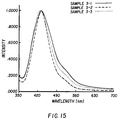
- Figure 15 shows the normalized absorbance spectra for variations Samples 3-1, 3-2 and 3-3). As in the previous examples, this figure shows a narrowing of spectral bandwidth which corresponds to a decrease in the average particle diameter. Variation Sample 3-2 using 50 ⁇ m milling media results in the narrowest bandwidth and lowest level of light scattering.
Landscapes
- Chemical & Material Sciences (AREA)
- Engineering & Computer Science (AREA)
- Physics & Mathematics (AREA)
- General Physics & Mathematics (AREA)
- Chemical Kinetics & Catalysis (AREA)
- Materials Engineering (AREA)
- Food Science & Technology (AREA)
- Colloid Chemistry (AREA)
- Silver Salt Photography Or Processing Solution Therefor (AREA)
- Disintegrating Or Milling (AREA)
- Developing Agents For Electrophotography (AREA)
- Crushing And Grinding (AREA)
Applications Claiming Priority (2)
| Application Number | Priority Date | Filing Date | Title |
|---|---|---|---|
| US248774 | 1994-05-25 | ||
| US08/248,774 US5500331A (en) | 1994-05-25 | 1994-05-25 | Comminution with small particle milling media |
Publications (3)
| Publication Number | Publication Date |
|---|---|
| EP0684507A2 true EP0684507A2 (fr) | 1995-11-29 |
| EP0684507A3 EP0684507A3 (fr) | 1996-01-24 |
| EP0684507B1 EP0684507B1 (fr) | 1999-09-08 |
Family
ID=22940626
Family Applications (1)
| Application Number | Title | Priority Date | Filing Date |
|---|---|---|---|
| EP95106646A Expired - Lifetime EP0684507B1 (fr) | 1994-05-25 | 1995-05-03 | Désintégration avec des moyens de broyage sans forme de petites particules |
Country Status (4)
| Country | Link |
|---|---|
| US (1) | US5500331A (fr) |
| EP (1) | EP0684507B1 (fr) |
| JP (1) | JPH07313894A (fr) |
| DE (1) | DE69511936T2 (fr) |
Cited By (9)
| Publication number | Priority date | Publication date | Assignee | Title |
|---|---|---|---|---|
| EP0684519A3 (fr) * | 1994-05-25 | 1996-06-05 | Eastman Kodak Co | Broyage d'un composé utile dans la formation d'images utilisant des agents de broyage polymériques. |
| EP0776952A3 (fr) * | 1995-11-30 | 1998-02-18 | Eastman Kodak Company | Encres d'impression par jet d'encre contenant des nanoparticules ou pigments organiques |
| EP1398083A1 (fr) * | 2002-09-05 | 2004-03-17 | Rohm And Haas Company | Procédé pour la préparation de fines particules solides et leurs dispersions |
| EP2411141A4 (fr) * | 2009-03-23 | 2012-08-22 | Vaelinge Photocatalytic Ab | Production de suspensions colloïdales de nanoparticules de dioxyde de titane à cristallinité maintenue grâce à l'utilisation d'un broyeur à billes comportant des billes nanométriques |
| US9375750B2 (en) | 2012-12-21 | 2016-06-28 | Valinge Photocatalytic Ab | Method for coating a building panel and a building panel |
| US9573126B2 (en) | 2012-03-20 | 2017-02-21 | Valinge Photocatalytic Ab | Photocatalytic composition |
| US9945075B2 (en) | 2013-09-25 | 2018-04-17 | Valinge Photocatalytic Ab | Method of applying a photocatalytic dispersion |
| US11045798B2 (en) | 2011-07-05 | 2021-06-29 | Valinge Photocatalytic Ab | Coated wood products and method of producing coated wood products |
| US12359086B2 (en) | 2012-12-21 | 2025-07-15 | Valinge Photocatalytic Ab | Method for coating a building panel and a building panel |
Families Citing this family (55)
| Publication number | Priority date | Publication date | Assignee | Title |
|---|---|---|---|---|
| US5750323A (en) * | 1995-08-31 | 1998-05-12 | Eastman Kodak Company | Solid particle dispersions for imaging elements |
| GB9710371D0 (en) * | 1997-05-20 | 1997-07-16 | Imation Corp | Formation and photographic use of solid particle dye dispersions |
| US5902711A (en) * | 1997-06-25 | 1999-05-11 | Eastman Kodak Company | Method to media mill particles using crosslinked polymer media and organic solvent |
| US6086242A (en) * | 1998-02-27 | 2000-07-11 | University Of Utah | Dual drive planetary mill |
| US6114079A (en) * | 1998-04-01 | 2000-09-05 | Eastman Kodak Company | Electrically-conductive layer for imaging element containing composite metal-containing particles |
| DE69901751T2 (de) * | 1998-04-01 | 2003-01-09 | Eastman Kodak Co., Rochester | Bildaufzeichnungselement, das eine verbesserte elektrisch leitfähige Schicht mit nadelförmigen Teilchen enthält |
| US6197104B1 (en) | 1998-05-04 | 2001-03-06 | Millennium Inorganic Chemicals, Inc. | Very high solids TiO2 slurries |
| EP0965865A1 (fr) * | 1998-05-20 | 1999-12-22 | Eastman Kodak Company | Nanoparticules dans réseaux de filtres couleurs |
| JP2000171931A (ja) * | 1998-09-30 | 2000-06-23 | Fuji Photo Film Co Ltd | 写真用固体微粒子分散物、その製造方法、及びそれを含有するハロゲン化銀写真感光材料 |
| US6395300B1 (en) | 1999-05-27 | 2002-05-28 | Acusphere, Inc. | Porous drug matrices and methods of manufacture thereof |
| US6610317B2 (en) | 1999-05-27 | 2003-08-26 | Acusphere, Inc. | Porous paclitaxel matrices and methods of manufacture thereof |
| US7919119B2 (en) * | 1999-05-27 | 2011-04-05 | Acusphere, Inc. | Porous drug matrices and methods of manufacture thereof |
| JP4763957B2 (ja) | 2000-05-10 | 2011-08-31 | オバン・エナジー・リミテッド | メディアミリング |
| JP4969761B2 (ja) | 2000-08-31 | 2012-07-04 | オバン・エナジー・リミテッド | 所望粒度を持つ固体基材の小粒子および第一材料の小粒状物を含む相乗作用性混合物を製造する方法 |
| US20060249245A1 (en) * | 2000-10-31 | 2006-11-09 | Bernard Balling | Ceramic and glass correction inks |
| US6620550B2 (en) | 2001-01-23 | 2003-09-16 | The Gillette Company | Battery cathode and method of manufacture therefor |
| US6569793B2 (en) | 2001-02-22 | 2003-05-27 | Specialty Minerals (Michigan) Inc. | Fluidized reaction of synthetic silicates |
| AU2002303836A1 (en) * | 2001-05-23 | 2002-12-03 | E.I. Du Pont De Nemours And Company | High pressure media and method of creating ultra-fine particles |
| US8403367B2 (en) | 2001-08-02 | 2013-03-26 | Eastman Kodak Company | Authentication using near-field optical imaging |
| US6722699B2 (en) * | 2001-08-02 | 2004-04-20 | Eastman Kodak Company | Authentication using near-field optical imaging |
| US20050258288A1 (en) * | 2003-11-26 | 2005-11-24 | E. I. Du Pont De Nemours And Company | High pressure media milling system and process of forming particles |
| EP1557448B1 (fr) * | 2004-01-26 | 2011-06-08 | Dainichiseika Color & Chemicals Mfg. Co., Ltd. | Broyage humide à l'usage des galets micros |
| DE102004040368B3 (de) * | 2004-08-20 | 2006-02-23 | Juhnke, Michael, Dipl.-Ing. | Mahlkörper zur Herstellung feinstkörniger Produkte |
| US7514489B2 (en) * | 2005-11-28 | 2009-04-07 | Martin Marietta Materials, Inc. | Flame-retardant magnesium hydroxide compositions and associated methods of manufacture and use |
| JP5603013B2 (ja) * | 2006-01-12 | 2014-10-08 | ザ ボード オブ トラスティーズ オブ ザ ユニバーシティ オブ アーカンソー | ナノ粒子組成物およびその製法並びに使用法 |
| US10100266B2 (en) | 2006-01-12 | 2018-10-16 | The Board Of Trustees Of The University Of Arkansas | Dielectric nanolubricant compositions |
| AU2007264418B2 (en) | 2006-06-30 | 2012-05-03 | Iceutica Pty Ltd | Methods for the preparation of biologically active compounds in nanoparticulate form |
| KR101478985B1 (ko) | 2006-10-19 | 2015-01-06 | 더 보드 오브 트러스티스 오브 더 유니버시티 오브 아칸소 | 정전기 스프레이를 사용하는 코팅 제조 방법 및 코팅 제조 장치 |
| US10752997B2 (en) | 2006-10-19 | 2020-08-25 | P&S Global Holdings Llc | Methods and apparatus for making coatings using ultrasonic spray deposition |
| US7999451B2 (en) * | 2006-11-10 | 2011-08-16 | Global Oled Technology Llc | Blue color filter element |
| US7973902B2 (en) * | 2006-11-10 | 2011-07-05 | Global Oled Technology Llc | Display with RGB color filter element sets |
| US7951450B2 (en) * | 2006-11-10 | 2011-05-31 | Global Oled Technology Llc | Red color filter element |
| US7837780B2 (en) * | 2006-11-10 | 2010-11-23 | Global Oled Technology Llc | Green color filter element |
| US7758961B2 (en) * | 2007-03-22 | 2010-07-20 | Milliken & Company | Functionalized nanoparticles and their use in particle/bulk material systems |
| US20080287586A1 (en) * | 2007-03-22 | 2008-11-20 | Jones Jamie N | Functionalized nanoparticles and their use in particle/bulk material systems |
| US7441717B1 (en) * | 2007-10-31 | 2008-10-28 | Eastman Kodak Company | Micromedia milling process |
| US8277697B2 (en) * | 2008-10-29 | 2012-10-02 | Global Oled Technology Llc | Color filter element with improved colorant dispersion |
| US7585363B1 (en) * | 2008-10-29 | 2009-09-08 | Eastman Kodak Company | Method for preparing nanodispersions of fluorinated phthalocyanine pigments |
| KR101580656B1 (ko) | 2009-04-24 | 2015-12-30 | 아이슈티카 피티와이 리미티드 | 디클로페낙의 신규 제형 |
| CN102438594A (zh) | 2009-04-24 | 2012-05-02 | 伊休蒂卡有限公司 | 吲哚美辛的新剂型 |
| AP2015008967A0 (en) | 2009-04-24 | 2015-12-31 | Iceutica Pty Ltd | A novel formulation of meloxicam |
| AP3138A (en) | 2009-04-24 | 2015-02-28 | Iceutica Pty Ltd | Production of encapsulated nanoparticles at high volume fractions |
| EP2652048B1 (fr) | 2010-12-13 | 2017-04-19 | Sun Chemical Corporation | Procédés de solubilisation de milieux de broyage dans des dispersions de particules de pigments |
| NZ629438A (en) | 2012-02-28 | 2016-10-28 | Iceutica Holdings Inc | Inhalable pharmaceutical compositions |
| US8476206B1 (en) | 2012-07-02 | 2013-07-02 | Ajay P. Malshe | Nanoparticle macro-compositions |
| US8486870B1 (en) | 2012-07-02 | 2013-07-16 | Ajay P. Malshe | Textured surfaces to enhance nano-lubrication |
| JP2016508447A (ja) * | 2013-02-28 | 2016-03-22 | サン・ケミカル・コーポレーション | 連続的微細メディア含有粉砕プロセス |
| US20140287039A1 (en) | 2013-03-15 | 2014-09-25 | Iceutica Inc. | Abiraterone Acetate Formulation |
| US20150246060A1 (en) | 2013-03-15 | 2015-09-03 | Iceutica Inc. | Abiraterone Acetate Formulation and Methods of Use |
| US9243148B2 (en) * | 2013-03-29 | 2016-01-26 | Xerox Corporation | Preparation of pigment dispersions and toner compositions |
| SG10201800491RA (en) | 2013-07-22 | 2018-03-28 | Iceutica Inc | Formulation of metaxalone |
| US20150157646A1 (en) | 2013-09-27 | 2015-06-11 | Iceutica Inc. | Abiraterone Steroid Formulation |
| US9526734B2 (en) | 2014-06-09 | 2016-12-27 | Iceutica Pty Ltd. | Formulation of meloxicam |
| US20160008820A1 (en) * | 2014-07-10 | 2016-01-14 | Xerox Corporation | Magnetic actuated-milled pigment dispersions and process for making thereof |
| EP3978215A1 (fr) * | 2020-09-30 | 2022-04-06 | Evonik Operations GmbH | Fabrication de moules à noyau en mousse complexes pourvus de surfaces de classe a |
Family Cites Families (13)
| Publication number | Priority date | Publication date | Assignee | Title |
|---|---|---|---|---|
| US3104608A (en) * | 1960-06-20 | 1963-09-24 | Du Pont | Polymer handling |
| ES293103A1 (es) * | 1962-11-12 | 1964-03-16 | Aziende Colori Naz Affini Acna S P A | Procedimiento para la preparación de quinacridona en forma de pigmento |
| US3713593A (en) * | 1970-08-11 | 1973-01-30 | Freeport Sulphur Co | Fine media milling process |
| DE2832761B1 (de) * | 1978-07-26 | 1979-10-31 | Basf Ag | Verfahren zur UEberfuehrung von rohen und/oder grobkristallisierten Perylen-tetracarbonsaeurediimiden in eine Pigmentform |
| US4404346A (en) * | 1980-08-05 | 1983-09-13 | Rohm And Haas Company | Production of powdered resin and the powdered resin so produced |
| JPS58105141A (ja) * | 1981-12-17 | 1983-06-22 | Fuji Photo Film Co Ltd | ハロゲン化銀乳剤の製造方法 |
| US4974368A (en) * | 1987-03-19 | 1990-12-04 | Canon Kabushiki Kaisha | Polishing apparatus |
| US4940654A (en) * | 1987-12-23 | 1990-07-10 | Eastman Kodak Company | Solid particle dispersion filter dyes for photographic compositions |
| US5066486A (en) * | 1988-10-14 | 1991-11-19 | Revlon, Inc. | Method for preparing cosmetic products and the products obtained thereby |
| US5066335A (en) * | 1989-05-02 | 1991-11-19 | Ogilvie Mills Ltd. | Glass-like polysaccharide abrasive grit |
| US5145684A (en) * | 1991-01-25 | 1992-09-08 | Sterling Drug Inc. | Surface modified drug nanoparticles |
| AU642066B2 (en) * | 1991-01-25 | 1993-10-07 | Nanosystems L.L.C. | X-ray contrast compositions useful in medical imaging |
| AU660852B2 (en) * | 1992-11-25 | 1995-07-06 | Elan Pharma International Limited | Method of grinding pharmaceutical substances |
-
1994
- 1994-05-25 US US08/248,774 patent/US5500331A/en not_active Expired - Lifetime
-
1995
- 1995-05-03 EP EP95106646A patent/EP0684507B1/fr not_active Expired - Lifetime
- 1995-05-03 DE DE69511936T patent/DE69511936T2/de not_active Expired - Fee Related
- 1995-05-24 JP JP7125158A patent/JPH07313894A/ja active Pending
Cited By (15)
| Publication number | Priority date | Publication date | Assignee | Title |
|---|---|---|---|---|
| EP0684519A3 (fr) * | 1994-05-25 | 1996-06-05 | Eastman Kodak Co | Broyage d'un composé utile dans la formation d'images utilisant des agents de broyage polymériques. |
| EP0776952A3 (fr) * | 1995-11-30 | 1998-02-18 | Eastman Kodak Company | Encres d'impression par jet d'encre contenant des nanoparticules ou pigments organiques |
| JP2008156649A (ja) * | 1995-11-30 | 2008-07-10 | Eastman Kodak Co | インクジェット用インク、その製造方法およびインクジェット印刷方法 |
| EP1398083A1 (fr) * | 2002-09-05 | 2004-03-17 | Rohm And Haas Company | Procédé pour la préparation de fines particules solides et leurs dispersions |
| US6896212B2 (en) | 2002-09-05 | 2005-05-24 | Rohm And Haas Company | Method of producing fine solid particles and dispersions |
| CN1298428C (zh) * | 2002-09-05 | 2007-02-07 | 罗姆和哈斯公司 | 制备细小固体颗粒和分散体的方法 |
| EP2411141A4 (fr) * | 2009-03-23 | 2012-08-22 | Vaelinge Photocatalytic Ab | Production de suspensions colloïdales de nanoparticules de dioxyde de titane à cristallinité maintenue grâce à l'utilisation d'un broyeur à billes comportant des billes nanométriques |
| EP2740538A1 (fr) * | 2009-03-23 | 2014-06-11 | Välinge Photocatalytic AB | Production de suspensions colloïdales de nanoparticules de dioxyde de titane à cristallinité maintenue grâce à l'utilisation d'un broyeur à billes comportant des billes nanométriques |
| US9963609B2 (en) | 2009-03-23 | 2018-05-08 | Valinge Photocatalytic Ab | Production of titania nanoparticle colloidal suspensions with maintained crystallinity by using a bead mill with micrometer sized beads |
| US11045798B2 (en) | 2011-07-05 | 2021-06-29 | Valinge Photocatalytic Ab | Coated wood products and method of producing coated wood products |
| US9573126B2 (en) | 2012-03-20 | 2017-02-21 | Valinge Photocatalytic Ab | Photocatalytic composition |
| US9375750B2 (en) | 2012-12-21 | 2016-06-28 | Valinge Photocatalytic Ab | Method for coating a building panel and a building panel |
| US11666937B2 (en) | 2012-12-21 | 2023-06-06 | Valinge Photocatalytic Ab | Method for coating a building panel and a building panel |
| US12359086B2 (en) | 2012-12-21 | 2025-07-15 | Valinge Photocatalytic Ab | Method for coating a building panel and a building panel |
| US9945075B2 (en) | 2013-09-25 | 2018-04-17 | Valinge Photocatalytic Ab | Method of applying a photocatalytic dispersion |
Also Published As
| Publication number | Publication date |
|---|---|
| EP0684507A3 (fr) | 1996-01-24 |
| EP0684507B1 (fr) | 1999-09-08 |
| DE69511936D1 (de) | 1999-10-14 |
| DE69511936T2 (de) | 2000-03-09 |
| JPH07313894A (ja) | 1995-12-05 |
| US5500331A (en) | 1996-03-19 |
Similar Documents
| Publication | Publication Date | Title |
|---|---|---|
| EP0684507B1 (fr) | Désintégration avec des moyens de broyage sans forme de petites particules | |
| EP0684519B1 (fr) | Broyage d'un composé utile dans la formation d'images utilisant des agents de broyage polymériques | |
| EP0684508B1 (fr) | Procédé continu de broyage par recirculation des moyens de broyage | |
| EP0430186A1 (fr) | Matériaux photographiques à l'halogénure d'argent sensibles à la lumière | |
| JP3066985B2 (ja) | 写真要素用フィルター色素の固体状粒子分散物 | |
| JPH04226450A (ja) | 写真要素用フィルター色素の固体粒子分散体 | |
| EP0215124B1 (fr) | Materiau photographique photosensible a l'halogenure d'argent | |
| CN1078902C (zh) | 含有分散染料的分散体及其制备方法 | |
| EP0887700B1 (fr) | Colorants sensibilisateurs pour absorption améliorée de lumière | |
| EP0640225B1 (fr) | Melanges aqueux de colorants de sensibilisation spectrale pour emulsions photographiques | |
| DE2733206C2 (fr) | ||
| EP0679936B1 (fr) | Eléments photographiques comprenant colorants sensibilisateurs spécifiques | |
| DE69328882T2 (de) | Photographisches Silberhalogenidmaterial | |
| US6881840B2 (en) | Benzothiazine dyes for imaging elements | |
| JPH037931A (ja) | ハロゲン化銀写真感光材料 | |
| JPS6225747A (ja) | ハロゲン化銀写真感光材料 | |
| JP2664968B2 (ja) | 写真要素 | |
| EP0695968A2 (fr) | Réduction de la viscosité dans une composition photographique à l'état fondue | |
| JP3467331B2 (ja) | ハロゲン化銀写真感光材料 | |
| JPH0990619A (ja) | 光硬化型組成物及び感光性カプセル | |
| EP1335243A1 (fr) | Matériaux d'enregistrement d'images contenant colorants benzothiaziniques | |
| EP0661588B1 (fr) | Elément photographique couleur | |
| EP0775938A1 (fr) | Combinaison de colorant filtre jaune et copulant magenta pyrazolone à 4 équivalents | |
| JPH05197078A (ja) | 写真要素用フィルター色素固体粒子分散体 | |
| JPH09179244A (ja) | 写真材料用フィルター色材 |
Legal Events
| Date | Code | Title | Description |
|---|---|---|---|
| PUAI | Public reference made under article 153(3) epc to a published international application that has entered the european phase |
Free format text: ORIGINAL CODE: 0009012 |
|
| AK | Designated contracting states |
Kind code of ref document: A2 Designated state(s): BE DE FR GB NL |
|
| PUAL | Search report despatched |
Free format text: ORIGINAL CODE: 0009013 |
|
| AK | Designated contracting states |
Kind code of ref document: A3 Designated state(s): BE CH DE FR GB IT LI NL |
|
| 17P | Request for examination filed |
Effective date: 19960318 |
|
| 17Q | First examination report despatched |
Effective date: 19980424 |
|
| GRAG | Despatch of communication of intention to grant |
Free format text: ORIGINAL CODE: EPIDOS AGRA |
|
| GRAG | Despatch of communication of intention to grant |
Free format text: ORIGINAL CODE: EPIDOS AGRA |
|
| GRAH | Despatch of communication of intention to grant a patent |
Free format text: ORIGINAL CODE: EPIDOS IGRA |
|
| RBV | Designated contracting states (corrected) |
Designated state(s): BE DE FR GB NL |
|
| GRAH | Despatch of communication of intention to grant a patent |
Free format text: ORIGINAL CODE: EPIDOS IGRA |
|
| GRAA | (expected) grant |
Free format text: ORIGINAL CODE: 0009210 |
|
| AK | Designated contracting states |
Kind code of ref document: B1 Designated state(s): BE DE FR GB NL |
|
| REF | Corresponds to: |
Ref document number: 69511936 Country of ref document: DE Date of ref document: 19991014 |
|
| ET | Fr: translation filed | ||
| PLBE | No opposition filed within time limit |
Free format text: ORIGINAL CODE: 0009261 |
|
| STAA | Information on the status of an ep patent application or granted ep patent |
Free format text: STATUS: NO OPPOSITION FILED WITHIN TIME LIMIT |
|
| 26N | No opposition filed | ||
| REG | Reference to a national code |
Ref country code: GB Ref legal event code: IF02 |
|
| PGFP | Annual fee paid to national office [announced via postgrant information from national office to epo] |
Ref country code: NL Payment date: 20030403 Year of fee payment: 9 |
|
| PGFP | Annual fee paid to national office [announced via postgrant information from national office to epo] |
Ref country code: DE Payment date: 20030530 Year of fee payment: 9 |
|
| PGFP | Annual fee paid to national office [announced via postgrant information from national office to epo] |
Ref country code: BE Payment date: 20030617 Year of fee payment: 9 |
|
| PG25 | Lapsed in a contracting state [announced via postgrant information from national office to epo] |
Ref country code: BE Free format text: LAPSE BECAUSE OF NON-PAYMENT OF DUE FEES Effective date: 20040531 |
|
| BERE | Be: lapsed |
Owner name: *EASTMAN KODAK CY Effective date: 20040531 |
|
| PG25 | Lapsed in a contracting state [announced via postgrant information from national office to epo] |
Ref country code: NL Free format text: LAPSE BECAUSE OF NON-PAYMENT OF DUE FEES Effective date: 20041201 Ref country code: DE Free format text: LAPSE BECAUSE OF NON-PAYMENT OF DUE FEES Effective date: 20041201 |
|
| NLV4 | Nl: lapsed or anulled due to non-payment of the annual fee |
Effective date: 20041201 |
|
| PGFP | Annual fee paid to national office [announced via postgrant information from national office to epo] |
Ref country code: GB Payment date: 20130425 Year of fee payment: 19 |
|
| PGFP | Annual fee paid to national office [announced via postgrant information from national office to epo] |
Ref country code: FR Payment date: 20130531 Year of fee payment: 19 |
|
| GBPC | Gb: european patent ceased through non-payment of renewal fee |
Effective date: 20140503 |
|
| REG | Reference to a national code |
Ref country code: FR Ref legal event code: ST Effective date: 20150130 |
|
| PG25 | Lapsed in a contracting state [announced via postgrant information from national office to epo] |
Ref country code: GB Free format text: LAPSE BECAUSE OF NON-PAYMENT OF DUE FEES Effective date: 20140503 Ref country code: FR Free format text: LAPSE BECAUSE OF NON-PAYMENT OF DUE FEES Effective date: 20140602 |