EP0684528A2 - Ladegerät unter Benutzung eines flüssigen Mediums - Google Patents
Ladegerät unter Benutzung eines flüssigen Mediums Download PDFInfo
- Publication number
- EP0684528A2 EP0684528A2 EP95303542A EP95303542A EP0684528A2 EP 0684528 A2 EP0684528 A2 EP 0684528A2 EP 95303542 A EP95303542 A EP 95303542A EP 95303542 A EP95303542 A EP 95303542A EP 0684528 A2 EP0684528 A2 EP 0684528A2
- Authority
- EP
- European Patent Office
- Prior art keywords
- fluid media
- fluid
- ions
- charged
- imaging member
- Prior art date
- Legal status (The legal status is an assumption and is not a legal conclusion. Google has not performed a legal analysis and makes no representation as to the accuracy of the status listed.)
- Granted
Links
- 239000012530 fluid Substances 0.000 title claims abstract description 92
- 150000002500 ions Chemical class 0.000 claims abstract description 30
- 239000011554 ferrofluid Substances 0.000 claims abstract description 15
- 239000000463 material Substances 0.000 claims abstract description 5
- 238000003384 imaging method Methods 0.000 claims description 37
- 239000007788 liquid Substances 0.000 claims description 4
- 230000032258 transport Effects 0.000 claims description 3
- 210000002445 nipple Anatomy 0.000 claims description 2
- 230000008878 coupling Effects 0.000 claims 1
- 238000010168 coupling process Methods 0.000 claims 1
- 238000005859 coupling reaction Methods 0.000 claims 1
- 238000000034 method Methods 0.000 abstract description 8
- 230000008569 process Effects 0.000 abstract description 8
- 238000000151 deposition Methods 0.000 abstract description 4
- 230000004913 activation Effects 0.000 abstract 1
- 108091008695 photoreceptors Proteins 0.000 description 15
- 238000012546 transfer Methods 0.000 description 8
- CURLTUGMZLYLDI-UHFFFAOYSA-N Carbon dioxide Chemical compound O=C=O CURLTUGMZLYLDI-UHFFFAOYSA-N 0.000 description 6
- 239000004020 conductor Substances 0.000 description 6
- CBENFWSGALASAD-UHFFFAOYSA-N Ozone Chemical compound [O-][O+]=O CBENFWSGALASAD-UHFFFAOYSA-N 0.000 description 4
- 230000008901 benefit Effects 0.000 description 4
- XLYOFNOQVPJJNP-UHFFFAOYSA-N water Chemical compound O XLYOFNOQVPJJNP-UHFFFAOYSA-N 0.000 description 4
- HEMHJVSKTPXQMS-UHFFFAOYSA-M Sodium hydroxide Chemical compound [OH-].[Na+] HEMHJVSKTPXQMS-UHFFFAOYSA-M 0.000 description 3
- 239000001569 carbon dioxide Substances 0.000 description 3
- 229910002092 carbon dioxide Inorganic materials 0.000 description 3
- 239000012092 media component Substances 0.000 description 3
- IJGRMHOSHXDMSA-UHFFFAOYSA-N Atomic nitrogen Chemical compound N#N IJGRMHOSHXDMSA-UHFFFAOYSA-N 0.000 description 2
- CDBYLPFSWZWCQE-UHFFFAOYSA-L Sodium Carbonate Chemical compound [Na+].[Na+].[O-]C([O-])=O CDBYLPFSWZWCQE-UHFFFAOYSA-L 0.000 description 2
- UIIMBOGNXHQVGW-UHFFFAOYSA-M Sodium bicarbonate Chemical compound [Na+].OC([O-])=O UIIMBOGNXHQVGW-UHFFFAOYSA-M 0.000 description 2
- 230000008021 deposition Effects 0.000 description 2
- 230000003292 diminished effect Effects 0.000 description 2
- 230000000694 effects Effects 0.000 description 2
- 230000005684 electric field Effects 0.000 description 2
- 239000011521 glass Substances 0.000 description 2
- 239000000383 hazardous chemical Substances 0.000 description 2
- 239000002608 ionic liquid Substances 0.000 description 2
- BWHMMNNQKKPAPP-UHFFFAOYSA-L potassium carbonate Chemical compound [K+].[K+].[O-]C([O-])=O BWHMMNNQKKPAPP-UHFFFAOYSA-L 0.000 description 2
- 239000000758 substrate Substances 0.000 description 2
- SMZOUWXMTYCWNB-UHFFFAOYSA-N 2-(2-methoxy-5-methylphenyl)ethanamine Chemical compound COC1=CC=C(C)C=C1CCN SMZOUWXMTYCWNB-UHFFFAOYSA-N 0.000 description 1
- NIXOWILDQLNWCW-UHFFFAOYSA-N 2-Propenoic acid Natural products OC(=O)C=C NIXOWILDQLNWCW-UHFFFAOYSA-N 0.000 description 1
- 229920002799 BoPET Polymers 0.000 description 1
- 229910001369 Brass Inorganic materials 0.000 description 1
- OKTJSMMVPCPJKN-UHFFFAOYSA-N Carbon Chemical compound [C] OKTJSMMVPCPJKN-UHFFFAOYSA-N 0.000 description 1
- RYGMFSIKBFXOCR-UHFFFAOYSA-N Copper Chemical compound [Cu] RYGMFSIKBFXOCR-UHFFFAOYSA-N 0.000 description 1
- 239000005041 Mylar™ Substances 0.000 description 1
- 230000002411 adverse Effects 0.000 description 1
- 238000013459 approach Methods 0.000 description 1
- 230000000903 blocking effect Effects 0.000 description 1
- 239000010951 brass Substances 0.000 description 1
- 229910052799 carbon Inorganic materials 0.000 description 1
- 238000004140 cleaning Methods 0.000 description 1
- 239000002131 composite material Substances 0.000 description 1
- 150000001875 compounds Chemical class 0.000 description 1
- 239000000356 contaminant Substances 0.000 description 1
- 238000011109 contamination Methods 0.000 description 1
- 230000001186 cumulative effect Effects 0.000 description 1
- 239000008367 deionised water Substances 0.000 description 1
- 229910021641 deionized water Inorganic materials 0.000 description 1
- 239000003989 dielectric material Substances 0.000 description 1
- 238000004090 dissolution Methods 0.000 description 1
- 238000009826 distribution Methods 0.000 description 1
- 239000012777 electrically insulating material Substances 0.000 description 1
- 230000002708 enhancing effect Effects 0.000 description 1
- 238000001704 evaporation Methods 0.000 description 1
- 230000008020 evaporation Effects 0.000 description 1
- 238000001914 filtration Methods 0.000 description 1
- 230000036541 health Effects 0.000 description 1
- 231100000206 health hazard Toxicity 0.000 description 1
- 238000009413 insulation Methods 0.000 description 1
- 239000012212 insulator Substances 0.000 description 1
- XGZVUEUWXADBQD-UHFFFAOYSA-L lithium carbonate Chemical compound [Li+].[Li+].[O-]C([O-])=O XGZVUEUWXADBQD-UHFFFAOYSA-L 0.000 description 1
- 229910052808 lithium carbonate Inorganic materials 0.000 description 1
- 238000012423 maintenance Methods 0.000 description 1
- 238000004519 manufacturing process Methods 0.000 description 1
- 230000007246 mechanism Effects 0.000 description 1
- 230000005499 meniscus Effects 0.000 description 1
- 229910052757 nitrogen Inorganic materials 0.000 description 1
- 239000004033 plastic Substances 0.000 description 1
- 229920000642 polymer Polymers 0.000 description 1
- 229910000027 potassium carbonate Inorganic materials 0.000 description 1
- 238000012545 processing Methods 0.000 description 1
- 108020003175 receptors Proteins 0.000 description 1
- 238000007665 sagging Methods 0.000 description 1
- 229910000030 sodium bicarbonate Inorganic materials 0.000 description 1
- 235000017557 sodium bicarbonate Nutrition 0.000 description 1
- 229910000029 sodium carbonate Inorganic materials 0.000 description 1
- 238000012421 spiking Methods 0.000 description 1
- 238000005507 spraying Methods 0.000 description 1
- 229910001220 stainless steel Inorganic materials 0.000 description 1
- 239000010935 stainless steel Substances 0.000 description 1
- 239000000126 substance Substances 0.000 description 1
- 239000008399 tap water Substances 0.000 description 1
- 235000020679 tap water Nutrition 0.000 description 1
Images

Classifications
-
- G—PHYSICS
- G03—PHOTOGRAPHY; CINEMATOGRAPHY; ANALOGOUS TECHNIQUES USING WAVES OTHER THAN OPTICAL WAVES; ELECTROGRAPHY; HOLOGRAPHY
- G03G—ELECTROGRAPHY; ELECTROPHOTOGRAPHY; MAGNETOGRAPHY
- G03G15/00—Apparatus for electrographic processes using a charge pattern
- G03G15/02—Apparatus for electrographic processes using a charge pattern for laying down a uniform charge, e.g. for sensitising; Corona discharge devices
- G03G15/0208—Apparatus for electrographic processes using a charge pattern for laying down a uniform charge, e.g. for sensitising; Corona discharge devices by contact, friction or induction, e.g. liquid charging apparatus
Definitions
- the present invention relates generally to an apparatus for depositing a substantially uniform charge on an adjacent surface, and, more particularly, concerns an apparatus to charge an imaging member such as a photoreceptor or a dielectric charge receptor by ion transfer via ionic conduction through a fluid media.
- an imaging member such as a photoreceptor or a dielectric charge receptor
- corona generating devices Several problems have historically been associated with corona generating devices. The most notable problem centers around the inability of such corona devices to provide a uniform charge density along the entire length of the corona generating electrode, resulting in a corresponding variation in the magnitude of charge deposited on associated portions of the adjacent surface to be charged.
- US-A-4,057,723 shows a dielectric coated coronode uniformly supported along its length on a conductive shield or on an insulating substrate. That patent shows a corona discharge electrode including a conductive wire coated with a relatively thick dielectric material, preferably glass or an inorganic dielectric, in contact with or spaced closely to a conductive shield electrode.
- US-A-4,353,970 discloses a bare wire coronode attached directly to the outside of a glass coated secondary electrode.
- US-A-4,562,447 discloses an ion modulating electrode that has a plurality of apertures capable of enhancing or blocking the passage of ion flow through the apertures.
- alternatives to corona generating charging systems have been developed. For example, roller charging systems have been disclosed and discussed in numerous articles of technical literature.
- the present invention relates to a device for charging charge retentive members by ionic conduction through a fluid media, wherein corona generating devices are avoided, together with their known disadvantages.
- an apparatus for charging a member comprising a fluid media; means for storing the fluid media; means for contacting the fluid media with the member to be charged; and means for applying an electrical bias to the fluid media, wherein the electrical bias transports ions through said fluid media to the member to be charged for transferring ions thereto.
- an electrostatographic printing machine including a charging device for applying an electrical charge to an imaging member, comprising a fluid media; means for storing the fluid media; means for contacting the fluid media with the imaging member; and means for applying an electrical bias to the fluid media, wherein the electrical bias transports ions through the fluid media to the imaging member for transferring ions thereto.
- One advantageous effect of the present invention is the deposition of a relatively uniform charge on a charge retentive member through the use of a fluid media in contact therewith which transfers ions to the charge retentive member when an electrical charge is applied to the fluid media.
- ion transfer via a fluid media relative to a corotron is that ozone production is very greatly reduced.
- a corona is not visually observable in a completely darkened room with the process of the present invention and absolutely no odor of ozone is detectable with the process of the present invention.
- organic photoreceptors are usually charged to less than -800V, ion transfer charging is, for all practical purposes, ozoneless.
- the need for ozone management and filtration is mitigated such that the ionic charging device of the present invention presents a lower health hazard than a typical corotron generating charging device.
- Still another advantage of the processes of the present invention is that the complexity of the power supply can be diminished. Because it is not necessary to control the discharge of corona, only a DC voltage bias is applied to the fluid media. Thus, the power supply is simpler than typical charging systems which use an AC signal superimposed onto a DC signal. In addition, the voltages necessary to operate the present invention are lower than any other practical charging device.
- Yet another advantage is the high degree of charge uniformity provide by the present invention. It is believed that the potential distribution on the dielectric being charged adjusts itself during the charging process in such a way that the undercharged areas tend to become "filled in” with the additional ions, leading to a uniform deposition of ions on the dielectric layer. It has been shown that the variation in surface voltage is plus or minus 1-2 volts over a Mylar surface. The device has also been shown to be capable of uniformly charging a photoreceptor surface up to 20 inches per second.
- an exemplary fluid media charging device 20 is illustrated.
- the primary components of the fluid media charging device 20 are a fluid reservoir 22 for placing the fluid media 24 in contact with a charge retentive or photoconductive surface 12 deposited on an electrically grounded conductive substrate 14 of the drum 10, and a DC voltage power supply 26 coupled to the fluid reservoir 22 for applying a DC voltage bias to the fluid media 24.
- the drum 10 is rotated by a motor (not shown) to advance the surface 12 in the direction of arrow 16 through various well known processing stations of, for example, a photocopier.
- the fluid reservoir 22 comprises a simple beaker or other vessel for containing an ionically conductive fluid media 24.
- a conductor 28, such as a copper wire, is coupled to the DC voltage power supply and is contacted with the fluid media 24 in order to apply an ion producing bias voltage to the fluid media 24.
- Contact between the fluid media 24 and the conductor 28 may be facilitated by a conductive nipple 21 extending into reservoir 22 and capable of being coupled to conductor 28.
- the fluid reservoir 22 may include a container fabricated of brass, stainless steel or any other conductive material or conductive composite materials such as a carbon loaded polymer or plastic, wherein a conductor is merely placed in contact with the fluid reservoir (as shown in FIG.
- this conductive fluid reservoir can be as low as about 2 nano-mho/cm.
- electrical contact can be made to the ionically conductive fluid either by immersing a wire or other electrical contact element into the fluid if the fluid reservoir 22 is made of an electrically insulating material (as shown in FIG. 1), or by applying a biasing voltage directly to the fluid container if the fluid reservoir 22 is made of a conductive material (as shown in FIG. 2).
- Components which can be added to the water to render it more ionically conductive include atmospheric carbon dioxide (CO2), lithium carbonate, sodium carbonate, potassium carbonate, sodium bicarbonate and the like.
- the concentration ranges can vary from trace levels to saturation.
- Another example of an ionically conductive medium is a gel that is composed of 4 wt% acrylic acid neutralized with NaOH containing 96 wt% water. Numerous other suitable fluid compounds and materials may be used with the apparatus of the present invention.
- a voltage bias is applied to the fluid media in the fluid reservoir 22 via DC power supply 26.
- Typical voltages applied to the fluid media might range from about -4000V to about +4000V, preferably between about ⁇ 400 to about ⁇ 700, and more preferably ranging from about -600 to about -675 volts.
- the voltage that is applied to the imaging or charge retentive member is essentially equal to the voltage applied to the fluid media such that a voltage of 750 volts, for example, applied to the ionically conductive medium results in a voltage of about 750 volts or slightly less on the imaging member.
- the voltage applied to the fluid media 24 by the power source 26 can be of a positive polarity or a negative polarity wherein the polarity of the charge which is deposited is exclusively controlled by the polarity of the voltage which is applied: the application of a positive bias to the ionically conductive fluid medium 24 causes positive ions to transfer to the imaging member while application of a negative bias to the ionically conductive fluid medium 24 causes negative ions to transfer to the imaging member.
- Specific embodiments of the present invention are directed to a device for selectively placing the ionically conductive fluid medium in contact with the surface to be charged so as to enable the process of ion transfer through the fluid medium to charge, for example, a photoconductive imaging member, wherein ions are transported through the ionically conductive fluid medium to the surface of the imaging member as the imaging member is transported therepast, thereby enabling the transfer of ions to the member.
- a device for selectively placing the ionically conductive fluid medium in contact with the surface to be charged so as to enable the process of ion transfer through the fluid medium to charge for example, a photoconductive imaging member, wherein ions are transported through the ionically conductive fluid medium to the surface of the imaging member as the imaging member is transported therepast, thereby enabling the transfer of ions to the member.
- the ionically conductive fluid may be contacted to the imaging member in several ways.
- the fluid itself may be directly contacted with the photoreceptor surface by merely filling the fluid reservoir 22 to its maximum capacity such that a meniscus is formed just above the upper perimeter of the reservoir 22, allowing the fluid media 24 to impinge upon the surface of the photoreceptor through an opening in the container reservoir.
- selective contact between the the fluid media and the photoreceptor surface may be accomplished by selectively positioning the reservoir into and out of close proximity with the photoreceptor.
- the fluid media 24 includes a ferrofluid of the type which exhibits an internal magnetic moment which can be spontaneously organized in a common direction under the influence of magnetic fields such that the position of the ionic conductive fluid media can be controlled via magnetic fields.
- the fluid media 24 comprises a ferrofluid material which is located within a reservoir having a small opening or aperture 23, wherein the aperture 23 is positioned opposite the imaging member 10.
- aperture 23 is provided in the form of a small slit which serves to confine the area of contact between the fluid media and the photoreceptor, and also serves to minimize the evaporation of the fluid from the reservoir.
- a magnet 29 is provided in the vicinity of the reservoir for controlling the position of the ferrofluid.
- an electromagnet coupled to an electrical or biasing source 27 via switch 25 is positioned external to the reservoir 22 positioned opposite the aperture 23, separated from the reservoir 22 by the imaging member 10. With switch 25 closed, the electromagnet 29 is activated so as to cause the ferrofluid to be attracted toward the top of the reservoir 22 where the fluid exits through the aperture 23 in the reservoir 22.
- a voltage to the ferrofluid causes ions to be transferred to the imaging surface.
- Various alternative embodiments may also be contemplated, including: an electromagnet positioned below the reservoir 22 and operating so as to repel the ferrofluid toward the imaging member 10 when activated; a permanent magnet which is selectively juxtapositioned adjacent to and away from the fluid reservoir by some mechanical mechanism for controlling the position of the ferrofluid; or a permanent magnet located within the reservoir and rotated for bringing the ferrofluid into and out of contact with the imaging member.
- aperture 23 may be obviated via the exploitation of a well-known spiking phenomenon inherent to ferrofluids, wherein magnetic fields combine with surface instabilities in the ferrofluid to generate so called spicules which cause the ferrofluid to swell in predetermined areas. This phenomenon could be harnessed to create spicules which rise above the perimeter of the reservoir 22 and into contact with the imaging member 10.
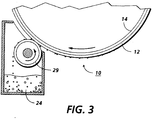
- ferrofluid-based embodiment described above may also benefit from a magnetic cleaner as shown in FIG. 3, comprising a rotatable magnet 29 positioned adjacent to the surface of the imaging member 10 for removing ferrofluid droplets which may become attached to the surface of the imaging member 10.
- the device of the present invention enables ionic conduction charging of a photoconductive imaging member, or any dielectric member placed in contact therewith, by placing a fluid' media component in contact with the surface of the photoconductive imaging member and applying a voltage to the fluid media component such that ions are transferred across the fluid media/imaging member interface to the imaging member.
- the imaging member thus becomes charged by the flow of ions through the fluid media component rather than by the spraying of ions onto the photoreceptor through a gaseous media as occurs in a corotron or like corona generating device.
- the fluid media such as an ionic liquid
- the fluid media is biased by a voltage approximately equal to the surface potential desired on the photoreceptor, causing ions to be deposited at the point of contact between the ionic liquid and the photoreceptor until the electric field across is completely diminished.
- the imaging member cannot be overcharged by the process disclosed in the present invention.
- the maximum voltage to which the imaging member can be charged is the voltage applied to the fluid media
- the charging of the imaging member is limited to this value since the electric field across the bulk of the fluid medium, which drives the ions to the fluid/insulator interface, drops to zero when the voltage on the imaging member reaches the voltage applied to the fluid.
- the imaging member can be undercharged if insufficient time is allowed for contact between the imaging member and the ionically conductive medium.
- the degree of undercharging is usually not significant (25 - 50 V) and can be compensated for by the application of a higher voltage to the ionically conductive medium.
- the circumferential rotating speed of the photoreceptor can range from very low values like anything greater than zero speed to high speeds such as, for example, about 100 inches per second and preferably from zero to about 20 inches per second.
- the present invention might also be used to eliminate the use of an erase lamp commonly utilized in a typical electrostatographic printing machine.
- an erase lamp is used to expose the photoreceptor after an imaging cycle for removing any residual charge thereon.
- the device of the present invention could be used to accomplish the same result because the ionically conductive fluid medium is able to charge imaging members to any voltage including zero (0) volts.
- an erase lamp is not needed to photodischarge the residual charge.
- the erase function typically associated with electrostatographic processes may be completely eliminated as a new charge can be applied independent of any pre-existing residual charge on the imaging member. This will work as long as the imaging member does not trap charges internally
Landscapes
- Physics & Mathematics (AREA)
- Engineering & Computer Science (AREA)
- Plasma & Fusion (AREA)
- General Physics & Mathematics (AREA)
- Electrostatic Charge, Transfer And Separation In Electrography (AREA)
Applications Claiming Priority (2)
| Application Number | Priority Date | Filing Date | Title |
|---|---|---|---|
| US08/250,090 US5457523A (en) | 1994-05-27 | 1994-05-27 | Ferrofluid media charging of photoreceptors |
| US250090 | 1994-05-27 |
Publications (3)
| Publication Number | Publication Date |
|---|---|
| EP0684528A2 true EP0684528A2 (de) | 1995-11-29 |
| EP0684528A3 EP0684528A3 (de) | 1996-10-02 |
| EP0684528B1 EP0684528B1 (de) | 2001-09-26 |
Family
ID=22946283
Family Applications (1)
| Application Number | Title | Priority Date | Filing Date |
|---|---|---|---|
| EP95303542A Expired - Lifetime EP0684528B1 (de) | 1994-05-27 | 1995-05-25 | Ladegerät unter Benutzung eines flüssigen Mediums |
Country Status (4)
| Country | Link |
|---|---|
| US (1) | US5457523A (de) |
| EP (1) | EP0684528B1 (de) |
| JP (1) | JPH07325460A (de) |
| DE (1) | DE69522853T2 (de) |
Families Citing this family (17)
| Publication number | Priority date | Publication date | Assignee | Title |
|---|---|---|---|---|
| USRE36489E (en) * | 1994-04-06 | 2000-01-11 | Janos Technology Inc. | Spectral analyzer with new high efficiency collection optics and method of using same |
| US5777651A (en) * | 1995-05-30 | 1998-07-07 | Xerox Corporation | Ionographic charging apparatus and processes |
| US5602626A (en) * | 1995-07-03 | 1997-02-11 | Xerox Corporation | Ionically conductive liquid charging apparatus |
| US5781833A (en) * | 1995-12-01 | 1998-07-14 | Xerox Corporation | Sealed liquid charging apparatus |
| US5554469A (en) * | 1995-12-01 | 1996-09-10 | Xerox Corporation | Charging processes with liquid compositions |
| US5666607A (en) * | 1996-01-11 | 1997-09-09 | Hewlett-Packard Company | Wet contact charging for electrophotography |
| US5667716A (en) * | 1996-07-01 | 1997-09-16 | Xerox Corporation | High magnetization aqueous ferrofluids and processes for preparation and use thereof |
| US5893663A (en) * | 1997-11-19 | 1999-04-13 | Xerox Corporation | Web liquid charging: improved resistance to contamination |
| US5895148A (en) * | 1997-11-19 | 1999-04-20 | Xerox Corporation | Control of fluid carrier resistance and water concentration in an aquatron charging device |
| US5819141A (en) * | 1997-11-19 | 1998-10-06 | Xerox Corporation | Control of fluid carrier resistance and liquid concentration in an aquatron charging device |
| US6142618A (en) * | 1998-04-29 | 2000-11-07 | Xerox Corporation | System for depositing image enhancing fluid and ink jet printing process employing said system |
| US6270214B1 (en) | 1998-04-29 | 2001-08-07 | Xerox Corporation | Ink jet printing process with improved image fixation |
| US6528226B1 (en) * | 2000-11-28 | 2003-03-04 | Xerox Corporation | Enhancing adhesion of organic electrostatographic imaging member overcoat and anticurl backing layers |
| US6365307B1 (en) | 2000-12-12 | 2002-04-02 | Xerox Corporation | Apparatus and method for assessing a photoreceptor |
| US6600888B2 (en) | 2001-11-02 | 2003-07-29 | Xerox Corporation | Liquid charging method and apparatus |
| US7422709B2 (en) * | 2004-05-21 | 2008-09-09 | Crosby Gernon | Electromagnetic rheological (EMR) fluid and method for using the EMR fluid |
| US9857361B2 (en) | 2013-03-15 | 2018-01-02 | Iris International, Inc. | Flowcell, sheath fluid, and autofocus systems and methods for particle analysis in urine samples |
Citations (3)
| Publication number | Priority date | Publication date | Assignee | Title |
|---|---|---|---|---|
| US4057723A (en) | 1976-01-23 | 1977-11-08 | Xerox Corporation | Compact corona charging device |
| US4353970A (en) | 1978-11-13 | 1982-10-12 | Hoechst Aktiengesellschaft | Method and apparatus for electrostatically charging a dielectric layer |
| US4562447A (en) | 1980-05-22 | 1985-12-31 | Konishiroku Photo Industry Co., Ltd. | Ion modulating electrode |
Family Cites Families (10)
| Publication number | Priority date | Publication date | Assignee | Title |
|---|---|---|---|---|
| US2904431A (en) * | 1954-08-26 | 1959-09-15 | Rca Corp | Electrographotographic charging means |
| US2987660A (en) * | 1955-06-06 | 1961-06-06 | Haloid Xerox Inc | Xerographic charging |
| US3394002A (en) * | 1964-10-21 | 1968-07-23 | Xerox Corp | Charge transfer with liquid layers |
| UST878019I4 (en) * | 1970-02-06 | 1970-09-29 | Electhophoretic charging method and apparatus | |
| JPS5948785A (ja) * | 1982-09-10 | 1984-03-21 | Canon Inc | クリ−ニング除帯電装置 |
| JPS5961858A (ja) * | 1982-09-30 | 1984-04-09 | Konishiroku Photo Ind Co Ltd | 静電記録用帯電及び除電装置 |
| US4762997A (en) * | 1983-11-30 | 1988-08-09 | Xerox Corporation | Fluid jet assisted ion projection charging method |
| JPS60237470A (ja) * | 1984-05-10 | 1985-11-26 | Canon Inc | 帯電装置 |
| JPH04109262A (ja) * | 1990-08-30 | 1992-04-10 | Konica Corp | 帯電装置 |
| JPH05297683A (ja) * | 1992-04-22 | 1993-11-12 | Brother Ind Ltd | 帯電装置 |
-
1994
- 1994-05-27 US US08/250,090 patent/US5457523A/en not_active Expired - Lifetime
-
1995
- 1995-05-19 JP JP7121159A patent/JPH07325460A/ja active Pending
- 1995-05-25 DE DE69522853T patent/DE69522853T2/de not_active Expired - Fee Related
- 1995-05-25 EP EP95303542A patent/EP0684528B1/de not_active Expired - Lifetime
Patent Citations (3)
| Publication number | Priority date | Publication date | Assignee | Title |
|---|---|---|---|---|
| US4057723A (en) | 1976-01-23 | 1977-11-08 | Xerox Corporation | Compact corona charging device |
| US4353970A (en) | 1978-11-13 | 1982-10-12 | Hoechst Aktiengesellschaft | Method and apparatus for electrostatically charging a dielectric layer |
| US4562447A (en) | 1980-05-22 | 1985-12-31 | Konishiroku Photo Industry Co., Ltd. | Ion modulating electrode |
Also Published As
| Publication number | Publication date |
|---|---|
| US5457523A (en) | 1995-10-10 |
| DE69522853T2 (de) | 2002-03-28 |
| DE69522853D1 (de) | 2001-10-31 |
| JPH07325460A (ja) | 1995-12-12 |
| EP0684528A3 (de) | 1996-10-02 |
| EP0684528B1 (de) | 2001-09-26 |
Similar Documents
| Publication | Publication Date | Title |
|---|---|---|
| EP0684528B1 (de) | Ladegerät unter Benutzung eines flüssigen Mediums | |
| US4568955A (en) | Recording apparatus using a toner-fog generated by electric fields applied to electrodes on the surface of the developer carrier | |
| US2879395A (en) | Charging device | |
| US5526029A (en) | Method and apparatus for improving transcription quality in electrographical printers | |
| US4057723A (en) | Compact corona charging device | |
| EP0216450A1 (de) | Corona-Aufladevorrichtung | |
| EP0232758B1 (de) | Kompaktes elektrophotographisches Druckgerät mit verbesserten Entwicklungsmitteln und sein Durchführungsverfahren | |
| US5561505A (en) | Mechanically sealable liquid charging apparatus | |
| US5602626A (en) | Ionically conductive liquid charging apparatus | |
| US4056723A (en) | Rotatable corona device | |
| FI57185C (fi) | Saett att framstaella en traod foer en koronagenerator | |
| US4320408A (en) | Method of forming electrostatic image | |
| US4666801A (en) | Method and apparatus for forming a toner image in electrophotographic printing | |
| US5832346A (en) | Multi-point contact charging device | |
| US5245502A (en) | Semi-conductor corona generator for production of ions to charge a substrate | |
| US5781833A (en) | Sealed liquid charging apparatus | |
| US3790466A (en) | Cleaning liquid purification device for use in wet-type electrostatic photography | |
| US5504383A (en) | High voltage power supply | |
| US5777651A (en) | Ionographic charging apparatus and processes | |
| US4086088A (en) | Imaging methods for use with charged particle modulator device | |
| US5668439A (en) | High voltage power supply | |
| Omodani et al. | Ion control characteristics of a pair of aperture electrodes | |
| JPS60101570A (ja) | 記録方法および装置 | |
| WO1981003387A1 (en) | Charger for electrophotographic surfaces | |
| SU1180831A1 (ru) | Устройство дл локальной зар дки электрографического носител информации |
Legal Events
| Date | Code | Title | Description |
|---|---|---|---|
| PUAI | Public reference made under article 153(3) epc to a published international application that has entered the european phase |
Free format text: ORIGINAL CODE: 0009012 |
|
| AK | Designated contracting states |
Kind code of ref document: A2 Designated state(s): DE FR GB |
|
| PUAL | Search report despatched |
Free format text: ORIGINAL CODE: 0009013 |
|
| AK | Designated contracting states |
Kind code of ref document: A3 Designated state(s): DE FR GB |
|
| 17P | Request for examination filed |
Effective date: 19970402 |
|
| 17Q | First examination report despatched |
Effective date: 19990301 |
|
| GRAG | Despatch of communication of intention to grant |
Free format text: ORIGINAL CODE: EPIDOS AGRA |
|
| GRAG | Despatch of communication of intention to grant |
Free format text: ORIGINAL CODE: EPIDOS AGRA |
|
| GRAH | Despatch of communication of intention to grant a patent |
Free format text: ORIGINAL CODE: EPIDOS IGRA |
|
| GRAH | Despatch of communication of intention to grant a patent |
Free format text: ORIGINAL CODE: EPIDOS IGRA |
|
| GRAA | (expected) grant |
Free format text: ORIGINAL CODE: 0009210 |
|
| AK | Designated contracting states |
Kind code of ref document: B1 Designated state(s): DE FR GB |
|
| REF | Corresponds to: |
Ref document number: 69522853 Country of ref document: DE Date of ref document: 20011031 |
|
| REG | Reference to a national code |
Ref country code: GB Ref legal event code: IF02 |
|
| ET | Fr: translation filed | ||
| PGFP | Annual fee paid to national office [announced via postgrant information from national office to epo] |
Ref country code: FR Payment date: 20020508 Year of fee payment: 8 |
|
| PGFP | Annual fee paid to national office [announced via postgrant information from national office to epo] |
Ref country code: GB Payment date: 20020522 Year of fee payment: 8 |
|
| PGFP | Annual fee paid to national office [announced via postgrant information from national office to epo] |
Ref country code: DE Payment date: 20020529 Year of fee payment: 8 |
|
| PLBE | No opposition filed within time limit |
Free format text: ORIGINAL CODE: 0009261 |
|
| STAA | Information on the status of an ep patent application or granted ep patent |
Free format text: STATUS: NO OPPOSITION FILED WITHIN TIME LIMIT |
|
| 26N | No opposition filed | ||
| PG25 | Lapsed in a contracting state [announced via postgrant information from national office to epo] |
Ref country code: GB Free format text: LAPSE BECAUSE OF NON-PAYMENT OF DUE FEES Effective date: 20030525 |
|
| PG25 | Lapsed in a contracting state [announced via postgrant information from national office to epo] |
Ref country code: DE Free format text: LAPSE BECAUSE OF NON-PAYMENT OF DUE FEES Effective date: 20031202 |
|
| GBPC | Gb: european patent ceased through non-payment of renewal fee |
Effective date: 20030525 |
|
| PG25 | Lapsed in a contracting state [announced via postgrant information from national office to epo] |
Ref country code: FR Free format text: LAPSE BECAUSE OF NON-PAYMENT OF DUE FEES Effective date: 20040130 |
|
| REG | Reference to a national code |
Ref country code: FR Ref legal event code: ST |