EP0684619A2 - Electrolyte polymère à conduction ionique et condensateur électrolytique utilisant celui-ci - Google Patents
Electrolyte polymère à conduction ionique et condensateur électrolytique utilisant celui-ci Download PDFInfo
- Publication number
- EP0684619A2 EP0684619A2 EP95107676A EP95107676A EP0684619A2 EP 0684619 A2 EP0684619 A2 EP 0684619A2 EP 95107676 A EP95107676 A EP 95107676A EP 95107676 A EP95107676 A EP 95107676A EP 0684619 A2 EP0684619 A2 EP 0684619A2
- Authority
- EP
- European Patent Office
- Prior art keywords
- group
- polymer electrolyte
- electrolyte
- ion
- conductive polymer
- Prior art date
- Legal status (The legal status is an assumption and is not a legal conclusion. Google has not performed a legal analysis and makes no representation as to the accuracy of the status listed.)
- Granted
Links
Images
Classifications
-
- H—ELECTRICITY
- H01—ELECTRIC ELEMENTS
- H01G—CAPACITORS; CAPACITORS, RECTIFIERS, DETECTORS, SWITCHING DEVICES, LIGHT-SENSITIVE OR TEMPERATURE-SENSITIVE DEVICES OF THE ELECTROLYTIC TYPE
- H01G9/00—Electrolytic capacitors, rectifiers, detectors, switching devices, light-sensitive or temperature-sensitive devices; Processes of their manufacture
- H01G9/004—Details
- H01G9/022—Electrolytes; Absorbents
- H01G9/025—Solid electrolytes
-
- H—ELECTRICITY
- H01—ELECTRIC ELEMENTS
- H01G—CAPACITORS; CAPACITORS, RECTIFIERS, DETECTORS, SWITCHING DEVICES, LIGHT-SENSITIVE OR TEMPERATURE-SENSITIVE DEVICES OF THE ELECTROLYTIC TYPE
- H01G9/00—Electrolytic capacitors, rectifiers, detectors, switching devices, light-sensitive or temperature-sensitive devices; Processes of their manufacture
- H01G9/004—Details
- H01G9/022—Electrolytes; Absorbents
- H01G9/025—Solid electrolytes
- H01G9/028—Organic semiconducting electrolytes, e.g. TCNQ
Definitions
- the present invention relates to an ion-conductive polymer electrolyte and an aluminum electrolytic capacitor configured with the same electrolyte as an electrolyte for driving the electrolytic capacitor.
- an electrolytic capacitor that is free from the leakage and evaporation of the electrolyte.
- Such a capacitor is configured by solidifying the capacitor element with the use of an ion-conductive polymer electrolyte composed of a mixture of siloxane-alkylene oxide copolymer and polyethylene oxide, as its prepolymer, and an alkali metal salt, instead of the liquid electrolyte.
- the electrolytic capacitor using, as its electrolyte, the ion-conductive polymer electrolyte in which alkali metal ions serve as the mobile ions has a disadvantage that the alkali metal ions are liable to diffuse into a dielectric substance layer formed on a positive electrode of the electrolytic capacitor, and the thus diffused alkali metal ions might sometimes cause a lowering of the dielectric constant of the dielectric substance layer, and finally invite a short-circuit in the capacitor.
- the ionic conductivity of the electrolyte constituting the electrolytic capacitor acts as an impedance of the capacitor. Therefore, when the ionic conductivity of the electrolyte is too poor, the impedance of the capacitor increases and such a capacitor is difficult to use in practical point of view.
- the primary object of the present invention is to provide a stable polymer electrolyte having a sufficiently high ionic conductivity, which will not decrease during a long-term storing at a high temperature, by improving the prepolymer which constitutes the polymer electrolyte.
- the present invention provides an ion-conductive polymer electrolyte comprising:
- each of n i , n 2 , n 3 , n 4 , n 5 and n 6 in the adducts is 6 or larger and 15 or smaller.
- the above-mentioned ion-conductive polymer electrolyte is solidified by forming a cross-linked chain at the terminal group X of the above-mentioned adduct.
- An electrolytic capacitor in accordance with the present invention comprises an aluminum positive electrode having a dielectric substance layer composed of aluminum oxide, an aluminum negative electrode, and an ion-conductive polymer electrolyte layer interposed between the above-mentioned dielectric substance layer and the negative electrode.
- the electrolyte is required to have a sufficient ionic conductivity which will not decrease during a long-term storing at a high temperature, and further to be free from any physical or chemical deterioration such as crack, contraction and dissolution or liquefaction.
- the ion-conductive polymer electrolyte configured by employing a prepolymer having a structure represented by the above-mentioned general formula (1) or (2) as its polymer mother ingredient and by dissolving an ammonium salt or a morpholinium salt therein, has a particularly excellent characteristic as an electrolyte for driving an electrolytic capacitor.
- the ion-conductive polymer electrolyte in accordance with the present invention can improve the physical strength of the electrolyte layer by forming a cross-linked chain at its terminal groups X in the prepolymer.
- the terminal group X of the adduct represented by the general formula (1) or (2) is an acryloyl group or a methacryloyl group, which has a double bond capable of initiating polymerization therein, it is possible to form the cross-linked chain by irradiating the adduct with an active ray such as ultraviolet ray or electron beam, or by heating it.
- an active ray such as ultraviolet ray or electron beam
- terminal group X of the adduct is an isocyanate group
- a maleate salt such as tetramethylammonium maleate and the like.
- terminal group X of the adduct is an epoxy group
- the adduct represented by the general formula (2) is to be made to have more cross-linking points per volume than the adduct represented by the general formula (1), it can produce a polymer electrolyte having a higher heat-resistant property.
- the above-mentioned feature is clearly seen in Tables 1 and 5 shown in the subsequent embodiments from the difference in the changes of the conductivity in the samples having a large unit number during storing at a high temperature.
- the above-mentioned adduct represented by the general formula (1) or (2) is usually liquid, and by allowing an ammonium salt or a morpholinium salt to dissolve therein, the electrolyte can be prepared, although it is preferable to add an organic solvent which has a sufficient intermiscibility with the above-mentioned compound.
- Preferable organic solvents may be exemplified as ethylene glycol, diethylene glycol, triethylene glycol and tetraethylene glycol.
- these solvents can dissolve a large quantity of ammonium oxalate, ammonium adipate, ammonium azelate, ammonium benzoate, ammonium formate, ammonium citrate, ammonium succinate, ammonium salycilate, ammonium tartarate, ammonium sebacate, ammonium 2-butyloctanedioate, ammonium p-nitrobenzoate, ammonium phthalate, ammonium borodisalycilate, ammonium maleate, ammonium y-resorcilate, ammonium lactate, ammonium glycolate, or ammonium diphenylacetate, and have a function of dissociating these ammonium salts into ion pairs.
- those of a dibasic acid refer to a mono-hydrogen mono-ammonium salt and a diammonium salt.
- Another preferred organic solvent may be exemplified as triethyleneglycol monomethylether or tetraethyleneglycol monomethylether. These solvents have a function of dissolving a large quantity of ammonium borodisalycilate, ammonium y-resocilate or the like and dissociate these ammonium salts into ion pairs. When these solvents are added to the prepolymer, it is possible to improve the conductivity dramatically. In addition, since these solvents have a high boiling point and a low vapor pressure, they give a great reliability to the electrolyte for a long-term storing at a high temperature.
- Still other preferred organic solvents may be exemplified as y-butyrolactone, propylene carbonate, ethylene carbonate, sulfolane, N,N-dimethylformamide, dimethylsulfoxide or acetonitrile.
- solvents have a high dielectric constant and a function of dissolving a large quantity of quaternary ammonium salt of benzoic acid, formic acid, salycilic acid, p-nitrobenzoic acid, borodisalycilic acid, y-resorcilic acid, lactic acid or the like, or a quaternary ammonium salt (including mono hydrogen salt) of a dibasic acid such as oxalic acid, adipic acid, azelaic acid, citric acid, succicinic acid, tartaric acid, sebacic acid, 2-butyloctanedioic acid, phthalic acid, maleic acid or the like, and dissociating these salts into ion pairs.
- a dibasic acid such as oxalic acid, adipic acid, azelaic acid, citric acid, succicinic acid, tartaric acid, sebacic acid, 2-butyloctanedioic acid, phthalic acid,
- the above-mentioned quaternary ammonium salts refer to an alkyl quaternary ammonium salt having from 1 to 4 carbon atoms.
- y-butyrolactone can dissolve N,N-dimethylmorpholinium maleate well.
- a polymer electrolyte having a sufficient ionic conductivity which does not decrease during a long-term storing at a high temperature, and is free from any physical and/or chemical deterioration such as crack, contraction or dissolution (or liquefaction).
- an aluminum electrolytic capacitor having a low impedance and being excellent in heat-resistant storing property.
- a solution was prepared by dissolving 20 g of ammonium 2-butyloctanedioate in 80 g of ethylene glycol.
- added was 20 g of each of the prepolymers of the compounds represented by the formula (1), wherein the terminal group X of the adduct is an acryloyl group and the number n for the ethylene oxide unit included in one branched chain (unit number) of the adduct is adjusted as listed after Sample numbers in Table 1 below, as well as 20 mg of benzyldimethyl ketal as a cross-linking initiator. And the obtained mixture was stirred well to dissolve the additives.
- Each of the mixtures was spread on a stainless steel tray in a thickness of 0.5 mm and irradiated with ultraviolet rays by a high pressure mercury lamp having an intensity of 100 mJ in a nitrogen atmosphere to obtain an ion-conductive polymer electrolyte sheet.
- deformations of the electrolytes sealed in glass tubes were also measured and observed after storing them at a high temperature, for evaluating the suitable number of the ethylene oxide unit included in the prepolymer which is practical with respect to the heat-resistant property.
- the results of the measurements are also summarized in Table 1. Evaluation of the deformations of the electrolytes was performed on the polymer electrolyte sheets finished to have a disk shape with a thickness of 1.0 mm and a diameter of 5 mm, and placed on a bottom of the sealed glass tube having a diameter of 6 mm and a length of 5 cm.
- the polymer electrolyte sheets sealed in the glass tubes were stored at 125 ° C, and then the outer shapes of these electrolyte sheets were observed.
- electrolytes comprising ethylene glycol and ammonium 2-butyloctanedioate, and a prepolymer of an adduct composed of sorbitol and polyethylene oxide
- best suitable is the one having the number of the ethylene oxide units included in one branched chain of the adduct in a range from 6 to 15, as an ion-conductive polymer electrolyte which satisfies both the requirements of high conductivity and high heat-resistant property at the same time.
- Example 1 As the prepolymer, 50 g of the same prepolymer as used in Sample No. 1 - 6 in Example 1 was used, and the polymer electrolytes were prepared with this prepolymer together with the salts and solvents listed in Tables 2 and 3 below. The method of preparing the electrolytes was the same as that in Example 1.
- Tables 2 and 3 show ionic conductivities of the electrolytes prepared in the above-mentioned manner, measured by means of the known complex impedance method at 30 ° C. Ionic conductivities of these electrolyte sheets measured after storing in a sealed glass tube in a manner similar to that in Example 1 at 110 ° C for 500 hours are also shown in Tables 2 and 3.
- an ion-conductive polymer electrolyte configured with any of the prepolymers, salts as well as solvents listed in Tables 2 and 3, has a sufficiently high conductivity in practical point of view and is excellent in the high heat-resistant property.
- a solution was prepared by dissolving 20 g of tetramethylammonium hydrogen maleate in 80 g of y-butyrolactone.
- added was each 20 g of the prepolymers represented by the formula (1) whose terminal group X is isocyanate group and whose number of ethylene oxide unit n included in one branched chain of the adduct is adjusted as listed after Sample numbers in Table 4 below, and the mixture was stirred well to dissolve the additive.
- the mixed solution was then spread on a flat Petri dish made of glass in a thickness of 0.5 mm, and the spread solution was cured by keeping it at 50°C for 1 hour to obtain an ion-conductive polymer electrolyte sheet.
- a solution was prepared by dissolving 20 g of ammonium 2-butyloctanedioate in 80 g of ethylene glycol.
- added was each 20 g of the prepolymers of the adducts represented by the formula (2), wherein the number n for the ethylene oxide unit included in one branched chain (unit number) of the adduct is adjusted as listed after Sample numbers in Table 5 below, as well as 20 mg of benzyldimethyl ketal as a cross-linking initiator. And the obtained mixture was stirred well to dissolve the additives.
- Each of the mixtures was spread on a stainless steel tray in a thickness of 0.5 mm and irradiated with ultraviolet rays by a high pressure mercury lamp having an intensity of 100 mJ in a nitrogen atmosphere to obtain an ion-conductive polymer electrolyte sheet.
- electrolytes comprising ethylene glycol and ammonium 2-butyloctanedioate, and a prepolymer of an adduct composed of tetramethylol methane and polyethylene oxide
- best suitable is the one having the number of the ethylene oxide units included in one branched chain of the adduct in a range from 6 to 15, as an ion-conductive polymer electrolyte which satisfies both the requirements of high conductivity and high heat-resistant property at the same time.
- the prepolymer 50 g of the same prepolymer as used in Sample No. 4 - 6 in Example 4 was used, and the polymer electrolytes were prepared with this prepolymer together with the salts and solvents listed in Table 6 below.
- the method of preparing the electrolyte was the same as that in Example 4.
- Table 6 shows ionic conductivities of the electrolytes prepared in the above-mentioned manner, measured by means of the known complex impedance method at 30 °C. Ionic conductivities of these electrolyte sheets measured after storing in a sealed glass tube in a manner similar to that in Example 1 at 125°C for 500 hours are also shown in Table 6.
- an ion-conductive polymer electrolyte configured with any of the prepolymers, salts as well as solvents listed in Table 6, has a sufficiently high conductivity in practical point of view and is excellent in the high heat-resistant property.
- a solution was prepared by dissolving 20 g of tetramethylammonium hydrogen maleate in 80 g of y-butyrolactone.
- added was each 20 g of the prepolymers represented by the formula (2) whose terminal group X is isocyanate group and whose number of ethylene oxide unit n included in one branched chain of the adduct is adjusted as listed after Sample numbers in Table 7 below, and the mixture was stirred well to dissolve the additive.
- the mixed solution was then spread on a flat Petri dish made of glass in a thickness of 0.5 mm and the spread solution was cured by keeping it in air at 50 ° C for 1 hour to obtain an ion-conductive polymer electrolyte sheet.
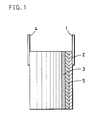
- FIG.1 shows a configuration of the aluminum electrolytic capacitor.
- a positive electrode (anode) connector 1 was spot- welded.
- the aluminum foil was anodized by soaking it in an aqueous solution of boric acid/sodium borate (80 g of boric acid + 8 g of sodium borate/1000 ml of water) kept at 90 ° C and by flowing a current of 30 A for 15 minutes and then applying a voltage of 600 V for 5 hours, to obtain a positive electrode foil 2.
- boric acid/sodium borate 80 g of boric acid + 8 g of sodium borate/1000 ml of water
- a negative electrode 3 was prepared by spot-welding a negative electrode connector 4 on an electrode 3 made of an aluminum foil of 3 cm x 100 cm in size and 0.05 mm in thickness, with a multiplicity of etched pores each having a diameter ranging from about 1 to 5 microns.
- a base liquid for the polymer electrolyte was prepared. That is, the liquid was prepared by adding 50 g of the prepolymer identical with that of Sample No. 1 - 6 in Example 1 and 500 mg of benzyldimethyl ketal to a solution composed of 80 g of ethylene glycol and 20 g of ammonium 2-butyloctanedioate, and by stirring the whole to make the composition sufficiently homogeneous.
- the base liquid composition for the polymer electrolyte was coated on the positive electrode foil 2 in a thickness of 0.1 mm, which was then irradiated with ultraviolet rays at an intensity of 100 mJ by means of a high pressure mercury lamp to cure the coated base liquid for the polymer electrolyte, thereby to form an ion-conductive polymer electrolyte layer 5.
- an aluminum electrolytic capacitor A which employed the ion-conductive polymer electrolyte was produced by rolling-up the laminated positive electrode foil 2, electrolyte layer 5 and negative electrode foil 3 together in a spiral arrangement.
- non-sealed aluminum electrolytic capacitor B similar to capacitor A was prepared using the known electrolyte prepared by dissolving 20 g of ammonium 2-butyloctanedioate in 80 g of ethylene glycol in the following manner. That is, the same positive electrode foil and negative electrode foil as those used for preparing the aluminum electrolytic capacitor element A were rolled-up together with a separator of 3 cm x 4 cm made of Manila hemp having a void ratio of 50% and a thickness of 0.1 mm in a spiral arrangement, and then the rolled-up assembly was impregnated under reduced pressure with the electrolyte at a pressure of 5 Torr at room temperature for one minute to obtain the capacitor element B.
- An aging process was performed by applying a voltage of 450 V at 80 ° C for two hours for element A, and by applying a voltage of 450 V at room temperature for 24 hours for element B, respectively.
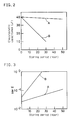
- capacitor element B of the comparative example configured with the known electrolyte employing ethylene glycol as its solvent deteriorate at early stage of the test after storing at a high temperature
- the capacitor element A configured with the electrolyte of the present invention has a sufficient reliability in its stability.
- Example 7 Different from the polymer electrolyte of Example 7 which employs ammonium 2-butyloctanedioate and ethylene glycol as the salt and the solvent, respectively, availability of other materials is investigated in this example.
- the manner of producing the elements was identical with that of Example 7, and the compositions of the ion-conductive polymer electrolytes are shown in Tables 8 and 9 below. Further, the aging voltages selected are 400 V for the polymer electrolytes employing ethylene glycol as the solvent, and 50 V for those employing the other solvents.
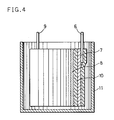
- FIG.4 shows a configuration of the aluminum electrolytic capacitor of this example.
- a positive electrode connector 6 was spot- welded.
- the aluminum foil was anodized by soaking it in an aqueous solution of boric acid/sodium borate (80 g of boric acid + 8 g of sodium borate/1000 ml of water) kept at 90 ° C and by flowing a current of 30 A for 15 minutes and then applying a voltage of 600 V for five hours, to obtain a positive electrode 7.
- boric acid/sodium borate 80 g of boric acid + 8 g of sodium borate/1000 ml of water
- a negative electrode 8 was prepared by spot-welding a negative electrode connector 9 on an electrode 8 made of an aluminum foil of 3 cm x 100 cm in size and 0.05 mm in thickness, with a multiplicity of etched pores each having a diameter ranging from about 1 to 5 microns.
- a capacitor electrode element was prepared by rolling-up the above-mentioned positive electrode foil 7 and the negative electrode foil 8, together with a separator 10 made of Manila hemp having a thickness of 40 ⁇ m and a density of 0.20 g/ml in a spiral arrangement.
- a base liquid for the polymer electrolyte was prepared by adding 50 g of the prepolymer identical with that of Sample No. 6 - 5 in Example 6 and 20 g of ammonium diphenylacetate to a solution composed of 20 g of ethylene glycol and 60 g of tetraethyleneglycol monomethylether, and by stirring the whole to make the composition sufficiently homogeneous.
- the above-mentioned capacitor electrode element was placed in a cylindrical vessel 11 made of aluminum, into which the above-mentioned base liquid composition for the polymer electrolyte was then injected. Thereafter, the pressure inside the vessel was reduced to 10 mmHg for 20 seconds, and then the above-mentioned base liquid composition for the polymer electrolyte was cured by keeping it in air at 50 °C for 24 hours. Finally, an aluminum electrolytic capacitor C was produced by aging the element by applying a voltage of 450 V at a temperature of 80 ° C for 2 hours.
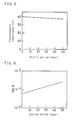
- the capacitor element C of this example has a sufficient reliability in its stability.
Landscapes
- Chemical & Material Sciences (AREA)
- Chemical Kinetics & Catalysis (AREA)
- Electrochemistry (AREA)
- Engineering & Computer Science (AREA)
- Power Engineering (AREA)
- Microelectronics & Electronic Packaging (AREA)
- Compositions Of Macromolecular Compounds (AREA)
- Conductive Materials (AREA)
- Secondary Cells (AREA)
- Electric Double-Layer Capacitors Or The Like (AREA)
Applications Claiming Priority (3)
| Application Number | Priority Date | Filing Date | Title |
|---|---|---|---|
| JP10870394 | 1994-05-23 | ||
| JP108703/94 | 1994-05-23 | ||
| JP10870394 | 1994-05-23 |
Publications (3)
| Publication Number | Publication Date |
|---|---|
| EP0684619A2 true EP0684619A2 (fr) | 1995-11-29 |
| EP0684619A3 EP0684619A3 (fr) | 1996-07-03 |
| EP0684619B1 EP0684619B1 (fr) | 2000-03-08 |
Family
ID=14491485
Family Applications (1)
| Application Number | Title | Priority Date | Filing Date |
|---|---|---|---|
| EP95107676A Expired - Lifetime EP0684619B1 (fr) | 1994-05-23 | 1995-05-18 | Electrolyte polymère à conduction ionique et condensateur électrolytique utilisant celui-ci |
Country Status (4)
| Country | Link |
|---|---|
| US (1) | US5526224A (fr) |
| EP (1) | EP0684619B1 (fr) |
| CN (1) | CN1052102C (fr) |
| DE (1) | DE69515368T2 (fr) |
Cited By (1)
| Publication number | Priority date | Publication date | Assignee | Title |
|---|---|---|---|---|
| EP3270390A4 (fr) * | 2015-03-11 | 2018-12-05 | Sanyo Chemical Industries, Ltd. | Solution électrolytique pour condensateur électrolytique en aluminium et condensateur électrolytique en aluminium utilisant ladite solution |
Families Citing this family (7)
| Publication number | Priority date | Publication date | Assignee | Title |
|---|---|---|---|---|
| EP0649153B1 (fr) * | 1993-10-19 | 1999-05-26 | Matsushita Electric Industrial Co., Ltd. | Electrolyte polymère à conduction ionique et condensateur électrolyte utilisant celui-ci |
| KR100462075B1 (ko) * | 2002-12-06 | 2004-12-17 | 파츠닉(주) | 알루미늄 전해콘덴서의 고압용 전해액 조성물 |
| KR100462082B1 (ko) * | 2002-12-11 | 2004-12-17 | 파츠닉(주) | 알루미늄 전해콘덴서의 고압용 전해액 조성물 |
| TWI460741B (zh) * | 2006-02-09 | 2014-11-11 | Shinetsu Polymer Co | 導電性高分子溶液、導電性塗膜、電容器,以及電容器之製造方法 |
| KR20090081367A (ko) * | 2006-11-22 | 2009-07-28 | 산요덴키가부시키가이샤 | 전해 콘덴서 및 그 제조 방법 |
| CN103430262B (zh) * | 2011-03-01 | 2017-03-15 | 日本贵弥功株式会社 | 聚合液、由该聚合液得到的导电性聚合物膜及固体电解电容器 |
| KR102414490B1 (ko) * | 2017-08-31 | 2022-06-29 | 쇼와 덴코 가부시키가이샤 | 고체 전해 콘덴서의 제조 방법 |
Family Cites Families (10)
| Publication number | Priority date | Publication date | Assignee | Title |
|---|---|---|---|---|
| JP2621355B2 (ja) * | 1988-06-06 | 1997-06-18 | 三菱化学株式会社 | 高分子ゲル電解質組成物 |
| JPH02105855A (ja) * | 1988-10-14 | 1990-04-18 | Ricoh Co Ltd | イオン伝導性組成物 |
| JP2790467B2 (ja) * | 1988-11-18 | 1998-08-27 | 日本カーリット株式会社 | 高分子固体電解質及びその製造法 |
| US5071521A (en) * | 1989-09-06 | 1991-12-10 | Matsushita Electric Industrial Co., Ltd. | Method for manufacturing a solid electrolytic capacitor |
| JP2902685B2 (ja) * | 1989-10-23 | 1999-06-07 | 日本ケミコン株式会社 | 電解コンデンサ用電解液 |
| JP2902684B2 (ja) * | 1989-10-23 | 1999-06-07 | 日本ケミコン株式会社 | 電解コンデンサ用電解液 |
| US5275750A (en) * | 1991-07-18 | 1994-01-04 | Matsushita Electric Industrial Co., Ltd. | Method of manufacturing a solid polymer electrolyte |
| JP2987474B2 (ja) * | 1991-10-15 | 1999-12-06 | 第一工業製薬株式会社 | 固体電解質 |
| EP0585072B1 (fr) * | 1992-08-27 | 1997-12-29 | Dai-Ichi Kogyo Seiyaku Co., Ltd. | Electrolyte polymère à conduction ionique |
| US5453335A (en) * | 1992-12-23 | 1995-09-26 | Arthur D Little, Inc. | Ion-conductive polymer and electrolyte additives |
-
1995
- 1995-05-15 US US08/441,519 patent/US5526224A/en not_active Expired - Lifetime
- 1995-05-18 DE DE69515368T patent/DE69515368T2/de not_active Expired - Lifetime
- 1995-05-18 EP EP95107676A patent/EP0684619B1/fr not_active Expired - Lifetime
- 1995-05-23 CN CN95106682A patent/CN1052102C/zh not_active Expired - Fee Related
Non-Patent Citations (1)
| Title |
|---|
| None |
Cited By (2)
| Publication number | Priority date | Publication date | Assignee | Title |
|---|---|---|---|---|
| EP3270390A4 (fr) * | 2015-03-11 | 2018-12-05 | Sanyo Chemical Industries, Ltd. | Solution électrolytique pour condensateur électrolytique en aluminium et condensateur électrolytique en aluminium utilisant ladite solution |
| US10607786B2 (en) | 2015-03-11 | 2020-03-31 | Sanyo Chemical Industries, Ltd. | Electrolytic solution for aluminum electrolytic capacitor and aluminum electrolytic capacitor using same |
Also Published As
| Publication number | Publication date |
|---|---|
| CN1052102C (zh) | 2000-05-03 |
| US5526224A (en) | 1996-06-11 |
| EP0684619A3 (fr) | 1996-07-03 |
| CN1122045A (zh) | 1996-05-08 |
| EP0684619B1 (fr) | 2000-03-08 |
| DE69515368D1 (de) | 2000-04-13 |
| DE69515368T2 (de) | 2000-10-26 |
Similar Documents
| Publication | Publication Date | Title |
|---|---|---|
| US6043975A (en) | Capacitors using ion conductive polymer electrolyte | |
| US4959753A (en) | Solid electrolytic capacitor and method of manufacturing the same | |
| US6765785B2 (en) | Polymer electrolyte composite for driving an electrolytic capacitor, an electrolytic capacitor using the same, and a method of making the electrolytic capacitor | |
| EP0444895A2 (fr) | Condensateur électrolytique et électrolyte utilisé | |
| US5526224A (en) | Ion-conductive polymer electrolyte and electrolytic capacitor using the same | |
| US5388026A (en) | Electrolytic capacitor and method for producing the same | |
| EP0649153B1 (fr) | Electrolyte polymère à conduction ionique et condensateur électrolyte utilisant celui-ci | |
| JP2787007B2 (ja) | イオン伝導性高分子電解質および電解コンデンサ | |
| JP3070813B2 (ja) | 電解コンデンサ駆動用電解質 | |
| US3609468A (en) | Paste composition for an electrolytic condenser and electrolytic condenser containing same | |
| US6183618B1 (en) | Process for treating impregnated electrolytic capacitor anodes | |
| JP3269146B2 (ja) | イオン伝導性高分子電解質 | |
| JPH07169653A (ja) | イオン伝導性高分子電解質および電解コンデンサ | |
| JP3254702B2 (ja) | 電解コンデンサおよびその製造法 | |
| JPS5938727B2 (ja) | 電解コンデンサ用電解液 | |
| US3766443A (en) | High molecular weight semi-solid electrolytic capacitor | |
| JPH0845792A (ja) | 電気二重層コンデンサ | |
| US4428028A (en) | Electrolytic capacitor | |
| JP2760186B2 (ja) | 電解コンデンサ及びその製造法 | |
| JPH1070044A (ja) | 電解コンデンサ駆動用電解液及びそれを用いた電解コンデンサ | |
| JPH05144676A (ja) | 電解コンデンサ | |
| JP3297067B2 (ja) | アルミ電解コンデンサの製造方法 | |
| JP3788486B2 (ja) | 電解コンデンサ用電解液 | |
| JPH0770442B2 (ja) | 電解コンデンサの駆動用電解液 | |
| JPH0645190A (ja) | 電気二重層コンデンサ |
Legal Events
| Date | Code | Title | Description |
|---|---|---|---|
| PUAI | Public reference made under article 153(3) epc to a published international application that has entered the european phase |
Free format text: ORIGINAL CODE: 0009012 |
|
| 17P | Request for examination filed |
Effective date: 19950518 |
|
| AK | Designated contracting states |
Kind code of ref document: A2 Designated state(s): DE FR GB |
|
| PUAL | Search report despatched |
Free format text: ORIGINAL CODE: 0009013 |
|
| RHK1 | Main classification (correction) |
Ipc: H01G 9/025 |
|
| AK | Designated contracting states |
Kind code of ref document: A3 Designated state(s): DE FR GB |
|
| 17Q | First examination report despatched |
Effective date: 19980703 |
|
| GRAG | Despatch of communication of intention to grant |
Free format text: ORIGINAL CODE: EPIDOS AGRA |
|
| GRAG | Despatch of communication of intention to grant |
Free format text: ORIGINAL CODE: EPIDOS AGRA |
|
| GRAH | Despatch of communication of intention to grant a patent |
Free format text: ORIGINAL CODE: EPIDOS IGRA |
|
| GRAH | Despatch of communication of intention to grant a patent |
Free format text: ORIGINAL CODE: EPIDOS IGRA |
|
| GRAA | (expected) grant |
Free format text: ORIGINAL CODE: 0009210 |
|
| AK | Designated contracting states |
Kind code of ref document: B1 Designated state(s): DE FR GB |
|
| REF | Corresponds to: |
Ref document number: 69515368 Country of ref document: DE Date of ref document: 20000413 |
|
| ET | Fr: translation filed | ||
| PLBE | No opposition filed within time limit |
Free format text: ORIGINAL CODE: 0009261 |
|
| STAA | Information on the status of an ep patent application or granted ep patent |
Free format text: STATUS: NO OPPOSITION FILED WITHIN TIME LIMIT |
|
| 26N | No opposition filed | ||
| REG | Reference to a national code |
Ref country code: GB Ref legal event code: IF02 |
|
| PGFP | Annual fee paid to national office [announced via postgrant information from national office to epo] |
Ref country code: GB Payment date: 20130515 Year of fee payment: 19 Ref country code: DE Payment date: 20130515 Year of fee payment: 19 |
|
| PGFP | Annual fee paid to national office [announced via postgrant information from national office to epo] |
Ref country code: FR Payment date: 20130531 Year of fee payment: 19 |
|
| REG | Reference to a national code |
Ref country code: DE Ref legal event code: R119 Ref document number: 69515368 Country of ref document: DE |
|
| GBPC | Gb: european patent ceased through non-payment of renewal fee |
Effective date: 20140518 |
|
| REG | Reference to a national code |
Ref country code: DE Ref legal event code: R119 Ref document number: 69515368 Country of ref document: DE Effective date: 20141202 |
|
| REG | Reference to a national code |
Ref country code: FR Ref legal event code: ST Effective date: 20150130 |
|
| PG25 | Lapsed in a contracting state [announced via postgrant information from national office to epo] |
Ref country code: DE Free format text: LAPSE BECAUSE OF NON-PAYMENT OF DUE FEES Effective date: 20141202 |
|
| PG25 | Lapsed in a contracting state [announced via postgrant information from national office to epo] |
Ref country code: GB Free format text: LAPSE BECAUSE OF NON-PAYMENT OF DUE FEES Effective date: 20140518 Ref country code: FR Free format text: LAPSE BECAUSE OF NON-PAYMENT OF DUE FEES Effective date: 20140602 |