EP0684939B1 - Herstellung von diisopropylether - Google Patents
Herstellung von diisopropylether Download PDFInfo
- Publication number
- EP0684939B1 EP0684939B1 EP94909701A EP94909701A EP0684939B1 EP 0684939 B1 EP0684939 B1 EP 0684939B1 EP 94909701 A EP94909701 A EP 94909701A EP 94909701 A EP94909701 A EP 94909701A EP 0684939 B1 EP0684939 B1 EP 0684939B1
- Authority
- EP
- European Patent Office
- Prior art keywords
- stream
- propene
- liquid
- recycle
- propane
- Prior art date
- Legal status (The legal status is an assumption and is not a legal conclusion. Google has not performed a legal analysis and makes no representation as to the accuracy of the status listed.)
- Expired - Lifetime
Links
- ZAFNJMIOTHYJRJ-UHFFFAOYSA-N Diisopropyl ether Chemical compound CC(C)OC(C)C ZAFNJMIOTHYJRJ-UHFFFAOYSA-N 0.000 title claims abstract description 54
- 238000004519 manufacturing process Methods 0.000 title claims abstract description 14
- KFZMGEQAYNKOFK-UHFFFAOYSA-N Isopropanol Chemical compound CC(C)O KFZMGEQAYNKOFK-UHFFFAOYSA-N 0.000 claims abstract description 126
- QQONPFPTGQHPMA-UHFFFAOYSA-N Propene Chemical compound CC=C QQONPFPTGQHPMA-UHFFFAOYSA-N 0.000 claims abstract description 112
- XLYOFNOQVPJJNP-UHFFFAOYSA-N water Substances O XLYOFNOQVPJJNP-UHFFFAOYSA-N 0.000 claims abstract description 59
- 239000003054 catalyst Substances 0.000 claims abstract description 52
- 238000000034 method Methods 0.000 claims abstract description 49
- 230000008569 process Effects 0.000 claims abstract description 40
- ATUOYWHBWRKTHZ-UHFFFAOYSA-N Propane Chemical compound CCC ATUOYWHBWRKTHZ-UHFFFAOYSA-N 0.000 claims abstract description 38
- 239000007788 liquid Substances 0.000 claims abstract description 37
- 238000006243 chemical reaction Methods 0.000 claims abstract description 32
- 238000006703 hydration reaction Methods 0.000 claims abstract description 30
- 230000036571 hydration Effects 0.000 claims abstract description 28
- 150000001336 alkenes Chemical class 0.000 claims abstract description 23
- 239000001294 propane Substances 0.000 claims abstract description 19
- JRZJOMJEPLMPRA-UHFFFAOYSA-N olefin Natural products CCCCCCCC=C JRZJOMJEPLMPRA-UHFFFAOYSA-N 0.000 claims abstract description 17
- 238000010992 reflux Methods 0.000 claims abstract description 17
- 230000003197 catalytic effect Effects 0.000 claims abstract description 14
- 238000006266 etherification reaction Methods 0.000 claims abstract description 14
- 229930195733 hydrocarbon Natural products 0.000 claims abstract description 10
- 150000002430 hydrocarbons Chemical class 0.000 claims abstract description 10
- 230000002378 acidificating effect Effects 0.000 claims abstract description 7
- 239000004215 Carbon black (E152) Substances 0.000 claims abstract description 6
- 238000001816 cooling Methods 0.000 claims abstract description 6
- 238000004064 recycling Methods 0.000 claims abstract description 6
- RTZKZFJDLAIYFH-UHFFFAOYSA-N Diethyl ether Chemical compound CCOCC RTZKZFJDLAIYFH-UHFFFAOYSA-N 0.000 claims description 20
- HNPSIPDUKPIQMN-UHFFFAOYSA-N dioxosilane;oxo(oxoalumanyloxy)alumane Chemical compound O=[Si]=O.O=[Al]O[Al]=O HNPSIPDUKPIQMN-UHFFFAOYSA-N 0.000 claims description 17
- 239000010457 zeolite Substances 0.000 claims description 17
- 229910021536 Zeolite Inorganic materials 0.000 claims description 15
- 238000010791 quenching Methods 0.000 claims description 12
- 239000011148 porous material Substances 0.000 claims description 11
- 239000012263 liquid product Substances 0.000 claims description 6
- 238000011027 product recovery Methods 0.000 claims description 6
- 239000007787 solid Substances 0.000 claims description 4
- 239000011949 solid catalyst Substances 0.000 claims description 3
- 239000012071 phase Substances 0.000 description 27
- 239000000047 product Substances 0.000 description 15
- 230000008901 benefit Effects 0.000 description 11
- 239000007789 gas Substances 0.000 description 10
- 238000002156 mixing Methods 0.000 description 9
- 238000010926 purge Methods 0.000 description 9
- 239000000463 material Substances 0.000 description 8
- TVMXDCGIABBOFY-UHFFFAOYSA-N octane Chemical compound CCCCCCCC TVMXDCGIABBOFY-UHFFFAOYSA-N 0.000 description 8
- 238000000605 extraction Methods 0.000 description 7
- 230000015572 biosynthetic process Effects 0.000 description 6
- 230000009849 deactivation Effects 0.000 description 6
- 239000000446 fuel Substances 0.000 description 6
- 239000003502 gasoline Substances 0.000 description 6
- CURLTUGMZLYLDI-UHFFFAOYSA-N Carbon dioxide Chemical compound O=C=O CURLTUGMZLYLDI-UHFFFAOYSA-N 0.000 description 5
- LFQSCWFLJHTTHZ-UHFFFAOYSA-N Ethanol Chemical compound CCO LFQSCWFLJHTTHZ-UHFFFAOYSA-N 0.000 description 5
- 239000006227 byproduct Substances 0.000 description 5
- 239000000571 coke Substances 0.000 description 5
- 238000013461 design Methods 0.000 description 5
- 238000004821 distillation Methods 0.000 description 5
- 230000000694 effects Effects 0.000 description 5
- 150000002170 ethers Chemical class 0.000 description 5
- 239000000376 reactant Substances 0.000 description 5
- 238000011069 regeneration method Methods 0.000 description 5
- 230000032683 aging Effects 0.000 description 4
- 150000001298 alcohols Chemical class 0.000 description 4
- 239000012530 fluid Substances 0.000 description 4
- 239000000203 mixture Substances 0.000 description 4
- 230000008929 regeneration Effects 0.000 description 4
- 229910002092 carbon dioxide Inorganic materials 0.000 description 3
- 238000004939 coking Methods 0.000 description 3
- 239000012141 concentrate Substances 0.000 description 3
- 238000009826 distribution Methods 0.000 description 3
- 239000003623 enhancer Substances 0.000 description 3
- 238000002474 experimental method Methods 0.000 description 3
- 238000011065 in-situ storage Methods 0.000 description 3
- 239000007791 liquid phase Substances 0.000 description 3
- 230000001590 oxidative effect Effects 0.000 description 3
- 125000004805 propylene group Chemical group [H]C([H])([H])C([H])([*:1])C([H])([H])[*:2] 0.000 description 3
- 239000002904 solvent Substances 0.000 description 3
- 241000196324 Embryophyta Species 0.000 description 2
- OTMSDBZUPAUEDD-UHFFFAOYSA-N Ethane Chemical compound CC OTMSDBZUPAUEDD-UHFFFAOYSA-N 0.000 description 2
- VGGSQFUCUMXWEO-UHFFFAOYSA-N Ethene Chemical compound C=C VGGSQFUCUMXWEO-UHFFFAOYSA-N 0.000 description 2
- VYPSYNLAJGMNEJ-UHFFFAOYSA-N Silicium dioxide Chemical compound O=[Si]=O VYPSYNLAJGMNEJ-UHFFFAOYSA-N 0.000 description 2
- MCMNRKCIXSYSNV-UHFFFAOYSA-N Zirconium dioxide Chemical compound O=[Zr]=O MCMNRKCIXSYSNV-UHFFFAOYSA-N 0.000 description 2
- 239000002253 acid Substances 0.000 description 2
- 229910000323 aluminium silicate Inorganic materials 0.000 description 2
- 239000011230 binding agent Substances 0.000 description 2
- 239000001569 carbon dioxide Substances 0.000 description 2
- 239000003153 chemical reaction reagent Substances 0.000 description 2
- 238000010586 diagram Methods 0.000 description 2
- 230000003301 hydrolyzing effect Effects 0.000 description 2
- 239000012535 impurity Substances 0.000 description 2
- VNWKTOKETHGBQD-UHFFFAOYSA-N methane Chemical compound C VNWKTOKETHGBQD-UHFFFAOYSA-N 0.000 description 2
- 229920000642 polymer Polymers 0.000 description 2
- 238000000746 purification Methods 0.000 description 2
- 239000011541 reaction mixture Substances 0.000 description 2
- 238000011084 recovery Methods 0.000 description 2
- 230000009467 reduction Effects 0.000 description 2
- 238000000926 separation method Methods 0.000 description 2
- 238000001179 sorption measurement Methods 0.000 description 2
- 238000000194 supercritical-fluid extraction Methods 0.000 description 2
- 238000003786 synthesis reaction Methods 0.000 description 2
- 238000010977 unit operation Methods 0.000 description 2
- 240000000731 Fagus sylvatica Species 0.000 description 1
- 235000010099 Fagus sylvatica Nutrition 0.000 description 1
- 239000006096 absorbing agent Substances 0.000 description 1
- 230000002411 adverse Effects 0.000 description 1
- -1 aliphatic alkyl ethers Chemical class 0.000 description 1
- 125000001931 aliphatic group Chemical group 0.000 description 1
- PNEYBMLMFCGWSK-UHFFFAOYSA-N aluminium oxide Inorganic materials [O-2].[O-2].[O-2].[Al+3].[Al+3] PNEYBMLMFCGWSK-UHFFFAOYSA-N 0.000 description 1
- 239000008346 aqueous phase Substances 0.000 description 1
- QVGXLLKOCUKJST-UHFFFAOYSA-N atomic oxygen Chemical compound [O] QVGXLLKOCUKJST-UHFFFAOYSA-N 0.000 description 1
- 230000009286 beneficial effect Effects 0.000 description 1
- 230000008033 biological extinction Effects 0.000 description 1
- 238000009835 boiling Methods 0.000 description 1
- 238000006555 catalytic reaction Methods 0.000 description 1
- 230000000052 comparative effect Effects 0.000 description 1
- 230000006835 compression Effects 0.000 description 1
- 238000007906 compression Methods 0.000 description 1
- 238000009833 condensation Methods 0.000 description 1
- 230000005494 condensation Effects 0.000 description 1
- 239000002826 coolant Substances 0.000 description 1
- 239000000498 cooling water Substances 0.000 description 1
- 230000007797 corrosion Effects 0.000 description 1
- 238000005260 corrosion Methods 0.000 description 1
- 239000006184 cosolvent Substances 0.000 description 1
- 230000008021 deposition Effects 0.000 description 1
- 238000011161 development Methods 0.000 description 1
- 230000018109 developmental process Effects 0.000 description 1
- 239000000539 dimer Substances 0.000 description 1
- 238000001035 drying Methods 0.000 description 1
- 230000008030 elimination Effects 0.000 description 1
- 238000003379 elimination reaction Methods 0.000 description 1
- 238000005516 engineering process Methods 0.000 description 1
- 230000004907 flux Effects 0.000 description 1
- 238000005194 fractionation Methods 0.000 description 1
- 239000007792 gaseous phase Substances 0.000 description 1
- 230000000887 hydrating effect Effects 0.000 description 1
- 230000010354 integration Effects 0.000 description 1
- 238000012986 modification Methods 0.000 description 1
- 230000004048 modification Effects 0.000 description 1
- 239000001301 oxygen Substances 0.000 description 1
- 229910052760 oxygen Inorganic materials 0.000 description 1
- 239000003348 petrochemical agent Substances 0.000 description 1
- 238000005504 petroleum refining Methods 0.000 description 1
- 239000002574 poison Substances 0.000 description 1
- 231100000614 poison Toxicity 0.000 description 1
- 239000002243 precursor Substances 0.000 description 1
- 238000012545 processing Methods 0.000 description 1
- JTXAHXNXKFGXIT-UHFFFAOYSA-N propane;prop-1-ene Chemical compound CCC.CC=C JTXAHXNXKFGXIT-UHFFFAOYSA-N 0.000 description 1
- WHFQAROQMWLMEY-UHFFFAOYSA-N propylene dimer Chemical compound CC=C.CC=C WHFQAROQMWLMEY-UHFFFAOYSA-N 0.000 description 1
- 230000000171 quenching effect Effects 0.000 description 1
- 230000035484 reaction time Effects 0.000 description 1
- 238000005057 refrigeration Methods 0.000 description 1
- 238000012958 reprocessing Methods 0.000 description 1
- 239000011347 resin Substances 0.000 description 1
- 229920005989 resin Polymers 0.000 description 1
- 238000009738 saturating Methods 0.000 description 1
- 239000000377 silicon dioxide Substances 0.000 description 1
- 239000011973 solid acid Substances 0.000 description 1
- 239000002594 sorbent Substances 0.000 description 1
- 230000003068 static effect Effects 0.000 description 1
- 238000001308 synthesis method Methods 0.000 description 1
Images

Classifications
-
- C—CHEMISTRY; METALLURGY
- C07—ORGANIC CHEMISTRY
- C07C—ACYCLIC OR CARBOCYCLIC COMPOUNDS
- C07C41/00—Preparation of ethers; Preparation of compounds having groups, groups or groups
- C07C41/01—Preparation of ethers
- C07C41/05—Preparation of ethers by addition of compounds to unsaturated compounds
-
- C—CHEMISTRY; METALLURGY
- C07—ORGANIC CHEMISTRY
- C07C—ACYCLIC OR CARBOCYCLIC COMPOUNDS
- C07C41/00—Preparation of ethers; Preparation of compounds having groups, groups or groups
- C07C41/01—Preparation of ethers
- C07C41/05—Preparation of ethers by addition of compounds to unsaturated compounds
- C07C41/06—Preparation of ethers by addition of compounds to unsaturated compounds by addition of organic compounds only
-
- Y—GENERAL TAGGING OF NEW TECHNOLOGICAL DEVELOPMENTS; GENERAL TAGGING OF CROSS-SECTIONAL TECHNOLOGIES SPANNING OVER SEVERAL SECTIONS OF THE IPC; TECHNICAL SUBJECTS COVERED BY FORMER USPC CROSS-REFERENCE ART COLLECTIONS [XRACs] AND DIGESTS
- Y02—TECHNOLOGIES OR APPLICATIONS FOR MITIGATION OR ADAPTATION AGAINST CLIMATE CHANGE
- Y02P—CLIMATE CHANGE MITIGATION TECHNOLOGIES IN THE PRODUCTION OR PROCESSING OF GOODS
- Y02P20/00—Technologies relating to chemical industry
- Y02P20/50—Improvements relating to the production of bulk chemicals
- Y02P20/582—Recycling of unreacted starting or intermediate materials
Definitions
- This invention relates to olefin hydration, especially for production of di-isopropyl ether (DIPE) from C 3 + olefinic feedstock.
- DIPE di-isopropyl ether
- the invention relates to a novel technique for recovering DIPE product and unreacted light hydrocarbons from reactor effluent.
- by-product propene (propylene) from which IPA and DIPE can be made is usually available in a fuels refinery, typically as a C 3 + aliphatic stream rich in propene and propane.
- a fuels refinery typically as a C 3 + aliphatic stream rich in propene and propane.
- the petrochemicals industry also produces mixtures of light olefin streams in the C 2 -C 7 molecular weight range and the conversion of such streams or fractions thereof to alcohols and/or ethers can also provide products useful as solvents and blending stocks for gasoline.
- Feedstocks of particular interest are light hydrocarbon streams rich in propene, which are often accompanied by significant amounts of propane, ethene, ethane and other light gases.
- Adapting available refinery feedstock to produce these oxygenates simultaneously as octane enhancers can involve two different olefin hydration and etherification processes, i.e. propene hydration etherification to give DIPE and IPA. Accordingly, a challenge is provided to explore these processes to discover how they may be integrated in a manner more beneficial to the production of high octane gasoline.
- Catalytic hydration of olefins to provide alcohols and ethers is established technology for production of the IPA and DIPE and is of significant commercial importance.
- Olefin hydration employing medium pore and large pore zeolite catalyst is a known synthesis method.
- processes for the direct hydration of olefins to provide alcohols and ethers using porous shape selective metallosilicate zeolite catalyst, such as zeolite Beta have been disclosed in U.S. Patent Nos. 4,857,664 (Huang et al.), 4,886,918 (Sorensen et al) and 5,138,102 (Beech et al).
- the present invention provides a novel process for the production of ether/alcohol from lower olefins.
- di-isopropyl ether (DIPE) is produced by hydration and etherification of a propene-rich feedstock containing C 2 - components, which comprises contacting the propene feedstock, IPA and water in a catalytic reactor containing porous solid acidic catalyst under olefin hydration and etherification conditions.
- DIPE di-isopropyl ether
- Improved operation is obtained by recovering a net liquid effluent stream from the catalytic reactor containing diisopropyl ether, isopropanol, water, unreacted propene, propane and C 2 - light gas components, and separating the liquid effluent stream in a vertical stripper column having a lower reboiler portion and an upper contact portion, thereby recovering an overhead vapor stream containing propene, propane and C 2 - light gas components from the stripper column.
- fresh feedstock is prefractionated to provide a reactor feedstream rich in propene; and the C3 recycle stream may be prefractionated economically with fresh feedstock.
- the olefins hydration and etherification process employs the reaction of propylene with water catalyzed by strong acid to form isopropanol. Reaction may be allowed to continue in the hydration zone to form di-isopropyl ether.
- the operating conditions of the olefin hydration and etherification reaction step include a temperature of 50 to 450°C, preferably from 100 to 250°C and most preferably from 120 to 220°C.
- the total pressure is 700 to 24000 kPa (100 to 3500 psi, preferably 500-2000 psi). Water to olefin reactant concentrations are maintained at mole ratio of 0.1 to 30, preferably 0.1-5.
- the preferred catalytic methods for making DIPE employ porous solid acid catalysts, such as zeolites Beta, Y, ZSM-35 and/or MCM-22 aluminosilicate.
- the preferred hydration/etherification catalyst comprises acidic, shape selective porous zeolite having a pore size of 5-8 x 10 -7 mm, such as aluminosilicate zeolite Beta.
- MCM-22 having pores similar to zeolite Beta and ZSM-5, is known for etherification catalysis, as disclosed by Marler et al in U.S. Patent 5,105,023.
- DIPE etherification conditions may vary widely in choice of temperature, pressure and reaction time.
- the preferred method reacts propene with water in an adiabatic downflow reactor containing a fixed bed of catalyst, such as zeolite Beta, at 100 to 250°C and pressure of at least 4000 kPa.
- catalyst such as zeolite Beta
- the olefin hydration and etherification reaction step is carried out in liquid phase or supercritical dense phase in continuous manner using a fixed bed flow reactor. Weight hourly space velocity, based on catalyst weight is maintained in the range of 0.1 to 10/hour when operating continuously.
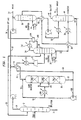
- a process flow diagram depicts production of diisopropyl ether by hydration of fresh olefinic feedstock stream, which is introduced as a propane-propene mixture via inlet 1 to feed splitter tower 2 to recover a propane-rich bottoms stream 3, which will also contain any C 4 + components in the feedstock.
- the reactor vessel 20 contains a series of fixed bed adiabatic hydration reaction zones 20A, 20B, 20C maintained under olefin hydration conditions.
- Static mixers and liquid distributors may be employed before each bed to promote operation in a single homogeneous phase, as localized high concentrations of water or propene are known to deactivate acidic catalysts (both zeolites and resins).
- at least one hydration reaction zone contains porous zeolite catalyst, such as zeolite Beta.
- a fluid handling system is operatively connected for recovering a liquid reactor effluent stream 22 from the last zone 20C. This can be achieved by splitting effluent stream 22 into a liquid product recovery stream 24 and a liquid recycle stream 16A, which is recycled to the multizone reactor 20 as a plurality of flow-controlled recycle streams R1, R2, R3. Heat exchanger 16H cools the interstage quench streams R2, R3 below the process temperature, thus balancing the adiabatic heat of reaction from the preceding zone.
- Reactor 20 is operated continuously by passing the liquid recycle stream 16A for direct mixing with the reactor feedstream. Reaction temperature can be controlled in zones 20B, 20C by varying the degree of cooling and/or flow rate of the recycle stream in unit 16H.
- the reactor effluent and liquid product recovery stream consist essentially of 0.5-10 wt % water, 20-60 wt% propene, 20-30 wt% di-isopropyl ether, 10-15 wt% isopropanol, and various amounts of unreacted light C 3 - materials, such as 5 to 40 wt% total C 3 -.
- propane and C 2 - components comprise 0.1-10 wt% and 3-40 wt%, respectively.
- the amount of unfractionated liquid recycle stream 16 may be sufficient to maintain a substantially homogeneous single liquid reaction phase in the primary hydration zone 20A under reaction conditions. Use of DIPE, IPA containing product for quench will also promote single phase operation.
- the first liquid product stream 24 is passed via exchangers 14, 23 and fluid handling unit 29 to the product fractionation system, as described.
- Effluent stream 24 is fractionated in the product recovery system first in C3 stripper column 30, equipped with reboiler means 31, to recover a liquid ether-rich stream 32.
- the column overhead vapor stream 34 is cooled in condenser means 34C to condense a large portion of C3 and C2 hydrocarbons for recycle via accumulator means 34A and recycle means 34R.
- a high recycle rate is maintained in the range of 25:1 to 100:1, preferably about 75:1.
- a propene-rich C3 stream 35 is withdrawn in a upper portion of column 30 for recycle to tower 2 via line 35. Light hydrocarbons may be purged from the system via line 36.
- unfractionated liquid recycle stream 16A is passed to reactor 20 at a high rate, usually about four times the total weight of propene and water reactants in the product recovery stream 24; the exact quantity depends on conversion targets, feed properties, etc..
- Ether-rich stream 32 containing by-product isopropanol, unreacted propene, water and C 6 + hydrocarbon oligomer is further separated after passing through heat exchangers 38, 39 to extractor unit 40, where it is contacted with feed water 42 and/or water recycle stream 52 to extract isopropanol in an aqueous phase 44.
- a wet product stream 46 consisting essentially of DIPE and by-product C 6 + propene oligomer is recovered from the extraction unit 40, and can be further processed to remove excess water.
- the extract phase 44 is passed via exchangers 38, 48 to IPA stripper column 50 to obtain an overhead isopropanol recycle stream 12.
- Makeup water stream 54 may be added to the IPA recycle stream 12, as required to maintain the reactor conditions.
- a portion of the stripper bottom stream is passed through reboiler means 51 and liquid aqueous stream 52 is recycled through the extraction loop via unit 40.
- the IPA extraction loop may be operated with extractants other than water.
- carbon dioxide has appropriate characteristics under supercritical conditions to extract IPA and produce a DIPE-rich raffinate stream analogous to stream 46.
- Such an alternative extraction loop may require changes in the manner of water addition.
- Carbon dioxide extraction can be effected at about 40-60°C temperature and 10,000-13,000 kPa pressure.
- IPA is readily recovered from the extractant by flashing to create a separate CO 2 gaseous phase, which can be recycled by compression.
- Conditions and operating techniques suitable for IPA/water and other systems can be found in McHugh and Krukons, Supercritical Fluid Extraction, 1986.
- supercritical extraction can be employed in a multistage system for removing water from stream 46 to provide a dry DIPE product containing a minor amount of C6 dimer suitable for gasoline blending.
- the process flow scheme for olefin hydration to ethers over a zeolite Beta catalyst as disclosed utilizes product recycle and reactor quench for improved catalyst life and temperature control.
- a preferred system utilizes three catalyst beds in a single vertical reactor shell with mixing with inter-bed quench to reduce cost while controlling system phase behavior in comparison to other designs (tubular reactor).
- Improved catalyst life and yield benefits are realized when recycling reactor product (pumparound) for propene hydration to di-isopropylether (DIPE) over typical porous acid solid catalyst.
- Product pumparound is advantageous as a means of controlling reactor temperature rise and therefore reduces equipment cost, as compared to a conventional isothermal tubular reactor or the like.
- This is achieved in the preferred reactor system configuration by providing fluid control means for splitting a first liquid effluent stream into a liquid product recovery stream and a liquid recycle stream, means for cooling at least a portion of the liquid recycle stream, and means for passing the cooled liquid recycle stream as interstage quench between serial fixed bed hydration zones in the catalytic reactor for controlling reaction temperature.
- total liquid recycle is combined with fresh feed at a weight ratio of 2:1 to 10:1 recycle:feed, and the liquid recycle stream is separated into at least two streams for recycle to separate reaction zones, and cooled liquid recycle is injected between separated fixed catalyst beds.
- the use of the product recycle for inter-bed quench eliminates inter-reactor coolers; while giving benefits in control of phase behavior. With three beds contained in a single reactor vessel, lower cost may be achieved.
- This preferred process design which is suitable for commercial design, utilizes feed purification, product recycle, and reactor quench for hydration of propene to DIPE to achieve high propene conversion (up to ⁇ 95% overall).
- the design also takes advantage of reactor recycle and quench with interstage mixing-distribution to provide reduced catalyst aging and reactor temperature control (heat removal).
- the optimum propene/water ratio is found between 3/1 and 4.5/1 (1.5-2.2 times stoichiometric). Lower water content can lead to increased oligomer formation and catalyst coking.
- the reactor feed contents must be within carefully adjusted ratios to maintain single phase operation, maintain product selectivity and balance IPA production with IPA losses from the system.
- the IPA distillation and recycle is critical to maintaining these ratios.
- reagent grade DIPE could be dried via distillation or sorption.
- fuel grade DIPE >3 wt% oligomer
- the oligomers do not foul the sorbents so drying by sorption could also be used.
- the DIPE process of this invention differs from traditional single reaction ether processes, such as dry reaction of a primary alkanol with an alkene in that the present catalyst is exposed to water (the other processes use alcohol feed to introduce the oxygen containing reactant).
- catalyst deactivation occurs both by hydrolytic damage and by pore plugging via coke and/or polymer deposition. Reducing the water content below stoichiometric to obtain single fluid phase operation reduces permanent hydrolytic damage but increases the rate of deactivation via coking. Catalyst activity lost due to coking during operation with low water content can be substantially recovered with little permanent hydrothermal damage. By contrast, catalyst deactivation due to exposure to high concentrations of water may not be recovered.
- 65% zeolite Beta is used in extrudate form with alumina binder; however, other binders such as silica, zirconia, etc may be used.
- Continuous runs are made, with propene weight hourly space velocity of 0.33/hr charged to catalyst.
- reaction conditions include reactor inlet temperature of about 165°C and pressure of 10,000 kPa.
- Figure 2 compares two reactor system configurations, one at high water content and one at low water content with pump-around and single phase conditions always maintained.
- the catalyst from the first experiment is not regenerable, whereas the catalyst from the second experiment is regenerable.
- the first run is operated without pump-around or procedures to maintain single phase operation.
- Phase equilibria data indicate two liquid phases are present during this experiment, because of the high water content.
- the second run uses a Beta catalyst with low water, pump-around and single phase operation. Operation at very low water content is also undesirable as this leads to high oligomer and coke production.
- the optimal propene/water mole ratio is between 3 and 4.5 (2 is stoichiometric for hydration of propene to isopropanol).
- the present invention utilizes a propane/propene (P/P) stripper to concentrate the C2- material prior to purging.
- P/P propane/propene
- Table 2 a 20% increase in DIPE production is achieved with the present invention, as compared to a simple purge, Table 1.
- This invention results in a 137% savings in P/P splitter utilities compared to allowing the C2- material to accumulate, Table 3.
- Table 3 demonstrates the poor performance of the P/P splitter at higher pressure.
- performing the C2- concentration in the P/P stripper at high pressure does not adversely impact the operation of this column. High pressure also allows for elimination of a recycle pump for stream 35.
- Stripper (30) is exemplified for the process flow rates of Table 2 as a vertical column with 22 trays for contact stages, designated 1-22 from top to bottom.
- Liquid stream 24 [480.8 kg-mols; 2834 kPa; 106°C (1059.0 lb-mols; 411 psia, 223°F)] from the reactor is fed to tray 15 in a mid portion of the column, and liquid product stream 32 [189.4 kg-mols; 2841 kPa; 179°C (417.3 lb-mols; 412 psia, 355°F)] is recovered from bottom tray 22.
- a side draw is made to remove liquid C3 stream 35 [480.8 kg-mols; 2827 kPa; 62.8°C (1059.0 lb-mols; 410 psia, 145°F)] from tray 5.
- Overhead vapor stream 34 [1083.8 kg-mols; 2758 kPa; 39.6°C (2387.2 lb-mols; 400 psia, 103.4°F)] is substantially condensed to provide reflux stream 34R [1069.7 kg-mols (2356.1 lb-mols)] at a molar reflux ratio of 75.7:1 and a C2-rich vapor purge stream 36 [14.1 kg-mols (31.1 lb-mols)] is removed from the system.
- the reflux as a molar ratio of liquid feed is 1.56:1.
- Improved stripper design with large reflux serves to concentrate both the overhead and sidedraw streams, with placement of the sidedraw in the top 25%-10% of the column contributing to a balancing of concentration of C3 components between recycle and purge streams.
- Excessive amounts of C2- light gas components in the stripper overhead would require condenser coolant to be less than a standard 37.7°C (100°F) cooling water stream.
- the side draw stream 35 is passed to the prefractionation P/P splitter unit 2, which can be operated at 1800 kPa (about 265 psia) for significant energy savings.
- the stripper purge stream has an optimal C 2 -light gas 40-70 wt%. At higher light gas content higher pressure and refrigeration are required to condense the overhead stream. At lower light gas content a substantial amount of propylene may be lost to the offgas. Location of the side draw is optimized to allow the single reflux stream 30 to produce the desired purity for both streams 35 and 36.
- the use of the stripper to remove light gas components also improves reactor performance by increasing propene purity and phase density, which influence reaction rates favorably.
- the unique nature of the DIPE system allows the two significantly different separations, C2/C3 and C3/DIPE, to be performed in the same column with a single reflux. Surprisingly, the high pressure required for condensation of the C2 stream actually slightly improves the ease of the C3/DIPE split. High pressure operation of conventional depropanizers is usually avoided due to convergence of C3 volatilities. This allows the DIPE unit to obtain high propene utilization while processing feeds containing appreciable amounts of C2- impurities, ie 0.1 to 10 wt%. Use of the P/P splitter to concentrate the recycled propene allows for easy rejection of any C4+ material in the fresh feed. Depending on the C4 content, the fresh feed may be processed by the initial P/P splitter unit or sent directly to the reactor.
- an improved process for production of fuel grade DIPE from low purity commercial feedstocks.
- This process offers significant advantages in catalyst life, propene utilization, capital cost, utility consumption and the ability to process impure feedstocks.
- Advantages of the process comprise: 1) reduction of reactor water content, 2) oxidative catalyst regeneration, 3) in-situ concentration and rejection of C2-,and C4+ feed impurities, 4) extraction of IPA, and 5) distillation and recycle of IPA to extinction.
Landscapes
- Chemical & Material Sciences (AREA)
- Organic Chemistry (AREA)
- Organic Low-Molecular-Weight Compounds And Preparation Thereof (AREA)
- Catalysts (AREA)
Claims (10)
- Verfahren zur Herstellung von Diisopropylether durch Hydratation und Veretherung eines Kohlenwasserstoff-Beschickungsmaterials, das Propen, Propan und C2 --Leichtgaskomponenten enthält, bei dem das Ausgangsmaterial und Wasser in einem katalytischen Reaktor, der einen porösen festen sauren Katalysator für die Hydratation von Olefinen enthält, bei Olefinhydratations- und -veretherungsbedingungen in Kontakt gebracht werden, wobei die Verbesserung umfaßt:Gewinnen eines reinen flüssigen Abflußstroms aus dem katalytischen Reaktor, der Diisopropylether, Isopropanol, Wasser, nicht umgesetztes Propen, Propan und C2 --Leichtgaskomponenten enthält,Abtrennen von zumindest einem Teil des flüssigen Abflußstroms in einer senkrechten Stripperkolonne, die einen unteren Reboilerabschnitt und einen oberen Kontaktabschnitt aufweist,Gewinnen eines dampfförmigen Kopfproduktstroms aus der Stripperkolonne, der Propen, Propan und C2 --Leichtgaskomponenten enthält, und eines flüssigen Rückstandsstroms, der Diisopropylether umfaßt,Abkühlen des dampfförmigen Kopfproduktstroms, wodurch ein kondensierter Rückflußstrom bereitgestellt wird, der reich an Propen und Propan ist,Entfernen der C2 --Leichtgaskomponenten aus dem kondensierten Rückflußstrom,Rezirkulieren des Rückflußstroms zum oberen Kontaktabschnitt der Stripperkolonne,Gewinnen eines vorweigend aus C3 bestehenden Umlaufstroms aus dem oberen Kontaktabschnitt der Stripperkolonne, undLeiten von zumindest einem Teil dieses C3-Umlaufstroms zum katalytischen Reaktor.
- Verfahren nach Anspruch 1, das den Schritt der Vorfraktionierung des frischen Ausgangsmaterials umfaßt, das Propen, Propan und C2 --Leichtgaskomponenten enthält, wodurch ein Beschickungsstrom für den Reaktor bereitgestellt wird, der reich an Propen ist und 0,1 bis 10 Gew.-% C2 --Komponenten enthält.
- Verfahren nach Anspruch 2, wobei zumindest ein Teil des C3-Umlaufstroms mit dem frischen Ausgangsmaterial vorfraktioniert wird.
- Verfahren nach Anspruch 1, das den Schritt des Splittens des flüssigen Abflußstroms in einen flüssigen Produktgewinnungsstrom und einen flüssigen Umlaufstrom,des Abkühlens von zumindest einem Teil des flüssigen Umlaufstroms, unddes Leitens des abgekühlten flüssigen rezirkulierten Stroms als Zwischenstufen-Abschreckung zwischen aufeinanderfolgenden Festbett-Hydratationszonen im katalytischen Reaktor zur Regelung der Reaktionstemperatur umfaßt, wobei der gesamte flüssige Umlauf in einem Gewichtsverhältnis von Umlauf:Beschickung von 2:1 bis 10:1 mit der frischen Beschickung gemischt wird.
- Verfahren nach Anspruch 4, wobei der flüssige Umlaufstrom in mindestens zwei Ströme für den Umlauf zu getrennten Reaktionszonen aufgeteilt wird und wobei zumindest ein Teil des abgekühlten flüssigen Umlaufs zwischen getrennten Katalysatorfestbetten eingesprüht wird.
- Verfahren nach Anspruch 4, wobei die Festbettzonen in einem senkrechten Reaktor mit Abwärtsströmung aufrechterhalten werden und wobei der feste Katalysator mindestens einen sauren Zeolith umfaßt.
- Verfahren nach Anspruch 1, wobei der feste Katalysator einen porösen Zeolith mit einer Porengröße von (5-8) x 10-7 mm umfaßt und wobei die Reaktionstemperatur bei 100 bis 250°C gehalten wird.
- Verfahren nach Anspruch 1, wobei der flüssige Abflußstrom aus dem katalytischen Reaktor im wesentlichen aus 0,5 bis 10 Gew.-% Wasser, 20 bis 60 Gew.-% Propen, 20 bis 30 Gew.-% Diisopropylether, 10 bis 15 Gew.-% Isopropanol und insgesamt 5 bis 40 Gew.-% Propan und C2 --Komponenten besteht.
- Verfahren nach Anspruch 1, wobei der aus der Stripperkolonne gewonnene flüssige Strom außerdem Isopropanol umfaßt und das Verfahren zudem das Extrahieren von Isopropanol aus dem flüssigen Strom mit Hilfe eines superkritischen Extraktionsmittels umfaßt, wodurch ein an Diisopropylether reicher Raffinatstrom bereitgestellt wird.
- Verfahren nach Anspruch 9, wobei das extrahierte Isopropanol für die Umwandlung zu Ether zum katalytischen Reaktor rezirkuliert wird.
Applications Claiming Priority (3)
| Application Number | Priority Date | Filing Date | Title |
|---|---|---|---|
| US20964 | 1987-03-03 | ||
| US08/020,964 US5324865A (en) | 1993-02-22 | 1993-02-22 | Di-isopropyl ether production |
| PCT/US1994/001771 WO1994019305A1 (en) | 1993-02-22 | 1994-02-22 | Di-isopropyl ether production |
Publications (3)
| Publication Number | Publication Date |
|---|---|
| EP0684939A1 EP0684939A1 (de) | 1995-12-06 |
| EP0684939A4 EP0684939A4 (de) | 1997-01-22 |
| EP0684939B1 true EP0684939B1 (de) | 1998-11-25 |
Family
ID=21801565
Family Applications (1)
| Application Number | Title | Priority Date | Filing Date |
|---|---|---|---|
| EP94909701A Expired - Lifetime EP0684939B1 (de) | 1993-02-22 | 1994-02-22 | Herstellung von diisopropylether |
Country Status (8)
| Country | Link |
|---|---|
| US (1) | US5324865A (de) |
| EP (1) | EP0684939B1 (de) |
| JP (1) | JPH08507071A (de) |
| AU (1) | AU676893B2 (de) |
| CA (1) | CA2156188A1 (de) |
| DE (1) | DE69414831T2 (de) |
| ES (1) | ES2124396T3 (de) |
| WO (1) | WO1994019305A1 (de) |
Families Citing this family (7)
| Publication number | Priority date | Publication date | Assignee | Title |
|---|---|---|---|---|
| US5473082A (en) * | 1988-09-02 | 1995-12-05 | Sulzer Brothers Limited | Device for carrying out catalyzed reactions |
| US5808161A (en) * | 1995-12-04 | 1998-09-15 | Mobil Oil Corporation | Process for the production of diisopropyl ether and isopropanol employing a solvent |
| US7410514B2 (en) * | 2002-12-05 | 2008-08-12 | Greg Binions | Liquid fuel composition having aliphatic organic non-hydrocarbon compounds, an aromatic hydrocarbon having an aromatic content of less than 15% by volume, an oxygenate, and water |
| RU2264379C1 (ru) * | 2004-07-21 | 2005-11-20 | Общество с ограниченной ответственностью "Научно-технологический центр по химическим технологиям" | Способ переработки пропенсодержащей углеводородной смеси |
| CN110121487A (zh) * | 2016-12-27 | 2019-08-13 | 环球油品有限责任公司 | 由高纯度丙烯产生二异丙醚的方法 |
| US10392330B2 (en) * | 2016-12-27 | 2019-08-27 | Uop Llc | Process for producing diisopropyl ether from high purity propylene |
| US10377688B2 (en) * | 2016-12-27 | 2019-08-13 | Uop Llc | Process for producing diisopropyl ether from high purity propylene |
Family Cites Families (8)
| Publication number | Priority date | Publication date | Assignee | Title |
|---|---|---|---|---|
| US4182914A (en) * | 1974-01-22 | 1980-01-08 | Nippon Oil Company Limited | Process for continuously producing diisopropyl ether |
| US4042633A (en) * | 1976-06-07 | 1977-08-16 | Gulf Oil Canada Limited | Process for preparing diisopropyl ether |
| US4666563A (en) * | 1985-11-20 | 1987-05-19 | Lloyd Berg | Separation of isopropyl ether from isopropanol and water by extractive distillation |
| US4857664A (en) * | 1987-12-30 | 1989-08-15 | Mobil Oil Corporation | Process for the production of ether and alcohol |
| US4906787A (en) * | 1987-12-30 | 1990-03-06 | Mobil Oil Corporation | Process for the production of ethers |
| US5154801A (en) * | 1990-05-24 | 1992-10-13 | Mobil Oil Corporation | Advances in product separation in dipe process |
| WO1992001661A1 (en) * | 1990-07-25 | 1992-02-06 | Mobil Oil Corporation | Reactor quenching for catalytic olefin hydration in ether production |
| US5162591A (en) * | 1990-07-25 | 1992-11-10 | Mobil Oil Corporation | Catalytic olefin hydration for ether production |
-
1993
- 1993-02-22 US US08/020,964 patent/US5324865A/en not_active Expired - Fee Related
-
1994
- 1994-02-22 WO PCT/US1994/001771 patent/WO1994019305A1/en not_active Ceased
- 1994-02-22 CA CA002156188A patent/CA2156188A1/en not_active Abandoned
- 1994-02-22 AU AU62442/94A patent/AU676893B2/en not_active Ceased
- 1994-02-22 EP EP94909701A patent/EP0684939B1/de not_active Expired - Lifetime
- 1994-02-22 DE DE69414831T patent/DE69414831T2/de not_active Expired - Fee Related
- 1994-02-22 ES ES94909701T patent/ES2124396T3/es not_active Expired - Lifetime
- 1994-02-22 JP JP6519168A patent/JPH08507071A/ja active Pending
Also Published As
| Publication number | Publication date |
|---|---|
| AU6244294A (en) | 1994-09-14 |
| AU676893B2 (en) | 1997-03-27 |
| US5324865A (en) | 1994-06-28 |
| EP0684939A1 (de) | 1995-12-06 |
| DE69414831T2 (de) | 1999-04-22 |
| EP0684939A4 (de) | 1997-01-22 |
| JPH08507071A (ja) | 1996-07-30 |
| DE69414831D1 (de) | 1999-01-07 |
| ES2124396T3 (es) | 1999-02-01 |
| CA2156188A1 (en) | 1994-09-01 |
| WO1994019305A1 (en) | 1994-09-01 |
Similar Documents
| Publication | Publication Date | Title |
|---|---|---|
| US4497968A (en) | Multistage process for converting olefins or oxygenates to heavier hydrocarbons | |
| EP0150969B1 (de) | Verfahren zur Umwandlung von leichten Olefinen zu schwereren Kohlenwasserstoffen | |
| US4695662A (en) | Light paraffin dehydrogenation process | |
| CN101472863A (zh) | 由含水异丁醇制备异辛烯的方法 | |
| JPS6366288A (ja) | メタノ−ルをアルキルエ−テルに変換する改良された方法 | |
| KR101376185B1 (ko) | 1-부텐계 스트림의 정밀 정제방법 | |
| US4898717A (en) | Multistage process for converting oxygenates to distillate hydrocarbons with interstage ethene recovery | |
| JP5192688B2 (ja) | C4炭化水素の工業的混合物からエチル−tert−ブチルエーテルを製造する方法 | |
| CN101472860A (zh) | 由含水异丁醇制备丁烯的方法 | |
| US5986148A (en) | Di-isopropyl ether synthesis and dry product recovery | |
| US5324865A (en) | Di-isopropyl ether production | |
| US5138102A (en) | Reactor quenching for catalytic olefin hydration in ether production | |
| US5208387A (en) | Two stage process for production of diisopropyl ether | |
| US4897245A (en) | Catalytic reactor system for conversion of light olefin to heavier hydrocarbons with sorption recovery of unreacted olefin vapor | |
| KR101524487B1 (ko) | C5 탄화수소를 함유하는 스트림에 또한 함유된 이소부텐의 선택적 이합체화 반응에 의한 고-옥탄 탄화수소 화합물의 제조를 위한 공정 | |
| US5113024A (en) | Process for product separation in the production of di-isopropyl ether | |
| US5154801A (en) | Advances in product separation in dipe process | |
| US7235702B2 (en) | Process for production of alcohols | |
| US4569827A (en) | Multistage system for producing hydrocarbons | |
| JP2024509898A (ja) | C4炭化水素混合物からイソブテンを得る方法 | |
| AU642297B2 (en) | Improved catalytic olefin hydration for ether production | |
| JPS6116792B2 (de) | ||
| KR20250173444A (ko) | 고순도 1-부텐 및 고순도 이소부탄의 생산 방법 | |
| CA2075002A1 (en) | Reactor quenching for catalytic olefin hydration in ether production |
Legal Events
| Date | Code | Title | Description |
|---|---|---|---|
| PUAI | Public reference made under article 153(3) epc to a published international application that has entered the european phase |
Free format text: ORIGINAL CODE: 0009012 |
|
| 17P | Request for examination filed |
Effective date: 19950824 |
|
| AK | Designated contracting states |
Kind code of ref document: A1 Designated state(s): BE DE ES FR GB IT NL |
|
| A4 | Supplementary search report drawn up and despatched |
Effective date: 19961206 |
|
| AK | Designated contracting states |
Kind code of ref document: A4 Designated state(s): BE DE ES FR GB IT NL |
|
| RHK1 | Main classification (correction) |
Ipc: C07C 43/04 |
|
| 17Q | First examination report despatched |
Effective date: 19970603 |
|
| GRAG | Despatch of communication of intention to grant |
Free format text: ORIGINAL CODE: EPIDOS AGRA |
|
| GRAG | Despatch of communication of intention to grant |
Free format text: ORIGINAL CODE: EPIDOS AGRA |
|
| GRAH | Despatch of communication of intention to grant a patent |
Free format text: ORIGINAL CODE: EPIDOS IGRA |
|
| GRAH | Despatch of communication of intention to grant a patent |
Free format text: ORIGINAL CODE: EPIDOS IGRA |
|
| GRAA | (expected) grant |
Free format text: ORIGINAL CODE: 0009210 |
|
| AK | Designated contracting states |
Kind code of ref document: B1 Designated state(s): BE DE ES FR GB IT NL |
|
| REF | Corresponds to: |
Ref document number: 69414831 Country of ref document: DE Date of ref document: 19990107 |
|
| REG | Reference to a national code |
Ref country code: ES Ref legal event code: FG2A Ref document number: 2124396 Country of ref document: ES Kind code of ref document: T3 |
|
| ET | Fr: translation filed | ||
| ITF | It: translation for a ep patent filed | ||
| PG25 | Lapsed in a contracting state [announced via postgrant information from national office to epo] |
Ref country code: ES Free format text: LAPSE BECAUSE OF NON-PAYMENT OF DUE FEES Effective date: 19990223 |
|
| PG25 | Lapsed in a contracting state [announced via postgrant information from national office to epo] |
Ref country code: GB Free format text: LAPSE BECAUSE OF NON-PAYMENT OF DUE FEES Effective date: 19990225 |
|
| PG25 | Lapsed in a contracting state [announced via postgrant information from national office to epo] |
Ref country code: BE Free format text: LAPSE BECAUSE OF NON-PAYMENT OF DUE FEES Effective date: 19990228 |
|
| BERE | Be: lapsed |
Owner name: MOBIL OIL CORP. Effective date: 19990228 |
|
| PG25 | Lapsed in a contracting state [announced via postgrant information from national office to epo] |
Ref country code: NL Free format text: LAPSE BECAUSE OF NON-PAYMENT OF DUE FEES Effective date: 19990901 |
|
| PLBE | No opposition filed within time limit |
Free format text: ORIGINAL CODE: 0009261 |
|
| STAA | Information on the status of an ep patent application or granted ep patent |
Free format text: STATUS: NO OPPOSITION FILED WITHIN TIME LIMIT |
|
| GBPC | Gb: european patent ceased through non-payment of renewal fee |
Effective date: 19990225 |
|
| PG25 | Lapsed in a contracting state [announced via postgrant information from national office to epo] |
Ref country code: FR Free format text: LAPSE BECAUSE OF NON-PAYMENT OF DUE FEES Effective date: 19991029 |
|
| 26N | No opposition filed | ||
| PG25 | Lapsed in a contracting state [announced via postgrant information from national office to epo] |
Ref country code: DE Free format text: LAPSE BECAUSE OF NON-PAYMENT OF DUE FEES Effective date: 19991201 |
|
| REG | Reference to a national code |
Ref country code: FR Ref legal event code: ST |
|
| REG | Reference to a national code |
Ref country code: ES Ref legal event code: FD2A Effective date: 20020916 |
|
| PG25 | Lapsed in a contracting state [announced via postgrant information from national office to epo] |
Ref country code: IT Free format text: LAPSE BECAUSE OF NON-PAYMENT OF DUE FEES Effective date: 20050222 |