EP0685330A1 - Film intercalaire résistant au feu et son utilisation dans un verre feuilleté - Google Patents
Film intercalaire résistant au feu et son utilisation dans un verre feuilleté Download PDFInfo
- Publication number
- EP0685330A1 EP0685330A1 EP95401286A EP95401286A EP0685330A1 EP 0685330 A1 EP0685330 A1 EP 0685330A1 EP 95401286 A EP95401286 A EP 95401286A EP 95401286 A EP95401286 A EP 95401286A EP 0685330 A1 EP0685330 A1 EP 0685330A1
- Authority
- EP
- European Patent Office
- Prior art keywords
- interlayer film
- crosslinking agent
- pvb
- plasticized
- interlayer
- Prior art date
- Legal status (The legal status is an assumption and is not a legal conclusion. Google has not performed a legal analysis and makes no representation as to the accuracy of the status listed.)
- Granted
Links
- 239000011229 interlayer Substances 0.000 title claims description 119
- 239000005340 laminated glass Substances 0.000 title claims description 30
- 230000009970 fire resistant effect Effects 0.000 title description 7
- 229920002037 poly(vinyl butyral) polymer Polymers 0.000 claims abstract description 131
- 239000003431 cross linking reagent Substances 0.000 claims abstract description 41
- 238000009877 rendering Methods 0.000 claims abstract description 4
- 238000000354 decomposition reaction Methods 0.000 claims description 14
- 238000000034 method Methods 0.000 claims description 13
- 238000004519 manufacturing process Methods 0.000 claims description 12
- 230000009471 action Effects 0.000 claims description 10
- 229910010272 inorganic material Inorganic materials 0.000 claims description 8
- 239000011147 inorganic material Substances 0.000 claims description 8
- 230000000694 effects Effects 0.000 claims description 7
- 125000002887 hydroxy group Chemical group [H]O* 0.000 claims description 6
- 230000008569 process Effects 0.000 claims description 5
- 230000001960 triggered effect Effects 0.000 claims description 3
- 239000004593 Epoxy Substances 0.000 claims description 2
- 150000001412 amines Chemical class 0.000 claims description 2
- 150000001875 compounds Chemical class 0.000 claims description 2
- 239000012948 isocyanate Substances 0.000 claims description 2
- 150000002513 isocyanates Chemical class 0.000 claims description 2
- 230000037431 insertion Effects 0.000 abstract 1
- 238000003780 insertion Methods 0.000 abstract 1
- 239000011521 glass Substances 0.000 description 22
- 239000000203 mixture Substances 0.000 description 8
- 238000006243 chemical reaction Methods 0.000 description 6
- 239000004014 plasticizer Substances 0.000 description 6
- 238000001125 extrusion Methods 0.000 description 5
- 229920000642 polymer Polymers 0.000 description 5
- IMNFDUFMRHMDMM-UHFFFAOYSA-N N-Heptane Chemical compound CCCCCCC IMNFDUFMRHMDMM-UHFFFAOYSA-N 0.000 description 4
- 239000003795 chemical substances by application Substances 0.000 description 4
- 239000010410 layer Substances 0.000 description 4
- -1 polysiloxanes Polymers 0.000 description 4
- 238000001757 thermogravimetry curve Methods 0.000 description 4
- OKKJLVBELUTLKV-UHFFFAOYSA-N Methanol Chemical compound OC OKKJLVBELUTLKV-UHFFFAOYSA-N 0.000 description 3
- 125000003545 alkoxy group Chemical group 0.000 description 3
- 230000008901 benefit Effects 0.000 description 3
- 230000015572 biosynthetic process Effects 0.000 description 3
- 230000000052 comparative effect Effects 0.000 description 3
- 239000003517 fume Substances 0.000 description 3
- 239000000463 material Substances 0.000 description 3
- 238000002844 melting Methods 0.000 description 3
- 230000008018 melting Effects 0.000 description 3
- 238000003825 pressing Methods 0.000 description 3
- 239000000779 smoke Substances 0.000 description 3
- 239000002904 solvent Substances 0.000 description 3
- 238000005507 spraying Methods 0.000 description 3
- KFZMGEQAYNKOFK-UHFFFAOYSA-N Isopropanol Chemical compound CC(C)O KFZMGEQAYNKOFK-UHFFFAOYSA-N 0.000 description 2
- VYPSYNLAJGMNEJ-UHFFFAOYSA-N Silicium dioxide Chemical compound O=[Si]=O VYPSYNLAJGMNEJ-UHFFFAOYSA-N 0.000 description 2
- 239000000654 additive Substances 0.000 description 2
- 230000005540 biological transmission Effects 0.000 description 2
- 238000007598 dipping method Methods 0.000 description 2
- 239000004744 fabric Substances 0.000 description 2
- 239000007788 liquid Substances 0.000 description 2
- OJXOOFXUHZAXLO-UHFFFAOYSA-M magnesium;1-bromo-3-methanidylbenzene;bromide Chemical compound [Mg+2].[Br-].[CH2-]C1=CC=CC(Br)=C1 OJXOOFXUHZAXLO-UHFFFAOYSA-M 0.000 description 2
- 238000002156 mixing Methods 0.000 description 2
- 229920005989 resin Polymers 0.000 description 2
- 239000011347 resin Substances 0.000 description 2
- 150000004756 silanes Chemical class 0.000 description 2
- 230000007480 spreading Effects 0.000 description 2
- 238000003892 spreading Methods 0.000 description 2
- 230000000930 thermomechanical effect Effects 0.000 description 2
- WYTZZXDRDKSJID-UHFFFAOYSA-N (3-aminopropyl)triethoxysilane Chemical compound CCO[Si](OCC)(OCC)CCCN WYTZZXDRDKSJID-UHFFFAOYSA-N 0.000 description 1
- XDLMVUHYZWKMMD-UHFFFAOYSA-N 3-trimethoxysilylpropyl 2-methylprop-2-enoate Chemical compound CO[Si](OC)(OC)CCCOC(=O)C(C)=C XDLMVUHYZWKMMD-UHFFFAOYSA-N 0.000 description 1
- WKBOTKDWSSQWDR-UHFFFAOYSA-N Bromine atom Chemical group [Br] WKBOTKDWSSQWDR-UHFFFAOYSA-N 0.000 description 1
- LFQSCWFLJHTTHZ-UHFFFAOYSA-N Ethanol Chemical compound CCO LFQSCWFLJHTTHZ-UHFFFAOYSA-N 0.000 description 1
- 206010061218 Inflammation Diseases 0.000 description 1
- 229910019142 PO4 Inorganic materials 0.000 description 1
- OAICVXFJPJFONN-UHFFFAOYSA-N Phosphorus Chemical group [P] OAICVXFJPJFONN-UHFFFAOYSA-N 0.000 description 1
- WNLRTRBMVRJNCN-UHFFFAOYSA-N adipic acid Chemical class OC(=O)CCCCC(O)=O WNLRTRBMVRJNCN-UHFFFAOYSA-N 0.000 description 1
- 150000001335 aliphatic alkanes Chemical class 0.000 description 1
- 150000001343 alkyl silanes Chemical class 0.000 description 1
- 238000007664 blowing Methods 0.000 description 1
- GDTBXPJZTBHREO-UHFFFAOYSA-N bromine Chemical group BrBr GDTBXPJZTBHREO-UHFFFAOYSA-N 0.000 description 1
- 229910052794 bromium Chemical group 0.000 description 1
- 239000003054 catalyst Substances 0.000 description 1
- 239000007822 coupling agent Substances 0.000 description 1
- 238000004132 cross linking Methods 0.000 description 1
- 230000001934 delay Effects 0.000 description 1
- 125000003700 epoxy group Chemical group 0.000 description 1
- GYLXWHLPLTVIOP-UHFFFAOYSA-N ethenyl(2,2,2-trimethoxyethoxy)silane Chemical compound COC(OC)(OC)CO[SiH2]C=C GYLXWHLPLTVIOP-UHFFFAOYSA-N 0.000 description 1
- 239000006260 foam Substances 0.000 description 1
- 239000012634 fragment Substances 0.000 description 1
- 239000010438 granite Substances 0.000 description 1
- 238000005470 impregnation Methods 0.000 description 1
- 230000006872 improvement Effects 0.000 description 1
- 230000004054 inflammatory process Effects 0.000 description 1
- 239000012212 insulator Substances 0.000 description 1
- 239000004579 marble Substances 0.000 description 1
- 239000000155 melt Substances 0.000 description 1
- 238000012544 monitoring process Methods 0.000 description 1
- 238000000465 moulding Methods 0.000 description 1
- TVMXDCGIABBOFY-UHFFFAOYSA-N octane Chemical compound CCCCCCCC TVMXDCGIABBOFY-UHFFFAOYSA-N 0.000 description 1
- 230000003287 optical effect Effects 0.000 description 1
- 239000011368 organic material Substances 0.000 description 1
- 230000035515 penetration Effects 0.000 description 1
- PARWUHTVGZSQPD-UHFFFAOYSA-N phenylsilane Chemical class [SiH3]C1=CC=CC=C1 PARWUHTVGZSQPD-UHFFFAOYSA-N 0.000 description 1
- 235000021317 phosphate Nutrition 0.000 description 1
- 150000003013 phosphoric acid derivatives Chemical class 0.000 description 1
- 229910052698 phosphorus Inorganic materials 0.000 description 1
- 239000011574 phosphorus Substances 0.000 description 1
- 125000005498 phthalate group Chemical class 0.000 description 1
- 229920000647 polyepoxide Polymers 0.000 description 1
- 238000006116 polymerization reaction Methods 0.000 description 1
- 230000000379 polymerizing effect Effects 0.000 description 1
- 229920001296 polysiloxane Polymers 0.000 description 1
- 239000000843 powder Substances 0.000 description 1
- XTUSEBKMEQERQV-UHFFFAOYSA-N propan-2-ol;hydrate Chemical compound O.CC(C)O XTUSEBKMEQERQV-UHFFFAOYSA-N 0.000 description 1
- 230000005855 radiation Effects 0.000 description 1
- 238000007665 sagging Methods 0.000 description 1
- CXMXRPHRNRROMY-UHFFFAOYSA-N sebacic acid Chemical class OC(=O)CCCCCCCCC(O)=O CXMXRPHRNRROMY-UHFFFAOYSA-N 0.000 description 1
- 230000035939 shock Effects 0.000 description 1
- FZHAPNGMFPVSLP-UHFFFAOYSA-N silanamine Chemical class [SiH3]N FZHAPNGMFPVSLP-UHFFFAOYSA-N 0.000 description 1
- 239000000377 silicon dioxide Substances 0.000 description 1
- 229920006268 silicone film Polymers 0.000 description 1
- 229920002379 silicone rubber Polymers 0.000 description 1
- 238000002791 soaking Methods 0.000 description 1
- 125000006850 spacer group Chemical group 0.000 description 1
- 239000004575 stone Substances 0.000 description 1
- 239000000126 substance Substances 0.000 description 1
- 230000008961 swelling Effects 0.000 description 1
- 238000003786 synthesis reaction Methods 0.000 description 1
- 230000009466 transformation Effects 0.000 description 1
- BPSIOYPQMFLKFR-UHFFFAOYSA-N trimethoxy-[3-(oxiran-2-ylmethoxy)propyl]silane Chemical compound CO[Si](OC)(OC)CCCOCC1CO1 BPSIOYPQMFLKFR-UHFFFAOYSA-N 0.000 description 1
- 238000009834 vaporization Methods 0.000 description 1
- 230000008016 vaporization Effects 0.000 description 1
- UKRDPEFKFJNXQM-UHFFFAOYSA-N vinylsilane Chemical class [SiH3]C=C UKRDPEFKFJNXQM-UHFFFAOYSA-N 0.000 description 1
- XLYOFNOQVPJJNP-UHFFFAOYSA-N water Substances O XLYOFNOQVPJJNP-UHFFFAOYSA-N 0.000 description 1
- 238000004383 yellowing Methods 0.000 description 1
Images
Classifications
-
- B—PERFORMING OPERATIONS; TRANSPORTING
- B32—LAYERED PRODUCTS
- B32B—LAYERED PRODUCTS, i.e. PRODUCTS BUILT-UP OF STRATA OF FLAT OR NON-FLAT, e.g. CELLULAR OR HONEYCOMB, FORM
- B32B17/00—Layered products essentially comprising sheet glass, or glass, slag, or like fibres
- B32B17/06—Layered products essentially comprising sheet glass, or glass, slag, or like fibres comprising glass as the main or only constituent of a layer, next to another layer of a specific material
- B32B17/10—Layered products essentially comprising sheet glass, or glass, slag, or like fibres comprising glass as the main or only constituent of a layer, next to another layer of a specific material of synthetic resin
- B32B17/10005—Layered products essentially comprising sheet glass, or glass, slag, or like fibres comprising glass as the main or only constituent of a layer, next to another layer of a specific material of synthetic resin laminated safety glass or glazing
- B32B17/10807—Making laminated safety glass or glazing; Apparatus therefor
- B32B17/10981—Pre-treatment of the layers
-
- B—PERFORMING OPERATIONS; TRANSPORTING
- B32—LAYERED PRODUCTS
- B32B—LAYERED PRODUCTS, i.e. PRODUCTS BUILT-UP OF STRATA OF FLAT OR NON-FLAT, e.g. CELLULAR OR HONEYCOMB, FORM
- B32B17/00—Layered products essentially comprising sheet glass, or glass, slag, or like fibres
- B32B17/06—Layered products essentially comprising sheet glass, or glass, slag, or like fibres comprising glass as the main or only constituent of a layer, next to another layer of a specific material
- B32B17/10—Layered products essentially comprising sheet glass, or glass, slag, or like fibres comprising glass as the main or only constituent of a layer, next to another layer of a specific material of synthetic resin
- B32B17/10005—Layered products essentially comprising sheet glass, or glass, slag, or like fibres comprising glass as the main or only constituent of a layer, next to another layer of a specific material of synthetic resin laminated safety glass or glazing
- B32B17/10009—Layered products essentially comprising sheet glass, or glass, slag, or like fibres comprising glass as the main or only constituent of a layer, next to another layer of a specific material of synthetic resin laminated safety glass or glazing characterized by the number, the constitution or treatment of glass sheets
- B32B17/10036—Layered products essentially comprising sheet glass, or glass, slag, or like fibres comprising glass as the main or only constituent of a layer, next to another layer of a specific material of synthetic resin laminated safety glass or glazing characterized by the number, the constitution or treatment of glass sheets comprising two outer glass sheets
-
- B—PERFORMING OPERATIONS; TRANSPORTING
- B32—LAYERED PRODUCTS
- B32B—LAYERED PRODUCTS, i.e. PRODUCTS BUILT-UP OF STRATA OF FLAT OR NON-FLAT, e.g. CELLULAR OR HONEYCOMB, FORM
- B32B17/00—Layered products essentially comprising sheet glass, or glass, slag, or like fibres
- B32B17/06—Layered products essentially comprising sheet glass, or glass, slag, or like fibres comprising glass as the main or only constituent of a layer, next to another layer of a specific material
- B32B17/10—Layered products essentially comprising sheet glass, or glass, slag, or like fibres comprising glass as the main or only constituent of a layer, next to another layer of a specific material of synthetic resin
- B32B17/10005—Layered products essentially comprising sheet glass, or glass, slag, or like fibres comprising glass as the main or only constituent of a layer, next to another layer of a specific material of synthetic resin laminated safety glass or glazing
- B32B17/10165—Functional features of the laminated safety glass or glazing
- B32B17/10311—Intumescent layers for fire protection
-
- B—PERFORMING OPERATIONS; TRANSPORTING
- B32—LAYERED PRODUCTS
- B32B—LAYERED PRODUCTS, i.e. PRODUCTS BUILT-UP OF STRATA OF FLAT OR NON-FLAT, e.g. CELLULAR OR HONEYCOMB, FORM
- B32B17/00—Layered products essentially comprising sheet glass, or glass, slag, or like fibres
- B32B17/06—Layered products essentially comprising sheet glass, or glass, slag, or like fibres comprising glass as the main or only constituent of a layer, next to another layer of a specific material
- B32B17/10—Layered products essentially comprising sheet glass, or glass, slag, or like fibres comprising glass as the main or only constituent of a layer, next to another layer of a specific material of synthetic resin
- B32B17/10005—Layered products essentially comprising sheet glass, or glass, slag, or like fibres comprising glass as the main or only constituent of a layer, next to another layer of a specific material of synthetic resin laminated safety glass or glazing
- B32B17/1055—Layered products essentially comprising sheet glass, or glass, slag, or like fibres comprising glass as the main or only constituent of a layer, next to another layer of a specific material of synthetic resin laminated safety glass or glazing characterized by the resin layer, i.e. interlayer
- B32B17/10688—Adjustment of the adherence to the glass layers
-
- B—PERFORMING OPERATIONS; TRANSPORTING
- B32—LAYERED PRODUCTS
- B32B—LAYERED PRODUCTS, i.e. PRODUCTS BUILT-UP OF STRATA OF FLAT OR NON-FLAT, e.g. CELLULAR OR HONEYCOMB, FORM
- B32B17/00—Layered products essentially comprising sheet glass, or glass, slag, or like fibres
- B32B17/06—Layered products essentially comprising sheet glass, or glass, slag, or like fibres comprising glass as the main or only constituent of a layer, next to another layer of a specific material
- B32B17/10—Layered products essentially comprising sheet glass, or glass, slag, or like fibres comprising glass as the main or only constituent of a layer, next to another layer of a specific material of synthetic resin
- B32B17/10005—Layered products essentially comprising sheet glass, or glass, slag, or like fibres comprising glass as the main or only constituent of a layer, next to another layer of a specific material of synthetic resin laminated safety glass or glazing
- B32B17/1055—Layered products essentially comprising sheet glass, or glass, slag, or like fibres comprising glass as the main or only constituent of a layer, next to another layer of a specific material of synthetic resin laminated safety glass or glazing characterized by the resin layer, i.e. interlayer
- B32B17/10761—Layered products essentially comprising sheet glass, or glass, slag, or like fibres comprising glass as the main or only constituent of a layer, next to another layer of a specific material of synthetic resin laminated safety glass or glazing characterized by the resin layer, i.e. interlayer containing vinyl acetal
-
- C—CHEMISTRY; METALLURGY
- C08—ORGANIC MACROMOLECULAR COMPOUNDS; THEIR PREPARATION OR CHEMICAL WORKING-UP; COMPOSITIONS BASED THEREON
- C08K—Use of inorganic or non-macromolecular organic substances as compounding ingredients
- C08K5/00—Use of organic ingredients
- C08K5/0008—Organic ingredients according to more than one of the "one dot" groups of C08K5/01 - C08K5/59
- C08K5/0025—Crosslinking or vulcanising agents; including accelerators
-
- Y—GENERAL TAGGING OF NEW TECHNOLOGICAL DEVELOPMENTS; GENERAL TAGGING OF CROSS-SECTIONAL TECHNOLOGIES SPANNING OVER SEVERAL SECTIONS OF THE IPC; TECHNICAL SUBJECTS COVERED BY FORMER USPC CROSS-REFERENCE ART COLLECTIONS [XRACs] AND DIGESTS
- Y10—TECHNICAL SUBJECTS COVERED BY FORMER USPC
- Y10T—TECHNICAL SUBJECTS COVERED BY FORMER US CLASSIFICATION
- Y10T428/00—Stock material or miscellaneous articles
- Y10T428/249921—Web or sheet containing structurally defined element or component
-
- Y—GENERAL TAGGING OF NEW TECHNOLOGICAL DEVELOPMENTS; GENERAL TAGGING OF CROSS-SECTIONAL TECHNOLOGIES SPANNING OVER SEVERAL SECTIONS OF THE IPC; TECHNICAL SUBJECTS COVERED BY FORMER USPC CROSS-REFERENCE ART COLLECTIONS [XRACs] AND DIGESTS
- Y10—TECHNICAL SUBJECTS COVERED BY FORMER USPC
- Y10T—TECHNICAL SUBJECTS COVERED BY FORMER US CLASSIFICATION
- Y10T428/00—Stock material or miscellaneous articles
- Y10T428/31504—Composite [nonstructural laminate]
- Y10T428/31942—Of aldehyde or ketone condensation product
Definitions
- the present invention relates to a fire-resistant interlayer film and its use in a laminate, in particular a laminated glass.
- Laminated glass is commonly used in buildings and in transport as glazing with “safety protection” characteristics and which makes it possible to reduce the probability of damage by impact.
- the simplest and best known of these laminated glasses consist of two or more sheets of glass bonded together by one or more interlayer films of plasticized polyvinyl butyral (PVB).
- PVB plasticized polyvinyl butyral
- Such structures are effective against impact but may prove insufficient in terms of safety protection in the event of fire. If the shattering or sagging of the glass is always mentioned first in this kind of situation, it should nevertheless be noted that the real first problem of these laminated glasses comes from the interlayer of plasticized PVB which softens and melts much more quickly than glass and which, therefore, in the event of glass shattering, also ceases very early to ensure that the glass fragments are maintained by bonding.
- the molten plasticized PVB then flows out of the glazing before igniting with strong releases of heat and smoke, this well before the start of softening of the glass.
- the rapid softening of plasticized PVB, the flow of burning plasticized PVB, the release of fumes and the ignition of plasticized PVB constitute all the dangers which it is necessary to remedy in this type of glazing before anything else.
- patent FR 2 346 548 describes a fire-resistant laminated glazing in which the interlayer film is a gel comprising a liquid with high vaporization heat such as water and a substance capable of forming an insulating foam under the effect of '' thermal radiation.
- This glazing designed so as to satisfy the greatest number of fire resistance criteria and therefore classified as “fire-resistant elements”, however has a lower frost and impact resistance than a traditional laminated glazing using a plasticized PVB interlayer film and its thickness is also greater.
- Laminated glazing in which layers of material acting as a thermal insulator in the event of fire are inserted between each face of the PVB interlayer film and the adjacent glass sheets are also described in patents such as US Pat. No. 4,071 649.
- a three-layer interlayer film structure is more complex than a simple plasticized PVB interlayer film and also results in thicker glazing. This structure does not prevent the final flow of PVB or its inflammation even if it delays the accomplishment of these two events.
- laminated glazing designed to resist fire has more complex structures and / or is more expensive (since it requires in particular the development of special interlayer films of specific composition or comprising several layers) than the traditional laminated glazing using common plasticized PVB interlayer films.
- their impact resistance properties are often less good than those of said traditional laminated glazing.
- the object of the present invention is therefore to find a simple and economical solution to the problem of the flow of PVB interlayer films.
- plasticized outside of glasses, in particular glazing laminated in the event of a significant increase in temperature, so as to provide laminated glasses, in particular glazing, simple and economical, having both good impact resistance and improved fire resistance , these laminated glasses also allowing, in their usual lighting function, maximum light transmission.
- the object of the present invention is to develop a transparent, fire-resistant interlayer whose basic composition is a traditional plasticized PVB composition, this interlayer can be obtained from common plasticized PVB interleaves. , which can be implemented according to usual methods and which can be advantageously used in the production of laminates, in particular the above-mentioned laminated glasses.
- plasticized polyvinyl butyral interlayer film comprising a crosslinking agent capable of rendering the plasticized polyvinyl butyral very low fuse or infusible.
- the invention also relates to laminates, in particular laminated glasses, comprising at least two rigid sheets of inorganic material and at least one interlayer film of organic material as defined above.
- the invention also relates to the methods of manufacturing the interlayer film and the laminates previously mentioned.
- crosslinking agent capable of rendering the plasticized PVB very weakly fusible or infusible is meant a compound allowing, under certain conditions (generally under the effect of heat, as explained later), the creation of sufficient bonds within plasticized PVB to make it very non-fusible or infusible, in particular by restricting the freedom of the PVB chains, and thus preventing its flow at high temperature.
- creation of bonds within the PVB one understands inter alia the creation of bridging bonds (intermolecular) between the chains of PVB (crosslinking bonds proper) and / or the formation of a tangle of interpenetrating polymer networks following, in particular, to the polymerization of the crosslinking agent within the plasticized PVB.
- plasticized PVB with very low fuse or infusibility is meant a plasticized PVB which does not flow whatever the temperature. Such a PVB is possibly capable of softening (plasticized PVB with very low meltability) without, however, becoming sufficiently liquid to flow.
- the interlayer film in which the plasticized PVB has been made very fuse or infusible following the action of the crosslinking agent, has a greatly increased resistance to fire. Its possible softening, after the action of the crosslinking agent on the plasticized PVB, takes place at temperatures much higher than the softening temperatures of the plasticized PVB films traditionally used (the latter temperatures generally being below 150 ° C approximately) and, moreover, this plasticized PVB film, rendered very non-meltable or infusible used in laminates does not flow from a certain temperature or ignite but retains its integrity before decomposing, its decomposition occurring at temperatures above 250 ° C, generally above 300 ° C.
- the use, in laminated glasses, of interlayer films of plasticized PVB made very fuse or infusible by the action of the crosslinking agent does not prevent obtaining transparent laminated glasses having good optical qualities.
- the impact resistance properties of said laminated glasses being all as satisfactory as the impact resistance properties of laminated glasses using usual interlayer films of plasticized PVB.
- the crosslinking agent present in the interlayer film according to the invention comprises at least two functions capable of reacting with the hydroxyl groups of the PVB and / or is capable of forming an interpenetrating network with the plasticized PVB, in particular by polymerizing.
- This crosslinking agent is chosen so as to react within the interlayer film under the effect of heat and / or a catalyst also present in this case in the interlayer film, or possibly under the effect of a treatment other than thermal.
- the crosslinking agent is chosen so as to react, under the action of heat, on the plasticized PVB in order to make it very non-fusible.
- temperatures between 100 ° C and the temperature at which the plasticized PVB used is likely to flow (the plasticized PVB starting to flow, generally from 180 ° C)
- temperatures between the softening temperature of the plasticized PVB alone or a slightly lower temperature for example 120 ° C for a softening temperature of 140 ° C
- temperatures between 120 and 170 ° C approximately are advantageously from temperatures between 120 and 170 ° C approximately.
- the choice of a crosslinking agent reacting on the plasticized PVB from temperatures between the softening temperature of the plasticized PVB or a slightly lower temperature and the temperature at which it begins to flow has several advantages in terms of the process of production of the interlayer film according to the invention and of the process for producing the laminates from this film, as explained later.
- the interlayer film comprising said agent has in particular the advantage of keeping its integrity (that is to say of not sinking) for any temperature below its decomposition temperature.
- the interlayer film comprises, as crosslinking agent, hydrolysable alkoxysilanes having at least two reactive functions, preferably dialkoxysilanes and / or trialkoxysilanes and / or tetraalkoxysilanes.
- Dialkoxysilanes and trialkoxysilanes are usually used as coupling agents to promote the adhesion of glass and polymers because they generally react both with the surface of the glass and with the polymers.
- PVB has hydroxyl groups reacting directly with the surface of the glass and does not require the use of such agents to adhere sufficiently to the glass placed in contact with it. Plasticized PVB is thus traditionally used as an interlayer in laminated glasses without the addition of alkoxysilanes.
- the addition of alkoxysilanes as defined above does not necessarily lead to an improvement in the adhesion between the glass and the plasticized PVB but leads to the creation of bonds within the PVB (rather than at the surface) making it possible to make the PVB infusible or very weakly fusible
- the hydroxyl groups of the PVB not used for the adhesion of the PVB can serve as attachment points for bridging with said alkoxysilanes and said alkoxysilanes being able to hydrolyze to give polysiloxanes mixing with the chains of plasticized PVB so as to form an interpenetrating network.
- the hydrolysable alkoxysilanes having at least two reactive functions and usable as crosslinking agent according to the invention can consist of any type of alkoxysilanes, in particular of aminosilanes, epoxysilanes, vinylsilanes, phenylsilanes, alkylsilanes ... having 2 or 3 identical alkoxy groups or different, such as methoxy, ethoxy, methacryloxy, glycidoxy ... groups or in modified silanes having one or more groups such as phosphorus or bromine and having 2 or 3 identical or different alkoxy groups such as those mentioned above, or optionally in silanes having 4 identical or different alkoxy groups such as those mentioned above.
- the interlayer film may comprise, as crosslinking agent, amines, blocked isocyanates or epoxies, these embodiments of the invention being however less advantageous and less easy to apply. in action.
- the interlayer film according to the invention can be produced in different ways.
- the crosslinking agent being an agent external to PVB capable of reacting on the PVB already synthesized, is to be distinguished from the components of synthesis of PVB and is added in the most simple and advantageous way to common PVB already synthesized.
- the crosslinking agent is deposited on the surface of a plasticized PVB film produced according to methods known to those skilled in the art (extrusion, pressing, etc.).
- a common plasticized PVB interlayer film is simply dipped in a bath of the crosslinking agent according to the invention, this agent being pure or diluted in a solvent appropriate.
- the crosslinking agent consists of alkoxysilanes
- these alkoxysilanes can be used pure or diluted in an alcohol, for example isopropanol or methanol, in a water-alcohol mixture, for example a water-isopropanol mixture, or in another solvent not constituting a PVB solvent, for example an alkane such as heptane, octane, etc.
- a very short soaking time for example of the order of 1 second to 2 minutes for pure or diluted alkoxysilanes is generally sufficient to obtain an interlayer film according to the invention.
- Another embodiment of the interlayer film according to the invention consists in spraying a light veil of the pure or diluted crosslinking agent on the surface of a common plasticized PVB interlayer film.
- a third embodiment of the present invention it is also possible to impregnate with the roller the surface of an interlayer film of common plasticized PVB, the impregnation solution consisting of the pure or diluted crosslinking agent. It is thus possible, as illustrated by the previously mentioned embodiments, to produce interlayer films according to the invention in a very simple manner from already existing plasticized PVB films, by treating the surface of said films.
- the addition of the crosslinking agent to the PVB can also be done before the formation of the interlayer film according to the invention comprising said PVB, this embodiment being however less advantageous.
- the interlayer films according to the invention can be obtained by introduction of the crosslinking agent into PVB powder already plasticized, or simultaneously or even before the addition of plasticizers to the PVB, before transformation of said PVB into interlayer film. by extrusion or by molding according to methods known per se.
- the processing conditions are controlled (for example the temperature or the mixing rate for the extrusion, etc.) and the crosslinking agent is chosen so as not to react with the plasticized PVB in the processing conditions used.
- plasticizers in PVB these plasticizers being in particular the plasticizers traditionally used to “soften” PVB, for example adipates, sebacates, phthalates, or being phosphates, etc. .., these plasticizers having no residual hydroxyl groups, is normally without influence on the reactions taking place in the PVB due to the presence of the crosslinking agent.
- the interlayer films according to the invention make it possible to produce laminates, in particular laminated glasses, previously explained in the definition of the invention.
- the laminated glasses comprise at least two sheets of glass and at least one interlayer film of plasticized PVB according to the invention.
- the laminates can also comprise several interlayer films according to the invention and / or other interlayer films, in PVB or not, as usually used in laminates, and / or can comprise at least one sheet of inorganic material made of a material other than glass, for example natural stone such as marble, granite, a reconstituted material, etc.
- the laminates according to the invention have, as illustrated below, an increased resistance to fire compared to laminates using traditional plasticized PVB interlayer films, as well as resistance to similar shocks to that of said traditional laminates. They are generally capable of withstanding temperatures of up to approximately 600 ° C. without the interlayer film flowing out of the laminate and before decomposition of said film.
- the laminated glasses according to the invention are simple and economical and allow good light transmission.
- the crosslinking agent is chosen so as to react on the plasticized PVB at temperatures higher than the softening temperature of the plasticized PVB and in particular higher than the usual temperatures for assembling the plasticized PVB and the sheets of inorganic materials to produce a laminate, or from slightly lower temperatures without the reaction at these temperatures being sufficient to make the plasticized PVB very little fuse or infusible, so as to allow the implementation of the interlayer films in the laminates according to usual methods.
- the assembly of the interlayer film and the sheets of inorganic material to give laminates can then be done with the interlayer film of softened plasticized PVB, the structure of which has not yet been modified by the crosslinking agent, under the same conditions as assembling an identical plasticized PVB film without crosslinking agent.
- the adhesion of PVB to the sheets in contact is thus carried out in a traditional manner by the hydroxyl groups on the surface of the PVB film and the film retains the same properties as a normal plasticized PVB film as they are sought in. such applications, as long as the reaction of the crosslinking agent on the plasticized PVB has not taken place in a complete manner (that is to say has not made the PVB infusible or very little fusible).
- the interlayer film is assembled to the sheets of inorganic material under the usual assembly conditions (temperatures generally of the order of 140 ° C.) and before the plasticized PVB is made very little fuse or infusible by the action of the crosslinking agent, the action of the crosslinking agent on the plasticized PVB can be triggered as soon as possible during the assembly of the interlayer film and rigid sheets under the effect of heat for example, or which can be triggered later, in particular during a fire.
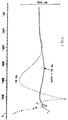
- FIG. 1 compares, as explained later, the thermograms recorded in the case of an interlayer film according to the invention and in the case of a traditional interlayer film.
- an interlayer film of PVB plasticized to 33 parts per 100 of dihexyl adipate resin marketed under the reference "SAFLEX TG 41" by the company MONSANTO and with an approximate thickness of 760 ⁇ m, is immersed in a gamma bath.
- -methacryloxypropyl trimethoxysilane pure or diluted to 50% in heptane for 10 seconds to 2 minutes, to obtain an interlayer film of PVB plasticized according to the invention.
- the interlayer film obtained is then dried by blowing dry cold air or in an oven at 50 ° C.
- the interlayer film thus produced is subjected to a thermomechanical analysis consisting in monitoring the penetration of a tip into said interlayer film as a function of the temperature.
- a thermomechanical analysis consisting in monitoring the penetration of a tip into said interlayer film as a function of the temperature.
- the interlayer film according to this example retains its integrity up to temperatures above 300 ° C before decomposing around 330 ° C.
- the corresponding thermogram is shown in solid lines in Figure 1 attached and shows, after a slight expansion of the film, a kind of softening of the film around 300 ° C just before its decomposition.
- the gamma-methacryloxypropyl trimethoxysilane used is sold under the reference "A 174" by the company UNION CARBIDE.
- a plasticized PVB interlayer film is produced in the same way as in Example 1 by this time dipping the uncrosslinked plasticized PVB interlayer film in a gamma-glycidoxypropyl trimethoxysilane bath sold under the reference "A 187" by the company UNION CARBIDE.
- the interlayer film according to the present example is characterized by a decomposition temperature greater than 300 ° C., said film retaining its integrity until its decomposition temperature.
- a plasticized PVB interlayer film is produced in the same way as in Example 1 by spraying this time a light veil of vinyltrimethoxyethoxysilane on the plasticized PVB interlayer film and then spreading the deposited veil with a cloth.
- the interlayer film according to the present example is characterized by a decomposition temperature greater than 300 ° C., said film retaining its integrity until its decomposition temperature.
- a plasticized PVB interlayer film is produced in the same way as in Example 1 by this time dipping the plasticized PVB interlayer film in an aminopropyltriethoxysilane bath.
- the interlayer film according to the present example is characterized by a decomposition temperature greater than 300 ° C., said film retaining its integrity until its decomposition temperature.
- a plasticized PVB interlayer film is produced in the same way as in Example 1 by spraying this time a light veil of trimethoxysilyldiaminophenylhexyl on the plasticized PVB interlayer film and then spreading the deposited veil with a cloth.
- the interlayer film according to the present example is characterized by a decomposition temperature greater than 300 ° C., said film retaining its integrity until its decomposition temperature.
- the interlayer film according to this example is used to produce a laminated glass according to a traditional method, the laminated glass comprising two sheets of glass between which said interlayer film is located and the bonding of the interlayer film to the glass being carried out during the treatment phase.
- autoclave of hot laminated glass under pressure The laminated glass thus obtained is placed in an oven at 600 ° C. and its evolution as a function of the temperature is followed. From 200 ° C, bubbles appear in the laminated glass without breaking the glass sheets or leaking the interlayer film. From 450 ° C, the interlayer film on the periphery of the laminate in contact with the atmosphere of the oven turns yellow and darkens but does not ignite. After one hour at 600 ° C, the interlayer film begins to disappear little by little from the periphery of the laminate, causing no significant release of smoke or drips and while leaving a thin white layer of silica on the adjacent glass sheets.
- the laminated glass obtained in this example like the laminated glasses obtained in an identical manner from the spacers described in Examples 1 to 4, has mechanical properties similar to those of a traditional laminated glass obtained identically from a plasticized PVB interlayer as described in the comparative example.
- the reaction of the alkoxysilanes on the PVB does not disturb the manufacture of the laminates, this reaction being initiated as early as possible during this manufacture and not being complete before the end of this manufacture.
- an interlayer film of PVB plasticized to 33 parts per 100 of dihexyl adipate resin, marketed under the reference "SAFLEX TG 41" by the company MONSANTO and with an approximate thickness of 760 ⁇ m is subjected to a thermomechanical analysis.
- This film is characterized by a softening temperature of the order of 150 ° C. It is observed that, under the effect of heat, small bubbles appear covering the entire surface of the film and that white fumes are released. This release is possibly followed by swelling of the product before yellowing then ignition before 250 ° C of the said product with strong release of black smoke and heat.
- the corresponding thermogram is shown in dotted lines in Figure 1 attached.
- the interlayer film according to this example is then used to make a laminated glass in the same way as in Example 5, then the laminated glass obtained is placed in an oven at 600 ° C. and its evolution as a function of the temperature is followed. From 180-200 ° C, the interlayer film flows out of the laminate in which a large quantity of bubbles appear. The interlayer film strongly yellows, blackens then ignites with strong release of heat and fumes.
- interlayer films can be advantageously used in the production of laminated glazings without in particular fear of leakage of said interlayer films in the event of fire.
- present invention constitutes, as sought after, a simple and economical solution to the problem of the flow of plasticized PVB interlayer films out of the glasses, in particular and advantageously already existing plasticized PVB interlayer films and commercially available, by proposing interlayer films which can be produced directly from said already existing interlayer films.
- interlayer films according to the invention in particular films having a thickness of 0.38 mm or 0.76 mm, can be advantageously used in the production of laminated glazing for buildings or laminated glazing for transport vehicles.
Landscapes
- Chemical & Material Sciences (AREA)
- Health & Medical Sciences (AREA)
- Chemical Kinetics & Catalysis (AREA)
- Medicinal Chemistry (AREA)
- Polymers & Plastics (AREA)
- Organic Chemistry (AREA)
- Joining Of Glass To Other Materials (AREA)
- Laminated Bodies (AREA)
- Addition Polymer Or Copolymer, Post-Treatments, Or Chemical Modifications (AREA)
- Compositions Of Macromolecular Compounds (AREA)
Abstract
Description
- La présente invention concerne un film intercalaire résistant au feu et son utilisation dans un feuilleté, notamment un verre feuilleté.
- Les verres feuilletés sont couramment utilisés dans le bâtiment et dans les moyens de transport comme vitrages présentant des caractéristiques de « protection sécurité » et permettant de réduire la probabilité des sinistres par choc. Les plus simples et les plus connus de ces verres feuilletés consistent en deux ou plusieurs feuilles de verre collées entre elles par un ou plusieurs films intercalaires de polyvinylbutyral (PVB) plastifié. De telles structures sont efficaces contre les chocs mais peuvent se révéler insuffisantes en matière de protection sécurité en cas d'incendie. Si l'éclatement ou l'affaissement du verre sont toujours évoqués en premier lieu dans ce genre de situation, il convient néanmoins de remarquer que le véritable premier problème de ces verres feuilletés vient du film intercalaire de PVB plastifié qui se ramollit et fond bien plus rapidement que le verre et qui, de ce fait, en cas d'éclatement du verre, cesse également très tôt d'assurer le maintien des éclats de verre par collage. Le PVB plastifié fondu s'écoule ensuite hors du vitrage avant de s'enflammer avec de forts dégagements de chaleur et de fumées, ceci bien avant le début de ramollissement du verre. Le ramollissement rapide du PVB plastifié, I'écoulement du PVB plastifié brûlant, le dégagement de fumées et l'inflammation du PVB plastifié constituent autant de dangers auxquels il est nécessaire de remédier dans ce type de vitrage préalablement à toute autre chose.
- Il convient de noter, en fait, que la plupart des vitrages feuilletés aptes à résister au feu actuellement existants ne présentent pas la structure simple et économique précédemment mentionnée et s'affranchissent de ce fait des problèmes liés à cette structure. Selon les cas, ces vitrages feuilletés anti-feu utilisent d'autres films intercalaires que le PVB plastifié ou utilisent des éléments intercalaires additionnels, ces autres films ou ces éléments ayant et/ou conférant au vitrage les propriétés de résistance au feu recherchées.
- Notamment, parmi les vitrages feuilletés résistant au feu connus comportant d'autres films intercalaires que le PVB plastifié, il convient de citer les vitrages feuilletés comprenant deux ou plusieurs feuilles de verre assemblées entre elles par l'intermédiaire d'un gel ou d'un film silicone. Ainsi, le brevet FR 2 346 548 décrit un vitrage feuilleté anti-feu dans lequel le film intercalaire est un gel comportant un liquide à chaleur de vaporisation élevée tel que l'eau et une substance susceptible de former une mousse isolante sous l'effet d'un rayonnement thermique. Ce vitrage, conçu de façon à satisfaire le plus grand nombre de critères de résistance au feu et classé de ce fait dans les « éléments coupe feu », présente cependant une résistance au gel et aux chocs plus faible qu'un vitrage feuilleté traditionnel utilisant un film intercalaire de PVB plastifié et son épaisseur est également plus importante.
- Un autre exemple de vitrage présentant des propriétés anti-feu particulièrement bonnes est donné dans la demande de brevet FR 2 394 394 décrivant un vitrage feuilleté comportant deux feuilles de verre entre lesquelles se trouve un film intercalaire d'élastomère de silicone. L'inconvénient majeur de ce produit est son prix extrêmement élevé par rapport au prix d'un feuilleté traditionnel utilisant un film intercalaire de PVB plastifié.
- Plusieurs vitrages feuilletés utilisant des films intercalaires de PVB ainsi que des éléments intercalaires additionnels présentant et/ou conférant auxdits vitrages des propriétés de résistance au feu peuvent également être cités. Ainsi le brevet US 5 219 630 décrit un vitrage présentant un film intercalaire, qui peut être un film de PVB, dans lequel se trouve inséré un réseau de fils métalliques ayant pour objet de retarder l'affaissement de l'intercalaire et du vitrage. Cependant, outre le fait qu'un tel réseau est visible, un moyen de ce genre ne permet pas véritablement de ralentir la fonte de l'intercalaire et n'empêche ni son écoulement final ni son inflammation à partir d'une certaine température. Des vitrages feuilletés dans lesquels des couches de matériau jouant un rôle d'isolant thermique en cas d'incendie sont insérées entre chaque face du film intercalaire de PVB et les feuilles de verre adjacentes sont également décrits dans des brevets tels que le brevet US 4 071 649. Une telle structure de film intercalaire à trois couches distinctes est cependant plus complexe qu'un simple film intercalaire de PVB plastifié et conduit également à des vitrages plus épais. Cette structure n'empêche par ailleurs pas l'écoulement final du PVB ni son inflammation même si elle retarde l'accomplissement de ces deux événements.
- Un dernier exemple de vitrage feuilleté apte à résister au feu existant actuellement et ne pouvant être classé véritablement parmi l'une ou l'autre des deux catégories précitées (film intercalaire autre que le PVB - éléments intercalaires additionnels) est donné dans le brevet EP 227 633. Ce brevet propose de mélanger au PVB utilisé pour réaliser l'intercalaire d'un vitrage feuilleté une quantité non négligeable d'un mélange plastifiant particulier composé de divers additifs présentant différentes fonctions, de façon à obtenir un film intercalaire de PVB plastifié, de composition modifiée apte à réagir en cas d'incendie pour résister au feu. Le mélange d'additifs ajoutés au PVB dans ce brevet est cependant complexe et oblige à réaliser un PVB plastifié particulier en vue de la réalisation d'un vitrage feuilleté présentant une résistance au feu.
- De façon générale, il convient de remarquer que les vitrages feuilletés conçus pour résister au feu présentent des structures plus complexes et/ou sont plus coûteux (car nécessitant notamment la mise au point de films intercalaires spéciaux de composition spécifique ou comportant plusieurs couches) que les vitrages feuilletés traditionnels utilisant des films intercalaires courants de PVB plastifié. En outre, leurs propriétés de résistance aux chocs sont souvent moins bonnes que celles desdits vitrages feuilletés traditionnels.
- L'objet de la présente invention est donc de trouver une solution simple et économique au problème de l'écoulement des films intercalaires de PVB plastifié hors des verres, notamment des vitrages, feuilletés en cas d'augmentation importante de température, de façon à fournir des verres feuilletés, notamment des vitrages, simples et économiques, présentant à la fois une bonne résistance aux chocs et une résistance améliorée au feu, ces verres feuilletés permettant de surcroît, dans leur fonction habituelle d'éclairage, une transmission maximale de la lumière.
- Plus précisément, l'objet de la présente invention est de mettre au point un intercalaire transparent, résistant au feu et dont la composition de base est une composition de PVB plastifié traditionnelle, cet intercalaire pouvant être obtenu à partir d'intercalaires de PVB plastifié courants, pouvant être mis en oeuvre selon des procédés habituels et pouvant être avantageusement utilisé dans la réalisation de feuilletés, notamment des verres feuilletés susmentionnés.
- Ces buts sont atteints grâce à un film intercalaire en polyvinylbutyral plastifié comprenant un agent de réticulation apte à rendre le polyvinylbutyral plastifié très peu fusible ou infusible.
- L'invention concerne également des feuilletés, notamment des verres feuilletés, comprenant au moins deux feuilles rigides de matière inorganique et au moins un film intercalaire de matière organique tel que précédemment défini.
- L'invention concerne également les procédés de fabrication du film intercalaire et des feuilletés précédemment mentionnés.
- Par « agent de réticulation apte à rendre le PVB plastifié très peu fusible ou infusible », on entend un composé permettant, sous certaines conditions (généralement sous l'effet de la chaleur, comme explicité ultérieurement), la création de suffisamment de liaisons au sein du PVB plastifié pour le rendre très peu fusible ou infusible, notamment en restreignant la liberté des chaînes de PVB, et empêcher, ainsi, son écoulement à haute température. Par « création de liaisons au sein du PVB », on entend entre autres la création de liaisons pontales (intermoléculaires) entre les chaînes de PVB (liaisons de réticulation proprement dites) et/ou la formation d'un enchevêtrement de réseaux polymères interpénétrés suite, notamment, à la polymérisation de l'agent de réticulation au sein du PVB plastifié.
- Par « PVB plastifié très peu fusible ou infusible », on entend un PVB plastifié ne coulant pas quelle que soit la température. Un tel PVB est éventuellement susceptible de ramollir (PVB plastifié très peu fusible) sans toutefois devenir suffisamment liquide pour couler.
- Il apparaît que le film intercalaire, au sein duquel le PVB plastifié a été rendu très peu fusible ou infusible suite à l'action de l'agent de réticulation, présente une résistance fortement accrue au feu. Son ramollissement éventuel, après l'action de l'agent de réticulation sur le PVB plastifié, s'opère à des températures bien plus élevées que les températures de ramollissement des films de PVB plastifié traditionnellement utilisés (ces dernières températures étant généralement inférieures à 150°C environ) et, de plus, ce film de PVB plastifié, rendu très peu fusible ou infusible utilisé dans des feuilletés ne s'écoule pas à partir d'une certaine température ni ne s'enflamme mais conserve son intégrité avant de se décomposer, sa décomposition intervenant à des températures supérieures à 250°C, généralement supérieures à 300°C. Par ailleurs, l'utilisation, dans des verres feuilletés, de films intercalaires de PVB plastifié rendu très peu fusible ou infusible par l'action de l'agent de réticulation n'empêche pas l'obtention de verres feuilletés transparents présentant de bonnes qualités optiques, les propriétés de résistance aux chocs desdits verres feuilletés étant toutes aussi satisfaisantes que les propriétés de résistance aux chocs des verres feuilletés utilisant des films intercalaires habituels de PVB plastifié.
- De préférence, l'agent de réticulation présent dans le film intercalaire selon l'invention comprend au moins deux fonctions susceptibles de réagir avec les groupements hydroxyles du PVB et/ou est apte à former un réseau interpénétré avec le PVB plastifié, notamment en polymérisant. Cet agent de réticulation est choisi de façon à réagir au sein du film intercalaire sous l'effet de la chaleur et/ou d'un catalyseur également présent dans ce cas dans le film intercalaire, ou éventuellement sous l'effet d'un traitement autre que thermique. De préférence, l'agent de réticulation est choisi de façon à réagir, sous l'action de la chaleur, sur le PVB plastifié pour le rendre très peu fusible ou infusible, à partir de températures comprises entre 100°C et la température à laquelle le PVB plastifié utilisé est susceptible de couler (le PVB plastifié commençant à couler, généralement, à partir de 180°C), avantageusement à partir de températures comprises entre la température de ramollissement du PVB plastifié seul ou une température légèrement inférieure (par exemple 120°C pour une température de ramollissement de 140°C) et la température à laquelle le PVB plastifié seul commence à couler, de préférence à partir de températures comprises entre 120 et 170°C environ. Le choix d'un agent de réticulation réagissant sur le PVB plastifié à partir de températures comprises entre la température de ramollissement du PVB plastifié ou une température légèrement inférieure et la température à laquelle celui-ci commence à couler présente plusieurs avantages au niveau du procédé de réalisation du film intercalaire selon l'invention et du procédé de réalisation des feuilletés à partir de ce film, comme explicité ultérieurement. Le film intercalaire comprenant ledit agent présente notamment l'avantage de garder son intégrité (c'est-à-dire de ne pas couler) pour toute température inférieure à sa température de décomposition.
- Selon une forme de réalisation particulièrement avantageuse de l'invention, le film intercalaire comprend comme agent de réticulation des alkoxysilanes hydrolysables présentant au moins deux fonctions réactives, de préférence des dialkoxysilanes et/ou des trialkoxysilanes et/ou des tétraalkoxysilanes. Les dialkoxysilanes et trialkoxysilanes sont habituellement utilisés comme agents de couplage pour favoriser l'adhésion du verre et des polymères car ils réagissent généralement à la fois avec la surface du verre et avec les polymères. Cependant, le PVB possède des groupements hydroxyles réagissant directement avec la surface du verre et ne nécessite pas le recours à de tels agents pour adhérer de façon suffisante au verre placé à son contact. Le PVB plastifié est ainsi traditionnellement utilisé comme intercalaire dans les verres feuilletés sans ajout d'alkoxysilanes.
- Dans le cas présent, il convient de remarquer que l'ajout d'alkoxysilanes tels que précédemment définis ne conduit pas nécessairement à l'amélioration de l'adhésion entre le verre et le PVB plastifié mais conduit à la création de liaisons au sein du PVB (plutôt qu'en surface) permettant de rendre le PVB infusible ou très peu fusible, les groupements hydroxyles du PVB non utilisés pour l'adhésion du PVB pouvant servir de points d'accrochage pour un pontage avec lesdits alkoxysilanes et lesdits alkoxysilanes pouvant s'hydrolyser pour donner des polysiloxanes se mêlant aux chaînes de PVB plastifié de façon à former un réseau interpénétré.
- Les alkoxysilanes hydrolysables présentant au moins deux fonctions réactives et utilisables comme agent de réticulation selon l'invention peuvent consister en tout type d'alkoxysilanes, notamment en des aminosilanes, époxysilanes, vinylsilanes, phénylsilanes, alkylsilanes... possédant 2 ou 3 groupements alkoxy identiques ou différents, tels que des groupements méthoxy, éthoxy, méthacryloxy, glycidoxy... ou en des silanes modifiés présentant un ou des groupements tels que le phosphore ou le brome et possédant 2 ou 3 groupements alkoxy identiques ou différents tels que ceux mentionnés précédemment, ou éventuellement en des silanes présentant 4 groupements alkoxy identiques ou différents tels que ceux mentionnés précédemment.
- Selon d'autres formes de réalisation de l'invention, le film intercalaire peut comprendre, comme agent de réticulation, des amines, des isocyanates bloqués ou des époxy, ces formes de réalisation de l'invention étant cependant moins avantageuses et moins faciles à mettre en oeuvre.
- Le film intercalaire selon l'invention peut être réalisé de différentes façons. L'agent de réticulation étant un agent extérieur au PVB apte à réagir sur le PVB déjà synthétisé, est à distinguer des composants de synthèse du PVB et est ajouté de la façon la plus simple et avantageuse sur du PVB courant déjà synthétisé. De préférence, l'agent de réticulation est déposé à la surface d'un film de PVB plastifié réalisé selon des méthodes connues de l'homme du métier (extrusion, pressage...).
- Ainsi, selon un mode de réalisation du film intercalaire selon l'invention particulièrement avantageux, un film intercalaire de PVB plastifié courant est simplement trempé dans un bain de l'agent de réticulation selon l'invention, cet agent étant pur ou dilué dans un solvant approprié. Par exemple, lorsque l'agent de réticulation consiste en des alkoxysilanes, ces alkoxysilanes peuvent être utilisés purs ou dilués dans un alcool, par exemple l'isopropanol ou le méthanol, dans un mélange eau-alcool, par exemple un mélange eau-isopropanol, ou dans un autre solvant ne constituant pas un solvant du PVB, par exemple un alcane tel que l'heptane, l'octane... Ils peuvent également être hydrolysés avant d'être mis au contact avec le PVB de façon à éviter des dégagements de produits gênants lors de l'ajout desdits alkoxysilanes au PVB, mais aussi de façon à rendre les alkoxysilanes plus réactifs. Un temps de trempage très court, par exemple de l'ordre de 1 seconde à 2 minutes pour des alkoxysilanes purs ou dilués est généralement suffisant pour obtenir un film intercalaire selon l'invention.
- Un autre mode de réalisation du film intercalaire selon l'invention consiste à déposer par pulvérisation un léger voile de l'agent de réticulation pur ou dilué à la surface d'un film intercalaire de PVB plastifié courant. Selon un troisième mode de réalisation de la présente invention, il est également possible d'imprégner au rouleau la surface d'un film intercalaire de PVB plastifié courant, la solution d'imprégnation consistant en l'agent de réticulation pur ou dilué. Il est ainsi possible, comme illustré par les modes de réalisation précédemment mentionnés, de réaliser des films intercalaires selon l'invention de façon très simple à partir de films de PVB plastifié déjà existants, en traitant la surface desdits films.
- L'ajout de l'agent de réticulation au PVB peut également se faire préalablement à la formation du film intercalaire selon l'invention comprenant ledit PVB, ce mode de réalisation étant cependant moins avantageux. Ainsi, les films intercalaires selon l'invention peuvent être obtenus par introduction de l'agent de réticulation dans de la poudre de PVB déjà plastifiée, ou simultanément ou encore préalablement à l'ajout de plastifiants au PVB, avant transformation dudit PVB en film intercalaire par extrusion ou par moulage selon des procédés connus en soi. Dans ce mode de réalisation, les conditions de transformation sont contrôlées (par exemple la température ou le taux de malaxage pour l'extrusion...) et l'agent de réticulation est choisi de façon à ne pas réagir avec le PVB plastifié dans les conditions de transformation utilisées. Dans ce cas, il est intéressant de choisir un agent de réticulation réagissant avec le PVB plastifié pour des températures supérieures à la température de ramollissement du PVB plastifié dans les conditions de pression utilisées et notamment supérieures à la température d'extrusion ou de pressage fixée, ou de choisir un agent de réticulation réagissant à partir de températures légèrement inférieures sans que la réaction soit néanmoins suffisante à ces températures pour rendre le PVB infusible ou très peu fusible, de façon à permettre la fonte ou la refonte du PVB plastifié pour son extrusion ou son pressage afin d'obtenir le film intercalaire recherché.
- Il convient de remarquer que la présence ou l'ajout des plastifiants dans le PVB, ces plastifiants étant notamment les plastifiants traditionnellement utilisés pour « assouplir » le PVB, par exemple des adipates, des sebacates, des phtalates, ou étant des phosphates, etc..., ces plastifiants n'ayant pas de groupes hydroxyles résiduels, est normalement sans influence sur les réactions s'opérant dans le PVB du fait de la présence de l'agent de réticulation.
- Les modes de réalisation du film intercalaire selon l'invention précédemment présentés sont bien sûr non exhaustifs. D'autres méthodes de mise au contact de l'agent de réticulation et du PVB utilisé pour faire les films intercalaires selon l'invention peuvent être envisagées et font partie de la présente invention.
- Les films intercalaires selon l'invention permettent de réaliser les feuilletés, notamment les verres feuilletés, précédemment explicités dans la définition de l'invention. Les verres feuilletés comprennent au moins deux feuilles de verre et au moins un film intercalaire en PVB plastifié selon l'invention. Les feuilletés peuvent comprendre également plusieurs films intercalaires selon l'invention et/ou d'autres films intercalaires, en PVB ou non, tels qu'habituellement utilisés dans les feuilletés, et/ou peuvent comprendre au moins une feuille de matière inorganique en une matière autre que le verre, par exemple en pierre naturelle telle que le marbre, le granit, un matériau reconstitué, etc... Les feuilletés selon l'invention présentent, comme illustré ci-après, une résistance accrue au feu par rapport aux feuilletés utilisant des films intercalaires traditionnels de PVB plastifié, ainsi qu'une résistance aux chocs similaire à celle desdits feuilletés traditionnels. Ils sont généralement aptes à résister à des températures allant jusqu'à 600°C environ sans écoulement du film intercalaire hors du feuilleté et avant décomposition dudit film. En outre, les verres feuilletés selon l'invention sont simples et économiques et permettent une bonne transmission de la lumière.
- De préférence, l'agent de réticulation est choisi de façon à réagir sur le PVB plastifié à des températures supérieures à la température de ramollissement du PVB plastifié et notamment supérieures aux températures habituelles d'assemblage du PVB plastifié et des feuilles de matières inorganiques pour réaliser un feuilleté, ou à partir de températures légèrement inférieures sans que la réaction à ces températures soit suffisante pour rendre le PVB plastifié très peu fusible ou infusible, de façon à permettre la mise en oeuvre des films intercalaires dans les feuilletés selon des procédés habituels. L'assemblage du film intercalaire et des feuilles de matière inorganique pour donner des feuilletés peut alors se faire avec le film intercalaire de PVB plastifié ramolli dont la structure n'a pas encore été modifiée par l'agent de réticulation, dans les mêmes conditions que l'assemblage d'un film de PVB plastifié identique sans agent de réticulation. L'adhésion du PVB aux feuilles à son contact s'opère ainsi de façon traditionnelle par les groupements hydroxyles de surface du film de PVB et le film conserve les mêmes propriétés qu'un film de PVB plastifié normal telles qu'elles sont recherchées dans de telles applications, tant que la réaction de l'agent de réticulation sur le PVB plastifié n'a pas eu lieu de façon complète (c'est-à-dire n'a pas rendu le PVB infusible ou très peu fusible).
- De préférence donc, dans le procédé de réalisation d'un feuilleté selon l'invention, le film intercalaire est assemblé aux feuilles de matière inorganique dans les conditions habituelles d'assemblage (températures généralement de l'ordre de 140°C) et avant que le PVB plastifié ne soit rendu très peu fusible ou infusible par l'action de l'agent de réticulation, l'action de l'agent de réticulation sur le PVB plastifié pouvant être déclenchée au plus tôt lors de l'assemblage du film intercalaire et des feuilles rigides sous l'effet de la chaleur par exemple, ou pouvant être déclenchée ultérieurement, notamment lors d'un incendie.
- D'autres caractéristiques et avantages de l'invention apparaîtront dans les exemples suivants illustrant la présente invention sans la limiter et donnant des résultats obtenus en matière de résistance au feu en utilisant un film intercalaire selon l'invention, les résultats obtenus en utilisant un film intercalaire traditionnel étant parallèlement illustrés dans l'exemple comparatif. Le figure 1 jointe compare, comme explicité ultérieurement, les thermogrammes enregistrés dans le cas d'un film intercalaire selon l'invention et dans le cas d'un film intercalaire traditionnel.
- Selon cet exemple, un film intercalaire de PVB plastifié à 33 parties pour 100 de résine d'adipate de dihexyle, commercialisé sous la référence « SAFLEX TG 41 » par la société MONSANTO et d'épaisseur approximative 760 µm est plongé dans un bain de gamma-méthacryloxypropyl triméthoxysilane pur ou dilué à 50 % dans de l'heptane, pendant 10 secondes à 2 minutes, pour obtenir un film intercalaire de PVB plastifié selon l'invention. Le film intercalaire obtenu est ensuite séché par soufflage d'air froid sec ou en étuve à 50°C.
- Le film intercalaire ainsi réalisé est soumis à une analyse thermomécanique consistant à suivre l'enfoncement d'une pointe dans ledit film intercalaire en fonction de la température. Une telle analyse permet de vérifier si un polymère est fusible ou non et le thermogramme enregistré au cours de cette analyse permet de déterminer la température de ramollissement ou de fusion dudit polymère.
- Le film intercalaire selon cet exemple conserve son intégrité jusqu'à des températures supérieures à 300°C avant de se décomposer aux alentours de 330°C. Le thermogramme correspondant est représenté en trait plein sur la figure 1 jointe et montre, après une légère dilatation du film, une sorte de ramollissement du film autour de 300°C juste avant sa décomposition. Le gamma-méthacryloxypropyl triméthoxysilane utilisé est commercialisé sous la référence « A 174 » par la société UNION CARBIDE.
- Selon cet exemple, un film intercalaire de PVB plastifié est réalisé de la même façon que dans l'exemple 1 en trempant cette fois le film intercalaire de PVB plastifié non réticulé dans un bain de gamma-glycidoxypropyl triméthoxysilane commercialisé sous la référence « A 187 » par la société UNION CARBIDE.
- Le film intercalaire selon le présent exemple se caractérise par une température de décomposition supérieure à 300°C, ledit film conservant son intégrité jusqu'à sa température de décomposition.
- Selon cet exemple, un film intercalaire de PVB plastifié est réalisé de la même façon que dans l'exemple 1 en pulvérisant cette fois un léger voile de vinyltriméthoxyéthoxysilane sur le film intercalaire de PVB plastifié puis en étalant le voile déposé avec un chiffon.
- Le film intercalaire selon le présent exemple se caractérise par une température de décomposition supérieure à 300°C, ledit film conservant son intégrité jusqu'à sa température de décomposition.
- Selon cet exemple, un film intercalaire de PVB plastifié est réalisé de la même façon que dans l'exemple 1 en trempant cette fois le film intercalaire de PVB plastifié dans un bain d'aminopropyltriéthoxysilane.
- Le film intercalaire selon le présent exemple se caractérise par une température de décomposition supérieure à 300°C, ledit film conservant son intégrité jusqu'à sa température de décomposition.
- Selon cet exemple, un film intercalaire de PVB plastifié est réalisé de la même façon que dans l'exemple 1 en pulvérisant cette fois un léger voile de triméthoxysilyldiaminophenylhéxyle sur le film intercalaire de PVB plastifié puis en étalant le voile déposé avec un chiffon.
- Le film intercalaire selon le présent exemple se caractérise par une température de décomposition supérieure à 300°C, ledit film conservant son intégrité jusqu'à sa température de décomposition.
- Le film intercalaire selon cet exemple est utilisé pour réaliser un verre feuilleté selon un procédé traditionnel, le verre feuilleté comprenant deux feuilles de verre entre lesquelles se trouve ledit film intercalaire et le collage du film intercalaire sur le verre étant effectué pendant la phase de traitement en autoclave du verre feuilleté à chaud et sous pression. Le verre feuilleté ainsi obtenu est mis dans un four à 600°C et son évolution en fonction de la température est suivie. A partir de 200°C, des bulles apparaissent dans le verre feuilleté sans qu'il y ait rupture des feuilles de verre ou écoulement du film intercalaire. A partir de 450°C, le film intercalaire à la périphérie du feuilleté en contact avec l'atmosphère du four jaunit et noircit mais ne s'enflamme pas. Après une heure à 600°C, le film intercalaire commence à disparaître peu à peu depuis la périphérie du feuilleté, en ne provoquant ni dégagement important de fumées ni coulures et tout en laissant une fine couche blanche de silice sur les feuilles de verre adjacentes.
- Il convient de remarquer par ailleurs que le verre feuilleté obtenu dans cet exemple, tout comme les verres feuilletés obtenus de façon identique à partir des intercalaires décrits dans les exemples 1 à 4, présente des propriétés mécaniques similaires à celles d'un verre feuilleté traditionnel obtenu de façon identique à partir d'un intercalaire de PVB plastifié tel que décrit dans l'exemple comparatif. En outre, la réaction des alkoxysilanes sur le PVB ne perturbe pas la fabrication des feuilletés, cette réaction étant déclenchée au plus tôt lors de cette fabrication et n'étant pas complète avant la fin de cette fabrication.
- Selon cet exemple, un film intercalaire de PVB plastifié à 33 parties pour 100 de résine d'adipate de dihexyle, commercialisé sous la référence « SAFLEX TG 41 » par la société MONSANTO et d'épaisseur approximative 760 µm est soumis à une analyse thermomécanique. Ce film se caractérise par une température de ramollissement de l'ordre de 150°C. On observe que, sous l'effet de la chaleur, des petites bulles apparaissent en couvrant la totalité de la surface du film et que des fumées blanches se dégagent. Ce dégagement est suivi éventuellement d'un gonflement du produit avant jaunissement puis inflammation avant 250°C dudit produit avec fort dégagement de fumées noires et de chaleur. Le thermogramme correspondant est représenté en pointillés sur la figure 1 jointe.
- Le film intercalaire selon cet exemple est ensuite utilisé pour réaliser un verre feuilleté de la même façon que dans l'exemple 5 puis le verre feuilleté obtenu est mis dans un four à 600°C et son évolution en fonction de la température est suivie. Dès 180-200°C, le film intercalaire s'écoule hors du feuilleté dans lequel une forte quantité de bulles apparaissent. Le film intercalaire jaunit fortement, noircit puis s'enflamme avec fort dégagement de chaleur et de fumées.
- Les exemples précédents montrent ainsi la résistance améliorée au feu des films intercalaires selon l'invention. Ces films intercalaires peuvent être avantageusement utilisés dans la réalisation de vitrages feuilletés sans craindre notamment d'écoulement desdits films intercalaires en cas d'incendie. Il convient également d'insister sur le fait que la présente invention constitue, comme recherché, une solution simple et économique au problème d'écoulement des films intercalaires de PVB plastifié hors des verres, notamment et avantageusement des films intercalaires de PVB plastifié déjà existants et disponibles commercialement, en proposant des films intercalaires pouvant être directement réalisés à partir desdits films intercalaires déjà existants.
- Les films intercalaires selon l'invention, notamment les films présentant une épaisseur de 0,38 mm ou 0,76 mm, peuvent être avantageusement utilisés dans la réalisation de vitrages feuilletés de bâtiment ou de vitrages feuilletés de véhicules de transport.
Claims (12)
- Film intercalaire en polyvinylbutyral plastifié destiné à la réalisation de feuilletés, notamment de verres feuilletés, caractérisé en ce qu'il comprend un agent de réticulation apte à rendre le polyvinylbutyral plastifié très peu fusible ou infusible.
- Film intercalaire selon la revendication 1, caractérisé en ce que l'agent de réticulation comprend au moins deux fonctions susceptibles de réagir avec les groupements hydroxyles du polyvinylbutyral et/ou en ce qu'il est apte à former un réseau interpénétré avec le polyvinylbutyral plastifié.
- Film intercalaire selon la revendication 2, caractérisé en ce que l'agent de réticulation est choisi parmi les composés suivants : alkoxysilanes, amines, isocyanates bloqués et époxy.
- Film intercalaire selon l'une des revendications 1 à 3, caractérisé en ce qu'il commence à se décomposer à des températures supérieures à 250°C environ.
- Film intercalaire selon la revendication 4, caractérisé en ce qu'il garde son intégrité pour toute température inférieure à sa température de décomposition.
- Film intercalaire selon l'une des revendications 1 à 5, caractérisé en ce que l'agent de réticulation est apte à réagir, sous l'action de la chaleur, sur le polyvinylbutyral plastifié pour le rendre très peu fusible ou infusible, à partir de températures comprises entre 100°C et la température à laquelle le PVB plastifié commence à couler.
- Procédé de fabrication d'un film intercalaire selon l'une des revendications 1 à 6, caractérisé en ce que l'agent de réticulation est ajouté au polyvinylbutyral déjà synthétisé.
- Procédé selon la revendication 7, caractérisé en ce que l'agent de réticulation est déposé à la surface d'un film de polyvinylbutyral plastifié.
- Feuilleté, en particulier verre feuilleté, comprenant au moins deux feuilles rigides de matière inorganique et au moins un film intercalaire tel que défini dans l'une des revendications 1 à 6.
- Verre feuilleté selon la revendication 9, caractérisé en ce qu'il résiste à des températures allant jusqu'à 600°C environ sans écoulement du film intercalaire hors du feuilleté et avant décomposition dudit film intercalaire.
- Procédé de fabrication d'un feuilleté selon l'une des revendications 9 ou 10, caractérisé en ce que le film intercalaire est assemblé aux feuilles de matière inorganique avant que le polyvinylbutyral ne soit rendu très peu fusible ou infusible par l'action de l'agent de réticulation.
- Procédé de fabrication selon la revendication 11, caractérisé en ce que l'action de l'agent de réticulation sur le polyvinylbutyral plastifié est déclenchée sous l'effet de la chaleur lors de l'assemblage du film intercalaire et des feuilles rigides de matière inorganique ou ultérieurement, notamment lors d'un incendie.
Applications Claiming Priority (2)
| Application Number | Priority Date | Filing Date | Title |
|---|---|---|---|
| FR9406772A FR2720683B1 (fr) | 1994-06-02 | 1994-06-02 | Film intercalaire résistant au feu et son utilisation dans un verre feuilleté. |
| FR9406772 | 1994-06-02 |
Publications (2)
| Publication Number | Publication Date |
|---|---|
| EP0685330A1 true EP0685330A1 (fr) | 1995-12-06 |
| EP0685330B1 EP0685330B1 (fr) | 2002-05-08 |
Family
ID=9463822
Family Applications (1)
| Application Number | Title | Priority Date | Filing Date |
|---|---|---|---|
| EP95401286A Expired - Lifetime EP0685330B1 (fr) | 1994-06-02 | 1995-06-01 | Film intercalaire résistant au feu et son utilisation dans un verre feuilleté |
Country Status (7)
| Country | Link |
|---|---|
| US (1) | US5656365A (fr) |
| EP (1) | EP0685330B1 (fr) |
| JP (1) | JP4141510B2 (fr) |
| AT (1) | ATE217257T1 (fr) |
| DE (1) | DE69526609T2 (fr) |
| ES (1) | ES2174905T3 (fr) |
| FR (1) | FR2720683B1 (fr) |
Cited By (1)
| Publication number | Priority date | Publication date | Assignee | Title |
|---|---|---|---|---|
| EP1721738A4 (fr) * | 2004-03-02 | 2007-06-13 | Mitsubishi Plastics Inc | Film de resine multicouche et verre stratifie |
Families Citing this family (6)
| Publication number | Priority date | Publication date | Assignee | Title |
|---|---|---|---|---|
| DE10018517A1 (de) * | 2000-04-13 | 2001-10-18 | Clariant Gmbh | Hochmolekulare, vernetzte Polyvinylbutyrale, Verfahren zu deren Herstellung sowie deren Verwendung |
| US20050260363A1 (en) * | 2004-01-28 | 2005-11-24 | Davies Phillip S | Laminated windows that are resistant to extreme heat or fire conditions |
| US20050260418A1 (en) * | 2004-01-28 | 2005-11-24 | Davies Phillip S | Laminated windows that are resistant to extreme heat or fire conditions |
| US7625627B2 (en) * | 2005-12-30 | 2009-12-01 | E.I. Du Pont De Nemours And Company | Decorative polyvinyl butyral solar control laminates |
| JP2015535860A (ja) * | 2012-09-14 | 2015-12-17 | ヘンケル アイピー アンド ホールディング ゲゼルシャフト ミット ベシュレンクテル ハフツング | 改良接着性組成物 |
| JP5920854B2 (ja) * | 2014-09-26 | 2016-05-18 | 株式会社クラレ | ポリビニルブチラールの連続繊維からなる不織布及びその製造方法 |
Citations (11)
| Publication number | Priority date | Publication date | Assignee | Title |
|---|---|---|---|---|
| FR2346548A1 (fr) | 1976-03-30 | 1977-10-28 | Saint Gobain | Vitrage multiple anti-feu, comportant une couche intercalaire de gel |
| US4071649A (en) | 1973-03-30 | 1978-01-31 | Glaverbel-Mecaniver | Fireproof glasswork |
| FR2394394A1 (fr) | 1977-06-16 | 1979-01-12 | Cim | Panneau antifeu transparent |
| EP0098961A1 (fr) * | 1982-06-08 | 1984-01-25 | Asahi Glass Company Ltd. | Verre de sécurité laminé |
| EP0227470A2 (fr) * | 1985-12-23 | 1987-07-01 | Bridgestone Corporation | Feuilles transparentes et stratifiés les contenant |
| EP0227633A2 (fr) | 1985-12-23 | 1987-07-01 | Monsanto Company | Couche intermédiaire résistant au feu |
| EP0389291A1 (fr) * | 1989-03-23 | 1990-09-26 | Pilkington Plc | Verres stratifiés |
| WO1990011324A1 (fr) * | 1989-03-25 | 1990-10-04 | Hüls Troisdorf Aktiengesellschaft | Matiere de moulage pour la fabrication de films destines a des vitres de securite en verre feuillete |
| EP0393006A1 (fr) * | 1989-04-10 | 1990-10-17 | Monsanto Company | Liaison de polyvinylbutyral avec du polyuréthane et procédé d'obtention |
| JPH0525213A (ja) * | 1991-07-17 | 1993-02-02 | Sekisui Chem Co Ltd | ポリビニルブチラール樹脂及びその製造方法 |
| US5219630A (en) | 1987-02-20 | 1993-06-15 | Miller Construction Limited | Fire resistant safety glass |
Family Cites Families (6)
| Publication number | Priority date | Publication date | Assignee | Title |
|---|---|---|---|---|
| US5187217A (en) * | 1987-04-02 | 1993-02-16 | Saint-Gobain Vitrage | Process for the production of a plasticized polyvinyl butyral for gluing a base onto a glazing |
| US5322875A (en) * | 1988-06-07 | 1994-06-21 | Saint-Gobain Vitrage | Polyvinylbutyral-based thermoplastic composition, useful for fixing bases on a glazing |
| US5364703A (en) * | 1990-01-16 | 1994-11-15 | General Electric Company | Copper-clad polyetherimide laminates with high peel strength |
| US5281976A (en) * | 1990-08-13 | 1994-01-25 | Matsushita Electric Industrial Co., Ltd. | Thermal transfer printing method |
| DK0563040T3 (da) * | 1990-12-20 | 1995-11-06 | Monsanto Co | Plastark til en lamineret rude og fremgangsmåde til styring af adhæsion og reducering af blokering deraf |
| US5415942A (en) * | 1993-11-04 | 1995-05-16 | E. I. Du Pont De Nemours And Company | Glass/plastic laminate structures for glazing applications |
-
1994
- 1994-06-02 FR FR9406772A patent/FR2720683B1/fr not_active Expired - Lifetime
-
1995
- 1995-06-01 AT AT95401286T patent/ATE217257T1/de active
- 1995-06-01 JP JP13510395A patent/JP4141510B2/ja not_active Expired - Fee Related
- 1995-06-01 DE DE69526609T patent/DE69526609T2/de not_active Expired - Lifetime
- 1995-06-01 EP EP95401286A patent/EP0685330B1/fr not_active Expired - Lifetime
- 1995-06-01 ES ES95401286T patent/ES2174905T3/es not_active Expired - Lifetime
- 1995-06-02 US US08/458,295 patent/US5656365A/en not_active Expired - Lifetime
Patent Citations (11)
| Publication number | Priority date | Publication date | Assignee | Title |
|---|---|---|---|---|
| US4071649A (en) | 1973-03-30 | 1978-01-31 | Glaverbel-Mecaniver | Fireproof glasswork |
| FR2346548A1 (fr) | 1976-03-30 | 1977-10-28 | Saint Gobain | Vitrage multiple anti-feu, comportant une couche intercalaire de gel |
| FR2394394A1 (fr) | 1977-06-16 | 1979-01-12 | Cim | Panneau antifeu transparent |
| EP0098961A1 (fr) * | 1982-06-08 | 1984-01-25 | Asahi Glass Company Ltd. | Verre de sécurité laminé |
| EP0227470A2 (fr) * | 1985-12-23 | 1987-07-01 | Bridgestone Corporation | Feuilles transparentes et stratifiés les contenant |
| EP0227633A2 (fr) | 1985-12-23 | 1987-07-01 | Monsanto Company | Couche intermédiaire résistant au feu |
| US5219630A (en) | 1987-02-20 | 1993-06-15 | Miller Construction Limited | Fire resistant safety glass |
| EP0389291A1 (fr) * | 1989-03-23 | 1990-09-26 | Pilkington Plc | Verres stratifiés |
| WO1990011324A1 (fr) * | 1989-03-25 | 1990-10-04 | Hüls Troisdorf Aktiengesellschaft | Matiere de moulage pour la fabrication de films destines a des vitres de securite en verre feuillete |
| EP0393006A1 (fr) * | 1989-04-10 | 1990-10-17 | Monsanto Company | Liaison de polyvinylbutyral avec du polyuréthane et procédé d'obtention |
| JPH0525213A (ja) * | 1991-07-17 | 1993-02-02 | Sekisui Chem Co Ltd | ポリビニルブチラール樹脂及びその製造方法 |
Non-Patent Citations (1)
| Title |
|---|
| DATABASE WPI Week 9310, Derwent World Patents Index; AN 93-80436 * |
Cited By (1)
| Publication number | Priority date | Publication date | Assignee | Title |
|---|---|---|---|---|
| EP1721738A4 (fr) * | 2004-03-02 | 2007-06-13 | Mitsubishi Plastics Inc | Film de resine multicouche et verre stratifie |
Also Published As
| Publication number | Publication date |
|---|---|
| JP4141510B2 (ja) | 2008-08-27 |
| FR2720683B1 (fr) | 1996-07-05 |
| DE69526609T2 (de) | 2002-11-28 |
| EP0685330B1 (fr) | 2002-05-08 |
| JPH08143343A (ja) | 1996-06-04 |
| FR2720683A1 (fr) | 1995-12-08 |
| ATE217257T1 (de) | 2002-05-15 |
| ES2174905T3 (es) | 2002-11-16 |
| DE69526609D1 (de) | 2002-06-13 |
| US5656365A (en) | 1997-08-12 |
Similar Documents
| Publication | Publication Date | Title |
|---|---|---|
| CA2076134C (fr) | Vitrage feuillete de securite pour avion | |
| EP2150404B2 (fr) | Vitrage anti-feu | |
| CA2266652C (fr) | Vitrage anti-feu | |
| CH674006A5 (fr) | ||
| EP1993828B1 (fr) | Vitrage anti-feu | |
| EP0347309B1 (fr) | Matériau de protection d'un élément en cas d'incendie | |
| EP0890431B1 (fr) | Vitrage en verre feuilleté résistant au feu | |
| EP0685330B1 (fr) | Film intercalaire résistant au feu et son utilisation dans un verre feuilleté | |
| EP1960317B1 (fr) | Vitrage anti-feu | |
| EP1161343B1 (fr) | Vitrage de protection au feu | |
| EP1855878B1 (fr) | Vitrage anti-feu | |
| WO2009130278A1 (fr) | Vitrage anti-feu | |
| BE1019263A3 (fr) | Vitrage resistant au feu. | |
| EP2367683B1 (fr) | Vitrage anti-feu | |
| EP2072247A1 (fr) | Vitrage anti-feu | |
| FR2679549A1 (fr) | Vitrages transparents resistant au feu. | |
| EP2694287B1 (fr) | Vitrage resistant au feu | |
| EP2130673A1 (fr) | Vitrage anti-feu | |
| EP0673757A1 (fr) | Feuille en matière plastique pour vitrage et vitrage fabriqué avec cette feuille | |
| JP2005255480A (ja) | 合わせガラス及びその製造方法 | |
| FR2743557A1 (fr) | Vitrage feuillete de protection solaire, de protection mecanique, de protection au feu et son procede de fabrication | |
| FR2755126A1 (fr) | Element vitre a couche(s) |
Legal Events
| Date | Code | Title | Description |
|---|---|---|---|
| PUAI | Public reference made under article 153(3) epc to a published international application that has entered the european phase |
Free format text: ORIGINAL CODE: 0009012 |
|
| AK | Designated contracting states |
Kind code of ref document: A1 Designated state(s): AT BE CH DE ES FR GB IT LI LU NL |
|
| 17P | Request for examination filed |
Effective date: 19960111 |
|
| 17Q | First examination report despatched |
Effective date: 19981124 |
|
| GRAG | Despatch of communication of intention to grant |
Free format text: ORIGINAL CODE: EPIDOS AGRA |
|
| RAP1 | Party data changed (applicant data changed or rights of an application transferred) |
Owner name: SAINT-GOBAIN GLASS FRANCE |
|
| GRAG | Despatch of communication of intention to grant |
Free format text: ORIGINAL CODE: EPIDOS AGRA |
|
| GRAH | Despatch of communication of intention to grant a patent |
Free format text: ORIGINAL CODE: EPIDOS IGRA |
|
| REG | Reference to a national code |
Ref country code: GB Ref legal event code: IF02 |
|
| GRAH | Despatch of communication of intention to grant a patent |
Free format text: ORIGINAL CODE: EPIDOS IGRA |
|
| GRAA | (expected) grant |
Free format text: ORIGINAL CODE: 0009210 |
|
| AK | Designated contracting states |
Kind code of ref document: B1 Designated state(s): AT BE CH DE ES FR GB IT LI LU NL |
|
| REF | Corresponds to: |
Ref document number: 217257 Country of ref document: AT Date of ref document: 20020515 Kind code of ref document: T |
|
| REG | Reference to a national code |
Ref country code: CH Ref legal event code: EP |
|
| REF | Corresponds to: |
Ref document number: 69526609 Country of ref document: DE Date of ref document: 20020613 |
|
| REG | Reference to a national code |
Ref country code: CH Ref legal event code: NV Representative=s name: KIRKER & CIE SA |
|
| GBT | Gb: translation of ep patent filed (gb section 77(6)(a)/1977) |
Effective date: 20020720 |
|
| REG | Reference to a national code |
Ref country code: ES Ref legal event code: FG2A Ref document number: 2174905 Country of ref document: ES Kind code of ref document: T3 |
|
| PLBE | No opposition filed within time limit |
Free format text: ORIGINAL CODE: 0009261 |
|
| STAA | Information on the status of an ep patent application or granted ep patent |
Free format text: STATUS: NO OPPOSITION FILED WITHIN TIME LIMIT |
|
| 26N | No opposition filed |
Effective date: 20030211 |
|
| PGFP | Annual fee paid to national office [announced via postgrant information from national office to epo] |
Ref country code: ES Payment date: 20120726 Year of fee payment: 18 |
|
| PGFP | Annual fee paid to national office [announced via postgrant information from national office to epo] |
Ref country code: AT Payment date: 20120529 Year of fee payment: 18 |
|
| PGFP | Annual fee paid to national office [announced via postgrant information from national office to epo] |
Ref country code: GB Payment date: 20130529 Year of fee payment: 19 Ref country code: CH Payment date: 20130612 Year of fee payment: 19 Ref country code: DE Payment date: 20130529 Year of fee payment: 19 Ref country code: LU Payment date: 20130612 Year of fee payment: 19 |
|
| PGFP | Annual fee paid to national office [announced via postgrant information from national office to epo] |
Ref country code: NL Payment date: 20130608 Year of fee payment: 19 Ref country code: IT Payment date: 20130620 Year of fee payment: 19 |
|
| PGFP | Annual fee paid to national office [announced via postgrant information from national office to epo] |
Ref country code: BE Payment date: 20130731 Year of fee payment: 19 |
|
| PGFP | Annual fee paid to national office [announced via postgrant information from national office to epo] |
Ref country code: FR Payment date: 20130712 Year of fee payment: 19 |
|
| REG | Reference to a national code |
Ref country code: DE Ref legal event code: R119 Ref document number: 69526609 Country of ref document: DE |
|
| PG25 | Lapsed in a contracting state [announced via postgrant information from national office to epo] |
Ref country code: LU Free format text: LAPSE BECAUSE OF NON-PAYMENT OF DUE FEES Effective date: 20140601 |
|
| REG | Reference to a national code |
Ref country code: CH Ref legal event code: PL |
|
| REG | Reference to a national code |
Ref country code: AT Ref legal event code: MM01 Ref document number: 217257 Country of ref document: AT Kind code of ref document: T Effective date: 20140601 |
|
| GBPC | Gb: european patent ceased through non-payment of renewal fee |
Effective date: 20140601 |
|
| REG | Reference to a national code |
Ref country code: FR Ref legal event code: ST Effective date: 20150227 |
|
| PG25 | Lapsed in a contracting state [announced via postgrant information from national office to epo] |
Ref country code: NL Free format text: LAPSE BECAUSE OF NON-PAYMENT OF DUE FEES Effective date: 20150101 |
|
| REG | Reference to a national code |
Ref country code: DE Ref legal event code: R119 Ref document number: 69526609 Country of ref document: DE Effective date: 20150101 |
|
| PG25 | Lapsed in a contracting state [announced via postgrant information from national office to epo] |
Ref country code: IT Free format text: LAPSE BECAUSE OF NON-PAYMENT OF DUE FEES Effective date: 20140601 Ref country code: LI Free format text: LAPSE BECAUSE OF NON-PAYMENT OF DUE FEES Effective date: 20140630 Ref country code: DE Free format text: LAPSE BECAUSE OF NON-PAYMENT OF DUE FEES Effective date: 20150101 Ref country code: CH Free format text: LAPSE BECAUSE OF NON-PAYMENT OF DUE FEES Effective date: 20140630 |
|
| PG25 | Lapsed in a contracting state [announced via postgrant information from national office to epo] |
Ref country code: GB Free format text: LAPSE BECAUSE OF NON-PAYMENT OF DUE FEES Effective date: 20140601 Ref country code: FR Free format text: LAPSE BECAUSE OF NON-PAYMENT OF DUE FEES Effective date: 20140630 Ref country code: AT Free format text: LAPSE BECAUSE OF NON-PAYMENT OF DUE FEES Effective date: 20140601 |
|
| REG | Reference to a national code |
Ref country code: ES Ref legal event code: FD2A Effective date: 20150729 |
|
| PG25 | Lapsed in a contracting state [announced via postgrant information from national office to epo] |
Ref country code: ES Free format text: LAPSE BECAUSE OF NON-PAYMENT OF DUE FEES Effective date: 20140602 |
|
| PG25 | Lapsed in a contracting state [announced via postgrant information from national office to epo] |
Ref country code: BE Free format text: LAPSE BECAUSE OF NON-PAYMENT OF DUE FEES Effective date: 20140630 |