EP0685464A1 - Zwischenprodukte für Reaktivfarbstoffe - Google Patents
Zwischenprodukte für Reaktivfarbstoffe Download PDFInfo
- Publication number
- EP0685464A1 EP0685464A1 EP95810342A EP95810342A EP0685464A1 EP 0685464 A1 EP0685464 A1 EP 0685464A1 EP 95810342 A EP95810342 A EP 95810342A EP 95810342 A EP95810342 A EP 95810342A EP 0685464 A1 EP0685464 A1 EP 0685464A1
- Authority
- EP
- European Patent Office
- Prior art keywords
- formula
- compound
- radical
- compounds
- hydrogen
- Prior art date
- Legal status (The legal status is an assumption and is not a legal conclusion. Google has not performed a legal analysis and makes no representation as to the accuracy of the status listed.)
- Withdrawn
Links
- 239000000543 intermediate Substances 0.000 title description 7
- 239000000985 reactive dye Substances 0.000 title description 7
- 229910052736 halogen Inorganic materials 0.000 claims abstract description 12
- 150000002367 halogens Chemical class 0.000 claims abstract description 12
- 125000000020 sulfo group Chemical group O=S(=O)([*])O[H] 0.000 claims abstract description 12
- 125000000391 vinyl group Chemical group [H]C([*])=C([H])[H] 0.000 claims abstract description 11
- 229920002554 vinyl polymer Polymers 0.000 claims abstract description 11
- 125000000843 phenylene group Chemical group C1(=C(C=CC=C1)*)* 0.000 claims abstract description 4
- 125000002947 alkylene group Chemical group 0.000 claims abstract description 3
- 125000003917 carbamoyl group Chemical group [H]N([H])C(*)=O 0.000 claims abstract description 3
- 125000003178 carboxy group Chemical group [H]OC(*)=O 0.000 claims abstract description 3
- 150000001875 compounds Chemical class 0.000 claims description 61
- -1 sulfo, hydroxy Chemical group 0.000 claims description 40
- 229910052739 hydrogen Inorganic materials 0.000 claims description 23
- 239000001257 hydrogen Substances 0.000 claims description 23
- 239000000203 mixture Substances 0.000 claims description 19
- 150000002431 hydrogen Chemical class 0.000 claims description 11
- 230000015572 biosynthetic process Effects 0.000 claims description 10
- 125000004093 cyano group Chemical group *C#N 0.000 claims description 10
- 238000003786 synthesis reaction Methods 0.000 claims description 10
- 125000002887 hydroxy group Chemical group [H]O* 0.000 claims description 9
- WKBOTKDWSSQWDR-UHFFFAOYSA-N Bromine atom Chemical group [Br] WKBOTKDWSSQWDR-UHFFFAOYSA-N 0.000 claims description 8
- UFHFLCQGNIYNRP-UHFFFAOYSA-N Hydrogen Chemical compound [H][H] UFHFLCQGNIYNRP-UHFFFAOYSA-N 0.000 claims description 8
- GDTBXPJZTBHREO-UHFFFAOYSA-N bromine Chemical group BrBr GDTBXPJZTBHREO-UHFFFAOYSA-N 0.000 claims description 8
- 229910052794 bromium Inorganic materials 0.000 claims description 8
- 239000000975 dye Substances 0.000 claims description 8
- 238000000034 method Methods 0.000 claims description 7
- XTHPWXDJESJLNJ-UHFFFAOYSA-N sulfurochloridic acid Chemical group OS(Cl)(=O)=O XTHPWXDJESJLNJ-UHFFFAOYSA-N 0.000 claims description 7
- 125000000229 (C1-C4)alkoxy group Chemical group 0.000 claims description 6
- 125000004178 (C1-C4) alkyl group Chemical group 0.000 claims description 5
- LGRFSURHDFAFJT-UHFFFAOYSA-N Phthalic anhydride Natural products C1=CC=C2C(=O)OC(=O)C2=C1 LGRFSURHDFAFJT-UHFFFAOYSA-N 0.000 claims description 4
- JHIWVOJDXOSYLW-UHFFFAOYSA-N butyl 2,2-difluorocyclopropane-1-carboxylate Chemical compound CCCCOC(=O)C1CC1(F)F JHIWVOJDXOSYLW-UHFFFAOYSA-N 0.000 claims description 4
- 125000004435 hydrogen atom Chemical group [H]* 0.000 claims description 4
- 238000002360 preparation method Methods 0.000 claims description 4
- 125000003161 (C1-C6) alkylene group Chemical group 0.000 claims description 3
- 238000004519 manufacturing process Methods 0.000 claims description 3
- 150000003568 thioethers Chemical class 0.000 claims description 3
- 125000000664 diazo group Chemical group [N-]=[N+]=[*] 0.000 claims 2
- 125000000217 alkyl group Chemical group 0.000 abstract description 4
- 229910006069 SO3H Inorganic materials 0.000 abstract description 3
- 125000004423 acyloxy group Chemical group 0.000 abstract description 2
- 239000003513 alkali Substances 0.000 abstract description 2
- 125000003545 alkoxy group Chemical group 0.000 abstract 2
- 125000003118 aryl group Chemical group 0.000 abstract 2
- OXSANYRLJHSQEP-UHFFFAOYSA-N 4-aminophthalic acid Chemical compound NC1=CC=C(C(O)=O)C(C(O)=O)=C1 OXSANYRLJHSQEP-UHFFFAOYSA-N 0.000 abstract 1
- 229910004727 OSO3H Inorganic materials 0.000 abstract 1
- 125000004453 alkoxycarbonyl group Chemical group 0.000 abstract 1
- 125000001997 phenyl group Chemical group [H]C1=C([H])C([H])=C(*)C([H])=C1[H] 0.000 abstract 1
- 239000002243 precursor Substances 0.000 abstract 1
- 125000000325 methylidene group Chemical group [H]C([H])=* 0.000 description 26
- QTBSBXVTEAMEQO-UHFFFAOYSA-N Acetic acid Chemical compound CC(O)=O QTBSBXVTEAMEQO-UHFFFAOYSA-N 0.000 description 15
- QAOWNCQODCNURD-UHFFFAOYSA-N Sulfuric acid Chemical compound OS(O)(=O)=O QAOWNCQODCNURD-UHFFFAOYSA-N 0.000 description 12
- 239000000243 solution Substances 0.000 description 12
- HEMHJVSKTPXQMS-UHFFFAOYSA-M Sodium hydroxide Chemical compound [OH-].[Na+] HEMHJVSKTPXQMS-UHFFFAOYSA-M 0.000 description 9
- XLYOFNOQVPJJNP-UHFFFAOYSA-N water Substances O XLYOFNOQVPJJNP-UHFFFAOYSA-N 0.000 description 7
- VEXZGXHMUGYJMC-UHFFFAOYSA-N Hydrochloric acid Chemical compound Cl VEXZGXHMUGYJMC-UHFFFAOYSA-N 0.000 description 6
- 239000003795 chemical substances by application Substances 0.000 description 6
- 239000002253 acid Substances 0.000 description 5
- 238000005160 1H NMR spectroscopy Methods 0.000 description 4
- ZAMOUSCENKQFHK-UHFFFAOYSA-N Chlorine atom Chemical compound [Cl] ZAMOUSCENKQFHK-UHFFFAOYSA-N 0.000 description 4
- NBIIXXVUZAFLBC-UHFFFAOYSA-N Phosphoric acid Chemical compound OP(O)(O)=O NBIIXXVUZAFLBC-UHFFFAOYSA-N 0.000 description 4
- CDBYLPFSWZWCQE-UHFFFAOYSA-L Sodium Carbonate Chemical compound [Na+].[Na+].[O-]C([O-])=O CDBYLPFSWZWCQE-UHFFFAOYSA-L 0.000 description 4
- 238000004458 analytical method Methods 0.000 description 4
- 239000000460 chlorine Substances 0.000 description 4
- 229910052801 chlorine Inorganic materials 0.000 description 4
- 125000001495 ethyl group Chemical group [H]C([H])([H])C([H])([H])* 0.000 description 4
- XKJCHHZQLQNZHY-UHFFFAOYSA-N phthalimide Chemical class C1=CC=C2C(=O)NC(=O)C2=C1 XKJCHHZQLQNZHY-UHFFFAOYSA-N 0.000 description 4
- 238000003756 stirring Methods 0.000 description 4
- 239000000725 suspension Substances 0.000 description 4
- LFQSCWFLJHTTHZ-UHFFFAOYSA-N Ethanol Chemical compound CCO LFQSCWFLJHTTHZ-UHFFFAOYSA-N 0.000 description 3
- XEKOWRVHYACXOJ-UHFFFAOYSA-N Ethyl acetate Chemical compound CCOC(C)=O XEKOWRVHYACXOJ-UHFFFAOYSA-N 0.000 description 3
- MHAJPDPJQMAIIY-UHFFFAOYSA-N Hydrogen peroxide Chemical compound OO MHAJPDPJQMAIIY-UHFFFAOYSA-N 0.000 description 3
- 0 [O-][N+](c(cc1)cc(*(N2)=O)c1C2=O)=O Chemical compound [O-][N+](c(cc1)cc(*(N2)=O)c1C2=O)=O 0.000 description 3
- 125000003277 amino group Chemical group 0.000 description 3
- 238000004128 high performance liquid chromatography Methods 0.000 description 3
- 239000000047 product Substances 0.000 description 3
- 150000003839 salts Chemical group 0.000 description 3
- KEQGZUUPPQEDPF-UHFFFAOYSA-N 1,3-dichloro-5,5-dimethylimidazolidine-2,4-dione Chemical compound CC1(C)N(Cl)C(=O)N(Cl)C1=O KEQGZUUPPQEDPF-UHFFFAOYSA-N 0.000 description 2
- BBVKJSHSYOHXGB-UHFFFAOYSA-N 2-[2-(2-hydroxyethylsulfonyl)ethyl]isoindole-1,3-dione Chemical compound C1=CC=C2C(=O)N(CCS(=O)(=O)CCO)C(=O)C2=C1 BBVKJSHSYOHXGB-UHFFFAOYSA-N 0.000 description 2
- VTYYLEPIZMXCLO-UHFFFAOYSA-L Calcium carbonate Chemical compound [Ca+2].[O-]C([O-])=O VTYYLEPIZMXCLO-UHFFFAOYSA-L 0.000 description 2
- 229920000742 Cotton Polymers 0.000 description 2
- IAZDPXIOMUYVGZ-WFGJKAKNSA-N Dimethyl sulfoxide Chemical compound [2H]C([2H])([2H])S(=O)C([2H])([2H])[2H] IAZDPXIOMUYVGZ-WFGJKAKNSA-N 0.000 description 2
- IOVCWXUNBOPUCH-UHFFFAOYSA-N Nitrous acid Chemical compound ON=O IOVCWXUNBOPUCH-UHFFFAOYSA-N 0.000 description 2
- KFSLWBXXFJQRDL-UHFFFAOYSA-N Peracetic acid Chemical compound CC(=O)OO KFSLWBXXFJQRDL-UHFFFAOYSA-N 0.000 description 2
- 239000004952 Polyamide Substances 0.000 description 2
- WCUXLLCKKVVCTQ-UHFFFAOYSA-M Potassium chloride Chemical compound [Cl-].[K+] WCUXLLCKKVVCTQ-UHFFFAOYSA-M 0.000 description 2
- VMHLLURERBWHNL-UHFFFAOYSA-M Sodium acetate Chemical compound [Na+].CC([O-])=O VMHLLURERBWHNL-UHFFFAOYSA-M 0.000 description 2
- WYURNTSHIVDZCO-UHFFFAOYSA-N Tetrahydrofuran Chemical compound C1CCOC1 WYURNTSHIVDZCO-UHFFFAOYSA-N 0.000 description 2
- 229910000147 aluminium phosphate Inorganic materials 0.000 description 2
- 150000001412 amines Chemical class 0.000 description 2
- 150000003863 ammonium salts Chemical class 0.000 description 2
- 239000007864 aqueous solution Substances 0.000 description 2
- 239000003054 catalyst Substances 0.000 description 2
- 239000001913 cellulose Substances 0.000 description 2
- 229920002678 cellulose Polymers 0.000 description 2
- 238000006243 chemical reaction Methods 0.000 description 2
- 230000008878 coupling Effects 0.000 description 2
- 238000010168 coupling process Methods 0.000 description 2
- 238000005859 coupling reaction Methods 0.000 description 2
- 238000001035 drying Methods 0.000 description 2
- 239000002657 fibrous material Substances 0.000 description 2
- 238000001914 filtration Methods 0.000 description 2
- 238000004108 freeze drying Methods 0.000 description 2
- 230000002140 halogenating effect Effects 0.000 description 2
- 238000005984 hydrogenation reaction Methods 0.000 description 2
- 125000002496 methyl group Chemical group [H]C([H])([H])* 0.000 description 2
- 238000006396 nitration reaction Methods 0.000 description 2
- 150000002978 peroxides Chemical class 0.000 description 2
- 230000000865 phosphorylative effect Effects 0.000 description 2
- 229920002647 polyamide Polymers 0.000 description 2
- OTYBMLCTZGSZBG-UHFFFAOYSA-L potassium sulfate Chemical compound [K+].[K+].[O-]S([O-])(=O)=O OTYBMLCTZGSZBG-UHFFFAOYSA-L 0.000 description 2
- 229910052939 potassium sulfate Inorganic materials 0.000 description 2
- 235000011151 potassium sulphates Nutrition 0.000 description 2
- 125000002924 primary amino group Chemical group [H]N([H])* 0.000 description 2
- 238000001223 reverse osmosis Methods 0.000 description 2
- 239000001632 sodium acetate Substances 0.000 description 2
- 235000017281 sodium acetate Nutrition 0.000 description 2
- 229910000029 sodium carbonate Inorganic materials 0.000 description 2
- LPXPTNMVRIOKMN-UHFFFAOYSA-M sodium nitrite Chemical compound [Na+].[O-]N=O LPXPTNMVRIOKMN-UHFFFAOYSA-M 0.000 description 2
- 230000001180 sulfating effect Effects 0.000 description 2
- FYSNRJHAOHDILO-UHFFFAOYSA-N thionyl chloride Chemical compound ClS(Cl)=O FYSNRJHAOHDILO-UHFFFAOYSA-N 0.000 description 2
- 210000002268 wool Anatomy 0.000 description 2
- ZEGQLHHXSSQIKQ-UHFFFAOYSA-N 2-[2-(2-hydroxyethylsulfanyl)ethyl]isoindole-1,3-dione Chemical compound C1=CC=C2C(=O)N(CCSCCO)C(=O)C2=C1 ZEGQLHHXSSQIKQ-UHFFFAOYSA-N 0.000 description 1
- RKKZDGOUSIOSIY-UHFFFAOYSA-N 4-benzamido-5-hydroxynaphthalene-2,7-disulfonic acid Chemical compound C=12C(O)=CC(S(O)(=O)=O)=CC2=CC(S(O)(=O)=O)=CC=1NC(=O)C1=CC=CC=C1 RKKZDGOUSIOSIY-UHFFFAOYSA-N 0.000 description 1
- OKTJSMMVPCPJKN-UHFFFAOYSA-N Carbon Chemical compound [C] OKTJSMMVPCPJKN-UHFFFAOYSA-N 0.000 description 1
- DGAQECJNVWCQMB-PUAWFVPOSA-M Ilexoside XXIX Chemical compound C[C@@H]1CC[C@@]2(CC[C@@]3(C(=CC[C@H]4[C@]3(CC[C@@H]5[C@@]4(CC[C@@H](C5(C)C)OS(=O)(=O)[O-])C)C)[C@@H]2[C@]1(C)O)C)C(=O)O[C@H]6[C@@H]([C@H]([C@@H]([C@H](O6)CO)O)O)O.[Na+] DGAQECJNVWCQMB-PUAWFVPOSA-M 0.000 description 1
- 239000002841 Lewis acid Substances 0.000 description 1
- WHXSMMKQMYFTQS-UHFFFAOYSA-N Lithium Chemical compound [Li] WHXSMMKQMYFTQS-UHFFFAOYSA-N 0.000 description 1
- GRYLNZFGIOXLOG-UHFFFAOYSA-N Nitric acid Chemical compound O[N+]([O-])=O GRYLNZFGIOXLOG-UHFFFAOYSA-N 0.000 description 1
- IOVCWXUNBOPUCH-UHFFFAOYSA-M Nitrite anion Chemical compound [O-]N=O IOVCWXUNBOPUCH-UHFFFAOYSA-M 0.000 description 1
- KIYRYBWZNKIOEU-QNEJGDQOSA-N OC(c1cc(/N=N/c(c(S(O)(=O)=O)cc2cc(S(O)(=O)=O)cc(NC(c3ccccc3)=O)c22)c2O)ccc11)N(CCS(CCOS(O)(=O)=O)(=O)=O)C1=O Chemical compound OC(c1cc(/N=N/c(c(S(O)(=O)=O)cc2cc(S(O)(=O)=O)cc(NC(c3ccccc3)=O)c22)c2O)ccc11)N(CCS(CCOS(O)(=O)=O)(=O)=O)C1=O KIYRYBWZNKIOEU-QNEJGDQOSA-N 0.000 description 1
- 229910019142 PO4 Inorganic materials 0.000 description 1
- ZLMJMSJWJFRBEC-UHFFFAOYSA-N Potassium Chemical compound [K] ZLMJMSJWJFRBEC-UHFFFAOYSA-N 0.000 description 1
- GSEJCLTVZPLZKY-UHFFFAOYSA-N Triethanolamine Chemical compound OCCN(CCO)CCO GSEJCLTVZPLZKY-UHFFFAOYSA-N 0.000 description 1
- 239000008351 acetate buffer Substances 0.000 description 1
- WETWJCDKMRHUPV-UHFFFAOYSA-N acetyl chloride Chemical compound CC(Cl)=O WETWJCDKMRHUPV-UHFFFAOYSA-N 0.000 description 1
- 239000012346 acetyl chloride Substances 0.000 description 1
- 125000002777 acetyl group Chemical group [H]C([H])([H])C(*)=O 0.000 description 1
- 125000003668 acetyloxy group Chemical group [H]C([H])([H])C(=O)O[*] 0.000 description 1
- 230000002378 acidificating effect Effects 0.000 description 1
- 150000001298 alcohols Chemical class 0.000 description 1
- 229910052925 anhydrite Inorganic materials 0.000 description 1
- 150000004982 aromatic amines Chemical class 0.000 description 1
- POJOORKDYOPQLS-UHFFFAOYSA-L barium(2+) 5-chloro-2-[(2-hydroxynaphthalen-1-yl)diazenyl]-4-methylbenzenesulfonate Chemical compound [Ba+2].C1=C(Cl)C(C)=CC(N=NC=2C3=CC=CC=C3C=CC=2O)=C1S([O-])(=O)=O.C1=C(Cl)C(C)=CC(N=NC=2C3=CC=CC=C3C=CC=2O)=C1S([O-])(=O)=O POJOORKDYOPQLS-UHFFFAOYSA-L 0.000 description 1
- 239000002585 base Substances 0.000 description 1
- PASDCCFISLVPSO-UHFFFAOYSA-N benzoyl chloride Chemical compound ClC(=O)C1=CC=CC=C1 PASDCCFISLVPSO-UHFFFAOYSA-N 0.000 description 1
- 125000001231 benzoyloxy group Chemical group C(C1=CC=CC=C1)(=O)O* 0.000 description 1
- OVHDZBAFUMEXCX-UHFFFAOYSA-N benzyl 4-methylbenzenesulfonate Chemical compound C1=CC(C)=CC=C1S(=O)(=O)OCC1=CC=CC=C1 OVHDZBAFUMEXCX-UHFFFAOYSA-N 0.000 description 1
- 239000000872 buffer Substances 0.000 description 1
- 229910000019 calcium carbonate Inorganic materials 0.000 description 1
- OSGAYBCDTDRGGQ-UHFFFAOYSA-L calcium sulfate Chemical compound [Ca+2].[O-]S([O-])(=O)=O OSGAYBCDTDRGGQ-UHFFFAOYSA-L 0.000 description 1
- 229910052799 carbon Inorganic materials 0.000 description 1
- 238000009903 catalytic hydrogenation reaction Methods 0.000 description 1
- KRVSOGSZCMJSLX-UHFFFAOYSA-L chromic acid Substances O[Cr](O)(=O)=O KRVSOGSZCMJSLX-UHFFFAOYSA-L 0.000 description 1
- 239000003086 colorant Substances 0.000 description 1
- 238000009833 condensation Methods 0.000 description 1
- 230000005494 condensation Effects 0.000 description 1
- 239000012954 diazonium Substances 0.000 description 1
- IJGRMHOSHXDMSA-UHFFFAOYSA-O diazynium Chemical class [NH+]#N IJGRMHOSHXDMSA-UHFFFAOYSA-O 0.000 description 1
- YWEUIGNSBFLMFL-UHFFFAOYSA-N diphosphonate Chemical compound O=P(=O)OP(=O)=O YWEUIGNSBFLMFL-UHFFFAOYSA-N 0.000 description 1
- 238000004043 dyeing Methods 0.000 description 1
- 239000000839 emulsion Substances 0.000 description 1
- 238000005516 engineering process Methods 0.000 description 1
- 125000001301 ethoxy group Chemical group [H]C([H])([H])C([H])([H])O* 0.000 description 1
- 125000003754 ethoxycarbonyl group Chemical group C(=O)(OCC)* 0.000 description 1
- 238000001704 evaporation Methods 0.000 description 1
- 230000008020 evaporation Effects 0.000 description 1
- 239000000706 filtrate Substances 0.000 description 1
- AWJWCTOOIBYHON-UHFFFAOYSA-N furo[3,4-b]pyrazine-5,7-dione Chemical compound C1=CN=C2C(=O)OC(=O)C2=N1 AWJWCTOOIBYHON-UHFFFAOYSA-N 0.000 description 1
- 125000005843 halogen group Chemical group 0.000 description 1
- 230000026030 halogenation Effects 0.000 description 1
- 238000005658 halogenation reaction Methods 0.000 description 1
- 125000005842 heteroatom Chemical group 0.000 description 1
- 239000005457 ice water Substances 0.000 description 1
- 229910052500 inorganic mineral Inorganic materials 0.000 description 1
- 125000002510 isobutoxy group Chemical group [H]C([H])([H])C([H])(C([H])([H])[H])C([H])([H])O* 0.000 description 1
- 125000000959 isobutyl group Chemical group [H]C([H])([H])C([H])(C([H])([H])[H])C([H])([H])* 0.000 description 1
- 238000002955 isolation Methods 0.000 description 1
- 125000003253 isopropoxy group Chemical group [H]C([H])([H])C([H])(O*)C([H])([H])[H] 0.000 description 1
- 125000001449 isopropyl group Chemical group [H]C([H])([H])C([H])(*)C([H])([H])[H] 0.000 description 1
- 150000007517 lewis acids Chemical class 0.000 description 1
- 229910052744 lithium Inorganic materials 0.000 description 1
- 239000000155 melt Substances 0.000 description 1
- 230000008018 melting Effects 0.000 description 1
- 238000002844 melting Methods 0.000 description 1
- UKVIEHSSVKSQBA-UHFFFAOYSA-N methane;palladium Chemical compound C.[Pd] UKVIEHSSVKSQBA-UHFFFAOYSA-N 0.000 description 1
- 125000000956 methoxy group Chemical group [H]C([H])([H])O* 0.000 description 1
- 125000001160 methoxycarbonyl group Chemical group [H]C([H])([H])OC(*)=O 0.000 description 1
- UCFFGYASXIPWPD-UHFFFAOYSA-N methyl hypochlorite Chemical compound COCl UCFFGYASXIPWPD-UHFFFAOYSA-N 0.000 description 1
- 239000011707 mineral Substances 0.000 description 1
- 235000010755 mineral Nutrition 0.000 description 1
- LNOPIUAQISRISI-UHFFFAOYSA-N n'-hydroxy-2-propan-2-ylsulfonylethanimidamide Chemical compound CC(C)S(=O)(=O)CC(N)=NO LNOPIUAQISRISI-UHFFFAOYSA-N 0.000 description 1
- 125000006606 n-butoxy group Chemical group 0.000 description 1
- 125000004108 n-butyl group Chemical group [H]C([H])([H])C([H])([H])C([H])([H])C([H])([H])* 0.000 description 1
- 125000003506 n-propoxy group Chemical group [H]C([H])([H])C([H])([H])C([H])([H])O* 0.000 description 1
- 125000004123 n-propyl group Chemical group [H]C([H])([H])C([H])([H])C([H])([H])* 0.000 description 1
- 230000007935 neutral effect Effects 0.000 description 1
- 229910017604 nitric acid Inorganic materials 0.000 description 1
- 238000005121 nitriding Methods 0.000 description 1
- 150000002828 nitro derivatives Chemical class 0.000 description 1
- 239000003960 organic solvent Substances 0.000 description 1
- 230000003647 oxidation Effects 0.000 description 1
- 238000007254 oxidation reaction Methods 0.000 description 1
- 239000010452 phosphate Substances 0.000 description 1
- DLYUQMMRRRQYAE-UHFFFAOYSA-N phosphorus pentoxide Inorganic materials O1P(O2)(=O)OP3(=O)OP1(=O)OP2(=O)O3 DLYUQMMRRRQYAE-UHFFFAOYSA-N 0.000 description 1
- XHXFXVLFKHQFAL-UHFFFAOYSA-N phosphoryl trichloride Chemical compound ClP(Cl)(Cl)=O XHXFXVLFKHQFAL-UHFFFAOYSA-N 0.000 description 1
- 229920000137 polyphosphoric acid Polymers 0.000 description 1
- 239000011591 potassium Substances 0.000 description 1
- 229910052700 potassium Inorganic materials 0.000 description 1
- 239000001103 potassium chloride Substances 0.000 description 1
- 235000011164 potassium chloride Nutrition 0.000 description 1
- 239000012286 potassium permanganate Substances 0.000 description 1
- 239000002244 precipitate Substances 0.000 description 1
- 125000001501 propionyl group Chemical group O=C([*])C([H])([H])C([H])([H])[H] 0.000 description 1
- 239000011541 reaction mixture Substances 0.000 description 1
- 238000004045 reactive dyeing Methods 0.000 description 1
- 238000010992 reflux Methods 0.000 description 1
- 238000007142 ring opening reaction Methods 0.000 description 1
- 125000005920 sec-butoxy group Chemical group 0.000 description 1
- 125000002914 sec-butyl group Chemical group [H]C([H])([H])C([H])([H])C([H])(*)C([H])([H])[H] 0.000 description 1
- 239000011734 sodium Substances 0.000 description 1
- 229910052708 sodium Inorganic materials 0.000 description 1
- 235000010288 sodium nitrite Nutrition 0.000 description 1
- 239000000126 substance Substances 0.000 description 1
- IIACRCGMVDHOTQ-UHFFFAOYSA-N sulfamic acid Chemical compound NS(O)(=O)=O IIACRCGMVDHOTQ-UHFFFAOYSA-N 0.000 description 1
- 230000019635 sulfation Effects 0.000 description 1
- 238000005670 sulfation reaction Methods 0.000 description 1
- 238000006277 sulfonation reaction Methods 0.000 description 1
- 150000003462 sulfoxides Chemical class 0.000 description 1
- 125000004213 tert-butoxy group Chemical group [H]C([H])([H])C(O*)(C([H])([H])[H])C([H])([H])[H] 0.000 description 1
- 125000000999 tert-butyl group Chemical group [H]C([H])([H])C(*)(C([H])([H])[H])C([H])([H])[H] 0.000 description 1
- YLQBMQCUIZJEEH-UHFFFAOYSA-N tetrahydrofuran Natural products C=1C=COC=1 YLQBMQCUIZJEEH-UHFFFAOYSA-N 0.000 description 1
- HFRXJVQOXRXOPP-UHFFFAOYSA-N thionyl bromide Chemical compound BrS(Br)=O HFRXJVQOXRXOPP-UHFFFAOYSA-N 0.000 description 1
- WFKWXMTUELFFGS-UHFFFAOYSA-N tungsten Chemical compound [W] WFKWXMTUELFFGS-UHFFFAOYSA-N 0.000 description 1
- 229910052721 tungsten Inorganic materials 0.000 description 1
- 239000010937 tungsten Substances 0.000 description 1
- ZNOKGRXACCSDPY-UHFFFAOYSA-N tungsten(VI) oxide Inorganic materials O=[W](=O)=O ZNOKGRXACCSDPY-UHFFFAOYSA-N 0.000 description 1
- 150000003682 vanadium compounds Chemical class 0.000 description 1
Classifications
-
- C—CHEMISTRY; METALLURGY
- C07—ORGANIC CHEMISTRY
- C07D—HETEROCYCLIC COMPOUNDS
- C07D209/00—Heterocyclic compounds containing five-membered rings, condensed with other rings, with one nitrogen atom as the only ring hetero atom
- C07D209/02—Heterocyclic compounds containing five-membered rings, condensed with other rings, with one nitrogen atom as the only ring hetero atom condensed with one carbocyclic ring
- C07D209/44—Iso-indoles; Hydrogenated iso-indoles
- C07D209/48—Iso-indoles; Hydrogenated iso-indoles with oxygen atoms in positions 1 and 3, e.g. phthalimide
-
- C—CHEMISTRY; METALLURGY
- C09—DYES; PAINTS; POLISHES; NATURAL RESINS; ADHESIVES; COMPOSITIONS NOT OTHERWISE PROVIDED FOR; APPLICATIONS OF MATERIALS NOT OTHERWISE PROVIDED FOR
- C09B—ORGANIC DYES OR CLOSELY-RELATED COMPOUNDS FOR PRODUCING DYES, e.g. PIGMENTS; MORDANTS; LAKES
- C09B62/00—Reactive dyes, i.e. dyes which form covalent bonds with the substrates or which polymerise with themselves
- C09B62/44—Reactive dyes, i.e. dyes which form covalent bonds with the substrates or which polymerise with themselves with the reactive group not directly attached to a heterocyclic ring
- C09B62/503—Reactive dyes, i.e. dyes which form covalent bonds with the substrates or which polymerise with themselves with the reactive group not directly attached to a heterocyclic ring the reactive group being an esterified or non-esterified hydroxyalkyl sulfonyl or mercaptoalkyl sulfonyl group, a quaternised or non-quaternised aminoalkyl sulfonyl group, a heterylmercapto alkyl sulfonyl group, a vinyl sulfonyl or a substituted vinyl sulfonyl group, or a thiophene-dioxide group
- C09B62/507—Azo dyes
- C09B62/51—Monoazo dyes
Definitions
- the present invention relates to new intermediates for the production of reactive dyes and processes for their preparation.
- Fiber-reactive dyes processes for their preparation and suitable intermediates for their synthesis are known in large numbers.
- the technical status achieved is in many cases not yet completely satisfactory.
- the synthesis of new reactive dyes is to a large extent linked to the discovery of new suitable intermediates. There is therefore a need for new intermediates which can serve as a starting point for the synthesis of new reactive dyes with improved properties.
- the present invention relates to compounds of the formula wherein R and R 'each independently represent hydrogen, sulfo, hydroxy, C1-C4alkoxy, halogen or cyano, A unsubstituted or by halogen, hydroxy, sulfato, carboxy, cyano, C2-C4-alkanoyloxy, C1-C4-alkoxycarbonyl or carbamoyl substituted or interrupted by a group -O- or -NR1- C1-C6-alkylene or unsubstituted or in the phenylene part by C1-C4-alkyl, C1-C4-alkoxy, halogen or sulfo substituted C1-C6 alkylene phenylene, R1 represents hydrogen or C1-C4-alkyl, Y is vinyl or a radical -CH2-CH2-U, and U is an alkali-releasable leaving group.
- sulfo generally includes both the free acid -SO3H and any salt form, e.g. an alkali, alkaline earth or ammonium salt or the salt of an organic amine such as the sodium, potassium, lithium or ammonium salt or the salt of triethanolamine.
- any salt form e.g. an alkali, alkaline earth or ammonium salt or the salt of an organic amine such as the sodium, potassium, lithium or ammonium salt or the salt of triethanolamine.
- C1-C4-alkyl generally means methyl, ethyl, n- or iso-propyl or n-, iso-, sec- or tert-butyl.
- C1-C4 alkoxy generally means methoxy, ethoxy, n- or iso-propoxy or n-, iso-, sec- or tert-butoxy and preferably methoxy or ethoxy.
- Halogen is generally e.g. for bromine or chlorine.
- Examples of C2-C4-alkanoyloxy are acetyl or propionyl
- examples of C1-C4-alkoxycarbonyl are methoxycarbonyl or ethoxycarbonyl.
- C1-C6-alkylene is generally to be understood as straight-chain or in any way branched C1-C besch-alkylene; Examples are methylene, 1,1- or 1,2-ethylene, 1,2- or 1,3-propylene, 1,2-, 1,3-, 1,4- or 2,3-butylene, 1,4 -, 2,3- or 2,4-pentylene, 2-methyl-1,5-pentylene and 1,6-hexylene, these radicals being substituted as indicated or, with the exception of methylene, by a hetero atom -O- or -NR1- can be interrupted.
- R and R 'independently of one another each preferably represent hydrogen, sulfo, chlorine, bromine, hydroxy, methoxy or cyano; R is particularly preferably hydrogen, sulfo, chlorine, bromine or cyano and R 'is hydrogen; R is particularly preferably hydrogen or sulfo and R 'is hydrogen.
- a particularly preferred embodiment of the invention relates to compounds of the formula (1) in which R and R 'are each hydrogen.
- A is a C1-C6alkylenephenylene radical, it is preferably unsubstituted or substituted in the phenylene part by methyl, methoxy, chlorine or sulfo, methylenephenylene or ethylenephenylene and particularly preferably methylenephenylene.
- A is preferably an unsubstituted C1-C6 alkylene radical or a radical of the formula - (CH2) p -O- (CH2) q - or - (CH2) p -NH- (CH2) q -, wherein p and q each independently represent an integer from 1 to 6.
- Particularly preferred meanings of A are 1,2-ethylene, 1,3-propylene, 1,4-butylene or a radical of the formula - (CH2) 2 ⁇ 3-O- (CH2) 2 ⁇ 3- or - (CH2) 2 ⁇ 3-NH- (CH2) 2 ⁇ 3-.
- a particularly preferred embodiment of the present invention relates to compounds of the formula (1), in which A is 1,2-ethylene, 1,3-propylene or a radical of the formula - (CH2) 2-O- (CH2) 2-.
- Suitable leaving groups U which can be split off under alkaline conditions are e.g. Halogen such as chlorine or bromine, acyloxy such as acetoxy or benzoyloxy, phosphato, sulfato or thiosulfato.
- Suitable radicals Y are vinyl, ⁇ -bromo or ⁇ -chloroethyl, ⁇ -acetoxyethyl, ⁇ -benzoyloxyethyl, ⁇ -phosphatoethyl, ⁇ -sulfatoethyl and ⁇ -thiosulfatoethyl.
- Y preferably represents vinyl or ⁇ -sulfatoethyl.
- R is hydrogen, sulfo, chlorine, bromine or cyano
- R ' is hydrogen
- Y is vinyl, ⁇ -bromo or ⁇ -chloroethyl, ⁇ -acetoxyethyl, ⁇ -benzoyloxyethyl, ⁇ -phosphatoethyl, ⁇ -sulfatoethyl or ⁇ -thiosulfatoethyl.
- R is hydrogen or sulfo
- R ' is hydrogen
- Y is vinyl or ⁇ -sulfatoethyl.
- a particularly preferred embodiment of the present invention Compounds of the formula (1) given above, wherein R and R 'are each hydrogen, A 1,2-ethylene, 1,3-propylene or a radical of the formula - (CH2) 2-O- (CH2) 2- and Y mean ⁇ -sulfatoethyl.
- step a) The condensation of the phthalic anhydride with the amine of formula (2) in step a) takes place e.g. in an aqueous or aqueous-organic medium at a temperature of about 40 to 200 ° C and preferably 50 to 150 ° C and normal pressure while distilling off the water formed.
- the oxidation of the thioether compound of formula (3) to the sulfonyl compound of formula (3a) in step b) can be carried out by various methods, e.g. with hydrogen peroxide with or without addition of tungsten or vanadium compounds as a catalyst, further with peracetic acid, potassium permanganate or chromic acid, or with chlorine / hydrochloric acid each in an aqueous, aqueous-organic or organic medium.
- step c) The nitration of the compound of formula (3a) to the compound of formula (3b) in step c) takes place advantageously in a mixture of conc. Sulfuric acid and conc. Nitric acid at room temperature or slightly above, e.g. at a temperature of 10 to 100 ° C or preferably 30 ° C to 50 ° C, instead.
- the reduction of the nitro compound of formula (3b) to the amino compound of formula (3c) in step d) takes place e.g. by catalytic hydrogenation with Pd / carbon in aqueous, aqueous-organic or organic medium at room temperature up to about 60 ° C; If the medium used for the hydrogenation contains organic solvents, alcohols such as ethanol and ethyl acetate or tetrahydrofuran are primarily suitable.
- the hydrogenation mixture can also contain a buffer, e.g. an acetic acid / acetate buffer.
- the reduction can also be carried out with Fe / hydrochloric acid or Fe / acetic acid in aqueous solution.
- the compounds of formula (3c), wherein U1 is hydroxy can by treatment with sulfating agents, phosphorylating agents, halogenating agents or alkyl or aryl carboxylic acid halides such as benzoyl chloride or acetyl chloride in the corresponding compounds of formula (1), wherein Y is -CH2-CH2-U, are transferred.
- Suitable sulfating agents are, for example, conc. Sulfuric acid and chlorosulfonic acid and amidosulfonic acid or other SO3 releasing compounds.
- the sulfation of the hydroxy group U1 to the sulfato group U can also in the course of the synthesis of the compounds of formula (3c), e.g. in the nitration step c).
- thionyl chloride or thionyl bromide can be used as the halogenating agent.
- Suitable phosphorylating agents are e.g. conc. Phosphoric acid, pyro-, meta- or polyphosphoric acid, alkyl phosphate, phosphorus oxytrichloride or mixtures of phosphoric acid and phosphorus (V) oxide.
- a radical R or R ' is introduced into the compound of the formula (3c), here comes e.g. sulfonation or halogenation, i.e. the introduction of a sulfo or halogen group, which can be carried out in a manner known per se, e.g. with conc. Sulfuric acid, oleum or chlorosulfonic acid or with chlorine or bromine in the presence of Lewis acids.
- the compounds of formula (1) are valuable new aromatic amines which can be obtained in the usual way, e.g. by the action of nitrous acid in aqueous mineral acid solution at low temperature, diazotized and then can be coupled with any coupling components in the acidic, neutral or weakly alkaline pH range.
- the new mono- or polyazo dyes obtained are fiber-reactive, i.e. they are able to react with the hydroxyl groups of cellulose or with the reactive centers of natural and synthetic polyamides with the formation of covalent chemical bonds, and result in dyeings and prints with good general fastness properties, especially good light and wet fastness properties, on the fiber materials mentioned.
- Another object of the present invention relates to compound mixtures each containing a compound of the formula and wherein A, R and R 'each have the meanings and preferences given above; the compound mixtures mentioned likewise represent valuable new intermediates for the synthesis of fiber-reactive dyes for cellulose and polyamide fiber materials and can be obtained, for example, by simply treating a compound of the formula (1) according to the invention in an aqueous alkaline medium.
- the alkaline medium has, for example, a pH of 8-14 and preferably 9-12 and can be prepared using conventional bases, for example sodium hydroxide.
- N- (2- (2-hydroxyethylsulfonyl) ethyl) phthalimide 253 parts are added to 735 parts of 100% sulfuric acid with stirring at 20-30 ° C. The mixture is left to stir for one hour at room temperature until a complete solution is obtained. Now 113 parts of mixed acid 50% are added dropwise within 3 hours at a temperature of 10-15 ° C. The mixture is then heated to 40 ° C. and left to stir at this temperature for a further 12 hours. For isolation, the nitriding mixture is worn at max. 5 ° C on 2500 parts of ice. 250 parts of potassium sulfate are added to the clear solution and the mixture is stirred at 10 ° C. for one hour.
- Example 11 If the compound obtained according to Example 11 is treated in an alkaline medium, an approximately stoichiometric mixture of two compounds of the formula is obtained wherein one compound has the amino group in the 4-position and the sulfo group in the 5-position and the other compound has the amino group in the 5-position and the sulfo group in the 4-position.
- the mixture is stirred at pH 5.5 for a further 2 hours until the coupling is complete, and the temperature is allowed to rise to room temperature. Then the dye solution is reverse osmotized and freeze-dried.
- a dye is obtained in the form of the free acid of the compound of the formula and colors cotton and wool in brilliant red tones with good general fastness properties.
- Example 13 If the procedure is as described in Example 13 and the pH of the reaction mixture is adjusted to pH 10 with 4N sodium hydroxide solution before the reverse osmosis, the mixture is stirred for one hour at this pH and then the pH is brought back to pH 6 with a little acetic acid, a dye is obtained which, in the form of the free acid, the isomer mixture in a ratio of 1: 1 of the formula corresponds. Reverse osmosis and subsequent freeze-drying give a dye which, when dyed on cotton or wool, has the same properties as the dye given in Example 13.
Landscapes
- Chemical & Material Sciences (AREA)
- Organic Chemistry (AREA)
- Organic Low-Molecular-Weight Compounds And Preparation Thereof (AREA)
- Coloring (AREA)
- Indole Compounds (AREA)
- Paper (AREA)
Abstract
Verbindungen der Formel <IMAGE> worin R und R' unabhängig voneinander je für Wasserstoff, Sulfo, Hydroxy, C1-C4-Alkoxy, Halogen oder Cyano stehen, A unsubstituiertes oder durch Halogen, Hydroxy, Sulfato, Carboxy, Cyano, C2-C4-Alkanoyloxy, C1-C4-Alkoxycarbonyl oder Carbamoyl substituiertes oder durch eine Gruppe-O-oder-NR1-unterbrochenes C1-C6-Alkylen oder unsubstituiertes oder im Phenylenteil durch C1-C4-Alkyl, C1-C4-Alkoxy, Halogen oder Sulfo substituiertes C1-C6-Alkylenphenylen ist, R1 für Wasserstoff oder C1-C4-Alkyl steht, Y Vinyl oder einen Rest-CH2-CH2-U bedeutet, und U eine alkalisch abspaltbare Abgangsgruppe ist, sind als Diazokomponenten für die Synthese von faserreaktiven Farbstoffen geeignet.
Description
- Die vorliegende Erfindung betrifft neue Zwischenprodukte für die Herstellung von Reaktivfarbstoffen sowie Verfahren zu ihrer Herstellung.
- Faserreaktive Farbstoffe, Verfahren zu ihrer Herstellung und geeignete Zwischenprodukte für ihre Synthese sind in grosser Zahl bekannt. Angesichts der immer höheren Anforderungen an Reaktivfärbungen in bezug auf Wirtschaftlichkeit, Applikationstechnik und Echtheitsniveau ist der erreichte technische Stand aber vielfach noch nicht voll befriedigend. Die Synthese neuer Reaktivfarbstoffe ist jedoch zu einem beträchtlichen Teil an das Auffinden von neuen geeigneten Zwischenprodukten gebunden. Es besteht daher ein Bedarf nach neuen Zwischenprodukten, welche als Ausgangspunkt für die Synthese von neuen Reaktivfarbstoffen mit verbesserten Eigenschaften dienen können.
- Es wurden nun überraschend neue Phthalimidverbindungen gefunden, die wertvolle Zwischenprodukte für die Synthese von Reaktivfarbstoffen darstellen.
- Gegenstand der vorliegenden Erfindung sind Verbindungen der Formel

worin
R und R' unabhängig voneinander je für Wasserstoff, Sulfo, Hydroxy, C₁-C₄-Alkoxy, Halogen oder Cyano stehen,
A unsubstituiertes oder durch Halogen, Hydroxy, Sulfato, Carboxy, Cyano,
C₂-C₄-Alkanoyloxy, C₁-C₄-Alkoxycarbonyl oder Carbamoyl substituiertes oder durch eine Gruppe -O- oder -NR₁- unterbrochenes C₁-C₆-Alkylen oder unsubstituiertes oder im Phenylenteil durch C₁-C₄-Alkyl, C₁-C₄-Alkoxy, Halogen oder Sulfo substituiertes C₁-C₆-Alkylenphenylen ist,
R₁ für Wasserstoff oder C₁-C₄-Alkyl steht,
Y Vinyl oder einen Rest -CH₂-CH₂-U bedeutet, und
U eine alkalisch abspaltbare Abgangsgruppe ist. - Der Begriff Sulfo umfasst hierbei generell sowohl die freie Säure -SO₃H als auch eine beliebige Salzform, z.B. ein Alkali-, Erdalkali- oder Ammoniumsalz oder das Salz eines organischen Amins wie etwa das Natrium-, Kalium-, Lithium- oder Ammoniumsalz oder das Salz des Triethanolamins.
- C₁-C₄-Alkyl bedeutet generell Methyl, Ethyl, n- oder iso-Propyl oder n-, iso-, sec.- oder tert.-Butyl. C₁-C₄-Alkoxy bedeutet generell Methoxy, Ethoxy, n- oder iso-Propoxy oder n-, iso-, sec.- oder tert.-Butoxy und vorzugsweise Methoxy oder Ethoxy. Halogen steht generell z.B. für Brom oder Chlor. Beispiele für C₂-C₄-Alkanoyloxy sind Acetyl oder Propionyl, Beispiele für C₁-C₄-Alkoxycarbonyl sind Methoxycarbonyl oder Ethoxycarbonyl. Unter C₁-C₆-Alkylen ist generell geradkettiges oder in beliebiger Weise verzweigtes C₁-C₆-Alkylen zu verstehen; Beispiele sind Methylen, 1,1- oder 1,2-Ethylen, 1,2- oder 1,3-Propylen, 1,2-, 1,3-, 1,4- oder 2,3-Butylen, 1,4-, 2,3- oder 2,4-Pentylen, 2-Methyl-1,5-pentylen und 1,6-Hexylen, wobei diese Reste wie angegeben substituiert oder mit Ausnahme von Methylen durch ein Heteroatom -O- oder -NR₁- unterbrochen sein können.
- R und R' bedeuten unabhängig voneinander je bevorzugt Wasserstoff, Sulfo, Chlor, Brom, Hydroxy, Methoxy oder Cyano; besonders bevorzugt steht R für Wasserstoff, Sulfo, Chlor, Brom oder Cyano und R' für Wasserstoff; insbesondere bevorzugt bedeutet R Wasserstoff oder Sulfo und R' Wasserstoff. Eine besonders bevorzugte Ausführungsform der Erfindung betrifft Verbindungen der Formel (1), worin R und R' je Wasserstoff sind.
- Bedeutet A einen C₁-C₆-Alkylenphenylenrest, handelt es sich bevorzugt um unsubstituiertes oder im Phenylenteil durch Methyl, Methoxy, Chlor oder Sulfo substituiertes Methylenphenylen oder Ethylenphenylen und besonders bevorzugt um Methylenphenylen.
- A bedeutet vorzugsweise einen unsubstituierten C₁-C₆-Alkylenrest oder einen Rest der Formel
-(CH₂)p-O-(CH₂)q-
oder
-(CH₂)p-NH-(CH₂)q-,
worin p und q unabhängig voneinander je eine ganze Zahl von 1 bis 6 darstellen. - A steht besonders bevorzugt für einen C₂-C₄-Alkylenrest oder für einen Rest der Formel -(CH₂)₂₋₄-O-(CH₂)₂₋₄- oder -(CH₂)₂₋₄-NH-(CH₂)₂₋₄-.
- Insbesonders bevorzugte Bedeutungen von A sind 1,2-Ethylen, 1,3-Propylen, 1,4-Butylen oder ein Rest der Formel
-(CH₂)₂₋₃-O-(CH₂)₂₋₃-
oder
-(CH₂)₂₋₃-NH-(CH₂)₂₋₃-.
- Eine besonders bevorzugte Ausführungsform der vorliegenden Erfindung betrifft Verbindungen der Formel (1), worin A 1,2-Ethylen, 1,3-Propylen oder einen Rest der Formel -(CH₂)₂-O-(CH₂)₂- bedeutet.
- Geeignete alkalisch abspaltbare Abgangsgruppen U sind z.B. Halogen wie etwa Chlor oder Brom, Acyloxy wie etwa Acetoxy oder Benzoyloxy, Phosphato, Sulfato oder Thiosulfato.
- Beispiele für geeignete Reste Y sind dementsprechend Vinyl, β-Brom- oder β-Chlorethyl, β-Acetoxyethyl, β-Benzoyloxyethyl, β-Phosphatoethyl, β-Sulfatoethyl und β-Thiosulfatoethyl. Y steht bevorzugt für Vinyl oder β-Sulfatoethyl.
- Von besonderem Interesse sind Verbindungen der zuvor angegebenen Formel (1), worin R Wasserstoff, Sulfo, Chlor, Brom oder Cyano; R' Wasserstoff; A unsubstituiertes C₁-C₆-Alkylen oder einen Rest der Formel
-(CH₂)p-O-(CH₂)q-
oder
-(CH₂)p-NH-(CH₂)q-,
worin p und q unabhängig voneinander je eine ganze Zahl von 1 bis 6 darstellen; und Y Vinyl, β-Brom- oder β-Chlorethyl, β-Acetoxyethyl, β-Benzoyloxyethyl, β-Phosphatoethyl, β-Sulfatoethyl oder β-Thiosulfatoethyl bedeuten. - Von ganz besonderem Interesse sind Verbindungen der zuvor angegebenen Formel (1), worin R Wasserstoff oder Sulfo; R' Wasserstoff; A C₂-C₄-Alkylen oder einen Rest der Formel -(CH₂)₂₋₄-O-(CH₂)₂₋₄- oder -(CH₂)₂₋₄-NH-(CH₂)₂₋₄-; und Y Vinyl oder β-Sulfatoethyl bedeuten.
- Eine insbesondere bevorzugte Ausführungsform der vorliegenden Erfindung stellen Verbindungen der zuvor angegebenen Formel (1) dar, worin R und R' je Wasserstoff, A 1,2-Ethylen, 1,3-Propylen oder einen Rest der Formel -(CH₂)₂-O-(CH₂)₂- und Y β-Sulfatoethyl bedeuten.
- Die Verbindungen der Formel (1) können erhalten werden z.B., indem man
- a) Phthalsäureanhydrid mit einer Verbindung der Formel
H₂N -A-S-CH₂-CH₂-U₁ (2)
zur Verbindung der Formel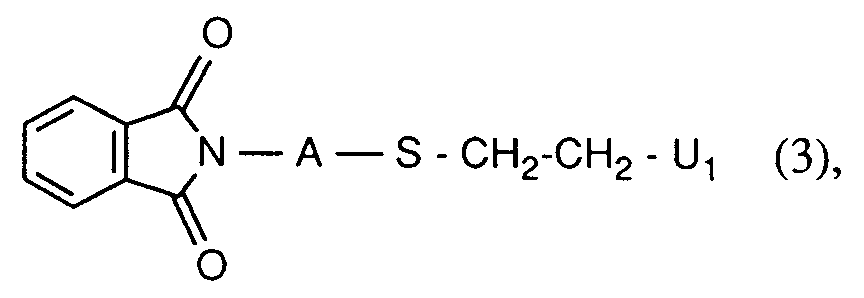
- b) die Thioetherverbindung der Formel (3) zur entsprechenden Sulfonylverbindung der Formel

- c) die erhaltene Verbindung der Formel (3a) selektiv nitriert zur Verbindung der Formel

- d) die erhaltene Verbindung der Formel (3b) zur Aminoverbindung der Formel

- Die Kondensation des Phthalsäureanhydrids mit dem Amin der Formel (2) im Schritt a) erfolgt z.B. in wässrigem oder wässrig-organischem Medium bei einer Temperatur von ca. 40 bis 200°C und vorzugsweise 50 bis 150°C und Normaldruck unter Abdestillieren des entstehenden Wassers.
- Die Oxidation der Thioetherverbindung der Formel (3) zur Sulfonylverbindung der Formel (3a) im Schritt b) kann nach verschiedenen Methoden erfolgen, z.B. mit Wasserstoffperoxid mit oder ohne Zusatz von Wolfram- oder Vanadinverbindungen als Katalysator, ferner mit Peressigsäure, Kaliumpermanganat oder Chromsäure, oder mit Chlor/Salzsäure je in wässrigem, wässrig-organischem oder organischem Medium.
- Die Nitrierung der Verbindung der Formel (3a) zur Verbindung der Formel (3b) im Schritt c) findet vorteilhaft in einem Gemisch von konz. Schwefelsäure und konz. Salpetersäure bei Raumtemperatur oder etwas darüber, z.B. bei einer Temperatur von 10 bis 100°C oder vorzugsweise 30°C bis 50°C, statt.
- Die Reduktion der Nitroverbindung der Formel (3b) zur Aminoverbindung der Formel (3c) im Schritt d) erfolgt z.B. durch katalytische Hydrierung mit Pd/Kohlenstoff in wässrigem, wässrig-organischem oder organischem Medium bei Raumtemperatur bis etwa 60°C; enthält das zur Hydrierung verwendete Medium organische Lösungsmittel, so kommen hierbei in erster Linie Alkohole wie Ethanol sowie Essigester oder Tetrahydrofuran in Frage. Das Hydriergemisch kann auch einen Puffer enthalten, z.B. einen Essigsäure/Acetatpuffer. Die Reduktion kann auch mit Fe/Salzsäure oder Fe/Essigsäure in wässriger Lösung durchgeführt werden.
- Die Verbindungen der Formel (3c), worin U₁ Hydroxy bedeutet, können durch Behandlung mit Sulfatierungsmitteln, Phosphorylierungsmitteln, Halogenierungsmitteln oder Alkyl- oder Arylcarbonsäurehalogeniden wie Benzoylchlorid oder Acetylchlorid in die entsprechenden Verbindungen der Formel (1), worin Y einen Rest -CH₂-CH₂-U ist, überführt werden.
- Geeignete Sulfatierungsmittel sind beispielsweise konz. Schwefelsäure sowie Chlorsulfonsäure und Amidosulfonsäure oder andere SO₃ abgebenden Verbindungen. Die Sulfatierung der Hydroxygruppe U₁ zur Sulfatogruppe U kann auch im Verlauf der Synthese der Verbindungen der Formel (3c), z.B. im Nitrierungsschritt c), erfolgen. Als Halogenierungsmittel können beispielsweise Thionylchlorid oder Thionylbromid verwendet werden. Geeignete Phosphorylierungsmittel sind z.B. konz. Phosphorsäure, Pyro-, Meta- oder Polyphosphorsäure, Phosphorsäurealkylester, Phosphoroxytrichlorid oder Gemische von Phosphorsäure und Phosphor-(V)-oxid.
- Wird in die Verbindung der Formel (3c) ein Rest R oder R' eingeführt, so kommt hier z.B. die Sulfonierung oder Halogenierung, d.h. die Einführung einer Sulfo- oder Halogengruppe, in Frage, die in an sich bekannter Weise, z.B. mit konz. Schwefelsäure, Oleum oder Chlorsulfonsäure bzw. mit Chlor oder Brom in Gegenwart von Lewissäuren, erfolgen kann. Die Verbindungen der Formel (1) mit R und/oder R'= Sulfo oder Halogen können wiederum als Ausgangsprodukte für die Synthese der entsprechenden Verbindungen mit R und/oder R' = Hydroxy, C₁-C₄-Alkoxy oder Cyano dienen, die nach üblichen in den Lehrbüchern der organischen Chemie beschriebenen Methoden erfolgen kann.
- Die Verbindungen der Formel (1) stellen wertvolle, neue aromatische Amine dar, die in üblicher Weise, z.B. durch Einwirkung salpetriger Säure in wässrig-mineralsaurer Lösung bei tiefer Temperatur, diazotiert und anschliessend mit beliebigen Kupplungskomponenten im sauren, neutralen oder schwach alkalischen pH-Bereich gekuppelt werden können. Die dabei erhaltenen neuen Mono- oder Polyazofarbstoffe sind faserreaktiv, d.h. sie vermögen mit den Hydroxylgruppen der Cellulose oder mit den reaktiven Zentren von natürlichen und synthetischen Polyamiden unter Bildung kovalenter chemischer Bindungen zu reagieren, und ergeben auf den genannten Fasermaterialien Färbungen und Drucke mit guten Allgemeinechten, insbesondere guten Licht- und Nassechtheiten.
- Ein weiterer Gegenstand der vorliegenden Erfindung betrifft Verbindungsgemische enthaltend je eine Verbindung der Formel
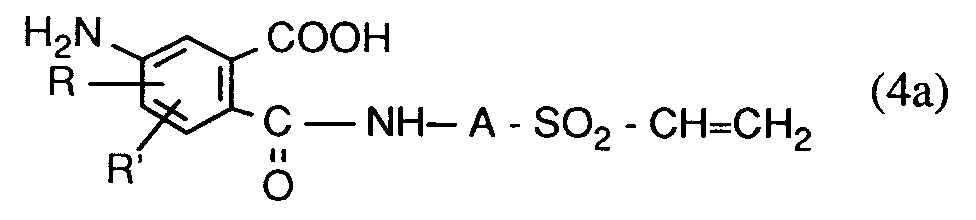
und
worin für A, R und R' jeweils die zuvor angegebenen Bedeutungen und Bevorzugungen gelten; die genannten Verbindungsgemische stellen ebenfalls wertvolle neue Zwischenprodukte für die Synthese von faserreaktiven Farbstoffen für Cellulose- und Polyamidfasermaterialien dar und können z.B. durch einfache Behandlung einer erfindungsgemässen Verbindung der Formel (1) in einem wässrigen alkalischen Medium erhalten werden. Das alkalische Medium weist z.B. einen pH-Wert von 8-14 und vorzugsweise 9-12 auf und kann mittels üblicher Basen, z.B. Natriumhydroxid, hergestellt werden. Beim Behandeln der Verbindungen der Formel (1) in einem solchen alkalischen Medium tritt eine Ringöffnung, wobei die Komponenten der Formel (4a) und (4b) im allgemeinen in einem stöchiometrischen Verhältnis, d.h. in etwa im Verhältnis 1:1, anfallen. - Die nachfolgenden Beispiele dienen der Erläuterung der Erfindung. Die Temperaturen sind in Celsiusgraden angegeben, Teile sind Gewichtsteile, und Prozentangaben beziehen sich auf Gew.-%, sofern nicht anders vermerkt. Gewichtsteile stehen zu Volumenteilen im Verhältnis von Kilogramm zu Liter.
- Zu einer Lösung aus 121 Teilen 2-Amino-2'-hydroxy-diethylsulfid in 121 Teilen Wasser werden 148 Teile Phthalsäureanhydrid eingetragen. Die Temperatur lässt man dabei auf 50°C ansteigen. Nach dem Eintragen erwärmt man die entstandene Suspension auf Rückfluss und destilliert bei Normaldruck das entstehende Wasser ab. Anschliessend erhöht man die Temperatur auf 150°C und lässt eine weitere Stunde bei dieser Temperatur rühren. Man erhält eine Schmelze von N-(2-(2-Hydroxy-ethylthio)-ethyl)-phthalimid der Formel

Man kühlt die entstandene Schmelze auf 80°C ab und gibt dann 8 Teile Natriumacetat und 0,5 Teile Wolfram(VI)-oxid dazu. Bei einer Temperatur von 75-80°C werden nun innert 2 Stunden 214 Teile Wasserstoffperoxid 35% zugetropft und weitere 2 Stunden bei 80°C und schwachem Peroxidüberschuss nachgerührt, bis mittels HPLC kein Sulfoxid mehr nachweisbar ist. Zur Ausfällung der entstandenen Emulsion giesst man die heisse Reaktionsmasse auf 500 Teile kaltes Wasser, filtriert und wäscht mit Wasser peroxidfrei. Nach dem Trocknen im Vakuum bei 60°C erhält man 253 Teile N-(2-(2-Hydroxy-ethylsulfonyl)-ethyl)-phthalimid der Formel
mit einem Schmelzpunkt von 120-122°C und einer Reinheit (HPLC) von 99%.
¹H-NMR-Analyse (gemessen in DMSO-d₆ mit TMS als Standard):
3,30 ppm (2H;t), 3,50 ppm (2H;t), 3,79 ppm (2H;q), 4,05 ppm (2H;t), 5,17 ppm (1H;t), 7,8 - 7,9 ppm (4H). - Zu 735 Teilen Schwefelsäure 100% werden unter Rühren bei 20-30°C 253 Teile N-(2-(2-Hydroxyethylsulfonyl)ethyl)phthalimid eingetragen. Man lässt eine Stunde bei Raumtemperatur nachrühren bis eine vollständige Lösung vorliegt. Nun werden bei einer Temperatur von 10-15°C 113 Teile Mischsäure 50% innert 3 Stunden zugetropft. Danach erwärmt man auf 40°C und lässt weitere 12 Stunden bei dieser Temperatur nachrühren. Zur Isolierung trägt man das Nitriergemisch bei max. 5°C auf 2500 Teile Eis aus. Die klare Lösung wird mit 250 Teilen Kaliumsulfat versetzt und eine Stunde bei 10°C verrührt. Das ausgefallene Produkt wird abfiltriert und mit Kaliumsulfatlösung 10% gewaschen. Man erhält 1195 Teile feuchtes 4-Nitro-N-(2-(2-sulfato-ethylsulfonyl)-ethyl)-phthalimid der Formel

¹H-NMR-Analyse (gemessen in DMSO-d₆ mit TMS als Standard): 3,45 ppm (2H, t); 3,50 ppm (2H, t); 4,05 ppm (2H, t); 4,10 ppm (2H, t); 8,16 ppm (1H, d); 8,52 ppm (1H, s); 8,63 ppm (1H, d). - 1195 Teile feuchtes 4-Nitro-N-(2-(2-sulfato-ethylsulfonyl)-ethyl)-phthalimid werden in 2500 Teilen Wasser, 10 Teilen Natriumacetat und 8 Teilen Essigsäure gelöst. Diese Lösung wird unter Zugabe von 30 Teilen Palladium-Kohle 5% unter Normaldruck bei 50°C mit Wasserstoff bis zum Stillstand hydriert. Nach der Katalysatorfiltration wird die entstandene Lösung mit 700 Teilen Kaliumchlorid versetzt und das ausgefallene Produkt abgenutscht. Nach dem Trocknen im Vacuum bei 50°C erhält man 150 Teile 78%iges (Nitrittiter) 4-Amino-N-(2-(2-sulfato-ethylsulfonyl)-ethyl)-phthalimid der Formel

mit einer Reinheit von 96% (HPLC).
¹H-NMR-Analyse (gemessen in DMSO-d₆ mit TMS als Standard):
3,42 ppm (2H;t), 3,48 ppm (2H;t), 3,94 ppm (2H;t), 4,07 ppm (2H;t), 6,45 ppm (2H;s), 6,80 ppm (1H;q) ³J= 7 Hz und ⁴J= 2 Hz, 6,93 ppm (1H;d)⁴J= 2 Hz, 7,48 ppm (1H,d) ³J= 7 Hz. - Analog wie in den Beispielen 1-3 beschrieben lassen sich die folgenden Verbindungen herstellen:


- Behandelt man die gemäss den Beispielen 3 bis 6a erhaltenen Verbindungen ca. 1 Stunde lang bei Raumtemperatur in einer wässrigen Lösung, deren pH-Wert durch Zugabe von Natriumhydroxidlösung auf ca. 10 eingestellt ist, und erniedrigt danach den pH-Wert mit Essigsäure auf 6, so erhält man ein in etwa stöchiometrisches Gemisch von zwei Verbindungen der in der Tabelle angegebenen Formel, worin sich die Aminogruppe einmal in 4-Stellung und einmal in 5-Stellung befindet.


- Zu 215 Teilen 100%iger Schwefelsäure werden bei 20 bis 30°C 32 Teile 65%iges Oleum zugetropft. Danach trägt man 37,8 Teile der Verbindung gemäss Beispiel 3 innerhalb von 30 Minuten ein und lässt dabei die Temperatur auf 60°C ansteigen. Man erwärmt die Sulfiermasse anschliessend ca. 3 Stunden auf 130°C, lässt danach auf Raumtemperatur abkühlen und trägt die abgekühlte Reaktionsmasse auf 500 Teile Eis aus. Man fällt die überschüssige Schwefelsäure mit Calciumcarbonat aus und stellt den pH-Wert des nach dem Abfiltrieren des CaSO₄ resultierenden Filtrats mit Natriumcarbonat auf einen Wert von 4 ein. Durch Eindampfen oder Gefriertrocknen erhält man die Verbindung der Formel

¹H-NMR-Analyse (gemessen in DMSO-d₆ mit TMS als Standard):
3,45 ppm (2H;t), 3,52 ppm (2H;t), 4,03 ppm (2H;t), 4,09 ppm (2H;t), 7,03 ppm (1H;s), 7,80 ppm (1H;s). - Behandelt man die gemäss Beispiel 11 erhaltene Verbindung in einem alkalischen Medium, erhält man ein in etwa stöchiometrisches Gemisch von zwei Verbindungen der Formel

worin die eine Verbindung die Aminogruppe in 4-Stellung und die Sulfogruppe in 5-Stellung und die andere Verbindung die Aminogruppe in 5-Stellung und die Sulfogruppe in 4-Stellung aufweist. - 37,8 Teile der Verbindung gemäss Beispiel 3 in 250 Teilen Eiswassersuspension werden mit 25 Volumenteilen 32%iger wässriger Salzsäure angesäuert und mit 25 Volumenteilen 4n Natriumnitritlösung diazotiert. Man rührt eine Stunde bei einer Temperatur von 5°C nach und zerstört dann die überschüssige salpetrige Säure mit Amidosulfonsäure. Diese Diazoniumsuspension lässt man bei 0 - 5°C und einem pH von 4,5 - 5,5 langsam in eine Suspension bestehend aus bei pH 6 in 200 Teilen Wasser angeschlämmte 1-Benzoylamino-8-hydroxynaphthalin-3,6-disulfonsäure einlaufen. Der pH wird dabei unter Zugabe von Natriumcarbonatlösung gehalten. Nach der Zugabe rührt man weitere 2 Stunden bis zur vollständigen Kupplung bei pH 5,5 nach und lässt dabei die Temperatur auf Raumtemperatur ansteigen. Dann wird die Farbstofflösung umkehrosmotisiert und gefriergetrocknet. Man erhält einen Farbstoff, der in Form der freien Säure der Verbindung der Formel

entspricht und Baumwolle und Wolle in brillanten roten Tönen mit guten Allgemeinechtheiten färbt. - Verfährt man wie im Beispiel 13 angegeben und stellt den pH-Wert des Reaktionsgemisches vor der Umkehrosmose mit 4n Natronlauge auf pH 10, lässt eine Stunde bei diesem pH verrühren und stellt danach den pH mit etwas Essigsäure wieder auf pH 6, so erhält man einen Farbstoff, welcher in der Form der freien Säure dem Isomerengemisch im Verhältnis 1:1 der Formel
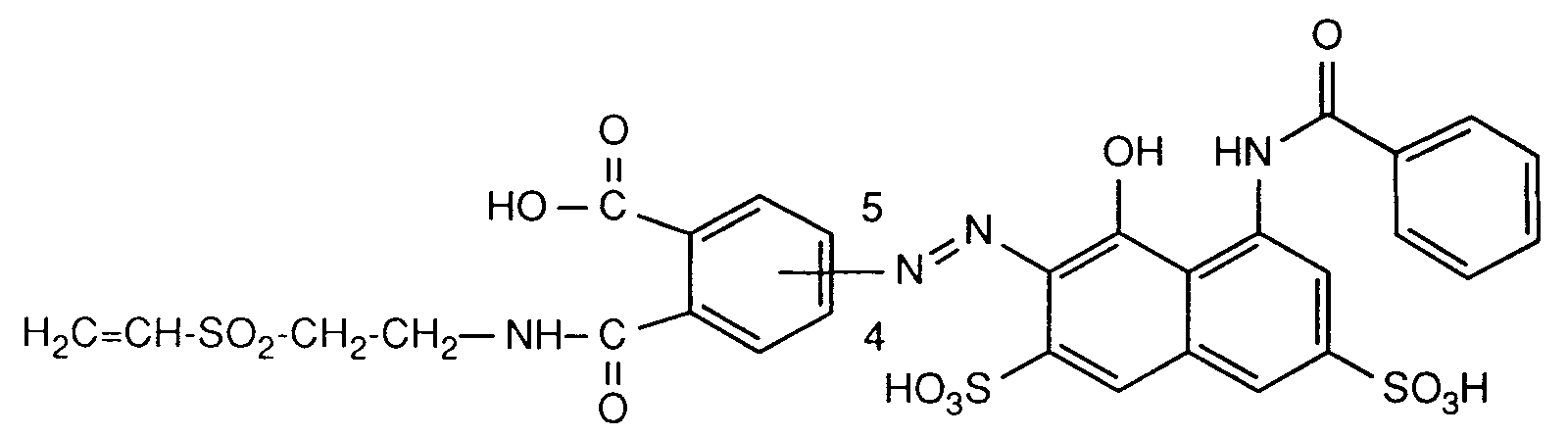
entspricht. Durch Umkehrosmose und anschliessendes Gefriertrocknen erhält man einen Farbstoff, der auf Baumwolle oder Wolle ausgefärbt die gleichen Eigenschaften wie der in Beispiel 13 angegebene Farbstoff besitzt.
Claims (14)
- Verbindungen der Formel

R und R' unabhängig voneinander je für Wasserstoff, Sulfo, Hydroxy, C₁-C₄-Alkoxy, Halogen oder Cyano stehen,
A unsubstituiertes oder durch Halogen, Hydroxy, Sulfato, Carboxy, Cyano,
C₂-C₄-Alkanoyloxy, C₁-C₄-Alkoxycarbonyl oder Carbamoyl substituiertes oder durch eine Gruppe -O- oder -NR₁- unterbrochenes C₁-C₆-Alkylen oder unsubstituiertes oder im Phenylenteil durch C₁-C₄-Alkyl, C₁-C₄-Alkoxy, Halogen oder Sulfo substituiertes C₁-C₆-Alkylenphenylen ist,
R₁ für Wasserstoff oder C₁-C₄-Alkyl steht,
Y Vinyl oder einen Rest -CH₂-CH₂-U bedeutet, und
U eine alkalisch abspaltbare Abgangsgruppe ist. - Verbindungen gemäss Anspruch 1, dadurch gekennzeichnet, dass R Wasserstoff, Sulfo, Chlor, Brom oder Cyano und R' Wasserstoff bedeuten.
- Verbindungen gemäss Anspruch 1 oder 2, dadurch gekennzeichnet, dass A einen unsubstituierten C₁-C₆-Alkylenrest oder einen Rest der Formel
-(CH₂)p-O-(CH₂)q-
oder
-(CH₂)p- NH-(CH₂)q-,
worin p und q unabhängig voneinander je eine ganze Zahl von 1 bis 6 darstellen, bedeutet. - Verbindungen gemäss einem der Ansprüche 1 bis 3, dadurch gekennzeichnet, dass A für C₂-C₄-Alkylen oder für einen Rest der Formel -(CH₂)₂₋₄-O-(CH₂)₂₋₄- oder -(CH₂)₂₋₄-NH-(CH₂)₂₋₄- steht.
- Verbindungen gemäss einem der Ansprüche 1 bis 4, dadurch gekennzeichnet, dass A für 1,2-Ethylen, 1,3-Propylen, 1,4-Butylen oder einen Rest der Formel
-(CH₂)₂₋₃-O-(CH₂)₂₋₃-
oder
-(CH₂)₂₋₃- NH-(CH₂)₂₋₃-
steht. - Verbindungen gemäss einem der Ansprüche 1 bis 5, dadurch gekennzeichnet, dass Y Vinyl, β-Brom- oder β-Chlorethyl, β-Acetoxyethyl, β-Benzoyloxyethyl, β-Phosphatoethyl, β-Sulfatoethyl oder β-Thiosulfatoethyl und bevorzugt Vinyl oder β-Sulfatoethyl bedeutet.
- Verbindungen der Formel (1) gemäss Anspruch 1, dadurch gekennzeichnet, dass R Wasserstoff, Sulfo, Chlor, Brom oder Cyano, R' Wasserstoff, A unsubstituiertes C₁-C₆-Alkylen oder einen Rest der Formel
-(CH₂)p-O-(CH₂)q-
oder
-(CH₂)p-NH-(CH₂)q-,
p und q unabhängig voneinander je eine ganze Zahl von 1 bis 6, und Y Vinyl, β-Brom- oder β-Chlorethyl, β-Acetoxyethyl, β-Benzoyloxyethyl, β-Phosphatoethyl, β-Sulfatoethyl oder β-Thiosulfatoethyl bedeuten. - Verbindungen der Formel (1) gemäss Anspruch 1, dadurch gekennzeichnet, dass R Wasserstoff oder Sulfo, R' Wasserstoff, A C₂-C₄-Alkylen oder einen Rest der Formel -(CH₂)₂₋₄-O-(CH₂)₂₋₄- oder -(CH₂)₂₋₄-NH-(CH₂)₂₋₄-, und Y Vinyl oder β-Sulfatoethyl bedeuten.
- Verbindungen der Formel (1) gemäss Anspruch 1, dadurch gekennzeichnet, dass R und R' je Wasserstoff, A 1,2-Ethylen, 1,3-Propylen oder einen Rest der Formel -(CH₂)₂-O-(CH₂)₂- und Y β-Sulfatoethyl bedeuten.
- Verfahren zur Herstellung von Verbindungen der Formel (1) gemäss Anspruch 1, dadurch gekennzeichnet, dass mana) Phthalsäureanhydrid mit einer Verbindung der Formel
H₂N-A-S-CH₂-CH₂-U₁ (2)
zur Verbindung der Formel b) die Thioetherverbindung der Formel (3) zur entsprechenden Sulfonylverbindung der Formel
 c) die erhaltene Verbindung der Formel (3a) selektiv nitriert zur Verbindung der Formel
 d) die erhaltene Verbindung der Formel (3b) zur Aminoverbindung der Formel

- Verwendung der Verbindungen der Formel (1) gemäss Anspruch 1 als Diazokomponente zur Herstellung von faserreaktiven Mono- oder Polyazofarbstoffen.
- Verbindungsgemisch enthaltend je eine Verbindung der Formel


- Verfahren zur Herstellung eines Verbindungsgemisches enthaltend je eine Verbindung der Formel (4a) und (4b) gemäss Anspruch 12, dadurch gekennzeichnet, dass man eine Verbindung der Formel (1) gemäss Anspruch 1 in einem alkalischen Medium behandelt.
- Verwendung eines Verbindungsgemisches enthaltend je eine Verbindung der Formel (4a) und (4b) gemäss Anspruch 12 als Diazokomponenten zur Herstellung von faserreaktiven Mono- oder Polyazofarbstoffen.
Applications Claiming Priority (2)
| Application Number | Priority Date | Filing Date | Title |
|---|---|---|---|
| CH167894 | 1994-05-30 | ||
| CH1678/94 | 1994-05-30 |
Publications (1)
| Publication Number | Publication Date |
|---|---|
| EP0685464A1 true EP0685464A1 (de) | 1995-12-06 |
Family
ID=4216045
Family Applications (1)
| Application Number | Title | Priority Date | Filing Date |
|---|---|---|---|
| EP95810342A Withdrawn EP0685464A1 (de) | 1994-05-30 | 1995-05-23 | Zwischenprodukte für Reaktivfarbstoffe |
Country Status (5)
| Country | Link |
|---|---|
| US (1) | US5576445A (de) |
| EP (1) | EP0685464A1 (de) |
| JP (1) | JPH07330730A (de) |
| KR (1) | KR950032118A (de) |
| TW (1) | TW310323B (de) |
Cited By (2)
| Publication number | Priority date | Publication date | Assignee | Title |
|---|---|---|---|---|
| EP0733680A3 (de) * | 1995-03-24 | 1997-09-17 | Basf Ag | Reaktivfarbstoffe mit einem benzoanellierten Heterocyclus als Anker |
| EP0838504A1 (de) * | 1996-10-21 | 1998-04-29 | DyStar Textilfarben GmbH & Co. Deutschland KG | Wasserlösliche faserreaktive Farbstoffe, Verfahren zu ihrer Herstellung und ihre Verwendung |
Citations (5)
| Publication number | Priority date | Publication date | Assignee | Title |
|---|---|---|---|---|
| US2533178A (en) * | 1948-05-01 | 1950-12-05 | Gen Aniline & Film Corp | alpha-(phthalimidomethyl-anilino)-anthraquinones and process of preparing the same |
| DE2227401A1 (de) * | 1972-06-06 | 1973-12-20 | Basf Ag | Anthrachinoide dispersionsfarbstoffe |
| DE2640764A1 (de) * | 1976-09-10 | 1978-03-16 | Bayer Ag | Azofarbstoffe |
| EP0124797A1 (de) * | 1983-04-18 | 1984-11-14 | American Hoechst Corporation | Wasserlösliche Monoazoverbindungen, Verfahren zu ihrer Herstellung und ihre Verwendung |
| EP0208655A2 (de) * | 1985-07-12 | 1987-01-14 | Ciba-Geigy Ag | Reaktivfarbstoffe, deren Herstellung und Verwendung |
-
1995
- 1995-05-15 TW TW084104865A patent/TW310323B/zh active
- 1995-05-23 EP EP95810342A patent/EP0685464A1/de not_active Withdrawn
- 1995-05-26 JP JP7128200A patent/JPH07330730A/ja active Pending
- 1995-05-26 US US08/451,355 patent/US5576445A/en not_active Expired - Fee Related
- 1995-05-29 KR KR1019950013595A patent/KR950032118A/ko not_active Withdrawn
Patent Citations (5)
| Publication number | Priority date | Publication date | Assignee | Title |
|---|---|---|---|---|
| US2533178A (en) * | 1948-05-01 | 1950-12-05 | Gen Aniline & Film Corp | alpha-(phthalimidomethyl-anilino)-anthraquinones and process of preparing the same |
| DE2227401A1 (de) * | 1972-06-06 | 1973-12-20 | Basf Ag | Anthrachinoide dispersionsfarbstoffe |
| DE2640764A1 (de) * | 1976-09-10 | 1978-03-16 | Bayer Ag | Azofarbstoffe |
| EP0124797A1 (de) * | 1983-04-18 | 1984-11-14 | American Hoechst Corporation | Wasserlösliche Monoazoverbindungen, Verfahren zu ihrer Herstellung und ihre Verwendung |
| EP0208655A2 (de) * | 1985-07-12 | 1987-01-14 | Ciba-Geigy Ag | Reaktivfarbstoffe, deren Herstellung und Verwendung |
Cited By (4)
| Publication number | Priority date | Publication date | Assignee | Title |
|---|---|---|---|---|
| EP0733680A3 (de) * | 1995-03-24 | 1997-09-17 | Basf Ag | Reaktivfarbstoffe mit einem benzoanellierten Heterocyclus als Anker |
| US5929217A (en) * | 1995-03-24 | 1999-07-27 | Basf Aktiengesellschaft | Reactive dyes with a benzo-fused heterocycle as anchor |
| EP0838504A1 (de) * | 1996-10-21 | 1998-04-29 | DyStar Textilfarben GmbH & Co. Deutschland KG | Wasserlösliche faserreaktive Farbstoffe, Verfahren zu ihrer Herstellung und ihre Verwendung |
| US5834601A (en) * | 1996-10-21 | 1998-11-10 | Dystar Textilfarben Gmbh & Co. Deutschland Kg | Water-soluble fiber-reactive dyes, process for their preparation, and their use |
Also Published As
| Publication number | Publication date |
|---|---|
| US5576445A (en) | 1996-11-19 |
| TW310323B (de) | 1997-07-11 |
| KR950032118A (ko) | 1995-12-20 |
| JPH07330730A (ja) | 1995-12-19 |
Similar Documents
| Publication | Publication Date | Title |
|---|---|---|
| DE3045471A1 (de) | Dioxazin-reaktivfarbstoffe, verfahren zu ihrer herstellung und ihre verwendung zum faerben und bedrucken von hydroxyl- oder amidgruppenhaltigen fasermaterialien | |
| DE1148341B (de) | Verfahren zur Herstellung von Farbstoffen | |
| EP0075905A2 (de) | Wasserlösliche faserreaktive Phthalocyaninverbindungen, Verfahren zu ihrer Herstellung und ihre Verwendung als Farbstoffe | |
| DE2503714C3 (de) | Verfahren zur Herstellung von wasserlöslichen Azofarbstoffen | |
| EP0051808B1 (de) | Wasserlösliche Monoazoverbindungen, Verfahren zu ihrer Herstellung und ihre Verwendung als Farbstoffe | |
| DE2040620B2 (de) | Wasserlösliche, faserreaktive Monoazofarbstoffe, Verfahren zu ihrer Herstellung und ihre Verwendung zum Färben und Bedrucken von Leder, Wolle, Seide, Polyamiden und Cellulose | |
| EP0029136B1 (de) | Quartäre und basische Azamethinverbindungen, Verfahren zu ihrer Herstellung und ihre Verwendung als Farbmittel | |
| DE1289930B (de) | Verfahren zur Herstellung von Azofarbstoffen und deren Metallkomplexverbindungen | |
| EP0222098B1 (de) | Wasserlösliche Triphendioxazin-Verbindungen, Verfahren zu ihrer Herstellung und ihre Verwendung als Farbstoffe | |
| DE3510612A1 (de) | Triphendioxazin-farbstoffe | |
| EP0154816B1 (de) | Sulfonsäuregruppenhaltige Azoverbindungen | |
| CH645125A5 (de) | Verfahren zur herstellung wasserloeslicher phthalocyaninfarbstoffe. | |
| DE2200107B2 (de) | Anthrachinonfarbstoffe, deren Herstellung und deren Verwendung | |
| DE3139657A1 (de) | Wasserloesliche disazoverbindungen, verfahren zu ihrer herstellung und ihre verwendung als farbstoffe | |
| EP0603116B1 (de) | Azoreaktivfarbstoffe | |
| EP0043575B1 (de) | Wasserlösliche Azoverbindungen, Verfahren zu ihrer Herstellung und ihre Verwendung als Farbstoffe | |
| EP0319474A1 (de) | Verfahren zur Herstellung von 1:2-Metallkomplexazofarbstoffen | |
| DE1058178B (de) | Verfahren zur Herstellung von Phthalocyaninpigmenten | |
| EP0688832A2 (de) | Reaktivfarbstoffe, ihre Herstellung und Verwendung | |
| EP0036555A1 (de) | Neue Zinkchloridkomplexverbindungen, Verfahren zu ihrer Herstellung sowie ihre Verwendung und Verfahren zur Herstellung von Phenoxazinverbindungen | |
| EP0255020B1 (de) | Wasserlösliche Triphendioxazin-Verbindungen, Verfahren zu ihrer Herstellung und ihre Verwendung als Farbstoffe | |
| EP0205079B1 (de) | Saure Triphendioxazin-disulfimid-Farbstoffe | |
| DE2346047A1 (de) | Blaue anthrachinoide dispersionsfarbstoffe, deren herstellung und verwendung | |
| DE2906442C2 (de) | ||
| DE1644257A1 (de) | Verfahren zur Herstellung von kupfer- oder nickelhaltigen Bisformazanfarbstoffen |
Legal Events
| Date | Code | Title | Description |
|---|---|---|---|
| PUAI | Public reference made under article 153(3) epc to a published international application that has entered the european phase |
Free format text: ORIGINAL CODE: 0009012 |
|
| AK | Designated contracting states |
Kind code of ref document: A1 Designated state(s): BE CH DE ES FR GB IT LI |
|
| RAX | Requested extension states of the european patent have changed |
Free format text: LT;LV;SI |
|
| 17P | Request for examination filed |
Effective date: 19960507 |
|
| RAP1 | Party data changed (applicant data changed or rights of an application transferred) |
Owner name: CIBA SC HOLDING AG |
|
| RAP3 | Party data changed (applicant data changed or rights of an application transferred) |
Owner name: CIBA SPECIALTY CHEMICALS HOLDING INC. |
|
| STAA | Information on the status of an ep patent application or granted ep patent |
Free format text: STATUS: THE APPLICATION IS DEEMED TO BE WITHDRAWN |
|
| 18D | Application deemed to be withdrawn |
Effective date: 19981201 |