EP0685501A1 - Copolymère polyoléfinique greffé - Google Patents
Copolymère polyoléfinique greffé Download PDFInfo
- Publication number
- EP0685501A1 EP0685501A1 EP95401293A EP95401293A EP0685501A1 EP 0685501 A1 EP0685501 A1 EP 0685501A1 EP 95401293 A EP95401293 A EP 95401293A EP 95401293 A EP95401293 A EP 95401293A EP 0685501 A1 EP0685501 A1 EP 0685501A1
- Authority
- EP
- European Patent Office
- Prior art keywords
- radical
- chosen
- macromonomer
- linear
- alkyl
- Prior art date
- Legal status (The legal status is an assumption and is not a legal conclusion. Google has not performed a legal analysis and makes no representation as to the accuracy of the status listed.)
- Withdrawn
Links
- 229920001577 copolymer Polymers 0.000 title claims description 7
- 239000000178 monomer Substances 0.000 claims abstract description 30
- 150000003254 radicals Chemical class 0.000 claims abstract description 27
- -1 phenyloxycarbonyl Chemical group 0.000 claims abstract description 21
- 239000003999 initiator Substances 0.000 claims abstract description 17
- 125000000217 alkyl group Chemical group 0.000 claims abstract description 14
- 239000003795 chemical substances by application Substances 0.000 claims abstract description 11
- 238000012546 transfer Methods 0.000 claims abstract description 9
- 150000001993 dienes Chemical class 0.000 claims abstract description 7
- 125000004122 cyclic group Chemical group 0.000 claims abstract description 6
- 125000002924 primary amino group Chemical group [H]N([H])* 0.000 claims abstract description 5
- 125000004453 alkoxycarbonyl group Chemical group 0.000 claims abstract description 4
- 125000003282 alkyl amino group Chemical group 0.000 claims abstract description 4
- PNDPGZBMCMUPRI-UHFFFAOYSA-N iodine Chemical compound II PNDPGZBMCMUPRI-UHFFFAOYSA-N 0.000 claims abstract description 4
- 125000003545 alkoxy group Chemical group 0.000 claims abstract description 3
- 229910052794 bromium Inorganic materials 0.000 claims abstract description 3
- 229910052801 chlorine Inorganic materials 0.000 claims abstract description 3
- 229910052760 oxygen Inorganic materials 0.000 claims abstract description 3
- SNZXFRFQGXSSGN-UHFFFAOYSA-N phenylsulfanyloxysulfanylbenzene Chemical compound C=1C=CC=CC=1SOSC1=CC=CC=C1 SNZXFRFQGXSSGN-UHFFFAOYSA-N 0.000 claims abstract description 3
- 229910052717 sulfur Inorganic materials 0.000 claims abstract description 3
- 238000006116 polymerization reaction Methods 0.000 claims description 17
- 229920000578 graft copolymer Polymers 0.000 claims description 16
- 238000000034 method Methods 0.000 claims description 16
- PPBRXRYQALVLMV-UHFFFAOYSA-N Styrene Chemical compound C=CC1=CC=CC=C1 PPBRXRYQALVLMV-UHFFFAOYSA-N 0.000 claims description 15
- 230000015572 biosynthetic process Effects 0.000 claims description 8
- 238000006243 chemical reaction Methods 0.000 claims description 8
- 238000010526 radical polymerization reaction Methods 0.000 claims description 8
- 238000003786 synthesis reaction Methods 0.000 claims description 8
- NIXOWILDQLNWCW-UHFFFAOYSA-N 2-Propenoic acid Natural products OC(=O)C=C NIXOWILDQLNWCW-UHFFFAOYSA-N 0.000 claims description 6
- VVQNEPGJFQJSBK-UHFFFAOYSA-N Methyl methacrylate Chemical compound COC(=O)C(C)=C VVQNEPGJFQJSBK-UHFFFAOYSA-N 0.000 claims description 5
- 239000000839 emulsion Substances 0.000 claims description 5
- 239000000203 mixture Substances 0.000 claims description 5
- ASAATBXPAUZKHD-UHFFFAOYSA-N 1-butylsulfanylpenta-1,3-diene Chemical compound C(CCC)SC=CC=CC ASAATBXPAUZKHD-UHFFFAOYSA-N 0.000 claims description 4
- KAKZBPTYRLMSJV-UHFFFAOYSA-N Butadiene Chemical compound C=CC=C KAKZBPTYRLMSJV-UHFFFAOYSA-N 0.000 claims description 4
- CIUQDSCDWFSTQR-UHFFFAOYSA-N [C]1=CC=CC=C1 Chemical compound [C]1=CC=CC=C1 CIUQDSCDWFSTQR-UHFFFAOYSA-N 0.000 claims description 4
- 239000003960 organic solvent Substances 0.000 claims description 4
- 238000002360 preparation method Methods 0.000 claims description 4
- SMZOUWXMTYCWNB-UHFFFAOYSA-N 2-(2-methoxy-5-methylphenyl)ethanamine Chemical compound COC1=CC=C(C)C=C1CCN SMZOUWXMTYCWNB-UHFFFAOYSA-N 0.000 claims description 3
- WKBOTKDWSSQWDR-UHFFFAOYSA-N Bromine atom Chemical compound [Br] WKBOTKDWSSQWDR-UHFFFAOYSA-N 0.000 claims description 3
- ZAMOUSCENKQFHK-UHFFFAOYSA-N Chlorine atom Chemical compound [Cl] ZAMOUSCENKQFHK-UHFFFAOYSA-N 0.000 claims description 3
- GDTBXPJZTBHREO-UHFFFAOYSA-N bromine Substances BrBr GDTBXPJZTBHREO-UHFFFAOYSA-N 0.000 claims description 2
- 239000000460 chlorine Substances 0.000 claims description 2
- JEVCWSUVFOYBFI-UHFFFAOYSA-N cyanyl Chemical compound N#[C] JEVCWSUVFOYBFI-UHFFFAOYSA-N 0.000 claims description 2
- 229910052736 halogen Inorganic materials 0.000 claims description 2
- 150000002367 halogens Chemical class 0.000 claims description 2
- 125000005842 heteroatom Chemical group 0.000 claims description 2
- 125000004435 hydrogen atom Chemical group [H]* 0.000 claims description 2
- KHUXNRRPPZOJPT-UHFFFAOYSA-N phenoxy radical Chemical compound O=C1C=C[CH]C=C1 KHUXNRRPPZOJPT-UHFFFAOYSA-N 0.000 claims description 2
- 229920000098 polyolefin Polymers 0.000 abstract description 3
- 125000002252 acyl group Chemical group 0.000 abstract 1
- 125000004442 acylamino group Chemical group 0.000 abstract 1
- 125000004423 acyloxy group Chemical group 0.000 abstract 1
- 150000001336 alkenes Chemical group 0.000 abstract 1
- 125000005012 alkyl thioether group Chemical group 0.000 abstract 1
- 125000003236 benzoyl group Chemical group [H]C1=C([H])C([H])=C(C([H])=C1[H])C(*)=O 0.000 abstract 1
- 125000003917 carbamoyl group Chemical group [H]N([H])C(*)=O 0.000 abstract 1
- JRZJOMJEPLMPRA-UHFFFAOYSA-N olefin Natural products CCCCCCCC=C JRZJOMJEPLMPRA-UHFFFAOYSA-N 0.000 abstract 1
- 125000000951 phenoxy group Chemical group [H]C1=C([H])C([H])=C(O*)C([H])=C1[H] 0.000 abstract 1
- 125000006678 phenoxycarbonyl group Chemical group 0.000 abstract 1
- OKKJLVBELUTLKV-UHFFFAOYSA-N Methanol Chemical compound OC OKKJLVBELUTLKV-UHFFFAOYSA-N 0.000 description 15
- 229920000642 polymer Polymers 0.000 description 11
- WYURNTSHIVDZCO-UHFFFAOYSA-N Tetrahydrofuran Chemical compound C1CCOC1 WYURNTSHIVDZCO-UHFFFAOYSA-N 0.000 description 7
- RTZKZFJDLAIYFH-UHFFFAOYSA-N Diethyl ether Chemical compound CCOCC RTZKZFJDLAIYFH-UHFFFAOYSA-N 0.000 description 6
- 239000000243 solution Substances 0.000 description 6
- 239000004793 Polystyrene Substances 0.000 description 5
- 229920002223 polystyrene Polymers 0.000 description 5
- CSNNHWWHGAXBCP-UHFFFAOYSA-L Magnesium sulfate Chemical compound [Mg+2].[O-][S+2]([O-])([O-])[O-] CSNNHWWHGAXBCP-UHFFFAOYSA-L 0.000 description 4
- IMNFDUFMRHMDMM-UHFFFAOYSA-N N-Heptane Chemical compound CCCCCCC IMNFDUFMRHMDMM-UHFFFAOYSA-N 0.000 description 4
- XTXRWKRVRITETP-UHFFFAOYSA-N Vinyl acetate Chemical compound CC(=O)OC=C XTXRWKRVRITETP-UHFFFAOYSA-N 0.000 description 4
- 238000007334 copolymerization reaction Methods 0.000 description 4
- PMJHHCWVYXUKFD-SNAWJCMRSA-N (E)-1,3-pentadiene Chemical class C\C=C\C=C PMJHHCWVYXUKFD-SNAWJCMRSA-N 0.000 description 3
- IJGRMHOSHXDMSA-UHFFFAOYSA-N Atomic nitrogen Chemical compound N#N IJGRMHOSHXDMSA-UHFFFAOYSA-N 0.000 description 3
- IAZDPXIOMUYVGZ-UHFFFAOYSA-N Dimethylsulphoxide Chemical compound CS(C)=O IAZDPXIOMUYVGZ-UHFFFAOYSA-N 0.000 description 3
- CERQOIWHTDAKMF-UHFFFAOYSA-N Methacrylic acid Chemical compound CC(=C)C(O)=O CERQOIWHTDAKMF-UHFFFAOYSA-N 0.000 description 3
- 239000000706 filtrate Substances 0.000 description 3
- VLKZOEOYAKHREP-UHFFFAOYSA-N n-Hexane Chemical compound CCCCCC VLKZOEOYAKHREP-UHFFFAOYSA-N 0.000 description 3
- 238000001556 precipitation Methods 0.000 description 3
- 239000000047 product Substances 0.000 description 3
- 238000000746 purification Methods 0.000 description 3
- 239000002904 solvent Substances 0.000 description 3
- YLQBMQCUIZJEEH-UHFFFAOYSA-N tetrahydrofuran Natural products C=1C=COC=1 YLQBMQCUIZJEEH-UHFFFAOYSA-N 0.000 description 3
- 229920002554 vinyl polymer Polymers 0.000 description 3
- XLYOFNOQVPJJNP-UHFFFAOYSA-N water Substances O XLYOFNOQVPJJNP-UHFFFAOYSA-N 0.000 description 3
- LGKANOVVJSORFA-ONEGZZNKSA-N (3e)-5-bromopenta-1,3-diene Chemical compound BrC\C=C\C=C LGKANOVVJSORFA-ONEGZZNKSA-N 0.000 description 2
- OSSNTDFYBPYIEC-UHFFFAOYSA-N 1-ethenylimidazole Chemical compound C=CN1C=CN=C1 OSSNTDFYBPYIEC-UHFFFAOYSA-N 0.000 description 2
- OZAIFHULBGXAKX-UHFFFAOYSA-N 2-(2-cyanopropan-2-yldiazenyl)-2-methylpropanenitrile Chemical compound N#CC(C)(C)N=NC(C)(C)C#N OZAIFHULBGXAKX-UHFFFAOYSA-N 0.000 description 2
- KGIGUEBEKRSTEW-UHFFFAOYSA-N 2-vinylpyridine Chemical class C=CC1=CC=CC=N1 KGIGUEBEKRSTEW-UHFFFAOYSA-N 0.000 description 2
- CSCPPACGZOOCGX-UHFFFAOYSA-N Acetone Chemical compound CC(C)=O CSCPPACGZOOCGX-UHFFFAOYSA-N 0.000 description 2
- HRPVXLWXLXDGHG-UHFFFAOYSA-N Acrylamide Chemical compound NC(=O)C=C HRPVXLWXLXDGHG-UHFFFAOYSA-N 0.000 description 2
- NIXOWILDQLNWCW-UHFFFAOYSA-M Acrylate Chemical compound [O-]C(=O)C=C NIXOWILDQLNWCW-UHFFFAOYSA-M 0.000 description 2
- 229910016455 AlBN Inorganic materials 0.000 description 2
- LSNNMFCWUKXFEE-UHFFFAOYSA-M Bisulfite Chemical compound OS([O-])=O LSNNMFCWUKXFEE-UHFFFAOYSA-M 0.000 description 2
- SOGAXMICEFXMKE-UHFFFAOYSA-N Butylmethacrylate Chemical compound CCCCOC(=O)C(C)=C SOGAXMICEFXMKE-UHFFFAOYSA-N 0.000 description 2
- XDTMQSROBMDMFD-UHFFFAOYSA-N Cyclohexane Chemical compound C1CCCCC1 XDTMQSROBMDMFD-UHFFFAOYSA-N 0.000 description 2
- VZCYOOQTPOCHFL-OWOJBTEDSA-N Fumaric acid Chemical compound OC(=O)\C=C\C(O)=O VZCYOOQTPOCHFL-OWOJBTEDSA-N 0.000 description 2
- MHAJPDPJQMAIIY-UHFFFAOYSA-N Hydrogen peroxide Chemical compound OO MHAJPDPJQMAIIY-UHFFFAOYSA-N 0.000 description 2
- BAPJBEWLBFYGME-UHFFFAOYSA-N Methyl acrylate Chemical compound COC(=O)C=C BAPJBEWLBFYGME-UHFFFAOYSA-N 0.000 description 2
- CNCOEDDPFOAUMB-UHFFFAOYSA-N N-Methylolacrylamide Chemical compound OCNC(=O)C=C CNCOEDDPFOAUMB-UHFFFAOYSA-N 0.000 description 2
- 150000003926 acrylamides Chemical class 0.000 description 2
- 150000001252 acrylic acid derivatives Chemical class 0.000 description 2
- 150000001408 amides Chemical class 0.000 description 2
- 125000004103 aminoalkyl group Chemical group 0.000 description 2
- 125000000129 anionic group Chemical group 0.000 description 2
- 125000004432 carbon atom Chemical group C* 0.000 description 2
- 125000002091 cationic group Chemical group 0.000 description 2
- 150000001991 dicarboxylic acids Chemical class 0.000 description 2
- 150000002148 esters Chemical class 0.000 description 2
- 239000011521 glass Substances 0.000 description 2
- 238000010348 incorporation Methods 0.000 description 2
- 229910052943 magnesium sulfate Inorganic materials 0.000 description 2
- 235000019341 magnesium sulphate Nutrition 0.000 description 2
- 238000004519 manufacturing process Methods 0.000 description 2
- FQPSGWSUVKBHSU-UHFFFAOYSA-N methacrylamide Chemical compound CC(=C)C(N)=O FQPSGWSUVKBHSU-UHFFFAOYSA-N 0.000 description 2
- 239000012074 organic phase Substances 0.000 description 2
- 239000002245 particle Substances 0.000 description 2
- PMJHHCWVYXUKFD-UHFFFAOYSA-N piperylene Natural products CC=CC=C PMJHHCWVYXUKFD-UHFFFAOYSA-N 0.000 description 2
- 229920003229 poly(methyl methacrylate) Polymers 0.000 description 2
- 239000004926 polymethyl methacrylate Substances 0.000 description 2
- BWHMMNNQKKPAPP-UHFFFAOYSA-L potassium carbonate Chemical compound [K+].[K+].[O-]C([O-])=O BWHMMNNQKKPAPP-UHFFFAOYSA-L 0.000 description 2
- 239000012429 reaction media Substances 0.000 description 2
- 230000009257 reactivity Effects 0.000 description 2
- 230000006641 stabilisation Effects 0.000 description 2
- 238000011105 stabilization Methods 0.000 description 2
- VZCYOOQTPOCHFL-UHFFFAOYSA-N trans-butenedioic acid Natural products OC(=O)C=CC(O)=O VZCYOOQTPOCHFL-UHFFFAOYSA-N 0.000 description 2
- 125000000391 vinyl group Chemical group [H]C([*])=C([H])[H] 0.000 description 2
- RYHBNJHYFVUHQT-UHFFFAOYSA-N 1,4-Dioxane Chemical compound C1COCCO1 RYHBNJHYFVUHQT-UHFFFAOYSA-N 0.000 description 1
- JAHNSTQSQJOJLO-UHFFFAOYSA-N 2-(3-fluorophenyl)-1h-imidazole Chemical compound FC1=CC=CC(C=2NC=CN=2)=C1 JAHNSTQSQJOJLO-UHFFFAOYSA-N 0.000 description 1
- DPBJAVGHACCNRL-UHFFFAOYSA-N 2-(dimethylamino)ethyl prop-2-enoate Chemical compound CN(C)CCOC(=O)C=C DPBJAVGHACCNRL-UHFFFAOYSA-N 0.000 description 1
- QNIRRHUUOQAEPB-UHFFFAOYSA-N 2-(prop-2-enoylamino)butane-2-sulfonic acid Chemical compound CCC(C)(S(O)(=O)=O)NC(=O)C=C QNIRRHUUOQAEPB-UHFFFAOYSA-N 0.000 description 1
- GOXQRTZXKQZDDN-UHFFFAOYSA-N 2-Ethylhexyl acrylate Chemical compound CCCCC(CC)COC(=O)C=C GOXQRTZXKQZDDN-UHFFFAOYSA-N 0.000 description 1
- PTZRYAAOQPNAKU-UHFFFAOYSA-N 2-[(1-carboxy-3-cyanobutyl)diazenyl]-4-cyanopentanoic acid Chemical compound N#CC(C)CC(C(O)=O)N=NC(C(O)=O)CC(C)C#N PTZRYAAOQPNAKU-UHFFFAOYSA-N 0.000 description 1
- DNLZVNZIAOXDTF-UHFFFAOYSA-N 2-[(dimethylamino)methyl]prop-2-enamide Chemical compound CN(C)CC(=C)C(N)=O DNLZVNZIAOXDTF-UHFFFAOYSA-N 0.000 description 1
- VMSBGXAJJLPWKV-UHFFFAOYSA-N 2-ethenylbenzenesulfonic acid Chemical compound OS(=O)(=O)C1=CC=CC=C1C=C VMSBGXAJJLPWKV-UHFFFAOYSA-N 0.000 description 1
- CFVWNXQPGQOHRJ-UHFFFAOYSA-N 2-methylpropyl prop-2-enoate Chemical compound CC(C)COC(=O)C=C CFVWNXQPGQOHRJ-UHFFFAOYSA-N 0.000 description 1
- OZAIFHULBGXAKX-VAWYXSNFSA-N AIBN Substances N#CC(C)(C)\N=N\C(C)(C)C#N OZAIFHULBGXAKX-VAWYXSNFSA-N 0.000 description 1
- QTBSBXVTEAMEQO-UHFFFAOYSA-M Acetate Chemical compound CC([O-])=O QTBSBXVTEAMEQO-UHFFFAOYSA-M 0.000 description 1
- NLHHRLWOUZZQLW-UHFFFAOYSA-N Acrylonitrile Chemical compound C=CC#N NLHHRLWOUZZQLW-UHFFFAOYSA-N 0.000 description 1
- QGZKDVFQNNGYKY-UHFFFAOYSA-O Ammonium Chemical compound [NH4+] QGZKDVFQNNGYKY-UHFFFAOYSA-O 0.000 description 1
- QMMFVYPAHWMCMS-UHFFFAOYSA-N Dimethyl sulfide Chemical group CSC QMMFVYPAHWMCMS-UHFFFAOYSA-N 0.000 description 1
- JIGUQPWFLRLWPJ-UHFFFAOYSA-N Ethyl acrylate Chemical compound CCOC(=O)C=C JIGUQPWFLRLWPJ-UHFFFAOYSA-N 0.000 description 1
- DGAQECJNVWCQMB-PUAWFVPOSA-M Ilexoside XXIX Chemical compound C[C@@H]1CC[C@@]2(CC[C@@]3(C(=CC[C@H]4[C@]3(CC[C@@H]5[C@@]4(CC[C@@H](C5(C)C)OS(=O)(=O)[O-])C)C)[C@@H]2[C@]1(C)O)C)C(=O)O[C@H]6[C@@H]([C@H]([C@@H]([C@H](O6)CO)O)O)O.[Na+] DGAQECJNVWCQMB-PUAWFVPOSA-M 0.000 description 1
- GYCMBHHDWRMZGG-UHFFFAOYSA-N Methylacrylonitrile Chemical compound CC(=C)C#N GYCMBHHDWRMZGG-UHFFFAOYSA-N 0.000 description 1
- 229910020667 PBr3 Inorganic materials 0.000 description 1
- 229920002845 Poly(methacrylic acid) Polymers 0.000 description 1
- ZLMJMSJWJFRBEC-UHFFFAOYSA-N Potassium Chemical compound [K] ZLMJMSJWJFRBEC-UHFFFAOYSA-N 0.000 description 1
- OFOBLEOULBTSOW-UHFFFAOYSA-N Propanedioic acid Natural products OC(=O)CC(O)=O OFOBLEOULBTSOW-UHFFFAOYSA-N 0.000 description 1
- XBDQKXXYIPTUBI-UHFFFAOYSA-M Propionate Chemical compound CCC([O-])=O XBDQKXXYIPTUBI-UHFFFAOYSA-M 0.000 description 1
- FAPWRFPIFSIZLT-UHFFFAOYSA-M Sodium chloride Chemical class [Na+].[Cl-] FAPWRFPIFSIZLT-UHFFFAOYSA-M 0.000 description 1
- 239000002253 acid Substances 0.000 description 1
- 230000032683 aging Effects 0.000 description 1
- 150000001298 alcohols Chemical class 0.000 description 1
- 239000003513 alkali Substances 0.000 description 1
- 150000001447 alkali salts Chemical class 0.000 description 1
- 150000008126 allyl sulfides Chemical class 0.000 description 1
- XYLMUPLGERFSHI-UHFFFAOYSA-N alpha-Methylstyrene Chemical compound CC(=C)C1=CC=CC=C1 XYLMUPLGERFSHI-UHFFFAOYSA-N 0.000 description 1
- 125000003277 amino group Chemical group 0.000 description 1
- 150000003863 ammonium salts Chemical class 0.000 description 1
- 239000008346 aqueous phase Substances 0.000 description 1
- 125000004429 atom Chemical group 0.000 description 1
- CQEYYJKEWSMYFG-UHFFFAOYSA-N butyl acrylate Chemical compound CCCCOC(=O)C=C CQEYYJKEWSMYFG-UHFFFAOYSA-N 0.000 description 1
- 150000001732 carboxylic acid derivatives Chemical class 0.000 description 1
- 150000001735 carboxylic acids Chemical class 0.000 description 1
- 238000010538 cationic polymerization reaction Methods 0.000 description 1
- 238000007385 chemical modification Methods 0.000 description 1
- 239000007795 chemical reaction product Substances 0.000 description 1
- 239000003638 chemical reducing agent Substances 0.000 description 1
- 238000000576 coating method Methods 0.000 description 1
- SPTHWAJJMLCAQF-UHFFFAOYSA-M ctk4f8481 Chemical compound [O-]O.CC(C)C1=CC=CC=C1C(C)C SPTHWAJJMLCAQF-UHFFFAOYSA-M 0.000 description 1
- LSXWFXONGKSEMY-UHFFFAOYSA-N di-tert-butyl peroxide Chemical compound CC(C)(C)OOC(C)(C)C LSXWFXONGKSEMY-UHFFFAOYSA-N 0.000 description 1
- 238000010790 dilution Methods 0.000 description 1
- 239000012895 dilution Substances 0.000 description 1
- 239000002270 dispersing agent Substances 0.000 description 1
- 239000003995 emulsifying agent Substances 0.000 description 1
- UIWXSTHGICQLQT-UHFFFAOYSA-N ethenyl propanoate Chemical compound CCC(=O)OC=C UIWXSTHGICQLQT-UHFFFAOYSA-N 0.000 description 1
- SUPCQIBBMFXVTL-UHFFFAOYSA-N ethyl 2-methylprop-2-enoate Chemical compound CCOC(=O)C(C)=C SUPCQIBBMFXVTL-UHFFFAOYSA-N 0.000 description 1
- 238000001914 filtration Methods 0.000 description 1
- 230000008014 freezing Effects 0.000 description 1
- 238000007710 freezing Methods 0.000 description 1
- 239000001530 fumaric acid Substances 0.000 description 1
- 125000000524 functional group Chemical group 0.000 description 1
- 229920001112 grafted polyolefin Polymers 0.000 description 1
- 125000000623 heterocyclic group Chemical group 0.000 description 1
- 150000002432 hydroperoxides Chemical class 0.000 description 1
- 230000014759 maintenance of location Effects 0.000 description 1
- VZCYOOQTPOCHFL-UPHRSURJSA-N maleic acid Chemical compound OC(=O)\C=C/C(O)=O VZCYOOQTPOCHFL-UPHRSURJSA-N 0.000 description 1
- 239000011976 maleic acid Substances 0.000 description 1
- CERQOIWHTDAKMF-UHFFFAOYSA-M methacrylate group Chemical group C(C(=C)C)(=O)[O-] CERQOIWHTDAKMF-UHFFFAOYSA-M 0.000 description 1
- 125000005395 methacrylic acid group Chemical group 0.000 description 1
- 125000001570 methylene group Chemical group [H]C([H])([*:1])[*:2] 0.000 description 1
- LVHBHZANLOWSRM-UHFFFAOYSA-N methylenebutanedioic acid Natural products OC(=O)CC(=C)C(O)=O LVHBHZANLOWSRM-UHFFFAOYSA-N 0.000 description 1
- 125000000896 monocarboxylic acid group Chemical group 0.000 description 1
- 150000002763 monocarboxylic acids Chemical class 0.000 description 1
- 229910052757 nitrogen Inorganic materials 0.000 description 1
- ICMWSAALRSINTC-UHFFFAOYSA-N penta-1,4-dien-3-ol Chemical compound C=CC(O)C=C ICMWSAALRSINTC-UHFFFAOYSA-N 0.000 description 1
- PNJWIWWMYCMZRO-UHFFFAOYSA-N pent‐4‐en‐2‐one Natural products CC(=O)CC=C PNJWIWWMYCMZRO-UHFFFAOYSA-N 0.000 description 1
- IPNPIHIZVLFAFP-UHFFFAOYSA-N phosphorus tribromide Chemical compound BrP(Br)Br IPNPIHIZVLFAFP-UHFFFAOYSA-N 0.000 description 1
- 229920002959 polymer blend Polymers 0.000 description 1
- 239000011591 potassium Substances 0.000 description 1
- 229910052700 potassium Inorganic materials 0.000 description 1
- 229910000027 potassium carbonate Inorganic materials 0.000 description 1
- HJWLCRVIBGQPNF-UHFFFAOYSA-N prop-2-enylbenzene Chemical compound C=CCC1=CC=CC=C1 HJWLCRVIBGQPNF-UHFFFAOYSA-N 0.000 description 1
- PNXMTCDJUBJHQJ-UHFFFAOYSA-N propyl prop-2-enoate Chemical compound CCCOC(=O)C=C PNXMTCDJUBJHQJ-UHFFFAOYSA-N 0.000 description 1
- 238000000926 separation method Methods 0.000 description 1
- 239000011734 sodium Substances 0.000 description 1
- 229910052708 sodium Inorganic materials 0.000 description 1
- 239000007858 starting material Substances 0.000 description 1
- 125000005504 styryl group Chemical group 0.000 description 1
- 239000000758 substrate Substances 0.000 description 1
- 125000000542 sulfonic acid group Chemical group 0.000 description 1
- 239000004094 surface-active agent Substances 0.000 description 1
- 239000000725 suspension Substances 0.000 description 1
- WMXCDAVJEZZYLT-UHFFFAOYSA-N tert-butylthiol Chemical compound CC(C)(C)S WMXCDAVJEZZYLT-UHFFFAOYSA-N 0.000 description 1
- 238000012360 testing method Methods 0.000 description 1
- YNHJECZULSZAQK-UHFFFAOYSA-N tetraphenylporphyrin Chemical class C1=CC(C(=C2C=CC(N2)=C(C=2C=CC=CC=2)C=2C=CC(N=2)=C(C=2C=CC=CC=2)C2=CC=C3N2)C=2C=CC=CC=2)=NC1=C3C1=CC=CC=C1 YNHJECZULSZAQK-UHFFFAOYSA-N 0.000 description 1
- 229920002725 thermoplastic elastomer Polymers 0.000 description 1
- 229920001567 vinyl ester resin Polymers 0.000 description 1
- NLVXSWCKKBEXTG-UHFFFAOYSA-N vinylsulfonic acid Chemical compound OS(=O)(=O)C=C NLVXSWCKKBEXTG-UHFFFAOYSA-N 0.000 description 1
Classifications
-
- C—CHEMISTRY; METALLURGY
- C08—ORGANIC MACROMOLECULAR COMPOUNDS; THEIR PREPARATION OR CHEMICAL WORKING-UP; COMPOSITIONS BASED THEREON
- C08F—MACROMOLECULAR COMPOUNDS OBTAINED BY REACTIONS ONLY INVOLVING CARBON-TO-CARBON UNSATURATED BONDS
- C08F290/00—Macromolecular compounds obtained by polymerising monomers on to polymers modified by introduction of aliphatic unsaturated end or side groups
- C08F290/02—Macromolecular compounds obtained by polymerising monomers on to polymers modified by introduction of aliphatic unsaturated end or side groups on to polymers modified by introduction of unsaturated end groups
- C08F290/04—Polymers provided for in subclasses C08C or C08F
-
- C—CHEMISTRY; METALLURGY
- C08—ORGANIC MACROMOLECULAR COMPOUNDS; THEIR PREPARATION OR CHEMICAL WORKING-UP; COMPOSITIONS BASED THEREON
- C08F—MACROMOLECULAR COMPOUNDS OBTAINED BY REACTIONS ONLY INVOLVING CARBON-TO-CARBON UNSATURATED BONDS
- C08F290/00—Macromolecular compounds obtained by polymerising monomers on to polymers modified by introduction of aliphatic unsaturated end or side groups
- C08F290/02—Macromolecular compounds obtained by polymerising monomers on to polymers modified by introduction of aliphatic unsaturated end or side groups on to polymers modified by introduction of unsaturated end groups
- C08F290/04—Polymers provided for in subclasses C08C or C08F
- C08F290/044—Polymers of aromatic monomers as defined in group C08F12/00
-
- C—CHEMISTRY; METALLURGY
- C08—ORGANIC MACROMOLECULAR COMPOUNDS; THEIR PREPARATION OR CHEMICAL WORKING-UP; COMPOSITIONS BASED THEREON
- C08F—MACROMOLECULAR COMPOUNDS OBTAINED BY REACTIONS ONLY INVOLVING CARBON-TO-CARBON UNSATURATED BONDS
- C08F290/00—Macromolecular compounds obtained by polymerising monomers on to polymers modified by introduction of aliphatic unsaturated end or side groups
- C08F290/02—Macromolecular compounds obtained by polymerising monomers on to polymers modified by introduction of aliphatic unsaturated end or side groups on to polymers modified by introduction of unsaturated end groups
- C08F290/04—Polymers provided for in subclasses C08C or C08F
- C08F290/046—Polymers of unsaturated carboxylic acids or derivatives thereof
Definitions
- the present invention relates to a grafted polyolefin copolymer which can be obtained by radical copolymerization of at least one ethylenically unsaturated monomer with a polyolefin macromomer having at one of its ends an olefinic terminal functional group.
- graft copolymers are obtained by anionic, cationic polymerization or group transfer polymerization.
- the preparation processes are however very difficult to implement taking into account, on the one hand, the very high purity required for the starting materials and, on the other hand, the generally very low polymerization temperatures.
- Some of these macromonomers can be obtained by radical route by addition to the polymerization of a functionalized transfer agent or initiator leading to polymers with OH, COOH or NH2 ends which in turn are chemically modified to lead to macromonomers with olefinic ends: see for example GF Meijs in Journal of Macromolecular Science. Macromol. Chem. Phys., C30 (3 & 4), 305 (1990) and T. Corner in JOCCA vol. 1992 (8), 307. These polymerizations however require two successive stages of polymerization and chemical reaction which require stages of intermediate purification.
- WO-A 8 804 304 describes the use of allyl sulfides as transfer agents in radical polymerization. This technique makes it possible to obtain polymers of low molecular weight terminated by an ethylenic end.
- the terminal unsaturations are of the acrylate or styrene type both substituted in alpha by a methylthioether group.
- Cacioli et al. in Journal of Macromolecular Science.
- Macromol Chem., A 23 (7), 839-852 (1986) describes the synthesis of polymethylmethacrylate macromer by radical polymerization in the presence of Co (ll) tetraphenylporphyrin salt, where one of the two chain ends is terminated by a methacrylate group linked by the methylene group in alpha of the double bond.
- these macromers are not very reactive in copolymerization: either the conversion into grafted copolymers is low, or the rate of incorporation of the macromer is much lower than the theoretical rate, or the mass molecular weight of the graft copolymer is low. Ito et al. in Polymer Prepint August 93 vol. 34 (2) p.
- the macromers resulting from the polymerization of an ethylenic monomer with a derivative of pentadiene (I) described below provides access to graft copolymers according to a very simple process without chemical modification steps or intermediate separation with very high macromer incorporation rates while maintaining a high molecular weight.
- the macromonomer used in the context of the present invention can be obtained by radical polymerization of at least one ethylenically unsaturated monomer.
- a conjugated diene transfer agent corresponding to the general formula: in which .
- the radicals R1, R2 and R3 which are identical or different are chosen from a hydrogen atom, a linear or branched C1 - C6 alkyl radical, a phenyl radical, an alkoxycarbonyl radical, an acyloxy radical and an acylamino radical, in which the alkyl part is linear or branched in C1 - C6, a phenoxycarbonyl radical and a cyano radical.
- (meth) acrylic esters is meant the esters of acrylic acid and of methacrylic acid with C1-C12, preferably C1-C ICE alcohols, such as methyl acrylate, ethyl acrylate , propyl acrylate, n-butyl acrylate, isobutyl acrylate, 2-ethylhexyl acrylate, methyl methacrylate, ethyl methacrylate, n-butyl methacrylate, methacrylate isobutyl ...
- Vinyl nitriles include those having 3 to 12 carbon atoms, in particular acrylonitrile and methacrylonitrile.
- the styrene can be replaced in whole or in part by alphamethylstyrene or vinyltoluene.
- the polymerization is carried out in a manner known per se, in solution, in bulk, in aqueous emulsion when the monomer (s) used are not miscible with water, in the presence of at least one radical initiator and of the transfer agent.
- Any type of free radical initiator or initiator customary in radical polymerization may be suitable.
- examples of initiators include hydroperoxides such as hydrogen peroxide, diisopropylbenzene hydroperoxide, sodium, potassium or ammonium persulfates, and cationic initiators such as azobis (isobutyronitrile) 4-4'azobis (4-cyano valeric acid). These initiators can be associated with a reducing agent such as, for example, bisulfite. The amount is generally between 0.05 and 2% by weight relative to the amount of the monomers.
- the amount of diene of formula 1 is generally between 0.05 and 10%, preferably between 0.1 and 3% by weight relative to the total weight of the monomers, depending on the molecular weight desired for the macromonomer.
- the diene can be introduced into the reaction medium either entirely at the start of the reaction, or continuously in solution in the main monomers, or even partially initially and partly continuously. When the solubility of the product in the monomers is low, it can be introduced in the form of a suspension simultaneously with the monomers.
- the polymerization temperature depending on the initiator used, is generally between 50 ° C and 100 ° C, preferably between 70 and 90 ° C.
- the conversion of the monomer into a macromonomer is generally limited to values of less than 90% (preferably between 30 and 85%) to avoid consuming the macromonomer by copolymerization of its diene end.
- the stabilization of the particles is ensured, if necessary, by any colloidal stabilization system known as anionic, cationic, amphoteric and nonionic emulsifiers.
- the polymerization can be carried out continuously, batchwise or semi-continuously with the introduction of a portion of the monomers continuously and be of the "seeded" or “incremental” type according to any known variant for obtaining particles of homogeneous and heterogeneous structure .
- This process for preparing the macromonomer constitutes the first step of the process of the invention.
- a second step with a view to obtaining the graft copolymer it is copolymerized by radical polymerization in the presence of an effective amount of a free radical initiator or initiator, a macromonomer prepared in the first step with at least one ethylenically unsaturated monomer.
- the free radical initiator or initiator and the ethylenically unsaturated monomer can be chosen from one of those indicated above for the first step.
- the first stage of preparation of the macromonomer is preferably carried out in aqueous emulsion but it can be carried out in bulk or in an organic solvent.
- the macromonomer can be isolated by any means, in particular by precipitation in an organic solvent.
- the second stage of preparation of the graft copolymer is preferably carried out in an organic solvent but it can be carried out in bulk or in aqueous emulsion.
- the relative amounts of monomers and macromonomers used in the second step are variable and depend on the percentage of grafting of the graft copolymer that it is desired to obtain. A person skilled in the art knows how to adapt these relative quantities as a function of the desired result.
- the graft copolymers obtained by the process of the invention have numerous applications. They can for example be used as a counting agent in polymer blends, adhesion agents on substrates, dispersing agents, agent for resistance to aging and for improving the gloss in polymer coatings. They can also be used as associative polymers, sequestering polymers, surfactant polymers, thermoplastic elastomers.
- Into a glass tube are introduced x moles / l of azosobutyronitrile (AIBN), y moles / l of methyl methacrylate (MMA) and zg / l of polystyrene macromonomer prepared according to the above process of variable number molecular mass ( Mn in g / mole).
- AIBN azosobutyronitrile
- MMA methyl methacrylate
- Mn in g / mole variable number molecular mass
- the tube is vacuum sealed after deaeration.
- the polymerization is carried out at 70 ° C for a time (t) in minutes.
- R2 is less than 1, this means that the macromonomer is preferably incorporated into the copolymer; R2 is therefore inversely proportional to the reactivity of the macromonomer.
- the grafted polymer is isolated by precipitation in a heptane / cyclohexane mixture (1/1) after dilution in THF (tetrahydrofuran). This purification is carried out twice. The absence of polymer in the precipitation filtrate is checked by GPC.
- the macromonomer is prepared according to the procedure of Example 2.1.
- the polymerization of the polystyrene macromonomer and of methacrylic acid is carried out in a DMSO: Dioxane (3.2) mixture in the presence of AlBN, at 70 ° C.
- the polymer is precipitated in cyclohexane then redissolved in the polymerization solvent for a second purification.
- the polymerization conditions and the results obtained are collated in Table 3 below.
Landscapes
- Chemical & Material Sciences (AREA)
- Health & Medical Sciences (AREA)
- Chemical Kinetics & Catalysis (AREA)
- Medicinal Chemistry (AREA)
- Polymers & Plastics (AREA)
- Organic Chemistry (AREA)
- Macromonomer-Based Addition Polymer (AREA)
Abstract
La présente invention concerne un copolymère polyoléfinique greffé qui peut être obtenu par copolymérisation radicalaire d'au moins un monomère à insaturation éthylénique avec un macromonomère possédant à l'une de ses extrémités un groupement fonctionnel terminal oléfinique.
Le macromonomère utilisé peut être obtenu par polymérisation d'au moins un monomère à insaturation éthylénique en présence d'un agent de transfert diène conjugué, par exemple selon l'enseignement de EP-A-597 747.
Obtention d'un copolymère greffé à haut poids moléculaire plus particulièrement utilisable sous forme de latex et dans des compositions de revêtement.
Description
- La présente invention concerne un copolymère polyoléfinique greffé qui peut être obtenu par copolymérisation radicalaire d'au moins un monomère à insaturation éthylénique avec un macromomère polyolèfinique possédant à l'une de ses extrémités un groupement fonctionnel terminal oléfinique.
- Selon l'art antérieur la plupart de ces copolymères greffés sont obtenus par polymérisation anionique, cationique ou polymérisation par transfert de groupe. Les procédés de préparation sont cependant très difficiles à mettre en oeuvre compte tenu, d'une part, de la très grande pureté exigée pour les produits de départ et, d'autre part, des températures de polymérisation généralement très basses.
- Certains de ces macromonomères peuvent être obtenus par voie radicalaire par addition à la polymérisation d'un agent de transfert ou d'un amorçeur fonctionnalisés conduisant à des polymères à extrémités OH, COOH ou NH2 qui à leur tour sont modifiés chimiquement pour conduire à des macromonomères à extrémités oléfiniques : voir par exemple G. F. Meijs dans Journal of Macromolecular Science. Macromol. Chem. Phys., C30 (3&4), 305 (1990) et T. Corner dans JOCCA vol. 1992 (8), 307. Ces polymérisation nécessitent cependant deux étapes successives de polymérisation et de réaction chimique qui nécessitent des étapes de purification intermédiaire. II y a donc un intérêt évident à disposer d'une technique de polymérisation radicalaire permettant de produire des macromères issus d'un monomère A en une seule étape, suivi d'une étape de polymérisation du monomère B pour obtenir un copolymère greffé poly(B)-g-poly(A).
- WO-A 8 804 304 décrit l'utilisation de sulfures allyliques comme agents de transfert en polymérisation radicalaire. Cette technique permet d'obtenir des polymères de bas poids moléculaires terminés par une extrémité éthylénique. Les insaturations terminales sont du type acrylate ou styrène toute deux substituées en alpha par un groupe methylthioether. De la même façon Cacioli et al. dans Journal of Macromolecular Science. Macromol Chem., A 23 (7), 839-852 (1986) décrit la synthèse de macromère de polymethylmethacrylate par polymérisation radicalaire en présence de sel de Co(ll) tetraphénylporphyrine, où une des deux extrémités de chaîne est terminée par un groupement methacrylate relié par le groupement méthylène en alpha de la double liaison. Le même auteur montre que ces macromères sont très peu réactifs en copolymérisation : soit la conversion en copolymères greffé est faible, soit le taux d'incorporation du macromère est bien inférieur au taux théorique, soit la masse moléculaire du copolymère greffé est faible. Ito et al. dans Polymer Prepint Août 93 vol. 34 (2) p. 620 montre également que les macromères d'acide polyméthacrylique décrits dans WO-A 8 804 304 à extrémités styryles, sont très peu réactifs en copolymérisation avec le styrène (voir notamment p. 621 tableau 2 exemple de WO-A 8 804 304).
- On a notamment trouvé selon la présente invention que les macromères issus de la polymérisation d'un monomère éthylénique avec un dérivé du pentadiene (I) décrit ci-dessous permet d'accéder à des copolymères greffés selon un procédé très simple sans étapes de modification chimique ou de séparation intermédiaires avec des taux d'incorporation du macromère très élevé tout en maintenant un haut poids moléculaire.
- Le macromonomère utilisé dans le cadre de la présente invention peut être obtenu par polymérisation radicalaire d'au moins un monomère à insaturation éthylénique.
- En présence d'une quantité efficace d'un agent de transfert diène conjugué répondant à la formule générale :

dans laquelle
. les radicaux R₁, R₂,et R₃ identiques ou différents sont choisis parmi un atome d'hydrogène, un radical alkyle linéaire ou ramifié en C₁ - C₆, un radical phényle, un radical alcoxycarbonyle, un radical acyloxy et un radical acylamino, dans lesquels la partie alkyle est linéaire ou ramifiée en C₁ - C₆, un radical phénoxycarbonyle et un radical cyano. - Le radical Y est choisi parmi les radicaux :
- un halogène choisi parmi le chlore, le brome et l'iode,
- X - R4 et - C H(R5 R6) dans lesquels :
- Ce procédé de fabrication de macromonomère est décrit en détail dans le brevet européen EP-A- 597 747 et est incorporé dans la description de la présente demande.
- Comme diéne répondant à la formule 1 et convenant plus particulièrement pour le procédé de l'invention, on recommande d'utiliser le 5-t buthylthio 1,3 pentadiène.
- Comme monomère à insaturation éthylénique, on vise plus spécifiquement selon l'invention les monomères choisis parmi le styrène, le butadiène, les esters (métha)acryliques et les nitriles vinyliques.
Par esters (méth)acryliques, on désigne les esters de l'acide acrylique et de l'acide méthacrylique avec les alcools en C₁-C₁₂, de préférence C₁-C₈, tels que l'acrylate de méthyle, l'acrylate d'éthyle, l'acrylate de propyle, l'acrylate de n-butyle, l'acrylate d'isobutyle, l'acrylate de 2-éthylhexyle, le méthacrylate de méthyle, le méthacrylate d'éthyle, le méthacrylate de n-butyle, le méthacrylate d'isobutyle... Les nitriles vinyliques incluent ceux ayant de 3 à 12 atomes de carbone, en particulier l'acrylonitrile et le méthacrylonitrile. - Le styrène peut être remplacé en totalité ou en partie par l'alphaméthylstyrène ou le vinyltoluène.
- Les autres monomères éthyléniquement insaturés utilisables seuls ou en mèlanges ou copolymèrisables avec les monomères ci-dessus sont notamment :
- les esters vinyliques d'acide carboxylique comme l'acétate de vinyle, le versatate de vinyle, le propionate de vinyle,
- les acides mono-et di- carboxyliques insaturés éthyléniques comme l'acide acrylique, l'acide méthacrylique, l'acide itaconique, l'acide maléique, l'acide fumarique et les mono-alkylesters des acides dicarboxyliques du type cité avec les alcanols ayant de préférence 1 à 4 atomes de carbone et leurs dérivés N-substitués,
- les amides des acides carboxyliques insaturés comme l'acrylamide, le méthacrylamide, le N-méthylolacrylamide ou méthacrylamide,
- les monomères éthyléniques comportant un groupe acide sulfonique et ses sels alcalins ou d'ammonium par exemple l'acide vinylsulfonique, l'acide vinylbenzène sulfonique, l'acide alpha-acrylamido méthylpropane-sulfonique, le 2-sulfoéthylène-méthacrylate,
- les monomères éthyléniques insaturés comportant un groupe amino secondaire, tertiaire ou quaternaire ou un groupe hétérocyclique contenant de l'azote par exemple les vinylpyridines, le vinylimidazole, les (meth)acrylates d'aminoalkyle et les (meth)acrylamides d'aminoalkyle comme le diméthylaminoéthylacrylate ou -méthacrylate, le ditertiobutylaminoéthylacrylate ou -méthacrylate, le diméthylamino méthylacrylamide ou -méthacrylamide... de même que les monomères zwitterioniques comme l'acrylate de sulfopropyl (diméthyl)aminopropyle...
- La polymérisation est réalisée de manière connue en soi, en solution, en masse, en émulsion aqueuse lorsque le ou les monomères utilisés ne sont pas miscibles à l'eau, en présence d'au moins un initiateur radicalaire et de l'agent de transfert.
Tout type d'initiateur ou amorçeur à radicaux libres habituels dans la polymérisation radicalaire peut convenir.
Des exemples d'initiateurs comprennent les hydroperoxydes tels que l'eau oxygénée, l'hydroperoxyde de diisopropylbenzène, les persulfates de sodium, de potassium ou d'ammonium, et les initiateurs cationiques comme l'azobis(isobutyronitrile) le 4-4'azobis (acide 4-cyano valérique).
Ces initiateurs peuvent être associés à un réducteur comme par exemple le bisulfite. La quantité se situe en général entre 0,05 et 2 % en poids par rapport à la quantité des monomères. - La quantité de diène de formule 1 est généralement comprise entre 0,05 et 10 %, de préférence entre 0,1 et 3 % en poids par rapport au poids total des monomères, suivant le poids moléculaire souhaité pour le macromonomère. Le diène peut être introduit dans le milieu réactionnel soit en totalité au début de la réaction, soit en continu en solution dans les monomères principaux, soit encore en partie initialement et en partie en continu. Lorsque la solubilité du produit dans les monomères est faible, il peut être introduit sous forme d'une suspension simultanément avec les monomères.
La température de polymérisation, fonction de l'initiateur mis en oeuvre, est généralement comprise entre 50°C et 100°C, de préférence entre 70 et 90°C.
La conversion du monomère en macromonomère est généralement limitée à des valeurs inférieures à 90 % (de préférence comprise entre 30 et 85 %) pour éviter de consommer le macromonomère par copolymérisation de son extrémité diènique.
Dans le cas où la polymérisation est effectuée en émulsion aqueuse, la stabilisation des particules est assurée, si nécessaire, par tout système de stabilisation colloïdale connu comme les émulsifiants anioniques, cationiques, amphotères et non ioniques.
La polymérisation peut être réalisée en continu, en discontinu ou semi-continu avec introduction d'une partie des monomères en continu et être du type "ensemencé" ou "incremental" selon toute variante connue pour l'obtention des particules de structure homogène et hétérogène. - Ce procédé de préparation du macromonomère constitue la première étape du procédé de l'invention.
- Selon une deuxième étape en vue d'obtenir le copolymère greffè on copolymèrise par polymérisation radicalaire en présence d'une quantité efficace d'un initiateur ou amorçeur à radicaux libres, un macromonomère préparé à la première étape avec au moins un monomère à insaturation éthylénique.
- L'initiateur ou amorçeur à radicaux libres et le monomère à insaturation éthylénique peuvent être choisis parmi l'un de ceux indiqués ci-dessus pour la première étape.
- La première étape de préparation du macromonomère est effectuée de préférence en émulsion aqueuse mais elle peut être effectuée en masse ou dans un solvant organique. Le macromonomère peut être isolé par tout moyen, en particulier par précipitation dans un solvant organique.
- La deuxième étape de préparation du copolymère greffé est effectuée de préférence dans un solvant organique mais elle peut être effectuée en masse ou en émulsion aqueuse.
- Les quantités relatives de monomères et de macromonomères utilisées dans la deuxième étape sont variables et dépendent du pourcentage de greffage du copolymère greffé que l'on souhaite obtenir. L'homme du métier sait adapter ces quantités relatives en fonction du résultat recherché.
- On recommande toutefois d'utiliser de 0,1 à 60 % de préférence de 1 à 30 % en poids de macromonomère par rapport au poids du copolymère greffé finalement obtenu.
- Les copolymères greffés obtenus par le procédé de l'invention ont des applications nombreuses.
On peut par exemple les utiliser comme agent comptabilisant dans les mélanges de polymère, agents d'adhérences sur substrats, agents dispersants, agent de résistance au vieillissement et d'amélioration de la brillance dans les revêtements de polymère. Ils sont également utilisables en tant que polymères associatifs, polymères séquestrants, polymères surfactants, thermoplastiques élastomères. - Les exemples suivants illustrent l'invention sans en limiter la portée.
- Sauf mentions contraires tous les pourcentages et parties sont en poids.
- A une solution de 1,4- pentadiène 3-ol (4,2 g ; 0,05 mole) dans l'éther (100 ml) maintenue à -10°C, est ajoutée une solution de PBr₃ (10 g ; 0,037 mole) dans l'éther. La réaction est exothermique avec dégagement de HBr. La solution est agitée et maintenue à température ambiante pendant 3 heures. La température est à nouveau abaissée à -10°C et 10 ml d'eau sont ajoutés. Le mélange est extrait à l'hexane (trois fois 20 ml) et la phase organique est lavée deux fois ave une solution saturée de NaCI et séchée sur MgSO₄. Le solvant est évaporé et le 5-bromo 1,3-pentadiène est obtenu (7 g ; rendement pondéral 95 %).
- 1,37 g de carbonate de potassium (0,01 mole), 1,5 g de 5-bromo 1,3-pentadiène (0,01 mole), 0,9 g de t-butyl thiol (0,01 mole) et 50 ml de méthanol sont agités pendant 20 heures à température ambiante ; le méthanol est évaporé au rotavapor et 20 ml d'eau sont ajoutés. La phase aqueuse est lavée avec trois fois 30 ml d'éther et les phases organiques sont rassemblées et séchées sur MgSO₄. Le solvant est évaporé et le produit distillé sous pression réduite. On obtient 1,32 g de 5-t butylthio 1,3-pentadiène (rendement pondéral : 87 %).
- 42,7 g (0,41 mole) de styrène sont mélangés à 0,4 g (0,0027 mole) de peroxyde de di t-butyle et 5 g (0,032 mole) de 5-t butylthio 1,3-pentadiène dans un tube de verre de 100 ml. Le milieu réactionnel est désaéré par trois cycles de congélation et mise sous vide, puis le tube est scellé sous vide et porté à 135°C pendant 70 mn. Le contenu est ensuite dilué dans 150 ml de THF et le polymère précipité dans 1,5 l de méthanol. Après filtration, le polymère obtenu est redissous dans 150 ml de THF et de nouveau précipité dans 1,5 l de méthanol. Le filtrat obtenu est séché sous vide à 50°C pendant 8 heures. On obtient ainsi 35 g de macromonomère soit un rendement pondéral de 83 %.
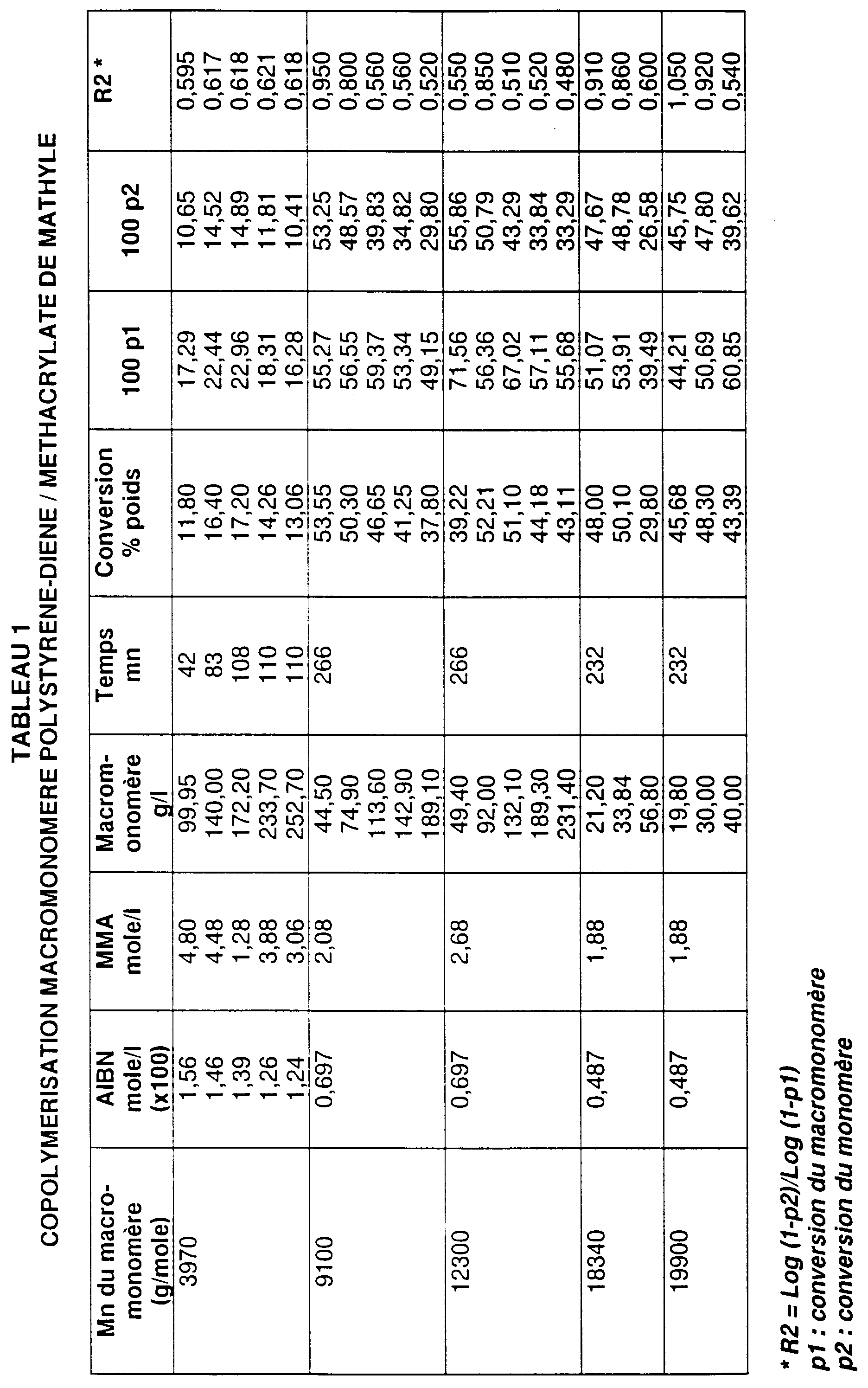
- Dans un tube de verre on introduit x moles/l d'azosobutyronitrile (AIBN), y moles/l de methacrylate de méthyle (MMA) et z g/l de macromonomère polystyrène préparé selon le procédé ci-dessus de masse moléculaire en nombre variable (Mn en g/mole).
- Le tube est scellé sous vide après désaération. La polymérisation est effectuée à 70°C pendant un temps (t) en minute.
- On effectue plusieurs essais en faisant varier x, y, z, Mn et t.
On caractérise le copolymère greffé en mesurant la conversion et R₂.
Les résultats obtenus sont rassemblés dans le tableau 1 ci-après. - R₂ représente le rapport de réactivité du macromonomère, exprimé selon R₂ =

où P₁ et P₂ représente la conversion molaire du macromonomère (2) et du macromonomère (1) dans le copolymère. Lorsque R₂ est inférieur à 1 cela signifie que le macromonomère s'incorpore préférentiellement dans le copolymère; R₂ est donc inversement proportionnel à la réactivité du macromonomère. - Le polymère greffé est isolé par précipitation dans un mélange heptane/cyclohexane (1/1) après dilution dans le THF (tétrahydrofuranne). Cette purification est effectuée deux fois. L'absence de polymère dans le filtrat de précipitation est vérifiée par GPC.
- 47 g (0,47 mole) de méthacrylate de méthyle sont polymérisé en présence de 400 mg (2,4 10⁻³ mole) d'AlBN ET 3?5 g (2,24 10⁻² mole) de 5-t butylthio 1,3-pentadiène à 70°C pendant 4 heures. Le produit de la réaction est dilué avec 150 Ml de THF et précipité dans 1,5 l d'heptane. Le produit précipité est filtré, séché à 50°C sous vide. Son poids sec est de 20 g, soit un rendement pondéral de 42,5 %.
- On reproduit le mode opératoire de l'exemple 2.2 ci-dessus. Le polymère greffé est précipité dans le méthanol contenant 10 % en volume d'acétone. L'absence de polymère greffé dans le filtrat a également été mis en évidence par GPC. Les résultats obtenus sont rassemblés dans le tableau 2 ci-après.

- On prépare le macromonomère selon le mode opératoire de l'exemple 2.1.
- La polymérisation du macromonomère polystyrène et de l'acide méthacrylique est conduite dans un mélange DMSO : Dioxane (3,2) en présence d'AlBN, à 70°C. Le polymère est précipité dans le cyclohexane puis redissous dan le solvant de polymérisation pour une deuxième purification. Les conditions de polymérisation et les résultats obtenus sont rassemblés tableau 3 ci-après.

R4 est choisi parmi un radical alkyle linéaire ou ramifié en C₁ - C₆, un radical phényle et un radical acyle dont la partie alkyle linéaire ou ramifiée est en C₁ - C₆
X est un hétéroatome choisi parmi O et S
R₅ est un radical capteur d'électrons choisi parmi un radical cyano, carbamoyle, phényloxycarbonyle, alcoxycarbonyle et phénylcarbonyle dans lequel la partie alkyle linéaire, cyclique ou ramifiée est en C₁ - C₆,
R₆ est un radical donneur d'électron choisi parmi un radical alkylthyoéther, phénylthioéther, amino, alkylamino, alcoxy et phénoxy dans lequel la partie alkyle linéaire, cyclique ou ramifiée est en C₁ - C₆
Claims (7)
1- Procédé de préparation d'un copolymère polyoléfinique greffé par un macromonomère polyoléfinique possédant à l'une de ses extrémités un groupement terminal oléfinique, caractérisé en ce que au cours d'une première étape on polymérise par polymérisation radicalaire au moins un monomère à insaturation éthylénique en présence d'une quantité efficace d'un agent de transfert diène conjugué répondant à la formule générale :

dans laquelle
. les radicaux R₁, R₂,et R₃ identiques ou différents sont choisis parmi un atome d'hydrogène, un radical alkyle linéaire ou ramifié en C₁ - C₆, un radical phényle, un radical alcoxycarbonyle, un radical acyloxy et un radical acylamino, dans lesquels la partie alkyle est linéaire ou ramifiée en C₁ - C₆, un radical phénoxycarbonyle et un radical cyano.
Le radical Y est choisi parmi les radicaux :
X est un hétéroatome choisi parmi O et S
R₅ est un radical capteur d'électrons choisi parmi un radical cyano, carbamoyle, phényloxycarbonyle, alcoxycarbonyle et phénylcarbonyle dans lequel la partie alkyle linéaire, cyclique ou ramifiée est en C₁ - C₆,
R₆ est un radical donneur d'électron choisi parmi un radical alkylthyoéther, phénylthioéther, amino, alkylamino, alcoxy et phénoxy dans lequel la partie alkyle linéaire, cyclique ou ramifiée est en C₁ - C₆
et dans une deuxième étape, on copolymèrise par polymérisation radicalaire, en présence d'une quantité efficace d'un initiateur ou amorçeur à radicaux libres un macromonomère préparé à la première étape avec au moins un monomère à insaturation éthylénique.
. les radicaux R₁, R₂,et R₃ identiques ou différents sont choisis parmi un atome d'hydrogène, un radical alkyle linéaire ou ramifié en C₁ - C₆, un radical phényle, un radical alcoxycarbonyle, un radical acyloxy et un radical acylamino, dans lesquels la partie alkyle est linéaire ou ramifiée en C₁ - C₆, un radical phénoxycarbonyle et un radical cyano.
Le radical Y est choisi parmi les radicaux :
- un halogène choisi parmi le chlore, le brome et l'iode,
- X - R4 et - C H(R5 R6) dans lesquels :
R4 est choisi parmi un radical alkyle linéaire ou ramifié en C₁ - C₆, un radical phényle et un radical acyle dont la partie alkyle linéaire ou ramifiée est en C₁ - C₆X est un hétéroatome choisi parmi O et S
R₅ est un radical capteur d'électrons choisi parmi un radical cyano, carbamoyle, phényloxycarbonyle, alcoxycarbonyle et phénylcarbonyle dans lequel la partie alkyle linéaire, cyclique ou ramifiée est en C₁ - C₆,
R₆ est un radical donneur d'électron choisi parmi un radical alkylthyoéther, phénylthioéther, amino, alkylamino, alcoxy et phénoxy dans lequel la partie alkyle linéaire, cyclique ou ramifiée est en C₁ - C₆
et dans une deuxième étape, on copolymèrise par polymérisation radicalaire, en présence d'une quantité efficace d'un initiateur ou amorçeur à radicaux libres un macromonomère préparé à la première étape avec au moins un monomère à insaturation éthylénique.
2- Procédé selon la revendication 1, caractérisé en ce que le monomère à insaturation éthylénique de la deuxième étape est choisi parmi l'un de ceux indiqués pour la synthèse du macromonomère à la première étape.
3- Procédé selon la revendication 2, caractérisé en ce que ledit monomère est choisi parmi le styrène, le butadiène, le méthacrylate de méthyle, l'acide acrylique ou leurs mélanges.
4- Procédé selon l'une quelconque des revendications précédentes caractérisé en ce que lors de la 1ére étape la conversion de monomère en macromère est inférieure à 90 %, de préférence comprise entre 30 et 85 %.
5- Procédé selon l'une quelconque des revendications précédentes, caractérisé en ce qu'on utilise de 0,1 à 60 %, de préférence de 1 à 30 % en poids de macromonomère par rapport au poids du copolymère obtenu.
6- Procédé selon l'une quelconque des revendications précédentes, caractérisé en ce que, lors de la première étape, le macromonomère est préféré par polymérisation en émulsion et que le copolymère greffé est préparé au cours de la deuxième étape par polymérisation dans un solvant organique.
7- Procédé selon l'une quelconque des revendications précédentes, caractérisé en ce que l'agent de transfert utilisé lors de la première étape est le 5-t butylthio 1,3-pentadiène.
Applications Claiming Priority (2)
| Application Number | Priority Date | Filing Date | Title |
|---|---|---|---|
| FR9406804 | 1994-06-03 | ||
| FR9406804A FR2720751B1 (fr) | 1994-06-03 | 1994-06-03 | Copolymère polyoléfinique greffe. |
Publications (1)
| Publication Number | Publication Date |
|---|---|
| EP0685501A1 true EP0685501A1 (fr) | 1995-12-06 |
Family
ID=9463851
Family Applications (1)
| Application Number | Title | Priority Date | Filing Date |
|---|---|---|---|
| EP95401293A Withdrawn EP0685501A1 (fr) | 1994-06-03 | 1995-06-02 | Copolymère polyoléfinique greffé |
Country Status (2)
| Country | Link |
|---|---|
| EP (1) | EP0685501A1 (fr) |
| FR (1) | FR2720751B1 (fr) |
Cited By (3)
| Publication number | Priority date | Publication date | Assignee | Title |
|---|---|---|---|---|
| FR2773161A1 (fr) * | 1997-12-31 | 1999-07-02 | Rhodia Chimie Sa | Procede de synthese de polymeres a blocs |
| US6608143B1 (en) | 1999-05-07 | 2003-08-19 | Sekisui Chemical Co., Ld. | Acrylic copolymer, acrylic pressure-sensitive adhesive composition, acrylic pressure-sensitive adhesive tape or sheet, and acrylic adhesive composition |
| WO2021083729A3 (fr) * | 2019-10-31 | 2021-08-12 | Agfa Nv | Précurseur de plaque d'impression lithographique |
Citations (2)
| Publication number | Priority date | Publication date | Assignee | Title |
|---|---|---|---|---|
| EP0520668A1 (fr) * | 1991-06-27 | 1992-12-30 | Rohm And Haas Company | Copolymères greffés |
| EP0597747A1 (fr) * | 1992-11-10 | 1994-05-18 | Rhone-Poulenc Chimie | Utilisation de diènes comme agent de transfert lors de la préparation de polymères |
-
1994
- 1994-06-03 FR FR9406804A patent/FR2720751B1/fr not_active Expired - Fee Related
-
1995
- 1995-06-02 EP EP95401293A patent/EP0685501A1/fr not_active Withdrawn
Patent Citations (2)
| Publication number | Priority date | Publication date | Assignee | Title |
|---|---|---|---|---|
| EP0520668A1 (fr) * | 1991-06-27 | 1992-12-30 | Rohm And Haas Company | Copolymères greffés |
| EP0597747A1 (fr) * | 1992-11-10 | 1994-05-18 | Rhone-Poulenc Chimie | Utilisation de diènes comme agent de transfert lors de la préparation de polymères |
Cited By (4)
| Publication number | Priority date | Publication date | Assignee | Title |
|---|---|---|---|---|
| FR2773161A1 (fr) * | 1997-12-31 | 1999-07-02 | Rhodia Chimie Sa | Procede de synthese de polymeres a blocs |
| US6608143B1 (en) | 1999-05-07 | 2003-08-19 | Sekisui Chemical Co., Ld. | Acrylic copolymer, acrylic pressure-sensitive adhesive composition, acrylic pressure-sensitive adhesive tape or sheet, and acrylic adhesive composition |
| EP1211269A4 (fr) * | 1999-05-07 | 2004-03-31 | Sekisui Chemical Co Ltd | Copolymere acrylique, composition d'adhesif acrylique autocollant, ruban ou feuille a adhesif acrylique autocollant, et composition acrylique adhesive |
| WO2021083729A3 (fr) * | 2019-10-31 | 2021-08-12 | Agfa Nv | Précurseur de plaque d'impression lithographique |
Also Published As
| Publication number | Publication date |
|---|---|
| FR2720751B1 (fr) | 1996-07-19 |
| FR2720751A1 (fr) | 1995-12-08 |
Similar Documents
| Publication | Publication Date | Title |
|---|---|---|
| JP3696203B2 (ja) | リビングタイプのフリーラジカル重合制御剤、重合方法、これを用いたエマルジョン及びポリマー | |
| EP1711536B1 (fr) | Procede de polymerisation radicalaire en emulsion mettant en oeuvre des alcoxyamines hydrosolubles | |
| EP0597747B1 (fr) | Utilisation de diènes comme agent de transfert lors de la préparation de polymères | |
| FR2764892A1 (fr) | Procede de synthese de polymeres a blocs | |
| EP1319027B1 (fr) | Procede de synthese de polymeres a blocs par polymerisation radicalaire controlee en presence d'un compose disulfure | |
| FR2794464A1 (fr) | Procede de synthese de polymeres a blocs par polymerisation radicalaire controlee a l'aide de thioether-thiones | |
| EP1397403A2 (fr) | Copolymeres a blocs tensioactifs prepares par polymerisation radicalaire controlee | |
| FR2781487A1 (fr) | Polymerisation en emulsion en presence d'un radical libre stable | |
| FR2812293A1 (fr) | Procede de synthese de polymeres a blocs par polymerisation radicalaire controlee | |
| EP4132990B1 (fr) | Procédé de polymérisation par voie radicalaire de thionolactones ou de thionocarbonates | |
| US6667376B2 (en) | Control agents for living-type free radical polymerization and methods of polymerizing | |
| FR2720751A1 (fr) | Copolymère polyoléfinique greffe. | |
| EP1064260A1 (fr) | Polymerisation en emulsion utilisant un compose a la fois surfactant et amorceur | |
| FR2799471A1 (fr) | Procede de preparation de polymeres greffes | |
| EP0874865A1 (fr) | Composes macromonomeres, leur preparation a partir de composes dieniques et leur utilisation | |
| EP4493614A1 (fr) | Procédé de polymérisation par voie radicalaire de thionolactides | |
| CA2439046C (fr) | Procede d'obtention de dispersions aqueuses a base de polybutadiene | |
| EP1951772A2 (fr) | Procede de polymerisation ou copolymerisation radicalaire controlee de monomeres methacryliques et/ou methacrylates pour realiser des polymeres methacryliques ou methacrylates ou des copolymeres exclusivement methacryliques et/ou methacrylates | |
| WO2025083340A1 (fr) | Copolymere thioester | |
| EP1888661A2 (fr) | Nouveau procede de preparation de copolymeres en peigne hydrosolubles | |
| WO2004078793A1 (fr) | Procede de synthese de copolymeres ramifies par polymerisation radicalaire controlee | |
| FR2816311A1 (fr) | Synthese de polymeres a blocs obtenus par polymerisation radicalaire controlee | |
| FR2829137A1 (fr) | Procede de polymerisation radicalaire realise en presence de composes disulfures | |
| FR2840613A1 (fr) | Procede de synthese de polymeres a blocs par polymerisation radicalaire controlee par de nouveaux agents de controle dithiophosphotesters |
Legal Events
| Date | Code | Title | Description |
|---|---|---|---|
| PUAI | Public reference made under article 153(3) epc to a published international application that has entered the european phase |
Free format text: ORIGINAL CODE: 0009012 |
|
| 17P | Request for examination filed |
Effective date: 19950609 |
|
| AK | Designated contracting states |
Kind code of ref document: A1 Designated state(s): AT BE CH DE DK ES FR GB GR IE IT LI LU MC NL PT SE |
|
| 17Q | First examination report despatched |
Effective date: 19961205 |
|
| RAP1 | Party data changed (applicant data changed or rights of an application transferred) |
Owner name: RHODIA CHIMIE |
|
| STAA | Information on the status of an ep patent application or granted ep patent |
Free format text: STATUS: THE APPLICATION IS DEEMED TO BE WITHDRAWN |
|
| 18D | Application deemed to be withdrawn |
Effective date: 19980122 |