EP0685802B1 - Système d'information pour la consultation d'informations centralisées en provenance d'applications opérationnelles - Google Patents
Système d'information pour la consultation d'informations centralisées en provenance d'applications opérationnelles Download PDFInfo
- Publication number
- EP0685802B1 EP0685802B1 EP95401252A EP95401252A EP0685802B1 EP 0685802 B1 EP0685802 B1 EP 0685802B1 EP 95401252 A EP95401252 A EP 95401252A EP 95401252 A EP95401252 A EP 95401252A EP 0685802 B1 EP0685802 B1 EP 0685802B1
- Authority
- EP
- European Patent Office
- Prior art keywords
- data
- axes
- indicators
- information
- domains
- Prior art date
- Legal status (The legal status is an assumption and is not a legal conclusion. Google has not performed a legal analysis and makes no representation as to the accuracy of the status listed.)
- Expired - Lifetime
Links
Classifications
-
- G—PHYSICS
- G06—COMPUTING OR CALCULATING; COUNTING
- G06F—ELECTRIC DIGITAL DATA PROCESSING
- G06F16/00—Information retrieval; Database structures therefor; File system structures therefor
- G06F16/20—Information retrieval; Database structures therefor; File system structures therefor of structured data, e.g. relational data
-
- Y—GENERAL TAGGING OF NEW TECHNOLOGICAL DEVELOPMENTS; GENERAL TAGGING OF CROSS-SECTIONAL TECHNOLOGIES SPANNING OVER SEVERAL SECTIONS OF THE IPC; TECHNICAL SUBJECTS COVERED BY FORMER USPC CROSS-REFERENCE ART COLLECTIONS [XRACs] AND DIGESTS
- Y10—TECHNICAL SUBJECTS COVERED BY FORMER USPC
- Y10S—TECHNICAL SUBJECTS COVERED BY FORMER USPC CROSS-REFERENCE ART COLLECTIONS [XRACs] AND DIGESTS
- Y10S707/00—Data processing: database and file management or data structures
- Y10S707/99931—Database or file accessing
Definitions
- the present invention relates to an information system for consultation centralized information from operational applications, composed of a server and a plurality of microcomputers transmitting requests to the server which includes data stored on the one hand form of files and on the other hand a metadictionary developed around a plurality of tables specific to the documentation and administration of the system.
- a server also called database
- microcomputers sending requests to the server, each microcomputer with an interface for user consultation graphic also called graphic front end.
- the server or database can be defined as an integrated set of data modeling a universe determined and to avoid duplication issues, the data used by the various applications are therefore grouped in this same server.
- server or database contains real world objects and associations between these objects. For reasons of simplicity of representation data and in order to allow better productivity of developers and users the relational data model is commonly used because it allows tabular representation of both objects and associations between objects.
- a relational database looks like a set of relationships hence the name of the model, these relationships also being called tables.
- the server is usually divided into two parts: the data and the metadictionary also called meta-base or data dictionary.
- the data part is physically stored in the database as files.
- the metadictionary part developed around a plurality of tables specific to documentation and system administration dynamically describes the database, its contents reflecting an image of the basis at all times.
- the metadictionary allows to describe in particular basic objects, system users, privileges and rights of users on different objects. Therefore the content of the metadictionary constitutes a set of information which evolves with the use of the database data. So any operation that affects the structure of the database automatically causes the dictionary to update. such a description of all the objects managed in the metadictionary makes it possible to integrated manipulation using the same language, usually SQL, too much data than their structures.
- Document US 4,774,661 discloses a database management system. data with an active, accessible and modifiable data dictionary by the user, like the one described above. This dictionary has been added for solve the problem related to the fact that the data stored by the system under a format and a form dictated by the architecture of the system, are accessible only by querying the system in a manner consistent with this form and this data format.
- the object of the present invention is to remedy the aforementioned drawbacks and offers an information system that allows rapid integration of applications, which authorizes a structuring data analysis and presents for the user great ease and comfort of use.
- the information system for the consultation of information centralized from operational applications mentioned in the preamble is remarkable in that the data is organized into domains, sub-domains and functions and are analyzed according to a process logic contained in the metadictionary materialized by means of axes and indicators describing the applications, a process which allows definition of the data to be imported into the server, to create, in addition to the tables containing the data, additional so-called consolidation tables for authorize a generic response to all requests made on data, and optimize access performance.
- the data organized into domains, sub-domains and functions are loaded into the database on which the user has, from his interrogation station, a functional view at through a metadictionary which describes the applications and allows a consolidation in terms of axes and indicators and which has a character of high genericity.
- Access to consultation by areas and sub-areas allows the user to be guided to the level corresponding to the desired data.
- the axes make it possible to analyze quantities according to predetermined criteria and indicators are the measurable values at which the user is interested.
- the selection of axes and indicators allows the composition automatic requests called in this case personal requests, requests which can be cataloged and recalled at any time, just like common queries offered from the outset to the user.
- the concept axes and indicators allows, in a simple way, to build queries translating to better the desired questions asked.
- This dynamic system is capable, in according to the choice of the user and thanks to the metadictionary to find, directly address the optimal consolidation table.
- the metadictionary which configures and governs the behavior of the database and of the user of this database.
- the tables of consolidation are deduced and created from the metadictionary. It is easy to describe an application and when it is desired to integrate a new application, the latter is attached to predetermined domains and sub-domains, then just describe it in terms of axes, indicators and preconsolidation levels so that it is automatically taken into account by the system.
- the tables corresponding to the application are built and the server (or the base) is enriched with these tables thanks to the metadictionary by defining axes and indicators.
- the metadictionary is an engine for configuration of the server and for query optimization and offers a character of multidimensionality.
- the application is then seen, via the interface graphic, according to all its dimensions. It is, furthermore, presented a high level of "security” because the user sees his access rights administered from very rigorously up to the level of the value of an indicator.
- the knowledge of data structure and SQL language are not necessary for the latter to use the graphical interface. The requests are considerably easier to formulate and access performance significantly optimized.
- remarkably one axis corresponds to an analysis dimension for a function, each axis being divided into levels allowing to obtain a desired mesh of information, while a indicator is the measure of the mesh of information defined after the choice of axes and levels, the chosen indicator then being analyzed along the axes predefined, its content representing the measurement of the information required.
- the metadictionary includes, the tables specific to each application, general information concerning management domains and sub-domains as well as the management of axes and indicators, information related to the loading and transfer of applications, the elements necessary for the automatic construction of consultation requests, user management and user rights.
- each microcomputer there is presented a unique graphical interface for interrogation by the user who automatically adapts to any type of data seen at through the metadictionary and therefore to the chosen function by presenting the axes and accessible indicator (s), the metadictionary providing the interface between a query expressed in terms of domains, subdomains, axes, levels and indicators and all the data contained in the server.
- each user can, thanks to the invention, access information necessary for piloting in its field of activity.
- Data is reliable because extracted directly from operating systems, any application can be easily integrated into such a system.
- dashboards for example made with Excel, trademark registered by Microsoft Corporation
- the user thus accesses all the functionalities present in the system from the same presentation screens.
- the user is guided in permanence, all selections and orders being made via the interface graphic, it has global and contextual online help at all times.
- the graphical interface can be compared to an intelligent graphical front end for the different applications managed by different databases.
- the information system according to the invention is remarkable in that it allows to build dynamically a common minimum axis by union of at least two axes after comparison and detection of equivalence of levels of at least two axes thus authorizing transversal interrogations across domains different for the analysis of different indicators in relation to the different axes common to said different indicators chosen themselves belonging to said different areas.
- the information system aims to offer a global vision of the different essential parameters to be able to effectively manage a plurality operational applications.
- These essential parameters are indicators which can be analyzed along multi-level axes and are classified by sub-domains functional themselves grouped into domains.
- Each user authorized to connect has a certain profile which determines the visible indicators as well as the axes or portions of axes in analysis.
- Access to the server supporting data and processing is possible at from "client" PC-type microcomputers on which software application has been loaded.
- Microcomputers must be connected to a network which constitutes the physical link to access the server.
- the world in which is used the information system consists of a set of objects homogeneous organized in classes and able to offer transverse views along of common axes.
- the data allowing the construction of the indicators are supported by dedicated applications, themselves managed by users with the knowledge of said applications. These various applications are in general heterogeneous (data, format, system, platform, ...) and therefore does not can, in general, be consolidated or juxtaposed between they. Indeed, the world of operational applications is populated high performance applications, each in its own field, but not cooperatives with each other. Each of them nevertheless constitutes the reference for the data it has to bear.
- the treatments carried out inside the system information can be classified into a number of phases.
- a first phase consists of extracting indicators and axes.
- the host machine operational application support is the place of processing and support database data for this application are input data.
- Processing consists in presenting the data selected for the information system in the form of indicators and axes. It’s essentially an aggregation and consolidation process, sometimes more complex treatments when indicators are concerned calculated from other data in the database.
- Several levels are presented According to the case.
- the output data is stored in a text file in a format specific to the information system and common to all applications entering the information system.
- a second phase consists in the transfer of the result file in the machine information system host (which is actually the server) whose data input come from a text file specific to the indicators and axes of the host machine.
- the treatment is carried out by the reception machine which, depending a calendar specific to each application, takes the initiative to repatriate the file provided that it is available and deemed valid. This transfer is automatic, but the IT administrator must be able to have a manual procedure for special cases.
- Data from output are stored in a text file relating to indicators and axes on the host machine.
- a third phase consists in verifying the result file in the information system host machine.
- the input data is on the host machine in the text file specific to indicators and axes and contain the verification criteria in the database or metadictionary, the processing therefore consisting of data verification incoming.
- the output data concerns the file thus verified, the account report of this verification, the rejection log and the update of the metadictionary.
- the fourth phase relates to loading into the server.
- the data input are in the text file specific to indicators and axes and relate to tables in their last state.
- the axes and the table consolidation are loaded and external identifiers are translated into internal identifiers.
- the output data concerns the updated tables, the loading report, release log and update metadictionary.
- the fifth phase consists of "historization” (storage and updating of information) in the server.
- the loaded base tables and the historization parameters in the metadictionary form the data entry.
- the data output include the historical table, the history report, the log of anomalies, deletions and archiving and updating the metadictionary.
- the sixth phase concerns calculations and preconsolidations in the server.
- the historical base table and the calculation and / or preconsolidation parameters constitute the input data whereas the processing in this phase is relating to the calculation of secondary indicators and multilevel consolidations.
- the output data concerns the basic table supplemented by the indicators calculated, the preconsolidation tables, the metadictionary update, the consolidation report and anomalies log.
- the seventh phase relates to the connection to the information system, consequently connection of the different microcomputers (clients) and the server.
- User name and password, user table and rights relating to said users as well as the metadictionary form the input data.
- the treatment consists of finding the name and verification of the user's password as well as the selection of indicators and user profile.
- the output data relates to the account connection rendering, list of authorized indicators, user profile and recording in the "logbook" file.
- the eighth and last phase is specific to the making of the request interrogation from a microcomputer to the server.
- the input data are constituted by the list of indicators and levels on the axes as well as by the metadictionary and the processing consists in searching for identifiers specific to the axes and indicators as well as to the search for the optimal consolidation.
- the output data concerns the name of the table optimal consolidation.
- the server comprises on the one hand the basic data supporting the information intended to be analyzed and secondly the metadictionary.
- this information system allows the consultation of centralized information from applications operational. However it also allows access to applications specialized, powered by operational applications. It is from data contained in host application files that it is possible to feed the indicators and the axes and to allow a consultation standardized information and reconciliation between certain information from various applications.
- the information is contained in a single physical file called an input file.
- This file consists of a file header and concatenation of several blocks separated by a line starting with a predetermined character, for example, "-----".
- the header lines all begin with the character "*".
- Each block has a section reserved for a block header listing the information contained in the block and presenting any comments.
- the rest of the block contains the data records in the form indicated in the file header.
- a block can only contain one type of record.
- it is planned in the information system at least one block per indicator and so general one block per axis.
- the input file will have, for example the following general structure:
- the data contained in the blocks which are provided by the applications sources consist of several types of information: information loading generics, axis descriptions and descriptors of indicators by axis.
- the descriptions of the axes and indicators are made in the blocks. Two types of blocks are therefore used: the blocks describing the axes and the blocks describing the indicators.
- the data files communicated to the information system must give both the value of the information and the links between them. When a user searches for a information, it can do this according to one or more levels of an axis and by function of several axes. For this, for each level of an axis there must be a identifier uniquely defining the occurrence of said level, this identifier cannot be modified during the entire lifetime of the occurrence in the source application.
- the data provided is as close as possible data contained in the metadictionary to facilitate consolidation.
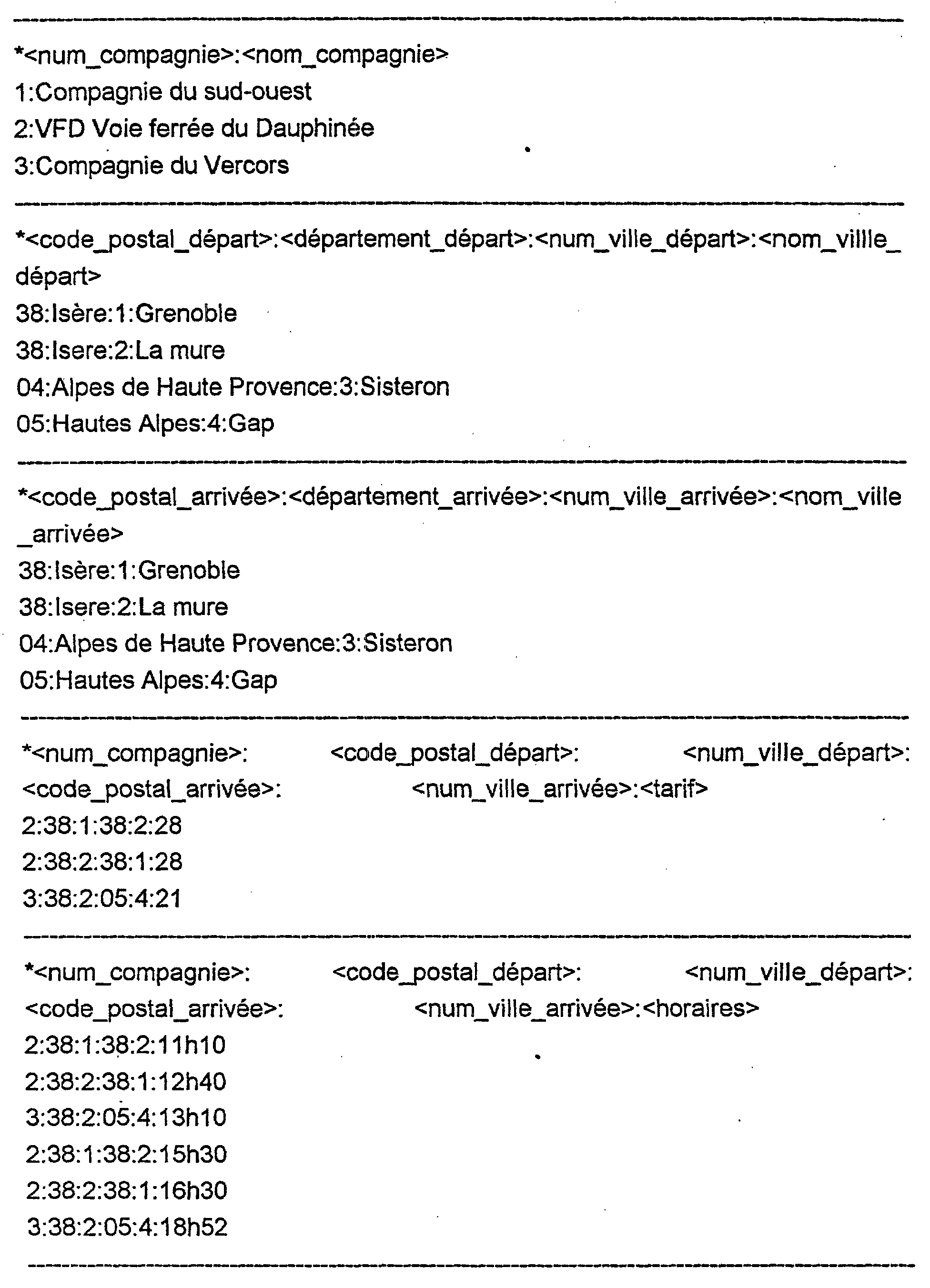
- the application concerns road connections by coach between cities of several departments as well as the prices of these links.
- the needs analysis shows two indicators which are timetables and prices and three axes which are the departure axis, the arrival axis and the company axis.
- the starting axis can, for example, be broken down into two levels, the department level and the city level; the arrival axis can also break down into two identical levels; department level and level city and finally the company axis has, for example, only one level, the name of the company.
- the input file looks like this: Description block of the axis "company” ⁇ company_name>: ⁇ company_name> Description block of the "departure” axis ⁇ departure_postal_code>: ⁇ departure_department>: ⁇ departure_ville_number>: ⁇ departure_ville_name> Description block of the "arrival" axis ⁇ arrival_postal_code>: ⁇ arrival_department>: ⁇ arrival_ville_number>: ⁇ arrival_ville_name> Description block of the "tariff" indicator ⁇ company_num>: ⁇ departure_postal_code>: ⁇ departure_number> :: ⁇ arrival_postal_code>: ⁇ arrival_number_ville>: ⁇ tariff> Descriptive block of the "hours" indicator ⁇ company_num>: ⁇ departure_postal_code>: ⁇ departure_number>: ⁇ departure_number
- the information system server constitutes a logical basis comprising a plurality of applications grouped into domains.
- Each domain is represented as a set of axes and indicators.
- Each host applications is therefore translated in terms of axes and indicators and disappears from the consultation level thus ensuring total independence relative to the application.
- the metadictionary meanwhile includes the logical definition of each of the areas determined, the definition of users and their rights based on said metadictionary.
Landscapes
- Engineering & Computer Science (AREA)
- Theoretical Computer Science (AREA)
- Data Mining & Analysis (AREA)
- Databases & Information Systems (AREA)
- Physics & Mathematics (AREA)
- General Engineering & Computer Science (AREA)
- General Physics & Mathematics (AREA)
- Information Retrieval, Db Structures And Fs Structures Therefor (AREA)
Description
- identification du système opérant ou de la base opérationnelle amont avec prise de connaissance de l'administrateur et des droits des utilisateurs,
- identification des besoins et du type de requête des utilisateurs du système opérant,
- détermination des domaines, sous-domaines, axes (chaque niveau d'axe représentant la maille de l'information désirée à analyser), indicateurs (mesure de la maille) et des règles de consolidation,
- préparation du serveur
- tables réceptrices des données amont du système opérant,
- enrichissement du métadictionnaire relativement au profil de l'utilisateur (droits d'accès) et à la définition des axes et des indicateurs,
- construction des tables de consolidation selon les règles de consolidation.
- apport d'une grande généricité, tout développement est réutilisable ou paramétrable, et rendu totalement indépendant de l'application opérationnelle source, une fois les paramètres chargés,
- construction des indicateurs et des axes le plus en amont possible,
- fourniture des indicateurs et des axes à partir de fichiers d'entrée construits sur le même schéma et "auto-décrits",
- conception du système d'information telle qu'elle permet d'aller chercher les informations sur le site central, tout en préservant d'une part les performances et en évitant d'autre part tout changement de la partie "client" sur un micro-ordinateur.
- les données liées à la sécurité autorisant le contrôle de l'accès aux données propres à l'application,
- le métadictionnaire contenant la description des données manipulées ainsi que les liens entre elles, métadictionnaire qui est la base du mécanisme de généricité,
- les données propres à l'application, support des indicateurs et des axes,
- les noms des tables et des champs doivent être aussi explicites que possible tout en gardant une longueur raisonnable,
- des noms juxtaposés utilisés pour une désignation doivent être séparés par un caractère de soulignement (appelé "underscore" par l'homme du métier),
- les noms des attributs désignant la même propriété, pour les diverses entités, doivent être identiques,
- toute entité du métadictionnaire doit posséder un identifiant unique interne de nature numérique pour accélérer les jointures (rapprochements entre des données se trouvant dans des tables différentes), tous les identifiants commençant par une même séquence de caractères.
- les axes qui sont des objets hiérarchisés représentant les points de vue selon lesquels il est désiré analyser les indicateurs,
- les tables de consolidation qui supportent les valeurs d'un ou plusieurs indicateurs selon un ou plusieurs axes.
- une partie "racine" identifiant l'application d'origine,
- une partie "suffixe" composée d'un caractère de soulignement ("underscore") et d'un nombre repérant le niveau de consolidation, la table de base comportant les niveaux les plus fins ayant pour suffixe "_0", pour les autres tables le nombre du suffixe est incrémenté en fonction du niveau de consolidation.
- - une table par axe : T_AXE.....
- IDLEV: identifiant de l'élément de niveau de l'axe
- NOM: désignation de l'élément de niveau de l'axe
- LEVEL niveau hiérarchique
- IDLEVH identifiant de l'élément de rattachement
- FLAGV validité du niveau
- n tables de consolidation RACINE_X:
- VALIND1: valeur indicateur 1
- VALIND2: valeur indicateur 2
................. - IDLEV_AXE1: identifiant de l'élément de niveau de l'axe 1
- IDLEV_AXE2: identifiant de l'élément de niveau de l'axe 2
- la table des applications opérationnelles TAB_APPLIS:
- IDAPPLI: identifiant de l'application
- NOM: désignation de l'application
- IDSUBDOMAIN: identifiant du sous-domaine de rattachement
- HOST: machine support de l'application (Nom IP)
- FIC_INPUT: nom du fichier d'entrée sur le système hôte
- FIC_CHAR: nom du fichier d'entrée sur le système de chargement /consolidation
- CALENDAR: calendrier de récupération des données
- IDADMIN: identifiant de l'admistrateur pour le système d'information
- IDCHAR_V: identifiant du chargement valide dans le métadictionnaire
- IDTR_V: identifiant du transfert valide dans le métadictionnaire
- FLAGV: drapeau de validité
- la table de gestion des transferts TAB_TRANS:
- IDTR: identifiant du transfert
- IDAPPLI: identifiant de l'application
- DATE_TR: date d'exécution du transfert
- VER_TR: version du transfert (pour plusieurs tentatives)
- STATUS: état du transfert (impossible, en cours, OK,NOK,..)
- CR_TR: compte rendu sommaire du transfert
- FIC_CR: nom du fichier de compte rendu
- la table de gestion des chargements :
- IDCHAR: identifiant du chargement
- IDAPPLI: identifiant de l'application
- DATE_CHAR: date d'exécution du chargement
- VER_CHAR: version du chargement (pour plusieurs tentatives)
- DATE_DON: date des données chargées
- VER_DON: version des données chargées
- STATUS: état du chargement (impossible, en cours, OK, NOK,..)
- CR_CHAR: compte rendu sommaire de chargement
- FIC_CR: nom du fichier de compte rendu
- la table de description des indicateurs TABIND
- IDIND: identifiant de l'indicateur
- CODIND: code de l'identificateur pour l'application
- NOM: désignation de l'indicateur
- IDAPPLI: identifiant de l'application de rattachement
- UNITE: unité
- TYP_DATA: type de données (alpha, numérique, date,...)
- FORMAT: format de la donnée (fonction du type)
- SEUIL_H: valeur seuil haut
- SEUIL_B: valeur seuil bas
- TYPIND: type d'indicateur (primaire, calculé, transverse)
- TYP_CUMUL: fonction à utiliser pour la consolidation
- TAB_RACINE: racine du nom de la table contenant la donnée
- CHAMP: nom du champ de la table support contenant la valeur
- TYP_HISTO type "d'historisation"
- FLAGV: drapeau de validité
- la table des tables consolidées TAB_CONSO :
- IDIND: identifiant de l'indicateur
- IDAXE: identifiant de l'axe
- LEV_MIN: niveau le plus fin de l'axe accessible
- SUFF: suffixe de consolidation à utiliser
- la table des liens Indicateurs/Axes IND_AXE:
- IDIND: identifiant de l'indicateur
- IDAXE identifiant de l'axe
- FLAGV: drapeau de validité
- la table des axes TAB_AXE:
- IDAXE: identifiant de l'axe
- NOM: désignation de l'axe
- NB_NIV: nombre de niveaux
- TAB_NOM: nom de la table support
- FLAGV: drapeau de validité
- TYPE_AXE: type d'axe (direct/traduit)
- FLAGV: drapeau de validité
- la table des tables de traduction d'axe:
- IDAXE_ORG: identifiant de l'axe source
- IDAXE_DEST: identifiant de l'axe destination
- TAB_TR: table de traduction
- FLAGV: drapeau de validité
- les tables de traduction TR_XXX_YYY:
- IDLEV_ORG: identifiant de l'item niveau source
- IDLEV_DEST: identifiant de l'item niveau destination
- la table des utilisateurs autorisés : WHOSWHO comportant les champs
suivants :
- NOM PRENOM : caractères majuscules
- IDPERS: identifiant utilisateur
- IDORG: identifiant de l'item d'organisation de rattachement
- TEL: téléphone
- MAIL: messagerie
- CLE: mot de passe crypté (longueur fonction du "process" de cryptage)
- DATECLE: date du changement de clé
- EDA_HOST: nom du serveur de données
- EDA_LOGIN: login d'accès au serveur EDA
- EDA-PASSWD: mot de passe accès serveur EDA
- EDA PROFILE: profil EDA de rattachement de l'utilisateur
- IDMETIER: identifiant du métier de rattachement
- FLAGV: drapeau de validité de l'entrée dans la table (1: Valide;0 périmé)
- la table des domaines DOMAIN:
- IDDOMAIN: identifiant du domaine
- NOM: désignation du domaine
- FLAGV: drapeau de validité de l'entrée dans la table (1: Valide;0 périmé)
- la table des sous-domaines ou fonctions SUBDOMAIN:
- IDSUBDOMAIN: identifiant du sous-domaine
- NOM: désignation du sous-domaine
- IDDOMAIN: identifiant du domaine de rattachement
- FLAGV: drapeau de validité de l'entrée dans la table (1: Valide;0 périmé)
- la table utilisateur/indicateurs accessibles : IND_USER:
- IDIND: identifiant de l'indicateur
- IDPERS: identifiant de l'utilisateur
- la table utilisateur/axes autorisés : AXE_USER:
- IDPERS identifiant de l'utilisateur
- IDAXE: identifiant de l'axe
- LEVMAX: niveau maxi de l'axe autorisé
- IDLISTAUT: identifiant de la liste des valeurs autorisées sur le niveau maxi
- la table LISTAUT contenant les listes d'autorisation sur les niveaux des
axes :
- IDLISTAUT: identifiant de la liste des valeurs autorisées sur le niveau maxi
- IDLEVAXE: identifiant du niveau autorisé
- scrutation quotidienne de la table des applications pour déterminer, à partir des informations CALENDAR, les applications dont il faut déclencher le transfert,
- transfert du fichier FIC-INPUT de la machine HOST dans FIC_CHAR avec gestion du STATUS, des comptes rendus CR_TR et FIC_TR, de DATE_TR et VER_TR,
- pendant le processus de transfert consultation uniquement par l'administrateur dédié IDADMIN,
- rangement du IDTR réussi dans IDTR_V de TAB_APPLIS.
- analyse de l'en-tête du fichier transféré; création IDCHAR dans TAB_CHAR avec mise à jour DATE_CHAR, VER_CHAR, DATE_DON, VER_DON.
- lecture de la description actuelle de l'application dans le métadictionnaire en terme d'indicateurs et d'axes à partir de TABIND et TAB_AXE (jointure IDAPPLI). Vérification avec les données du fichier entrant.


- le format du fichier (fichier de type enregistrement de format fixe ou fichier de type enregistrement de taille variable avec séparateur),
- le caractère séparateur,
- le type de fichier (données ou traitement d'anomalies),
- la personne ou le service à contacter en cas de problème,
- le type de machine ou de système origine,
- la période de validité des données.
informations diverses
- Personne ou service à contacter en cas de problème
- type de machine ou système Origine
- période de validité des données
Commentaire libre limité à un certain nombre de caractères et terminé par ".". Ce commentaire correspond au message qui sera affiché lorsque l'utilisateur accédera aux données de l'application courante.
Bloc descriptif de l'axe "compagnie"
<num_compagnie>:<nom_compagnie>
Bloc descriptif de l'axe "départ"
<code_postal_départ>:<département_départ>:<num_ville_départ>:<nom_villle_ départ>
Bloc descriptif de l'axe "arrivée"
<code_postal_arrivée>:<département_arrivée>:<num_ville_arrivée>:<nom_ville _arrivée>
Bloc descriptif de l'indicateur "tarif"
<num_compagnie>: <code_postal_départ>: <num_ville_départ>::
<code_postal_arrivée>: <num_ville_arrivée>:<tarif>
Bloc descriptif de l'indicateur "horaires"
<num_compagnie>: <code_postal_départ>: <num_ville_départ>::
<code_postal_arrivée>: <num_ville_arrivée>:<horaires>
- VARIABLE (:) DATA
- DATE 31-12-1992
- TRANSFERT 01-01-1993
- VALIDE (01-12-92 / 30-09-1992)
- FROM (Mr DUPONT Tel 227-7777)
- COMMENT une nouvelle liaison existe : Grenoble-> Seyssinet ;
Claims (6)
- Système d'information pour la consultation d'informations centralisées en provenance d'applications opérationnelles, composé d'un serveur et d'une pluralité de micro-ordinateurs émettant des requêtes vers le serveur qui comporte d'une part des données stockées sous forme de fichiers et d'autre part un métadictionnaire élaboré autour d'une pluralité de tables propres à la documentation et à l'administration du système, caractérisé en ce que les données sont organisées en domaines, sous domaines et fonctions et en ce qu'elles sont analysées selon un processus logique contenu dans le métadictionnaire matérialisé au moyen d'axes et d'indicateurs, un axe étant découpé en niveaux, la définition d'axes et de niveaux sur les axes permettant d'obtenir un ensemble de données, un indicateur représentant une mesure regroupant des données du même type parmi l'ensemble de données, le processus permettant au moment de la définition des données à importer dans le serveur, de créer, en plus des tables contenant les données, des tables complémentaires dites de consolidation pour autoriser une réponse générique à l'ensemble des requêtes effectuées sur les données et optimiser les performances d'accès.
- Système d'information selon la revendication 1, caractérisé en ce que le métadictionnaire comprend les tables propres à chaque application, les informations générales concernant la gestion des domaines et des sous-domaines ainsi que la gestion des axes et des indicateurs, les informations liées au chargement et au transfert des applications, les éléments nécessaires à la construction automatique des requêtes de consultation, la gestion des utilisateurs et des droits des utilisateurs.
- Système d'information selon la revendication 2, caractérisé en ce que sur chaque micro-ordinateur, il est présenté une interface graphique unique pour l'interrogation par l'utilisateur qui s'adapte automatiquement à tout type de données vues au travers du métadictionnaire et donc à la fonction choisie en présentant les axes et les indicateur(s) accessibles, le métadictionnaire assurant l'interface entre une requête exprimée en terme de domaines, sous-domaines, axes, niveaux et indicateurs et l'ensemble des données contenues dans le seveur.
- Système d'information selon la revendication 3, dans lequel un axe minimal commun est construit dynamiquement par union d'au moins deux axes après comparaison et détection d'équivalence de niveaux des au moins deux axes autorisant ainsi des interrogations transversales au travers de domaines différents pour l'analyse de différents indicateurs par rapport aux différents axes communs auxdits différents indicateurs choisis eux-mêmes appartenant auxdits domaines différents.
- Système d'information selon la revendication 4 dans lequel, pour chaque application les informations sont contenues dans un seul fichier physique se composant d'un en-tête et de la concaténation de plusieurs blocs séparés par une ligne commençant par un caractère prédéterminé, les lignes d'en-tête commençant toutes par un second caractère prédéterminé, chaque bloc comportant une partie réservée à un en-tête de bloc listant les informations contenues dans ledit bloc et présentant des commentaires éventuels, le reste du bloc contenant les enregistrements de données sous une forme indiquée en en-tête de fichier, un seul type d'enregistrement étant contenu dans un même bloc, alors qu'il est prévu, dans le système d'information, au moins un bloc par indicateur et un bloc par axe.
- Procédé d'intégration d'une application opérationnelle dans un système d'information selon les revendications précédentes caractérisé par les étapes suivantes :identification du système opérant ou de la base opérationnelle amont avec prise de connaissance de l'administrateur et des droits des utilisateurs,identification des besoins et du type de requête des utilisateurs du système opérant,détermination des domaines, sous-domaines, axes, indicateurs et des règles de consolidation,préparation du serveurtables réceptrices des données amont du système opérant,enrichissement du métadictionnaire relativement au profil de l'utilisateur et à la définition des axes et des indicateurs,construction des tables de consolidation selon les règles de consolidation.
Applications Claiming Priority (2)
| Application Number | Priority Date | Filing Date | Title |
|---|---|---|---|
| FR9406738 | 1994-06-02 | ||
| FR9406738A FR2720846B1 (fr) | 1994-06-02 | 1994-06-02 | Système d'information pour la consultation d'informations centralisées en provenance d'applications opérationnelles. |
Publications (2)
| Publication Number | Publication Date |
|---|---|
| EP0685802A1 EP0685802A1 (fr) | 1995-12-06 |
| EP0685802B1 true EP0685802B1 (fr) | 2001-09-26 |
Family
ID=9463792
Family Applications (1)
| Application Number | Title | Priority Date | Filing Date |
|---|---|---|---|
| EP95401252A Expired - Lifetime EP0685802B1 (fr) | 1994-06-02 | 1995-05-30 | Système d'information pour la consultation d'informations centralisées en provenance d'applications opérationnelles |
Country Status (4)
| Country | Link |
|---|---|
| US (1) | US5706475A (fr) |
| EP (1) | EP0685802B1 (fr) |
| DE (1) | DE69522855T2 (fr) |
| FR (1) | FR2720846B1 (fr) |
Families Citing this family (6)
| Publication number | Priority date | Publication date | Assignee | Title |
|---|---|---|---|---|
| JPH103421A (ja) * | 1995-11-20 | 1998-01-06 | Matsushita Electric Ind Co Ltd | 仮想ファイル管理システム |
| DE60040846D1 (de) * | 1999-02-26 | 2009-01-02 | Henry Haugland | Massenerzeugung individualer virtueller servern, vertueller webseiten sowie virtueller webobjekten |
| FR2805628B1 (fr) * | 2000-02-24 | 2003-09-12 | Bull Sa | Procede d'administration deleguee des donnees d'un annuaire d'entreprise |
| JP2005525630A (ja) * | 2002-04-19 | 2005-08-25 | コンピューター アソシエイツ シンク,インク. | 推論サービスを提供するためのシステム及び方法 |
| US20080005667A1 (en) * | 2006-06-28 | 2008-01-03 | Dias Daniel M | Method and apparatus for creating and editing electronic documents |
| US8041725B2 (en) * | 2008-06-25 | 2011-10-18 | International Business Machines Corporation | Eliminating duplicate and invalid calendar items from end user calendars using a unique entry identifier (UEID) |
Family Cites Families (4)
| Publication number | Priority date | Publication date | Assignee | Title |
|---|---|---|---|---|
| US4774661A (en) * | 1985-11-19 | 1988-09-27 | American Telephone And Telegraph Company, At&T Information Systems | Database management system with active data dictionary |
| US5448726A (en) * | 1989-10-23 | 1995-09-05 | International Business Machines Corporation | Data base management system with data dictionary cache including a single loadable object descriptor |
| US5555409A (en) * | 1990-12-04 | 1996-09-10 | Applied Technical Sysytem, Inc. | Data management systems and methods including creation of composite views of data |
| US5555403A (en) * | 1991-11-27 | 1996-09-10 | Business Objects, S.A. | Relational database access system using semantically dynamic objects |
-
1994
- 1994-06-02 FR FR9406738A patent/FR2720846B1/fr not_active Expired - Fee Related
-
1995
- 1995-05-30 DE DE69522855T patent/DE69522855T2/de not_active Expired - Lifetime
- 1995-05-30 EP EP95401252A patent/EP0685802B1/fr not_active Expired - Lifetime
- 1995-06-02 US US08/460,810 patent/US5706475A/en not_active Expired - Lifetime
Also Published As
| Publication number | Publication date |
|---|---|
| US5706475A (en) | 1998-01-06 |
| DE69522855D1 (de) | 2001-10-31 |
| FR2720846B1 (fr) | 1996-07-26 |
| DE69522855T2 (de) | 2002-07-04 |
| EP0685802A1 (fr) | 1995-12-06 |
| FR2720846A1 (fr) | 1995-12-08 |
Similar Documents
| Publication | Publication Date | Title |
|---|---|---|
| US12367337B2 (en) | Methods and systems for shared language framework to maximize composability of software, translativity of information, and end-user independence | |
| US9602585B2 (en) | Systems and methods for retrieving data | |
| US8572043B2 (en) | Method and system for storage of unstructured data for electronic discovery in external data stores | |
| US7225195B2 (en) | Method for a dynamic information messaging system | |
| EP2153329B1 (fr) | Procédé et dispositif de gestion, de traitement et de contrôle de paramètres utilisés à bord d'aéronefs | |
| EP4453758A1 (fr) | Procédés et systèmes pour structure de langage partagé pour la composabilité de la traduction logicielle d'informations | |
| CN113094385A (zh) | 一种基于软件定义开放工具集的数据共享融合平台及方法 | |
| US11164350B2 (en) | Ontology-backed automatic chart creation | |
| US20130232106A1 (en) | System and Method For Applying An Update To A Database | |
| US20250131361A1 (en) | System and method for data extraction, evaluation and assessment | |
| EP0685802B1 (fr) | Système d'information pour la consultation d'informations centralisées en provenance d'applications opérationnelles | |
| CA2919696A1 (fr) | Outil de decouverte legale | |
| US11100045B2 (en) | Legal discovery tool implemented in a mobile device | |
| US20140258927A1 (en) | Interactive graphical document insight element | |
| FR2931272A1 (fr) | Procede d'import export de donnees d'une base de donnees | |
| Tody et al. | Simple spectral access protocol version 1.1 | |
| US20140025369A1 (en) | System and method for phrase matching with arbitrary text | |
| US9633030B2 (en) | Data analysis and reporting tool | |
| Bell et al. | Snowflake Essentials | |
| Thomson | Archivematica Overview Demo, 03 December 2020 DIP | |
| KR20030060202A (ko) | 트리형 분류체계를 사용하고 있는 다수의 문서관리 및지식관리시스템을 통합하는 통합운영시스템 | |
| Book | Consultative Committee for Space Data Systems | |
| CA2484156C (fr) | Systeme de gestion d'informations integrees dans un protocole | |
| CN119013665A (zh) | 使用分解的流式传输数据来构建车辆阴影 | |
| WO2003094085A1 (fr) | Systeme de gestion d'informations |
Legal Events
| Date | Code | Title | Description |
|---|---|---|---|
| PUAI | Public reference made under article 153(3) epc to a published international application that has entered the european phase |
Free format text: ORIGINAL CODE: 0009012 |
|
| AK | Designated contracting states |
Kind code of ref document: A1 Designated state(s): CH DE ES FR GB IE IT LI NL |
|
| 17P | Request for examination filed |
Effective date: 19960607 |
|
| 17Q | First examination report despatched |
Effective date: 20000308 |
|
| GRAG | Despatch of communication of intention to grant |
Free format text: ORIGINAL CODE: EPIDOS AGRA |
|
| GRAG | Despatch of communication of intention to grant |
Free format text: ORIGINAL CODE: EPIDOS AGRA |
|
| GRAH | Despatch of communication of intention to grant a patent |
Free format text: ORIGINAL CODE: EPIDOS IGRA |
|
| RAP1 | Party data changed (applicant data changed or rights of an application transferred) |
Owner name: BULL S.A. |
|
| GRAH | Despatch of communication of intention to grant a patent |
Free format text: ORIGINAL CODE: EPIDOS IGRA |
|
| GRAA | (expected) grant |
Free format text: ORIGINAL CODE: 0009210 |
|
| AK | Designated contracting states |
Kind code of ref document: B1 Designated state(s): CH DE ES FR GB IE IT LI NL |
|
| PG25 | Lapsed in a contracting state [announced via postgrant information from national office to epo] |
Ref country code: NL Free format text: LAPSE BECAUSE OF FAILURE TO SUBMIT A TRANSLATION OF THE DESCRIPTION OR TO PAY THE FEE WITHIN THE PRESCRIBED TIME-LIMIT Effective date: 20010926 Ref country code: IT Free format text: LAPSE BECAUSE OF FAILURE TO SUBMIT A TRANSLATION OF THE DESCRIPTION OR TO PAY THE FEE WITHIN THE PRE;WARNING: LAPSES OF ITALIAN PATENTS WITH EFFECTIVE DATE BEFORE 2007 MAY HAVE OCCURRED AT ANY TIME BEFORE 2007. THE CORRECT EFFECTIVE DATE MAY BE DIFFERENT FROM THE ONE RECORDED.SCRIBED TIME-LIMIT Effective date: 20010926 Ref country code: IE Free format text: LAPSE BECAUSE OF FAILURE TO SUBMIT A TRANSLATION OF THE DESCRIPTION OR TO PAY THE FEE WITHIN THE PRESCRIBED TIME-LIMIT Effective date: 20010926 |
|
| REG | Reference to a national code |
Ref country code: CH Ref legal event code: EP |
|
| REF | Corresponds to: |
Ref document number: 69522855 Country of ref document: DE Date of ref document: 20011031 |
|
| REG | Reference to a national code |
Ref country code: IE Ref legal event code: FG4D Free format text: FRENCH |
|
| REG | Reference to a national code |
Ref country code: GB Ref legal event code: IF02 |
|
| GBT | Gb: translation of ep patent filed (gb section 77(6)(a)/1977) |
Effective date: 20011201 |
|
| NLV1 | Nl: lapsed or annulled due to failure to fulfill the requirements of art. 29p and 29m of the patents act | ||
| PG25 | Lapsed in a contracting state [announced via postgrant information from national office to epo] |
Ref country code: ES Free format text: LAPSE BECAUSE OF FAILURE TO SUBMIT A TRANSLATION OF THE DESCRIPTION OR TO PAY THE FEE WITHIN THE PRESCRIBED TIME-LIMIT Effective date: 20020326 |
|
| PG25 | Lapsed in a contracting state [announced via postgrant information from national office to epo] |
Ref country code: LI Free format text: LAPSE BECAUSE OF NON-PAYMENT OF DUE FEES Effective date: 20020531 Ref country code: CH Free format text: LAPSE BECAUSE OF NON-PAYMENT OF DUE FEES Effective date: 20020531 |
|
| REG | Reference to a national code |
Ref country code: IE Ref legal event code: FD4D |
|
| PLBE | No opposition filed within time limit |
Free format text: ORIGINAL CODE: 0009261 |
|
| STAA | Information on the status of an ep patent application or granted ep patent |
Free format text: STATUS: NO OPPOSITION FILED WITHIN TIME LIMIT |
|
| 26N | No opposition filed | ||
| REG | Reference to a national code |
Ref country code: CH Ref legal event code: PL |
|
| PGFP | Annual fee paid to national office [announced via postgrant information from national office to epo] |
Ref country code: GB Payment date: 20140425 Year of fee payment: 20 |
|
| PGFP | Annual fee paid to national office [announced via postgrant information from national office to epo] |
Ref country code: DE Payment date: 20140424 Year of fee payment: 20 |
|
| PGFP | Annual fee paid to national office [announced via postgrant information from national office to epo] |
Ref country code: FR Payment date: 20140521 Year of fee payment: 20 |
|
| REG | Reference to a national code |
Ref country code: DE Ref legal event code: R071 Ref document number: 69522855 Country of ref document: DE |
|
| REG | Reference to a national code |
Ref country code: GB Ref legal event code: PE20 Expiry date: 20150529 |
|
| PG25 | Lapsed in a contracting state [announced via postgrant information from national office to epo] |
Ref country code: GB Free format text: LAPSE BECAUSE OF EXPIRATION OF PROTECTION Effective date: 20150529 |