EP0686376A2 - Pièce à main angulaire, motorisée et refroidie pour l'art dentaire - Google Patents
Pièce à main angulaire, motorisée et refroidie pour l'art dentaire Download PDFInfo
- Publication number
- EP0686376A2 EP0686376A2 EP95108629A EP95108629A EP0686376A2 EP 0686376 A2 EP0686376 A2 EP 0686376A2 EP 95108629 A EP95108629 A EP 95108629A EP 95108629 A EP95108629 A EP 95108629A EP 0686376 A2 EP0686376 A2 EP 0686376A2
- Authority
- EP
- European Patent Office
- Prior art keywords
- head part
- tool
- angle piece
- piece according
- cooling fluid
- Prior art date
- Legal status (The legal status is an assumption and is not a legal conclusion. Google has not performed a legal analysis and makes no representation as to the accuracy of the status listed.)
- Withdrawn
Links
- 238000001816 cooling Methods 0.000 claims abstract description 23
- 238000000227 grinding Methods 0.000 claims abstract description 4
- 238000005553 drilling Methods 0.000 claims abstract description 3
- 238000003801 milling Methods 0.000 claims abstract description 3
- 239000012809 cooling fluid Substances 0.000 claims description 23
- 238000007789 sealing Methods 0.000 claims description 7
- 239000011324 bead Substances 0.000 claims description 5
- 239000002826 coolant Substances 0.000 abstract description 3
- XLYOFNOQVPJJNP-UHFFFAOYSA-N water Substances O XLYOFNOQVPJJNP-UHFFFAOYSA-N 0.000 description 4
- 238000011161 development Methods 0.000 description 3
- 230000018109 developmental process Effects 0.000 description 3
- 239000000498 cooling water Substances 0.000 description 2
- 241001494479 Pecora Species 0.000 description 1
- 244000052616 bacterial pathogen Species 0.000 description 1
- 210000000988 bone and bone Anatomy 0.000 description 1
- 230000000295 complement effect Effects 0.000 description 1
- 230000001419 dependent effect Effects 0.000 description 1
- 230000000994 depressogenic effect Effects 0.000 description 1
- 239000007943 implant Substances 0.000 description 1
- 239000007788 liquid Substances 0.000 description 1
- 238000004519 manufacturing process Methods 0.000 description 1
- 238000000034 method Methods 0.000 description 1
- 238000001356 surgical procedure Methods 0.000 description 1
Images


Classifications
-
- A—HUMAN NECESSITIES
- A61—MEDICAL OR VETERINARY SCIENCE; HYGIENE
- A61C—DENTISTRY; APPARATUS OR METHODS FOR ORAL OR DENTAL HYGIENE
- A61C1/00—Dental machines for boring or cutting ; General features of dental machines or apparatus, e.g. hand-piece design
- A61C1/02—Dental machines for boring or cutting ; General features of dental machines or apparatus, e.g. hand-piece design characterised by the drive of the dental tools
- A61C1/05—Dental machines for boring or cutting ; General features of dental machines or apparatus, e.g. hand-piece design characterised by the drive of the dental tools with turbine drive
- A61C1/052—Ducts for supplying driving or cooling fluid, e.g. air, water
- A61C1/055—Ducts for supplying driving or cooling fluid, e.g. air, water through the working tool, e.g. hollow burr
-
- A—HUMAN NECESSITIES
- A61—MEDICAL OR VETERINARY SCIENCE; HYGIENE
- A61C—DENTISTRY; APPARATUS OR METHODS FOR ORAL OR DENTAL HYGIENE
- A61C1/00—Dental machines for boring or cutting ; General features of dental machines or apparatus, e.g. hand-piece design
- A61C1/02—Dental machines for boring or cutting ; General features of dental machines or apparatus, e.g. hand-piece design characterised by the drive of the dental tools
- A61C1/05—Dental machines for boring or cutting ; General features of dental machines or apparatus, e.g. hand-piece design characterised by the drive of the dental tools with turbine drive
- A61C1/052—Ducts for supplying driving or cooling fluid, e.g. air, water
Definitions
- the invention relates to an elbow with the features specified in the preamble of claim 1.
- the dentist needs such contra-angles for drilling, grinding and milling work on teeth and jawbones.
- the angle piece contains gear elements for the rotary drive of a clamping device which is arranged in the head part of the angle piece and serves for clamping the tool.
- the clamping device It is known to design the clamping device as a collet in which the tool is fixed by spring force.
- a push button provided on the back of the head part; for this purpose, a displaceable sleeve is provided between the push button and the collet, which engages with its wedge-shaped front end in the collet and expands it when the push button is depressed.
- the known elbow therefore has an annular cover on the front of the head part with one, two or three nozzles, to which water is fed through a feed line running in the shaft part of the elbow, which is sprayed through the nozzles from the outside against the tool.
- tools that are cooled from the inside and have a longitudinal bore for this purpose enable more effective cooling (DE-A-34 33 570, EP-A-374 276).
- Tools cooled on the inside have the advantage over tools cooled on the outside that they only throw off a small amount of water, as a result of which germs can be distributed in the mouth and outside the mouth, which the dentist and his auxiliary personnel have to breathe in.
- An angle piece with the features specified in the preamble of claim 1 is known from EP-A-374 276. It is used to hold a longitudinally drilled tool, to which the cooling water is fed through a supply line running in a push button.
- Contra-angles which are intended for internally cooled tools, are also able to accommodate conventional tools that do not have a longitudinal bore and therefore cannot be cooled from the inside, because for clamping the tool in the head part of the contra-angle, the only thing that matters is that the tool shank has a suitable outer diameter.
- Dentists usually have a wide range of tools that are not pierced. If he uses such tools in an elbow, as disclosed in DE-A-34 33 570, the tool remains without cooling, which leads to the disadvantages described above.
- the present invention has for its object to provide an elbow in which it is achieved in a simpler manner that it can be used for the internal cooling and the external cooling of tools.
- the additional supply line for external cooling of the tool only branches off from the first supply line in the head part of the angle piece, the length of the further supply line can be limited to a minimum. At the same time, this has the consequence that the changes which have to be made to the contra-angle in order to make it usable for external cooling in addition to the internal cooling are only minimal because they leave the contra-angle essentially unchanged.
- the additional feed line in the head part can preferably be shut off by a shut-off valve.
- the shut-off valve can be a very simple valve, the tightness of which requires only moderate requirements.
- the shut-off valve can be a linear slide or a rotary slide valve, the handle of which must be arranged so that it protrudes as little as possible and does not interfere with work in the patient's mouth. From this point of view, the use of a rotary slide valve as a shut-off valve, which is arranged on the head part coaxially to the tool or to its clamping device, is particularly advantageous.
- Such a rotary valve can be integrated as a ring in the contour of the head part, it does not interfere with work and is nevertheless easy to handle, especially if it is a ring which is attached to the tip (underside) of the head part and the head part there completes, so that the mouths of the other leads are in this ring.
- the rotary slide valve can be gripped and rotated not only on its outer lateral surface, but also on its lower boundary edge, so that it does not have to protrude from the outer surface of the rest of the head part.
- the rotary slide valve can instead be provided at this point instead of the otherwise usual tip of the head part, so that the outer contour of the head part does not change at all.
- the use of a rotary valve on the lower tip of the head part also has the advantage that the branch line provided for the external cooling of the tool has the smallest possible length in this case.
- the additional supply line for the cooling fluid which is provided for the external cooling, opens into a distribution channel which distributes the cooling fluid over several lines directed against the tool.
- This distribution channel can be arranged in the rotary valve, but also in an adjacent structural part of the head part.
- the rotary valve can be attached to the tip of the head part in different ways. It can, for example, be pushed onto a pin and held there by a locking ring. It is cheapest to provide him with an annular bead on the inside and him with this in an annular groove To snap the outer surface of the pin, which is a structural part of the head part, the spring action can be supported by a spring tension ring. Any leakage of coolant, which can occur to the outside, is insignificant, since the head part gets wet on the outside anyway when working.
- shut-off valve is required to shut off the line supplying the internal channel of the tool with cooling fluid, because if a tool is used without an internal cooling channel, the supply line is blocked anyway, because the tool does not allow any drainage. So that the cooling fluid does not then enter the bearing and gear elements in the head part, the supply line, which flows into the tool when it is cooled inside, can be sealed off in the vicinity of the tool shaft by means of sealing rings. Such seals are known from DE-A-39 30 114.
- the air supply line can also be branched to the tip of the handpiece, in order to be able to provide air cooling in addition to the liquid cooling.
- This air branch line can expediently be shut off by the same rotary slide valve as the supply line for the cooling fluid.
- Both cooling fluid and compressed air can emerge from several orifices directed towards the tool if a distribution channel is provided for both, which preferably extends in a semi-ring shape around the tool and is located either in the rotary valve or in the adjacent structural part of the head part.
- the angle piece has a housing 1 consisting of a shaft part 2 and a head part 3, which enclose a right angle with one another with their gear axes 4 and 5.
- a collet 6 - shown only schematically as a sleeve - is rotatably mounted.
- the collet can have a structure as disclosed for example in EP-A-0 374 276, in DE-A-34 33 570 or in DE-A-43 15 596.
- a tool 7 which is drilled lengthwise from the tip; the bore 8 ends before the rear end of the tool and is accessible through an inlet opening 9 provided on the side.
- the inlet opening is in the area of an insert 10 which is inserted into the head part 3 from below.
- This insert is shown enlarged in FIG. 2. It consists of a main part 11, which has a passage for the tool 7. In this passage an annular projection 12 is formed, which serves as a stop for two sealing rings 13 and 14, which form a liquid-tight passage for the tool 7.
- annular channel 15 Between the two sealing rings 13 and 14 is an annular channel 15, in which on the one hand the inlet opening 9 and on the other hand a first feed line 16 for a cooling fluid, in particular water, opens out. Cooling fluid brought in through the feed line 16 is distributed in the annular space 15, enters the longitudinal bore 8 through the opening 9 and exits again at the tool tip (not shown).
- the sealing rings 13 and 14 are prestressed against the annular projection 12 with the aid of clamping rings 17 and 18. Compressed air is introduced into the space 19 above the seal 13 via an air supply line 20, so that there is a higher pressure in the space 19 than in the annular channel 15, as a result of which leakage of the cooling fluid upwards into the head part 3 of the angle piece is avoided.
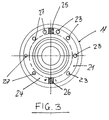
- the air supply line 20 continues into the shaft 2 of the elbow and is distributed over a distribution channel 21, which is provided in the main part 11 of the insert and surrounds the tool 7 in a semi-long shape (see FIG. 3). From the distribution duct 21, the air is guided on the one hand through one or more ducts 22 through the upper region of the seal 13 to the sealing gap between the seal 13 and the tool 7 and on the other hand out via a plurality of branch lines 23 out of the main part 11.
- a supply line for cooling fluid runs parallel to the air supply line 20 in the shaft part 2 of the elbow, and is covered by the air supply line 20 in FIG. 1. It opens into a further semi-ring-shaped distribution channel 24 which, like the distribution channel 21, surrounds the tool 7 in a semi-ring shape; 3, the two semi-ring-shaped channels 21 and 24 complement each other to form a ring which is divided by two intermediate walls 25 and 26 which separate the air from the cooling fluid (water).
- the supply line 16 leads from the distribution channel 24 to the ring channel 9, but further supply lines 27 lead downwards out of the main part 11.
- the main part 11 of the insert has a peg-shaped extension 28, on which a rotatable ring 29 is attached, which serves as a rotary slide valve. There is an O-ring seal 30 between this ring 29 and the main part.
- the ring 29 is snapped onto the peg-shaped extension 28, which for this purpose has an annular groove 31 into which the rotary slide valve 29 engages with an annular bead 32. So that the annular bead 32 can spring back, the ring 29 is cut in an annular manner from the rear at this point.
- a spring tension ring (not shown here), which presses the annular bead 32 into the annular groove 31, can be located in the incision 33 formed in this way, as required.
- the feed lines 23a and 27a can be made to coincide with the feed lines 23 and 27; then cooling fluid and compressed air can exit directed towards the outside of the tool 7.
- the feed lines 23 and 27 can also be shut off by turning the ring 29.
- the angle of rotation of the ring can be limited by stops.
- the outer contour of the insert 10 corresponds to the outer contour of a known angle piece; it differs from this in the structure of the Use, in particular in the two-part design with main part 11 and annular rotary slide 29, which enables the multiple use of the angle piece according to the invention for tools with internal cooling and / or external cooling.
Landscapes
- Health & Medical Sciences (AREA)
- Oral & Maxillofacial Surgery (AREA)
- Dentistry (AREA)
- Epidemiology (AREA)
- Life Sciences & Earth Sciences (AREA)
- Animal Behavior & Ethology (AREA)
- General Health & Medical Sciences (AREA)
- Public Health (AREA)
- Veterinary Medicine (AREA)
- Dental Tools And Instruments Or Auxiliary Dental Instruments (AREA)
Applications Claiming Priority (2)
| Application Number | Priority Date | Filing Date | Title |
|---|---|---|---|
| DE19944419660 DE4419660C2 (de) | 1994-06-06 | 1994-06-06 | Winkelstück für den zahnärztlichen Bedarf |
| DE4419660 | 1994-06-06 |
Publications (2)
| Publication Number | Publication Date |
|---|---|
| EP0686376A2 true EP0686376A2 (fr) | 1995-12-13 |
| EP0686376A3 EP0686376A3 (fr) | 1996-05-15 |
Family
ID=6519857
Family Applications (1)
| Application Number | Title | Priority Date | Filing Date |
|---|---|---|---|
| EP95108629A Withdrawn EP0686376A3 (fr) | 1994-06-06 | 1995-06-06 | Pièce à main angulaire, motorisée et refroidie pour l'art dentaire |
Country Status (2)
| Country | Link |
|---|---|
| EP (1) | EP0686376A3 (fr) |
| DE (1) | DE4419660C2 (fr) |
Cited By (1)
| Publication number | Priority date | Publication date | Assignee | Title |
|---|---|---|---|---|
| FR2728453A1 (fr) * | 1994-12-27 | 1996-06-28 | Buermoos Dentalwerk | Piece a main medicale ou dentaire |
Families Citing this family (2)
| Publication number | Priority date | Publication date | Assignee | Title |
|---|---|---|---|---|
| DE10024724C2 (de) * | 2000-05-19 | 2003-03-27 | Axel Kirsch | Anschlußstück für einen Bohrer zum Erzeugen von Bohrungen in Knochengewebe und Bohrgerät |
| DE102007012232B4 (de) * | 2007-03-12 | 2009-01-15 | Sirona Dental Systems Gmbh | Dentale Bearbeitungsmaschine und Verfahren zur Überwachung von Dichtelementen in dentalen Bearbeitungseinheiten |
Citations (4)
| Publication number | Priority date | Publication date | Assignee | Title |
|---|---|---|---|---|
| DE3433570A1 (de) | 1984-09-13 | 1986-03-20 | Leiter, Alfred, 7530 Pforzheim | Umlaufendes werkzeug fuer chirurgische, insbesondere dentalchirurgische zwecke und vorrichtung zur versorgung des werkzeugs mit einem kuehlmittel |
| EP0374276A1 (fr) | 1988-12-19 | 1990-06-27 | Matsutani Seisakusho Co. Ltd., | Fraise et pièce à main dentaire |
| DE3930114A1 (de) | 1989-05-23 | 1990-11-29 | Alfred Leiter | Arbeitsgeraet fuer medizinische zwecke |
| DE4315596A1 (de) | 1993-04-05 | 1994-10-06 | Alfred Leiter | Winkelstück für den zahnärztlichen Bedarf |
Family Cites Families (3)
| Publication number | Priority date | Publication date | Assignee | Title |
|---|---|---|---|---|
| DE3828866C1 (fr) * | 1988-08-25 | 1990-02-08 | Kaltenbach & Voigt Gmbh & Co, 7950 Biberach, De | |
| DE4039162C3 (de) * | 1990-12-07 | 1996-08-14 | Kaltenbach & Voigt | Ärztliches oder zahnärztliches Handstück |
| DE4142113A1 (de) * | 1991-12-19 | 1993-06-24 | Siemens Ag | Zahnaerztliches instrument mit mitteln zur kuehlung der praeparationsstelle |
-
1994
- 1994-06-06 DE DE19944419660 patent/DE4419660C2/de not_active Expired - Fee Related
-
1995
- 1995-06-06 EP EP95108629A patent/EP0686376A3/fr not_active Withdrawn
Patent Citations (4)
| Publication number | Priority date | Publication date | Assignee | Title |
|---|---|---|---|---|
| DE3433570A1 (de) | 1984-09-13 | 1986-03-20 | Leiter, Alfred, 7530 Pforzheim | Umlaufendes werkzeug fuer chirurgische, insbesondere dentalchirurgische zwecke und vorrichtung zur versorgung des werkzeugs mit einem kuehlmittel |
| EP0374276A1 (fr) | 1988-12-19 | 1990-06-27 | Matsutani Seisakusho Co. Ltd., | Fraise et pièce à main dentaire |
| DE3930114A1 (de) | 1989-05-23 | 1990-11-29 | Alfred Leiter | Arbeitsgeraet fuer medizinische zwecke |
| DE4315596A1 (de) | 1993-04-05 | 1994-10-06 | Alfred Leiter | Winkelstück für den zahnärztlichen Bedarf |
Cited By (1)
| Publication number | Priority date | Publication date | Assignee | Title |
|---|---|---|---|---|
| FR2728453A1 (fr) * | 1994-12-27 | 1996-06-28 | Buermoos Dentalwerk | Piece a main medicale ou dentaire |
Also Published As
| Publication number | Publication date |
|---|---|
| DE4419660C2 (de) | 1997-07-10 |
| DE4419660A1 (de) | 1995-12-21 |
| EP0686376A3 (fr) | 1996-05-15 |
Similar Documents
| Publication | Publication Date | Title |
|---|---|---|
| DE3034930C2 (fr) | ||
| DE69401949T2 (de) | Chirurgisches gerät, insbesondere für die zahnchirurgie | |
| DE9310601U1 (de) | Kassette zur Aufnahme ärztlicher, insbesondere zahnärztlicher Instrumente | |
| EP0199848A1 (fr) | Dispositif pour introduire un endoscope ou un instrument chirurgical dans les organes creux avec des moyens pour alimenter et évacuer un liquide d'irrigation | |
| EP0491149A1 (fr) | Mandrin notamment pour perceuse chirurgicale | |
| EP0937441B1 (fr) | Dispositif pour le nettoyage intensif d'articles médicaux notamment dentaires | |
| DE69209923T2 (de) | Turbineneinsatz für zahnärztliches Handstück | |
| DE4304514C1 (de) | Ärztliches, insbesondere zahnärztliches Instrument mit innen gekühltem Werkzeug | |
| DE3136880C2 (de) | Kleinmotor für den Antrieb medizinischer Instrumente, insbesondere für die Mikrochirurgie | |
| EP0686376A2 (fr) | Pièce à main angulaire, motorisée et refroidie pour l'art dentaire | |
| DE2542826C3 (de) | Vorrichtung zur Versorgung eines mit einem Antrieb für ein zahnärztliches Werkzeug versehenen Handstückes mit Kühlmittel | |
| DE2653588C2 (de) | Zahnärztliches Handstück | |
| DE2915271C2 (fr) | ||
| EP1780421A1 (fr) | Batterie de soupapes | |
| DE2852576C2 (de) | Dental-Handstück | |
| EP0230010B1 (fr) | Appareil de dentisterie | |
| DE4039162C2 (de) | Ärztliches oder zahnärztliches Handstück | |
| DE69608975T2 (de) | Zwischenstück für dentales Handstück | |
| EP0271597B1 (fr) | Soupape de retenue pour l'installation dans le conduit de fluide d'un appareil médical | |
| DE4131495C1 (fr) | ||
| EP0739611B1 (fr) | Instrument de traitement dentaire avec dispositif d'éclairage | |
| EP0693907B1 (fr) | Piece coudee pour porte-outils dentaires | |
| DE19741528B4 (de) | Wegeventilvorrichtung für pneumatischen Förderstrom | |
| DE2602497A1 (de) | Hydraulisches dreiwegeventil, insbesondere wasseranschluss fuer mund- und/ oder hautmassage- bzw. hautreinigungsdusche | |
| DE10025013C2 (de) | Zahnärztliches Instrument mit Mitteln zur Kühlung der Präparationsstelle |
Legal Events
| Date | Code | Title | Description |
|---|---|---|---|
| PUAI | Public reference made under article 153(3) epc to a published international application that has entered the european phase |
Free format text: ORIGINAL CODE: 0009012 |
|
| AK | Designated contracting states |
Kind code of ref document: A2 Designated state(s): AT CH DE FR LI |
|
| PUAL | Search report despatched |
Free format text: ORIGINAL CODE: 0009013 |
|
| AK | Designated contracting states |
Kind code of ref document: A3 Designated state(s): AT CH DE FR LI |
|
| STAA | Information on the status of an ep patent application or granted ep patent |
Free format text: STATUS: THE APPLICATION IS DEEMED TO BE WITHDRAWN |
|
| 18D | Application deemed to be withdrawn |
Effective date: 19961116 |