EP0686410A2 - Feuerlöscher - Google Patents
Feuerlöscher Download PDFInfo
- Publication number
- EP0686410A2 EP0686410A2 EP95107190A EP95107190A EP0686410A2 EP 0686410 A2 EP0686410 A2 EP 0686410A2 EP 95107190 A EP95107190 A EP 95107190A EP 95107190 A EP95107190 A EP 95107190A EP 0686410 A2 EP0686410 A2 EP 0686410A2
- Authority
- EP
- European Patent Office
- Prior art keywords
- propellant
- extinguishing
- extinguisher
- liquid
- fire extinguisher
- Prior art date
- Legal status (The legal status is an assumption and is not a legal conclusion. Google has not performed a legal analysis and makes no representation as to the accuracy of the status listed.)
- Granted
Links
Images


Classifications
-
- A—HUMAN NECESSITIES
- A62—LIFE-SAVING; FIRE-FIGHTING
- A62C—FIRE-FIGHTING
- A62C13/00—Portable extinguishers which are permanently pressurised or pressurised immediately before use
- A62C13/66—Portable extinguishers which are permanently pressurised or pressurised immediately before use with extinguishing material and pressure gas being stored in separate containers
Definitions
- the invention relates to a fire extinguisher for liquid extinguishing agents with rapid mixing.
- extinguishing agents When using liquid extinguishing agents, it is often necessary to add extinguishing agents. It is important that the extinguishing agent and extinguishing agent additives are mixed well at the start of the extinguishing and throughout the entire extinguishing.
- One possibility for this is to put the extinguishing agent additive in a special container on the extinguisher and to guide propellant from a propellant reservoir through this container into the extinguisher.
- a container is arranged in the extinguisher itself, which is provided with a film, so that when the extinguisher is acted upon by the propellant, the container is destroyed and the extinguishing agent additive is introduced into the extinguishing agent.
- a propellant guide tube on the extinguisher which protrudes into the extinguishing agent filling, at least one outlet opening being immersed in the extinguishing agent filling.
- the propellant pipe is attached to the extinguisher head.
- all essential components namely propellant reservoir and extinguishing agent guide tube, are located on the extinguisher head.
- the container for the extinguishing agent additive arranged inside the extinguisher can be provided floating on the surface of the liquid extinguishing agent or can also be attached to the extinguishing agent head.
- one or more outlet openings are arranged laterally with respect to the axis of the guide tube on the propellant guide tube. This allows the mixing to be further optimized.
- the fire extinguisher according to the invention has a housing 1 on which an extinguisher head 2 is arranged, for example by sealing screwing.
- the propellant reservoir 3 is attached to the extinguisher head 2.
- the container for dispensing extinguishing agent additives 5 floats on the surface of the extinguishing agent filling 7.
- the propellant guide tube 4 with lateral outlet openings 6 is arranged on the extinguisher head 2.
- the propellant guide tube can also be used in conjunction with premixed extinguishing agents.
- no separate container for an extinguishing agent additive is required. This is already mixed into the extinguishing agent.
- the use of a propellant guide tube has also proven to be advantageous for these premixed extinguishing agents. This can be due to this to be attributed to the fact that separations take place in the premixed solutions, which are eliminated by the targeted whirling of the liquid.
- the strength of the swirling of the extinguishing agent and thus the mixing can be adjusted by a targeted geometric design of the propellant guide tube and the outlet openings attached to it.
- the propellant guide tube is only a few millimeters immersed in the liquid or extends almost to the bottom of the extinguisher.
- the blowing agent also serves to mix the regularly required extinguishing agent additives (e.g. tensides) with the extinguishing agent.
- Fire extinguishers that have been on the market up to now have the pressure curve, shown schematically in FIG. 2, over time when extinguished.
- the pressure determines essential properties of the extinguishing jet, e.g. B. the drop size, the drop size distribution, the foaming, but above all the throwing distance.
- the disproportionate decrease in the entire area of the curve has the consequence that in the event of a fire, which in any case represents a stress situation, erroneous behavior can occur during the extinguishing action. It is precisely the disproportionately decreasing throw range that, in particular inexperienced extinguishing personnel, cannot optimally readjust the alignment of the extinguishing jet to match the throw range.
- the amount of propellant be increased compared to the amount of propellant calculated from the free volume in the extinguisher working pressure and density.
- safety surcharges for this calculated amount of propellant, e.g. B. in the The order of 1 to 5%.
- these safety supplements still belong to the arithmetically determined amount of propellant.
- the aim of the invention is to offer an excess amount of propellant in addition to the safety supplements and to distribute this propellant in the extinguishing liquid in connection with the propellant guide tube protruding into the extinguishing liquid.
- the foaming rate (ratio of the foaming agent to the foam produced) increases by a factor of 4-5. This normally means a significant improvement in the extinguishing performance.
- Another advantage of the embodiment according to the invention is that the bubbles contained in the foam contain an increased proportion of propellant, so that a nitrogen gas mixture is increasingly transported into the fire in the room instead of combustion-supporting breathing air. This also supports the deletion process.
- the pressure loss over time (shown schematically in FIG. 3) has a linear course over a wide range. This will ensure the successful handling of the extinguisher significantly supported.
- the extinguishing process is evened out in an even better solution if a propellant guide tube is arranged in the propellant reservoir, through which the extinguishing agent is brought into contact with a propellant which is predominantly in liquid form.
- a propellant guide tube does not necessarily have to protrude into the extinguishing liquid in this embodiment. Rather, the uniformity of the extinguishing conditions can be supported by generating a free jet for liquid propellant.
- At least one outlet opening of small diameter is preferably provided at the outlet end of the propellant guide tube.
- a small diameter is meant here that the diameter of the outlet opening is significantly smaller than the diameter of the propellant guide tube.
- a plurality of outlet openings of small diameter are preferably arranged, in particular equidistantly on the circumference of the propellant guide tube.
- the outlet end of the propellant guide tube with the outlet openings of small diameter can preferably be connected as an independent part to the propellant guide tube. This facilitates assembly and adaptation to different extinguishing agents.
- CO2 is preferably used as a blowing agent in the usual way. However, this does not mean that the invention is fundamentally dependent on the use of CO2. Instead of CO2, other blowing agents can be used.
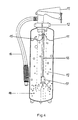
- the fire extinguisher 11 has an extinguisher head 12 which is provided with an operating handle 13 and a hose 14 for dispensing the extinguishing agent. Inside the extinguisher 11 is on the Extinguishing head 12 preferably arranged the propellant reservoir 15. The reservoir can also be attached to the outside of the extinguisher 11.
- the propellant guide tube 16 is preferably attached to the extinguisher head 12 and has a nozzle head 17 with a plurality of openings of small diameter at its outlet end.
- a riser pipe shown in dashed lines in the drawing) which extends into the lower region 18 of the storage container.
- the liquid in the riser pipe is passed through the extinguisher head 12 into the propellant guide tube and enters the extinguishing liquid 19 at the nozzle head 17.
- additives to the extinguishing liquid are preferably provided by a cartridge (not shown in the drawing) floating in the extinguishing liquid with a bursting film which bursts from the propellant reservoir 18 when the extinguisher is charged with propellant.
- the advantages of the invention also apply equally to pre-mixed extinguishing agents. Compared to the amount of blowing agent of 50 g given above by way of example, blowing agent amounts of 70-150 g would preferably be used in this exemplary embodiment.
Landscapes
- Health & Medical Sciences (AREA)
- Public Health (AREA)
- Business, Economics & Management (AREA)
- Emergency Management (AREA)
- Fire-Extinguishing By Fire Departments, And Fire-Extinguishing Equipment And Control Thereof (AREA)
- Fireproofing Substances (AREA)
- Fire-Extinguishing Compositions (AREA)
Abstract
Description
- Die Erfindung betrifft einen Feuerlöscher für flüssige Löschmittel mit Schnelldurchmischung.
- Bei Verwendung flüssiger Löschmittel ist häufig das Einbringen von Löschmittelzusätzen erforderlich. Es kommt darauf an, Löschmittel und Löschmittelzusätze schlagartig bei Beginn der Löschung und während der gesamten Löschung gut zu vermischen. Eine Möglichkeit hierfür ist, den Löschmittelzusatz in einem besonderen Behältnis am Löscher einzubringen und Treibmittel aus einem Treibmittelvorratsbehälter durch dieses Behältnis in den Löscher zu leiten.
- Bei anderen Ausführungen wird im Löscher selbst ein Behältnis angeordnet, welches mit einer Bersffolie versehen ist, so daß bei Beaufschlagung des Löschers mit dem Treibmittel das Behältnis zerstört und der Löschmittelzusatz in das Löschmittel eingebracht wird.
- Die beschriebenen Lösungen erscheinen als mit hohem Fertigungsaufwand beziehungsweise mit nicht ausreichender Sicherheit hinsichtlich der Durchmischung von Zusatz und Löschmittel behaftet.
- Diese Nachteile galt es zu vermeiden. Erfindungsgemäß wird vorgeschlagen, an dem Löscher ein Treibmittelführungsrohr anzuordnen, welches in die Löschmittelfüllung hereinragt, wobei wenigstens eine Auslaßöffnung in die Löschmittelfüllung eingetaucht ist. Beim Öffnen des Feuerlöschers strömt das Treibmittel durch das Führungsrohr und setzt nach Austritt aus der Auslaßöffnung das Löschmittel in heftige Bewegung. Durch den Druckanstieg wird das Behältnis für den Löschmittelzusatz zerstört. Der Löschmittelzusatz wird durch die extrem starke Bewegung des Löschmittels mit diesem schlagartig und während der gesamten Löschung anhaltend vermischt.
- Nach einer bevorzugten Ausführung ist das Treibmittelführungsrohr am Löscherkopf befestigt. Hierdurch wird der Montageaufwand beim Zusammenbau des Löschers erheblich verringert. Insbesondere befinden sich alle wesentlichen Komponenten, nämlich Treibmittelvorratsbehälter und Löschmittelführungsrohr, am Löscherkopf. Das im Inneren des Löschers angeordnete Behältnis für den Löschmittelzusatz kann auf der Oberfläche des flüssigen Löschmittels schwimmend vorgesehen sein oder ebenso am Löschmittelkopf befestigt werden.
- Nach einer weiter bevorzugten Ausführung sind am Treibmittelführungsrohr eine oder mehrere Auslaßöffnungen seitlich bezogen auf die Achse des Führungsrohres angeordnet. Hierdurch kann die Vermischung weiter optimiert werden.
- Anhand der beigefügten Abbildung 1 wird ein Ausführungsbeispiel der Erfindung schematisch dargestellt.
- Der erfindungsgemäß Feuerlöscher weist ein Gehäuse 1 auf, an dem ein Löscherkopf 2 zum Beispiel durch dichtende Verschraubung angeordnet ist. Am Löscherkopf 2 ist der Treibmittelvorratsbehälter 3 angebracht. Das Behältnis zur Abgabe von Löschmittelzusätzen 5 schwimmt auf der Oberfläche der Löschmittelfüllung 7. Am Löscherkopf 2 ist das Treibmittelführungsrohr 4 mit seitlichen Auslaßöffnungen 6 angeordnet.
- Durch die heftige Bewegung des Löschmittels erfolgt eine hervorragende Vermischung von Löschmittel und Zusatzstoff. Hierzu muß man sich vorstellen, daß bei einem Löscher mit neun Litern Löschmittel circa 100 Liter Treibgas in circa vier Sekunden durch die Flüssigkeit hindurch geschossen werden.
- In einer besonderen Anwendung kann das Treibmittelführungsrohr auch in Verbindung mit vorgemischten Löschmitteln verwendet werden. In diesem Fall ist kein gesondertes Behältnis für einen Löschmittelzusatz erforderlich. Dieser ist bereits in das Löschmittel eingemischt. Auch für diese vorgemischten Löschmittel hat sich die Verwendung eines Treibmittelführungsrohres als vorteilhaft erwiesen. Dies kann darauf zurückzuführen sein, daß bei den vorgemischten Lösungen Trennungen erfolgen, die durch die gezielte Durchwirbelung der Flüssigkeit aufgehoben werden. Durch gezielte geometrische Ausführung des Treibmittelführungsrohres und der daran angebrachten Auslaßöffnungen kann die Stärke der Verwirbelung des Löschmittels und damit die Durchmischung eingestellt werden. Je nach Anforderung taucht das Treibmittelführungsrohr nur wenige Milimeter in die Flüssigkeit ein oder reicht fast bis zum Boden des Löschers.
- Das Treibmittel dient außerdem dazu, die regelmäßig notwendigen Löschmittelzusätze (z. B. Tenside) mit dem Löschmittel vermischen. Bisher am Markt befindliche Feuerlöscher weisen beim Löschen den in Fig. 2 schematisch dargestellten Druckverlauf über der Zeit auf. Der Druck bestimmt wesentliche Eigenschaften des Löschstrahles, z. B. die Tropfengröße, die Tropfengrößenverteilung, die Verschäumung, vor allem aber die Wurfweite. Die im gesamten Bereich der Kurve überproportionale Abnahme (nichtlinearer Verlauf) hat zur Folge, daß im Brandfall, welcher ohnehin eine Streßsituation darstellt, ein Fehlverhalten bei der Löschaktion auftreten kann. Gerade die überproportional abnehmende Wurfweite führt dazu, daß, insbesondere ungeübtes Löschpersonal, die Ausrichtung des Löschstrahles nicht in Anpassung an die Wurfweite optimal nachregeln können.
- Es wird vorgeschlagen, daß die Menge an Treibmittel gegenüber der aus freiem Volumen im Löscher Arbeitsdruck und Dichte errechneten Treibmittelmenge erhöht ist.
- Dies wird durch folgende Überschlagsrechnung erläutert:
freies Volumen im Löscher: V = 1700 cm³
Arbeitsdruck: P = 15 bar
Dichte: D = 2 kg/m³, bezogen auf einen Normaldruck von 1 bar
errechnete Treibmittelmenge: M = 50 g. - In der praktischen Anwendung mag es zu dieser errechneten Treibmittelmenge gewisse Sicherheitszuschläge geben, z. B. in der Größenordnung von 1 bis 5 %. Diese Sicherheitszuschläge gehören nach dem Ausgangspunkt der Erfindung noch zu der rechnerisch ermittelten Treibmittelmenge. Der Erfindung geht es darum, über die Sicherheitszuschläge hinaus, eine Übermenge von Treibmittel anzubieten und dieses Treibmittel in Verbindung mit dem in die Löschflüssigkeit hineinragenden Treibmittel-Führungsrohr in der Löschflüssigkeit zu verteilen.
- Es gelingt z. B. durch die Verwendung einer entsprechenden Übermenge von Treibmittel bei Verwendung von CO₂ als Treibmittel 1 Gew.% Treibmittel in die Löschflüssigkeit einzubringen. Das bedeutet., daß in einem Liter Flüssigkeit 10 g CO₂ gelöst sind, die entspannt etwa 10 Liter Gas ergeben.
- Durch die erfindungsgemäße Zugabe von Treibmittel in einer Übermenge erhöht sich die Verschäumungsrate (Verhältnis des Schaummittels zu produziertem Schaum) ca. um den Faktor 4 - 5. Dies bedeutet im Normalfall eine wesentliche Verbesserung der Löschleistung.
- Ein weiterer Vorteil der erfindungsgemäßen Ausführung liegt darin, daß in den im Schaum enthaltenen Bläschen ein erhöhter Anteil von Treibmittel enthalten ist, so daß verstärkt anstelle von verbrennungsunterstützender Atemluft in dem Raum ein Stickgasgemisch in das Feuer transportiert wird. Dies unterstützt ebenfalls den Löschvorgang.
- Ein weiterer wesentlicher Vorteil ist, daß sich, wenn der Löscher aufgeladen ist, der Druck im wesentlichen nicht mehr verändert. Bei normal aufgeladenen Feuerlöschern, also praktisch bei allen Geräten, die es derzeit gibt, besteht die Gefahr, daß der für die Funktion des Gerätes so wichtige Druck sich bis auf eine Größe verkleinert, die einen ordnungsgemäßen Betrieb nicht mehr sicherstellt. Das ist darauf zurückzuführen, daß, wenn der Löscher zum Beispiel beim Gehen oder Rennen geschüttelt wird, sich das wenige im Löscher befindliche Kohlendioxid in der Löschflüssigkeit auflöst.
- Die subjektiv gestellte Aufgabe schließlich, nämlich den Löschvorgang zu vergleichmäßigen, wird ebenfalls erreicht. Der Druckverlust über der Zeit (schematisch dargestellt in Fig. 3) weist in weiten Bereichen einen linearen Verlauf auf. Hierdurch wird die erfolgreiche Handhabung des Löschers wesentlich unterstützt. Die Vergleichmäßigung des Löschvorganges wird in noch verbesserter Lösung erreicht, wenn in dem Treibmittel-Vorratsbehälter ein Treibmittel-Führungsrohr angeordnet ist, durch das das Löschmittel mit einem in überwiegend flüssiger Form vorliegenden Treibmittel in Kontakt gebracht wird. Nach bisheriger Kenntnis der Anmelderin muß bei dieser Ausführung nicht unbedingt ein Treibmittel-Führungsrohr in die Löschflüssigkeit hineinragen. Vielmehr kann durch Erzeugung eines Freistrahles für flüssiges Treibmittel die Vergleichmäßigung der Löschbedingungen unterstützt werden.
- Bevorzugt wird jedoch die Verwendung eines Treibmittel-Führungsrohres, welches in die Löschflüssigkeit in gefülltem Zustand des Löschers hineinragt (Bezug genommen wird hier auf die übliche Anwendungshaltung des Löschers, bei dem der Löschkopf, an dem das Treibmittel-Führungsrohr bevorzugt befestigt ist, oben liegt). Am Austrittsende des Treibmittel-Führungsrohres ist bevorzugt wenigstens eine Auslaßöffnung geringen Durchmessers vorgesehen. Mit gringem Durchmesser ist hier gemeint, daß der Durchmesser der Auslaßöffnung deutlich kleiner ist, als der Durchmesser des Treibmittel-Führungsrohres. Bevorzugt sind mehrere Auslaßöffnungen geringen Durchmessers, insbesondere äquidistant am Umfang des Treibmittel-Führungsrohres, angeordnet sind.
- Bevorzugt ist das Auslaßende des Treibmittel-Führungsrohres mit den Auslaßöffnungen geringen Durchmessers als eigenständiges Teil mit dem Treibmittel-Führungsrohr verbindbar. Dies erleichtert die Montage und die Anpassung an unterschiedliche Löschmittel.
- Bevorzugt wird als Treibmittel in der bisher üblichen Weise CO₂ verwendet. Das bedeutet jedoch nicht, daß die Erfindung von der Verwendung von CO₂ grundsätzlich abhängig ist. Anstelle von CO₂ können auch andere Treibmittel eingesetzt werden.
- Ein Ausführungsbeispiel ist in Fig. 4 schematisch dargestellt. Der Feuerlöscher 11 weist einen Löscherkopf 12 auf, der mit einem Bedienungshandgriff 13 und einem Schlauch 14 zur Abgabe des Löschmittels versehen ist. Im Innern des Löschers 11 ist an dem Löscherkopf 12 bevorzugt der Treibmittel-Vorratsbehälter 15 angeordnet. Der Vorratsbehälter kann aber auch außen am Löscher 11 angebracht sein. Am Löscherkopf 12 ist bevorzugt das Treibmittel-Führungsrohr 16 angebracht, welches an seinem Auslaßende einen Düsenkopf 17 mit einer Mehrzahl von Öffnungen geringen Durchmesser aufweist. In dem Löscher 11 ist ein Steigrohr angebracht (in der Zeichnung gestrichelt dargestellt), das bis in den unteren Bereich 18 des Vorratsbehälters reicht. In dem Steigrohr wird die Flüssigkeit nach Auslösen des Feuerlöschers durch den Löscherkopf 12 in das Treibmittel-Führungsrohr geleitet und tritt am Düsenkopf 17 in die Löschflüssigkeit 19 ein. Zusätze zur Löschflüssigkeit werden bei diesem Ausführungsbeispiel bevorzugt durch eine in der Löschflüssigkeit schwimmende (in der Zeichnung nicht dargestellte) Patrone mit einer Berstfolie, die bei Beaufschlagung des Löschers mit Treibmittel aus dem Treibmittel-Vorratsbehälter 18 zerplatzt. Die Vorteile der Erfindung stellen sich aber auch gleichermaßen bei bereits vorgemischten Löschmitteln ein. Gegenüber der oben beispielhaft angegebenen Treibmittelmenge von 50 g würden bevorzugt in diesem Ausführungsbeispiel Treibmittelmengen von 70 - 150 g eingesetzt werden.
Claims (9)
- Feuerlöscher für flüssige Löschmittel, bestehend aus einem Gehäuse und einem Löscherkopf mit einem Treibmittelvorratsbehälter, dadurch gekennzeichnet, daß ein Treibmittelführungsrohr in die Löschmittelfüllung hineinragt, wobei wenigstens eine Auslaßöffnung in die Löschmittelfüllung eingetaucht ist.
- Feuerlöscher nach Anspruch 1, dadurch gekennzeichnet, daß das Treibmittelführungsrohr am Löscherkopf befestigt ist.
- Feuerlöscher nach Anspruch 1 oder 2, dadurch gekennzeichnet, daß eine oder mehrere Auslaßöffnungen am Treibmittelführungsrohr seitlich angeordnet sind.
- Feuerlöscher für flüssige Löschmittel mit Treibmittel-Vorratsbehälter, insbesondere nach Anspruch 1, dadurch gekennzeichnet, daß die Menge an Treibmittel gegenüber der aus freiem Volumen im Löscher (über der Löschmittelfüllung) Arbeitsdruck und Dichte errechneten Treibmittelmenge erhöht ist.
- Feuerlöscher für flüssige Löschmittel mit Treibmittel-Vorratsbehälter mit wenigstens einer der Löschmittelfüllung zugewandten Treibmittel-Auslaßöffnung nach Anspruch 4, dadurch gekennzeichnet, daß das Treibmittel aus dem Vorratsbehälter beim Eintritt in die Löschflüssigkeit im wesentlichen flüssig ist.
- Feuerlöscher nach einem der Ansprüche 4 oder 5 dadurch gekennzeichnet, daß im Vorratsbehälter des Löschers ein Steigrohr angeordnet ist.
- Feuerlöscher nach einem der Ansprüche 4 bis 6 dadurch gekennzeichnet, daß die dem Löschmittel zugewandte Treibmittel-Auslaßöffnung wenigstens eine, bevorzugt eine Mehrzahl von Öffnungen geringeren Durchmessers zur Abgabe des Treibmittels aufweist.
- Feuerlöscher nach Anspruch 7 dadurch gekennzeichnet, daß die der Löschflüssigkeit zugewandte Treibmittel-Auslaßöffnung als selbständige, mit dem Löscherkopf oder dem Treibmittel-Führungsrohr verbindbare Einheit, angeordnet ist.
- Feuerlöscher nach einem der Ansprüche 4 bis 8 dadurch gekennzeichnet, daß ein Treibmittel mit guter Löslichkeit in der Löschflüssigkeit, insbesondere CO₂, angeordnet ist.
Applications Claiming Priority (4)
| Application Number | Priority Date | Filing Date | Title |
|---|---|---|---|
| DE9407753U DE9407753U1 (de) | 1994-05-11 | 1994-05-11 | Feuerlöscher mit Schnelldurchmischung |
| DE9407753U | 1994-05-11 | ||
| DE29505581U DE29505581U1 (de) | 1995-04-07 | 1995-04-07 | Feuerlöscher mit erhöhter Treibmittelmenge |
| DE9505581U | 1995-04-07 |
Publications (3)
| Publication Number | Publication Date |
|---|---|
| EP0686410A2 true EP0686410A2 (de) | 1995-12-13 |
| EP0686410A3 EP0686410A3 (de) | 1996-06-05 |
| EP0686410B1 EP0686410B1 (de) | 1998-06-24 |
Family
ID=25962058
Family Applications (1)
| Application Number | Title | Priority Date | Filing Date |
|---|---|---|---|
| EP95107190A Expired - Lifetime EP0686410B1 (de) | 1994-05-11 | 1995-05-11 | Feuerlöscher |
Country Status (5)
| Country | Link |
|---|---|
| EP (1) | EP0686410B1 (de) |
| AT (1) | ATE167635T1 (de) |
| DE (1) | DE59502638D1 (de) |
| DK (1) | DK0686410T3 (de) |
| ES (1) | ES2118473T3 (de) |
Cited By (2)
| Publication number | Priority date | Publication date | Assignee | Title |
|---|---|---|---|---|
| NL1008969C2 (nl) * | 1998-04-23 | 1999-10-26 | H T Research B V | Werkwijze voor het blussen van een brand. |
| FR2779656A1 (fr) * | 1998-06-15 | 1999-12-17 | Extincteurs Harden | Tube detasseur pour extincteur a gaz auxiliaire propulseur de poudre extinctrice, tete d'extincteur associee audit tube et extincteur comprenant une telle tete |
Family Cites Families (5)
| Publication number | Priority date | Publication date | Assignee | Title |
|---|---|---|---|---|
| FR969186A (fr) * | 1948-07-13 | 1950-12-15 | Centrale Incendie | Extincteur d'incendie, notamment pour films cinématographiques |
| GB911232A (en) * | 1958-06-07 | 1962-11-21 | John Kerr & Company Manchester | Improvements in or relating to fire extinguishers |
| GB1478602A (en) * | 1975-11-10 | 1977-07-06 | Rampart Eng Co Ltd | Powder type portable fire extinguishers |
| DE3006945A1 (de) * | 1980-02-25 | 1981-09-03 | A. Werner GmbH & Co Spezialfabrik für Feuerlöschtechnik, 5414 Vallendar | Feuerloescher |
| FR2662608B1 (fr) * | 1990-06-05 | 1992-09-11 | Rot | Cartouche frangible pour additifs d'extinction dans des extincteurs a eau mise sous pression au moment de l'emploi par un gaz comprime. |
-
1995
- 1995-05-11 DE DE59502638T patent/DE59502638D1/de not_active Expired - Lifetime
- 1995-05-11 AT AT95107190T patent/ATE167635T1/de active
- 1995-05-11 ES ES95107190T patent/ES2118473T3/es not_active Expired - Lifetime
- 1995-05-11 DK DK95107190T patent/DK0686410T3/da active
- 1995-05-11 EP EP95107190A patent/EP0686410B1/de not_active Expired - Lifetime
Cited By (3)
| Publication number | Priority date | Publication date | Assignee | Title |
|---|---|---|---|---|
| NL1008969C2 (nl) * | 1998-04-23 | 1999-10-26 | H T Research B V | Werkwijze voor het blussen van een brand. |
| FR2779656A1 (fr) * | 1998-06-15 | 1999-12-17 | Extincteurs Harden | Tube detasseur pour extincteur a gaz auxiliaire propulseur de poudre extinctrice, tete d'extincteur associee audit tube et extincteur comprenant une telle tete |
| EP0965364A1 (de) * | 1998-06-15 | 1999-12-22 | Extincteurs Harden | Schlauch für Feuerlöscher |
Also Published As
| Publication number | Publication date |
|---|---|
| ES2118473T3 (es) | 1998-09-16 |
| EP0686410A3 (de) | 1996-06-05 |
| ATE167635T1 (de) | 1998-07-15 |
| DK0686410T3 (da) | 1999-02-01 |
| EP0686410B1 (de) | 1998-06-24 |
| DE59502638D1 (de) | 1998-07-30 |
Similar Documents
| Publication | Publication Date | Title |
|---|---|---|
| DE69709057T2 (de) | Feuerbekämpfungseinrichtung | |
| DE69210603T2 (de) | Ausrüstung zur brandbekämpfung | |
| DE69319915T2 (de) | Düse mit einer die flüssigkeit zum verwirbeln bringenden schraubenfeder | |
| DE69533679T2 (de) | Gas- und Flüssigkeitsnebel abgebende Feuerbekämpfungsvorrichtung | |
| DE3517284C2 (de) | Verfahren und Vorrichtung zum Herstellen und zur Abgabe von mit einem Zusatzmittel vermischten Löschmitteln | |
| DE29522033U1 (de) | Vorrichtung zum Impuls-Medien-Austrag | |
| DE102017117412A1 (de) | Verfahren und Vorrichtung zur Herstellung von Löschschaum mit löschfähigem Gas | |
| DE2524146A1 (de) | Vorrichtung zum beimischen eines durch eine fluessigkeit abtragbaren, festen stoffes zu der fluessigkeit | |
| DE60013911T2 (de) | Düsensprüher und feuerlöscher | |
| EP3337576B1 (de) | Feuerlöscher | |
| DE202017102091U1 (de) | Brandlöschlanze | |
| DE69900183T2 (de) | Anriebsquelle zur zuführung eines löschmittels zu einem sprühknopf zum löschen eines feuers | |
| EP0671216A2 (de) | Sprühdüse zur Erzeugung eines Doppel-Sprühnebel-Kegels | |
| DE2733601C3 (de) | Chemikalsauerstoffgerät mit Kreislaufatmung | |
| EP0686410A2 (de) | Feuerlöscher | |
| DE2600295C3 (de) | Flammspritzbrenner zum Pulverflammspritzen | |
| DE29505581U1 (de) | Feuerlöscher mit erhöhter Treibmittelmenge | |
| DE3933582A1 (de) | Werferrohr | |
| DE631477C (de) | Luftschaumerzeuger fuer Feuerloeschzwecke | |
| DE675800C (de) | Vorrichtung zur Erzeugung von physikalischem Schaum, insbesondere fuer Feuerloeschzwecke | |
| DE9407753U1 (de) | Feuerlöscher mit Schnelldurchmischung | |
| DE2822380A1 (de) | Feuerloescher | |
| EP3991805B1 (de) | Schaumzufuhreinrichtung | |
| EP1293230A1 (de) | Verfahren zur Brandlöschung und Löschanlage | |
| DD141626A1 (de) | Drallduese zur erzeugung von spruehnebeln |
Legal Events
| Date | Code | Title | Description |
|---|---|---|---|
| PUAI | Public reference made under article 153(3) epc to a published international application that has entered the european phase |
Free format text: ORIGINAL CODE: 0009012 |
|
| 17P | Request for examination filed |
Effective date: 19950612 |
|
| AK | Designated contracting states |
Kind code of ref document: A2 Designated state(s): AT BE CH DE DK ES FR GB IE IT LI NL PT SE |
|
| PUAL | Search report despatched |
Free format text: ORIGINAL CODE: 0009013 |
|
| AK | Designated contracting states |
Kind code of ref document: A3 Designated state(s): AT BE CH DE DK ES FR GB IE IT LI NL PT SE |
|
| 17Q | First examination report despatched |
Effective date: 19961017 |
|
| GRAG | Despatch of communication of intention to grant |
Free format text: ORIGINAL CODE: EPIDOS AGRA |
|
| GRAG | Despatch of communication of intention to grant |
Free format text: ORIGINAL CODE: EPIDOS AGRA |
|
| GRAH | Despatch of communication of intention to grant a patent |
Free format text: ORIGINAL CODE: EPIDOS IGRA |
|
| GRAH | Despatch of communication of intention to grant a patent |
Free format text: ORIGINAL CODE: EPIDOS IGRA |
|
| GRAA | (expected) grant |
Free format text: ORIGINAL CODE: 0009210 |
|
| AK | Designated contracting states |
Kind code of ref document: B1 Designated state(s): AT BE CH DE DK ES FR GB IE IT LI NL PT SE |
|
| REF | Corresponds to: |
Ref document number: 167635 Country of ref document: AT Date of ref document: 19980715 Kind code of ref document: T |
|
| REG | Reference to a national code |
Ref country code: CH Ref legal event code: EP |
|
| REF | Corresponds to: |
Ref document number: 59502638 Country of ref document: DE Date of ref document: 19980730 |
|
| REG | Reference to a national code |
Ref country code: ES Ref legal event code: FG2A Ref document number: 2118473 Country of ref document: ES Kind code of ref document: T3 |
|
| REG | Reference to a national code |
Ref country code: IE Ref legal event code: FG4D Free format text: GERMAN |
|
| GBT | Gb: translation of ep patent filed (gb section 77(6)(a)/1977) |
Effective date: 19980921 |
|
| ET | Fr: translation filed | ||
| REG | Reference to a national code |
Ref country code: PT Ref legal event code: SC4A Free format text: AVAILABILITY OF NATIONAL TRANSLATION Effective date: 19980924 |
|
| REG | Reference to a national code |
Ref country code: DK Ref legal event code: T3 |
|
| PLBE | No opposition filed within time limit |
Free format text: ORIGINAL CODE: 0009261 |
|
| STAA | Information on the status of an ep patent application or granted ep patent |
Free format text: STATUS: NO OPPOSITION FILED WITHIN TIME LIMIT |
|
| 26N | No opposition filed | ||
| PGFP | Annual fee paid to national office [announced via postgrant information from national office to epo] |
Ref country code: SE Payment date: 20000417 Year of fee payment: 6 |
|
| PGFP | Annual fee paid to national office [announced via postgrant information from national office to epo] |
Ref country code: PT Payment date: 20000419 Year of fee payment: 6 |
|
| PGFP | Annual fee paid to national office [announced via postgrant information from national office to epo] |
Ref country code: ES Payment date: 20000509 Year of fee payment: 6 |
|
| PG25 | Lapsed in a contracting state [announced via postgrant information from national office to epo] |
Ref country code: SE Free format text: LAPSE BECAUSE OF NON-PAYMENT OF DUE FEES Effective date: 20010512 Ref country code: ES Free format text: LAPSE BECAUSE OF NON-PAYMENT OF DUE FEES Effective date: 20010512 |
|
| PG25 | Lapsed in a contracting state [announced via postgrant information from national office to epo] |
Ref country code: PT Free format text: LAPSE BECAUSE OF NON-PAYMENT OF DUE FEES Effective date: 20011130 |
|
| REG | Reference to a national code |
Ref country code: GB Ref legal event code: IF02 |
|
| REG | Reference to a national code |
Ref country code: PT Ref legal event code: MM4A Free format text: LAPSE DUE TO NON-PAYMENT OF FEES Effective date: 20011130 |
|
| REG | Reference to a national code |
Ref country code: ES Ref legal event code: FD2A Effective date: 20030303 |
|
| BECN | Be: change of holder's name |
Owner name: *MINIMAX HOLDING G.M.B.H. & CO. K.G. Effective date: 20050928 |
|
| REG | Reference to a national code |
Ref country code: GB Ref legal event code: 732E |
|
| REG | Reference to a national code |
Ref country code: CH Ref legal event code: PUE Owner name: MINIMAX MOBILE SERVICES GMBH & CO. KG Free format text: MINIMAX GMBH & CO. KG#INDUSTRIESTRASSE 10-12#23843 BAD OLDESLOE (DE) -TRANSFER TO- MINIMAX MOBILE SERVICES GMBH & CO. KG#INDUSTRIESTRASSE 10-12#23843 BAD OLDESLOE (DE) Ref country code: CH Ref legal event code: PFA Owner name: MINIMAX GMBH & CO. KG Free format text: MINIMAX GMBH#INDUSTRIESTRASSE 10 - 12#23843 BAD OLDESLOE (DE) -TRANSFER TO- MINIMAX GMBH & CO. KG#INDUSTRIESTRASSE 10-12#23843 BAD OLDESLOE (DE) |
|
| NLS | Nl: assignments of ep-patents |
Owner name: MIMX HOLDINGS GMBH & CO. KG Effective date: 20060307 Owner name: MINIMAX HOLDING GMBH Effective date: 20060307 |
|
| NLT1 | Nl: modifications of names registered in virtue of documents presented to the patent office pursuant to art. 16 a, paragraph 1 |
Owner name: MINIMAX GMBH & CO KG |
|
| REG | Reference to a national code |
Ref country code: FR Ref legal event code: TP Ref country code: FR Ref legal event code: CD |
|
| REG | Reference to a national code |
Ref country code: GB Ref legal event code: 732E |
|
| NLS | Nl: assignments of ep-patents |
Owner name: MINIMAX MOBILE SERVICES GMBH & CO. KG Effective date: 20060627 |
|
| REG | Reference to a national code |
Ref country code: FR Ref legal event code: TP |
|
| BECA | Be: change of holder's address |
Owner name: *MINIMAX MOBILE SERVICES G.M.B.H. & CO. K.G.MINIMA Effective date: 20050928 |
|
| BECH | Be: change of holder |
Owner name: *MINIMAX MOBILE SERVICES G.M.B.H. & CO. K.G. Effective date: 20050928 |
|
| BECN | Be: change of holder's name |
Owner name: *MINIMAX MOBILE SERVICES G.M.B.H. & CO. K.G. Effective date: 20050928 |
|
| PGFP | Annual fee paid to national office [announced via postgrant information from national office to epo] |
Ref country code: NL Payment date: 20120531 Year of fee payment: 18 Ref country code: DK Payment date: 20120521 Year of fee payment: 18 Ref country code: IE Payment date: 20120522 Year of fee payment: 18 Ref country code: CH Payment date: 20120523 Year of fee payment: 18 |
|
| PGFP | Annual fee paid to national office [announced via postgrant information from national office to epo] |
Ref country code: BE Payment date: 20120524 Year of fee payment: 18 Ref country code: FR Payment date: 20120601 Year of fee payment: 18 Ref country code: GB Payment date: 20120522 Year of fee payment: 18 |
|
| PGFP | Annual fee paid to national office [announced via postgrant information from national office to epo] |
Ref country code: IT Payment date: 20120528 Year of fee payment: 18 |
|
| PGFP | Annual fee paid to national office [announced via postgrant information from national office to epo] |
Ref country code: AT Payment date: 20120511 Year of fee payment: 18 |
|
| PGFP | Annual fee paid to national office [announced via postgrant information from national office to epo] |
Ref country code: DE Payment date: 20130527 Year of fee payment: 19 |
|
| BERE | Be: lapsed |
Owner name: *MINIMAX MOBILE SERVICES G.M.B.H. & CO. K.G. Effective date: 20130531 |
|
| REG | Reference to a national code |
Ref country code: NL Ref legal event code: V1 Effective date: 20131201 |
|
| REG | Reference to a national code |
Ref country code: CH Ref legal event code: PL |
|
| GBPC | Gb: european patent ceased through non-payment of renewal fee |
Effective date: 20130511 |
|
| PG25 | Lapsed in a contracting state [announced via postgrant information from national office to epo] |
Ref country code: LI Free format text: LAPSE BECAUSE OF NON-PAYMENT OF DUE FEES Effective date: 20130531 Ref country code: CH Free format text: LAPSE BECAUSE OF NON-PAYMENT OF DUE FEES Effective date: 20130531 |
|
| REG | Reference to a national code |
Ref country code: DK Ref legal event code: EBP Effective date: 20130531 |
|
| REG | Reference to a national code |
Ref country code: IE Ref legal event code: MM4A |
|
| PG25 | Lapsed in a contracting state [announced via postgrant information from national office to epo] |
Ref country code: IT Free format text: LAPSE BECAUSE OF NON-PAYMENT OF DUE FEES Effective date: 20130511 Ref country code: BE Free format text: LAPSE BECAUSE OF NON-PAYMENT OF DUE FEES Effective date: 20130531 Ref country code: NL Free format text: LAPSE BECAUSE OF NON-PAYMENT OF DUE FEES Effective date: 20131201 |
|
| REG | Reference to a national code |
Ref country code: FR Ref legal event code: ST Effective date: 20140131 |
|
| PG25 | Lapsed in a contracting state [announced via postgrant information from national office to epo] |
Ref country code: GB Free format text: LAPSE BECAUSE OF NON-PAYMENT OF DUE FEES Effective date: 20130511 Ref country code: IE Free format text: LAPSE BECAUSE OF NON-PAYMENT OF DUE FEES Effective date: 20130511 Ref country code: DK Free format text: LAPSE BECAUSE OF NON-PAYMENT OF DUE FEES Effective date: 20130531 |
|
| PG25 | Lapsed in a contracting state [announced via postgrant information from national office to epo] |
Ref country code: FR Free format text: LAPSE BECAUSE OF NON-PAYMENT OF DUE FEES Effective date: 20130531 |
|
| REG | Reference to a national code |
Ref country code: DE Ref legal event code: R119 Ref document number: 59502638 Country of ref document: DE |
|
| REG | Reference to a national code |
Ref country code: AT Ref legal event code: MM01 Ref document number: 167635 Country of ref document: AT Kind code of ref document: T Effective date: 20140511 |
|
| REG | Reference to a national code |
Ref country code: DE Ref legal event code: R119 Ref document number: 59502638 Country of ref document: DE Effective date: 20141202 |
|
| PG25 | Lapsed in a contracting state [announced via postgrant information from national office to epo] |
Ref country code: AT Free format text: LAPSE BECAUSE OF NON-PAYMENT OF DUE FEES Effective date: 20140511 |
|
| PG25 | Lapsed in a contracting state [announced via postgrant information from national office to epo] |
Ref country code: DE Free format text: LAPSE BECAUSE OF NON-PAYMENT OF DUE FEES Effective date: 20141202 |